edigraphic.com
Rev
ista
Lat
inoamer
Chromosomal genes-mediated inhibition of intestinal
and foodborne pathogens by
Lactobacillus
acidophilu
s
AA11
Aly E. Abo-Amer*
* Division of Microbiology, Department of Botany, Faculty of Science, Sohag University, Sohag, Egypt.
Vol. 48, No. 1 January - March. 2006 pp. 24 - 30
ABSTRACT. Approximately 63 strains of Lactobacillus acidophi-lus were isolated from Egyptian home-made cheese and examined for production of antagonism. Only eight strains demonstrated in-hibitory activity against spoilage microorganisms (i.e. Staphylococ-cus aureus and Bacillus cereus) and pathogens (i.e. E. coli, Salmo-nella sp. and Shigella sp.). Lactobacillus acidophilus AA11 produced a more antimicrobial activity with a wide range of inhibi-tion. The agent AA11 was sensitive to proteolytic enzymes and re-tained full activity after 30 min at 100 oC. Activity against sensitive cells was bactericidal but not bacteriolytic. The compound was pro-duced during growth phase and can be extracted from the culture supernatant fluids with n-Butanol. 12 % SDS-PAGE analysis of 40% ammonium sulphate precipitated agent showed two peptides with molecular weights of ~36 kDa and ~29 kDa. No plasmid was identified in Lactobacillus acidophilus AA11 indicating that the genes encoding the inhibitory agent located on the chromosome. These characteristics identify the inhibitory substance as a bacterio-cin, designated acidocin AA11 and confer the agent an application potential as a biopreservative.
Key words: Lactobacillus acidophilus, acidocin AA11, plasmid, SDS-PAGE.
RESUMEN. Se aislaron aproximadamente 63 cepas de Lactobacillus acidophilus de queso egipcio elaborado en casa y se examinó la pro-ducción de antagonismo. Sólo ocho cepas demostraron actividad inhi-bitoria contra microorganismos que echan a perder el queso (i.e. Sta-phylococcus aureus y Bacillus cereus) y patógenos (i.e. E. coli, Salmonella sp. y Shigella sp.). Lactobacillus acidophilus AA11 pro-dujo una mayor actividad antimicrobiana con un mayor rango de inhi-bición. El agente AA11 fue sensible a enzimas proteolíticas y retuvo actividad completa después de 30 min a 100º C. La actividad contra células sensibles fue bactericida pero no bacteriolítica. El compuesto se produjo durante la fase de crecimiento y puede ser extraído de cultivo de fluidos del sobrenadante con n-Butanol. Análisis con 12% SDS-PAGE del agente precipitado en sulfato de amonio al 40% mostró dos péptidos con pesos moleculares de ~36 kDa y ~29 kDa. No se identifi-có ningún plásmido en Lactobacillus acidophilus AA11 indicando que los genes que codifican al agente inhibidor están localizados en el cro-mosoma. Esas características identifican a la sustancia inhibitoria como un bacteriocín, designado acidocin AA11 y confieren al agente una aplicación potencial como un biopreservador.
Palabras clave: Lactobacillus acidophilus, acidocin AA11, plásmi-do, SDS-PAGE.
INTRODUCTION
Lactobacilli play an important role in suppressing
un-desirable intestinal microflora.27 Organic acids and
hydro-gen peroxide produced by Lactobacillus acidophilus have
demonstrated broad-spectrum inhibition.15,44 Previous
studies suggested that bacteriocins either mediate or
fa-cilitate inhibitory activity produced by L.
acidophi-lus.15-17,28,37,47 Crude lactocidin produced by L.
acidophi-lus demonstrated antimicrobial effect against Proteus,
Salmonella, Escherichia, Staphylococcus, Bacillus, Strep-tococcus, and Lactobacillus.47 Criteria for bacteriocin
identification include a little potential for broad-spectrum inhibition restricted to closely related species, a
bacteri-cidal mode of action, and a proteinaceous nature.39
Previ-ous studies reported that bacteriocins produced by
lacto-bacilli showed antimicrobial activities restricted to the
Lactobacilliaceae6,8,19,45,46 although a broader range of
inhibition has been observed for a number of bacteriocins
produced by gram-positive bacteria. Hurst18 and
Klaen-hammer23 reported that inhibitory activity by L.
acidophi-lus does not specifically confirm the involvement of
bac-teriocins. Production of bacteriocin by L. acidophilus and
L. casei has been reported.7,21 Bacteriocin production is
often proposed as a beneficial characteristic of probiotic
bacteria.14,25 It may contribute to the colonization
resis-tance of the host and its protection against gastrointestinal
pathogens.5,34 The bacteriocin produced by L.
acidophi-lus IBB 801 isolated from dairy products displays
antibac-terial activity against E. coli and Salmonella suggesting
that it may have potential as a probiotic.48 Bacteriocin
may facilitate the establishment of probiotic strains in the
competitive environment of the gut;25 however, the
impor-tance of bacteriocin production in vivo remains under
dis-cussion.32 Finally, bacteriocins produced by probiotic
lac-tic acid bacteria may contribute to an increased stability of
the food product during its storage and shelf-life.22,31,35 As
addi-edigraphic.com
tives in food and for more natural and microbiologicallysafe food products, bacteriocins may have considerable
potential for food preservation.1 Therefore, this study was
purposed to screen a number of lactic acid bacteria in an attempt to discover bacteriocins with wide range of
inhibi-tion spectra. In this study 63 strains of L. acidophilus were
examined for antigonism of gram-positive and gram-nega-tive bacteria under conditions eliminating inhibition by hydrogen peroxide and organic acids. Spoilage
microor-ganisms (i.e. Staphylococcus aureus and Bacilluscereus)
and pathogens (i.e. E. coli, Salmonella sp. and Shigella
sp.) were sensitive to L. acidophilus. The inhibitory
com-pound, designated acidocin AA11, was identified as a bac-teriocin.
MATERIAL AND METHODS
Bacterial cultures and cultivation conditions Lactobacillus acidophilus strains were isolated from dif-ferent sources of Egyptian home-made cheese under anaero-bic conditions (BBL Gas-pak system) using MRS agar
(Ox-oid)10 at 37 oC. The identification of the strains was
performed according to their morphological, cultural, phys-iological and biochemical characteristics by the procedures
described in the Bergey’s Manual.4 The indicator strains
(Table 1) were grown in LB medium (1% tryptone, 1% yeast
extract, 0.5% NaCl) and on LA agar (LB with 1.5% agar).36
The Lactobacillus acidophilus strains were subcultured and maintained by bi-weekly transfer in MRS agar.
Detection of antimicrobial activity
An agar spot test was preliminary used for this
pur-pose.13 Overnight cultures of the Lactobacillus
acidophi-lus strains were spot-inoculated on the surface of MRS
agar plates and incubated, under anaerobic conditions
(BBL Gas-pak system), overnight at 37 oC to allow
colo-nies to grow. Ten ml of LA soft agar (LB with 0.75% agar)
inoculated with 75 µl of the organism (grown overnight at
37 oC in LA) to be tested for sensitivity was poured on the
plates. After incubation, a clear zone around the colonies was scored as a positive inhibition.
Preparation of culture supernatant
The bacteriocin producing strains were grown in MRS broth under anaerobic conditions (BBL Gas-pak system) at
37 oC for 48 hours. The supernatant fluids were separated
from the cells by centrifugation at 2,555 Xg for 20 min.
The pelletted cells were kept at 4 oC for plasmid and
pro-tein examination. The supernatant was adjusted to pH 6.5 with 1 M NaOH and treated with catalase (5 mg/ml final concentration) to eliminate antagonism by organic acid and hydrogen peroxide respectively. The supernatant fluid was concentrated using a disposable ultrafiltration device, Vivaspin (Sartorius AG).
Antimicrobial activity assay
Well diffusion agar was used to demonstrate
antimicro-bial activity.38 Fifty µl of overnight culture of each target
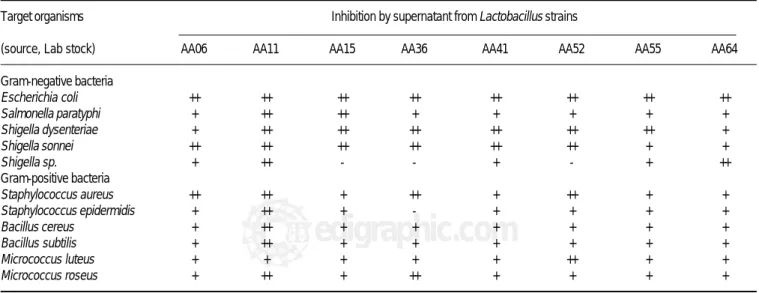
Table 1. Inhibition of different target organisms by culture supernatant fluids of Lactobacillus acidophilus strains according to agar well diffusion assay.
Target organisms Inhibition by supernatant from Lactobacillus strains
(source, Lab stock) AA06 AA11 AA15 AA36 AA41 AA52 AA55 AA64
Gram-negative bacteria
Escherichia coli ++ ++ ++ ++ ++ ++ ++ ++
Salmonella paratyphi + ++ ++ + + + + +
Shigella dysenteriae + ++ ++ ++ ++ ++ ++ +
Shigella sonnei ++ ++ ++ ++ ++ ++ + +
Shigella sp. + ++ - - + - + ++
Gram-positive bacteria
Staphylococcus aureus ++ ++ + ++ + ++ + +
Staphylococcus epidermidis + ++ + - + + + +
Bacillus cereus + ++ + + + + + +
Bacillus subtilis + ++ + + + + + +
Micrococcus luteus + + + + + ++ + +
Micrococcus roseus + ++ + ++ + + + +
edigraphic.com
strain (Table 1) was distributed on LA plates. Fifty µl of
pretreated supernatant fluids of the Lactobacillus
acido-philus strains were put in each 5 mm wells formed in LA
plates. The plates were left at 4 oC for 2 hours for
superna-tant diffusion and then incubated aerobically at 37 oC
overnight. Finally, the diameter of the inhibition zone was determined. Antimicrobial activities were assayed in du-plicate.
Mode of action
To investigate whether the antimicrobial compound acts as a bactericidal or bacteriolytic peptide, the 20% (v/
v) of the concentrated L. acidophilus AA11 supernatant
were added to a mid-log phase of E. coli growing in LB at
37 oC. At appropriate intervals during incubation, samples
were taken and the optical densities at 600 nm and the number of cfu/ml on LA were determined.
Heat and proteases sensitivity
Heat stability was determined by holding the L.
acido-philus AA11 supernatant at 37 oC, 60 oC, 100 oC for 30
min and 120 oC for 15 min, and assayed for the residual
activity using well diffusion assay. Sensitivity to
pro-teolytic enzymes was achieved by treatment the L.
acido-philus AA11 supernatant with 0.5 mg/ml of lysozyme,
cat-alase, papain, trypsin and pepsin and incubated at 37 oC
for 2 hrs. The enzymes were deactivated at 70 oC for 20
min. The remaining antimicrobial activity was assayed
Stability of crude acidocin AA11 during storage
The supernatant fluids were stored at different
tempera-tures, 37 oC, 4 oC and -20 oC. At different time intervals
samples were assayed for the antimicrobial activity of aci-docin AA11 using well diffusion assay.
Acidocin AA11 production
To study the production of acidocin AA11 vs time
dur-ing growth, Lactobacillus acidophilus AA11 was grown
under anaerobic conditions (BBL Gas-pak system) in MRS
broth at 37 oC. At interval times, optical densities were
measured at 600 nm and cell-free supernatant fluids were
prepared to test inhibitory activity against E. coli.
Extraction of acidocin AA11 with organic solvents
Supernatant fluids were mixed thoroughly with differ-ent organic solvdiffer-ents such as n-butanol, n-hexane, i-amyla-lcohol, chloroform and di-ethyl ether by ratio 1:1. The
mixtures were centrifuged at 2,555 X g for 10 min to achieve phase separation. The organic phase and the aque-ous phase were collected. The solvent removed from the organic phase by evaporation at 45ºC. The residue from the organic phase was resuspended in an amount of saline (0.85 % NaCl) equal to the starting volume of the original
supernatant fluid.41
Isolation of plasmid DNA
Plasmid DNA was isolated from Lactobacillus
acido-philus AA11 using the method described by Sambrook et
al.36 of alkaline lysis with 10 mg/ml lysozyme. 1%
agar-ose gel electrophoresis was used to detect the presence of plasmids.
SDS-PAGE analysis
The supernatant fluids were precipitated with 40 % am-monium sulphate and subjected to SDS-PAGE (12%)
ac-cording to the method of Laemmli.26 The gel was stained
with Coomassie blue (Sigma) after electrophoresis at 30 mA for 45 min. The protein markers and their molecular weights were Dalton Marker Vll-LTM standard mixtures 14,000-66,000 (Sigma) which include BSA (66 kDa), Ovalbmin (45 kDa), Glyceraldehyde-3-phosphate dehy-drogenase (36 kDa), Carbonic anhydrase (29 kDa), Trypsi-nogen PMSF treated (24 kDa), Trypsin inhibitor (20.1
kDa) and α-Lactalbumin (14.2 kDa).
RESULTS AND DISCUSSION
Inhibitory spectra
Sixty eight Strains of Lactobacillus acidophilus were
isolated from Egyptian home-made cheese. Extracts from these strains were examined for inhibition of the indicator strains listed in Table 1. A total of eight strains (AA06, AA11, AA36, AA41, AA52, AA55, AA64) displayed a wide range effect of antimicrobial activity toward Gram-positive and Gram-negative bacteria. Gram-Gram-positive
food-borne pathogens such as Staphylococcus epidermidis,
Sta-phylococcus aureus, Bacillus subtilis and Bacillus cereus
were strongly inhibited by the antimicrobial agent AA11. Interestingly, the inhibitory compound AA11 strongly in-hibited several gram-negative bacteria including
food-borne pathogens such as Salmonella paratyphi, Shigella
sonnei, Shigella dysenteriae, Escherichia coli and
Shigel-la sp. Because of the interesting inhibition spectrum of
AA11 it was studied in more details. Various bacteriocins
produced by Lactobacillus acidophilus strains have been
aci-edigraphic.com
dophilucin A,42 acidocin 8912,20,40 acidocin B41 and
aci-docin D20079.12 However, a broad spectrum inhibition of
acidocin AA11 against foodborne and intestinal patho-gens has not been reported for of any these bacteriocins, and their inhibitory effect appears to be limited to some (often closely related) lactic acid bacteria.
Characteristics of acidocin AA11
As shown in Table 2, the antagonism produced by
Lac-tobacillus acidophilus AA11 was resistant to lysozyme and catalase but was completely absent after treatment with pepsin, trypsin or papain. Acidocin AA11 is moder-ately heat-stable, all antimicrobial activity was retained
after incubation at 100 oC for 30 min while heat
steriliza-tion by autoclaving (121 oC for 15 min) led to a loss of
ac-tivity. The temperature stability of acidocin AA11 differs from that of the above mentioned bacteriocins,
acidophi-lucin A and acidocin B (80 oC for 20 min)41 are less
heat-stable, whereas lactacins B (121 0C for 3 min)2 and F (121
oC for 15 min) are more heat-stable.30 The antimicrobial
compound of Lactobacillus acidophilus AA11 could be
stored at 4 oC or – 20 oC for at least 100 days without loss
of its activity (Fig. 1). However, storage at 37 oC resulted
in a loss of activity possibly attributed to the action of proteolytic enzymes which might be present in the super-natant fluids. The antimicrobial agent was produced con-tinuously during growth phase as demonstrated in Fig. 2. However, the level of inhibition reached a maximum at the beginning of mid-log phase and remained constant at sta-tionary phase. These results showed that the agent AA11 is
Table 2. Effect of different heat and enzymatic treatments on the activity
of crude Acidocin AA11. E. coli was used as an indicator strain in well dif-fusion assay.
Treatments Diameter (mm) of Inhibition zone
Temperature (for 30 min)
Control (4 oC) 15
37 oC 15
60 oC 15
100 oC 15
120 oC (autoclaving for 15 min) 9 Enzymes
Control (without treatment) 15
Lysozyme 15
Catalase 15
Pepsin -*
Trypsin
-Papain
-* No inhibition zone, diameter of well is 5 mm.
Figure 1. Effect of time and temperature on acidocin AA11 during stor-age. Cell-free supernatant fluid was stored at -20 oC ( ), 4 oC ( ) or 37 oC ( ). The inhibitory activity was determined by well diffusion assay
us-ing E. coli as indicator strain.
heat-stable and strongly sensitive toward proteolytic en-zymes. On the basis of the above mentioned results, the
antimicrobial agent produced by Lactobacillus
acidophi-lus AA11 was classified as a bacteriocin which was
desig-nated acidocin AA11.
Bactericidal action of acidocin AA11
To test for a bactericidal or bacteriolytic mode of
ac-tion, the effect of acidocin AA11 on the lysis of
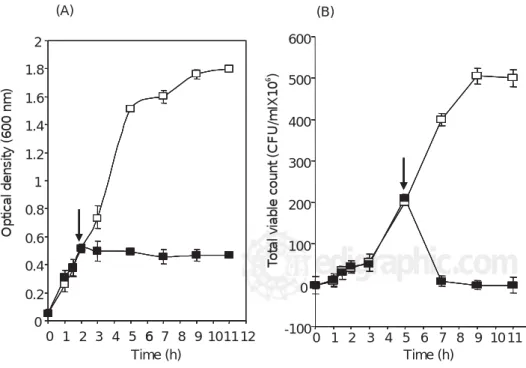
Escheri-chia coli was investigated. The lysis of E. coli was moni-tored in the presence of the acidocin AA11. As presented
in Fig. 3, Exposure of E. coli to acidocin AA11 resulted in
a decrease in the number of viable cells, the viability was reduced at ~ 21-fold during 2 hours. However, the optical density remained constant, indicating that lysis did not occur. Clearly, the antimicrobial compound exhibited a bactericidal effect on the target strain. A similar result
ob-tained by ten Brink et al.41 with acidocin B. The general
edigraphic.com
bacteriocins of lactic acid bacteria is disruption of the electrochemical gradients across the plasma membrane by
pore formation.24
Extraction of acidocin AA11 with butanol
Organic solvents were investigated for the extraction of
acidocin AA11 from culture supernatant fluids of
Lacto-bacillus acidophilus AA11 (Table 3). Extraction with sol-vents such as i-Amylalcohol and di-ethyl ether did not show the complete removal of acidocin AA11 from the aqueous phase. Hexane did not result in any removal of the agent from the aqueous phase. However the best ex-traction was achieved with butanol and chloroform. Ex-traction with butanol demonstrated that acidocin AA11 was removed completely from the aqueous phase and could be recovered from the organic phase. This result suggests that at least part of acidocin AA11 has a hydro-phobic character and shares this property with other
bacte-riocins.24,41
Chromosomally genes encoded acidocin AA11
To determine whether plasmid or chromosomal genes are responsible for the production of acidocin AA11,
sam-ples of Lactobacillus acidophilus AA11 grown
anaerobi-cally in MRS broth at 37 oC were withdrawn during
loga-rithm phase for plasmid isolation and analysis. 1% agarsoe gel electrophoresis of plasmid preparations indicated that
no plasmids were detected in Lactobacillus acidophilus
Figure 2. Bacteriocin production and growth of Lactobacillus acidophilus
AA11. Production of bacteriocin ( ) is detected by well diffusion assay in the presence of E. coli as an indicator strain grown in LA aerobically at 37
oC. The growth of Lactobacillusacidophilus AA11 ( ) was grown
anaero-bically in MRS medium at 37 oC. Time (h) 0
2 4 6 8 10 12 14 16 18
0 5 10 15 20 25 30 35 40
0 0.2 0.4 0.6 0.8 1 1.2 1.4 1.6 1.8 2
Time (h) 0
2 4 6 8 10 12 14 16 18
0 5 10 15 20 25 30 35 40
0 0.2 0.4 0.6 0.8 1 1.2 1.4 1.6 1.8 2
Inhibition z
one (mm)
Optical density (600 nm)
Figure 3. Effect of Lactobacillus acido-philus AA11 bacteriocin on the growth of
E. coli in LB at 37°C. The arrows indi-cate where the bacteriocin was added. Optical density at 600 nm (A) and viabili-ty (B) of E. coli culture were determined in the presence ( ) and the absence ( ) of AA11 supernatant fluid.
0 0.2 0.4 0.6 0.8 1 1.2 1.4 1.6 1.8 2
0 1 2 3 4 5 6 7 8 9 1011 12
Time (h) Time (h)
6 -1000 1 2 3 4 5 6 7 8 9 10 11 12
0 100 200 300 400 500 600
(A) (B)
T
otal viab
le count (CFU/mIX10 )
6
edigraphic.com
:rop odarobale FDP
VC ed AS, cidemihparG
arap
acidémoiB arutaretiL :cihpargideM
sustraídode-m.e.d.i.g.r.a.p.h.i.c sustraídode-m.e.d.i.g.r.a.p.h.i.c
cihpargidem ed odabor
AA11 suggesting that the genes responsible for acdiocin AA11 production are located on the chromosome. As shown in Fig. 4 that two major protein bands of apparent molecular sizes of ~36 kDa and ~29 kDa were distin-guished in all samples. However, the intensity of these
bands increased at mid-log and late-log confirming the previous result that the maximum level of the bacteriocin production was occurred during mid-log phase. Similar re-sults were reported for two-peptide bacteriocins such as
lactacin F and lactococcin G.11,43 In conclusion, acidocin
AA11 meets many of the requirements proposed by Piard
and Desmazeaud33 for an ideal antimicrobial compound.
In addition to its inhibition spectrum, technological prop-erties (heat and storage stability) provide the bacteriocin an application potential as a biopreservative.
REFERENCES
1. Aymerich, M.T., Garriga, M., Monfort, J.M., Nes, I., Hugas, M., 2000. Bacteriocin-producing Lactobacilli in Spanish-style fermented sausages: characterization of bacteriocins. Food Mi-crobiol. 17:33-45.
2. Barefoot, S. F. and Klaenhammer, T. R. 1983. Detection and activity of lactacin B, a bacteriocin produced by Lactobacillus acidophilus. Appl. Environ. Microbiol. 45:1808-1815. 3. Barefoot, S.F. and Klaenhammer, T. R. 1984. Purification and
characterization of the Lactobacillus acidophilus bacteriocins, lac-tacin B. Antimicrobial Agents and Chemotherapy 26:328-334. 4. Bergey’s Manual of Systematic Bacteriology, 1984. N. Krieg
(Ed), vol. 1, 2, Baltimore: Williams and Wilkins.
5. Bourlioux, P. 1997. What is currently known about the molecu-lar mechanisms of colonization resistance? Anaerobe 3:179-184. 6. Chen, H. and Hoover, D.G., 2003. Bacteriocins and their food ap-plications. Comprehensive Rev. Food Sci. Food Safety 2:82-100. 7. Cuozzo, S. A., Sesma, F., Palacios, J. M., Holgado, A. P. D., &
Raya, R. R. 2000. Identification and nucleotide sequence of genes involved in the synthesis of lactocin 705, a two-peptide bacteriocin from Lactobacillus casei CRL 705. FEMS Microbi-ol. Lett. 185:157-161.
8. De Klerk, H. C., and Coetzee, J. N. 1961. Antibiosis among lactobacilli. Nature 192:340-341.
9. De Klerk, H. C., and Smit, J. A. 1967. Properties of a Lactoba-cillus fermenti bacteriocin. J. Gen. Microbiol. 48:309-316. 10. De Man, J. C., Rogosa, M. E. and Sharpe, M. E. 1960. A medium
for the cultivation of Lactobacilli. J. Appl. Bacteriol. 23:130-135. 11. De Vuyst, L. and Vandamme, E. J. 1994. Bacteriocins of Lac-tic Acid Bacteria: Microbiology, GeneLac-tics and Applications, Blackie Academic and Professional, London.
12. Deraz, S. F., Karlsson, E. N., Hedstrom, M., Andersson, M. M. and Mattiasson, B. 2005. Purification and characterization of acidocin D20079, a bacteriocin produced by Lactobacillus ac-idophilus DSM 20079. J. Biotech. 117:343-354.
13. Fleming, H. P., Etchells, J. L. and Costilow, R. L. 1975. Micro-bial inhibition by an isolate of Pediococcus from cucumber brines. Appl. Microbiol. 30:1040-1042.
14. Fooks, L. J. and Gibson, G. R. 2002. In vitro investigations of the effect of probiotics and prebiotics on selected human intes-tinal pathogens. FEMS Microbiol. Ecol. 39:67-75.
15. Gilliland, S. E., and Speck, M. L. 1977. Use of the Minitek sys-tem for characterizing lactobacilli. Appl. Environ. Microbiol. 6:1289-1292.
16. Hamdan, I. Y, and Mikolajcik, E. M. 1974. Acidolin: an antibi-otic produced by Lactobacillus acidophilus. J. Antibiot. (To-kyo). 27:631-636.
17. Hosono, A., Yastuki, K. and Tokita, F. 1977. Isolation and characterization of an inhibitory substance against Escherichia
Table 3. Extraction of acidocin AA11 from culture supernatant fluid of
Lactobacillus acidophilus AA11 with different organic solvents. E. coli was used as an indicator strain in well diffusion assay.
Diameter (mm) of inhibition zone present in solvents
Solvents Organic phase Aqueous phase
None 15
n-Butanol 15 7
n-Hexane _ 9
i-Amylalcohol 12 10
Chloroform 13 8
Di-ethyl ether 9 _*
* No inhibition zone, diameter of well is 5 mm.
Figure 4. 12 % SDS-PAGE analysis of ammonium sulphate precipitated acidocin AA11 extracted from Lactobacillus acidophilus AA11 growing anaerobically in MRS at 37oC during growth curve. Lanes 1, 2, 3 and 4
edigraphic.com
coli produced by Lactobacillus acidophilus. Milchwissenschaft 32:727-730.
18. Hurst, A. 1973. Microbial antagonism in foods. Can. Inst. Food Sci. Technol. J. 6:80-90.
19. Jack, R.W., Tagg, J. R. and Ray, B. 1995. Bacteriocins of Gram-positive bacteria. Microbiol. Rev. 59:171–200.
20. Kanatania, K., Tahara, T., Yoshida, K., Miura, H., Sakamoto, M. and Oshimura, M. 1992. Plasmid-associated bacteriocin production by and immunity of Lactobacillus acidophilus TK8912. Biosci. Biotech. Biochem. 56:648-651.
21. Kawai, Y., Saitoh, B., Takahashi, O., Kitazawa, H., Saito, T., Nakajima, H. and Itoh, T. 2000. Primary amino acid and DNA sequences ofgassericin T, a lactacin F-family bacteriocin pro-duced by Lactobacillus gasseri SBT2055. Biosci. Biotech. Bio-chem. 64:2201-2208.
22. Kitazawa, H., Ino, T., Kawai, Y., Itoh, T., Saito, T., 2002. A novel immunostimulating aspect of Lactobacillus gasseri: in-duction of ‘Gasserokine’ as chemoattractants for macrophages. Int. J. Food Microbiol. 77:29-38.
23. Klaenhammer, T. R. 1982. Microbiological considerations in selection and preparation of Lactobacillus strains for uses as di-etary adjuncts. J. Dairy Sci. 65:1339-1349.
24. Klaenhammer, T. R. 1993. Genetics of bacteriocins produced by lactic acid bacteria. FEMS Microbiol. Rev. 12:39-86. 25. Klaenhammer, T. R., and Kullen, M. J. 1999. Selection and
de-sign of probiotics. International J. Food Microbiol. 50:45-57. 26. Laemmli, U.K. 1970. Cleavage of structural proteins during
the assembly of the head of bacteriophage T4. Nature (Lon-don) 227:680-685.
27. Metchnikoof, E. 1908. The prolongation of life. G.P. Putnam’s Sons, New York.
28. Morin, A., Saheb, S. A., Bisaillon, J. G., Beaudet, R. and Sylvestre, M. 1980. Effect of culture medium composition on inhibition of growth of Neisseria gonorrhoeae by lactobacilli. Curr. Microbiol. 4:283-286.
29. Muriana, P. M. and Kleanhammer, T. R. 1987. Conjugal trans-fer of plasmid encoded determinants for bacteriocin production and immunity in Lactobacillus acidophilus 88. Appl. Environ. Microbiol. 53:553-560.
30. Muriana, P. M. and Kleanhammer, T. R. 1991. Purification and partial characterization of lactacin F, a bacteriocin produced by Lactobacillus acidophilus 11088. Appl. Environ. Microbiol. 57:114-121.
31. Naidu, A. S., Bidlack, W. R., Clemens, R. A. 1999. Probiotic spectra of lactic acid bacteria (LAB). Crit. Rev. Food Sci. Nu-trition 38:13-126.
32. Ouwehand, A. C., Kirjavainen, P. V., Shortt, C., and Salminen, S. 1999. Probiotics: mechanisms and established effects. Int. Dairy J. 9:43-52.
33. Piard, J.C. and Desmazeaud, M. 1992. Inhibiting factors pro-duced by lactic acid bacteria. Part 2. Bacteriocins and other an-tibacterial substances. Lait 72:113-142.
34. Reid, G., Howard, J., and Gan, B. S. 2001. Can bacterial inter-ference prevent infection? Trends in Microbiol. 9:424-428.
35. Salminen, S., Isolauri, E., and Salminen, E. 1996. Clinical uses of probiotics for stabilizing the gut mucosal barrier: successful strains and future challenges. Antonie Van Leeuwenhoek Int. J. G. Mol. Microbiol. 70:347-358.
36. Sambrook, J., Fritsch, E. F. and Maniatis, T. 2001. Molecular cloning: a laboratory manual, 3rd ed. Cold Spring Harbor
Lab-oratory Press, Cold Spring Harbor, NY.
37. Shahani, K. M., and Ayebo, A. D. 1980. Role of dietary lacto-bacilli in gastrointestinal microecology. Am. J. Clin. Nutr.
33:2448-2457.
38. Tag, J.R. and McGiven, A.R. 1971. Assay system for bacterio-cin. Appl. Microbiol. 21:943.
39. Tagg, J.R., Dajani, A.S., and Wannamaker, L.W. 1976. Bacteri-ocins of gram-positive bacteria. Bacteriol. Rev. 40:722-756. 40. Tahar, T., Kanatania, K., Yoshida, K., Miura, H. Sakamoto, M.
and Oshimura, M. 1992. Purification and some properties of ac-idocin 8912, a novel bacteriocin produced by Lactobacillus aci-dophilus TK8912. Biosci. Biotech. Biochem. 56:1212-1215. 41. ten Brink, B., Minekus, M, van der Vossen, J.M.B.M., Leer, R. J.
and Huis in’t Veld, J. H. J. 1994. Antimicrobial activity of lacto-bacilli: preliminary characterization and optimization of produc-tion of acidocin B, a novel bacteriocin produced by Lactobacil-lus acidophiLactobacil-lus M46. J. Appli. Bacteriol. 77:140-148.
42. Toba, T., Yoshioka, E. and Itoh, T. 1991. Acidophilucin A, a new heat-labile bacteriocin produced by Lactobacillus acido-philus LAPT 1060. Lett. in Appli Microbiol. 12:106-108. 43. Todorov, S. D. and Dicks, L. M. T. 2005. Effect of Growth
Medium on Bacteriocin Production by Lactobacillus plan-tarum ST194BZ, a Strain Isolated from Boza. Food Technol. Biotechnol. 43:165-173.
44. Tramer, J. 1966. Inhibitory effect of Lactobacillus acidophi-lus. Nature. 211:204-205.
45. Upreti, G. C, and Hinsdill, R. D. 1973. Isolation and Character-ization of a bacteriocin from a Homofermentative Lactobacil-lus. Antimicrob Agents Chemother. 4:487-494.
46. Upreti, G. C. and Hinsdill, R. D. 1975. Production and Mode of Action of Lactocin 27: Bacteriocin from a Homofermentative Lactobacillus. Antimicrob Agents Chemother. 7:139-145. 47. Vincent, J. G., Veomett, R. C., and Riley, R. F. 1959.
Antibac-terial activity associated with Lactobacillus acidophilus. J. Bac-teriol. 78:477-484.
48. Zamfir, M., Callewaert, R., Cornea, P. C., Savu, L., Vatafu, I., and De Vuyst, L. 1999. Purification and characterization of a bacteriocin produced by Lactobacillus acidophilus IBB 801. J. Appl. Microbiol. 87:923-931.
Correspondence to:
Aly E. Abo-Amer