UNIVERSIDAD DE VALLADOLID
ESCUELA DE INGENIERIAS INDUSTRIALES
Máster en Ingeniería Industrial
Applications of blockchain in procurement
Autor:
Martínez Martínez, Cristina
Francisco Javier Rey Martínez
Technische Universität Dresden
TFM REALIZADO EN PROGRAMA DE INTERCAMBIO
TÍTULO: Applications of blockchain in procurement ALUMNO: Cristina Martínez Martínez
FECHA: 22/08/2019
Resumen
Actualmente, la adquisición en la cadena de suministro presenta algunas ineficiencias relacionadas con la seguridad en las transacciones, tediosos intercambios de información, duplicación de actividades, demoras en los pagos y falta de conocimiento sobre la procedencia real y las condiciones de los productos. Tecnologías potenciales, como blockchain, aumentan la transparencia a través de un libro mayor distribuido que garantiza a través del consenso entre nodos, la transparencia de las nuevas transacciones introducidas en la red. Esta tesis muestra los resultados de implementar blockchain en las siguientes aplicaciones para adquisiciones: trazabilidad de materias primas, contratos inteligentes, unión con tecnología IoT, pagos y financiación de proveedores, y redes que facilitan la relación con los proveedores. Si la implementación se ejecuta correctamente, involucrando a todos los actores y midiendo el desempeño, es posible reducir costos, fraude y mejorar la imagen de la empresa. Sin embargo, también existen barreras como la complejidad.
Palabras clave
Abstract
The current procurement in the supply chain process presents some inefficiencies related to security in transactions, tedious exchanges of information, duplication of activities in verification, delays in payments and lack of knowledge about the real provenance and conditions of the products. Potential technologies, such as blockchain, increase transparency through a distributed ledger that ensures through consensus between nodes, the transparency of the new transactions introduced in the network. This thesis shows the results of applying blockchain in procurement in the fields of: traceability of raw materials, smart contracts, its union with IoT technology, payments and supplier financing, and networks that facilitate and track the relationship with suppliers. If the implementation is properly executed, involving every actor and measuring the performance, from a pilot project to a project that completes the entire process, it is possible to reduce costs, fraud, and improve the image of the company. However, there are also some barriers such as complexity.
Keywords
Applications of Blockchain in
Procurement
Free scientific work for obtaining the degree
Master of Industrial Engineering
Exchange student from the University of Valladolid (Spain)
Submitted to the: Technische Universität Dresden
Faculty of Business and Economics
Chair of Business Administration, esp. Logistics
Prof. Dr. Rainer Lasch
Name:
Cristina Martínez Martínez
Matriculation number:
4833376
i
Abstract
The current procurement in the supply chain process presents some inefficiencies related to security in transactions, tedious exchanges of information, duplication of activities in
verification, delays in payments and lack of knowledge about the real provenance and
conditions of the products, that do not add any value to the business chain. Potential
technologies, such as blockchain, increase transparency through a distributed ledger
that, either private, public or consortium, ensures through consensus between nodes, the
transparency of the new transactions introduced in the network. This thesis shows the
results of applying blockchain in procurement in the fields of: traceability of raw
materials, immutable smart contracts with automatic verifications through its union with
IoT technology, payments and supplier financing, and networks that facilitate and track
the relationship with suppliers. If the implementation is properly executed, involving
every actor and measuring the performance, from a pilot project to a project that
completes the entire process, it is possible to reduce costs, fraud or other risks, and improve the image of the company. However, there are also some barriers such as
complexity that become to achieve implementation in all companies into a challenge.
Keywords
Blockchain, Procurement, Smart contracts, Traceability, Supply Chain Management,
Table of Contents
Abstract ... i
Keywords ... i
List of Figures ...v
List of Abbreviations ... vi
Chapter 1. Introduction ... vii
1.1 Background and State of the Art ... vii
1.2 Motivation ... ix
1.3 Objectives and research questions ... ix
1.4 Research design ... ix
1.5 Outline ...x
Chapter 2. Foundations ...11
2.1 Procurement as a part of the SCM ...11
2.1.1. Supply Chain Management and Logistics ...11
2.1.1.1. Definitions of Supply Chain Management ...12
2.1.1.2 The Evolution of the Supply Chain Management ...13
2.1.1.3 The Importance of the SCM ...14
2.1.1.4 Functions for SCM ...15
2.1.2 Procurement ...15
2.1.2.1 Definition ...15
2.1.2.2 Importance ...16
2.1.2.3 Steps ...16
2.1.2.4 Problematic associated ...18
2.1.2.6 E-procurement and Procurement 4.0 ...18
2.2 Blockchain ...20
2.2.1 Definition and properties ...20
2.2.2 Cryptography in Blockchain ...21
2.2.3 Architecture of the blockchain ...23
2.2.5 Types of Blockchain ...27
2.2.6 Platforms ...28
2.2.7 Challenges of Blockchain ...28
2.2.8 Fields of Blockchain application ...29
Chapter 3. Applications of blockchain in procurement ...31
3.1.Blockchain in Procurement ...31
3.1.1. Traceability ...31
3.1.2. Smart Contracts ...35
3.1.3. Combination with Internet of Things ...37
3.1.4. Auditing and Governance ...38
3.1.5. Supplier Relationship Management ...39
3.1.6. Finance Service ...40
3.2.How to implement blockchain in procurement ...43
3.3.Metrics, advantages and disadvantages ...44
3.3.1. Key Performance Indicators: KPIs ...45
3.3.2. Advantages ...45
3.3.3. Disadvantages ...48
Chapter 4. Conclusions and future research ...50
4.1 Conclusions ...50
4.2 Future research ...51
References... vii
List of Figures
Figure 1.1. The four stages of the Industry ... vii
Figure 1.2. Chain of transactions ... viii
Figure 1.3. Graphic chart of the research design ... x
Figure 2.1. The scope of logistics ... 11
Figure 2.2. The scope of Supply Chain ... 11
Figure 2.3. Porter’s Value Chain ... 16
Figure 2.4. Types of networks ... 20
Figure 2.5. Key pair generation ... 22
Figure 2.6. Digital signature ... 22
Figure 2.7. Hashing ... 23
Figure 2.8. Blockchain architecture ... 24
Figure 2.9. Merkle Tree ... 25
Figure 3.1. Blockchain traceability system for Walmart ... 33
Figure 3.2. (a) Blockchain architecture Vs (b) Smart Contracts architecture ... 36
Figure 3.3. IoT Oracles for Smart Contracts ... 36
List of Abbreviations
CPS: Cyber Physical Systems viiEDI: Electronic Data Interchange 13, 14, 19, 31
ERP: Enterprise Resource Planning 13, 31, 40
JIT: Just in Time 13
KPI: Key Performance Indicator 14, 45
P2P: Peer-to-peer 20
POC: Proof of Concept 33
PoS: Proof of Stake 25, 26, 27, 28
PoW: Proof of Work 25, 26, 28
Chapter 1
.
Introduction
This chapter includes firstly an explanation of the background and the state of the art of the topic, secondly the motivation, thirdly the objectives pursued, subsequently the methodology followed to achieve those objectives and finally an overview about the structure of the rest parts of the thesis.
1.1 Background and State of the Art
Currently we are living the fourth industrial revolution so-called Industry 4.0 that is slowly becoming visible in companies around the world. [1]
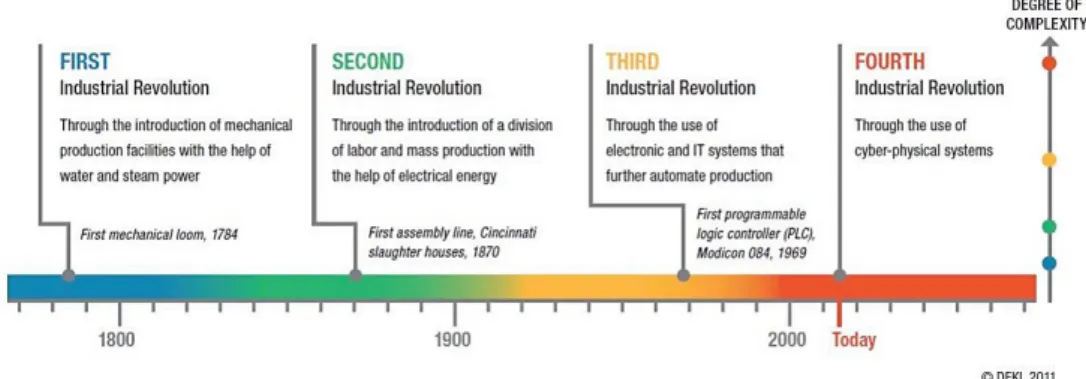
As it is shown in the Figure 1.1, the different revolutions in the industry started at the end of the 18th century with the first industrial revolution, when the work became mechanic with the development of steam engines. One century after, a new power, the electricity, changed the factories creating the mass production during the second industrial revolution. The third industrial revolution appeared in the 20th century with the arrival of the digital transformation and the automated production. However, the industry has continued changing and now, in the 21th century we are in a new industry age, the fourth revolution of industry. [2]
Figure 0.1. The four stages of the Industry
The concept of “Industrie 4.0” appeared for the first time in the strategies of the German government in 2011, but it was not until April 2013 at the industrial fair in Hannover that the word became popular. The aim of the Industry 4.0 is to archive to create a smart factory with smart and product and using smart services, a decentralized production where everything is connected with CPS (Cyber Physical Systems) technology and where users increase their participation in the process. [1]
Big Data and Advanced Analysis Techniques, Cloud Computing, Autonomous Robots, Simulation, Additive Manufacturing and Augmented Reality. [3]
There are four principles in which Industry 4.0 technologies are based: Interconnection, Information Transparency, Decentralized Decisions and Technical Assistance. [4]
Despite the nine typical technologies, it is possible to find new technologies that can contribute to the Industry 4.0 and satisfies the four principles of this revolutionary industry, for example blockchain, that can provide a connection between the actors of the transactions increasing the security with a decentralized system. Blockchain can be used in every part of the manufacturing process, but this thesis focuses on the supply chain, concretely in the procurement.
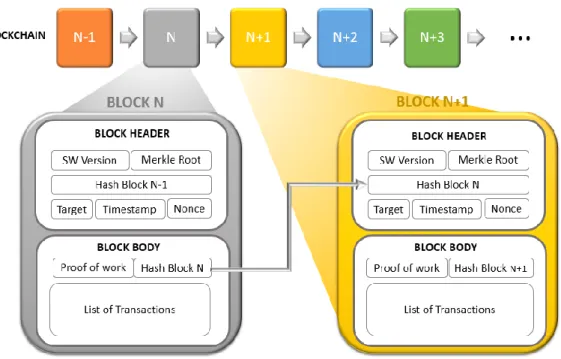
The blockchain technology seems to emerge in 2008 when an individual or a group under the name of “Satoshi Nakamoto” published how to create blocks of data and linked them into a chain in the paper “Bitcoin: A peer-to-peer electronic cash system.” It was only a way to describe decentralised transactions, but using an electronic cash based on cryptographic that eliminate the need of a financial third party. In the Figure 1.2 can be seen a chain of transactions where each block is verified by the previous block [5]
Figure 0.2. Chain of transactions
Nakamoto use Bitcoin as the first virtual currency that uses Blockchain, but the idea was to extend the concept to every transaction that can eliminate third parties. Here is where this thesis tries to find an application to Blockchain in Procurement.
1.2 Motivation
The motivation to work on this topic is to give an idea about how Blockchain can create a competitive advantage to the industrial companies that are looking for including Industry 4.0 in their factories.
Procurement is the first step of the chain production system and is the first bottleneck to overcome. In addition, procurement needs transparency, confidence from each party involved and a process as simplified as possible to reduce times that do not add value. Therefore, blockchain support procurement with a simplifies process in which the risk to manipulate transactions is decreased and in which all the management systems and be integrated improving the interconnection of each cyber-physical party.
For this reason, it has looked for the appropriate way and fields to use the available blockchain technology in the process of procurement to secure a competitive advantage.
1.3 Objectives and research questions
Based on the motivation found, there is one main objective in this thesis: to collect information about the characteristics of blockchain applied in a specific part of the supply chain process, the procurement, and to evaluate the advantages and disadvantages after implementing blockchain in this part of the process. Hence, it has been explored the following Research Questions (RQs):
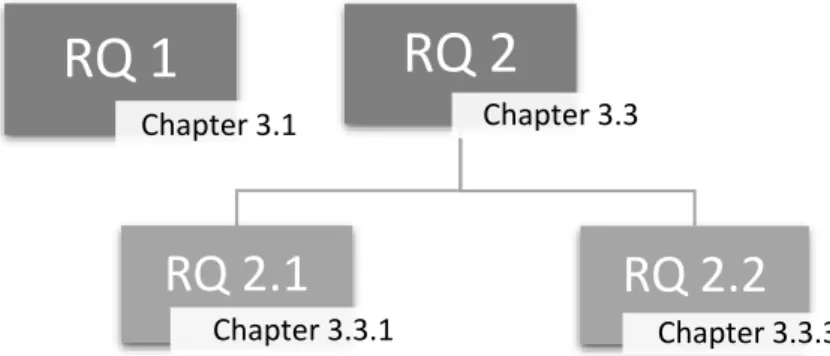
• RQ1: Which are the fields of application of the blockchain technology in procurement? • RQ2: Which are the most significant effects expected in procurement when a blockchain technology is implemented in a company?
- Which are relevant KIPs (Key Performance Indicators) measures? (RQ2.1) and which are the challenges (RQ2.2)?
1.4 Research design
blockchain platform providers and different success case studies have been studied to obtain information about strengths and weaknesses.
Figure 0.3. Graphic chart of the research design
1.5 Outline
The rest of this thesis is structured as follows:
Chapter 2 - Foundations: This chapter gives an overview on Procurement with the currently problems that can be found with the actual technology and an overview on Blockchain, this comprises a definition, a description of their characteristics, their usage and the way to combine the technology in the field of Procurement.
Chapter 3 – Applications of blockchain in procurement: This chapter includesa study of the different fields, within the acquisition process, in which blockchain can be applied. Through examples of case studies found, a vision is given of how companies have been implementing it in their process and the results they have obtained. After that, it is explained the methodology to create an implementation in a company. To conclude with a subsection where the strategy is analysed in order to find the advantages and disadvantages. In addition, recommendations, points of improvement and indicators to measure the performance are shown.
Ultimately, in the Chapter 4 – Conclusions and future research: The conclusions and a guide of the future lines of study obtained are summarized to answer the research questions.
RQ 1
Chapter 3.1
RQ 2
Chapter 3.3
RQ 2.1
Chapter 3.3.1
RQ 2.2
Chapter 2. Foundations
In this chapter, there is a review about the procurement and blockchain considering how they have evolved over time to be able to focus on how they are understood at the present time and what needs and advantages they present in the companies. After this, a first approach is made to solve how they can fit both, in which steps of the procurement process can be applied and describing some examples where they have already worked with this technological strategy in procurement.
2.1 Procurement as a part of the SCM
2.1.1. Supply Chain Management and Logistics
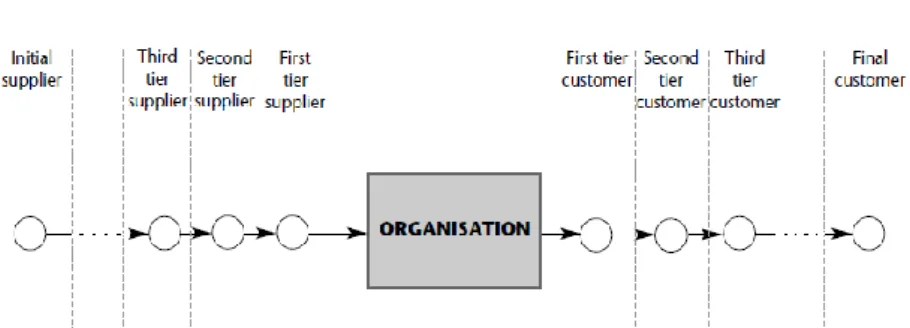
The goal of the manufacturers in the factories is to collect raw materials from suppliers and deliver finished products to customers. The use of the word “product” includes goods and services, understanding that goods have associated some services that added value, like warranties or client services. To get this goal, factories have to organize the operations of taking products from the suppliers (inputs) and converting them to deliver to the customers (outputs). [7] These operations require a movement of materials and information within the organization that is called logistics, shown in Figure 2.1. [8]
Figure 0.1. The scope of logistics
However, organizations never work isolated, they have a huge network surrounding, through upstream and downstream linkages where Supply Chain works, as is illustrated in Figure 2.2.
On one side the scope of logistics “spans the organisation, from the management of raw materials and information through to the delivery of the final product”, thus, could be said that logistics is a part of the supply chain. And on the other side, the supply chain “is the network of organisations that are involved in the different processes and activities that produce value in the form of products and services in the hands of the ultimate consumer”. [7]
2.1.1.1. Definitions of Supply Chain Management
Once the concept of Supply Chain is understood as the network of parties directly implicated in procurement, manufacture operations and distribution, then… What is supply chain management? It has been presented a bibliographic review of this concept. The term of Supply Chain Management (SCM) was firstly used by Oliver and Webber
in the newspaper Financial Times in 1982 which they defined as “The process of planning, implementing, and controlling the operations of the supply chain with the purpose to satisfy customer requirements as efficiently as possible. Supply chain management spans all movement and storage of raw materials, work-in-process inventory, and finished goods from point of origin to point of consumption”.
Since then, other authors have developed their own definitions, including more details and adapting to the new times, but most of them remain close the original definition of Oliver and Webber. [8]
In 1998 Lambert et al. redefined the SCM involving other parties like suppliers in the process “Supply Chain Management is the integration of key business processes from end-user through original suppliers that provides products, services and information that add value for customers and stakeholders”. [8]
manufacturing operations, and it drives coordination of processes and activities with and across marketing, sales, product design, finance and information technology." [9]
2.1.1.2 The Evolution of the Supply Chain Management
The Supply Chain Management (SCM) has been modernized during the ages and it can be divided into five Eras: Creation, Integration, Globalization, [10] Specialization and SCM 2.0. [11]
• Creation Era
The Era of Creation, as is described above, was in the 1980’s with the first appearance of the term SCM, however it did not begin to have relevance until the 20th century [11], when Henry Ford, director of Toyota Motor Company in the United States, began to apply it on the assembly lines of their cars.
Its main features were reengineering, large scale changes, cost reduction [10] and continuous improvement; these last two features derive their influence from what Henry Ford learned from the practices of the industrial engineer Taiichi Ohno on Toyota’s automotive assembly lines in Japan with JIT system (Just in Time).
• Integration Era
The second age stands out for the developments of EDI systems (Electronic Data Interchange) in 1960 that improve inter-Organizational integration, and the resource planning systems ERP (Enterprise Resource Planning) in the 90’s that improve intra-Organizational integration. [10] With the arrival of internet in the factories, a new development of the Era of integration has been achieved where both inter-Organizational and intra-Organizational integrations at the same time are possible.
Thanks to this Age it is achieved through integration to reduce costs and increase value added. [10]
• Globalization Era
The next was characterized by the expansion of organizations national borders, integrating global sources and global suppliers into their core business.
the globalization of supply chain management in organizations with the aim of increasing their competitive and cost reduction through global outsourcing. [10]
• Specialization Era
During the first phase of SCM specialization the vertical integration is transformed into horizontal integration, with the subcontract of specialized services and therefore, the expansion in the supplier network. Having good specialized suppliers improves the efficiency. And then, during the second phase it was created a manage of the SCM as a service, in order to monitor the performance of the suppliers. [11]
• Era of SCM X.0
The SCM X.0 Age, defined as the digital value of the chain [12], is based on the previous ages of globalization and integration [11] and is distinguished by including in addition to execution, the design of the supply chain. This design is characterized by being: rapid (incorporating for example demand sensing, automated KPI reporting, real-time planning and execution, dynamic inventory replenishment or robotic workforce), scalable (using reconfigurable supply networks, digital products or cloud-hosted tools), intelligent (tools to predict, to analyse data and cognitive computing) and connected (a platform collaborative and social). [12]
SCM X.0 manages four flows from the supplier to the end customer: materials and information (like in the traditional SCM), and two new flows the knowledge related to co-innovation, and the flow of money. [13]
2.1.1.3 The Importance of the SCM
Once you understand the evolution, you can list some of the main benefits of good supply chain management: Increases control over each block of the process and on the product or service, improves customer satisfaction by increasing the reliability offered or faster order cycles and therefore increases customer loyalty [14], improves profitability and competitiveness by reducing operating costs [14], improves relations between supply chain actors [15].
2.1.1.4 Functions for SCM
The Global Supply Chain Forum identifies eight important functions for the supply chain management: [16]
• Customer relationship management
• Customer service management
• Demand management
• Order fulfilment
• Manufacturing flow management
• Supplier relationship management (Procurement)
• Product development and commercialization
• Returns management (Returns)
This thesis focuses on one of these activities that is procurement, but it should be noted that all of them are linked and influence each other.
2.1.2 Procurement
2.1.2.1 Definition
The term procurement usually creates confusion because some authors use the term as a process of buying but using the term of Croxton (2001) procurement is more than this, is the process of managing the relationship with suppliers and organising the flow of materials. From this point of view, procurement includes three sub-processes: [6]
• Supplier management: Finding potential suppliers and selecting the bests for the organization. It is an important part to create close relationships and working together.
• Contract management: The process of negotiating good quality, services and prices of the products, ordering goods and payment processing.
2.1.2.2 Importance
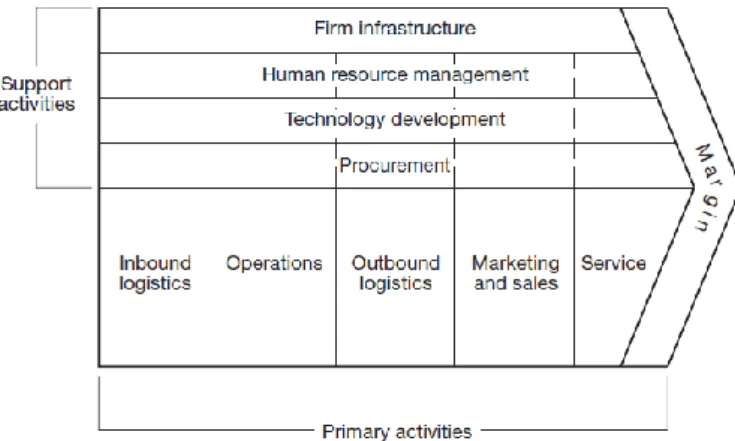
Porter, 1980, described procurement as one of the four main supporting activities in business together with firm infrastructure, human resource management and technology development, in his Value Chain Model (Figure 2.3) for a general business taking a cross-cutting role in primary activities. [6]
Figure 0.3. Porter’s Value Chain
The value chain must be linked with the value chain of its suppliers, customers and distributors to create a value network improving the exchange of information, the standardization and the control of the product cost.
2.1.2.3 Steps
After establishing the importance of having a procurement process, the next thing is to design a procurement process that help manage the procurement cycle within an organization. For that purpose, the following seven consecutive steps have to be done: [7]
Step 0: The process starts with a preliminary step: The identification of raw material or service needs. This role is taken by the user department who makes the following work:
- Recognise the need for goods - Examine the available goods
- Prepare the specifications of these goods - Check the budget of the department - Get clearance to purchase
- Prepare and send a purchase request to the procurement department
Step 1: The process continues in the procurement department, analysing the purchase request and sending a request to a list of suppliers. The tasks are:
- Confirm the decision to purchase after examining the material requested, the current stocks, the alternative products and the production options
- Make a list of a few possible suppliers
- Send a request for proposal (RFP) or a request for quotation (RFQ) to this list.
Step 2: Then, each chosen supplier on the list have to: - Examines the RFP or RFQ
- Check the status, credit, and see how best satisfy the order
- Send a quotation back to the organisation, giving details of products, prices, availability and quality.
Step 3: After the answer of the suppliers, procurement has to choose the best supplier and negotiate with him:
- Examine the quotations and do commercial evaluations - Discuss technical aspects with the user department - Check budget details and clearance to purchase
- Choose the best supplier, based on the details supplied
- Discuss, negotiate and finalise terms and conditions with the supplier
- Broadcast a contractual agreement between the organization and its supplier of the transaction with the terms and conditions attached, called purchase order (PO).
Step 4: The purchase has started, and the next step is that the chosen supplier releases the goods with the delivery order:
- Receive, acknowledge and process the purchase order - Organise all operations needed to supply the materials - Ship materials together with a shipping advice
- Send an invoice.
Step 5: Subsequently, the procurement department have to receive the invoice and manage it:
- Acknowledge receipt
- Do any necessary follow-up and expediting - Receive, inspect and accept the materials
- Notify the user department of materials received.
Step 6: In the next step, the user department have to check the goods that have been received:
- Update inventory records - Use the materials as needed.
Step 7: To conclude, procurement has to make the transaction of payment to the supplier: - Arrange payment of the supplier’s invoice.
2.1.2.4 Problematic associated
In the traditional method, with handwritten contracts, the procurement process seems complicated, because as it has been shown, involves many steps and documents, that is reflected in a significant loss of time and money. [7]
The problem can be summarized in the following weak points: - Taking a long time to go through the whole procedure
- Relying on a lot of forms and paperwork which move around different locations
- Lot of employees busy in the same process
- Intermediaries to verify the compliance of the contracts - Inevitable errors with so many documents and people involved
When the purchase is very important and expensive, the effort of negotiating with suppliers is worthwhile, but for making small purchases, the loss of time and money during the process become a problem for the company because sometimes, the process is more expensive than the value of the items purchased [7] and the time spent is longer than the time the customer is willing to take. [6]
The logistics lead time, the time spends in procurement, manufacturing and delivery, should be equal as the time the customer is willing to take.
Using a traditional, handwritten system took an average of 10,3 days for a customer to get materials delivered from a manufacturer’s stock.
For that reason, operating on the reduction of the complexity of contracts and transactions between companies is a competitive advantage.
Other problems associated with the acquisition are determined by the lack of knowledge about the provenance of the materials and the conditions during transport.
2.1.2.6 E-procurement and Procurement 4.0
paperwork with electronic works. It was created a system to automate internal and external processes related to the requirement, purchase, supply, payment and control of products using the Internet as the main means in customer-supplier communication. It allows to share information between organizations and its suppliers, and when they have a need of goods, the system can send requests. EDI (Electronic data interchange) and ERP (Enterprise Resource Planning) systems are based in e-procurement to join in a unique software the whole process of procurement. SAP, GEP, Oracle and Coupa are the most significant and known software.
2.2 Blockchain
In this chapter are presented the main principles of the blockchain technology, its architecture, its types and how does it work.
2.2.1 Definition and properties
Blockchain is a distributed ledger consisting of a chain of immutable blocks that contains a record of data transactions encrypted. [17] The ledger enables transparency in transactions over a peer-to-peer (P2P) distributed network of nodes. [18] The chain is formed adding new fixed blocks from each new transaction, creating a blockchain. Transactions are validated by cryptography and it is not needed any third party to control. [17] Each block is linked with the previous block so that every transaction executed can be traced. [18]
There are three significant properties of blockchain that should be explained:
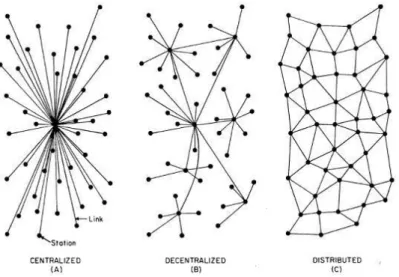
• Peer-to-Peer (P2P) ledge: A distributed ledge architecture that divided the work in peers. Each node is called “peer” and is equally privileged. The network stores and transfers data without any single central server and therefore data cannot be hack, exploit or lost. Instead of this, it is hosted by a network of distributed nodes in a manner that the data can be accessible to anyone on the blockchain network. [17]
Figure 0.4. Types of networks
• Immutable and tamper-proof: Once a block of the chain is processed, data cannot be altered. Each block has associated a hash function that is unique for this block, like the fingerprint of that block, and it is linked with the next block. Therefore, if a hacker changes one block, it will lead a change in the hash and the hacker will have to change the following hashes of the chain of blocks which is quite difficult because requires a lot of computational power to do.[17]
2.2.2 Cryptography in Blockchain
The origin of blockchain appears with Satoshi Nakamoto who defined the electronic coin, Bitcoin, as a chain of digital signatures known as “blockchain”. In short, he described that each owner of bitcoins can make transactions with any other party connected to the same network. The advantage is that transactions are verified without the need of a financial institution to check. Transactions are validated with cryptography by a network of users who donate their computer power in exchange for additional rewards. [19]
- Symmetric cryptography: During the history this method was the most used to exchange information. The main characteristic is that it exists a key that only the sender and the receiver know, but it was difficult to guarantee the security.
- Asymmetric cryptography: With the evolution of cryptography appeared this mechanism that lead the exchange of information without sharing the key previously. This method uses two different keys: a private key (can be seen as a key) and a public key (can be seen as a padlock). Public key can encrypt, and private key can decrypt. Blockchain uses the asymmetric cryptography and a mathematical algorithm (Elliptic Curve) to encrypt the transactions. The typical digital signature algorithm used in blockchains is the elliptic curve digital signature algorithm (ECDSA): [20]
The method allows to sign messages guaranteeing the identity of the sender without the need of long size keys (256 bits). Now, each node has a wallet, that can be seen as a key chain that includes a private key, a public key and a digital signature, to carry out transactions.
Figure 0.5. Key pair generation
- The digital signature consists in two integer numbers (known as r and s) generated from a hash of something to be signed, plus a private key. With the public key, a mathematical algorithm can be used on the signature to determine that it was originally produced from the hash and the private key, without knowing the private key. The digital signature is the digest (output) of having applied a hash function to the public key.
The typical digital signature is involved with two phases: signing and verification. For instance, the user1 wants to send to user2 a transaction. The first step is the signing phase, user1 encrypts the transaction using his private key and sends the encrypted result of the original transaction to user2. Them, in the verification phase, the user2 validates the transaction with the public key of the user1 to check if the data has been tampered or not. [20]
Figure 0.6. Digital signature
The method is more secure than a handwritten signature because it must have three properties: authentication (make sure the message has been created by a known sender), non-repudiation (the sender cannot deny has sending the message), and data integrity (the message has not been altered in transit).
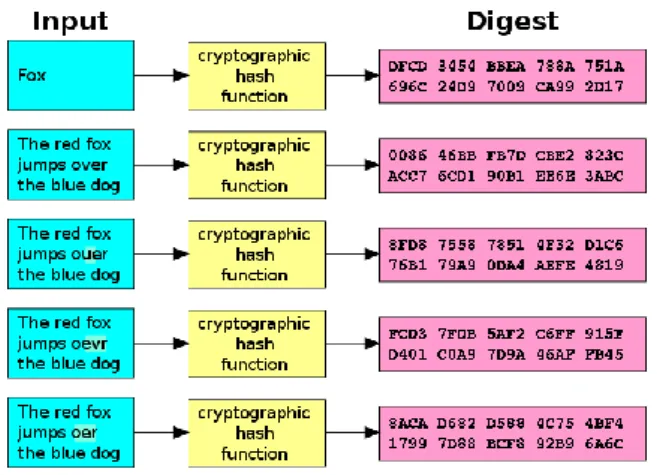
A cryptographic hash function, shown in Figure 2.7, is a mathematical equation that enables encrypt information. It must have some properties: Computationally efficient, deterministic (for any given input, a hash function must always give the same result), pre-image resistant (the output of a cryptographic hash function must not reveal any information about the input) and collision resistant (it must be extremely unlikely to find two different inputs that produce the same output). [22] Hash functions are often called one-way functions because, according to the properties listed above, they must not be reversible. If an attacker could easily reverse a hash function, it would be totally useless. Therefore, cryptography requires one-way hash functions.
Figure 0.7. Hashing
There are several different classes of hash functions and the most commonly used are: Secure Hashing Algorithm (SHA-2 and SHA-3), RACE Integrity Primitives Evaluation Message Digest (RIPEMD), Message Digest Algorithm 5 (MD5) and BLAKE2.
They differ in the way the algorithm creates a digest, or output, from a given input and the fixed length of the digest they produce. SHA-256 is the most famous because it was used in original Bitcoin protocol.
2.2.3 Architecture of the blockchain
Figure 0.8. Blockchain architecture
• Block Header: Contains metadata about that particular block such as the Version of the software, the Hash of the previous chronologically block, the Timestamp, the Merkle Root, the Target and the Nonce. [20]
1.
Software Version: The version of the software indicates the rules that the miners are following. [20]2. Previous Block Hash: The Hash is the cryptographic value of the block and it is the output of applying the hash function to the input. The first block of the chain is called Genesis which is the unique that has no previous block. [20]
3. Timestamp: The moment of the mining competition. In Bitcoin, the timestamp is the seconds spend since the 1st of January of 1970. [20]
4. The Merkle Tree Root: The hash value of all the transactions in the block.
5. The Target: The value to approach. The hash of the block will be less than or equal to the current target of the network
6. The Nonce: Is the value adjusted by miners, the number of attempts to find the target value. A value that usually starts with some zeros and it increases in each transaction.
1. Block Identifies: A table which stores user location and sensing data.
2. Merkle Tree: Structure of transactions in the block.
Figure 0.9. Merkle Tree
Given the latest block, it is possible to access all previous blocks linked together in the chain, so a blockchain database retains the complete history of all assets and instructions executed since the very first one – making its data verifiable and independently auditable. As the number of participants grows, it becomes harder for malicious actors to overcome the verification activities of the majority. Therefore, the network becomes increasingly robust and secure. [19]
When a new block is formed, it will contain a hash of the previous block in the block header, so that blocks can form a chronologically ordered chain from the first block ever generated in the entire blockchain (Genesis Block) to the newly formed block. This process is repeated over-and-over again to grow and maintain the network.
2.2.4 How to create new blocks: Protocols of Consensus
As it has been described, blockchain is a decentralized peer-to-peer system with no central authority figure, which creates a problem in how to create agreement between the distributed network: someone has to be selected to record the transactions. To solve this problem, there are several common mechanisms to reach a consensus in blockchain among which is stand out: PoW, PoS, DPOS and PBFT. [20]
calculate the hash values to create agreement and “mining” that is the Proof of work procedure that create a new block. [24]
In the process of mining, the miners will run the header block through a hash function (which will return a hash value), only changing by brute force the ‘nonce value’, which impacts the resulting hash value. The consensus means a nonce value equal or smaller than the target given. When one node reaches it, broadcasts the block to other nodes and when all other nodes validate the hash value, this new block is appended to their own blockchains. [20] PoW is a competition between miners. The miner who solves the cryptographic puzzle faster is the winner and gets some cryptocurrencies as reward.
There are two big drawbacks in PoW: efficiency and vulnerability. The efficiency is low, as it wastes too many computational resources to find the target value. The more the computational power of the miner (hash rate), the more chances to solve the puzzle. [24] Approximately every 12–15 seconds, a miner finds a block. The algorithm automatically readjusts the difficulty of the problem if the time to solve the puzzle starts to take more than 12 seconds. PoW is also vulnerable to a “51% attack”, in which some miners could capture 51 percent of a network’s computing power and gain dominance to their advantage.
PoW is useful in public blockchains as Bitcoin, that was the first to use this consensus, then, Ethereum also starts using an improved version of PoW called “Ethash”. - PoS (Proof of stake): Miners in PoS have to prove the ownership of the amount of
currency also called stake. It is believed that people with more currencies would be less likely to attack the networks. The selection based on account balance is quite unfair because the single richest person is bound to be dominant in the network. As a result, many solutions are proposed with the combination of the stake size to decide which one to forge the next block (Blackcoin uses the size of the stake and Peercoin favours older coins). The more you invest, the better your chances. Validators are paid processing fees (no new coins are mined in the process). [20]
PoS consumes less energy and is more effectively. Many blockchains adopt PoW at the beginning and transform to PoS gradually. For instance, Ethereum is planning to move from Ethash (a kind of PoW) to Casper (a kind of PoS). [20]
expertise, hardware, electricity, etc. Only the richest stakeholders are permitted to have control of consensus in the blockchain. [20]
PoS has different variations, the most common is DPOS.
- DPOS (Delegated proof of stake): The difference is that the democracy is representative, stakeholders elect their delegates to generate and validate blocks. With significantly fewer nodes to validate the block, it could be confirmed quickly. The downside is the creation of cartels and the centralization. [20]
- PBFT (Practical byzantine fault tolerance): This protocol reach consensus even with malicious nodes. The entire process could be divided into three phases: pre-prepared, prepared and commit. The leader node would enter next phase if it has received the 2/3 of the votes from the rest of the nodes. So PBFT requires that every node is known to the network, what is useful in permissioned blockchain.
Hyperledger Fabric utilizes the PBFT. [20]
2.2.5 Types of Blockchain
Depending on the access of the network, current blockchain can be divided roughly into two settings: public, private. Another categorization can be done attending to the capacity of creating new blocks (taking part in the consensus) without authority, blockchain can be divided into two new types: Permissioned and Permission-less.
The combinations of both categories create three current types of blockchain that are called: Public blockchain, Consortium blockchain and Private blockchain
- Public blockchain: Data is public, so every node has access to the data. Additionally, it does not required permission to participate in the consensus to verify transactions (usually Pow) [20]. Bitcoin and Ethereum are public blockchains.
- Consortium blockchain: Operate under the leadership of a group. The consensus process is controlled by a pre-selected group of nodes. Less nodes means more efficiency. Data can be public or private. [20] Banks use this type of blockchain. - Private blockchain: An organization control the networks, turning blockchain into a
In protocol consensus, PoW and PoS are more suitable for public blockchain, instead consortium and private blockchains might has preference for DPOS and PBFT. [20]
2.2.6 Platforms
There are implementations with different programming languages and consensus algorithms for blockchain that result different cryptocurrencies and blockchain platforms. [25] In this subsection, are presented as public platforms Bitcoin and Ethereum, and as private platform Hyperledger.
• Bitcoin: Bitcoin, as it has been described during this thesis, is a distributed and private blockchain network. [25] It enables a system to make payments online using the electronic currency Bitcoin with a P2P network.
At the time of writing (July 2019), there are around 10,5 thousand of nodes participating in the blockchain mining process, almost 23% being located in the USA and 18% in Germany. [26]
• Ethereum: It appeared in 2013, when Buterin described a new public and distributed blockchain platform that included besides a cryptocurrency (ether) a new tool for decentralized applications (DApps) with the concept of smart contracts. [25] Smart contracts are described deeply in the next chapter.
The programs that make Smart contracts are written in programming languages of high level like Solidity or Serpent. A new block is added to Ethereum, at the time of writing (July 2019), at an average of each 10 seconds, and the number of nodes is around 8,3 thousand, 41% the USA, 14% China, 7% Canada and 5% Germany. [27]
• Hyperledger: It is public blockchain network, a project launched by the Linux Foundation and contributed by IBM and Digital Asset that included a range of technologies: distributed ledgers, smart contracts, client libraries, graphical interfaces, utility libraries and sample applications. [25] Hyperledger Fabric is the framework to create smart contracts but there are other types of frameworks and tools focus on different applications. [28]
2.2.7 Challenges of Blockchain
consolidate as a mature technology. Scalability, privacy leakage and selfish mining are the three main challenges it faces. [20]
• Scalability: Blockchain is an expanding network that grows with every new transaction that is made. All transactions have to be stored before validating a new one. The rules about the block size and the time expend to generate a new block are far away from the real requirement of fulfilling thousands of transactions per second. Meanwhile, as the capacity of blocks is very small, many small transactions might be delayed since miners prefer those transactions with high transaction fee. However, large block size is not the solution because it will slow down the speed propagation of stored old transactions.
In order to solve the scalability problem there are a number of proposals, which can be categorized into: optimization of blockchain and redesigning blockchain.
• Privacy Leakage: blockchain cannot guarantee the transactional privacy since the values of all transactions and balances for each public key are publicly visible.
• Selfish Mining: Blockchain is susceptible to attacks of colluding selfish miners. Generally, it is convinced that nodes with over 51% computing power can reverse the blockchain and reverse the happened transaction. However, recent research shows that even nodes with less 51% power are still dangerous.
2.2.8 Fields of Blockchain application
Blockchain was born to be implemented in the cryptocurrency Bitcoin, however, nowadays blockchain means a solution in multiple fields as it has been described in this subsection. The blockchain applications has been classify in this thesis according to the thematic area that blockchain supply solution to: Financial, Governance, Integrity verification, Healthcare, Education Privacy and Security, Data Management, Internet of Things, Business and Industry[29][19] [30]
- Financial applications: Currencies, Perdition Marketplace, Trade Finance. - Governance: Digital Identity, Public Procurement, Voting, Public
administration, Mobility, Legal: Smart Contracts and Smart Properties, Proof of Existence, Defence.
- Healthcare: HER, Vaccinations, Food Outbreaks. - Education: Certification management, Reputation. - Privacy and Security: Anonymization, Secure Storage. - Data Management: Human Resources, Data Distribution.
- Internet of Things: IoT E-business, Distributed Device Management. - Business and Industry: Energy Sector, Minerals, Agriculture and Food,
Chapter 1.
Applications
of
blockchain
in
procurement
1.1.
Blockchain in Procurement
In the past sections, it has been shown the importance of developing the procurement process. Companies are calls to apply the most innovative technology in their process and, in this section, it is going to be presented how blockchain can help to make procurement more valuable.
Bill McBeath, chief research officer at Chainlink Research. supported in a seminar the application of blockchain in the production system by companies and suppliers as it improves the exchange and transparency of data by saying “And it is shared, so multiple entities see the same data as a single version of the truth. This is the most powerful part of blockchain. Without blockchain, you end up with discrepancies between systems. One company with its own ERP system might send an EDI message or PDF to another company to order, but when they put it into their system, the data may be converted, incorrectly keyed-in, or interpreted so it is not necessarily the same. With the blockchain, everyone sees exactly the same data.”
Many other authors talk about the advantages but the immaturity of technology, however,
i
t is an important field of research that gradually brings the pieces together. [31]The possible fields of application in procurement have been studied and have been found: Smart Contracts, Traceability, Internet of Things, Auditing, Supplier Relationship Management and Finance Service. [32]
There are already some important multinationals that are implementing blockchain in their procurement processes and they are going to be analysed. It should be noted that most often the fields of application listed above appear combined in enterprises implementations and that it is difficult to analyse the results in an isolated way.
1.1.1. Traceability
The industry sectors that requires more transparency in the procurement are among others: agri-food industry because of the quality of the irrigation water and pesticides; the livestock industry because of the conditions of animals in farms, the diseases and the medicines supplied to the animals; the pharmacy because of the legal conditions of some raw materials and the transport conditions to keep qualities and the minerals industry due to the political conflicts. In addition, as a result of the globalization mentioned above, many suppliers are from areas with less demanding legal requirements and that can be a problem if it is unknown under what conditions the preparation of products for procurement occurs.
The certificates, the supplier credentials and the qualification statuses can be verified with a distributed ledger which contains the information of each step during the process of purchasing. [17]
For the purpose of knowing a real case of use, it is going to be analysed the first application found of blockchain in procurement in Walmart.
Walmart is an American multinational retail corporation that provide fresh products, bakery, deli and dairy products, electronics, apparel, toys and home furnishings for hypermarkets and stores. It has more than 11.200 stores in 27 countries and 10 websites in 10 countries. The 2018 revenue was 500,3 billion of dollars and 2.2 million of direct and indirect employers worldwide. [33]
In 2016, Walmart collaborated with IBM and the Tsinghua University in Beijing in a new project in which blockchain claimed to create a new model for food traceability, supply chain transparency and auditability.
The blockchain platform used is Hyperledger fabric, developed by Linux Foundation. An open source and permissioned blockchain technology with modular architecture that hosts smart contracts, consensus and membership services. [34] The open source enables that Walmart suppliers were included in the project.
The result of the first pilot was the total upload of certificates of authenticity to the blockchain, bringing more trust to a system and the company.
In the same year, the second POC (Proof of concept) was planned to trace the mangos sold in United States. The goal was to reduce the time spent in tracing the products that usually takes around one week. It takes that long because participants in the food industry supply chain each have their own information silos. Food can only be traced one step at a time. This time the result after implementing blockchain could be measurable, and the time spent to trace the provenance of the mangos went from 7 days to 2.2 seconds. [35] The platform designed for both POCs using blockchain record: farm origin data, batch number, factory and processing data, soil quality and fertilizers, expiration dates, temperatures and shipping details. The technology used to get data was bar or QR codes, radio frequency identification, cameras, temperature and humidity sensors and geographic information systems.
In the following figure it can be seen an example of the data records of one type of food with the information about certificates, the identification and the activity timeline.
Figure 1.1. Blockchain traceability system for Walmart
The procurement managers can remotely trace all information and make correct deviations. For example, conditions in each refrigerated containers of the trucks are controlled and, if conditions differ the established, alerts are received to correct them. [36] y [37]
traces over 25 products from 5 different suppliers using the IBM Food Trust platform of Hyperledger Fabric and plans expand the system to more products and categories. [35] Then, in October of last year, IBM announced that global retailer Carrefour, which has more than 12,000 stores in 33 countries, will launch the first European IBM Food Trust blockchain. Carrefour stores will initially use the system to highlight consumers' confidence in a number of Carrefour-branded products and will expand its application to all Carrefour brands worldwide by 2022.
Its objective is that at the end of the supply chain consumers can check the entire product cycle by scanning the QR code. [38]
Recently, Walmart announced to its suppliers of fresh leafy green that they will be required to start in 2019 tracing their products using the same platform because of the continuous scandals in US about food-borne illnesses like Salmonella and E coli. In most cases, it takes authorities days to isolate the problem before it can be contained. [35] Once the blockchain is enough scale and include at least 10 nodes, IBM believes that Walmart can also use blockchain to predict patterns and road traffic based in radar sensors, traffic cameras and GPS devices. [39]
Once applied to fresh lettuce, mangoes and pork meat, they want to apply it to bio-pharmacy along with Merck for medicines. The project aims to provide an audit trail of drugs to track who has shared data and with whom, without revealing the data itself. [40] The consultancy firm Accenture and the shipping company DHL joined in a blockchain project in 2018 to record the serialization of pharmaceutical products and other products that suffer frequent counterfeits and imitations. Information about the transportation and manufacture is recorded in the platform for stakeholders, such as doctors, government, hospitals and pharmacies, to consult. [41]
Ford motors, together with IBM and Asian manufacturers, has also a pilot project where it wants to ensure the clean provenance of the Congo cobalt used for lithium batteries, ensuring that the cobalt extraction has not been a product of child exploitation and has not contributed to the conflicts of the country. [42]
1.1.2. Smart Contracts
Blockchain was initially designed for P2P money only but the advantages of blockchain technology, transparency and authenticity, are best applied in Smart Contracts for any kind of P2P value transaction. Smart contracts can be described as scripts, lines of “if…then…” programming code, which are stored on a blockchain and automatically execute when the preconditions of the contract are satisfied. The operation takes place without any human interaction. [30] [43] The digital information is shared in the blockchain, but it cannot be modified.
There are three things to consider when smart contracts are applicated: the system has to guarantee the no entry of malicious contracts (blocks) in the blockchain and moreover, the contract has to be secure against attacks. [44] They have properties of contractual agreements but should not be confused with legal contracts.
If a comparison with traditional contracts is made, on one side, in both types the terms and conditions have to be complete and anticipate all of the possible states. Furthermore, the time is reduced from days to minutes, the escrow is not necessary, the remittance becomes automatic, it is not necessary the physic presence to sign the contract and third parties may not be needed. [45]
The main benefit is the automation of the process [44] that can be summarized in two advantages: Cost reduction during transaction and transparency increasing by removing third parties involved.
In a smart contract, the conditions and times in which a certain product of a supplier has to arrive could be listed: temperature, quantity or colour. These conditions are translated into lines of code. An integrated system with sensors would detect if the conditions have been satisfied and could be returned for breach of contract. The satisfaction obtained with each shipment from each supplier is collected in a database that helps in the choice of supplier of future acquisitions. [46]
Figure 1.2. (a) Blockchain architecture Vs (b) Smart Contracts architecture
Oracles are trusted providers of external data [48], like routers connecting APIs. [49] External events and data in principle do not belong to a smart contract considering that smart contracts reside inside a blockchain and only the data about transactions is stored on that blockchain. Oracles allow an interface between the blockchain and the external world. It is a type of smart contract that collects data from software interfaces or other sources: IoT sensors, weather stations or GPS signal and introduce them into the blockchain keeping transparency. [48]
The main purpose of Oracles is to provide information to other smart contracts in order to monitor the fulfilment of the terms of the contract. [49]
Figure 1.3. IoT Oracles for Smart Contracts
Thinking about the future of smart contracts, Gartner has estimates that by 2022, more than 25% of companies will be using smart contracts. The popularity will increase and make impact in the global commerce. [50]
Today, “TradeLens has more than 100 participants, which include port and terminal operators, ocean shipping lines, customs authorities, freight forwarders and logistics companies, and the platform processes over 10 million discrete shipping events and thousands of documents each week”. [51]
The platform enables traceability and also the opportunity of exchanging documents. Besides, the beta program ClearWay, ensure with smart contracts that the approvals are in place. This module enables players like importers, exporters, government agencies, customer, brokers and other organizations to cooperate to be able to exchange trusted information. [51] [52]
The first pilot lasted 12 months in an environment with more than 10 partners where vulnerabilities, delays and errors were identified.
The results estimated that the required steps to localize a container decreased from 10 to 1 and people involved in the search was reduced from 5 to 1. What is more, the transit time of a shipment can be reduced by 40%. [51] [52]
1.1.3. Combination with Internet of Things
A powerful improvement in procurement is to be able to connect and control the supply chain network. This can be achieved through the use of the Internet of Things technology where all the data collected by the devices are also stored and accessible on a blockchain platform that provides transparency and security, to be used in smart contract variables, as explained in the section above, or for consulting information on the conditions under which the transport of raw materials is carried out, explained in the traceability.
Devices and technologies like sensors, cameras, traffic radars, radio frequency identification tags, GPS, Wi-Fi, digital fingerprint readers included in the IoT technology allow to the procurement department to know, among others:
- The real-time location of the items
- The speed of movement and the delivery date - The transport and storage conditions
- The real state of the products, the defective products and the packaging used - The identity of the real actors
All the data collected are used to make instant decisions but also to predict situations. The Big Data analysis is also one of the technologies that must be incorporated to obtain maximum benefits.
A study made by BCG reflects the implications of a system that pairs blockchain and IoT in supply chain and estimates a net saving of 0.4% to 0.8% of revenue comparing with a system that only use IoT. This substantial improvement is given by the solution to problems such as real-time traceability, automate smart contracts, reduction on credit letter fees, instant dispute resolution with insurances, fraud instantly detected and improve of space container utilization.
It is based on the analysis of 35 proof of concepts, but there is no information about the companies that have implemented it. [53]
To summarize, the combination of these technologies, facilitates the sharing of information and service managing the ecosystem between humans and machines and automates the workflows in a transparent manner. [54]
In the future, when the Artificial Intelligence technology get more developed, the devices will be able to make decisions based on those data collected such as, for example, at what point a truck should refuel or what temperature should be optimal to maintain a certain product.
1.1.4. Auditing and Governance
Governance in procurement refers to systems and tools established to ensure the control and probity of the process. It includes procurement policies, effectiveness measurement: and management procedures. [55]
Smart contracts can include policies and ethical aspects that the company has so that beyond the internal barriers of the company, these policies can be ensured.
The measure of effectiveness is reinforced by a system that provides secure data, obtaining much more valuable indicators.
Finally, management procedures can be integrated into blockchain so that the process cannot be advanced until it is verified that each previous step within the procedure has been completed
the procurement process. It is a structured review that stems from the Plan Procurement Management process through the Control Procurements.
Procurement and supply chain audit are a measurement of the right compliance of the process. Auditing in procurement principally measure: the compliance of contracts, the transparency in the practices and the compliances of policies.
A supply chain audit is a measurement tool for compliance, validation and progress. It can indicate to a business the efforts needed to build a more sustainable supply chain. The panel explored the use of audits to help organisations understand their suppliers and how they give visibility and transparency into their practices. [56]
The internal audit of the company can improve having access to the network data by having real and much more transparent data. Applications of reporting data can be designed to send to the audit services the information they need about process monitoring. [57]
Smart contracts are audited automatically. Internal audit teams must be trained in the learning of the new technology and must be part of the implementation to ensure that these contracts are being audited correctly.
Risks and governance will move and reside in the blockchain network itself. Cybersecurity becomes the centre of the audit when there is a system that contains such amount of data. Through blockchain and its accesses it can be controlled who accesses and with what intentions.
1.1.5. Supplier Relationship Management
Blockchain offers a platform where suppliers and buyers share a transparent space and where create trustworthy relationships. The transparency provided by the system improves the relationship with suppliers. Trust helps collaboration and focus attention on the real problems of the process. [58]
The choice of suppliers was one of the steps in procurement that involves more time. Having reliable data about the history of performance of each provider helps with the quality of choice. These data records allow the creation of supplier catalogues with information about them.
Any transaction, including payments, will be simpler, safer and faster. Purchase orders, Purchase Requests and Request for Quotations and Invoices can be sent securely through blockchain and avoid leaks. Blockchain can eradicate fraudulent suppliers.
The implementation of this system is a joint challenge in which research and improvements are sent by both parties, creating a common project in which relations are strengthened having a positive impact in the process.
1.1.6. Finance Service
An important part of the procurement process is the role of the financial services to make effective payments between companies and suppliers and to international trading due to distrust and fraud.
Trade Finance is the financing and facilitation of national and international trades and business transactions. It includes such activities as lending, issuing letters of credit, factoring, export credit and insurance. Trade finance involves multiple players such as importers, exporters, banks and financers, insurers, logistics companies, port authorities, credit agencies and other service providers. All is translating in a big number of documents and parties involved.
Traditionally, banks and financial institutions have been intermediaries in trade deals and vendors of ERP (Enterprise Resource Planning) software such as SAP as a service between companies and suppliers.
For example, the bank provides a letter of credit to the supplier providing for payment upon presentation of certain documents, such as a bill of lading.
Another example is known as factoring and involves a bank paying the supplier the invoices before the buyer makes the payment and assuming the risks of payment delays or defaults. [59]
However, the traditional process has some problems: low scalability, high complexity, operational risks, repetitive documents verifications that incurs costs and delays, and legal processes involved in international trade deals, that creates a barrier for many companies, leaving almost 60% of companies without access to trade finance services.[60]
participants ensuring transparency and security and reducing risks of manipulation and saving money.
Figure 1.4. Procurement and trace finance process in Blockchain
Notaries ensure that documents such as bill of lading and invoices cannot fraudulently used to obtain finance from multiple banks.
In 2008 it just exists some consortia between financial institutions to make financial transactions thought blockchain: Voltron and Marco Polo collaborating with R3, Batavia and We.Trade led by IBM.
In July 2018, We.Trade reported it was operational across 11 European countries and had successfully executed 7 live trade transactions between 10 companies on the platform. [61]
Standard Chartered announced it completed the first blockchain transaction with supply chain finance company Linklogis. The financing was for upstream suppliers of Digital Guangdong, a joint venture between Tencent, China Unicom, China Telecom and China Mobile. [62]
Banks has a lot of benefits by adoptting blockchain in trade: Reducing costs though digitalization, new client entrances, risk mitigation, reinforcing bank brand making easier to trade and creating a image of innovative firm. [63]
Solution for payments. Blockchain technology offers instantaneous transactions. Smart contract enables instantaneous transactions payment from buyers to suppliers. This shortens the cash payment cycle.
The blockchain payment with Procure-to-Pay, the solution of R3, works easier: “Once transactions occur, the Buyer and Supplier immediately share the same set of information without having to send the document back and forth like in a conventional way. Moreover, the system automatically rechecks the information on the purchasing order, goods receipts, and invoice, this is called the 3-Way Matching. This replaces the human verification process which may risk errors. Once the system’s invoice approval is visible to the Bank, they will transfer the sum to the Supplier on the due date.” [64]
The benefits are reduced rate of 50% in time spend, cost saving, paperless, facility for buyers to request invoice financing and support the e-tax invoice submission. [64]