Research Article
A Study of SUOWA Operators in Two Dimensions
Bonifacio Llamazares
Departamento de Econom´ıa Aplicada, Instituto de Matem´aticas (IMUVA), Universidad de Valladolid, Avenida Valle de Esgueva 6, 47011 Valladolid, Spain
Correspondence should be addressed to Bonifacio Llamazares; [email protected] Received 17 March 2015; Accepted 14 June 2015
Academic Editor: Eckhard Hitzer
Copyright © 2015 Bonifacio Llamazares. This is an open access article distributed under the Creative Commons Attribution License, which permits unrestricted use, distribution, and reproduction in any medium, provided the original work is properly cited.
SUOWA operators are a new class of aggregation functions that simultaneously generalize weighted means and OWA operators. They are Choquet integral-based operators with respect to normalized capacities; therefore, they possess some interesting properties such as continuity, monotonicity, idempotency, compensativeness, and homogeneity of degree 1. In this paper, we focus on two dimensions and show that any Choquet integral with respect to a normalized capacity can be expressed as a SUOWA operator.
1. Introduction
The study of aggregation operators has received special atten-tion in the last years. This is due to the extensive applicaatten-tions of these functions for aggregating information in a wide variety of areas. Two of the best-known aggregation operators are the weighted means and the ordered weighted averaging (OWA) operators (Yager [1]). Both classes of functions are defined by means of weighting vectors, but their behavior is quite different. Weighted means allow weighting each information source in relation to their reliability while OWA operators allow weighting the values according to their ordering.
Although both families of operators allow solving a wide range of problems, both weightings are necessary in some contexts. Some examples of these situations have been given by several authors (see, for instance, Torra [2–4], Torra and Godo [5, pages 160-161], Torra and Narukawa [6, pages 150-151], Roy [7], Yager and Alajlan [8], and Llamazares [9] and the references therein) in fields as diverse as robotics, vision, fuzzy logic controllers, constraint satisfaction prob-lems, scheduling, multicriteria aggregation probprob-lems, and decision-making.
A typical situation where both weightings are necessary is the following (Llamazares [9]): suppose we have several sen-sors to measure a physical property. On the one hand, sensen-sors
may be of different quality and precision, so a weighted mean type aggregation is necessary. On the other hand, to prevent a faulty sensor from altering the measurement, we might consider an OWA type aggregation where the maximum and minimum values are not taken into account. A similar situa-tion occurs when a committee of experts has to assess several candidates or proposals. On the one hand, a weighted mean type aggregation is suitable for reflecting the expertness or the confidence in the judgment of each expert. On the other hand, an OWA type aggregation allows us to deal with situa-tions where an expert feels excessive acceptance or rejection towards some of the candidates or proposals.
Different aggregation operators have appeared in the literature to deal with this kind of problems. A usual approach is to consider families of functions parameterized by two weighting vectors, one for the weighted mean and the other one for the OWA type aggregation, which generalize weighted means and OWA operators in the following sense. A weighted mean (or an OWA operator) is obtained when the other weighting vector has a “neutral” behavior; that is, it is(1/𝑛, . . . ,1/𝑛)(see Llamazares [10] for an analysis of some func-tions that generalize the weighted means and the OWA oper-ators in this sense). Two of the solutions having better prop-erties are the weighted OWA (WOWA) operator, proposed by Torra [3], and the semiuninorm based ordered weighted averaging (SUOWA) operator, introduced by Llamazares [9]. Volume 2015, Article ID 271491, 12 pages
The good properties of WOWA and SUOWA operators are due to the fact that they are Choquet integral-based operators with respect to normalized capacities. In the case of SUOWA operators, their capacities are the monotonic cover of certain games, which are defined by using the capacities associated with the weighted means and the OWA operators and “assembling” these values through semiuninorms with neutral element 1/𝑛.
Because of their good properties, it seems interesting to analyze the behavior of SUOWA operators from different points of view. In this paper, we consider the case of two dimensions that, although simple, is attractive from a theo-retical point of view, and we show that any Choquet integral with respect to a normalized capacity can be expressed as a SUOWA operator.
The remainder of the paper is organized as follows. In
Section 2we recall the concepts of semiuninorm and uni-norm and give some interesting examples of such functions.
Section 3is devoted to Choquet integral, including some of the most important particular cases: weighted means, OWA operators, and SUOWA operators. InSection 4, we give the main results of the paper. Finally, some concluding remarks are provided inSection 5.
2. Semiuninorms and Uninorms
Throughout the paper, we will use the following notation: 𝑁 = {1, . . . , 𝑛}; given𝐴 ⊆ 𝑁, |𝐴| denotes the cardinality of𝐴; vectors are denoted in bold and 𝜂denotes the tuple (1/𝑛, . . . ,1/𝑛) ∈R𝑛. We writex ≥y if𝑥𝑖 ≥ 𝑦𝑖for all𝑖 ∈ 𝑁. For a vectorx∈R𝑛,[⋅]and(⋅)denote permutations such that 𝑥[1]≥ ⋅ ⋅ ⋅ ≥ 𝑥[𝑛]and𝑥(1)≤ ⋅ ⋅ ⋅ ≤ 𝑥(𝑛).
Semiuninorms are a class of necessary functions in the definition of SUOWA operators. They are monotonic and have a neutral element in the interval[0,1]. These functions were introduced by Liu [11] as a generalization of uninorms, which, in turn, were proposed by Yager and Rybalov [12] as a generalization of𝑡-norms and𝑡-conorms.
Before introducing the concepts of semiuninorm and uninorm, we recall some well-known properties of aggrega-tion funcaggrega-tions.
Definition 1. Let𝐹 :R𝑛 → Rbe a function.
(1)𝐹is symmetric if𝐹(𝑥𝜎(1), . . . , 𝑥𝜎(𝑛)) = 𝐹(𝑥1, . . . , 𝑥𝑛) for allx∈R𝑛and for all permutation𝜎of𝑁. (2)𝐹is monotonic ifx ≥ y implies𝐹(x) ≥ 𝐹(y)for all
x,y∈R𝑛.
(3)𝐹is idempotent if𝐹(𝑥, . . . , 𝑥) = 𝑥for all𝑥 ∈R. (4)𝐹is compensative (or internal) if min(x) ≤ 𝐹(x) ≤
max(x)for allx∈R𝑛.
(5)𝐹is homogeneous of degree 1 (or ratio scale invariant) if𝐹(𝑟x) = 𝑟𝐹(x)for allx∈R𝑛and for all𝑟 >0.
Definition 2. Let𝑈 : [0,1]2 → [0,1].
(1)𝑈is a semiuninorm if it is monotonic and possesses a neutral element𝑒 ∈ [0,1](𝑈(𝑒, 𝑥) = 𝑈(𝑥, 𝑒) = 𝑥for all𝑥 ∈ [0,1]).
(2)𝑈is a uninorm if it is a symmetric and associative (𝑈(𝑥, 𝑈(𝑦, 𝑧)) = 𝑈(𝑈(𝑥, 𝑦), 𝑧)for all𝑥, 𝑦, 𝑧 ∈ [0,1]) semiuninorm.
We denote by U𝑒 (resp., U𝑒𝑖) the set of semiuninorms (resp., idempotent semiuninorms) with neutral element𝑒 ∈ [0,1].
SUOWA operators are defined by using semiuninorms with neutral element 1/𝑛. Moreover, they have to belong to the following subset (see Llamazares [9]):
̃
U1/𝑛= {𝑈 ∈U1/𝑛| 𝑈 (1 𝑘,
1 𝑘) ≤
1
𝑘 ∀𝑘 ∈ 𝑁} . (1)
Obviously, U1𝑖/𝑛 ⊆ ̃U1/𝑛. Notice that the smallest and the largest elements ofŨ1/𝑛 are, respectively, the following semiuninorms:
𝑈⊥(𝑥, 𝑦) = { { { { { { { { { { { { { { {
max(𝑥, 𝑦) if (𝑥, 𝑦) ∈ [1 𝑛,1]
2 ,
0 if (𝑥, 𝑦) ∈ [0,1
𝑛) 2
,
min(𝑥, 𝑦) otherwise,
𝑈⊤(𝑥, 𝑦) = { { { { { { { { { { { { { { { 1
𝑘 if (𝑥, 𝑦) ∈ 𝐼𝑘\ 𝐼𝑘+1, where𝐼𝑘= (1𝑛,1𝑘] 2
(𝑘 ∈ 𝑁 \ {𝑛}) ,
min(𝑥, 𝑦) if (𝑥, 𝑦) ∈ [0,1 𝑛]
2
,
max(𝑥, 𝑦) otherwise.
In the case of idempotent semiuninorms, the smallest and the largest elements ofU1/𝑛𝑖 are, respectively, the following uninorms (which were given by Yager and Rybalov [12]):
𝑈min(𝑥, 𝑦) ={{ {
max(𝑥, 𝑦) if (𝑥, 𝑦) ∈ [1 𝑛,1]
2 ,
min(𝑥, 𝑦) otherwise,
𝑈max(𝑥, 𝑦) ={{ {
min(𝑥, 𝑦) if (𝑥, 𝑦) ∈ [0,1 𝑛]
2 , max(𝑥, 𝑦) otherwise.
(3)
In addition to the previous ones, several procedures to construct semiuninorms have been introduced by Lla-mazares [13]. One of them, which is based on ordinal sums of aggregation operators, allows us to get continuous semiuni-norms. Some of the most relevant continuous semiuninorms obtained are the following:
𝑈𝑇L(𝑥, 𝑦)
={{{{ {
max(𝑥, 𝑦) if (𝑥, 𝑦) ∈ [1
𝑛,1] 2
,
max(𝑥 + 𝑦 −1
𝑛,0) otherwise,
𝑈̃𝑃(𝑥, 𝑦) ={{ {
max(𝑥, 𝑦) if (𝑥, 𝑦) ∈ [1 𝑛,1]
2 ,
𝑛𝑥𝑦 otherwise,
𝑈𝑇M(𝑥, 𝑦) = { { { { { { { { { { { { {
max(𝑥, 𝑦) if (𝑥, 𝑦) ∈ [1 𝑛,1]
2 ,
min(𝑥, 𝑦) if (𝑥, 𝑦) ∈ [0,1 𝑛)
2 ,
𝑥 + 𝑦 −𝑛1 otherwise,
𝑈𝑃(𝑥, 𝑦) =
{ { { { { { { { { { {
max(𝑥, 𝑦) if (𝑥, 𝑦) ∈ [1 𝑛,1]
2 ,
min(𝑥, 𝑦) if (𝑥, 𝑦) ∈ [0,1 𝑛)
2 ,
𝑛𝑥𝑦 otherwise.
(4)
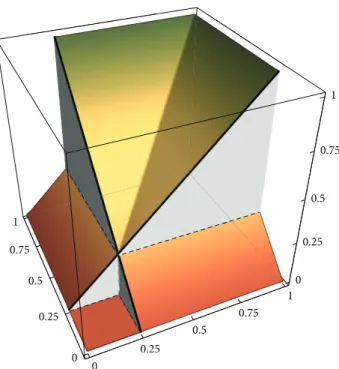
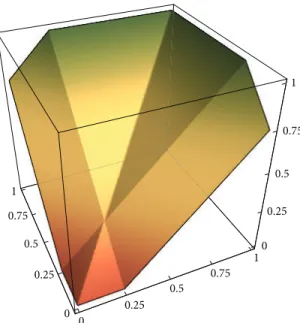
Notice that the last two semiuninorms are also idempo-tent. The plots of all these semiuninorms are given, for the case𝑛 =4, in Figures1–8.
3. Choquet Integral
The notion of Choquet integral is based on that of capacity (see Choquet [14] and Murofushi and Sugeno [15]). The concept of capacity resembles that of probability measure but in the definition of the former additivity is replaced by monotonicity (see also fuzzy measures in Sugeno [16]). A game is then a generalization of a capacity where the mono-tonicity is no longer required.
Definition 3. (1) A game𝜐on𝑁is a set function,𝜐 :2𝑁 → R satisfying𝜐(⌀) =0.
0
0.25 0.5
0.75 1
0 0.25 0.5 0.75
1
0 0.25
0.5 0.75
1
0.25 0.5
0.75 0.25
0.5 5
Figure 1: The semiuninorm𝑈⊥for𝑛 =4.
0
0.25 0.5
0.75 1
0 0.25 0.5 0.75
1
0 0.25
0.5 0.75
1
Figure 2: The semiuninorm𝑈⊤for𝑛 =4.
(2) A capacity (or fuzzy measure)𝜇on𝑁is a game on 𝑁satisfying𝜇(𝐴) ≤ 𝜇(𝐵)whenever𝐴 ⊆ 𝐵. In particular, it follows that𝜇 : 2𝑁 → [0, ∞). A capacity𝜇is said to be normalized if𝜇(𝑁) =1.
0
0.25
0.5 0.75 1
0 0.25 0.5 0.75
1
0 0.25
0.5 0.75
1
0.25
0.5 0.75 0.25
0.5 5
Figure 3: The uninorm𝑈minfor𝑛 =4.
0
0.25 0.5
0.75 1
0 0.25 0.5 0.75
1
0 0.25
0.5 0.75
1
Figure 4: The uninorm𝑈maxfor𝑛 =4.
Definition 4. Let𝜐be a game on𝑁. The monotonic cover of 𝜐is the set function̂𝜐given by
̂𝜐(𝐴) =max
𝐵⊆𝐴𝜐 (𝐵) . (5)
Some basic properties of̂𝜐are given in the sequel.
Remark 5. Let𝜐be a game on𝑁. Then, one has the following: (1)̂𝜐is a capacity.
0 0.25
0.5 0.75 1
0 0.25 0.5 0.75
1
0 0.25
0.5 0.75
1
0 25
0.5 0.75 1 0.25
0.5 0.75
1
0 0
Figure 5: The uninorm𝑈𝑇Lfor𝑛 =4.
0
0.25 0.5
0.75 1
0 0.25 0.5 0.75
1
0 0.25
0.5 0.75
1
0.25 0.5
0.75 0.25
0.5 5
Figure 6: The uninorm𝑈̃𝑃for𝑛 =4.
(2) If𝜐is a capacity, then̂𝜐 = 𝜐.
(3) If𝜐(𝐴) ≤ 1 for all𝐴 ⊆ 𝑁and𝜐(𝑁) = 1, then̂𝜐is a normalized capacity.
0 0.25
0.5 0.75 1
0 0.25 0.5 0.75
1
0 0.25
0.5 0.75
1
Figure 7: The uninorm𝑈𝑇Mfor𝑛 =4.
0
0.25 0.5
0.75 1
0 0.25 0.5 0.75 1
0 0.25
0.5 0.75
1
Figure 8: The uninorm𝑈𝑃for𝑛 =4.
nonnegative vectors given that we are actually considering the asymmetric Choquet integral with respect to𝜇(on this, see again Grabisch et al. [20, page 182]).
Definition 6. Let𝜇be a capacity on𝑁. The Choquet integral with respect to𝜇is the functionC𝜇:R𝑛 → Rgiven by
C𝜇(x) =∑𝑛
𝑖=1
𝜇 (𝐵(𝑖)) (𝑥(𝑖)− 𝑥(𝑖−1)) , (6)
where𝐵(𝑖)= {(𝑖), . . . , (𝑛)}, and one uses the convention𝑥(0)= 0.
It is worth noting that the Choquet integral has several properties which are useful in certain information aggrega-tion contexts (see, for instance, Grabisch et al. [20, pages 192-193 and page 196]).
Remark 7. Let𝜇be a capacity on𝑁. Then,C𝜇is continuous, monotonic, and homogeneous of degree 1. Moreover, it is idempotent and compensative when 𝜇 is a normalized capacity.
Notice that the Choquet integral can also be represented by using decreasing sequences of values (see, for instance, Torra [21] and Llamazares [9]):
C𝜇(x) = 𝑛
∑
𝑖=1
𝜇 (𝐴[𝑖]) (𝑥[𝑖]− 𝑥[𝑖+1]) , (7)
where𝐴[𝑖]= {[1], . . . , [𝑖]}, and we use the convention𝑥[𝑛+1]= 0.
From the previous expression, it is straightforward to show explicitly the weights of the values𝑥[𝑖]by representing the Choquet integral as follows:
C𝜇(x) =∑𝑛
𝑖=1
(𝜇 (𝐴[𝑖]) − 𝜇 (𝐴[𝑖−1])) 𝑥[𝑖], (8)
where we use the convention𝐴[0]= ⌀.
3.1. Weighted Means and OWA Operators. Weighted means and OWA operators (Yager [1]) are well-known functions in the field of aggregation operators. Both families of functions are defined in terms of weight distributions that add up to 1.
Definition 8. A vector q ∈ R𝑛 is a weighting vector ifq ∈ [0,1]𝑛and∑𝑛𝑖=1𝑞𝑖=1.
The set of all weighting vectors ofR𝑛will be denoted by
W𝑛.
Definition 9. Letp be a weighting vector. The weighted mean associated withp is the function𝑀p:R𝑛 → Rgiven by
𝑀p(x) =∑𝑛
𝑖=1
𝑝𝑖𝑥𝑖. (9)
Definition 10. Letw be a weighting vector. The OWA operator associated withw is the function𝑂w :R𝑛 → Rgiven by
𝑂w(x) =∑𝑛
𝑖=1
𝑤𝑖𝑥[𝑖]. (10)
Remark 11. (1) Ifp is a weighting vector, then the weighted mean𝑀pis the Choquet integral with respect to the normal-ized capacity𝜇p(𝐴) = ∑𝑖∈𝐴𝑝𝑖.
(2) Ifw is a weighting vector, then the OWA operator𝑂wis the Choquet integral with respect to the normalized capacity 𝜇|w|(𝐴) = ∑|𝐴|𝑖=1𝑤𝑖.
So, according to Remark 7, weighted means and OWA operators are continuous, monotonic, idempotent, compen-sative, and homogeneous of degree 1. Moreover, in the case of OWA operators, given that the values of the variables are previously ordered in a decreasing way, they are also symmetric.
3.2. SUOWA Operators. SUOWA operators were introduced by Llamazares [9] in order to consider situations where both the importance of information sources and the importance of values had to be taken into account. These functions are Cho-quet integral-based operators where their capacities are the monotonic cover of certain games. These games are defined by using semiuninorms with neutral element 1/𝑛 and the values of the capacities associated with the weighted means and the OWA operators. To be specific, the games from which SUOWA operators are built are defined as follows.
Definition 12. Letp and w be two weighting vectors and let 𝑈 ∈ ̃U1/𝑛.
(1) The game associated with p, w, and 𝑈 is the set function𝜐p𝑈,w :2𝑁 → Rdefined by
𝜐p𝑈,w(𝐴) = |𝐴| 𝑈 (𝜇p(𝐴) |𝐴| ,
𝜇|w|(𝐴)
|𝐴| )
= |𝐴| 𝑈 (∑𝑖∈𝐴𝑝𝑖
|𝐴| , ∑|𝐴|𝑖=1𝑤𝑖
|𝐴| )
(11)
if𝐴 ̸= ⌀and𝜐p𝑈,w(⌀) =0.
(2)̂𝜐p𝑈,w, the monotonic cover of the game𝜐𝑈p,w, will be called the capacity associated withp, w, and𝑈.
Notice that𝜐𝑈p,w(𝑁) = 1. Moreover, since𝑈 ∈ ̃U1/𝑛, we have𝜐𝑈p,w(𝐴) ≤ 1 for all𝐴 ⊆ 𝑁(see Llamazares [9]). There-fore, according to the third item ofRemark 5,̂𝜐p𝑈,wis always a normalized capacity.
Definition 13. Letp and w be two weighting vectors and let 𝑈 ∈ ̃U1/𝑛. The SUOWA operator associated withp, w, and𝑈 is the function𝑆𝑈p,w:R𝑛 → Rgiven by
𝑆𝑈p,w(x) =∑𝑛
𝑖=1
𝑠𝑖𝑥[𝑖], (12)
where𝑠𝑖 = ̂𝜐p𝑈,w(𝐴[𝑖]) − ̂𝜐𝑈p,w(𝐴[𝑖−1])for all𝑖 ∈ 𝑁,̂𝜐𝑈p,w is the capacity associated withp, w, and𝑈, and𝐴[𝑖]= {[1], . . . , [𝑖]} (with the convention that𝐴[0]= ⌀).
According to expression(7), the SUOWA operator asso-ciated withp, w, and𝑈can also be written as
𝑆𝑈p,w(x) =∑𝑛
𝑖=1 ̂𝜐𝑈
p,w(𝐴[𝑖]) (𝑥[𝑖]− 𝑥[𝑖+1]) . (13)
By the choice of̂𝜐𝑈p,w, we have𝑆𝑈p,𝜂 = 𝑀pand𝑆𝑈𝜂,w = 𝑂w for any𝑈 ∈ ̃U1/𝑛. Moreover, byRemark 7and given that̂𝜐𝑈p,w is a normalized capacity, SUOWA operators are continuous, monotonic, idempotent, compensative, and homogeneous of degree 1.
4. The Results
The use of Choquet integral has become more and more extensive in the last years (see, for instance, Grabisch et al. [25] and Grabisch and Labreuche [26]). Although simple, the case𝑛 = 2 is interesting from a theoretical point of view. Thus, for instance, Grabisch et al. [20, page 204] show that, in this case, any Choquet integral with respect to a normal-ized capacity can be written as a convex combination of a minimum, a maximum, and two projections; that is, given a normalized capacity 𝜇, there exists a weighting vector 𝜆 belonging toW4such that
C𝜇(𝑥1, 𝑥2) = 𝜆1min(𝑥1, 𝑥2) + 𝜆2max(𝑥1, 𝑥2)
+ 𝜆3𝑥1+ 𝜆4𝑥2.
(14)
In our case, we are going to show that any Choquet integral with respect to a normalized capacity can be written as a SUOWA operator. Notice that when𝑛 =2,𝜐p𝑈,wis always a normalized capacity for any weighting vectors p and w and for any semiuninorm𝑈. Therefore, given a normalized capacity𝜇, we need to prove that there exist weighting vectors p and w and a semiuninorm𝑈such that
𝜐𝑈p,w({1}) = 𝑈 (𝑝1, 𝑤1) = 𝜇1,
𝜐𝑈p,w({2}) = 𝑈 (𝑝2, 𝑤1) = 𝜇2, (15)
where we use the notations𝜇1 and𝜇2 to denote the values 𝜇({1})and𝜇({2}), respectively.
Firstly we are going to show that, in the case of the semi-uninorms 𝑈⊥, 𝑈⊤, 𝑈min, and𝑈max, there exist normalized capacities which cannot be expressed as SUOWA operators. For this, we will use the following lemma.
Lemma 14. If𝑈 ∈ {𝑈⊥, 𝑈⊤, 𝑈min, 𝑈max}, then𝑈(𝑥, 𝑦) =0.5 if and only if𝑥 = 𝑦 =0.5.
Proof. Let𝑈 ∈ {𝑈⊥, 𝑈⊤, 𝑈min, 𝑈max}. Since 0.5 is the neutral element of𝑈, we have𝑈(0.5,0.5) =0.5.
Conversely, suppose𝑈(𝑥, 𝑦) =0.5. InTable 1, where 0.5−
Table 1: Values taken by𝑈⊥,𝑈min,𝑈max, and𝑈⊤.
𝑥 𝑦 𝑈⊥(𝑥, 𝑦) 𝑈min(𝑥, 𝑦) 𝑈max(𝑥, 𝑦) 𝑈⊤(𝑥, 𝑦)
0.5− 0.5− 0 min(𝑥, 𝑦) min(𝑥, 𝑦) min(𝑥, 𝑦)
0.5− 0.5 𝑥 𝑥 𝑥 𝑥
0.5− 0.5+ 𝑥 𝑥 𝑦 𝑦
0.5 0.5− 𝑦 𝑦 𝑦 𝑦
0.5 0.5 0.5 0.5 0.5 0.5
0.5 0.5+ 𝑦 𝑦 𝑦 𝑦
0.5+ 0.5− 𝑦 𝑦 𝑥 𝑥
0.5+ 0.5 𝑥 𝑥 𝑥 𝑥
0.5+ 0.5+ max(𝑥, 𝑦) max(𝑥, 𝑦) max(𝑥, 𝑦) 1
Theorem 15. Let𝜇be the normalized capacity on𝑁 = {1,2} such that𝜇1 = 0and𝜇2 = 0.5. If𝑈 ∈ {𝑈⊥, 𝑈⊤, 𝑈min, 𝑈max}, then there do not exist weighting vectorspandwsuch that𝜇 =
𝜐𝑈
p,w.
Proof. Given𝑈 ∈ {𝑈⊥, 𝑈⊤, 𝑈min, 𝑈max}, consider two weight-ing vectorsp and w such that𝑈(𝑝2, 𝑤1) =0.5. ByLemma 14, we have𝑝2= 𝑤1 =0.5. Therefore,𝑈(𝑝1, 𝑤1) = 𝑈(0.5,0.5) = 0.5 and, consequently,𝑈(𝑝1, 𝑤1) =0 is not possible.
In each of the following theorems we consider the semi-uninorms𝑈𝑇L,𝑈𝑇M,𝑈̃𝑃, and𝑈𝑃, respectively, and we show that any normalized capacity can be written as a SUOWA operator associated with appropriate weighting vectorsp and w, which are given explicitly.
Theorem 16. Let𝜇be a normalized capacity on𝑁 = {1,2} and letpandwbe two weighting vectors defined as follows:
(1)If𝜇1+ 𝜇2<1, then
p= (0.5+𝜇1− 𝜇2 2 ,0.5+
𝜇2− 𝜇1
2 ) ,
w= (𝜇1+ 𝜇2 2 ,1−
𝜇1+ 𝜇2
2 ) .
(16)
(2)If𝜇1+ 𝜇2≥1andmin(𝜇1, 𝜇2) <0.5, then
p={{ {
(𝜇1,1− 𝜇1) 𝑖𝑓 𝜇1>0.5, (1− 𝜇2, 𝜇2) 𝑖𝑓 𝜇2>0.5,
w= (𝜇1+ 𝜇2−0.5,1.5− 𝜇1− 𝜇2) .
(17)
(3)Ifmin(𝜇1, 𝜇2) ≥0.5, then
p= (0.5+ 𝜇1− 𝜇2,0.5+ 𝜇2− 𝜇1) ,
w= (max(𝜇1, 𝜇2) ,1−max(𝜇1, 𝜇2)) .
(18)
Then,𝜇 = 𝜐𝑈𝑇L
p,w; that is,C𝜇= 𝑆𝑈p,𝑇wL.
Proof. Let𝜇be a normalized capacity on𝑁 = {1,2}and recall that when𝑛 =2, the semiuninorm𝑈𝑇Lis defined by
𝑈𝑇L(𝑥, 𝑦)
={{ {
max(𝑥, 𝑦) if (𝑥, 𝑦) ∈ [0.5,1]2,
max(𝑥 + 𝑦 −0.5,0) otherwise.
(19)
We distinguish the following cases: (1) If𝜇1+ 𝜇2<1, consider
p= (0.5+𝜇1− 𝜇2 2 ,0.5+
𝜇2− 𝜇1
2 ) ,
w= (𝜇1+ 𝜇2 2 ,1−
𝜇1+ 𝜇2
2 ) .
(20)
Then,
𝑈𝑇L(𝑝1, 𝑤1) =0.5+𝜇1− 𝜇2
2 +
𝜇1+ 𝜇2
2 −0.5= 𝜇1,
𝑈𝑇L(𝑝2, 𝑤1) =0.5+𝜇2− 𝜇1
2 +
𝜇1+ 𝜇2
2 −0.5= 𝜇2. (21)
(2) If𝜇1+ 𝜇2≥1 and min(𝜇1, 𝜇2) <0.5, consider
p={{ {
(𝜇1,1− 𝜇1) if𝜇1>0.5, (1− 𝜇2, 𝜇2) if𝜇2>0.5,
w= (𝜇1+ 𝜇2−0.5,1.5− 𝜇1− 𝜇2) .
(22)
We distinguish two cases:
(a) If𝜇1>0.5, then
𝑈𝑇L(𝑝1, 𝑤1) =max(𝜇1, 𝜇1+ 𝜇2−0.5) = 𝜇1,
𝑈𝑇L(𝑝2, 𝑤1) =1− 𝜇1+ 𝜇1+ 𝜇2−0.5−0.5= 𝜇2. (23)
(b) If𝜇2>0.5, then
𝑈𝑇L(𝑝1, 𝑤1) =1− 𝜇2+ 𝜇1+ 𝜇2−0.5−0.5= 𝜇1,
𝑈𝑇L(𝑝2, 𝑤1) =max(𝜇2, 𝜇1+ 𝜇2−0.5) = 𝜇2. (24)
(3) If min(𝜇1, 𝜇2) ≥0.5, consider
p= (0.5+ 𝜇1− 𝜇2,0.5+ 𝜇2− 𝜇1) ,
w= (max(𝜇1, 𝜇2) ,1−max(𝜇1, 𝜇2)) . (25)
We distinguish three cases:
(a) If𝜇1> 𝜇2, then
𝑈𝑇L(𝑝1, 𝑤1) =max(0.5+ 𝜇1− 𝜇2, 𝜇1) = 𝜇1,
𝑈𝑇L(𝑝2, 𝑤1) =0.5+ 𝜇2− 𝜇1+ 𝜇1−0.5= 𝜇2.
(b) If𝜇1= 𝜇2, then
𝑈𝑇L(𝑝1, 𝑤1) =max(0.5, 𝜇1) = 𝜇1,
𝑈𝑇L(𝑝2, 𝑤1) =max(0.5, 𝜇2) = 𝜇2.
(27)
(c) If𝜇1< 𝜇2, then
𝑈𝑇L(𝑝1, 𝑤1) =0.5+ 𝜇1− 𝜇2+ 𝜇2−0.5= 𝜇1,
𝑈𝑇L(𝑝2, 𝑤1) =max(0.5+ 𝜇2− 𝜇1, 𝜇2) = 𝜇2. (28)
Theorem 17. Let𝜇be a normalized capacity on𝑁 = {1,2} and letpandwbe two weighting vectors defined as follows:
(1)Ifmax(𝜇1, 𝜇2) <0.5, then
p= (0.5+ 𝜇1− 𝜇2,0.5+ 𝜇2− 𝜇1) , w= (min(𝜇1, 𝜇2) ,1−min(𝜇1, 𝜇2)) .
(29)
(2)If𝜇1+ 𝜇2<1andmax(𝜇1, 𝜇2) ≥0.5, then
p={{ {
(𝜇1,1− 𝜇1) 𝑖𝑓 𝜇1<0.5, (1− 𝜇2, 𝜇2) 𝑖𝑓 𝜇2<0.5,
w= (𝜇1+ 𝜇2−0.5,1.5− 𝜇1− 𝜇2) .
(30)
(3)If𝜇1+ 𝜇2≥1andmin(𝜇1, 𝜇2) <0.5, then
p={{ {
(𝜇1,1− 𝜇1) 𝑖𝑓 𝜇1>0.5, (1− 𝜇2, 𝜇2) 𝑖𝑓 𝜇2>0.5,
w= (𝜇1+ 𝜇2−0.5,1.5− 𝜇1− 𝜇2) .
(31)
(4)Ifmin(𝜇1, 𝜇2) ≥0.5, then
p= (0.5+ 𝜇1− 𝜇2,0.5+ 𝜇2− 𝜇1) ,
w= (max(𝜇1, 𝜇2) ,1−max(𝜇1, 𝜇2)) . (32)
Then,𝜇 = 𝜐𝑈𝑇M
p,w; that is,C𝜇= 𝑆𝑈p,𝑇wM.
Proof. Let𝜇be a normalized capacity on𝑁 = {1,2}and recall that when𝑛 =2, the semiuninorm𝑈𝑇Mis defined by
𝑈𝑇M(𝑥, 𝑦) = { { { { { { { { {
max(𝑥, 𝑦) if (𝑥, 𝑦) ∈ [0.5,1]2,
min(𝑥, 𝑦) if (𝑥, 𝑦) ∈ [0,0.5)2,
𝑥 + 𝑦 −0.5 otherwise.
(33)
We distinguish the following cases: (1) If max(𝜇1, 𝜇2) <0.5, consider
p= (0.5+ 𝜇1− 𝜇2,0.5+ 𝜇2− 𝜇1) ,
w= (min(𝜇1, 𝜇2) ,1−min(𝜇1, 𝜇2)) . (34)
We distinguish three cases:
(a) If𝜇1< 𝜇2, then
𝑈𝑇M(𝑝1, 𝑤1) =min(0.5+ 𝜇1− 𝜇2, 𝜇1) = 𝜇1,
𝑈𝑇M(𝑝2, 𝑤1) =0.5+ 𝜇2− 𝜇1+ 𝜇1−0.5= 𝜇2. (35)
(b) If𝜇1= 𝜇2, then
𝑈𝑇M(𝑝1, 𝑤1) =min(0.5, 𝜇1) = 𝜇1,
𝑈𝑇M(𝑝2, 𝑤1) =min(0.5, 𝜇2) = 𝜇2. (36)
(c) If𝜇1> 𝜇2, then
𝑈𝑇M(𝑝1, 𝑤1) =0.5+ 𝜇1− 𝜇2+ 𝜇2−0.5= 𝜇1,
𝑈𝑇M(𝑝2, 𝑤1) =min(0.5+ 𝜇2− 𝜇1, 𝜇2) = 𝜇2. (37)
(2) If𝜇1+ 𝜇2<1 and max(𝜇1, 𝜇2) ≥0.5, consider
p={{ {
(𝜇1,1− 𝜇1) if𝜇1<0.5, (1− 𝜇2, 𝜇2) if𝜇2<0.5,
w= (𝜇1+ 𝜇2−0.5,1.5− 𝜇1− 𝜇2) .
(38)
We distinguish two cases:
(a) If𝜇1<0.5, then
𝑈𝑇M(𝑝1, 𝑤1) =min(𝜇1, 𝜇1+ 𝜇2−0.5) = 𝜇1,
𝑈𝑇M(𝑝2, 𝑤1) =1− 𝜇1+ 𝜇1+ 𝜇2−0.5−0.5= 𝜇2. (39)
(b) If𝜇2<0.5, then
𝑈𝑇M(𝑝1, 𝑤1) =1− 𝜇2+ 𝜇1+ 𝜇2−0.5−0.5= 𝜇1,
𝑈𝑇M(𝑝2, 𝑤1) =min(𝜇2, 𝜇1+ 𝜇2−0.5) = 𝜇2. (40)
(3) If𝜇1+ 𝜇2≥1 and min(𝜇1, 𝜇2) <0.5, then the proof of this case is similar to that of the second item inTheorem 16.
(4) If min(𝜇1, 𝜇2) ≥ 0.5, then the proof of this case is similar to that of the third item inTheorem 16.
Theorem 18. Let𝜇be a normalized capacity on𝑁 = {1,2} and letpandwbe two weighting vectors defined as follows:
(1)If𝜇1+ 𝜇2<1, then
p={{{{ {
(𝑝1, 𝑝2) ∈W2 𝑖𝑓 𝜇1= 𝜇2=0,
( 𝜇1
𝜇1+ 𝜇2, 𝜇2
𝜇1+ 𝜇2) 𝑜𝑡ℎ𝑒𝑟𝑤𝑖𝑠𝑒,
w= (𝜇1+ 𝜇2 2 ,1−
𝜇1+ 𝜇2
2 ) .
(2)If𝜇1+ 𝜇2 ≥ 1andmin(𝜇1, 𝜇2) < 2 max(𝜇1, 𝜇2)(1−
max(𝜇1, 𝜇2)), then
p={{ {
(𝜇1,1− 𝜇1) 𝑖𝑓 𝜇1≥ 𝜇2, (1− 𝜇2, 𝜇2) 𝑖𝑓 𝜇1< 𝜇2,
w= ( min(𝜇1, 𝜇2) 2(1−max(𝜇1, 𝜇2)),1
− min(𝜇1, 𝜇2) 2(1−max(𝜇1, 𝜇2))) .
(42)
(3)If𝜇1+ 𝜇2 ≥ 1andmin(𝜇1, 𝜇2) ≥ 2 max(𝜇1, 𝜇2)(1−
max(𝜇1, 𝜇2)), then
p= { { { { { { {
(1−2𝜇𝜇2 1,
𝜇2
2𝜇1) 𝑖𝑓 𝜇1≥ 𝜇2, ( 𝜇1
2𝜇2,1− 𝜇1
2𝜇2) 𝑖𝑓 𝜇1< 𝜇2, w= (max(𝜇1, 𝜇2) ,1−max(𝜇1, 𝜇2)) .
(43)
Then,𝜇 = 𝜐p𝑈,̃𝑃w; that is,C𝜇= 𝑆𝑈p,̃𝑃w.
Proof. Let𝜇be a normalized capacity on𝑁 = {1,2}and recall that when𝑛 =2, the semiuninorm𝑈̃𝑃is defined by
𝑈̃𝑃(𝑥, 𝑦) ={{ {
max(𝑥, 𝑦) if (𝑥, 𝑦) ∈ [0.5,1]2,
2𝑥𝑦 otherwise. (44)
We distinguish the following cases: (1) If𝜇1+ 𝜇2<1, consider
p={{{{ {
(𝑝1, 𝑝2) ∈W2 if 𝜇1= 𝜇2= 0,
( 𝜇1 𝜇1+ 𝜇2,
𝜇2
𝜇1+ 𝜇2) otherwise,
w= (𝜇1+ 𝜇2 2, 1 −𝜇1+ 𝜇2 2) .
(45)
We distinguish two cases:
(a) If𝜇1= 𝜇2=0, then
𝑈̃𝑃(𝑝1, 𝑤1) =2⋅ 𝑝1⋅0=0= 𝜇1,
𝑈̃𝑃(𝑝2, 𝑤1) =2⋅ 𝑝2⋅0=0= 𝜇2. (46)
(b) If(𝜇1, 𝜇2) ̸= (0,0), then
𝑈̃𝑃(𝑝1, 𝑤1) =2 𝜇1 𝜇1+ 𝜇2
𝜇1+ 𝜇2 2 = 𝜇1,
𝑈̃𝑃(𝑝2, 𝑤1) =2 𝜇2 𝜇1+ 𝜇2
𝜇1+ 𝜇2 2 = 𝜇2.
(47)
(2) If𝜇1+ 𝜇2 ≥ 1 and min(𝜇1, 𝜇2) < 2 max(𝜇1, 𝜇2)(1− max(𝜇1, 𝜇2)), then notice that the case max(𝜇1, 𝜇2) =1 is not possible. Moreover, we have
min(𝜇1, 𝜇2)
2(1−max(𝜇1, 𝜇2)) <max(𝜇1, 𝜇2) . (48)
On the other hand, given that min(𝜇1, 𝜇2) ≥1−max(𝜇1, 𝜇2), we get
min(𝜇1, 𝜇2)
2(1−max(𝜇1, 𝜇2)) ≥0.5, (49)
and, consequently, max(𝜇1, 𝜇2) > 0.5. Now consider the following weighting vectors:
p={{ {
(𝜇1,1− 𝜇1) if𝜇1≥ 𝜇2, (1− 𝜇2, 𝜇2) if𝜇1< 𝜇2,
w
= ( min(𝜇1, 𝜇2) 2(1−max(𝜇1, 𝜇2)),1−
min(𝜇1, 𝜇2) 2(1−max(𝜇1, 𝜇2))) .
(50)
We distinguish two cases:
(a) If𝜇1≥ 𝜇2, then
𝑈̃𝑃(𝑝1, 𝑤1) =max(𝜇1, 𝜇2
2(1− 𝜇1)) = 𝜇1,
𝑈̃𝑃(𝑝2, 𝑤1) =2(1− 𝜇1) 𝜇2
2(1− 𝜇1) = 𝜇2.
(51)
(b) If𝜇1< 𝜇2, then
𝑈̃𝑃(𝑝1, 𝑤1) =2(1− 𝜇2) 𝜇1
2(1− 𝜇2) = 𝜇1,
𝑈̃𝑃(𝑝2, 𝑤1) =max(𝜇2, 𝜇1
2(1− 𝜇2)) = 𝜇2.
(52)
(3) If𝜇1+ 𝜇2 ≥ 1 and min(𝜇1, 𝜇2) ≥ 2 max(𝜇1, 𝜇2)(1− max(𝜇1, 𝜇2)), then max(𝜇1, 𝜇2) ≥0.5, and we also have
min(𝜇1, 𝜇2)
2 max(𝜇1, 𝜇2) ≥1−max(𝜇1, 𝜇2) , (53)
or, equivalently,
1− min(𝜇1, 𝜇2)
2 max(𝜇1, 𝜇2) ≤max(𝜇1, 𝜇2) . (54)
On the other hand, since min(𝜇1, 𝜇2) ≤max(𝜇1, 𝜇2), we get
min(𝜇1, 𝜇2)
and, consequently,
1− min(𝜇1, 𝜇2)
2 max(𝜇1, 𝜇2) ≥0.5. (56)
Consider now the following weighting vectors:
p= { { { { { { {
(1 − 𝜇2
2𝜇1, 𝜇2
2𝜇1) if 𝜇1≥ 𝜇2, ( 𝜇1
2𝜇2, 1 − 𝜇1
2𝜇2) if 𝜇1< 𝜇2, w= (max(𝜇1, 𝜇2) , 1 −max(𝜇1, 𝜇2)) .
(57)
We distinguish three cases:
(a) If𝜇1> 𝜇2, then
𝑈̃𝑃(𝑝1, 𝑤1) =max(1− 𝜇2
2𝜇1, 𝜇1) = 𝜇1,
𝑈̃𝑃(𝑝2, 𝑤1) =2 𝜇2
2𝜇1𝜇1= 𝜇2.
(58)
(b) If𝜇1= 𝜇2, then
𝑈̃𝑃(𝑝1, 𝑤1) =max(0.5, 𝜇1) = 𝜇1,
𝑈̃𝑃(𝑝2, 𝑤1) =max(0.5, 𝜇2) = 𝜇2. (59)
(c) If𝜇1< 𝜇2, then
𝑈̃𝑃(𝑝1, 𝑤1) =2 𝜇1
2𝜇2𝜇2= 𝜇1,
𝑈̃𝑃(𝑝2, 𝑤1) =max(1− 𝜇1
2𝜇2, 𝜇2) = 𝜇2.
(60)
Theorem 19. Let𝜇be a normalized capacity on𝑁 = {1,2} and letpandwbe two weighting vectors defined as follows:
(1)If𝜇1+ 𝜇2 < 1andmax(𝜇1, 𝜇2) < 2 min(𝜇1, 𝜇2)(1−
min(𝜇1, 𝜇2)), then
p= { { { { { { {
(1− 𝜇2 2𝜇1,
𝜇2
2𝜇1) 𝑖𝑓 𝜇1≤ 𝜇2, (2𝜇𝜇1
2,1− 𝜇1
2𝜇2) 𝑖𝑓 𝜇1> 𝜇2, w= (min(𝜇1, 𝜇2) ,1−min(𝜇1, 𝜇2)) .
(61)
(2)If𝜇1+ 𝜇2 < 1andmax(𝜇1, 𝜇2) ≥ 2 min(𝜇1, 𝜇2)(1−
min(𝜇1, 𝜇2)), then
p={{ {
(𝜇1,1− 𝜇1) 𝑖𝑓 𝜇1≤ 𝜇2, (1− 𝜇2, 𝜇2) 𝑖𝑓 𝜇1> 𝜇2,
w
= ( max(𝜇1, 𝜇2) 2(1−min(𝜇1, 𝜇2)),1−
max(𝜇1, 𝜇2) 2(1−min(𝜇1, 𝜇2))) .
(62)
(3)If𝜇1+ 𝜇2 ≥ 1andmin(𝜇1, 𝜇2) < 2 max(𝜇1, 𝜇2)(1−
max(𝜇1, 𝜇2)), then
p={{ {
(𝜇1,1− 𝜇1) 𝑖𝑓 𝜇1≥ 𝜇2, (1− 𝜇2, 𝜇2) 𝑖𝑓 𝜇1< 𝜇2,
w
= ( min(𝜇1, 𝜇2) 2(1−max(𝜇1, 𝜇2)),1−
min(𝜇1, 𝜇2) 2(1−max(𝜇1, 𝜇2))) .
(63)
(4)If𝜇1+ 𝜇2 ≥ 1andmin(𝜇1, 𝜇2) ≥ 2 max(𝜇1, 𝜇2)(1−
max(𝜇1, 𝜇2)), then
p= { { { { { { {
(1− 𝜇2 2𝜇1,
𝜇2
2𝜇1) 𝑖𝑓 𝜇1≥ 𝜇2, ( 𝜇1
2𝜇2,1− 𝜇1
2𝜇2) 𝑖𝑓 𝜇1< 𝜇2, w= (max(𝜇1, 𝜇2) ,1−max(𝜇1, 𝜇2)) .
(64)
Then,𝜇 = 𝜐𝑈𝑃
p,w; that is,C𝜇= 𝑆p𝑈,𝑃w.
Proof. Let𝜇be a normalized capacity on𝑁 = {1,2}and recall that when𝑛 =2, the semiuninorm𝑈𝑃is defined by
𝑈𝑃(𝑥, 𝑦) = { { { { { { { { {
max(𝑥, 𝑦) if (𝑥, 𝑦) ∈ [0.5,1]2,
min(𝑥, 𝑦) if (𝑥, 𝑦) ∈ [0,0.5)2,
2𝑥𝑦 otherwise.
(65)
We distinguish the following cases:
(1) If𝜇1 + 𝜇2 < 1 and max(𝜇1, 𝜇2) < 2 min(𝜇1, 𝜇2)(1− min(𝜇1, 𝜇2)), then notice that the case min(𝜇1, 𝜇2) =0 is not possible. Moreover, min(𝜇1, 𝜇2) <0.5, and we also have
max(𝜇1, 𝜇2)
2 min(𝜇1, 𝜇2) <1−min(𝜇1, 𝜇2) , (66)
or, equivalently,
min(𝜇1, 𝜇2) <1− max(𝜇1, 𝜇2)
2 min(𝜇1, 𝜇2). (67) On the other hand, since min(𝜇1, 𝜇2) ≤max(𝜇1, 𝜇2), we get
max(𝜇1, 𝜇2)
2 min(𝜇1, 𝜇2) ≥0.5, (68)
and, consequently,
1− max(𝜇1, 𝜇2)
2 min(𝜇1, 𝜇2)≤0.5. (69)
Consider now the following weighting vectors:
p= { { { { { { {
(1 − 𝜇2
2𝜇1, 𝜇2
2𝜇1) if𝜇1≤ 𝜇2, (𝜇1
2𝜇2, 1 − 𝜇1
2𝜇2) if𝜇1> 𝜇2, w= (min(𝜇1, 𝜇2) ,1−min(𝜇1, 𝜇2)) .
We distinguish three cases:
(a) If𝜇1< 𝜇2, then
𝑈𝑃(𝑝1, 𝑤1) =min(1− 𝜇2
2𝜇1, 𝜇1) = 𝜇1,
𝑈𝑃(𝑝2, 𝑤1) =2𝜇2
2𝜇1𝜇1= 𝜇2.
(71)
(b) If𝜇1= 𝜇2, then
𝑈𝑃(𝑝1, 𝑤1) =min(0.5, 𝜇1) = 𝜇1,
𝑈𝑃(𝑝2, 𝑤1) =min(0.5, 𝜇2) = 𝜇2. (72)
(c) If𝜇1> 𝜇2, then
𝑈𝑃(𝑝1, 𝑤1) =2𝜇1
2𝜇2𝜇2= 𝜇1,
𝑈𝑃(𝑝2, 𝑤1) =min(1− 𝜇1
2𝜇2, 𝜇2) = 𝜇2.
(73)
(2) If𝜇1+ 𝜇2 < 1 and max(𝜇1, 𝜇2) ≥ 2 min(𝜇1, 𝜇2)(1− min(𝜇1, 𝜇2)), then notice that the case min(𝜇1, 𝜇2) =1 is not possible. Moreover, we have
max(𝜇1, 𝜇2)
2(1−min(𝜇1, 𝜇2)) ≥min(𝜇1, 𝜇2) . (74)
On the other hand, given that max(𝜇1, 𝜇2) <1−min(𝜇1, 𝜇2), we get
max(𝜇1, 𝜇2)
2(1−min(𝜇1, 𝜇2)) <0.5, (75)
and, consequently, min(𝜇1, 𝜇2) < 0.5. Now consider the following weighting vectors:
p={{ {
(𝜇1,1− 𝜇1) if𝜇1≤ 𝜇2, (1− 𝜇2, 𝜇2) if𝜇1> 𝜇2,
w
= ( max(𝜇1, 𝜇2) 2(1−min(𝜇1, 𝜇2)),1−
max(𝜇1, 𝜇2) 2(1−min(𝜇1, 𝜇2))) .
(76)
We distinguish two cases:
(a) If𝜇1≤ 𝜇2, then
𝑈𝑃(𝑝1, 𝑤1) =min(𝜇1, 𝜇2
2(1− 𝜇1)) = 𝜇1,
𝑈𝑃(𝑝2, 𝑤1) =2(1− 𝜇1) 𝜇2
2(1− 𝜇1) = 𝜇2.
(77)
(b) If𝜇1> 𝜇2, then
𝑈𝑃(𝑝1, 𝑤1) =2(1− 𝜇2) 𝜇1
2(1− 𝜇2) = 𝜇1,
𝑈𝑃(𝑝2, 𝑤1) =min(𝜇2, 𝜇1
2(1− 𝜇2)) = 𝜇2.
(78)
(3) If𝜇1+ 𝜇2 ≥ 1 and min(𝜇1, 𝜇2) < 2 max(𝜇1, 𝜇2)(1− max(𝜇1, 𝜇2)), then the proof of this case is similar to that of the second item inTheorem 18.
(4) If𝜇1 + 𝜇2 ≥ 1 and min(𝜇1, 𝜇2) ≥ 2 max(𝜇1, 𝜇2)(1− max(𝜇1, 𝜇2)), then the proof of this case is similar to that of the third item inTheorem 18.
5. Conclusion
SUOWA operators are a useful tool for dealing with situations where combining values by using both a weighted mean and an OWA type aggregation is necessary. Given that they are Choquet integral-based operators with respect to normalized capacities, they have some natural properties such as con-tinuity, monotonicity, idempotency, compensativeness, and homogeneity of degree 1. For this reason, it seems interesting to analyze their behavior from different points of view. In this paper, we have shown that, in two dimensions, if we consider one of the following continuous semiuninorms:𝑈𝑇L,𝑈𝑇M,𝑈̃𝑃, and𝑈𝑃, then any Choquet integral with respect to a normal-ized capacity can be expressed as a SUOWA operator associ-ated with the chosen semiuninorm and two weighting vectors p and w, which are given explicitly.
Conflict of Interests
The author declares that there is no conflict of interests regarding the publication of this paper.
Acknowledgments
The partial financial support from the Ministerio de Econom´ıa y Competitividad (Project ECO2012-32178) and the Junta de Castilla y Le´on (Consejer´ıa de Educaci´on, Project VA066U13) is gratefully acknowledged.
References
[1] R. R. Yager, “On ordered weighted averaging aggregation oper-ators in multicriteria decisionmaking,”IEEE Transactions on Systems, Man, and Cybernetics, vol. 18, no. 1, pp. 183–190, 1988. [2] V. Torra, “Weighted OWA operators for synthesis of
informa-tion,” inProceedings of the 5th IEEE International Conference on Fuzzy Systems, vol. 2, pp. 966–971, New Orleans, La, USA, September 1996.
[3] V. Torra, “The weighted OWA operator,”International Journal of Intelligent Systems, vol. 12, no. 2, pp. 153–166, 1997.
[5] V. Torra and L. Godo, “Continuous WOWA operators with application to defuzzification,” inAggregation Operators: New Trends and Applications, T. Calvo, G. Mayor, and R. Mesiar, Eds., vol. 97 ofStudies in Fuzziness and Soft Computing, pp. 159–176, Physica, Heidelberg, Germany, 2002.
[6] V. Torra and Y. Narukawa, Modeling Decisions: Information Fusion and Aggregation Operators, Springer, Berlin, Germany, 2007.
[7] B. Roy, “Double pond´eration pour calculer une moyenne: pourquoi et comment?”RAIRO Operations Research, vol. 41, no. 2, pp. 125–139, 2007.
[8] R. R. Yager and N. Alajlan, “A generalized framework for mean aggregation: toward the modeling of cognitive aspects,” Information Fusion, vol. 17, pp. 65–73, 2014.
[9] B. Llamazares, “Constructing Choquet integral-based operators that generalize weighted means and OWA operators,” Informa-tion Fusion, vol. 23, pp. 131–138, 2015.
[10] B. Llamazares, “An analysis of some functions that generalizes weighted means and OWA operators,”International Journal of Intelligent Systems, vol. 28, no. 4, pp. 380–393, 2013.
[11] H.-W. Liu, “Semi-uninorms and implications on a complete lattice,”Fuzzy Sets and Systems, vol. 191, pp. 72–82, 2012. [12] R. R. Yager and A. Rybalov, “Uninorm aggregation operators,”
Fuzzy Sets and Systems, vol. 80, no. 1, pp. 111–120, 1996. [13] B. Llamazares, “SUOWA operators: constructing
semi-uni-norms and analyzing specific cases,”Fuzzy Sets and Systems, 2015.
[14] G. Choquet, “Theory of capacities,”Annales de l’Institut Fourier, vol. 5, pp. 131–295, 1953.
[15] T. Murofushi and M. Sugeno, “A theory of fuzzy measures: representations, the Choquet integral, and null sets,”Journal of Mathematical Analysis and Applications, vol. 159, no. 2, pp. 532– 549, 1991.
[16] M. Sugeno,Theory of fuzzy integrals and its applications [Ph.D. thesis], Tokyo Institute of Technology, Meguro, Japan, 1974. [17] M. Maschler and B. Peleg, “The structure of the kernel of a
cooperative game,”SIAM Journal on Applied Mathematics, vol. 15, no. 3, pp. 569–604, 1967.
[18] M. Maschler, B. Peleg, and L. S. Shapley, “The kernel and bargaining set for convex games,”International Journal of Game Theory, vol. 1, no. 1, pp. 73–93, 1971.
[19] D. Denneberg, Non-Additive Measures and Integral, Kluwer Academic, Dordrecht, The Netherlands, 1994.
[20] M. Grabisch, J.-L. Marichal, R. Mesiar, and E. Pap,Aggregation Functions, Encyclopedia of Mathematics and its Applications, Cambridge University Press, 2009.
[21] V. Torra, “On some relationships between the WOWA operator and the Choquet integral,” inProceedings of the 7th Interna-tional Conference on Information Processing and Management of Uncertainty in Knowledge-Based Systems (IPMU ’98), pp. 818– 824, Paris, France, 1998.
[22] J. Fodor, J.-L. Marichal, and M. Roubens, “Characterization of the ordered weighted averaging operators,”IEEE Transactions on Fuzzy Systems, vol. 3, no. 2, pp. 236–240, 1995.
[23] M. Grabisch, “Fuzzy integral in multicriteria decision making,” Fuzzy Sets and Systems, vol. 69, no. 3, pp. 279–298, 1995. [24] M. Grabisch, “On equivalence classes of fuzzy connectives—the
case of fuzzy integrals,”IEEE Transactions on Fuzzy Systems, vol. 3, no. 1, pp. 96–109, 1995.
[25] M. Grabisch, T. Murofushi, and M. Sugeno, Eds.,Fuzzy Mea-sures and Integrals: Theory and Applications, vol. 40 ofStudies in Fuzziness and Soft Computing, Physica, Heidelberg, Germany, 2000.