A portable and adaptable fault tolerance solution for
heterogeneous applications
Nuria Losada, Basilio B. Fraguela, Patricia Gonz´alez, Mar´ıa J. Mart´ın
{nuria.losada, basilio.fraguela, patricia.gonzalez, mariam}@udc.es Grupo de Arquitectura de Computadores, Universidade da Coru˜na, Spain (+34) 881 011212; (+34) 981 167160 (fax). Corresponding author: Nuria Losada.
Abstract
Heterogeneous systems have increased their popularity in recent years due to the high performance and reduced energy consumption capabilities pro-vided by using devices such as GPUs or Xeon Phi accelerators. This paper proposes a checkpoint-based fault tolerance solution for heterogeneous appli-cations, allowing them to survive fail-stop failures in the host CPU or in any of the accelerators used. Besides, applications can be restarted changing the host CPU and/or the accelerator device architecture, and adapting the com-putation to the number of devices available during recovery. The proposed solution is built combining CPPC (ComPiler for Portable Checkpointing), an application-level checkpointing tool, and HPL (Heterogeneous Program-ming Library), a library that facilitates the development of OpenCL-based applications. Experimental results show the low overhead introduced by the proposal and prove its portability and adaptability benefits.
Keywords:
1. Introduction
The usage of heterogeneous devices has become increasingly popular, as it provides important improvements in runtime and power consumption with re-spect to approaches solely based on general-purpose CPUs [1]. The November 2016 TOP500 list (http://www.top500.org/) clearly shows this tendency, with 86 systems with accelerators in comparison with the 64 on June 2014, which means a 34% increase in the last couple of years. Heterogeneous ap-plications are those capable of exploiting more than one type of computing system, gaining performance not only by using CPU cores but also by incor-porating specialized accelerator devices such as GPUs or Xeon Phis. From a fault tolerance perspective, these applications can suffer failures both in the main processor (host) or in the accelerators.
Di Martino et al. [2] have studied the Cray heterogeneous supercomputer Blue Waters, reporting that 1.53% of applications fail due to system prob-lems. Moreover, applications using heterogeneous nodes displayed a higher percentage of failures due to system errors, which also grew larger when scal-ing. Overall, failed applications noticeably run for about 9% of the total production node hours. These results bring to light the necessity of fault tol-erance mechanisms in High Performance Computing (HPC) heterogeneous applications to ensure the completion of their execution.
transpar-ent checkpointing infrastructure for sequtranspar-ential and MPI parallel applications, and HPL (Heterogeneous Programming Library) [5], a C++ library for pro-gramming heterogeneous systems on top of OpenCL [6], a widely adopted standard for heterogeneous computing. The proposal tolerates stop fail-ures in the host and/or in the accelerator devices used by the application. The main contributions of this work are:
• An application-level checkpointing solution for heterogeneous applica-tions that applies a host-side approach (checkpoints are performed by the host between kernels invocations) and allows recovering from both host and devices failures.
• A low-overhead checkpointing protocol which minimizes host-device data transfers during the checkpoint operation.
• A highly portable restart process that allows applications to be recov-ered on different machines. The recovery is completely independent of the architecture of the host and the devices, the operating system and any higher level frameworks used.
• A highly adaptable restart process that allows the recovery of the ap-plications adapting the computation to the available number of devices.
allowing applications to be started in those that are available and to later continue their execution using a more appropriate or powerful set of resources. This paper is structured as follows. Section 2 comments upon the main characteristics of heterogeneous computing and HPL main characteristics. Section 3 introduces CPPC. The proposed portable and adaptable fault tol-erance solution for heterogeneous applications is described in Section 4. The experimental results are presented in Section 5. Section 6 covers the related work. Finally, Section 7 concludes this paper.
2. Heterogeneous computing
Among the large number of frameworks for the development of appli-cations that exploit heterogeneous devices, OpenCL is the most widely sup-ported and, thus, the one that provides the largest portability across different device families.
2.1. OpenCL
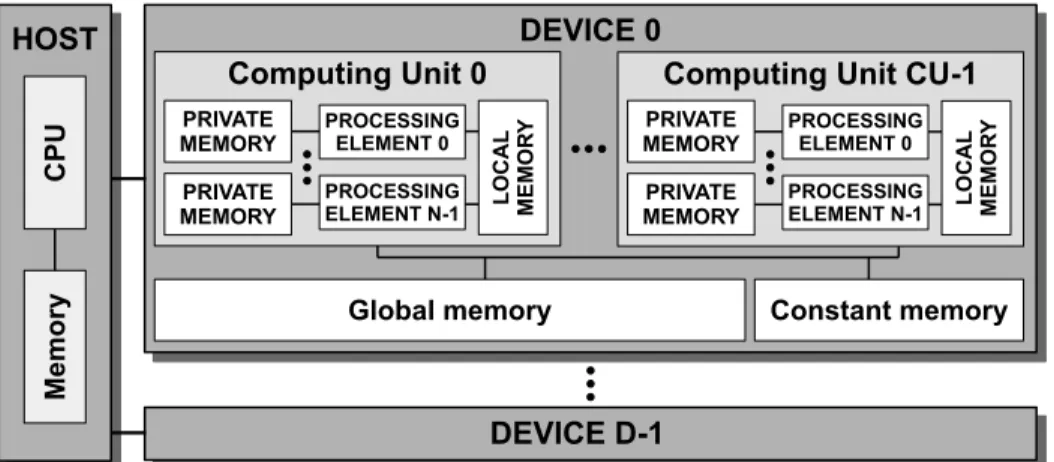
Figure 1: OpenCL hardware model. It is comprised of a host with a standard CPU and memory, to which a number of computing devices are attached.
computing units in Figure 1, which may share a small and fast scratchpad memory, called local memory.
Regarding the memory model, the devices have four kinds of memory. First, the global memory is the largest one and can be both read and written by the host or by any PE in the device. Second, a device may have a constant memory, which can be set up by the host and it is read-only memory for its PEs. Third, there is a local memory restricted to a single group of PEs. Finally, each PE in an accelerator has private memory that neither the other PEs nor the host can access.
2.2. HPL
The Heterogeneous Programming Library (HPL) [5], available under the GNU General Public License (GPL) at http://hpl.des.udc.es, supports the previously described model on top of the OpenCL standard. The library provides three main components to users:
• A template class Array that allows the definition of the variables that need to be communicated between the host and the devices.
• An application programming interface (API) that allows inspecting the available devices and requesting the execution of kernels.
• An API to express the kernels. Kernels can be written using a language embedded in C++, which allows HPL to capture the computations requested and build a binary for them that can run in the chosen device. Another possibility is to use HPL as an OpenCL wrapper [7], enabling the use of kernels written in native OpenCL C in a string, just as regular OpenCL programs do, and thus, easing code reuse.
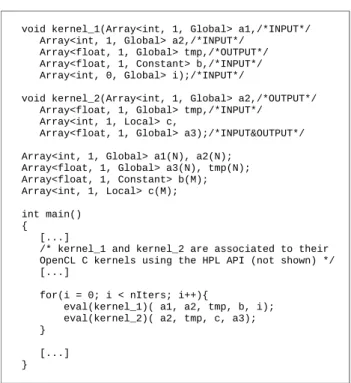
Figure 2: Example of an HPL application where two different kernels are invokednIters
times.
will be performed, as Local Arrays are invalidated between kernel runs. As for the output arrays, necessarily in global memory, they are only copied to the host when needed, for instance, when the Array data()method is used. This method returns a raw pointer to the array data in the host. When this method is called, HPL ensures that the data in the host is consistent by checking if any device has modified the array, and only in that case HPL transfers the newest version of the data from the device to the host. In fact, HPL always applies a lazy copying policy to the kernels arguments that ensures that transfers are only performed when they are actually needed.
3. CPPC overview
CPPC [4] is an open-source checkpointing tool available under the GPL at http://cppc.des.udc.es. It is implemented at the application level, and, thus, it is independent of the operating system and any higher-level framework used.
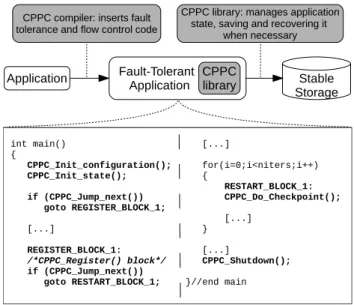
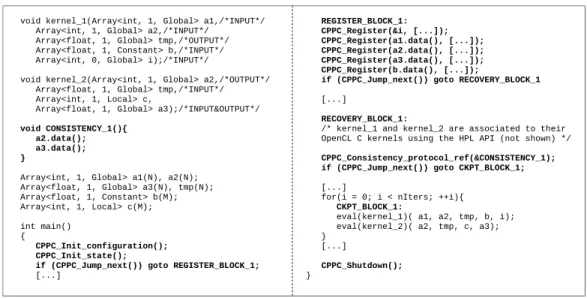
CPPC appears to the final user as a compiler tool and a runtime library. The CPPC compiler instruments the user-provided source files, adding calls to the CPPC library. This is illustrated in Figure 3, where the code inserted by the compiler is shown in boldface. The CPPC instrumentation performs the following actions:
Figure 3: At compile time the CPPC source-to-source compiler automatically transforms a code into an equivalent fault-tolerant version by adding the instrumentation code (marked in boldface in the figure).
• Registration of variables: the routine CPPC Register() explicitly marks the variables necessary for the successful recovery of the applica-tion, for their inclusion in checkpoint files. During restart, this routine also recovers the values from the checkpoint files to their proper mem-ory location.
• Checkpoint: the CPPC Do checkpoint() routine is placed inside the most computationally expensive loops. A checkpoint file will be gener-ated every N calls to this function, N being user-defined.
• Shutdown: the CPPC Shutdown() routine is added at the end of the application to ensure the consistent system shutdown.
liveness analysis to save only those variables that are essential for the appli-cation recovery. Besides, CPPC applies the zero-blocks exclusion technique, which avoids the storage of memory blocks that contain only zeros. More-over, CPPC provides multithreaded dumping, overlapping the checkpoint file writing with the computation of the application, and thus, reducing the checkpointing overhead.
The state files generated by CPPC are portable, allowing the execu-tion to restart on different architectures and/or operating systems. Porta-bility is achieved by using HDF5, a portable storage format available at http://www.hdfgroup.org/HDF5/, and by avoiding the inclusion in the
check-point files of non-portable state. This state is recovered through the re-execution of the code responsible for creating such state in the original execution. The compiler automatically identifies both the variables to be checkpointed and the non-portable code to be re-executed upon restart. The application stack is an example of such non-portable state, and it is recovered by recreating the sequence of original function calls that built the stack up to the checkpoint location. Additionally, CPPC incorporates a portability layer to deal with different file systems, being able to track open files at runtime, so that, upon restart, they can be re-opened and re-positioned in the correct part of the file.
variable registration blocks, checkpoint blocks, and non-portable state recov-ery blocks. The compiler inserts control flow code (labels and conditional jumps) to ensure an ordered re-execution. When the execution flow reaches the CPPC Do checkpoint() call where the checkpoint file was generated, the recovery process ends and the execution can resume normally.
For more details about CPPC and its restart protocol the reader is re-ferred to [3, 4].
4. Portable and adaptable checkpoint/restart of heterogeneous
ap-plications
This section describes our proposal to obtain adaptable fault tolerant HPC heterogeneous applications using CPPC and HPL. First, the design decisions are described and justified, to latter present the implementations details of the proposed solution.
4.1. Design decisions
Table 1: Maximum kernel times (seconds) of the most time-consuming applications from popular benchmarks suites for heterogeneous computing.
KERNELS
NUMBER
MAX. TIME
(SECONDS)
RODINIA
BENCHMARKS
DEFAULT
PARAMETERS
cfd 14004 0.00032 streamcluster 4833 0.00069 particlefilter 36 0.91775 hybridsort 21 0.10381
SHOC
BENCHMARKS
SIZE 4
SCAN 15360 0.00138 Spmv 10000 0.00320 MD 162 0.00901 Stencil2D 22044 0.00318
SNUNPB
BENCHMARKS
CLASS B
CG 8076 4.10887 FT 111 0.51884 SP 5637 0.05743 BT 3842 0.10504
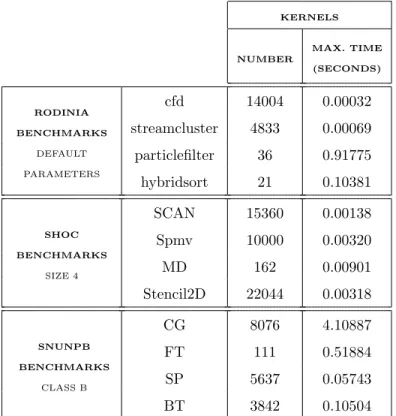
while in SHOC the largest problem available (size 4) was used. Finally, in SUN-NPB the configuration used was class B, as it was the largest problem that fits in the device memory. The studied applications execute a large number of kernels whose maximum times range from 0.32 milliseconds in application cfd to 4.1 seconds in CG, thus making host-side checkpointing a very appropriate alternative.
in the local and private memory of the accelerators), and the state shared among the host and the devices (data in the global and constant memory of the accelerators, which may or may not also be in the host memory). By locating checkpoints in the host code, only the host private state and the shared state need to be included in the checkpoint files. The fact that nei-ther private nor local memory data of the devices need to be checkpointed improves the performance of the proposal because smaller checkpoint file sizes are obtained, a key factor for reducing the checkpoint overhead.
Also, the solution must guarantee the consistency of the checkpointed data. During the execution of a heterogeneous application, computations performed in the host and in the devices can overlap, as the host can launch several kernels for their execution in the devices and continue with its own computation. Thus, a consistency protocol is needed to ensure a successful restart upon failure. The protocol must include synchronizations so that the kernels that may modify the data included in the checkpoint files are finished before the checkpointing. In addition, those checkpointed shared variables modified by the kernels must be transferred back to the host memory.
access them is prohibitive.
As checkpointing back-end, the CPPC tool was chosen because of the portable application-level approach it provides. The checkpoint files gener-ated by CPPC allow the restart on different host, while their size is reduced by checkpointing only the user-variables necessary for the recovery of the application, thus, reducing the checkpointing overhead.
When placing the checkpoints in the host code, if a non-vendor specific heterogeneous framework is used, the application can be potentially recov-ered using a different device architecture. Moreover, if the distribution of data and computation performed by the application is not tied to the num-ber of devices available at runtime, applications could be restarted adapting to a different number of devices. However, decoupling the distribution of data and computation from the number of devices available at runtime can be a hard task in some applications. The high programmability of HPL simplifies the implementation of programs in which the application data and computa-tion is not tied to the available devices at runtime. This, together with the fact that HPL is not tied to any specific vendor, operating system or hard-ware platform, facilitates the implementation of a fault tolerance solution that enables applications to be restarted using a different device architecture and/or a different number of devices.
4.2. Implementation details
actions: inserting checkpoints, registering the necessary host private variables or shared variables, generating the appropriate consistency protocol routines, and identifying the non-portable state recovery blocks.
First, the compiler identifies the most computationally expensive loops in the host code by performing an heuristic computational load analysis [3] and a CPPC Do checkpoint() call is inserted at the beginning of the body of these loops, in between kernel invocations. The most computationally expensive loops are those that perform the core of the computation, and thus take the longest time to execute, allowing the user to specify an adequate checkpointing frequency.
Once the checkpoints are located, the CPPC compiler automatically reg-isters the necessary data for the successful recovery of the application during restart. As established by the design of the proposal, by locating checkpoints in the host code, only the host private state and the shared state between host and devices need to be included in the checkpoint files. The CPPC compiler analyses the host code to identify which host private variables are alive when checkpointing, inserting the appropriate calls toCPPC Register(). The com-piler is extended to cope with HPLArray objects, identifying which of them correspond to shared variables alive when checkpointing, and using the HPL data() method to obtain a raw pointer to the data to be registered.
consistency of the data included in the checkpoint files. The consistency protocol routine works as a callback function: it is passed as an argument to the new CPPC library CPPC Consistency protocol ref() routine, so that, when a checkpoint call triggers a checkpoint generation, the appropri-ate callback consistency protocol routine is invoked. Using the information from the live variable analysis performed during the registration process, the CPPC compiler identifies which of the registered shared variables may be modified within the kernels. These potentially inconsistent shared variables necessarily correspond with shared Arrays in global memory. The consis-tency protocol routine is implemented by invoking the HPL data() method on those shared Arrays, which performs the necessary synchronizations and data transfers. Moreover, both synchronizations and data transfers are only performed when the host copy of the variable is inconsistent, otherwise, both operations are avoided, thus, minimizing the consistency protocol overhead. In order to preserve the portability features of both the checkpointing and the heterogeneous framework back-ends, the CPPC compiler is extended to avoid the inclusion in the checkpoint files of the non-portable state specific to heterogeneous applications. Instead, such non-portable state is recovered by the re-execution of those blocks of code responsible for its creation in the original execution. The CPPC compiler identifies as non-portable state the setup of the available devices at runtime, as well as the kernels definitions and compilations. As a result, the proposal is completely independent of the machine, and applications can be restarted using different hosts and/or devices.
com-Figure 4: The CPPC compiler locates the checkpoint at the beginning of the main loop, generates the appropriate registration calls for the live variables, and determines that the consistency protocol must be applied only to theArrays a2anda3, as no other registered
Arraymay be modified by the kernels.
4.3. Restart portability and adaptability
As commented previously, the implementation of the proposal pays spe-cial attention to the preservation of the portability features of both frame-works, allowing applications to be restarted using different hosts and/or de-vices. Additionally, by exploiting the high programmability of HPL via the instrumentation introduced by CPPC, applications can be restarted using a different number of devices. Two types of applications can be distinguished: pseudo-malleable applications and malleable applications, being the late ones able to fully adapt to a different number of devices at restart time. The CPPC compiler inserts the same instrumentation for both types of applications and it distinguishes one from another by activating a flag in the instrumentation code.
Pseudo-malleable applications are those in which the distribution of data and/or computation must be preserved when restarting, otherwise, the restart will not be successful. The CPPC compiler determines that an application is pseudo-malleable when any of the checkpointed variables has a dependency with the number of devices available at runtime. For instance, in the example code shown in Figure 5a, the registered variable d has such a dependency. These applications can be restarted using a larger or smaller number of phys-ical devices but the same number of virtual devices. When fewer physphys-ical devices are used to recover the application, some of them will have to per-form extra computations. When using a larger number of physical devices, some of them will not perform any computation. As shown in Figure 5b, the CPPC compiler inserts the instrumentation to perform the following actions:
(a) Original. (b) Instrumented by CPPC.
Figure 5: Automatic instrumentation of pseudo-malleable applications.
application (with the variable orig devices).
• Setting the number of devices used to the original number when the pseudomalleable flag is activated.
• Modifying all the references to particular devices to ensure they corre-spond with a physical device by using the real devices variable.
At runtime, HPL transparently manages the data allocations and transfers into the devices memory, releasing the CPPC instrumentation of this duty.
(a) Original. (b) Instrumented by CPPC.
Figure 6: Automatic instrumentation of malleable applications.
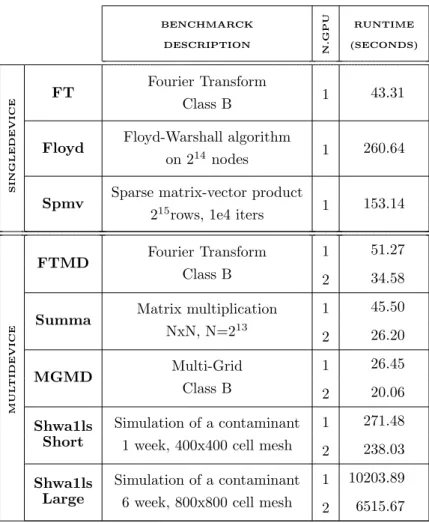
Table 2: Testbed benchmarks description and original runtimes. BENCHMARCK DESCRIPTION N.GPU RUNTIME (SECONDS) SINGLEDEVICE
FT Fourier Transform
Class B 1 43.31
Floyd Floyd-Warshall algorithm
on 214 nodes 1 260.64
Spmv Sparse matrix-vector product
215rows, 1e4 iters 1 153.14
MUL
TIDEVICE
FTMD Fourier Transform
Class B
1 51.27 2 34.58
Summa Matrix multiplication
NxN, N=213
1 45.50 2 26.20 MGMD Multi-Grid Class B 1 26.45 2 20.06
Shwa1ls Simulation of a contaminant
1 week, 400x400 cell mesh
1 271.48
Short
2 238.03
Shwa1ls Simulation of a contaminant
6 week, 800x800 cell mesh
1 10203.89
Large
2 6515.67
5. Experimental results
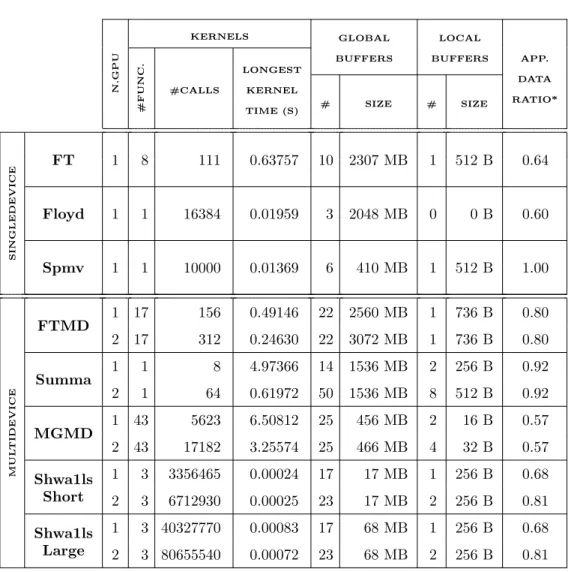
the algorithm for matrix multiplication described in [11]. Finally, Shwa1ls is a real application that performs a shallow water simulation parallelized for multiple GPUs in [12]. Most of the experimental results shown in this section were carried out with Shwa1ls-Short configuration, since it presents a reasonable execution time to carry out exhaustive experiments. However, some of the experiments have also been conducted with the Shwa1ls-Large configuration, so as to show the impact of the checkpointing operation in a long-running application. Table 3 further characterizes the testbed hetero-geneous applications. Regarding the kernels, it shows the number of kernel functions, the total number of invocations to the kernels, and the execution time of the longest kernel in the application. Additionally, the table presents how many buffers in global and local memory are used (showing both the number and their total size), and also the overall ratio between the applica-tion data inputs and outputs and the intermediate results. As can be seen in the table, the testbed applications cover a wide range of scenarios.
Table 3: Testbed benchmarks characterization.
N.GPU
KERNELS GLOBAL
BUFFERS
LOCAL
BUFFERS APP.
DATA
RATIO*
#FUNC.
#CALLS
LONGEST
KERNEL
TIME (S) # SIZE # SIZE
SINGLEDEVICE
FT 1 8 111 0.63757 10 2307 MB 1 512 B 0.64
Floyd 1 1 16384 0.01959 3 2048 MB 0 0 B 0.60
Spmv 1 1 10000 0.01369 6 410 MB 1 512 B 1.00
MUL
TI
D
E
VICE
FTMD 1 17 156 0.49146 22 2560 MB 1 736 B 0.80
2 17 312 0.24630 22 3072 MB 1 736 B 0.80
Summa 1 1 8 4.97366 14 1536 MB 2 256 B 0.92
2 1 64 0.61972 50 1536 MB 8 512 B 0.92
MGMD 1 43 5623 6.50812 25 456 MB 2 16 B 0.57
2 43 17182 3.25574 25 466 MB 4 32 B 0.57
Shwa1ls 1 3 3356465 0.00024 17 17 MB 1 256 B 0.68
Short 2 3 6712930 0.00025 23 17 MB 2 256 B 0.81
Shwa1ls 1 3 40327770 0.00083 17 68 MB 1 256 B 0.68 Large 2 3 80655540 0.00072 23 68 MB 2 256 B 0.81
*Application data ratio calculated as InputDataInputData+OutputData+OutputData+IntermediateData
native OpenCL equivalents.
5.1. Instrumentation and checkpoint overhead
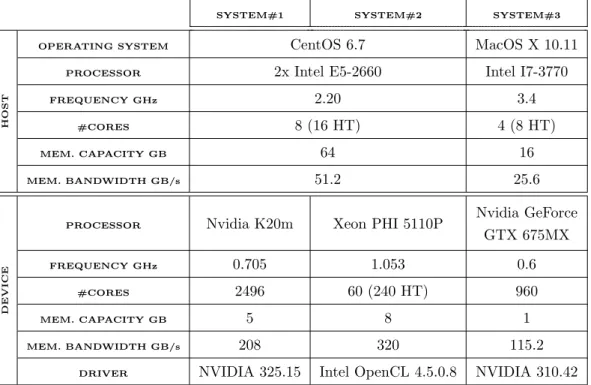
over-Table 4: Hardware platform details
SYSTEM#1 SYSTEM#2 SYSTEM#3
HOST
OPERATING SYSTEM CentOS 6.7 MacOS X 10.11
PROCESSOR 2x Intel E5-2660 Intel I7-3770
FREQUENCY GHz 2.20 3.4
#CORES 8 (16 HT) 4 (8 HT)
MEM. CAPACITY GB 64 16
MEM. BANDWIDTH GB/s 51.2 25.6
DEVICE
PROCESSOR Nvidia K20m Xeon PHI 5110P
Nvidia GeForce GTX 675MX
FREQUENCY GHz 0.705 1.053 0.6
#CORES 2496 60 (240 HT) 960
MEM. CAPACITY GB 5 8 1
MEM. BANDWIDTH GB/s 208 320 115.2
DRIVER NVIDIA 325.15 Intel OpenCL 4.5.0.8 NVIDIA 310.42
where more checkpoints would have to be done during a normal execution, we also show results for the Shwa1ls-Large application, where 10 checkpoint files (one every 17 minutes when using one GPU and one every 11 minutes when using 2 GPUs) are performed.
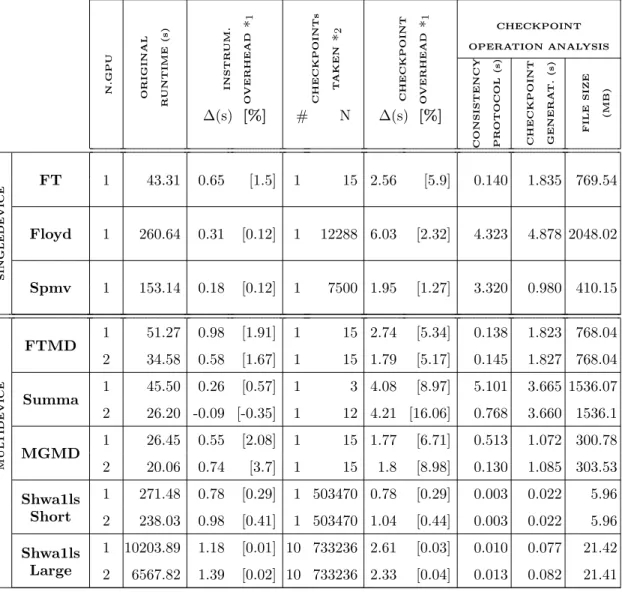
Table 5 analyses the instrumentation and checkpoint overheads. First, the original runtimes (in seconds) are presented. Then, both the instrumentation overhead absolute value (the difference with the original runtimes, in seconds) and relative value (that difference normalized with respect to the original times, in percentage) are shown. The instrumentation overhead is negligible, always below a few seconds. In the application Summa running on two GPUs, the instrumentation overhead is negative, explained by the optimizations applied by the GNU compiler.
Table 5: Instrumentation and checkpoint overhead analysis for the testbed benchmarks. N.GPU ORIGINAL R U NTIME (s) INSTR U M. O VERHEAD ∗1 CHECKPOINTs T AKEN ∗2
CHECKPOINT OVERHEAD
∗1 CHECKPOINT
OPERATION ANALYSIS
∆(s) [%] # N ∆(s) [%]
CONSISTENCY PR OTOCOL (s) CHECKPOINT GENERA T. (s) FILE SIZE (MB) SINGLEDEVICE
FT 1 43.31 0.65 [1.5] 1 15 2.56 [5.9] 0.140 1.835 769.54
Floyd 1 260.64 0.31 [0.12] 1 12288 6.03 [2.32] 4.323 4.878 2048.02
Spmv 1 153.14 0.18 [0.12] 1 7500 1.95 [1.27] 3.320 0.980 410.15
MUL
TIDEVI
CE
FTMD 1 51.27 0.98 [1.91] 1 15 2.74 [5.34] 0.138 1.823 768.04
2 34.58 0.58 [1.67] 1 15 1.79 [5.17] 0.145 1.827 768.04
Summa
1 45.50 0.26 [0.57] 1 3 4.08 [8.97] 5.101 3.665 1536.07 2 26.20 -0.09 [-0.35] 1 12 4.21 [16.06] 0.768 3.660 1536.1
MGMD
1 26.45 0.55 [2.08] 1 15 1.77 [6.71] 0.513 1.072 300.78 2 20.06 0.74 [3.7] 1 15 1.8 [8.98] 0.130 1.085 303.53
Shwa1ls 1 271.48 0.78 [0.29] 1 503470 0.78 [0.29] 0.003 0.022 5.96 Short 2 238.03 0.98 [0.41] 1 503470 1.04 [0.44] 0.003 0.022 5.96
Shwa1ls 1 10203.89 1.18 [0.01] 10 733236 2.61 [0.03] 0.010 0.077 21.42 Large 2 6567.82 1.39 [0.02] 10 733236 2.33 [0.04] 0.013 0.082 21.41
∗1) ∆(s) absolute overhead in seconds. [%]relative overhead with respect to the original
runtimes.
∗2)#Total number of checkpoints taken. N checkpointing frequency, iterations between
checkpoints.
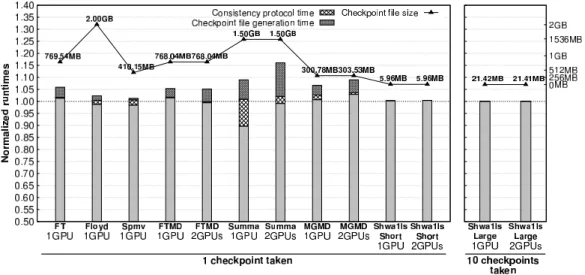
Figure 7: Normalized checkpoint overhead for the testbed benchmarks.
running on one GPU and generating a 5.96 MB checkpoint file, to a maximum value of 6.03 seconds for Floyd when saving 2 GB of data. The checkpoint file generation overhead includes the state management operations, the copy in memory of the data, and the creation of a thread to dump the data to disk. The actual dumping to disk is performed by the multithreaded dump-ing of CPPC in background, overlappdump-ing the checkpoint file writdump-ing to disk with the computation of the application. As can be observed, the check-point file generation overhead heavily depends on the size of the checkcheck-point files. Besides, the impact of this overhead obviously depends on the original application runtime.
gen-eration times. This situation can also be observed in Figure 7, where the consistency protocol is represented below the value 1 for those applications. This occurs because some operations in the original application take slightly less time when a checkpoint file is generated, due to the synchronizations per-formed by the consistency protocol. In Floyd, experimental results show that these synchronizations reduce the time spent by OpenCL, used as back-end by HPL, in some inner operations. In Summa and Spmv these synchro-nizations reduce the time spent in further synchrosynchro-nizations that exist in the original application code. This situation can happen quite frequently, since heterogeneous applications present synchronizations at some point of their execution.
5.2. Restart overhead
Figure 8: Runtimes for the testbed benchmarks after a failure. When a failure occurs, applications can be restarted from a checkpoint file instead of starting the execution from the beginning, which would consume more time.
the costs: the restart overhead (reading and positioning) and the application computation from the restart point to the end (the 25% of the total execution in these experiments). Upon a failure, when non-fault tolerance mechanisms are used, the applications have to be re-executed from the beginning. Thus, for comparison purposes the original runtimes are also represented in the figure (left bars).
In some applications the reading phase has a high impact due to the short runtimes, making the restart runtime close to the original runtime. How-ever, restarting the application from a previous checkpoint is always better than starting it from the beginning of the computation, and the benefits of including fault tolerance mechanisms in long-running HPC heterogeneous applications will be unquestionable.
5.3. Portability and adaptability benefits
The restart experiments presented in the previous subsection recovered the application using the same host and devices available during the original execution. This subsection presents the results when restarting using a dif-ferent host or device architecture and/or a difdif-ferent number of devices. All the systems described in Table 4 will now be used.
Figure 9 shows the restart runtimes when recovering the applications using the same host and different devices: the same GPUs, Xeon Phi accel-erators, and the CPU. The checkpoint file sizes are also shown. The devices positioning times vary with the device architecture, as the kernels compila-tion times are larger when using the Intel OpenCL driver in the Xeon Phi and CPU experiments. The computation times on the different devices are consistent with the original runtimes in the same device. For instance, in Spmv the original runtime is larger when using a GPU than when using a Xeon Phi accelerator, thus, the same tendency can be observed in the restart runtimes.
Figure 9: Restart runtimes for the testbed benchmarks on different device architectures.
Figure 10: Restart runtimes for the testbed benchmarks using a different number of GPUs.
0 100 200 300 400 500 SYSTEM#3 1GPU SYSTEM#1 1GPU SYSTEM#1 2GPUs 0MB 512MB 1GB 1.5GB 2GB Times (seconds) Restart system Original system Reading Host positioning Devices positioning Computation Shwa1ls Short Shwa1ls Short SYSTEM#3 1GPU SYSTEM#3 1GPU Checkpoint file size
5.96MB 5.96MB
Figure 11: Restart runtimes for Shwa1ls using a different host, a different number and architecture of devices, and a different operating system.
using a larger or a smaller number of devices. Besides, the restart runtimes of the malleable applications (FTMD and Shwa1ls) are not conditioned by the number of devices used for the checkpoint file generation, and, instead, these times are only influenced by the number of devices used during the restart execution, as an optimal distribution among them is performed.
using the available devices, even without using any accelerators at all, and to later continue its execution using a more appropriate set of devices, or vice-versa, depending on the availability of resources in the cluster.
6. Related work
Fault tolerance for parallel applications is a very active research topic with a large number of approaches published in the last two decades. Re-garding fault tolerance in heterogeneous applications, approaches exist based on Algorithm-Based Fault Tolerance (ABFT), in which extra information in the application is used to check the results for errors. Such a solution is presented in A-ABFT [13], which describes an ABTF proposal for matrix operations on GPUs. However, these solutions are highly specific for each particular application and algorithm.
More generic solutions are based on checkpointing. On the one hand, solutions exist that have focused on detecting soft errors, which usually do not result in a fail-stop error but cause a data corruption. A solution of this kind is VOCL-FT [14], which combines ECC error checking, logging of OpenCL inputs and commands, and checkpointing for correcting those ECC errors in the device memory that cannot be corrected by the device. On the other hand, the following paragraphs comment on other proposals that, like the one presented in this paper, are focused on fail-stop failures.
the host memory. The main drawback of diskless checkpointing is its large memory requirements. As such, this scheme is only adequate for applications with a relatively small memory footprint at checkpoint. Besides, some GPU applications postpone the data transfers until the end of the execution, which will be translated in an unsuitable checkpointing frequency.
CheCUDA [16] and CheCL [17] are checkpointing tools for CUDA and OpenCL applications, respectively. Both are implemented as add-on pack-ages of BLCR [18], a system-level checkpoint/restart implementation for Linux clusters. Checkpointing is triggered by POSIX signals: after receiving the signal, in the next synchronization between the host and the devices, the user data from the device memory is transferred to the host memory, and the host memory is checkpointed using BLCR. Also, both use wrapper functions to log the CUDA or OpenCL calls, in order to enable their re-execution dur-ing the restart process. CheCUDA requires no CUDA context to exist when checkpointing, as otherwise BLCR fails to restart. For this reason the con-text is destroyed before every checkpoint and recreated afterwards, as well as during the restart process, using the log of CUDA calls. In CheCL a dif-ferent strategy is used. The OpenCL application is executed by at least two processes: an application process and an API proxy. The API proxy is an OpenCL process and the devices are mapped to its memory space, allowing the application process to be safely checkpointable.
in CheCUDA, all CUDA resources have to be released before every check-point and recreated afterwards, as well as during the restart process, using a replay strategy to re-execute the CUDA calls from the log. However, the replay during the restart process relays on the reallocation of the memory chunks at the same address as before checkpointing, which is not guaranteed by NVIDIA and could not work correctly in certain environments.
Laosooksathit et al. [20] model and perform simulations to estimate the performance of checkpoints relying on virtualization and CUDA streams that are applied at synchronization points under the control of a model, but they offer no actual implementations.
HeteroCheckpoint [21] presents a CPU-GPU checkpointing mechanism using non-volatile memory (NVM). The application is instrumented by the programmer, explicitly indicating where and when a checkpoint is taken and which CUDA variables need to be checkpointed. CUDA streams are used to enable parallel data movement and the programmer can specify which CUDA variables are not modified in the kernels executed before a checkpoint, allow-ing variables to be pre-copied before a checkpoint starts. Also, redundant data between two checkpoints, as in an incremental checkpointing, do not cause unnecessary data transfers. In this proposal, when checkpointing, the host and the device are synchronized and data is transferred from the device memory to the NVM via the host memory.
pri-vate to an offload process, and dealing with the distributed states of the processes that conform the offload application. When the host receives a checkpoint signal, it pauses the offload application, drains all the communi-cation channels, captures a snapshot of the offload processes and the host, and resumes the execution. Snapify can be used for checkpoint and restart, process migration, and process swapping.
Table 6: Related work overview.
SUPPORTED
DEVICES CHECKPOINTING RESTART
NVIDIA XEONPHI GENERIC GRANULARITY FREQUENCY POR T ABLE AD APT ABLE Bautista
et al. [15] X
Application level
Timer decides when data transfer originates ckpt
CheCUDA [16] X System level (BLCR [18])
Signal triggers ckpt in next host-devs synchro.
CheCL [17] X System level (BLCR [18])
Signal triggers ckpt in next host-devs synchro.
NVCR [19] X System level (BLCR [18])
Signal triggers checkpoint Laosooksathit
et al. [20] X
System level (VCCP [23])
In kernels at synchros. chosen by a model
HeteroCkpt [21] X Application level
Indicated by the user in the host code
Snapify [22] X System level (BLCR [18]) Signal triggers checkpoint Proposal: CPPC+HPL X Application level
User-defined freq. at
points chosen by the tool X X
character-istics and number of devices used during their generation. Moreover, the application-level portable checkpointing further reduces the checkpoint files size and also decouples them from the host machine. Therefore, applica-tions can be recovered not only using a different device architecture and/or a different number of devices, but also using a host with a different archi-tecture and/or operating system. To the best of our knowledge, no other work provides such portability and adaptability benefits to heterogeneous applications.
7. Concluding remarks
This work presents a fault tolerance solution for heterogeneous applica-tions. The proposal targets HPL applications thus, it is not tied to any particular accelerator vendor. Fault tolerance support is obtained by using a host-side application-level checkpointing. The host-side approach avoids the inclusion in the checkpoint files of the device/s private state, while the application-level strategy avoids the inclusion of not relevant host data, thus minimizing the checkpoint files size. This approach provides portability and efficiency, while ensuring an adequate checkpointing frequency, as most of HPC heterogeneous applications execute a large number of short kernels.
com-bination of CPPC and HPL maximizes portability and adaptability, allowing failed executions to be resumed using a different number of heterogeneous computing resources and/or different resource architecture. The ability of applications to adapt to the available resources will be particularly useful for heterogeneous cluster systems.
The experimental evaluation shows the low overhead of the proposed solution, which is mainly determined by the saved state size. The restart experiments using hosts with different operating systems, different device architectures and different numbers of devices demonstrate the portability and adaptability of the proposal.
Future work includes the study of the proposed solution on heterogeneous MPI applications, which can also benefit from the use of a local recovery strategy. Using MPI implementations that provide resilience features, a fail-ure in one of the devices can be managed locally by one MPI process, instead of forcing the roll-back of all the MPI processes executing the application.
Acknowledgements
References
[1] S. W. Keckler, W. J. Dally, B. Khailany, M. Garland, D. Glasco, GPUs and the future of parallel computing, IEEE Micro 31 (5) (2011) 7–17.
[2] C. Di Martino, W. Kramer, Z. Kalbarczyk, R. Iyer, Measuring and Understanding Extreme-Scale Application Resilience: A Field Study of 5,000,000 HPC Application Runs, in: IEEE/IFIP International Confer-ence on Dependable Systems and Networks, 2015, pp. 25–36.
[3] G. Rodr´ıguez, M. J. Mart´ın, P. Gonz´alez, J. Touri˜no, A Heuristic Ap-proach for the Automatic Insertion of Checkpoints in Message-Passing Codes, Journal of Universal Computer Science 15 (14) (2009) 2894–2911.
[4] G. Rodr´ıguez, M. J. Mart´ın, P. Gonz´alez, J. Touri˜no, R. Doallo, CPPC: a compiler-assisted tool for portable checkpointing of message-passing applications, Concurrency and Computation: Practice and Experience 22 (6) (2010) 749–766.
[5] M. Vi˜nas, Z. Bozkus, B. B. Fraguela, Exploiting heterogeneous paral-lelism with the Heterogeneous Programming Library, Journal of Parallel and Distributed Computing 73 (12) (2013) 1627–1638.
[6] Khronos OpenCL Working Group, The OpenCL specification. Version 2.0.
[8] S. Che, M. Boyer, J. Meng, D. Tarjan, J. Sheaffer, S. Lee, K. Skadron, Rodinia: A benchmark suite for heterogeneous computing, in: IEEE International Symposium on Workload Characterization, 2009, pp. 44– 54.
[9] A. Danalis, G. Marin, C. McCurdy, J. S. Meredith, P. C. Roth, K. Spaf-ford, V. Tipparaju, J. S. Vetter, The Scalable Heterogeneous Comput-ing (SHOC) Benchmark Suite, in: ProceedComput-ings of the 3rd Workshop on General-Purpose Computation on Graphics Processing Units, 2010, pp. 63–74.
[10] S. Seo, G. Jo, J. Lee, Performance characterization of the NAS Par-allel Benchmarks in OpenCL, in: IEEE International Symposium on Workload Characterization, 2011, pp. 137–148.
[11] R. A. Van De Geijn, J. Watts, SUMMA: Scalable universal matrix mul-tiplication algorithm, Concurrency-Practice and Experience 9 (4) (1997) 255–274.
[12] M. Vi˜nas, J. Lobeiras, B. B. Fraguela, M. Arenaz, M. Amor, J. A. Garc´ıa, M. J. Castro, R. Doallo, A multi-GPU shallow-water simula-tion with transport of contaminants, Concurrency and Computasimula-tion: Practice and Experience 25 (8) (2013) 1153–1169.
[14] A. J. Pe˜na, W. Bland, P. Balaji, VOCL-FT: Introducing Techniques for Efficient Soft Error Coprocessor Recovery, in: International Conference for High Performance Computing, Networking, Storage and Analysis, 2015, pp. 71:1–71:12.
[15] L. Bautista-Gomez, A. Nukada, N. Maruyama, F. Cappello, S. Mat-suoka, Low-overhead diskless checkpoint for hybrid computing systems, in: International Conference on High Performance Computing (HiPC), 2010, pp. 1–10.
[16] H. Takizawa, K. Sato, K. Komatsu, H. Kobayashi, CheCUDA: A Check-point/Restart Tool for CUDA Applications, in: International Confer-ence on Parallel and Distributed Computing, Applications and Tech-nologies, 2009, pp. 408–413.
[17] H. Takizawa, K. Koyama, K. Sato, K. Komatsu, H. Kobayashi, CheCL: Transparent Checkpointing and Process Migration of OpenCL Applica-tions, in: IEEE International Parallel Distributed Processing Sympo-sium, 2011, pp. 864–876.
[18] P. H. Hargrove, J. C. Duell, Berkeley lab checkpoint/restart (BLCR) for Linux clusters, Journal of Physics: Conference Series 46 (1) (2006) 494.
[20] S. Laosooksathit, N. Naksinehaboon, C. Leangsuksan, A. Dhungana, C. Chandler, K. Chanchio, A. Farbin, Lightweight Checkpoint Mecha-nism and Modeling in GPGPU Environment, in: Workshop on System-level Virtualization for High Performance Computing, Vol. 12, 2010, pp. 13–20.
[21] S. Kannan, N. Farooqui, A. Gavrilovska, K. Schwan, HeteroCheckpoint: Efficient Checkpointing for Accelerator-Based Systems, in: 2014 44th Annual IEEE/IFIP International Conference on Dependable Systems and Networks, 2014, pp. 738–743.
[22] Rezaei, A. and Coviello, G. and Li, C.-H. and Chakradhar, S. and Mueller, F., Snapify: Capturing Snapshots of Offload Applications on Xeon Phi Manycore Processors, in: Proceedings of the 23rd Interna-tional Symposium on High-performance Parallel and Distributed Com-puting, 2014, pp. 1–12.