W O R L D B A N K W O R K I N G P A P E R N O . 1 7 0
Participatory
Communication
A Practical Guide
1818 H Street, N.W.
Washington, D.C. 20433, U.S.A. All rights reserved
Manufactured in the United States of America First Printing: June 2009
Printed on recycled paper
1 2 3 4 5 12 11 10 09
World Bank Working Papers are published to communicate the results of the Bank’s work to the development community with the least possible delay. The manuscript of this paper therefore has not been prepared in accordance with the procedures appropriate to formally-edited texts. Some sources cited in this paper may be informal documents that are not readily available.
The findings, interpretations, and conclusions expressed herein are those of the author(s) and do not necessarily reflect the views of the International Bank for Reconstruction and Development/The World Bank and its affiliated organizations, or those of the Executive Directors of The World Bank or the governments they represent.
The World Bank does not guarantee the accuracy of the data included in this work. The boundaries, colors, denominations, and other information shown on any map in this work do not imply any judgment on the part of The World Bank of the legal status of any territory or the endorsement or acceptance of such boundaries.
The material in this publication is copyrighted. Copying and/or transmitting portions or all of this work without permission may be a violation of applicable law. The International Bank for Reconstruction and Development/The World Bank encourages dissemination of its work and will normally grant permission promptly to reproduce portions of the work.
For permission to photocopy or reprint any part of this work, please send a request with complete information to the Copyright Clearance Center, Inc., 222 Rosewood Drive, Danvers, MA 01923, USA, Tel: 978-750-8400, Fax: 978-750-4470, www.copyright.com.
All other queries on rights and licenses, including subsidiary rights, should be addressed to the Office of the Publisher, The World Bank, 1818 H Street NW, Washington, DC 20433, USA, Fax: 202-522-2422, email: [email protected].
ISBN-13: 978-0-8213-8008-6 eISBN: 978-0-8213-8010-9
ISSN: 1726-5878 DOI: 10.1596/978-0-8213-8008-6
Cover photo by Curt Carnemark
iii
Contents
Preface ...v
1. Development Communication...1
Trends in Development Communication ...1
A Call for Participation ...3
Defining Participation ...4
Conceptual Challenges in a Participatory Communication Model ...7
Notes...8
2. Participatory Communication ...9
History and Vision: A Snapshot ...9
Conceptual Framework...10
Participatory Spaces: The Role of the Media...12
Combining Theory with Practice: The Multi-Track Model ...13
Notes...16
3. Applying Participatory Communication in Development Projects ...17
Participatory Communication in Action...17
The Four Phases of the Communication Program Cycle...20
Notes...36
4. Participatory Communication in Civil Society ...37
Women, Healthy Lifestyles and Community Empowerment ...37
Youth and Participatory Governance...39
Disability, Social Mobilization and Bottom-Up Advocacy...43
Lessons Learned...46
References...49
Tables Table 1.1. Lasswell’s Theory...1
Table 1.2. The Conceptual Approaches to Development Communication ...8
Table 2.1. The Main Features of Communication Modes ...13
Table 3.1 The Johari Window...21
Figures
Figure 3.1. The Funnel Approach: Zooming In on Key Issues ...23
Boxes
v
Preface
hat do we mean when we say participatory communication? What are the practical implications of working with participatory communication strategies in develop-ment and social change processes? What experiences exists in practice that documents that participatory communication adds value to a development project or program?
The aim of this user guide on participatory communication is to provide answers to some of these questions. Many communication practitioners and development workers face obstacles and challenges in their practical work. A participatory communication strategy offers a very specific perspective on how to articulate social processes, decision-making processes, and any change process for that matter. Participatory approaches are nothing new. However, what is new is the proliferation of institutions, especially governmental but also nongovernmental organizations (NGOs), that seek participatory approaches in their development initiative.
This guide seeks to provide perspectives, tools and experiences regarding how to go about it with participatory communication strategies. It is conceived as a guide to be of relevance and utility for development workers in the field. It is targeted at both at government and their officials, World Bank staff, and at civil society.
The particular relevance of this guide is three-fold:
■
placing the practitioner debate about participatory communication within a conceptual framework, allowing the practitioner who reads this to position him- or herself conceptually, understanding some of the possible implications of opting for one or another strategic approach in their use of communication■
providing an introduction to the use of a participatory communication approach to specific development projects as well as illustrating the use of participatory communication in broader social change processes.■
drawing generic lessons learned from the experiences with participatory communicationIt is thus our hope that this user guide in participatory communication will contribute to the formulation of communication strategies that again can enhance dynamic, engaging, and sustainable change processes.
Finally, we would like to thank those people who participated in the review of the draft document. We thank Line Friberg, Karen Reiff, Obadiah Tohomdet, Tony Lambino, and Barbara Catherwood. A special thanks goes to Florencia Enghel who challenged us by raising many questions as well as providing us with very detailed comments. Finally, we should acknowledge the contribution of the Danish Ministry of Foreign Affairs that made this publication possible.
Thomas Tufte and Paolo Mefalopulos Copenhagen and Washington, DC. January 20, 2009
1
C H A P T E R 1
Development Communication
Trends in Development Communication
The discipline of development communication, both as theory and as practice, emerged closely interconnected with the growing “development industry.” From the outset “development support communication,” “program support communication,” “communication for development,” or as called in this publication, “development communication,” has been seen as a strategic tool to persuade people to change and enhance development processes.
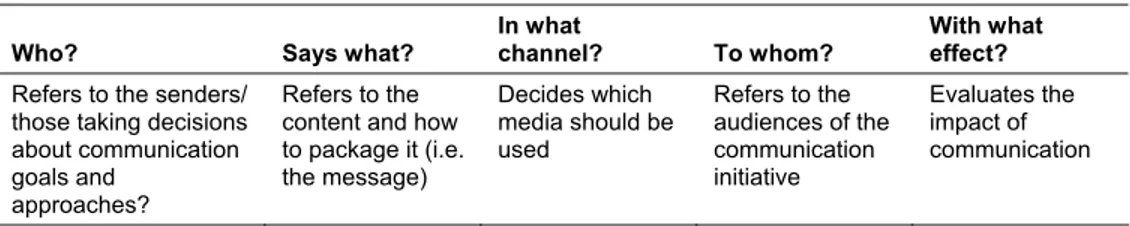
Many communication models have informed the field. The early models like Lasswell’s communication theory (1948) were linear in their understanding of communication, which was understood as a transfer of information, leading to foreseeable step-by-step change processes, as it is shown in its model illustrated below. These processes were usually identified with changes in behaviors much in line with the development thinking of the modernization paradigm. Persuasion theory, originating from the advertising industry, also became a strategy to achieve information transfer.
Throughout the 1970s and 1980s, strategic communication approaches to enhance individual behavior change evolved to be known as behavior change communication (BCC). Behavior change communication is associated closely with social marketing. Social marketing strategies are a means to promote particular behaviors or social norms via communication interventions. Social marketing is widely used in health communication, including family planning, and more recently in HIV/AIDS communication.
In these early models of strategic communication, there were no participatory elements. The assumption was that the power of communication to enhance development was in the correct crafting of the content and in the adequate targeting of audiences. The goal was individual behavior change.
Table 1.1. Lasswell’s Theory
Who? Says what?
In what
channel? To whom?
With what effect? Refers to the senders/
those taking decisions about communication goals and
approaches?
Refers to the content and how to package it (i.e. the message)
Decides which media should be used
Refers to the audiences of the communication initiative
By the early 1990s, budget line items for Information, Education and Communication (IEC) activities began to be incorporated more systematically within development projects. Typically these activities are nonparticipatory in approach, emphasizing dissemination of information via the production of audio-visual or print materials.
Two models of communication came to dominate. First, the diffusion model of communication emerged, which relies heavily on the practice and theory of Everett Rogers (1962), emerged. Second, during the 1950s, experiences with participatory communication first appeared when Brazilian adult educator Paulo Freire worked with adult literacy campaigns among the poor peasants in North-eastern Brazil.1 Freire’s original literacy work empowered landless peasants to formulate their own demands for a better life and to liberate themselves from oppressive conditions. From this experience, he grew into one of the most influential proponents for participatory communication theory and practice. Central to this line of thinking was the emphasis on letting the stakeholders get involved in the development process and determine the outcome, rather than imposing a pre-established (i.e. already decided by external actors) outcome.
From the outset the focus of participatory communication was on dialogical communication rather than on linear communication. The emphasis was on participatory and collective processes in research, problem identification, decision-making, implementation, and evaluation of change.
Most recently participatory approaches to communication have reinforced the emphasis on structural and social change. A broad-based policy debate initiated by the Rockefeller Foundation in 1997 and pursued by the Communication for Social Change Consortium in subsequent years has focused on structural inequality and social transformation. The “Rockefeller process” led to a definition of communication for social change as “a process of public and private dialogue through which people themselves define who they are, what they need and how to get what they need in order to improve their own lives. It utilizes dialogue that leads to collective problem identification, decision making, and community-based implementation of solutions to development issues” (www.communicationforsocialchange.org).
Another line of thinking within development communication focuses on life skills development. This deals with the issues of developing core competencies required to engage actively as a citizen in society. This approach developed through the 1990s with a close connection to formal and informal education. Areas such as health education, civic education, income generation, and human rights are the core competencies associated with life skills development, and the forms of communication are didactic and face-to-face. Life skills development initiatives are performed in both formal and informal educational contexts.
Participatory Communication: A Practical Guide 3
A Call for Participation
While the quest for participation in development programs and projects has existed for a long time, in recent years it has gained voice and become a stronger concern. Participation is a principle in development with support coming from many different stakeholders: governments, donors, civil society, and ordinary citizens
From the 1970s and onwards, voices of both development practitioners and academics from developing countries have raised fundamental questions about the Western domination of the work and debate in development. The questions include who voices the concerns of the poorest and most marginalized populations, how is policy developed, and who participates in the decision-making processes? At the core of these concerns lies the quest for participation of the “voiceless” from developing countries—the marginalized and poorest sectors, as well as the disabled and women— in the international policy development and debate, as well as in the practical day-to-day work of implementing development projects. These questions have gained resonance today among many of the larger institutions working with development.
An early critique comes from Latin America through Freire’s work in Brazilian adult education. He produced seminal works on the history of participatory communication, particularly his books on liberating pedagogy (1979) and his critique of extension work (1973). The section on defining participation contains an elaboration of his dialogical communication model, which emphasizes a close dialectic between collective action and reflection and works towards empowerment.
Additional early Latin American contributions to participatory strategies included scholars and practitioners who, in line with the dependency paradigm’s national discourse, were critical of the international (Western) centers. They were also inspired by the resistance movements against military dictatorships and the pro-democracy movement across Latin America, especially in the 1980s. Examples of this critical thinking and concern about people’s participation are reflected in the academic works of British development researcher Robert Chambers (1983) and Colombian development researcher Arturo Escobar (1995).
Within development practice in the course of the 1990s and into the new millennium, these critical approaches to the dominant development discourses grew. From the large UN summits through the 1990s to the world social forums in recent years, with a growing voice civil society has articulated questions and concerns about participation in the development discourse, policy process, and actual practice. Transnational advocacy networks within a growing global civil society have provided innovative spaces for the participation paradigm to evolve into an ever more resonant quest for the contributions of the voiceless, the poorest, and marginalized sectors. As promises of past paradigms fail to materialize, the demand for a shift from expert-driven models to endogenous ones grows steadily.
The international development community has been attentive to the issues raised. Today participation, along with concerns for voice, empowerment, and poverty orientation, is at the core of much development work, particularly in governance issues. Participatory approaches are present in project cycles of many organizations.
Defining Participation
Stakeholders often have very different visions and definitions of participation in development. Therefore, for development practitioners to be clear on their conceptual approach to participation, a series of important questions have to be answered:
■
What is participation to each stakeholder?■
Why is participation so important in development processes, and for whom is it important?■
Who is supposed to participate?■
When is participation relevant, and for whom?■
What are the most common constraints to participation, and according to whom?■
How is a successful participatory process evaluated?No consensus exists around a common definition of participation: it varies depending on the perspective applied. Some stakeholders define participation as the mobilization of people to eliminate unjust hierarchies of knowledge, power, and economic distribution. Others define it as the reach and inclusion of inputs by relevant groups in the design and implementation of a development project. These examples represent two of the main approaches to participation: a social movement perspective
and a project-based or institutional perspective. These perspectives share a common
understanding of participation as the involvement of ordinary people in a development process leading to change. Their scope and methods, however, can differ.
Why is a participatory approach required? There are several answers. From the institutional perspective mentioned above, participation can be used a tool to achieve a pre-established goal defined by someone external to the community involved. For the social movement mentioned above, participation itself can be a goal as an empowering process. There is, however, growing consensus for active participation in the early stages of a development project or program, both in research and design of interventions. Such participatory goal setting does not secure a continued role for participation in the following stages of project implementation. It only indicates that with ownership in setting goals a sustained process with relevant outcomes and impact will be possible.
Furthermore, the fundamental aim of empowering people to handle challenges and influence the direction of their own lives is inherent in participation. In Deepa Narayan’s definition of empowerment, participation becomes a turning point: “Empowerment is the expansion of assets and capabilities of poor people to participate in, negotiate with, influence, control, and hold accountable institutions that affect their lives” (Narayan 2006: 5). Narayan’s perspective is the institutional one, where participation for empowerment is about strengthening the people’s capacities and the demand side of governance.
Participatory Communication: A Practical Guide 5
■
Psycho-social outcomes of increased feelings of ownership of a problem and a commitment to do something about it■
Improvement of competencies and capacities required to engage with thedefined development problem
■
Actual influence on institutions that can affect an individual or communityThese illustrate that participation produces outcomes at least three levels:
■
Individual psycho-social level■
Life skills level, emphasizing the acquirement of competencies■
Institutional level or the level of community developmentKeywords: Goal versus tool, participatory strategies result in a continuum of outcomes: ownership, commitment, competencies, capacities, institutional influence.
Participation as a Method in Development Projects
This section explores how participation can be used by development organizations, ranging from international agencies to civil society organizations. Within this landscape of organizations, participation is an essential tool in development projects:
■
Providing basic services effectively – Mechanisms of public or private service provision, including health, education, transport, agricultural extension and water, entail strategies that are affordable and inclusive even of marginalized groups.■
Pursuing advocacy goals – Collection of data from ordinary citizens feeds their voice into policy formulation processes. A key element to achieve this input is support of civil society and local governance initiatives, such as popular participation in public budgeting and individual and community empowerment programs that strengthen the voice of marginalized groups. Furthermore, advocacy has grown significantly in recent years as an NGO activity.■
Monitoring progress towards goals – These activities include self-reporting schemes and direct community involvement in monitoring processes.■
Facilitating reflection and learning among local groups – Opportunities for dialogue, learning and critique become central elements in evaluating a project or program.Stages of a Participatory Development Project
Each project issue can be divided into stages, and this division facilitates assessment of when and to what degree a participatory approach is relevant. From an institutional perspective, there are four key stages of a development project:
and community knowledge and attitudes, existing policies and other relevant contextual information related to socio-economic conditions, culture, spirituality, gender, etc.
2. Design Stage defines the actual activities. A participatory approach helps to secure the ownership and commitment of the communities involved. Active participation by local citizens and other stakeholders aims to enhance both the quality and relevance of the suggested interventions.
3. Implementation Stage is when the planned intervention is implemented. Participation at this stage increases commitment, relevance and sustainability. 4. Evaluation Stage participation ensures that the most significant changes are
voiced, brought to common attention and assessed. For a meaningful evaluation, indicators and measurements should be defined in a participatory process at the very beginning of the initiative involving all relevant stakeholders.
Chapter 3 provides an in-depth look at how to make a participatory approach to communication operational at every stage. If all activities incorporate authentic, or highest-level, participation, empowerment results.
Keywords: Participation as tool: allows service provision; enables voice; allows monitoring via self-reporting; facilitates critical reflection and learning. Participation in four stages of a project: research, design, implementation and evaluation.
A Typology of Participation
Cutting across the distinctions of participation as a goal versus participation as a tool used in specific project stages allows different perceptions of participation to be identified. Each of the categories below refers to different levels of participation and communication (see also Mefalopulos 2008: 91ff). When initiating a development project or program, it is useful to clarify what perception of participation will guide the strategy conceptually. Stretching the concept, four perceptions can be identified:
■
Passive participation is the least participatory of the four approaches. Primary stakeholders of a project participate by being informed about what is going to happen or has already happened. People’s feedback is minimal or non-existent, and their participation is assessed through methods like head counting and contribution to the discussion (sometimes referred to as participation by information).■
Participation by consultation is an extractive process, whereby stakeholders provide answers to questions posed by outside researchers or experts. Input is not limited to meetings but can be provided at different points in time. In the final analysis, however, this consultative process keeps all the decision-making power in the hands of external professionals who are under no obligation to incorporate stakeholders’ input.Participatory Communication: A Practical Guide 7
the project. This level of participation does not usually result in dramatic changes in what should be accomplished, which is often already determined. It does, however, require an active involvement in the decision-making process about how to achieve it. This incorporates a component of horizontal communication and capacity building among all stakeholders—a joint collaborative effort. Even if initially dependent on outside facilitators and experts, with time collaborative participation has the potential to evolve into an independent form of participation.
■
Empowerment participation is where primary stakeholders are capable and willing to initiate the process and take part in the analysis. This leads to joint decision making about what should be achieved and how. While outsiders are equal partners in the development effort, the primary stakeholders are primus inter pares, i.e., they are equal partners with a significant say in decisions concerning their lives. Dialogue identifies and analyzes critical issues, and an exchange of knowledge and experiences leads to solutions. Ownership and control of the process rest in the hands of the primary stakeholders.Keywords: Passive participation, consultation, functional participation, empowerment participation
Conceptual Challenges in a Participatory Communication Model
When approaching a development problem from a communications perspective, to what conceptual approaches should one refer?
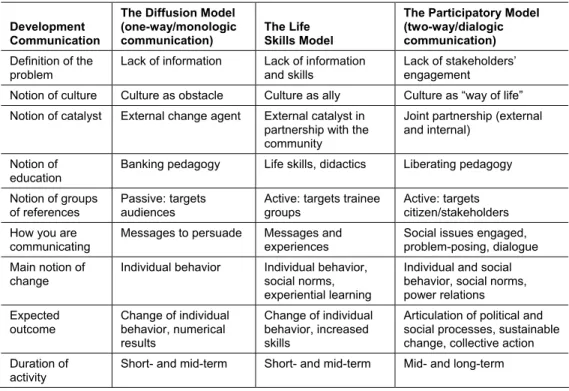
In the multiplicity of communication approaches applied in development over the years, two main schools dominate and co-exist in today’s development practice. On one hand, the diffusion model encompasses a broad range of strategies aiming to solve problems due to “lack of knowledge and information.” External change agents drive the processes, with little to no room for participation. This approach is linear, monologue-like, top-down communication.
On the other hand, is the participatory model based on Freire’s liberating pedagogy from the 1960s, renewed in more recent debates about development? This school takes globalization, transnational networking, new media and governance into account. These issues help to determine the strategic communication objectives. Rather than communicating the correct or relevant information to specific audiences, it is about articulating processes of collective action and reflection by relevant stakeholders. The center of attention is the empowerment of citizens by their active involvement in the identification of problems, development of solutions and implementation of strategies. The participatory model is a dialogic and horizontal approach to communication and development.
The Life Skills Training Model can be considered as the intermediary model of development communication (Hendricks 1998). In life skills training, the focus is on the development of personal skills. This approach also originates in adult education, but in development work it is connected with rights-based approaches, as well as with addressing structural conditions that impede skills development.
Table 1.2. The Conceptual Approaches to Development Communication
Development Communication
The Diffusion Model (one-way/monologic communication)
The Life Skills Model
The Participatory Model (two-way/dialogic communication) Definition of the
problem
Lack of information Lack of information and skills
Lack of stakeholders’ engagement
Notion of culture Culture as obstacle Culture as ally Culture as “way of life” Notion of catalyst External change agent External catalyst in
partnership with the community
Joint partnership (external and internal)
Notion of education
Banking pedagogy Life skills, didactics Liberating pedagogy
Notion of groups of references
Passive: targets audiences
Active: targets trainee groups
Active: targets citizen/stakeholders How you are
communicating
Messages to persuade Messages and experiences
Social issues engaged, problem-posing, dialogue Main notion of
change
Individual behavior Individual behavior, social norms, experiential learning
Individual and social behavior, social norms, power relations Expected
outcome
Change of individual behavior, numerical results
Change of individual behavior, increased skills
Articulation of political and social processes, sustainable change, collective action Duration of
activity
Short- and mid-term Short- and mid-term Mid- and long-term
The nine parameters in the left column are a conceptual checklist to work within the earliest stages of developing a participatory communication strategy. Thus, a conceptual clarity can emerge from discussing these parameters. This discussion can relate the parameters to the four stages (research, design, implementation, evaluation) of a participatory development project, as well as to the typology of participation (passive, consultation, collaboration, empowerment) both presented earlier in this chapter. A closer analysis of participatory communication follows in Chapter 2.
Notes
1 Participatory approaches have been also adopted in other sectors, such as forestry, where
9
C H A P T E R 2
Participatory Communication
History and Vision: A Snapshot
The vision of using new technologies to pursue better lives for humankind has always existed, and it was reinforced throughout the 20th century with each new technological advancement. In 1927 the German author Bertolt Brecht formulated a “radio theory” in which he envisioned the new technology, the radio, as a dialogical instrument for change: “Change this apparatus over from distribution to communication… On this principle the radio should step out of the supply business and organize its listeners as suppliers” (Brecht 1927). It was in many ways a precursor to the theory and practice of participatory communication, as well as of interactive media such as the internet.
In the years that followed Brecht’s early vision, the radio lost its dialogic potential as it developed into a mass mediated broadcasting instrument. However, today’s rapid spread of community radio, as well as the growth of digital radio and interactive radio program formats, revives the participatory potential of radio technology.
Brecht’s work contains the two core visions still inherent today in participatory communication: first, technologies possess the potential to improve the lives of many people by giving them a voice; second, his groundwork laid out the educational principles inherent in many of today’s participatory communication models— dialogical communication.
Brecht’s educational principles have inspired many in innovative theatre, including Brazilian theatre practitioner Augusto Boal. Developed in the 1970s, his ideas from Forum Theatre brought principles of participatory theatre a step further, and they are still spreading around the world (Boal 1974).
In the 1960s and 1970s, the Colombian sociologist Orlando Fals Borda developed participatory action research (PAR) as a methodology involving stakeholders in the identification of the core issues in development process. Later in the 1980s, Robert Chambers, a research associate at the Institute of Development Studies in Sussex, UK, was instrumental in developing a successful methodology for community facilitation known as Participatory Rural Appraisal (PRA). PRA makes people express their own knowledge and conduct their own analysis, assessment, and action planning.
Conceptual Framework
When applying a participatory approach to communication in development projects, there are key questions and a framework of guiding principles to lead practitioners and stakeholders. The following are key questions to consider:
■
What is the development problem to address: information, lack of skills, or social inequality?■
What notion of culture is inherent in the proposed approach?■
Is the catalyst or change agent understood?■
What principles guide the understanding of education?■
Are there active stakeholders or audiences to address? What are their respective roles in the communication process?■
What messages will be communicated: examples, life experiences or social issues?■
What is the aim of the change: individual behaviors, social norms, power relations, social or economic structures?■
How will outcomes be monitored and evaluated?■
What is the time perspective to achieve the desired changes?These questions are relevant to pose prior to any communication for development intervention. Chapter 3 will move a step further and provide practical guidelines and illustrations of how the monologic and dialogic approaches to communication for development can apply participation.
Guiding Principles
A number of principles emerge as fundamental to participatory communication. These principles stem from globally influential thinkers and contribute to the framework under which participatory communication has evolved. Although not an exhaustive list, the following are some of the most important principles:
Dialogue
The free and open dialogue remains the core principle of participatory communication. Paulo Freire defines dialogue as “the encounter between men in order to name the world. Those who have been denied their primordial right to speak their word must first reclaim this right and prevent the continuation of this act of exclusion.” For Freire, the free and open dialogue whereby people can “name the world” is voice, the principle of action-reflection-action and horizontal communication.
Participatory Communication: A Practical Guide 11
Voice
Central to dialogic communication is a consciousness of power relations contained in any human relationship. Freire’s concern was a shift in power, giving voice to marginalized groups, time and space to articulate their concerns, to define their problems, to formulate solutions, and to act on them. The role of the media in participatory communication possesses similar concerns. Supporting and strengthening community media can ensure the most marginalized groups have a platform to voice their concerns, engage in public debate and solve problems.
Liberating Pedagogy
For dialogic communication to happen, someone or something has to articulate the process. This catalyst is typically a person,1 either internal to the community or external, acting to facilitate the dialogue. A radio or television program could also serve as the catalyst. According to Freire, however, the objective of the catalyst is not only to offer relevant solutions to pre-defined problems, thus simply disseminating information from the informed to the uninformed in a non-participatory manner. Rather, the catalyst would articulate a dialogue whereby collective problem identification and solution would take place (Freire 1970).
For this liberating pedagogy to take place, Freire outlined four pillars on which to communicate: love, humility (the absence of arrogance), faith and hope. The logical consequence is the establishment of mutual trust. The result of a liberating pedagogy based on dialogue is what he termed “conscientizacão,” which translates roughly into action-oriented awareness raising. Freire’s liberating pedagogy contrasts what he called a “banking pedagogy” of depositing information in the minds of people (see the conceptual framework in Chapter 1).
Action-Reflection-Action
Despite the emphasis on dialogue and reflection, participatory communication is also strongly action oriented. As a crucial ingredient of participatory communication, the empowerment process is based on reflection on problems, but also on integration of action—the attempt to act collectively on the problem identified. It grounds the “talk” in real life problems.
Key results of participatory communication are the articulation of awareness raising and commitment to action. First and foremost, it becomes a process of empowerment for involved communities that feel commitment to and ownership of the problem. Issues of leadership lay inherent in the attention given to the catalyst, and the emphasis of the collective nature of the process speaks to the need for mutually reinforcing the commitment to change, as well as speaking to the actual issue of power. Today these guiding principles are widely recognized as the foundation of most participatory communication. In the 1970s, the Bolivian communication pioneer Luiz Ramiro Beltrán spoke of “horizontal communication” as a way of pinpointing what participatory communication brings to the table, which is significantly different from the diffusion- and effects-oriented communication models (Beltrán 1979).
Keywords: Naming the world, true dialogue, voice, power, liberating pedagogy, catalyst,
Participatory Spaces: The Role of the Media
Access to spaces of communication and dialogue is crucial, as mentioned previously. This access is also a crucial step in the participatory communication assessment, which will be elaborated in Chapter 3. What is often not made explicit in participatory communication approaches, however, is the important role of media access, which is increasingly crucial considering the rapid changes in media tools, coverage and worldwide use. Thus, participatory communication is also about visibility and voice in the mediated public sphere, which leads us to ask further: what more concrete roles do the media play in participatory communication?
While some of the diffusion-oriented, monologic models of communication focus on national mass media’s key roles in communication interventions, the more participatory strategies emphasize media that allows more dialogue, such as community-based media. Whether media serve only as channels of communication or whether they become catalysts of social mobilization and change in themselves is another distinction. The Colombian scholar Clemencia Rodriguez argues in her book, Fissures in the Mediascape, “citizen media are highly participatory by providing access and space for people to participate in all phases of media production” (Rodriguez, 2001).
Furthermore, another distinction regards choice of medium—whether to use mass media or face-to-face communication like theatre or concerts. Linked to this choice is a concern for how the chosen media and communication formats are used. For example, theatre can be used not only for one-way communication but also in very participatory and dialogical ways, as in Augusto Boal’s Forum Theatre.
Over the years, a series of concepts have emerged emphasizing different aspects of media’s role in participatory communication processes. F. Ogboajah spoke in the mid 1980s of the “Oramedia” in Africa. These media were all the popular forms of communication from poetry and folk tales to theatre and musical concerts. They were grounded in indigenous culture and both produced and consumed by members of a group, reinforcing the values of that group. This concept stresses not only the cultural characteristics of these media but also the people’s participation in their production and consumption. With a more political approach, the concept of “Alternative Media” emerged in Latin America in the 1970s to signify the grassroots media—community radios, murals, video documentaries—in opposition to the mainstream media. These came to symbolize a resistance platform in the fight against the military dictatorships and provided a space for the voice and visibility of oppressed groups under these regimes. In 1984, British-American John Downing coined “Radical Media” and Clemencia Rodriguez the concept of “Citizen Media” in 2001. Each in their own way, these theories incorporate aspects of citizenship and people’s participation.
In developing participatory communication strategies, media-specific concerns evolve around the following issues:
■
Types of media: from folk, community, and mass media to the new media of internet and satellite communicationParticipatory Communication: A Practical Guide 13
■
Nature of media: electronic media, one-way or interactive, face-to-face communication■
Institutional characteristics of media: from public to private, national to community-owned, free and independent to closely government controlled■
Economic logic informing the media: commercial media, non-profit media,and mixed models.
Does the existing media environment stimulate dialogue and empowerment processes? This question needs to be answered to assess how and to what degree collaboration with media can contribute to giving voice and visibility to the communities involved.
The list of related media issues could be expanded to include a distinction between analog versus digital media, state of legal regulation of the media, diversification of media types, massification of access. These are keywords that describe the process leading to a new media scenario where new opportunities are provided for people and groups to be directly involved in program development and management.
Keywords: Media access, community-based media, culture and Oramedia, politics and alternative media, citizenship and citizens media, new media scenario
Combining Theory with Practice: The Multi-Track Model
The multi-track model originated from the need to combine the richness and complexity of operational approaches and development challenges into a consistent methodological communication framework. To highlight its flexibility and adaptability to various situations, this model divides its approaches to communication into two basic categories: monologic communication and dialogic communication.
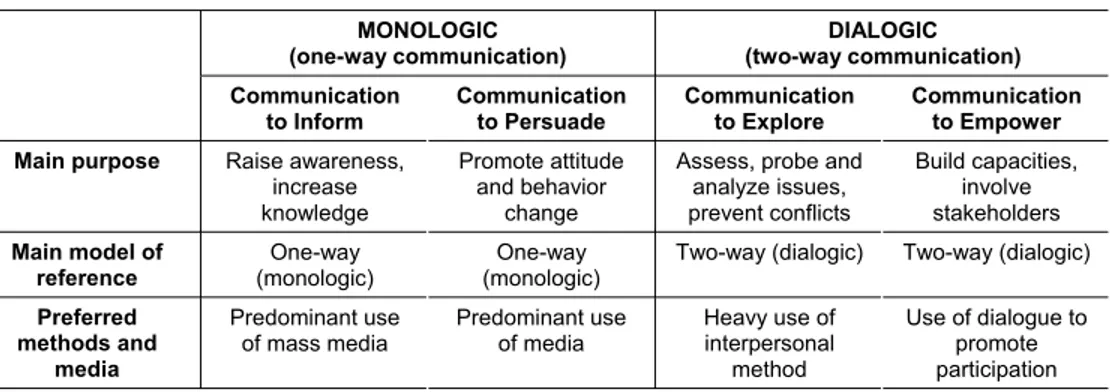
Monologic communication comprises one-way communication approaches such as information dissemination, media campaigns, and other diffusion approaches. Dialogic communication approaches refer to two-way communication, where the process and its outputs are open-ended and the scope explores issues and generates new knowledge and solutions, rather than just transmits information. Table 2.1 illustrates the main features of these two communication modes.
Table 2.1. The Main Features of Communication Modes
MONOLOGIC
(one-way communication) (two-way communication) DIALOGIC Communication
to Inform Communication to Persuade Communication to Explore Communication to Empower Main purpose Raise awareness,
increase knowledge
Promote attitude and behavior
change
Assess, probe and analyze issues, prevent conflicts
Build capacities, involve stakeholders Main model of
reference (monologic) One-way (monologic) One-way Two-way (dialogic) Two-way (dialogic) Preferred
methods and media
Predominant use
of mass media Predominant use of media Heavy use of interpersonal method
This categorization shows clearly what communication methods and tools should be used in specific initiatives. No approach fits universally, but each should be applied appropriately according to circumstances and desired objectives. Similar to the others, the multi-track model divides a communication program into four main phases: research, strategy design, implementation, monitoring, and evaluation. However, differently from the other models that are defined by one of the two modes, the multi-track model divides and combines the two according to the needs of each phase.
In the first phase, the dialogic mode should be the guiding principle, since in any investigation key stakeholders build trust and seek solutions jointly. In this way, dialogue and two-way communication become necessary to reconcile different perceptions and positions and to define the priorities for the development initiatives. Since the objectives of the communication initiatives are identified and decided in phase one, the initiative is shaped through a participatory approach, even if an imperfect one.
The objectives set in the first phase will decide the communication modes of reference of the other phases. If the objectives are a health campaign to prevent the spread of avian flu, for instance, the communication strategy may be based on monologic, one-way approaches. Instead, if mobilizing communities to take a more active part is the strategy, many of the communication approaches will be dialogic. Other cases may be a more balanced combination of both approaches.
Hence, the multi-track is an integrated and project-oriented model, combining different approaches within a flexible framework. It always requires dialogue with all key stakeholders during the initial stages, problem identification and research of an initiative, no matter what the purpose or the sector of the intervention. After this the approach becomes truly multi-track, using a variety of approaches appropriate to the situation. The various approaches—information dissemination, social marketing, lobbying, community mobilization and others—are considered tracks and intended as actions or paths to be followed. This model is not simply the sum of different communication approaches: it has a consistent theoretical and methodological framework, which is capable of containing the major differences of the two opposing paradigms without incurring in basic contradictions.
The participatory communication paradigm does not call for a replacement of the basic communication functions associated with information dissemination, but rather broadens its boundaries to include more interactive ways of communicating. This new conception contains functions of both communication modes: the monologic and the dialogic. When the two are fully understood and properly applied, if needed combined together, development communication is used to its fullest advantage (see examples in Chapter 3 and 4).
Participatory Communication: A Practical Guide 15
Whenever local stakeholders are not engaged from the beginning of the intervention, the possibilities for problems and failures rise dramatically. Examples are innumerable in which communication failed to achieve expected changes due to people’s initial lack of involvement or to their limited or contradictory understanding of issues by various stakeholders. That specific behavior changes cannot be achieved without recognition of wider social acceptance and/or changes is increasingly acknowledged.
The fact that the two main communication perspectives, monologic (one-way) and dialogic (two-way), rely on different theoretical perspectives and methodological frameworks should not be considered as contradictory, but rather as an asset capable of better addressing the complexity of many situations. This asset derives its strength from the selective and purposeful use of specific communication approaches applied according to the objectives of the initiative.
When dealing with the challenges of each individual phase of a communication program (research/communication-based assessment, strategy design, implementation and evaluation), it is easier to see what type of communication to apply for which purpose. The research phase must always be based on two-way communication methods and is most effective in investigating, assessing, and uncovering key issues. This greatly reduces the possibility of relying on incorrect assumptions and avoids the risk of alienating relevant stakeholders by leaving them out of the decision-making process. After this phase, approaches of both modes can be used according to the needs and scope of the initiative.
Different from other models, the multi-track approach selects and combines different communication approaches into a unified grand approach. The differences between the two modalities, however, remain significant. The monologic/diffusion mode and its tracks can be considered as a close-ended linear communication flow. When tracks such as social marketing or Information, Education and Communication (IEC) are designed and implemented, the end objectives are always defined from the start.
The dialogic mode instead can be considered a circular, open-ended process, since the objectives are usually not specifically defined, and even when they are, they can be changed according to the output of the investigation. The primary goal of the two-way communication process is not to persuade audiences to adopt a predefined change but rather to engage stakeholders to explore the situation and define the needed change.
How each perspective defines or conceives a communication objective and the relative implications for evaluating the impact of the intervention reflects the difference between the two modes. In diffusion approaches, the communication objective requires changes in awareness, knowledge, attitude or behaviors/practices of specific groups of people. A baseline study before and after the intervention assesses the impact, while other variables that may interfere with the communication are taken into account.
In summary, the multi-track approach combines the theoretical potential of the main development communication families with their rich range of practical applications. This model uses theoretical interpretation to guide the selection and application of specific communication approaches, according to the needs and circumstances of specific initiatives. DevComm’s experiences in a number of projects confirm the value-added of this approach, however, more long-term and systematic studies are needed to accurately assess its effectiveness.
Notes
1 This would certainly be one of the key tasks of the “new communicator” or
17
C H A P T E R 3
Applying Participatory
Communication in
Development Projects
Participatory Communication in Action
Participation and communication are terms with broad and multifaceted connotations, trying to define them specifically is a difficult task. Even harder is providing a widely acceptable definition of participatory communication. For the scope of this book, participatory communication is an approach based on dialogue, which allows the sharing of information, perceptions and opinions among the various stakeholders and thereby facilitates their empowerment, especially for those who are most vulnerable and marginalized. Participatory communication is not just the exchange of information and experiences: it is also the exploration and generation of new knowledge aimed at addressing situations that need to be improved.
To be genuinely participatory and truly effective,1 communication should occur among all parties affected, ensuring all have similar opportunities to influence the outcome of the initiative. Optimally participatory communication would be part of the whole project process, from beginning to end. Since this approach promotes the active involvement of stakeholders in investigating options and shaping decisions regarding development objectives, participatory communication also facilitates empowerment. In this way, the effects go beyond the project boundaries, spilling into the wider social and political dimensions.
The literature on development programs is increasingly flooded by examples of projects apparently embracing “participation.” At a closer look, however, very few cases meet the standards of genuine participation. This publication, while embracing a broad range of applications, promotes the highest form of participatory communication applications, empowerment communication (defined in Chapter 1).
It should be highlighted that within the current structure of the development aid system it is rather difficult to have a high degree of participation. The agenda of projects and programs is often set by a few individuals (for example, policy makers or technocrats) with very little input from other stakeholders, especially at the local level. Moreover, the rigid management procedures and the tight deadlines for planning and funding required for approving and implementing projects allows little flexibility needed for participatory processes.
Finally, it should be noted how participation and participatory communication tend to be associated with grassroots and community-driven development. While this is often the case, it should be acknowledged that participatory communication could be used at any level of decision making (local, national, international) regardless of the diversity of groups involved, even if the number of people involved can significantly affect its effectiveness. There are instances where participatory communication has been used to enhance social accountability in water reforms, to engage parliamentarians in governance reforms and to mediate conflicts between local communities and national authorities.
Value-added and benefits
To reinforce the benefits of adopting participatory communication, it is important to understand that participation and participatory communication are main answers to why so many development initiatives in the 1970s and 1980s did not achieve their objectives to produce significant improvements for the many poor of the planet. The causes of many such failures were ascribed to the limited understanding of local context and the insufficient involvement of local stakeholders. In addition, misunderstandings and differences in perceptions about key problems often led to limited political buy-in and faulty project design.
By actively engaging stakeholders from the start and by seeking a broader consensus around development initiatives, participatory communication has begun to be considered a crucial tool to avoid past mistakes. Many conflicts and obstacles can be prevented if addressed in a timely fashion. Moreover, genuine participation increases the sense of project ownership by local stakeholders, thus enhancing sustainability. On one hand, communication practitioners might have a more complex process to take into account the many viewpoints to be reconciled, but on the other, they are likely to gain some extra benefits. For example, communicating project objectives and outputs might become redundant because stakeholders will already be aware, many of them will already consider the initiatives their own, will become actively engaged in the project.
Participatory Communication: A Practical Guide 19
Risks and constraints
When developing participatory approaches, there are some limitations and potential pitfalls to consider in regard to the qualityand ownership of the interventions.
As to quality of interventions, Bill Cooke and Uma Khotari have drawn our attention to the “tyranny of the method” (Cooke and Khotari 2001). They address the risk of insisting on participatory strategy no matter what the context or the environment. With a growing consensus around the benefits of participatory strategies, a word of caution is called for as to the relevance, timeliness and content of proposed participatory strategies. Critiques of populist participatory approaches include the difficulty, if not impossibility, in managing a decision-making process with large numbers people involved speak to technical limitations and to theoretical, political and conceptual limitations in unfolding a participatory method. Inappropriate timing of participation (e.g., half-way through a project) can also lead to further delay and conflicts, especially when reverting to top-down approaches like trying to persuade people “to participate” in what has already been decided. In this respect, obstacles are sometimes unfairly ascribed to participation itself, rather than to its wrong application. One condition for successful participatory approaches is the articulation of local ownership of the problem and related solution. Collective, community-based solutions are often the answer, yet in achieving these, there is the risk of “tyranny” of the group. Based on some myth of community in participatory approaches, “communities” often are seen by many practitioners as the turning point of bottom-up solutions. They are often taken for granted as homogeneous socio-economic and cultural entities– harmonious units where people share common lifestyles, interests and visions of life. In trying to emulate participation, it is important, however, not to conceal the power relations in a community, the differences in opinions, lifestyles, beliefs and the socio-economic distribution. A community can be full of tension, inequality and conflict, and practitioners need to be aware of the environment and treat the community as a sum of different groups rather than a homogeneous entity.
Finally a built-in problem exists in participatory approaches attempts to scale up the strategy. Given the differences among projects, their objectives and nature, and the host communities, replication is difficult. This is a risk to calculate with when strategies are defined and developed.
Different from one-way communication intervention, participatory communica-tion requires a predominantly dialogic process, whose outcomes and implicacommunica-tions are not always easy to pre-determine. This makes some managers of development initiatives uneasy. On the other hand, the higher the level of control from the top, the weaker the sense of ownership and commitment by the local stakeholders. Stakeholders’ ownership and commitment are necessary ingredients to ensure better and more sustainable results.
The Four Phases of the Communication Program Cycle
The communication program cycle can run parallel to the project cycle when they both start at the same time. As presented in Chapter 1, the basic phases of a communication program can be classified as:
■
Participatory Communication Assessment (PCA) is where communication methods and tools are used to investigate and assess the situation;■
(Participatory) Communication Strategy Design is based on the findings of the research and defines the best way to apply communication to achieve the intended change;■
Implementation of Communication Activities to determine where activities planned in the previous phase are carried out;■
Monitoring and Evaluation runs through the whole communication program, monitoring progress and evaluating the final impact of the intervention.To make the program cycle genuinely participatory, two-way communication should be adopted from the beginning and be applied consistently in each phase of the process. Because implementation success depends largely on the way the strategy has been designed, the first two phases, probing key issues and making decisions affecting the whole program, are crucial. Finally, monitoring and evaluation assesses progress and helps to make the necessary adjustments during the implementation and to measure the overall impact at the end. This classification is equally valid for outreach (one-way) types of communication programs, as well as for participatory (two-way) ones.
Full participation by all stakeholders in any step of the process is not possible and, in some cases probably not entirely desirable. For some situations and technical issues, it would not make sense to broaden the participatory decision-making exercise. If priorities are decided in a participatory manner and there is a broad consensus, for example, to build a bridge in a certain spot, there is no need to involve all stakeholders in the technical decisions concerning the type of concrete, bolts and other technical specifications for construction. Unless there are people familiar with different technical engineering specifications, general participation would only delay the process and would not benefit the end result. In general, however, an overall participatory process (at least in key steps) is relevant to ensure transparent leadership and management of a bridge or other infrastructure project, including securing equal access to the bridge according to agreed policies and pricing.
Participatory Communication: A Practical Guide 21
Box 3.1. An Example of Participatory Communication Assessment
In a water project, officers of an international organization identified as a key development priority the need to improve the water system of a poor region in a Central American country. Based on their knowledge and expertise, the officials defined what was needed and which aspects should be improved, with little or no input from local stakeholders. Expectations of the stakeholders were not considered, and as problems emerged, project management came under increased pressure from the donor and national political authorities to gain the support of what are too often referred to as “beneficiaries.” Thus, a more participatory stand was adopted in the following stages, and local stakeholders were involved in decisions concerning the technical design of the new water system.
The end results of this mixed approach (that is, top-down in the beginning and participatory from halfway mark) were less than satisfactory. Managers and a subsequent review mission ascribed much of the failure to participation, when in fact should have been ascribed to a faulty use of participatory communication. To be effective and actually participatory, the project should have sought participants’ inputs at the beginning when assessing the situation and making decisions on what to do were made. Subsequent actions in the process could have been restricted to technical experts. This water project not only misused the concept of participation but also jeopardized the overall success of the project itself.
When stakeholders are not included from the start, participation is significantly impaired. In this example, local stakeholders should have been included in defining the needed outcome of the improved water system. They would have gained interest and been knowledgeable about which services were needed to improve lives. Rather they found themselves in a discussion of the technical design of a water system in which they had limited knowledge or interest. By switching these two basic factors—no stakeholder input in setting priorities and stakeholder inclusion in technical decisions—the project management set itself up for failure.
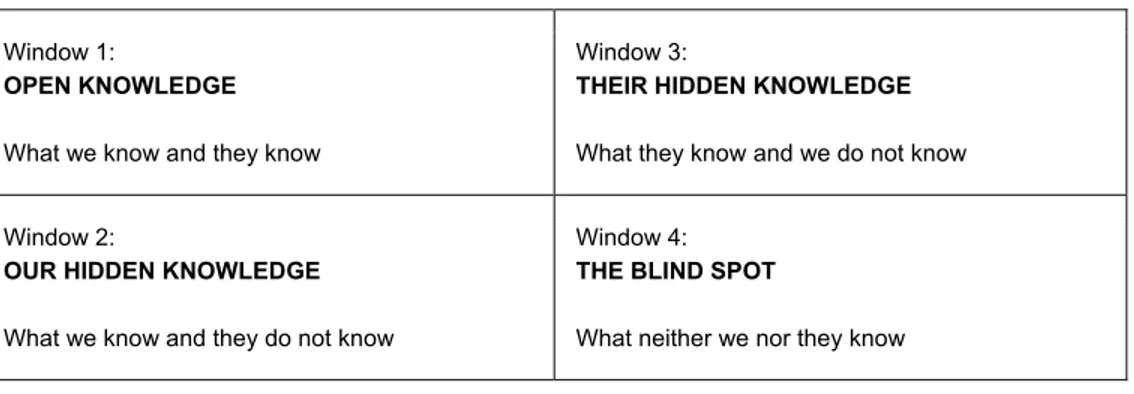
The Johari Window is a tool originally developed by Joseph Luft and Harry Inghman (hence the name) to explain interpersonal communication processes. It has been adapted to illustrate the dialogical process that exchanges knowledge and explores issues, leading to the best possible change. The Johari window is a useful tool to illustrate the process of joint decision making necessary in any participatory communication initiative. If “the unknown” is addressed successfully, the successful outcome is the definition of the objectives for the intended change. These objectives constitute the core of the subsequent communication strategy presented in the next pages.
Table 3.1 The Johari Window
Window 1:
OPEN KNOWLEDGE
What we know and they know
Window 3:
THEIR HIDDEN KNOWLEDGE
What they know and we do not know
Window 2:
OUR HIDDEN KNOWLEDGE
What we know and they do not know
Window 4: THE BLIND SPOT
Window #1 represents the first step of the initiative, starting with dialogue based on the common knowledge shared by all parties involved. “We” broadly refers to outside experts and project staff, while “They” refers to internal and local stakeholders. Window #2 represents knowledge of They, the local players, which is not known by the outside experts; window #3 is the opposite, knowledge of We, the outside experts, is shared with local stakeholders, covering areas not known to them. The final window represents the end of the exercise and concerns issue/s unknown to both groups. At this point knowledge, experiences, and skills of key stakeholders must come together to find the most appropriate options and solutions leading to the desired change. If key stakeholders jointly define the nature and extent of the intended change, the chances for success and sustainability of the initiative increase significantly.
Keywords: Communication program cycle, Johari window
Phase One: Participatory Communication Assessment (PCA)
In this phase, issues of relevance are researched and analyzed through two-way communication methods and techniques. For these tasks to be successful, it is necessary to establish an open or common space where key stakeholders can interact freely with each other. Establishing an open space facilitates the local stakeholder involvement in the decision-making process, thereby enhancing the chances of success and sustainability of the development initiative.
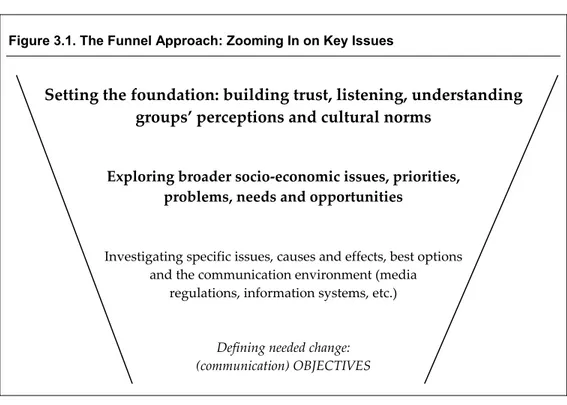
The name Participatory Communication Assessment (PCA) is derived from the Participatory Rural Communication Appraisal (PRCA) methodology created in the late 1990s. The PCRA was developed in Southern Africa by a joint FAO (Food and Agriculture Organizations of the United Nations)/SADC (Southern Africa Development Community) project based in Harare, Zimbabwe, as a way to enhance project design and operations (Anyaegbunam et al., 2004). As PCA, the name is partially modified and the concept is similar yet broader for two reasons: 1) to account for its wide range of applications reaching beyond the original rural focus and 2) to indicate the more analytical nature of this approach from the initial concept of appraisal to a more in-depth assessment of the situation, which usually includes options to address change and to seek solutions. PCA can be visualized as a funnel (figure 3.1), starting wide and narrowing down to define the key issues necessary to have a successful and sustainable change.
Participatory Communication: A Practical Guide 23
Figure 3.1. The Funnel Approach: Zooming In on Key Issues
Setting the foundation: building trust, listening, understanding
groups’ perceptions and cultural norms
Exploring broader socio-economic issues, priorities, problems, needs and opportunities
Investigating specific issues, causes and effects, best options and the communication environment (media
regulations, information systems, etc.)
Defining needed change: (communication) OBJECTIVES
The following are basic steps in the PCA: 1) understand the socio-cultural context while identifying and defining key issues (including definition of key stakeholders); 2) create a common/public space, establish dialogue, and build trust among key stakeholders; 3) assess needs, problems, risks, opportunities, and solutions; 4) prioritize key issues for change and reconcile different perceptions; 5) validate findings and define solutions/objectives.
To clarify and simplify the adoption of participatory communication approaches, the following guidelines illustrate the steps to follow, as a general reference for practitioners. Variables such as experience in this approach, scope of the intervention and specific socio-cultural context may change the definition or sequence of the steps.
The scope of any development initiative is to improve the lives of some stakeholders. In the past, decisions on what change and how were left in the hands of a restricted group of decision makers and technical experts. More recently, such decisions increasingly involve key stakeholders. Nevertheless, often external actors continue to define a development project or program.
A classic example of external, top-down decision making
project innovations have failed to take into account local knowledge and needs, resulting in failure or underachievement.
The following steps indicate how to implement participatory communication-based research:
STEP1:ISSUE IDENTIFICATION AND DEFINITION
Initiatives originate in a number of ways: request of local stakeholders, study by a public or private organization, government-defined priority or need identified by outside technical experts. Whatever the origin, a participatory communication assessment adopted initially to explore all relevant issues is most effective.
The use of the participatory communication assessment at the beginning is exploratory: it is not restricted to a specific area or sector but is open to all areas and issues deemed relevant by one of various stakeholder groups. Conversely a PCA adopted in an on-going project with objectives already set is topical: it is restricted to investigate and probe topics related to set objectives. In this case, topical PCA should be considered a partial participatory approach, since the main priorities/objectives are already defined, and probably not in a participatory way.
To be genuinely exploratory, a PCA should assess any issue deemed important by stakeholders, including issues of global import such as climate change. It will be essentially exploratory since the PCA can investigate and explore various key issues, risks, and perceptions, and come up with key priorities and recommendations within a broad spectrum of applications.
On the other hand, there is the example of a project with the main goal to reduce the environmental impact of the destruction of the Amazon forest. The project manager may request a communication intervention in order to find ways to stop the practice of starting fires (even though often farmers are not the major cause of such problems), which lead to significant forest destruction. In order to design an effective communication strategy a PCA will need to investigate the causes of the fires and probe farmers’ perceptions and rationale for starting those fires. Even if topical, to be at least partially participatory, the findings of the PCA will need to be discussed and negotiated with project management. If it is not, the whole exercise will be reduced to a top-down, one-way persuasion initiative, which is highly questionable not only from a participatory perspective but also as far as results are concerned.
Clearly, the range of a topical participatory communication assessment is limited by the boundaries set by the project nature and objectives. Therefore, if the objectives are set properly and are considered relevant by key stakeholders, PCA can still play a major role in the overall success of the initiative. If this is not the case, the major contribution of PCA should be to identify critical areas, obstacles and risks, feeding these findings back to project management.
Participatory Communication: A Practical Guide 25
STEP 2:ESTABLISH A COMMON SPACE
This step is often neglected, yet it is one of the most crucial. Past experiences teaches that many project failures result from two major factors: faulty project design and lack of buy-in by those who are supposed to be beneficiaries. Both of these problems are due to a basic flaw: insufficient or very limited involvement of key stakeholders in the decision-making process of the development initiative. Establishing a space where all stakeholders feel comfortable enough to express their views, share their concerns, and provide their inputs on the desired change is key for the success and long-term sustainability of any initiative. This step, when adopted, comes after the initial definition of issue/s of interest and is the ideal one to start any initiative.
Key stakeholders must interact, achieve a mutual understanding, and then seek a consensus about priorities.2 All of this can be achieved only if all parties trust and talk to each other. Building trust is, therefore, a very important prerequisite to ensure genuine participatory communication. Creating a common space can engender this trust. The space can be established in many ways, such as regular meetings in a physical space open to everybody, more formal mechanisms where stakeholder representatives convene and engage in a dialogue facilitated by a neutral source, or where appropriate, use of interactive technologies, such as the internet, to allow people no matter how distant to provide their inputs and interact directly with the other players.
There are a number of communication methods, techniques and icebreakers, which are particularly effective in establishing trust and require a high degree of empathy and understanding of the situation. These tools include a transect walk in rural and peri-urban settings where local stakeholders walk around the community illustrating the various social and productive areas to outsiders; historical timeline to trace the history and patterns of certain populations; trend lines to identify if and when certain phenomena (such as AIDS, soil erosion, and so forth) have occurred, making it easier to identify key causes and possible solutions; and seasonal/daily calendar in which relevant groups describe key activities during the different time of the years, or even daily activities, according to the scope of the investigation.
0All of these are dialogic tools, using two-way communication. Outside experts should act as facilitators to make certain that dialogue, while covering key areas, flows freely in directions considered important by stakeholders. When these activities have established trust and issues of interest are jointly explored, it is possible to proceed to the next step.
STEP 3:ASSESSING NEEDS, PROBLEMS, RISKS, OPPORTUNITIES, AND SOLUTIONS