La Universidad Católica de Loja
ÁREA SOCIOHUMANÍSTICA
TÍTULO DE LICENCIADO EN CIENCIAS DE LA EDUCACIÓN
MENCIÓN INGLÉS
Teachers and students´ perceptions of teaching English in small classes in
Ecuador.
TRABAJO DE TITULACIÓN
AUTORA:
Ibarra Segura, María Leisi
DIRECTOR:
Espinosa Jaramillo, Franklin Oswaldo, Mgtr.
CENTRO UNIVERSITARIO QUITO - CARCELÉN
ii
APROBACIÓN DEL DIRECTOR DEL TRABAJO DE TITULACIÓN
Magister.
Franklin Oswaldo Espinosa Jaramillo
DOCENTE DE LA TITULACIÓN
De mi consideración: El presente trabajo de titulación: Teachers and students´ perceptions of teaching English in small classes in Ecuador realizado por Ibarra Segura María Leisi, ha sido orientado y revisado durante su ejecución, por cuanto se aprueba la presentación del mismo.
Loja, julio de 2016
iii
DECLARACIÓN DE AUTORÍA Y CESIÓN DE DERECHOS
“Yo, Ibarra Segura María Leisi, declaro ser autora del presente trabajo de titulación: Teachers and students´ perceptions of teaching English in small classes in Ecuador, de la Titulación de Licenciado Ciencias de la Educación mención Inglés, siendo Mgtr. Franklin Oswaldo Espinosa Jaramillo director del presente trabajo; y eximo expresamente a la Universidad Técnica Particular de Loja y a sus representantes legales de posibles reclamos o acciones legales. Además certifico que las ideas, conceptos, procedimientos y resultados vertidos en el presente trabajo investigativo, son de mi exclusiva responsabilidad.
Adicionalmente, declaro conocer y aceptar la disposición del Art. 88 del Estatuto Orgánico de la
Universidad Técnica Particular de Loja que en su parte pertinente textualmente dice: “Forman
parte del patrimonio de la Universidad la propiedad intelectual de investigaciones, trabajos científicos o técnicos y tesis de grado o trabajos de titulación que se realicen con el apoyo
financiero, académico o institucional (operativo) de la Universidad”
iv
ACKNOWLEDGMENT
I am grateful in a special way to the
Universidad
Técnica
Particular
de
Loja,
Departamento de Lenguas Modernas y Literatura, its
teaching and administrative staff for being the bridge
that connected me with a lot of important knowledge.
I thank God and the institution for this achievement.
v
CONTENTS Pag.
COVER………...i
APROBACIÓN DEL DIRECTOR DEL TRABAJO DE TITULACIÓN………..……….ii
DECLARACIÓN DE AUTORÍA Y CESIÓN DE DERECHO...……….….………...iii
ACKNOWLEDGMENT.…...………..………..….…...iv
CONTENTS………..………....v
ABSTRACT………..…..………..……….………...1
RESUMEN……..……….……….………...2
INTRODUCTION………...3
DISCUSSION………...5
Literature Review….……….………...5
METHOD………...16
Description, Analysis, and Interpretation of Results………….………...18
Conclusions………...39
Recommendations.………40
REFERENCES………..………41
1
ABSTRACT
The topic discussed in this document is "Teachers and students' perceptions of teaching
English in small classes in Ecuador”. This research has as its main purpose to determine what
are the benefits of teaching and learning English in small classes?, What teaching strategies and resources benefit the teaching of English in small classes?, How do student feel about learning English in small classes, and if there are any limitations when teaching English in small classes.
This research was carried out in Quito, Ecuador with the cooperation of one high school and two private institutes. The process started by applying surveys to five teachers, and forty six students from basic, and baccalaureate level.
The answers on the questionnaires were tabulated; the quantitative method was used for
this purpose; the views of teachers and students were compared with information from experts’
researches, and to the data gathered from the observation sheet.
The results show that in classes with twenty or less students, the interaction is often more common between student and teacher.
2
RESUMEN
El tema tratado en este documento es "Teachers and students' perceptions of teaching English in small classes in Ecuador". Esta investigación tiene el propósito de determinar ¿cuáles son las ventajas de enseñar y estudiar Inglés en clases pequeñas?, ¿Qué estrategias y recursos benefician la enseñanza del Inglés en clases pequeñas?, ¿Cómo se siente el estudiante al estudiar inglés en clases pequeñas?, y si hay algunas limitaciones cuando se enseña Inglés en clases pequeñas.
Esta investigación se llevó a cabo en Quito, Ecuador con la cooperación de un colegio y dos institutos privados. El proceso inició mediante la aplicación de encuestas a cinco profesores y cuarenta y seis estudiantes del nivel básico y bachillerato.
Las respuestas de los cuestionarios fueron tabuladas; el método cuantitativo se utilizó para este propósito; las opiniones de profesores y estudiantes fueron comparadas con la información de investigaciones de expertos, y los datos recogidos en hoja de observación.
Los resultados muestran que en clases con veinte o menos estudiantes, la interacción es más frecuente entre estudiante y profesor.
3
INTRODUCTION
During the last decades, in Ecuador has increased the interest for the education and learning of the English language; nevertheless, there are still persistent disadvantages such as to teach too many students in a class. It is a factor that teachers face across the whole country. This situation can significantly affects the teaching and learning process.
Therefore, considering the great importance that education and communication represent worldwide, the current study aims to know teachers and students’ perceptions of teaching and learning English in small classes. To achieve this goal, the study aims to answer the following questions:
What are the benefits of teaching and learning English in small classes?
What teaching strategies and resources benefit the teaching of English in small classes?
How do students feel about learning English in small classes?
Are there any limitations when teaching English in small classes?
In order to achieve this goal, a deep literature research was done. The aim of this literature review was to identify topic and authors that looked for criteria related to teaching and learning English in small classes in different countries; so, Moradi, Z., Moin, A., & Ketabi, S. (2012) developed a study that showed the effect of class size in Iranian students who studied English as foreign language. The researchers observed three different classes during six weeks, with five, ten and fifteen students in each one. At the end of the study, they could note that, in smaller classes, students feel encouraged for participation, and they also had less anxiety. According to researchers´ words, a negative point to the study was that they did not have sufficient previous studies on this topic with regard to Iranian students.
4
application in only one educational institution; added to this, the participants were students of the same course.
On the other hand, Harfitt, G. J. (2013) performed a research in Hong Kong to know if the teachers changed pedagogical practice when they worked with a small class or a large one. The participants were four English teachers, volunteers, who gave classes in schools located in Kowloon, a place which is part of the urban area of Hong Kong. The results of this study showed many interesting details; such as some teachers did not change their approach and they did similar things in small classes as in large ones. Besides, they defined the small classes as a good atmosphere to apply their knowledge acquired on the teacher training courses. The limited aspects mentioned by the author were the short time used for study, and the fact that the sample was small. It did not allow visualizing the multiple activities developed during a more extensive period which would allow the author to have a broader perspective from teachers and students.
The previous studies provide the bases for the actual study since they all focus on the effects of teaching English in small classes. The current study looks forward to provide relevant information useful for educational purposes and considerations for a future research about the benefits produced when people teach and learn any subject in a small class, in special new languages. At the same time, it will provide effective strategies and resources for teaching-learning in classes with few students.
Additionally, this study can benefit English teachers and students because they can improve the way how to teach and learn a foreign language. Teachers can have the opportunity to apply new techniques and resources in easy way, and students can participate more in each activity. Because of this, the chances of learning the new language will be significantly improved.
5
DISCUSSION
Literature Review
Language is one of the most significant means of global communication; for this reason, many experts dedicate their time and effort to study the way how people learn a new language in a better and easier way.
Currently, most of people around the world use English language, but there are several factors that can affect the teaching and learning process of this language. One of these factors is the amount of students in a classroom.
Taking into account the aforementioned facts, some experts´ opinions were reviewed to know if there are advantages or disadvantages when teachers works with few pupils, and what techniques and strategies are better to apply in a small class. In this sense, the topics and studies presented below have been gathered from different academic sources.
Managing Learning
There are several steps to control a class in a good way. Some of these steps are mentioned by Roger, Phillips & Walters (2005), they state that teachers have to give clear instructions; all the teachers must have a work plan; they have to assess students individually, and they must provide feedback through exercises.
Harmer (1998), states that it is very important the way how teachers give instructions to their students. It is very useful to simplify the commands and follow a sequence. Besides, teachers have to be sure about the information that they want to communicate to the students; in this way, they give the pupils proper instructions according to the activities stated in the prior plan.
6
Related to adequate time that teachers have to set for each activity, Brouhton, Brumfit, Flavell, Hill & Pincas (1980) comment that there is a great difficulty on assigning an exact time for each activity in class. In this sense, teachers should evaluate students´ development, and what it would be the ideal time for students to move forward to next stage. The essential point to apply a good timing in every step of the study program is to know what each student has assimilated, and it is necessary to keep in mind that when students learn a new language, it is more important to be effective than to be fast.
Furthermore, it is necessary to guide students and give them a good feedback; in this regard, Blatchford, Moriarty, Edmonds, & Martin (2002), through their research results, express that teachers can offer correct and fast feedback on students´ work in small classes, but they have more complications with large classes; consequently, teachers consider that they may neglect students in a large class, and this would have a negative consequence on learning.
On the other hand, Roger, Phillips & Walters (2005) argue that it is easy to work with a small class because it gives the possibility to get a better students’ effort; the teacher can go around the classroom, check individual progress, correct homework, provide feedback and assess the knowledge acquired by students; besides, the teacher can approach students by their names and students interact among themselves using their proper names.
Teacher-student and student-student interaction
The interaction in the classroom is one of the most important points during teaching and learning a new language. For this reason Richards & Lockhart (1996)talk about the importance to use different activities which permit an interactive work in the classroom. Those activities are group work and pair work.
7
Likewise, Larsen (2000) assured that the interaction in a classroom usually is more noticeable between teachers and students than students to students. In addition, Roger, Phillips & Walters (2005) argue that when teacher intervenes a lot, the participations of students decrease and students-students interaction is affected, so the work in classroom goes down and the plan of the lesson is only performed by the professor.
Regarding teacher-student and student-student interaction, Blatchford (2003) states that when a teacher works with a small group of students, it is easier to give assistance to each member in a group; however, this situation can produce an individualization of the activities. Therefore, the group work can be affected and become less productive. Besides, Scrivener (2011) states that it is good to make use of pairs and small groups to exploit chances for pupils practice their speaking out; this permits that the teacher checks solutions to questions and other assignments, and it serves as a means to assess the work.
Class size
Another important point is the size of the class; it includes the classroom and the number of students. With this in mind, Anderson (2000) argues that small classes permit more individual work; this is the way to explain that a small class is better for teachers. They can manage discipline and they obtain more pupils´ participation. These aspects help to obtain a good teaching and learning environment because there is a narrow relation between class size and classroom processes; in the same way, there is more daring in a large class because a small class permits to plan quickly and use more time in each task; in fact, the teacher can control the reactions easier than in large classroom.
Regarding class size, Anderson (2000) mentions that teachers have less stress in small classes because they can manage few pupils, and they can catch their individual attention. In addition, students´ attention, in a classroom, is another important element in teaching learning process. This author marks out the fact that some students cannot concentrate when there are many pupils in a class; the professor finishes very tired and the students are not really satisfied with the learning process.
8
participate; on the contrary, a class with a lot of pupils does not provide enough time in order that every student takes part in the classroom tasks. Besides, another interesting thing about small classes is the dynamic way to work; it is more active and snappy.
Talking about the same theme, Scrivener (2011) argued that the class size is relative to teachers´ planning for class because several teachers plan classroom activities according to the amount of student. The teachers have different perceptions about class size; some teachers consider that 25 students is a large class; in other case, several teachers think that 40 or 80 pupils are a regular class, and it is possible that teachers have 100 students in a classroom and they consider it normal. About this, Roger, Philips & Walters (2005) consider that teachers have to talk aloud to manage these kinds of classes; this means more effort for them; in contrast, teachers can talk in a normal tone when they work with less than 20 students.
Teaching techniques, strategies or activities for teaching English to small classes
The strategies, activities, and techniques used in class are essential for the success of the teaching learning process. In this sense, Griffee (2012) mentions the need to establish the methods to teach according the class size; the use of adequate equipment and distribution of time; so that, teachers would have enough time to develop each planned activity.
It is possible that students assimilate the language in a better way through different listening exercises, but they would have limitations to learn building language or other structures. In addition to this aspect, Scrivener (2005) argues that direct interaction between students is better and positive for learning in a small class.
Furthermore, Brouhton, Brumfit, Flavell, Hill & Pincas (1980) argue that conversation is other technique used with small groups and individual classes; this tool generally is applied in private institutions or private lessons. The experts recommend a native speaker for conversation practice because they engage more students’ attention. Different experiences show that teachers in general do not always cover all students´ expectations.
9
Other important skills in teaching and learning process are mentioned by Horning (2007), who expresses that reading and writing are essential, and students demonstrate their engagement and motivation because, in small class, they can improve their writing without an extensive writing exercise.
Additionally, Nation (2013) mentions some activities to practice the new language like extensive, intensive, faster, and repeated reading; through which teacher can focus on spelling, pronunciation and speed to give students an appropriate feedback particularly on their pronunciation.
Learning environment in small classes
It is very important to talk about the place where classes are developed, especially the way how teachers use all spaces in a classroom; these will help to improve the teaching and learning process. Some authors mention this theme in their research; Roger, Philips and Walters (2005) provide several tips about the organization of physical space: sit students in a circle, work in small groups of four, or eliminate the use of desks. Those are some of the ideas to use the furniture in the classroom.
Similarly, many authors see the social and emotional atmosphere as a factor that affects the learning of a new language. Scrivener (2005) argues that when it fosters the respect and support between teachers to pupils, pupils to pupils, and pupils to teacher, this creates a better environment, which is more productive for everyone in class.
In the same line, Roger, Philips and Walters (2005, p. 60) say“The size of the class. It is
more difficult to keep an orderly atmosphere in a large class than a small one”; in addition,
10
Similarly, Harmer (2001) argues that the way in which a classroom is arranged and the way teachers handles the emotions can motivate or demotivate students in different ways. In fact, an attractive classroom influence notoriously in the development of the lesson. These factors together can help to keep students motivated during the entire lesson.
It is feasible to observe that the way people learn a new language has been studied for several years. In fact, many experts have carried out many investigations with the intention to know the best environment for learning to take place. Indeed, and according to the experts, there are many factors that affect the teaching and learning process in a class. Therefore, the authors show different results in their investigations. Through these works, authors present valuable notes about techniques and resources used in a small class, and the real teaching and learning situation in classes with few students.
Watson (2006) clarifies some hypothesis about the belief that smaller classes are more effective for learning and few differences between these and larger classes. He poses some hypothesis; when professors work in a large class, they have to speak more time than when they work in small classes. Additionally, the author expresses that this situation frequently obligates the teachers talk to pupils in their native language; in the same way, teachers call to students by their name less often, in a large class, than in a small class. Thus, the use of students´ name induces a favorable rapport between the professor and the pupils.
The next hypothesis points to the students´ participation which is more evident in a small class than in a large class. In addition, the teachers used more closed questions in large class than in a small one; in this way, the teacher know the answers previously and the students only have to answer in simple words. They do not have the opportunity to add anything to the message. In contrast, students’ questions in a small class have a higher level of intellectual
requirement because they have the opportunity to extend their dialogue. Another important thing, it is that in smaller classes there are less repeated questions because the teachers can hear students better than in a large class; for that reason, it is unnecessary to ask again the questions.
11
with discipline problems are more impersonal in a larger class than in a small one. In fact, the control of the discipline is high personal in smaller classes; the teacher personalizes the way to treat each pupil.
The author selected two lessons to carry out this study, one of them with 23 students and the other with 40 students. The two lessons consisted of students choosing a topic and working in groups; then, they had to appoint a representative of their group, who explained their ideas to the rest of the class.
The instruments applied in both groups were the introduction of surveys; in addition, this author mentioned the used of two cameras to record the behavior of teachers and students in both classes.
The author evaluated the information through tabulating the data, the results obtained from the small class and the large one were compared both quantitatively and qualitatively. He basically analyzed in quantitative form the following variables: number of times that teachers and students used verbal and non-verbal language, number of times that teachers and students used native language in their speech, number of words spoken by teachers and students, number of times that teachers used students´ names and vice versa, and number of times that open and closed questions were used during class.
Although the method used by the author was in essence quantitative, he took into
account the students’ initiative to ask questions, make jokes and create dialogues to do his
qualitative analysis.
The conclusions achieved by the author showed that teachers in large classrooms do not care enough about the language used in the classroom; contrary to the small classrooms. However, the differences between large and small classes are not very big. He noted that one of the most important things in small and large classes is that teachers know students´ names; this helps to have a better interaction in class.
The next study considered for this research is the one made by Moradi, Moin, & Ketabi (2012) who searched for differences in class size in Iranian English first language learners.
12
weeks, took notes about the way how students learned and then they analyzed the collected data.
The quantitative analysis of collected data was based on two indicators: turn-taking of talk and talk time; the authors compared the results of these indicators versus the number of students in each class in order to develop comparative analysis among the three classes.
As a result, the authors found and mentioned about the opportunity that the students had to communicate using the second language in a real context; they noted that it is more frequent in small classes. The students in small classes were mostly motivated to begin a conversation than those in the large classes.
Other important point detected by these authors were that communication and relationship during classes were directly related. In the first class chosen, the students had more time to express during the activities in classrooms; their participation in tasks did not generate them much anxiety opposite to the other classes where there were more students.
In the same study, the authors mention that teachers perceive an increase in communication capacity when students communicate in the second language; they express better and personalize their answers. According to the authors´ words, smaller classes encourage the student´s participation with a lot of motivation in the class events and dialogues.
A remarkable conclusion in this study was that the class size influences the contribution of each pupil in the classroom task. There is less opportunity to apply more communicative strategies in written and spoken English, in small classes; on the contrary, the teacher is forced to look for new strategies to stimulate students´ participation in large classes.
These authors mentioned as one limitation, the fact that there were very few previous studies about the consequences of class size in Iranian English foreign language learners.
An additional study included in the current study is the one made by Cakmak (2009) who wanted to identify teacher candidates´ perceptions about the relationship between class size and its effects in the teaching process.
13
were in their third year of the career, therefore they had plenty experience about teaching. Secondly, he chose a group, and applied them open-ended questionnaires about their perceptions of class size. The participants had to consider the motivation, teaching methods, classroom management, assessment, teacher behavior and student achievement.
After the participants completed the questionnaire, the researcher gathered the information, created a computer file for each question and typed the responses. Then, he analyzed the responses and determined the common aspects in them; in this step, he applied a qualitative analysis of the data obtained, and concentrated in the answers which were related to the effect of class size on the teaching process.
One of the common answers was the fact that it is a problem for beginning teachers when the number of students in a class increases, because it is less difficult to implement new methods in teaching-learning in a regular class planned in a small class than in a large one. Indeed, the results showed the necessity to know how to transmit the knowledge about a new language in a class with few students; it is a big responsibility for the teachers.
Some of the participants argued that one of the most difficult things to manage is class motivation. According to them, it is easier to stimulate a small group than a large one. Besides, they mentioned the necessity to know specific characteristics from every learner in order to use methods and techniques according to them.
A conclusion in this study showed that there is a close relationship between class size and its effects in the teaching-learning process. At the end, the author recommends that teacher training programs have to be fortified in teaching techniques and methods which are effective in both types of classes, small and large ones.
14
Mathematics, Physics, Chemistry and Biology. After the information was collected, it was tabulated by using a computer program.
The author began with a quantitative analysis of the collected information based on the class size; that is the number of students in a classroom. These data went through a qualitative analysis when he correlated the number of students with students´ sex, and school geographic location; in this case, he refers to urban and rural, and the subject.
All these data were classified into 5 tables; the author performed some combinations to demonstrate the importance of class size above the number of students, students´ sex, school geographic location, and the subject.
The results demonstrated several differences between students of both, the small and the large class.
As a result of the analysis of the data, Adeyemi (2008) concluded that the class size has a serious influence in the learning process and its quality from secondary schools in Ekiti State, Nigeria. Subsequently, he explained that students’ performance is higher when they are in smaller classes; it is the opposite when they are in a large class.
One more study considered in this research is the one made by Harfitt (2013), in his study he mentions that educators apply the same techniques when they are teaching in a large class, as well as in a small one. He explored the connections between class size and the pedagogical practice implemented by professors with a lot of practice in Hong Kong.
The socialization of this paper permits to compare the experience in a large class and one of a reduced-size, English language class, both of the same grades. In order to do this, the author observed and documented, through video, the class of four English teachers who were volunteered to perform this study. They had between 5 and 20 years of experience. In addition, the participation was limited for the authorization of their institutes and the schedule. The schools in this study were from the same urban area of Hong Kong; the author chose 8 lessons of 40 minutes each.
15
classroom interaction and learning. The observation, in each case, was to the same teacher who taught in a large class and in a reduced-size class, both at the identical level.
The purpose of this study was to compare teachers´ academic ability when they managed a large or a small class. In addition, the author consider very important to determine students´ language skills and their aptitude.
The author applied an interview to each participant teacher to establish the sample. Teachers told him about their experience and comment about their pedagogical decision to make the class plan, and how they organized the classroom to generate student to student interaction. They explained that the organization permits to take notes about pupils´ skills.
Then, the author could see, in action, the classroom organization and the lesson plan. He noted that those were dynamic and included different activities as pair work, group work, reading circles and others. As a result, the students had a real interaction among them.
One of the most remarkable results in this research is that teachers did not change their teaching methods and they continued with the same pedagogy in the small classes as in the large ones. At the same time, the author marks that when the class is small, it is easier to develop a good relation between teacher and students; they usually use their proper names and say jokes among them.
The study also showed that students´ participation is easier in small classes because they are not afraid to participate in front of their classmates; for this reason, students answer to questions and perform tasks in a voluntary form. On the other hand, when the classes are very large, teachers have to select one student to talk in front of the others; for this reason, many students do not participate in all activities in the class.
In a final commentary Harfitt (2013) states that when the students were asked what they liked the most about small classes, all the respondents cited “better classroom management” as
their first answer.
16
METHOD
Setting and participants
The present research was carried out with the participation of three educational institutions in Quito city, one private high school and two private institutes in which English is taught as a foreign language. The high school worked with small groups of students in all levels: pre-basic, basic and baccalaureate. In a similar way, the two private institutes consider the work with small groups as a very necessary strategy for the success in their students´ participation and the learning of a new language.
The participants were five teachers, with degree in English and more than five years of teaching experience, and forty six students who belong to different levels of education, ten students from ninth of basic, fifteen from first of baccalaureate, five from second of baccalaureate, and sixteen students from basic level in the private institutes; all of them were people between fifteen to thirty five years old. The participants in the research showed a lot of interest and cooperation.
Procedure
For conducting this research, it was necessary to review the opinion and outcomes submitted by some expert researchers in the field of teaching English in small classes. This information was available in books, magazines and web sites focused in education.
After analyzing several sources, the information was gathered in topics which are included in the literature review of the current study.
The next step in the process was to look for educational institutions in which English was taught as foreign language; these classrooms had to meet one important condition, they ought to have 20 students or less per class. After that, a request, official letters, to apply the surveys into five classes was sent, through official letters, to the principals of each selected academic institution. One private high school and two private institutes authorized us to apply surveys to their teachers and students.
17
teachers and students from basic level. Several questions were established on sensitive aspects inside a class; the most remarkable aspects were discipline, and communication between pupils and teachers.
At the same time, it was possible to observe a lesson performance and take notes about the way how the teachers and their pupils feel teaching, and learning a new language in a small class.
Then, the instruments were classified into teachers’ questionnaires, students’
questionnaires, and the observation´ sheets. This organization facilitated to manage the information during tabulation of results. The tabulated information was organized in excel tables.
The results were analyzed in quantitative and qualitative form which allowed to obtain
18
Description, Analysis and Interpretations of results
The information described below provides interesting results; they are based on the teachers´ and students´ perceptions of teaching English in small classes. At the same way, the opinion of several experts is taken into account.
The results of questionnaires were contrasted with experts’ opinions, and with the notes taken during our observation process in the three academic institutions.
Qualitative and Quantitative Analysis
[image:23.612.79.560.354.561.2]What are the benefits of teaching and learning English in small classes?
Table 1
TEACHERS´ PERCEPTIONS
No. In small classes
Totally
agree Agree Partially agree Disagree TOTAL
f % f % f % f % f %
1 It is easier to design activities that help students to apply what they learned in class 4 80% 1 20% - - - - 5 100%
2 The students are attentive and participate in class activities 4 80% - - 1 20% - - 5 100%
3 The class space allows activities designed for you to develop properly. 2 40% 3 60% - - - - 5 100%
4 You can provide an adequate feedback 3 60% 1 20% 1 20% - - 5 100%
5 It is performed activities that allow greater interaction between students 4 80% 1 20% - - - - 5 100%
6 There is more interaction between the teacher and the students. 4 80% - - 1 20% - - 5 100%
7 It is easy for you to remember the name of students. 4 80% 1 20% - - - - 5 100%
Author: María Ibarra S.
19
Table 2
STUDENTS´ PERCEPTIONS
No. In small classes
Totally
agree Agree Partially agree Disagree TOTAL
f % f % f % f % f %
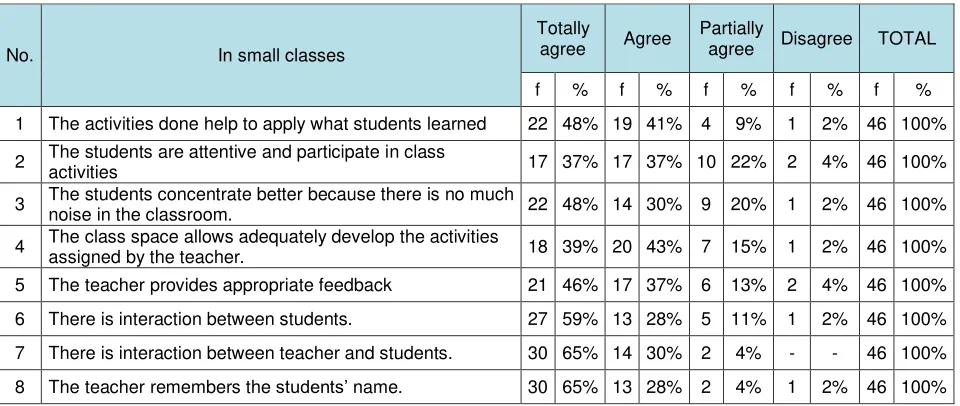
1 The activities done help to apply what students learned 22 48% 19 41% 4 9% 1 2% 46 100%
2 The students are attentive and participate in class activities 17 37% 17 37% 10 22% 2 4% 46 100%
3 The students concentrate better because there is no much noise in the classroom. 22 48% 14 30% 9 20% 1 2% 46 100%
4 The class space allows adequately develop the activities assigned by the teacher. 18 39% 20 43% 7 15% 1 2% 46 100%
5 The teacher provides appropriate feedback 21 46% 17 37% 6 13% 2 4% 46 100% 6 There is interaction between students. 27 59% 13 28% 5 11% 1 2% 46 100% 7 There is interaction between teacher and students. 30 65% 14 30% 2 4% - - 46 100% 8 The teacher remembers the students’ name. 30 65% 13 28% 2 4% 1 2% 46 100% Author: María Ibarra S.
Source: Students´ questionnaire
Regarding item number one from teachers’ questionnaire: In small classes, it is easy to
design activities that help students to apply what they learned in class, and from students’
questionnaire: In small classes, the activities done help to apply what students learned. The items above receive the following responses; 4 teachers (80%) of teachers replied that they totally agree; in the same way, 22 students (48%) of students answered that they totally agree. Going in the same line, 1 teacher (20%) of teachers replied that they agree, while 19 students (41%) of students stated that they agree. Going down from positive responses to responses that have a negative connotation, we have that 0 teachers (0%) of teachers replied that they partially agree; meanwhile, 4 students (9%) of students stated that they partially agree; finally, 0 teachers (0%) of teachers stated that they disagree; while 1 student (0%) of students mentioned that s/he disagree.
20
This author argues that one of the most used activity in small classes is an interactive exercise in which one student presents a classmate to the rest of the class. This exercise facilitates the integration of the group, and the use of previous knowledge.
According to the results, most of the teachers considered easy to design activities that help students to apply what they learned in class, but only few students though that the activities in class permitted to apply what they learned. It was possible to see that teachers provided different activities which allowed all students in class practiced the previous learned information. Besides, it was notorious that teachers´ experience and the small number of students helped them to design adequate tasks.
The following analysis corresponds to the second item from teachers and student´s
questionnaires: “In small classes, the students are attentive and participate in class activities”. The
answers show different perceptions: 4 teachers (80%) of teachers totally agree; in the same way, 17 students (37%) of students answered that they totally agree. We can note that 0 teachers (0%) of teachers replied that they agree, while 17 students (37%) of students expressed they agree. Right after these positive responses, 1 teacher (20%) of teachers stated that they partially agree; similarly, 10 students (20%) of students answered they partially agree. At the end, 0 teachers (0%) of teachers replied that they disagree; in contrast, 2 students (4%) of students stated that they disagree.
Concerning to students´ attention and participation in class activities, the authors Brouhton, Brumfit, Flavell, Hill & Pincas (1980) mention that students´ attention during class is highly necessary to develop a good class, and the conversation is one of the better techniques used with small groups and individual classes because these permit a total group participation.
The results above show that most teachers considered they get their students´ attention and achieve all students´ participation in class; similarly, in the observation process, it was seen that 4 teachers got their students´ attention and applied different activities as dialogues. Teachers gave all students the opportunity to join the dialogue. In this context, it was observed that 1 teacher did not get a total integration in class activities.
21
The following results correspond to item number three in students´ questionnaire: “In the
small classes: The students concentrate better because there is no much noise in the
classroom”; the answers show that 22 students (48%) of students replied that they totally agree; while 14 students (30%) of students answered that they agree and 9 students (20%) partially agree; contrary to this, only 1 student (2%) of students expressed they disagree.
The results above show a similar criterion to Anderson (2000) who argues that some students cannot concentrate when there are many pupils in a class. This author also mentions that a lot noise is not recommendable to study a language because concentration is one of the most necessary factors during the learning of a subject, specially a new language.
The noise affects students´ concentration. It could be observed, and notes were taken about this in five English classes; it was seen that most of the students were very concentrated in individual exercises because there was not any noise. It is important to emphasize that there were few people in the classroom which helped to avoid unnecessary noise.
The third item in teachers´ survey corresponds to the question: “In small classes: The
class space allows activities designed for you to develop properly” versus the fourth item from
students´ survey: “In small classes, the class space allows adequately develop the activities assigned by the teacher”. The analysis of the answers provides the following results: 2 teachers (40%) of teachers replied that they totally agree; in the same way, 18 students (39%) of students answered they totally agree. Continuing with positive responses, 3 teachers (60%) of teachers and 20 students (43%) of students told they agree; in addition, it was noticed that there were 0 teachers (0%) of teachers who partially agree; but, 7 students (15%) of students stated that they partially agree. At the end, 0 teachers (0%) of teachers disagrees, contrary to 1 student (2%) of students who mentioned they disagree.
Concerning to the fact that class space allows adequately develop the activities assigned by the teacher; Griffee (2012) mentions the importance to create activities according the class size. In this aspect, the author argues that in small classes is possible to divide students in pairs and groups work to develop some tasks, using a little space into the classroom.
22
for the number of students in each class; even so, the work was developed with facility, and teachers and students considered the class space permitted to develop all activities easily.
Consequently, the physical space into classrooms constitutes a very important tool to facilitate the teaching and learning process. Besides, teachers and students can move around the classroom in free way to develop many different activities.
The following analysis is about the fourth item from teachers´ questionnaire: “In small classes, you can provide an adequate feedback”, and the fifth item from students´ questionnaire: “In small classes, the teacher provides appropriate feedback”. The results determined that 3 teachers (60%) of teachers answered that they totally agree, 21 students (46%) of students had the same criterion and replied that they totally agree. Going on the analysis, 1 teacher (20%) of teachers expressed that they agree, while 17 students (37%) of students said that they agree. Additionally, 1 teacher (20%) of teachers stated that they partially agree; in the same way, 6 students (13%) of students mentioned that they partially agree. But, there were some negative responses too, 2 students (4%) of students replied that they disagree; however, 0 teachers (0%) of teachers stated that they disagree.
In regard to the statement that teacher provides appropriate feedback, Adeyemi (2008) argues that students continuous practice and a good feedback often help to increase their achievement level; however, it is possible that students´ performance declines when the class is large.
Whereas the results above show that most teachers, and only few students replied that they totally agree, it was observed that all teachers interviewed provided appropriate feedback; it thanks the small number of students in class. In the same way, and contrary to the results, it was observed a total positive students´ reaction because all of them looked very satisfied about the feedback received. Besides, it was noticeable that the individual techniques used by each teacher permitted that they provided adequate answers to each pupil; it observed that teachers considered students´ requirements to give them a correct feedback.
The analysis presented in this part corresponds to the fifth item from teachers´
questionnaire: “In small classes, it is performed activities that allow greater interaction between students” and the sixth item from students´ questionnaire: “In small classes, there is interaction
23
teachers and 27 students (59%) of students replied that they totally agree; in this same sense, 1 teacher (20%) of teachers mentioned that they agree, while 13 students (28%) of students stated that they agree. Going on positive replies, we have that 0 teachers (0%) of teachers said that they partially agree; but, 5 students (11%) of students replied that they partially agree. Finally, 0 teachers (0%) of teachers answered that they disagree, likewise 1 student (2%) of students that they disagree.
Regarding to perform activities that allow greater interaction between students, Richards & Lockhart (1996) argue that planning activities that promote interaction in class has additional benefits. One of the benefits can be that students´ language practice among them and a teacher´s passive role; thus, teacher becomes a guide in class.
According to the arguments above, all teachers and the majority of the students gave a positive response about this topic; with a slight difference in the results, our observations´ notes show that in four classes observed, teachers generated activities which permitted a greater interaction between students. In those classes, students practiced activities without teacher´s participation; the most common exercise used was a group dialogue, and a simple conversation between two students. Only in one class, teacher did not generate a total students´ interaction through activities implemented; in this case, teacher spoke more than students to students during class. However, students, in that class, expressed their satisfaction because they received much personal feedback.
The following analysis presents the results about the sixth question in teachers´
24
Regarding the interaction between teacher and the students, Larsen (2000) mentions that the interaction in a classroom usually is more noticeable between teacher and students than students to students because teacher speaks and students listen and repeat, or students only listen and write most of the time.
The results above revealed that all teachers, and the majority of students, think there is more interaction between teachers and students. These outcomes are similar to the notes taken during observation; it was seen that in almost all classes observed, there was more interaction between teacher and students than students to students. For that reason, teachers were overloaded because the most students´ conversations depended on them, and they looked very tired when the classes ended.
As regards the item number seven from teachers´ questionnaire: “In small classes, it is easy for you to remember the name of students”, and the item number eight from students´ questionnaire: “In small classes, the teacher remembers the students’ name”. The replies about this item show that: 4 teachers (80%) of teachers replied that they totally agree; in the same way, 30 students (65%) of students stated that they totally agree. Furthermore, 1 teacher (20%) of teachers mentioned that they agree; likewise, 13 students (28%) of students said that they agree. On the other hand, 0 teachers (0%) of teachers replied that they partially agree; while, 2 students (4%) of students answered they partially agree. In addition, 0 teachers (0%) (0 teachers) of teachers mentioned that they disagree; in the same way, 1 students (2%) of students replied that they disagree.
Regarding the fact that teacher remembers their students´ names, Watson (2006) argues that the use of students´ names induces a favorable interaction between the teacher and the students. Additionally, the level of confidence is raised and the environment becomes friendly.
In line with the general comments made above, the outcomes based on the observation process show that in the majority of cases, teachers remember students´ names; this is similar to teachers´ replies, because most of them expressed a total positive answer. Thus, when the class is small, it is noteworthy that it is easier for teachers call students by their proper names, and the act of communicating seems to flow fairly effortlessly.
25
perception, except for one student who expressed he disagrees; this could be seen as an isolated answer.
Putting it all together, it has been inferred that the benefits of teaching and learning English in small classes are: All students in the classroom have the opportunity to do the implemented activities, they can concentrate because there is not any extra noise; meanwhile, the teacher has more facility to provide feedback, and students have the possibility to practice with their classmates and create a confident environment. Furthermore, students feel better in class when the teachers call them by their names.
[image:30.612.82.559.362.580.2]What teaching strategies and resources benefit the teaching of English in small classes?
Table 3
TEACHERS´ PERCEPTIONS
No. In small classes
Total
agree Agree Partially agree Disagree TOTAL
f % f % f % f % f %
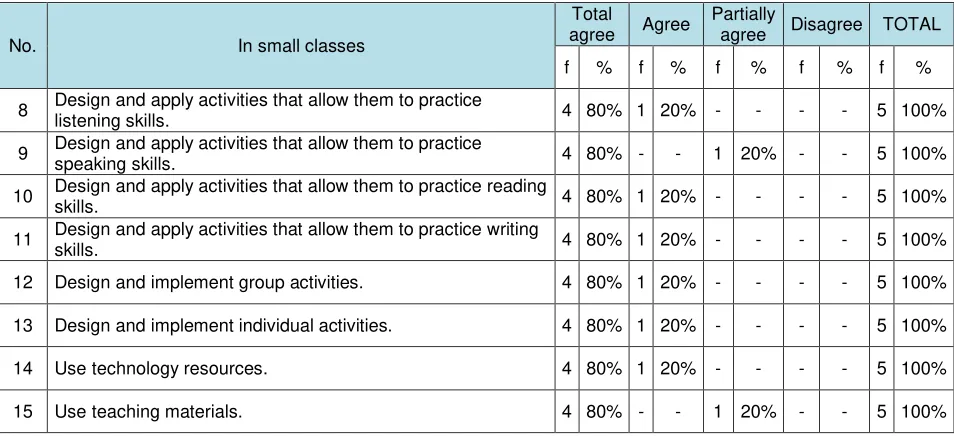
8 Design and apply activities that allow them to practice listening skills. 4 80% 1 20% - - - - 5 100%
9 Design and apply activities that allow them to practice speaking skills. 4 80% - - 1 20% - - 5 100%
10 Design and apply activities that allow them to practice reading skills. 4 80% 1 20% - - - - 5 100%
11 Design and apply activities that allow them to practice writing skills. 4 80% 1 20% - - - - 5 100%
12 Design and implement group activities. 4 80% 1 20% - - - - 5 100%
13 Design and implement individual activities. 4 80% 1 20% - - - - 5 100%
14 Use technology resources. 4 80% 1 20% - - - - 5 100%
15 Use teaching materials. 4 80% - - 1 20% - - 5 100%
Author: María Ibarra S.
26
Table 4
STUDENTS´ PERCEPTIONS
No. In small classes
Total
agree Agree Partially agree Disagree TOTAL
f % f % f % f % f %
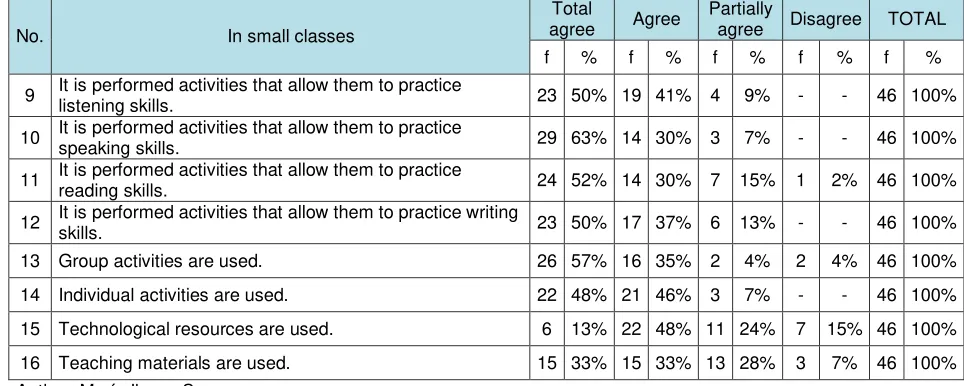
9 It is performed activities that allow them to practice listening skills. 23 50% 19 41% 4 9% - - 46 100%
10 It is performed activities that allow them to practice speaking skills. 29 63% 14 30% 3 7% - - 46 100%
11 It is performed activities that allow them to practice reading skills. 24 52% 14 30% 7 15% 1 2% 46 100%
12 It is performed activities that allow them to practice writing skills. 23 50% 17 37% 6 13% - - 46 100%
13 Group activities are used. 26 57% 16 35% 2 4% 2 4% 46 100%
14 Individual activities are used. 22 48% 21 46% 3 7% - - 46 100% 15 Technological resources are used. 6 13% 22 48% 11 24% 7 15% 46 100% 16 Teaching materials are used. 15 33% 15 33% 13 28% 3 7% 46 100% Author: María Ibarra S.
Source: Students´questionnaire
The following analysis corresponds to question number eight from teachers´
questionnaire: “In small classes, the teacher designs and applies activities that allow students to
practice listening skills”, and question number nine from students´ questionnaire: “In small
classes, it is performed activities that allow students to practice listening skills”. The replies
to the questionnaire show that 4 teachers (80%) of teachers stated that they totally agree; in the same way, 23 students (50%) of students mentioned that they totally agree. Going on with positive perception, we have that 1 teacher (20%) of teachers said that they agree, and 19 students (41%) of students answered that they agree, too. Consequently, 0% (0 teachers) of teachers replied that they partially agree; while, 4 students (9%) of students mentioned that they partially agree. Finally, 0 teachers (0%) expressed that that they disagree; likewise, 0 students (0%) of students said that they disagree.
27
Indeed, it was noticeable that in all classes observed, teachers used an audio recorded in one class activity. This result is similar to the analysis above, in which all teachers provided a positive answer about performing activities that allow students to practice listening skills; this fact shows that in most English classes, teachers apply listening activities; besides, many of them used different kinds of equipment, such as audio recorded or TV. Besides, teachers elaborated a class plan related to listening skills. Finally, most of students looked satisfied with listening activities, and the class plan applied.
Regarding item number nine from teachers´ questionnaire: “In small classes, design and apply activities that allow them to practice speaking skills”, and item number ten from students´ questionnaire: “In small classes, it is performed activities that allow students to practice reading
skills”. The statement previously analyzed receive the following answers: 4 teachers (80%) of teachers replied that they totally agree; similarly, 29 students (63%) of students said that they totally agree. In addition to positive criterion, 0 teachers (0%) of teachers replied that they agree; while, 14 students (30%) of students mentioned that they agree. On the other hand, 1 teacher (20%) of teachers stated that they partially agree; in the same way, 3 students (7%) of students answered that they partially agree; meanwhile, 0% (0 teachers) of teachers and 0% (0 students) of students stated that they disagree.
In regard to activities that allow students practice speaking skills, Scrivener (2011) stated that it is easier for students to practice their speaking out when they work in pairs and small groups; this kind of organization in class allows that teachers check answers to questions and other assignments.
In concordance with the results above, and the author´s opinion, the notes took during observation´ process show that teachers performed speaking activities, and all students practice their speaking skills. Furthermore, it could see that it was simple for teachers to apply tools and techniques because they worked with few students, and students felt less stress when they spoke out.
Additionally, it could observed that due to the small number of students in each class, the most common activity, developed by teachers to practice speaking skills, was work in pairs.
28
eleven from students´ questionnaire: “In small classes, it is performed activities that allow students to practice reading skills”. The results from the statement above show that 4 teachers (80%) of teachers replied that they totally agree; in the same line, 24 students (52%) of students answered that they totally agree. Moving on positive reactions, 1 teacher (20%) of teachers mentioned that they agree; similarly, 4 students (30%) of students stated that they agree. On the other hand, 0 teachers (0%) of teachers stated that they partially agree; whereas, 7 students (15%) of students mentioned that they partially agree. Finally, 0 teachers (0%) of teachers said that they disagree; similarly, 1 student (2%) of students replied that they disagree.
In this regard, Harfitt (2013) suggests, as a good activity, group work reading circles which facilitates the practice of reading in small classes because all students have the opportunity to participate. According to the author, students´ participation in all learning activities is a vital element to promote an effective teaching-learning environment.
During the observation process, the results demonstrated that teachers perform reading activities with all students´ participation. Students had the opportunity to read a short paragraph, and the teacher correct their reading pronunciation at the same moment; it was very satisfactory for students who mentioned that they practice reading during several minutes each day, inside and outside the classroom. This kind of activities in English language allows teachers to correct students´ reading pronunciation at the same time.
The following results correspond to item number eleven from teachers´ questionnaire: “In
small classes, teacher design and apply activities that allow students to practice writing skills”,
and question number twelve from students´ questionnaire: “In small classes, it is performed
29
Contrary to the result above, Moradi, Moin, & Ketabi (2012) stated that there is less opportunity to apply much communicative strategies in written English, in small classes, because small classes encourage active students´ participation in class activities, in special dialogues.
According the research and the observation notes, teachers applied activities that allow students to practice writing skills. Nevertheless, not all teachers are totally convinced about this situation because some of them considered that s/he only apply writing activities, but s/he did not design them. However, in general terms, it was observed that teachers implemented several writing activities such as writing a well structure paragraph; all students were focused in developing the task and their writing skill, and teachers had more time to provide feedback related to writing skills.
Regarding to item number twelve from teachers´ questionnaire: In small classes, the teacher designs and implements group activities, and item number thirteen from students´ questionnaire: In small classes, group activities are used. The following results were found: 4 teachers (80%) of teachers replied that they totally agree; in the same way, 26 students (57%) of students answered that they totally agree. In accordance with this positive criterion, 1 teacher (20%) of teachers mentioned that they agree; additionally, 16 students (35%) of students said that they agree. In the same line, 0 teachers (0%) of teachers replied that they partially agree; but, 2 students (4%) of students stated that they partially agree. Finally, 0 teachers (0%) of teachers said that they disagree; while, 2 students (4%) of students answered that they disagree.
Considering the used of group activities, Harfitt (2013) argues that group work is often organized in the small classes because there is a cooperative environment, and it is easier to apply exercises in small groups. In addition, the author suggest students´ circle activity as an effective way to work in groups.
30
The following analysis corresponds to item number thirteen from teachers´ questionnaire: In small classes, the teacher designs and implements individual activities, and item number fourteen from students´ questionnaire: In small classes, individual activities are used. The responses about the items demonstrated that 4 teachers (80%) of teachers mentioned that they totally agree; likewise, 22 students (48%) of students answered that they totally agree. Continuing with positive replies, 1 teacher (20%) of teachers stated that they agree; similarly, 21 students (46%) of students replied that they agree. Moving to negative opinions, 0 teachers (0%) of teachers said that they partially agree; while, 3 students (7%) of students answered that they partially agree. At the end, 0 teachers (0%) of teachers replied that they disagree; equally, 0 students (0%) of students mentioned that they disagree.
In regards of the design and implementation of individual activities, Anderson (2000) argues that small classes give the opportunity to do more individual work; such as practicing vocabulary exercises, complete a dialogue and readings.
The results obtained above are analogous to the observation notes, in all classes observed teachers implemented individual activities. This fact states clear that the design and implementation of individual activities is easier in small classes because all students have the same opportunity to take part on them. It should be mentioned that the experience of each teacher was reflected in some way on the activities designed, and implemented for individual students work.
31
Regarding the use of technological resources, Griffee (2012) argues that it is necessary to establish methods for teaching in accordance with class size, and the use of adequate equipment is essential. Besides, this author comments that the possibility to work with audio recorder is easier in small classes.
In addition to the analysis above, it can be added that the use of technology resources was a very important complement in classes observed; in fact, all teachers used some kind of technological equipment during the class. The most common tools utilized were audio recorder and videos; these instruments facilitated the development of several activities, particularly listening exercises.
Related to the item number fifteen from teachers questionnaire: In small classes, teachers use teaching materials, and item number sixteen from students´ questionnaire: In small classes, teaching materials are used. The following results can be shared: 4 teachers (80%) of teachers answered that they totally agree; in the same way, 15 students (33%) of students replied that they totally agree. Meanwhile, 0 teachers (0%) of teachers mentioned that they agree; similarly, 15 students (33%) stated that they agree. On the other hand, 1 teacher (20%) of teachers said that they partially agree; equally, 13 students (28%) mentioned that they partially agree. Finally, in a total negative context, 0 teachers (0%) of teachers stated that they disagree; while, 3 students (7%) of students replied that they disagree.
Concerning to the use of teaching materials, Harfitt (2013) suggests that the use of worksheets in the class help students to remember some exercises, and it is a clue for class interaction. According to this, it is possible to illustrate the lesson which permits to eliminate the use of mother tongue. In addition, it forces students to talk in the target language.
32
Indeed, the use of good materials, practical technologic resources, and pertinent strategic to practice writing, reading, speaking and listening help to increase the benefits to teaching English in small classes.
[image:37.612.78.561.257.420.2]How do students feel about learning English in small classes?
Table 5
TEACHERS´ PERCEPTIONS
No. In small classes
Total
agree Agree Partially agree Disagree TOTAL
f % f % f % f % f %
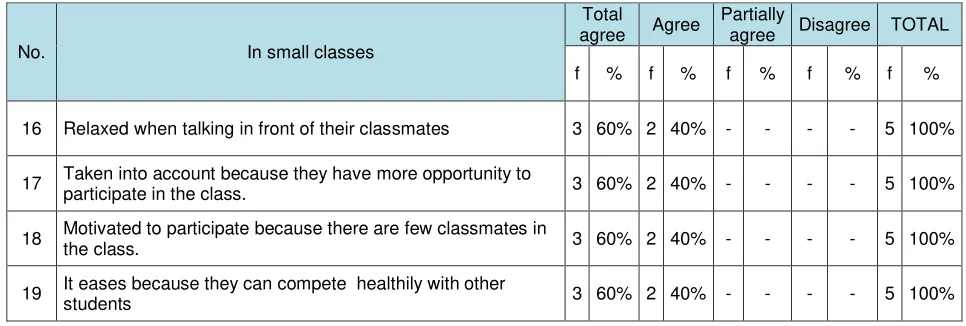
16 Relaxed when talking in front of their classmates 3 60% 2 40% - - - - 5 100%
17 Taken into account because they have more opportunity to participate in the class. 3 60% 2 40% - - - - 5 100%
18 Motivated to participate because there are few classmates in the class. 3 60% 2 40% - - - - 5 100%
19 It eases because they can compete healthily with other students 3 60% 2 40% - - - - 5 100%
Author: María Ibarra S.
[image:37.612.81.559.484.614.2]Source: Teachers`questionnaire
Table 6
STUDENTS´ PERCEPTIONS
No. In small classes
Total
agree Agree Partially agree Disagree TOTAL
f % f % f % f % f %
17 relaxed when speaking in front of my classmates. 25 54% 16 35% 4 9% 1 2% 46 100%
18 taken into account because I have more opportunity to participate in the class. 23 50% 20 43% 2 4% 1 2% 46 100%
19 motivated to participate because we are few peers in the class. 22 48% 19 41% 5 11% - - 46 100%
20 comfortable because I can compete healthily with other students. 25 54% 18 39% 2 4% 1 2% 46 100% Author: María Ibarra S.
Source: Students`questionnaire
33
my classmates. In regard to the items above, that the results showed 3 teachers (60%) of teachers replied they totally agree; likewise, 25 students (54%) of students said that they totally agree. In a similar line, 2 teachers (40%) of teachers mentioned that they agree; besides, 16 students (35%) of students answered that they agree. In the opposite case, 0 teachers (0%) of teachers mentioned that they partially agree; but nevertheless 4 students (9%) of students replied that they partially agree. Moving to negative responses, 0 teachers (0%) of teachers expressed that they disagree; on the contrary, 1 student (2%) of students stated that they disagree.
Taking into consideration the item above, the students are relaxed when talking in front of their classmates; in this sense, Richards & Bohlke (2011) suggest the construction of dialogues to discuss about similar interests. These authors consider that it is very important that teachers promote a friendly attitude among students; this helps to create an environment where students can express themselves without being criticized by others.
Lastly, it can be mentioned that according the notes taken during observation process, in some classes, students were nervous when they participated in front of their classmates because their answers were criticized by the other students. However, teachers´ perception is completely different because all teachers interviewed expressed a positive answer; in other words, they supposed that their students were relaxed during their participation in front of their classmates. In fact, the students´ position is understandable because it is not comfortable that someone else criticizes when it comes to learn something new, particularly concerning a foreign language.
34
Regarding the item analyzed in the preceding paragraph, Moradi, Moin, & Ketabi (2012) mention that the students get the opportunity to practice conversations using the target language more frequently in small classes. According to the authors´ perceptions, smaller classes encourage the students´ participation with a lot of motivation in class events and dialogues.
According to notes taken, in the majority of classes observed, all students had the opportunity to participate in class activities, particularly in spoken tasks. The dialogues were more interactive, and students could speak more time. Undoubtedly, the small number of students in each class allowed teachers to motivate students´ participation in the activities proposed.
In regards to item number eighteen from teachers´ survey: In small classes, students feel motivated to participate because there are few classmates in class and the item number nineteen from students´ survey: In small classes, I feel motivated to participate because we are few peers in the class. The items above obtained the following answers: 3 teachers (60%) of the teachers replied that they totally agree; similarly, 22 students (48%) of students mentioned that they totally agree. Continuing with positive connotation, 2 teachers (40%) of teachers said that they agree; in the same way, 19 students (41%) of students answered that they agree. Changing the perspective to a negative connotation, 0 teachers (0%) of teachers answered that they partially agree; meanwhile, 5 students (11%) of students replied that they partially agree. Finally, 0 teachers (0%) of teachers mentioned that they disagree; equally, 0 students (0%) of students stated that they disagree.
Concerning to the motivation to participate in a class with few classmates, Cakmak (2009) argues that it is easier to stimulate a small group than a large one; in addition, there is more time for each student when they do a task, and students are frequently involved in class activities.
Based on the notes taken during observation process, it can be added that students looked full motivated because all of them participated in each activity proposed by teacher. Additionally, most of students expressed they were satisfied because they had more attention when they spoke, and they had more time to participate in activities during class. It was evident that the small number of students, in these classes, affected in a positive way students´ participation.