BIBLIOTECAS DEL TECNOLÓGICO DE MONTERREY
PUBLICACIÓN DE TRABAJOS DE GRADO
Las Bibliotecas del Sistema Tecnológico de Monterrey son depositarias de los trabajos recepcionales y de
grado que generan sus egresados. De esta manera, con el objeto de preservarlos y salvaguardarlos como
parte del acervo bibliográfico del Tecnológico de Monterrey se ha generado una copia de las tesis en
versión electrónica del tradicional formato impreso, con base en la Ley Federal del Derecho de Autor
(LFDA).
Es importante señalar que las tesis no se divulgan ni están a disposición pública con fines de
comercialización o lucro y que su control y organización únicamente se realiza en los Campus de origen.
Cabe mencionar, que la Colección de
Documentos Tec,
donde se encuentran las tesis, tesinas y
disertaciones doctorales, únicamente pueden ser consultables en pantalla por la comunidad del
Tecnológico de Monterrey a través de Biblioteca Digital, cuyo acceso requiere cuenta y clave de acceso,
para asegurar el uso restringido de dicha comunidad.
Design of a Procedure that Facilitates the Integration and
Combination of Several Technologies into the
Teaching-Learning Process-Edición Única
Title
Design of a Procedure that Facilitates the Integration and
Combination of Several Technologies into the
Teaching-Learning Process-Edición Única
Authors
Francisco Huerta Tamayo
Affiliation
Tecnológico de Monterrey, Universidad Virtual
Issue Date
1999-12-01
Item type
Tesis
Rights
Open Access
Downloaded
18-Jan-2017 20:13:31
INSTITUTO TECNOLÓGICO Y DE ESTUDIOS
SUPERIORES DE MONTERREY
UNIVERSIDAD VIRTUAL
DESIGN OF A PROCEDURE THAT FACILITATES
THE INTEGRATION AND COMBINATION OF SEVERAL
TECHNOLOGIES INTO THE TEACHING-LEARNING PROCESS
PRESENTED AS THE FINAL REQUIREMENT
FOR THE DEGREE OF:
MAESTRO EN ADMINISTRACIÓN
DE TECNOLOGÍAS DE INFORMACIÓN
AUTHOR: ING. FRANCISCO HUERTA TAMAYO
SUPERVISOR: DRA. MÓNICA PORRES HERNÁNDEZ
DESIGN OF A PROCEDURE THAT FACILITATES THE INTEGRATION AND COMBINATION OF SEVERAL
TECHNOLOGIES INTO THE TEACHING-LEARNING PROCESS
Thesis presented by
FRANCISCO HUERTA TAMAYO
This thesis is dedicated to:
God, for giving me the opportunity to enjoy my life.
My wife, Blanca Pérez, for her love.
My sons, Francisco and Carlos Huerta, for their happiness and patience.
Acknowledgments
A work such as this one could not have been completed in isolation.
Consequently, I wish to acknowledge a number of people who contributed to the
development of this work. I am deeply grateful to the ITESM Mexico City Campus
-its faculty, staff and students- for starting me down this path.
Thanks to Ariel Téllez, Damian Martínez, Oscar García and Juan Antonio
Valverde for the enormous contribution in the elaboration of the product of this
thesis. Also, I would like to acknowledge the assistance and support of many
people who help me with their encourage during the development of this work,
especially the people who I work with: Alejandra Gutiérrez, Deborah Sarky, Jaime
Aguilera, Fernando Herrera, David Ramírez, Pablo Ramírez and Marco Vasquez.
I wish to recognize the contribution of all the professional people who
participate with their comments. From the Innovation for Education Center of the
ITESM Mexico City Campus: Cynthia and Georgina Villanueva, and Alberto
Gastelú. From the Virtual University: Elizabeth Romero, Angel Ibarra, Carlos
Sandoval and Juan Eligio Duarte. Tanks to all of them.
I must give special mention to Rocio Oliver and José Luis Espíndola for
reading the early drafts of this work and giving me feedback and encouragement.
A special thanks to Mónica Porres for her guidance and ideas, and for taking on
this project.
Finally, and definitely far from least, I wish to express my gratitude to
Carlos Pérez and Blanca Gómez for their unconditional help and my love for
ABSTRACT
DESIGN OF A PROCEDURE THAT FACILITATES THE INTEGRATION AND COMBINATION OF SEVERAL
TECHNOLOGIES INTO THE TEACHING-LEARNING PROCESS
December, 1999
FRANCISCO HUERTA TAMAYO
INGENIERO EN SISTEMAS ELECTRÓNICOS INSTITUTO TECNOLÓGICO Y DE ESTUDIOS
S U P E R I O R E S DE M O N T E R R E Y
MAESTRO EN ADMINISTRACIÓN INSTITUTO TECNOLÓGICO Y DE ESTUDIOS
S U P E R I O R E S DE M O N T E R R E Y
MAESTRO EN ADMINISTRACIÓN DE TECNOLOGÍAS DE INFORMACIÓN INSTITUTO TECNOLÓGICO Y DE ESTUDIOS
S U P E R I O R E S DE M O N T E R R E Y
Supervisor: Dra. Mónica Porres Hernández
Abstract
One of the reasons why many teachers are not integrating technology
in their classrooms is the lack of prior experiences in using it as a productivity
tool and for teaching. The teachers will not integrate technology into their
technology) just because they are unable to use it consistently and effectively.
In this work, the author presents the relationship between the
teaching-learning process and the technology with the intention of eliminates this
problem.
The methodology used by the author to develop this work is the action
research. The problem detected by him is the one defined above and then he
formulates the following hypothesis: "If the teachers understand how the
teaching-learning process is developed and how technology can be used to
collaborate in this process, they will integrate it more efficiently".
To deal with the problem stated, the author proposes a procedure that
helps the teacher to integrate a given set of technology applications into the
teaching-learning process. The procedure is used to develop a prototype that
uses only the technology applications related with Internet.
The procedure and the prototype was presented to a group of experts
involved in the implantation of several teaching media, and they expressed the
following:
a. The procedure facilitates the work of the pedagogical advisor and the
teacher on the selection of the technology tools and, helps to link
successfully a pedagogical design with the use of different technology
media.
b. The prototype integrates several technologies through a single interface
that is user friendly. Its modularity allows to incorporate several "plug-in"
Internet technologies.
a. Information Technologies alios access to a rich interactive learning
experience wich can, in some cases, exceed the interactivity in a
traditional classroom.
b. The procedure presented by the author provides assistance to the
pedagogical advisors and the teacher to move the interactivity into the
classroom toward a more student-centered approach.
c. It seems that improvements in university teaching are likely to come from
multiple media.
TABLE OF CONTENTS
THE PROBLEM 1
CHAPTER 1. TRENDS IN HIGHER EDUCATION 5
1.1 The world is changing 5
1.2 The Workplace is changing 9
1.3 Present and future in higher education 11
1.4 The new technologies for the new teachers 18
CHAPTER 2. HOW TO USE TECHNOLOGY IN TEACHING AND
LEARNING 21
2.1 Understanding the teaching-learning process 21
2.2 Conversational framework 25
2.3 The traditional education and the conversational
framework 27
2.4 Teaching Media 28
2.5 Using multiple media to enable effective teaching
and learning 29
2.6 Classification of media 30
2.7 Audio-visual media 31
2.7.1 Audio-vision 31
2.7.2 One-way video system 32
2.7.3 Video 33
2.8.1 Hypertext 35
2.8.2 Hypermedia 35
2.8.3 Multimedia resources 36
2.9.1 Interactive Media: Microworlds 41
2.9.2 Interactive Media: Modeling 43
2.10.1 Adaptive media: Instructional software 44
2.10.2 Adaptive Media: Tutorials 46
2.10.3 How to Use Tutorials in Teaching 46
2.10.4 Simulations Software 47
2.10.5 How to Use Simulations in Teaching 48
2.10.6 Adaptive Media: Problem-solving Courseware 49
2.10.7 How to Use Problem-Solving Courseware in Teaching.. 50
2.11 Discursive media 51
2.11.1 Discursive Media: Audio-conferencing 51
2.11.2 Video-conferencing 53
2.11.3 One-way Video 54
2.11.4 Computer-mediated conferencing 56
2.11.6 Collaboration 59
2.12 Conversational framework and teaching media 60
CHAPTER 3: METHODOLOGY 62
3.1 Action Research 63
3.1.1 Identification and clarification of the general idea 63
3.1.2 Recognition of the Problem and explanation of the facts 63
3.1.3 Review of literature to find out if the problematic has
been studied before 65
3.1.4 Structure of the general plan and its implantation 65
3.1.5 Establish the criteria for evaluation and the feedback
techniques 66
3.2 Design of a procedure to integrate technology into the
teaching-learning process ...68
CHAPTER 4. RESULTS 71
4.1 Description of the experts' groups 71
4.2 Questions asked to the experts ...72
4.3 Comments of the pedagogical advisors ...73 4.4 Comments of the Coordinators of logistic for the Virtual
University ...75
4.5 Comments of the technical support staff ...76
4.6 Interpretation of the results ...77
CHAPTER 5. CONCLUSIONS AND RECOMMENDATIONS 81
5.1 Conclusions ...81
5.2 Recommendations ...84
APPENDIX A. UTILIZATION OF TECHNOLOGY INTO THE TEACHING AND
LEARNING PROCESS: THE CURRENT SITUATION 86
APPENDIX B. COURSE STRUCTURE 88
APPENDIX C. INTERNET APPLICATIONS 89
APPENDIX D. PROTOTYPE OF THE CONVERSATIONAL FRAMEWORK
BASED ON INTERNET APPLICATIONS 90
APENDIX E. COMMENTS 105
INDEX OF FIGURES
Figure 1.1. Student Environment Model 14
Figure 2.1. Conversational Framework 25
Figure 2.2. Overlapping domains of Hypertext, Hypermedia, and Multimedia 37
Figure 3.1. Procedure to integrate technology into the teaching-learning process 69
Figure A.1. Average use of technology 87
Figure D.1. Prototype: Home Page 96
Figure D.2. Prototype: Class Information 97
Figure D.3. Prototype: Announcements 98
Figure D.4. Prototype: Schedule 99
Figure D.5. Prototype: Video- streaming with slides 100
Figure D.6. Prototype: HyperNews (Usenet) 101
Figure D.7. Prototype: Students 102
Figure D. 8. Prototype: Learning Links 103
INDEX OF TABLES
Table 1.1. Traditional education and workplace requirements 11
Table 1.2. Alternative Educational Model 15
Table 2.1 Conversational framework and teaching media 61
Table 4.1 .A Summary of the experts' comments and general conclusion 78
Table 4.1 .B Summary of the experts' comments and general conclusion 79
Table B.1 Internet Applications 89
Table D.1. Course Structure and the Conversational Framework 91
Table D.2. Internet applications and teaching media 91
Table C.3. The Conversational Framework and the Internet applications 92
Table D.4. Scene 1: course structure and Internet applications 93
Table D.5. Scene 2: course structure and Internet applications.. 94
THE PROBLEM
The proliferation of computers and related technologies in schools
constitutes one of the most substantive changes that have occurred in education
over the last years. For example, in the ITESM Mexico City Campus, during the
last two years the number of personal computers has increased from 2,000 to
more than 9,000 while the population has increased only by no more of 10%.
Numbers, however, do not indicate the extent to which computers and related
technologies are integral to the teaching and learning process. While it appears
that schools and classrooms have technology in them, evidence suggests that they
are not very well integrated into teachers' practice. When it can be definitively
determined that teachers are routinely using computers and related technology to
accomplish their work and facilitate students' learning, then it can be said that the
next step has been taken. Until that time, we must accept that technology is in
schools, but many teachers still rely on traditional methods of teaching.
One of the reasons why many teachers are not integrating technology in
their classrooms is the lack of prior experiences in using it as a productivity tool
and for teaching. Hence, there is little in the way of a foundation to propel them to
use technology to teach. Institutions responsible for preparing teachers in
pedagogy fail to sufficiently prepare them to use technology to deliver academic
services. The result is the perpetuation of the marriage of teachers to traditional
Teachers will not abandon traditional pedagogy just because they have to.
For teachers, to integrate technology into their practice, they need to believe that
using technology is more efficient and effective than their usual methodologies.
There is an educational "cemetery" of innovations that never had a chance
to live or lived only briefly because a vision of the impact on teaching was never
conceived. When computers and related technologies are introduced in schools, a
plan for why and how they are to be used needs to be in place. Its relevance to
teachers, students, and the curriculum need to be clearly articulated too.
At least three problems arise in an effort to integrating technology into
schools and teachers' practice. One is the difficulty associated with obtaining
hardware. The second problem is that of maintaining hardware that has been
purchased. The third problem, however, resides in the human realm and influences
teachers' decisions about integrating technology into practice.
Of the problems related to infusing technology in schools, overcoming those
emanating from human nature are imperative, if teachers are to integrate
technology into their practice. Without the human, the machine (technology) cannot
be used to its potential, but the human can continue to work, without the machine.
Technology is a heading for a variety of hardware, software and
telecommunications available for use in schools. A list of technology includes
computers, laser disc players, C D - R O M , overhead projector panels, digital
cameras, local and wide area networks, and multimedia systems. Numerous
applications yield computer-assisted instruction, computer managed instruction,
publishing, communication, and networking. How can a teacher productively use all
the hardware, software and telecommunication applications available to him or
her? It becomes useful, then, for teachers to be selective in the technology they
spend time with. Also, with so much technology on the market and numerous
possibilities for its use, where would teachers begin? Simplifying computer
technology allowed teachers to focus their attention on a manageable
configuration. The more complex an innovation is the more time it takes to master
it. Teachers may also abandon an innovation because they are unable to use it
consistently and effectively.
Encouraging teachers to integrate technology into their practice is a
formidable task. A change agent needs to have an understanding of the
psychological effect of the resistance to change, being waged by teachers
undergoing the change process. Teachers have personal and professional
concerns about practically any innovation introduced to them. In addition, they are
also concerned about technology's impact on their students.
Teachers with concerns need specific assistance to resolve the concerns
they have about an innovation. For teachers to integrate innovations (computers
and related technologies) into their practice, their concerns about it need to be
resolved. There are a number of interventions a change agent can use to assist
teachers in overcoming their concerns. Encouraging on a one-to-one basis,
providing technical assistance, and modeling how to use technology are a few
Teacher educators need to revisit their practices and teach with technology
so that teachers emerge able to use computers and related technology. The
responsibility does not end there, however. If those responsible for training
teachers incorporate technology into their preparation repertoire, then schools
must extend the skills. And this is one of the main objective of these work.
In conclusion, the teachers will not integrate technology into their practice
just because they have to. Even more, if they are currently trying to use it, they
may abandon an innovation (with computers and/or related technology) just
because they are unable to use it consistently and effectively. In this work, the
author presents the relationship between the teaching-learning process and the
technology with the intention of eliminate this problem.
Finally, the aim of the author is to help all those higher education's teachers
that want to learn how to be more effective in the Information Age. Using most of
CHAPTER 1. TRENDS IN HIGHER EDUCATION
This chapter presents the changes that has to be taken in higher education
as a result of the transformation that is taking place in the workplace and, in
general, the hole world.
It is also stated the conclusions of some authors and researchers about:
a. The adaptation process that the learning organizations -universities and
colleges- has to carry on in order to evolve according to the changes in
theirs environment.
b. The paradigm shift that has to be assimilated by the teacher to play a new
role.
c. The importance of the technology as one of the enablers of the new
paradigm.
1.1 The world is changing
Futurists have coined a variety of phrases to describe our emerging world:
"knowledge economy", "information age", or "digital economy", are only a few.
Regardless of the term, change is the focus, with technology increasing the pace of
transformation. Oblinger & Rush (1997) explain why the society is being
transformed by global competition and the power of technology. And they analyze
some indicators that have been changing lately:
Volume of information. The volume of new information is increasing at
year than their grandparents encountered in a lifetime. Knowledge doubles every
seven years. Ten thousand scientific articles are published every day.
Technological Competence. Technology is now a competency that is
requvred \n Yr\e workforce; "A \s becorrVvng another bas\c sk\\\. Sixty-five percen\ or a\\
workers use some type of information technology in their jobs. By the year 2000,
this number will increase to 95%.
Telecommuting. The population that is employed in home-based business
is increasing. In the U S , for instance, it is expected that by year 2000, 50% of the
working population will be working on this basis.
Collaboration. The capacity for individuals to use technology independently
and collaboratively in their work is increasingly required. No one person has all the
competencies needed in today's high performance workplace.
Reskilling. It is estimated that the shelf life of a technical degree today is
only five years. Although many of the critical skills required in the high performance
workplace have not changed (e.g., science, engineering, finance, and law), the
pace of knowledge advancement requires constant updating.
Demographics. The changing demographics of higher education are
placing new demands on institutions. Students are more diverse; they are older,
must balance other life and career priorities, and prefer to attend college on a
part-time basis. Individuals expect to have greater access to educational resources and
alternatives, particularly from beyond the campus.
Selectivity. Students are using their purchasing power to be more selective
environment that fosters measurable improvement in their skill development, not
just during college, but throughout their careers. Students are increasingly
selecting curricula that enhance their chances for initial and sustained employment.
"Today's learners are becoming increasingly impatient. Their dealing with
world-class service providers in other settings have conditioned them to expect
just-in-time and real-just-in-time services", Dolence & Norris, 1995. .
Government influence. Governors and other policy makers are pushing to
make higher education more affordable and accessible to older, working students,
and to make institutions more responsive to the changing workplace where many
jobs now require continual retraining. Governors are discussing the creation of a
virtual university. Accreditation is being criticized. Various boards and legislators
are proposing that tenure be eliminated, or at the very least be reviewed
periodically. There is a growing sense that government, not faculty senates, will
dictate higher education policy.
Increasing demand. Looking slightly ahead to the year 2000, futurists
estimate that just to keep even each individual in the workforce will need to
accumulate learning equivalent to that currently associated with 30 credit hours of
instruction, every seven years. This could equal over 20 million fulltime equivalent
(FTE) learners from the workforce. Using our existing educational model, these
learners would require an additional 672 campuses with an enrollment of 30,000
students each. To meet the full potential demand by the year 2010, a campus
This is not merely an issue for American higher education. With
globalization, all the countries in the world are interconnected and the issues that
concerns one or some of them, usually have an impact over the others.
Mexico is not the exception, it is changing with the hole world. Sometimes
faster, sometimes slower, but it is changing.
Neither country can be seen as an isolated entity. All the world is being
integrated as a hole and this integration is being accelerated by technology
advancements. For example, now days:
a. Today a computer chip can perform electronic operations as fast as 4
billionths of a second. By the year 2000, 200 trillionths.
b. With the press of a button, in a matter of seconds, E-mail is zapped from
computer to computer anywhere in the world.
c. A single hair-thin optical fiber can transmit the contents of the Encyclopedia
Britannica—all twenty-nine volumes-in less than a second.
d. Satellite technology enables instant visual communication from one country
to another.
e. From the comfort of your own home or office—through the Internet—you
have quick and ready access to major libraries, universities, scientific
journals, newspapers, magazines, and many other sources.
f. More than 50 million people in 160 countries are already on the Net with
The author's thinking is that higher education must recognize and adapt to
all these changes if it really wants to occupy the pivotal role in society of the
Information Age. Lets now focus on the changes that have been taking place in the
workplace to see their impact on education.
1.2 The Workplace is changing
Now days, a lot of organizations are rethinking their strategies and operating
structures. Reengineering has become very common. Competition is global.
Incremental change is not enough. Knowing and anticipating your customers'
wants and needs is essential. Organizations are promoting more employee
empowerment. Teaming and group problem solving are critical skills. Technology
and the power of information are key to a competitive edge. All these changes are
affecting the workplace.
The main changes that are taking place in the workplace are:
Rapid change. In this business climate, there are significant implications for
workers. Consider that more than 75% of the Fortune 1,000 companies are
revamping fundamental work processes and undergoing radical change. Consider
too the changes brought about by the move from mainframe to client/server
applications. Reskilling such a worker calls for over 350 hours of training and an
investment of $50,000 per person (Panepinto, 1994 in Oblinger & Rush, 1997).
Teamwork. The ability to work effectively in teams is an important
characteristic of today's high performance workplace. In our current environment,
who know how to work collaboratively; people who can work with colleagues on a
problem or a new product, operating in cross-functional teams of engineers,
marketers, lawyers, accountants, and other skilled professionals. These teams
need to be increasingly diverse-in a global sense. People from all cultures and all
countries will need to be able to effectively communicate as a team in the global
market.
Decision-making. Increasingly, employees are empowered to make their
own decisions. The days of a parent-child like relationship between management
and employees are gone from business. In business' flattened organizations,
employees are expected to make decisions and to make them quickly (CMI, 1995).
Building and applying Competencies. The question "What competencies
are needed here?" is constantly asked in the business environment. Employees
are expected to engage in a constant quest to build their expertise, both in depth
and breadth. Those with the greatest competence are expected to mentor others.
The competencies of people are an important asset to business products and
services (CMI, 1995), and lifelong learning is a requirement.
As organizations begin to change the way they work and the new IT enabled
changes begin to take hold, there can be mayor changes in employment. Changes
can occur in overall levels of employment as well as in the kinds of skills required
and the rate of change of these skills.
At this point the author asks himself:
a. Does higher education teach students the new decision-making process?
c. Is lifelong learning fostered in higher education?
d. Could technology help in the develop of these skills required?
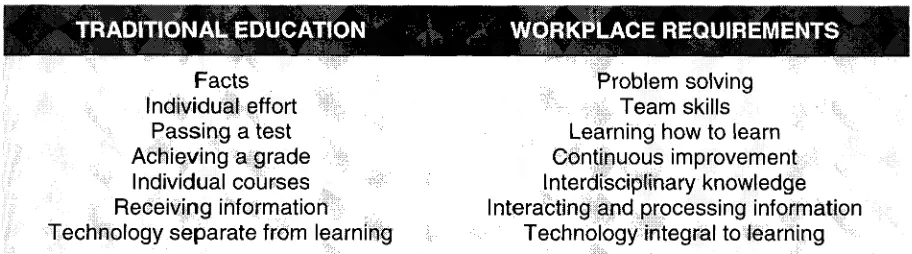
Unfortunately, there is a mismatch between traditional education and
[image:26.612.60.516.185.312.2]workplace requirements. Table 1.1 shows the contrast.
Table 1.1. Traditional education and workplace requirements
From O B L I N G E R , Diana G . , & R U S H , Sean C. (1997): The learning revolution. The challege of information technology in the academy (p. 7). Anker Publishing Company, Inc.
So, if higher education is expected to occupy the pivotal role in society of
Information Age, it has to change and adapt to the evolution of the world and, most
specifically, the workplace. Next section concerns about the present trends in
higher education.
1.3 Present and future in higher education
Duderrstandt (in Katz and Associates, 1999) concludes that the next decade
will represent a period of significant transformation for colleges and universities as
we respond to the challenges of serving a changing society and a profoundly
changed world. Perhaps the most critical challenges facing most institutions will be
to develop the capacity for change; to remove the constraints that prevent
institutions from responding to the needs of rapidly changing societies; to remove
Facts Problem solving
Team skills Learning how to learn Continuous improvement Interdisciplinary knowledge Interacting and processing information
Technology integral to learning Individual effort
unnecessary processes and administrative structures; to question existing
premises and arrangements; and to challenge, excite, and embolden all members
of the campus community to embark on what he believes will be a great adventure.
Colleges and universities have long enjoyed a monopoly over advanced
education because of geographical location and their monopoly on certification
through the awarding of degrees. Today all of these market constraints are being
challenged, as information technology eliminates the barriers of space and time
and as new competitive forces enter the marketplace to challenge "credentialing."
In the current paradigm, the colleges and universities are faculty centered.
The faculty has long been accustomed to dictating what it wishes to teach, how it
will teach it, and where and when the learning will occur. Students must travel to
the campus to learn.
This carefully regulated and controlled enterprise, called the university or
college, could be eroded by several factors:
1. The growing demand for advanced education and training simply cannot be
met by such a carefully rationed and controlled paradigm.
2. Current cost structures for higher education are simply incapable of
responding to the need for high-quality yet affordable education.
3. Information technology is releasing higher education from the constraints of
space and time (and possibly also reality with virtual universities).
All of these forces are driving us toward an open learning environment, in
which the student will evolve into an active learner and consumer, and unleashing
New paradigms are being developed which address this emerging
environment. In fact, some see a future where students will receive their education
on three "campuses" (Oblinger & Rush, 1997). A residential college community
where -for a summer or for four years- students study and receive guidance,
support, evaluation, and motivation; A global electronic campus that they can enter
via a computer, "commuting" from home, dormitory room, or community center;
and, the continuing education and training provided at their workplace by
employers and community organizations.
The new world and workplaces requires this kind of campuses, then it is
better to accelerate the integration of technology in education. If not, it wont be
possible to have these new kind of campuses, specially the global electronic
campus.
Now days, to complete a course, students go from place to place, acquiring
the resources they need. Print materials are kept in the library. Advice from a
faculty member is in another place and available only at certain times. The
classroom, as a resource, is in a different location and time. Lectures are
presented once but are not available for later review. Laboratories are open at
specified hours, based on institutional convenience rather than student needs.
Although computer labs allow access to the network and external resources, the
student must arrive during open hours and hope for a free terminal. The students'
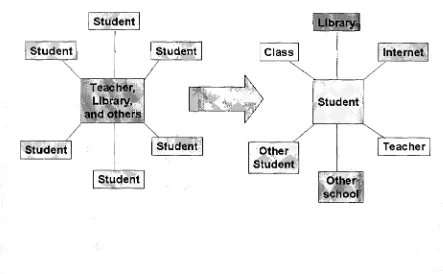
The model of the student environment is changing. Just like the world and
workplace change. The Figure 1.1* bellow depicts the current model where an
institutional organization or function is at the center; students must move from
place-to-place or person-to-person. The emerging model places the student at the
[image:29.612.64.507.231.505.2]center, with more flexible access to people and information.
Figure 1.1. Student Environment Model
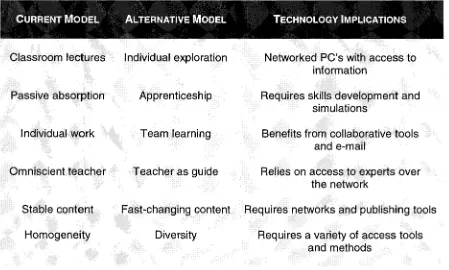
In the current model the teaching-learning process is based on the
classroom lectures, that is why it is also called the lecture model. The students'
learning is expected to be built through the passive absorption during the teacher
lecture, the individual work and some readings. Of course, there are some others
activities, like lab practices, but they occupy just a few part of the time the student
spend when he or she is learning.
On the other hand, the alternative model that is proposed, is centered in the
student, not the teacher. This means that the student learns through the
exploration, the experimentation and teamwork. So, the teacher is a guide and not
the omniscient that used to be.
The Table 1.2 shows the comparison between the two models and the
[image:30.612.100.549.325.595.2]technology implications we are concern about.
Table 1.2. Alternative Educational Model
Classroom lectures Passive absorption Individual work Omniscient teacher Stable content Homogeneity Individual exploration Apprenticeship Team learning
Teacher as guide
Fast-changing content
Diversity
Networked PC's with access to information
Requires skills development and simulations
Benefits from collaborative tools and e-mail
Relies on access to experts over the network
Requires networks and publishing tools
Requires a variety of access tools and methods
At the close of the twentieth century, Denning predicts that higher education
is facing a series of strong, sometimes contradictory pressures that will transform
the two major missions of the university- teaching and research the teaching side,
he says, these pressures will be resolved by a new distinction between knowledge
and information, between "knowing how" and "knowing about." This change will be
accompanied by a strong alignment of graduate educational offerings with the
needs and interests of working professionals, with a special emphasis on certifying
competence in selected areas. This distinction will also foster a new commitment to
offering broader perspectives that enable people to deal with complexity and
uncertainty, act with wisdom, build powerful social relationships, and practice the
skills of entrepreneurship. Digital media and Internet communications will transform
learning practices from the sequential classroom curriculum to nonlinear
"hyperlearning" environments. A new kind of teacher will emerge-the teacher who
is a course manager and a coach rather than an information transmitter. (Denning,
1997).
The hyperlearning is contrasted with the traditional model of school where a
course is a sequence of topics covered in a series of lectures, held in classrooms
at weekly intervals, with homework practice in between. It is designed to convey
information in an orderly manner. All students proceed at the same pace
regardless of their interests, prior experience, talents, or other demands on their
time. At the end grades indicate the levels of achievement they were able to make
in the fixed time period allocated for the course.
"... Instead of a classroom, see in your mind a large "learning room" with an entrance, an exit, and a number of learning stations (booths). You meet the teacher on entry. The teacher may place you into a small study or working group. The room's exit is guarded by a "certifier" whose job is to assess whether you have become competent at everything promised by the teacher, according to well-defined standards. You visit the stations to learn particular subjects or practices. Colored lines on the floor suggest paths among the stations. You can visit as many stations as you need to, and in any order consistent with your current knowledge, to prepare yourself for final certification. You can take trial certifications and then backtrack to the stations needed. You can take self-assessment tests at any time you like. You collaborate with other students in projects and study groups. You call on the teacher for help at any moment you are stuck. The teacher will offer guidance if you are heading in a wrong direction. In contrast to the linear model, everyone who exits gets the same "grade" (a certificate of completion or competence); the variables are the length of time and the path followed."
The digital media and networking are two driving forces who are driving
teacher to a new role that will fit the new hyperlearning approach. A s classrooms
disappear and machines take over much of the presentations -often doing it much
better than a live human lecturer- and as the machines take over testing and
record keeping, the teacher most focus in some others aspects.
This does not mean that teaching is made obsolete by technologies for
presentation, assessment, and record-keeping. To the contrary, the teacher will be
expected to inspire, motivate, manage, and coach students. It is noticeable that
just a few teachers have learned these skills because they never had to.
Learners need to develop the capacity to search, select, and synthesize vast
amounts of information to create knowledge (Dolence & Norris, 1995). Yet today's
students are confronted with an array of seemingly independent entities which they
must navigate. Courses stand alone. Faculty speak about "their courses." Although
program - a process which the faculty own. Students have minimal choices in
customizing their programs of study.
1.4 The new technologies for the new teachers
Digital media are now helping those most venerable information
organizations -colleges and universities- to rethink the ways in which they serve
society. Colleges and universities specialize in creating new knowledge, shifting
and storing it, and then sharing it with the next generation. The new
communications technologies offer higher education the opportunity to carry out its
traditional missions with powerful new tools. Education has never been more
important, and access to affordable higher education is increasingly a necessity
rather than a privilege. The most imaginative colleges and universities will not
hesitate to use the new technologies to make education more effective, more
affordable, and more accessible as well.
Farrington (1999) remark that the information technology is having a great
impact on programs of postgraduate education because it helps to provide lifelong
learning fore mature students. He also mention that digital media is useful for
liberating traditional education institutions from the constrains of their real estate
and now allow them to deliver courses and programs to new and often untraditional
groups of students wherever they may be in the world.
Bellow is a brief exploration of the opportunities information technologies
offer for improving high education (Farrington, 1999):
a. The new media do present provocative opportunities for improving
could be used to share faculty among different institutions and thus
eliminate redundancy in teaching capacity.
b. The powerful visualization capabilities of computers can be used to present
information in ways that are often more effective than print. Digital media
can be used to exploit the powerful simulation capabilities of computer so it
can be substituted for humans in teaching process.
c. Powerful software enables computers to interact with students more and
more as humans do, to help them team skills in subjects as diverse as
foreign languages mathematics, and music.
d. The digital technologies connect students and faculty so that they can
discuss and debate with one another without being present in the same
place at the same time.
e. The World Wide Web can be used to: deliver the notes of the teacher,
promote the discussion between the students and/or the teacher, or provide
a complete introductory course via this media.
It is important to remark that digital technologies are simply additional
methods of communicating and certainly not the only means by which students and
In the next chapter the author will explain the teaching-learning process like
a continuing conversation between the teacher and the students. A s every part of
the conversation can be realized with different media, it will be explained how
different technology can be used to improve the traditional teaching-learning
CHAPTER 2. HOW TO USE TECHNOLOGY IN TEACHING AND
LEARNING
In order to understand the way technology participates in the different steps
of the teaching learning process, this chapter has the task of making a global
analysis of:
a. The teaching-learning process like a continuing conversation between
teachers and students.
b. How traditional teaching-learning process is improved when different media
is used.
c. How technology can help in the development of the continuing conversation
framework.
2.1 Understanding the teaching-learning process.
To understand better the relationship between education and technology is
going to be easier if we have a reference model that explains how the
teaching-learning process is taken in place. Laurillard (1993) developed one that can be
useful for this purpose, but to understand it we have to inquire a little bit into her
heuristic.
She based her work on the recommendations Marton and Ramden (1998)
made to the teachers:
1. Present the learner with new ways of seeing.
3. Integrate substantive and syntactic structures.
4. Make the learners' conceptions explicit to them.
5. Highlight the inconsistencies within and the consequences of learners'
conceptions.
6. Create situations where learners center attention on relevant aspects.
7. Test understanding of phenomena; use the results for diagnostic
assessment and curriculum design.
8. Use reflective teaching strategies.
Laurillard observed that the first three and the sixth are prescriptive about
what to tell students, focusing more on how to present than on how to interact.
Numbers (4) and (5) work better because they assume the kind of interaction
between teacher and student that gives the teacher access to what the student's
conceptions are, and then prescribe how the interaction should continue thereafter.
Numbers (7) and (8) prescribe different forms of interaction, allowing students'
views to be represented and taken into account in the approach to teaching and
assessment.
The recommendations are in the spirit of a more co-operative approach to
the way both educational research and teaching should be carried out. Their
discussion of each one shows how the empirical base can be used to generate the
strategy they define. Implicit in this discussion are two distinct ways of linking
a. From descriptions of the internal structures of different conceptions, deduce
how teachers and students should make their conceptions explicit so that
they can be compared and contrasted.
b. From descriptions of the differences between successful and unsuccessful
teaching, deduce the characteristics of successful teacher-student
interactions.
She also notice that phenomenographic studies produce descriptions of the
internal structures of students' and experts' conceptions, they clarify what aspects
of the conceptions should be focused on in the interaction, how students relate to
the ideas, and how the dialogue should be conducted. Secondly, the research
prescribes not the action the teacher must do to the student, but the form of the
interaction between teacher, and subject matter. This is why she believes
phenomenography offers the best hope for a principled way of generating teaching
strategy from research outcomes.
Finally, she concludes that co-operative style is more democratic, giving full
representation to students' as well as teachers' conceptions, and if it prescribes
anything, it does so at the level of how the resulting dialogue should be conducted.
The best expression of an empirically-based teaching strategy so far, therefore, is
as follows, and can be organized into four general categories of description. The
learning process must be constituted as a dialogue between teacher and student,
operating at the level of descriptions of actions in the world, and having the
Discursive
teacher's and student's conceptions should each be accessible to the other
teacher and students must agree learning goals for the topic, and task goals
the teacher must provide an environment within which students can act on,
generate and receive feedback on descriptions appropriate to the topic goal
Adaptive
the teacher has the responsibility to use the relationship between their own
and the student's conception to determine the focus of the continuing
dialogue
Interactive
the students must act to achieve the task goal
the teacher must provide meaningful intrinsic feedback on the actions that
relates to the nature of the task goal
Reflective
the teacher must support the process in which students link the feedback on
their actions to the topic goal for every level of description within the topic
structure
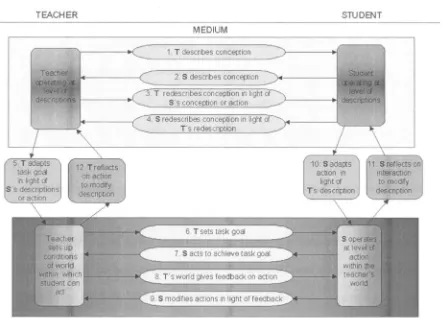
2.2 Conversational framework
The characteristics explained above, conducted Laurillard (1993) to a new
model that she called the "Conversational Framework" for academic learning that
[image:40.612.96.538.207.525.2]is shown in Figure 2.1*.
Figure 2.1. Conversational Framework
This model describes the teaching-learning process as an interaction
between teacher and student, operating at two levels:
a. The "discursive level" is the level of theory. This represents the way the
teacher articulates the subject matter, or presents the ideas, and the student
joins the dialogue, putting their point of view, asking questions, practicing
the moves of language and argument, proof and representation. The
teacher must then have the opportunity to re-express their point, in order to
clarify or elaborate, and then the student must be able to have another
attempt at representing the theory to be sure the dialogue has arrived at
consensus between the two—the four-stage process is the minimum
required to guarantee consensus.
b. The "interactive level" is the level of practice, representing the way the
student acts in the world, or at least in a world constructed by the teacher
such that their interactive activities will give them experience of the theory in
action. Here the teacher sets a task, the student acts, the world responds to
their action, and the student can modify their action in order to better
achieve the goal of the task. This represents the field trip, or the laboratory
experiment, or any situation where the teacher sets an exercise and gives
feedback that enables the student to improve their performance.
Theory and practice should not remain separate, of course, and ideally, the
student should be using the theoretical description to "adapt" their actions, and
also to "reflect" on their experiences as they articulate their ideas at the discursive
level. Therefore the student is using "reflecting" and "adapting" to link the two
levels at which they are operating. Similarly, the good teacher will be using
activities to those appropriate to the students' needs, and will "reflect" on their
performance at the interactive level in elaborating the theory.
The conversational framework highlights the iterative character of the
learning process. At both levels that iteration must be able to occur: practice with
feedback, and continued dialogue between student and teacher to progress
towards a more accurate articulation of the theory.
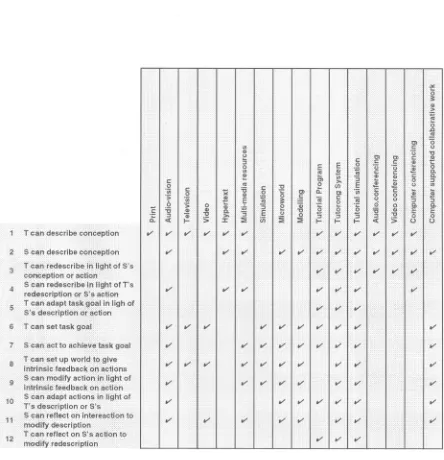
The model is a complete specification of what is required during the learning
situation and shows what can be offered by the combinations of different media, as
it will be stated later. It also represents adaptation (activities 5 and 10) and
reflection (11 and 12) as internal to both teacher and student, and characterizes
the two levels of their dialogue as discursive, i.e. interactive at the level of
descriptions (activities 1 to 4), and interactive at the level of actions (activities 6 to
9).
2.3 The traditional education and the conversational framework
Traditional methods of teaching and learning tend to favor the presentational
aspects of the process more than the active ones. For lectures, and for reading
print-based materials, which are both purely presentational in form, the students
are required to do little more that "attending" a one-sided part of the discursive
level. They are truly active only when they are given exercises or tasks to practice
the techniques they have been taught. This is the interactive level, although it may
be the case that only part of this iterative process actually occurs. Do they receive
unexpected mystery? If the teacher is supervising closely and the practice exercise
is well-designed, then this kind of exercise could certainly sustain the interactive
level of the learning process.
This is also the point at which students can begin to make the connection
between the practice and theory, although of course while they are doing lab-work,
or field-work, or problem classes, there is rarely any opportunity for the individual
student to have a dialogue with the teacher. Teacher-student dialogue may be
available, but in the different teaching context of the tutorial or small group (or
rather large group, as is generally the case these days).
And how does the student practice the articulation of their subject, which is
the other part of the discursive level? This is the stage at which they develop and
generate their own ideas, their own expression of the knowledge they are learning
-the point at which they make it their own. That really only occurs in the
assignment tasks when they do the report and project work. And of course the
feedback on the assignment will be separate again. So the essential activities in
the learning process are covered in some way for the traditional modes of
teaching, but they are attenuated over time.
2.4 Teaching Media
Having arrived at a perspective on teaching and learning that sees the
process as a dialogue, it seems like if not other teaching methods different to the
The familiar methods of teaching in higher education are there to support
learning as it is commonly understood to occur (Laurillard, 1993):
a. through acquisition, so we offer lectures and reading;
b. through practice, so we set exercises and problems;
c. through discussion, so we conduct seminars and tutorials;
d. through discovery, so we arrange field trips and practices.
These methods, if practiced in combination, are capable of satisfying most
of the constraints imposed by the teaching strategy declared inherently in the
conversational framework. Feedback on students' actions is the weakest link.
Is the author's believe that no one medium can solve the problems, as will
become clear. But given the conversational character of the teaching-learning
process, what kind of role can the various media possibly play? Lets explore the
teaching methods and media now available to higher education, to see which are
capable of delivering the complex iterative process, stated in the conversational
framework. None could do it all, but all of them could do something, and a
combination of them could do quite a lot.
2.5 Using multiple media to enable effective teaching and learning
A medium is in part a channel for transfer content. Just as important,
however, a medium is a representational container enabling new types of
messages (e.g., sometimes a picture is worth a thousand words). Since expression
and communication are based on representations such as language and imagery,
messages students and teachers can exchange. New forms of representation
make possible a broader, more powerful repertoire of pedagogical strategies
(Dede, 1999).
A mix of teaching and learning methods will be the most efficient way to
support student learning, because only then it is possible to embrace all the
activities of discussion, interaction, adaptation, and reflection, which are essential
for academic learning. Dede (1999) confirms this thinking with his experience in
distributed learning:
"My course on learning across distance uses seven instructional media:
• face-to-face interaction, • videoconferencing,
• synchronous interactions in a text-based virtual world, • "groupware" that incorporates a shared design-space, • asynchronous, threaded discussions,
• asynchronous telementoring, and
• websites structured around an ongoing interaction or experience.
The first four of these interactive media are synchronous, the next two asynchronous, and the last a mixture of both. This wide range of media enables distributed learning that incorporates the complementary strengths of face-to-face instruction, virtual synchronous interaction, and asynchronous expression and communication. Participants are able to contrast the amount of effort required to master the rhetoric of each medium, the instructional design strategies effective in each, and the ways each shapes their individual cognitive and affective experiences, as well as group interactions. With the exception of videoconferencing, the usage of these media creates no additional costs for the instructor and students."
2.6 Classification of media
There are many attempts in the literature to categorize and classify the
Classification of forms is a notoriously difficult task, even more if we want some
kind of guiding.
The following, in this chapter, each of the principal teaching media are
analyzed in terms of the conversational framework to see how far they serve the
needs of a principled teaching strategy. The author selected the main types of
teaching media, and divided them into their unadulterated way of using each one.
This allows us to focus on their essential pedagogical characteristics, and by
distinguishing them from each other to identify the unique contribution made by
each one. It is hard to find any of these existing in their canonical form, of course,
as designers recognize the limitations and each medium is used in combination
with another, to the extent that hybrids, such as Internet, acquire an identity of their
own.
2.7 Audio-visual media
The audio-visual media include audio, audio-vision, broadcast one-way
video system or film, and videocassette. These are distinguished from the
computer-based media and the teleconferencing media discussed in the following
sections of this chapter.
2.7.1 Audio-vision
Audio programming may be delivered to individuals or classrooms via radio
broadcasts or through standard telephone service. In this format. The teacher
speaks to distant students, who cannot respond directly in real time (during the
materials delivered prior to the instruction or facilitated on-site by a third party or
classroom facilitator. A teacher may ask students to respond verbally (even though
the teacher can not hear the response) or in writing, and students monitor their
own learning in other ways. This type of distance learning has been used
extensively for student learning and teacher training in several developing
countries. Besides the low cost of delivery and duplication, other benefits of
one-way audio programming include ease of use, low production costs, and its
requirement for little specialized training (Roblyer, Edwards and Havriluk, 1997).
2.7.2 One-way video system
Educational programming can be broadcast one way from one point
(transmitter, uplink) to a single point or multiple points (receivers) via satellite,
cable television, microwave, or public broadcasting systems. Broadcasts can be
sent via open air or encrypted. Anyone with the necessary hardware and
connections (as with a cable system) can receive open-air broadcasts, as can
anyone with the coordinates to focus a satellite receiver dish. Encrypted programs
require decryption devices. Anyone who has ever watched pay-per-view television
at home has probably rented such a device and installed it temporarily into the
cable television system (Roblyer, Edwards and Havriluk, 1997).
Instructional programs can be broadcast in real time (live), or they can be
delivered via broadcast for taping and showing at a later time (tape delay). Live
broadcasts permit student-teacher interaction over telephones or special response
systems usually for a predetermined number of students. A later section will
program segments for later teacher or learner control and use; this keeps delivery
costs to a minimum while ensuring the timeliness of content, and it permits
flexibility regarding both the time and place of instruction.
2.7.3 Video
The principal contrast between broadcast television and video is the relative
controllability of the latter, making it adaptive by the student. Some researchers
have referred to video-cassette plus exercises as 'interactive', but Laurillard (1993)
defined it as involving intrinsic feedback on what the student does - the information
in the system should change as a result of their action. Nothing in the video
changes when a student rewinds it, just as nothing in a book changes when you
turn a page. The epithet 'interactive' is applied to video because a cassette allows
students to carry out activities in between watching sections, and to carry out
analytical exercises on the video material itself. These are excellent ways of using
video cassette, and of exploiting its controllability, but they are not interactive in the
strong sense, and are essentially the same kind of activities as reading a book,
re-reading it, analyzing passages, doing activities between re-reading, etc. The medium
cannot itself provide intrinsic feedback on what the student is doing. It is 'active
video' perhaps but not 'interactive video'.
Video has the same ability as television, however, to bring together
experience and description of that experience, and being self-paced, can enhance
this further with the opportunity for students to reflect on what they are doing.
observed this in the way a set of videos of children doing mathematics were used
in a course for teachers:
"Thus, the video can be described as having two aspects to its full meaning. One is the sense of the problems of doing mathematics, the other involves a critical appreciation of these problems. Students need to respond in two ways to understand the whole; they need to be receptive to the stimulus of the 'real-life' sound plus vision and to show a sympathetic but instinctive understanding of it; they also need to pursue a rational enquiry into its fuller meaning along the lines prompted by the notes and voice-over elements."
(Durbridge 1984b)
She also found in the students some frustration an anxious about the quality
of their learning. However, Durbridge does suggest ways in which 'pre-emptive'
extrinsic feedback can be offered, e.g. where the academic's version of the
answer, or their comment on an expected wrong answer, is written at the end of
the notes, or summarized at the beginning of the next video section, in much
presumed to have done in an activity. Students need to know what they are meant
to be learning, and need to have a sense of when they have achieved what is
expected. The non-interactive media must attend to this aspect of the learning
process, even though they cannot support it fully.
The only advantage of video over television is in the self-pacing provided by
greater learner control, which at least allows students to reflect on the interaction
they have witnessed, making this available to the activity of modifying their
2.8.1 Hypertext
The basic concept of nonsequential, Computer-based text was first
envisioned more than 40 years ago by Vannevar Bush. Today, Tripp and Roby
(1990) define hypertext as a "nonlinear, multidimensional, semantic structure in
which words are linked by associations." These links resemble connections in a
concept map in contrast to a traditional page-by-page progression through a
textbook. For example, an electronic encyclopedia might link certain words with
sections of text in another part of the encyclopedia. When the user clicks the
mouse pointer on a word, let's say Boston, the screen then displays information
from another part of the program about that Rome. The hypertext model has no
real ending point; the section on Boston may allude to the Revolutionary War, and
these words could also be a "hot spot" with links to another section about that war,
and so on. Some have broadened the definition of hypertext to include sound,
video, animation, and pictures (Landow, 1990; Foss, 1989; Megarry, 1988).
Tolhurst (1995) suggests that references to video, audio, and animation displays
as text are inaccurate; she assets that textual information can include diagrams,
pictures, and tables. Generally speaking, static media are acceptable in the
hypertext format: photographs, sketches, tables and diagrams.
2.8.2 Hypermedia
Current literature reflects a great deal of overlap between the definitions of
hypertext and hypermedia. A useful interpretation of hypermedia includes all the
2.8.3 Multimedia resources
Multimedia has become such a common term in commercial usage that its
definition has become particularly vague. Many tailor its definition to suit their own
particular needs (Blattner and Dannenburg, 1990). Kozma (1991) suggests that the
term has actually been in use for several decades, only recently being linked to the
use of computers. Since some definitions of multimedia do not include nonlinear
links between information, a suggested definition would specify the use of multiple
media formats to present information.
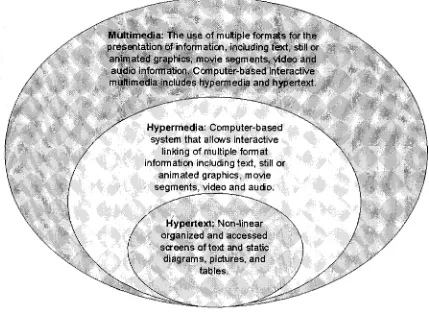
Tolhurst (1995) offers a useful diagrammatic view of the distinctions
between hypertext, hypermedia, and multimedia. See Figure 2.2*. As we can
notice, hypertext is a subset of hypermedia and, at the same time, hypermedia is a
subset of Multimedia.
Figure 2.2. Overlapping domains of Hypertext, Hypermedia, and Multimedia
2.8.4 Overview of Hypermedia, Options
As hypermedia programs have evolved, they have become more powerful
and more user friendly. Consequently, authors can now draw on wide variety of
resources. This section describes some common features that are available in
1zyxwvutsrqponmlkjihgfedcbaZYXWVUTSRQPONMLKJIHGFEDCBA. Audio resources. Hypermedia authoring programs offer the user a number
of ways to incorporate audio clips:
a. C D Audio
b. Videodiscs
c. Recorded sounds
d. Prerecorded sounds
2. Video resources. Video clips can add a whole new dimension to a program
and provide authors with many new communication possibilities. As with
audio, authors can incorporate video displays into a program in many ways:
a. Digitized videos
b. Videodiscs
c. Prerecorded videos on C D - R O M s
3. Photographs. "A picture is worth a thousand words" in hypermedia, as
much as elsewhere. Photographs provide a powerful resource for authors in
all subject areas.
d. Scanned photos
e. Captured from video sources
f. Digital cameras
g. Imported from C D - R O M s
4. Graphics. Graphics or drawings offer another tool for authors to
difficult to get across with words. This aspect of hypermedia authoring is
particularly appealing to artistically inclined users.
a. Created by authors
b. Imported from clip art collections
c. Scanned images
5.zyxwvutsrqponmlkjihgfedcbaZYXWVUTSRQPONMLKJIHGFEDCBA Animation. Animation can be a highly effective tool for illustrating a
concept; for example, a student might create an animation of a seed
germinating as part of a project on plants. The sources of these displays are
familiar:
a. Imported from C D - R O M s
b. Created using animation tools
6. Text. In spite of the attention paid to all the other components of
hypermedia, text still remains one of the most powerful ways of
communicating ideas.
c. Writing as project develops
d. Importing from word processing files
2.8.5 impact of Hypermedia in Education
Capabilities and strengths of hypermedia include (Roblyer, Edwards and
Havriluk; 1997):
1. Motivation. Hypermedia programs offer such varied options that most
complete a project or term paper will often tackle a hypermedia project
enthusiastically. McCarthy (1989) expressed the belief that the most
important characteristic of hypermedia is its ability to encourage students to
be proactive learners.
2.zyxwvutsrqponmlkjihgfedcbaZYXWVUTSRQPONMLKJIHGFEDCBA Flexibility. The user of a hypermedia program can draw on such diverse
tools that the technology truly offers something for everybody. For example,
a student who may not excel at expressing ideas in writing can record what
he/she wants to say orally.
3. Development of creative and critical-thinking skills. The tremendous
access to hypertext and hypermedia tools opens up a multitude of creative
avenues for both students and teachers. Marchionini (1988) referred to
hypermedia as a "fluid" environment that constantly requires the learner to
make decisions and evaluate progress. He asserted that this process forces
students to apply higher-order thinking skills. Turner and Dipinto (1992)
reported that the hypermedia environment seems to encourage students to
think in terms of metaphors, to be introspective, and to give free rein to their
imaginations.
4. Improved writing and process skills. Turner and Dipinto (1992) also
found that exposure to hypermedia authoring tools helps students in the
following areas:
a. It gives students a new and different perspective on how to organize and
b. It gives students a new insight into writing; instead of viewing their
writing as one long stream of text, they now see it as "chunks" of
information to be linked together.
5.zyxwvutsrqponmlkjihgfedcbaZYXWVUTSRQPONMLKJIHGFEDCBA Forward thinking. The hypertext/hypermedia seems likely to persist. A
review of the number of World Wide Web pages on the Internet gives ample
evidence that linking information together via hypertext and hypermedia is
indeed an effective way to present and add value to large bodies of
information. In time, millions of people may publish multimedia documents
on the information highway in the hope of attracting viewers, readers, and
listeners (Gates, 1995).
2.9.1 Interactive Media: Microworlds
Microworlds made their biggest impact in education in the form of Logo,
Seymour Papert's programming language for geometry. In his book 'Mindstorms',
Papert describes the reasoning behind the development of a Newtonian
microworld, and in doing so, expresses exactly the difference between a
microworld and a simulation. What makes microworlds interesting is that they
appear to address explicit description of the student's point of view (Papert, 1980).
The formalism provided as an essential feature of a microworld allows the
student to express their description of some aspect of the world in a form
understandable by, and therefore scanned by, the program.
Microworlds are very similar to simulations (as we will see in the next part of