1 Comics in ToonDoo and Collaborative learning, a visual literacy resource to evidence
vocabulary learning with emphasis in action verbs in an EFL group of seventh graders in a Cajicà school
Author
ALBA MILENA VELANDIA GONZÁLEZ
UNIVERSIDAD SANTO TOMÁS
FACULTY OF EDUCATION
DISTANCE B.Ed. IN ENGLISH AS A FOREING LANGUAGE
2 Comics in ToonDoo and Collaborative learning, a visual literacy resource to evidence
the learning vocabulary with emphasis in action verbs in an EFL group of seventh graders in a Cajicà school
Author
ALBA MILENA VELANDIA GONZÁLEZ
Directed by:
Mag. Carmen Josefa Enciso
UNIVERSIDAD SANTO TOMÁS
FACULTY OF EDUCATION
DISTANCE B.Ed. IN ENGLISH AS A FOREING LANGUAGE
Bogotá
3 Acceptance Note
The title research project “Comics in ToonDoo and Collaborative learning, a visual literacy resource to evidence vocabulary learning with emphasis in action verbs in an EFL group of seventh graders in a Cajicà school” presented by Alba Milena Velandia Gonzàlez”, was approved as a degree work to receive the title of Bachelor of Education in English as a Foreign Language.
TUTOR: _________________________________
_________________________________
_________________________________
JUROR 1: _________________________________
_________________________________
_________________________________
JUROR 2: _________________________________
_________________________________
_________________________________
7 LIST OF TABLES
Table 1. Data Collection Instruments. 41
Table 2. Syllabus “ My life in a comic”. 55
8 LIST OF FIGURES
9 LIST OF APPENDIXES
Appendix 1. Test outcomes institutional for period 119
Appendix 2A. Diagnostic Test. 120
Appendix 2B. Marcela’s Diagnostic Test. 123
Appendix 2C. Results Diagnostic Test. 125
Appendix 3A. Final Test. 127
Appendix 3B. Marcela’s Final Test. 130
Appendix 3C. Results Final Test. 132
Appendix 4A. Comic “ The Pedro’s Routine. 134
Appendix 4B. Comic “A new day” . 140
Appendix 4C. Comic “A new friend”. 142
Appendix 4D. Comic “My friend Marcela and I” 145
Appendix 4E. Comic “Good play”. 150
Appendix 4F. Comic “ The Travel of Megan” 152
Appendix 4G. Comic “The wonderful vacations”. 155
Appendix 4H. Comic “A victorious day” 165
Appendix 5A. Interview about the project. 171
Appendix 5B. Interview example. 172
Appendix 6A. Journal Example – Lesson 1. 173
Appendix 6B. Journal Example – Lesson 8. 174
Appendix 7A. Hetero – evaluation rubric. 175
Appendix 7B. Self-evaluation rubric. 176
Appendix 7C. Hetero-evaluation and self- evaluation results. 177
Appendix 7D. Co-evaluation rubric. 178
Appendix 7E. Co- evaluation rubric results. 179
Appendix 8. Authorization by parents. 181
10 ABSTRACT
The objective of this paper is to determine how the implementation of visual literacy tools such as comics created through ToonDoo (digital tool) evidences in an EFL group of seventh graders at a Cajicà School to use vocabulary with emphasis in action verbs. This document explains an action research proposal with implementation. The process involved diagnostic tests in written and oral forms, a journal, visual literacy activities involving a comic design, an interview and rubrics for data collection. The methods for data analyzed were carried out by the Content Analysis Approach and the Narrative Approach. The results demonstrated that visual literacy tools such as comic created in ToonDoo evidence the use of vocabulary but in a very slow manner due to the complexity of learning the tool in function of the allotted time despite the substantial interaction of the students in the assigned project.
Key words: Visual literacy, Comics, ToonDoo, Collaborative Learning, Vocabulary Learning, Digital Resources.
11
El objetivo de este trabajo es determinar cómo la implementación de herramientas de literacia visual como cómics creados a través de aprendizaje colaborativo y ToonDoo (herramienta digital) evidencia aprendizaje de vocabulario con énfasis en verbos de acción, en un grupo de estudiantes de inglés como lengua extranjera, pertenecientes al grado
séptimo de la Institución Educativa Departamental Pablo Herrera en Cajicá. Este
documento explica una propuesta de investigación-acción con implementación. El proceso consistió en pruebas de diagnóstico en formas escrita y oral, un diario, una serie de
actividades de literacia visual dentro de ellas el diseño de una historieta, una entrevista y rúbricas para la recolección de datos. Los métodos para datos analizados se llevaron a cabo por medio del Enfoque de Contenido y el Enfoque Narrativo. Los resultados demostraron que las herramientas de literacia multimodal como historietas creadas en ToonDoo evidencia la utilización de vocabulario pero de una manera muy lenta debido a la
complejidad del aprendizaje de la herramienta en función del tiempo asignado, a pesar de la interacción sustancial de los estudiantes en el proyecto asignado.
12 INTRODUCTION
The main goal for this proposal is to analyze and establish concrete data on the effect that implementation of visual literacy resources such as comics created through
collaborative learning and the interaction with a digital tool as ToonDoo has on students in a seven grade classroom environment when reinforcing vocabulary and the application of such. Walsh (2010) defines visual literacy as the meaning-making that occurs through the reading, viewing, understanding, responding to and producing and interacting with multimedia and digital texts. On the other hand, according to Stocker (2011) “the uses of ToonDoo (interactive and digital Web 2.0 tool) allow students to make use of vocabulary more productively and to make use of the time spend in class more collaboratively effective” (p.16).
By researching the activities provided by visual literacy resources such a comic in ToonDoo, a clear perspective on how this interaction can evidence student’s use of new vocabulary and correct application can be obtained. With the results given from the investigation, it is possible to provide proof that the visual literacy resources through the Information and Communication Technologies (ICTs) have a direct influence on the learning process and Ochoa (2013) states additionally that “the application of ICT in education motivates students and captures their attention, becoming one of the engines of learning” (p.24).
Thus, great benefits can be gained in Pablo Herrera High School by the knowledge
acquired from this research; we can apply these results directly to the school’s curriculum, increase student engagement and participation as well as student passion for the subject which is English, and the most important thing contribute to improving the communicative competences in the students.
To contribute to the strengthening of the competence as defined above is evident to work in the vocabulary because as explained Brown (2007) “the vocabulary is essential when constructing ideas and when trying to express thoughts as well as being the
13 The students need to use the vocabulary in an everyday scenario with real communicative events because in various contexts of reality of people or a group of people where the elements of communication are into action with these situations looking to develop skills to communicate efficiently.
In this way, it is important, as this study demonstrates, to allow students to assimilate in forms different from the traditional way in which students are passive subjects who receive knowledge from the teachers. The work with this visual resorces offers the opportunity for students to use the comic to evidence action verbs vocabulary and also to encourage the active interaction between the students; in other words, as Barkley (2005) indicates, “Collaborative learning offer students opportunities to learn valuable
interpersonal and teamwork skills and dispositions by participating in task-oriented learning groups” (p.69).
The following research study is organized in 6 chapters which give an account of different components of the research process. Chapter one describes the problem statement that provides a general view of the context, presents the research question, objectives and proposal justification as input of the process of teaching English as a foreign language to students of seventh grade.
In Chapter two, the theoretical framework is presented, which contains the main constructs that support the study realized and that emerged from the question and the research objectives.
Chapter three refers to the research design that describes how this qualitative and quantitative investigation is framed in the methodological process of the Research Studies with an implementation and how the selected instruments help to collect the information that will be analyzed in the next chapter.
14 In Chapter five the data gathering will be analyzed that shows the process with the students during the pedagogical intervention, their perceptions, and how they used the vocabulary with emphasis in action verbs through resources of visual literacy.
On the other hand, Chapter six presents the conclusions and pedagogical implications that emerge from the strengths and difficulties presented along the project elaborated by the students, the limitations at general level of the study and the final contribution of the
proposal.
Finally, this proposal presents a series of references of authors that support the
15
1. PROBLEM STATEMENT
Traditionally, the teaching of English in public high schools has been practiced from my point of view as the teaching of structures without a context or a really communicative function, and one of the well-known aspects is the huge gap between public and private education even more when we talk about second language teaching. El MEN( Ministerio de Educación Nacional) with the Colombia bilingual program has as a goal to have citizens that are able to communicate in English, with comparable international standards ,that involve the country in the process of global economy, communication and cultural opening; it calls the teachers to reflect from the discipline and didactic point of view in order to achieve the established goal and close up a bit this gap that makes difficult the access to higher education and well-paid jobs.
Therefore, I as a future English teacher, questioned myself about the most relevant aspects where the English teaching is having troubles in public schools with , for that, I decided from my role as a Spanish teacher in Pablo Herrera High School in Cajicá, to collect the perception of some English teachers through informal conversations. As a result, one of the biggest concerns of teachers is the lack of vocabulary in EFL that students have when they arrive to secondary since in the learning process “the vocabulary is a basic lexical item for learning any language, that is, the vocabulary is the starting point for the development of any of the four skills of EFL” (Brown, 2007, p. 435).
The seventh grade students come from primary levels without a teacher specialized in English. The level is low due in part to the number of English classes per week (1 hour in primary), the material used in the Institution is barely motivating for effective learning and they live in a family context that does not allow language practice.
16 The bad results in the local test in seventh graders 2014 (See Appendix 1) support the statements mentioned before since six graders teachers have to start basically from zero and as a consequence seventh graders teachers receive students, ranging between 12 and 14 years, with considerable difficulties in vocabulary, as well as lack of use in communicative events, besides, students show lack of interest and a low learning English process due to the few lessons they have per week.
Considering what we mention before, it is possible corroborate that with the local result of diagnostic test (See Appendix 2A) where we can see the difficulties that students have at the moment of expressing and understanding in communicative events, taking into account the previous knowledge students should have in order to start seventh grade contents; these contents are focused on present simple and progressive, but the learning process is too slow and weak.
On the other hand, when checking the methodology used in English classes, we could identify some strengths when using multimodal literacy tools such as reading
comprehensions, contests, presentations, relation drawing, highlighting that according to the teachers, activities that have drawings are the most attractive for students; as
weaknesses, we could identify the few use of technological visual communication tools since teachers state that the school does not have software to work with and when they have it, students just try to enter to webs sites like Youtube and facebook that distract the goal of the lesson.
17 Thus, it is evident that many times the poor use of technology in English classes is due to handling and wrong election of unattractive tools for students. For that reason, it is necessary that now a days teachers use these tools to approach students to knowledge, Ramos (2005) says “it is necessary a new approach to teaching / learning to include new strategies and new tools that bring us new technologies to be able handle the new codes for the integral formation of students as citizens of a modern and multicultural society”. (p, 15)
In this order of ideas, the tools implemented to achieve that goal should be according to the diverse now a day ways of communications and technologies as Ortero (2009) says “several semiotic modes (verbal, visual and auditory) gain special importance as semiotic research in the world of contemporary communication, where it is present more and more intense thanks to technological advances that we are living" (p, 656)
In that sense, my research is focus on the Vocabulary Learning based on the integration among visual literacy tools and digital resources taking into account that the research will be a support to improve the level in the English learning process in Pablo High School from a collaborative learning. According to the results of the research of Quintero (2010) “technology allows students to develop work where they feel part of a community with which to interact and share interests and learning objectives” (p, 21).
Reviewing different visual literacy strategies I found out Comic as a resource that integrate what was mentioned before because the comic make use of the text-image dynamics modality through which students are exposed to knowledge and can practice a subject by expressing communicative events; Cohn (2012) asserts “in the comic images support the text and give students significant contextual clues to word meaning”. From this way, I decided implement a comic design using ToonDoo (digital tool) with the seventh grades students in order to get vocabulary learning and visual literacy through a didactic unit.
18 meaningful way to make progress through activities that focus their attention, considering that a language is not presented in an isolated way but rather in a natural, cultural and significant linguistic environment.
Research Questions
Main question:
How does the implementation of visual literacy resources such as comics created through collaborative learning and the interaction with a digital tool as ToonDoo, evidences vocabulary learning with emphasis in action verbs in an EFL group of seventh graders at a Cajicá School?
General Objective
To determine if the implementation of visual literacy resources such as comics created through collaborative learning and the interaction with a digital tool as ToonDoo, evidences vocabulary learning with emphasis in action verbs in an EFL group of seventh graders at a Cajicá School.
Specific objectives
1. To describe vocabulary learning in the seven graders students from visual literacy activities.
2. To determine if the use of comics encourage visual literacy in the seven graders students through action verbs.
19 JUSTIFICATION
The rapid change and abundant studies in teaching practices as well as the diverse generation of teaching materials and tools in the last 20 years where every day there are more and more innovating applications, have made teachers become exposed to the access of these with the goal of expediting a more effective learning process.
It is clear the high interest of students in activities of visual impact supported by digital resources. This is not that only these kind of strategies are the most effective ones, on the contrary, what it is looked for is to integrate traditional teaching with new
tendencies and in this way according to Dias (2001) what technology does is:
Support and extend curriculum objectives to encourage students to better understand and build learning, it is not then something done separately but it must be part of the daily activities carried out in the classroom. (P, 4).
In that sense, the use of multimodal resources give specially to the humanistic teachers the possibility to integrate these two paradigms with the goal of having a meaningful learning Particularly, Pablo Herrera Departmental Educative Institution English teachers have hardly worked with some multimodal tools in their teaching process since didactic resources are really few, short weekly lessons and a socio- economical and familiar context not very favorable.
However, the results of final test per period do not show a learning improvement process specifically in seventh graders in the EFL, which invite to reflect about
20 From this way, I tried to implement multimodal literacy tools to evidence the use of vocabulary and I considered that the design of a comic will allow to integrate visual literacy with digital resources. For that so, this project used an innovated tool , attractive and easy to use as for teachers as well for students, the comic through the use of ToonDoo (a digital tool) that became in the final project of several visual literacies activities based on
vocabulary that will support Pablo Herrera High School teachers in their teaching process. Cohn (2012) states that “the elaboration of comics allows for the multimodality of human expression found in co-speech gestures”. Therefore, when facilitated by the
interaction with Web 2.0 tools, as Marques (2007) cites, “allow professors and students to easily elaborate group and individual materials as well as to share them and submit them under readers’ comments”. This means that professors from any educative sector could use tools with educative goals.
Moreover , the use of multimodal resources allow students to take part in a
collaborative learning, an approach that now a days is taking big importance in the learning process where the “students are actively exchanging, debating and negotiating ideas within their groups increases students’ interest in learning” (Dooly, 2008,p.8).
Therefore, Pablo Herrera Departmental Educative Institution English teachers could seek for actual, innovative and effective strategies that allow it to overcome such
difficulties that present during the process of teaching and the implementation mentioned before in this project research is a flexible proposal that can be implemented in this didactic search.
Finally, this research proposal is not only a valuable resource for professors and
21
2. THEORETICAL FRAMEWORK
The following chapter details the constructs that served as the theoretical basis of my research project, which aim to determine if the implementation of visual literacy resources such as comics created through collaborative learning and the interaction with a digital tool as ToonDoo, evidences vocabulary learning with emphasis in action verbs in an EFL group of seventh graders at a Cajicá School.
Objectively, the implementation of comics through as a pedagogical tool and by using ToonDoo as an ICT mediator for the creation of these comics would permit practice of basic lexical in an evidencing way so that these EFL students can make use of the language they are learning. I believe also that by utilizing collaborative learning, the students not only will be able to help each other developing the project as well as the work with comics and Web 2.0 tools such as ToonDoo, but also they will help each other in the main target which is learning the English language.
The multimodal literacy concept is a characterization of the reality of communication where people (students) must understand the combination of components in which people express, that is sound, music, words, pictures, images, texts; moreover, this multimodal literacy specifically visual literacy is something that would also by association of new meaning, expressly for communicative purposes.
2.1 Vocabulary as a basic lexical for learning a language
22 Brown (2007),mentions “the thousands of lexical building blocks that are available to the average user of a language” (p.435). Lexical Items are basic to all the four skills, but Vocabulary is not a skill so “the skill in this aspect is achieved by getting efficient storage which becomes a competence and a recovery of learning at the right time which results in the performance of learning” (Brown et al., 2007, p. 435) . In this context, “el aprendizaje del léxico de una nueva lengua ha de ser de forma gradual, desde el nivel más básico hasta el más avanzado” (Monroig and Pérez ,1992,p 169). Thus the importance of using resources that allow the acquisition of vocabulary according to the context of learners, thus the use of vocabulary must be commensurate with the specific needs of the age, interest and in the same way and close to be a useful naturally learn vocabulary.
In addition, Ghazal (2007) argues that:
Vocabulary is central to language and is of great significance to language learners. Words are the building blocks of a language since they label objects, actions, ideas without which people cannot convey the intended meaning. Teaching vocabulary should not only consist of teaching specific words but also aim at equipping learners with strategies necessary to expand their vocabulary knowledge. (p.49)
Therefore, the students who participated in this research project had were exposed to different strategies to use the vocabulary in context, “several studies also suggest that one might not make a long progress in English learning without an adequate size of vocabulary, as higher levels of the language require a higher amount of known words” (Lajtai et al., 2013,p.13).
23 learn not just about knowing a specific amount of words but to use it in context, and this is made possible by integrating multimodal literacy.
Therefore, in this research proposal, based on the fact that lexical is essential to develop the different language skills was designed a pedagogic intervention in order to find better and effective resources for vocabulary learning using a specific multimodal literacy. Nonetheless, taking a moment to Reflect what would be the environment most effective to achieve the vocabulary learning arose aspects to take into account as the age and characteristics of the participants and this determined the search for a very different way than traditionally was being used, but an approach where the learners were more active, ie, create a more dynamic classroom interaction and this only was possible through Collaborative learning.
2.2 Collaborative Learning
In terms of Smith and MacGregor (1992) “Collaborative learning is an umbrella terms for a variety of educational approaches involving joint intellectual effort by students, or students and teachers together” (p, 19). Usually, students work in groups, mutually searching for understanding, solutions, or meanings, or creating a product and whole the activities are center on students’ exploration.
As explained by Dillenbourg (1999), “collaborative learning (CL) is a situation in which two or more people learn or attempt to learn something together” (p.23). Each element of this definition can be interpreted in different ways:
"two or more" may be interpreted as a pair, a small group (3-5 subjects), a class (20-30 subjects), a community (a few hundreds or thousands of people), a society (several thousands or millions of people)... and all intermediate levels.
24
"together" may be interpreted as different forms of interaction: face-to-face or computer mediated, synchronous or not, frequent in time or not, whether it is a truly joint effort or whether the labor is divided in a systematic way.
These three elements of the definition define the space of what is encountered under the label 'collaborative learning', I explored in this research the space with pairs learning through intensive problem solving during one or two hours per class using a digital
resource during a year course. Barkley et al. (2005) indicated that “Collaborative learning continues to attract interest because it addresses several major concerns related to
improving student learning” (p.85).
CL offer students opportunities to learn valuable interpersonal and teamwork skills and dispositions by participating in task-oriented learning groups. Also, Kane and Harms (1999) argue that “CL creates new challenges for a teacher to find in her or himself the capacity to provide diverse learning environments for students with distinct, often overlapping, motivations and learning practices” ( p. 19). In this sense, this research project provides an environment mediated by digital resources in order to enrich the relationships between teacher and students.
Furthermore, Kane and Harms et al. (1999) based on reflections established a series of practices that they found significant in enhancing collaborative process:
Creating comfortable, safe zones for learning because in creating the context of the life of the mind.
Engaging in problem-solving approaches teaching with other faculty and with students.
Involving students in decisions.
Privileging analysis and evaluation of information over absorption of facts.
Providing continuous feedback.
25 Therefore, during the process performed in this research aspects as negotiation of meaning was involved to allow students to take decisions, constant feedback, and different kind of evaluations: hetero-evaluation, co-evaluation and self-evaluation.
Barkley (1991) asserts “co-laboring is an important feature of collaborative learning, all participants in the group must engage actively in working together toward the shared objectives” (chapter 1). For that reason, I decided to focus the pedagogical intervention through Goal Oriented Learning because from the beginning the goal was determined to achieve where the students worked together on a collaborative assignment.
Dillenbourg et al. (1999) states that CL “allows students to assimilate in forms different from the traditional way in which students are passive subjects who receive knowledge from the teachers. The work performed by the participants may vary and develop in different jobs with the objective of achieving the set goal” (p.1-19).
In terms of Laal (2012) “the professor is a guide and the students who manage to plan, acquire and end up producing the knowledge to be learned. Ultimately the results are meaningful developed through motivation” (p.491). Moreover, students are able to share their own experiences and listen to others’ in a diversified exchange pool of ideas, “students become submerged in situations where they are driven to listen carefully, think critically and participate” (Laal et al., 2012, p.492) .
26 2.3 Multimodal Literacy
The National Council of Teachers of English published a statement in 2005 regarding the concept of multimodal literacies. It was established that “multimodal literacies is the interplay of meaning-making systems (alphabetic, oral, visual, etc.) that teachers and students should strive to study and produce” (p.4). This means, all modes of
communication are codependent and each affects the nature of the content of the other and the overall rhetorical impact of the communication event itself.
Likewise, Walsh (2010) added that:
Multimodal literacy refers to meaning-making that occurs through the reading, viewing, and understanding, responding to and producing and interacting with multimedia and digital texts. It may include oral and gestural modes of talking, listening and dramatizing as well as writing, designing and producing such texts. (p.31)
Therefore, the processing of modes, such as image, words, sound and movement within texts can occur simultaneously and is often cohesive and synchronous. Walsh (2010) argues:
27 Consequently, I can conclude that Multimodal literacy involves different ways of producing meaning understood by the participants of the communication, for the transmitters as well as for the audience. It is the competency that allows a person to understand the different modes in which the communication is presented. According to Otero (2010) "Multimodality of communication consists of several semiotic modes (verbal, visual and auditory) and it gains special importance as semiotic research in the world of contemporary communication, where it is present increasingly intense thanks to
technological advances we are living " [My translation] (p. 656).
The medium used as multimodal should be constituted by elements that are
synchronous in such ways that are produced to help transmit the message. The National Council of Teachers of English et al., (2005) suggests that it “involves the use of different type’s media by which messages are transmitted; however, when referred to multimodal, it is important to understand that it is the combination arrangement of the different modes of communication that is used”. Multimodal literacy provides varied arrangements that allow teaching and learning.
For this project, I decided to take within the multimodal literacy visual literacy as the most relevant to support research, because the visual part is the currently most striking students by being in the pre-adolescence. According to Harmer (2006) “the students have a limited attention span; unless activities are extremely engaging they can easily get bored and the teachers need to provide a variety of resources” (p.38). Below it explains what it is and its characteristics.
Visual Literacy
Visual literacy has been defined as the “ability to understand, interpret and evaluate visual messages” (Bristor & Drake, 1994, Vol.22). The National Council of Teachers of English (NCTE/IRA) (1996) clearly acknowledges the importance of teaching students to be visually literate. The organization’s preface to its standards states:
28 how to interpret and create visual texts … is another essential component of the English language arts curriculum. (p. 5)
Messaris (1995) states that “visual literacy is the gaining of knowledge and experience about the working of the visual media coupled with a heightened conscious awareness of those workings” (p.22). In the same way, Frey and Fisher (2008) asserts:
Visual literacy is an integral part of literacy development, and this much-needed classroom companion helps teachers engage students as critical readers or writers and prepare them for living in the twenty-first century. Today's students live in an increasingly visual world where they are engaged not only by words, but also by images. (p.62)
Likewise, Frey and Fisher et al. (2008, p. 64) establish that teaching Visual Literacy offers background information, research, practical ideas, and sample lessons to help educators:
Capture the attention of learners and boost their critical thinking skills.
Support and strengthen multiple competencies in literacy.
Help students comprehend and assess visual information.
Reach students with disabilities and extend their understanding.
29 will be a prerequisite in the future because visual media are integral to how we work, entertain, communicate, and educate” (p.10). In addition, Baker, F. (2012) asserts:
One of the best ways to engage students in visual and news literacy is by
incorporating cartoons and comics in the classroom, because they are traditionally found in newspapers and magazines, they are easily accessible. With Internet access, teachers and students can locate cartoons and comics from every newspaper in the U.S., as well as those from all over the world. (p.67)
Thus, using comic as a resource to promote visual literacy in the classroom represented a valuable support for this research proposal.
2.4 Comics as a didactic resource
As stated by Cohn (2012) “comics are a social object that is the result of two human behaviors: writing and drawing. Believing ‘comics’ are an object of inquiry would be akin to linguists focusing on ‘novels’ as opposed to studying English, the language that novels a ‘visual language’ ”(p.47).
In addition, Jane Scanlon (2013) asserts that “comics is hence a form of literature that is composed by modalities of communication such as written verbal language and image language, also called visual-graphic. Comics are without a doubt a very useful tool where image and text are intertwined together to transmit meaningful messages” (p. 65).
30 The comic fits perfectly within what is called visual literacy and for this reason was a resource that allowed to the studio presented in this research from a pedagogical look. , Moreover, Rollan and Mendez (1986) defined the comic as a close education element and described as follows:
The comic is a teaching vehicle that stands with advantage among the fortunately overcome purely verbalist teaching, and the only iconic, with difficult gaps to overcome, taking both his expressive virtues for a balanced synthesis and perform a scheme that underscores the importance the versatility of its components. [My translation] (p. 11).
Taking into account that The Common European Framework of Reference for Languages (2002) includes “the comics within the types of texts listed as channels of written communication”. (p. 93), it becomes clear that the comic is a teaching resource in the linguistic field offers many benefits for the development of basic skills in any language and a pleasant stimulus as Aparici (1992) states "inculcates the dialogue between the image and word and promotes new forms of expression that give life to school "(p.5).
Therefore, though comic students are able to learn language as well as make use of the language with the integration new ways of communication and expression. According to Diago and Bedoya (p.56) there are a number of objectives that can be achieved through the comic, some of them are:
Promote the combination of techniques group work, critic and creative.
Encourage creativity from the collective task to the individual task.
Developing the capacity of critical assessment.
Develop capacity for dialogue and tolerance.
Training for oral and written expression.
31 Garcia (2013, p, 16) within the advantages found to use a comic in the classroom
specifically in the foreign language classroom include the following:
They can work different content: phonetic-phonological, language or grammatical, lexical-semantic, functional and communicative, cultural or strategic.
It is possible to work the five skills: listening, understanding reading, oral interaction, speaking and writing.
As recommended by the CEFR, is a real material, not manipulated or adapted.
It is a dynamic, communicative and family resource for students.
New technologies allow production in an attractive way, simple and quick.
Promotes cooperative and collaborative work.
His playful component favors the teaching-learning through play.
Appeals to the young students.
It features iconic elements and verbal elements, it can be used as a resource to acquire lexicon by inductive way.
It features iconic elements and verbal elements, it can be used as a resource to acquire lexicon inductive way. In that sense, in this research drawing up a comic was proposed by a digital resource to use vocabulary evident from collaborative work, an excellent resource that allowed the integration of several elements for educational purposes.
2.5 Motivation and ICT
Ochoa and Holguin (2013), establish that “motivation is one of the main factors for the inclusion of ICT in effective teaching”, as the entire population of School Gabriela Gómez Carvajal, the ICT seen from an educational mediation is a very good tool and a very good way to carry out the development of academic activities, in this particular case the area of English. Ochoa asserts that:
The application of ICT in education motivates students and captures their attention, becoming one of the engines of learning, as it encourages activity and active
32 learning more, since they are continuously active in interacting with the computer and distance between themselves. (p. 17)
Besides, Ramos (2005), says that “with the combination of technological, pedagogical and human resource efficiency further respond to the interests and needs of each individual, in this sense motivate students to learn” ( p. 10). Therefore, in this research proposal, the use of ICT could become a motivational tool for students, focusing on learning activities that are interesting within the student context, high school students today are surrounded by technological media calling their attention and this factor allows easy inclusion of ICT in English classes.
So, this project proposed use ICT as an effective way in the Vocabulary learning because allow captures the students’ attention, becoming one of the engines of learning, as it encourages activity and active thinking. Thus, to be more motivated, students can spend more time working and learning more, since they are continuously active in interacting with different tools, for that reason is necessary to make a reflection around the methodology to teach EFL, according to Kalpana and Rupal (2012),“ICT implementation as a dynamic process to requires new skills, competencies and attitudes amongst those curriculum planners, educational leaders, teachers and trainers who are going to design and develop materials and support learners online as well as off line” (p.45).
Therefore it is vital pose new spaces and use multimedia resources of learning that contribute to increase student interest in learning. Likewise, several teachers are looking for different tools to increase motivation of students not only in the classroom but to stay out of these classrooms y classrooms and this requires a conscious effort from pedagogy oriented to not fall into the mistake of leaving responsibility in the hands only of the tool. In terms of Low (2003), “ICT cannot ascertain a learner’s motivational levels and language skills, detect semantic and cultural differences, and gauge learners’ communication abilities, the presence of a competent e-Coach (e.g. who is knowledgeable, able to encourage
33 Therefore, in this research proposal, the use of ICT in the learning process is
understood as making a change the relationship between teacher and learner. The design and planning of the curriculum should be supported from these tools that enable the
development of skills in EFL students. According to Vannestal (2009), “ICT helps to create more variation in the classroom, which might lead to increased motivation in the students and thus better conditions to learn the target language” (p.17). Also, the ICT
implementation in the language classroom provides the students the opportunity to write for others rather than only for their teacher “their production is exposed and it has the potential to be read by an audience, this could help assure that students put more effort into their work” (Vannestal et al , 2009, p. 18)
From this way, it is important to use ICT as a medium in a process of education and that promote collaborative work, access to knowledge and communication channels and that requires that teachers use all communication tools in their teaching pedagogies reflective practice.
2.6 ToonDoo
According to Stocker (2011), “ToonDoo allows you to make comics strips easily. Teacher could use this tool to introduce ideas about whatever topic .At the end of the lesson, show them how to use the website and make their own. So that they could view each other’s get them to embed the code using the link into a glossary activity on your Moodle site” (p.3).
Further, ToonDoo has a shop where you can purchase print-quality images at
ToonDoo. Sitocker also states that “You can buy a hi-res image of any tool at ToonDoo (if the author has granted permission). The Hi-res images are of print quality and can be used for printing on any surface - T-shirts, posters, cloth, mugs, mouse pads, key chains and more” ( p. 3).
34 text and images in constructing their individualized comics. Nevertheless, the side also has a collaborative component that allows students to work together on comics, share their comics, and make comments on peers’ comics.
This Web 2.0 technology “allows students to become creative comic producers, providing them with opportunities to explore illustrations, conversations and dialog which are key features needed to make comics” (Bustamante, Hurlbut and Moeller, 2012, p.6). From this way, ToonDoo teaches students how to storyboard their ideas and think about how they wish to communicate their ideas as they create a script through the elements of a story.
There are even more benefits to be gained by having students create their own
cartoons in class. According to Teacher’s guide to ToonDoo by creating cartoons, students:
Interpret a concept from verbal/textual form (provided by teacher) to visual form (created in ToonDoo)
Organize science concept to fit a limited-panel representation
Create their own new, unique representation of an idea
Appreciate the difficult scientists encounter when trying to communicate their ideas to others
Demonstrate computer skills
Therefore, in this research proposal, ToonDoo is understood as a web 2.0 tool to allowed to make comics in an easy way, this could be used by students and teachers and also has a store of images . Also, as established Bustamante, Hurlbut and Moeller et al. (2012) “ToonDoo proved be a valuable feature of the technology as students who are not so good at drawing their ideas with paper and pen, because they feel more comfortable
35
3. RESEARCH DESIGN
In order to determine if the implementation of visual literacy resources such as comics created through collaborative learning and the interaction with a digital tool as ToonDoo, evidences vocabulary learning with emphasis in action verbs in an EFL group of seventh graders at a Cajicá School, it was necessary to lay out a Mixed research (qualitative and quantitative) design involving different components about Action research project which are detailed in this chapter. For this project it was necessary to choose some participants that were relevantly accorded to the specific need to be able to test out this project with validity, 7th grade students from the Educative Institution Pablo Herrera, making it the component of the context and participants.
The process also involved choosing a type of study to be developed, which will characterize the study and its results. The other component depicted here is the stages of this research process so that it is better understood and organized. Finally, the last component in this research design lists the instruments and techniques that are used to collect the data obtained from the sample.
3.1. Context and participants
The participants of this research proposal belonged to the Educative Institution Pablo Herrera located in the rural area (Chuntame) of the municipality of Cajicà, which is north of Bogota, D.C, Colombia. It is an institution of public character that renders educative
services in the primary and secondary basic education levels in the morning part of the working day, and primary basic education in the afternoon part of the working day. For this reason, I remark that the class hours are of 55 minutes only, and the English class hours rendered in primary school are limited to one weekly hour and 3 weekly hours for secondary school.
36 with groups between 15 and 23 students approximately; Since the year of 2014, some spaces were open that allow for better service, this include: 1 laboratory, 1 audiovisuals room and 1 computer lab with internet service to be shared with all the departments. The institution counts with four quality policies that worked in transversal ways within the curriculum; these are 1) Formation for healthy cohabitation, 2) Artistic and Cultural Sensibility, 3) Competent and competitive formation, and 4) Shared leadership. In this way, this research project is integrated from the competent and competitive formation to the proposed curriculum of the English department as far as the implementation of multimodal literacy tools to be able to entice vocabulary with emphasis in action verbs in the students. Likewise, shared leadership is integrated from the collaborative work in each of the activities proposed and in the final project of the comic design.
The participants in this research proposal were a 7th grade group of 16 students, between the ages of 12 and 14 years. The group was composed of 9 female students and 7 male students. The criteria used for selecting those participants were according to the group of 7th grade students who were registered for the 2015 year at the Pablo Herrera
Departmental Educative Institution of the Cajicá Municipality. The students reach the seventh grade with a very low level in vocabulary to be able to express common daily activities, which was supported by the results of the diagnosis test. For this reason, this proposal was designed to determine if the implementation of multimodal tools such as comics using ToonDoo entices in on EFL group of seventh grade students at Cajicà School to use of vocabulary with emphasis in action verbs.
3.2.Type of study
As this research proposal aims to determine if the implementation of visual literacy resources such as comics created through collaborative learning and the interaction with a digital tool as ToonDoo, evidences vocabulary learning with emphasis in action verbs in an EFL group of seventh graders at a Cajicá School, this research study will follow the
37 grounds, it employs strategies of inquiry that involve collecting data either simultaneously or sequentially to best understand research problems. The data collection also involves gathering both numeric information as well as text information so that the final database represents both quantitative and qualitative.
According to Dönyei (2007) “mixed method research allow understand a complex phenomenon by converging numeric trends from quantitative data and specific details from qualitative data. Words can be used to add meaning to numbers and numbers can be used to add precision to words”. (p.45). Therefore, this proposal implements different instruments to collect qualitative (observing, interview, analyzing documents) and quantitative data (diagnostic and final test, rubrics).
The Research design for this study follows the principles and procedures of a Research Studies with an implementation claim that as Fraser, Richman and others (2009, p.3) the intervention research is a dynamic process that involves researches, agencies, and
practitioner. Intervention research involves creative as well as evaluative processes, and it often result in two products: a detailed description of a new program or service and an evaluation of the effectiveness of that program or service.
It is pertinent to adopt this research method in this proposal because first interventions will be performed weekly during four academic periods, into a dynamic process, in an EFL group of seven graders and second, the intervention involve innovation and creativity with the use of multimodal literacy tool as a comic developed in ToonDoo (web 2.0). Thus, the intervention will continue through action research because educational level determines the main features that will guide the development of this proposal.
Action Research always understands itself as a concrete, practical expression of the aspiration to change the social or educational world for the better through the improvement of shared social practices;it also is a form of self-reflexive inquiry that can be utilized by teachers in order to improve the rationality and justice of their own practices, their
38 Action Research can help language teachers, learners, and researchers make a
collaborative reflection that leads to an improvement of understanding and experience in language classrooms. So,this joint effort would bring the diverse bases of their knowledge and their distinctive social locations to bear on a problem collaboratively and to solve a real English teaching problem in context. Nunan (as cited in Hien 2009, p. 102) argues that the seven steps in the action research cycle are: initiation (problem), preliminary investigation (nature of the problem), Intervention (strategies applied), Evaluation (diagnostic and final test), Dissemination (report), Follow-up (Alternative solutions are continually investigated). In this way, this research proposal takes as reference the previous steps where the intervention was carried out through some strategies listed as follows in chronological order: the formulation of the problem, the context analysis, the formulation of the objectives, the pedagogical intervention where the thematic unit was developed with activities prior to the comic design in ToonDoo (activities focusing on vocabulary), realization of the closing outcome , the analysis of the data obtained including analysis of the of the participation and interest of the students through the results of an interview in a report, which presented the impact of the visual literacy tool and the type of interaction between the participants, and finally the presentation of some conclusions that permitted to make a pedagogical contribution and that served as input in case the investigation is
continued.
3.2.1 Stages of the Research Process
To determine if the implementation of visual literacy resources such as comics created through collaborative learning and the interaction with a digital tool as ToonDoo, evidences vocabulary learning with emphasis in action verbs in an EFL group of seventh graders at a Cajicá School, I decided to use an action research project, which helped me test this proposal as a researcher and as docent.
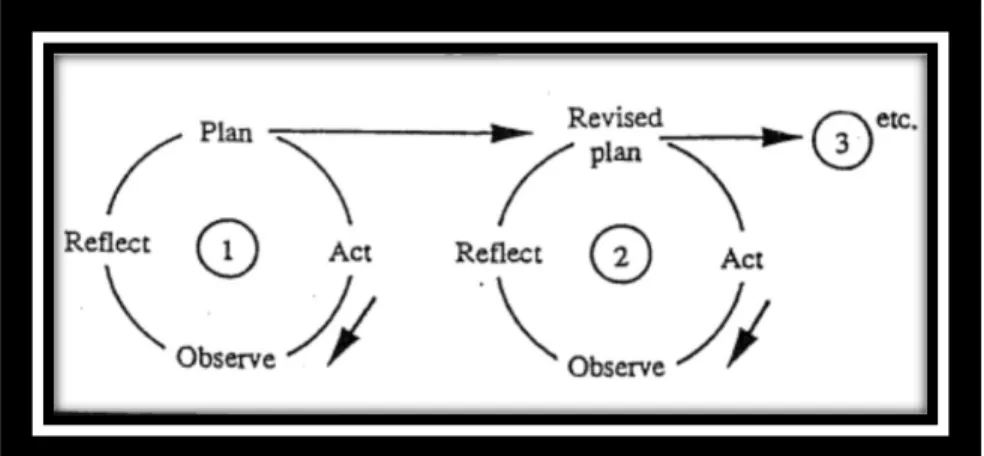
39 but in summary all the authors follow a spiral of action research cycles consisting of mayor phases: planning, acting, observing and reflecting, that can be observed in Figure 1.
Figure 1.Action Research Spiral
Thus, the best way to organize, categorize and develop this research proposal was to follow these phases. To support this, I followed the development of Henning et al. (2009):
Observing stage, Henning et al. (2009) states that this phase consists of two steps. First, action researchers should construct an objective description of student
performance. It should be thorough, detailed, objective, and as free from judgments or inferences as possible. Second, examining data from multiple perspectives by making comparisons and contrasts, by integrating different observations in different ways, and by viewing the data through different conceptual tenses.
The aim with this phase was to know the level of vocabulary with emphasis in action verbs in seventh grade students and the relationship between this vocabulary and visual literacy. The instrument used was an Initial Diagnostic Test ( See
40
Planning, Henning et al. (2009) cites that is phase refers to deciding on the goals and purpose of the study, deciding on the research question to guide the study, selecting the research participants, and determining the method of data collection. The aim with this phase was to implement English language demonstrated through the expression of vocabulary learning displayed by comics.
Besides, to realize a closing outcome through a visual literacy tool such a comic designed in ToonDoo, a production to included collaborative learning with emphasis in negotiation of meaning and peer assessment. In that sense, I implemented some visual literacies activities according with the Goal oriented learning and collaborative learning, at the end the instrument used was the elaboration of a comic in ToonDoo (See Appendix 4A to 4H).
Acting, Henning et al (2009) states that this phase refers to actions to be carried out. It includes implementing new teaching strategies and collecting data on them. Data collection to analyze the level of interest and impact about the implementation of the comic in ToonDoo as a visual literacy tool includes administering tests,
observing students, and conducting surveys and interviews. The aim with this phase was to capture the learners’ opinion from their own learning experience about the implementation of visual literacies. The instrument used was an Interview of 12 questions through a recording at the end of the pedagogic implementation. (See Appendix 5A to 5B)
Reflecting, Henning et al. (2009) describes this phase in 3 step: 1st. interpreting and explaining your observations, generating many plausible explanations as possible, 2nd. developing new teaching strategies derived from past experience, data from the study, techniques shared by other teachers, or the educational literature. 3rd. justifying the new teaching strategies with the data, best practice, educational research, or educational theory.
41 progress. The instrument used was a journal to record the data collected of each class - 14 lessons (See Appendix 6A to 6B).
The second aim was to monitor and evaluate the action research process and the learners’ results based on their participation and the development of the didactic unit through three kinds of rubrics: hetero-evaluation with 4 categories: vocabulary, communicative competence, collaborative work and assessment; Co-evaluation and; Self-evaluation with 3 categories: vocabulary, communicative competence and collaborative work. (See appendix 7A to E).
3.3. Data collection Instruments and Techniques
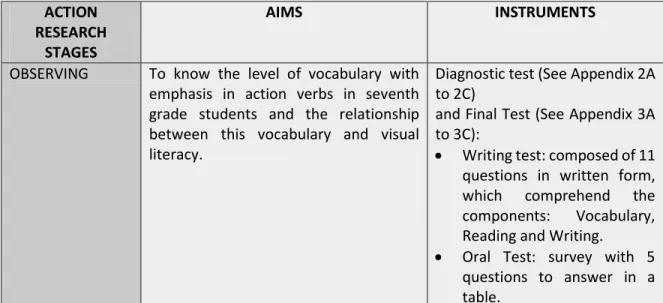
Johnson (2012) states that collecting data in an action research project is a series of quick looks taken at different times and in a variety of ways, and the author explains this with an example “In this sense, data collection in action research is much like collecting soil samples: You collect little bits of soil in different places over time” (p. 24). In this way, Table 1 shows a summary of the phases of action research and instruments that I applied in this study.
Table 1. Data Collection Instruments ACTION
RESEARCH STAGES
AIMS INSTRUMENTS
OBSERVING To know the level of vocabulary with emphasis in action verbs in seventh grade students and the relationship between this vocabulary and visual literacy.
Diagnostic test (See Appendix 2A to 2C)
and Final Test (See Appendix 3A to 3C):
Writing test: composed of 11 questions in written form, which comprehend the components: Vocabulary, Reading and Writing.
42 PLANNING To realize a closing outcome through a
visual literacy tool such a comic designed in ToonDoo - a production to included collaborative learning with emphasis in negotiation of meaning and peer assessment.
Comic: elaboration of a comic in ToonDoo. (See Appendix 4A to 4H).
ACTING To capture the learners’ opinion from their own learning experience about the implementation of visual literacies.
Interview: 12 recorded questions at the end of the pedagogic implementation. (See Appendix 5A to 5B).
REFLECTING To describe implications during the research project through reflections and perceptions by registering the process and students’ progress through a Journal.
To monitor and evaluate the action research process and the learners’ results based on their participation and the development of the didactic unit.
Journal: recording the data collected of each class (14 lessons). (See Appendix 6A to 6B).
43 4. INSTRUCTIONAL DESIGN
Since this is a project that involves teaching classes, this chapter contains the instructional design, which will be utilized to determine if the implementation of visual literacy resources such as comics created through Collaborative Learning and the
interaction with a digital tool as ToonDoo, evidences Vocabulary Learning with emphasis in action verbs in an EFL group of seventh graders at a Cajicá School. In this chapter, the participants as well as the theoretical foundation from the pedagogical intervention
implemented including the teaching methods, the material to be worked, and the procedures for this research proposal will be specified.
4.1. Pablo Herrera Department school participants
The participants for this research proposal comprise a group of 16 students of the 7th grade class of Educative Institution Pablo Herrera in Cajicà, Colombia. These students take 3 hours of English weekly based on the English department plan of the institution
according to the lawful standards of the Ministry of National Education for the corresponding grade of 7th as well as in the specific context of the institution.
The institution defines within the plan of the English Department (English Department Curriculum 2015) the specific objectives to ultimately achieve the main target which
determines what the each student should have learned by the end of the 7th grade academic year. Such objectives, which correspond to each of the 4th periods, are: 1) To express ideas and sentiments with short and clear sentences in a comprehensible communication, 2) To deal with daily topics with vocabulary worked during the year, 3) To express events that are occurring at the moment, and 4) To present activities realized in the spare time.
44 importantly to practice with enjoyment during these 3 weekly hours of English so that learning this language is more substantial and meaningful for them. I believe that by utilizing more efficient tools, students could be able to achieve the institution’s objectives and ultimately to make use of the language. Visual literacy resources such as comics created in through Collaborative Learning and the interaction with ToonDoo could be an alternative in which students not only will be exposed to visual association of meaning but also be exposed to discuss the meaning in collaborative learning.
For this reason, it is necessary to create a structured instructional design based on a theoretical support to be able to intervene pedagogically and test the validity of the proposal. The nature of this research proposal integrated Goal Oriented Learning, Collaborative Learning and Vocabulary Learning with visual literacies through digital resources allow the students interact with other classmates, express ideas, use vocabulary with a specific propose, combine digital resources with other visual literacy tools finding new ways to learn a language.
4.2. Theoretical foundations supporting the pedagogical intervention
For this pedagogical intervention I set a pedagogic goal around vocabulary learning for that reason I decided to focus on Goal Oriented Learning, according to Donovan, Chair, Morell and Harvey (2001) this refers to “increased competence level in individuals for a given task, overcoming task difficulties, and mastering challenging activities”(p.8) and from which was constituted a didactic unit with a main topic and 3 subtopics that was designed according to the institution's curriculum mesh and the purpose of this investigation to certain extend.
The Goal Oriented Learning, allowed me to begin from a sequence of vocabulary where students should fill this vocabulary into a structure through communicative events using a comic, in this way we could see a Vocabulary learning. Different researches include the technology as an effective teaching strategy using visual support systems such as
45 In this context, was evident to do an integration between Goal Oriented Learning, Vocabulary Learning and Collaborative Learning to implement the didactic unit integrated ToonDoo in the classroom language. Considering that “the vocabulary is the sub-skill of a language and it plays a very important role in language learning and teaching” ( Siriwan, 2007, p.45) and the vocabulary learning is the main concern of seventh grade teachers from Educative Institution Pablo Herrera and the main students difficulty in the second language learning process.
Consequently, I considered fundamental to create an interactive environment to explore the tool and evidence the use of this vocabulary, this way I made use of the Collaborative Learning approach “two or more students laboring together and sharing the workload equitably as they progress toward intended learning outcomes” (Barkley, Cross and Mayor, 2005,p.5), in order to make in couples the comic with the purpose of achieving the most optimum learning process for the population of this research .
Finally, each procedure was subjected to evaluation in order to obtain results about the process developed through digital material as a resource to the comic design, highlighting the student’s role as a self-manager of their learning process and the teacher’s role as a guiding and feedback proving figure.
4.2.1. Goal oriented learning
The Goal oriented learning comes from Goal Setting Theory proposed by Locke and Latham (1990) this theory present a goal as an immediate regular of human action, guiding the direction, intensity, and persistence of task related behavior. In providing this directions and persistence learning goals are proposed to enhance performance on a given task.
46 Furthermore, Elliot and Thrash (as cited in Farsani, Beikmohammadi and Mohebbi, 2014) suggested a four-dimensional approach to goal orientation in which mastery goal orientation is further differentiated into two dimensions: mastery approach and mastery avoidance:
1. Mastery-approach goal orientation refers to making efforts to improve one’s skills and abilities, to advance one’s learning, to understand material, or to master a task. Individuals with mastery goal orientation believe that ability is changeable (i.e., incremental theory of ability), perceive difficult tasks as challenging not threatening, set high performance goals, and demonstrate high levels of intrinsic motivation.
2. Mastery-avoidance goal orientation comprises the efforts individuals exert to avoid losing one’s skills and abilities, forgetting what one has learned,
misunderstanding material, or leaving a task incomplete or unmastered .(p.7) According to Donovan et al, (2001, p.13), studies about goal oriented learning
demonstrated the positive impact indicating that individuals with a strong learning goal orientation are likely to set higher goals and exhibit higher self-efficacy than individuals with a weak learning goal orientation.
4.2.2. Vocabulary Learning
Vocabulary is an essential element within a language, for that reason as cite López et al. (1995 p, 48 ) teachers should choose different strategies and types of tasks to teach vocabulary and help learners develop different systems of organizing lexical items in order to facilitate the storage and retrieval of words.
47 Vocabulary learning is the acquisition of memorized sequences of lexical items that serve as a pattern on the basis of which the learner creates new sequences.
Vocabulary acquisition is not merely a mental collection of individual lexical items, it includes more knowing its semantic aspect. (p, 10)
According to Taffy (2003) there are several different facets of vocabulary learning:
First of all, we need to ensure that the words we choose to teach represent important and useful words. Second, we need to teach students to be active vocabulary
learners who use a combination of problem-solving strategies and cross checking to figure out new words in context. Third, we need to teach students to become
metacognitive aware of words, and of how meaning is packaged into words in English. Fourth, we need to help students develop both the skill and the will to learn new vocabulary words. And fifth, we need to allow students to encounter core vocabulary concepts repeatedly in both the same and different forms. (p.7)
On the other hand, for students to achieve ability to learn and use vocabulary
effectively is necessary to “use visual support systems as an effective way to support their vocabulary and literacy skills along with promoting their successful participation in inclusive classroom settings” (Lindey-Glenn et al, 2008, p. 4).
4.2.3. Collaborative Learning
48
The intentional design in collaborative learning faculty member create intentional learning activities. The focus is on intentional group activities carefully structured to provide opportunities for learning.
In collaborative learning, all participants in the group must engage actively in working together toward the stated objectives; all group members receive the same task that together constitute a single, large project, all students must contribute more or less equally.
As students work together on a collaborative assignment, they must increase their knowledge or deepen their understanding of course curriculum. The task assigned to the group must help them accomplish the learning objectives of the course.(p.24)
Likewise, students are responsible for one another's learning as well as their own and that reaching the goal implies that students have helped each other to understand and learn. For collaborative learning to be effective, there should be both "group goals" and
"individual accountability" (Slavin, 1989). This means that the collaborative learning task must ensure that every group member has learnt something. Ideally, a collaborative
learning task would allow for each member to be responsible for some concept necessary to complete the task.
49 4.3. Pedagogical Objectives
General Objective
To implement a didactic unit for goal oriented learning in seven graders students through collaborative activities by integrating comics in ToonDoo in the language classroom, during the academic year.
Specific Objectives
• To get the use of vocabulary about routines, free time activities and activities at home. • To describe communicative events about preferences and activities through a comic. • To accomplish a collaborative learning through a digital resource.
4.4. Participants Roles
Student’s role
The students following the Goal Oriented learning working together toward a common goal hard in the different activities, persisting in the face of difficulty and frustration through the competence activities, taking risks and trying things that they did not know how to do like a comic using a digital resource, all in the service of mastering the task at hand. They participated in learning activities into an ongoing process, were concerned with charting their own progress through negotiation meaning with a partner and discovered “all outcomes as opportunities to learn something about themselves” (Husman, 2005).
Therefore, the students were responsible for one another's learning as well as their own and that reaching the goal implies that “students have helped each other to understand and learn” (Dooly et al., 2008, Chapter 1). It means, that they need to do a negotiator between the self, the learning process, and the goal, this aspect contribute to the learning process and the students reinforce the idea to taking responsibility for their own learning while learning to respect the opinions and work of the partner.