1
UNIVERSIDAD TÉCNICA PARTICULAR DE LOJA
La Universidad Católica de Loja
ESCUELA DE CIENCIAS DE LA EDUCACIÓN MENCIÓN INGLÉS
MODALIDAD ABIERTA Y A DISTANCIA
A DESCRIPTIVE ANALYSIS OF ANGLICISMS USED IN
ECUADORIAN MAGAZINES
Research done in order to achieve
The Bachelor‘s Degree in Teaching
English as a Foreign Language
AUTHORS:
G0NZALEZ RODRIGUEZ RINA ESPERANZA
MALO TOLEDO MARCIA CATALINA
ADVISOR:
LIC. PAREDES ZÚÑIGA FABIAN MARCELO
CENTRO UNIVERSITARIO AZOGUES
ii
CERTIFICATION
Lic. Marcelo Paredes
CERTIFIES THAT:
This research work has been thoroughly revised by the graduation
committee. Therefore, authorizes the presentation of this thesis,
which complies with all the norms and internal requirements of the
Universidad Técnica Particular de Loja.
Loja, march, 2011
………
iii
CONTRATO DE CESION DE DERECHOS DE TESIS DE GRADO
―Nosotras, Rina Esperanza González Rodríguez y Marcia Catalina
Malo Toledo declaramos ser autoras del presente trabajo y eximimos
expresamente a la Universidad Técnica Particular de Loja y a sus
representantes legales de posibles reclamos o acciones legales.
Adicionalmente declaro conocer y aceptar la disposición del Art. 67
del Estatuto Orgánico de la Universidad Técnica Particular de Loja
que en su parte pertinente textualmente dice: ―formar parte del
patrimonio de la Universidad la propiedad intelectual de
investigaciones, trabajos científicos o técnicos y tesis de grado que se
realicen a través, o que el apoyo financiero, académico o institucional
(operativo) de la Universidad‖.
……… ………
Rina González R. Marcia Toledo M. C.I 030133970-1 C.I 030112620-7
iv
AUTHORSHIP
The thoughts, ideas, opinions and the information obtained through
this research are the only responsibility of the authors.
March, 2011
……….. .………..
Rina González R. Marcia Toledo M. C.I 030133970-1 C.I 03012620-7
v
DEDICATION
This present work I dedicate with my heart to my beloved
husband Miguel Angel and my dear son Lenin Israel who
has trusted in me to pursue this career that with tokens
of love, affect and appreciation has always been present
to help me and support me to achieve my goals. Also to
the loved ones of my life, my parents, whom has been
faithful witnesses of my sacrifice, and they guided me
since I saw the first light.
RINA ESPERANZA
To my God Almighty for giving me the courage and the
determination, as well as guidance in conducting this
research study, despite all difficulties.
To my beloved husband José and lovely kids Patricio,
Nancy, and Silvia for allowing me to continue with my
studies. Please never doubt my love for you.
To my parents Guillermo and Rosa for their unfailing
support with my studies, I am honored to have you as my
parents.
vi
ACKNOWLEDGMENT
I present my sincere gratitude first to God as
the Supreme Being who guides my path, then
to the Universidad Técnica Particular de Loja,
mainly to my Advisor Marcelo Paredes, who
with patience and dedication addressed me and
to be successfully in this research paper.
And to all those who selflessly helped me reach
the goal of my dreams.
RINA GONZALEZ R.
I thank my sister Silvia for advising me the
importance of having a career in this life.
I also extend my heartfelt gratitude to my
Thesis Advisor, Licenciado Marcelo Paredes.
You were very tolerant and determined to see
me achieving my objective.
I wish to extend my utmost gratitude to my
brothers Cesar and Claudio, for being ready to
help me whenever I needed it.
vii
CONTENTS
Certification ... ii
Contrato de cesion de derechos de tesis de grado... iii
Authorship ... iv
Dedication ... v
Acknowledgment ... vi
Contents ... vii
Abstract ... 1
Introduction ... 3
Methodology ... 5
Discussion ... 7
- Literature Review ... 7
- Results... 37
- Description, Interpretation And Analysis Of Results ... 139
- Conclusions ... 175
References ... 177
1
ABSTRACT
The theme for our research project is ―A DESCRIPTIVE
ANALYSIS OF ANGLICISMS IN ECUADORIAN MAGAZINES‖. Since
this is a current phenomenon in our society, which has shown up
within the last few years, its focus of attention is over their linguistic
role in Ecuadorian magazines. The ―Universidad Técnica Particular de Loja‖ has launched a project that has to be carried out by the pre
-graduate students of English all over Ecuador, and this particular
investigation has been done in the city of Azogues where all kinds of
magazines were found, from cultural ones to scholarly and those of
general interest.
A qualitative and quantitative study, based on the linguistic,
sociological, ideological and cultural aspects, has been made. Many
magazines were sifted through to find the actual required data, a
bibliographic, analytical, and descriptive method, were used.
After finding and analyzing the information, it is clear that our
language is gradually loosing territory, so to speak, or should it
rather be said that the Spanish language is being enriched by the
increasing use of anglicisms, which may result in a cultural change,
provoking modifications in the everyday language use; with this
reflection it may be concluded that through this work we have
accomplished our main objective, which, we hope, will contribute to
the understanding that language is a dynamic social phenomenon,
2
found, as if they were a new language, common to all human beings,
that is spoken in a new technological, virtual world. Changes in the
structure and functions of language have been registered, and it may
be a result of a clear social factor, related to the perception of the
English language as a universal one, and the snobbish kind of image
3
INTRODUCTION
Along these years, it has been common to see how English has
been subtlety spread among Spanish literature, and in some cases,
used unconsciously by many people. All the English terms and
words found as anglicisms have been introduced through the mass
media, internet, music, and magazines could not be the exception.
These linguistic changes are spreading along the different areas, but
our core investigation is on Magazines. There, anglicisms can easily
be perceived. The reason why English is used in the Spanish
language is a complex paradox that has to do with the belief that
English is the language of power, and, of course, everybody wants to
be ―powerful‖.
With the collected information, we state the importance of this
investigation, that, although there have been many prior studies
about this subject, a follow up in this area could be considered of
great importance to build the existing data, and it is hoped that it will
help other investigators as a footstep for further researches about the
influence of anglicisms in our language.
The means and economic resources used to carry out this
investigation were absolutely pinned of the investigators. The main
motive for this commitment is to comply with a requirement, previous
to the obtainment of the bachelor‘s degree on educational sciences, English mayor, at the ―Universidad Técnica Particular de Loja‖.
The scarce libraries in this town has been the only delaying
4
is hoped to be useful for the readers who may find it to be a worth
while piece of information.
The objectives aimed for, during this investigation were:
General objective
To research the linguistic phenomenon of anglicisms used in
Ecuadorian magazines.
Specific objectives
To identify the syntactic and lexical Anglicism more commonly
used in Ecuadorian magazines.
To make a deep analysis of the anglicisms found in Ecuadorian
magazines regarding syntactic, semantic, and morphological
aspects
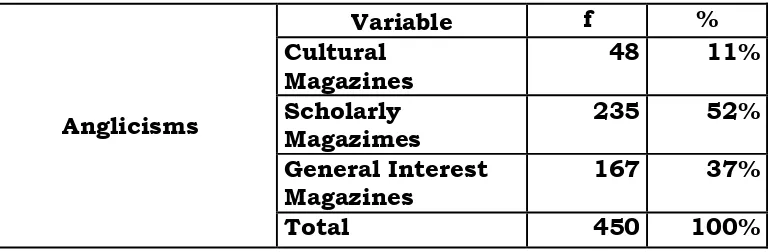
To establish which variable (cultural, scholarly and general
interest magazines) contains the highest number of anglicisms.
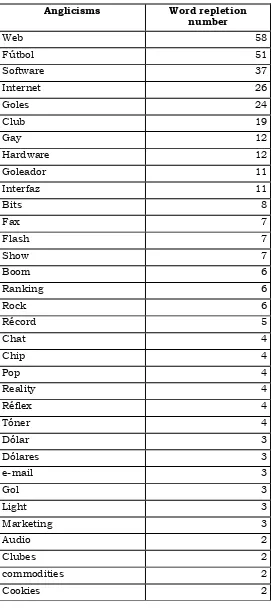
To determine which anglicisms are mostly used.
The methods used for this research are the qualitative and
quantitative, which have been supported by the resources such as
reading techniques, for instance, skimming and scanning;
note-taking, and instruments like data collection formats, cards, and
tables.
The essence of this research has been strongly supported by
previous studies done in this field, in different parts of the world, as
well as their methods and results. It may be said that our objectives
5
METHODOLOGY
This field research process was carried out in the city of Azogues
and it was done, basically, by buying the magazines first, once this
resource was available, all of them were read and some anglicisms
were found.
Then, within a couple of weeks, after that we proceeded to
discriminate the terms and verify if they really justified to be
considered as anglicisms, observing how frequent they appeared in
the revised literature, and classified them by categories. The most
relevant information on anglicisms was found in the topics that
referred to technology.
The chosen words that appear within this document were chosen
because of their singular characteristics, each one of them was
carefully analyzed, and every one of them reflected a unique change,
for example; some of them have changed their spelling to fit the
Spanish language phonetic production, others have changed their
meaning from their native language; although many of them are
words that are used in simple everyday speech, when used in the
technological field have totally changed their function and meaning,
that is the case of ―web‖ which used to define a cobweb, a natural
fiber produced for spiders, today is a main word for the world of
internet with a whole lot of implications; the analysis of these and
6
It is worth mentioning that most of the selected words are
already accepted by the RAE, (Real Academia de la Lengua) of
Spanish language, while others are starting to be used as frequently
that who knows in a short period of time may be accepted by the RAE
as useful words, and put them into the Spanish lexicon referring
them as ―foreign‖ words, as usually happens when there are words borrowed by any other language, of course they come accompanied
by some semantic, morphological or phonic changes, in order to fit
within the Spanish lexis, sintax and phonic production; while others
may keep their original form, either way it is thought that they
enrich the lexicon of the host language.
For the analysis of the picked up data, many charts were drawn
and in them, the found words were classified, and then some
comments were made in order to explain what linguistic aspects have
changed or remained the same; some syntactic, semantic and
morphological analysis were taken into account, and some
conclusions were met.
Once the Anglicisms were identified, and chosen by the number
of times they appeared in the sifted articles and the contexts they
showed up, the collected data was tabulated using some charts,
where the information was categorized according to the variables:
cultural, scholarly, general interest, from these categories, the
anglicisms with the most special features were chosen for their
7
DISCUSSION
Literature Review
There are important criteria to be taken into account in order to
make this project rest on some logical and reasonable bases, to
justify it. Therefore, a Linguistic, Sociological, Cultural, Ideological
and quantitative Analysis, will be done.
The study of anglicisms basically comprises information dealing
with linguistics, language and sociolinguistics, followed by detailed
information about magazines and patterns of case studies carried out
in different countries.
The discussion of this work contains the scientific information
that supports this research and gives the opportunity to deal with
several aspects of language and linguistics, as well as with
anglicisms, the central issue of this project, for this reason some
definition are shown hereafter.
Linguistics
Linguistics is the science devoted to the study of language and
languages in all their aspects – their structure, their interrelationship with the rest of human activity, their history and mutual relations as
states Crystal‘s (1998) words:
Linguistics as a scientific discipline can be
conceptualized, it must be observed and treated in terms
of the following topics: history and development of the
subject from antiquity to modern times in various parts of
8
study of the sounds and forms of language; relationships
of language; application to problems of pedagogy and
education in general; model and example for the study of
human behavior as a whole, including human history. (p.
163)
Regarding the role of linguistics, it is related to other branches
and approaches that describe different peculiarities during its
evolution in time and its linking function between man and culture.
According to Trask (1998), the key branches of linguistics
playing a vital role in the teaching and development of languages.
Morphology
Trask (1998), mention that this branch of linguistics deals with
the structure and word formation, so, it is in charge of identifying,
analysing, combining, and describing morphemes, just by using a set
of word-formation principles that govern both the phonological and
morphological structures of words.
Semantics
According to Burneo (2007), this branch deals with the study of
meaning. Then it studies the signs, symbols and structures of
meaning. Consequently it is concerned with the meaning of
morphological and semantic units such as morphomes, words,
phrases, clauses, sentences and any piece of discourse.
Pragmatics
The next branch is provided by Wikipedia (2010), the free
9
which context contributes to meaning. Pragmatics encompasses
speech act theory, conversational implicature; talk in interaction and
other approaches to language behavior in philosophy, sociology, and
linguistics. It studies who to transmission of meaning depends not
only on the linguistics knowledge of the speaker and listener, but also
on the context of the utterance, knowledge about the status of those
involved, the inferred intent of the speaker, and so on. In this
respect, pragmatics explains how language users are able to
overcome apparent ambiguity, since meaning relies on the manner,
place, time, etc. of an utterance.
Phonology
In this following branch of linguistics, Swann (2004), expresses
that it is a science which studies the speech sounds in general
according to their production, composition, distribution and function
within the language. Likewise Trask (1998), defines phonology as the
key element of language; therefore, it is quite indispensable.
Linguists assure that phonology is the language‘s voice, because it is supposed to be pronounced by speakers, to produce communication.
That means that languages survive thanks to their sounds, which are
the messengers of thoughts and ideas.
Syntax
Finally, Burneo (2007), states that linguistically, sintax is a
subfield of linguistics that studies the principles and rules that
govern the way words are joined together to form phrases, clauses
10
constitutive rules that speakers follow when they combine words into
sentences.
Lexical categories
Wikipedia (2010), the free encyclopedia provides us with the
following definition about this subject: in grammar, a lexical category
is a class of words or lexical class, in other words it is a part of
speech. Common linguistic categories include nouns and verbs,
among others. There are open word classes, which constantly acquire
new members, and closed word classes, which acquire new members
infrequently if at all.
Different languages may have different lexical categories, or they
might associate different properties to the same one. Some argue
that the formal distinctions between parts of speech must be made
within the framework of a specific language or language family, and
should not be carried over to other languages or language families.
From this point of view, it‘s worth pointing out that the four main lexical categories are noun, verb, adjective and preposition. The
lexical category of a particular word is usually shown in the entry of a
lexicon or a dictionary because it helps people who look up words in
dictionaries to solve morphological problems.
Some Information provided by Richards and Schmidt (2002),
helps in the understanding of what a lexical category is and what it
may include:
11
b) Its meaning, which may be given in a formalized way by
focusing on semantic features.
c) Its lexical category, say: noun, verb, adjective or preposition,
tackling on morphological features.
d) Other linguistic items that may co-occur with in a sentence. It
deals with the appropriate place of words in a sentence.
Therefore it focuses on syntactic features or language
structure.
Contact languages
Gonzáles (2005), states that contact languages are the
co-existence of two or more languages in geographical areas or a speech
community. This means that the degree of bilingualism or
multilingualism is usually involved, either throughout the speech
community or on the part of some individuals.
Swan (2004), converges on his definition of contact languages
and defines it as a stable language that arises under certain
conditions when two or more languages come into contact with each
other; for example, in Asia, Africa or the Caribbean area, where the
Pidgins and the Creoles make the prototypical contact languages of
America. The author asserts that naturally, when contact languages
occur, there is always one, which predominates either in use or in
number of speakers, and logically, the predominant language tends
12
Language vices
Wikipedia (2005), the free encyclopedia provides us with the
following definition: in general terms, language-vice is regarded as the
deformation or linguistic changes which occur due to diverse
socio-linguistic factors. Naturally, some of these vices distort the message
communication, while others enrich the language corpus.
Stylistic vices
Collins (2002), states that the terms for stylistic vices do not
strictly denote changes of meaning or arrangement as do most terms
for rhetorical figures; rather, these are qualitative labels whose
accuracy will always be relative to the context and purpose.
In this respect, every dimension or aspect of style has vices
associated with it, and every vice has a corresponding virtue. Indeed,
the very same locution may in one sense be regarded as exemplifying
a stylistic virtue, and in another, a vice.
Barbarisms
According to Martinez (1982), barbarisms are words or
expressions that are unacceptable, usually, because it is foreign or
vulgar. That is why; barbarisms have always been set within the low
level of language styles.
In fact, Ayto (1990) provides us with the etymology of the word
―barbarism‖ by stating that it is a derivation of the Latin term ―barbarous‖, which means ―Foreigner‖. The author adds that the
term ―barbarous‖ originally referred to a person, who did not speak
13 Greek ―barbaros‖ meaning ―foreign‖ lexically ignorant, or a person
unable to speak intelligibly.
On the other hand, Fowler‘s (1981), says that the word
barbarous means ―putting aside intentionally archaism and
metaphor‖. In other words, he makes reference to an illiterate expression. Briefly speaking, in Fowler‘s concept, a barbarism is
commonly considered as a term that wounds the feelings, especially
of those who know little or nothing about Greek or Latin languages.
González (2005), on the other side, defines barbarism as the
unconscious use of language, either semantically, syntactically or
phonically, which distorts the corpus of language because it is
supposed to be correct.
Likewise, Merino (1982), conceptualizes anglicisms as ―The English words or expressions that have been taken by another
language, and have incorporated it as part of its lexical corpus‖.
With the purpose to exemplifying the use and role of anglicisms,
Lorlach (2005), provides the first exhaustive and up-to-date account
of British and American English words that have been incorporated
into the Ecuadorian formal, informal and colloquial language. It is
common knowledge that Spanish as a romance language possesses a
corpus that comes from Greek and Latin languages in a high
percentage, and English does too, though in a lower rate. It is this
fact that makes easily adaptable the insertion of English words into
the Spanish lexicon. This author goes deeper and asserts that the
14
technology literature. This premise is justified by the fact that
English is now by far the world‘s biggest lexical exporter language
and one of the main reasons for this to occur is that trade is growing
amazingly and it is mainly conducted in English Language, and this
domain has expanded to other fields ranging from pop music to
electronic communication.
Although some people think and argue that anglicisms distort
the lexicon of other languages and try to block the insertion of
English words into the Spanish Language. Contrary to this
statement, linguists and lexicographers assert that language respects
neither boundaries nor law, so, the key purpose of Lorlach‘s dictionary is to show how the process of lexical importation can
change a word‘s form and function, sometimes subtly, at others remarkably as in the transformation of ―pain killer‖ to ―jack
-of-all-trades‖
When defining a sociocultural phenomenon, in a dictionary,
each entry has a brief definition of the loan word, followed by the
information of its history and distribution, which results in variations
in its spelling, function, meaning and pronunciation. As explained
above, the degree of acceptance and usage, as well as the lexical and
semantic restrictions depend on the linguistic context, users‘ age and
background.
Further on, Lorlach tries to reinforce his statement when he
argues that reading magazines can be challenging, fun and curious
15
word. It would be interesting to know why some words look so
unfamiliar and where they come from, what they mean and how they
entered the language, claims the author, who adds that a pathetic
example of this socio-linguistic phenomenon is English due to its
condition of world language. Thus, Spanish is constantly adopting
English words to its lexicon, due to the cultural influence of English
language.
Borrowings and loans
According to Richards & Schmidt (2002), borrowing is as a word
or phrase which has been taken from one language and used by its
speakers. Whereas; Swann (2004) conceptualizes that borrowing
occurs when a vocabulary item from one language enters the
vocabulary of another, For example, the word ‗garage‖ comes from
French or the word ―loch‖ comes from Scottish.
The definitions of borrowing and loan are very close in meaning
and context. Reason being, some dictionaries and linguistic
glossaries consider the terms borrow and loan as synonyms.
Wilton (2003), on the other hand, establishes some reasons for
language borrowings. He claims that there are many-fold reasons for
taking a term from another language. A common reason is need;
languages often suffer from the missing of terms to express certain
ideas or to describe items or objects. For instance, new fauna or flora
terms, this fact makes it necessary to adopt a foreign word in order to
fill the lexical gap of the borrower language. Another reason is the
16
expresses a special feeling or mood. A third cause can be the
mastery of a new culture such is the case of the Norman Conquest in
England.
The contact between speakers of different languages could also
result in borrowings, which help emphasize and define their social
status and their cultural background.
Wilton does his best to clarify and make it explicit on his
contribution when he classifies the borrowings in different types, in
this respect; he affirms that just as there are different reasons for
borrowings, they can also be classified in four categories:
a) Guest words, terms which keep their original pronunciation,
spelling and meaning. This means that they are simply taken
into another language as they are. For example, the word
―diva‖ that comes from Italian is pronounced and written in
English, exactly as it is in its original language
b) Foreign words, are those partially assimilated, which are
harder to be recognized as borrowings, such is the case of the
word ―hotel‖, which cannot be distinguished in written form,
but just in oral one.
c) Loan words these terms become a virtual native and can hardly
be identified. For instance, ―bishop‖ and ―street‖.
d) Calques make a loan translation from other languages like
―world-view‖, which has been translated from the German
17
Hughes (2002), has established another classification of
borrowings, which depends on whether the words are direct and
indirect borrowings. A direct borrowing occur when words are
original of the donor language, while the indirect borrowing takes
place when the words have been taken from another language to then
be transferred to a third one.
Magazine (definition, language used and audience)
The Oxford Advanced Learner‘s Dictionary (1991), defines the
word magazine as ―A large thin book with a paper cover that contains
news, stories, articles, photographs, etc, and is sold weekly or
monthly‖. The magazines selected for this research differ in the
language register used in their texts. For example, the cultural
magazines use a miscellany of language styles on their attempt to
reach the widest audience possible. This means that the audience of
these magazines is quite heterogeneous. The massive audience
captured by these magazines obeys to the wide range of terms that
they include, decoration, famous‘ lives, scientific reports and articles.
Scholarly magazines mainly focuses on economy and
technology, but they also deal with education topics; the most
assiduous audience of this type of magazines are: professionals,
people involved in education, as well as students of second and third
level, writers can be added to the list of readers of this kind of
magazines. Retired people can also be considered as frequent
readers of scholarly magazines because they usually prefer to be
18
Linguistic studies forcefully demands of an experimentation
process, in this sense; there must be pioneering case studies, which
usually become the basis. Thus, we have found many cases applied
to different languages around the world, some studies have been
done for purely scientific research, in other cases it is orientated to
help people involve in the teaching learning process of English
language. In any case, it establishes a solid base to emit criteria and
undertake further investigation.
The Timofeeva‘s (2005), study refers towards localization of anglicisms; this study investigates the ways in which the use of
anglicisms on the localized promotional websites of global companies
may be beneficial for the companies. The study suggests that
anglicisms may be used in a promotional text as a strategic device,
and localization of anglicisms is defined as part of the localization
process which requires the adaptation of the stylistic, grammatical,
and sociolinguistic aspects of anglicisms to the target language. The
data came from the Best Western Italia website, and the study
focuses on the use of anglicisms in Italian. The data were collected in
the period 18.12.2006-23.12.2006, and the material for the present
study consists of 48 web pages that contain 10 785 words, 490 of
which are anglicisms, and, consequently, anglicisms make 4.5% of
the total number of words. The study performs data-driven analysis
of anglicisms that means that the methods were determined by the
data, and those characteristics of anglicisms which were more
19
analysed. Thus, the present study combines quantitative and
qualitative methods. Firstly, the frequency and word class
distribution of anglicisms were identified. Secondly, semantic and
etymological analyses of anglicisms were performed. Thirdly,
grammatical analysis of anglicisms was conducted by means of a
focus on the word formation processes, the assignation of gender, the
plural formation, word order and agreement of noun phrases, verbs,
adverbs, spelling, and false anglicisms.
The results of the present study suggest that the use of
anglicisms on a localized promotional website may help to designate
the target audience of the website, economize space on a website by
using shorter English words, avoid the ambiguity caused by
homonyms, create an authentic atmosphere of international
environment, and enrich the user‘s vocabulary with new vocabulary
items and new concepts. However, it is necessary to acknowledge
that the effectiveness of such a marketing strategy depends on
certain characteristics of the target market, and the usage of
anglicisms might be very popular among a particular speech
community, but ineffective and harmful when excessively used.
Another study done by Liberman (2009), in
Europe an unused question was given from a big Language Log
fan: Do you have any idea if the nice folks in, say Germany or Italy
or Spain, go as nuts as Americans seem to when native speakers
20
It appears that the strong form of ―going nuts‖ that we have called wordrage is mainly an Anglophone phenomenon, with the
British as the originators and still the champions. But the
sociolinguistic settings in Germany, Italy, and Spain are very different
from the situation in the U.S. — and as a result, they have their own kinds of language wars over there.
The most obvious difference is the role of traditional local
language varieties. Each of the European standard languages
developed in the midst of a complex dialect continuum, where
differences increase with geographical and social distance, and
enough distance creates differences like those between German and
Dutch, or French and Italian. As a result, many if not most
Europeans speak a local ―dialect‖ that is very different in morphology, pronunciation, and word stock from the standard national language
that they also control to one extent or another; and in practice, the
local and standard varieties are often mixed to a variable degree
depending on circumstances.
Something of the same kind is also true in the U.S., but the
differences are generally not as great. Those are both instances of
concern about the evolution of the standard national language, and
there are plenty of those around. But most European countries have
one or more governmental institutions charged with establishing and
maintaining language standards and perhaps this makes the
citizenry less prone to take up pitchforks and torches on their own
21
English loan words thrive in many languages, including
Norwegian, such is the case study of Andersen (2002), stipulates
anglicisms may be used for different purposes, to denote new
concepts (such as reality TV in, as new words fork nown concepts
(such as party in, in movie titles, brand names, names of companies,
products, artists, and so on. The use of recent loan words raises
debate and criticism, and the Norwegian Language Council
encourages the formation of domestic words to replace recent loans
in cases like. The critics rarely express the same antagonism towards
loan words of other origins or towards older, well established loan
words of English origin that are no longer perceived as such, like
sport and pled (plaid). Setting aside this debate, the current paper is
concerned with how anglicisms can be identified in Norwegian texts,
and it describes the development of a language processing tool that is
used to automatize the identification process.
The paper reports on a series of experiments involving
alternative strategies for automatic anglicism retrieval: n-gram-based
pattern matching and lexical database lookup, as well as combinatory
methods. The tool‘s performance is evaluated against manually controlled data. The n-gram statistics are mainly gathered from the
via chart gram lists produced by the ―Phrases in English‖ project e BNC, but restricted to productive and uniquely English chronograms,
in the sense that they are non-existent in a Norwegian reference
lexicon. The lexicon lookups are mainly based on existing data
22
the processing tool described in the current study is developed as
part of the Norwegian Newspaper Corpus project. The Norwegian
Newspaper Corpus is a large and self-expanding corpus of Norwegian
newspaper texts (Holland 2000). The collection of this dynamic and
continually growing corpus began in 1998. The corpus is
automatically updated by means of w3mir, which is an all-purpose
http copying and mirroring tool. On a daily basis, the mirroring tool
retrieves recently published texts from a set of remote web sites,
specifically the entire Internet version of ten major Norwegian
newspapers. A set of own-developed tools is used for further
processing and annotation of the texts. The system automatically
selects the relevant text, ignoring advertisements, navigation menus,
and hotmail code and so on. Next, it automatically classifies the text.
Further, the texts are interpreted with word class and other
morpho-syntactic information by means of the Oslo-Bergen tagger, and the
tagged and untagged texts are added to the database.
English in Croatia: past and presente, a study done by Nikolic &
Socanac (2006), says that the rise of English as a language of
international communication has affected European languages in
similar ways. Since the common trends are well known, it is more
interesting to explore features which are specific for individual
languages as a basis for a wider comparative approach.
For most European languages, including Croatian, the
23
influences exerted by neighboring languages: primarily Italian and
German and, to a lesser extent, Hungarian. In this respect, there
were strong regional differences resulting from historical divisions,
Italian being dominant in the south and German in the north.
Con-tacts with other Slavic languages grew particularly intense with the
growing influence of the pan-Slavic ideal. Thus, in the effort to
develop new terminologies, words were often borrowed from Russian
and Czech as genetically related languages in preference to those
from other languages. The Croatian spelling reform was carried out
under a strong Czech influence. Above all, however, the nineteenth
century was a period of language reform with the aim of bringing
Croatian and Serbian closer together by stressing similarities and
disregarding differences between the two languages - as a result, a
common language, Serbo-Croatian was eventually created which
became the official language of the South Slavic state that emerged
after the break-up of the Austro-Hungarian Empire at the end of the
World War I.
Throughout the nineteenth and the beginning of the twentieth
century, English was still a far-away and rather exotic language that
few Croatian speakers were familiar with. At the time, most English
loan words entered Croatian through German mediation. The main
foreign languages taught at Croatian schools were French and
German. Italian remained the language of instruction in coastal
Croatia until World War I, so that it functioned as the second, rather
24
English was first introduced as a foreign language at the Naval
Academy in Bakar in 1882. It was sporadically taught at some
private schools in Zagreb at the end of the nineteenth century.
A massive influx of Anglicisms began after World War II, the
period in which Europe came to be divided by the Iron Curtain. The
growing prestige of Anglo-American civilization was evident in the
West and suppressed in the East, without much success - Coca-Cola
and jeans were objects of desire, symbolizing a different world.
However, barriers to this new influence were far stronger in the East
than in the West. In the West, English expanded from the north to
the south, and with the growth of proficiency, became the European
lingua franca, used for international communication. In some
countries, it entered some internal domains such as higher education
and science. In the East, Russian functioned as the lingua franca in
the Soviet Union. In spite all the efforts, it never fully acquired this
status in the East European countries belonging to the Soviet bloc,
where it was taught as the only compulsory foreign language in the
schools. While attitudes towards English were positive, since it was
largely seen as the language of democracy and progress, attitudes
towards Russian, an imposed language, were expressly negative in
the countries of the Soviet bloc.
Many studies of the increasing number of Anglicisms in modern
German have been made during the last two decades as mention in
the study of Vesterhus (2008), about Anglicisms in German Car
25
language used in car advertising. It is no secret that German
advertising copywriters have a liking for the English language.
Furthermore, it was a must for the makers and importers of cars
spend vast amounts of money every year on TV commercials, ads in
newspapers and magazines as well as on brochures and leaflets.
The present article examines printed car advertising. The
corpus consists of 1008 ads from newspapers and magazines and
435 publicity leaflets and model brochures. The advertisements were
all found in well known German publications such as ―Die Welt‖,
―FAZ‖, ―Spiegel‖, ―Focus‖ and ―auto motor and sport‖, whereas the
publicity leaflets were all made available by car manufacturers or
importers on the German market. In contrast to former frequency
studies of Anglicisms in German, no user‘s manuals or technical
descriptions were taken into consideration. As in the previous
studies we have confined ourselves to nouns borrowed from English
with British or American spelling. Verbs are thus not represented in
the corpus. The predominance of nouns among Anglicisms in
German has also been confirmed by other frequency studies.
In another corpus of Anglicisms appear 7680, which is
equivalent to a type-token-ratio of 3.60. Compared to our former
26
Type-token-ratio
Corpus Types Tokens TTR
1991 2820 7190 2.55
1993 2843 8956 3.15
1997 2134 7680 3.60
With regard to text frequency a direct comparison of the three
corpora is problematic because the predominance of advertisements
in the new corpus makes it difficult to establish an exact number of
pages. If, however, only the brochures and leaflets in the new corpus
are taken into consideration, the text frequency in the three corpora
would be as follows:
Text frequency
Corpus Anglicisms
(tokens)
Number of
pages
Text frequency (page)
1991 7190 8458 0.85
1993 8956 8612 1.04
1997 5636 5103 1.10
The text frequency was also established separately for the
27
The present article about the impact of lexical anglicisms in
Spanish film magazines: a case study across time, of Guzman (2002);
which has been specifically designed for electronic publication, is
complemented by three glossaries, which can be accessed in two
ways:
1. double-clicking on marked words will directly take the reader to
the word in the relevant glossary
2. double-clicking on each item in the following list will take the
reader to the beginning of the glossary in question:
By clicking on ―back‖ in the browser menu, the reader will return to the original place in the article itself.
Each of the three glossaries contains a list of the anglicisms
conveying the following information:
The definition of the word, except in very transparent
expressions; the source from which the word has been
obtained.
The study illustrates the relevance of the word in context in
bold, whereas, other anglicisms appearing in the same text
have been capitalized.
Information regarding two dictionaries: The Royal Academy of
the Spanish Language as the authoritative Spanish lexicographical
work in discussions on norms, usage, prescription and authority; and
Görlach‘s Dictionary of European Anglicisms as a pioneering survey
28
It is perhaps one of the most well-known common places to
comment on the huge influence of the English language, as a reflex of
the dominating Anglophone culture of our times, on the languages of
the rest of the world, and, especially, on those of the so-called
―Western world‖. This influence seems more pervasive in the field of
lexis than in any other area of language as far as Spanish is
concerned.
Most of the complaints are based on general impressions
obtained after having listened to the news on the radio or on
television, or having read a newspaper or a magazine. It cannot be
denied that the presence of English is pervasive and obvious in all
these media.
The present paper concerns a specific type of English influence
from a particular kind of texts on a particular dialectal variety of
Spanish and a given time-span. The research for this paper was
carried out in two phases, the first in the early 1980s. The second
phase of the project was begun nearly twenty years later. I was thus
able to carry out a real-time study of the influx of English loan words
into Spanish despite what in retrospect seem unfortunate short
comings in the original study, and to test the final statement made in
Guzman‘s study (1984:304).
Onysko's (2007), research on Anglicisms in German is devoted
to specialists in language contact. The author focuses on the
manifestations of English loan words as witnessed in a corpus of the
29
the lexical productivity of anglicisms, the book also includes a
discussion of German-English code-switching as they appear in the
corpus.
The book is divided into three parts. After a brief introductory
chapter, Part I takes on the task of defining what an Anglicism is,
and touches on the distinction of several theoretical terms.
The author goes further to discuss the methodology of this
study and provides the results of the quantitative research, which
permits to justify his statement by using Der Spiegel in the study,
including the facility of researching the magazine due to its
accessibility on CD-ROM and the ―traditional medium of research‖ that this magazine represents.
A diachronic comparison converges with the above utterance
regarding the use of the most frequent words reveals that in most
cases the token frequencies have increased from 1994 to 2000.
Namely the nouns are more likely to be borrowed than coined,
with the different semantic categories; it is common to find adjectives,
followed by verbs. Within this chapter, morphological adaptation is
also considered, where gender and plural suffixation are
quantitatively investigated. The author does so by comparing
findings from his corpus to those of other researchers using the same
news magazine in their study. The author finds that the number of
anglicisms per page in Der Spiegel has steadily increased from 2.9
30 is in part ―connected to new importations particularly in the field of
computer and communication technology‖.
Additionally, the author claims that the results of the qualitative
analysis of the data are presented in three chapters, each one
focusing on the grammatical integration of anglicism into the German
morphological system. In so doing, the author demonstrates how
this hierarchy interacts with the phonological, semantic and
morphological rules to determine the gender of nominal anglicisms.
In short, the book provides a brief synopsis of the impact of
anglicisms on the German language and what implications this may
have for its future. He adds a brief yet enlightening discussion on
why anglicisms are present in the German news magazine, focusing
on the denotative and connotative needs of the author, and continues
by stressing the important conclusion that while the corpus in
question ―resembles a stable language contact scenario, in which
English influence leads to an expansion of the German lexicon...
these anglicisms continue to have a minimal numerical impact in the
general German language‖. This leads the author to conclude that
―German stands undisputed in its integrity on the lexical and
structural level‖.
Erkenbrecher (2006), comments in his study about Anglicisms
in German, that for many Germans it is impossible not to be
confronted with English words. While listening to the radio, watching
TV or surfing on the internet, we come across many terms that are
31
because there is no corresponding German word. Sometimes new
words are created on the basis of an originally English word. In some
cases during that process, changes take place which would make
certain loan words exceptions of what onecould call ―proper‖ loan words.
The question is: What justifies the classification of one word as
a ―proper‖ Anglicism and what makes an Anglicism a
Pseudo-Anglicism? Furthermore, how many Pseudo-Anglicisms are actually
in use? Loan words are often widely known and used, since their
borrowing serves a certain purpose, for example to provide a name for
a new invention. One can realize that there is always a reason for
borrowing and that it never happens illogically.
It can be held true that the transfer of linguistic features, words
or terms from one language group to another language group is most
frequent if mutual, direct contact is established. Furthermore, the
prestige a certain nation language community has at a certain time in
history is even more influential on borrowing/loaning of words.
―Idiomatic expressions and phrases, sometimes translated word
-for-word, canbe borrowed, usually from a language that has ―prestige‖ at the time.
In order to create a terminological basis for further examination
and to avoid complications regarding terminology; in this sense, he
took the terminology to extend and improve it in order to make it
32
In the present study referes about Cross Language
Phonemisation a research done by Schroder & Steigner (2007),
statement that the anglicisms are words that contain one or more
lexemes originating from American English or British English, used
in a language that is not English. This definition does not distinguish
between words that stem from British English and words stemming
from American English. We subdivide anglicisms into three
categories:
Interactive NLP systems like TTS have attained high levels of
quality in recent years. Nevertheless, non-native words representa
major difficulty. In an increasingly internationalized world, TTS
systems, and also language recognizers, should be designed to cover
non-native items in current languages in order to meet the
expectations of users towards a high quality NLP system. In the
present paper, we present an approach for the phonemization of
non-native words within the framework of the German TTS synthesis
system MARY. As every day experience suggests that English
represents the language with the strongest influence on current
spoken German, we decided to focus our research on the
phonemisation of anglicisms.
To clarify this issue, the author uses xenomorphs, which are
words that are built from combinations of English morphemes from
the respective native language. The morphology of xenomorphs is
governed by the morphological rules of the native language.
33
German language within the last years, mainly influenced by the
distribution of the World Wide Web. We consider ―down-loaden‖ to down load as one of the most popular examples for this group.
Further on, the writer includes Pseudo Anglicisms, which are
words in German linguistic usage that have English phonology and
morphology but are not used in their original meaning. Probably the
most popular example of this category is the word ―Handy‖, which is the German term for ―mobile phone‖. ―Smoking‖ represents an older example of a pseudo Anglicism – it has the meaning of ―dinner jacket‖ in German.
This socio-linguistic phenomenon has caused language purists
can become very emotional when confronted with the use of
anglicisms in German, claiming that they are not ―real German‖. For the purpose of speech synthesis, we can leave that normative
question unanswered. Instead, we follow a descriptive linguistics
conviction: if people use anglicisms, our TTS system should be able to
pronounce them.
Moskowitz (2005), reports in this study that you may be
wondering why you should bother learning Spanish regionalisms in
the first place. After all, what is so important about learning
provincialisms that, if used, could make you sound like a boorish
local yokel? It is certainly true that using language inappropriately,
whether General Spanish anywhere, or a regional variety in the
wrong locale, can make one look foolish or worse and that increasing
34
is lexicographers‘ duty to continually expand the knowledge of General Spanish vocabulary, given the fact that it is an international
language, the second most international language on the planet after
English. To increase our command of General Spanish in its
broadest and most general context, speakers must learn something
about the regional varieties of which it is composed. Thus, to
understand General Spanish, we need to know what is general and
what is regional and, to do so, we must learn something about the
regionalisms themselves: what they are, where they are used, and
what they mean to those who use them. To some extent,
understanding Spanish regionalisms means having an international
perspective on the language or, looked at from the opposite direction,
even to scratch the surface of international Spanish requires us to
learn aspects of regional Spanish.
Commonly, regionalisms are not regarded as standard language,
therefore, one can argue that the existence of regionalisms in a
particular country should be viewed as a sign of linguistic
enrichment, dexterity and even virtuosity rather than
impoverishment.
However, as language has no boundaries, when Anglicisms are
involved in this diversity or plurality, however, attitudes among
educated Spanish speakers are often negative. Thus the use of
guacha in the sense of arandela ‗washer‘ is frowned upon, and the lexical diversity of Spanish speakers who use both terms is not seen
35
the introduction of Anglicisms into the Spanish language is generally
given the pejorative label of ―Spanglish‖ and, in some circles, is also viewed as yet another manifestation of Anglo and North American
attempts at imperialism and cultural domination.
The author concludes by emphasizing that regionalisms help
understand the matter of pronunciation, that is, phonology,
supported by the enrichment of the language lexicon.
The use of anglicisms in magazines
The rate of anglicisms in Ecuadorian magazines can not be
regarded as new. However, it has gradually increased depending on
the magazine type. For example, cultural magazines use the lowest
percentage of anglicisms. Actually, we can not regard as something
new the introduction of English words in the text contents of
magazines printed in Ecuador. The problem centers in those
researchers have not focused their attention on this linguistic
problem, neither reader; themselves have taken into account these
foreign words, neither as a linguistic contribution, nor as lexical
invasion.
This indicting style has been adopted by other types of
magazines, which use the imported words depending on the topics
they are going to broadcast. In this sense magazine, readers affirm
that highest use rate of terms have been found in magazines with a
high flow of commercial publicity in order to hold customers‘
36
general interest and scholarly magazines reach a universe of one
37
Results
After having studied some language theories stated in the
theoretical frame where our analysis is based upon, this investigation
has got some results. A number of magazines had to be read,
analyzed and classified in order to have some solid conclusions on
the investigation‘s objectives. The results here upon obey to a
conscious understanding of what anglicisms are, and how they have
inundated our natural language, Spanish; therefore, in order to
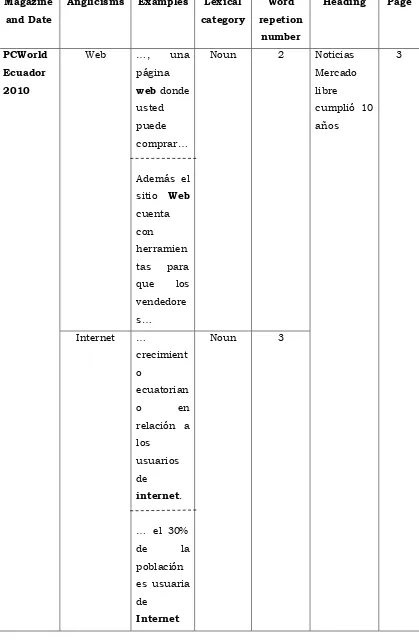
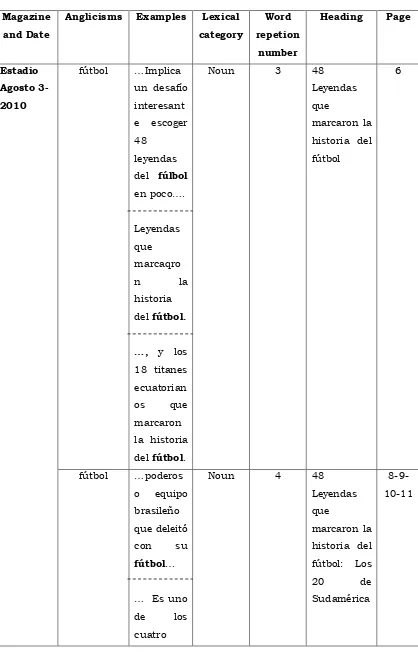
deliver this information, many Magazines like ―La Casa: Revista de la
casa de al Cultura Benjamin Carrion Number 67 and 68‖; ―PCworld
Ecuador and América Economia‖; ―Estadio‖ and ―la Onda‖, have been chosen, and all of them contain a valuable information on the subject
discussed; around it a semantic, morphological, syntactic and social
analysis was made, as well as a comparative one. Bellow, some
38
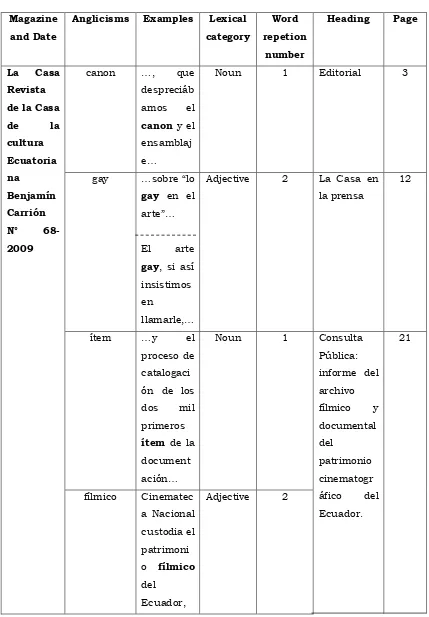
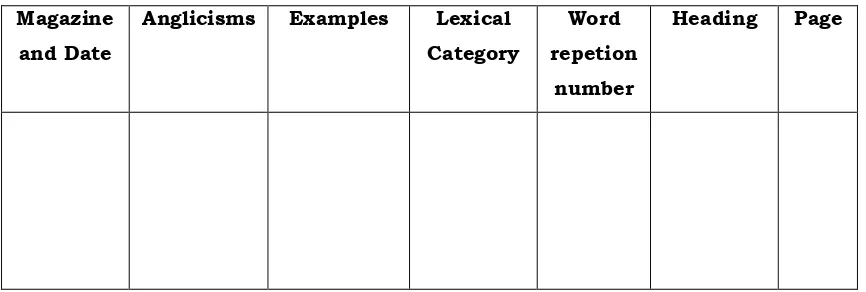
Qualitative Tabulation Table One
Variable: Cultural magazine
Magazine
and Date
Anglicisms Examples Lexical
category
Word
repetion
number
Heading Page
La Casa
Revista
de la Casa
de la
cultura
Ecuatoria
na
Benjamín
Carrión
N°
68-2009
canon …, que
despreciáb
amos el
canon y el
ensamblaj e…
Noun 1 Editorial 3
gay …sobre ―lo
gay en el arte‖…
El arte
gay, si así
insistimos
en
llamarle,…
Adjective 2 La Casa en
la prensa
12
ítem …y el
proceso de
catalogaci
ón de los
dos mil
primeros
ítem de la
document ación…
Noun 1 Consulta
Pública:
informe del
archivo
fílmico y
documental
del
patrimonio
cinematogr
áfico del
Ecuador.
21
fílmico Cinematec
a Nacional
custodia el
patrimoni
o fílmico
del
Ecuador,
[image:45.595.105.534.155.772.2]39 …
…, a
través de
las
Muestras
de Tesoros
del
Archivo
fílmico
ecuatorian o y,…
filmes … La
apremiant
e
necesidad
de ubicar
los filmes
ecuatorian os…
… única bóveda
climatizad
a para
filmes en
el país.
Noun 2
film Un film
modesto,
sin
mayores
búsqueda
s
estéticas, …
Noun 1 Consulta
Pública:
Festival de
cine
israelita
22
internet … textos
impresos
que son
intranscen
Noun 2 La joven
poesía
ecuatoriana
40 dentes, así
internet
está plagado…
… como
ocurre con
la
televisión,
el fútbol,
el
internet...
fútbol …, como
ocurre con
la
televisión, el fútbol…
…, donde el fútbol y
la política
reemplaza
ron a las ideas,…
Noun 2 35
light …muerte
de la
literatura
light/poét ica…
Adjective 1 Lobos
hambriento
s
38
internet …, solo
porque ha
sido
escrita
para
internet, ….
Noun 1 La
literatura
ha muerto
41
boom …, Juan
Carlos
Onettise
Noun 2 La novelería
de nuestros
novelistas
41 quedó y se
perdió el
boom
pero se
gano
nuestro
respeto,…
…, como los
fenómenos
de una
boom
añejo.
hall …, y
después,
en el hall
alzó su
copa por
las letras.
Noun 1 Tierra
adentro
44
close up …; que en
una
cámara
empezara
a
aproximar
se a la
niñita y
esta, en
close up,
le hiciera
un guiño…
Noun 1 Sobre la
competenci
a
54
web …, pues
estamos
permanen
temente
ligados vía
web.
Noun 1 Asesoría a
la
Biblioteca
Nacional
42
fútbol …y ha
eliminado
sus días
de fútbol
en el
estadio…
Noun 1 Fernando
Cazón Vera
o la poesía
como
testimonio
de la vida
59
boom El boom
del
realismo
mágico ya
está bastante…
Noun 1 El narrador
en su tinta
63
bestseller ..., una
auténtica
bestseller,
como la
calificó el
gran
estudioso …
Noun 1 Presentació
n de virgen
de medianoche de AmintaBue naño 66
link …con un
link para
descargar una…
Noun 1 El pie De
creadores
indulgentes
y críticos
asépticos de
la letra
71
Web … Llegué
a esta
página
web por
pura …
43
La Casa
Revista
de la Casa
de la
cultura
Ecuatoria
na
Benjamín
Carrión
N° 67 –
2009
marketing Su poesía
ha sido
víctima y
de la
absurda
importanci
a del
marketin
g y de la
envidia y
la
arrogancia
de
algunos
poetas.
Noun 1 La ternura
tiene filo de
navaja
4
pop …atrevers
e a
experimen
tar con
ritmos
nuevos o
fusionar
con otros
estilos
como el
pop o el punk,…
Noun 1 La parábola
de Kurt
28
light … Poco a
poco la
gente
prefirió lo
light lo
inmediato,
lo que hoy
es bello y
mañana
no se
sabe…
44
Rock El rock
alternativo
como tal
empezó a
gestarse a
principios
de los
ochenta,…
…, famoso en esa
ciudad por
promocion
ar el rock
independi
ente.
… rompe totalmente
el
paradigma
musical
en que el
rock se
hallaba
embargad
o.
Noun 3 28-29
Fans …, en la
cuallos
fans
pueden
escoger lo que sea…
Noun 1 29
Gay … El arte
gay, si así
insistimos
en
llamarle,
Adjective 1 Lo gay en el
arte
45 debe ser
entendido
como una
expresión legítima… performer … Como
cualquier
otro
artista o
performer
, busca
una
redefinició
n del
cuerpo,…
Noun 1
gay Todo
cuando
ser gay en
Latinoamé
rica aún es algo…
…, de un escritorazo
que
resultó ser
gay y que
su
valentía y
compromi so…
…, para
ser un
escritor
gay en
Latinoamé
rica hay
que ser
Noun
Adjective
3 Reflexiones
sobre el
valor de
Reynaldo
Arenas