English / Spanish syntactic contrasts: minimalism and optimality
Raquel Fernández Fuertes
English / Spanish syntactic contrasts: minimalism and optimality
Abstract
Recent developments in linguistic theory carried out within the principles and
parameter model and the minimalist program provide an excellent framework for the
comparison of languages. In this study we use said framework to analyze the nature
of subjects and their positions in the sentence in English and Spanish. We
specifically concentrate on lexical preverbal and postverbal subjects and on the
special type of subject present in expletive constructions in order to provide a
comparative account of word-order differences and similarities between English and
Spanish. We show that the [+/- pronominal] agreement differences are responsible
for: 1) the different nature of preverbal subjects in English and in Spanish; 2) the
possibility of postverbal subjects in Spanish but not in English; and 3) the different
INDEX
INTRODUCTION 1
1. THEORETICAL BACKGROUND 9
1.1. Generative Theory and the Comparison of Languages 9
1.2. From the Principles and Parameters Model to the Minimalist Program 12 1.2.1. Government and Binding Theory and the Principles and
Parameters Model 12
1.2.2. The Minimalist Program 16
1.2.2.1. Building Structures 17
1.2.2.2. The Principles 31
1.2.2.3. Optionality of Movement in the Minimalist Program 44 1.2.2.4. Subject-verb Agreement as a Movement Operation
in the Minimalist Program 48
1.3. Antisymmetry 55
1.3.1. Introduction 55
1.3.2. The Relationship between Hierarchy and Linear Order 56
1.3.3. Adjunction 61
1.4. Optimality Theory 63
1.4.1. Optimality Theory and the Previous Generative Tradition 63 1.4.1.1. The Ideal Net: Grammatical versus Ungrammatical Sentences 64
1.4.1.2. Markedness and Constraints 64
1.4.2. Optimality Theory Processes 67
1.4.2.1. Pro and Optimality Theory 70
1.4.2.2. Expletives and Optimality Theory 74
1.5. Other Developments in the Theory 76
1.5.1. Pollock (1989): The Split Inflection Hypothesis 76
1.5.1.1. Tensed Clauses 81
1.5.1.3. The Predicate Loc 86
1.5.1.4. Pollock and the Minimalist Program 86
1.5.2. The VP-Internal Subject Hypothesis and Parametric Variation 89
1.5.3. The Pro-drop Parameter 95
1.5.4. Recent Accounts of the Pro-drop Parameter (Null-subject
Parameter) 104
1.6. The Theory of Word Order in the Literature 109
2. SUBJECTS 114
2.1. Preliminaries 115
2.1.1. The Principles and Parameters Model, the Minimalist
Program and Subjects 115
2.1.2. Agreement Features 120
2.1.2.1 Null-subject Languages and Non-configurational Languages:
Pronominal Agreement 129
2.1.2.2. Agreement Possibilities and Binding 132
2.1.3. Subjects: Adjunct / Argument Dichotomy 134
2.1.3.1. Null-subject Languages and Non-configurational
Languages: Subjects as Adjuncts 137
2.1.3.2. Doubling Structure: DP and Agreement Clitic 141
2.1.4. The Issue of Terminology 143
2.1.4.1. Rivero (1978, 1980) 144
2.1.4.2. Contreras (1976, 1991) 145
2.1.4.3. Hernanz and Brucart (1987) 149
2.1.4.4. Olarrea (1996) 151
2.1.4.5. Zubizarreta (1998, 1999) 160
2.2. Subject / Verb versus Verb / Subject Orders 164
2.3. Preverbal Subjects 170
2.3.1. Clitic Left-dislocated Constructions and Preverbal Subjects 170
2.3.2. The Position of Preverbal Subjects 173
2.3.2.1. A Unified Account of Preverbal Items and their Positions:
Subjects and Objects 176
2.3.3. Preverbal Subjects: Restrictions and Chains 181
2.3.3.1. Lack of Agreement: The Matching of Person Features 185 2.3.4. Left-dislocated Subjects and the Null-subject Parameter 188
2.3.4.1. Preverbal Subjects and Interrogative Sentences:
Pro and Lexical NPs 190
2.4. Postverbal Subjects 193
2.4.1. Perspectives on VS Order as a Product of Different Processes 199 2.4.2. A Note on Postverbal Subjects in Declaratives and Interrogatives 205 2.4.3. Postverbal Subjects and Focus: VSO / VOS Structures 214 2.4.4. Fully Referential NPs versus Pronouns as Postverbal Subjects 217
3. EXPLETIVES 231
3.1. Introduction: Expletives and Subjects 231
3.1.1. Outline 231
3.1.2. Pleonastic Elements 235
3.1.2.1. An Expletive Typology 235
3.1.2.2. There / It Contrast 241
3.2. Expletives: Preliminary Considerations 244
3.2.1. Existential Constructions in English and Spanish/French 245 3.2.2. Adjunct / Expletive / Locative There and Expletive
Referential Pro 248
3.2.3. Expletives There and Pro 251
3.2.4. The Status of V 256
3.2.5. A Typology of NPs 265
3.2.6. Existential and Presentational There Sentences 273
3.2.7. Ergative-expletives and Existential-expletives 274
3.3. Semantic Properties 276
3.3.1. Existential Constructions and the Predicate Loc 276
3.3.1.1. Pollock's (1989) Verbal Typology 277
3.3.1.2. Location and Auxiliaries Have/Tener/Avoir 281
3.3.2. Lexical Doublets 287
3.3.3. Existential Constructions and the Full Interpretation Principle 290
3.4. Syntactic Properties 293
3.4.1. Agreement in Existential Constructions 293
3.4.2. Movement in Existential Constructions: Case and Economy
Principles 315 3.4.2.1. Expletive Constructions as a Manifestation of Case
Assignment 315 3.4.2.2. Case Transmission and Accusative Case: Be versus Haber 319
3.4.2.3. Inherent Case Assignment and Unaccusatives 323
3.4.2.4. The Motivation for the Movement: Economy Principles 328
3.5. Representations of Existential Constructions 331
3.6. Conclusion 337
CONCLUSION 341
BIBLIOGRAPHY 352
INTRODUCTION
The present study, which takes a generative approach to language, focuses
on the comparison of the nature of subjects and their positions in the sentence in
English and Spanish. The points of departure are the central cases of the obligatory
presence of referential subjects in English (he has arrived), as contrasted with the
existence of null subjects in Spanish (pro ha llegado). More specifically, we
concentrate on an analysis of lexical preverbal and postverbal subjects in English
and Spanish; and on the type of subject present in expletive constructions in the
two languages.
The main goal of generative grammar is to account for the knowledge of
language. In order to achieve this, two main issues have to be considered. The first
issue regards those properties that are universal; the second relates to those that are
shared by a given group of languages. In a generative framework, these properties
are captured in terms of universal grammar (UG) as the theory of the initial state
(the biological endowment of the human language capacity), and particular
grammars as the theories of attained states (particular individual languages)
it is necessary to compare the language under analysis with other languages in
order to discover, from among the entire set of characteristics defining that
language, what is universal and what are language-specific choices. Generative
grammar, therefore, provides the necessary tools for this comparative work which
is, in our case, a goal in itself.
Within the overall framework of generative grammar, government and
binding theory -and specifically principles and parameters theory (PP)- and the
minimalist program (MP) constitute the theoretical basis of this work. It is
especially from the inception of the PP theory that the model, with comparative
analysis at its core, provides more tools to carry out such an analysis: principles
refer to universal properties, while properties that are shared by a group of
languages are said to be parametrized. Parameters, in this sense, appear as a new
way to constrain the variation among languages, a variation that is predetermined.
Thus, the pro-drop parameter, for instance, is seen as a constraint dividing
languages into two typological groups: those that allow null subjects, like Spanish
(Juan ha llegado; pro ha llegado); and those that do not, like English (John has
come; *pro has come). This type of analysis is what led to the so-called new
comparative syntax.
The two traditional goals, put forward at the early stages of the theory and
captured in the PP model, are reformulated within the modern generative grammar.
The inherent tension between universal and parametrized properties is nevertheless
maintained all along the research inquiry. The MP (Chomsky 1993, 1995) and later
advancements in the theory (Chomsky 1998, 1999) attempt to reduce this tension
by minimizing descriptive technology; the result is a few well-defined accurate
time, refined enough to capture the differential features. This tension will prove to
be challenging for a comparative analysis, since it contemplates both individual
and common features among languages. Thus, on the one hand, there is a search for
a characterization of the different languages, which may lead to an increasing
degree of complexity of rule systems (not only between languages but also among
the different grammatical constructions within the same language). And, on the
other hand, there is also a search for common ground among languages, which
leads to the conclusion that language structure is largely invariant. It should be
borne in mind that the MP is a program, not a theory, and as such it is still in its
developmental stage and is open to interpretation. This makes the MP a challenging
working field.
In order to account for variation both between English and Spanish and
within these two languages (interlanguage and intralanguage variation), we make
use of several proposals that deal with more specific issues in a comparative
analysis. In this respect, we explore the consequences for our analysis of the split
inflection hypothesis (Pollock 1989), among others. This hypothesis reflects how
verbal inflection contains information on tense mood and, more importantly for our
analysis, agreement. More specifically, it deals with how this information, in the
case of agreement, for example, may be enclitic in the verb itself, like first person
singular -o in Spanish cant-o, or it may be outside of the verb, as a separate lexical
item, like I in English I sing. Another proposal, the VP-internal subject hypothesis
(Koopman and Sportiche 1985), establishes the universal position in which all
subjects are generated (within the verbal phrase) and from which they move to
higher positions under certain circumstances and complying to certain requisites.
subjects in Spanish versus the case of English, for instance. Lastly, we will make
use of the pro-drop parameter (Perlmutter 1971, among others) together with some
of its reformulations in terms of other proposals more specifically related to our
topic, the analysis of preverbal, postverbal and expletive subjects. We will see, for
instance, how the presence of the null subject element pro is accounted for in the
cases of Spanish lexical preverbal subjects (Ana tiene pro unos ojos preciosos), as
contrasted with English (Ana has beautiful eyes). Also, proposals like Rizzi’s
(1991) argue that in Spanish but not in English inflection is pronominal. This is
linked to the analysis of pro as an element tied to a special type of agreement,
verbal inflection. We can even go a step further and see if, at least in the case of
expletive constructions, third person default agreement (Schütze 1999) or null
agreement (Kato 1999) can be analyzed as the real subject, thus substituting pro
(hay un libro).
Even when researchers share fundamental assumptions of a common
framework, substantial disagreements occasionally arise. This is the case of
Schütze’s (1999) default agreement and Sobin’s (1997) virus theory for the
analysis of agreement in expletive constructions. Both accept the peculiar
agreement relationship established in English between verb and postverbal NP
(there are books; there is a book), but while for Sobin (1997) this is the result of a
grammatical virus, for Schütze (1999) it is generated by the grammar proper. We
will see how and at which level these and other proposals help to accommodate the
comparative analysis of subjects in English and Spanish, and the possible different
adjustments that may be made in order to get to a refined enough analysis that
clearly captures the similarities as well as the differences between the two
The main body of the study is organized as follows. In chapter one, we state
the theoretical basis on which this analysis is founded. The chapter presents an
overall perspective of the gradual progressive change and development in
generative grammar, especially from the PP theory to the MP, including recent
proposals framed within the MP such as antisymmetry (Kayne 1994) and
optimality theory (Prince and Smolensky 1993, Archangeli and Langendoen 1997).
Once this theoretical framework is delimited, we will focus on our analysis and
offer a comparative study of different issues in English and Spanish. Taking as a
point of departure, then, the theoretical background presented in chapter one,
chapter two and three deal with the analysis of subjects in English and Spanish,
preverbal / postverbal subjects and expletives respectively. Chapter two deals with
SV / VS orders, the way they are generated and the differences that exist between
the two languages, including different existing positions and their pragmatic value.
Chapter three concentrates on the analysis of existential constructions and includes
both semantic and syntactic properties, once an expletive typology has been
provided.
The subject, the external argument of the predicate, may appear in three
different positions: 1) it may remain within the verb phrase where it is generated,
this being a universal position (as in postverbal subjects in Spanish); 2) it may raise
to inflection to check information on person, number and tense (as in subjects in
English); and 3) it may raise to the complementizer position or, in any case, a
position higher than inflection, if it has some special interpretation such as focus,
topic, etc. that requires it to be so (as in preverbal subjects in Spanish). Our
analysis concentrates on how these positions are filled, by which type of elements
present in the analysis of subject positions. Specifically, we will address three
problematic issues: 1) the nature of lexical preverbal subjects in English and
Spanish in terms of positions and operations involved (adjunction or movement); 2)
the presence of postverbal subjects in Spanish versus their absence in English; and
3) the subject element in expletive constructions in English and Spanish, with a
focus on agreement properties.
Chapter two focuses on the first two issues. Since in terms of superficial
structures, word-order differences may not appear, as in the case of preverbal
subjects, we need to turn to an analysis that gives us a more refined insight on the
actual differences that do exist between, for instance, preverbal subjects in English
and preverbal subjects in Spanish, in spite of an apparent similarity. Also,
well-known properties of subjects in Spanish include the fact that free inversion of a
subject NP is possible, thus leaving the preverbal subject position empty, as in the
cases of null subjects where a pronominal subject is not phonologically spelled out.
We analyze the relationship between these two properties that are applicable in
Spanish but not in English.
Chapter three concentrates on expletive constructions and on how the
notion of subject is to be applied in these cases where a non-argumental element is
placed in subject position; since this element does not refer to any specific entity, it
is called an expletive. We will see that syntactic elements which have no semantic
significance raise important questions about how the semantic and the syntactic
components interact, and that this is especially true in the case of pleonastic NPs.
This is so because they occur as subjects of clauses, in a position usually reserved
for NPs, denoting an argument of a lexical head and the subject of the main
In fact, from the comparison between languages such as English and
French, it is assumed that expletive constructions in Spanish must have an elliptic
or covert 3rdps expletive element. The possibility of null subjects is then related to
the lack of the equivalent expletive there in Spanish (Jaeggli 1981) and the
presence of proexpl (Rivero 1980) (there is a book; pro hay un libro). Since Spanish
generally allows for null subjects, it lacks overt expletives. In view of this
difference, it is also our aim to present a uniform account of the cross linguistic
distribution of overt expletives (there in English) and covert ones (proexplin
Spanish). We start from the idea that in languages such as Spanish, subjects can
always be dropped, which is the property that distinguishes Spanish from
languages with overt expletives, such as English.
Our analysis will also focus on the relationship between the element in
subject position (the expletive there and pro) and the postverbal NP (the associate a
book and un libro), and also on the type of verb in these structures (a relevant
factor for movement operations).
Since Chomsky (1980), the analysis of expletive constructions in English
has been based on a movement relation between the expletive and its associate: the
associate a book moves to subject position where there is located and, once in
subject position, subject-verb agreement is carried out. The type of relation and the
different characteristics associated with it change depending on the proposal, but
the movement view always remains, especially because an analysis of expletives in
terms of movement aims at solving the contradiction of having subjects that are
syntactic elements with no semantic interpretation. In this sense, subject position is
filled with an NP, the associate, moved from its original postverbal position. Two
analysis: 1) it will be necessary to explain then the actual presence of there and pro
and account for the different properties these elements have; and 2) since language
is economical (captured in the minimalist principles of economy) and all operations
in a language have to be reduced to the minimum, it will be necessary to determine
why a movement operation is needed and how this operation is carried out.
The theoretical analysis of subject positions and the nature of subjects that
we provide in this study is based on a large body of specific examples and also
includes data from languages other than English and Spanish. In this respect, the
comparative perspective adopted may be relevant not only for grammatical
description, but also for the underlying theory of a more applied tendency ranging
from text books to translation, including automatic translation and even computer
1. THEORETICAL BACKGROUND
1.1. Generative Theory and the Comparison of Languages
The ultimate aim of generative grammar is to account for the knowledge of
language. In order to achieve this, any generative analysis will have to address the
properties of the language in its two dimensions, universal and specific. Universal
properties are shared by all languages, while language-specific properties, although
they can be shared by a group of languages, define languages in a more individual
and particular way. This double aspect of language that includes universal and
specific properties parallels the concepts of universal grammar (UG) and the
so-called principles and parameters theory (PP theory). Generative linguistics
develops a theory of the human language faculty and how language is acquired,
which is general enough to capture the universal features of language, and flexible
enough to account for the variability that is in fact observed among specific
languages.
Recent developments in generative grammar, specifically the minimalist
model in Chomsky 1995, 1998 and 1999), consider two interface levels, as in
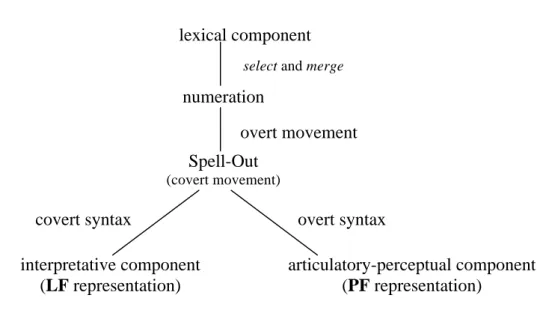
diagram (I). The two levels of representation of the structure of a sentence in a
grammar are LF (logical form) and PF (phonetic form). At LF, representations
include only semantic features and at PF representations include only phonetic
features.1
Diagram I
It is assumed that the conceptual-intentional performance system is
universal and therefore must be identical in all languages. The underlying idea is
the condition of uniformity at LF. On the other hand, the PF interface (the overt
realization or Spell-Out of a sentence) varies from language to language. Therefore,
languages differ from each other in their overt (explicit) syntax, but not in the
covert (implicit) component.
An approach to language such as this one, that distinguishes common
properties between languages, but that also accounts for the degree of variation
existing between them, will obviously be relevant to the comparative study of
languages. In fact, we can even claim that generative linguistics is, by definition,
comparative. Comparing or contrasting languages under the generative approach
has little in common with the ultimate goal of XIXth century comparative grammar
which was mainly historical since it focused on establishing relations of parenthood
1
Spell-Out
PF LF overt operations
between languages. Generative grammar is also very useful for historical
linguistics, specially for studies on diachronic syntax, and great insights are gained
with the combination of historical and generative perspectives (see, for instance, all
the work by Lightfoot, Roberts, Adams, etc.). The main point of divergence
between XIXth century comparative studies and recent ones is the descriptive
nature of the former versus the explanatory nature of the latter. In that sense, the
main idea in the comparative generative approach is to account for the entire set of
characteristics that define a given language and to distinguish, by means of the
comparison to other languages, which properties are universal (and, therefore,
shared by all languages), and which ones are language-specific choices determined
by UG.
In order to proceed with our comparative analysis of English and Spanish,
we will first present the theoretical basis for our study. This includes both general
treatments within the generative tradition, and also more precise proposals that deal
with word order and word-order effects, this being the main focus of our analysis.
The main word-order issues that we will address here are the relative
position of the subject and the verb and the consequences the different orderings
may trigger in English and Spanish. Other languages, primarily French, will also be
used in order to provide a clearer view of the proposals, as well as specific
argumentation in the comparative analysis. Both English and Spanish are
characterized as SVO languages as far as word order is concerned. However,
although they share a common universal basis, a generative approach to the study
of these languages will provide a more refined account that will include not only
points of convergence but also the specific properties that make these languages
1.2. From the Principles and Parameters Model to the Minimalist Program 1.2.1. Government and Binding Theory and the Principles and Parameters
Model
In early generative grammar, languages were conceived as complex systems
of rules that were both construction-particular and language-particular. As opposed
to this view, the PP approach stresses universality among languages.
First, the government and binding theory (GB theory) and later, the PP
model have been concerned with the underlying universal properties as well as
variation among languages.2 So, unlike other approaches to the study of language,
where the focus is often on the study of one specific language, generative
linguistics approaches language in general, as a species-specific endowment. The
generative linguist tries, therefore, to provide a presentation of the native speaker’s
internal knowledge of language (genetic and psychological).
Part of this internal knowledge of the language is said to be innate to the
human species and is called universal grammar (UG). Therefore, UG is a system
that contains the principles and rules that are common to all human languages. As
Chomsky (1981, 7) himself states, “universal grammar may be thought of as some
system of principles, common to the species and available to each individual prior
to experience”. Nevertheless, UG knowledge is not enough to speak a language.
Besides, while certain grammatical principles and rules are universal, it is also true
that there is a lot of variation among the different languages, to a greater or lesser
degree, depending on the languages under analysis. Exposure to a given language
is required in order to set knowledge of how UG principles are realized and to
achieve parametrized language-specific properties.
If we focus on word order, for instance, we immediately observe clear
differences between languages such as English and Spanish and languages like
Japanese. While components such as subjects, verbs and objects are present in all
these languages, (these being notions available in all languages), their ordering in
the sentence varies from one to the next. Thus, while English and Spanish are
considered SVO languages, Japanese is an SOV language, as the examples in
(1)-(3) reveal, respectively:
(1) John hit Mary
(2) Juan le pegó a María
[Juan her-clitic hit-3rdps-past to María]
(3) John ga Mary o but-ta
[John particle Mary particle hit-past]3
While in English and Spanish the object follows the verb, in Japanese the object
precedes the verb. This difference in the linear order of the constituents is captured
in the PP model by means of a parameter, the so-called word-order parameter
(Kuno 1973, Zwart 1993, Haegeman 1994, Kayne 1994, Haegeman and Guéron
1999).4
3 From Kuno (1973).
Parameters, therefore, account for the variation that exists between
languages; or, put in a different way, parameters offer a group of values from
which languages select and so each language may present different settings or
values of a certain parameter. In the process of language acquisition, parameters are
fixed by the person learning a language according to the data they are exposed to.
The above mentioned differences between English/Spanish and Japanese are,
therefore, the result of parametric variation even though these have been accounted
for in rather different ways as the various models attempt to refine the explanatory
power of the theory.5
As Haegeman and Guéron (1999) summarize, UG contains a set of absolute
universals, notions and principles which do not vary from one language to the next.
Some of these universal principles are parametrized so that UG offers a range of
choices for language-specific properties which vary cross-linguistically; these are,
therefore, not fully determined by UG, although UG does provide for the [+/-] open
parameter dimension. This may be viewed as a contradiction within the model
since we are dealing with universal and less-universal properties.6
As noted before, when studying a particular language from a generative
approach, we need to determine which characteristics of this particular language
are universal, which properties are language-specific and how these relate to the
parameters of UG. This type of study proves to be very fruitful for the comparison
5 Although a more detailed account of parameters can be provided, for the present analysis we simply refer to the issues that are relevant for our comparative analysis. The definition of a parameter is far from being fixed, although there seems to be some agreement with respect to defining parameters as [+/-] features of functional categories (Borer 1984, Chomsky 1991, Atkinson 1992, Liceras 1997 and references therein). In previous models, only one feature may, and in fact usually did, account for the existence of a parameter so that a certain property determined a parameter and from there a number of properties were derived, like in the directionality parameter or the pro-drop parameter.
6
of languages, since it gives a full account in terms of principles. Moreover, through
the analysis of a selection of properties, this theory helps to determine the
universality or the specific nature of the characteristics of each language analyzed.
In order to clearly illustrate the workings of this theory, let us briefly
discuss the application of one principle (the extended projection principle, EPP)
and one parameter (the pro-drop parameter) in the comparative study of English
and Spanish. The EPP, as a principle of UG, establishes that all sentences must
have a subject. See the examples in (4)-(6) for English, Spanish and French,
respectively:
(4) Manuel / he has sung *pro has sung
(5) Manuel / él ha cantado pro ha cantado
(6) Manuel / il a chanté *pro a chanté
As the previous examples reveal, the three languages comply with the EPP either
by the presence of a lexical NP as subject (Manuel) or of a personal pronoun (he,
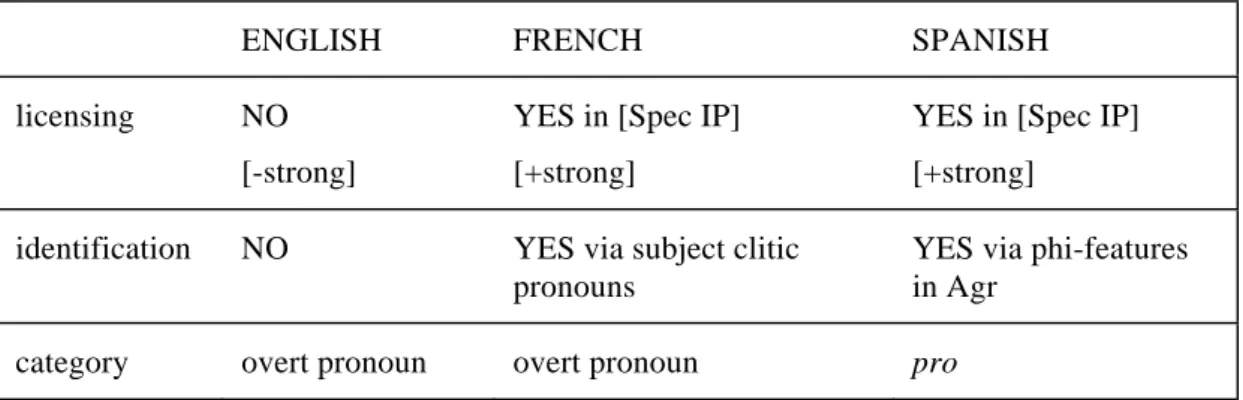
él, il). On the other hand, languages that select the pro-drop parameter can drop
their subject pronoun, having pro, a non-overt NP with the features [-anaphor, +
pronominal], in its place.7 Pro is a universal category provided by UG but it does
not occur in the same positions in all languages. As the previous examples reveal,
subject pro-drop is not realized in all languages. Thus, while the syntax of Spanish
allows a pronominal subject to be left unexpressed, this is not the case in English or
French.
Within the PP framework, those language-specific phenomena that may be
shared by different languages but that do not constitute parameters in themselves
should also be considered.8 Since not every syntactic phenomenon has been
defined in terms of parameters and since one single property does not qualify, in
principle, as a parameter, when comparing languages, the analysis should treat
those properties that are not comprised in a parameter but that nonetheless
somehow define the idiosyncrasy of a given language.
1.2.2. The Minimalist Program
Within the MP, as in the PP approach described before, universality among
languages is still stressed. As in the previous model, UG captures this idea since it
provides a fixed system of principles and a finite set of finitely valued parameters;
language-particular rules are, therefore, reduced to a choice of values for these
parameters.
The transition from the PP approach to the MP is marked by conceptual
differences in terms of the levels of structure, the nature of principles, etc.9 Within
the MP, principles of economy are going to become more and more relevant and it
will be mainly on the basis of these principles that the previous PP approach will be
turned into the MP.
In the following sections, we will present the different parts of the model,
focusing first on the levels of structure and then on the principles of economy and
movement relationships.
8
This is a very sketchy view of the PP theory. Notions such as competence and performance of an individual, the core and periphery of a language, among others, should also be taken into account. For a more detailed account see Chomsky (1995), specifically chapter one by Chomsky and Lasnik. 9
1.2.2.1. Building Structures
Within the new approach, the different levels of analysis to be considered
are the first ones to be altered, since they are the building blocks of the entire
theory and further consequences develop from them. An attempt to capture the
transition from one model to the other is reflected in the following diagrams (II)
and (III). They show the difference between DS and SS in the previous model and
how SS has turned into Spell-Out, which is no longer a level of analysis, in the new
model.
As seen in diagrams (II) and (III), several changes appear when comparing
the two proposals. Within GB there were four distinct levels, as diagram (II)
reveals, each one with its own properties. These four levels are Deep Structure
(DS), Surface Structure (SS), Phonetic Form (PF) and Logical Form (LF).
The MP, as in diagram (III), defends the existence of just two minimal and
DS
SS
PF LF transformations
covert move
with consequences for LF
move with no consequences for LF
lexicon + PS rules (X-bar principles) pre-minimalist levels of representation Diagram II
LF PF
Spell-Out
move covert (no mergemove) merge and overt move
indispensable levels: the PF level with phonetic properties (that ensure the
well-formedness as far as sound is concerned, which accounts for speech perception and
pronunciation); and the LF level with semantic properties (that ensure meaning
providing as well a set of concepts which are interpreted and conveyed). This
reduction to two interface levels is based on the assumption that DS and SS levels
are no longer needed since they do not form an interface directly with the final
result.10 Therefore, a level of representation (PF or LF) of the structure of a
sentence is a stage in a derivation at which representations comprise only features
of a single type (either phonetic or semantic).11 By contrast, the grammatical
structures produced by merge or move operations do not constitute a separate level
of representation, since they contain three different sets of features (phonetic,
grammatical and semantic). The derivations will no longer be considered
grammatical/ungrammatical, but rather, following the new terminology, they will
have to converge both at LF and PF in order to be accepted; failing to converge
will make a derivation crash.
Along these lines, S-structure conditions on raising and lowering (examples
7 and 8) are discarded in favor of morphological properties of lexical items. This
gives way to two types of operations: merge and move.
(7) NP subject-raising
theyi seem ti to have many friends
therei seems ti to be a nice view from the balcony
(8) agreement lowering to lexical V
(he) eat-s ... [AGRP 3rdps [TP past [VP eat ]]] ...
... [AGRP ti [TP tj [VP eat-3rdps-pastj]]] ...
Therefore, the new emphasis on the morphological properties of lexical items
results on a reanalysis of raising operations, such as the one in (7), and lowering
ones, such as the one in (8), in terms of other type of operations.
Thus, the operations involved in the process of constructing a sentence
could be presented as follows:
1. Select and project: a word already fully inflected from the lexicon is selected.12
Then, if the word is a head (a lexical category or an empty category), it projects
according to X-bar structure (if it is a complement, it does not project), as shown in
(9):13
2. Merge and agree: another item is taken to merge with the previous item in order
11 The derivation of a given structure is a representation of a set of merge and move operations used to form the structure (Radford 1997a, 1997b).
12
See Chomsky (1998, 1999) for subsequent access to a subset of the lexicon (LEX) much in the manner of distributed morphology (Halle and Marantz 1993).
sing
... VP
V’ NP*
Vmax
V verb: sing (9)
NP
N’
N
to fill the slot created by the projection, as song in (9) will merge with sing in the
empty slot, as in (10):
Any operation of merging must be completed before Out, since after
Spell-Out nothing else can be added to the derivation. By means of the operation agree,
some kind of relation is established between the merged elements in terms of
lexical items and their features.14 Unlike merge, agree is language-specific.
3. Move: this operation combines the two previous ones, merge and agree, and so
establishes agreement between the lexical item and the features, and merges them
into a phrase that is determined by these features (but these features are not
necessarily its maximal projection) and headed by the lexical item. Like agree,
move is also language-specific.
13 NP* corresponds to the external argument of the verb (i.e. the subject), to differentiate it from the NP object (an internal argument of the verb).
14
As we will see in further sections, this operation (agree) will be very important for the analysis of there constructions, as well as for the differences between English and Spanish.
VP
V’ NP*
Vmax
V NP
sing a song
As we will see later in detail, the position in which subject elements generate is the
specifier of the verb phrase. From this position and in the case of English, subjects
overtly move to the specifier of the inflection phrase, as in (11).15
Any movement operation either overt or covert must be justified by
principles of economy. The division between covert and overt movement brings
about, right from the very beginning, the minimalist concept of feature movement
as opposed to category movement, which are both movement operations. Overt
movement takes place before Spell-Out, while covert movement takes place after
Spell-Out. When dealing with Verb-movement, for instance, the movement is overt
when in order to check strong V features in Tense the entire the verb has to move
up; and it is covert when only the features that are necessary for convergence are
moved.16 Contrary to merge, move creates checking relations. Checking theory has
15 See section 1.5.2. and chapter two for a detailed analysis. 16
The concept of pied-piping makes reference to a process by which a moved constituent or set of features drags one or more other constituents or sets of features along with it when it moves. The example in (ii) shows pied-piping:
(i) who were you talking to? (ii) to whom were you talking?
In (ii), the preposition to is pied-piped along with whom. See also Chomsky (1995).
VP Spec
Vmax
V’
V NP
sing I’
I IP Spec
NP*
ti
wei
(11)
to apply in all cases of movement, whether it is an abstract checking or whether it
is the whole category that moves. In checking theory, items carry grammatical
features that have to be checked in the course of the derivation. So, as we will see
in the following examples (12) and (13), an element moves to check its features;
with this operation, the element makes its features match the features of the
position to which it is moving. Thus, an agreement relationship is established
between the initial position of the element and the final one to which the element
itself or only its features move.
The following examples in (12) and (13) show the operation of covert
movement in English and overt movement in Spanish respectively. The presence of
the NP all/todos makes visible the different type of verb movement operating in
English and Spanish: 17
(12) our friends all go to the university ... [IP [VP all go ]]
*our friends go all to the university18
17 Overt movement or category movement will be presented in the tree diagrams by means of a continuous line, as in (13) above, while a discontinuous line will correspond to covert movement or feature movement, as in (12) above.
18 Ungrammatical unless given a specific reading-pause with special emphasis on all, therefore rendering marked structures, as in (i) and (ii):
(i) our friends go ‘ ALL ‘ to the university
(ii) nuestros amigos ‘ TODOS ‘ van a la universidad
CP
IP
I’
VP I
V’
V
In (12), only the Person, Number and Tense features of go raise to IP to be checked
(3rdpp and present tense), while the verb remains in situ. Since only the features of
the verb, and not the verb itself, move, it is a covert movement.
In (13), in order for the verb to check its features and thus converge at LF, overt
movement has to apply and the entire verb is raised to IP. The difference between
overt and covert movement is related to the principles of economy affecting all
languages and also to the particular nature of IP in the different languages. As we
will see, covert movement is preferred to overt movement, following the economy
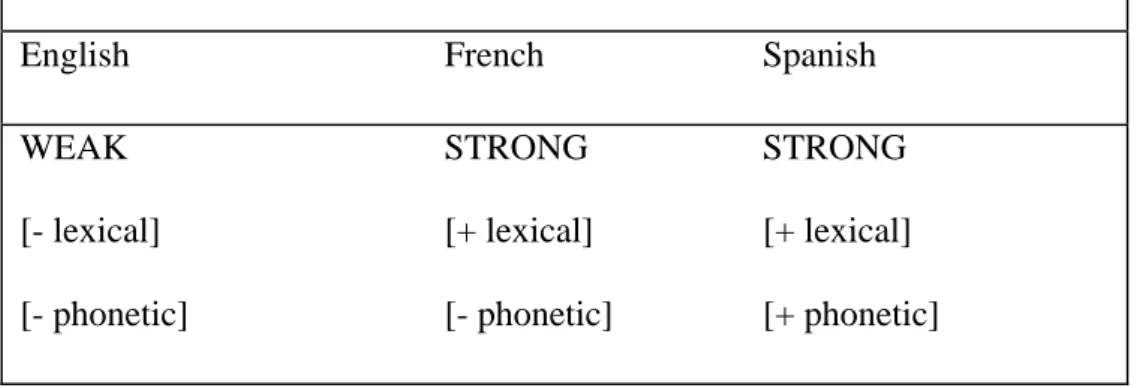
principle of procrastination. Also, the [+ strong] feature in IP in Spanish triggers
overt movement as opposed to the [- strong] feature in English.
The new developments within the MP in Chomsky´s (1998, 13) minimalist
inquiries (MI) and also Chomsky (1999) further reduce the complexity involved in
these operations. The main points are the following:
1) reduced access to the lexicon (LEX): derivations make a one-time selection of a *nuestros amigos todos van a la universidad
*nuestros amigos van todos a la universidad ... [IP vani [VP todos ti ] ...
CP
IP
I’
VP I
V’
V
lexical array (LA) from the lexicon. In this way, the derivation does not access the
lexicon at every point.19 This implies that the information contained in LEX, once
it is selected, will no longer be needed. Thus, the derivation will not have to carry
LEX along and therefore burden complexity is reduced.
2) reduced operative complexity: a language makes a one-time selection of a subset
of features (F) dispensing with further access to it. At the same time, there applies a
one-time operation that assembles elements of the subset of features into elements
of the lexicon to build an expression (EXP). Therefore, both feature selection and
feature-element assembling are operations that apply once and only once; when the
corresponding features are selected and assembled to an element, no further
select/merge operations will take place.
The consequence of these reductions is an overall simplification of the
process of building up a structure, placing features at the forefront of syntax.
Minimalist premises are therefore kept; these reductions further specify the way
operations such as select and project are to be performed. In that sense, select is a
one-time non-recursive operation that consists of the following steps:
- Select [F] from the universal feature set F
- Select LEX, assembling features from [F]
- Select LA from LEX
- Map LA to EXP with no recourse to [F] for narrow syntax
Thus, an expression is a set of interface representations {PF, LF}: {PF} are
symbolic objects at the sensorimotor interface and {LF} are objects at the
conceptual-intentional interface. Moreover, a linguistic item is a collection of
phonetic, semantic and formal features. Phonetic features are accessed in the
phonetic component, ultimately yielding a PF-interface representation; semantic
features are interpreted at LF; and formal features are accessible in the course of
the narrow-syntactic derivation. Semantic and formal features intersect, but there is
a subset of formal/phonetic features that does not correspond to semantic features.
This is the case for the features in T, for instance, which are uninterpretable formal
features that appear, prima facie, to violate conditions of optimal design; and also
the case of expletives, phonetic features with no semantic interpretation that as
such should not appear in the final outlay of an expression.20
Chomsky´s (1998) MI restricts the basic operations to merge and agree that
satisfy minimalist conditions. These operations are based on feature matching
(identity) and driven by suicidal greed; that is, once feature matching has taken
place, matched features are deleted.21
The elementary operation pure merge has two cases: pair-merge
(adjunction) and set-merge (substitution). Pair-merge in (14a) refers to a Spec-head
relation, like the one between the VP-internal subject and V; set-merge is
exemplified in (14b) with the verb-inflection relationship:
approach to accessing lexical arrays. 20
We will deal with expletives in chapter three.
YP
X Y’
Y (14a)
Y’
Y XP
X’ YP
Pair-merge refers to a Spec-head relationship. It has an inherent asymmetry: X is
adjoined to Y. Given the asymmetry, the adjoined element X leaves the category
type unchanged; the target Y projects. Set-merge is symmetric, so one might expect
either X or Y to project. But set-merge also has an inherent asymmetry so that,
when X and Y merge, it is to satisfy the requirements of one (the selector) but not
of both.
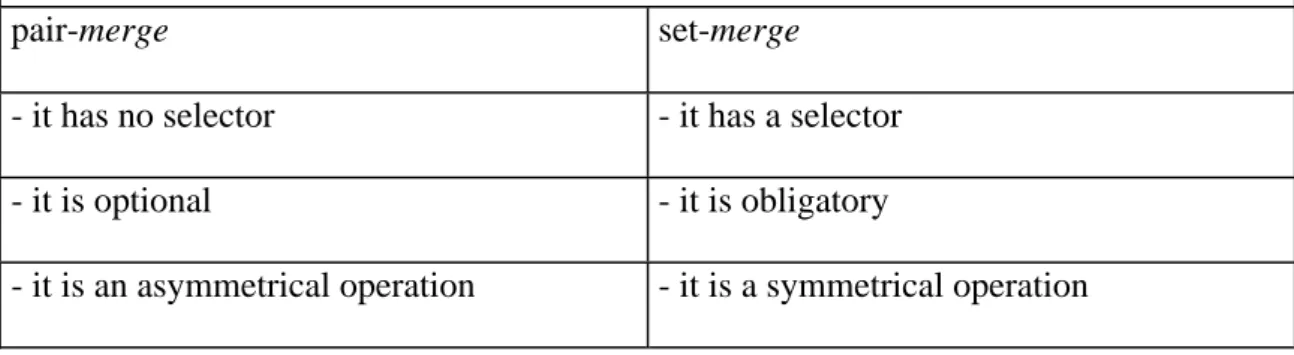
The distinction between substitution and adjunction, following Chomsky
(1998), is captured in table (I):
Table I: substitution versus adjunction
pair-merge set-merge
- it has no selector - it has a selector
- it is optional - it is obligatory
- it is an asymmetrical operation - it is a symmetrical operation
In this respect, language design is close to optimal and provides only the necessary
information for an operation to project a certain structure Z: Z is determined by the
operation itself, if the operation is symmetrical, but a selector is needed to
determine Z if the operation is asymmetrical. Accordingly, merge has a selector for
set-merge but not pair-merge.
The second elementary operation is agree. It is clear that there are (LF)
interpretable inflectional features that enter into agreement relationships with
interpretable inflectional features. Thus, the phi-features of T (within IP) are
21
uninterpretable and agree with the interpretable phi-features of a nominal that may
be local or remote, yielding the surface effect of noun-verb agreement under IP.
The agreement relation removes the uninterpretable features from narrow syntax,
therefore allowing derivations to converge at LF while remaining intact for the
phonetic component (with language-variant PF-manifestation), as in (15):22
The relationship between merge, agree and move bears on the analysis of
expletives. This is illustrated in the examples in (16a) and (16b):
(16) [IP I be [a proof discovered]]
a. merge + agree: there was a proof discovered
b. move: a proof was discovered
If an expletive is available, merge combined with agree (the latter to establish the
IP-postverbal NP relation) applies, as in (16a). Move does not apply since it is a
22 Narrow syntax refers to the computation of LF (Chomsky 1999). Narrow syntax maps a selection of choices from the lexicon to LF, so that the set of features as such is not accessed; only the lexicon and the features of its items are accessed (Chomsky 1998). The phonetic component, in contrast, does not have any such restrictions (as we will see in the case of expletives) and has further access
IP
I’
I VP
V V’ Spec
Spec
phi-features (3rdpp)
play jueg-a-n NP subject
(3rdpp)
more complex operation; also the derivation will crash with an unused expletive.
Move applies if no expletive is available, as in (16b), so that the NP a proof appears
in preverbal position.
The operations that we have described take place in the process of sentence
creation. The tree diagram in (17) reflects the processes of merge and move. This
last process takes place both before and after Spell-Out (overt and covert move
respectively):
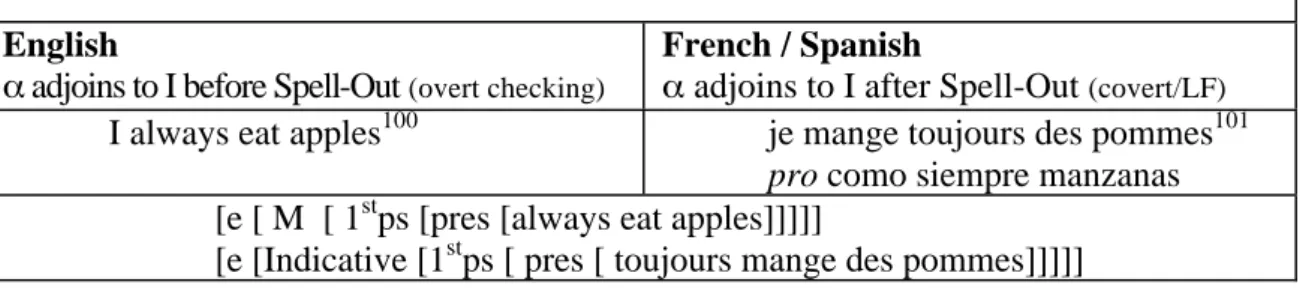
Again, in the case of English, V-movement is a covert operation whereby only the
verbal features in VP rise to IP to be checked and to match these features with
subject features. French V-movement is overt so that the entire verb, rather than
only its features, raises to IP. The features of the verb are matched with the subject
to the set of features a language selects. Features are introduced in the course of the computation and in different ways for the different languages.
a song
tj(les chansons)
IP I’ I’ I VP V’ V v’ v’ v v-max Spec (object) Spec NP* Spec (object) Spec (subject) ti C’ CP Spec C tj ti hei
ili lesj
sings
a chantées (17)
features in [Spec IP], as in English, and also with object features (French shows
AgrO with clitic pronouns in preverbal position with avoir). Moreover, since
simpler operations are preferred over more complex ones, agree is preferred over
move. Move is a last resort, chosen when nothing else is possible; when, as in the
case of French, rich inflection triggers the overt raising of the verb. This proposal is
at the basis of one of the economy principles (procrastinate), as we will see later.
Thus, even if verbs come fully inflected from the lexicon (Tense, Person,
Number, Gender ...), inflection nodes must be kept in the tree because they are
needed for checking purposes. The tree in (18) presents the different inflectional
nodes (Mood, Agreement Subject, Tense and Agreement Object) for the English
verbal form they eat:
Besides, some changes have been introduced under the minimalist approach
in the tree diagram in (17): the elimination of AgrS, the elimination of AgrO as
external to V, the subsequent introduction of the "light" verb v and the presence of CP
C’
C MP
M
M’
AgrSP AgrS’
AgrS TP
T’
T AgrOP
AgrO’
AgrO VP (...)
present indicative 3rdpp
(18)
two specifiers for some of the heads.23
Thus, once select and merge apply, the structure is built. The next step is
move or, as Chomsky maintains, the "displacement property"; both terms refer to
the same phenomenon.24 However, before dealing with movement operations, we
will refer to certain conditions that must hold up when these operations take place.
1.2.2.2. The Principles
Movement is triggered by the need of lexical items to check their features in
functional categories. However, in order for a computation to be optimal, it has to
follow economy principles which constrain movement in order to minimize
derivation.25 The main idea is that derivations must be as economical as possible
without any superfluous or redundant steps.26 This movement towards minimizing
the steps is captured by the principles of economy. The three main principles of
economy considered in the MP are the following:
1. Minimal link condition (previously called shortest move).27 This principle
deals with the length of the derivation. Chomsky (1995) defines it in the following
words: "a longer link from to K cannot be formed if there is a shorter legitimate
link from to K" (295), so that, " can raise to target K only if there is no
legitimate operation move targeting K, where is closer to K" (296). The
23 This will all be discussed later, having as a starting point Pollock´s (1989) split inflection hypothesis, together with other developments in the theory in order to provide a coherent background for the analysis of subjects carried out in chapters two and three.
24 Items appear in positions displaced from those in which they are interpreted. The displacement property clearly reflects the disparity --in fact complementarity-- between morphology (checking of features) and theta-theory (assignment of thematic roles), something which is stressed more and more in the MP.
25 Even though Chomsky considers both select and merge irrelevant with regards to economy concerns and states that only move is constrained by them, it is necessary to add that Kitahara (1995) applies economy principles not only to move but also to merge.
application of this principle involves a global comparison of possible different
derivations, instead of a local application of a principle at one point in a
derivation.28
2. Procrastination. This principle states that, since overt movement is more
costly than covert movement, the former should operate as late as possible.29 The
idea is that, while reaching to PF, structures try to minimize overt syntax, thereby
making use of feature checking (covert movement) whenever possible, rather than
applying overt movement before Spell-Out.30
3. Last resort, (previously called greed).31 According to this principle, when
a constituent moves, it does so in order to satisfy its own needs. If there are no
requirements to fulfil, there must be no movement, since movement is nothing
short of a last resort. As Marantz (1995) puts it, this principle implies the
exhaustion of other possible resorts a derivation may have for avoiding the
violation of some principle or filter. Therefore, this last economy principle bans,
for example, super-raising, as illustrated in (19):
(19) *Johni seems [ that [ IT is certain [ ti to fix the car ] ]
27 We will always refer to the last version of the principles of economy. 28
According to Marantz (1995), the minimal link condition includes a reflection and rephrasing of previous constraints labeled subjacency, Rizzi's relativized minimality and the head movement constraint. For varying approaches see, among others, Huang (1982), Lasnik and Saito (1984), Rizzi (1990), Watanabe (1991, 1992a) and Chomsky (1995).
29 This economy principle proposed by Chomsky in the MP contrasts sharply with the opposite principle proposed by Pesetsky (1989) and Pollock (1993) which they call the earliness principle. Following the earliness principle, one should move as early as possible, before Spell-Out if possible rather than after it. We will not pursue this issue any further since it completely departs from the general trend of the minimalist principles of economy. For further reference see Brody (1993). 30
Notice that if the overt-covert distinction collapses (Chomsky 1998, 1999), procrastinate is not formulable. Therefore, Pesetsky's (1989) earliness principle (perform computations as quickly as possible) would be applicable.
31
In (19), the subject NP John undergoes super-raising from its original position in
the embedded clause (to fix) to the subject position of the main clause (seems), past
the position where the subject of is (it) is placed.
The use of economy principles leads to an implicit comparison of
derivations in the sense that we always have to look for the most economic
derivation in terms of length, cost and requirements, respectively. This may also be
related to a comparison of derivations not only within a language, but also among
different languages. This implies that when comparing different constructions in
various languages, we should indicate which one is more economical.
The last requirement for a derivation to be optimal is to comply with
checking theory. Checking theory regulates, by means of movement operations, the
optimal matching of interpretable and uninterpretable features: interpretable
features are the ones lexical items have, while uninterpretable features are those
contained in nodes such as IP. Items come fully inflected from the lexicon.
Therefore, checking relations are created by movement only and not by merge. The
checking process is carried out in the following way. The item (and its features) is
affected by checking theory in such a way that it confronts the corresponding
abstract features in inflection (I) and v. Therefore, the information contained in I
and v is no longer in the form of affixes that attach to items, as it was in previous
models; it is rather a collection of features that must coincide with the features of
the item. If the features of the item and of I/v match, then I and v disappear and the
derivation enters the PF component under Spell-Out. If the features do not match,
then I and v remain and the derivation crashes at LF.
In a sentence like the one in (20), for example, the head of the VP, the verb
features contained in v and I have to be [present tense, 3rdps] as well, for the
derivation not to crash. In order to check such features, the features in V raise to v
and then to I. So it is not the entire verb that moves, but rather just the features that
need to be checked, as indicated in (21a) and (21b). Here lies the difference
between alpha-move (movement of categories) and F-move (movement of
features), which is intimately related to the economy principle of procrastination.
(20) Marta escribe una carta
(21a) ... IP
Spec I’
I
[present, 3rdps] v-max
Spec
[present, 3rdps] v’
v VP
V’
V NP
escribe
... IP (21b)
Spec I’
I v-max
Spec v’
v VP
V’
V NP
The same process affects the English sentence in (22):
The verb writes comes with the feature –s incorporated. As in the previous case, if
there is any pairing of [present tense, 3rdps] features between V and I/v, then these
features in I, once checked, disappear and the derivation is legitimate. If, on the
contrary, the features do not coincide, v and I are not deleted and, as they are not
legitimate LF objects, the derivation crashes. This is the minimalist approach to the
building of well-formed constructions which contrasts with previous approaches
based on the movement of entire categories and subsequent cyclic movements to
pick up all affixes (the 3rdps –s in the present tense in English) necessary to
complete the bare-item (write). With the reduction of operations and the
straightforwardness achieved by the MP, all processes have been simplified.
Under the minimalist maxim of getting rid of unnecessary levels, some
nodes in the tree diagram, as seen in (17), (Tense and specially AgrS and AgrO
contained within IP) are to be re-defined together with the information these nodes
were supposed to contain. This will give way to a new organization in the tree
diagram as it is partially indicated in (17), which will be dealt with later.
Both Tense and Agreement nodes were considered to be affixes, an analysis
(22) ... IP
Spec I’
I v-max
Spec v’
v VP
V’
V NP
reflected in Emonds (1980), Pollock (1989, 1993) and Chomsky (1991), among
others. That is why Pollock's (1989) proposal deals with the raising of verbs to
Tense to get the affix or the lowering of the affix in Tense to mix with the verb
(what was previously called affix-hopping). Nevertheless, the minimalist approach
presents a new approach to movement which, as we have already said, is very
different from the approach to movement in the PP approach. The information
present in layers such as I and v is not considered an affix but rather an abstract
feature. In this way, lexical items come fully inflected from the lexicon and their
features are checked with the abstract features contained in those nodes according
to checking theory. Therefore, Agreement plays only a mediating role and the same
is true of Tense, when they have performed their role, they disappear.
The minimalist reformulation not only affects the information that is
internal to those nodes but also to the nodes themselves. Nevertheless, going back
to Chomsky's (1991) split of AgrP, we are to consider AgrS and AgrO as informal
notations in order to distinguish the two functional roles of Agreement:
subject-verb agreement (associated with nominative Case and determined by the relation of
[Spec VP] to AgrS) and object-verb agreement (associated with accusative Case
and determined by the relation of the NP to AgrO). In this way, we are in fact
talking only about one element, Agreement, as a collection of phi-features. Under
minimalist assumptions, Agreement has no semantic properties of any kind (since
every item comes fully inflected from the lexicon), although it is structurally
motivated since a position is needed to check the subject/object either overtly or
covertly, among other issues.
The new position for AgrO is to be found in a reformulation of the VP
correspond to the previous AgrO.32 As opposed to AgrO, the "light" verb v is
required on the basis of structure since it has lexical content.33 Also, while AgrO
was outside the VP, v, as shown in the tree diagram in (17), which we partially
repeat here in (23), is included in the VP and thus movement is kept within the VP
(no more concepts of domain or barriers or equidistance intervene, and
consequently no violation of any economy principle occurs):
As far as AgrS is concerned, it blends with Tense (Inflection), a category
with meaning, so that it will be in this node where nominative Case as well as
Tense are to be checked. In this new reorganization of Agreement nodes, another
important modification is the possibility of having more than one specifier per
head.34 This is clearly seen in the tree diagram in (24), where both I and v-max are
equipped with two specifier positions each:
32
Some of the ideas behind this proposal also underlie Chomsky’s (1995) analysis of multiple specifiers. Hale and Keyser (1991, 1993) and Speas (1986) propose the two-VP-layers analysis. 33 Larson's (1988) proposal.
34 As we will see later, this new minimalist analysis which allows the presence of more than one specifier will have consequences for the analysis of there constructions, as constructions with a
so-... IP v-max
Spec v’
v VP...
(23)
IP
I’
I’ I
VP ... v’
v’
v v-max
Spec1
Spec2
Spec1
Spec2
Each of these double positions constitutes a slot in which both subject and object
will rise to check their features, the inner Spec (Spec1) for the subject and the outer
Spec (Spec2) for the object. That is why, as Chomsky (1995) maintains, the entire
transition from one proposal to the other can be summed up by saying that "the
main change is a change from Agr-based to a multiple-Spec theory" (355) because
the roles these Specs play corresponds, in fact, to the one played by AgrS/O.
Pollock's (1989) split inflection hypothesis has helped to point out the
necessary distinction among the different features contained in I. Once this split has
been accepted and analyzed, a reorganization of such features has led to a more
accurate perception of how sentences are built. And even if Pollock's (1989)
proposal is not followed word for word, the idea behind it is still maintained: the
importance of the split of the features constituting the node I for the comparison
among languages, specifically between English-type languages and French-type
languages. When confronting a comparative analysis, these individual features are
going to provide ground for parametric differences among the languages under
analysis, as we will see throughout the corpus of this work.
Once the processes of select, project and merge have occurred, movement
takes place. Words are fully inflected when they are taken from the lexicon.
Variation among languages has to be attributed to differences between the features
of lexical items in those languages; and these are the features that need to be
checked through movement. In the minimalist framework syntactic structures are
built step by step, starting from the lexical projection and extending the projection
upwards by means of functional projections.
b. pro cantamos una canción
c. nous chantons une chanson
Thus, in sentences like those in (25), we select from the lexicon a fully inflected
verb, sing/cantamos/chantons (with all its inflectional endings), which projects a V'
with an empty complement position. This position is filled by the object, a
song/una canción/une chanson, through merge. The three examples in (25) differ at
least with regards to these three issues: covert movement in English (25a) versus
overt movement in Spanish/French (25b, 25c); the extent of the movement (verbs
remaining in v-max in English (25a) while moving to IP in Spanish (25b)); and the
slots present or lacking in every language depending on whether or not they are
filled (AgrOP present in French (25c), but neither in English nor in Spanish).35
The first checking relation that is established is the movement of V to v, the
"light" verb, and from v to I. Such movement may be covert, as in the English
example in (25a) and the corresponding tree diagram in (26), which means that it
takes place after Spell-Out and that it is just a movement of features; the category
itself does not move, the features raise alone:
IP
I’
I’ I
VP V’
V NP v’
v’
v v-max
Spec1
Spec2
Spec1
Spec2
we sing a song
Since the V-features are weak in English, there is no need for the verb to raise and
check them before Spell-Out (thus complying with the economy principle of
Procrastinate).
This movement may be overt as in the Spanish and French examples in
(25b) and (25c) and the corresponding tree diagram in (27):
As an overt movement, it takes place before Spell-Out and the movement carries
along a full category with the subsequent formation of an argument chain
(A-chain), since it is a movement from an argument position (V) to another argument
position (v and then I).
The second checking relation affects the subject NP that moves from [Spec1
v'] to [Spec1 I], as in (28):
35
There is no entity in the MP consisting of any position that is projected but not filled, although a position could very well be filled by an empty category, such as pro (in [Spec1 IP]).
IP
I’
I’ I
VP V’
V NP v’
v’
v v-max
Spec1
Spec2
Spec1
Spec2
pro nous
cantamos chantons