Cite this:Phys. Chem. Chem. Phys., 2019,21, 10402
Hydrogen quenches the size effects in carbon
clusters
†
Jose´ I. Martı´nez *aand Julio A. Alonso b
A characteristic fingerprint of atomic clusters is that their properties can vary in a non-smooth way with the cluster sizeN. This is illustrated herein by studying the cluster size dependence of several properties of neutral CN and cationic C+N carbon clusters: C–C bond lengths, cluster structure, intrinsic cluster
stability, ionization energy, and spatial distribution of the reactivity index for charge exchange with elec-trophiles. Nonetheless, clusters can lose the size dependence of their properties by interaction with other chemical species, which is rationalized in this study by analyzing carbon clusters fully saturated with hydrogen to form linear alkanes, CNH2N+2. In all cases, the lowest energy structures are zigzagging
linear chains, the variations of C–C bond lengths andCCCd angles with alkane size are very minor and smooth, the stability function shows practically no structure as a function of the alkane size, the ioniza-tion energies just decrease smoothly with alkane size, and the spatial distribuioniza-tion of the reactivity index is analogous and highly delocalized in all the alkanes. In summary, the interaction of carbon clusters with hydrogen to form alkanes quenches all the size-dependent features that the carbon clusters originally owned. The arrival at the quenching of the size effects follows an involved path. In each CNHnfamily
with fixedN, the values of the properties of the molecules like the ionization potential, the electron affinity, and others show sizable oscillations as the number of hydrogen atoms grows from the pure carbon cluster to the alkane.
1 Introduction
The most important characteristic of atomic clusters and nanoparticles is the non-smooth dependence of their proper-ties with the cluster size, that is, with the number of atoms in the cluster. This non-smooth variation has been detected in the physical and chemical properties. As an illustration, a few noteworthy cases can be selected among the many possible examples.
The structures of the clusters often vary with the cluster size. As a remarkable example, the structures of cationic boron clusters B+N with sizes between 17 and 25 atoms are short
cylinders formed by two rings, whereas smaller clusters are quasiplanar.1 On the other hand, the main allotrope of bulk solid boron, rhombohedrala-B, is formed by icosahedral B12
clusters connected by strong covalent bonds.2Electronic prop-erties are also quite sensitive to cluster size. The ionization energy of alkali metal clusters presents sudden drops at the
magic numbersN= 8, 20, 40, 58, 92,. . .,3which are explained by the high stability achieved by the closing of electronic shells that occurs at these particular cluster sizes.4,5 The binding
energies of atomic core orbitals can be very sensitive to the size of the nanoparticles and can be probed by X-ray absorption near-edge structure (XANES) spectroscopy.6 Mercury clusters reveal a band gap closure with increasing cluster size, which corresponds to an insulator–metal transition.7Optical proper-ties represent another interesting case. The color of gold nanorods depends on their aspect ratio (ratio between the lengths of the longitudinal and transverse axes of the nanorod), because the aspect ratio influences the optical absorption spectrum.8 Magnetism at the nanoscale is intricate and rich in surprises. For instance, the magnetic moment per atom of nickel clusters shows an overall decrease as a function of cluster size, but oscillations are superimposed to that decrease, with deep local minima at Ni6and Ni13, and another minimum
at Ni55–Ni56.9 Larger nanoparticles also display a substantial
dependence of the magnetization with temperature and particle volume. For instance, a temperature-induced ferromagnetic to superparamagnetic transition has been observed in Fe nano-particles only below a threshold size.10 Following the discovery of the catalytic properties of small gold nanoparticles by Haruta and coworkers,11one of the areas where the cluster size effects show more promise is nanocatalysis.12 In their seminal work
aMaterials Science Factory, Dept. Surfaces, Coatings and Molecular Astrophysics,
Institute of Material Science of Madrid (ICMM-CSIC), Sor Juana Ine´s de la Cruz 3, ES-28049 Madrid, Spain. E-mail: [email protected]
bDepartamento de Fı´sica Teo´rica, Ato´mica y O´ptica, University of Valladolid,
ES-47011 Valladolid, Spain
†The authors dedicate this work to Professor Pablo Espinet on the occasion of his 70th birthday.
Received 25th February 2019, Accepted 1st May 2019
DOI: 10.1039/c9cp01114e
rsc.li/pccp
PAPER
Open Access Article. Published on 02 May 2019. Downloaded on 5/23/2019 10:18:00 AM.
This article is licensed under a
Creative Commons Attribution 3.0 Unported Licence.
numbers often arise from the closing of shells, either electronic shells4,5or atomic shells,15 or to specially favorable electronic and atomic structures like in C60.16Magic numbers have been
also observed in the case of clusters synthesized on metal surfaces. Artaud et al.17 have recently reported the discovery of a novel family of metastable non-Kekule´ carbon clusters of magic sizes and morphologies that covalently anchor to the substrate preventing the growth of graphene.
The selected examples reviewed above give evidence of the variety of size effects occurring in clusters. An interesting topic seldom studied is the quenching of the size effects in clusters. This can occur by the interaction of the clusters with other species, and in this work we focus on the quenching of the size effects in small carbon clusters by hydrogen. For this purpose we have considered a family of molecules with a similar structure, the linear alkanes CNH2N+2withN= 2–25. In Section 2
we briefly present the computational method used in the calcula-tions. The results showing how the presence of H atoms quenches the size effects are reported in Sections 3.1 and 3.2. The alkane CNH2N+2is the heaviest molecule at the end of each CNHnfamily,
and the variation of the properties as the numbernof hydrogen atoms increases in the family is analyzed in Section 3.3. Finally, the conclusions are summarized in Section 4.
2 Computational approach
The atomic structures, cluster stabilities, electronic properties and reactivity of neutral CN and cationic C+N carbon clusters
with N r 16, and neutral CNH2N+2 and cationic (CNH2N+2)+
alkanes withN= 2–25 have been investigated using the density functional theory as implemented in the Gaussian09 atomistic simulation package.18 The hybrid B3LYP method19,20 was employed to treat exchange and correlation effects, and the molecular orbitals were expanded on a cc-PVQZ basis21set. In the case of the pure carbon clusters, for each cluster-size we have used a number of different isomers reported in the literature as starting geometries for the structural optimization within the B3LYP method.22Besides, for all the neutral CNand
cationic C+Nisomers studied we have analyzed the two
lowest-lying electronic spin states. On the other hand, alkanes are hydrocarbon compounds consisting of C and H atoms. Their chemical structure consists of single bonds only. Three types of alkanes exist: linear, branched and cyclic. In the present study
fðrÞ ¼ dm dnðrÞ
N
¼ @rðrÞ
@N
n
(1)
provides a quantitative measure of the change of the chemical potentialmof a system in response to a local changedn(r) in the external potentialn(r) (due to the presence of a reagent species) for fixed numberNof electrons. The functionf(r) can also be viewed as the local change of the electron density due to a global change in the number of electrons for fixed external potential. It is useful to consider the Fukui functions from above,f+(r), and from below,f(r),24that is
fðrÞ¼ @rðrÞ
@N
n
; (2)
which measure the change in the local electron density as the number of electrons changes fromNtoN+ dNor toNdN, respectively. In the present case we are interested inf(r). In practice,f(r) can be computed, by using a finite difference approximation, as the density difference:25,26
f(r) =rn,N(r)rn,N1(r), (3)
where rn,N(r) and rn,N1(r) are the ground-state electronic
densities of the neutral and cationic molecules in the geo-metrical configuration of the neutral.
3 Results and discussion
3.1 Size effects in small carbon clustersThe lowest-energy structures of neutral CN and cationic C+N
carbon clusters withN= 2–16 calculated by the B3LYP method have been discussed in a previous work22 and here we only summarize the results. Neutral C2–C10 form cumulenic linear
structures with nearly equal bond lengths, and C11–C16exhibit
monocyclic-ring structures. For C4, C6 and C8 we found
low-lying cyclic isomers with energies differing by less than 0.15 eV from the linear structures. Concerning the cationic clusters, C+
2,
C+
4–C+7 and C+9are linear, and C+10–C+16 exhibit monocyclic-ring
structures. The ground state structure of C+3is a bent
configu-ration, 0.19 eV more stable than the perfect linear isomer. C+8
has a cyclic ground-state configuration and a low-lying linear isomer nearly degenerate. Finally, C+6 is a slightly non-planar
distorted hexagon with practically the same energy as the linear form.
Open Access Article. Published on 02 May 2019. Downloaded on 5/23/2019 10:18:00 AM.
This article is licensed under a
Fig. 1 shows different curves of C–C bond-length values for neutral CNand cationic C+Ncarbon clusters from N= 2 to 16.
The diamonds (blue curve) and triangles (green curve) report the average C–C bond lengths for CNand C+N, respectively. The
average in the cyclic clusters is over all C–C bonds, but in the linear clusters the average is over the internal bonds excluding the two C–C bonds at the cluster ends. The circles (black curve) and squares (red curve) correspond to C–C bond lengths at the ends of the linear CNand C+Nclusters, respectively. The reason
for distinguishing between internal C–C bonds and C–C bonds at the cluster ends in linear clusters is that the internal C atoms have two C neighbors, while the C atoms at the ends of the cluster only have one neighbor. It is worth noticing that all the bond length curves display an irregular and oscillating trend. This effect is more pronounced for the smallest clusters with a linear arrangement.
In addition to the transition from linear to cyclic structures and the oscillations of the bond lengths, these clusters also show a pronounced size dependence of other properties. The cluster stability, measured by the cluster binding energy, has an interesting oscillating behavior as a function of cluster size.22 But the best way to appreciate the variations of the cluster stability is through the stability function. Fig. 2 shows the stability functions D2(CN) and D2(C+N) of neutral and cationic
carbon clusters, respectively. The stability function of the neutral clusters is defined
D2(CN) =E(CN+1) +E(CN1)2E(CN), (4)
whereE(CN) represents the total energy of the cluster with N
atoms, and a similar definition applies to the cationic clusters. The functionsD2(CN) andD2(C+N) measure the stability of the
cluster of sizeNcompared to the averaged energy of the clusters
with neighbor sizes,N+ 1 andN1. Clusters more stable than the neighbors are characterized by positive peaks in a plot of the stability functionversus N. Fig. 2 indeed reveals thatD2(CN)
andD2(C+N) possess a rich structure and noticeable cluster size
effects, with pronounced stability peaks for particular cluster sizes. In a previous work22we have shown that the details of the succession of high and low values of the stability function compare very well with the local variations of the cluster abundance measured by mass spectrometry in cluster beams produced by pulsed laser vaporization of graphite.27 It is interesting to notice the energy scale of Fig. 2, that is, the range of values of D2(CN) and D2(C+N). Those values vary between
2 eV and 3 eV.
The ionization energy IP of carbon clusters also reveals clear size effects. Fig. 3 shows our calculated ionization energies of the carbon clusters CNwithNup to 15 compared to the values
measured by photoionization spectroscopy by Belau et al.,27 and to results of highly accurate coupled cluster (CC) calcula-tions, also performed by Belauet al.27for clusters up toN= 10. We only provide a short discussion of the main features because Belauet al.have presented a detailed and comprehen-sive analysis of the comparison between the experiments and the CC results. One can notice the smaller values of the experimental IPs compared to the CC and B3LYP calculations up to C6. This difference has been ascribed by Belauet al.to the
likely presence of clusters in electronic excited states in their experiments. In fact, charge exchange28,29and electron impact experiments30yielded values in better accord with the
theore-tical results of Fig. 3. The agreement between theory and experiment is quite satisfactory for C7 to C9. Finally, the
comparison is less satisfactory forNlarger than 9, where again the theoretical IPs are higher than the experimental ones (for C10, C12, C14and C15) in a size-range where the occurrence
on clusters in excited electronic states is less likely. In this size region the IPs from electron impact experiments are even lower,
Fig. 1 C–C bond-lengths (in Å) in neutral CN and cationic C+Ncarbon
clusters fromN= 2 to 16. C–C bond-length at the edges of the linear CN
clusters (black circles), and C+
Nclusters (red squares). Average C–C
bond-lengths for CN and C+N clusters (blue diamonds and green triangles,
respectively). The average in the cyclic clusters is over all C–C bonds. In the linear clusters, the average is over the internal bonds excluding the two C–C bonds at the cluster ends.
Fig. 2 Stability functionsD2(CN) andD2(C+N) of neutral (red) and cationic
(blue) carbon clusters up toN= 15.
Open Access Article. Published on 02 May 2019. Downloaded on 5/23/2019 10:18:00 AM.
This article is licensed under a
and the trend of alternation of local maxima and minima is shifted with respect to the alternation seen in the photoioniza-tion experiments; that is, low IP values in the photoionizaphotoioniza-tion experiment correspond to high IP values in the electron impact experiments, andvice versa. In spite of the differences between experiment and theory in Fig. 3, which should deserve a further study, the message we want to extract from this figure, that is relevant for the present work, is that IP varies with the cluster size in a non-smooth way, that is, IP shows pronounced cluster size effects.
3.2 Quenching of the size effects by hydrogen
The remarkable size effects observed in the stability, ionization energies and C–C bond lengths of CNand C+Nclusters can be
quenched by functionalizing the clusters. To investigate this issue we consider the functionalization of the carbon clusters with hydrogen by forming linear alkanes, with composition CNH2N+2, in which all the C–C bonds are single bonds. The
C3H8 and C16H34 alkanes are shown in Fig. 4. Neutral and
cationic linear alkanes have been studied.
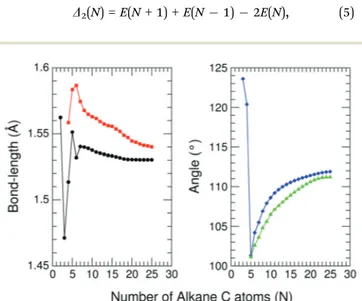
The C–C bond lengths in the neutral alkanes range, for all sizes studied, between 1.529 Å and 1.535 Å and theCCCd angles in the carbon chains range between 113.41 and 113.81.
two curves, are given in the right panel of Fig. 5. The diamonds (blue curve) represent theCCCd angles at the end of the alkane structure, and the triangles (green curve) are averages over all the
d
CCCangles excluding the angles at the end of the alkane chain. It is noticeable that abrupt changes in the variation of the CCCd
angles withNare quenched starting fromN= 5. BeyondN= 5, a monotonic and smooth variation towards a limiting value of the angle is observed. In a similar way, the bond lengths vary monotonically starting fromN= 5 (red curve) andN = 7 (black curve). This quenching of size effects contrasts with the non-smooth and non-monotonic behavior displayed by the C–C bond lengths of the pure carbon clusters in Fig. 1. In this respect, one should notice, however, that the cationic alkanes are more resilient than the neutrals.
The calculated stability functions of neutral CNH2N+2and cationic
(CNH2N+2)+alkanes have been plotted as a function ofNin Fig. 6. In
the case of neutral alkanes the stability function is defined as
D2(N) =E(N+ 1) +E(N1)2E(N), (5) Fig. 3 Comparison between experimental (black circles)27and calculated
adiabatic ionization energies (in eV) of carbon clusters. Two sets of calculations are included: results from coupled cluster CC calculations (red diamonds),27and B3LYP results (this work; blue squares).
Fig. 4 Computed gas-phase structure of the C3H8and C16H34alkanes.
Fig. 5 C–C bond-lengths (in Å) andCCCd angles (in degrees) for cationic (CNH2N+2)+alkanes in their ground-state structures as a function ofNup
toN= 25. Left panel: Squares (red curve) represent the average C–C bond lengths, where that average is taken over the all the bonds excluding the two C–C bonds at the alkane ends; circles (red curve) correspond to the C–C bond lengths at the ends of the alkane. Right panel: Diamonds (blue curve) represent theCCCd angles at the end of the alkane structure, and the triangles (green curve) are averages over all the CCCd angles excluding those at the end of the alkane chain.
Open Access Article. Published on 02 May 2019. Downloaded on 5/23/2019 10:18:00 AM.
This article is licensed under a
whereNindicates the number of carbon atoms in the alkane, andE(N) represents the energy of the CNH2N+2alkane. Because
the linear alkanes have one CH3group at each of the two ends
of the chain, the alkane withNcarbon atoms hasN2 inner CH2groups.
Using in Fig. 6 an energy scale like that in Fig. 2, the plot of
D2(N) for neutral alkanes is just a horizontal line
indistinguish-able from the horizontal axis, that isD2(N) = 0 independent of
sizeN. This means that the size effects observed in Fig. 2 for pure neutral carbon clusters have been completely quenched by the functionalization with hydrogen in the linear alkanes. Fig. 6 shows that by enlarging the energy scale in a factor of1000, that is, focusing on a meV scale, faint size effects can be appreciated inD2(N), which oscillates withN. The oscillations are extremely weak, and only noticeable forNlower than 7. In the case of cationic alkanes the energy scale has to be enlarged by only a factor of10 in order to appreciate faint size effects. Again, those faint size effects are restricted toNlower than 7, with stability maxima appearing atN= 4 andN= 6 (also in the neutral case), and the oscillations have totally disappeared forNlarger than 7.
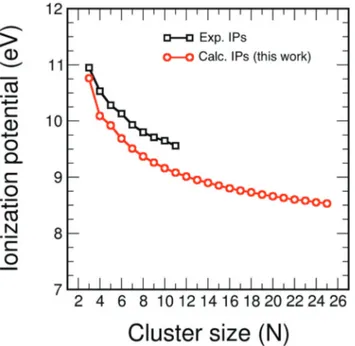
The calculated ionization potentials
IP(N) =E(CNH2N+2)+E(CNH2N+2) (6)
of linear alkanes are shown in Fig. 7. Experimental ionization potentials,31available forN= 3–11, are also included, and the comparison of calculated and experimental IPs is satisfactory. The calculated IPs are slightly smaller than the experimental IPs, with differences quite constant (except for C3H8), and in all
cases below 5%. Comparison with the calculations of other authors32 is also satisfactory. The ionization potential of the
linear alkanes decreases withNbut the decrease is smooth, and in contrast to the behavior of IP for the pure carbon clusters (see Fig. 3), abrupt size effects have been completely quenched in the linear alkanes by the effect of hydrogen. The values of IP have not yet reached a saturation value for the largest alkanes studied here, C25H52. The calculated electron affinities of the
alkanes are negative; that is, the linear alkane anions are not stable against electron detachment. This is in contrast to pure carbon anions.33
The large ionization potentials and negative electron affi-nities of the alkanes are consistent with the well-known low reactivity of these molecules with ionic and other polar substances. The chemical reactivity is often studied by using the Fukui functions.23 As noticed above in Section 2, in a
density functional framework, a good approximation to the Fukui function measuring the local reactivity of a mole-cule towards (electron-poor) electrophiles is given by the electron density difference between the neutral and the cationic molecules.25,26 For the case of carbon clusters and alkanes, respectively,
fC
NðrÞ ¼rCNðrÞ rCþNðrÞ ¼DrCNðrÞ; fC
NH2Nþ2ðrÞ ¼rCNH2Nþ2ðrÞ rðCNH2Nþ2ÞþðrÞ ¼DrCNH2Nþ2ðrÞ:
(7)
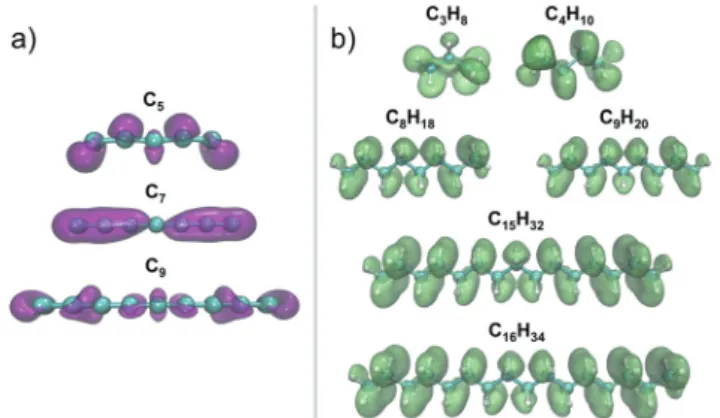
Regions where this function is large are especially reactive towards electrophiles; that is, electrophiles withdraw electro-nic charge preferentially from those regions. The electron density difference Dr(r) reveals in Fig. 8 that the Fukui functionf
CNH2Nþ2ðrÞshows substantial delocalization through
the alkane chains. This delocalization is an effect common to all alkane sizes, and the spatial distribution of f
CNH2Nþ2ðrÞis
similar in all of them. In contrast, the Fukui function of carbon clusters, fC
NðrÞ, presents differences when one
com-pares different cluster sizes, as illustrated in the specific cases of C5, C7, and C9in Fig. 8.
Fig. 6 Stability function D2(N) (in eV) of: (a) neutral alkanes CNH2N+2,
and (b) cationic alkanes (CNH2N+2)+ for N = 3–24. Notice that the
scale of energies has been enlarged by a factor of1000 with respect to Fig. 1 in the case of neutral alkanes, and by a factor of10 for cationic alkanes.
Fig. 7 Calculated ionization potentials (in eV) of CNH2N+2 alkenes (red
circles), compared to available experimental ionization potentials (black squares).31
Open Access Article. Published on 02 May 2019. Downloaded on 5/23/2019 10:18:00 AM.
This article is licensed under a
3.3 Trends in the properties of each CNHnfamily asn increases. The road to saturation
Although our main purpose, developed in the previous sections, consists in studying how the addition of hydrogen affects the size effects in CNclusters, that is, the variation of the properties as the
number of C atoms in the cluster increases, a complementary but different question that we have also investigated is how the properties of CNclusters of fixedNchange as hydrogen is added
until full saturation is reached in the alkanes. For this purpose, the two representative families C5Hn (n = 1–12) and C7Hn
(n= 1–16) have been selected. For each cluster C5Hnor C7Hn
an extensive set of isomers have been considered and the lowest energy structure has been determined in each case. Fig. 9 shows the energies required to remove a single H atom from the CNHnclusters (n= 5, 7), which we call hydrogen evaporation
energy for consistency with the notation used in other sections:
Ev(CNHn) =E(CNHn1) +E(H)E(CNHn), (8)
where the energies on the right hand side of the equation are the energies of the corresponding molecules and the energy of an isolated H atom, respectively. In the C5Hnfamily, an even–
odd effect appears in the evaporation energy for molecules with
nbetween 6 and 12, where molecules with evenn have larger evaporation energies than molecules with oddn. Those differ-ences arise from the details of the chemical bonding in the different molecules. Those details can be appreciated with the help of Fig. 10, which shows the calculated lowest energy structures of C5Hnwithn= 1–12.
C5H12is a non-cyclic saturated hydrocarbon, in which all the
C–C bonds are single bonds. The molecule is very stable and consequently the energy to remove a single H atom is large,
Ev(C5H12) = 4.54 eV. After removing one H atom, the molecule
obtained, C5H11, contains one unsaturated C orbital, which
indicates that C5H11is highly reactive. In fact, this molecule is
only observed in extreme conditions.34The low stability of this molecule is reflected in a low value of the energy to remove an
H atom,Ev= 1.79 eV. C5H10is a symmetric cyclic molecule with
saturated bonds, which makes the molecule quite stable, with largeEv= 4.20 eV. Loss of an H atom leads to C5H9, with an
unsaturated C orbital. This molecule is, then, reactive and removing an H atom only costs an energyEv= 2.90 eV. C5H8,
with all the C bonds saturated, has a larger evaporation energy,
Ev= 3.62 eV. C5H7has a C atom with a non-saturated bond, and
its higher reactivity leads to a lowEv= 2.06 eV. C5H6has all C
bonds saturated, andEvincreases up to a value of 3.52 eV. In
summary, the even–odd oscillations in the magnitude ofEvfor
C5Hnin the rangen= 6–12 are correlated with the presence or
absence of unsaturated carbon orbitals. Local maxima of Ev
occur for molecules with all bonds saturated (n= 6, 8, 10, 12), while the local minima correspond to molecules with an
Fig. 8 Surfaces with a constant value (equal to 0.02 e Å3) of the Fukui
functionsf
CNðrÞandf
CNH2Nþ2ðrÞfor several carbon clusters and alkanes.
The spatial distribution of the Fukui functions is measured by the differ-ence between the electron densities of the corresponding neutral and cationic species. The regions wheref(r) is localized are regions prone to release electronic charge when the molecule reacts with electrophiles.
Fig. 9 Energy to remove an H atom,Ev(in eV), as a function of the number
of hydrogen atoms, n, from the C5Hn (n= 1–12) and C7Hn (n= 1–16)
molecules.
Fig. 10 Calculated ground state structures of C5Hn(n= 0–12) molecules.
Open Access Article. Published on 02 May 2019. Downloaded on 5/23/2019 10:18:00 AM.
This article is licensed under a
unsaturated C orbital (n= 7, 9, 11). The behavior is different in the region betweenn= 1 andn= 5, where all the evaporation energies are larger than 3.9 eV, in spite of the fact that all these molecules, except C5H4, have unsaturated C orbitals and are
reactive. A similar trend in the hydrogen evaporation energies occurs in the C7Hn family, whose ground state structures are
shown in Fig. 11. The even–odd oscillation shown in Fig. 9, that is, the correlation between local maxima of Evand full bond saturation applies betweenn= 6 and n = 16, andEvis again relatively large betweenn= 1 andn= 5. The trend ofEvas the number of H atoms in the molecule increases, starting with CNH and ending with the fully saturated molecule CNH2N+2, is
non smooth. However, as shown in the previous sections, after the C clusters are fully saturated with hydrogen, that is, when saturated alkanes are formed, the properties vary very smoothly with the alkane size, that is, with the number of CH2
groups added.
The ionization potentials and the electron affinities of C5Hn
(n = 1–12) and C7Hn (n = 1–16) have been plotted in Fig. 12.
Similar to the behavior of Evdiscussed above, IP shows large
amplitude even–odd oscillation in each family betweenn = 6 and n = 2N: molecules with even values of n have larger ionization potentials than molecules with odd values ofn. As mentioned above, the molecules with even values ofnhave all carbon orbitals saturated, while molecules with odd values ofn
have one unsaturated bond. The even–odd oscillation is also quite convincing fornsmaller than 6, with some misfit in the transition between the two regions. A complementary way of interpreting the even–odd oscillations in IP is in terms of spin pairing, since molecules with even n have even number of electrons (4N +n, excluding the core electrons of the carbon atoms). Even–odd oscillations of IP are also well known in alkali metal clusters.3,35In spite of the sizable oscillations of IP
shown in Fig. 12, two observations can be made. The values of IP for the molecules at the end of each family, IP(C5H12) =
9.93 eV and IP(C7H16) = 9.52 eV, are larger than the IPs of other
members of the family, with the only exception of C5H10in the
C5Hnfamily. Second, the values of IP(C5H12) and IP(C7H16) are
very close, which explains the trend observed in Fig. 7, that is,
the quenching of size effects discussed in the first part of this work.
The electron affinities also show even–odd oscillations, between n = 3 and n = 12 in the C5Hn series, and between
n= 5 andn= 16 in the C7Hnseries. The oscillations confirm the
spin paring, because the maxima of EA occur for clusters with odd number of electrons, where capture of one electron leads to an even number. However, the most important feature is that the electron affinity changes sign in the middle of each family. That is, EA becomes negative, which indicates that those molecular anions are not stable against electron detachment. In spite of this fact it is also worth to notice that the electron affinities of C5H12 and C7H16 are the most negative ones in
their respective families, and that their values are nearly the same, supporting again the quenching of size effects in the saturated alkanes.
4 Summary and conclusions
The most fascinating characteristic of small atomic clusters is that the values of most of their properties do not scale smoothly with the cluster sizeN. Instead, the values of those properties can vary substantially in this regime in which every atom counts. This has been illustrated here by analyzing several properties of neutral CNand cationic C+Ncarbon clusters. The
cluster structure changes from linear to cyclic at about C10. The
C–C bond lengths display an oscillating and irregular variation with the cluster size N. The cluster stability (related to the
Fig. 11 Calculated ground state structures of C7Hn(n= 1–16) molecules.
Fig. 12 Electron affinity, EA (in eV), and ionization potential, IP (in eV), as a function of the number of hydrogen atoms,n, of C5Hn(n= 0–12) and C7Hn
(n= 0–16) molecules (see structures in Fig. 10 and 11).
Open Access Article. Published on 02 May 2019. Downloaded on 5/23/2019 10:18:00 AM.
This article is licensed under a
lowest energy structures are linear chains, the variations of C–C bond lengths and CCCd angles are minor and smooth, the stability functions show practically no structure as a function of alkane size, the ionization energies show no relevant features and decrease smoothly with alkane size, and the spatial dis-tribution of the Fukui functions is analogous in all the linear alkanes. In summary, the interaction of carbon clusters with hydrogen to form alkanes quenches all the size-dependent features originally owned by the carbon clusters. The road to arrive at the quenching of the size effects is intricate. In each CNHn family of fixed N, the values of the properties of the
molecules like the ionization potential, the electron affinity, and others show sizable oscillations as the number n of hydrogen atoms grows from the pure carbon cluster, where
n= 0, to the alkane, wheren= 2N+ 2.
Conflicts of interest
The authors declare no competing financial interests.
Acknowledgements
We acknowledge funding from the Spanish MINECO (Grants MAT2017-85089-C2-1-R and RYC-2015-17730), Comunidad de Madrid (FotoArt-CM Project P2018/NMT-4367) through the Program of R&D activities between research groups in Techno-logies 2018, co-financed by European Structural Funds, Junta de Castilla y Leo´n (Grant VA021G18), University of Valladolid (GIR Grupo de Fı´sica de Nanoestructuras), and the EUviathe ERC-Synergy Program (Grant ERC-2013-SYG-610256 Nanocosmos) and EU Horizon 2020 Research and Innovation program (Grant 785219 – Graphene Flagship Core2–). We also thank the computing resources from CTI-CSIC.
Notes and references
1 E. Oger, N. Crawford, R. Kelting, P. Weis, M. Kappes and R. Ahlrichs,Angew. Chem., Int. Ed., 2007,46, 8503–8506. 2 D. Emin,Phys. Today, 1987,40, 56–62.
3 W. A. Saunders, K. Clemenger, W. A. de Heer and W. D. Knight,Phys. Rev. B: Condens. Matter Mater. Phys., 1985,32, 1366–1368.
10 J. Bansmann, V. Senz, R. P. Methling, R. Ro¨hlsberger and K. H. Meiwes-Broer,Mater. Sci. Eng., C, 2002,19, 305–310. 11 T. Hayashi, K. Tanaka and M. Haruta,J. Catal., 1998,178,
566–575.
12 Nanocatalysis, ed. U. Heiz and U. Landman, Springer, 2007. 13 L. Li, A. H. Larsen, N. A. Romero, V. A. Morozov, C. Glinsvad, F. Abild-Pedersen, J. Greeley, K. W. Jacobsen and J. K. Nørskov,J. Phys. Chem. Lett., 2013,4, 222–226.
14 F. Calle-Vallejo, J. I. Martnez, J. M. Garca-Lastra, P. Sautet and D. Loffreda,Angew. Chem., Int. Ed., 2014,53, 8316–8319. 15 T. P. Martin,Phys. Rep., 1996,273, 199–241.
16 J. A. Alonso,Structure and Properties of Atomic Nanoclusters, Imperial College Press, London, 2nd edn, 2012.
17 A. Artaud, L. Magaud, K. Ratter, B. Gilles, V. Guisset, P. David, J. I. Martnez, J. A. Martn-Gago, C. Chapelier and J. Coraux,Nano Lett., 2018,18, 4812–4820.
18 M. J. Frisch, G. W. Trucks, H. B. Schlegel, G. E. Scuseria, M. A. Robb, J. R. Cheeseman, G. Scalmani, V. Barone, B. Mennucci, G. A. Petersson, H. Nakatsuji, M. Caricato, X. Li, H. P. Hratchian, A. F. Izmaylov, J. Bloino, G. Zheng, J. L. Sonnenberg, M. Hada, M. Ehara, K. Toyota, R. Fukuda, J. Hasegawa, M. Ishida, T. Nakajima, Y. Honda, O. Kitao, H. Nakai, T. Vreven, J. A. Montgomery, Jr., J. E. Peralta, F. Ogliaro, M. Bearpark, J. J. Heyd, E. Brothers, K. N. Kudin, V. N. Staroverov, R. Kobayashi, J. Normand, K. Raghavachari, A. Rendell, J. C. Burant, S. S. Iyengar, J. Tomasi, M. Cossi, N. Rega, J. M. Millam, M. Klene, J. E. Knox, J. B. Cross, V. Bakken, C. Adamo, J. Jaramillo, R. Gomperts, R. E. Stratmann, O. Yazyev, A. J. Austin, R. Cammi, C. Pomelli, J. W. Ochterski, R. L. Martin, K. Morokuma, V. G. Zakrzewski, G. A. Voth, P. Salvador, J. J. Dannenberg, S. Dapprich, A. D. Daniels, A˜. Farkas, J. B. Foresman, J. V. Ortiz, J. Cioslowski and D. J. Fox,
Gaussian-09 Revision E.01, Gaussian Inc., Wallingford CT, 2009.
19 A. D. Becke,J. Chem. Phys., 1993,98, 5648–5652.
20 P. J. Stephens, F. J. Devlin, C. F. Chabalowski and M. J. Frisch,J. Phys. Chem., 1994,98, 11623–11627.
21 T. H. Dunning,J. Chem. Phys., 1989,90, 1007–1023. 22 J. I. Martnez and J. A. Alonso,Phys. Chem. Chem. Phys., 2018,
20, 27368–27374.
23 K. Fukui,Science, 1982,218, 747–754.
24 J. I. Martnez, M. J. Lo´pez and J. A. Alonso,J. Chem. Phys., 2005,123, 074303.
Open Access Article. Published on 02 May 2019. Downloaded on 5/23/2019 10:18:00 AM.
This article is licensed under a
25 P. W. Ayers and R. G. Parr,J. Am. Chem. Soc., 2000, 122, 2010–2018.
26 P. W. Ayers, R. C. Morrison and R. K. Roy,J. Chem. Phys., 2002,116, 8731–8744.
27 L. Belau, S. E. Wheeler, B. W. Ticknor, M. Ahmed, S. R. Leone, W. D. Allen, H. F. Schaefer and M. A. Duncan,J. Am. Chem. Soc., 2007,129, 10229–10243.
28 S. B. H. Bach and J. R. Eyler, J. Chem. Phys., 1990, 92, 358–363.
29 R. Ramanathan, J. A. Zimmerman and J. R. Eyler,J. Chem. Phys., 1993,98, 7838–7845.
30 J. Benedikt, S. Agarwal, D. Eijkman, W. Vandamme, M. Creatore and M. C. M. van de Sanden, J. Vac. Sci. Technol., A, 2005,23, 1400–1412.
31 CRC Handbook of Chemistry and Physics, ed. D. R. Lide, CRC Press, Boca Raton, FL., 81st edn, 2000.
32 C. Cao and H. Yuan, J. Chem. Inf. Comput. Sci., 2002,42, 667–672.
33 N. G. Gotts, G. von Helden and M. T. Bowers,Int. J. Mass Spectrom. Ion Processes, 1995,149–150, 217–229.
34 J. Pacansky and A. Gutierrez,J. Phys. Chem., 1983,87, 3074–3079. 35 W. A. de Heer,Rev. Mod. Phys., 1993,65, 611–676.
Open Access Article. Published on 02 May 2019. Downloaded on 5/23/2019 10:18:00 AM.
This article is licensed under a