PROGRAMA DE DOCTORADO EN INGENIERÍA
QUÍMICA Y AMBIENTAL
TESIS DOCTORAL:
Lignin depolymerization by
supercritical water ultrafast reactions.
Presentada por Nerea Abad Fernández para
optar al grado de
Doctora por la Universidad de Valladolid
Dirigida por:
TABLE OF CONTENTS
ABSTRACT
LIGNIN DEPOLYMERIZATION BY
SUPERCRITICAL WATER
ULTRAFAST REACTIONS.
ABSTRACT
11
Surviving on a planet provided with limited resources to support our increasing population is the greatest challenge humanity has faced so far. The main problem is based on that our economy is driven by many technologies that are not sustainable at all. This necessity of developing sustainable technologies capable of addressing such challenges, together with the increasing concern over environmental protection and questions about future availability of petrochemical feedstock have spurred research and development toward new materials from renewable resources environmentally friendly and sustainable. Within this context, lignin, a complex natural polymer obtained as by-product in large quantities in paper industries and biorefineries, arises as a promising candidate for these purposes.
The aim of this thesis is to valorise lignin obtaining low molecular weight aromatic products of high value through an ultra-rapid and environmentally friendly technology employing sub and supercritical water as solvent and reaction medium, in order to achieve high yields and selectivity, which has been a challenge to this day.
Three main products were obtained from the reaction mixture after separation and extraction: a light oil, containing low molecular weight compounds, a heavy oil, containing oligomers, and char.
The research started with studying the effect of the parameters that control the depolymerization of lignin: temperature and reaction time. For this study, Kraft lignin as an example of pulp and paper industry by-product was chosen as raw material. Different temperatures between 300 and 400ºC and reaction times as short as 60 ms were studied, with a lignin concentration in the reactor of 0.1% w/w. Increasing temperature and reaction time promoted secondary reactions of repolymerization At 386ºC and 170 ms, the highest yield in light oil (44.6%), as well as the highest selectivity in aromatic monomers (9.9%) were achieved, with a formation of char of only 3.5%.
ABSTRACT
12
386±2ºC, and increasing the lignin concentration 5-times (i.e. 0.5% w/w of lignin in the reactor). Different reaction times below 0.5 s were studied. Using this base-catalysed supercritical water depolymerisation, the reaction reached an optimum point at 300 ms with a light oil yield of 60% and a selectivity in key compounds such as guaiacol, creosol, vanillin and acetovanillone of around 20 wt%. The char formation in this point was surprisingly low (4 wt%).
In the third part of this thesis, the depolymerization process in alkaline supercritical water was extrapolated to real pulp and biorefinery residues, such as as kraft black liquors with low lignin content and to other lignins. The optimal conditions (386ºC and 300 ms) were applied to all raw materials for comparison purposes, considering that they were obtained from different biomasses (woody and non-woody) and by different processes (kraft, organosolv, biomass hydrolysis, enzymatic hydrolysis). In addition, it was proven that the proposed technology is equally effective to treat directly industrial black liquors than when using the corresponding technical lignin, obtaining yield higher than 50 wt% to light oil, containing as main monomers guaiacol (2.7 wt%), syringol (3.0 wt%) and syringaldehyde (7.3 wt%).
INTRODUCTION
LIGNIN DEPOLYMERIZATION BY
SUPERCRITICAL WATER
ULTRAFAST REACTIONS.
INTRODUCTION
15
Lignin is a major component of terrestrial lignocellulosic biomass. The effective utilization of lignin is critical for the accelerated development and deployment of the advanced cellulosic biorefinery. However, we acknowledge that, despite some markets and uses of lignin which stretch back decades, it has been long said in the pulp industry that “one can make anything from lignin except money.” [1]
1. Biomass and biorefinery concepts.
The biorefinery concept embraces a wide range of technologies able to separate biomass (i.e. agricultural, forestry and industrial residues) into their components (i.e. cellulose, hemicellulose and lignin) for their later conversion to value added products, biofuels and chemicals. Cellulose has a strong molecular structure made by long chains of glucose molecules (C6 sugar) and constitutes 30-50% of total lignocellulosic dry matter. Its crystalline structure has high tensile strength and is difficult to break. Hemicellulose is a relatively amorphous component containing a mix of C6 and C5 sugars, which is easier to break down through chemical or thermal processes than cellulose. Hemicellulose constitutes 20–40% of total feedstock dry matter. Lignin, made of phenolic polymers, is essentially the glue that provides rigidity to the structure of plants and trees and it constitutes 15–35% of total feedstock dry matter [2]. Figure 1 shows the lignocellulosic biomass composition and structure.
INTRODUCTION
16
While cellulose and hemicellulose have been used for many years in high-value industrial applications (i.e. paper, textile, plastic, pharmaceutical or fuel), lignin is considered a by-product from paper industry and the modern biorefineries, being mostly consumed as low-grade fuel (Figure 2) [3].
Figure 2. Simplified scheme of a biorefinery process.
However, lignin, as the only large-scale source of renewable aromatic moieties, has a great potential by itself or as a source of chemicals. Thus, its utilization from both an economic standpoint and from a sustainability perspective, is an important consideration for our future [4]. For this reason, research is recently focused on lignin valorisation, trying to find high-value applications of this biopolymer, as well as to produce high-value materials from it, in order to push biorefineries towards a sustainable and cost-effective reality.
2. Lignin.
INTRODUCTION
17
phenylpropane monomeric units (monolignols), namely coniferyl, synapyl, and coumaryl alcohols. These monolignols produce guaiacyl, syringyl and p-hydroxyphenyl propanoic units into the lignin polymer, where are linked together mainly by ether linkages (e.g. α-O-4, 5-O-4 and β-O-4) and also by C-C bonds (e.g. 5-5, β-β, β-5 and β-1) [6]. It is present in secondary cell walls and confers structural support, impermeability and resistance against microbial attack to the plant [7]. The lignin content differs for hardwood and softwood species and herbaceous plants. In hardwood trees, it is 27–33%, softwood trees 18–25%, and for herbaceous plants it is 17–24% [4]. On the other hand, the number of functional groups and type of linkages in the lignin molecule vary from species to species, tree to tree, and even in woods from different parts of the same tree. Hence, lignin from softwood is composed mainly of moieties derived from coniferyl alcohol (type-G), hardwood lignin contains residues derived from both coniferyl and sinapyl alcohols (type-G and S) [8], whereas lignins derived from grasses and herbaceous crops contain the three basic phenol units (types-H,G and S). In addition, the monolignols in wood are basically linked by carbon-carbon and ether-type bonds [4]. Figure 3 presents a simple and general lignin structure model, as well as a table with the possible linkages in the molecule.
INTRODUCTION
18
3. Extraction of lignin.
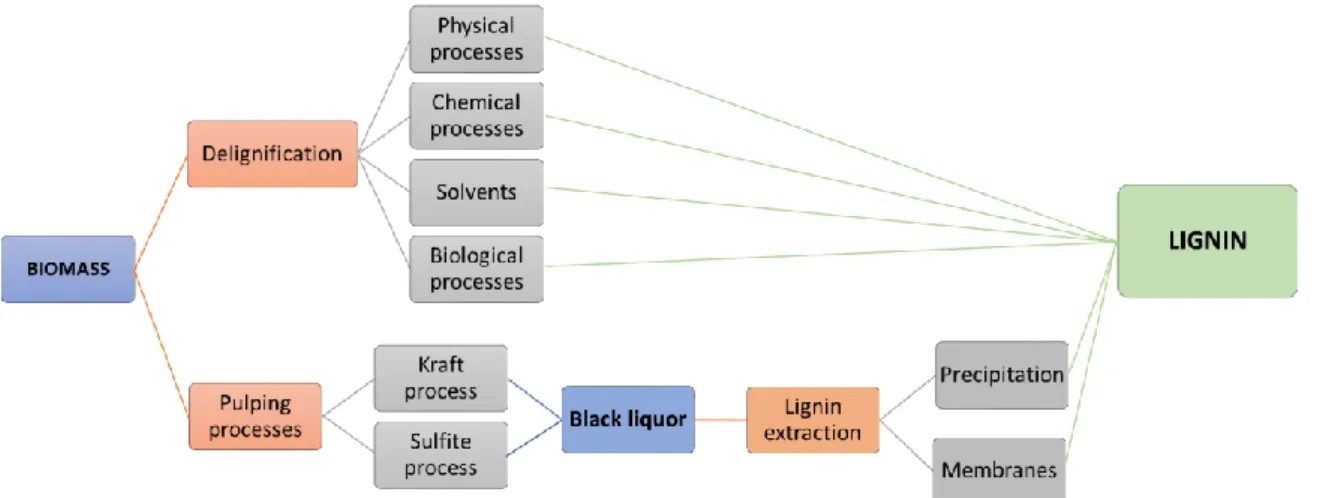
Lignin can be obtained through different delignification processes of lignocellulosic biomasses. The lignin extraction process is an essential technique to provide a robust and reproducible process for biomass valorization because it overcomes some physical and chemical barriers that make lignin resistant to later bioprocesses to be converted in high-value products. The lignin extraction technologies are divided in four categories: physical treatment (e.g., ball milling), solvent fractionation (including the organosolv process, together with phosphoric acid fractionation and the use of ionic liquids), chemical treatment (acidic, alkaline, and oxidative), and biological treatment (using mainly fungi). Some of these delignification methods are soda and organosolv processes. In the soda delignification process, biomass is digested by the treatment with an aqueous solution of NaOH at temperatures of about 160 ºC. Lignin depolymerization occurs principally by the cleavage of α- and β-aryl ether bonds and saponification of intermolecular ester bonds cross-linking hemicelluloses and lignin. However, the organosolv process consists on the delignification of wood using organic solvents in order to produce high-quality lignins. In this process, lignin is cooked at temperatures of 100-200ºC for 1 h.
On the other hand, lignin can be also recovered from black liquor obtained as residue in pulp and paper industries via precipitation of lignin or using membranes, for example. The acid sulphite pulping process dissolves lignin by applying SO32− at acidic environment and 130–160 °C. This sulphite lignin,
INTRODUCTION
19
number of applications (i.e. dispersants, adsorbents, antioxidant or polymer additives), Kraft lignin, present in insoluble form, is mostly burned onsite to recover energy for process use [8].
A simplified scheme of the lignin recovery processes from biomass and black liquor is shown in Figure 4.
Figure 4. Extraction methods of lignin from biomass and black liquors.
Although many methods are available nowadays for the extraction and purification of lignin from biomass or black liquors, none of them indeed provides a 100% yield and structural authenticity. One of the reasons for the lack of perfect extraction is the aggressive treatment often performed during the process. The extraction method employed directly influences the structure and properties of lignin. Thus, the lignin behaviour, as well as the type of lignin products will depend on not only the biomass source, but also on the extraction and purification strategy previously employed.
4. Valuable products from lignin.
INTRODUCTION
20
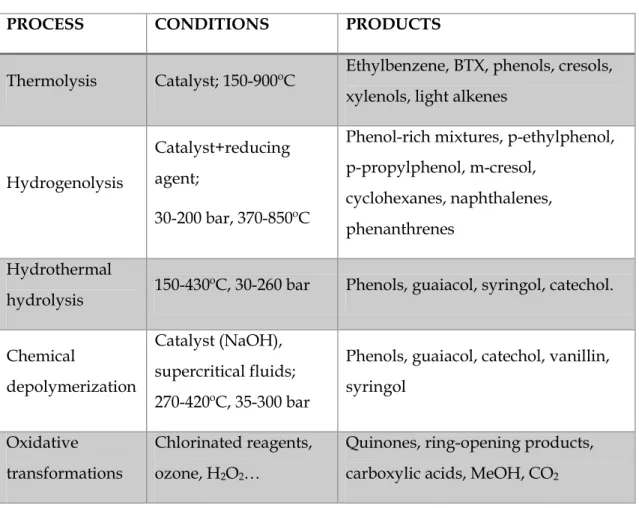
chemical because of its properties, pharmacological applications, and use as chemical intermediate for the synthesis of other products. However, the selective transformation of lignin into high value products still remains elusive [4]. Different strategies, including thermolysis, hydrogenolysis, hydrothermal hydrolysis, chemical depolymerisation and reductive or oxidative transformation are being extensively investigated for lignin conversion [10]. Thermolysis is referred to the pyrolytic decomposition of organic matter at elevated temperatures by a rapid heating in the absence of oxygen, in order to avoid combustion of lower molecular weight fragments obtained from biomass. In case of lignin, it is a quite complex mechanism where many parallel radical coupling and rearrangement reactions take place simultaneously. Using catalyst such as zeolite HZSM-5 and high temperatures, interesting products such as BTX can be obtained. However, this technology presents an important handicap: laboratory-scale results found with milligram-scale experiments cannot be extrapolated to large-scale experiments [4].
Hydrogenolysis is referred to the pyrolytic transformation of lignin under reducing conditions in the presence of a catalyst and a reducing agent such as H2.
Because of the presence of a reducing agent, the oxygen content of the fragments and simpler molecules is lower than that of starting lignin. Phenol-rich mixtures can be obtained from this process, but the procedure requires relatively high pressures and specific expensive catalysts [4].
INTRODUCTION
21
usually lower than other biomass thermochemical methods, including pyrolysis and steam gasification [4].
Chemical depolymerization is probably the most direct method to produce high-value chemicals from lignin, but it is also probably the most challenging. In most cases, there is little selectivity and yields are modest. An additional problem is the difficulty of isolation of the products from the degradation of the polymer. Some of common methods for chemically induced depolymerization of lignin are base-catalysed and supercritical fluids-assisted depolymerization. Treating lignin with aqueous NaOH solution at high temperatures leads to phenols and derivatives. The process is relatively simple, but its selectivity remains still unsatisfactory, probably due to the reaction conditions employed in most studies. High reaction times favour the formation of by-products and complex mixtures. For this reason, controlling this reaction parameter is extremely important in this process. On the other hand, lignin has shown good solubility in supercritical fluids and the depolymerization process proceeds with high selectivity. In some cases, a base such as NaOH is added to the solvent, while in others no additional reactant other than solvent is added. The use of supercritical fluids for lignin depolymerization presents a problem related to the high cost or to the equipment employed to perform the reaction. Thus, the design of adequate reactors is required to do this process cost-effective [4].
INTRODUCTION
22
Table 1. Thermochemical and chemical lignin transformation processes.
PROCESS CONDITIONS PRODUCTS
Thermolysis Catalyst; 150-900ºC Ethylbenzene, BTX, phenols, cresols, xylenols, light alkenes
Hydrogenolysis
Catalyst+reducing agent;
30-200 bar, 370-850ºC
Phenol-rich mixtures, p-ethylphenol, p-propylphenol, m-cresol,
cyclohexanes, naphthalenes, phenanthrenes
Hydrothermal
hydrolysis 150-430ºC, 30-260 bar Phenols, guaiacol, syringol, catechol. Chemical
depolymerization
Catalyst (NaOH), supercritical fluids; 270-420ºC, 35-300 bar
Phenols, guaiacol, catechol, vanillin, syringol
Oxidative transformations
Chlorinated reagents, ozone, H2O2…
Quinones, ring-opening products, carboxylic acids, MeOH, CO2
INTRODUCTION
23
reaction temperature and the residence time [5]. Controlled depolymerization of lignin is one of the most challenging and promising technologies to produce small aromatic chemicals that now are obtained only from petrochemical industry.
5. Lignin depolymerization using sub and supercritical water.
As it was seen in the previous sections, due to the complex structure and presence of various linkages between monomers in the lignin structure, the conversion of this phenolic heteropolymer to value-added compounds is substantially more difficult than that of polymeric carbohydrates (such cellulose or starch). In recent years, the use of supercritical technique is believed to have positive effect on the depolymerization of lignin material to small molecules [6].
INTRODUCTION
24
water, most notably the difference in ionic product of water, presenting the subcritical water medium a higher concentration of ions thus favouring ionic reactions vs the radical reactions that are prevalent under SCW conditions [14].
References.
1. Ragauskas, A.J., et al., Lignin Valorization: Improving Lignin Processing in the Biorefinery. Science, 2014. 344(6185): p. 1246843.
2. Cherubini, F., The biorefinery concept: Using biomass instead of oil for producing energy and chemicals. Energy Conversion and Management, 2010. 51(7): p. 1412-1421. 3. Pińkowska, H., P. Wolak, and A. Złocińska, Hydrothermal decomposition of alkali lignin
in sub- and supercritical water. Chemical Engineering Journal, 2012. 187: p. 410-414. 4. G. Calvo-Flores, F., et al., Lignin and Lignans as Renewable Raw Materials: Chemistry,
Technology and Applications. 2015.
5. Gosselink, R.J.A., et al., Co-ordination network for lignin—standardisation, production and applications adapted to market requirements (EUROLIGNIN). Industrial Crops and Products, 2004. 20(2): p. 121-129.
6. Wang, X., et al., Depolymerization of Lignin with Supercritical Fluids: A Review. Vol. 821-822. 2013. 1126-1134.
7. Hendriks, A.T.W.M. and G. Zeeman, Pretreatments to enhance the digestibility of lignocellulosic biomass. Bioresource Technology, 2009. 100(1): p. 10-18.
8. Hu, J., Q. Zhang, and D.-J. Lee, Kraft lignin biorefinery: A perspective. Bioresource Technology, 2018. 247: p. 1181-1183.
9. Zhang, F., J. Lin, and G. Zhao, Preparation and Characterization of Modified Soda Lignin with Polyethylene Glycol. Materials (Basel, Switzerland), 2016. 9(10): p. 822.
10. Wang, H., et al., From lignin to valuable products–strategies, challenges, and prospects. Bioresource Technology, 2019. 271: p. 449-461.
11. Pérez, E., C.O. Tuck, and M. Poliakoff, Valorisation of lignin by depolymerisation and fractionation using supercritical fluids and conventional solvents. The Journal of Supercritical Fluids, 2018. 133: p. 690-695.
12. Tuck, C.O., et al., Valorization of Biomass: Deriving More Value from Waste. Science, 2012. 337(6095): p. 695-699.
13. Li, J., G. Henriksson, and G. Gellerstedt, Lignin depolymerization/repolymerization and its critical role for delignification of aspen wood by steam explosion. Bioresource Technology, 2007. 98(16): p. 3061-3068.
AIMS AND CONTENTS
AIMS AND CONTENTS
27
Lignin, a complex natural polymer obtained as by-product in large quantities in paper industries and biorefineries, is a promising candidate for obtaining aromatic high value products from a renewable resource. The main problem present in most studies is the difficulty to depolymerize this biopolymer in low molecular weight compounds with high yield and selectivity, avoiding repolymerization reactions of the fragments previously formed.
The main hypothesis of this thesis is that:
Thus, the main purpose of this research work was to depolymerize lignin using an environmentally friendly process able to work with reaction times short enough to avoid or control repolymerization, obtaining in this way high yield and selectivity in aromatic monomers of interest such as vanillin. For that purpose, a continuous technology employing sudden-expansion micro-reactors, as well as hot and pressurized water as solvent was employed.
In order to achieve the aim of this thesis, the following partial objectives were defined and described in the four chapters constituting the thesis:
1. Search for optimal operating conditions for lignin depolymerization using sub and supercritical water.
Depolymerization of Kraft lignin using continuous sudden-expansion microreactors at different temperatures (300-400 ºC) and different reaction times (60 ms – 4.6 s).
Determination of the optimal operating conditions for obtaining the maximum monomeric yield.
2. Improvement of the lignin depolymerization process using supercritical water by addition of NaOH as catalyst.
AIMS AND CONTENTS
28
Depolymerization of Kraft lignin at the optimal temperature and different reaction times below 0.5 s using base-catalysed supercritical water in order to increase the monomeric yield.
Determination of the optimal reaction time for obtaining the maximum monomeric yield.
Study of reaction mechanisms of lignin depolymerization in alkaline supercritical water.
3. Application of the ultra-fast base-catalysed supercritical water technology to real pulping and biorefinery residues for its valorisation.
Depolymerization of different lignins obtained from diverse biomasses and isolation methods using alkaline supercritical water at the optimal operating conditions determined for Kraft lignin in basic medium.
Direct treatment of Kraft black liquors using supercritical water at the optimal operating conditions determined for Kraft lignin.
Study of the influence of lignin nature in the alkaline supercritical water depolymerization process and in the type of lignin products.
4. Development of a strategy to recover low-molecular-weight products from the lignin product mixture in a continuous process.
Simulation of a continuous downstream process for separating low-molecular-weight products from the lignin product mixture using Aspen HYSYS.
Optimization of the downstream process in order to minimize the monomeric losses.
CHAPTER I
DEPOLYMERIZATION OF KRAFT
LIGNIN USING SUB- AND
SUPERCRITICAL WATER.
CHAPTER I
31
DEPOLYMERIZATION
OF
KRAFT
LIGNIN
USING
SUB-
AND
SUPERCRITICAL
WATER.
Abstract.
CHAPTER I
32
1. Introduction.
Lignin is one of the most important components of lignocellulosic biomass. It is mainly formed by hydroxyl-phenylpropane units (p-hydroxyphenyl, guaiacyl and syrigyl units) derived from three monomers (monolignols), p-coumaryl, coniferyl and sinapyl alcohols (Figure 1), differently distributed depending on the vegetal material: softwood, hardwood or grass [1]. Hardwood lignins are primarily composed by guaiacyl and syringyl units with traces of p-hydroxyphenyl propanoid units, whereas softwood lignins are composed mainly of guaiacyl units with small amount of p-hydroxyphenyl propanoid units. On the other hand, grass lignins are also classified as guaiacyl-syringyl lignin containing a low level of structural elements derived from p-coumaryl alcohol [2].
Figure 1. Structure of monolignols forming lignin.
Lignin is produced mainly as a by-product in pulp and paper processes and more recently in biorefineries, where is treated as waste material being mostly consumed as low-grade fuel [3].
CHAPTER I
33
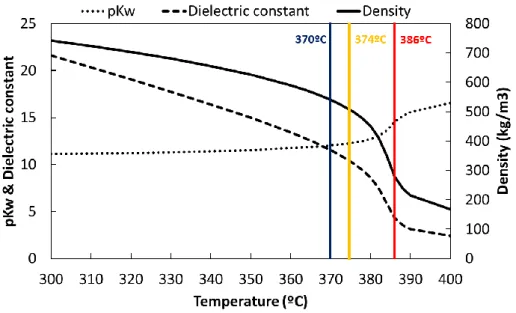
time can be done to maximize the reaction selectivity, as well as to avoid the generation of undesired products formed by repolymerization reactions. The density, dielectric constant and ionic product of water (pKw) from 300ºC to 400ºC at a pressure of 25 MPa are plotted in Figure 2.
Figure 2. Properties of pressurized water below and above the critical temperature of water (374ºC)calculated according to the equations developed in literature [11].
As explained in previous works, reactions in sub- and supercritical water (SCW) are dominated mainly by ionic or radical mechanisms respectively [8, 12]. Ionic reactions are more favoured in the subcritical than in the supercritical region because of the higher dielectric constant. Also, higher concentration of H+ and
OH− ions from the water dissociation promote acid or basic-catalyzed reactions.
On the other hand, radical reactions favourably occur under supercritical conditions.
CHAPTER I
34
The purpose of this study was to examine the trend of decomposition of Kraft lignin in sub- and supercritical water as a fast-continuous process for times below 0.5 s and to determine the effect of the reaction parameters (temperature and time) on the degree of lignin decomposition to form phenolic compounds. Four temperatures were selected for this study: two at subcritical conditions (300 and 370ºC) and two at supercritical conditions (386 and 400ºC). These are temperatures with different water properties close to and far from the critical point of water (Figure 2). The lignin used in the experiments was a commercial lignin of relatively high molecular weight (Mw ~ 10,000). The major low-molecular-weight phenolic compounds contained in the liquid product fractions were quantified by GC-MS, while solid residues were examined by FT-IR.
2. Materials and methods. 2.1. Materials.
All the chemicals were purchased from Sigma-Aldrich. Kraft lignin with low sulfur content (4%) was used as starting material. Properties of this lignin can be seen in Table S1. Distilled water was used as the reaction medium to run the experiments. Ethyl acetate (>99%) was employed to extract the lower-molecular-weight aromatic compounds from the liquid products. The calibration standards used in the GC-MS analysis were: guaiacol (≥99%), vanillin (99%), acetovanillone (≥98%), homovanillic acid (≥97%), as well as the internal standard 2-phenyl ethanol (≥99%).
2.2. Methods.
2.2.1. Calculation of the reaction time.
The reaction time was calculated as the equivalent to the residence time in the reactor as shown in equation 1, where V is the volume of the reactor, ρ is the density of water at working temperature and pressure, calculated as Wagner et al. [13], and M is the total mass flow. Density was considered as that of water because of the low concentration of lignin.
𝑡𝑅 = 𝑉·𝜌
CHAPTER I
35
The reactor volume was calculated as the sum of the volume of the different parts composing the reactor (See Figure 5): 1/3 of a T-union (point of mixing) + tube before thermocouple + 2/3 of T (thermocouple) + tube after thermocouple + valve connector + valve adapter. Valve connector and adapter volumes, not appreciable in Figure 5, were 4.1·10-2 and 1.8·10-1 cm3, respectively. Tubes and
pieces of 1/8’’ and ¼’’ were used, depending on the reaction time required.
2.2.2. Recovery of the lower-molecular-weight phenolic compounds.
Once the reaction finished, 140 mL of the reaction mixture were treated in order to recover the phenolic monomers in a concentrated oil and calculate the oil yield. Firstly, the solid was separated from the liquid by centrifugation (10 min, 7000 rpm). The liquid was recovered by carefully pipetting it without shaking the decanted solid. Then, the wet solid was washed with milli-Q water and dried in an oven at 45ºC, obtaining the solid fraction. The liquid fraction was subjected to a liquid-liquid extraction process with ethyl acetate (1:2 vol/vol). The solvent was evaporated from the aqueous extract using a rotary evaporator and the extract was then dried in a vacuum oven at 40ºC yielding a fraction, weighed and labeled as aromatic oil. Finally, the water was removed from the aqueous residue in a freeze-dryer and it was weighed and labeled as aqueous residue.
CHAPTER I
36
2.2.3. Characterization of the depolymerization products.
Phenolic monomers contained in the aromatic oil were detected and quantified by a gas chromatograph equipped with a capillary column HP-5ms, 30 m x 0.25 mm x 0.25 μm (Agilent Technologies, USA). Data of the chromatographic separations were acquired using a quadrupole mass spectrometer detector (5977A-Agilent Technologies, USA). The equipment was used in split-less mode and Helium was used as carrier gas. The oven temperature was programmed as follows: initial temperature was set at 32 ºC and kept for 10 min, then temperature was raised to 52 ºC at 2ºC/min, and kept for 2 min; to 65ºC at 2ºC/min, and kept for 2 min; to 93ºC at 4ºC/min, and kept for 2 min; to 230ºC at 2ºC/min and kept for 3 min; and finally, to 300ºC at 15ºC/min, and kept for 3 min. To eliminate the acquisition of the solvent (acetone) by the MS, a solvent delay was programmed at 3.70 minutes after confirming that no compounds were removed with the solvent. For compound identification, the data obtained in the GC-MS analysis were compared with m/z values compiled in the spectrum library Wiley. Data analysis was performed using the Agilent MassHunter software (Agilent Technologies, USA). Validation of compound identification was carried out by comparison of their MS spectra and their retention times with standards. Quantification of the major monomers identified in the oily products was done following the internal standard method [14].
The solid fraction and the aqueous residue were analyzed by FT-IR (ATR with diamond crystal) at ambient temperature with a Bruker Tensor 27 equipment.
2.2.4. Calculation of fractionation yields and selectivity of monomers.
For calculating the yield of the fractionation product ‘i’, %𝑌𝑖, equation 2 was used:
%𝑌𝑖 = 𝐶𝑖
𝐶𝐿𝑔× 100 (2)
Where 𝐶𝑖 is the concentration of the fraction ‘i’ in the product mixture, expressed
in g · L−1and 𝐶
𝐿𝑔 the concentration of lignin in the reactor just before the reaction,
CHAPTER I
37
Analogously, the yield in the monomer ‘x’, %𝑌𝑥, present in the product mixture, is referred to the total amount of lignin and calculated as equation 3:
%𝑌𝑥 = 𝐶𝑥
𝐶𝐿𝑔× 100 =
𝑋𝑥𝑜𝑖𝑙𝐶𝑜𝑖𝑙
𝐶𝐿𝑔 × 100 = 𝑋𝑥
𝑜𝑖𝑙⋅ 𝑌
𝑜𝑖𝑙 (3)
Where 𝐶𝑥 is the concentration of the monomer ‘x’ in the product mixture, 𝑋𝑥𝑜𝑖𝑙 (g · g−1) is the mass fraction (or selectivity) of the monomer ‘x’ in the aromatic oil
and 𝐶𝑜𝑖𝑙 is the concentration of the aromatic oil in the product mixture (g · L−1). 2.3. Experimental setup.
The fast-continuous process employed to depolymerize lignin using sub- and supercritical water was similar to the one designed in a previous work by our group to hydrolyze cellulose [15]. A simplified scheme of the pilot plant is shown in Figure 4. Sudden-expansion micro-reactors (SEMR) were employed. Inconel 600 tubes were used to build the reactors in order to reduce corrosion. The reaction section was thermally isolated. An illustration of a SEMR can be seen in Figure 5. Heating was achieved by mixing the compressed room temperature lignin solution with a stream of hot pressurized water in a “T” junction, in order to quickly reach the target temperature (300-400ºC) between 0.1 and 3 ms. A thermocouple located in the middle point of the reactor monitored the reaction temperature. Instantaneous cooling to 150-180ºC was achieved by sudden decompression using a high-temperature valve, model Autoclave 30VRMM4812-HT, stopping rapidly the reaction. This coolingmethod is more effective than the conventional heat transfer methods because the temperature change is instantaneous (0.01-1 ms), allowing an accurate control of the reaction time. After the decompression, a jacket cooler was set up in order to get the sample to room temperature.
CHAPTER I
38
±5 ms (below 0.5 s). However, reactions at subcritical conditions away from the critical point of water (300ºC) were carried out in a broader range of reaction times, from ms to 4.6 s, since at lower temperatures, longer reaction times would be required for an effective decomposition of lignin. The reaction time was controlled by changing the inlet flow to the reactor and the reactor volume. At 300ºC, the minimum reaction time reached using the smallest reactor and the maximum flow rate was 170 ms, because of the high density of water. The lignin concentration at the inlet of the reactor was 1000 ppm (0.1%w/w) in all experiments. This low initial concentration was fixed due to clogging problems in the inlet of the decompression valve because of solid particles fomed. The lignin solution was fed to the reactor by a Lewa EK1 pump at a flow rates within 1.6-2.5 L·h-1, and water was pumped by a Milton Roy pump at flow rate within
3.5-5.1 L·h-1. Micro-reactors were built with reaction volumes between 0.5 and
12.3 cm3, depending on the reaction times required. The short time needed to
start and stop the reaction, along with the small reactor volume, allowed the micro-reactor to be considered as isothermal, having a constant and homogenous reaction rate through the whole reactor.
Water Tank
High-T valve Heat
exchanger
Cooler Heater
Product Lignin
Tank
SEMR
Water pump Lignin pump
CHAPTER I
39 Figure 5. Sudden-expansion micro-reactor (SEMR). Instantaneous heating of lignin solution is achieved by mixing it with hot water. Instantaneous cooling is achieved by sudden decompression using a high-temperature valve.
3. Results and discussion.
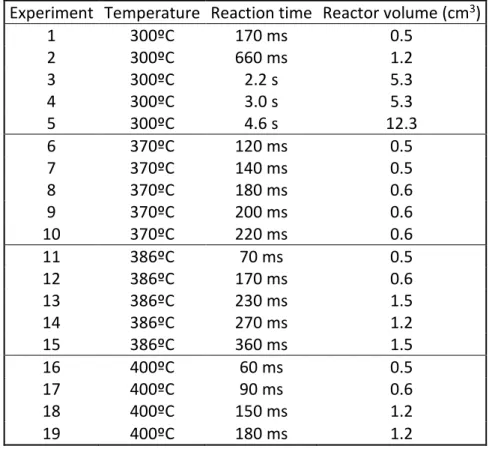
A total of 19 experiments were performed in order to examine the trend of hydrothermal decomposition of Kraft lignin in sub- and supercritical water and to determine the effect of the reaction parameters (temperature and time) on the degree of lignin conversion to low-molecular-weight phenolic compounds. A summary of the experiments is shown in Table S2.
3.1. Solid and aqueous residue fractions characterization.
Fourier Transform Infrared Spectroscopy (FT-IR) provides information about chemical functionalities present in the lignin structure. Figure 6 shows the FT-IR spectrum of Kraft lignin, three solid fractions and two aqueous residues (AqR) obtained at different operating conditions taken as examples for comparison purposes. Table S3 shows some typical bands.
As can be observed, the FT-IR spectra of lignin and aqueous residues were very similar, which indicated that they have a similar structure and functional group types. Small differences could only be observed in the 3000-2800 cm-1 region
CHAPTER I
40
On the other hand, solid fractions spectra look also like lignin spectrum with some differences in bands 1710-1665 cm-1, typical of unsaturated aldehydes and ketones, 1400-1300 cm-1 and 900-700 cm-1 corresponding to the C-H bending
typical of saturated and unsaturated hydrocarbons, respectively, and the band corresponding to C-O stretching in the region 1300-1000 cm-1, which indicates
CHAPTER I
41 Figure 6. Comparison of the lignin structure with solids and aqueous residues (AqR) obtained at different operating conditions analysed by FT-IR. Only five fractions were shown here as examples in order to confirm AqR is practically unconverted or partially depolymerized soluble lignin and solid fraction is lignin with some chemical modifications, probably due to repolymerization reactions.
3.2. Effect of temperature and reaction time in the depolymerization and repolymerization products.
CHAPTER I
42
lead to gas (mainly CO2), an organic phase, an aqueous phase and sometimes
solid chars [1]. Here, the yield of the main products (aromatic oil and solid fraction) obtained at different temperatures and reaction times is presented in Figure 7.
Higher conversion of lignin to an aromatic oil containing low-molecular-weight phenolic compounds was observed under supercritical conditions (400 and 386ºC) or under subcritical conditions close to the critical point of water (370ºC). As observed in Figure 7A-7C, depolymerization of lignin occurred rapidly, in 90 ms at 400ºC, 170 ms at 386ºC and 140 ms at 370ºC, reaching a maximum in the aromatic oil yield of 40.4, 44.6 and 32.4% respectively. On the other hand, under subcritical conditions at a temperature far from the critical point (300ºC, Figure 7D), lignin depolymerized slowly, reaching a maximum oil yield of only 11.8% at much higher reaction times (2.2 s). Thus, at higher temperatures, lower reaction times are required for reaching higher yields in aromatic low-molecular-weight fragments, as expected from the kinetic point of view. This also suggests that decomposition of lignin is accelerated by radical reactions, as reflected by its increased rate under supercritical conditions, where the ionic product and dielectric constant are much lower. The rapid depolymerization of lignin under supercritical conditions occurred mainly because of the cleavage of ether bonds from the abundant β-aryl ether (β-O-4) linkages in softwood lignin [17, 18]. Faravelli et al. [19] discovered that the weakest bond inside the lignin structure favoured radical formation and initiated the radical reaction.
CHAPTER I
43
weight fragments instead of further depolymerization into basic phenolic compounds occur.Moreover, in SCW, the dielectric constant of water decreases with increasing temperature, promoting the dissolution of lignin and the reaction of soluble lignin fragments with low-molecular-weight soluble compounds to form polymers and cross-linked phenolic fragments [20]. Thus, the repolymerization reactions via radical coupling and/or via ionic reactions (condensation) were promoted by increasing temperature, as it was affirmed by Wahyudiono et al. [4]. This was also noticed in other study, where heavier products were formed during hydrothermal reactions leading to condensed compounds and, when high temperatures and/or long residence times were reached, to cross-linked phenolic fragments [21].
Figure 7. Yield of aromatic oil (continuous line) and solid fractions (dotted line) vs reaction time at A) 400 ºC, B) 386ºC, C) 370ºC and D) 300ºC. Fractionation yields calculated as in equation 2.
CHAPTER I
44
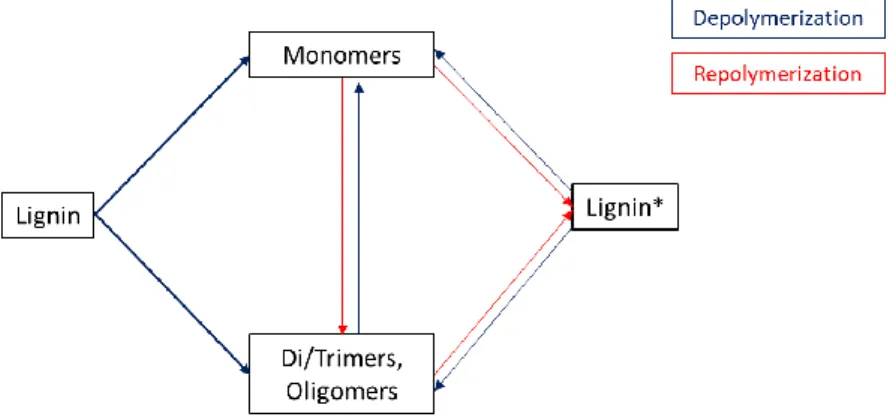
and being formed repolymerization products (i.e. solid fraction); in a third step, lignin seems to depolymerized again, increasing the amount of phenolic compounds. It is probable that the repolymerized products depolymerize again, giving a lower aromatic oil yield in this second depolymerization, since repolymerized lignin has probably a more compact and complex structure than the unreacted lignin. A simplified scheme of this hypothesis is shown in Figure 8. This hypothesis could explain why other studies at longer reaction times gave lower aromatic oil yields. A long experimental work would be necessary to corroborate this hypothesis.
Figure 8. Possible reaction pathway of lignin in hydrothermal processes using sub and supercritical water. The main depolymerization occurs from unreacted lignin (bold lines). Repolymerization reactions are promoted by increasing temperature and reaction time.
CHAPTER I
45 3.3. Selectivity and yield of aromatic monomers with temperature and reaction time.
During hydrothermal degradation, various aromatic monomers were formed. Table S4 shows the results of the qualitative examination of the aromatic oils using GC-MS, while Figure S1 shows a model chromatogram. The major compounds identified in the aromatic oils were guaiacol, vanillin, acetovanillone and homovanillic acid; all of them are derived from coniferyl alcohol, which is the main monomer of softwood lignins. Other analytes were also detected in small amounts (Table S4). Indeed, a total of 17 compounds have been identified, showing the complexity of the degradation pathway. The selectivity of the major monomers in the aromatic oil vs time, as well as the yield of those compounds referred to lignin for the different temperatures studied are shown in Figure 9. At 400ºC, the curve of the selectivity of monomers in the oil (Figure 9-A1) followed the same increasing trend than in the case of solid fraction yield, as it was seen in the previous section (Figure 7A). This similar trend between the monomers and solid formation could be explained as in the previous section: reaction of soluble lignin fragments to form polymers and cross-linked phenolic components was promoted at higher temperatures. At 400ºC the soluble lignin fragments seem to repolymerize preferentially than monomers. Acetovanillone was the first compound formed at 60 ms. Then, this compound disappeared and vanillin and homovanillic acid were formed. Homovanillic acid continued increasing with the reaction time up to 6.6% in the aromatic oil at 170 ms. At 150 ms, when vanillin started to decrease, acetovanillone increased again, up to 2.8% in the oil at 170 ms.
CHAPTER I
46
yield of 2.6%: 1.6% homovanillic acid, 0.5% vanillin, 0.3% acetovanillone and 0.2% guaiacol. It was reported in previous works that guaiacol and other methoxy phenols are formed partly by hydrolysis of ether-bonds [1].
At 386ºC (Figure 9-B1), the trend of monomers selectivity (total curve) was similar to that of the oil yield (Figure 7B). Thus, the optimal reaction time in terms of monomeric yield corresponded to that of the highest aromatic oil yield (170 ms), with 4.4% of phenolic monomers, corresponding 2.2% to guaiacol, 1.1% to vanillin, 0.7% to homovanillic acid and 0.7% to acetovanillone. At this temperature, the aromatic oil fraction was very selective, with a total composition in high value monomers of 10% (4.5% guaiacol, 2.6% vanillin, 1.6% homovanillic acid and 1.3% acetovanillone). Homovanillic acid and acetovanillone were formed firstly, and then, when those disappeared, the formation of guaiacol and vanillin took place. These trends were similar to those at 400ºC, where vanillin and acetovanillone were formed and decomposed conversely.
At 370ºC the trend of the monomer formation (Figure 9-C2) was different to that of the aromatic oil formation (Figure 7C). The maximum in the monomeric yield (170 ms) occurred at a reaction time longer than the maximum in aromatic oil yield. This indicates that di-trimers were formed first and they further cleave to form the monomers, being the former those which control the trend of the oil curve. The highest selectivity in the oil appeared at 200 ms (Figure 9-C1) with 8.0%, being 4.4% homovanillic acid, 1.8% vanillin, 1.0% acetovanillone and 0.8% guaiacol. However, the highest yield was obtained at 170 ms (Figure 9-C2), but with a low value of 0.5%, since the oil yield at this reaction time was only 21.4% (Figure 7C). This indicates that di-trimers seem to be involved mostly in the repolymerization reactions because they disappeared much faster than monomers to form solid residue. At 370ºC, vanillin and acetovanillone were firstly formed, and subsequently, they seem to degrade. Both homovanillic acid and guaiacol were formed reaching a maximum at 170 ms.
CHAPTER I
47
were vanillin (3.2%) and acetovanillone (1.8%). In here, acetovanillone and guaiacol were firstly formed, and then homovanillic acid increased up to 2.3% at 2.2s. After this time, the latter was decomposed and vanillin and acetovanillone increased until reaching the maximum yield at 3.0 s, for finally decreasing (and homovanillic acid increased again).
CHAPTER I
48
CHAPTER I
49 4. Conclusions.
The hydrothermal decomposition of lignin was performed in sub- and supercritical water. Kraft lignin as an example of a residue from pulp and paper industry was chosen for this study. This lignin was successfully degraded into low-molecular-weight components such as guaiacol, vanillin, acetovanillone and homovanillic acid, being the optimal operating conditions 386ºC and 170 ms. At this temperature and reaction time, a yield of aromatic oil yield of 44.6% was obtained, with a total of the four selected monomers of 9.9%, suppressing almost totally the solid formation. The solid fraction consisted of repolymerized products, reaction more favoured at higher temperatures and reaction times. It was also concluded that changing the reaction conditions from sub- to supercritical, as well as the reaction time, strongly influenced the lignin degradation reactions into phenolic monomers. A more comprehensive study would be required for understanding the mechanism of those reactions.
Hydrothermal decomposition of kraft lignin in sub- and supercritical water could become an environmentally friendly technology to produce effectively aromatic monomers of high value-added.
Supplementary information.
Table S1. Properties of Kraft lignin.
pH 6.5 (25 °C, 5%, aqueous solution)
Solubility H2O: Mostly soluble
NaOH: 0.05% (warm 5% aqueous)
MEK, methanol: partially soluble
Benzene, hexane: insoluble
Dioxane, ethylene glycol: soluble
CHAPTER I
50
Table S2. Summary table of the experiments performed in sub- and supercritical water conditions at different reaction times. A total of 6 different reactors were made.
Experiment Temperature Reaction time Reactor volume (cm3)
1 300ºC 170 ms 0.5
2 300ºC 660 ms 1.2
3 300ºC 2.2 s 5.3
4 300ºC 3.0 s 5.3
5 300ºC 4.6 s 12.3
6 370ºC 120 ms 0.5
7 370ºC 140 ms 0.5
8 370ºC 180 ms 0.6
9 370ºC 200 ms 0.6
10 370ºC 220 ms 0.6
11 386ºC 70 ms 0.5
12 386ºC 170 ms 0.6
13 386ºC 230 ms 1.5
14 386ºC 270 ms 1.2
15 386ºC 360 ms 1.5
16 400ºC 60 ms 0.5
17 400ºC 90 ms 0.6
18 400ºC 150 ms 1.2
19 400ºC 180 ms 1.2
Table S3. Characteristic IR absorptions
Frequency, cm-1 Bond Functional group
3600–3200 O-H stretch phenols, aliphatics
3000-2800 C-H stretch aromatic and aliphatic hydrocarbons
1710-1665 C=O stretch α, β-unsaturated aldehydes, ketones
1600-1585 C-C stretch (in ring) aromatics 1500-1400 C-C stretch (in ring) aromatics
1400-1300 C-H bend saturated aromatic hydrocarbons
1300-1000 C-O stretch alcohols, carboxylic acids, esters, ethers
CHAPTER I
51 Table S4. GC-MS compounds list present in the aromatic oils. Only the major compounds (guaiacol, vanillin, acetovanillone and homovanillic acid) were quantified. Dodecylbenzene was also identified in Kraft lignin, being probably an impurity.
Retention time (min) Compound
29.99 Guaiacol
34.46 5-methyl guaiacol
35.30 4-methyl guaiacol (creosol)
40.12 4-Ethylguaiacol
42.18 4-Vinylguaiacol
44.42 Syringol
44.76 Eugenol
47.20 Vanillin
50.08 Isoeugenol
52.35 Acetovanillone
54.76 Homovanillyl alcohol
57.61 Propiovanillone
61.29 Homovanillic acid
65.50 4-hydroxy-3-methoxycinnamaldehyde
65.79 Acetosyringone
69.73 Dehydrozingerone
74.59 Dodecylbenzene
Figure S1. Example of a chromatogram obtained by GC-MS for an aromatic oil obtained at 170 ms and 386ºC.
References.
1. Joffres, B., et al., Thermochemical Conversion of Lignin for Fuels and Chemicals: A Review. Oil Gas Sci. Technol. – Rev. IFP Energies nouvelles, 2013. 68(4): p. 753-763. 2. Liu, W.-J., H. Jiang, and H.-Q. Yu, Thermochemical conversion of lignin to functional
CHAPTER I
52
3. Pińkowska, H., P. Wolak, and A. Złocińska, Hydrothermal decomposition of alkali lignin in sub- and supercritical water. Chemical Engineering Journal, 2012. 187: p. 410-414. 4. Wahyudiono, M. Sasaki, and M. Goto, Recovery of phenolic compounds through the
decomposition of lignin in near and supercritical water. Chemical Engineering and Processing: Process Intensification, 2008. 47(9): p. 1609-1619.
5. Saisu, M., et al., Conversion of Lignin with Supercritical Water−Phenol Mixtures. Energy & Fuels, 2003. 17(4): p. 922-928.
6. Fang, Z., et al., Reaction chemistry and phase behavior of lignin in high-temperature and supercritical water. Bioresource Technology, 2008. 99(9): p. 3424-3430.
7. Okuda, K., et al., Disassembly of lignin and chemical recovery—rapid depolymerization of lignin without char formation in water–phenol mixtures. Fuel Processing Technology, 2004. 85(8): p. 803-813.
8. Yong, T.L.-K. and Y. Matsumura, Reaction Kinetics of the Lignin Conversion in Supercritical Water. Industrial & Engineering Chemistry Research, 2012. 51(37): p. 11975-11988.
9. Yong, T.L.-K. and Y. Matsumura, Kinetic Analysis of Lignin Hydrothermal Conversion in Sub- and Supercritical Water. Industrial & Engineering Chemistry Research, 2013.
52(16): p. 5626-5639.
10. Toor, S.S., L. Rosendahl, and A. Rudolf, Hydrothermal liquefaction of biomass: A review of subcritical water technologies. Energy, 2011. 36(5): p. 2328-2342.
11. Brunner, G., Chapter 2 - Properties of Pure Water, in Supercritical Fluid Science and Technology, G. Brunner, Editor. 2014, Elsevier. p. 9-93.
12. Antal, M.J., et al., Heterolysis and Homolysis in Supercritical Water, in Supercritical Fluids. 1987, American Chemical Society. p. 77-86.
13. Wagner, W., et al., The IAPWS Industrial Formulation 1997 for the Thermodynamic Properties of Water and Steam. Journal of Engineering for Gas Turbines and Power, 2000. 122(1): p. 150-184.
14. Baumard, P.a.B., H., Internal standard quantification method and Gas Chromatograph-Mass Spectrometer (GC-MS): A reliable tool for Polycyclic Aromatic Hydrocarbon (PAH) quantification in natural matrices. Analusis, 1997. 25(7): p. 246-252.
15. Cantero, D.A., M. Dolores Bermejo, and M. José Cocero, High glucose selectivity in pressurized water hydrolysis of cellulose using ultra-fast reactors. Bioresource Technology, 2013. 135: p. 697-703.
16. Pérez, E. and C.O. Tuck, Quantitative analysis of products from lignin depolymerisation in high-temperature water. European Polymer Journal, 2018. 99: p. 38-48.
17. Li, J., G. Henriksson, and G. Gellerstedt, Lignin depolymerization/repolymerization and its critical role for delignification of aspen wood by steam explosion. Bioresource Technology, 2007. 98(16): p. 3061-3068.
18. Kang, S., et al., Classified Separation of Lignin Hydrothermal Liquefied Products. Industrial & Engineering Chemistry Research, 2011. 50(19): p. 11288-11296.
19. Faravelli, T., et al., Detailed kinetic modeling of the thermal degradation of lignins. Biomass and Bioenergy, 2010. 34(3): p. 290-301.
20. Wahyudiono, et al., Decomposition of a Lignin Model Compound under Hydrothermal Conditions. Chemical Engineering & Technology, 2007. 30(8): p. 1113-1122.
CHAPTER II
OBTENTION OF AROMATIC
MONOMERS FROM LIGNIN
THROUGH ULTRAFAST SCW
REACTIONS USING SODIUM
HYDROXYDE AS CATALYST.
CHAPTER II
55
OBTENTION OF AROMATIC MONOMERS FROM LIGNIN
THROUGH ULTRAFAST REACTIONS IN WATER USING
SODIUM HYDROXYDE AS CATALYST.
Abstract.
CHAPTER II
56
1. Introduction.
Bio-based polymers’ growth rates are at same level as synthetic polymers: Worldwide production capacity is forecasted to increase from 6.6 million tons in 2016 to 8.5 million in 2021. In the absence of renewables aromatic building blocks,
polymers are currently produced from a petrochemical aromatic molecule and a bio-based aliphatic molecule [1]. Lignin is an aromatic biopolymer that constitutes a major component of lignocellulosic biomass. It is composed by combination of three phenylpropanoid units (p-coumaryl, coniferyl and synapyl alcohols) randomly connected in different proportions depending on the biomass of origin. Despite its abundance and promising molecular structure for obtaining high value monoaromatic compounds, lignin is still underutilized compared to other feedstocks [2]. Currently, lignin is produced in large quantities in the pulp and paper industry as the main component of black liquor, a low-value residual stream that is further processed to be burned and obtain energy in the same plant. Moreover, with the increasing role of biorefineries in a bio-based economy, even more generation of lignin is expected. Depolymerization is an obvious strategy to valorize lignin as it provides single aromatic chemicals. However, this route has been deceptive because of the low selectivity of the compounds targeted and the tendency of lignin fragments to recombine to form char-type by-products [2]. However, this has not discouraged the scientific community who has redoubled its efforts to obtain a solution and as consequence, important advances have been achieved. Some of the most successful approaches explored were catalyst improvement [3], or pretreatment stages with oxidants [4] or formaldehyde [5, 6]. Nevertheless, this kind of meticulous processes are very far of being translated into commercial practice due to the several non-continuous steps that must be carried out and the long time required. Ragauskas et al. [7] have presented this paradigm, posing the reality: “although fundamental research has historically focused
on converting lignin to chemicals materials, very little of this effort has been translated
CHAPTER II
57
CHAPTER II
58
avoid blockages, with the additional advantage that it acts as catalyst [2]. To facilitate understanding and analysis of the reaction products, it has been common to fractionate the samples according to their solubility in water and organic solvents [2, 10, 13]. As polar solvents would dissolve similar solutes, lignin fragments from lignin breakdown would distribute within the solvents according to their chemical characteristics. Ethyl acetate seems to be a good candidate as extracting solvent as it is non-costly and environmentally benign. Experimentally, it was demonstrated that EtAc could easily extract monomers but also higher molecular weight compounds soluble in water [17]. Thus, a light fraction can be extracted from the water-soluble compounds, namely light oil, mainly composed by aromatic fragments from depolymerization. The water-insoluble compounds can likewise be fractionated into a heavy oil and a solid residue that has been commonly designated as char.
2. Materials and methods.
2.1. Materials.
Lignin used in this work was kraft lignin with low sulfide content (4% sulfur) from Sigma-Aldrich. Distilled water was used as the reaction medium to run the experiments. Sodium hydroxide used as catalyst was purchased from Sigma-Aldrich. The calibration standards used in the GC-MS analysis were all purchased from Sigma-Aldrich (USA): syringol (≥98%), acetosyringone (97%), homovanillic acid (≥97%), guaiacol (≥99%), creosol (≥98%), acetovanillone (≥98.0%), vanillin (99%), syringaldehyde (≥97%) and the internal standard 2-phenyl ethanol (≥99%). Ethyl acetate (>99%) employed for carrying out the extractions was purchased from Sigma Aldrich. Kraft lignin named as HKL and the corresponding black liquor (HKBL) were supplied by a Spanish paper industry.
2.2. Supercritical water process.
CHAPTER II
59
Sudden Expansion Micro-Reactors (SEMR) consisting in short inconel steel tubes with small internal diameters (1.4-4.8 mm) were used in order to achieve reaction times as short as 60 milliseconds. The lignin solution is continuously compressed and pumped up to the operation pressure, remaining at room temperature until the inlet of the reactor. NaOH, used as catalyst, is premixed with the lignin stream. Heating is achieved by mixing the compressed room temperature lignin solution with a stream of hot pressurized water in the T junction. The product is depressurized through a high temperature needle valve (high-T valve), instantaneously cooling down the effluent down to ca. 150 ºC and therefore stopping the reaction. To further reduce the temperature down to ambient, a cooler was set after the preheater used to preheat the SCW.
P-1 P-2 Water CV-1 CV-2 PI-1 PI-2 High-T valve PT-1 Preheater Cooler V-3 Heater Product TT TT TT TT V-2 TT Lignin + NaOH Solution TT SEMR 150ºC 400ºC 450ºC 22ºC 22ºC 260 bar
260 bar 120ºC
22ºC
Figure 1. Scheme of the SCW plant.
In this study, base-catalyzed reactions were carried out at 386 ± 2.6ºC and 260 ± 5 bar with low reaction times between 40 and 500 ms. The reaction time was controlled by changing the inlet flow to the reactor and the reactor volume. The flows were varied between 1.4 and 2.6 L·h-1 of the basic lignin solution and 3.4-
4.4 L·h-1 of SCW. Two reactors were made with volumes of 0.6 and 1.1 cm3 for
CHAPTER II
60
solution of NaOH 0.2 M (pH 13). All the experiments were made by triplicate referring results as the arithmetic average value. Carbon losses (TOC+IC) because of gasification (CO2) and/or volatilization of monomers between 0.4 and
15.2 wt% were determined for experiments performed at 386ºC.
2.3. Fractionation of depolymerization products.
Once the reaction finished, the reaction product was treated to recover the aromatic monomers of interest following a similar procedure that in previous chapter. Figure 2 presents a simplified scheme of the procedure used to separate the mixture into four fractions. Product mixture (P) was acidified by adding concentrated H2SO4 dropwise until the solution reached pH=2. The
CHAPTER II
61 Figure 2. Separation sequence for product fractionation after lignin depolymerization.
The product of interest in this study was light oil containing the low-molecular-weight phenolic compounds. The aqueous residue fraction contained salts formed (Na2SO4) during neutralization and it was not considered in this study. 2.4. Characterization procedures.
2.4.1. GC-MS analysis of the oily fractions.
CHAPTER II
62
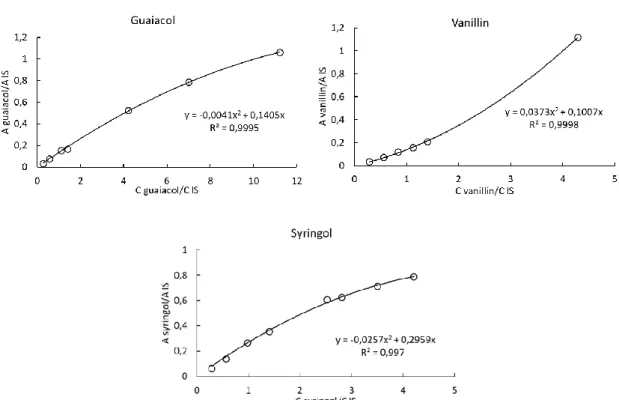
were compared with m/z values compiled in the spectrum library Wiley. Data analysis was performed using the Agilent Mass Hunter software (Agilent Technologies, USA). Validation of compound identification was carried out by comparison of their MS spectra and their retention times with standards. Quantification was carried out employing the internal standard method. With this calibration method, the peak area of each compound was normalized to the peak area of the internal standard. Some calibration curves are represented in Figure 3.
Figure 3. Calibration curves for guaiacol, vanillin and syringol using the internal standard method for GC-MS.
2.4.2. Gel Permeation Chromatography (GPC).
CHAPTER II
63
concentration between 2 and 6 mg/mL The injection volume was 25 µl. Further details can be found in reference 2. Calibration standards were not used since the objective of this work was to study the molecular weight distribution qualitatively. Base line was corrected manually and chromatograms were normalized to the highest peak (Y-axis) for comparison purposes.
2.4.3. Micro-elemental analysis CHNS.
LECO CHNS-932 and VTF-900 analyzer equipped with an automatic sampler with capacity for 50 samples and an ultra-microbalance SARTORIUS M2P (precision ± 0.001 mg) were used.
Proportion of each element was corrected to exclude the moisture according to the following equations:
0 C moist. % % 100 100 % C 0 H moist. H moist. 2 % % 18 % 100 100 % 0 S moist. % % 100 100 % S
%C, %H, %S are the corrected percentages for C, H and S respectively; %C0, %H0,
%S0 are the nominal percentages. %moist. is the percentage of moisture. 2.4.4. Fourier Transform Infrared Spectroscopy (FTIR-ATR).
The equipment used for FT-IR analysis of lignin and char was a Bruker Tensor 27 with a diamond crystal. The analysis were performed at room temperature. The spectra are recorded in mode Attenuated Total Reflection (ATR). The base line was corrected, and the peaks were normalized to the area between 1393 and 1816 cm-1 (aromatic skeletal vibration).
2.4.5. Thermo Gravimetrical Analysis (TGA).
CHAPTER II
64
atmosphere (60 mL/min flow) from a temperature of 50 ºC up to temperatures around 850 ºC. Keeping a constant temperature of 850ºC, air was flowing during 5 min with a flow of 60 ml· min-1.
Content of moisture was determined from TGA traces as the mass loss within temperature up to 120 ºC.
2.4.6. Nuclear Magnetic Resonance (NMR).
NMR spectra were collected using an Agilent DD2 500 instrument equipped with cryoprobe, operating at 499.81 MHz for 1H and at 125.69 MHz for 13C. Pyridine
was used as solvent, and the experiments were performed at room temperature.
2.5. Calculation of fractionation yields and selectivity of monomers.
For calculating the yield of the fractionation product ‘i’, %𝑌𝑖, equation 1 was used: %𝑌𝑖 =
𝐶𝑖
𝐶𝐿𝑔× 100 (1)
Where 𝐶𝑖 is the concentration of the fraction ‘i’ in the product mixture, expressed in g · L−1and 𝐶𝐿𝑔 the concentration of lignin in the reactor, expressed in g · L−1.
Analogously, the yield in the monomer ‘x’, %𝑌𝑥, present in the product mixture, is referred to the total amount of lignin and calculated as equation 2:
%𝑌𝑥= 𝐶𝑥
𝐶𝐿𝑔× 100 =
𝑋𝑥𝑜𝑖𝑙𝐶𝑜𝑖𝑙
𝐶𝐿𝑔 × 100 = 𝑋𝑥
𝑜𝑖𝑙⋅ 𝑌
𝑜𝑖𝑙 (2)
Where 𝐶𝑥 is the concentration of the monomer ‘x’ in the product mixture, 𝑋𝑥𝑜𝑖𝑙 (g · g−1) is the mass fraction (or selectivity) of the monomer ‘x’ in the aromatic oil
and 𝐶𝑜𝑖𝑙 is the concentration of the aromatic oil in the product mixture (g · L−1).
3. Results and discussion.
3.1. Effect of reaction parameters on the kraft lignin depolymerization/repolymerization: Mechanisms.
CHAPTER II
65
depolymerization product since monomers can be more easily isolated from the remaining mixture of di-trimers and the latter be used as precursor of materials [9]. Optimization of this fraction depends on time and temperature (Figure 4) as maxima were found at longer reaction times for lower temperatures, as it was seen in Chapter I. However, it seems that reaction time has a more detrimental effect than temperature as the highest yield of light oil was obtained at 400 ºC and short times. These results are in agreement with other studies where it is shown that increasing the reaction time (i.e. increasing the reaction severity), decreases the concentration of phenolic compounds (monomeric oil production) as the importance of repolymerization reactions increases [15].
Figure 4. Non-catalyzed depolymerization of lignin in sub- and supercritical water (results from Chapter I). Light oil yield vs reaction time at different temperatures.
CHAPTER II
66
lower and temperatures where ionic pathways are supposed to be less important. NaOH increased the light oil yield to almost double, even reacting a lignin concentration 5-times greater than in the case of non-catalytic reaction.
Figure 5. Evolution of the depolymerization reaction of kraft lignin vs time at 386 ºC. a) Light oil yield with and without NaOH catalyst addition. b) Yield of heavy oil and char obtained in the base-catalyzed reaction. c) Elemental composition for char. A triplicate extraction of one experiment was performed in order to determine the standard deviation for each fraction: char 4.6 wt%, heavy oil 5.0 wt% and light oil 1.3 wt%.
CHAPTER II
67
yield. This behavior was also observed at other temperatures in Chapter I. It was thought that water insoluble fractions obtained at reaction times below or over 240 ms must be different in composition than each other and therefore, originated by different kind of reactions. Indeed, TGA done to these samples reveal that the latter are more stable than the former as a peak in the derivative at T = 770 ºC is appreciated in Figure 6a, which is coherent with the presence of resilient repolymerization products. Nevertheless, whatever transformations are occurring they do not alter significantly the aromatic structure as little difference was observed in the FT-IR spectrum at wavenumbers within 1400 and 1650 cm-1
(Figure 6b). This is not the case of the C-O bonds whose signals appeared within 1000 and 1300 cm-1 as spectra of lignin, and solid at short and long residence times
were different.
Elemental analysis also shows a significant change in %C, %H and %O respect the starting lignin (Figure 5c). The values of H/C quickly decreased within the first 64 ms while those for %C increased. These changes point to a first very fast reaction step of dehydration of the aliphatic backbone as proposed in Figure 7. This hypothesis can be further supported by Heteronuclear Single-Quantum Correlation (HSQC), which is a 2D NMR technique that detects 13C-1H coupling
separated by three or four bonds. The -OH groups located in the aliphatic backbone of lignin disappeared upon SCW treatment (see Section 3.3. Additional results, Figure 13).
CHAPTER II
68
Once the equilibrium is established, the -O-4 ether linkages will be progressively cleaved. According to McDonough [19], dehydration will be followed by a hydrolysis that generates an enolate that will immediately proceed to form the corresponding ketone via keto-enol tautomerization. However, Roberts et al. [12] proposed a basic-catalyzed reaction through resonance-stabilized benzyl carbocations. These mechanisms are proposed for temperatures not higher than 300 ºC, where ionic pathways are dominant. As discussed above, reaction temperatures in this work are higher so additional pathways must be considered [22]. Apart from breaking ether linkages, depolymerization can proceed via different homolytic cleavages to produce the main monomers including the homovanillic acid, which has never been reported in significant amounts from lignin depolymerization.
As depolymerization proceeds, smaller oligomers and monomers will be incorporated to the aromatic oil fraction increasing its yield while the amount of solid fraction decreases down to an optimum point at 240 ms.