Lasers and Optics © Springer-Verlag 1998 Applied Physics B
Photoacoustic characterization of phase transitions
in amorphous metal alloys
A b stra ct In this work a pulsed laser photoacoustic technique is employed in amorphous alloys for the characterization of crystallization temperatures and the determination o f the acti vation energies for the transitions. It is shown that the changes produced in the photoacoustic signal generated by low en ergy laser pulses (< 200 pJ), is a sensitive probe for detecting the crystallization o f a metallic amorphous sample. A piezo-electric transducer attached to the sample by means o f a glass substrate was used for the acoustic detection. The developed technique has the advantages o f requiring a minimum amount o f sample, with no special sample preparation or condition-ing. In order to demonstrate the validity o f the technique, it was applied to the study o f the crystallization processes o f the amorphous Mg Zn alloy, comparing the result with respect to resistivity measurements.
The stability o f amorphous metals can be determined by thermal measurements. When an amorphous metal is heat ed above its glass transition temperature, it undergoes first a second order glass to undercooled liquid transition and af-terwards a first order liquid to crystal transition [1,2]. The structural changes are usually detected by X ray or neu tron diffraction, scanning calorimetry or electrical resistivi ty measurements. The stability of the amorphous phase and the activation energies for the transitions are determined by the kinetics o f transformation, that is, the delay before the transition takes place, after heating above the critical tem perature. When isothermal annealing is used, the activation energy is determined from Arrhenius plots and at constant heating rates from Kissinger plots [3]. In this work a new technique for the determination o f phase transition in metal alloys, based on the photoacoustic effect is presented. Pho toacoustics is related to the phenomena o f the generation o f acoustic waves in a medium after interaction with mod ulated or pulsed electromagnetic radiation. One interesting property of the phenomena, is that the photoacoustic signal generated, depends on the thermoelastic parameters o f the
medium (thermal expansion, sound velocity, heat capacity, etc.), magnitudes that change greatly in a phase transition, hence, structural changes can be easily determined in realtime by monitoring the changes in the photoacoustic signals. Prior work related to photoacoustic characterization o f phase tran-sitions relies on the use o f a chopped lamp or a CW low power laser and a gas cell with a microphone [4]. This technique re-quires a very small volume o f gas contacting the sample and the microphone [5]. This requirement is difficult to achieve as the microphone must be placed far from the sample, outside the temperature controlled region, leading to sophisticated de-signs [6,7].
In this work a pulsed laser photoacoustic technique is employed. Pulsed laser generation o f acoustic waves in the condensed phase, has been widely used for the characteriza tion o f materials [8]. Here, the laser excitation o f the sample acts only as a source o f acoustic waves, then the energy of the pulse must be always sufficiently low to avoid heating or surface changes. As the detector used is a piezoelectric trans-ducer contacting the sample by means of a glass substrate, it can be easily placed outside the oven without any special requirement in the design.
In order to demonstrate the validity of the technique de-veloped, it was applied to the study of the crystallization processes o f the amorphous Mg Zn alloy (Mg7oZn30). This alloy was selected because it has been thoroughly studied and the large number o f prior publications allows a reliable comparison with the results. It presents a eutectic at the com position used, and has a high temperature equilibrium phase M g5iZn2o (denoted as M g7Zn3> that has been characterized by Higashi [9], The sample becomes amorphous after rapid cooling from the melt [10,11] with a short range order similar to that o f the Mg5iZn2o crystalline phase [12 14], Accord ing to Andonov [15] it is actually described by the coexis tence o f a disordered phase similar to the liquid state and better organized aggregates which are not yet crystallized. The amorphous phase is only marginally stable [16] and different authors have found somewhat different transition temperatures, depending on the thermal history o f the materi al [7,17]. The crystallization upon heating has been described
187 Received: 24 February 1997
D J . Orzi1, G.M. Bilm es1, J.O. Tocho1, N. Mingólo2,0 .E . Martínez3
1 Centro de Investigaciones ópticas (CIC-CONICET) and Universidad Nacional de La Plata, C.C.124, 1900, La Plata, Argentina Fax: +54-21/71-2771, E-mail: [email protected])
2 Departamento de Física, Facultad de Ingeniería, UBA, Paseo Colón 850, 1063 Buenos Aires, Argentina (Fax: +54-1-331-0129, E-mail: [email protected])
3 Departamento de Física, FCEyN UBA, Pabellón 1, Ciudad Universitaria, 1428 Buenos Aires, Argentina (Fax: +54-1-782-7647, E-mail: [email protected])
PACS: 78.20; 61.40; 64
-- -
-"
--
-- “ ”
-by several authors [10,11,13,18,19], and the activation en ergy for crystallization has been determined [11,18].
In characterizing this new technique, electrical conductiv ity and photoacoustic signals were simultaneously measured during different thermal cycles o f the samples in the range between room temperature and 560 K, identifying com plete ly the most important phase transitions that take place in this material. Activation energies o f the transition as well as the sound velocity in the amorphous and crystalline phase were also measured.
Generation o f photoacoustic signals and changes as a function o f temperature, are discussed in terms o f the changes in the thermodynamic parameters o f the samples.
1 Experim ental
The experimental setup used is shown in Fig. 1. The ex citation source was the second harmonic (A. 532 nm) o f a Q-switched Nd3+-YAG laser, providing 7 ns width pulses at a repetition rate o f 10 Hz and attenuated to less than 200
pJ
to avoid excessive heating o f the material. The samples were rib bons 20 pm thick, 1 mm wide, and pieces around 1 mm long were cut and pressed between an L shaped glass substrate and a glass cover, to ensure good acoustical contact ( sam ple holder ). The short arm o f the substrate was located inside a temperature controlled oven, and the end o f the large part outside it, attached with glue to the acoustic transducer. The latter was a cylindrical ceramic piezoelectric detector (PZT) 4 mm in diameter and 4 mm long. The substrate was L shaped in order to avoid spurious acoustic signals produced by scat tered light absorbed at the surface o f the transducer [20]. The peak to peak amplitude o f the first detected acoustic oscilla tion (H) was monitored as a function o f the temperature. The acoustic signals were amplified ( x 800), and afterwards pro cessed by a storage digital oscilloscope that sampled at 100 M sam ples/sec with 8 bit resolution per point.The temperature o f the oven could be controlled between room temperature and 560 K using heating rates between 1 K /m in and 15 K /m in. The temperature o f the sample was measured by a thermocouple, mounted on the glass substrate at a distance o f a few millimetres from the sample. Energy measurements ( E ) were performed with a pyroelectric detec tor, sampling the pulse using a glass plate as the beam splitter. The four probe method was used for the measurement o f the resistivity (/?), using samples 10 mm long and electric con tacts made by pressing copper foils.
Automatic and simultaneous measurements o f the ampli tude o f the acoustic signal, energy o f the pulse, temperature, and resistivity, were made by taking 32 averages every 10 seconds. The data were stored in the computer for further pro cessing.
The samples (M g
7
oZn3
o near eutectic composition), were manufactured by the melt spinning technique [21], and X ray diffraction spectra were taken to verify that the material was initially amorphous. [image:2.595.307.555.72.330.2]Figure 2 shows the changes observed in the acoustic sig nal at three different temperatures (290 K, 423 K and 523 K). The registered signal is the result o f the response o f the de tector to all the waves, including reflections, and presents a characteristic “ringing o f the piezoelectric crystal. Hence, the selection o f the part o f the signal used to measure, must
[image:2.595.305.553.399.597.2]Fig. 1. Experimental set up used for the photoacoustic detection. Automat ic and simultaneous measurements of the amplitude of the acoustic signal, pulse energy, temperature, and resistivity, were made by taking 32 aver ages every 10 seconds. The data was stored in the computer for further processing
Fig. 2. Time dependence of the photoacousdc signal at different tempera tures. (solid) 290 K, (short dash) 423 K; (long dash) 523 K. The change in the shape is evident, and the peak to peak amplitude of the first oscillation is taken as the photoacoustic signal H
be made carefully. It is clear that, with the exception o f the first part o f the signal, the rest not only changes in ampli tude but also in shape, probably due to interference effects between different acoustic waves, deformations of the sam ple, etc. Taking this into account, the peak to peak amplitude o f the first oscillation was used as the photoacousdc signal H, and was divided by the laser pulse energy ( E ) to compensate the shot to shot laser fluctuations.
188
-=
--
-“
-”
247
2 R e su lts
Figure 3 shows a sim ultaneous m easurem ent o f the norm al ized photoacoustic signal
H /E
and the resistanceR
as a func tion o f the temperature, perform ed by heating the sam ples at a rate o f 9 K /m in . In both cases strong changes w ere ob served above 360 K (an increase o fH/E;
decrease o f /?), corresponding to the crystallization o f die sam ple, as it was previously reported in the literature [1 0 ,1 1 ,1 3 ,1 8 ], A fter heating to 570 K, the sam ple was cooled to room tem pera ture, show ing the irreversibility o f the transition. Successive temperature cycles o f heating and cooling show ed no further changes, confirm ing com plete crystallization. Thermal cycles perform ed from room temperature to 4 1 0 K (after the first transition), show ed a similar behaviour consistent with a com plete crystallization also at this stage. H ence tw o transition temperatures can be easily identified, one around 370 K and the other around 4 7 0 K.To determine the reproducibility o f the m easurem ents, ex periments were performed with the sam e heating rate w ith different pieces o f the sam e ribbon. Sim ilar curves w ere ob tained with a reproducibility within 5% o f the values o f the transition temperatures
The activation energies for the crystallization processes were estimated by the K issinger peak shift m ethod [3 ,1 1 ]. This procedure involves plotting
\og(T?/v)
as a function o f 1 /7 ), whereT\
is the temperature o f the transition, andv
is the^ heating rate. The slope o f the straight line obtained gives the activation energy o f the transition.Two activation energies w ere estim ated, corresponding to the two steps o f the crystallization. Figure 4 show s K issinger plots corresponding to the data obtained for different heating rates between 1 K /m in and 15 K /m in . The activation ener gies obtained for the tw o transitions are
E\ —
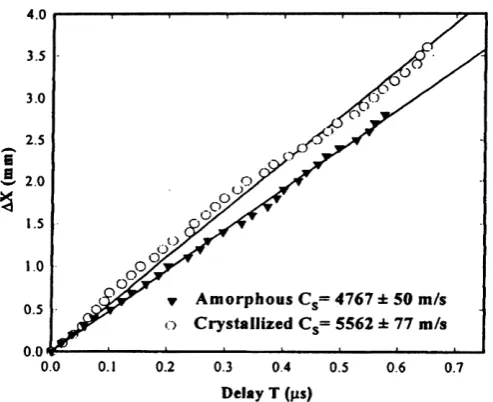
153 kJ/m ole, and £ 2 92 kJ/m ole.One o f the possible sources o f variation in the photoa coustic signal is a change in the sound velocity, a parameter that has not been measured previously for this alloy. With the aim o f establishing the importance o f the different parameters in this change, the sound velocity w as determ ined before and after the crystallization o f the sam ple. This w as performed outside the oven by m easuring the arrival tim e o f the acoustic signal after the laser shot, as a function o f the distance b e tw een the laser spot and the transducer. Figure 5 show s that the sound velocity in the amorphous phase (4767 ± 50 m /s) is
15% sm aller than in the crystalline phase (5562
±
77 m /s).3 D iscu ssio n s
[image:3.595.308.551.72.248.2]The origin o f the acoustic signal is the pressure w ave gener ated by the local heating o f the material, after absorbing part o f the laser energy. The signal detected depends in a com pli-cated manner on die excitation detection geom etry conditions o f the experim ent, and both the surface and bulk w aves are coupled to the detector. From the treatment perform ed by Bunkin et al. for the therm o optical generation o f acoustic w aves in a solid [22], the follow ing general expression for the amplitude o f the acoustic pulse as a function o f the therm o
Fig.3. Simultaneous measurement of resistance (/?) and normalized photoa coustic signal {H/E), as a function of temperature for a Mg7oZn3o alloy.
Arrows show the heating ( ►) and cooling (« ) cycles respectively. The heating rate was 9 K/min. Two transitions appear. The transition tempera ture was taken at the half point of the signal change, as shown
Fig. 4. Kissinger plots for the two steps of the crystallization processes of Mg7oZn3o The slope gives the corresponding activation energies, and the
values obtained are E\ 153 kJ/mole, and £ 2 92 kJ/mole
w here
fi
is the volum e thermal expansion coefficient, Cp is the heat capacity at constant pressure,E
is the absorbed laser pulse energy,p
is the density, F is a function o f the temporal and spatial shape o f the laser pulse and the geom etry o f the detection; r is the laser pulse duration, andD
2csr Z /a 2 is the acoustic diffraction parameter, with cs the sound velocity; Z the distance betw een the acoustic source and the detector, anda
the diameter o f the illum inated region.From (1), changes in the acoustic signal can be expect-ed from changes in the sound velocity, the alloy density, the expansion coefficient or the heat capacity. The sm all change m easured in the sound velocity, together with the sm ooth de pendence o f
F
withD,
cannot explain the large variations observed in the acoustic signal. The change in the density be tw een the glass, crystal and liquid is also very small [14,15].189
elastic parameters o f the m edia can be deduced:
(
1
)
--
-— —
-“ ”
-=
-= =
-=
[image:3.595.308.550.319.490.2]
-Fig. 5. Sound velocity determination in the amorphous and crystalline phase. The delay in the arrival of the acoustic signal was determined as a function of the distance between the laser spot and the position of the transducer
During a glass to undercooled liquid transition, Cp and /J are expected to increase upon heating, and conversely Cp and /? should decrease in the undercooled liquid to crystal tran sition [1,2]. Hence from (1), the sign o f the change in the photoacoustic signal w ill depend on which o f the two magni tudes has a larger relative change.
It is convenient at this stage to summarize prior results obtained by other authors with this alloy. The crystallization upon heating has been described by several authors [10,11, 13,18,19], showing first a crystallization transition around 360 K, reflected by a decrease o f the order o f 10% in the electrical resistivity [1 1 ,1 3 ,1 8 ], and two peaks in DSC ex periments [10,19]. Smaller crystallization temperatures were found by Schaal [23] using small angle X ray scattering and very slow heating rates (0.375 K /m in). This first dou blet is associated with the polymorphous crystallization o f very fine grained M gsiZn2o which is highly defective, and a subsequent recrystallization process to more perfect grains. A much smaller DSC peak occurs at higher temperature (around 500 K) due to the precipitation o f some Mg.
From the photoacoustic results, the first transition can be assigned to the material crystallization to M g5iZn:>o (detected as a doublet by DSC [1 1 ,1 3 ,1 8 ]). Our results with the elec trical resistivity are similar to those previously published [10,
19], validating our interpretation o f the photoacoustic signal changes. From Eq. (1), the increase o f the photoacoustic sig nal upon crystallization indicates that the change in Cp is the dominant mechanism involved in this transition. This is con sistent with the results reported in [15], where no important change in the thermal expansions in this temperature range were found during their diffraction studies.
From prior work, the activation energies o f the two peaks o f the DSC doublet were found to be 160kJ/m ole and 120kJ/m ole [11]. Shiotani et al. [18] determined the ac tivation energy for different com positions between 69 at.% and 72 at% o f M g by Arrhenius plots using the electrical re sistivity changes, yielding values between 150kJ/m ole and 130kJ/m ole. Calka [16] showed that the activation energy
depends on the composition and aging o f the sample. With our technique only one activation energy
E\
153kJ/m ole was determined with a value Consistent with prior works.The second transition detected corresponds to the segrega tion o f Mg, as reported by several authors [10,11,13,18,19]. The activation energy for this transition has not been previ ously reported.
It was not possible to determine the glass transition from our measurement, probably due to its proximity to room tem perature. The small decrease in the photoacoustic signal be tween room temperature and 350 K can be attributed to the in crease in Cp during the glass transition, but this result was not repetitive enough for an unambiguous assignment. This coin cides with previous findings, that showed that when scanned with DSC the endothermic glass transition is either absent or extremely weak [10].
The photoacoustic signal increases by a factor o f two in the first transition while the electrical resistivity decreases by only 15%, showing a larger sensitivity o f the new method for this amorphous to crystalline transition. This feature aris es from the large change in Cp for these transitions. For the crystal crystal transition, the sensitivities are similar, showing a 50% relative change in both magnitudes.
4 C o n c lu sio n s
rIt has been shown that the changes produced in the photoa coustic signal generated by low energy laser pulses (less than
200
jjJ),
is a sensitive probe for detecting the crystallization o f a metallic amorphous sample.The developed technique has the following advantages over other competitive methods. A minimum amount o f sam ple is required, and it can be solid or a powder. Due to the focusability o f the laser and the negligible penetration depth o f the light, small area, thin amorphous layers can be studied. N o special sample preparation or conditioning is necessary. N o contacts are soldered or glued and no special shape is re quired.
In the particular case o f the alloy studied, the sensitivi ty o f the photoacoustic measurements was higher than that obtained with electrical resistivity measurements.
Inspite o f the high sensitivity o f the technique, the Nd3+ YAG pulsed laser used can be replaced by smaller compact lasers such as diode pumped systems. In this way, the de veloped method can be converted in a very simple, compact system, to be used for
in situ
studies and incorporated into larger equipment such as electron microscopes, X ray diffrac tometers, or scanning calorimeters.Acknowledgements. The authors wish to thank Dr. M.E. de la Cruz for pro viding die melt-spinning equipment for the production of the samples, and Eng. N. Martinez for the resistivity measurement equipment This work was carried out with partial support from the Universidad de Buenos Aires and from the Universidad Nacional de La Plata.
1. G.W. Scherer. Glass formation and relaxation in Mater. Sei. Technol. Vol.9, ed. by R.W. Cahn, P. Haasen, E.J. Kramer (VCH, New York 1991)
2. H. Baxi, T.B. Massalski: Mater. Sei. Eng. 97, 291 (1988) 3. H.E. Kissinger J. Res. Nat. Bur. Stand. 57, 217 (1956)
I9O
R eferences
=
-~"
--
--
--
[image:4.595.42.289.69.270.2]
-4. M.A. Siqueira, C.C. Ghizoni, J.I. Vargas , E.A. Menezes, H. Vargas, L.C.M. Miranda: J. Appl. Phys. 51, 1403 (1980)
5. H. Vargas, L.C.M. Miranda: Phys. Rep. (Review Section of Physics Letters) 161, 43 (1988)
6. J. Fernandez, J. Etxebarria, M.J. Tello, A. Lopez Acharri, J. Phys. D: Appl. Phys. 16, 269 (1983)
7. C. Pichon, M. Le Liboux, D. Fournier, A.C. Boccara: Appl. Phys. Lett. 35, 435 (1979)
8. See for example: 8th Intenjational Topical Meeting on Photoacoustic and Photothermal Phenomena, Journal de Physique IV, Colloque C7, Vol.4 C7-545-667. (1994)
9. I. Higashi, N. Shiotani, M. Uda, T. Mizoguchi, H. Katoh: J. Solid State Chem. 36, 225 (1981)
10. A. Calka, M. Madhava, D.E. Polk, B.C. Giessen, H. Matyja, J. Vander Sande: Scripta Metall. 11, 65 (1977)
11. P. Boswell: Mater. Sci. Eng. 34, 1 (1978)
12. H. Rudin, S. Jost, H.J. Giintherodt: J. Non-CrysL Solids 61/62, 291 (1984)
13. M. Ito, H. Narumi, T. Mizoguchi, T. Kawamura, H. Iwasaki, N. Shio
tani: J. Phys. Soc. Jpn. 54, 1843 (1985)
14. P. Andonov, P. Chieux: J. Non-CrysL Solids 93, 331 (1987) 15. P. Andonov, P. Chieux: J. Non-Cryst. Solids 108, 58 (1989) 16. A. Calka: J. Phys. F: Met Phys. 16, 1577 (1986)
17. J.B. Suck, H. Rudin, H.S. Giintherodt, H. Beck: J. Phys. C: Solid State Phys. 14, 2305 (1981)
18. N. Shiotani, H. Narumi, H. Arai, K. Wakatsuki, Y. Sasa, T. Mizoguchi: Proc. 4th. Int. Conf. on Rap. Quenched Metals, Sendai, Japan, 2, 667 (1981)
19. T. Matsuda, U. Mizutani: Proc. 4th. Int. Conf. on Rap. Quenched Metals, Sendai, Japan 2, 1315 (1981)
20. C.K.N. Patel, A.C. Tam: Rev. Mod. Phys. 53, 517 (1981)
21. R.W. Cahn: Metallic Classes in Mater. Sci. Technol. Voi. 9, ed. by R.W. Cahn, P. Haasen, E.J. Kramer (VCH, New York 1991) 22. F.V. Bunkin, ALA. Kolomensky, V.G. Mikhalevich: In Lasers in
Acoustics, Chap. 4, (Harwood Academic Publishers, Switzerland 1991)
23. M. Schaal, P. Lamparter, S. Steeb: Z. Naturforsch. 41a, 1123 (1986)