Making within a BDI Agent
Cecilia Sosa Toranzo, Marcelo Errecalde, and Edgardo Ferretti
Laboratorio de Investigaci´on y Desarrollo en Inteligencia Computacional Universidad Nacional de San Luis, Ej´ercito de los Andes 950, San Luis - Argentina
e-mails:{csosatoranzo, merreca, ferretti}@unsl.edu.ar
Abstract. The BDI model, as a practical reasoning architecture aims at making decisions about what to do based on cognitives notions as beliefs, desires and intentions. However, during the decision making pro-cess, BDI agents also have to make background decisions like choosing what intention to achieve next from a set of possibly conflicting desires; which plan to execute from among the plans that satisfy a given inten-tion; and whether is necessary or not to reconsider current intentions. With this aim, in this work, we present an abstract framework which integrates aPossibilistic Defeasible Logic Programming [1] approach to decision making in the inner decision processes within BDI agents.
Keywords: Agreement Technologies, Multi-criteria Decision Making, BDI, Argumentation, Possibilistic Defeasible Logic Programming
1
Introduction
The BDI model is a particular decision making model based on cognitive notions, namely: Belief, Desires and Intentions. This model is very relevant because of its similarity with human reasoning, the theoretical underpinning it has [2, 3], as well as its applicability to solve real-world problems [4, 5].
machinery is presented in [8]. To the best of our knowledge, at present, there are no proposals which clearly formulate how these choices are made in BDI agent’s inner decision processes. In this way, the main goal of this paper aims at incor-porating in a generic way, multi-criteria decision making in BDI agent’s inner decision processes. In particular, an argumentation-based approach to multi-criteria decision making is used [9]. In this respect, some proposals exist [10, 11], aiming at incorporating argumentation-based approaches within BDI agents.
The rest of the paper is organized as follows. Sect. 2 briefly introduces the BDI model to provide the background concepts underlying the proposed abstract framework (Sect. 3), which integrates multi-criteria argumentation-based deci-sion making in the inner decideci-sion processes of the BDI architecture. Then, this framework is exemplified in the Tileworld domain (Sect. 4). Finally, Sect. 5 draws the conclusions and briefly describes possible future work.
2
BDI Model
Belief-Desires-Intentions models (BDI) have been inspired from the philosophi-cal tradition on understandingpractical reasoning and were originally proposed by Bratman et al. [2]. This kind of reasoning can be conceived as the process of deciding what action perform next to accomplish a certain goal. Practical reasoning involves two important processes, namely: decidingwhat states of the world to achieve and how to do it. The first process is known as deliberation and its result is a set of intentions. The second process, so-called means-ends reasoning involves generating actions sequences to achieve intentions.
The mental attitudes of a BDI agent on its beliefs, desires and intentions, rep-resent its informational state, motivational state and decision state, respectively. The BDI architecture defines its cognitive notions as follows:
– Beliefs: Partial knowledge the agent has about the world.
– Desires:The states of the world that the agent would ideally like to achieve. – Intentions: Desires (states of the world) that the agent has committed
(dedicated resources) to achieve.
These cognitive notions are implemented as data structures in the BDI archi-tecture, which also has an interpreter in charge of manipulating them to select the most appropriate actions to be performed by the agent. This interpreter per-forms the deliberation and means-ends reasoning processes aforementioned, and its simpler version is shown in Algorithm 1, as proposed in [12].
Algorithm 1Agent control loop (version 1) 1: whiletruedo
2: observe the world;
3: update internal world model;
4: deliberate about what intention to achieve next;
5: use means-ends reasoning to get a plan for the intention; 6: execute the plan;
7: end while
Moreover, it can happen that some of the actions from the executing plan might fail in achieving the intended results, hence replanning capabilities should be provided. Both replanning and intentions reconsideration (if performed) must be carried out during the execution phase of the chosen actions.
3
Integration Framework
As mentioned above, the BDI model uses the cognitive notions of beliefs, de-sires and intentions to decide what to do, but also, inner decisions exist re-lated to these high-level decisions which, in our view, have not been clearly de-tailed in previous works. That is why, in this section we propose an abstract framework which integrates multi-criteria argumentation-based decision making to solve inner decision making in a BDI agent.
In Sect. 2 it was referred that a BDI agent comprises two fundamental pro-cesses, namely, deliberation and means-ends reasoning, which are followed by a plan execution stage. Within these processes (deliberation, means-ends reasoning and execution) the following inner decisions can be made:
– Choice among conflicting desires:deliberation requires to commit to an intention from among conflicting desires.
– Choice between plans: duringmeans-ends reasoning it might be neces-sary to choose from among plans which achieve the same intention, that is, deciding which action perform to achieve a particular intention.
– Intentions reconsideration: during the execution process (of only one plan or a mega-plan involving all the plans the agent has committed to) decisions should be made with respect to whether reconsider or not cur-rent intentions based on the dynamics of the environment, and if so, if new intentions should be adopted or current intentions should be dropped.
alternatives, (2) the set C containing the criteria that will be used to compare alternatives among each other, and (3) the preferences P, composed by a pref-erence order among criteria and a prefpref-erence order among the possible values an alternative can take for each particular criterion. To select an alternative, this function implements the argumentation-based decision framework proposed in [9]. Therefore, next section briefly describes this framework and a pseudo-code of theselect(·,·,·) function is presented.
3.1 The Argumentation-Based Decision Framework
The argumentation-based decision framework described in this section is for-mally related to thechoice-based approach (CBA) to decision making, as stated in [9]. The CBA takes as primitive object the choice behaviour of the individual, which is represented by means of achoice structure(B,C(·)) consisting of two elements:
– Bis a set of subsets ofX(the set containing all the available alternatives to the decision maker). Each set B ∈ B, represents a set of alternatives (or choice experiment) that can be conceivably posed to the decision maker. – C(·) is achoice rule which basically assigns to each set of alternativesB ∈ B
a non-empty set that represents the alternatives that the decision maker might choose when presented the alternatives in B. (C(B) ⊆ B for every
B ∈ B). WhenC(B) contains a single element, this element represents the individual’s choiceamong the alternatives in B. The setC(B) might, how-ever, contain more than one element and in this case they would represent theacceptable alternatives in B for the decision maker.
This decision framework is conceptually composed by three components. The first component is setX. The second component, the epistemic component, rep-resents the agent’s knowledge and preferences, and the third one is the decision component. Formally, the argumentation-based decision framework is a triple ⟨X,K, Γ⟩where:
– X is the set of all the possible alternatives that can be presented to the decision maker.
– K is the epistemic component of the decision maker (see Definition 4.5 from [9]). Formally,K is a 5-tuple,K=⟨C, >C, ACC, Π, ∆⟩where:
* Cis a set ofcomparison literals representing the preference criteria that the decision maker will use to compare the elements in X. Let C = {C1, . . . , Cn} (n >0) be the set of preference criteria that will be used
to compare the elements inX, each criterionCi has associated a
com-parision literalci(·,·) that states the preference between two alternatives
ofX, based on their attribute values. Then,C={c1(·,·), . . . , cn(·,·)}.
* >Cis a strict total order over the elements ofC. (Definition 4.2 from [9]).
* ACC is a user-specified aggregation function that aggregate necessity degrees.ACCmust satisfy specific properties (see [9]) and functionfΦ+(·)
ACC(α1, ..., αn) = [1− n
∏
i=1
(1−αi)] +kmax(α1, ..., αn) n
∏
i=1
(1−αi) (1)
withk∈(0,1), which has been shown in [9] to satisfy the desired prop-erties to apply the framework.
* Π is a set ofcertain clauses. * ∆is a set ofuncertain clauses.
P(Π, ∆) is a conformant P-DeLP program (see Definition 4.3 from [9]). – Γ is thedecision component. It is a set with two decision rules:1
Γ =
{
DR1 :{W} ⇐ {B bt(W, Y)}, not{bt(Z, W)}
DR2 :{W, Y} ⇐ {B sp(W, Y)}, not{bt(Z, W)} }
withB⊆X.
Rule DR1 states that an alternativeW ∈B will be chosen, if W is better than another alternativeY and there is not a better alternativeZ thanW. Besides, rule DR2 says that two alternatives W, Y ∈ B with the same properties will be chosen if there is not a better alternativeZthanW andY.
Let B ∈ B be a set of alternatives posed to the agent and ⟨X,K, Γ⟩ be the agent’s decision framework. Let {Di
B
⇐Pi, not Ti}i=1...n⊆Γ be the set of
applicable decision rules with respect toK. The set ofacceptable alternatives of the agent will beΩB =∪
n i=1Di.
In Algorithm 2, a general algorithm which implements a choice ruleC(·) is presented. As it can be observed function µ has as input parameter a choice experiment (B). A choice experiment is a set containing at least one element, hence, this function returnsfailure if receives as argument an empty set (step 1). If the choice experiment has one element, then it is thus returned as solution since there is only one trivial choice to be made (step 2). Then, if a non-empty set was received as parameter, the resulting set solis initialized (step 3) and a local copy (ch) of the original choice experiment is made (step 4). The computing process to determine the set of acceptable alternatives ends when ch becomes empty (step 6), thus exiting the main loop (step 5) returning the computed set of acceptable alternatives sol (step 13). While there are alternatives in ch, an alternative is removed from this set and is assigned toh(step 7). If there is not a better alternative thanhin the choice experiment (step 9) andhis better than any other alternative in the choice experiment (step 8), then his added to the resulting set sol (step 10), otherwise is discarded (step 9). Besides, if his not better than any other alternative in the choice experiment (step 8), but there is no other alternative (let us denoted it ash′
) in the choice experiment better thanh(step 11), then it holds thathandh′
have the same properties, and they are the best, therefore his added to the resulting setsol (step 12). It is worth mentioning, that in turn (when selected in step 7)h′ will also be added to
sol. Based on the above-mentioned framework, functionselect(·,·,·) executes the steps shown in Algorithm 3 to choose from among the alternatives inB.
1 Due to space constraints, the literals better(·,·) and same prop(·,·) in [9], will be
Algorithm 2Compute Acceptable Alternatives
functionµ(choice-experiment)returnsnon-empty-set-of-alternatives, or failure 1:ifEmpty?(choice-experiment)then returnfailure
2:ifSingleton?(choice-experiment)then returnchoice-experiment 3:sol← ∅
4:ch←choice-experiment 5:loop do
6:ifEmpty?(ch)then exit 7:h←Remove-Element(ch)
8:ifIs-h-Better-Than-Any-Other?(choice-experiment)then 9:ifAny-Better-Than-h?(choice-experiment)thendiscardh
10:elseAdd-Element(sol,h)
else
11:ifAny-Better-Than-h?(choice-experiment)thendiscardh
12:elseAdd-Element(sol,h) 13:returnsol
Algorithm 3Computation for alternatives selection
functionselect(alternativesB, criteriaC, preferences P) returns non-empty-set-of-alternatives, or failure
1: Define the comparison literal for eachCi∈C
2: Define>C according to the preferences of each criterion inP
3: Build a conformant programP(Π, ∆) (as defined in [9]) 4: return Evaluation of functionµ(B)
4
Example: The Tileworld
The Tileworld experimental domain [13] is a grid environment containing agents, tiles, holes and obstacles. The agent’s objective consists of scoring as many points as possible by pushing the tiles into the holes to fill them in. The agent is able to move up, down, left, or right, one cell at a time, having as only restriction that obstacles must be avoided. This environment is dynamic, so that holes and tiles may randomly appear and disappear in accordance to a series of world parameters, which can be varied by the experimenter.
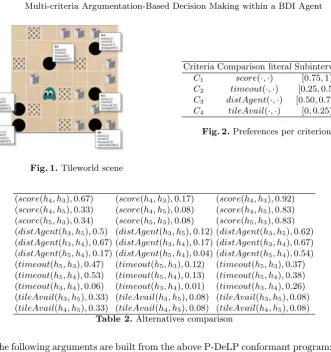
A BDI agent for theTileworldcan be implemented as follows: the agent’s beliefs consist of its perceptions about the objects locations, as well as the score and time-out time for all the holes. Desires are the holes to be filled in, and the current intention (IH) aims at filling a particular hole right now. The means-end reasoner basically is a special-purpose route planner, which guides the agent to a particular tile that must be pushed into the hole to be filled in. Figure 1 shows a hypothetical scene in which the framework proposed in Sect. 3 will be used.
filtering stage takes place where one of the reachable holes is selected and be-comesIH. In this case, all options are conflicting each other, since it is not pos-sible to fill in more than one hole at a time. Hence, all reachable holes will serve as input toselec(·,·,·) function. In this way,B={h3, h4, h5},C={C1= score,
C2 = timeout, C3 = distAgent, C4 = tileAvail (distance to the nearest tile)} and>C={(distAgent, timeout),(distAgent, tileAvail),(timeout, tileAvail),
(score, distAgent),(score, timeout),(score, tileAvail)}.
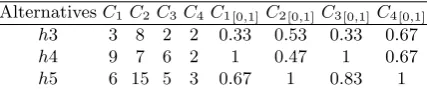
Figure 2 presents preference for each criterion. Table 1 shows the alternatives and their respective values for each criterion. Likewise, following the approach from [9], a conformant P-DeLP program would be:
∆=
(score(h4, h3),0.92) (bt(W, Y)←score(W, Y),0.99) (score(h4, h5),0.83) (∼bt(W, Y)←score(Y, W),0.99) (score(h5, h3),0.83) (bt(W, Y)←distAgent(W, Y),0.74) (distAgent(h3, h5),0.62) (∼bt(W, Y)←distAgent(Y, W),0.74) (distAgent(h3, h4),0.67) (bt(W, Y)←timeout(W, Y),0.49) (distAgent(h5, h4),0.54) (∼bt(W, Y)←timeout(Y, W),0.49) (timeout(h5, h3),0.37) (bt(W, Y)←tileAvail(W, Y),0.24) (timeout(h5, h4),0.38) (∼bt(W, Y)←tileAvail(Y, W),0.24) (timeout(h3, h4),0.26)
(tileAvail(h3, h5),0.08) (tileAvail(h4, h5),0.08)
Π={
(∼bt(W, Y)←sp(W, Y),1) (∼bt(W, Y)←sp(Y, W),1)} In the particular program presented above, the necessity degrees of the clauses belonging to (Π, ∆) were calculated as follows:
1. Normalize the alternatives’ attribute values to interval [0,1] for all of the preference criteria (see Table 1).
2. Compare the alternatives among each other with respect to the normalized preference criteria (see first column of Table 2). The necessity degree of the clause is calculated as the absolute value of the remainder of their normalized attribute values.
3. Divide the necessity degrees obtained in previous step by the number of preference criteria provided to the decision maker,i.e.,by 4 in this case (see second column of Table 2).
4. Map the necessity degrees obtained in previous step to the subinterval as-signed to the comparison literal in the clause (see third column of Table 2). 5. For each clause (ϕ, α) such thatϕis a rule of the kindbt(W, Y)←ci(W, Y)
or∼bt(W, Y)←ci(Y, W), setαto the upper bound value of the subinterval
assigned toci(·,·).
AlternativesC1 C2C3C4 C1[0,1]C2[0,1]C3[0,1]C4[0,1] h3 3 8 2 2 0.33 0.53 0.33 0.67
h4 9 7 6 2 1 0.47 1 0.67
[image:7.595.201.415.601.646.2]h5 6 15 5 3 0.67 1 0.83 1
Fig. 1.Tileworld scene
Criteria Comparison literal Subinterval
C1 score(·,·) [0.75,1)
C2 timeout(·,·) [0.25,0.5)
C3 distAgent(·,·) [0.50,0.75)
C4 tileAvail(·,·) [0,0.25)
Fig. 2.Preferences per criterion
(score(h4, h3),0.67) (score(h4, h3),0.17) (score(h4, h3),0.92) (score(h4, h5),0.33) (score(h4, h5),0.08) (score(h4, h5),0.83) (score(h5, h3),0.34) (score(h5, h3),0.08) (score(h5, h3),0.83) (distAgent(h3, h5),0.5) (distAgent(h3, h5),0.12) (distAgent(h3, h5),0.62) (distAgent(h3, h4),0.67) (distAgent(h3, h4),0.17) (distAgent(h3, h4),0.67) (distAgent(h5, h4),0.17) (distAgent(h5, h4),0.04) (distAgent(h5, h4),0.54) (timeout(h5, h3),0.47) (timeout(h5, h3),0.12) (timeout(h5, h3),0.37) (timeout(h5, h4),0.53) (timeout(h5, h4),0.13) (timeout(h5, h4),0.38) (timeout(h3, h4),0.06) (timeout(h3, h4),0.01) (timeout(h3, h4),0.26) (tileAvail(h3, h5),0.33) (tileAvail(h3, h5),0.08) (tileAvail(h3, h5),0.08) (tileAvail(h4, h5),0.33) (tileAvail(h4, h5),0.08) (tileAvail(h4, h5),0.08)
Table 2.Alternatives comparison
The following arguments are built from the above P-DeLP conformant program:2 A1 ={(bt(h4, h3)←score(h4, h3),0.99), (score(h4, h3),0.92)}
A2 ={(∼bt(h3, h4)←score(h4, h3),0.99), (score(h4, h3),0.92)} A3 ={(bt(h4, h5)←score(h4, h5),0.99), (score(h4, h5),0.83)} A4 ={(∼bt(h5, h4)←score(h4, h5),0.99), (score(h4, h5),0.83)} A5 ={(bt(h5, h3)←score(h5, h3),0.99), (score(h5, h3),0.83)} A6 ={(∼bt(h3, h5)←score(h5, h3),0.99), (score(h5, h3),0.83)}
A7 ={(bt(h3, h5)←distAgent(h3, h5),0.74), (distAgent(h3, h5)),0.62)} A8 ={(∼bt(h5, h3)←distAgent(h3, h5),0.74), (distAgent(h3, h5)),0.62)} A9 ={(bt(h3, h4)←distAgent(h3, h4),0.74), (distAgent(h3, h4),0.67)} A10={(∼bt(h4, h3)←distAgent(h3, h4),0.74), (distAgent(h3, h4),0.67)} A11={(bt(h5, h4)←distAgent(h5, h4),0.74), (distAgent(h5, h4),0.54)} A12={(∼bt(h4, h5)←distAgent(h5, h4),0.74), (distAgent(h5, h4),0.54)} A13={(bt(h5, h3)←timeout(h5, h3),0.49), (timeout(h5, h3),0.37)} A14={(∼bt(h3, h5)←timeout(h5, h3),0.49), (timeout(h5, h3),0.37)} A15={(bt(h5, h4)←timeout(h5, h4),0.49), (timeout(h5, h4),0.38)} A16={(∼bt(h4, h5)←timeout(h5, h4),0.49), (timeout(h5, h4),0.38)}
2 To simplify notation, given an argument⟨A, h, α⟩, only the setAof uncertain clauses
A17={(bt(h3, h4)←timeout(h3, h4),0.49), (timeout(h3, h4),0.26)} A18={(∼bt(h4, h3)←timeout(h3, h4),0.49), (timeout(h3, h4),0.26)} A19={(bt(h3, h5)←tileAvail(h3, h5),0.24), (tileAvail(h3, h5),0.08)} A20={(∼bt(h5, h3)←tileAvail(h3, h5),0.24), (tileAvail(h3, h5),0.08)} A21={(bt(h4, h5)←tileAvail(h4, h5),0.24), (tileAvail(h4, h5),0.08)} A22={(∼bt(h5, h4)←tileAvail(h4, h5),0.24), (tileAvail(h4, h5),0.08)} To calculate the accrued structures for these arguments, it will be used the
ACC function defined below, withK= 0.1:3
ACC(α1, . . . , αn) = [1−∏ n
i=1(1−αi)] +Kmax(α1, . . . , αn)∏ n
i=1(1−αi)
As it can be observed, twelve a-structures can be built to support the reasons by which an alternative should be deemed better than another one.
[Φ1, bt(h3, h5),0.67], [Φ′1,∼bt(h3,h5),0.90],Φ1=A7∪ A19, Φ′1=A6∪ A14; [Φ2,∼bt(h5, h3),0.67], [Φ′2,bt(h5,h3),0.90], Φ2=A8∪ A20, Φ′2=A5∪ A13; [Φ3, bt(h3, h4),0.78], [Φ′3,∼bt(h3,h4),0.93],Φ3=A9∪ A17, Φ′3=A2; [Φ4,∼bt(h4, h3),0.78], [Φ′4,bt(h4,h3),0.93], Φ4=A10∪ A18,Φ′4=A1; [Φ5, bt(h5, h4),0.73], [Φ′5,∼bt(h5,h4),0.85],Φ5=A11∪ A15,Φ′5=A4∪ A22; [Φ6,∼bt(h4, h5),0.73], [Φ′6,bt(h4,h5),0.85], Φ6=A12∪ A16,Φ′6=A3∪ A21;
Those a-structures warranted from the dialectical process (shown in bold), will be used by Algorithm 2 to compute the set of acceptable alternatives. In this particular case, only decision rule DR1 can be applied. For alternativeh4, precondition of DR1 can be warranted and like there is no warranted a-structure supporting a conclusion of the kind bt(Z, h4) to warrant DR1’s restriction, h4 becomes the acceptable alternative. Finally, hole h4 becomesIH.
Once a hole has been selected to fill in, plans to achieve this intention are selected. The criteria set provided for plan selection could beC={C1=length,
C2= cost,C3= timeoutTile}. CriterionC1 is the number of action within the plan. C2 represents the plan cost which is calculated as the sum of its actions costs, which depend on the agent’s orientation. Finally,C3 is the time-out time of the tile selected in the plan to fill in the hole.
On the other hand, the fact that holes appear and disappear causes the agent to change its intentions. For example, when the set of holes dot not change while the agent is executing a plan, then there is no need to deliberate; but if the set of holes do change, this might mean that IH has disappeared or that a closer hole has appeared; thus, intentions reconsideration is necessary. To achieve this behaviour, it is important to consider appropriate criteria to determine whether these changes have occurred or not. Means-ends reasoning and intention re-consideration also use the argumentation-based decision framework (as in the filtering stage), in order to choose a plan to execute or to reconsider intentions, while the plan is under execution. Due to space constraints, how this framework is applied in these stages, will not be developed in this paper.
3 This function is a variant of the One-Complement accrual function used in [14] where
5
Conclusions
In this work, we presented an abstract framework that integrates argumentation-based decision making from a multi-criteria approach, within the inner decision processes of a BDI agent. In this way, the contribution of this work is twofold. On one hand, it was specified how to perform concrete implementations of inner decision making processes within a BDI agent. On the other hand, different criteria and preferences were aggregated to get a solution to a multi-criteria decision problem as an instantiation of argumentation-based decision making.
In order to get a better understanding and provide feedback to the abstrac-tion process carried out to propose this present framework, as future work, fol-lowing the idea proposed in [15], new instantiations of the framework will be done with other methods belonging to the research field of Agreement Technologies.
References
1. Alsinet, T., Ches˜nevar, C.I., Godo, L., Simari, G.: A logic programming framework for possibilistic argumentation: formalization and logical properties. Fuzzy Sets and Systems159(10) (2008) 1208–1228
2. Bratman, M., Israel, D., Pollack, M.: Plans and resource bounded reasoning. Com-putational Intelligence4(4) (1988) 349–355
3. Dennett, D.C.: Intentional systems. Journal of Philosophy68(1971) 87–106 4. Evertsz, R., Fletcher, M., Jones, R., Jarvis, J., Brusey, J., Dance, S.:
Implement-ing Industrial Multi-agent Systems UsImplement-ing JACK. In: ProgrammImplement-ing Multi-Agent Systems. Springer (2004)
5. Benfield, S.S., Hendrickson, J., Galanti, D.: Making a strong business case for multiagent technology. In: 5th AAMAS. (2006)
6. Casali, A., Godo, L., Sierra, C.: A graded BDI agent model to represent and reason about preferences. Artifical Intelligence175(7-8) (2011) 1468–1478
7. Amgoud, L.: A formal framework for handling conflicting desires. In Nielsen, T.D., Zhang, N.L., eds.: ECSQARU. Volume 2711 of Lecture Notes in Computer Science., Springer (2003) 552–563
8. Amgoud, L., Prade, H.: Formalizing practical reasoning under uncertainty: An argumentation-based approach. In: IAT, IEEE Computer Society (2007) 189–195 9. Ferretti, E., Errecalde, M., Garc´ıa, A., Simari, G.: A possibilistic defea-sible logic programming approach to argumentation-based decision mak-ing. Manuscript ID: TETA-2012-0093.R1. Under Review process inJETAI.
https://sites.google.com/site/edgardoferretti/TETA-2012-0093.R1.pdf? attredirects=0&d=1.
10. Rotstein, N.D., Garc´ıa, A.J., Simari, G.R.: Reasoning from desires to intentions: A dialectical framework. In: AAAI, AAAI Press (2007) 136–141
11. Schlesinger, F., Ferretti, E., Errecalde, M., Aguirre, G.: An argumentation-based BDI personal assistant. In: IEA/AIE. Volume 6069 of LNAI., Springer (2010) 12. Wooldridge, M.: Reasoning about Rational Agents. The MIT Press (2000) 13. Pollack, M.E., Ringuette, M.: Introducing the tileworld: Experimentally evaluating
agent architectures. In: 8th AAAI. (1990) 183–189
14. G´omez, M., Ches˜nevar, C., Simari, G.: Modelling argument accrual in possibilistic defeasible logic programming. In: ECSQARU. LNCS, Springer (2009) 131–143 15. Sosa-Toranzo, C., Schlesinger, F., Ferretti, E., Errecalde, M.: Integrating a voting