The -250G/A and -514C/T Polymorphisms in
Hepatic Lipase Gene Promoter Confers an Increased Risk
of Hepatocellular Carcinoma in a Chinese Population
Chuan-Zhen Niu,*,♦Fu-Hua Zhang, **,♦ Yan Li,*** Jing-Jing Liu,** Cui-Xia Bao****
* ICU, Yantai Infectious Disease Hospital, Yantai, P.R. China. ** Department of Clinical Laboratory, Yantai Infectious Disease Hospital, Yantai, P.R. China. *** Department of Clinical Laboratory, Yantai Center for Disease Control and Prevention, Yantai, P.R. China. **** Department of Clinical Laboratory, Yantai Yuhuangding Hospital, Yantai, P.R. China.
♦ These authors are regarded as co-first authors.
November-December, Vol. 17 No. 6, 2018: 992-1000
INTRODUCTION
Hepatocellular carcinoma (HCC), one of the most common malignancies, ranks the fifth in cancer inci-dence and the third in cancer mortality around the world; over 1.2 million people die from it yearly,
espe-cially in Asia and Southern Africa.1,2 It is worth noting
that the HCC incidence and mortality is the third
among all malignancies in China.3 At present, surgical
resection and liver transplantation are the two main treatments for early-stage HCC, but the HCC progno-sis remains poor and unstable due to tumor invasion, metastasis and recidivism, and chemotherapy
resist-ance.1 Risk factors for HCC generally include hepatitis
B and C virus infection, obesity, dietary carcinogens
and iron overload.4 Cigarette smoking has been
suggest-ed as a causal factor of HCC progression, as well as a
prognostic risk factor for HCC patient survival.5,6
Based on the study of Cleary, et al., genetic alterations
are crucial factors in the occurrence and development of HCC, since they result in disorders of cellular
path-ways.7 However, not all individuals exposed to risk
fac-tors develop HCC because of individual differences, and studies on susceptibility of HCC are beneficial for illuminating the molecular basis of individual
differ-ences.8 Multiple studies have exerted their efforts to
ge-netic correlations between specific driver gene
polymorphisms and the risk of HCC.9,10
The Official Journal of the Mexican Association of Hepatology, the Latin-American Association for Study of the Liver and
the Canadian Association for the Study of the Liver
Manuscript received: Manuscript received: Manuscript received: Manuscript received:
Manuscript received: October 30, 2017. Manuscript accepted: Manuscript accepted: Manuscript accepted: Manuscript accepted: Manuscript accepted: Februay 28, 2018.
DOI:10.5604/01.3001.0012.7199
A B S T R A C T A B S T R A C T A B S T R A C T A B S T R A C T A B S T R A C T
Introduction and aim. Introduction and aim.Introduction and aim. Introduction and aim.
Introduction and aim. Hepatocellular carcinoma (HCC) is a lethal malignancy, but the molecular mechanisms of hepatocarcino-genesis remain undefined. The present study aims to investigate the relationship between polymorphisms of the hepatic lipase (HL) gene promoters and risk of HCC. Material and methods.Material and methods.Material and methods.Material and methods. Totally, 279 HCC patients and 200 healthy individuals were enrolled.Material and methods. Polymerase chain reaction-restriction fragment length polymorphisms (PCR-RFLP) was used to analyze the genotypes of HL gene. Logistic regression analysis was conducted to identify risk factors of HCC. Results.Results.Results.Results. There was significant difference in the distri-Results. bution of smoking history, drinking history, and family history of subjects between the case and control groups (all p < 0.05). Differ-ence in the -250G/A (p = 0.011; OR = 1.61; 95%CI: 1.11-2.34) and -514C/T (p = 0.007; OR = 1.65; 95%CI: 1.14-2.38) genotypes and allele frequencies between two groups was significant. A higher risk of HCC was identified in those with polymorphisms in the 250G/A (p = 0.007; OR = 1.45; 95%CI: 1.111.89) and 514C/T (p = 0.003; OR = 1.51; 95%CI: 1.152.00). Polymorphisms at -250G/A (GA + AA) (p = 0.025; OR = 1.55; 95%CI: 1.06-2.28), -514C/T (CT + TT) (p = 0.021; OR = 1.57; 95%CI: 1.07-2.29), smoking history (p = 0.017; OR = 1.70; 95%CI: 1.10-2.63) and drinking history (p = 0.003; OR = 2.04; 95%CI: 1.27-3.27) were sig-nificantly related to the risk of HCC (all p < 0.05). Conclusion.Conclusion.Conclusion.Conclusion.Conclusion. The results obtained from this study indicated that polymorphisms of -250G/A and -514C/T in HL gene promoters were associated with the risk of HCC.
Key words. Key words.Key words. Key words.
As the most common genetic variations exist in human
body,1 single nucleotide polymorphisms (SNPs) are
asso-ciated with disease susceptibility and treatment outcomes, and provide powerful tools for a variety of medical genetic
studies.11,12 Hepatic lipase (HL), synthesized and secreted
by hepatic parenchymal cells, is a member of aliphatic families, which form a complex by the action with
heparan sulfate proteoglycans (HSPG).13 HL promoter has
four common SNPs linked to inheritance, including -250G/A, -514C/T, -763A/G, and -710T/C, which affect the metabolism of plasma lipoproteins; moreover, there exists association between promoter polymorphisms of HL
gene, HL activity, and plasma lipoprotein.14 HCC is
con-sidered as a multifactorial disease and gene polymor-phisms is regarded as an important contributor to hepatocarcinogenesis, indicating a high degree of genetic
heterogeneity might be exhibited in HCC patients.8 At
present, studies on the HL gene polymorphisms and HCC risk has been not found yet. In this study, polymer-ase chain reaction restriction fragment length polymor-phisms (PCR-RFLP) was used to detect the genotypes of -250G/A, -514C/T, -763A/G, and -710T/C in patients with HCC in order to clarify the role of HL gene promoter polymorphisms in the occurrence of HCC.
MATERIAL AND METHODS
Ethic statement
This study was conducted with the approval of the Eth-ics Committee of Yantai Yuhuangding Hospital. Informed consent and required documentation was obtained from each patient and respective guardians prior to the study.
Study subjects
From September 2013 to September 2015, 279 patients with HCC received clinical and pathological diagnosis in Yantai Yuhuangding Hospital were collected as the case group. All the included patients were new cases, with sec-ondary cases and recurrent cases of HCC excluded. Among 279 patients, there were 143 male patients (aging 30-75 years old) and 136 female patients (aging 51.17 ± 10.30 years old). There were 90 smoking patients, 189 non-smoking patients; 96 drinking patients, 183 non-drinking patients and 35 patients with family history. During the same period, 200 healthy individuals who came to Yantai Yuhuangding Hospital for physical examination were en-rolled as the control group. Among the healthy controls, there were 103 male patients (aging 30-75 years old) and 97 female patients (aging 52.34 ± 10.70 years old), and there were 43 smoking patients, 157 non-smoking patients; 37 drinking patients, 163 non-drinking patients and 11
pa-tients with family history. In both of the case and control groups, individuals were excluded with infection of hepa-titis B, hepahepa-titis C virus infection, or other liver diseases, including alcoholic liver disease, metabolic liver disease. People of the Han nationality without blood relationship were recruited, whose routine tests were normal.
Questionnaire survey
In this study, detailed demographic data and related ex-posure factors of patients in the case group were obtained from records of Yantai Yuhuangding Hospital, and main contents included age, gender, smoking history, drinking history, family history. Informed consent was obtained from each patient. The self-made questionnaires (Table 1) about demographic data and related exposure factors were used for people in the control group, including age, gen-der, smoking history, drinking history, family history. Smoking history standard was defined as six months or more of continuous or cumulative smoking in lifetime, and drinking history was defined as drinking at least once a week for six months or more. After obtaining the in-formed consent, professionally trained investigators were dispatched to conduct a detailed inquiry of the subjects face-to-face, and results were filled in the questionnaire according to the facts.
Blood specimen collection
Five mL of venous blood was collected from subjects with empty stomach in the morning, and anticoagulated with elhylene diamine tetraacetic acid (EDTA) (Shanghai Haling Biological Technology Co. Ltd., Shanghai, China). According to the kit instructions, DNA extraction kit was used to extract the genomic DNA. Nucleic acid-protein detector (Puyang Scientific Instrument Research Institute of Nanjing University, Nanjing, Jiangsu, China) was used for quantitative analysis. The extraction was stored at -20 °C for preservation. Blood genomic DNA extraction kit was purchased from Shanghai Sangon Biotech Co., Ltd. (Shanghai, China).
Genotyping
Polymorphisms analysis of genes was conducted by
PCR-RFLP. The 25 μL of PCR reaction system contains 1
x PCR buffer, 1.5 mmol/L Mg2+, 200 μmol/L dNTP, 200
Table 1. Health Questionnaire.
Number of your hospital: __________
Section 1 Personal information
1 Name: _________________________________________________________
2. Age: _____
3. Sex: male female
4. Nationality: Han nationality other nationalities
5. Marital status: single married re-marriage divorced widowed
6. Occupation: worker peasant office clerk Medical and Health staff
Self-employed administrator others
7. Native place: _______________________________________________________
8. Birthplace: _________________________________________________________
9. Address: Phone:
10. Smoking history: Yes No (Turn to the 13th question with the answer No)
11. Duration of cigarette smoking: __________________________________________
12. Smoking frequency: pack/week
13. Drinking history: Yes No (Turn to the 16th question with the answer No)
14. Drinking age: year
15. Drinking frequency: once a week twice to forth a week fifth to sixth a week
once a day twice or more than twice a day
16. Family history: Yes No
17. Height: ________________________
18. Weight: ________________________
Section 2 Results of physical and laboratory examinations
1. Blood type: ________________________
2. HBV test
Hepatitis B surface antigen (HBsAg): _____ Hepatitis B e antibody (anti-HBe):
Hepatitis B surface antibody (anti-HBs): _____ Hepatitis B core antibody (anti-HBe):
Hepatitis B e antigen (HBeAg): _____ HBV-DNA:
3. Liver functions
Total bilirubin (TBIL) _____ 3-22 umol/LDirect bilirubin (DBIL) _____ 0-6 umol/L
Indirect bilirubin (IBIL) _____ 3-22 umol/LTotal protein (TP) _____ 60-80 g/L
Albumin (ALB) _____ 35-55 g/L Globulin (GLO) _____ 25-35 g/L
r-Transpeptidase (GGT) _____ 0-40 U/LAlanine aminotransferase (ALT) _____ 8-45 U/L
Aspartate aminotransferase (AST) _____ 4-40 U/L
Alkaline phosphatase _____ (ALP) 40-150 U/L
4. Liver fluke enzyme marker: ________________________
5. Anti-KCV: ______________________________________
72 °C for 5 min. PCR amplification was determined by 2%
agarose gel electrophoresis containing 0.5 μg/mL
ethid-ium bromide (Beijing RuiDaHengHui Science and Tech-nology Development Co., Ltd, Beijing, China). PCR primers were synthesized by Shanghai Invitrogen Biotech Co., Ltd. (Shanghai, China) (Table 2). Extracted agarose gel was treated with electrophoresis (5 V/cm) for 40 min, and the reaction products were observed under a
ultravio-let (UV) light. Then 5 μL of PCR products were added
with 10 μL of endonuclease DRA I, NLA III, SPH I, and
AVA II (TaKaRa Biotechnology Dalian Co., Ltd., Dalian, Liaoning, China) respectively, and placed at a constant temperature overnight. Enzyme-digested products were treated with 4% agarose gel electrophoresis and 8% non-denaturing polyacrylamide gel (SNF Floerger, France)
electrophoresis and then stained by 0.1% AgNO3 (Bolinda
Technology Co., Ltd., Shenzhen, Guangdong, China) to observe the genotypes.
Statistical analysis
Epidata software 3.02 (The Epidata Association, Odense, Denmark) and SSPS 18.0 software (SPSS Inc., Chicago, IL, USA) were used for data collection and analysis. The meas-urement data was performed as mean ± standard deviation, and t-test was used. The enumeration data were analyzed by
Chi-square test. Chi-squared (χ2) goodness-of-fit test was
applied to identify the genotypes of the control group, and to determine whether the genotype distribution is consist-ent with Hardy-Weinberg equilibrium (HWE). Bonferroni correction was used for multiple comparisons. Multivariate logistic regression was used to calculate odds ratios and 95% confidence intervals (CI) for the estimation to the relative odds of related factors and the association between gene polymorphisms and disease. p < 0.05 represented signifi-cant difference.
RESULTS
Baseline characteristics of
the case and control groups are comparable
A total of 279 patients with HCC were enrolled in this study. Compared with the baseline characteristics of healthy population, there was no significant difference in the distribution of age and gender between the two groups (p > 0.05). Compared with the control group, there was significant difference in the distribution of smoking histo-ry, drinking histohisto-ry, and family history in the case group (p < 0.05) (Table 3).
Genotypes of the
-250G/A, -514C/T, -763A/G and -710T/C
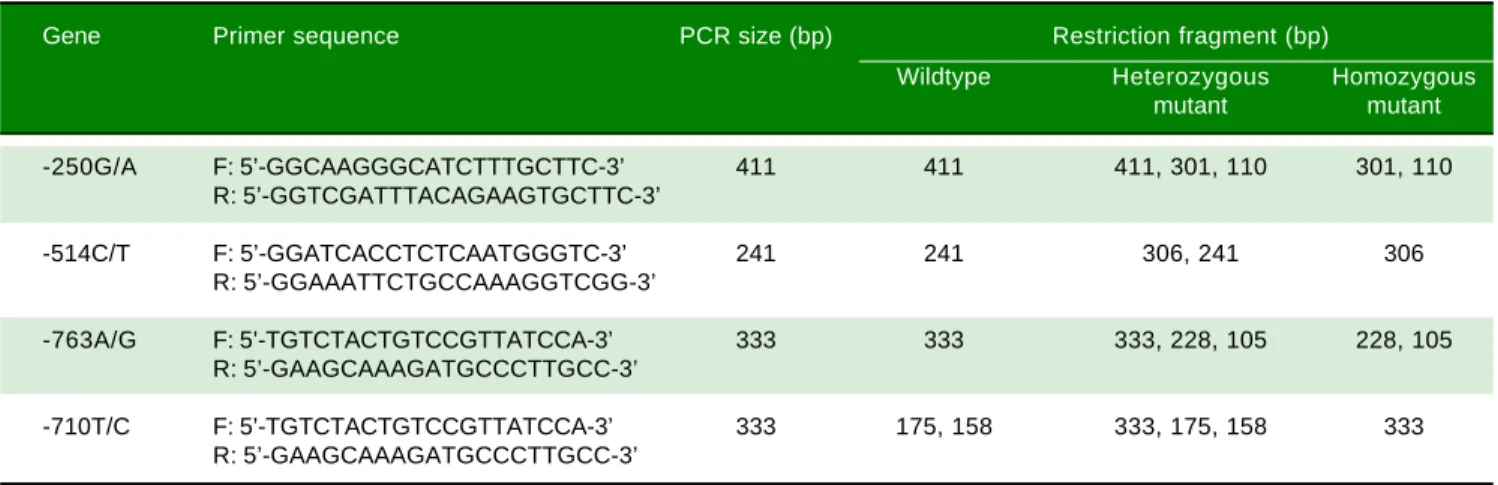
PCR-RFLP was performed to analyze the genotypes of HL gene. The results of -250 G/A were a 411 bp frag-ment as GG (wildtype), three fragfrag-ments of 411 bp, 301 bp and 110 bp as GA (heterozygote variant), in addition to two fragments of 301 bp and 110 bp as AA (homozygous mutant) (Figure 1A). The results of -514C/T were a 241 bp fragment as CC type (wildtype), 241 bp and 306 bp fragments as CT (heterozygote variant) as well as a 306 bp fragment as TT (homozygous mutant) (Figure 1B). The result of -763A/G was a 333 bp fragment as AA (wildtype), 333 bp, 228 bp and 105 bp fragments as AG (heterozygote variant), in addition to 228 bp and 105 bp fragments as GG (homozygous mutant) (Figure 1C). The result of -710T/C was 175 bp and 158 bp fragments as TT (wildtype); 333 bp, 175bp and 158 bp fragments as TC (heterozygote variant); a 333 bp fragment as CC (ho-mozygous mutant) (Figure 1D).
Table 2. Primer sequences for PCR-RFLP.
Gene Primer sequence PCR size (bp) Restriction fragment (bp)
Wildtype Heterozygous Homozygous
mutant mutant
-250G/A F: 5’-GGCAAGGGCATCTTTGCTTC-3’ 411 411 411, 301, 110 301, 110
R: 5’-GGTCGATTTACAGAAGTGCTTC-3’
-514C/T F: 5’-GGATCACCTCTCAATGGGTC-3’ 241 241 306, 241 306
R: 5’-GGAAATTCTGCCAAAGGTCGG-3’
-763A/G F: 5’-TGTCTACTGTCCGTTATCCA-3’ 333 333 333, 228, 105 228, 105
R: 5’-GAAGCAAAGATGCCCTTGCC-3’
-710T/C F: 5’-TGTCTACTGTCCGTTATCCA-3’ 333 175, 158 333, 175, 158 333
Table 3. The baseline characteristics of study subjects between the case and the control groups.
Variable Case group (n = 279) Control group (n = 200) χ2 value Pvalue
Age (year)
≥ 50 148 116
< 50 131 84 1.08 0.282
Gender
Male 143 103
Female 136 97 0.05 0.958
Smoking history
Yes 90 43
No 189 157 2.59 0.010
Drinking history
Yes 96 37
No 183 163 3.83 < 0.001
Family history
Yes 35 11
No 244 189 2.58 0.010
Polymorphisms in the
-250G/A and -514C/T loci increased the risk of HCC
Genotype distribution of polymorphisms and allele frequency of the four promoters of HL as -250G/A, -514C/ T, -763A/G and 710T/C in the control group and the case group are listed in table 4. These promoters reached ge-netic equilibrium with population representation after the HWE test. Differences in -250G/A and -514C/T genotypes and allele frequencies between the two groups were statis-tically significant (p < 0.05). No difference in 763A/G and -710T/C genotypes and allele frequencies was found be-tween the two groups (p > 0.05). Our study statistically analyzed the distribution and allele frequencies of the four polymorphisms using the Bonferroni correction method to control the false discovery, and p < 0.0125 (0.05/4)
rep-resented significant difference. Therefore, results of Bon-ferroni correction method showed that there was signifi-cant difference in allele frequencies of -250G/A and -514C/T polymorphisms between the case group and the control group (all p < 0.01). As shown in table 4, for -250G/A polymorphisms, compared with patients with GG wildtype, the risk of HCC was significantly increased in patients who carried (GA + AA) heterozygote variant (p = 0.001; OR = 1.61; 95%: 1.11-2.34). For -514C/T polymorphisms, the risk of HCC in patients who carried (CT + TT) heterozygote variant (p = 0.007; OR = 1.65; 95%: 1.04-2.28) was also increased, when compared with patients with CC wildtype. For -250G/A polymorphisms, compared with patients with G allele, the risk of HCC was notably increased in patients who carried A allele (p = 0.007; OR = 1.45; 95%: 1.11-1.89). For -514C/T
Figure 1. Figure 1. Figure 1. Figure 1.
Figure 1. The electrophoretogram of PCR-RFLP products. AAAAA. -250G/A locus. M: represents marker. 1: represents GG. 2: represents GA. 3: represents AA. B.
B. B. B.
B. -514C/T locus. M: represents marker. 1: represents CC. 2: represents CT. 3: represents TT. C.C.C.C.C. 763A/G locus. M: represents marker. 1: represents AA: 2: represents AG. 3: represents GG: D.D.D.D.D. -710T/C locus. M: represents marker. 1: represents TT. 2: represents TC: 3: represents CC. PCR-RFLP: polymerase chain reaction-restriction fragment length polymorphism.
M 1 2 3
600bp 500bp 400bp 300bp 200bp 100bp
600bp 500bp 400bp 300bp 200bp 100bp
600bp 500bp 400bp 300bp 200bp 100bp
600bp 500bp 400bp 300bp 200bp 100bp
M 1 2 3 M 1 2 3 M 1 2 3
A A A A
polymorphisms, the risk of HCC in patients who carried T allele (p = 0.003; OR = 1.51; 95%: 1.15-2.00) was also increased, when compared with patients with C allele. In -763A/G and -710T/C polymorphisms, there was no statis-tical correlation between the risk of HCC and carriage of heterozygote variant and homozygous variant, compared with patients who carried wildtype (p > 0.05). Results in-dicate that polymorphisms in the -250G/A and -514C/T increased the risk of HCC.
The GA + AA genotype in
-250G/A and CT + TT genotype in -514C/T were associated with higher frequencies of
smoking and drinking of HCC patients
The associations between polymorphisms of 250G/A, -514C/T, -763A/G, -710T/C and pathological features indi-cated that the frequency of smoking in patients with GA + AA genotype in -250G/A was significantly higher than pa-tients with GG genotype (p < 0.05), and there was no
Table 4. Genetic correlation between genotype and allele frequency of four promoters of HL gene and the risk of HCC.
SNP Case group Control group χ2 value P value OR (95%CI)
(n = 279) (n = 200)
-250G/A
GG 99 (0.355) 94 (0.47) Refer.
GA 134 (0.48) 84 (0.42) 2.01 0.038 1.52 (1.02-2.24)
A A 46 (0.165) 22 (0.11) 2.33 0.020 1.99 (1.11-3.55)
GA + AA 180 (0.645) 106 (0.53) 2.53 0.011* 1.61 (1.11-2.34)
G 332 (0.59) 272 (0.68) Refer.
A 226 (0.41•j 128 (0.32) 2.69 0.007* 1.45 (1.11-1.89)
-514C/T
CC 116 (0.416) 108 (0.54) Refer.
CT 119 (0.427) 72 (0.36) 2.16 0.031 1.54 (1.04-2.28)
TT 44 (0.158) 20 (0.1) 2.41 0.016 2.05 (1.14-3.70)
CT + TT 163 (0.584) 92 (0.46) 2.69 0.007* 1.65 (1.14-2.38)
C 351 (0.63) 288 (0.72) Refer.
T 207 (0.37) 112 (0.28) 2.95 0.003* 1.51 (1.15-2.00)
-763A/G
A A 81 (0.290) 68 (0.34) Refer.
AG 143 (0.513) 93 (0.465) 1.21 0.227 0.77 (0.51-1.17)
GG 55 (0.197) 39 (0.195) 0.63 0.526 0.84 (0.50-1.42)
AG + GG 198 (0.710) 132 (0.660) 1.16 0.247 1.26 (0.85-1.86)
A 305 (0.547) 229 (0.573) Refer.
G 253 (0.453) 171 (0.428) 0.80 0.426 0.90 (0.69-1.16)
-710T/C
TT 90 (0.323) 57 (0.285) Refer.
TC 137 (0.491) 101 (0.505) 0.71 0.478 1.16 (0.77-1.77)
CC 52 (0.186) 42 (0.21) 0.91 0.363 1.28 (0.75-2.16)
TC + CC 189 (0.677) 143 (0.715) 0.88 0.379 0.84 (0.56-1.25)
T 317 (0.568) 215 (0.538) Refer.
C 241 (0.432) 185 (0.462) 0.94 0.347 1.13 (0.87-1.47)
* p < 0.0125 (0.05/4) measured by Bonferroni test. HL: hepatic lipase. HCC: hepatocellular carcinoma. SNP: single nucleotide polymorphism. OR: odds ratio. CI: confidence interval.
association between different genotypes in -250G/A and age, gender, drinking history, and family history of patients (all p > 0.05). The frequencies of smoking and drinking in patients with CT + TT genotype in -514C/T was significantly higher than those of with CC genotype (p < 0.05), and there was no association between different genotypes in -514C/T and the age, gender and family histo-ry of patients (all p > 0.05). And there was no association between different genotypes in -763A/G or -710T/C with the age, gender, smoking history, drinking history, and family history of patients (all p > 0.05) (Table 5). Results indicate that the GA + AA genotype in -250G/A and CT + TT genotype in -514C/T were associated with increased frequencies of smoking and drinking in HCC patients.
Polymorphisms at -250G/A and -514C/T, smoking history and drinking history were
significantly related to the risk of HCC
logistic regression analysis with the Enter model was per-formed with smoking history, drinking history, family history, and different genotypes of 250G/A, 514C/T, -763A/G, -710T/C as the independent variables, with the fact whether patients suffered from HCC as the depend-ent variable. It showed that -250G/A and -514C/T polymorphism, smoking history and drinking history of patients were significantly correlated with the risk of HCC, and -250G/A (GA + AA) (p = 0.025; OR = 1.55; 95%CI: 1.06-2.28), -514C/T (CT + TT) (p = 0.021; OR = 1.57; 95%CI: 1.07-2.29), smoking history (p = 0.017; OR = 1.70; 95%CI: 1.10-2.63) and drinking history (p = 0.003; OR = 2.04; 95%CI: 1.27-3.27) were demon-strated to be the risk factors for HCC (Table 6). These data indicate that polymorphisms at -250G/A and -514C/T, smoking history and drinking history were notably associ-ated with the risk of HCC.
DISCUSSION
Considered as one of the most prevalent and lethal ma-lignancies worldwide, HCC is a common digestive
sys-tem tumor with poor treatment effect and prognosis,15,16
which mainly prevails in Asia, especially in China.17
Previ-ously, it has been reported that there are differences exist-ed in genetic susceptibility to cancer among individuals, which are mediated by both environmental and genetic
factors.18 Furthermore, various gene polymorphisms have
been identified to be correlated with the occurrence and
development of HCC.1,19 Therefore, this study was
per-formed to investigate the association between the HL gene polymorphisms and risks of HCC in Chinese populations. Our results demonstrated that the 250G/A and -514C/T polymorphisms in HL gene promoter are associated with the risk of HCC.
The results of this study showed that compared to pa-tients with GG wildtype of -250G/A, the risk of HCC in patients with GA and AA mutants increased prominently, and the risk was also higher in patients with CT and TT mutants in -514C/T than those with CC wildtype, which indicated that -250G/A and -514C/T polymorphisms in HL gene promoters are correlated with the risk of HCC. It has been reported that individuals were susceptible to developing certain cancers owing to genetic
polymor-phisms or alteration.18 For example, the polymorphic
lo-cus rs1047781 of FUT2 gene is correlated with HCC development, and FUT2 polymorphisms are proposed as
predictors for tumor aggression in HCC.20 Based on the
study of Leonhardt, et al., the PCR products of HL were
identified in all the included HCC patients and healthy
controls.21 As a liver-secreted lipolytic enzyme, HL is
as-sociated with the metabolism of plasma lipids that exist in high-density lipoproteins (HDL), low density lipoprotein
Table 5.
Associations between polymorphisms of four HL gene promoters and pathological features of HCC.
Variable -250G/A - 514C/T - 763A/G - 710T/C G G
GA + AA
P value C C C T + T T P value A A A G + G G P value T T T C + C C P value Age (year) ≥ 50 55 93 59 89 41 1 0 7 44 1 0 4 < 5 0 4 4 8 7 0.533 5 7 7 4 0.537 4 0 9 1 0.603 4 6 8 5 0.337 Gender Male 5 0 9 3 5 8 8 5 4 0 1 0 3 4 1 1 0 2 Female 4 9 8 7 0.588 5 8 7 8 0.280 4 1 9 5 0.690 4 9 8 7 0.189 Smoking history Y e s 23 67 29 61 31 59 31 59 N o 7 6 1 1 3 0.017 8 7 1 0 2 0.029 5 0 1 3 9 0.141 5 9 1 3 0 0.590 Drinking history Y e s 31 65 29 67 32 64 32 64 N o 6 8 1 3 5 0.420 8 7 1 1 6 0.036 4 9 1 5 4 0.252 5 8 1 2 5 0.781 Family history Y e s 15 20 14 21 11 24 12 23 N o 8 4 1 6 0 0.330 1 0 2 1 4 2 0.840 7 0 1 7 4 0.735 7 8 1 6 6 0.784
(LDL) and in the very low density lipoprotein
(VLDL).22,23 -250G/A, -514C/T, -763A/G, and -710T/C that
have been identified as the four HL gene promoter poly-morphisms are in complete linkage disequilibrium,
which were reported to decrease the LIPC activity.24
Fag-gin, et al. have demonstrated that the common -514C/T
variant in the HL gene promoter is associated with differ-ent levels of HL activity, LDL buoyancy, and HDL-2 cho-lesterol, in particular, compared with the CT and TT genotypes, the CC genotype is associated with higher HL activity, more atherogenic LDL particles and lower HDL cholesterol levels.25 Consistently, Jiang et al. have reported
that the LDL-C levels in HCC patients were significantly
lower than those in health people,26 and it was further
re-ported that HL activity reduced remarkably when treated with intensive lipid-lowering therapy, which indicates
that the HL activity and LDL level are positively related.27
In addition, it was evidenced that HL activity was higher in subjects with the GG genotype of HL gene promoter
-250G/A than in those with the GA or AA genotypes.28
Besides, it was demonstrated in our study that HL gene promoter -250G/A and -514C/T polymorphisms and the habits of smoking and drinking were closely related to the risk of HCC. A previous study reported that alcohol in-take and cigarette smoking are regarded as the two
co-fac-tors in the pathogenesis of HCC.29 Compared with
nonsmokers, cigarette smokers are more likely to develop
HCC.30 Alcohol intake is also reported to be tightly
relat-ed to HCC, and there is a high mortality rate of smoker
HCC patients.6
In conclusion, we found that the -250G/A and -514C/T polymorphisms in HL gene promoter are associated with the risk of HCC, while the polymorphisms of -763A/G and -710T/C exerted no effect on the risk of HCC. In the view of the small sample size at the primary stage of our study, results may suffer from some bias. We also realize that the increased risk of HCC requires for
the simultaneous changes and synergistic effects of mul-tiple genes. Therefore, follow-up study will be needed to verify the association between -250G/A and -514C/T polymorphisms of HL gene and the risk of HCC, in or-der to lay a theoretical foundation for better prevention, diagnosis, and treatment measures for HCC at the genet-ic level.
ABBREVIATIONS
• CI: confidence intervals.
• EDTA: elhylene diamine tetraacetic acid.
• HCC: hepatocellular carcinoma.
• HDL: high-density lipoproteins.
• HL: hepatic lipase.
• HSPG: heparan sulfate proteoglycans.
• HWE: Hardy-Weinberg equilibrium.
• PCR-RFLP: polymerase chain reaction restriction
fragment length polymorphisms.
• SNPs: single nucleotide polymorphisms.
ACKNOWLEDGMENTS
We would like to acknowledge the helpful comments on this paper received from our reviewers.
CONFLICT OF INTEREST
The authors declares that there is no conflict of interest regarding the publication of this article.
REFERENCES
1. Chou YE, Hsieh MJ, Chiou HL, Lee HL, Yang SF, Chen TY. CD44 gene polymorphisms on hepatocellular carcinoma sus-ceptibility and clinicopathologic features. Biomed Res Int
2014; 2014: 231474. Table 6. Multivariate logistic regression analysis for risk factors of HCC.
Factor B SE OR 95% CI P value
-250G/A 0.44 0.20 1.55 1.06-2.28 0.025
-514C/T 0.45 0.19 1.57 1.07-2.29 0.021
-763A/G 0.36 0.21 1.43 0.95-2.16 0.084
-710T/C -0.17 0.21 0.84 0.56-1.27 0.422
Smoking history 0.53 0.22 1.70 1.10-2.63 0.017
Drinking history 0.71 0.24 2.04 1.27-3.27 0.003
Family history 0.54 0.39 1.72 0.80-3.70 0.167
2. El-Din HG, Ghafar NA, Saad NE, Aziz M, Rasheed D, Hassan EM. Relationship between codon 249 mutation in exon 7 of p53 gene and diagnosis of hepatocellular carcinoma. Arch Med Sci 2010; 6: 348-55.
3. Chen Y, Wang D, Guo Z, Zhao J, Wu B, Deng H, Zhou T, et al. Rho kinase phosphorylation promotes ezrin-mediated me-tastasis in hepatocellular carcinoma. Cancer Res 2011; 71: 1721-9.
4. Bishayee A, Politis T, Darvesh AS. Resveratrol in the chem-oprevention and treatment of hepatocellular carcinoma. Can-cer Treat Rev 2010; 36: 43-53.
5. Koh WP, Robien K, Wang R, Govindarajan S, Yuan JM, Yu MC. Smoking as an independent risk factor for hepatocellular carcinoma: the Singapore Chinese Health Study. Br J Can-cer 2011; 105: 1430-5.
6. Siegel AB, Conner K, Wang S, Jacobson JS, Hershman DL, Hidalgo R, Verna EC, et al. Smoking and hepatocellular carci-noma mortality. Exp Ther Med 2012; 3: 124-8.
7. Cleary SP, Jeck WR, Zhao X, Chen K, Selitsky SR, Savich GL, Tan TX, et al. Identification of driver genes in hepatocel-lular carcinoma by exome sequencing. Hepatology 2013; 58: 1693-702.
8. Lu SC, Zhong JH, Tan JT, Tang HL, Liu XG, Xiang BD, Li LQ, et al. Association between COX-2 gene polymorphisms and risk of hepatocellular carcinoma development: a meta-analy-sis. BMJ Open 2015; 5: e008263.
9. Yong KJ, Gao C, Lim JS, Yan B, Yang H, Dimitrov T, Kawa-saki A, et al. Oncofetal gene SALL4 in aggressive hepato-cellular carcinoma. N Engl J Med 2013; 368: 2266-76. 10. Roessler S, Long EL, Budhu A, Chen Y, Zhao X, Ji J, Walker
R, et al. Integrative genomic identification of genes on 8p as-sociated with hepatocellular carcinoma progression and pa-tient survival. Gastroenterology 2012; 142: 957-66 e12. 11. Pravica V, Popadic D, Savic E, Markovic M, Drulovic J,
Mos-tarica-Stojkovic M. Single nucleotide polymorphisms in multi-ple sclerosis: disease susceptibility and treatment response biomarkers. Immunol Res 2012; 52: 42-52.
12. Wang DG, Fan JB, Siao CJ, Berno A, Young P, Sapolsky R, Ghandour G, et al. Large-scale identification, mapping, and genotyping of single-nucleotide polymorphisms in the human genome. Science 1998; 280: 1077-82.
13. Dichek HL, Brecht W, Fan J, Ji ZS, McCormick SP, Akeefe H, Conzo L, et al. Overexpression of hepatic lipase in transgenic mice decreases apolipoprotein B-containing and high density lipoproteins. Evidence that hepatic lipase acts as a ligand for lipoprotein uptake. J Biol Chem 1998; 273: 1896-903. 14. van’t Hooft FM, Lundahl B, Ragogna F, Karpe F, Olivecrona
G, Hamsten A. Functional characterization of 4 polymor-phisms in promoter region of hepatic lipase gene. Arterio-scler Thromb Vasc Biol 2000; 20: 1335-9.
15. Huang Q, Tan Y, Yin P, Ye G, Gao P, Lu X, Wang H, et al. Metabolic characterization of hepatocellular carcinoma using nontargeted tissue metabolomics. Cancer Res 2013; 73: 4992-5002.
16. Gong J, Lv L, Huo J. Roles of F-box proteins in human diges-tive system tumors (Review). Int J Oncol 2014; 45: 2199-207.
17. Chen M, Therneau T, Orsini LS, Qiao YL. Design and ration-ale of the HCC BRIDGE study in China: a longitudinal, multi-center cohort trial in hepatocellular carcinoma. BMC Gastroenterol 2011; 11: 53.
18. Weng CJ, Hsieh YH, Tsai CM, Chu YH, Ueng KC, Liu YF, Yeh YH, et al. Relationship of insulin-like growth factors system gene polymorphisms with the susceptibility and pathological
development of hepatocellular carcinoma. Ann Surg Oncol
2010; 17: 1808-15.
19. Guan Q, Chen Z, Chen Q, Zhi X. XRCC1 and XPD polymor-phisms and their relation to the clinical course in hepatocar-cinoma patients. Oncol Lett 2017; 14: 2783-8.
20. Chen CT, Liao WY, Hsu CC, Hsueh KC, Yang SF, Teng YH, Yu YL. FUT2 genetic variants as predictors of tumor devel-opment with hepatocellular carcinoma. Int J Med Sci 2017; 14: 885-90.
21. Leonhardt U, Ritzel U, Ottleben M, Ramadori G. Circulating human hepatic lipase mRNA in patients with hepatocellular carcinoma and healthy controls. Eur J Surg 1999; 165: 539-42.
22. Dichek HL, Agrawal N, El Andaloussi N, Qian K. Attenuated corticosterone response to chronic ACTH stimulation in he-patic lipase-deficient mice: evidence for a role for hehe-patic li-pase in adrenal physiology. Am J Physiol Endocrinol Metab
2006; 290: E908-15.
23. Erickson B, Selvan SP, Ko KW, Kelly K, Quiroga AD, Li L, Nel-son R, et al. Endoplasmic reticulum-localized hepatic lipase decreases triacylglycerol storage and VLDL secretion. Bio-chim Biophys Acta 2013; 1831: 1113-23.
24. Ou L, Yao L, Guo Y, Fan S. Association of the G-250A pro-moter polymorphism in the hepatic lipase gene with the risk of type 2 diabetes mellitus. Ann Endocrinol (Paris) 2013; 74: 45-8.
25. Faggin E, Zambon A, Puato M, Deeb SS, Bertocco S, Sartore S, Crepaldi G, et al. Association between the —514 C→ T polymorphism of the hepatic lipase gene promoter and un-stable carotid plaque in patients with severe carotid artery stenosis. J Am Coll Cardiol 2002; 40: 1059-66.
26. Jiang SS, Weng DS, Jiang L, Zhang YJ, Pan K, Pan QZ, Chen CL, et al. The clinical significance of preoperative serum cholesterol and high-density lipoprotein-cholesterol levels in hepatocellular carcinoma. J Cancer 2016; 7: 626-32. 27. Zambon A, Hokanson JE, Brown BG, Brunzell JD. Evidence
for a new pathophysiological mechanism for coronary artery disease regression: hepatic lipase-mediated changes in LDL density. Circulation 1999; 99: 1959-64.
28. Zambon A, Deeb SS, Hokanson JE, Brown BG, Brunzell JD. Common variants in the promoter of the hepatic lipase gene are associated with lower levels of hepatic lipase activity, buoyant LDL, and higher HDL2 cholesterol. Arterioscler Thromb Vasc Biol 1998; 18: 1723-9.
29. Hennedige T, Venkatesh SK. Imaging of hepatocellular carci-noma: diagnosis, staging and treatment monitoring. Cancer Imaging 2013; 12: 530-47.
30. Tanaka K, Hirohata T, Takeshita S, Hirohata I, Koga S, Sugi-machi K, Kanematsu T, et al. Hepatitis B virus, cigarette smoking and alcohol consumption in the development of hepatocellular carcinoma: a case-control study in Fukuoka, Japan. Int J Cancer 1992; 51: 509-14.
Correspondence and reprint request:
Cui-Xia Bao, Ph.D.
Department of Clinical Laboratory, Yantai Yuhuangding Hospital, No. 20, Yuhuangding East Road, Yantai 264099, Shandong