Pegylated interferon-alpha2b plus ribavirin for
the treatment of chronic hepatitis C virus genotype 4 infection
in patients with normal serum ALT
Jaber Al-Ali,*,** Iqbal Siddique,*,*** Rosh Varghese,** Fuad Hasan*,**
* Department of Medicine, Faculty of Medicine, Kuwait University, Kuwait.
** Department of Medicine, Mubarak Al-Kabeer Hospital, Kuwait. *** Thunayan Al-Ghanim Gastroenterology Center, Al-Amiri Hospital, Kuwait.
ABSTRACT
Background. Approximately one-third of patients with chronic hepatitis C virus infection have persistently normal liver enzymes reflected by a normal serum alanine transaminase (ALT). Data with regards the effica-cy and safety of treatment in patients chronically infected with Hepatitis C virus genotype 4 and normal serum ALT are limited. Aim. To evaluate the efficacy and safety of peginterferon alfa-2b plus ribavirin com-bination therapy in this population. Material and methods. Twenty-two patients with chronic hepatitis C virus genotype 4 infection were enrolled in an open-labeled, uncontrolled pilot study. All patients had biopsy proven chronic hepatitis and persistently normal serum ALT levels. Patients were treated with sub-cutaneous peginterferon alfa-2b at a dose of 1.5 µg/kg body weight once per week plus oral ribavirin (15 mg/kg/day) for 48 weeks. Patients were followed for 24 weeks post-treatment. Results. Sixteen patients out of twenty two completed the study (9 [40.9%] females, mean age 43.8 years). The ALT level were nor-mal in all patients, with a mean of 38.6 U/L. Sustained viral response was achieved in 13 patients (59%), 4 patients (18.1%) were non-responders and 2 patients (9%) relapsed while 1 patient had a viral breakthrough during treatment. Two patients (9%) discontinued the treatment because of adverse events. Conclusions.
Combination therapy of pegylated interferon-alpha2b and ribavirin is safe and resulted in a sustained viro-logical response in a significant number of patients with chronic Hepatitis C, genotype 4, and persistently normal serum ALT.
Key words. Hepatitis C virus. Genotype 4. Pegylated Interferon. Normal transaminases.
Correspondence and reprint request: Dr. Jaber Al-Ali Department of Medicine. Faculty of Medicine, Kuwait University P.O. BOX 24923. Safat 13110, Kuwait
Tel.: +965-2498-6315. Fax: +965-2533-8907. E mail: [email protected]
Manuscript received: September 18, 2011. Manuscript accepted: October 03, 2011. INTRODUCTION
Chronic hepatitis C virus (HCV) infection is the leading cause of liver disease in the Middle East with a prevalence of up to 20% in some populations.1-3 The most common genotype in the region is genoty-pe 4.4,5 Most patients chronically infected with HCV have elevated serum aminotransferase levels, while approximately 25-40% of the infected patients exhi-bit normal aminotransferase levels.6-8 These pa-tients are usually not given anti-HCV treatment, as majority of them have mild degree of histological da-mage on liver biopsy.9-13 The natural clinical course
of these patients is not well understood.9-11,14 Some studies report that approximately 30% of these subjects may progress to cirrhosis, and the develop-ment of hepatocellular carcinoma has also been des-cribed in some cases.11,13 These observations raise the question of treatment of these patients, particularly with the availability of the new antiviral therapy.
OBJECTIVE
The aim of this study was to determine the effica-cy and safety of pegylated interferon alfa-2b and ri-bavirin combination therapy in chronically infected patients with HCV genotype 4 who have persistently normal serum transaminases.
MATERIAL AND METHODS
Patients selection
Treatment-naïve patients infected with HCV genotype 4 and persistently normal alanine transa-minase (ALT) levels were eligible for inclusion in the study. The patients were included independent of mode of acquisition of infection, or level of serum HCV RNA level. The criteria for inclusion in the study were:
• Age between 16 and 65 years.
• HCV RNA detectable by polymerase chain reac-tion.
• Infection with HCV genotype 4.
• Liver biopsy findings consistent with the diagno-sis of chronic hepatitis C.
• Compensated liver disease (Child-Turcotte class A), and
• Persistently normal serum ALT level, defined as normal ALT values at regular 2 months interval over a six-month period.
Criteria for exclusion were:
• Clinical evidence of hepatic decompensation, e.g. presence of ascites, hepatic encephalopathy, vari-ceal hemorrhage.
• Serum albumin < 30 g/L; total serum bilirubin > 50 µmol/L; prothrombin time > 4 s above con-trol.
• Serum creatinine > 140 mmol/L. • Hemoglobin < 110 g/L.
• Total leukocyte count < 2 x 10⁹/L. • Platelets < 50 x 109/L.
• Seropositivity for hepatitis B surface antigen or human immunodeficiency virus.
• Serum iron saturation 150%. • Alcohol or drug dependence. • Serious comorbid conditions. • Severe psychiatric disorders, and
• Treatment with anti-viral or immunosuppressive agents prior to enrollment.
All women of childbearing potential were required to have a negative pregnancy test at the time of in-clusion in the study.
Serum HCV RNA testing was performed using a qualitative polymerase chain reaction assay which has a lower limit of detection of 50 IU/mL (Cobas Amplicor HCV Monitor Test, Version 2.0, Roche Diagnostics, Branchburg, New Jersey). HCV geno-typing was performed using the Versant HCV Genotyping assay (LiPA) (Innogenetics, Ghent, Bel-gium). Patients having a HCV RNA of ≤ 600,000 IU/ mL were considered to have a low viral load; while those with HCV RNA of > 600,000 IU/mL were con-sidered to have a high viral load. All patients un-derwent a liver biopsy prior to initiation of anti-HCV therapy and all biopsies were reviewed by a single pathologist scored using the METAVIR sys-tem.17
The study was conducted in accordance with the Declaration of Helsinki, and the protocol and the statement of informed consent were approved by the ethical committee of the Medical Research Council, Faculty of Medicine, Kuwait University. All patients gave an informed consent prior to inclusion in the study.
Study design
This was an open-label uncontrolled pilot study. The treatment consisted of peginterferon alfa-2b (Pe-gintron®, Schering-Plough Corp., Kenilworth, New Jersey) at a dose of 1.5 µg/kg body weight per week, subcutaneously in combination with ribavirin (Re-betol®, Schering-Plough Corp., Kenilworth, New Jersey) 15 mg/kg/day for 48 weeks. Ribavirin was administered orally with food in two or three divi-ded doses daily. Any patient who received a single dose of treatment was included in the analysis.
Monitoring
Assessment of efficacy
Patients who had a undetectable HCV RNA (defi-ned as < 50 IU/mL) at treatment week 12 were con-sidered to have achieved a complete early virological response [C-EVR], while those who has ≥ 2 log re-duction in HCV RNA level compared to baseline HCV RNA level) were considered to have achieved a partial early virological response (P-EVR). Patients who failed to clear HCV RNA from serum after 24 weeks of therapy were considered as non-responders and did not receive further treatment. Those pa-tients who had C-EVR or P-EVR continued treat-ment until week 48. Patients who had undetectable HCV RNA negative at the end of week 48 were con-sidered to have end-of-treatment response (ETR). Those patients who had reappearance of HCV RNA in serum while still on therapy were considered to have viral breakthrough. All patients who achieved ETR after 48 weeks were followed for an additional 24 weeks after finishing treatment. Those patients who had an undetectable HCV RNA at week 72 were determined to have achieved sustained virological response (SVR), while those in whom there was re-appearance of HCV RNA in serum after discontinua-tion of therapy were labeled as having had a relapse. The primary efficacy end point was SVR. Secon-dary end points include C-EVR and ETR at week 48.
Compliance monitoring
Peginterferon alfa-2b was administered to all pa-tients in a local primary care clinic by a registered nurse who documented compliance. Adherence to ri-bavirin ingestion was monitored by capsule count.
Statistical analysis
The data were analyzed using the SPSS software (SPSS Inc., Chicago, IL, USA). We used the Z-test to compare the difference between two proportions means. A p-value of < 0.05 was considered statisti-cally significant. All p-values presented are two-si-ded.
RESULTS
Table 1 shows the socio-demographic characteris-tics of the 22 patients (13 males, 9 females) enrolled in the study. The mean age at the time of inclusion in the study was 43.8 ± 10.9 (range 17-58) years. All 22 patients were Arabs, of whom 13 (59.1%) were Kuwaiti nationals, 6 (27.3%) Egyptians and 3
(13.6%) Syrians. The mean body mass index (BMI) was 26.1 ± 2.6. A total of 12 (54.5%) patients were overweight (BMI 25.0-29.9) and 3 (13.6%) were obe-se (BMI > 30). The mean ALT level prior to initia-tion of therapy was 38.6 ± 11.4 (range 22-56). HCV RNA was detected in the baseline sera of all patients with a median level of 0.74 ± 0.69 x 10⁶ IU/mL (ran-ge 0.07-2.4 x 10⁶), 12 (54.5%) patients had low viral load (LVL) while 10 (45.4%) had high viral load (HVL). The pre-treatment liver biopsy showed di-sease activity scores of A1 in 15 (68.2%) and A2 in 7 (31.8%) patients. Seventeen (77.3%) patients had a fibrosis score of ≤ F2, while 7 (31.8%) patients had a fibrosis score of > F2.
Figure 1 shows the flow of patients through the study. Two (9.1%) patients withdrew from study within the first 12 weeks because of adverse effects from the medications. The remaining 20 patients
re-Table 1. Characteristics of 22 patients with HCV genotype 4 with normal ALT treated with weight-based pegylated interfe-ron-alpha2b plus ribavirin.
Characteristic
• Age at diagnosis (years)
Mean ± SD (range) 43.8 ± 10.9 (17-58) • Body mass index (kg/m2)
Mean ± SD (range) 26.1±2.6 (22-30) • Gender, n (%)
Male 13 (59.1)
Female 9 (40.9)
• Nationality, n (%)
Kuwait 13 (59.1)
Egypt 6 (27.3)
Syria 3 (13.6)
• Alanine transaminase (U/L)
Mean ± SD (range) 38.6 ± 11.4 (22-56) • Base HCV RNA (x106 IU/mL)
Mean ± SD (range) 0.74 ± 0.69 (0.07-2.4) Low viral load*, n (%) 12 (54.5) High Viral Load**, n (%) 10 (45.5) • Activity score***
Mean ± SD (range) 1.3 ± 0.5 (1-2) A1, n (%) 15 (68.2) A2, n (%) 7 (31.8) • Fibrosis score***
Mean ± SD (range) 1.5 ± 1.3 (0-4) F0, n (%) 7 (31.8) F1, n (%) 5 (22.7) F2, n (%) 5 (22.7) F3, n (%) 3 (13.6) F4, n (%) 2 (9.1)
ceived at least 80% of the peginterferon alfa-2b and ribavirin. At the end of week 12 of treatment a total of 14 (63.6%) patients achieved C-EVR, while 2 (9.1%) achieved P-EVR. There were 4 (18.2%) pa-tients who failed to achieve EVR were declared non-responders and received no further treatment.
The secondary endpoint of ETR was achieved in 15 (68.2%) patients, who included 13 (92.8%) pa-tients who had achieved C-EVR and both the patients with P-EVR. One (4.5%) patient who had achieved C-EVR had detectable HCV RNA in his serum at week 48 (breakthrough). A total of 13 (59%) patients achieved the primary endpoint of achieving SVR. All 13 patients who had SVR were those who had achieved C-EVR. Both the patients who had P-EVR but had reached ETR relapsed by week 72 and failed to achieve SVR. None of these patients experienced a flare-up in ALT levels during or after the cessation of treatment. The mean ALT in the 13 patients who achieved SVR
decreased from 38.8 ± 11.3 IU/L to 28.0 ± 5.0 IU/L at week 72.
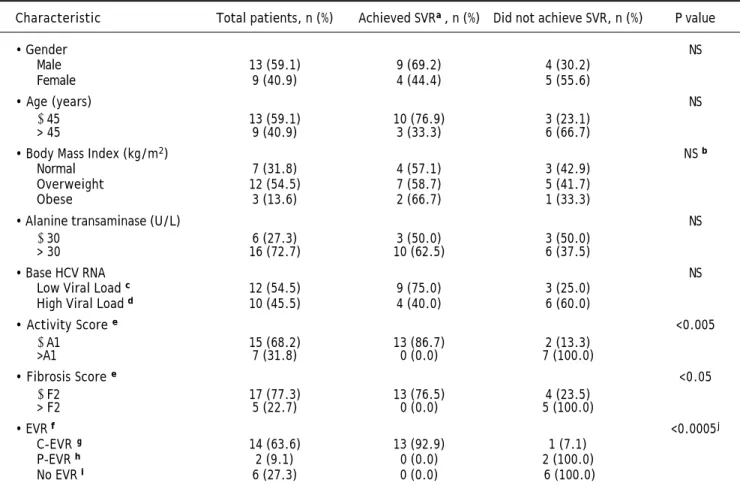
Table 2 compares the characteristics of patients who either achieved or failed to reach SVR (inclu-ding the 2 patients who discontinued treatment within 12 weeks because of adverse events). The proportion of male patients who achieved SVR was 69.2% compared to 44.4% of the females. 76.9% of the patients aged ≤ 45 years achieved SVR compared to 33.3% of those who were older than 45 years. The proportion of patients with normal BMI who re-ached SVR was 57.1% compared to 58.7% of those who were overweight and 66.7% of obese patients. Patients who had a baseline ALT of ≤ 30 U/L achie-ved SVR in 50.0% compared to 62.5% of those who had a base ALT of > 30 U/L. However, none of the above differences were found to be statistically signi-ficant (p > 0.05).
The proportion of patients with a baseline LVL (HCV RNA of ≤ 600,000 IU/mL) and reached SVR Figure 1. Flow of pa-tients through the study. aC-EVR: complete early viro-logical response, defined a completed loss of HCV RNA after 12 weeks of therapy. bP-EVR: partial early virolo-gical response, defined a ≥ 2 log decrease in, but not complete absence of, HCV RNA after 12 weeks of the-rapy.
cEVR: early virological res-ponse.
dNonresponder: Failure to cleare HCV RNA from serum after 24 weeks of therapy. eETR: end-of-treatment res-ponse, defined as HCV RNA negative by a sensitive test at the end of 48 weeks of treatment.
fBreakthrough: reappearan-ce of HCV RNA in serum whi-le still on therapy.
gSVR: sustained virological response, defined as HCV RNA negative 24 weeks af-ter cessation of treatment. hRelapse: reappearance of HCV RNA in serum after the-rapy is discontinued. Patients assessed
(n = 22)
Patients enrolled in the study (n = 22)
Peginterferon α-2b 1.5 µg/kg/week Ribavirin 15 mg/kg/day
48 weeks (n = 22)
Week 0 Received at least one dose
(n = 22)
Discontinued treatment (n = 2) Adverse events: 2 (9%)
Week 12 C-EVRa P-EVRb No EVRc
(n = 14) (n = 2) (n = 4)
Week 24 HCV RNA HCV RNA HCV RNA Nonresponderd
undetectable undetectable undetectable (n = 4) (n = 14) (n = 2) (n = 0)
Week 48 ETRe ETR
(n = 13) (n = 2)
Breakthroughf (n = 1)
Week 72 SVRg SVR
(n = 13) (n = 0)
Table 2. Predictors of response in 22 patients with HCV genotype 4 with normal ALT treated with weight-based pegylated inter-feron-alpha2b plus ribavirin.
Characteristic Total patients, n (%) Achieved SVRa, n (%) Did not achieve SVR, n (%) P value
• Gender NS
Male 13 (59.1) 9 (69.2) 4 (30.2)
Female 9 (40.9) 4 (44.4) 5 (55.6)
• Age (years) NS
≤ 45 13 (59.1) 10 (76.9) 3 (23.1) > 45 9 (40.9) 3 (33.3) 6 (66.7)
• Body Mass Index (kg/m2) NS b
Normal 7 (31.8) 4 (57.1) 3 (42.9)
Overweight 12 (54.5) 7 (58.7) 5 (41.7)
Obese 3 (13.6) 2 (66.7) 1 (33.3)
• Alanine transaminase (U/L) NS
≤ 30 6 (27.3) 3 (50.0) 3 (50.0)
> 30 16 (72.7) 10 (62.5) 6 (37.5)
• Base HCV RNA NS
Low Viral Load c 12 (54.5) 9 (75.0) 3 (25.0)
High Viral Load d 10 (45.5) 4 (40.0) 6 (60.0)
• Activity Score e <0.005
≤ A1 15 (68.2) 13 (86.7) 2 (13.3)
>A1 7 (31.8) 0 (0.0) 7 (100.0)
• Fibrosis Score e <0.05
≤ F2 17 (77.3) 13 (76.5) 4 (23.5) > F2 5 (22.7) 0 (0.0) 5 (100.0)
• EVR f <0.0005j
C-EVR g 14 (63.6) 13 (92.9) 1 (7.1)
P-EVR h 2 (9.1) 0 (0.0) 2 (100.0)
No EVR i 6 (27.3) 0 (0.0) 6 (100.0)
aSVR: sustained virological response. bZ-test based on two groups(normal and overweight + obese). cLow viral load: HCV RNA ≤ 600,000 IU/mL. dHigh viral
load: HCV RNA > 600,000 IU/mL. eBasedon METAVIR scoring system.17fEVR: early virological response. gC-EVR: complete early virological response,
defi-ned a complete loss of HCV RNA after 12 weeks of therapy. hP-EVR: partial early virological response, defined a ≥ 2 log decrease in, but not complete
absen-ce of, HCV RNA after 12 weeks of therapy. iIncludes 2 patients who discontinued therapy prior to week 12 because of adverse events. jZ-test based on two
groups (C-EVR and P-EVR + No EVR).
was 75% compared to 40.0% of those with a HVL. However, this difference did not reach statistical sig-nificant (p > 0.05). A majority of patients (86.7%) who had a necro-inflammatory activity score on li-ver biopsy of ≤ A1 achieved SVR compared to none of those who had an activity score of > A1 (p < 0.005). Similarly, 76.5% of those patients who had a fibrosis score of ≤ F2 on the liver biopsy reached SVR com-pared to none of those with a fibrosis score of > F2 (p < 0.05). A total of 13 (92.9%) patients who had C-EVR reached SVR, compared to none of the 2 patients who had P-EVR (p < 0.05), or the 6 patients who did not have EVR (p < 0.005).
DISCUSSION
Persistently normal ALT (PNALT) is usually de-fined as ALT levels in the normal range on at least 4
de-velopment of HCC has been described after 15 years of follow up.21-24 From a public health perspective, these patients with normal ALT may serve as a re-servoir for the virus in the community and thus treatment could be considered to eliminate this re-servoir of infection. A French study has shown that treatment of PNALT patients in the same manner as elevated ALT (EALT) patients will reduce the mortality and morbidity related to hepatitis C. These would strongly argue in favor of treating chronic hepatitis C patients with PNALT.
The combination of pegylated interferon and ri-bavirin is at present the treatment of choice in pa-tients with chronic HCV and EALT and so it is presumed to be the optimal therapy for patients with PNALT as well. The data regarding the effica-cy and safety of antiviral therapy in patients with genotype 4 infection and normal ALT are limited since most of the therapeutic trials have enrolled HCV infected patients with elevated serum ALT le-vels. In the limited studies available, the safety profile in PNALT patients was similar to that in patients with elevated ALT levels receiving pegin-terferon plus ribavirin.
The randomized trials with pegylated interferon in genotype 1 showed comparable SVR in patients with PNALT and EALT levels.25,26 Though SVR ra-tes were much lower in the studies with regular in-terferon and ribavirin when compared to those with pegylated interferon and ribavirin, the SVR in PNALT group were similar to those of EALT group in the studies with genotype 4 chronic hepatitis C patients.27 The SVR of 59% in genotype 4 HCV posi-tive patients with PNALT in our study is compara-ble to the SVR of 44-69% in HCV positive genotype 4 patients with raised liver enzymes.28-31 This is also similar to the SVR of 56% seen in a study on geno-type 4 patients with PNALT using pegylated interfe-ron alpha-2a and ribavirin. The EVR and ETR were also similar to those found in other studies with ge-notype 4 patients with raised ALT.28,30-33
There were no ALT flares during interferon treat-ment in our study unlike that observed in some ear-lier studies.34 This finding is in agreement with studies where ALT flares were not noted during the treatment. The side effects were not significantly higher in our study in comparison to other studies on genotype 4 with EALT.28,30 In patients who achieved SVR the mean ALT dropped by 10 U/L af-ter treatment compared with pretreatment values. This suggests that the normal values in these pa-tients may be higher than their true normal values and the viral clearance with associated improvement
in hepatic inflammation resulted in regression of these values to their true normal. This may mean that the currently accepted ULN for serum AST and ALT levels are too high. Some researchers have at-tempted to re-evaluate the ULN for serum ALT in chronic hepatitis C in order to redefine normal serum ALT levels.35-37 This also suggests that ALT activity may be an unreliable guide for treatment de-cisions and indeed, treatment of patients with chro-nic hepatitis C should rely on the probability of viral eradication, symptoms, histology, anticipated pro-gression of disease, and the risk of transmission ra-ther than on a single biochemical parameter. Nearly 45% of the patients in our study had significant fi-brosis (i.e. F2 or higher) and 9% had cirrhosis on li-ver biopsy. The factors which were the most significant predictors of SVR in our patients inclu-ded attainment of C-EVR, and presence of an activi-ty score of ≤ A1 and fibrosis scores of ≤ F2 on liver biopsy. Therefore, neither the presence of PNALT, nor a fibrosis score of up to F2 on liver biopsy should routinely exclude patients with HCV genoty-pe 4 from receiving combination therapy with genoty- pe-gylated interferon and ribavirin.
Though it is a nonrandomized, open label study with only a small number of patients the study is re-levant because of the lack of studies reported in the literature on pegylated interferon alpha 2b in HCV genotype 4 with PNALT. The findings from the stu-dy suggest that the response rate and safety profile of this treatment in PNALT patients may be compa-rable to EALT patients with genotype 4.
CONCLUSION
Our pilot study has shown that pegylated interfe-ron alpha 2b plus ribavirin is an effective and safe treatment for chronic HCV genotype 4 infection with PNALT, and that ALT levels should not be the sole determinant in deciding the need for treatment in chronic HCV infection. However as this is a pilot study, the findings needs to be confirmed by further randomized and bigger trials.
ABBREVIATIONS
• HHCV: Hepatitis C virus.:
• AALT: Alanine aminotransferase.L : • RRNA: Ribonucleic acid.:
REFERENCES
1. Abdel-Aziz F, Habib M, Mohamed MK, Abdel-Hamid M, Gamil F, Madkour S, Mikhail NN, et al. Hepatitis C (HCV) infection in a community in the Nile Delta: population description and HCV prevalence. Hepatology 2000; 32: 111-5. 2. Angelico M, Renganathan E, Gandin C, Fathy M, Profili MC,
Refai W, De Santis A, et al. Chronic liver disease in the Alexandria governorate, Egypt: contribution of schistoso-miasis and hepatitis virus infections. J Hepatol 1997; 26: 236-43.
3. Ray SC, Arthur RR, Carella A, Bukh J, Thomas DL. Genetic epidemiology of hepatitis C virus throughout Egypt. J In-fect Dis 2000; 182: 698-707.
4. Zekri AR, Bahnassy AA, Ramadan AS, El-Bassuoni M, Badran A, Madwar MA. Hepatitis C virus genotyping versus sero-typing in Egyptian patients. Infection 2001; 29: 24-6. 5. Fakeeh M, Zaki AM. Hepatitis C: prevalence and common
genotypes among ethnic groups in Jeddah, Saudi Arabia.
Am J Trop Med Hyg 1999; 6: 889-92.
6. Marcellin P, Lévy S, Erlinger S. Therapy of hepatitis C: pa-tients with normal aminotransferase levels. Hepatology
1997; 26: 133S-136S.
7. Tassopoulos, NC. Treatment of patients with chronic he-patitis C and normal ALT levels. J Hepatol 1999; 31: 193-6. 8. Bacon BR. Treatment of patients with hepatitis C and nor-mal serum aminotransferase levels. Hepatology 2002; 36: S179-S184.
9. Persico M, Persico E, Suozzo R, Conte S, De Seta M, Co-ppola L, Palmentieri B, et al. Natural history of hepatitis C virus carriers with persistently normal aminotransferase levels. Gastroenterology 2000; 118: 760-4.
10. Martinot-Peignoux M, Boyer N, Cazals-Hatem D, Pham BN, Gervais A, Le Breton V, Levy S, et al. Prospective study on anti-hepatitis C virus-positive patients with persistently normal serum alanine ansaminase with or without detectable serum hepatitis C virus RNA. Hepatology 2001; 34: 1000-5. 11. Cividini A, Rebucci C, Silini E, Mondelli MU. Is the natural
history of hepatitis C virus carriers with normal amino-transferase really benign? Gastroenterology 2001; 121: 1526-7.
12. Puoti C, Magrini A, Stati T, Rigato P, Montagnese F, Rossi P, Aldegheri L, et al. Clinical, histological, and virological features of hepatitis C virus carriers with persistently normal or abnormal alanine transaminase levels. Hepatolo-gy 1997; 26: 1393-8.
13. Hui CK, Belaye T, Montegrande K, Wright TL. A comparison in the progression of liver fibrosis in chronic hepatitis C between persistently normal and elevated transaminase. J Hepatol 2003; 38: 511-7.
14. Strader DB, Wright T, Thomas DL, Seeff LB. Diagnosis, ma-nagement, and treatment of hepatitis C. Hepatology
2004; 39: 1147-71.
15. Poordad F, McCone J Jr, Bacon BR, Bruno S, Manns MP, Sulkowski MS, Jacobson IM, Reddy KR, et al. Boceprevir for untreated chronic HCV genotype 1 infection. N Engl J Med 2011; 364: 1195-206.
16. McHutchison JG, Everson GT, Gordon SC, Jacobson IM, Sulkowski M, Kauffman R, McNair L, et al. Telaprevir with peginterferon and ribavirin for chronic HCV genotype 1 infection. N Engl J Med 2009; 360: 1827-38.
17. Bedossa P, Poynard T. An algorithm for the grading of ac-tivity in chronic hepatitis C. The METAVIR Cooperative Study Group. Hepatology 1996; 24: 289-93.
18. Mathurin P, Moussalli J, Cadranel JF, Thibault V, Charlotte F, Dumouchel P, Cazier A, et al. Slow progression rate of
fibrosis in hepatitis C virus patients with persistently nor-mal alanine transaminase activity. Hepatology 1998; 27: 868-72.
19. Pradat P, Alberti A, Poynard T, Esteban JI, Weiland O, Marcellin P, Badalamenti S, et al. Predictive value of ALT levels for histologic findings in chronic hepatitis C: a Euro-pean collaborative study. Hepatology 2002; 36: 973-7. 20. Rumi MG, De Filippi F, La Vecchia C, Donato MF, Gallus S,
Del Ninno E, Colombo M. Hepatitis C reactivation in pa-tients with chronic infection with genotypes 1b and 2c: a retrospective cohort study of 206 untreated patients.
Gut 2005; 54: 402-6.
21. Ghany MG, Kleiner DE, Alter H, Doo E, Khokar F, Promrat K, Herion D, et al. Progression of fibrosis in chronic hepatitis C. Gastroenterology 2003: 124: 97-104.
22. Okanoue T, Makiyama A, Nakayama M, Sumida Y, Mitsuyoshi H, Nakajima T, Yasui K, et al. A follow-up study to determi-ne the value of liver biopsy and determi-need for antiviral therapy for hepatitis C virus carriers with persistently normal serum aminotransferase. J Hepatol 2005; 43: 599-605. 23. Persico M, Palmentieri B, Coppola L, Di Giacomo Russo G,
De Marino F, De Sio I, Torella R. Occurrence of HCC in asymptomatic HCV-related chronic hepatitis. Dig Dis Sci
2002; 47: 2407-10.
24. Puoti C, Bellis L, Martellino F, Durola L, Spilabotti L, Dell’Unto O, Galossi A, et al. Occurrence of hepatocellular carcinoma in an apparently ‘healthy’ HCV patient. Eur J Gastroenterol Hepatol 2005; 17: 1263-4.
25. Zeuzem S, Diago M, Gane E, Reddy KR, Pockros P, Prati D, Shiffman M, et al. Peginterferon alfa-2a (40 kilodaltons) and ribavirin in patients with chronic hepatitis C and nor-mal aminotransferase levels. Gastroenterology 2004; 127: 1724-32.
26. Puoti C, Pellicelli AM, Romano M, Mecenate F, Guarisco R, Barbarini G, Mazzoni E, et al. Treatment of hepatitis C vi-rus carriers with persistently normal alanine aminotrans-ferase levels with peginterferon alpha-2a and ribavirin: a multicentric study. Liver Int 2009; 29: 1479-84.
27. Hasan F, Asker H, Al-Khalid J, Al-Mekhaizeem K, Al-Shamali M, Siddique I, Al-Nakib B. Interferon-alpha in combination with ribavirin for the treatment of chronic hepatitis C in patients with persistently normal aminotransferase levels.
Digestion 2002; 65: 127-30.
28. Hasan F, Asker H, Al-Khaldi J, Siddique I, Al-Ajmi M, Owaid S, Varghese R, et al. Peginterferon alfa-2b plus ribavirin for the treatment of chronic hepatitis C genotype 4. Am J Gastroenterol 2004; 99: 1733-7.
29. Alfaleh FZ, Hadad Q, Khuroo MS, Aljumah A, Algamedi A, Alashgar H, Al-Ahdal MN, et al. Peginterferon alpha-2b plus ribavirin compared with interferon alpha-2b plus ribavirin for initial treatment of chronic hepatitis C in Saudi pa-tients commonly infected with genotype 4. Liver Int 2004; 24: 568-74.
30. Kamal SM, El Tawil AA, Nakano T, He Q, Rasenack J, Hakam SA, Saleh WA, et al. Peginterferon {alpha}-2b and ribavirin therapy in chronic hepatitis C genotype 4: impact of treatment duration and viral kinetics on sustained virolo-gical response. Gut 2005; 54: 858-66.
31. El-Zayadi AR, Attia M, Barakat EM, Badran HM, Hamdy H, El-Tawil A, El-Nakeeb A, et al. Response of hepatitis C genotype-4 naïve patients to 24 weeks of Peg-interferon-alpha2b/ribavirin or induction-dose interferon-alpha2b/ ribavirin/amantadine: a non-randomized controlled study.
Am J Gastroenterol 2005; 100: 2447-52.
response to peginterferon plus ribavirin treatment of he-patitis C virus genotype 4 infection. J Viral Hepat 2007; 14: 460-7.
33. Moucari R, Ripault MP, Martinot-Peignoux M, Voitot H, Cardoso AC, Stern C, Boyer N, et al. Insulin resistance and geographical origin: major predictors of liver fibrosis and response to peginterferon and ribavirin in HCV-4. Gut
2009; 58: 1662-9.
34. Serfaty L, Chazouillères O, Pawlotsky JM, Andreani T, Pellet C, Poupon R. Interferon alfa therapy in pa-tients with chronic hepatitis C and persistently normal aminotransferase activity. Gastroenterology 1996; 110: 291-5.
35. Prati D, Taioli E, Zanella A, Della Torre E, Butelli S, Del Vec-chio E, Vianello L, et al. Updated definitions of healthy ranges for serum alanine aminotransferase levels. Ann In-tern Med 2002; 137: 1-10.
36. Zeuzem S, Alberti A, Rosenberg W, Marcellin P, Diago M, Negro F, Prati D, et al. Review article: management of pa-tients with chronic hepatitis C virus infection and “nor-mal” alanine aminotransferase activity. Aliment Pharmacol Ther 2006; 24: 1133-49.
37. Yagura M, Tanaka A, Kamitsukasa H, Otsuka H, Kanno S, Aoyama T. Re-evaluation of the serum alanine aminotrans-ferase upper normal limit in chronic hepatitis C patients.