Rev Hosp Jua Mex 2015; 82(1): 18-25
8
18
Artículo original
The on- and off-transient phases two
V
O
2kinetics during submaximal exercise in old men
Javier Padilla-Pérez*
Fisiología del Ejercicio
* Escuela Superior de Medicina, IPN. Canadian Centre for Activity and Ageing, School of Kinesiology, The University of Western Ontario 6501811FTGAF), London, Ontario, Canada N6A 3K7.
RESUMEN
Se evaluó en adultos maduros voluntarios sanos si la respuesta fundamental de VO2 (Φ2 VO2) al ejercicio submáximo
(ontransitoria) y su recuperación (offtransitoria) muestran una cinética similar (τ2Onvs. τ2Off) de la φ2 VO2 (τ2,
constan-te fundamental de tiempo) de modelos exponenciales de mejor ajusconstan-te ya evaluados. Los voluntarios (n = 9; media ± SD: 72 ± 4 años) hicieron una prueba inicial de rampa (15 W·min-1) hasta el agotamiento, de la que fueron
identificados el umbral ventilatorio (θ) y las intensidades de trabajo submáximo para 80%θ (ModRel) y 120%θ (HvyRel); además se seleccionó una intensidad absoluta de 50 W (ModAbs). On y off transitorias fueron desde una línea de base (LB) sin previo aviso al voluntario. Cada una duró 6 min y se repitió entre 4-6 veces para cada intensidad. VO2 fue mediada de respiración a respiración en una LB y en cada transición. Los datos fueron filtrados, interpolados y sobrepuestos a intervalos de 1 s para obtener un perfil de respuesta individual para cada sujeto e intensidad. Esta respuesta fue ajustada con modelos exponenciales de dos (2C) y tres componentes (3C), usando diferentes ventanas de ajuste, y los parámetros (P) estimados (v.gr., τ2) fueron determinados para cada
componente. Nuestros mejores modelos de ajuste estadístico y/o fisiológico mostraron valores transitorios simétri-cos (on similar off) de τ2VO2 (s) con 2C, 7P (Mod_Abs and Rel: on = 57 ± 15 y off = 56 ± 14); y para HvyRel (on
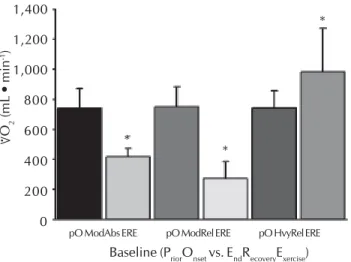
= 40 ± 9 y off = 39 ± 7) con 3C, 10P. La LB (mL · min-1) de Hvyon (744 ± 115) fue menor que Hvyoff (982 ± 288).
Tiempo medio de la respuesta cinética global (s) Hvyon (82 ± 18) fue menor que Hvyoff (55 ± 8). Las cinéticas on y off de la respuesta transitoria de la Φ2 VO2 están notablemente influenciadas por la dinámica de la VO2 durante
el ejercicio muscular submáximo en hombres adultos mayores.
Palabras clave: Cinética de la fase dos de O2, transiciones de respuesta y de recuperación de O2, constante de tiempo, hombres adultos mayores.
ABSTRACT
We assessed in old healthy male volunteers if the fundamental VO2 (Φ2 VO2) to submaximal exercise (ontransient
response) and its recovery (offtransient response) show in the VO2 kinetics (τ2, time constant two) on-off symmetry
(τ2Onvs. τ2Off) characterised from best exponential fitting models previously assessed. Volunteers (n = 9; mean ±
SD: 72 ± 4 yrs) completed an initial incremental ramp test (W·min-1) to volitional fatigue from which the ventilatory
threshold (θ) and work rates corresponding to 80%θ (ModRel) and 120%θ (HvyRel) were identified, plus a selected “absolute” work rate of 50 W (ModAbs) (submaximal exercise). On and off step-transitions in work rate were initiated from a baseline (BL) without warning to the subject. Each transition (On, Off) lasted 6 min and 4-6 transitions were performed at each intensity. The VO2 response was measured breath-by-breath at BL and throughout each transition. On and off data were filtered, interpolated to 1-s intervals and ensemble-averaged to yield a single response profile for each subject and intensity. The averaged response for each subject was fit with a two- (2C), and three-component (3C) exponential model by using different fitting windows, and parameter (P) estimates (i.e., τ2)
were determined for each component. Our best statistically and/or physiologically fitting models showed symmetry τ2 values for Mod with 2C, 7P (Mod_Abs and Rel: on = 57 ± 15 and off = 56±14); and for HvyRel (on = 40 ±
9 y off = 39 ± 7) with 3C, 10P. BL (mL·min-1) Hvyon (744 ± 115) was low compared Hvyoff (982 ± 288). Overall
• •
•
•
•
• •
•
•
INTRODUCTION
Greater understanding of oxygen (O2) kinetics control and, in particular, its relation to the plasticity of the O2 transport/utilization system is important for improving the human condition, crucially for patients suffering from pathologically slowed O2 kinetics and the elderly popula-tion.1 A slowing of pulmonary oxygen uptake (VO
2) kine-tics during the on-transition to a step increase in work rate (WR) of moderate intensity2 require to be characterized by an exponential model with twocomponents and seven parameters (2C,7P),3 below what has been termed the anae-robic threshold. For heavy exercise (above anaeanae-robic thres-hold), the physiological basis for phases 1 (θ1) and 2 (θ2) transitions in VO2 kinetics is evident while θ2 to θ3 (phase three) transitions in heavy exercise are complex,4 with asymmetries of VO2 transients at the onset and offset, and require complex model5 like an exponential model with three components and 10 parameters (3C,10P),3 for appro-priate characterisation as a result of a slow kinetic compo-nent which is of delayed onset of approximately ≥ 2 min, supporting the possibility of a more complex link between muscle force production and the metabolic mechanisms of energy transfer at a work rate,6-8 specially above anaerobic threshold, both during the ontransient and offtransient (recovery) responses to submaximal exercise.9 The end of exercise does not indicate the cessation of functional and metabolic activities in the body systems, it is necessary for the body to normalize its function and settle the active metabolism during this post-exercise recovery period (i.e., VO2 offtransient response). The slower VO2 off transient component had a small amplitude and long time constant, but did not differ significantly among the various tests and also the off transient kinetics for VO2 has been reported it was independent of the magnitude of the contribution to the slow phase from the ontransient kinetics.10 Even more, following muscular contractions the rate of recovery is stron-gly dependent upon muscle fibre oxidative capacity since it has been observed that following submaximal intensity muscle contractions, the speed of recovery of microvascu-lar O2 pressures recovers much faster in the more oxidative mixed gastrocnemius than in the less oxidative white gas-trocnemius.11 It has been also observed, that both the kinetic
responses of femoral artery blood flow and the muscle capillary blood flow appear to be coupled with muscle oxygen uptake during recovery from moderate knee-exten-sion exercise, such that extraction falls, because the cellular energetic state is not further compromised, throughout recovery.12 However on one hand, it is important to men-tion that dependent upon the relative speed of VO2 and blood flow kinetics, the exercise offtransient may represent a condition of sub- or supra-optimal perfusion.11 On the other hand, VO2 and phosphocreatine kinetics during exer-cise of a muscle group accustomed to daily activity are not compromised in physically active older humans, and phos-phocreatine kinetics reflect the kinetics of muscle O2 con-sumption, and are expressed at the pulmonary VO2 kinetics after a transit delay.13 It has been observed also that the
VO2 kinetics remained slow when contractions were initia-ted from an elevainitia-ted baseline despite experimentally increased blood flow and uniform fibre activation, adding evidence that muscle VO2 control is more complex than previously suggested. In consequence our current unders-tanding of the control of muscle VO2 in correspondence to the fundamental pulmonary VO2 kinetics demand conside-ration of new alternative mediators for VO2 control.14
The ontransient and offtransient (recovery) responses to submaximal exercise has been modelled based on the fact that the mean transit time from the muscle capillary to the lung is approximately 15-20 s, clearly indicate that it is necessary to take account of this transit delay “from muscle to mouth” if pulmonary VO2 kinetics are to be used to estimate the kinetics of muscle O2 consumption and even the removal of the first 20 s of pulmonary data from consideration effectively “time aligns” the muscle and pulmonary signals and results in close agreement between the responses,8 however the ontransient vs. offtransient responses to submaximal exercise have not been assessed physiological/statistically isolating their θ2VO2 dynamics. Taking in consideration that “the issue is not simply a mathematical quibble over fitting strategies but one with significant physiological implications” (Whipp)15 the pur-pose in this study was to assess with exponential mathe-matical models the isolated φ2 from both the ontransient (exercise φ2VO2) and the offtransient (post-exercise φ2VO2 recovery) responses to submaximal exercise in old men,
mean response time (s) Hvyon (82 ± 18) resulted low compared Hvyoff (55 ± 8). The on and off kinetics of the transient responses of the φ2 VO2 are strongly influenced by the dynamics of VO2 during muscular submaximal
exercise in older men.
Key words: O2 uptake kinetics, on- and off-phase two O2, time constant, old adults.
Rev Hosp Jua Mex 2015; 82(1): 18-25
Padilla-Pérez J. The submaximal ontransient and offtransient VO2kinetics in old men.
0
20
using the 2C,7P for moderate intensity exercise (Mod) and the 3C,10P model for heavy intensity exercise (Hvy).
Hypothesis
If the isolated exponential φ2VO2 ontransient- and off-transient responses to forcing functions of submaximal exer-cise are kinetically symmetrical to each other then the time constant duration (τφ2VO2) from the two component and three component models should not be significantly diffe-rent to each other (τ2on similar to τ2off) in old men.
MATERIAL AND METHODS
Subjects
The subjects in this study were 9 healthy males aged ranged from 66 to 79 years. Data were obtained from the studies carried out under control conditions in our labora-tory over several years. Subjects performed cycle ergometer exercise in both the moderate-intensity exercise and the heavy intensity exercise. The Review Board for Research Using Human Subjects provided ethical approval and each subject gave their informed consent.
Testing procedures
The determination of maximal oxygen uptake (VO2 max) and the VO2 at ventilatory threshold (θ) was carried out on an electrically braked cycle ergometer (Lode H-300-R Roxon Medi-Tech). The test was performed as a ramp function with work rate increasing at a rate of 15 W·min-1. The θ was determined by visual inspection of data using the criteria outlined previously3 of a systematic increase in
VE/VO2 (VE, expired gas volume) and in end-tidal O2 pressure (PETO2) with no concomitant rise in VE/VCO2 (VCO2, CO2 uptake) or a decrease in end-tidal CO2 pressure (PETCO2). Constant-load exercise tests were performed on subsequent visits to the laboratory. Exercise began with 6 min of loadless (~15 W) cycling. The work rate was then increased as a step function to an intensity corresponding to a VO2 of approximately 80% of the VO2 at θ (ModRel, relative moderate-intensity) or the VO2 of approximately 120% of the VO2 at θ (HvyRel, relative heavy-intensity). Also, it was selected an “absolute” work rate of 50 W (ModAbs, abso-lute moderate-intensity) corresponding of approximately 62% of the VO2 at θ. The subjects exercised at the appro-priate work rate for 6 min (ontransient VO2 response), after which the work rate was abruptly decreased and the sub-jects continued loadless cycling for 6 min (offtransient VO2 response).
Data collection and analysis
Gas exchange was determined using previously reported methods.9 Throughout exercise, inspired and expired gas volumes (VI and VE) were measured using a low dead space (90 mL) bidirectional turbine (VMM110, Alpha technolo-gies), which was calibrated prior to each test using a syrin-ge of known volume (3.01 L). Respired gases were sampled continuously (1 mL·s-1) at the mouth and analysed for con-centrations of O2, CO2 and N2 by mass spectrometry (MGR 9N, Airspec 2000) after calibration with precision-analy-sed gas mixtures (9%O2, 7%CO2). Changes in gas concen-tration were aligned with gas volumes by measuring the time delay for a bolus of gas to pass the turbine to the resulting changes in fractional gas concentrations as mea-sured by the mass spectrometer.
Breath-by-breath alveolar gas exchange was calculated using previously described algorithms.16 The breath-by-brea-th data were interpolated to 1 s intervals. In order to im-prove the signal-noise ratio each subject performed a num-ber of repetitions of the exercise protocol. For Mod were performed 6-8 constant-load exercise tests for each condi-tion (2-4 transicondi-tions·visit-1) and for HvyRel were performed 2-3 constant-load exercise tests (1 transition·visit-1). The interpolated data were then averaged for each individual to yield a single response. The single response (50 W, 80% θ, 120% θ overlayed data) was used for determining the kine-tics of the VO2 on- and offtransient responses to submaxi-mal exercise.
Models
Rev Hosp Jua Mex 2015; 82(1): 18-25
Padilla-Pérez J. The submaximal ontransient and offtransient
V
O
2
kinetics in old men.
21
Moderate intensity (50 Watts, 80% θ) exercise VO2(t) = A0 + A1 • [1-e-[(t - TD1) / τ2]] + A
2 • [1-e-[(t-TD2)/τ2]] 2C,7PBaseline to 6 min Entire transient response τ “φ1”, τφ2Isolated_Stat & Phys ∴φ2Isolated_Stat & PhysVO2(t) = A0 + A2 • [1-e-[(t-TD2)/τ2]]
Relative (120 %θ) Heavy intensity exercise VO2(t) = A0 + A1 • [1-e-[(t-TD1)/τ1]] + A
2 • [1-e-[(t-TD2)/τ2]] + A3 • [1-e-[(t-TD3)/τ3]] 3C,10PBaseline to 6 min Entire transient response τ “φ1”, τφ2Isolated_Stat & Physs, “φ3” ∴
∴φ2Isolated_Phys & StatVO2(t) = A0 + A2 • [1-e-[(t-TD2)/τ2]]
Exercise transient VO2: Pulmonary O2uptake (VO2) corporal response from the start (onset) to end (offset) of the exercise of an application of an ergometric forced function lasting 6
min (ontransient VO2) to the 6 min end exercise recovery (offtransient VO2). θ, ventilatory threshold. Stat, statistically significant based on Fisher's test. Phys, physiological sense based
on the differentiation of the phases and the numeric values of the estimated temporal parameters, of the transient VO2response, according to the intensity of the exercise modelled.
VO2(t), mass rate of change per unit of time (dVO2 • dt-1), mL • min-1. TD: time dalay, s; A
0: baseline (the VO2 at the start of the model). A, the VO2 distance value from A0 to the VO2
required for phase one (A1), phase two (A2) and phase three (A3) amplitudes, mL. 1-e-(t/τ), the negative exponential distribution (Evans, Hasting and Peacock, 1993); e-(t/τ), the die-away
factor with the time constant t (s), for an exponential increase (offtransient VO2 response); t, the time in which the transient VO2 response is gradually (exponentially) dying away, when
t = τ means the time required for the transient VO2 response to die away to e-1 part (e-1 = 1/2.71828 = 0.3678) of its original value, thus, τ = 1 - 0.3678 = 0.63, and e = 2.718281
= [(1 + n-1)]n, n ≥ 10 and ‘e’ is incommensurable with one. Two components (2C), TD1 and TD2. Three components (3C), 2C and TD3. 7P: seven parameters (a
0, a1, a2, TD1, TD2,
τ1, τ2). 10P: ten parameters (7P, a3, TD3, τ3). The θ means that even the mathematical exponential model fit the entire experimental data, phase one (“φ1”) did not behave in an
exponential way and probably phase three will not (“φ3”).
Table 2. Subject characteristics and data for maximal and submaximal exercise in nine old men.
Age Height Mass Work Rate Max VO2 peak θ
(years) (cm) (kg) (Watts) (l·min-1) (mL·kg-1·min-1) (mL·min-1) (mL·kg-1·min-1)
72.4 ± 4.4 173.8 ± 5.5 79.8 ± 9.9 127.8 ± 20.7 2.2 ± 0.4 27.8 ± 6.8 1,333.2 ± 138.6 17.0 ± 2.7
Submaximal exercise
50 W§ e Moderate intensity exercise Heavy intensity exercise
VO2 PO VO2 PO VO2
(mL·min-1) (mL·kg-1·min-1) (W) (mL·min-1) (mL·kg-1·min-1) (W) (mL·min-1) (mL·kg-1·min-1)
1,180.3 ± 1a 14.9 ± 1.4c 35.7 ± 11.1e 1,049.6 ± 198b 13.2 ± 2.2d 89.1 ± 16.6f 1,782.6 ± 332.6b 22.6 ± 5.3d
All data are mean ± SD. §Absolute PO. q: ventilatory threshold. PO: power output. VO
2: pulmonary oxygen uptake. mL • kg-1 • min-1, VO2 relative to total body mass. Significant
differences between means with different letter, allocated by Two way ANOVA procedure, post-hoc Holm-Sidak (P < 0.001): agbF
Rev Hosp Jua Mex 2015; 82(1): 18-25
Padilla-Pérez J. The submaximal ontransient and offtransient VO2kinetics in old men.
2
22
The ontransient and offtransient pulmonary oxygen up-take response profiles to absolute moderate intensity (Mo-dAbs = 50 ± 0 W), relative moderate-intensity (ModRel80%θ = 36 ± 11 W), and relative heavy-intensity (HvyRel120%θ = 89 ± 17 W) square wave exercise is shown in figure 3. Steady states of VO2 ontransient and offtransient were attai-ned at moderate (Mod) but not at heavy (Hvy) intensities (Figure 3).
The VO2 baseline On and Off comparisons from our three different submaximal exercise intensities are shown in figure 4. Analysis showed high On VO2 baseline compa-Usually 100 iterations were run and the parameter
estima-tes examined to allow further iterations with the estimaestima-tes obtained. The models were run with φ2 τ underestimated (e.g. 15 s) or overestimated (e.g. 70 s) to assure that the minimised residuals were not due to a localised minimi-sed least squares residuals.18 Specific details of each best model with reference to start and end-point of each fit has been published some where else.3 9 However in brief in this study the 2C,7P modelled for moderate intensity exer-cise only either from 2 min BaSeLine to 6 min ontransient
VO2 Mod3 or from 1 min BSL to 6 min offtransient VO 2 ModAbs.9 This 2C,7P
BSL to 6 min was a twocomponent expo-nential fitted from BSL-start to end-exercise with two exponential equations differentiating θ1 and θ2. The 3C10P modelled for heavy-intensity exercise with a fitting win-dow either from 2 min BSL to 6 min ontransient VO2 HvyRel or from 1 min BSL to 6 min offtransient VO2 HvyRel. This 3C,10PBSL to 6min was a three component exponential fitted from BSL_start to either end-, or recovery-exercise3,9 with three exponential equations differentiating φ1, φ2 and φ3 (Table 1).
Statistical analyses
Estimated values of the θ2 τ and estimated parameters of interest from the different models used were compared, on
vs. off exercise intensity group, using two-way analysis of variance all pairwise multiple comparison procedures (post-hoc Holm-Sidak) with repeated measures.19 The Student’s
t-test was used to determine if the mean values of two conditions were significantly different.19 The probability level of 0.05 was chosen as the criterion for acceptance of statistical significance.
RESULTS
Subjects were of similar physical characteristics and car-diorespiratory fitness (Table 2). As expected, analysis showed that the power output and the pulmonary oxygen uptake both absolute and relative to total body mass, from the three different exercise intensities were significantly different (P < 0.05) to each other (Table 2).
MRTHvyRel = [A1/(A1 + A2 + A3)] • (TD1 + τ1) + [A2/(A1 + A2 + A3)] • (TD2 + τ2) + [A3/(A1 + A2 + A3)] • (TD3 + τ3)
Figure 2. MRTHvyRel.
MRTMod = [A1/(A1 + A2)] • (TD1 + τ1) + [A2/(A1 + A2)] • (TD2 + τ2)
Figure 1. MRTMod.
Figure 3. Groups ontransient and offtransient pulmonary oxygen uptake (VO2) response profiles to absolute moderate (50 W), relative moderate (80% θ), and relative heavy (120% θ) square wave exercise. Exercise onset (start) is at four min and offset (end) is at ten min. Data points (symbols) are the breath-by-breath interpolated to second-by-second pulmonary VO2
(experimental data) from either two min baseline (On_baseline: 2 min to 4 min) to the entire ontransient response (Onset to Offset) or one min baseline (Off_baseline: 9 min to 10 min) to the entire offtransient response (Offset to “EndRecoveryExercise” base-line). The nine subjects submaximal exercise at each intensity (n = 9) are displayed. θ: ventilatory threshold.
(n = 9)
Onset Offset ERE
0 2 4 6 8 10 12 14 16
Time (min) 3
2
1
0
Absolute moderate square wave exercise. Relative moderate square wave exercise. Relative heavy square wave exercise.
V
O2
(L • min
Figure 4. Pulmonary oxygen uptake (VO2) baseline On (pO) and Off (ERE) comparisons from three different submaximal exercise intensities. Absolute moderate (ModAbs = 50 W), relative moderate (ModRel = 80% θ), and relative heavy (HvyRel = 120% θ) square wave exercise. * P < 0.001.
1,400
1,200
1,000
800
600
400
200
0
V
O2
(mL • min
-1)
pO ModAbs ERE pO ModRel ERE pO HvyRel ERE
Baseline (PriorOnset vs. EndRecoveryExercise) *
*
*
red Off VO2 baseline for absolute moderate-intensity (Mo-dAbs: t = 4.4, P < 0.001), relative moderate-intensity (Mod Rel: t = 6.5, P < 0.001) and relative heavy-intensity (HvyRel: t = 3.2, P = 0.002) (Figure 4).
The fundamental temporal parameters (A2, TD2, τ2) for the ontransient VO2 vs. offtransient (P > 0.05) VO2 submaximal exercise comparisons from our best fitting models (Table 1) are shown in table 3. Either the amplitude φ2VO2 or the time constant φ2VO2 resulted similar bet-ween on and off transitions for each submaximal exercise intensity (Table 3).
Table 3. Fundamental temporal parameter for the ontransient vs. offtransient VO2 submaximal exercise comparisons from best fitting models.
Isolated phase II VO2 transient response
Exercise intensity Best fitting modelOn-, Off-window Parameter On¶ Off§
Absolute moderate (50 W)¶ § 2C,7P
On_baseline 2 min to 6 min end exercise Amplitude, mL • min-1 245±52 262±109
Off_baseline 1 min to 6 min exercise recovery Time delayed, s 27.2±4.3 26.3±4.0
Time constant, s 51.9±12.9 51.0±12.7
Relative moderate (80% θ)¶ § 2C,7P
On_baseline 2 min to 6 min end exercise Amplitude, mL • min-1 143±94 121±69
Off_baseline 1 min to 6 min exercise recovery Time delayed, s 26.1±7.4 24.3±7.0
Time constant, s 61.6±16.0 60.9±14.0
Relative heavy (120% θ) 3C,10POn_baseline 2 min to 6 min end exercise Amplitude, mL • min-1 607±208 613±250 Off_baseline 1 min to 6 min exercise recovery Time delayed, s 22.0±3.8 27.0±5.5
Time constant, s 40.2± 8.4 38.7±6.6
All data are mean ± SD from 9 male old sample size. VO2: pulmonary oxygen uptake. θ: ventilatory threshold. The 2Components, 7Parameters and the
3Components, 10Parameters both with an entire transient fitting window from baseline to 6 min, isolated phase II VO2 ontransient and offtransient responses (P > 0.05) to submaximal (moderate and heavy) exercise.
The VO2 ontransient and offtransient MRT compari-sons from three different submaximal exercise intensities in this study are shown in figure 5. Analysis showed that only the HvyRel VO2 ontransient MRT (not the moderate-intensities: ModAbs and ModRel) resulted significantly high (t = 5, P < 0.001) compared VO2 offtransient MRT (Figure 4).
Figure 5. Pulmonary oxygen uptake (VO2) Ontransient and Offtransient overall mean response time (MRT) comparisons from three different submaximal exercise intensities. MRT, the time required to achieve the 63.22% of the entire VO2 transient of response. Absolute moderate (ModAbs = 50 W), relative moderate (ModRel = 80% θ), and relative heavy (HvyRel = 120% θ) square wave exercise.* P < 0.001.
On ModAbs Off On ModRel Off On HvyRel Off
VO2 Transient Response (On vs. Off) 100
80
60
40
20
0
Rev Hosp Jua Mex 2015; 82(1): 18-25
Padilla-Pérez J. The submaximal ontransient and offtransient VO2kinetics in old men.
4
24
DISCUSSION
The VO2 kinetic analysis used in the present study isola-tes the fundamental phase 2 (φ2VO2) component of the response to submaximal exercise, which in normal condi-tions in healthy participants closely reflects the skeletal muscle φ2VO2 dynamics.6-8 The ontransient (exercise φ2VO2)
vs. the offtransient (post-exercise φ2VO2 recovery) respon-ses to the exercise tests for absolute moderate exercise; for relative moderate exercise and; for relative heavy exercise (submaximal exercise) cycling (ontransient) and constant off-loadless (offtransient) cycling were analysed with best statistically and/or physiologically exponential mathema-tical fitting models3,9 that characterised the on φ
2VO2 kine-tics (on τφ2VO2) and the off φ2VO2 kinetics (off τφ2VO2) for this submaximal exercise in old healthy adult men. The on isolated- and off isolated-φ2VO2 makes a physiological sense because it is obtained by fitting the entire (on, off) response with and exponential mathematical model iden-tifying the three theoretical phases named the cardiodyna-mic phase (φ1VO2), the fundamental exponential phase (φ2VO2) and the subsequent (φ3VO2) either steady-state for moderate exercise or the phase of delayed onset for exerci-se above lactate threshold that yields a slowly developing supplemental rise in VO2 resulting in what has been ter-med ‘excess’ VO2 specially for supra lactate threshold exer-cise.20 Whether or not these phases φ
1VO2 and φ3VO2 are exponentials or not is matter of debate. However, in this study the isolated φ2VO2 exponential phase for submaxi-mal exercise from the ontransient and offtransient showed symmetry to each other; confirming that our best statistica-lly and physiological3 9 fitting model constituents reflected the system’s physiological features, with implications for its control mechanisms due to the fact that the pulmonary VO2 kinetics usefully reflect the entire response of the mus-cle fibers that are contributing to force production. Besi-des, physiological systems analysis constitutes a tested and valuable tool that enhances understanding of the physiolo-gy of gas exchange kinetics and muscle energetics.21
Steady states of VO2 ontransient and offtransient obser-ved at moderate (Mod) but not at heavy (Hvy) intensities in this study agreed with previous observations from other researchers5,15 20 confirming that for exercise above anaero-bic threshold, the VO2 dynamics are more complex.
The fundamental temporal parameters (A2, TD2, τ2) for the ontransient VO2vs. offtransient VO2 submaximal exerci-se comparisons from our best fitting models resulted similar between on and off transitions for each submaximal exercise intensity. Thus characterizing the fundamental VO2 kinetics should take into account these temporal physiological con-siderations modulating muscle efficiency since this θ2VO2
clearly reflects the fundamental kinetics of the muscle ener-gy metabolism during/recovery of this exercise intensity.8 Thus an association between muscle phosphocreatine de-crease, determined by magnetic resonance spectroscopy, and pulmonary oxygen kinetics exists. However, on considering the entire temporal kinetic parameters, it has been observed dynamic asymmetry of phosphocreatine concentration and VO2 between the ontransient and offtransient of moderate-and high-intensity exercise in humans.22,23 This is on the other hand, in partial agreement with our observation that the VO2 ontransient and offtransient MRT comparisons from the three different submaximal exercise intensities in this study resul-ted similar for the moderate-intensities (ModAbs and Mo-dRel) but the HvyRel VO2 ontransient MRT resulted signifi-cantly high compared VO2 offtransient MRT. Again, a more complex kinetics exists in this HvyRel exercise,5 22 sugges-ting that overall mean response time up-hill (Hvyon MRT) is harder than its Hvyoff MRT (down-hill); this observation also agrees with the fact, that in this study the VO2 OffBaseline was low compared VO2 OnBaseline in each of the three diffe-rent submaximal exercise intensities and also it is explained because in the onset of exercise there is a rapid adjustment of blood flow required to facilitate adequate O2 delivery as metabolic rate increases; in contrast, a slower adjustment of flow following cessation of exercise would speed recovery as the metabolic rate returns to its resting level.12 Besides, it has been observed that slowed oxidative energy provision at the onset of exercise was correlated with the transient skele-tal muscle deoxygenation peak and the reduced spatial dis-tribution but it was not correlated with a microvascular O2, probably due to an absolute, rather than kinetic, mismatch of microvascular O2 delivery and consumption affecting the kinetics of muscular oxidative energy provision when mus-cle deoxygenation reaches some ‘critical’ level.24
CONCLUSIONS
The on and off fundamental kinetics of the transient responses of the φ2VO2 are strongly influenced by the dy-namics of the VO2 during muscular submaximal exercise in older men.
ACKNOWLEDGEMENTS
and Engineering Council, Canada. Javier Padilla was su-pported by Escuela Superior de Medicina, COFAA-SIP-CO-TEPABE-EDD, Instituto Politécnico Nacional, CONACyT, México.
REFERENCES
1. Poole DC, Jones AM. Oxygen Uptake Kinetics. Compr Physiol 2012; 2: 933-96.
2. Babcock MA, Paterson DH, Cunningham DA, Dickinson JR. Exercise on-transient gas exchange kinetics are slowed as a function of age. Med Sci Sports Exerc 1994; 26: 440-6. 3. Padilla JP, Kowalchuk JM, Taylor AW, Paterson DH. Phase
two on-transient O2 kinetics is slow age- related during submaximal exercise in adult men. Rev Hosp Jua Méx 2008; 75(3): 166-82.
4. Özyener F, Rossiter HB, Ward SA, Whipp BJ. Influence of exercise intensity on the on- and off-transient kinetics of pulmonary oxygen uptake in humans. J Physiol 2001; 533: 891-902.
5. Paterson DH, Whipp BJ. Asymmetries of oxygen uptake transients at the on- and offset of heavy exercise in humans. J Physiol 1991; 43: 575-86.
6. Grassi B, Poole DC, Richardson RS, Knight DR, Erickson BK, Wagner PD. Muscle O2 uptake kinetics in humans: implications for metabolic control. J Appl Physiol 1996; 80: 988-98.
7. Kemp G. Physiological implications of linear kinetics of mitochondrial respiration in vitro. Am J Physiol Cell Physiol 2008; 295: C844-C848.
8. Krustrup P, Jones AM, Wilkerson DP, Calbet JA, Bangsbo J. Muscular and pulmonary O2 uptake kinetics during moderate and high-intensity sub-maximal knee-extensor exercise in humans. J Physiol 2009; 587: 1843-56.
9. Padilla JP. Comparison of modelling techniques used to characterize moderate and heavy phase two recovery O2 kinetics in old men. Rev Hosp Jua Méx 2014; 81(2): 92-103. 10. Cunningham DA, St Croix CM, Paterson DH, Özyener F,
Whipp BJ. The off-transient pulmonary oxygen uptake (VO2) kinetics following attainment of a particular VO2 during heavy-intensity exercise in humans. Exp Physiol 2000; 85(3): 339-47. 11. McDonough P, Behnke BJ, Padilla DJ, Musch TI, Poole DC. Control of microvascular oxygen pressures during recovery in rat fast-twitch muscle of differing oxidative capacity. Exp Physiol 2007; 92(4): 731-8.
12. Harper AJ, Ferreira LF, Lutjemeier BJ, Townsend DK, Barstow TJ. Matching of blood flow to metabolic rate during recovery from moderate exercise in humans. Exp Physiol 2008; 93(10): 1118-25.
13. Paterson DH, McCreary CR, Marsh GD, Cunningham DA, Thompson RT. The effects of age on kinetics of oxygen uptake
and phosphocreatine in humans during exercise. Exp Physiol 1998; 83: 107-17.
14. Wüst RCI, McDonald JR, Sun Y, Ferguson BS, Rogatzki MJ, Spires J, Kowalchuk JM, et al. Slowed muscle oxygen uptake kinetics with raised metabolism are not dependent on blood flow or recruitment dynamics. J Physiol 2014: 1-15.
15. Ferreira LF, Harper AJ, Townsend DK, Lutjemeier BJ, Barstow TJ. Kinetics of estimated human muscle capillary blood flow during recovery from exercise. Exp Physiol 2005; 90(5): 715-26. 16. Beaver WL, Lamarra N, Wasserman K. Breath-by-breath measurements of true alveolar gas exchange. J Appl Physiol 1981; 51: 1662-75.
17. Motulsky HJ, Ransnas A. Fitting curves to data using nonlinear regression: a practical and nonmathematical review. FASEB J 1987; 1: 365-74.
18. Marquardt DW. An algorithm for least-squares estimation of nonlinear parameters. J Soc Induct Appl Math 1963; 11(2): 431-41.
19. Zar JH. Biostatistical Analysis, Third Edition, New Jersey: Prentice Hall, Inc., U.S.A., 1996.
20. Whipp BJ. The bioenergetics and gas exchange basis of exercise testing. Clin Chest Med 1994; 15: 173-92.
21. Perrey S, Burnley M, Millet GP, Jones AM, Poole DC, Gimenez P, Hughson RL, et al. Comments on Point: Counterpoint: The kinetics of oxygen uptake during muscular exercise do/do not manifest time-delayed phases. J Appl Physiol 2009; 107: 1669-75. 22. Rossiter HB, Ward SA, Kowalchuk JM, Howe FA, Griffiths JR,
Whipp BJ. Dynamic asymmetry of phosphocreatine concentration and O2 uptake between the on- and off-transients of moderate and high-intensity exercise in humans. J Physiol 2002; 541(3): 991-1002.
23. McDonough P, Behnke BJ, Kindig CA, Poole DC. Rat muscle microvascular PO2 kinetics during the exercise off-transient. Exp Physiol 2001; 86(3): 349-56.
24. Bowen TS, Rossiter HB, Benson AP, Amano T, Kondo N, Kowalchuk JM, Koga S. Slowed oxygen uptake kinetics in hypoxia correlate with the transient peak and reduced spatial distribution of absolute skeletal muscle deoxygenation. Exp Physiol 2013; 98(11): 1585-96.
Solicitud de sobretiros:
Javier Padilla P.MD, MSc, PhD (Candidate) Fisiología del Ejercicio
Escuela Superior de Medicina Instituto Politécnico Nacional Casco de Santo Tomás, DMH C.P.11340, México, D.F. Tel.: (55) 5729-6300, Ext. 62733 Fax (ext.): 62801