GOLD CARBENES FROM CYCLOHEPTATRIENES: GENERATION AND
FATE.
Yahui Wang
Dipòsit Legal: T 1612-2015
ADVERTIMENT. L'accés als continguts d'aquesta tesi doctoral i la seva utilització ha de respectar els drets de la persona autora. Pot ser utilitzada per a consulta o estudi personal, així com en activitats o materials d'investigació i docència en els termes establerts a l'art. 32 del Text Refós de la Llei de Propietat Intel·lectual (RDL 1/1996). Per altres utilitzacions es requereix l'autorització prèvia i expressa de la persona autora. En qualsevol cas, en la utilització dels seus continguts caldrà indicar de forma clara el nom i cognoms de la persona autora i el títol de la tesi doctoral. No s'autoritza la seva reproducció o altres formes d'explotació efectuades amb finalitats de lucre ni la seva comunicació pública des d'un lloc aliè al servei TDX. Tampoc s'autoritza la presentació del seu contingut en una finestra o marc aliè a TDX (framing). Aquesta reserva de drets afecta tant als continguts de la tesi com als seus resums i índexs.
ADVERTENCIA. El acceso a los contenidos de esta tesis doctoral y su utilización debe respetar los derechos de la persona autora. Puede ser utilizada para consulta o estudio personal, así como en actividades o materiales de investigación y docencia en los términos establecidos en el art. 32 del Texto Refundido de la Ley de Propiedad Intelectual (RDL 1/1996). Para otros usos se requiere la autorización previa y expresa de la persona autora. En cualquier caso, en la utilización de sus contenidos se deberá indicar de forma clara el nombre y apellidos de la persona autora y el título de la tesis doctoral. No se autoriza su reproducción u otras formas de explotación efectuadas con fines lucrativos ni su comunicación pública desde un sitio ajeno al servicio TDR. Tampoco se autoriza la presentación de su contenido en una ventana o marco ajeno a TDR (framing). Esta reserva de derechos afecta tanto al contenido de la tesis como a sus resúmenes e índices.
Yahui Wang
Gold Carbenes from Cycloheptatrienes:
Generation and Fate
DOCTORAL THESIS
Supervised by Prof. Antonio M. Echavarren
Institut Català d’Investigació Química (ICIQ)
Av. Països Catalans, 16
43007 Tarragona
Tel. 977 920 218
Fax. 977 920 225
HAGO CONSTAR que este trabajo de investigación titulado “Gold
Carbenes from Cycloheptatrienes: Generation and Fate”, que presenta
Yahui Wang para la obtención del título de doctor, ha sido realizado bajo
mi dirección en el Institut Català d’Investigació Química vinculado a la
Universidad Rovira I Virgili.
Tarragona, 14 de maig de 2014
El director de la Tesis Doctoral
Acknowledgements
The research documented in this Doctoral Thesis was carried out in l’Institut Català d’Investigació Química (ICIQ) under the supervision of Prof. Antonio M. Echavarren. I would like to thank Antonio for giving me so much guidance relating to this research and personal concerns in the nearly four years I have spent in his laboratory. I do thank Prof. Antonio M. Echavarren for performing the DFT calculations in this Thesis.
I would like to thank the ICIQ foundation for the fellowships allocated to me during my Thesis (October 2010 - July 2014).
I would also like to thank Sònia Gavaldà, Vanessa Martínez and Imma Escofet for their wonderful efforts, which allowed me to dedicate most of my time on research.
Thanks to Dr. Verónica López-Carrillo, Dr. Juhanes Aydin, Dr. María Moreno, Dr. Timm Haug, Dr. Madeleine Livendahl, Dr. Riccardo Sinisi and especially Dr. César R. Solorio-Alvarado for taking care of me during my first month (homesick period) in Tarragona.
I would like to thank all of my labmates, especially Katya Smirnova (Princess), Pilar Calleja, Anna Homs (Catalan Flower), Dr. Oscar Pablo, Dr. José M. Muñoz, Dr. Javier Carreras, Dr. Laura López, Dr. Núria Huguet, Dr. Beatrice Ranieri, Cristina Garcia, Elena Orbe-Izquierdo, Alba González, Sofia Ferrer, Bart Herlé and Dr. Anthony Pitaval (Big Daddy) who contributed to give this laboratory a friendly and happy atmosphere.
I would like to thank Zhouting Rong, Bart Herlé, Dr. Michael Muratore and Dr. Paul McGonigal for pleasant collaboration in some projects.
I would like to thank all of the smokers in the lab, Dr. Tania Jiménez, Morgane Gaydou, Masha Kirillova, Dr. David Leboeuf, Ruth Dorel (quitting now) and especially Carla Obradors (my Chemistry Model) for discussing chemistry during breaks we have taken together.
I would like to thank Dr. Hamidreza Samouel and Juan Gallardo for discussing basic concepts in catalysis, and Carla Obradors, Dr. Tania Jiménez, Dr. Michael Muratore and Dr. Paul McGonigal for valuable suggestion and language help when preparing this Thesis.
I would like to give huge and special thanks to Dr. Claudia De León (Boss), Dr. Michael Muratore and Dr. Paul McGonigal (Cherry-boy) for giving color to my life
here.
Thanks to all of the people who gave me help in these years in Tarragona.
Finally, I would like to end up by thanking the most important people: my parents and my wife.
At the moment of the writing of this thesis, the results presented herein had been published in:
“Intermolecular Reactions of Gold(I)-Carbenes with Furans by Related
Mechanisms”
David Lebœuf, Morgane Gaydou, Yahui Wang, and Antonio M. Echavarren, Org.
Chem. Front.2014, 1, DOI: 10.1039/c4qo00130c.
“Formal (4+1) Cycloaddition of Methylencyclopropanes with
7-Aryl-1,3,5-cycloheptatrienes by Triple Gold(I) Catalysis”
Yahui Wang, Michael E. Muratore, Zhouting Rong, and Antonio M. Echavarren,
Angew. Chem. Int. Ed.2014, 53, DOI: 10.1002/anie.201404029.
“Gold(I) Carbenes by Retro-Buchner Reaction: Generation and Fate”
Yahui Wang, Paul R. McGonigal, Bart Herlé, Maria Besora, and Antonio M.
Echavarren, J. Am. Chem. Soc. 2014, 136, 801–809.
“Gold for the Generation and Control of Fluxional Barbaralyl Cations”
Paul R. McGonigal, Claudia de León, Yahui Wang, Anna Homs, César R.
Solorio-Alvarado, and Antonio M. Echavarren, Angew. Chem. Int. Ed. 2012, 51, 13093–
13096.
“Cyclopropanation with Gold(I) Carbenes by Retro-Buchner Reaction from
Cycloheptatrienes”
César R. Solorio-Alvarado, Yahui Wang, and Antonio M. Echavarren, J. Am. Chem.
Table of Contents
Prólogo ... 13
List of Catalysts, Abbreviations and Acronyms ... 14
Resumen ... 15
General introduction ... 19
Singlet and triplet carbenes ... 19
Fischer and Schrock carbenes ... 19
Gold carbenes ... 21
Methods for generating free carbenes ... 24
Generation of gold carbenes ... 29
Buchner ring expansion ... 33
Retro-Buchner reactions ... 34
Chapter 1. The generation and fate of gold carbenes by retro-Buchner reactions ... 37
Background ... 37
Objectives ... 38
Synthesis of 7-aryl cycloheptatrienes ... 39
Results and discussions. ... 41
Cyclopropanation ... 41
Kinetic study of cyclopropanation ... 43
DFT calculations of retro-Buchner reaction ... 44
Cyclopropanation/Cope-rearrangement ... 45
C-H insertions ... 46
Formation of cyclopropyl gold(I) carbenes ... 47
Biscycloheptatriene ... 49
With furans ... 50
7-Alkylcycloheptatriene ... 52
7-Alkynyl cycloheptatrienes ... 52
Conclusions. ... 58
Experimental part. ... 59
Chapter 2. (4+1) Cycloaddition of methylenecyclopropanes or cyclobutenes with gold(I) carbenes. ... 91
Background ... 91
Results and discussions ... 96
With methylenecyclopropanes (MCPs) ... 96
With cyclobutenes. ... 99
Mechanistic insight ... 100
Conclusion ... 104
Experimental part ... 105
1. Cycloheptatrienes ... 105
3. Procedure for the preparation of cyclobutenes ... 108
4. Procedure for gold catalyzed (4+1) reactions ... 111
Chapter 3. Formal C-H insertions of gold carbenes ... 131
Background ... 131
Objectives ... 135
Results and discussions ... 136
Indenes formation ... 136
DFT calculations ... 138
Fluorenes formation ... 141
Conclusions ... 145
Experimental part ... 146
1. General procedure for the synthesis of arylcycloheptatrienes ... 146
2. General procedure for the gold-catalyzed formation of indenes and fluorenes ... 168
Prólogo
This thesis has been divided into one introduction and three research chapters.
The introduction provides some basic concepts and methods for the generation of free carbenes and gold(I) carbenes.
Chapter 1 presents all of the reactions (except reactions discussed in Chapter 2 and 3) we have found based on the gold-catalyzed retro-Buchner reaction. Part of this work on the cyclopropanation of gold-carbenes is included in the following publication: César R. Solorio-Alvarado, Yahui Wang, and Antonio M. Echavarren, J. Am. Chem. Soc.2011, 133, 11952–11955. To avoid overlap with the thesis of Dr. César R. Solorio-Alvarado, his work in this publication is not included in this thesis.
We present some reactions of cycloheptatrienes that do not undergo retro-Buchner reactions. Some results presented in this chapter support the mechanism of “Gold for the Generation and Control of Fluxional Barbaralyl Cations”, as published in: Paul R. McGonigal, Claudia de León, Yahui Wang, Anna Homs, César R. Solorio-Alvarado, and Antonio M. Echavarren, Angew. Chem. Int. Ed. 2012, 51, 13093– 13096.
Chapter 2 gives the detailed study on a new formal (4+1) cycloaddition strategy by using methylenecyclopropanes or cyclobutenes as synthetic equivalent of 1,3-dienes. The entirety of this work was published in: Yahui Wang, Michael E. Muratore, Zhouting Rong, and Antonio M. Echavarren, Angew. Chem. Int. Ed.2014, 53, DOI: 10.1002/anie.201404029.
List of Catalysts, Abbreviations and Acronyms
All of the gold(I) complexes used in this thesis have been listed bellow. They were prepared according to our previous publications.1
In this manuscript, the abbreviations and acronyms used follow the recommendations found in the on-line “Guidelines for authors” of the Journal of Organic Chemistry.
1
(a) Nieto-Oberhuber, C.; López, S.; Muñoz, M. P.; Cárdenas, D. J.; Buñuel, E.; Nevado, C.; Echavarren, A. M. Angew. Chem. Int. Ed. 2005, 44, 6146–6148. (b) López, S.; Herrero-Gómez, E.; Pérez-Galán, P.; Nieto-Oberhuber, C.; Echavarren, A. M. Angew. Chem. Int. Ed. 2006, 45, 6029–6032. (c) Amijs, C. H. M.; López-Carrillo, V.; Raducan, M.; Pérez-Galán, P.; Ferrer, C.; Echavarren, A. M. J. Org. Chem. 2008, 73, 7721–7730. (d) M. Raducan, PhD thesis, ICIQ, 2010.
P
R'' Au R
R
NCMe
R'
R' N N
Au N
iPr
iPr iPr
iPr
Ph E
SbF6
A: R = t-Bu, R' = R'' = H
B: R = t-Bu, R' = R'' = i-Pr
C: R = Cy, R' = OMe, R'' = H SbF6
D: [Au(PPh3)CH3CN]+ SbF6-
H: [Ag(CH3CN)2]+ SbF6
I: [Cu(CH3CN)4]BF4
J: [Pt(COD)Cl2]
O
tBu
tBu
P
3 Au NCPh
F
SbF6
N Au O
O Cl
Resumen
Los carbenos metálicos son uno de los intermedios más fundamentales en síntesis orgánica y se han sido utilizados ampliamente para preparar moléculas muy complejas.2 Se han utilizado varios metales de transición para la descomposición de diazocompuestos como un método muy potente de generación de carbenos.3
Considerando el interés de nuestro grupo en el desarrollo de nuevas transformaciones catalizadas por oro,4,5 descubrimos un nuevo método para generar carbenos de oro(I) 3 a través de una reacción retro-Buchner del tautómero norcaradieno 2 basado en su equilibrio con el cicloheptatireno 1. Los carbenos de oro(I) 3 son especies muy reactivas respeto a varios tipos de nucleófilos para formar diferentes tipos de productos que no son fáciles de preparar con otros métodos. Además, esta estrategia constituye una alternativa más segura en la síntesis de carbenos metálicos evitando el uso de diazocompuestos que son altamente explosivos (Esquema 1).
Esquema 1. Carbenos de oro(I) a partir de cicloheptatrienos.
Los carbenos de oro(I) con un arilo como sustituyente generados a través de la reacción retro-Buchner pueden atraparse con alquenos para formar ciclopropanos 1,2,3-trisustituidos con rendimientos excelentes (Esquema 2).6
Esquema 2. Reacción de ciclopropanación.
2 Libros y reviews seleccionados: (a) Doyle, M. P. Chem. Rev.
1986, 86, 919–939. (b) Moss, R. A.; Platz, M. S.; Jones, M. Jr., Reactive Intermediate Chemistry; Wiley: New York, 2004. (c) Jones, M. Jr.; Moss, R. A., Carbenes; John Wiley & Sons, New York, 1973.
3
Reviews seleccionados sobre el uso de diazocompuestos como precursores de carbenos: (a) Díaz-Requejo, M. M.; Pérez, P. J. Chem. Rev.2008, 108, 3379–3394. (b) Davies, H. M. L.; Manning, J. R. Nature2008, 451, 417–424. (c) Zhang, Z.; Wang, J. Tetrahedron2008, 64, 6577–6605. (d) Lebel, H.; Marcoux, J.-F.; Molinaro, C.; Charette, A. B. Chem. Rev.2003, 103, 977–1050.
4
(a) Jiménez-Núñez, E.; Echavarren, A. M. Chem. Rev. 2008, 108, 3326–3350. (b) Obradors, C.; Echavarren, A. M. Chem. Commun.2014, 50, 16–28. (c) Obradors, C.; Echavarren, A. M. Acc. Chem. Res.2014, 47, 902–912.
5 Solorio-Alvarado, C. R.; Echavarren, A. M. J. Am. Chem. Soc.2010, 132, 11881–11883.
6 Solorio-Alvarado, C. R.; Wang, Y.; Echavarren, A. M. J. Am. Chem. Soc.2011, 133, 11952–11955.
R R
R
AuL+
cycloheptatrienes norcaradienes
AuL+
1 2
3
Ar
+ R R
DCE, 120 ºC R R
Ar
AuL+
Los carbenos de oro(I) sustituidos con un ciclopropilo cis-6 y trans-6 fueron generados con el método de la reacción retro-Buchner pero mostraron una reactividad diferente. La configuración relativa de los dos grupos fenilos juega un papel clave en la estereoquímica del producto final obtenida durante el proceso (Esquema 3).
Esquema 3. Carbenos de oro(I) con un ciclopropilo.
Los carbenos de oro(I) 3 generados desde los cicloheptatrienos pueden atraparse intermolecularmente con furanos para formar el intermedio 8, el cual no es muy estable y reacciona a través de un reordenamiento sigmatrópico para obtener 9. La reactividad de los intermedios 9 depende completamente de los sustituyentes del furano. Tal y como se muestra en el Esquema 4, cuando R2 = H, se produce una isomerización muy rápida (ruta a) obteniendo dienos lineales tipo 10. En cambio, cuando R2 ≠ H, domina una adición tipo Mukaiyama-Michael (ruta b) promovida por oro(I) para formar los productos cíclicos 11.7
Esquema 4. Reacción entre cicloheptatrienos y furanos.
Además, descubrimos que los metilenciclopropanos (MCPs)8 y los ciclobutenos también pueden usarse para atrapar los carbenos de oro(I) generados desde los cicloheptatrienos dando lugar a cicloadiciones (4+1) con muy buenos rendimientos (Esquema 5). Esta reacción representa una nueva y complicada estrategia para usar
7
Lebœuf, D.; Gaydou, M.; Wang, Y.; Echavarren, A. M. Org. Chem. Front. 2014, 1, DOI: 10.1039/c4qo00130c.
8 Los metilociclopropanos pueden transformarse en ciclobutenos usando catálisis de platino o paladio: (a)
PtCl2: Fürstner, A.; Aissa, C. J. Am. Chem. Soc. 2006, 128, 6306–6307. (b) Paladio: Shi, M.; Liu, L.-P.; Tang, J. J. Am. Chem. Soc. 2006, 128, 7430–7431.
H +LAu H Ph H H Ph Ph Ph Z,Z-7 trans-6 H +LAu H Ph Ph H H cis-6 Ph Ph Ph Ph +
E,Z-7 E,E-7
O O R1 R2 R1 R2 AuL+ LAu R2 O R1 AuL+ R2
O R1
b
a
path b R2≠ H path a
R2 = H
1 3 8
9 11
10
R1
metilenciclopropanos o ciclobutenos como equivalentes sintéticos de 1,3-dienos en una cicloadición (4+1) con carbenos. A parte de los carbenos de oro(I) generados en la reacción retro-Buchner desde 7-arilo-1,3,5-cicloheptatrienos, otros precursores, por ejemplo derivados de diazocompuestos3 o acetatos propargílicos,9 también se pueden usar en esta nueva estrategia de adición (4+1).10
Esquema 5. Cicloadición (4+1).
Los carbenos de oro(I) generados a través de la reacción retro-Buchner desde los 1,3,5-cicloheptatrienos 18 pueden atraparse intramolecularmente con arenos o alquenos para formar fluorenos 19 o indenos 20. Esta metodología representa una estrategia completamente nueva para la síntesis de estos compuestos y puede aplicarse en la síntesis de indenofluorenos usados en materiales orgánicos electrónicos (Esquema 6). Estas reacciones se llevan a cabo a través de una reacción Friedel−Crafts intramolecular atacando el carbeno de oro(I), que es altamente electrofílico, con un alqueno o un areno. La reactividad de los intermedios catiónicos generados con la reacción retro-Buchner es más similar a los carbenos de rodio o cobre, o incluso a los carbenos libres, que a la de los carbocationes.11
Esquema 6. Síntesis directa de fluorenos y indenos.
Los correspondientes cálculos DFT del mecanismo de estas reacciones revelaron detalles muy intrigantes de las diferentes rutas (Esquema 7). Así, en la síntesis de
9 Reviews de reordenamientos de carboxilatos propargílicos catalizados por oro: (a) de Haro, T.;
Gómez-Bengoa, E.; Cribiú, R.; Huang, X.; Nevado, C. Chem. Eur. J.2012, 18, 6811–6824. (b) Wang, S.; Zhang, G.; Zhang, L. Synlett2010, 692–706. (c) Shiroodi, R. K.; Gevorgyan, V. Chem. Soc. Rev.2013, 42, 4991–5001. (d) Correa, A.; Marion, N.; Fensterbank, L.; Malacria, M.; Nolan, S. P.; Cavallo, L. Angew. Chem. Int. Ed.2008, 47, 718–721. (e) Marco-Contelles, J.; Soriano, E. Chem. Eur. J.2007, 13, 1350– 1357. (f) Amijs, C. H. M.; López-Carrillo, V.; Echavarren, A. M. Org. Lett.2007, 9, 4021–4024. 10 Wang, Y.; Muratore, M. E.; Rong, Z.; Echavarren, A. M. Angew. Chem. Int. Ed. 2014, 53, DOI: 10.1002/anie.201404029.
11 Wang, Y.; McGonigal, P. R.; Herlé, B.; Besora, M.; Echavarren, A. M. J. Am. Chem. Soc. 2014, 136, 801–809.
R1
R2
Ar
+
R1
Ar
R2
Ar
R1
R2
Ar R1
+ R1
Ar
AuL+
2+1
opening
Ar
R1
4+1 2+1
overall 4+1
12
3 16 17
3 13 14
15
R
R1
R2
AuL+ AuL+
R = aryl R = alkenyl
18
indenos, descubrimos que una migración 1,4- del metal compite con la ruta principal de formación del complejo de oro(I) coordinado al producto con una 1,2-H migración/eliminación concertada del oro(I). La formación de los fluorenos incluye un proceso tipo diatrópico para la formación del complejo (η1-fluoren)-oro(I).
Esquema 7. Proposición mecanística.
AuL H
Ia: R = H
Ib: R = OMe
IIa-b AuL
ΔG‡= 10.4 (a), 12.5 (b)
ΔGº= -22.1 (a), -19.9 (b)
IIIa-b AuL+
II'a-b
R
R R
AuL
H H
R
Au
L
TSII-II'
ΔG‡= 10.4 (a), 13.8 (b)
ΔGº= -22.1 (a), -16.1 (b)
III'a-b AuL+
ΔG‡= 6.4 (a), 10.5 (b)
ΔGº= -24.0 (a), -18.9 (b)
ΔG‡= 12.9 (a), 12.6 (b)
ΔGº= 0 (a), -4.2 (b)
R R
R
s: R = H
t: R = OMe
R
s': R = H
t': R = OMe
TSIb-IIb
TSIa-IIa
General Introduction
Singlet and triplet carbenes
Carbenes, carbanions, carbocations and radicals are four types of fundamental reactive intermediates in organic synthesis. Among them, carbenes have been widely used as one-carbon synthon source for the construction of complex molecules.12 Depending on the electronic spins they possess, in general, free carbenes can be classified into two types: singlet and triplet carbenes (Figure 1). The singlet state, with its two paired electrons and unfilled p orbital, exhibits electrophilic reactivity and the cyclopropanation with alkene in a concerted pattern should be stereospecific. In contrast, the triplet carbene reacts like a diradical and the additions would not be stereospecific.
Figure 1Fischer and Schrock carbenes
Two types of metal-coordinated carbenes, LnM=CR2, can be distinguished: the
singlet-derived Fischer carbenes and triplet-derived Schrock carbenes.
The first Fischer carbene complex was prepared in the laboratory of E. O. Fischer in 1964 by the attack of methyllithium on the tungsten hexacarbonyl complex followed by methylation (Scheme 1).13 Soon after the discovery of Fischer type complexes their chemistry was systematically explored and they have been since well established as valuable species in organic synthesis as well as in catalytic processes.14
12 Selected reviews and books: (a) Baird, M. S. Chem. Rev. 2003, 103, 1271–1294. (b) Doyle, M. P.; Duffy, R.; Ratnikov, M.; Zhou, L. Chem. Rev.2010, 110, 704–724. (c) Harvey, D. F.; Sigano, D. M. Chem. Rev.1996, 96, 271–288. (d) Moss, R. A. Acc. Chem. Res. 2006, 39, 267–272. (e) Doyle, M. P. Chem. Rev.1986, 86, 919–939. (f) Barluenga, J.; Santamaría, J.; Tomás, M. Chem. Rev. 2004, 104, 2259–2284. (g) Cheng, Y.; Meth-Cohn, O. Chem. Rev. 2004, 104, 2507–2530. (h) Brookhart, M.; Studabaker, W. B. Chem. Rev. 1987, 87, 411–432. (i) Moss, R. A.; Platz, M. S.; Jones, M. Jr., Reactive Intermediate Chemistry; Wiley: New York, 2004. (j) Jones, M. Jr.; Moss, R. A., Carbenes; John Wiley & Sons, New York, 1973.
13 Fischer, E. O.; Maasböl, A. Angew. Chem. Int. Ed.
1964, 3, 580–581.
14 Selected recent publications of Fischer carbenes: (a) Barluenga, J.; Santamaría, J.; Tomás, M. Chem. Rev. 2004, 104, 2259–2284. (b) Barluenga, J.; Vicente R.; Barrio, P.; López, L. A.; Tomás, M.; Borge, J.
R C R R C R
Fischer carbenes normally contain a π-donating group, such as −OMe or −NMe2, on
the carbene carbon to stabilize the empty p orbital on the carbene carbon by π-donation from one of the lone pairs of the heteroatom. This stability effect makes the metal to carbene π-back-donation very weak and the direct carbene to metal σ-donation predominates. Therefore, the carbon tends to be positively charged, and the carbene behaves as an electrophile (Figure 2).
[image:21.595.183.431.62.111.2] Figure 2In the Schrock case, two covalent bonds between metal and triplet carbene are formed, and each metal-carbon bond is polarized toward the carbon because of its higher electronegativity. As a result, the carbon tends to be more negatively charged, and the carbene exhibits nucleophilic character. Binding of a Schrock carbene is considered to increase the oxidation state of the metal by two units. Alternatively, the Schrock carbene can also be considered as a Fischer carbene with a very strong back-donation (Figure 3).
Figure 3 Fischer carbene and Schrock carbene.Due to their more electronegative properties and more stable M (dπ) orbitals,
generally, most of the late transition metal carbenes can be classified into Fischer carbenes and act as electrophiles.
J. Am. Chem. Soc.2004, 126, 14354–14355. (c) Barluenga, J.; Vicente R.; Barrio, P.; López, L. A.; Tomás, M. J. Am. Chem. Soc.2004, 126, 5974–5975. (d) Barluenga, J.; Vicente R.; López, L. A.; Rubio, E.; Tomás, M.; Álvarez-Rúa, C. J. Am. Chem. Soc.2004, 126, 470–471. (e) Barluenga, J.; Vicente R.; López, L. A.; Tomás, M. J. Am. Chem. Soc.2006, 128, 7050–7056.
W(CO)6
MeLi
(CO)5W
O
Me (CO)5W
O Me
Me3O BF4 (CO) 5W
OMe
Me
M
R1
O R2 weak σ π Fischer carbene L M R L M R M C π-bond M C σ-bond carbene-like carbocation-like δ- δ+ M C π-bond M C σ-bond L M R carbanion-like δ -δ+
[image:21.595.181.433.378.433.2]Gold carbenes
Gold(I) carbenes have very often been proposed as the key intermediates in many gold-catalyzed reactions, and are structurally related to singlet carbenes and posses similar reactivity.4 However, the structure of gold carbenes has been questioned, because in some cases both the gold carbene and the gold-stabilized carbocation intermediates can be invoked to rationalize the outcome of a given reaction.15
In 2009, chemists began to make substantial progress towards resolving this controversy.16
The ligand and carbene can both donate their paired electrons to gold, forming a three-center-four-electron σ-hyperbond. The gold center can also form two π-bonds by back-donation of its electrons from two filled d-orbitals into empty π-acceptors on the ligand and carbene (Figure 4).
[image:22.595.181.429.256.306.2] Figure 4 Bonding of gold carbenes.The more carbene-like structure occurs with an increase in gold-carbon π-bonding and a decrease in the σ-bonding. Considering the competition between ligand and carbene for the electron density from gold,17 strongly σ-donating and weakly π-acidic ligands are expected to increase carbene-like reactivity. In contrast, π-π-acidic ligands increase carbocation-like reactivity of the intermediate by decreasing gold-to-carbene π-donation (Figure 5).
Figure 5 Carbocation-like or carbene-like.15 (a) Fürstner, A.; Morency, L. Angew. Chem. Int. Ed.2008, 47, 5030–5033. (b) Seidel, G.; Mynott, R.; Fürstner, A. Angew. Chem. Int. Ed.2009, 48, 2510–2513.
16 (a) Benitez, D.; Shapiro, N. D.; Tkatchouk, E.; Wang, Y.; Goddard III, W. A.; Toste, F. D. Nat. Chem. 2009, 1, 482–486. (b) Echavarren, A. M. Nat. Chem.2009, 1, 431–433.
17 For a review on ligand effects in homogeneous gold catalysis: Gorin, D. J.; Sherry, B. D.; Toste, F. D.
Chem. Rev.2008, 108, 3351–3378.
L
R1
Au R
2
Au
R1
R2 Au
L
σ-bond π-bond
Au
L C L Au C
L Au R
L Au R
Au C
π-bond
Au C
σ-bond
carbene-like carbocation-like
L Au R
P(OMe)3
P(OPh)3
PMe3
PPh3
IPr
carbocation-like
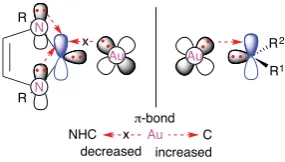
[image:22.595.185.426.428.496.2]N-Heterocyclic carbenes (NHCs) are strong σ-donors and weak π-acceptors. These ligands are strong σ-donors because the carbon of these carbenes is softer and less electronegative than most heteroatom Lewis bases. The NHC ligands acts as a strong π-donor to the unoccupied p-orbital of the NHC carbon center. This participation of the p-orbital at carbon on NHC minimizes the π-donation from gold to the NHC. Therefore, the π-back-donation from gold to carbon center is increased, and the intermediate should be more carbene-like (Figure 6).
[image:23.595.233.376.166.247.2]Figure 6 NHC ligands increase π-back-donation from gold to carbene center.
For example, gold complexe with IPr18 has been shown to be the best catalyst for the cyclopropanation of cis-stilbene. In this transformation, the intermediate shows a carbene-like reactivity (Scheme 2).16a
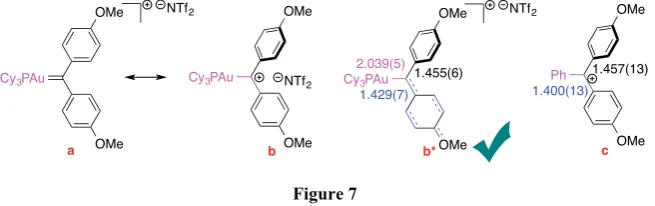
Scheme 2Recently, a diaryl gold carbene complex (a in Figure 7) was isolated and characterized by X-ray diffraction by Alois Fürstner and his coworker.19 The Au–C carbene bond length (2.039(5) Å) is not significantly different from the bond length normally associated with gold-carbon single bond (for comparison, the Au–C bond length in [Ph3PAu–Ph] is 2.045(6) Å).20 However, the bond between the carbene
center and the aryl group is shortened appreciably. The more contracted C–C bond connects to an aryl ring that is nearly co-planar with the carbene center to enable efficient orbital overlap, which stabilizes the electron-deficient carbene center. These observations are quite comparable to the structural features of diarylcarbenium ions, such as c.
For complex a, electron back donation from the filled d-orbitals of gold to the empty p-orbital of the carbene alone is not sufficient and is actually very weak, and the
18 IPr: 1,3-bis(2,6-diisopropylphenyl)imidazolidene.
19 Seidel, G.; Fürstner, A. Angew. Chem. Int. Ed.2014, 53, 4807–4811.
20 Fernández, E. J.; Laguna, A.; Olmos, M. E. Adv. Organomet. Chem.2004, 52, 77–141.
x
R R
Au
R1
R2 Au
N N
π-bond
Au C
x NHC
increased decreased
O O
+ Ph
Ph
AuLCl/AgSbF6
CD2Cl2 O
O Ph
Ph
substituted arene rings play a dominant role in stabilizing the gold carbene (see b*). Therefore, Alois Fürstner concluded: Since carbon species that carry a formal positive charge (or a good leaving group) and a carbon–metal bond at the same site are commonly called “carbenoids”,21 gold carbenes should be scientifically called gold carbenoids and the structure like a is not recommended to use.
[image:24.595.143.471.141.244.2] Figure 7However, the structure chosen in Figure 7 is a very special example, since the 4-methoxyl phenyl substituent is a very strong electron-donating group and its powerful ability to stabilize the carbene center gives gold no chance to back-donate electrons to the empty p obital of carbene. Predictably, in cases in which the carbene center cannot obtain enough stabilization from substituents, the back-donation from gold is still a source of stabilization, and the gold carbene bonding model is still a pertinent representation.
As noted above, actually for Fischer carbenes, the π-back-donation from metal to carbene is always weak. Therefore, we cannot exclude gold carbenes from the Fischer carbene family, based solely on the bonding arrangement shown in Figure 7, which shows the π-back-donation is negligible in this extreme case.22
In our opinion, so far, the best description of gold carbene originates from Toste and Goddard: “The reactivity in gold(I)-coordinated carbenes is best accounted for by a continuum ranging from a metal-stabilized singlet carbene to a metal-coordinated carbocation. The position of a given gold species on this continuum is largely determined by the carbene substituents and the ancillary ligand”.16a
In this thesis manuscript, we have chosen to employ Occam's razor and represent gold–carbon bonds in the manner which best describes their observed reactivity. The reactions discussed in the following chapters are best described by invoking gold-coordinated carbenes as intermediate species; however, we advise the reader to
21IUPAC´s definition of carbenoid: “Complexed carbene-like entities that display the reactivity
characteristics of carbenes, either directly or by acting as sources of carbenes”.
22 For a recent discussion about the structure of gold carbenes: Hussong, M. W.; Rominger, F.; Krämer,
P.; Straub, B. F. Angew. Chem. Int. Ed.2014, 53, DOI: 10.1002/anie.201404032. Cy3PAu
OMe
OMe
NTf2
Cy3PAu
OMe
OMe
a b*
2.039(5)
1.455(6)
1.429(7)
Ph
OMe
c
1.457(13)
1.400(13)
OMe NTf2
Cy3PAu
OMe
b OMe
bear in mind the discussion concerning the continuum that exists between gold-stabilized singlet carbene and gold-coordinated carbocation.
Methods for generating free carbenes
Because of their electron-deficient nature (six valence electrons), most carbenes are highly reactive and are normally generated in situ.
Some of the classical, transition metal-free, ways of forming carbene intermediates are summarized below.
1. α-Elimination
Carbenes can be generated by the α-elimination of a hydrogen halide from a suitable alkylhalide. The most common example is the formation of dichlorocarbene upon treating chloroform with a strong base.23 A 50% aqueous NaOH solution and benzyltriethylammonium chloride, as phase transfer catalyst, are frequently employed to promote α-elimination efficiently (Scheme 3).
Scheme 3There is an alternative route for the generation of dichlorocarbene by the treatment of trichloroacetic acid with a base through decarboxylation and loss of chloride (Scheme 4).24
Scheme 4Similar α-elimination methodology can also be applied to dichloromethane and benzyl chlorides with alkyl lithium reagents. The aromatic group provides the carbanion extra stabilization, which makes the lithiation feasible (Scheme 5).25
Scheme 5These α-elimination methods shown above are restricted to halohydrocarbon without β-hydrogens, because β-elimination occurs preferentially.
23 (a) Hine, J. J. Am. Chem. Soc.1950, 72, 2438–2445. (b) Hine, J.; Dowell Jr., A. M. J. Am. Chem. Soc. 1954, 76, 2688–2692.
24 Wagner, W. M.; Kloosterziel, H.; Bickel, A. F. Recl. Trav. Chim. Pays–Bas.1962, 81, 933–946. 25 Closs, G. L.; Closs, L. E. J. Am. Chem. Soc.1960, 82, 5723–5728.
HCCl3
base
CCl3
–Cl CCl2
base
CCl3
–Cl CCl2 CCl3
HOOC OOC
–CO2
ArCH2X ArCHX
–X
The α-elimination method can also be applied in organomercury compounds for carbene generation. The carbon-mercury bond is more covalent than the C-Li bond, therefore, the organomercury reagents are generally stable at room temperature and isolable (Scheme 6).26
Scheme 6Because of the high toxicity of organomercury compounds, they have seldom been used for synthetic purposes.
2. From halomethylzinc reagents
Methylene iodide with a zinc-copper couple, referred as Simmons-Smith reagent, is very useful for the transfer of a methylene unit to alkenes.27 Although it looks like a carbene mechanism 28 , the reactive intermediate has been identified as iodomethylzinc iodide (Scheme 7).29
Scheme 7The results of classical Simmons-Smith conditions have been found to be sensitive to the method of zinc activation and are sometimes difficult to reproduce. The combination of diethylzinc and diiodomethane, the Furukawa modification, has been developed as a convenient and reliable method for Simmons-Smith reaction.30 Both the EtZnCH2I and ICH2ZnI generated in the reaction are reactive reagents
toward cyclopropanation with alkenes (Scheme 8).
Scheme 826 Seyferth, D.; Burlitch, J. M.; Minasz, R. J.; Mui, J. Y.; Simmons, H. D.; Treiber, A. J. H.; Dowd, S. R.
J. Am. Chem. Soc.1965, 87, 4259–4270. 27
Simmnos, H. E.; Smith, R. D. J. Am. Chem. Soc.1958, 80, 5323–5324.
28 According to IUPAC´s
definition of carbenoid, Simmons–Smith reagents should be called carbenoids. 29 (a) Charette, A. B.; Marcoux, J.-F. J. Am. Chem. Soc.1996, 118, 4539–4549. (b) Nakamura, M.; Hirai, A.; Nakamura, E. J. Am. Chem. Soc.2003, 125, 2341–2350.
30 Furukawa, J.; Kawabata, N.; Nishimura, J. Tetrahedron1968, 24, 53–58.
C PhHg
Cl
Cl Br
heating CCl2
CH2I2
Zn–Cu
IZnCH2I
CH2I2
IZnCH2I
Et2Zn + EtZnCH2I + EtI
The main limitation of Simmons-Smith reaction is that only the methylene unit can be transferred successfully, although some other modifications have been developed.31
3. Decomposition of diazo compounds
Decomposition of diazo compounds is one of the most general ways of generating carbenes. The driving force for decomposition of diazo compounds to carbenes is the formation of the very stable nitrogen molecule (Scheme 9).
Scheme 9Although carbenes can be formed by photolysis or thermolysis, metal-catalyzed decomposition of diazo derivatives32 is particularly powerful and allows the diazo compounds to undergo various transformations delivering many functionalized products under very mild conditions. The reactivity depends on their electronic properties as well as the nature of the metal-based catalysts (Scheme 10).
Scheme 10The main drawback of this method is the limited stability of the diazo compounds. In order to counter their relatively facile dimerization, the diazo compound is usually added slowly into the reaction mixture using a syringe pump.
4. From diazirines
31
(a) Vicente, R.; González, J.; Riesgo, L.; González, J.; López, L. A. Angew. Chem. Int. Ed.2012, 51, 8063–8067. (b) Lévesque, É.; Goudreau, S. R.; Charette, A. B. Org. Lett. 2014, 16, 1490–1493 and references cited therein.
32 Selected reviews on the use of diazo compounds as carbene precursors: (a) Díaz-Requejo, M. M.;
Pérez, P. J. Chem. Rev.2008, 108, 3379–3394. (b) Davies, H. M. L.; Manning, J. R. Nature2008, 451, 417–424. (c) Davies, H. M. L.; Denton, J. R. Chem. Soc. Rev.2009, 38, 3061–3071. (d) Zhang, Z.; Wang, J. Tetrahedron2008, 64, 6577–6605. (e) Ye, T.; McKervey, M. A. Chem. Rev.1994, 94, 1091–1160. (f) Forbes, D. C.; Doyle, M. P. Chem. Rev.1998, 98, 911–935. (g) Lebel, H.; Marcoux, J.-F.; Molinaro, C.; Charette, A. B. Chem. Rev.2003, 103, 977–1050.
photolysis or thermolysis
–N2
N2
R2
R1 R1
R2
LM EWG H
LM EWG
EWG
LM EWG
EDG
acceptor carbene acceptor/acceptor carbene donor/acceptor carbene
EWG = CO2R, COR, CONR2, CN, PO(OR)2, SO2R, NO2, CF3...
The diazirines are the cyclic isomers of diazo compounds and are highly reactive carbene precursors resulting from their highly strained structure and also the potential for loss of nitrogen (Scheme 11).33
Scheme 11Because of their difficult preparation, diazirines are normally only applicable to mechanistic studies.
5. From sulfonylhydrazones
Sulfonylhydrazones can be used as precursors for diazo compounds. In the presence of base under photochemical irradiation or by heating, they can decompose to form diazo intermediates, which usually generate carbenes under the same conditions.34 Sometimes, this method can be used to prepare several relatively stable diazo derivatives (Scheme 12).35
Scheme 12Recently, transition metals have also been exploited to generate carbene intermediates from sulfonylhydrazones under very mild conditions, and many potentially useful reactions have been developed.36
6. From oxadiazolines
Thermolysis of oxadiazolines can generate (CH3O)2C: and related dioxacarbenes.37
Similarly, dithiacarbenes can also be formed by this method (Scheme 13).38
33 (a) Liu, M. T. H. Chemistry of Diazirines, 2 vols., CRC Press, Boca Raton, FL, 1987. For reviews: (b) Liu, M. T. H. Chem. Soc. Rev. 1982, 11, 127–140. (c) Moss, R. A. Acc. Chem. Res.2006, 39, 267–272. For synthesis, see: (d) Martinu, T.; Dailey, W. P. J. Org. Chem.2004, 69, 7359–7362 and references cited therein.
34 (a) Kaufman, G. M.; Smith, J. A.; Vander Stouw, G. G.; Shechter, H. J. Am. Chem. Soc. 1965, 87, 935– 937. For recent examples: (b) Barluenga, J.; Tomás-Gamasa, M.; Aznar, F.; Valdés, C. Nat. Chem.2009, 1, 494–499. (c) Li, H.; Wang, L.; Zhang, Y.; Wang, J. Angew. Chem. Int. Ed.2012, 51, 2943–2946. 35 For example, phenyl diazomethane was prepared by this method: (a) Zhou, Y.; Trewyn, B. G.;
Angelici, R. J.; Woo, L. K. J. Am. Chem. Soc. 2009, 131, 11734–11743. (b) Creary, X. Org. Synth.1986, 64, 207.
36
Selective publications: (a) Zhang, Y.; Wang, J. Topics in Current Chemistry, Stereoselective Alkene Synthesis, Edited by Jianbo Wang, Springer, 2012, 327, 239–270. (b) Xia, Y.; Liu, Z.; Xiao, Q.; Qu, P.; Ge, R.; Zhang, Y.; Wang, J. Angew. Chem. Int. Ed.2012, 51, 5714–5717. (c) Ye, F.; Ma, X.; Xiao, Q.; Li, H.; Zhang, Y.; Wang, J. J. Am. Chem. Soc.2012, 134, 5742–5745. (d) Zhou, L.; Ye, F.; Ma, J.; Zhang, Y.; Wang, J. Angew. Chem. Int. Ed.2011, 50, 3510–3514.
N
N photolysis or thermolysis
–N2
R1
R2
R1
R2
R2C NNHSO2Ar R2C NNSO2Ar
base heating –SO2Ar
R2C N2 R2C
–N2
Isolable Sometimes
Interestingly, these carbenes are quite different from the carbenes discussed above and they exhibit some nucleophilic properties through donation of electron density from the heteroatoms into the vacant p-orbital of the carbene center.39
7. From phenanthrene precursors
Free carbenes can be generated from phenanthrene precursors under photochemical conditions.40 The driving force for this reaction is the release of stable phenanthrene. Interestingly, this can be regarded as a special retro-Buchner process (Scheme 14).
Scheme 14However, due to the difficulty of preparing phenanthrene derivatives, this route of forming carbenes is not suitable for application in organic synthesis.
8. Atomic carbon mediated carbene formation
Atomic carbon is a highly reactive species.41 Since most of the reactions involving C atoms are very fast and extremely exothermic, it suggests that there is no energy barrier for these reactions. Carbenes are often the intermediates in C atom reactions,
37 Warkentin, J. Acc. Chem. Res.
2009, 42, 205–212. 38 (a) Rigby, J. H.; Danca, M. D. Tetrahedron Lett.
1999, 40, 6891–6894. (b) Rigby, J. H.; Laurent, S. J. Org. Chem. 1999, 64, 1766–1767.
39 (a) Moss, R. A. Acc. Chem. Res.1989, 22, 15–21. (b) Venneri, P. C.; Warkentin, J. Can. J. Chem. 2000, 78, 1194–1203. (c) Pole, D. L.; Sharma, P. K.; Warkentin, J. Can. J. Chem.1996, 74, 1335–1340. (d) Couture, P.; Warkentin, J. Can. J. Chem.1997, 75, 1281–1294.
40 (a) Graves, K. S.; Thamattoor, D. M.; Rablen, P. R. J. Org. Chem.
2011, 76, 1584–1591. (b) Moore, K. A.; Vidaurri-Martinez, J. S.; Thamattoor, D. M. J. Am. Chem. Soc.2012, 134, 20037−20040. (c) Nigam, M.; Platz, M. S.; Showalter, B. M.; Toscano, J. P.; Johnson, R.; Abbot, S. C.; Kirchhoff, M. M. J. Am. Chem. Soc.1998, 120, 8055–8059. (d) Glick, H. C.; Likhotvorik, I. R.; Jones, M. Tetrahedron Lett. 1995, 36, 5715–5718. (e) Richardson, D. B.; Durrett, L. R.; Martin, J. M.; Putnam, W. E.; Slaymaker, S. C.; Dvoretzky, I. J. Am. Chem. Soc.1965, 87, 2763–2765.
41 Moss, Robert A; Jones, Maitland (2004). "Atomic carbon". Reactive intermediate chemistry. pp. 463– 500. O N N MeO MeO Me Me heating –N2 O Me Me O N N C3H7S
C3H7S
Me Me heating –N2 O Me Me +
(CH3O)2C
(C3H7S)2C
and in general there are two ways in which carbenes can be produced: C–H insertion of alkanes42 and deoxygenation of carbonyl compounds (Scheme 15).43
Scheme 15However, because of the lack of general and convenient method for atomic carbon generation, the chemistry of carbenes from C atom is still a relatively young field.44
Generation of gold carbenes
Additionally, several ways of generating gold(I) carbene intermediates are illustrated below.
1. Diazo compounds
Gold(I) complexes have also been found limited application with diazo precursors (Scheme 16).45 However, rhodium and copper complexes are more popular catalysts for the decomposition of diazo compounds.
Scheme 162. Cyclopropenes
It has been demonstrated that ring cleavage of cyclopropenes gives vinyl gold(I) carbene intermediates (Scheme 17).46
42 Skell, P. S.; Engel, R. R. J. Am. Chem. Soc.
1966, 88, 4883–4890.
43 Selected references: (a) Dewar, M. J. S.; Nelson, D. J.; Shevlin, P. B.; Biesiada, K. A. J. Am. Chem. Soc.1981, 103, 2802–2807. (b) Armstrong, B. M.; McKee, M. L.; Shevlin, P. B. J. Am. Chem. Soc.1995, 117, 3685–3689.
44“Future researchers should be encouraged by the fact that is difficult to imagine a molecule that will not react with atomic carbon.”---by Philip B. Shevlin in (2004). "Atomic carbon". Reactive intermediate chemistry. (eds. Moss, Robert A; Jones, Maitland) pp. 495.
45 (a) Fructos, M. R.; Belderrain, T. R.; de Frémont, P.; Scott, N. M.; Nolan, S. P.; Díaz-Requejo, M. M.;
Pérez, P. J. Angew. Chem. Int. Ed.2005, 44, 5284–5288. (b) Prieto, A.; Fructos, M. R.; Díaz-Requejo, M. M.; Pérez, P. J.; Pérez-Galán, P.; Delpont, N.; Echavarren, A. M. Tetrahedron2009, 65, 1790–1793. (c) Rivilla, I.; Gõmez-Emeterio, B. P.; Fructos, M. R.; Díaz-Requejo, M. M.; Pérez, P. J. Organometallics 2011, 30, 2855–2860. (d) Pérez, P. J.; Díaz-Requejo, M. M.; Rivilla, I. Beilstein J. Org. Chem.2011, 7, 653–657. (e) Yu, Z.; Ma, B.; Chen, M.; Wu, H.-H.; Liu, L.; Zhang, J. J. Am. Chem. Soc.2014, 136, 6904–6907.
C O R2
R1 R1
R2
+ CO R H C
R C H
1)
2)
N2
CO2Et
Ph
AuL+ AuL+
CO2Et
3. Propargylic carboxylates
In the presence of a gold(I) catalyst, propargylic carboxylates undergo 1,2-acyloxy migration to generate vinyl gold carbene intermediates, which can be trapped by 1,3-diones, alkenes, or electron-rich aromatics intra- or intermolecularly.47 Because propargylic carboxylates are readily available, they are very effective and common carbene precursors in gold catalysis (Scheme 18).
Scheme 184. 1,6-Enynes
We have revealed that cyclopropanyl gold carbenes are the intermediates of 1,6-enyne cycloisomerizations. These reactive intermediates exhibit various reactivities toward many functional groups intra- or intermolecularly (Scheme 19).48
Scheme 1946
(a) Hadfield, M. S.; Bauer, J. T.; Glen, P. E.; Lee, A.-L. Org. Biomol. Chem.2010, 8, 4090–4095. (b) For review on gold(I) catalyzed transformations of cyclopropenes: Miege, F.; Meyer, C.; Cossy. J. Beilstein. J. Org. Chem.2011, 7, 717–734.
47 For reviews and lead references on gold-catalyzed propargylic carboxylate rearrangement: (a) de Haro,
T.; Gómez-Bengoa, E.; Cribiú, R.; Huang, X.; Nevado, C. Chem. Eur. J.2012, 18, 6811–6824. (b) Wang, S.; Zhang, G.; Zhang, L. Synlett2010, 692–706. (c) Shiroodi, R. K.; Gevorgyan, V. Chem. Soc. Rev. 2013, 42, 4991–5001. (d) Correa, A.; Marion, N.; Fensterbank, L.; Malacria, M.; Nolan, S. P.; Cavallo, L. Angew. Chem. Int. Ed.2008, 47, 718–721. (e) Marco-Contelles, J.; Soriano, E. Chem. Eur. J.2007, 13, 1350–1357. (f) Amijs, C. H. M.; López-Carrillo, V.; Echavarren, A. M. Org. Lett.2007, 9, 4021–4024. (g) Li, G.; Zhang, G.; Zhang, L. J. Am. Chem. Soc.2008, 130, 3740–3741. (h) Shapiro, N. D.; Shi, Y.; Toste, F. D. J. Am. Chem. Soc.2009, 131, 11654–11655. (i) Shapiro, N. D.; Toste, F. D. J. Am. Chem. Soc.2008, 130, 9244–9245. (j) Gorin, D. J.; Dubé, P.; Toste, F. D. J. Am. Chem. Soc.2006, 128, 14480– 14481. For Cu(I) and Pt(II) catalyzed this rearrangement: (k) Barluenga, J.; Riesgo, L.; Vicente, R.; López, L. A.; Tomás, M. J. Am. Chem. Soc.2007, 129, 7772–7773.
48 (a) Escribano-Cuesta, A.; López-Carrillo, V.; Janssen, D.; Echavarren, A. M. Chem. Eur. J.2009, 15, 5646–5650. (b) López, S.; Herrero-Gómez, E.; Pérez-Galán, P.; Nieto-Oberhuber, C.; Echavarren, A. M. Angew. Chem. Int. Ed.2006, 45, 6029–6032. For reviews, see: (c) Jiménez-Núñez, E.; Echavarren, A. M. Chem. Rev.2008, 108, 3326–3350. (d) Obradors, C.; Echavarren, A. M. Chem. Commun.2014, 50, 16– 28. (e) Obradors, C.; Echavarren, A. M. Acc. Chem. Res.2014, 47, 902–912. (f) Taduri, B. P.; Sohel, S. M. A.; Cheng, H.-M.; Lin, G.-Y.; Liu, R.-S. Chem. Commun.2007, 2530–2532.
R Me
CH2Cl2, 20 ºC
AuL+ Me R
AuL+
R2OCO
R1
AuL+
AuL+
R1
OCOR2
CH2Cl2, 23 ºC
AuL+
Z
R
Z H
R
+LAu
5. Gold-catalyzed alkyne oxidation
The groups of Zhang and Toste demonstrated that alkynes effectively serve as precursors to versatile α-oxo gold carbenes in the presence of a suitable oxidant. In general, sulfoxides are the best oxidants for intramolecular alkyne oxidation and pyridine or quinoline N-oxides are suitable for intermolecular reactions (Scheme 20).49
Scheme 206. Acetylenic Schmidt reaction
Similar to alkyne oxidation, azides can serve as leaving-group-bearing nucleophiles. After loss of dinitrogen, gold(I) iminocarbene intermediates are generated. Subsequent rearrangements produce 1H-pyrroles as the final products (Scheme 21).50
Scheme 217. Loss of SO2 and imidazolylidene
The SO2-imidazolium moiety in the gold complex can act as a leaving group. By
heating, the gold carbene is formed with the dissociation of SO2 and
imidazolylidene (Scheme 22). 51
49 (a) Shapiro, N. D.; Toste, F. D. J. Am. Chem. Soc.2007, 129, 4160–4161. (b) Ye, L.; Cui, L.; Zhang, G.; Zhang, L. J. Am. Chem. Soc.2010, 132, 3258–3259. (c) He. W.; Li, C.; Zhang, L. J. Am. Chem. Soc. 2011, 133, 8482–8485. (d) Noey, E. L.; Luo, Y.; Zhang, L.; Houk, K. N. J. Am. Chem. Soc.2012, 134, 1078–1084. (e) Luo, Y.; Ji, K.; Li, Y.; Zhang, L. J. Am. Chem. Soc.2012, 134, 17412–17415. (f) Ji, K.; Zhao, Y.; Zhang, L. Angew. Chem. Int. Ed.2013, 52, 6508–6512. (g) Lu, B.; Li, Y.; Wang, Y.; Aue, D. H.; Luo, Y.; Zhang, L. J. Am. Chem. Soc.2013, 135, 8512–8524. (h) Ji, K.; Zhang, L. Org. Chem. Front. 2014, 1, 34–38. For a review, see: (i) Zhang, L. Acc. Chem. Res.2014, 47, 877–888.
50 (a) Gorin, D. J.; Davis, N. R.; Toste, F. D. J. Am. Chem. Soc.2005, 127, 11260–11261. (b) Lu, B.; Luo, Y.; Liu, L.; Ye, L.; Wang, Y.; Zhang, L. Angew. Chem. Int. Ed.2011, 50, 8358–8362. (c) Yan, Z.; Xiao, Y.; Zhang, L. Angew. Chem. Int. Ed.2012, 51, 8624–8627.
51 Ringger, D. H.; Chen, P. Angew. Chem. Int. Ed.2013, 52, 4686–4689.
R1 R2 [Au]
[O] R1
[Au]
O R2
R1 R2
[Au] R1 R2 [Au]– O LG –LG O LG N3 R1 R2
[Au] R N
1
R2
N N
[Au]
N R2
R1
[Au]–
N N
N R1 R2
Similarly, cationic N-heterocyclic carbene (NHC) gold(I) benzylidene complex can also be generated from a phosphonium ylide.52
8. Gold vinylidenes from (2-ethynylphenyl)alkynes
Gold vinylidenes are proposed as the most likely intermediates in the gold catalyzed cycloisomerization of (2-ethynylphenyl)alkynes (Scheme 23). The gold vinylidene intermediates are highly reactive and can undergo intramolecular/intermolecular C-H insertions, cyclopropanations/ring-expansions with alkenes.53 Recently, a new aryne generation method from related substrates by hexadehydro-Diels–Alder (HDDA) reaction has attracted much attention.54 Interestingly, in some cases, simple silver salts, such as AgOTf, AgSbF6 and AgNO3, are effective for promoting the
HDDA aryne formation under milder conditions.55
Scheme 23
52 Fedorov, A.; Moret, M.-E.; Chen, P. J. Am. Chem. Soc.
2008, 130, 8880–8881.
53 (a) Ye, L.; Wang, Y.; Aue, D. H.; Zhang, L. J. Am. Chem. Soc.2012, 134, 31–34. (b) Hashmi, A. S. K.; Braun, I.; Nösel, P.; Schädlich, J.; Wieteck, M.; Rudolph, M.; Rominger, F. Angew. Chem. Int. Ed.2012, 51, 4456–4460. (c) Hashmi, A. S. K.; Wieteck, M.; Braun, I.; Rudolph, M.; Rominger, F. Angew. Chem. Int. Ed.2012, 51, 10633–10637. (d) Hansmann, M. M.; Rudolph, M.; Rominger, F.; Hashmi, A. S. K. Angew. Chem. Int. Ed.2013, 52, 2593–2598.
54 (a) Hoye, T. R.; Baire, B.; Niu, D.; Willoughby, P. H.; Woods, B. P. Nature2012, 490, 208–212. (b) Niu, D.; Willoughby, P. H.; Woods, B. P.; Baire, B.; Hoye, T. R. Nature2013, 501, 531–534. (c) Niu, D.; Hoye, T. R. Nat. Chem.2013, 6, 34–40. (d) Holden, C.; Greaney, M. F. Angew. Chem. Int. Ed.2014, 53, 5746–5749.
55 Yun, S. Y.; Wang, K.-P.; Lee, N.-K.; Mamidipalli, P.; Lee, D. J. Am. Chem. Soc.2013, 135, 4468– 4471.
N N O2S
MeO
Me Mes
OTf 1) BuLi 2) NHC–Au+
N N O2S
MeO Me Mes OTf Au N N Dipp Dipp heating Au N N Dipp Dipp OMe
+ SO2+
N N Me Mes OTf R AuL LAu+ AuL AuL R 5-endo-dig
R
LAu+
Buchner ring expansion
The Buchner ring expansion is a carbene addition to benzene or its homologs to form cycloheptatrienes.56 This reaction was first reported by E. Buchner and T. Curtius in 1885.57 One typical example is shown below. The first step involves formation of a carbene from ethyl diazoacetate, which cyclopropanates benzene to form a norcaradiene derivative. Ring expansion occurs in the second step, with an electrocyclic opening of the cyclopropane to form a 7-membered ring. Although photochemical or thermal conditions can be used to initiate the carbene formation, transition metal catalysts (mainly rhodium- and copper-based) are often used to perform this reaction under very mild conditions (Scheme 24).58
Scheme 24Because the regioselectivity is not easy to control, Buchner reactions are normally only applied in synthesis in cases where the insertion occurs in an intramolecular fashion. Two recent total syntheses featuring Buchner reactions as key steps are listed below.
In 2001, the group of Danheiser reported a new ring expansion-annulation strategy for the synthesis of substituted azulenes (Scheme 25). This method was successfully used as a key step to construct the skeleton of antiulcer drug egualen sodium (KT1-32).59
56 For reviews, see: (a) Dave, V.; Warnhoff, E. W. Org. React.
1970, 18, 217–401. (b) Ye, T.; McKervey, M. A. Chem. Rev.1994, 94, 1091–1160. (c) Reisman, S. E.; Nani, R. R.; Levin, S. Synlett2011, 2437– 2442.
57 Buchner, E.; Curtius, T. Chem. Ber.1885, 18, 2371–2377.
58 Anciaux, A. J.; Demonceau, A.; Noels, A. F.; Hubert, A. J.; Warin, R.; Teyssie, P. J. Org. Chem. 1981, 46, 873–876.
59 Kane, J. L.; Shea, K. M.; Crombie, A. L.; Danheiser, R. L. Org. Lett.2001, 3, 1081–1084.
O OEt N2
H + metal catalyst
hv or heating
CO2Et
H CO
2Et
H
norcaradiene derivative
In 2011, Reisman reported the enantioselective total synthesis of (+)-salvileucalin B. The synthetic route features a copper-catalyzed arene cyclopropanation reaction to provide the unusual norcaradiene core (Scheme 26).60
Scheme 26Retro-Buchner reactions
There have only been few reported examples of retro-Buchner processes, all of which are lacking generality and simplicity to make them synthetically useful.
1,2,3,4,5,6-Hexamethyltricyclo[4.1.0.02.5]hept-3-ene reacts in the presence of [Rh(CO)2Cl]2 to give quantitatively hexamethylbenzene. The carbene (:CH2)
generated alongside could be trapped with cyclohexene (Scheme 27).61 However, its lower methylated analogues proved to be inactive.
Scheme 2760 Levin, S.; Nani, R. R.; Reisman, S. E. J. Am. Chem. Soc.2011, 133, 774–776. 61 Volger, H. C.; Hogeveen, H.; Roobeek, C. F. Recueil1973, 92, 1223–1231.
O N2
Br
Rh2(OCOt-Bu)4
Et2O, r.t., 45 min
Br
O
PhNTf2
DMAP, r.t., 5 min
OTf
Et3B, Pd(OAc)2/o-biphenylPCy2,
KF, THF, reflux, 10 min
benzene, 80 ºC, 6 h then NaOH, 90% yield
SO3/pyridine
25–42% over 3 steps SO3Na
egualen sodium (KT1-32)
O O
H
O N2 CN
Cu(hfacac)2 (10 mol%)
DCM, 120 ºC, MW, 1 min 65% O CN H O O steps H O O O O O Salvileucalin B Me Me Me Me Me Me Me Me Me Me Me [Rh] Me Me Me Me Me Me
+ :CH2
It has been shown previously in this chapter that free carbenes can be generated from phenanthrene precursors under photochemical conditions (Scheme 28).40
Scheme 28The reaction of 7-ethoxycarbonyl-1,3,5-cycloheptatriene with an equimolecular amount of Pd(OAc)2 at 80 °C in MeCN has been reported to give ethyl 2-and
4-formylbenzoate (8% each) by cleavage of one cyclopropane C-C bond of the corresponding norcaradienes. In addition, diethyl maleate (14% yield) was formed, presumably by a dimerization of a Pd(II) carbene formed by a retro-Buchner process (Scheme 29).62
Scheme 2962 Saito, K.; Kozaki, M.; Takahashi, K. Chem. Pharm. Bull.1993, 41, 2187−2189.
R2
R1
hv
+ R2
R1
R
R=CN, CO2Et
Pd(OAc)2
Chapter 1. The generation and fate of gold carbenes by
retro-Buchner reactions
Background
Several representative methods for generating gold(I) carbenes intermediates are listed in the general introduction.
A new example of gold(I) carbene formation through retro-cyclopropanation was reported by our laboratory in 2010 (Scheme 1-1).5 This gold(I) carbene 4 was generated from intermediate 3 by cycloisomerization of 1,6-enynes with the general structure 1 through a mechanism that involves loss of one molecule of 1-methoxynaphthalene 5. The gold(I) carbene 4 can be trapped by intermediate 3 to form di-cyclopropanated naphthalene derivatives 6. This was the first time that of gold(I) catalyzed retro-cyclopropanation was achieved in the context of bench chemistry with easy to handle reagents.63
Scheme 1- 1 Gold(I) carbenes through retro-cyclopropanations.A similar process was also proposed in the gas phase cleavage of 1-ethoxy-2-methoxycyclopropane with [AuIMes]+ on the basis of collision-induced dissociation (CID) experiments and theoretical calculations.64
63 Cleavage of cyclopropanes to form metal carbenes had only been reported previously with low
efficiency using highly electrophilic PhWCl3/RAlCl2 (R = Et, Cl): (a) Gassman, P. G.; Johnson, T. H. J. Am. Chem. Soc.1976, 98, 6057–6058. (b) Gassman, P. G.; Johnson, T. H. J. Am. Chem. Soc.1976, 98, 6058–6059.
64 (a) Batiste, L.; Fedorov, A.; Chen, P. Chem. Commun.2010, 46, 3899–3901. (b) Fedorov, A.; Chen, P. Organometallics2010, 29, 2994–3000. (c) Fedorov, A.; Batiste, L.; Bach, A.; Birney D. M.; Chen, P. J. Am. Chem. Soc. 2011, 133, 12162–12171. (d) Batiste, L.; Chen, P. J. Am. Chem. Soc. 2014, 136, DOI: 10.1021/ja4084495.
R2
R1
MeO
AuL+
CH2Cl2, 23 ºC
R2
AuL+
OMe OMe
R1
H H
R1
R2
AuL+
R2
AuL+
OMe
H R1
R2
MeO H R2
1 2
3
5
4 6
Objectives
Although gold(I) carbenes can be generated by this annulation/fragmentation process shown in Scheme 1-1, the tedious preparation of the required substrates detracts significantly from its synthetic utility.
It is known that cycloheptatrienes 7 are in equilibrium with norcaradienes 8. In general, the equilibrium lies on the side of the cycloheptatriene tautomer, as a result of the strained cyclopropane ring present in the norcaradiene (Scheme 1-2).65
We postulated that gold(I) carbenes could be generated by a similar retro-cyclopropanation from the norcaradiene tautomer, as shown in Scheme 1-2.
Scheme 1- 2 Gold(I) carbenes from cycloheptatrienes.65 (a) Ciganek, E. J. Am. Chem. Soc.1965, 87, 1149–1150. For recent review on this equilibrium: (b) McNamara, O. A.; Maguire. A. R. Tetrahedron2011, 67, 9–40.
R R
R AuL+
cycloheptatrienes norcaradienes AuL+
7 8
Synthesis of 7-aryl cycloheptatrienes
7-Aryl cycloheptatrienes 10 were easily prepared in good yields by reactions of organolithium or Grignard reagents with tropylium tetrafluoroborate or tropylium bromide (Scheme 1-3).66
It is worthy to note that organolithium reagents, generated in situ by lithium-bromine exchange, normally give better results than Grignard reagents for this reaction. This is due to the ease of homo-coupling of Grignard reagents and the quite similar polarity of biaryl byproduct to the desired 7-arylcycloheptatrienes 10, which makes the separation very difficult. We also found the commercially available organolithium reagents, such as phenyl lithium, give poorer results compared with reagents generated in situ by lithium-bromine exchange.
In Chapter 3 of this Thesis we also present a series of o-styryl substituted cycloheptatrienes obtained through this procedure.
Scheme 1- 3 Synthesis of 7-aryl cycloheptatrienes from organolithium or Grignard reagents.
Alternatively, we also prepared 7-substituted cycloheptatrienes 10 under mild conditions employing commercially available or easily accessible potassium trifluoroborate salts67 instead of organolithium or Grignard reagents (Table 1-1). By using this method, no biaryl byproduct was observed. Acetal (10q), iodide (10t) and benzofuran (10r) containing cycloheptatrienes were successfully obtained in good yields. Unfortunately, electron-deficient and alkyl nucleophiles were unreactive under these conditions.
66 Tropylium tetrafluoroborate was purchased from Alfa Aesar (€ 657/100 g) or can be easily prepared
according to: (a) Conrow, K. Org. Synth.1963, 43, 101–103. Tropylium bromide was prepared according to the reported procedure: (b) Doering, W. E.; Knox, L. H. J. Am. Chem. Soc. 1957, 79, 352–356. 67 Trifluoroborate salts were prepared from boronic acids RB(OH)2 and potassium bifluoride K[HF2]. For
reviews on their application in synthesis, see: (a) Darses, S.; Genet, J. P. Chem. Rev.2008, 108, 288–325. (b) Molander, G. A.; Ellis, N. Acc. Chem. Res.2007, 40, 275–286.
R
BF4
-THF, -78 ºC to 23 ºC, 12 h R-MgX or Li
Ph (10a),
p-FC6H4 (10b), p-ClC6H4 (10c), p-BrC6H4 (10d), p-MeOC6H4 (10e), o-MeC6H4 (10f), o-Cyclopropyl (10g),
o-OPhC6H4 (10h), o-OBnC6H4 (10i),
1-Naphthyl (10j), 2-Naphthyl (10k)
9-Phenanthryl (10l) R=
O
Ph
10m: R=
10n: R=
Table 1- 1 Cycloheptatrienes from potassium trifluoroborate salts.a
a Reaction at 60 °C, 0.12 M in THF, 2 equiv of potassium trifluoroborate salts, 12 h. Yields are for
isolated products.
R-BF3K
tropylium tetrafluoroborate THF, 60 ºC, 12 h
10a
81%
Ph
10o
81%
10p
79% O
O
10q
94%
O
10e
85%
10r
80%
10n
80%
10k
74%
10s
77%
10t
49%
O
O
I
R
O
BF3K