Autocrine Regulation of Human Prostate Carcinoma Cell
Proliferation by Somatostatin through the Modulation of
the SH2 Domain Containing Protein Tyrosine
Phosphatase (SHP)-1
PEDRO DARI´O ZAPATA, ROSA MARI´A ROPERO, ANA MONTSERRAT VALENCIA, LOUIS BUSCAIL,
JOSE IGNACIO LO´ PEZ, ROSA MARI´A MARTI´N-OROZCO, JUAN CARLOS PRIETO, JAVIER ANGULO,
CHRISTIANE SUSINI, PILAR LO´ PEZ-RUIZ, AND BEGON˜ A COLA´S
Departamento de Bioquı´mica y Biologı´a Molecular, Universidad de Alcala´ (P.D.Z., R.M.R., A.M.V., R.M.M.-O., J.C.P., P.L.-R., B.C.), and Servicio de Urologı´a, Hospital Universitario Prı´ncipe de Asturias (J.A.), Alcala´ de Henares-Madrid E-28871, Spain; INSERM, U-531, IFR 31, CHU Rangueil L3 (L.B., C.S.), Toulouse 31403, France; and Servicio de Anatomı´a Patolo´gica, Hospital de Basurto, Universidad del Paı´s Vasco (J.I.L.), Bilbao E-48013, Spain
The present study was intended to gain additional informa-tion on the growth regulainforma-tion of prostate by somatostatin (SRIF) and the intracellular events involved. The human pros-tate adenocarcinoma cell lines PC-3 and LNCaP produce SRIF and express subtypes 2 and 5 of SRIF receptors. The secretion of SRIF is related to the proliferative status of these cells; an inverse relationship exists between cell proliferation and the amount of secreted SRIF. Moreover, the growth of PC-3 cells is inhibited by SRIF overexpression and increased by block-age of endogenous SRIF. Coincident with the increase in SRIF secretion, the activity and levels of the SH2 domain containing protein tyrosine phosphatase (SHP)-1, present in PC-3 cells are augmented, but the effect can be partially prevented by
neutralization of secreted endogenously SRIF. The activity of SHP-1 is also stimulated by the SRIF analog RC160. Overex-pression of SHP-1 induces inhibition of PC-3 cell growth. SHP-1 is also present in normal prostate, benign prostatic hyperplasia, prostatic intraepithelial neoplasia, and well dif-ferentiated adenocarcinoma. In contrast, no signal is detected in poorly differentiated prostate cancer. These findings dem-onstrate that SRIF inhibits PC-3 and LNCaP cell proliferation through an autocrine/paracrine SRIF loop. This effect could be mediated by activation of the tyrosine phosphatase SHP-1 detected in these cells as well as in human prostate and pros-tate cancer. (J Clin Endocrinol Metab87: 915–926, 2002)
P
ROSTATE CANCER IS one of the most common ma-lignancies among men in the Western world and is a major health problem in many industrialized countries. As the tumor is initially androgen dependent in the majority of cases, endocrine manipulation is a first-line therapy for met-astatic and locally advanced cancer that often achieves re-mission or stabilization of the disease (1). However, this period of remission is invariably followed by tumor relapse, and the treatment options available, based on cytotoxic che-motherapy, antiparasitic agents, or aromatase inhibitors, are only palliative. Patients with metastatic prostate cancer de-velop an androgen refractory phenotype that will lead to disease progression and eventual death (2). Bearing in mind the need to develop new therapies, it has been demonstrated that the prostate is not exclusively dependent on androgens, but also on additional factors of paramount importance that maintain normal prostate function and play a role in the development of pathological conditions. In this sense, the importance of peptide hormones, growth factors, autocrine-paracrine regulatory loops and stromal-epithelial interac-tions is now widely recognized (3).Increasing interest has developed in recent years in the role of somatostatin (SRIF) in prostate cancer. SRIF analogs have successfully been used to inhibit tumor growth in experi-mental prostatic tumors in animals (4, 5); however, the re-sults obtained in clinical trials are a subject of controversy. Although Figget al.(6) did not find a response in patients with metastatic hormone refractory prostate cancer treated with the SRIF analog somatuline, Maulardet al.(7) demon-strated therapeutic benefit in patients with hormone refrac-tory prostate cancer using the same analog. Conversely, Logothetiset al.(8) observed that SMS 201–995, other SRIF analog, stimulated prostatic tumor growth in refractory pros-tatic carcinoma.
What is undeniable is that the peptide SRIF is a powerful inhibitor of a wide range of biological activities, including hormone secretion and cell proliferation (9). In this sense, SRIF and analogs affect the growth of various normal and tumor cells (10, 11). This effect may involve indirect mech-anisms through the inhibition of the synthesis and secretion of growth factors and hormones. It has been reported that SRIF and analogs inhibit the release of pituitary GH and PRL, and these hormones facilitate prostatic cancer growth (12). On the other hand, bothin vivoandin vitrostudies provide solid evidence for the existence of a direct antiproliferative effect of SRIF and analogs, which is exerted through specific SRIF receptors on normal and neoplastic cells (10). Five
sub-Abbreviations: ITS, Insulin (50 ng/ml), transferrin (50 ng/ml), and sodium selenite (50 pg/ml); PIN, prostatic intraepithelial neoplasia; PTP, protein tyrosine phosphatase; SHP-1, SH2 domain containing pro-tein tyrosine phosphatase (SHP)-1; SRIF, somatostatin; sst, somatostatin receptor.
types of SRIF receptors (sst1–sst5) have been cloned; all struc-turally are typical G protein-coupled receptors, and are linked to different signal transduction pathways, including adenylate cyclase, ion conduction channels, and tyrosine phosphatases (9, 13, 14). There is also emerging evidence for the hypothesis that SRIF may act as an autocrine/paracrine regulatory factor. In fact, a variety of normal cells, endocrine and lymphoid cells included, that synthesize endogenous SRIF are known to express SRIF receptors (15–17). However, it has not been documented yet whether SRIF could play a negative autocrine role in such cells.
The presence of SRIF receptor in human prostate is evi-dent, but contradictory results were obtained about the dis-tribution and expression of receptor subtypes and their re-lation to different pathological situations (18 –22). No studies have been performed to date to clarify the identity of the receptor subtypes and mechanism(s) through which SRIF directly affects cell proliferation. Interestingly, we recently identified the presence of SH2 domain containing protein tyrosine phosphatase (SHP)-1 in rat prostate (23). Other re-cent reports suggest that SHP-1 may participate in the neg-ative regulation of cellular proliferation by SRIF (24 –26). Therefore, a better understanding of the mechanisms under-lying this direct inhibitory action would shed new light on the involvement of SRIF in the etiology of prostate cancer and could foster the development of new cancer therapies.
In this report we provide evidence that SRIF is expressed and secreted by PC-3 and LNCaP cells, and that it regulates prostatic cell growth through an autocrine loop. Moreover, we identify SHP-1 in human prostatic cancer cell lines as well as in human prostate and prostate cancer. This enzyme is activated by SRIF in PC-3 cells, and thus it may be involved in the antiproliferative effect of SRIF on the prostate.
Subjects and Methods Experimental subjects
The human material selected for this study was obtained from trans-rectal needle biopsies and routine surgical specimens of radical cystec-tomy, transurethral resection, retropubic prostateccystec-tomy, and radical prostatectomy. The tissues were used in the experiments after approval by the local ethical committee. Normal adult prostate (2 cases), benign prostatic hyperplasia (7 cases), high grade prostatic intraepithelial neo-plasia (PIN) without coexistent adenocarcinoma (3 cases), low grade adenocarcinoma (Gleason score 7 or less; 12 cases), high grade adeno-carcinoma (Gleason score higher than 7; 8 cases), and large duct ade-nocarcinoma (2 cases) were studied. Neoplasms with definite or pre-sumptive neuroendocrine differentiation on light microscopy were not included in the study.
Cell culture and growth assay
PC-3 and LNCaP human prostatic carcinoma cell lines were cultured in RPMI 1640 medium (Life Technologies, Inc., Gaithersburg, MD) con-taining 10% (PC-3) or 7% (LNCaP) FBS and antibiotics. Cell growth was measured by cell counting using a model Cassy 1 (Scha¨rfe System, Coulter, Hialeah, FL), after treatment of cells with 0.05% trypsin and 0.02% EDTA.
Immunoprecipitation and PTP assay
Cells were washed and solubilized with 50 mmol/liter Tris-HCl buffer (pH 7.5) containing 140 mmol/liter NaCl, 1 mmol/liter EDTA, 0.3 mg/ml soybean trypsin inhibitor, and 0.1 mmol/liter phenylmethyl-sulfonylfluoride (buffer A) in the presence of 1.5%
3-[(3-cholamidopro-pyl)dimethylammonio]-1-propanesulfonate and 0.5 mmol/liter sodium orthovanadate. The mixture was gently agitated for 30 min at 4 C and thereafter centrifuged at 18,500⫻gfor 20 min. Soluble proteins (400 – 600 g) were incubated for 2 h at 4 C with an anti-SHP-1 protein antibody (Santa Cruz Biotechnology, Inc., Santa Cruz, CA) prebound to Sepha-rose-protein A (Sigma). The beads were then washed twice with buffer A and resuspended in 180l of 50 mmol/liter Tris-HCl (pH 7) con-taining 0.05% bacitracin, 1 mg/ml BSA, and 5 mmol/liter dithiothreitol for PTP assay. The reaction was initiated by the addition of 30,000 cpm [33P]poly-(Glu,Tyr) and allowed to proceed for 10 min at 30 C as
de-scribed previously (23). PTP activity was expressed in picomoles of inorganic phosphate released per min at 30 C from radiolabeled substrate.
Immunoblotting
Soluble proteins (50g) were resolved through 7.5% SDS-polyacryl-amide gels, transferred to a nitrocellulose membrane, and immunoblot-ted with primary antibodies. Immunoreactive proteins were visualized by the ECL immunodetection system (Pierce Chemical Co., Rockford, IL) with horseradish peroxidase-conjugated secondary antibodies and was quantified by the Image Scion computer program (Scion Corp., Fred-erick, MD).
Immunocytochemistry
Cells were grown in four-well multiwell plates on crystal slides (25,000 cell/cm2) for immunocytochemical detection of SRIF or SHP-1.
Cells were fixed for 15 min in 0.1 mol/liter phosphate buffer (pH 7.4) with 4% paraformaldehyde. Cell membranes were permeabilized with 0.05% Triton X-100 in PBS. The slides were blocked with 1% gelatin in PBS and then incubated overnight with monoclonal anti-SRIF (Chemi-con Co., Temecula, CA) or monoclonal anti-SHP-1 antibodies (Santa Cruz Biotechnology, Inc.). SRIF was detected with biotinylated second-ary antibody and avidin-biotin/horseradish peroxidase complex. SHP-1 was detected with antimouse IgG horseradish peroxidase-conjugated antibodies. The color was developed with diaminobenzidene substrate. Finally, slides were washed in PBS, dehydrated in a graded series of ethanol, cleared in xylene, and mounted with Canada balsam. Slides were analyzed under the microscope and photographed.
SRIF RIA
Cells were cultured for 48 h in RPMI 1640 medium supplemented with FBS (3500 cells/cm2). After this time the medium was changed, and
cells were cultured in three experimental groups: RPMI without FBS (0%); with insulin (50 ng/ml), transferrin (50 ng/ml), and sodium se-lenite (50 pg/ml; ITS); or with FBS. Pooled culture media were collected and acidified with trifluoroacetic acid and concentrated using Sep-Pak C18cartridges (Waters Corp., Les Ulis, France). The adsorbed peptides
were eluted with 80% acetonitrile/0.1% trifluoroacetic acid. The eluates were evaporated under vacuum. The dried samples were analyzed for immunoreactivity. SRIF-like immunoreactivity was measured by RIA with rabbit polyclonal antibody (provided by Dr. E. Arilla, University of Alcala´, Alcala´, Spain), the radioligand [125I-11Tyr]SRIF and the
stan-dard SRIF-14 as previously described (27). This assay detects SRIF-14 and molecular forms extended at the amino-terminus of SRIF-14, in-cluding SRIF-28 and pro-SRIF.
RT-PCR
GCT-3⬘; sst4: sense, 5⬘-GAACCTCGTCGTGACCAGCC-3⬘; and antisense, 5⬘-CTGGTTGCAGGGCTTCCTGCT-3⬘; and sst5: sense, 5⬘ -TGCAG-GAGGGCGGTACCTG-3⬘; and antisense, 5⬘ -TGGACGCGGCTCCGT-GGC-3⬘. Thermal cycling parameters were 94 C for 1 min, 30 sec of annealing (59 C for SRIF, 63 C for sst1 and sst5, 62 C for sst2, 67 C for sst3, and 65 C for sst4), and 72 C for 1 min with a final extension of 72 C for 10 min in a DNA thermal cycler (MJ Research, Inc., Cambridge, MA). The number of cycles was 35 for SRIF and 25, 30, and 35 for SRIF receptors. PCR products were separated on 2% agarose gels and visu-alized with ethidium bromide. To confirm that PCR products resulted from cDNA templates rather than from genomic DNA, reactions were also carried out in the absence of reverse transcriptase during the RT procedure.
Transfection of SHP-1 and SRIF in PC-3 cells
The human SHP-1 cDNA was subcloned into the pcDNAI neo ex-pression vector (Invitrogen, San Diego, CA). PC-3 cells were stably transfected using DOTAP reagent (Roche Molecular Biochemicals, In-dianapolis, IN) with 4g SHP-1 in pcDNAI neo vector. Stable colonies obtained by selection with G418 (600g/ml) were screened for the presence of SHP-1 using Western blot analysis as described below. Control cultures were transfected with a mock vector lacking SHP-1 cDNA.
The rat SRIF cDNA was cloned into the pUC13 expression vector (a gift from Dr. M. Montminy, Boston, MA). PC-3 cells were seeded in 100-mm dishes or 24-well multiwell plates (for cell counting studies) and transiently transfected using Fugene 6 reagent (Roche Molecular Bio-chemicals) with the 1g SRIF in pUC13 vector. Control cultures were transfected with the same vector lacking the SRIF cDNA.
Immunohistochemistry
The material was fixed in 10% formalin for less than 24 h and em-bedded in paraffin following routine methods. Sections (5 m thick) were cut from the paraffin blocks and applied to positively charged slides (Fisher Scientific, Pittsburgh, PA). Cut sections were incubated overnight at 37 C, deparaffinized in xylene, and rehydrated through decreasing concentrations of ethanol. The slides were then pretreated in 0.1% Difco (Detroit, MI) trypsin and microwaved in citrate buffer before staining. Immunohistochemical staining was performed using the bi-otin-avidin method on an automated immunostainer, and the sections were slightly counterstained with hematoxylin. The anti-SHP1 antibody dilution was 1:200. A histological section of every case was stained with hematoxylin and eosin for control.
Statistical analysis
Stastitical comparisons between experimental groups were per-formed usingttest.P⬍0.05 was considered significant.
Results
Analysis of the SRIF and sst expression in PC-3 cells
In search of regulatory mechanisms responsible for the control of prostatic cell proliferation, we evaluated whether SRIF could be expressed and secreted by PC-3 cells in an autocrine fashion. RT-PCR of PC-3 total RNA with SRIF-specific primers resulted in a single product, 370 bp in size, that corresponds to the expected size of an RT-PCR product derived from prepro-SRIF mRNA (Fig. 1A). As a negative control, the PCR was carried out with water instead of cDNA (Fig. 1A, Cneg). To exclude the possibility that genomic DNA
was amplified, a cDNA reaction was performed without reverse transcriptase (Fig. 1A, CDNA-free). PC-3 culture
su-pernatants were tested for SRIF immunoreactivity to deter-mine whether PC-3 translates SRIF mRNA into peptide. Me-dium that overlaid PC-3 cell cultures for 48 h (conditioned medium) contained a significantly greater amount of SRIF
(103.5⫾18 fmol/106cells) than control medium (levels not
detected) that had not been exposed to cells. Using antibodies against SRIF, immunocytochemical analysis revealed the specific expression of the peptide in PC-3 cells (Fig. 1B).
The results clearly demonstrate that SRIF is produced and secreted by PC-3 cells, so we next determined the presence of specific SRIF receptors. We isolated total RNA from PC-3 cells and performed RT-PCR reactions using specific pairs of primers for sst-1, -2, -3, -4, and -5. Identical samples were subjected to 25, 30, and 35 PCR amplification cycles to pro-vide relative quantification of specific sstr subtype cDNAs. The assay revealed that PC-3 cells exclusively express sst-5 and sst-2, failing to detect the expression of sst-1, sst-3, and sst-4 (Fig. 1A).
Effects of serum depletion on SRIF secretion
Effect of SRIF on PC-3 and LNCaP cell proliferation
We then explored whether variations in the amount of SRIF present in the culture medium could modify prostatic cell proliferation. We first evaluated the effect of addition of an anti-SRIF antibody to cell culture medium. As observed in Fig. 4A, neutralization of endogenously produced SRIF resulted in the stimulation of PC-3 cell growth of about 35%. For LNCaP cells, a stimulation of 153⫾11% was observed. Conversely, SRIF overexpression decreased the proliferation of PC-3 cells by 45% compared with that of control cells after transfection of PC-3 cells with SRIF expression vector (Fig. 4B). These results show that SRIF, produced by human pros-tatic cancer cells lines and acting locally, may be involved in the tight regulation of cell proliferation.
SRIF activates SHP-1 in PC-3 cells
Immunoblotting experiments were undertaken to exam-ine the expression of SHP-1 in PC-3 cells and LNCaP cells
(Fig. 5). In both cases, specific monoclonal SHP-1 anti-bodies revealed a single band with an apparent molecular mass of 66 kDa. It is clear that the expression of SHP-1 in LNCaP was higher than that in PC-3 cells. In contrast, the ubiquitously expressed PTPs, SHP-2 and PTP 1B, were de-tected at similar levels in PC-3 and LNCaP cells (Fig. 5). The expression of SHP-1 in these cell lines was confirmed by immunocytochemical analysis (Fig. 10, C and D).
After we determined that PC-3 cells contained SHP-1, we investigated the effects of endogenous SRIF on both its pro-tein level and its activity. Immunoprecipitation of SHP-1 with anti-SHP-1 antibodies revealed that after 3 d of culture without serum, SHP-1 activity was increased by 3-fold in PC-3 cells compared with control cells cultured in the pres-ence of serum (Fig. 6A). This increase was prevented at least in part by addition of an anti-SRIF antibody in serum-free medium. Furthermore, the level of SHP-1 protein was also increased when cells were cultured in the absence of serum
FIG. 1. Expression of SRIF and sst mRNA (A) and immunocytochemical detection of SRIF in PC-3 cells (B). Cells were cultured in RMPI 1640 medium with 10% FBS for 2 d. RT-PCR analysis of prepro-SRIF mRNA and sst1-sst5 mRNA was performed. PCR products were 370 bp for SRIF, 284 bp for sst2, and 472 bp for sst5. CDNA-freeis a control with absence of genomic DNA; Cnegis a negative control. The figure is representative of three experiments. The positions of the DNA size molecular mass markers are shown (B). SRIF was immunostained as described inSubjects and Methods. A typical field is shown (⫻32;right panel). The primary antibody was omitted in a negative control (⫻16;left panel).
(Fig. 6B), and this increase was reduced in the presence of anti-SRIF antibodies. Thus, serum withdrawal was associ-ated with an increase in both SHP-1 protein level and activity, and neutralization of endogenous SRIF reversed these
ef-fects, suggesting that serum deprivation-induced SHP-1 ac-tivation in PC-3 cells may be due at least in part to SRIF. In addition, when PC-3 cells were transiently transfected with
FIG. 2. Effects of serum depletion on SRIF secretion and growth of
PC-3 cells. PC-3 cells were cultured in RPMI with 10% FBS, and then after 2 d of culture (d 0), the medium was removed, and the cells were washed with PBS and cultured in RMPI with 10% FBS (control), RPMI with ITS, or RPMI alone (0%) for 4 d. A, SRIF secretion was measured by RIA in the conditioned medium. Results are expressed as femtomoles per 106cells (mean ⫾
SEMof five experiments
per-formed in duplicate). *, P⬍ 0.05 vs.control. B, Cell growth was measured by cell counting, and results are expressed in 103⫻number of cells. C, The level of prepro-SRIF mRNA was determined by RT-PCR at the indicated times.
FIG. 3. Effects of serum depletion on SRIF secretion and growth of LNCaP cells. LNCaP cells were cultured in RPMI with 7% FBS and then after 2 d of culture (d 0), the medium was removed, and the cells were washed with PBS and cultured in RMPI with 7% FBS (control), RPMI with ITS, or RPMI alone (0%) for 4 d. A, SRIF secretion was measured by RIA in the conditioned medium. Results are expressed in femtomoles per 106cells (mean⫾
SRIF vector, the increase in SRIF levels affected both SHP-1 activity (Fig. 7A) and SHP-1 protein level (Fig. 7B), which were increased by 182% and 244%, respectively.
To confirm the role of SRIF in the activation of SHP-1, we also analyzed the effect of the stable analog of SRIF, RC160, on SHP-1 activity in PC-3 cells. Cells were incubated in the presence of 10⫺8 mol/liter RC160 for various times, after which they were solubilized, and SHP-1 activity was mea-sured in SHP-1 immunoprecipitates. As shown in Fig. 8, SHP-1 activity increased upon treatment with RC160.
Stim-ulation of SHP-1 activity was maximal after 5 min of RC160 exposure and was maintained up to 20 min. The stimulation of SHP-1 activity by RC160 was also dose dependent. A maximal increase was observed with 10⫺8mol/liter RC160 (46.5% over a basal value of 100) and was maintained for higher doses of RC160.
Stable expression of SHP-1 induced inhibition of PC-3 cell growth
To obtain direct evidence of the role of SHP-1 in the reg-ulation of PC-3 cell proliferation, SHP-1 or empty vector was stably expressed in PC-3 cells. Two clones expressing high levels of SHP-1 (CSH 11 and CSH12) and one clone express-ing empty vector (PS12) were selected (Fig. 9A). As show in Fig. 9B, the growth of PC-3 cells overexpressing SHP-1 was reduced compared with that of control cells and cells ex-pressing empty vector. After 6 d of culture, the proliferation of the two clones overexpressing SHP-1 was reduced by 35% and 45%, respectively.
SHP-1 is present in human prostate
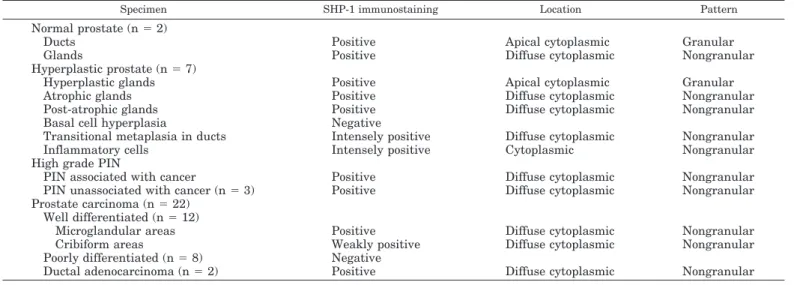
SHP-1 granular and cytoplasmic immunostaining was de-tected in normal, hyperplastic, and neoplastic glands of the prostate with different intensities and distributions (Table 1). In normal and hyperplastic glands the immunostaining was restricted to the luminal side of duct and acinar cells (Fig. 10A). In PIN (Fig. 10B) and well differentiated adenocarci-noma (Fig. 10, E and F), SHP-1 antibodies also immuno-stained the cytoplasm of neoplastic cells, but the staining was diffuse and did not show this polar arrangement observed in benign tissue. High grade adenocarcinomas, represented by cases of Gleason scores 8 –10, were all negative (Fig. 10, G and H). Lymphoid cells in both prostatic specimens and controls displayed an intense and diffuse cytoplasmic positivity.
FIG. 4. Effects of SRIF on PC-3 cell proliferation. A, PC-3 cells were cultured in RPMI with serum and after 2 d of culture treated once daily with goat IgG as a control or with anti-SRIF antibody for 6 d. Then cell number was determined. Results are expressed as a per-centage of the value obtained for the control, and values are the mean⫾SEMof seven experiments performed by triplicate. ***,P⬍
0.001vs.control. B, PC-3 cells were grown overnight in 24-well mul-tiwell plates and then transfected with SRIF cDNA or empty vector (control). Three days after transfection proliferation was evaluated by cell counting. Results are expressed as a percentage of the control (mean ⫾SEM of nine separated experiments). ***, P ⬍ 0.001vs.
control.
FIG. 5. Expression of PTPs in PC-3 and LNCaP cells. Solubilized proteins (50g) of PC-3 and LNCaP cells were subjected to SDS-PAGE, transferred to nitrocellulose membrane, and immunoblotted using anti-SHP2, anti-SHP1, and anti-PTP1B antibodies. The figure is representative of three experiments.
Discussion
The mechanisms underlying prostate tumoral growth are still poorly understood. Since the early work demonstrating the presence of SRIF-like proteins in the human prostate
gland (28), a large body of evidence has indicated a prom-inent role of SRIF in the regulation of prostate growth. How-ever, the mechanism(s) through which SRIF directly affects cell proliferation and the signaling pathways involved still need to be clearly defined.
It is well known that prostatic carcinoma expresses ssts, but conflicting data exist about the expression of subtypes sst2 and sst5. Although sst2 was not found in primary
pros-FIG. 6. Effect of SRIF on activity and expression of SHP-1 in PC-3 cells. Cells were cultured in RPMI with 10% FBS, and after 2 d (d 0) the medium was removed, the cells were washed and cultured in RPMI without serum with 0.8g/ml anti-SRIF antibody or goat IgG as control for 3 d, then lysates were obtained. A, Equal amounts of proteins were immunoprecipitated with anti-SHP-1 antibody, and tyrosine phosphatase activity was measured as described inSubjects and Methods. B, Cell lysates (50g) were subjected to SDS-PAGE and immunoblotted with anti-SHP1 antibody. Immunoblots were ana-lyzed densitometrically. In both cases results are expressed as a percentage of the values obtained on d 0 (mean⫾SEMof three sep-arated experiments). *,P⬍0.05vs.control. #,P⬍0.05, cells cultured without serum withvs.without anti-SRIF antibody.
tate cancer specimens using in situ hybridization and RT-PCR (18, 19), this subtype was revealed in metastases of hormone refractory prostatic adenocarcinoma (20), in ortho-topic PC-3 tumors and their metastases (21), and in Dunning rat model R-3327 AT-1 (22). In agreement with this latter set of reports, we detected sst2 and sst5 RNA in PC-3 cells. These cells are derived from metastatic, rather than primary, tu-mors. More recently, Halmoset al.(29) defined the incidence and properties of sst in patients with organ-confined and locally advanced prostate cancer. They found that the
inci-dence of ssts on prostate cancer did not seem to be affected by tumor progression. SstI and sst5 mRNA were widely distributed, whereas sst2 was rarely detected. However, fur-ther analysis of the pattern of ssts expression is needed in a large cohort of patients, with reference to stage and grade of tumors, to know whether the loss or gain of an SRIF receptor subtype may be associated with the progression of prostate cancer.
The present study reveals that SRIF is produced by PC-3 and LNCaP cells and that this peptide is an important neg-ative regulator of the cell proliferation of these cell lines. We show that SRIF secretion is related to the proliferative status of prostatic cells, as culture conditions that increase SRIF secretion, such as serum withdrawal, induce a decrease in PC-3 and LNCaP cell growth. Despite the opposite effect of ITS, a basal medium supplement, on PC-3 and LNCaP cell growth, the inverse relationship between cell proliferation and SRIF secretion is kept. In addition, SRIF overexpression
FIG. 8. RC-160 induced stimulation of SHP-1 activity in PC-3 cells. Cells were cultured for 24 h in RPMI with 10% FBS and in serum-free medium overnight and incubated at 37 C for the indicated times with 10⫺8mol/liter RC-160 (A) or for 5 min with increasing concentrations of RC-160 (B) before solubilization and immunoprecipitation with anti-SHP-1 antibody. Immunoprecipitates were assayed for PTP ac-tivity. Results are the mean⫾ SEMof three experiments made in duplicate. *,P⬍0.05; **,P⬍0.01; ***,P⬍0.001 (vs.control).
FIG. 9. Effect of stable expression of SHP-1 on PC-3 cell growth. Cloned cell lines were obtained from PC-3 cells stable transfected with empty vector (PS12) and vector encoding SHP-1 (CSH11 and CSH12), respectively. A, Cell lysates (50g) were subjected to SDS-PAGE and immunoblotted using anti-SHP1 antibody. The figure is representa-tive of three experiments. B, PC-3 cells and clones PS12 (control), CSH11, and CSH12 were grown in RPMI with 10% FBS. Cell growth was daily measured by cell counting. Results are the mean⫾SEMof
three experiments made in triplicate. *,P⬍0.05; **,P⬍0.01; ***,
P⬍0.001 (vs.PS12).
inhibits PC-3 cell growth. Conversely, blockage of endoge-nous SRIF by specific antibodies results in an increase in PC-3 and LNCaP cell growth. Taken together, these data suggest the existence of an autocrine/paracrine SRIF loop, inhibitory for cell proliferation of these human prostatic cancer cell
lines. The activity of this loop could be negatively regulated, in a cell-specific manner, by factors present in serum, as is demonstrated by the addition of ITS to basal medium. In this sense, Tanget al.(30) reported that in the absence of serum, PC-3 cells show an initial phase of growth, followed by a
TABLE 1. Immunohistochemical distribution of SHP-1 in normal and pathological human prostate
Specimen SHP-1 immunostaining Location Pattern
Normal prostate (n⫽2)
Ducts Positive Apical cytoplasmic Granular
Glands Positive Diffuse cytoplasmic Nongranular
Hyperplastic prostate (n⫽7)
Hyperplastic glands Positive Apical cytoplasmic Granular
Atrophic glands Positive Diffuse cytoplasmic Nongranular
Post-atrophic glands Positive Diffuse cytoplasmic Nongranular
Basal cell hyperplasia Negative
Transitional metaplasia in ducts Intensely positive Diffuse cytoplasmic Nongranular
Inflammatory cells Intensely positive Cytoplasmic Nongranular
High grade PIN
PIN associated with cancer Positive Diffuse cytoplasmic Nongranular
PIN unassociated with cancer (n⫽3) Positive Diffuse cytoplasmic Nongranular
Prostate carcinoma (n⫽22) Well differentiated (n⫽12)
Microglandular areas Positive Diffuse cytoplasmic Nongranular
Cribiform areas Weakly positive Diffuse cytoplasmic Nongranular
Poorly differentiated (n⫽8) Negative
Ductal adenocarcinoma (n⫽2) Positive Diffuse cytoplasmic Nongranular
PIN, Prostatic intraepithelial neoplasia.
phase, starting from d 3– 4, in which the number of cells begins to decrease. The initial growth phase could be due to the autocrine production of various growth factors detected in these cells (3). The increase in SRIF secretion (maximum on d 3) that we observed in these cells could counterbalance the positive growth regulatory loops and be responsible for the decrease in cell proliferation. Instead, LNCaP cells keep a relatively constant cell number for 5– 6 d after serum with-drawal, coincident with the increase in the SRIF level since first day after serum withdrawal.
It is evident that the presence of SRIF in PC3 and LNCaP epithelial cells revises classic studies in which expression of this peptide in the prostate is limited to neuroendocrine cells (28). However, prior studies have shown that these cell lines consist of multipotent cells capable of both neuroendocrine and epithelial differentiation. In fact, the treatment of cul-tured prostate cancer cells with hormone-deficient medium induces the acquisition of numerous neuroendocrine char-acteristics that include the cessation of mitotic activity and the release of some neurosecretory products into the culture medium (31). Assuming that endogenous SRIF inhibits PC3 and LNCaP cell proliferation, the increase in its secretion could be important for the proliferative suppression associ-ated with the neuroendocrine differentiation event. Our group is studying this possibility.
SHP-1, a protein tyrosine phosphatase with two N-termi-nal Src homology 2 domains that allow binding to phospho-tyrosines residues, plays a role in terminating growth factor and cytokine signals by dephosphorylating critical mole-cules (26, 32–35). SHP-1 is highly expressed in hemopoietic cells (35); however, recent studies revealed SHP-1 is also substantially expressed under the control of an alternative tissue-specific promoter in a variety of nonhemopoietic cells, especially in some malignant epithelial cells (36). However, the precise function and targets of SHP-1 in nonhemopoietic cells are largely unknown. In previous studies we reported the expression of SHP-1 in rat prostate epithelial cells (23), but the presence of this PTP in human prostate has not been previously documented. We report now, for the first time, that SHP-1 is also abundant in human prostatic cancer cells lines and that its activity and protein levels are stimulated by endogenously produced SRIF. Coincident with the increase in SRIF secretion, the results presented here show that serum deprivation increases the activity of SHP-1 as a result at least in part of an increase in SHP-1 expression. This increase is partly caused by SRIF, as it is prevented by the neutralization of endogenously secreted SRIF. The increase in SHP-1 ac-tivity is greater than that in SHP-1 levels, suggesting that other factors either present in serum or induced by serum deprivation may modulate the SHP-1 activity, although not its level. Previously, Breviniet al.(37) demonstrated a direct inhibitory effect of SRIF on LNCaP cell proliferation, which could be mediated by the activation of unidentified PTP. Numerous studies reported that SRIF can stimulate PTP activity in other cell types, and all five SRIF receptor subtypes have been shown to stimulate PTP in various transfected cells (9, 13). SHP-1 has been identified as the PTP involved in the SRIF-induced antiproliferative signal (24, 25). In fact, recent studies have revealed that SHP-1 associates with sst2, be-comes activated in response to SRIF, and participates in the
negative regulation of mitogenic insulin signaling (24, 26). Other studies, however, have suggested that the more widely expressed SHP-2 is the principal component of sst-mediated antiproliferative signaling (38, 39). We demonstrate that RC160 stimulates SHP-1 activity in a time- and dose-depen-dent manner. This analog binds with high affinity to sst2 and sst5. As we have detected both subtypes in PC-3 cells, we cannot determine which of them is implicated in the activa-tion of SHP-1. Recent reports show that SHP-1 associates with sst2 and is involved in the sst2-mediated up-regulation of p27kip1, leading to cell cycle arrest (40). Moreover, Raully
et al.(41) reported that the expression of sst2 in mouse NIH-3T3 fibroblasts generated a negative autocrine loop by stim-ulating SRIF production and increasing both SHP-1 activity and SHP-1 levels. The antiproliferative effect of SRIF is also mediated by sst5, although the mechanisms regulated by this receptor subtype do not seem to be related to SHP-1 activa-tion, and these results are far from conclusive. In this sense, Cordelieret al.(42) demonstrated that the antiproliferative signal mediated by rat sst5 implicates a cGMP-dependent pathway, whereas Sharma et al.(43) suggest that the anti-proliferative signaling via human sst5 leading to growth inhibition is PTP dependent. Thus, it is necessary to deter-mine which SRIF receptor subtype expressed is coupled to SHP-1 in PC-3 cells. Our demonstration that SHP-1 overex-pression reduced PC-3 cell growth is an argument in favor of the role of SHP-1 in the negative control of cell growth. Matozakiet al.(44) have also shown that overexpression of SHP-1 is associated with growth inhibition and a decrease in growth factor-induced mitogenesis. Conversely, decreased levels of SHP-1 were associated with increased cell growth and growth factor-mediated cell responses (35). The essential role of SHP-1 as a negative regulator of cell growth is con-sistent with a marked overexpansion of multiple hemopoi-etic cell types, which has been observed in motheatenmice characterized by mutations in the SHP-1 gene and loss of SHP-1 activity (45). Our results clearly indicate that SHP-1 is a component involved in the SRIF autocrine inhibitory loop, because when you block secreted SRIF, the PC-3 cell prolif-eration increases, decreasing the activity and the levels of SHP-1. The overexpression of SRIF causes a decrease in PC-3 cell proliferation and an increase in the activity and levels of SHP-1. However, this cell line expresses other PTPs, such as SHP-2 and PTP1B, which could also mediate the antiprolif-erative effect of SRIF in the prostate.
PC-3 is an established cell line and it may not truly rep-resent the in vivo situation. In an attempt to determine whether SHP-1 is expressed in human prostate we investi-gated the expression and immunolocalization of SHP-1 in normal, benign, and malignant prostatic tissue. We found consistent changes in localization and intracellular distribu-tion of SHP-1, associated with the transidistribu-tion from benign prostate to prostate cancer and also with a variable degree of differentiation within malignant tissue. SHP-1 expression is detected in normal prostate, benign prostatic hyperplasia, high grade PIN, and well differentiated adenocarcinoma. In contrast, no signal is detected in poorly differentiated pros-tate cancer. This correlated well with our findings that the expression level of SHP-1 is higher in LNCaP than in PC-3 cells. LNCaP is a well differentiated human prostatic cancer
cell line. However, PC-3 is a highly invasive, androgen-independent, and less differentiated human prostatic cancer cell line (46). Moreover, the tumors formed by both cell lines after injections in athymic mice are different (47, 48). Tumors formed by PC-3 cells are undifferentiated adenocarcinomas, whereas LNCaP tumors are better differentiated. Thus, the loss of SHP-1 expression may play an important role during the development and progression of prostate cancer. In this sense, SHP-1 can be activated by SRIF and participate in the negative regulation of growth factor signaling. A low ex-pression of SHP-1 has been detected in Burkitt lymphoma (49) and in erythroid progenitors of patients with polycy-themia vera, which are hypersensitive to the mitogenic ef-fects of growth factors and cytokines (50). Growth factors and their receptors seem to play an important role in the control of prostate growth. Recent studies have provided evidence that there is a shift toward increased expression and auto-crine production of growth factors during the progression of prostate cancer, which represents an adaptation in response to androgen ablation (3). The androgen deprivation could also lead to the development of a negative growth-regulating loop involving SRIF. However, this loop could be deficient due to low expression of SHP-1. Assuming that the incidence of ssts on prostate cancer appears to be unaffected by tumor progression (29), postreceptor signaling defects, such as loss of SHP-1, may play a role in the pathogenesis of prostate cancer by permitting the persistence of signals generated by growth factors. In this sense, Douziech et al. (51) demon-strated that SRIF exerts different effects on human pancreatic cancer cell growth depending upon the presence or absence of SHP-1. The antiproliferative effect of the peptide is not observed when the enzyme is not expressed.
Despite the attention focused in recent years on the effi-cacy of SRIF to treat prostate cancer, the molecular mecha-nisms used by this peptide are far from being well docu-mented. We have demonstrated that PC-3 and LNCaP cells synthesize and secrete SRIF, and this peptide, acting through sst2 and/or sst5, inhibits cell proliferation. This antiprolif-erative effect could be mediated by SHP-1, a PTP present in prostatic cells and regulated, both short and long term, by endogenously secreted SRIF. We have identified SHP-1 in normal human prostate, benign prostatic hyperplasia, and well differentiated prostate cancer, but it seems to be lacking in poorly differentiated advanced prostate cancer. SHP-1 can play a key role in the control of prostatic cell proliferation, and its cellular presence may determine the therapeutic po-tential of SRIF in the control of prostate cancer. Future studies are necessary to determine whether the loss of this negative regulation contributes to prostatic tumor development and progression.
Acknowledgments
Received February 27, 2001. Accepted October 23, 2001.
Address all correspondence and requests for reprints to: Dr. Begon˜a Cola´s, Departamento de Bioquı´mica y Biologı´a Molecular, Universidad de Alcala´, E-28871 Alcala´ de Henares-Madrid, Spain. E-mail: begona. [email protected].
This work was supported by Grant PM97-0069 (DGESIC) and Grant HF-1998-0132 (Accio´n integrada Hispano-Francesa) from the Ministerio de Educacio´n y Ciencia, by Grant Alonga-Grupo Synthelabo from
Fun-dacio´n para la Investigacio´n en Urologı´a, and by Grant AECI from the Ministerio de Asuntos Exteriores.
References
1.Catalona WJ1994 Drug therapy: management of cancer of the prostate. N Engl J Med 331:996 –1004
2.Sogani PC1987 Treatment of advanced prostatic cancer. Urol Clin North Am 14:353–371
3.Russell PJ, Bennett S, Stricker P1998 Growth factor involvement in progres-sion of prostate cancer. Clin Chem 44:705–723
4.Pinski J, Schally AV, Halmos G, Szepeshazi K1993 Effect of somatostatin analog RC-160 and bombesin/gastrin releasing peptide antagonist RC-3095 on growth of PC-3 human prostate cancer xenografts in nude mice. Int J Cancer 55:963–967
5.Pinski J, Reile H, Halmos G, Groot K, Schally AV1994 Inhibitory effects of somatostatin analogue RC-160 and bombesin/gastrin releasing peptide an-tagonist RC-3095 on the growth of the androgen-independent Dunning R-3327-AT-1 rat prostate cancer. Cancer Res 54:169 –174
6.Figg WD, Thibault A, Cooper MR, Reid R, Headlee D, Dawson N, Kohler DR, Reed E, Sartor O1995 A phase I study of the somatostatin analogue somatuline in patients with metastatic hormone refractory prostate cancer. Cancer 15:2159 –2164
7.Maulard C, Richaud P, Droz JP, Jessueld D, Dufour-Esquerre F, Housset M 1995 Phase I-II study of the somatostatin analogue lanreotide in hormone-refractory prostate cancer. Cancer Chemother Pharmacol 36:259 –262 8.Logothetis CJ, Hossan EA, Smith TL1994 SMS 201–995 in the treatment of
refractory prostatic carcinoma. Anticancer Res 14:2731–2734
9.Patel YC1999 Somatostatin and its receptor family. Front Neuroendocrinol 20:157–198
10. Pollak MN, Schally AV1998 Mechanisms of antineoplastic action of soma-tostatin analogs. Proc Soc Exp Biol Med 217:143–152
11. Reubi JC, Laissue JA1995 Multiple actions of somatostatin in neoplastic disease. Trends Int Pharmacol Sci 16:110 –115
12. Voges GE, Jacobi GH1987 Prolactin regulation of prostate growth. In: Motta M, Serio M, eds. Hormonal therapy of prostatic diseases: basic and clinical aspects. Amsterdam: Medicom Europe; 105–119
13. Buscail L, Delesque N, Esteve JP, Saint-Laurent N, Prats H, Clerc P, Rob-berecht P, Bell GI, Liebow C, Schally AV1994 Stimulation of tyrosine phos-phatase and inhibition of cell proliferation by somatostatin analogues: medi-ation by human somatostatin receptor subtypes SST1 and SST2. Proc Natl Acad Sci USA 91:2315–2319
14. Buscail L, Esteve JP, Saint-Laurent N, Bertrand V, Reisine T, O’Carroll AM, Bell GI, Schally AV, Vaysse N, Susini C1995 Inhibition of cell proliferation by the somatostatin analogue RC-160 is mediated by somatostatin receptor subtypes SST2 and SST5 through different mechanisms. Proc Natl Acad Sci USA 92:1580 –1584
15. van Hagen PM, Krenning EP, Kwekkeboom DJ, Reubi JC, Anker-Lugten-burg PJ, Lowenberg B, Lamberts SW1994 Somatostatin and the immune and hematopoietic system; a review. Eur J Clin Invest 24:91–99
16. Reubi JC, Waser B, Lamberts SWJ, Mengod G1993 Somatostatin (SRIH) messenger ribonucleic acid expression in human neuroendocrine and brain tumors using in situ hybridization histochemistry: comparison with SRIH receptor content. J Clin Endocrinol Metab 76:642– 647
17. Levy L, Bourdais J, Mouhieddine B, Benlot C, Villares S, Cohen P, Peillon F, Joubert D1993 Presence and characterization of the somatostatin precursor in normal human pituitaries and in growth hormone secreting adenomas. J Clin Endocrinol Metab 76:85–90
18. Reubi JC, Waser B, Schaer J, Markwalder R1995 Somatostatin receptors in human prostate and prostate cancer. J Clin Endocrinol Metab 80:2806 –2814 19. Sinisi AA, Bellastella A, Prezioso D, Nicchio MR, Lotti T, Salvatore M,
Pasquali D1997 Different expression patterns of somatostatin receptor sub-types in cultured epithelial cells from human normal prostate and prostate cancer. J Clin Endocrinol Metab 82:2566 –2569
20. Nilsson S, Reubi JC, Kalkner KM, Laissue JA, Horisberger U, Olerud C, Westlin JE1995 Metastasic hormone-refractory prostatic adenocarcinoma ex-presses somatostatin receptors and is visualized in vivo by [111In]-labeled
DTPA-d-[Phe1]-octreotide scintigraphy. Cancer Res 55:5805s–5810s
21. Plonowski A, Schally AV, Nagy A, Sun B, Szepeshazi K1999 Inhibition of PC-3 human androgen-independent prostate cancer and its metastases by cytotoxic somatostatin analogue AN-238. Cancer Res 59:1947–1953 22. Koppa´n M, Nagy A, Schally AV, Arencibia JM, Plonowski A, Halmos G1998
Targeted cytotoxic analog of somatostatin AN-238 inhibits growth of androgen independent Dunning R-3327-AT-1 prostate cancer in rats at nontoxic doses. Cancer Res 58:4132– 4137
23. Valencia AM, Oliva JL, Bodega G, Chiloeches A, Lopez-Ruiz P, Prieto JC, Susini C, Colas1997 Identification of a protein-tyrosine phosphatase (SHP1) different from that associated with acid phosphatase in rat prostate. FEBS Lett 406:42– 48
asso-ciates with the sst2 somatostatin receptor and is an essential component of sst2-mediated inhibitory growth signaling. J Biol Chem 272:24448 –24454 25. Douziech N, Calvo E, Coulombe Z, Muradia G, Bastien J, Aubin RA, Lajas
A, Morisset J1999 Inhibitory and stimulatory effects of somatostatin two human pancreatic cancer cell lines: a primary role for tyrosine phosphatase SHP-1. Endocrinology 140:765–777
26. Bousquet C, Delesque N, Lopez F, Saint-Laurent N, Esteve JP, Bedecs K, Buscail L, Vaysse N, Susini C1998 sst2 somatostatin receptor mediates neg-ative regulation of insulin receptor signaling through the tyrosine phosphatase SHP-1. J Biol Chem 273:7099 –7106
27. Patel YC, Reichlin S1978 Somatostatin in hypothalamus extrahypothalamic brain and peripheral tissues of the rat. Endocrinology 102:523–531 28. Di Sant’Agnese PA, De Mesy Jensen KL1984 Somatostatin and/or
soma-tostatin like immunoreactive endocrine-paracrine cells in the human prostate gland. Arch Pathol Lab Med 108:693– 696
29. Halmos G, Schally AV, Sun B, Davis R, Bostwick DG, Plonowski A2000 High expression of somatostatin receptors and messenger ribonucleic acid for its receptor subtypes in organ-confined and locally advanced human prostate cancers. J Clin Endocrinol Metab 85:2564 –2571
30. Tang DG, Li L, Chopra DP, Porter AT1998 Extended survivability of prostate cancer cells in the absence of trophic factors increased proliferation, evasion of apoptosis, and the role of apoptosis proteins. Cancer Res 58:3466 –3479 31. Bonkhoff H1998 Neuroendocrine cells in bening and malignant prostate
tissue: morphogenesis, proliferation, and androgen receptor status. Prostate 8:18 –22
32. D’Ambrosio D, Hippen KL, Minskoff SA, Mellman I, Pani G, Siminovitch KA, Cambier JC1995 Recruitment and activation of PTP1C in negative reg-ulation of antigen receptor signaling by FcgRIIB1. Science 268:293–297 33. Kingmu¨ller U, Lorenz U, Cantley LC, Neel BG, Lodish HF1995 Specific
recruitment of SH-PTP1 to the erythropoietin receptor causes inactivation of JAK2 and termination of proliferative signals. Cell 80:729 –738
34. Haque SJ, Harbor P, Tabrizi M, Yi T, Williams BRG1998 Protein-tyrosine phosphatase Shp-1 is a negative regulator of IL-4- and IL-13-dependent signal transduction. J Biol Chem 273:33893–33896
35. Yi T, Mui ALF, Kristal G, Ihle JN1993 Hematopoietic cell phosphatase associates with the interleukin-3 (IL-3) receptorchain and down-regulates IL-3-induced tyrosine phosphorylation and mitogenesis. Mol Cell Biol 13: 7577–7585
36. Banville D, Stocco R, Shen SH1995 Human protein tyrosine phosphatase 1C (PTPN6) gene structure: alternate promoter usage and exon skipping generate multiple transcripts. Genomics 27:165–173
37. Brevini TAL, Bianchi R, Motta M1993 Direct inhibitory effect of somatostatin on the growth of the human prostatic cancer cell line LNCaP: possible mech-anism of action. J Clin Endocrinol Metab 77:626 – 631
38. Reardon DB, Dent P, Wood SL, Kong T, Sturgill TW1997 Activation In vitro of somatostatin receptor subtypes 2,3, or 4 stimulates protein tyrosine
phos-phatase activity in membranes from transfected Ras-transformed NIH 3T3 cells: coexpression with catalytically inactive SHP-2 blocks responsiveness. Mol Endocrinol 11:1062–1069
39. Florio T, Yao H, Carey KD, Dillon TJ, Stork PJS1999 Somatostatin activation of mitogen-activated protein kinase via somatostatin receptor 1 (sstr1). Mol Endocrinol 13:24 –37
40. Page`s P, Benali N, Saint-Laurent N, Esteve JP, Schally AV, Tkaczuk J, Vaysse N, Susini C, Buscail L1999 sst2 somatostatin receptor mediate cell cycle arrest and induction of p27Kip1. J Biol Chem 274:15186 –15193
41. Rauly I, Saint-Laurent N, Delesque N, Buscail L, Esteve JP, Vaysse N, Susini C1996 Induction of a negative autocrine loop by expression of sst2 soma-tostatin receptor in NIH 3T3 cells. J Clin Invest 97:1874 –1883
42. Cordelier P, Esteve JP, Bousquet C, Delesque N, O’Carroll AM, Schally AV, Vaysse N, Susini C, Buscail L1997 Characterization of the antiproliferative signal mediated by the somatostatin receptor subtype sst5. Proc Natl Acad Sci USA 94:9343–9348
43. Sharma K, Patel YC, Srikant CB1999 C-Terminal region of human soma-tostatin receptor 5 is required for induction of Rb and G1cell cycle arrest. Mol
Endocrinol 13:82–90
44. Matozaki T, Uchida T, Fujioka Y, Kasuga M1994 Src kynase tyrosine phos-phorylates PTP1C, a protein tyrosine phosphatase containing Src homology-2 domains that down-regulates cell proliferation. Biochem Biophys Res Com-mun 204:871– 881
45. Shultz LD, Schweitzer PA, Rajan TV, Yi T, Ihle JN, Matthews RJ, Thomas ML, Beier DR1993 Mutations at the murine motheaten locus are within the hematopoietic cell protein-tyrosine phosphatase (Hcph). Cell 73:1445–1454 46. Webber MM, Bello D, Quader S1997 Immortalized and tumorigenic adult
human prostatic epithelial cell lines: characteristics and applications. II. Tu-morigenic cell lines. Prostate 30:58 – 64
47. Kaighn ME, Narayan KS, Ohnuki Y, Lechner JF, Jones LW1979 Establish-ment and characterization of a human prostatic carcinoma cell line (PC3). Invest Urol 17:16 –23
48. Pretlow TG, Delmoro CM, Dilley GG, Spadafora CG, Pretlow TP1991 Transplantation of human prostatic carcinoma into nude mice in Matrigel. Cancer Res 51:3814 –3817
49. Delibrias CC, Floettmann JE, Rowe M, Fearon DT1997 Downregulation of SHP-1 in Burkitt lymphomas and germinal center B lymphocytes. J Exp Med. 186:1575–1583
50. Wickrema A, Chen F, Namin F, Yi T, Ahmad S, Uddin S, Chen YH, Feldman L, Stock W, Hoffman R, Platanias LC1999 Defective expression of the SHP-1 phosphatase in polycythemia vera. Exp Hematol 27:1124 –1132
51. Douziech N, Calvo E, Coulombe Z, Muradia G, Bastien J, Aubin RA, Lajas A, Morisset J1999 Inhibitory and stimulatory effects of somatostatin on two human pancreatic cancer cell lines: a primary role for tyrosine phosphatase SHP-1. Endocrinology 140:765–777