
UNIVERSIDAD TÉCNICA PARTICULAR DE LOJA
La Universidad Católica de Loja
ÁREA SOCIOHUMANÍSTICA
TITULACIÓN DE LICENCIADO EN CIENCIAS DE LA EDUCACIÓN
MENCIÓN INGLÉS
Teachers and students´ perceptions of teaching English in small classes in
Ecuador.
TRABAJO DE FIN DE TITULACIÓN
AUTOR: Yachimba Alcaciega, Fausto Anibal
Directora: Camacho Minuche, Gina Karina, Mgs
CENTRO UNIVERSITARIO TENA
ii
APROBACIÓN DEL DIRECTOR DEL TRABAJO DE FIN DE TITULACIÓN
Magister
Gina Karina Camacho Minuche
DOCENTE DE LA TITULACIÓN
De mi consideración:
El presente trabajo de fin de titulación: “Teachers and students´ perceptions of teaching
English in small classes in Ecuador” realizado por el profesional en formación: Yachimba Alcaciega Fausto Anibal, ha sido orientado y revisado durante su ejecución, por cuanto se
aprueba la presentación del mismo.
Loja, Febrero 2015
iii
DECLARACIÓN DE AUTORÍA Y CESIÓN DE DERECHOS
Yo, Yachimba Alcaciega Fausto Anibal, declaro ser autor (a) del presente trabajo de fin
de titulación: Teachers and students´ perceptions of teaching English in small classes in
Ecuador”, de la Titulación de Ciencias de la Educación mención Inglés, siendo la Magister Gina Karina Camacho Minuche directora del presente trabajo; y eximo expresamente a la
Universidad Técnica Particular de Loja y a sus representantes legales de posibles reclamos
o acciones legales. Además certifico que las ideas, conceptos, procedimientos y resultados
vertidos en el presente trabajo investigativo, son de mi exclusiva responsabilidad.
Adicionalmente, declaro conocer y aceptar la disposición del Art. 88 del
Estatuto Orgánico de la Universidad Técnica Particular de Loja que en su parte
pertinente textualmente dice: “Forman parte del patrimonio de la Universidad la
propiedad intelectual de investigaciones, trabajos científicos o técnicos y tesis de
grado o trabajos de titulación que se realicen con el apoyo financiero, académico o
institucional (operativo) de la Universidad”
f ...
iv
DEDICATION
I dedicate this work to my family. A special feeling of gratitude to my loving wife
Mirian Guadalupe Tonato Guaman whose words of encouragement and push for tenacity
rang in my ears. To my dear daughters Allison, Karol and Yeraldine who are always by my
v
ACKNOWLEDGEMENT
I would like to acknowledge and express my gratitude to my thesis director for
allowing me to conduct my research and for providing the assistance I requested. I would
also like to thank to the human resources staff of Loja University for their constant support.
vi CONTENTS
COVER……… i
APROBACIÓN DEL DIRECTOR (A) DEL TRABAJO DE FIN DE TITULACIÓN…. ii DECLARACIÓN DE AUTORIA Y CESIÓN DE DERECHOS ……… iii
DEDICATION ………. iv
ACKNOWLEDGEMENT………. v
CONTENTS ……….. vi
ABSTRACT……….……… 1
RESUMEN……… 2
INTRODUCTION ………..……… 3
LITERATURE REVIEW………. 4
METHOD ……… 5
DISCUSSION……… 6
Description, analysis and interpretation of the results……… 20
Conclusions ……….. 41
Recommendations ……… 42
REFERENCES……….………… 44
ABSTRACT
This purpose of this investigation was to discover teachers and students’ perceptions of teaching and learning English in small classes in Ecuadorian High schools. The analyzed
sample was composed of seventy-one students and five teachers from mixed-founded high
schools who were surveyed. Furthermore, from the five observed class, three were in an
urban area and two belonged to a rural area near the city of Archidona, in the Napo
province. The data collection was done through the use of surveys to teachers and students
and an observation class form. The quantitative analysis, description and analysis of results
were based on the information obtained from teachers’ and students’ questionnaires and observation sheets. The provided results evidenced that in small classes, there is beneficial
interaction between students and teachers alike. Hence, most of the surveyed sample agreed
and partially agreed with the statements provided in the questionnaires.
2 RESUMEN
Esta investigación se realizó con la finalidad de conocer las percepciones de
maestros y estudiantes de la enseñanza y aprendizaje de Inglés en pequeños grupos en
colegios Ecuatorianos. La muestra analizada comprendió setenta y un alumnos y cinco
profesores de Colegios Fiscomisionales quienes fueron encuestados. Además, de las cinco
clases observadas, tres se encontraban en zona urbana y dos pertenecían a la zona rural del
cantón Archidona, en la provincia de Napo. La recopilación de datos fue hecha a través de
encuestas a profesores y estudiantes y mediante una ficha de observación de clases. El
análisis cuantitativo, la descripción y análisis de los resultados se basaron en la información
obtenida de los cuestionarios de profesores y estudiantes y registro de observación. Los s
resultados proporcionados evidenciaron que en clases pequeñas, existe mucha interacción
entre los estudiantes y profesores los cuales benefician a los dos. Esa fue la razón por la
cual la mayoría de la muestra encuestada estuvo entre los rangos de acuerdo y parcialmente
de acuerdo.
3
INTRODUCTION
English language teaching has become an essential part of our current learning process.
All fields of education require a students’ firm base of this important subject, which day after day is used increasingly around the world. The process requires effort, and dedication from
both teachers and students. Trained teachers will improve the quality of teaching; yet, there are
some other factors that may influence the teaching-learning process such as class size which is
a problem being faced by most teachers around the country. Galton (1994, p. 94-95) based on
his study, concluded that “there is a positive correlation between increasing class size and pupil
progress, and there is also a negative correlation between these two concepts”. Regarding this aspect, Harmer (2007, p. 125) states that “large classes present challenges that smaller classes do not” this means that working with small groups benefits the teaching-learning process due to a positive learning environment, adequate classroom management, and positive interaction.
One of the reasons why working with small groups benefits the teaching-learning
process is a positive learning environment. The classroom environment plays an essential role
in the success of any lesson because the classroom environment sets the stage for the lesson.
Educational research supports that the classroom environment creates an atmosphere of
mutual respect and support in the classroom, where students feel safe in expressing concerns or
asking questions, and where tolerance and a sense of common identity and community are
promoted.
Secondly, working with small classes benefits the teaching-learning process because of
adequate classroom management. Teachers are able to use an adequate classroom
management. They can move students’ chairs to whatever position they want to, in order to permit interaction among students. Teachers have the power to control where students are
seated, and can use seating plans to minimize behavioural problems and maximize potential
4
student next to a weak one. They must also create opportunities to increase students´
participation and to strengthen students´ knowledge. A teacher can change his/her classroom
from a formal setting to an informal setting to encourage a more interactive and cooperative
student environment. Generally, conditions of the classroom environment can affect student
behaviour. A dark classroom can make students tired or promote off-task behaviour. A hot
classroom can make students restless. A teacher should do what he or she can to ensure a
suitable physical environment for learning. Reorganizing classroom seating to allow for easier
movement from student-to-student or group-to-group has significant merit in preventing time
wasting. Teachers should also remove all distracting materials or objects when teaching their
lessons. They can also give clear instructions and group the students easily. If teachers plan fun
and interesting activities, students will be interested in the topics and it will increase the level
of learning and minimize misbehavior.
Previous researches that have been done about teaching English in small class indicated
that there were more advantages of teaching English in smaller class than in large class. In
this way, Galton, M. & Pell, T. (2009) revels in their study that teachers felt more comfortable,
enthusiastic and relaxed when they work with small class. It also permitted that teachers can
identify individual pupil differences and offer remedial help, thereby raising standards. The
purpose of this study was to know if there are some changes in attainment and attitudes
associated with particular kinds of teachers and pupil behavior, then this study, which was
carried out in fifteen Honk Kong´s primary school, reached the goal planted by the author.
Also, the study of Blatchford, P., Moriarty, V., & Martin, C. (2002) was done with the purpose to know if there are interaction between students- teachers in small class. This study
which was carried out in the University of London drew some schools from a wide range of
social backgrounds and they were situated in urban, suburban, and rural areas. This study
5
Lastly, the study done by Konstantopoulos, S. (2007) identified how the class size
reduction can affect the achievement gap. The experiment involved students in 79 elementary
schools in from 42 districts in Tennessee. The results of the study of indicated that
higher-achieving students benefited more from being in small classes in early grades than other
students. The author concluded that high achievers take more advantage of the opportunities or
teacher practices that take place in small classes or create more opportunities for learning in
small classes than lower-achieving students in small classes or other students in other classes,
especially in the first 2 years of school
As a conclusion, working with small classes benefits the teaching-learning process
because of increased interaction; students that are close to the teacher can be corrected by the
teacher immediately whilst interacting. The interaction between students and teachers and
between the students themselves becomes successful. Students are more confident when they
speak to one another; however, they will always need the teacher’s assisted motivation.
As stated before, the benefits of small classes improves the teaching –learning process; students will be able to learn better in an environment where they feel self-confident and can
express their feelings, thoughts and emotions. It is essential to grow linguistically. Respect
and the correct seating arrangement influence the process positively, they encourage free
6 METHOD
Setting and participants
This investigation was carried out in three schools of the Napo province, specifically in
Archidona and Cotundo. One school was located in a rural area and two of them in the urban
sector. Two of them were mixed-founded high schools and one was a public school.
The participants consisted of 71 students from 2 different classrooms. Forty males and
thirty females were the sample population. From this sample population 27 students belonged
to rural areas and 44 belonged to urban sectors. These students were from 1st, 2nd and 3rd senior
high school grade, and their ages ranged from 14 to 19 years.
Moreover, 5 English teachers (3 male and 2 female) from different schools were chosen
to apply the survey. The teaching experience of the participants ranged from 5 to 15 years as
teachers.
Procedure
Four hypothesis questions were the proposal for the university. In order to answer
them, two kinds of instruments were used for both teachers and students. The students´
questionnaire consisted of 22 questions which were divided into four areas or factors. Factor
number one which had 8 items asked about the benefits of teaching English in small classes.
The second factor evaluated strategies and sources which help the teaching process. It also
consisted of 8 items. The third factor asked for students´ opinions on how they felt about
learning English in a small class. It had four items. The last factor asked about the limitations
of learning English in a small class and it consisted of only 2 items.
On the other hand, the teachers´ questionnaire consisted of 21 items with the same 4
factors, but from a teachers´ point of view. The first factor related to the students´ benefits of
7
factor had just 8 items; factor number three had only 4 items whilst the last factor related to
limitation had 2 items.
Moreover, the observation sheet was made up of 22 items. They were related to both the
teacher and students’ questionnaires.
Once the permission to carry out the investigation was granted by the school principals,
the process began. The students were visited in their classroom on a date indicated by the high
school inspector. Before handing out the surveys, teachers and students were appropriately
briefed about the purpose of the study as well as the confidentiality of the information supplied
by them. The participants then completed the surveys, and after being handed in were
classified according to the ranges (totally agree, agree, partially agree and disagree).
After this, one class per teacher was observed and relevant aspects were recorded on the
sheets of paper provided by the university. Those aspects helped to strengthen the opinions
made in the written surveys.
Finally, all of the information was tabulated and recorded in graphs. Then, students´
and teachers´ blocks were compared one by one in order to answer the proposed questions and
the class observation sheet supported their answers. This meant that if both the students and
teachers responding totally agreed that some strategies are used to practice the listening skills,
the class observation sheet showed if it was true or not and which strategy was used. In
8 DISCUSSION
Literature Review
Working in an educational field implies a huge sacrifice and effort for teachers and
students. The Ecuadorian government has declared that ‘Everyone has a right to Education’; and has since started to implement changes in different aspects of the field. This encourages
teachers to look for new methods, strategies and techniques which help improve the teaching
and learning process of English as a second language in public schools.
These methodologies correctly applied in classrooms, will help to motivate students to
achieve their goals and use English independently throughout their lives. However, that is not
enough to solve some of the deficits in the English teaching- learning process. There are also
other factors that influence this important process. The present research study has some
theories, concepts and definitions of certain interesting and important themes which will help
us to understand and clarify some of the unclear ideas related to the proposed study.
These themes have been carefully chosen because they focus on some of the important
aspects that teachers should consider when teaching English in public Ecuadorian schools.
Managing Learning
Gebhard (1996) mentions that classroom management refers to the way teachers
organize what goes on in the classroom, so he defines to managing learning as the term
educators use to describe methods of preventing misbehavior and dealing with it if it arises.
However, Davis and Pearse (2000) focus on ¨the necessities of the teachers and students in the
classroom¨. Teachers have the necessity to involve students in the educational process and by
doing that, they should be able to manage positive feedback, controlled timing and clear
instructions.
Feedback gives students clear guidance on how to improve their learning Gebhard
9
gives the teacher the opportunity to know of any shortcomings in their syllabus and planning.
Positive feedback is an essential part of effective learning. It helps students understand the
subject being studied and to create an academic feedback which is more strongly and
consistently related to achievement than any other teaching behaviour.
The author states ¨feedback can improve a student's confidence, self-awareness and
enthusiasm for learning¨. For example, effective feedback during the first year at university
can aid the transition to higher education and may support student retention. Providing
students engage with feedback, it should enhance learning and improve assessment
performance. Additionally, Gibbs and Simpson (2004) also said that giving feedback to the
students about their assignments was the single most powerful influence on student
achievement.
Consciously or unconsciously, teachers are giving students’ feedback all the time: facial
expressions, tone of voice, and especially words all say a lot about our expectations and the
quality of the responses to those expectations. It has been proved that adequate feedback
encourages students to retain what they have learnt. In brief, teachers should be able to manage
good feedback, being the first step to acquire new knowledge.
The second fact he refers to is that teachers should be able to manage timing in the
classroom. Time is one of the most difficult aspects of lesson planning to control, Brown
(2001). Timing is an element that teachers should build into a lesson plan; that is, what to do if
the class activities end earlier or later than planned. Timing in classroom is essential when
time management is the thread running through almost all aspects of teaching. Teachers can
spend time recording student progress, organizing the classroom, deciding how long and how
often to teach various subjects.
Students spend relatively little of their time in the classroom. Effective use of school
10
book success in english teaching, Davis and Pearse (2000) mention that much of the essentials
of classroom life involve time management in some way: paring down paperwork; planning;
establishing routines that eliminate wasted time and confusion; using learning centers,
independent assignments, and seatwork to give teachers time to work with small groups; and
creating classroom environments that allow students and activities to move smoothly from one
to the next. The authors say that courses are normally based on a syllabus which constitutes an
essential guide for the course. It sets teachers’ objectives and tells them what to teach, in what order, in what period of time, and—to some extent—how. Units are also usually related to periods of time. For example, you may have to cover a unit every month, or every ten teaching
hours.
In sum, time is a determinant factor for planning activities in the teaching learning
process. It is important to look for organized activities which do not take up a lot of time but
help promote students skills.
The third factor that teachers should be able to manage in the classroom is how to give
instructions. Davis and Pearse (2000) state that instructions should be simple and clear, and as
far as possible, standardized. The way that teachers give instructions is an important aspect of
managing a classroom, and it is worth taking time to consider how they can be made clear to
the students and at the same time provide opportunities for students to interact in meaningful
ways. One way is to write the instruction on the board or show them on an overhead projector
screen. Another language activity is to give the instructions as a dictation. After giving the
dictation, students correct one another by comparing their dictation with a written version.
These authors also support that effective instructions are vital if activities are to go well,
especially activities involving changes of interaction. If students do not pay attention to the
instructions, they will not be understood. So, teachers need to have all the learners’ attention
11
the instructions must be simple and clear so students can understand them without difficulty. It
will guarantee efficient work and a good understanding.
Teacher – students and students – students´ interactions.
Interaction is the vital part of communication so language learners develop best when
they have opportunities to interact. Díaz-Rico (2012) mentions that students need opportunities
to talk in a natural interactional context for a variety of purposes: to establish and maintain
social relationships; to express reactions, to give and seek information; to solve problems,
discuss ideas, or to teach and learn a skill; to entertain or play with language; or to display
achievement. Students need to learn to interact with a variety of conversational partners:
students, the teacher, other adults at school, age peers, guests and so on. The author also says
that the interaction teacher-students occurs when the teacher creates a positive classroom
environment. In this case, the teacher creates opportunities where students feel confident, are
able to speak freely whilst making mistakes and believing that their way of speaking is
respected and their opinions taken seriously. Finally, he concludes that interaction is a kind of
action that occurs as two or more objects have an effect upon one another.
Similarly, Herrera (2011) mentions that teachers know that students cannot learn what
they do not practice. That means students need to talk to and to interact with their classmates.
It is with the student to student interaction that they create ways to transmit information. They
organize their ideas to express their thoughts and emotions to others. Therefore, Herrera
(2011) considers that ¨social interaction will help to develop social language¨. This means that
students will have opportunities to practice a language used in society. That is the interaction
between students and adults outside school hours. In this interaction, the students will have the
opportunity to share a multiple language function. They will be able to promote resources or
12
cognitive academic language proficiency (CALP) in a second language, they must have
frequent opportunities to practice language used in academic settings Thomas & Collier (2002).
In a sheltered instruction observation protocol (SIOP) lesson, instructions should
minimize teacher centered lecturing and maximize students interaction with teachers and other
students (Echevarria et al.,2000). This means that when students work in collaborative groups,
teachers have the perfect opportunity to walk around the classroom, discuss projects with small
groups of students, and challenge the students’ understanding of the key content concepts.
In sum, interaction not only facilitates language learning but is also a causative force of
acquisition. This is the ignition of developing the skill of speaking. This is the firm base of
communication. Through interaction students can create a positive classroom environment
where they can feel free to express their thoughts and emotions and at the same time will
become more self-confident.
Class Size
The next theme which is considered an important part of this study is class size. As
Ehrenberg; Brewer; Gamoran and Willms (2001) mention the number of students in a class
has the potential to affect how much is learned in a number of different ways. For example, it
could affect how students interact with each other—the level of social engagement. This may result, for example, in more or less noise and disruptive behavior, which in turn affects the
kinds of activities the teacher is able to promote. It could affect how much time the teacher is
able to focus on individual students and their specific needs rather than on the group as a
whole.
“Class size is defined as the number of students that are regularly present in the
teacher’s classroom for instruction” Deutsch (2003). A class size of less than 20 students is considered to be small, and classrooms with more than 20 students are viewed as large (Finn,
13
their students participated more often during discussion and question and answer sessions
(Folger, 1989).
Teachers with small classes give their students more individualized attention, which
allows increased opportunities to identify which students are at risk and provide them with
individualized instruction (Nye, Hedges, & Konstantopoulos, 2002) . The authors previously
mentioned that they also found that lower – achieving students benefited more for participating in classrooms with fewer than 20 students than did higher – achieving students, particularly in the area of reading.
Johnston (1990) reported that teachers of small classes in Project START perceived
their students to be more cooperative, supportive and caring toward their peers than those in
larger classes. He also mentions that in small classes, interaction between students and teachers
is positively affected by small class size.
Ehrenberg; Brewer; Gamoran; and Willms (2001) say teachers may choose different
methods of teaching and assessment when they have smaller classes. For example, they may
assign more writing, or provide more feedback on students’ written work, or use open-ended assessments, or encourage more discussions, all activities that are more feasible with a smaller
number of students.
In contrast, Brock (2013) identified some common problems in large classes. One of
these problems is classroom management. It is when learning everyone´s name is hard. It is
difficult to get students to pay attention. Cheating can become a problem when you cannot be
everywhere at one time. In a large class, there is more chance that making one student happy
will make another student unhappy. Everything takes more time. Space and a sufficient amount
of materials become classroom management problems: Teachers cannot monitor groups if
14
assessment. Assignments and giving written feedback take much more time. Grading can be
more complicated. With oral activities, it may be hard to know who is succeeding in a large
class because it is hard to know what mistakes students are making.
In sum, there are some positive and negative aspects of teaching English in a small
class. However, teaching in small classes will have more teacher and student benefits.
Teaching fewer students will improve the participation and create a family like environment
where students and teachers will feel confident to interact with one another. On the other hand,
teaching large classes is a challenge for teachers because they have to be able to manage and
control the classroom.
Teaching techniques, strategies or activities for teaching English to small classes.
There are some strategies, techniques and activities used by teachers when teaching
small classes. Strategies are the umbrellas for techniques that are selected and used in practice
according to Herrera (2012). The strategies selected by an effective teacher are philosophically
consistent with the method of classroom instruction. Among the strategies used in a small class
are hand on activities which constitute a type of strategy that educators may employ when
using the sheltered instruction method with their students. According to Herrera (2012) ¨A
strategy is a collection of philosophically grounded and functionally related techniques that
serves as an implementation component of an instructional method¨. Other strategies of this
method are cooperative learning strategy, scaffolding, learning which develops an active
participation of the students in a small area. Afflerbach, Pearson, and Paris (2008) have
defined a strategy as “ a systematic plan, consciously adapted and monitored, to improve one’s
performance in learning” (p.365). As educators, one of our intents is to provide students with skills that support their learning beyond their time in our classroom. Students can apply a wide
15
prior experience, interactions with peer knowledge of word meaning, and other strategies they
have learned to make sense when talking and writing.
Some learning strategies start at home and are later elaborated upon in school. Teachers
can explicitly model, practice and apply the three types of learning strategy cognitive,
metacognitive and social affective strategies.
On the other hand, Herrera and Murry (2011) define techniques as ¨specific actions or
action sequences that have been designed to achieve a defined, strategy objective¨. Technique
is like an umbrella which contains chosen strategies, and represents action subcomponents of
strategy. For example, if educators decide to use the strategy of cooperative learning, they may
decide to have students collaborate by doing thinking pair-share, jigsawing, or group problems
solving. Individual techniques can also be combined effectively with other related techniques
to achieve successful implementation of a particular strategy.
Learning environment in small classes
The classroom environment plays a pivotal role in the success of any lesson because the
classroom environment sets the stage for the lesson. The classroom environment should
accommodate multiple types of student grouping (e.g., collaborative, one on one, small groups,
and whole groups).
Teachers also seek to create a learning environment in which respect and rapport are
evident. The classroom must be arranged correctly; seating arrangement evidence an
awareness of how their classroom environment is organized and how their work is treated
within the classroom. When classroom environments are supportive of what children are trying
to do, they can more easily demonstrate what they can do ( Bjorklud. Muir-Broaddus, &
Schneider, 1990; Neuman &Roskos, 1997).
The physical arrangement of desks and chairs in the classroom is one of the ways in
16
arranged so that teacher has easy access to all the students and the students can easily dialogue
and interact with one another. Grouping desks in number of no more than five helps to
accomplish this goal.
Hasting and Schwieso (1995) recommended that group seating arrangement be used
when interactions, discussion, and collaboration are needed to complete a task or project.
Cambourne (2001-2002) suggests that when organizing settings, the teacher can decide
which literacy tools, props, or paraphernalia will be purchased and made available for teaching
and learning to read and write.
Although some teachers design the space in their rooms to support literacy learning.
Research has shown consistently that when language arts classrooms are partitioned into
smaller spaces such as learning centers, project or activity areas, or small group discussion
areas, this bounded and partitioned arrangement of classroom space into smaller physical space
facilitates verbal interaction among peers and enhance cooperative and associative learning
(Loughlin & Martin, 1987; Morrow, 1990; Rivilin & Weinstein, 1984).
Due to the importance of the small class in the Educational field, many researchers have
made studies related to this controversial topic. It has helped teachers to look for techniques
and strategies which will be used adequately in small classes. All of the studies previously
carried out previously have concluded that small classes have more benefits than large classes
do. Even though, students who attend an educational institution have increased a lot, studying
in small classes will always be an advantage.
Galton and Pell ( 2009) began their study at a point in time when there was considerable
controversy surrounding the issue of reducing class size. There were a lot of people who think
17
The broad aims of this program of research were twofold; first to ascertain the benefits
of Small Classes Teaching (SCT) in the local context and second, to determine what teaching
strategies, professional support and resources were necessary to maximize the effectiveness of
SCT in Hong Kong’s primary schools.
The results of this important study clarify that small classes may compensate, in part,
for prior attainment on entry to primary school, particularly for pupils with disadvantaged
backgrounds to the extent that they have matched the performance of children in classes with
standard populations of pupils by the end. However, any such advantages are gradually eroded
year by year so that by the end on returning to normal classes they fall behind. So the author´s
conclusions imply that while in normal classes most teachers stuck to the whole class instructor
mode, whilst within the smaller classes there continued to be a degree of experimentation
across the remaining three approaches. .
On the other hand, Blatchford; Moriarty and Martin (2002) state that this study has
connections between class size and teaching interactions using a multi-method approach and
data from a longitudinal study of more than 10,000 children and their teachers over 3 years.
Significantly, the children asked many questions that the teacher was able to respond to and
make part of the teaching session. The teacher believed that this was partly due to the size of
the group, as she could listen to them all and respond to them. This increased their confidence
and enabled them to feel secure enough to ask questions. Results show, overall, that in smaller
classes, there is more individualized teacher support for learning. Observations in another
small class of fewer than 15 children showed that interactions between the teacher and the
children were of high quality in both whole-class and small group contexts.
The schools in the study drew from a wide range of social backgrounds and were
situated in urban, suburban, and rural areas. When the study started, 49% of the sample were
18
income), the vast majority (97%) spoke English as a first language, and most (91%) were
classified as from white U.K. ethnic backgrounds. Schools were either all-through primary
schools (i.e., children aged 4–11 years), constituting 74%, or infant schools (i.e., children aged 4–7 years), constituting 26%. The teacher was also able to give immediate feedback to the children about the quality of their work.
In this study, two main kinds of data were used. The first is the narrower, quantitative
kind (e.g., frequency of attention); the second is broader (e.g., responsiveness and knowledge
of individuals). Distinguishing between the two may help explain the inconsistencies of
research literature, for example, differences between the systematic observation studies of
Shapson (1980) and teacher reports.
Konstantopoulos (2007). In an experiment that involved students in 79 elementary
schools in 42 districts in Tennessee planned three hypotheses for his study, number one being
that in small classes, teachers are more likely to identify lower achievers and hence are more
likely to provide instruction designed to benefit those students in the early grades. The result
did not support this hypothesis. The second one was that teachers are also more likely to
identify higher-achieving students in small classes and thus are more likely to provide effective
strategies that benefit these students more. Alternatively, it is plausible that the instructional
practices in small classes benefit higher achievers more. That is, high-achieving students may
be more engaged (or motivated) in learning than other students in small classes. Possibly high
achievers take more advantage of the opportunities or teacher practices that take place in small
classes or create more opportunities for learning in small classes than lower achieving students
in small classes.
Although this study helped us to better understand the effects of small classes on
student achievement, the mechanism is still not clearly defined. Unfortunately, data about
19
could have unveiled the mechanism of small-class effects via information about instructional
processes and interactions between students and teachers.
Finn and Gerber (2005) presented three research questions which involved
participation, academic achievement and effects of participation.
The study included 4,948 participants in Tennessee’s class-size experiment, Project STAR. The percentage of all students who graduated from high school was 77.5% in the
transcript sample. Graduation rates were higher for female students (81.8%) than for male
students (73.1%), higher for white students (81.8%) than for minority students (67.9%), and
higher for students who did not receive free lunches (83.4%) than for students who received
free lunches (72.8%).
The analysis involved a set of computer runs addressing each of the three research
questions. The first set addressed the effect of small-class participation on the likelihood of
graduation (Question 1), the second set examined the relationship between academic
achievement and likelihood of graduation (Question 2), and the third set included both
small-class participation and early academic achievement (Question 3). Each set consisted of three
computer runs to (a) test main effects alone, (b) test interactions above and beyond main
effects, and (c) estimate strength-of effect measures from a reduced model containing those
effects found to be important and significant.
The results showed that the percentage of all students who graduated from high school
was 77.5% in the transcript sample. Graduation rates were higher for female students (81.8%)
than for male students (73.1%), higher for white students (81.8%) than for minority students
(67.9%), and higher for students who did not receive free lunches (83.4%) than for students
20
On the basis of a large sample of white and minority students followed from
kindergarten through Grade 12, the analysis revealed a strong relationship between
mathematics and reading achievement in K–3 and graduation from high school.
The non-significant interactions indicated that these relationships held for White and
minority students and for higher and lower SES students alike.
Blatchford Bassett and Brown (2005) examined the effect of class size differences on
teacher-pupil interactions, pupil engagement and pupil-pupil interaction. Moreover, this work
established whether the effects of small class sizes found in the earlier study, in terms of
increased individual attention, decreased levels of off task behavior, and increased rates of
pupil-pupil interaction, are still evident at the end of the primary school stage (i.e., 11 years). It
also extended the earlier observation study, and the literature on class size effects on classroom
processes, in two main ways. First, the extent to which class size effects are affected by school
subject, and second a systematic way the effect of extra adults in the classroom on teacher and
pupil behavior.
The study also contributes by using a more sophisticated form of data analysis than the
previous study, in order to model the hierarchical, clustered nature of observation data, and the
possibly confounding influence of other variables.
The methodology applied in this study was through systematic observation. It helped to
measure more reliably the extent to which class size differences are related to the type and
nature of teacher pupil interactions and pupil work related behavior. In contrast to other forms
of data collection it builds up data on the basis of careful recording of on-going behavior
(rather than, say, ratings or judgments).
There were observations on pupils in 21 small classes, 20 large classes, 17 small sets
and 9 large sets. For the sample of pupils, teachers were asked to select 9 pupils, three from
21
the researcher, two from each ability band, one girl and one boy. If a child was absent for more
than a day they were replaced by a “reserve” drawn from the nine. In some cases there were observations on more than six children (for example, the originally selected child and the
reserved) and there were 257 children in all, 128 girls and 129 boys, 83 low ability, 87 medium
ability and 87 high ability.
Observations were not conducted during parts of the day when all the pupils were
outside the classroom and the aim was to observe each child over a period of two days at any
given time throughout the day. Observations were conducted in blocks of ten-second time
intervals, with gaps of ten seconds between observations to allow recording of what took place
in the previous ten seconds.
The results were clear in showing that there were no main effects of class size
difference on any of the individual or total on or off task categories. Pupils in small and large
classes spent the same amount of time on and off tasks. The author concluded that class size
affects student engagement more than teaching behavior.
In summary, all of the studies made by different researchers are focused on the capacity
that students have to learn English in small classes. However, some of them have applied some
different methodologies for getting truthful results which help to improve the teaching and
22
Description, Analisis and interpretation of results
In this section, you will find a detailed description, analysis and interpretation of the
results. This information is presented following a field observation. The purpose of this study is
to discover teachers and students’ perceptions about teaching and learning English in small classes through the following questions:
What are the benefits of teaching and learning English in small classes?
What teaching strategies and resources benefit the teaching of English in small classes?
How do students feel about learning English in small classes?
Are there any limitations when teaching English in small classes?
For this study, a survey was applied to teachers and students from different educational
institutions of the Napo province. The applied survey contained three blocks. The first block
identified as literal A was related to the benefits of teaching and learning English in small
classes. It contained eight benefits of teaching and learning English in small classes and
students had to select the best ones. The second block (B) was related to strategies and
resources which help to teach English in small classes. Similar to form number one, it
contained six likely activities used in the classroom and two items related to resources. The
third block (C) asked for opinions related to feelings about learning English in small classes.
This block had four questions. Finally, block four (D) focused on the limitations of learning
English in small classes. This block had just 2 items.
On completing this research, answers to the question planted are going to be mentioned and
the most common benefits of working in small classes will be stated as well as the specific
technique which can be applied to develop the four English skills. Of course, students’
opinions will indicate whether they are comfortable or not when they attend small classes. It is
23
[image:29.595.79.533.143.383.2]What are the benefits of teaching and learning English in small classes?
TABLE 1 Teachers’ Perceptions
Author: Fausto Yachimba
Source : Teachers’ Questionaire
TABLE 2
Students’ Perceptions
Author: Fausto Yachimba
Source : Students’ Questionaire Benefits of teaching and learning English in
small Classes
Totally
agree Agree Partially Agree disagree total
f % f % f % F % f %
It is easy to design activities that help students
to apply what they have learnt 4 80 1 20 0 0 0 0 5 100
Students are attentive and participate in class
activities 5 100 0 0 0 0 0 5 0
Classroom space makes it easier for designed
activities to be developed 0 0 2 40 3 60 5 0
An adequate feedback can be done 0 0 5 100 0 0 0 0 5 0
Activities that promote more interaction
between students are done 0 0 5 100 0 0 0 0 5 100
There is interaction between teachers and
students 2 40 3 60 0 0 0 0 5 100
It is easy to remember the names of the
students 4 80 1 20 0 0 0 0 5 100
Benefits of teaching and learning English in small Classes
Totally
Agree Agree Partially Agree Disagree no answer total
f % F % f % f % f % f
%
Activities completed help to practice what
students have learned 46 64.79 25 35.21 0 0 0 0 0 0 71 100
Students are attentive and participate in class
activities 34 47.89 29 40.85 8 11.27 0 0 0 0 71 100
Students concentrate better because there is not
any noise in the classroom 30 42.25 30 42.25 10 14.08 0 0 1 1.408 71 100
The class space allows assigned activities to
be developed adequately by the teacher 40 56.34 26 36.62 3 4.225 0 0 2 2.817 71 100
Teacher gives students an adequate feedback 50 70.42 18 25.35 3 4.225 0 0 0 0 71 100 There is interaction among the students 32 45.07 29 40.85 8 11.27 0 0 2 2.817 71 100
There is interaction between the teacher and
students 49 69.01 17 23.94 4 5.634 0 0 1 1.408 71 100
[image:29.595.62.569.469.740.2]24
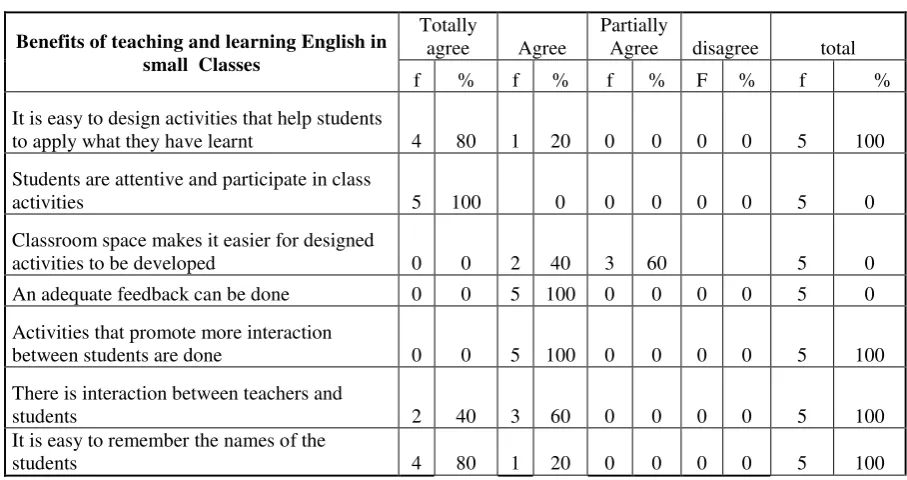
Table 1 shows the teachers’ perceptions of the benefits of teaching English in a small class. Teachers that had been working in the educational field had an average of 6-10 years of
experience. Three of them were around 35 years of age and 2 were in their 50s. Through the
results, I could see that 4 of the teachers which represented 80% of the sample population said
that they totally agreed that it was easy to design activities that help students to practice what
they have learnt, while only one teacher just agreed, thus representing 20%.
On the other hand, students’s perception is positively evident in their answers that is, from 71 surveyed students, 46 pupils which represented 64,78% totally agreed that the
activities carried out by teachers help to practice what students have learnt. While 25 students,
resulting in 35,21 % just agreed.
The results clearly showed that the majority of teachers plan activities which help to
practice what students are learning. It is confirmed by the majority of students who have
mentioned that strict planned activities applied at each moment are essential to help them
remember and practice what they have been learning. From a traditional point of view, a
teacher is a person who educates students and controls the learning process. A teacher can be
a counselor, a facilitator, a guardian, a mentor, a coach and so on. He or she is responsible for
forming and conveying a wide knowledge of all fields to their students. So, the teacher´s role
is to look for different activities which help students strengthen their knowledge.
Pairing down paperwork, planning, independent assignments and seatwork are some
activities that Davis and Pearse (2000. p.122) have suggested for small classes. They think that
by creating a positive classroom environment students can practice what they are learning.
These strategies and activities must be applied in each moment of the teaching and learning
process. So, if we, as teachers, apply and use suitable activities, students will be engaged to
learn real English that they will be able to remember and use in their daily lives. The authors
25
students feedback at any time, this is essential as it encourages students to remember and
practice what they have learnt”.
Even though , games played in groups can be beneficial activities that help students
practice what they have learnt, some students can learn more effectively through the use of
songs and puzzles. All of this depends on the learning style students have; however, the most
important thing is daily practice. Writing useful daily phrases and hanging them on the
classroom wall can be another great idea for practising English.
During the observation class, I noticed that teachers often used gap filling activities and
unscrambling word games to practise vocabulary. Even though these activities were taken as
evaluations by the students, they found them fun. Group cooperation was essential when
taking part in such activities, students needed freedom to stand up and ask questions about the
assigned tasks.
The second item aimed to discover if the students were attentive and participated in
class activities. For this aspect, all the applied teachers, that is 100% and 34 of 71 suveyed
students which represents 47,88% totally agreed with this item. On the other hand, there were
29 pupils which represented 40,84% whose answers agreed to this item and 8 responders
equivelent to 11,26% of the students said they are partially attentive and participate in class
activities.
As the table shows, all surveyed teachers said that students were attentive and
participated in class activities; equally the students’ opinions were similar to teachers’
opinions. Although, not all the students totally agreed with the second item. It means that the
activities used by the teacher are not enough to fulfill students’ perspectives causing distraction and in some cases boredom.
Arriving late to class, sleeping, reading newspapers, listening to music, text-messaging,
26
decorum of the classroom. The obtained results differ from what Folger (1989) said
“classrooms with less than 20 students participate more during discussion and answer
sessions”. Then, teachers must walk around the classroom monitoring the students’ work and helping them when necessary.
Herrera (2011) has mentioned that “teachers know that students cannot learn what they
do not practice”. That means that if students do not pay attention to the instruction given by the teacher, they do not know what they have to do and as a result, feel lost, and confused. So,
teachers need to have all the learners’ attention when giving instruction.
Talking is perhaps one of the most common distractions in a classroom. When a student
talks to another during a lecture, he/she is distracting all the other students around him. When
speaking out of turn, students can miss vital information, assignments and instructions. It can
be a distracting chain-reaction effect. Once a student misses information, he/she may ask
his/her neighbor what he/she is missed, which can cause more talking and confusion.
Definitely, when the students distract one other, they easily lose concentration. The
results of the survey showed that 30 of 71 surveyed students totally agreed that students
concentrate better because there is not much noise in the classroom, however, 30 just agreed
with this item. In both cases the porcentage is of 42.25%. and although 10 students
representing 14,08% partially agreed and 1 student, equal to 1,40% preferred not to answer, it
is necessary to clarify that students’ concentration during an English class is essential because
they are not learning subjects, they are learning a language.
The results showed that more than half of the surveyed students do not show high
concentration levels during class. Students, who easily lose concentration in the classroom, are
often those who have a certain kind of social or economic problem, often students living alone
in a rented room because their parents live far away. Such students are able to go out
27
of the cases they do not complete their homework assignments or eat appropriately. These
factors can cause lack of concentration in the classroom due to the fact that students are
meditating on their break time snack whilst in a math or literature class.
The third item is related to classroom space. Where 2 teachers, representing 40% of
the sample agreed that class space allows to develop adequately assigned activities by the
teacher while 3 responders that represent 60% said that they partially agree with this question.
From a 71 student population sample, 40 students representing 56,33% totally agreed
with this item. Moreover, 26 students, that is a 36,69% of the sample population said they
agreed and only 3 students, meaning 4,22% partially agreed that classroom space helps to
develop activities adequately . Obviously, if the space is big enough and there are 11 or 15
students both teacher and students can perform a variety of activities which help increase their
knowledge.
The physical environment can play a big role in enhancing or impeding students'
learning. Some scientists have mentioned that “the way your classroom furniture is arranged
has an effect on learning” Brown (2001, p.192 ). However, table 1 shows that not all teachers have an adequately designed classroom space. Although, most of the students totally agreed
that it facilitates doing certain activities, others are not completely convinced.
Apparently, there was confusion between the dimension of the room and physical
arrangement terms. Such that, most of the teachers’ answers focused on the dimension of the classroom. They considered that the physical space where they teach was not appropriate for
carrying out certain activities, so it is partially considered a benefit. It is true, some of the
28
Similarly, the classroom should be arranged to promote efficient learning and minimize
behavioral problems where students are able to see and hear instructions and have efficient
access to learning materials. The teacher should be able to easily monitor students and provide
feedback and be flexible enough to allow for different types of learning activities. Physical
space facilitates verbal interaction among peers and enhances cooperative and associative
learning (Loughlin & Martin, 1987; Morrow, 1990; Rivilin & Weinstein, 1984); however, not
all teachers think the same, in the applied survey to English teachers, more than half of them
partially agreed that classroom space helps designed activities to be developed. This is because
there are some really small classrooms; the chairs are very heavy, and as a result they cannot be
moved quickly.
Item number 4 refers to the feedback that teachers give to their students. At this point,
all teachers surveyed, that is 100% of the sample agreed that they give appropriate feedback to
students.
On this matter, students think like teachers. Resulting in 50 students that is 70,42 %
totally agreeing that teachers give students adequate feedback. On the other hand, 18 students,
representing 25,35% agreed, while 3, that is 4,22% said that they partially agreed.
Teachers are aware that feedback is important in the classroom; so they prepare
different materials which support the teaching process. In small classes, teachers have time to
provide detailed feedback when marking assignments and tests, so students get a better sense of
how they are improving and where they need to work harder. Teachers also have more time to
answer questions before, during, and after class as it obviously takes less time to answer a
fewer number of questions from a fewer number of students.
These results confirm what Gebhard (1996) said that feedback can improve a student´s
confidence, self-awareness and enthusiasm for learning. In small classes, students have the
29
“adequate feedback given at any moment encourages students to remember what they are learning, and it ends up being the single most powerful influence on students´ achievement”
Gibbs and Simpson (2004 p.89). Additionally, effective feedback is a great way for teachers to
use collected data in order to improve student learning. Unfortunately, feedback opportunities
are scarce in most classrooms (Bransford, Brown, & Cocking, 1999).
During the class observation, it could be observed that the teacher spent 3 to 4 minutes
giving feedback to students. This feedback was given at the beginning of the class and was
related to the last topic at the end of the last class, thus helping reinforce the knowledge given
during the class period. Feedback helps students overcome any shortcomings experienced
during the teaching and learning process. Despite all teachers agreeing that they provide
adequate feedback, the majority of students totally agreed on this benefit.
The next benefit of teaching English in small classes is the interaction among students.
As it is known, interaction is the essence of communication in humans, especially for those
who are learning another language. So, the results of the applied surveys to teachers from
different high schools showed that all surveyed teachers (5) representing 100% agreed that in
small class activities there is greater interaction among students.
However, the percentage of students who thought that there was a high level of
interaction among them was high. That is, from 71 surveyed students, 32 which means 45,07%
mentioned that they totally agreed that there is interaction among them, while 29 which make
up the 40,84 % of the sample agreed and 8, that is 11,26 % said that they partially agreed.
Even though, one way or another, there is interaction, 2 students, representing 2,81% percent
prefered not to answer the question.
As the results have shown, teachers are not fully convinced that their planned activities
work well with students' interaction. So, they need to look for more strategies in order to fulfill
30
learning which involves structuring classes around small groups that work together in such a
way that each group member's success depends on the group's success, permitting
student-student interaction both inside and outside of the classroom. However, the activities assigned
by the teacher are enough for most of the students who are fully convinced that they interact
among them.
Working in groups, expressing reactions, discussing ideas, acting in dialogues among
others, encourage students to interact. Small classes permit doing these kind of activities.
Then, the results agreed with Diaz-Rico (2012, p. 48) who mentioned "students need
opportunities to talk in natural interactional context".
When students interact they have to use English because it is the language they are
learning. However, due to the influence of the kichwa language in the zone, most of the
students used their native language when doing speaking activities. Others use a mix of
English and Spanish language (Spanglish) when they ask for someone for something. But,
when they use the textbook, they tried to imitate some dialogues or some phrases. Sometimes
they use isolated words to communicate and sometimes use phrases placed on the wall.
Studies done by Guieppe & Hubbal (2008) provide evidence that interactive discussion
may occur easily in small classes, where teachers act as facilitator, director, manager,
compared with large class. However, table one shows that 2 surveyed teachers which represent
40% from the sample population totally agreed that there is greater interaction between
teacher-students
while 3 teachers which represents 60% only agreed with this item.
Table two refers to students’ answers where it is noticed that out of 71 students who answered the questionaire, 49 which represents 69,01% totally agreed that there was total
interaction between students and teachers. Although, 17 students that is 23,94% mentioned
that they agreed with this item, 4 responders which means 5,63% of the sample partially agreed
31
Interaction is a specific part of communication, and in a small class, it is of great
benefit because students find in the teacher a friend who supports their ideas and helps them
express their feelings in a free way, correcting certain mistakes. As the results show, most of
the students totally agreed with item seven. Every day, teachers make countless real-time
decisions and facilitate dozens of interactions between themselves and their students. It implies
maintaining the student´s confidence which will allow them to express their ideas and increase
communication among them. Students’ responses involve what Herrera (2011) considered “a
social interaction”. That is the students’ opportunities to practice a language used in a society
where they will share the multiple language function.
Although all teachers did not totally agree with this item, it was definitely very
important for the students. The teachers’ duty however, is to always create more opportunities
of interaction helping the students when necessary, increasing vocabulary or by using
dialogues. They also have to talk about real life activities, sports, entertainment or other
interesting topics ending in discussions between students. These activities are an essential key
for the personal and social development of the students. Through them, students’
self-confidence increases and they become independent users of English as a second language.
The final benefit of working in small classes is that it is easier for teachers to remember
the names of the students. According to the applied survey 4 out of 5 surveyed teachers,
representing 80% mentioned that they can remember their students’ names easily whilst in smaller groups, whilst only 1 that is 20% of the sample mentioned that they agreed with this
item.
Most of the students’ answers matchedthe teachers’ answers, so from the 71 surveyed
students, 61 of them, which represents 85.91% of the total of the surveyed students totally
32
agreed with this item and 2 students, representing 2,81% partially agreed while 1 students
prefered not to answer.
Evidence demonstrates that reducing class size, particularly for younger students has a
positive effect on students achievement overall and even more of an impact on disadvantaged
children’s education. When I refer to disadvantaged children I mean children who are learning
English as a third language.
Remembering the name of every student easily, is a great advantage for teachers and
students because students can be identified and assisted immediately when having difficulty.
Some years ago, students were called by numbers or by their nicknames, which caused
discomfort in the student. Moreover, if teachers use their names, they will promote a mutual
respect, be more polite and create an adequate class environment where the learning will be
much more meaningful. Teachers and students were aware of this item, so most of their
answers showed that they totally agreed.
The survey, which was applied to students and teachers from different schools in the
city of Archidona, identified the benefits of teaching and learning English in small classes.
Three of the seven benefits had greater impact on the process of teaching English. These
benefits correspond to items 1, 2, and 7 from table 1. Although, items 4, 5, and 6 were also
considered as benefits they did not have a great impact. On the other hand, students preferred
items 1, 4, 5, 7 and 8 which were considered highly beneficial when learning English. As a
result, students benefit most from working in a small class .
Last but not least, students learn faster when classes are smaller because in most of the
cases, students receive personal assistance by the teachers. Furthermore, if they actively
participate in all of the class activities, they will obviously be more motivated and will interact
33
ideas and opinions without fear of scorn and retribution from their peers because small classes
help to create a positive learning environment.
[image:39.595.80.551.207.443.2]What teaching strategies and resources benefit the teaching of English in small classes?
TABLE 3
Teachers’ Perceptions
Author: Fausto Yachimba
Source : Teachers’ Questionaire
TABLE 4
Students’ Perceptions
Author: Fausto Yachimba
Source : Students’ Questionnaire
Strategies and resources that promote the teaching of English in small classes
Totally agree Agree Partially Agree disagree Total
f % f % f % f % f %
Design and apply activities that help to
practice listening skills 2 40 2 40 1 20 0 0 5
100
Design and apply activities that help to
practice speaking skills 2 40 3 60 0 0 0 0 5 100
Design and apply activities that help to
practice reading skills 3 60 1 20 1 20 0 0 5 100
Design and apply activities that help to
practice writing skills 3 60 1 20 1 20 0 0 5 100
Design and apply grouping activities 1 20 3 60 1 20 0 0 5 100
Design and apply individual activities 1 20 3 60 0 0 1 20 5 100
Use of technological resources 1 20 2 40 2 40 5 100
Use of didactic materials 1 20 4 80 0 0 0 0 5 100
Strategies and resources that promote the teaching of English in small classes
Totally
agree Agree
Partially
Agree Disagree
No
answer Total
f % f % f % f % f % F %
Activities that permit practicing
listening skills are done 35 49.3 30 42.25 6 8.451 0 0 0 0 71 100 Activities that permit practicing
speaking skills are done 44 61.97 22 30.99 5 7.042 0 0 0 0 71 100 Activities that permit practicing
reading skills are done 41 57.75 24 33.8 6 8.451 0 0 0 0 71 100 Activities that permit practicing
[image:39.595.85.582.515.731.2]34
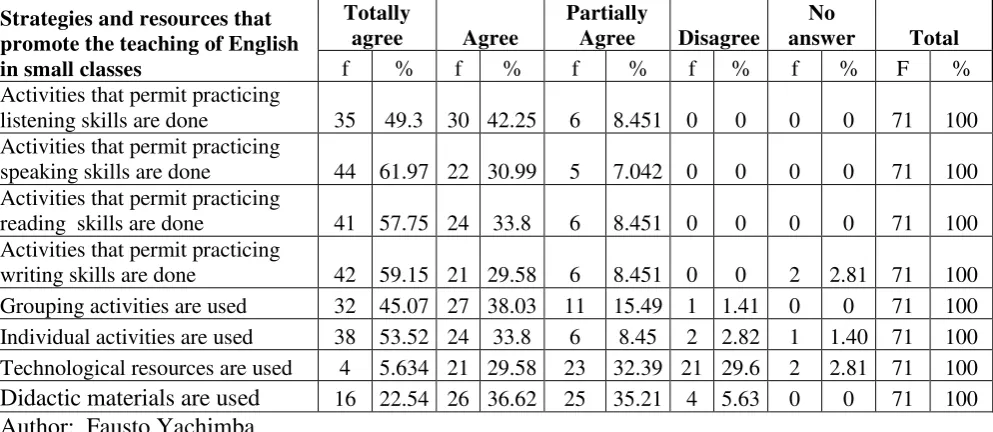
The second block of this survey is related to strategies and resources of teaching
English in a small class. Thus, table 3 clearly shows the results of the first item where from 5
surveyed teachers 2, which represents 40% of the sample totally agreed that teachers design
and apply activities that help practice listening skills, while 2 teachers, representing 40% of the
sample agreed with this item. Finally, 1 teacher which represents 20% of the sample partially
agreed that teachers design and apply activities that help practice listening skills.
Similarly, chart 4 indicates that out of 71 surveyed students, 35 of them, which
represents 49,25% of the sample mentioned that teachers design and apply activities that permit
students to practice listening skills. Similarly, 30 students, representing 42,25% agreed and 6
students that represent 8,45% partially agreed.
The results have shown that most of the teachers´ agreed with items on this question
although there was a teacher who partially agreed. Moreover, most of the students also
considered this item as a benefit.
Listening in particular is an active process by which students receive, construct meaning
form, and respond to spoken, and or, nonverbal messages. This receptive skill forms an integral
part of the communication process and should not be separated from the other language arts.
Furthermore, listening comprehension complements reading comprehension. Verbally
clarifying the spoken message before, during, and after a presentation, enhances listening
comprehension. Students were awared that the activities planned by teachers, helped them to
improve their listening skills. This relates to what Emmert, (1994) said “listening is more than merely hearing words”. This implies that teachers and students consider this item as a benefit.
It is therefore essential that teachers design classroom activities for developing listening
skills. In a particular conversation with students about whether their teacher used different
![behaviours.AlthoughDeMeyeretal.[ ]developedtheControllingTeachingScalefor beenfoundtobepositivelyassociatedwithmaladaptivepsychologicalexperiencesand EvaluatingthePsychometricPropertiesofaScaletoMeasurePerceivedExternalandInternalFacesofControllingTeachin](data:image/gif;base64,R0lGODlhAQABAIAAAP///wAAACH5BAEAAAAALAAAAAABAAEAAAICRAEAOw==)