PERMANYER
ORIGINAL ARTICLE Rev Invest Clin. 2019;71:255-64
Survey on the Perception of Health
Professionals on the Use of Intradialytic
Oral Nutrition in Patients under
Hemodialysis
Samuel Ramos-Acevedo
1§, Ailema J. González-Ortiz
1§, Ricardo Correa-Rotter
1,
Aurora E. Serralde-Zuñiga
2, Paola Miranda-Alatriste
1, Ximena Atilano-Carsi
1,
Etna Dominguez-Zambrano
1and Ángeles Espinosa-Cuevas
1*
1Department of Nephrology and Mineral Metabolism; 2Clinical Nutrition Service, Instituto Nacional de Ciencias
Médicas y Nutrición Salvador Zubirán, Mexico City, Mexico.
§These authors contributed equally to this work.
Received for publication: 19-12-2018 Approved for publication: 28-02-2019 DOI: 10.24875/RIC.19002947
ABSTRACT
Background: Intradialytic oral nutrition (ION) has been shown to improve many clinical outcomes, including lowering mortality,
in hemodialysis (HD) patients. Despite the benefits, ION is underused in many countries. Objective: The objective of our study
was to determine the perception of health-care professionals (HCP) in our environment of the use of ION in patients undergoing HD. Methods: Survey applied to HCP in Mexico who worked or had worked in an HD unit in their locality. Results: From 272 HCP
who answered the survey, 74.3% believed that the use of ION has at least one beneficial effect; of these, the most frequently mentioned were an improvement in quality of life (QoL) (54.7%) followed by an improvement in serum albumin (37.9%) and muscle anabolism (31.6%). However, 49% consider that its use involves some risks. Of the respondents, 22% reported that their HD units allowed patients to consume food or supplements during HD sessions; the main reason given to forbid the introduction of food or supplements was the clinic’s policy (41%). Conclusions: The personnel surveyed heterogeneous opinions regarding
ION, but most believe that it may improve the QoL or the nutritional status of the patients. Nevertheless, the use of ION is uncommon in our country as it is against the internal regulations of most HD units. (REV INVEST CLIN. 2019;71:255-64)
Key words: Intradialytic oral nutrition. Dietary supplement. Health-care professionals. Hemodialysis. Nutrition therapy.
Corresponding author:
*Ángeles Espinosa-Cuevas
Department of Nephrology and Mineral Metabolism Instituto Nacional de Ciencias Médicas
y Nutrición Salvador Zubirán Av. Vasco de Quiroga, 15
Col. Belisario Domínguez Sección XVI, Del. Tlalpan C.P. 14080, Mexico City, Mexico
INTRODUCTION
Protein-energy wasting (PEW) has been identified as a common problem in patients with chronic kid-ney disease (CKD), with a current prevalence of 25-70%1. The diagnosis of PEW has been strongly
associated with an increased risk of morbidity and mortality in patients on hemodialysis (HD) treat-ment2,3. It is well known that PEW starts from early
stages of CKD and one of its main components is a low energy and protein intake of patients4,5. The
components of PEW have a direct effect on caloric and protein intake. The average intake of calories in days of HD sessions is 22 Kcal/Kg BW and, for protein, <0.90 g/Kg BW6,7. The ideal values should
be 30-35 Kcal/Kg and 1.1-1.2 g of protein/kg, re-spectively8,9. The reduced caloric and protein intake
during HD is explained in part by the anorectic pro-cesses that result from the systemic inflammation present in these patients. It has been shown that between 35% and 50% of patients in HD have some degree of anorexia, which reduces their daily energy and protein intake and affects their quality of life (QoL)10. Other possible causes are the diet
restric-tions that are often suggested by the health-care professionals (HCP) that are in contact with pa-tients in HD, as well as the presence of gastrointes-tinal symptoms, the most common of these being indigestion, constipation, diarrhea, abdominal pain, reflux, and disability to eat11,12.
Intradialytic oral nutrition (ION) is a clinical nutrition strategy in which the patient is given oral supple-ments during HD sessions to help them meet their energy and protein needs. The use of ION has shown to increase serum albumin, improve nitrogen bal-ance (from anabolic states), and increase patient survival13-15. Recently, a consensus for promoting
this practice has been published16. Despite the good
results, ION is an uncommon practice due to many theoretical and physiological aspects. Kalantar-Za-deh et al. have exposed some reasons why ION is not a common practice, such as hypotension related to mesenteric blood flow sequestration, risk of bron-chial aspiration, nausea, vomiting or diarrhea, lack of glycemic control, work overload (mainly for nurs-es), development of harmful fauna in the HD unit (insects, rodents, etc.), infections, hygiene, and the costs that such practice represents17.
Few studies have evaluated the use of ION and have occasionally reported adverse events (such as gastro-intestinal symptoms or hypotension)18-21. Strong et
al. conducted a cross-sectional study to assess the frequency of intradialytic adverse events related to the ingestion of beverages and food during HD sions; hypotension occurred in only 19% of the ses-sions recorded18. Despite the evidence of the benefits
provided by ION and the scarce information available regarding its efficiency and safety, HCP remains re-luctant to implement this nutritional therapy. The objective of our study was to determine the percep-tion of HCP in our environment of the use of ION in patients undergoing treatment with HD.
METHODS
Study Population
A cross-sectional study was conducted with a conve-nience sampling involving the application of individual surveys (previously validated by experts) on the per-ception and use of ION in the medical, nursing, and nutrition personnel that worked or have worked with patients on HD. The survey was conducted during two of the most important nephrology meetings in Mexi-co, held during the second semester of 2016. Sample calculations for physicians and dietitians were made by finite populations considering practicing nephrolo-gists certified by the National Council of Nephrology and by the National College of Renal Dietitians in Mexico, resulting in 249 physicians and 60 dietitians. For nurses, there was no registration of practicing personnel, so the sample was calculated by infinite populations, resulting in 96 nurses.
The survey included the following aspects:
1. Demographics: profession of the subject surveyed (physician, nurse, or dietitian); their patients’ age group (adult, pediatric, or both); whether they were unit chiefs or part of the general staff; city in which they worked; and type of institution in which they worked (private, public, or both).
option); and whether the HD unit allowed the in-troduction and consumption of food during HD sessions.
3. Perception of ION: the participants were presented with five definitions of ION, from which they had to choose the one they thought most convenient for their practice. The following questions aimed to know the opinion of the staff about ION, including whether they believed it had benefits or not, if it involved risks, and if so, what the risks were.
4. Reasons why they thought the practice of ION is not usual: the survey included a list of common reasons, some found in the literature and some that are usually given by other respondents of why food or supplements are not allowed during HD sessions. The participants could choose more than one option.
5. Two other questions focused on the place of aca-demic training and the maximum level of studies.
The general characteristics of participants, such as the age group of patients with whom they work, place of the country, and type of institution where they worked, and knowledge of the concept of ION, were analyzed by grouping the participants according to
their profession (physicians, dietitians, and nurses). The states in which the participants reported to have worked were grouped by regions according to the National Survey of Health and Nutrition22: northern
region; central region, capital city, and southern re-gion. The study was conducted according to the guidelines stated in the Declaration of Helsinki.
Statistical analysis
Variables are presented as percentages or absolute or relative frequencies. The Chi-square test or exact method of Chi-square test or Fisher’s exact test was used accordingly to determine statistical differences between the groups. To evaluate the main reasons why no food or oral nutritional supplements were al-lowed during HD sessions, we considered only the answers of those who mentioned that their HD units did not permit it. To account for lost data, we consid-ered relevant central tendency measurements. p < 0.05 was considered statistically significant. Data were analyzed using IBM SPSS Statistics 21.0.0.
RESULTS
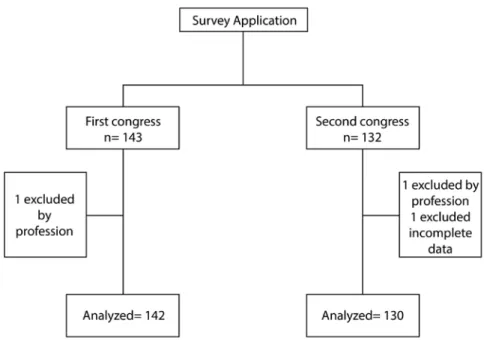
A total of 275 surveys were applied (Fig. 1); of these, three could not be analyzed because they had
incomplete data or were from professionals other than physicians, nurses, or dietitians (e.g., social work-ers and unit managwork-ers), leaving a total of 272 surveys of HCP (137 doctors, 104 nurses, and 31 dietitians). The power sample size for physicians was 0.89; for nurses, it was 0.7823, and for dietitians, the sample
size represented almost 50% of the renal dietitians registered in 2016 in the Mexican College of Renal Dietitians (Colegio Mexicano de Nutriólogos Renales). The majority of the participants worked with adults in the public health sector; most came from Mexico City and received their academic training in the coun-try (Table 1).
Regarding the definition of ION, 70% (n = 191) of participants understood it as the oral administration of nutrients that patients lose during HD sessions (Table 1). Other participants considered that ION re-ferred to parenteral supplementation or the usual diet of the renal patient. Most of the participants men-tioned that they would indicate ION to patients who needed it; with less frequency, they said they would indicate it to all patients. In contrast, 26% of the participants reported that they would not indicate ION to any patient. It should be noted that dietitians did not necessarily have a clearer idea of what ION is, while physicians – although most of them did know the concept – did not apply it in their professional practice.
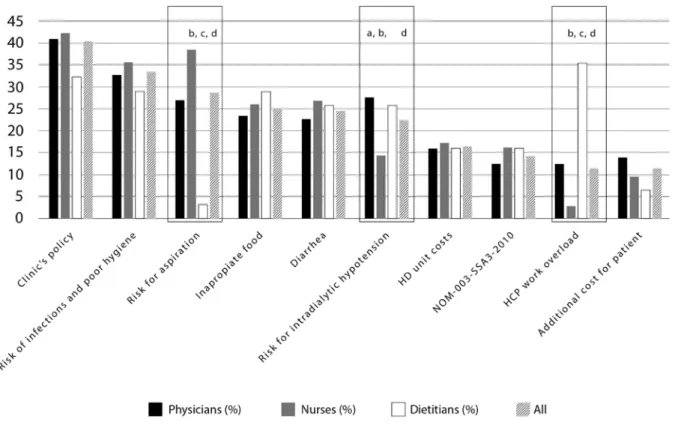
With respect to the routine complications that par-ticipants said to have usually observed during an HD session independently of the use of ION, the most frequently reported were intradialytic hypotension (74%), cramps (70%), hypertension (50.2%), nausea or vomiting (30%), and catheter dysfunction (26%). Other responses were: infections (24%), headache (22.7%), tachycardia (12.5%), chest pain (7%), and somatic pain (3%). Regarding the perception of the benefits and/or risks of ION, 74% of the respondents perceived at least one nutritional benefit and just un-der half (49%) believed that it also posed risks. The main perceived benefit was the improvement in QoL. It should be noted that all professionals have different perceptions of the benefits of ION, except in sleep quality, adherence to hemodialysis sessions, and elec-trolyte balance (p = n.s.) (Fig. 2). The main risk per-ceived by physicians and dietitians was intradialytic hypotension, and by nurses, it was bronchial aspira-tion (Fig. 3).
Regarding the question about whether the consump-tion of food was allowed during HD sessions in the centers where the participants worked, it was found that only 60 (22%) of the centers allowed this prac-tice. The participants mentioned that the main reason why they do not allow food consumption during HD session is the clinic’s policy in the centers where they worked, with no statistical difference between profes-sions (p = 0.606). The second main reason was the increased risk of infections (33.5%), followed by the risk of bronchial aspiration (28.7%); the latter was not commonly mentioned by dietitians (p = 0.001). Another reason mentioned was the work overload that ION can imply (p < 0.01). Other less frequent reasons were: lack of glycemic control (9.6%), lack of electrolyte control (<5%), lack of fluid control (7.7%), personnel workload (11.4%), and the increase in pa-tient expenses (11.4%) (Fig. 4).
DISCUSSION
ION is an anabolic strategy to improve PEW in pa-tients with kidney disease and has shown important benefits such as decreasing catabolism, and there-fore, improving patient’s nutritional status, and sur-vival rates13-16. These effects are explained by adding
an average of 10 kcals/kg and 0.3-0.4 g/kg of pro-tein to the patient’s diet4,24. However, despite this
evidence and that ION is a common practice in Euro-pean and Eastern Asian countries, it is not frequently used in North America25, including Mexico due to
some disadvantages perceived by HCP such as chang-es in blood prchang-essure during the digchang-estion procchang-ess, the risk of bronchial aspiration or infections, and the work overload of the responsible personnel17.
The present study reflects the perception of health personnel regarding the use of ION in our country. This is the second published study describing the ex-perience in the use of ION; the first was carried out by Kistler et al.25 For our research, it was important
Table 1. General characteristics of surveyed health-care professionals
n = 272 Total
n (%) Physiciansn (%) 137 (50.3)
Nurses n (%) 104 (38.2)
Dietitians n (%) 31 (11.4)
p value
Health-care sector
Public sector 158 (58) 67 (49) 79 (76) 12 (39) <0.01d
Private sector 61 (22.5) 24 (17.5) 24 (23) 13 (42) <0.01a
Both 53 (19.5) 46 (33.5) 1 (1) 6 (19) <0.01b
0.017c
Age group of patients attended by HCP
Adults 248 (91) 126 (92) 97 (93.3) 25 (80.6) 0.015d
Children 5 (2) 5 (3.6) – – 0.016a
Both 19 (7) 6 (4.4) 7 (6.7) 6 (19.4) 0.277b
0.027c
Region in Mexico where HCP worked
North 49 (18) 31 (22.6) 14 (13.5) 4 (12.9) 0.034d
Center 79 (25.7) 37 (27) 27 (26) 6 (19.4) 0.007a
Capital City 80 (29.5) 43 (31.4) 25 (24) 12 (38.7) 0.017b
South 71 (26) 24 (17.5) 38 (36.5) 9 (29) 0.652c
Abroad 2 (0.8) 2 (1.5) – –
Academic training of HCP
Country 264 (97) 131 (95.6) 103 (99) 30 (96.8) 0.234
Abroad 8 (3) 6 (4.4) 1 (1) 1 (3.2)
Which patients would you allow to consume food or supplements during the session?
All patients 67 (24.6) 31 (22.6) 23 (22.1) 13 (42) 0.024d
None of the patients 71 (26) 42 (30.7) 28 (26.9) 1 (3) 0.291a
Those who need it 104 (38.2) 50 (36.5) 41 (39.4) 13 (42) 0.895b
Those who could transport
and/or cook it 30 (11.2) 14 (10.2) 12 (11.5) 4 (13) 0.003
c
What do you understand by ION?
Using parenteral route for
nutrition during treatment 21 (8) 7 (5) 7 (6.7) 7 (22.6) 0.033
d
Oral route for feeding during
treatment (correct answer) 191 (70) 103 (75) 66 (63.5) 22 (71) 0.317
a
Renal patient diet 52 (19) 23 (17) 27 (26) 2 (6.4) 0.182b
None of the above 8 (3) 4 (3) 4 (3.8) – 0.016c
Exact method of Chi-square test.
aPhysician versus nurses and dietitians bNurses versus physicians and dietitians cDietitians versus physicians and nurses dGeneral p-values
Figure 2. Perception about the possible benefits for the patient with the use of intradialytic oral nutrition. (a) Physicians versus all (p < 0.05), (b) nurses versus all (p < 0.05), dietitians versus all (p < 0.05), (d) all (p < 0.05).
needs6,7, ION might be a useful strategy to
imple-ment26,27.
In our survey, HCP were asked about the benefits of the use of ION. The most frequently mentioned were improvements in muscle anabolism (31.6%), serum albumin (37.9%), and QoL (54%). These results are not different from those reported by Kistler et al.25,
who also found that clinicians’ opinions regarding the use of ION, among others, was an improvement in QoL. However, our respondents perceived not only benefits but also risks, being the most frequently mentioned intradialytic hypotension by our physi-cians, and bronchial aspiration by our nurses. It has been proposed that variables such as the energy con-tent, volume or characteristics of consumed foods may be related to the incidence and prevalence of intradialytic hypotension16, although variations in the
definition of this complication affect its reported prevalence. As an example, the reported prevalence of intradialytic hypotension under the simplest
definition (a decrease of ≥ 20 mmHg) is 50-70%; when the definition includes a clinical event and nurs-ing interventions, the prevalence decreases by up to 7%19. Strong et al.18 analyzed 23 patients who
brought their food to be consumed during the HD session, and the prevalence of intradialytic hypoten-sion was 19%. The study found that patients who consumed >200 Kcal during the session had a trend towards double the risk (p = 0.058) of presenting hypotension, 3 times more when consuming more than 200 ml of liquids (p = 0.011), and required 5 times more mannitol (p = 0.005) with the consump-tion of liquids. The patients who preferred the intake of solid foods in the form of snacks were less likely to present hypotension18.
Kistler et al.25 mentioned that the most important
concern, for both experienced and inexperienced HCP about oral supplementation during HD sessions, is intradialytic hypotension, although it rarely occurs in people who consume food during the session26-29.
The concern that patients may develop intradialytic hypotension related to the consumption of food or supplements during an HD session is based on a theoretical-physiological notion involving hemody-namic redistribution, given that blood perfusion is concentrated in the digestive system, and a consid-erable volume of it circulates through the HD sys-tem. However, the studies that have evaluated these associations differ in the methods used and therefore, in their findings18-21.
Furthermore, many of the negative effects related to the consumption of food during HD may be re-duced by a careful selection of candidates to ION based on their clinical condition.16 In fact, Benner et
al. found fewer missed treatment days, fewer hos-pitalizations and no association with reduced dialy-sis efficacy in those patients treated with ION29.
Kistler et al.25 found that about 70% of the
Euro-pean HCP participating in their survey provided food to patients during HD sessions (mostly dietitians), and almost all provided the food at no cost to pa-tients. In contrast, in our country, only about 20% of the HCP surveyed had patients’ consuming food during an HD session. Kistler et al.25 mentioned
some reasons that may encourage clinicians to pro-vide food during HD sessions. The two most fre-quently mentioned are: (1) it is an opportunity to provide additional energy (89%) and (2) it can also be an opportunity to teach the patient about a proper diet (47%). Finally, one of the main reasons why ION is not implemented in our HD centers is their clinic’s policy based on the assumption that national regulations restrict it; however, there is no mention of this restriction in the Official Mexican Guidelines NOM-003-SSA3-2010 for the practice of HD nor in the document for the certification of HD units30. On the other hand, policies of
out-sourced HD clinics may be another reason why this practice is not common. It is interesting to note that in our study, although intradialytic hypotension was the most important concern for HCP, it was not the main reason why food is not allowed during HD ses-sions. In the study of Kistler et al.25, intradialytic
hypotension was infrequent according to 24% of the respondents, or even completely absent accord-ing to 34%. Regardaccord-ing the possibility that the
presence of food leads to poor hygiene and the emergence of pests in the HD unit, 67% of the re-spondents said there was no risk of this happening, and 15% said it was very uncommon. With respect to the main reasons why ION was not a common practice in our HCP study, nurses perceived the risk for aspiration as a major problem while dietitians perceived this as a minor problem or maybe un-likely to happen. Intradialytic hypotension was per-ceived by physicians as a major reason why ION is not practiced, whereas nurses did not perceive so. Surprisingly, nurses perceived work overload as a minor reason why ION is not practiced, but dieti-tians perceived this as a major reason.
It is worth mentioning that even though some stud-ies have shown a decrease in patient mortality with the use of ION14,15, this outcome was not
men-tioned by the personnel surveyed in the present work, which suggests that the health personnel do not perceive this nutritional intervention as a clini-cal strategy to improve patient’s survival.
Regarding the type of ION used, it should be noted that studies evaluating the use of both food and oral supplements have not shown one to be better than the other. Nutritional markers other than al-bumin and nitrogen balance have not been studied, including hand grip strength or physical functional-ity31 or bioelectrical impedance. The present study
found that HCP mostly perceives ION as a good opportunity to improve the QoL of HD patients, so it is important to evaluate this outcome. It also seems that the safety of ION is not certain, espe-cially with respect to the risk of intradialytic hypo-tension or infections in HD patients. Nevertheless, the benefits seem to outweigh the risks, at least in theory.
of the use of ION, and the understanding of the possible reasons why this practice is not used in some countries despite the extensive evidence on its benefits reported in the literature.
The health-care personnel working in HD units per-ceived that ION has benefits related mainly to the QoL, but also that there are risks such as intradialytic hy-potension, which have not been well described in literature. Therefore, we conclude that despite the well-defined benefits on nutritional markers such as an increase in serum albumin and the survival rate of the patients, the implementation of this practice in our country is not an easy task. ION is used in only 22% of the HD units found in our country, mainly because it is prohibited by the clinic’s policy for these units.
ACKNOWLEDGMENTS
The authors acknowledge the positive response to the survey from all participants.
REFERENCES
1. Carrero JJ, Thomas F, Nagy K, Arogundade F, Avesani CM, Chan M, et al. Global prevalence of protein-energy wasting in kidney disease: a meta-analysis of contemporary observational studies from the international society of renal nutrition and metabo-lism. J Ren Nutr. 2018;28:380-92.
2. Antón-Pérez G, Santana-Del-Pino Á, Henríquez-Palop F, Monzón T, Sánchez AY, Valga F, et al. Diagnostic usefulness of the pro-tein energy wasting score in prevalent hemodialysis patients. J Ren Nutr. 2018;28:428-34.
3. Fouque D, Kalantar-Zadeh K, Kopple J, Cano N, Chauveau P, Cuppari L, et al. A proposed nomenclature and diagnostic crite-ria for protein-energy wasting in acute and chronic kidney dis-ease. Kidney Int. 2008;73:391-8.
4. Sabatino A, Piotti G, Cosola C, et al. Dietary protein and nutri-tional supplements in convennutri-tional hemodialysis. Semin Dial. 2018;31:583-91.
5. Carrero JJ, Stenvinkel P, Cuppari L, Gandolfini I, Kooman JP, Fi-accadori E, et al. Etiology of the protein-energy wasting syn-drome in chronic kidney disease: a consensus statement from the international society of renal nutrition and metabolism (IS-RNM). J Ren Nutr. 2013;23:77-90.
6. Burrowes JD, Larive B, Cockram DB, Dwyer J, Kusek JW, McLe-roy S, et al. Effects of dietary intake, appetite, and eating hab-its on dialysis and non-dialysis treatment days in hemodialysis patients: cross-sectional results from the HEMO study. J Ren Nutr. 2003;13:191-8.
7. González-Ortíz AJ, Domínguez-Zambrano EL, Correa-Rotter R, Espinosa-Cuevas MA. Patterns of Food Consumption and Eating Habits of Mexican Population on Dialysis and Non-Dialysis Treatment Days in Hemodialysis Patients. Genova, Italy: Poster Presented at XIX Congress of the International Society of Renal Nutrition and Metabolism; 2018.
8. Brown RO, Compher C, American Society for Parenteral and Enteral Nutrition Board of Directors. A.S.P.E.N. clinical guidelines: nutrition support in adult acute and chronic renal failure. JPEN J Parenter Enteral Nutr. 2010;34:366-77.
9. Kalantar-Zadeh K, Cano NJ, Budde K, Chazot C, Kovesdy CP, Mak RH, et al. Diets and enteral supplements for improving outcomes in chronic kidney disease. Nat Rev Nephrol. 2011; 7:369-84.
10. Zabel R, Ash S, Bauer J, King N. Assessment of subjective appetite sensations in hemodialysis patients. Agreement and feasibility between traditional paper and pen and a novel electronic appetite rating system. Appetite. 2009; 52:525-7.
11. Kistler BM, Fitschen PJ, Ikizler TA, Wilund KR. Rethinking the restriction on nutrition during hemodialysis treatment. J Ren Nutr. 2015;25:81-7.
12. Ikizler TA, Cano NJ, Franch H, Fouque D, Himmelfarb J, Kalantar-Zadeh K, et al. Prevention and treatment of protein energy wasting in chronic kidney disease patients: a consensus state-ment by the international society of renal nutrition and me-tabolism. Kidney Int. 2013;84:1096-107.
13. Pupim LB, Majchrzak KM, Flakoll PJ, Ikizler TA. Intradialytic oral nutrition improves protein homeostasis in chronic hemodialysis patients with deranged nutritional status. J Am Soc Nephrol. 2006;17:3149-57.
14. Lacson E Jr., Wang W, Zebrowski B, Wingard R, Hakim RM. Outcomes associated with intradialytic oral nutritional sup-plements in patients undergoing maintenance hemodialysis: a quality improvement report. Am J Kidney Dis. 2012; 60:591-600.
15. Weiner DE, Tighiouart H, Ladik V, Meyer KB, Zager PG, Johnson DS, et al. Oral intradialytic nutritional supplement use and mortality in hemodialysis patients. Am J Kidney Dis. 2014;6 3:276-85.
16. Kistler BM, Benner D, Burrowes JD, Campbell KL, Fouque D, Garibotto G, et al. Eating during hemodialysis treatment: a con-sensus statement from the international society of renal nutri-tion and metabolism. J Ren Nutr. 2018;28:4-12.
17. Kalantar-Zadeh K, Ikizler TA. Let them eat during dialysis: an overlooked opportunity to improve outcomes in maintenance hemodialysis patients. J Ren Nutr 2013;23:157-63.
18. Strong J, Burgett M, Buss ML, Carver M, Kwankin S, Walker D. Effects of calorie and fluid intake on adverse events during he-modialysis. J Ren Nutr. 2001;11:97-100.
19. Benaroia M, Iliescu EA. Oral intake during hemodialysis: is there an association with intradialytic hypotension? Hemodial Int. 2008;12:62-5.
20. Sivalingam M, Banerjee A, Nevett G, Farrington K. Haemody-namic effects of food intake during haemodialysis. Blood Purif. 2008;26:157-62.
21. Borzou SR, Mahdipour F, Oshvandi K, Salavati M, Alimoham-madi N. Effect of mealtime during hemodialysis on patients’ complications. J Caring Sci. 2016;5:277-86.
22. Hernández-Ávila M, Rivera-Dommarco J, Shamah-Levy TL, et al. Encuesta Nacional de Salud y Nutrición de Medio Camino 2016 (ENSANUT). Instituto Nacional de Salud Pública, México: ENSA-NUT; 2016. p. 1-154.
23. Faul F, Erdfelder E, Lang AG, Buchner A. G*Power 3: a flex-ible statistical power analysis program for the social, behav-ioral, and biomedical sciences. Behav Res Methods. 2007;39: 175-91.
24. Fouque D, McKenzie J, de Mutsert R, Azar R, Teta D, Plauth M, et al. Use of a renal-specific oral supplement by haemodialysis patients with low protein intake does not increase the need for phosphate binders and may prevent a decline in nutritional status and quality of life. Nephrol Dial Transplant. 2008; 23:2902-10.
25. Kistler B, Benner D, Burgess M, Stasios M, Kalantar-Zadeh K, Wilund KR, et al. To eat or not to eat-international experiences with eating during hemodialysis treatment. J Ren Nutr. 2014; 24:349-52.
26. Sezer S, Bal Z, Tutal E, Uyar ME, Acar NO. Long-term oral nutri-tion supplementanutri-tion improves outcomes in malnourished pa-tients with chronic kidney disease on hemodialysis. JPEN J Par-enter Enteral Nutr. 2014;38:960-5.
27. Caetano C, Valente A, Silva FJ, Antunes J, Garagarza C. Effect of an intradialytic protein-rich meal intake in nutritional and body composition parameters on hemodialysis patients. Clin Nutr ESPEN. 2017;20:29-33.
dur-ing hemodialysis on intradialytic hypotension in patients un-dergoing maintenance hemodialysis. J Ren Nutr. 2019;29: 102-11.
29. Benner D, Brunelli SM, Brosch B, Wheeler J, Nissenson AR. Ef-fects of oral nutritional supplements on mortality, missed dialy-sis treatments, and nutritional markers in hemodialydialy-sis patients. J Ren Nutr. 2018;28:191-6.