OPENING EDUCATION
Beyond the digital divide
This publication is available to download from the Futurelab website –
www.futurelab.org.uk/openingeducation.
Also from Futurelab:
Literature Reviews and Research Reports
Written byleading academics, these publications provide comprehensive
surveys of research and practice in a range of different fi elds.
Handbooks
Drawing on Futurelab’s in-house R&D programme as well as projects from
around the world, these handbooks offer practical advice and guidance to
support the design anddevelopment of new approaches to education.
Opening Education Series
Focusing on emergent ideas in education and technology, this series of
publications opens up new areas for debate anddiscussion.
We encourage the use and circulation of the text content of these
publications, which are available to download from the Futurelab website –
www.futurelab.org.uk/resources. For fulldetails of our open access policy,
1 Introduction
2 The place of ICT use in 21st century society
3 Recognising the multiple levels of ICT access and use 4 So what is the digital divide… and why does it matter? 5 Recognising the continued importance of the digital divide 6 Towards a charter for change
7 Beyond the digital divide: questions to consider 8 Beyond the digital divide: where next?
References
Contents
l
divide: Rethin
k
ing digita
l
inc
lu
sion for the 21st cent
u
ry
What is the Opening Education series?
Opening Education is Futurelab’s ‘blue skies’ publications series. As its name suggests, this series is intended to open up areas for debate; to provoke, to challenge, to stimulate new visions for education.
The ideas and arguments presented in these publications are generated in a variety of ways – through events, collaborations and consultations with
thinkers, practitioners and policy makers from a variety of sectors, through
thought-experiments andvisioning workshops, and as unexpected ‘side effects’ of the research anddevelopment activity that goes on at Futurelab on a day-to-daybasis. The series complements our evidence-based publications
by offering a space to propose new ideas that may not yet be ready for implementation or rigorous evaluation, and to fl ag up emerging issues of concern that may require action in the education sector.
Why publish this series?
All the research into innovation in a range of sectors suggests that having a superfl uity of ideas is essential for growth anddevelopment – education is no different. We need to have a surplus of potential ideas, visions and plans so that we have a range of strategies to draw on when we face the serious educational challenges that social, economic and technical change presents
us with. Not all ideas willbecome a reality, not all ideas will survive in the form in which they were fi rst presented, but what cannot be denied is that education, and educators, need to know that there is scope to dream; to think
about new approaches anddifferent ways of doing things; to know that the ways we do things now will not be always and forever the same.
It is in this spirit that we publish these papers. They are experimental and
exploratory, both in their arguments and in the forms in which we publish
– theydon’t alllook the same, feel the same, say the same thing. They all,
however, attempt to open up a new area for debate and for action, and we
look forward to hearing from you and working withyou to determine their fate.
Keri Facer
Research Director
Forewor
d
l
divide: Rethin
k
ing digita
l
inc
lu
sion for the 21st cent
u
Given the integral role of digital technology in contemporary society should
we be concerned with enduring inequalities in individuals’ ICT use? Is the so-called ‘digitaldivide’ a 20th century problem set to soon disappear from allbut the margins of society? Do governments have a part to play in ensuring that all members of society are able to access the opportunities affordedby ICT use?
In this paper we argue that the digitaldivide continues to present a serious and signifi cant threat to the establishment of the UK as a successfuldigital
society. There is overwhelming evidence that as ICT becomes woven into the fabric of everydaylife then the divisions in ICT use are strengthening rather than diminishing. At the same time, individuals from all sectors of society
can be considered as being digitallydisadvantaged – not just those who are socially excluded in general.
The time is therefore right for countries such as the UK to be reconsidering their efforts to tackle the digitaldivide. Over ten years on from the popular emergence of the concept, the digitaldivide remains an important issue that
demands renewed attention. With careful thought anddue consideration it shouldbe possible for policy makers, technologists and other concerned
stakeholders to develop a revitalised policy agenda whichbuilds upon but moves beyond previous digitaldivide policy-making.
As a precursor to such work, this paper considers the reasons why the digital divide remains a complex and entrenched social problem. Firstly, there is a diverse and wide range of technologies which can be considered as ICTs – not just computers and the internet. Similarly, there is a diverse and wide range of activities for which ICTs can be used if individuals so choose – from
learning and employment to leisure and entertainment. One of the primary
challenges facing policy makers is to match the affordances of ICTs with the everyday needs, interests anddesires of individuals. In this sense the digital divide continues to demand a complex set of policy responses which go far
beyond simply increasing levels of hardware provision and support, and then assuming the ‘gap’ to have been ‘bridged’.
1
. Intro
du
ction
l
divide: Rethin
k
ing digita
l
inc
lu
sion for the 21st cent
u
From this background the paper argues that a ‘charter for change’ is needed – a list of basic entitlements which we contend that every individual in the 21st centurydigital age can reasonably expect. At the veryleast, then, we argue that government should seek to…
Enable all individuals to make informed and empowered choices about the uses of ICTs whilst ensuring these individuals have ready access to the resources required to enable them to act on these choices.
With this in mind, we also offer a list of assumptions about the digital divide which we feel shouldunderpin future discussion and action. Furthermore, the paper concludes byhighlighting some key areas of contention which will require consideration and clarifi cation before sustained progress can be made – namely:
• Who should take a lead in coordinating anddriving the digitaldivide effort?
• How do we ensure ready access to hardware and software for all
individuals?
• How do we ensure ready access to relevant content and services for all individuals?
• How do we ensure ready access to skills, social and technical support and know-how for all individuals?
• How do we ensure that all individuals can exercise an empowered choice about their ICT (non)use?
Given these wide ranging challenges, this paper is intended to act as a resource for discussion and action across a wide range of different sectors – from the education community to the technology industry, from social
policy makers to community practitioners. Although the digitaldivide is often seen as an individual problem, it undoubtedly requires collective solutions. As such, above all, we hope that the issues and arguments raised in this paper can act as a catalyst for a sustained period of dialogue and development concerning the digitaldivide and the establishment of a more equitable information society.
l
divide: Rethin
k
ing digita
l
inc
lu
sion for the 21st cent
u
We live in a fast-changing ‘runaway world’ where the social, economic, cultural and political foundations of society are being redefi ned on a continualbasis (Giddens 2000). The muchheralded globalisation of society
is now manifested in a variety of ways, such as an apparent acceleration of time, shrinking of space and reconfi guration of social relations along internationallines. Although traditional structures such as the nation-state retain a signifi cant importance in the governance of society, their infl uence is increasinglybeing challengedby other entities such as the transnational
corporation.
Most commentators agree that this recasting of social relations is borne not only of economic, cultural and political changes but also of the changing technological world in which we are living. This is perhaps most clear in the rise of the information society and the attendant knowledge economy, where the production, management and consumption of information and knowledge are seen to now be at the core of economic productivity and
societaldevelopment. Clearly, one of the key accelerators of these new forms of society and economyhas been the rapiddevelopment of new telecommunications and computerised technologies over the past three
decades. The global fl ows of data, services and people which characterise the globalknowledge economyhave been underpinnedby information and
communications technology (ICT). From e-commerce to e-learning, ICTs such as the internet and other global telecommunications systems are major conduits through which contemporary society is acted out.
A defi ning characteristic of ICT has proved to be its ability to bring people and
places together, thus underpinning the ‘time/space compression’ outlined
above (Harvey1989). In his infl uential analysis of the rise of the so-called
‘network society’, Manuel Castells (1996) outlinedhow the dominant functions and processes in contemporary society are now organised increasingly
around networks rather than physicalboundaries - what Castells termed the ‘space of fl ows’ (ie the movement of information or money) rather than the space of places (ie their originallocation). Crucially Castells saw the rising importance of networks in society as brought about by the coincidence of new technologicaldevelopments with the restructuring of capitalism and nation states in the 1980s. Now ICTs can be said to be fi rmly at the heart of the interconnectedlogic of 21st centurylife.
2. T
h
e p
l
ace of ICT
u
se in 2
1
st cent
u
r
y
societ
y
l
divide: Rethin
k
ing digita
l
inc
lu
sion for the 21st cent
u
l
divide: Rethin
k
ing digita
l
inc
lu
sion for the 21st cent
u
An age of equality?
This technology-based reconfi guration has been evident in the transformation of most, if not all, areas of society over the past decade. Employment,
education, health, welfare, politics, leisure and entertainment all now take place in ways and in locations which wouldhave been unimaginable a generation ago, often with technology at their heart. Of course, we should
be wary of seeing these developments as heralding a total transformation of society. Many of these ‘online’ developments replicate rather than replace existing ‘offl ine’ practices and activities (Woolgar 2002). Yet one noticeable shift has been the increasinglydecentred and individualised nature of life in this globalised, networked, knowledge-focused world. Free to live beyond the confi nes of the nation-state, local community or family, the onus is placed on the individual citizen to make their way in the world. For some commentators these changes are whollybenefi cial, ‘freeing’ societies and their citizens from the interference of the nation-state and other regulatorybodies and allowing the (re)distribution of services and wealth along more effi cient and mark
et-driven lines (see Stromquist 2002).
Whilst the globalised nature of contemporary society can prove empowering for some individuals and groups, it also undeniablyhas led to increased
fragmentation, marginalisation anddis-empowerment. The global
opportunities of the 21st century such as low-cost air travel andderegulation of international trade barriers belie the persistence and reinforcement of manydistinctly 20th century inequalities, limited opportunities and social
problems. Whereas some individuals benefi t from their new-found agency, others fare less well from being decoupled from the familiar anchors of the welfare state, nuclear family and so on. We cannot afford to see contemporary
society as offering homogenous benefi ts for all. Individuals, groups, organisations and countries can be as connected or isolated, as advantaged
or disadvantaged in the globalised technology-driven age as before. Crucially
these inequalities are also being reconfi gured along different lines – in particular within as well as between social groups.
l
divide: Rethin
k
ing digita
l
inc
lu
sion for the 21st cent
u
New practices for new times?
Whilst debate rages over whether society in the early 21st century is necessarilybetter or worse than before, we can be certain that we are experiencing a different form of society. In particular the changes outlined
above imply a vast set of expected new practices and ways of operating within a less linear, structured and predictable logic of society. In the world of work, for example, the expectation of a ‘job for life’ has long passed. An individual’s employability is seen to rest on their ability to adapt to different demands and circumstances on a ‘just-in-time’ basis. Employees are expected to be fl exible in their working practices – operating when and where required, as opposed to clocking-in from nine-to-fi ve in the same location. Practices such
as remote teleworking, video-conferencing and fl exi-time are now common features of the workplace.
Similarly, in terms of education, individuals are expected to now learn
different skills andknowledges in different ways as their situation dictates. Regardless of their age or stage of prior education, individuals are expected to cast themselves as lifelong learners, willing and able to engage withlearning as and when appropriate throughout the life-course. This can involve learning through formal educational institutions, remote learning, or learning from others in non-formal and informal settings. Some educational opportunities willbe personalised and tailored to the individual’s needs and requirements, whilst others will take the form of mass instruction. The notion of ‘fi nishing one’s education’ at the age of 16, 18 or 21years is now a thing of the past.
All of these new practices and ‘ways-of-being’ imply a revised set of expected
competencies and abilities which are required if one is to be an ‘effective’ and
successful member of society. In a physical sense, individuals are required
to be more mobile now than ever before (Urry 2000). Alongside the basic skills of numeracy andliteracy, individuals are required to develop different forms of information and technologicalliteracies (Bawden 2001). Successfully
negotiating the ever-changing opportunities and choices on offer requires the
development of a capacity for constant self-evaluation and self-awareness (Beck-Gernsheim 1996). The successful individual is therefore required to be refl ective and refl exive, building upon andlearning from past experiences and
reacting to new opportunities and circumstances.
l
divide: Rethin
k
ing digita
l
inc
lu
sion for the 21st cent
u
Crucially ICT is seen to be an integral element of these new ways-of-being, playing important roles in underpinning an individual’s refl exive judgement and social action. The life of the refl exively modern individual is likely to be
boundup with an array of technological possibilities from mobile ph
one-based communication to the online sharing of information. Through these technologically-facilitated channels, refl exivity is therefore “no longer about
distanciateddecision-making [now] there is no distance at allbetween
knowledge and action” (Lash 2002, p156). Of course many of the competencies seen as essential to contemporarylife – such as communication, refl exivity, team-work, adaptability and so on – are underpinnedbydecidedly non-technological practices and contexts. Nevertheless, the fact remains that ICTs provide an integral context for these actions.
ICT use encompasses a number of integral roles in 21st centurylife. At a
basic level, what one knows, who one interacts with, and what one is able to
do is contingent upon being connected adequately to the information fl ows of contemporary society. For example, computer-mediated communication and mobile telecommunications technologies are at the heart of many social
interactions, however mundane or life-changing. Similarly, the world wide web is a key setting where individuals access and interact with information. ICTs now play an integral role in people’s purchasing of goods and services, their employment and education, their involvement in civic or political affairs as well as consumption of leisure and entertainment services.
Indeed, ICT now lies at the heart of most of the activities which are seen to constitute ‘social inclusion’ - from playing an active role in one’s neighbourhood and community to maintaining one’s personal fi nances. The inclusive role of ICT has recentlybeen reinforcedby the digital migration of most government and public services. Technologies such as the internet,
digital TV and mobile telephony are now important means of accessing and
interacting withlocal government, health and welfare services, the criminal
justice system and other areas of government. In all these instances, ICT
use is implicated increasingly in what it means to be socially, economically, culturally and politically involved in 21st century society.
l
divide: Rethin
k
ing digita
l
inc
lu
sion for the 21st cent
u
l
divide: Rethin
k
ing digita
l
inc
lu
sion for the 21st cent
u
ry
Whilst ICT use is certainly not a pre-requisite to surviving in 21st century
society, therefore, it is almost certainly an integral element of thriving in 21st century society.
3. Recognising t
h
e m
ul
tip
l
e
l
e
v
e
l
s of ICT
access an
d
u
se
Before we continue this discussion further, it is necessary to establish the contours and complexities of ‘ICT access anduse’ – complexities often glossed over by those commentating on the digital age. As our discussion so far has implied, any talk of ‘ICT access anduse’ in contemporary society
refers to much more than access to a desktop PC, having basic keyboard
skills and a familiarity with Offi ce software applications. Crucially, the digital
activities and interactions outlined above can take place via a range of
different types of ICT. The convergence of new media platforms such as digital
television, mobile telephony, games technologies and other portable devices
has led to
a multi-modality of technology access anduse. There are a wider number of ICT devices upon which one may, for example, use the internet. However, it is important to recognise that the technical and social qualities of suchuse can vary considerably across different platforms – for example, the difference
between searching the world wide web on a mobile telephone and on a
desktop PC.
Alongside this variety of ICT hardware we also need to acknowledge the importance of people’s connections into information and
telecommunications networks. ‘Plugging in’ to the digitallandscape is now contingent on a range of types andlevels of connectivity. Whilst the connectivitydebate during the late 1990s and early 2000s centred around
the necessity of ‘broadband’ rather than ‘narrowband’ access to the internet, other spectrums of connectively now exist, including wireless and satell
ite-based connections, all withvarying speeds and quality of data transmission and all suitable for different types of users.
competencies andliteracies above andbeyondbasic ‘technologicalliteracy’ of being able to operate common ICT tools effectively. This muchbroader
view of ‘multi-literacies’ sees individuals requiring the language, number and technical skills which give them access to the evolving digital world, alongside a set of creative and critical skills andunderstanding required to productively engage with technologyuse in their lives (New London Group
1996). As Andy Carvin (2000) has outlined, these competencies include the ability to be ‘information literate’ (the ability to discern the quality of content), ‘adaptivelyliterate’ (the ability to develop new skills whilst using ICTs) and
‘occupationallyliterate’ (the ability to apply these skills in business, education or domestic environments). These competencies are underpinnedbylevels of
basic literacy in reading and writing and the functionalliteracy of being able to put these skills to dailyuse. Crucially, then, the various forms of ‘digital literacies’ required of the individual ICT user both mirror but also go beyond
the traditional 20th centuryliteracies of ‘lettered representation’ (Kress 2003, Lankshear et al 2000, Marsh 2006). As Thoman and Jolls (2005, p4) conclude:
“No longer is it enough to be able to read the printed word; children, youth, and adults, too, need the ability to both critically interpret the powerful images of a multimedia culture and express themselves in multiple media forms.”
4. So w
h
at is t
h
e
d
igita
l
d
i
v
i
d
e… an
d
w
hy
d
oes it matter?
It shouldbe clear from our discussion so far that ICT use is an important element of effective participation in 21st century society. Given the integral
part that ICTs play in nationaldevelopment, organisational growth and
individual welfare, governments cannot afford to under estimate the importance of what was referred to during the 1990s as the ‘digitaldivide’. Now, more than ever before, intervening in the digitaldivide offers a timely
and powerful opportunity for policy makers to force positive social change – creating opportunities for the technologically-based empowerment of individuals and their eventual increased social inclusion andlong-term
security (Norris 2001, Wilhelm 2004). l divide: Rethin
k
ing digita
l
inc
lu
sion for the 21st cent
u
l
divide: Rethin
k
ing digita
l
inc
lu
sion for the 21st cent
u
ry
As the past decade of digitaldivide policy-making has proved, it cannot be assumed that engineering such changes willbe an easy task. As discussed, ‘ICT use’ is a multi-faceted concept which encompasses a variety of activities and practices, via a range of hardware platforms and means of connectivity, requiring a number of different competencies and resulting in a number of outcomes. It follows that the ambition of any efforts to ensure the fair and
equitable use of ICT use within society must reach wellbeyond issues of technological resourcing and availability of content. In this sense there is a need to move beyond a conventionalunderstanding of the ‘digitaldivide’ as a simple case of ‘technologyhaves’ and ‘technologyhave-nots’ andbegin to address the area of digital inclusion in more nuanced terms.
For example, alongside the user/non-user divide a little discussed facet of the digitaldivide debate is the substantial proportion of ‘ordinary’ users of ICTs who nevertheless do not make best use of digital technology. Indeed, the tendency to view the digitally excluded purely in terms of ‘non-users’ of technologyhas prompted an narrow alignment of the digitaldivide with
general concerns over social exclusion anddeprivation. As we shall go on to
discuss, the issues underlying the digitaldivide impinge on the ICT (non)use of individuals from all socialbackgrounds. In this sense the digitaldivide should
not be viewed merely as a sub-set of general patterns of social exclusion. Although many people who couldbe considered to be digitally excluded
would also be considered as being more generally socially excluded, the two categories are not mutually inclusive. In tackling the digitaldivide we must consider the substantialbut ‘hidden’ digital exclusion of individuals who may
wellhave relativelyhighlevels of income and educationalbackground, who nevertheless gain little from their engagement with ICTs.
Moreover, anydisparities in use should not be assumed to be static in nature, as individuals tend to drop in and out of ICT engagement at different stages in the life course as their circumstances change (Anderson 2005). Whilst at a primarylevel the digitaldivide is obviously predicatedupon an individual
either having or not having adequate access to the necessaryhardware, software and network connections, more attention needs to be paid to issues surrounding the dynamics of the use of ICT. As the US commentator Mark
From this perspective, a number of authors have begun to map out multi-dimensionaldefi nitions of the digitaldivide which encompass the multiple levels of ICT use outlined in the previous section. For instance, Lievrouw and Farb (2003) propose four basic elements of digital equity above andbeyond matters of physical access to resources – namely skills, content,
values and context. Similarly, Yu (2006) discusses ‘ICT use’ in terms of skills,
literacies, support and outcomes of activity and practice (such as the
differences in outcomes between ICT-based entertainment as opposed to education). Also of use is Jan van Dijk’s (2005, p21) delineation between the motivations behind making use of ICTs, possession of operational, information and strategic ICT skills, and the nature of usage (eg usage time, the number anddiversity of applications). Crucially, van Dijk sees the success of these stages of engagement with ICTs as contingent on the following aspects of resourcing:
• temporal resources (time to spend on different activities in life)
• material resources above andbeyond ICT equipment and services (eg income and allkinds of property)
• mental resources (knowledge, general social and technical skills above andbeyond specifi c ICT skills)
• social resources (social network positions and relationships – eg in the workplace, home or community)
• cultural resources (cultural assets, such as status and forms of credentials).
Implicit to all these models of ICT use are the surrounding social, cultural
and cognitive contexts of the activity or practice that ICT is being used for, as well as the overall relevance andutility of the activity itself. This combination of technological possibilities, user capabilities andunderstandings, and the wider social context is sometimes described in terms of the ‘affordances’ of ICTs (Norman 1999). In this sense facilitating such affordances of ICTs relies
both on the technology providers (to produce and provide content which is of use to the user) and the individualusers themselves (to perceive content to be useful and feel compelled to make use of it). Aside from issues of user cognition, these individual perceptions andunderstandings of the affordances of ICT use are likely to be organisationally and sociallybased (Cushman and
l
divide: Rethin
k
ing digita
l
inc
lu
sion for the 21st cent
u
l
divide: Rethin
k
ing digita
l
inc
lu
sion for the 21st cent
u
ry
Klecun 2006). If the wider cultural context of use (such as the workplace, school or home) does not fi t well with the culture of the ICT application, then
use will not easily follow. As such ICT use is not just based on the individual being able to ‘understand’ the potentialbenefi ts of ICT use, but how well
ICT-based activity ‘fi ts’ with the wider contexts within which they are operating. To view the digitaldivide as a matter simply of successfully
‘marketing’ the benefi ts of ICT to the individual is to ignore the wider issues which must also be addressed.
In this sense an integral aspect of ICT (non)use is that of individual agency
and choice. Above andbeyondhaving the necessary access to resources,
digital inclusion is therefore predicated on the ability to make an informed
choice when and when not to make use of ICTs. Digital inclusion is not therefore simply a matter of ensuring that all individuals make use of ICTs throughout their day-to-daylives, but a matter of ensuring that all individuals are able to make what couldbe referred to as ‘smart’ use of ICTs, ie using ICTs as and when appropriate. In this sense not making use of ICTs can be a positive outcome for some people in some situations, providing that the individual is exercising an empowered ‘digital choice’ not to do so (see Dutton 2005, Selwyn 2006).
The complexity and socially-rooted nature of these issues has prompted an
understandable reticence amongst sections of the policy community and
IT industry to feel that they are able to engineer any sustained, meaningful
change when it comes to individuals’ ICT use. Some in the policy community
and IT industry are resigned to see inequalities in ICT use as a natural and unavoidable phenomenon, akin to all forms of inequality in a functioning and
‘effective’ market economy. Other more techno-utopian stakeholders continue to store considerable faith in the power of market forces to eventuallylead
l
divide: Rethin
k
ing digita
l
inc
lu
sion for the 21st cent
u
l
divide: Rethin
k
ing digita
l
inc
lu
sion for the 21st cent
u
ry
5. Recognising t
h
e contin
u
e
d
importance
of t
h
e
d
igita
l
d
i
v
i
d
e
We would argue strongly against abandoning the digitaldivide as a viable area for social intervention. There is little researchbasis for being either resigned or complacent when it comes to digital inequalities. Instead, there is considerable evidence that the digitaldivide is neither disappearing through
the machinations of the market or being rendered obsolete by advances in technologicaldevelopment. Nor, as we have argued above, are digital
inequalities rigidly following the entrenchedlines of general inequality and
social injustice. As such we would contend that the digitaldivide continues to be one of the most important social issues of our time. Moreover, it is a social issue which can be addressedby policy makers and other concerned
stakeholders in the information society/knowledge economy – albeit requiring a carefully thought-through approach to any intervention.
As a basis to this discussion it is worthwhile taking some time to consider the patterning of the digitaldivide in more detail. In doing so there is a wealth
of empirical evidence on which we can draw. Ledbyhigh-profi le surveys administeredby the likes of the World Internet Project and Pew Internet & American Life Project, a host of large-scale and well-executed studies have sought to map the digital inequalities in developed anddeveloping countries alike. Building upon a series of seminalUS surveys in the 1990s which fi rst
brought the digitaldivide to political prominence – such as the NTIA’s ‘Falling Through the Net’ reports and the ‘UCLA Internet Report’ - a succession of studies and surveys show specifi c social groups to remain signifi cantlyless
likely than others to engage with new technologies (eg Roe and Broos 2005, Dutton et al 2005, Kaiser Family Foundation 2005, Chinn and Fairlie 2004,
Holloway 2005, Chakraborty and Bosman 2005, Demoussis and
Whilst there is some variation to the magnitude of difference, the social groups most likely to be characterised as being ‘digitally excluded’ in these data are most commonlydelineated in terms of gender, age, income, race, educational background, geography anddisability. The nature of this patterning can be seen in the context of the UK, for example, in the latest data from the Offi ce of National Statistics (2006). These data show that 57% of households in the UK
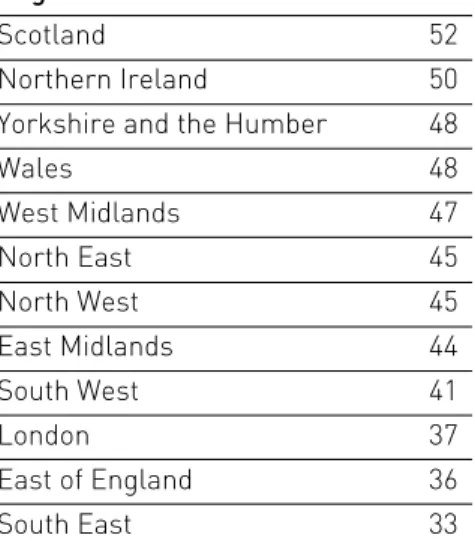
could access the internet, marking a slight but steady rise from previous years [Table 1]. However, these baseline data were noticeablydelineatedby a number of factors. In terms of regionalvariation, for example, over half of households in Scotlandbut only one third of households in the south-east of England were found to lack internet access [Table 2]. Similarly, the 35% of adults who had
never made use of the internet were more likely to be female, from older age groups and/or residing in lower-income households [Table 3], again replicating patterns evident in data from previous years.
Table 1: Households with
internet access UK, 2006 (ONS 2006)
Year % of households
2002 46
2003 50
2004 51
2005 55
2006 57
l
divide: Rethin
k
ing digita
l
inc
lu
sion for the 21st cent
u
ry
Table 2: Households with no internet access by region and type of connection,
UK, 2006 (ONS 2006)
Region % of households
Scotland 52
Northern Ireland 50
Yorkshire and the Humber 48
Wales 48
West Midlands 47
North East 45
North West 45
East Midlands 44
South West 41
London 37
East of England 36
l
divide: Rethin
k
ing digita
l
inc
lu
sion for the 21st cent
u
ry
Table 3: Percentage of adult population (age 16 years or over) that has
has never made use of the internet (ONS 2006)
The signifi cance of these factors is confi rmed – to a greater or lesser extent – by a burgeoning body of academic literature conductedby scholars around
the world. The breadth of this digitaldivide literature was recently illustrated
in a comprehensive systematic review of 192 English-language research
reports by Liangzhi Yu (2006). This analysis confi rmed the following factors as emerging from the recent literature as associated with the non-use of ICTs within countries:
Income/socio-economic status Lower levels of income are consistently shown to be associated withdigital divides concerning access to anduse of a range of ICTs.
Education Lower levels of education are also shown to be associated withdigitaldivides
concerning access to anduse of a range
of ICTs.
Income
Up to £10,400 51
£10,401 – £14,559 38
£14,560 – £20,799 25
£20,800 - £36,399 12
£36,400 + 6
Gender
Men 30
Women 40
Age-groups
16–24 years 10
25–44 years 17
45–54 years 26
55–64 years 43
l
divide: Rethin
k
ing digita
l
inc
lu
sion for the 21st cent
u
ry
Family structure Family composition, adult caring responsibilities (ie for an older parent)
tend to be associated withless contact
with ICT. Conversely, the presence
of school-age children within the
household tend to increase contact
with ICT.
Age Increased age is associated withdecreased
levels of access, limited modes of use and patterns of connecting. Age differences
are especially pronounced in those
individuals aged 60 years and over.
Race Some US studies report lower levels of access anduse amongst African-
American and Latino populations.
However, many studies report that then racialdifferences in ICT use
disappear when issues of income and education are taken into consideration.
Gender Whilst gender differences were associated
withdigitaldivides during the 1990s, more
recent academic research seems to
indicate declining gender differences in ICT access andbasic levels of engagement.
Geography/rural-urban location Levels of ICT use generallyless in rural
and inner-city areas, although often
differences are not evident once other
socio-economic variables are taken
into account.
Culture/social participation Communities and individuals withhigher
levels of social contacts tend to make
more use of ICTs.
l
divide: Rethin
k
ing digita
l
inc
lu
sion for the 21st cent
u
ry
The identifi cation of these trends is useful, although it shouldbe noted that most of the researchliterature to date has been primarily concerned with
ICT access and generallevels of ‘use’, and therefore lacks the multi-layered
realities of ICT use which we have outlined above. As such we shouldbe wary of the diminishing importance of certain variables in terms of these ‘headline’ statistics (eg the apparent disappearance of the gendereddigital divide). In fact, beyond these basic levels of access andbeing a ‘user’ or
‘non-user’, other studies of ICT use suggest that all of these variables continue to infl uence the nature, quality and outcomes of an individual’s ICT engagement.
Taking the example of differences between men and women’s use of the internet, a robust body of qualitative research suggests that despite the apparentlydiminishing divide between the sexes in terms of the quantity of access andbasic internet use, gender remains an important factor in terms of the quality and nature of an individual’s engagement (see Liff and Shepard
2004, van Dijk 2006). For instance recent studies of (non)use of the internet in everyday settings such as the home, workplace, and classroom highlight a
host of deep-rooted ways in which gender continues to fundamentally mediate engagement with new technologies, regardless of an individual’s age or technologicalbackground (eg Cranmer 2006, Lally 2003).
Concerns continue to be raisedby social scientists over the gendered nature of a host of technologicaluses, including the playing of computer games (Melissa and Newcombe 2005), the use of mobile telephony (Lemish and
Cohen 2005), and computer-mediated shopping (Dittmar et al 2004). These studies have shown, for example, how women’s engagement with ICTs is often compromisedby their roles as partner, sister, daughter, student, or employee. These compromises are experienced in terms of when and where women get to use technologies, as well as who gets to use technology and
with what outcomes. As with all areas of contemporary society, it seems that ICT use continues to be a highly gendered area of life, even if this is now not always immediately obvious from the basic access andusage data. Crucially, these issues have been found to impact on the ICT use of women from all socio-economic and educationalbackgrounds. These more subtle continuations of inequality are not unique to gender; the same conclusions can be drawn for the continued infl uence on ICT use of all the major variables within Yu’s typology, alongside other variables such as physicaldisability and
l
divide: Rethin
k
ing digita
l
inc
lu
sion for the 21st cent
u
ry
The bearing of these inequalities between different social groups on the outcomes of ICT use continues to be signifi cant. If individuals from
underserved social groups such as older adults, the unemployed and/or carers are experiencing quantitatively and qualitativelydiminished forms of ICT use then there is a danger that they will further fallbehind those individuals who, in contrast, couldbe said to be ‘super served’ by ICTs. From this empiricalbackground, we can therefore conclude that ICT use continues to be a source of signifi cant social inequality in enduring ways. As such it is clear that the digitaldivide is a multi-faceted social problem, requiring a multi-faceted intervention. As Yu (2006, p235) concludes:
l
divide: Rethin
k
ing digita
l
inc
lu
sion for the 21st cent
u
l
divide: Rethin
k
ing digita
l
inc
lu
sion for the 21st cent
u
ry
On the basis of this evidence, we would argue that there is a pressing imperative to develop a wide-ranging and ambitious agenda which sets out to address the multiple layers of the digitaldivide. It shouldbe clear from our discussion so far that the digitaldivide is not set to simplydiminish or
disappear of its own accord. Instead it continues to demand a complex set of policy responses which go far beyond simply increasing levels of hardware provision and then assuming the ‘gap’ to have been ‘bridged’. We would
contend that the time is right for a country such as the UK to develop a renewed and revised portfolio of interventions and initiatives whichbuilds
upon but moves beyond the past decade of digitaldivide policy-making. In short there is a need for policy makers, technologists and other stakeholders in the UK as a digital society to work together on how best to achieve the following aim:
Enabling all individuals to make informed and empowered choices about the uses of ICTs whilst ensuring these individuals have ready access to the resources required to enable them to act on these choices.
To date, much government activity in the area of the digitaldivide has centred
on the latter half of this aim: ie “ensuring that individuals have ready access to the resources required to use ICTs”. In particular, UK government activity has focused on widening access to ICT resources, skills and support for the sociallydisadvantaged, as well as the provision of public services through
ICT to all citizens. These objectives have been pursued through a series of
high-profi le initiatives over the past ten years prompted initiallyby the Social
Exclusion Unit’s PAT15 report (SEU 2000). These initiatives have included
ICT for All, UK Online, NGfL and associated Community Grids for Learning, the People’s Network, learndirect, and others. Specifi c digitaldivide pilot initiatives such as Wired-Up Communities and Computers Within Reach were also implementedduring the fi rst years of the 2000s. Latterly, a new wave of initiatives such as the Digital Challenge community funding programme, the PCs for Pupils initiative and the UK Online Social Impact Demonstrator projects have been introduced in response to the government’s recent ‘Action Plan on Social Exclusion’ (Cabinet Offi ce 2006) and ‘Inclusion Through
Innovation’ report (SEU 2005).
l
divide: Rethin
k
ing digita
l
inc
lu
sion for the 21st cent
u
ry
Yet with the demise of the over-arching Offi ce of the e-Envoy there are signs that the momentum from this policy work of the last ten years is declining. In particular there is clearly scope to extend the focus of current digitaldivide initiatives to encompass all sectors of society, not just those considered to
be generally sociallydisadvantaged. Moreover, there is a need for the policy
community to begin to give serious consideration to the fi rst half of our stated
aim – ie “enabling all individuals to make informed and empowered choices about the uses of ICTs”. In a refl exive, globalised society where individuals are expected to take responsibility for their own actions, this is arguably the most important aspect of the digitaldivide. The key question to consider is whether government, public sector organisations and other concerned stakeholders
have the capacity to support and strengthen individuals’ capacity to make these choices when it comes to ICT.
With this in mind we conclude this paper with a ‘charter for change’ – outlining a list of basic entitlements which we would suggest that every
individual in the 21st centurydigital age can reasonably expect. We also offer a list of corresponding assumptions about the digitaldivide which should
Beyond the digital divide: a charter for change
We propose a set of four entitlements which we suggest that every individual
in the current digital age can reasonably expect:
• Entitlement one: all individuals are able to exercise an empowered and
informed choice about their use or non-use of ICT.
• Entitlement two: all individuals have ready access to the requisite social
and technical support, skills andknow-how to support their use of ICT. • Entitlement three: all individuals have ready access to ICT-based content
and services which are relevant anduseful to their needs and interests. • Entitlement four: all individuals have ready access to a full range of ICT
hardware and software.
Underpinning these entitlements, we also propose a set of six challenges to our basic assumptions about the digitaldivide which should inform future
discussion and action:
• Challenge one: to start from premise that individuals from all sectors of society can be digitally excluded – not just those who are considered
sociallydisadvantaged in general, or just those who make no use of ICT. • Challenge two: to remember that there is a diverse and wide range of
technologies which can be considered as ICTs – not just computers and
the internet.
• Challenge three: to draw upon the diverse and wide range of activities for which ICTs can be used.
• Challenge four: to strive to extend the range of ICT-mediated activities through the involvement of all social groups in the production of digital
content and services.
• Challenge fi ve: to fi nd ways to make the full range of ICT-based
activities visible andviable to all individuals – regardless of their current engagement with ICT.
• Challenge six: to seek to match the affordances of ICTs with the everyday
needs, interests anddesires of individuals. l divide: Rethin
k
ing digita
l
inc
lu
sion for the 21st cent
u
l
divide: Rethin
k
ing digita
l
inc
lu
sion for the 21st cent
u
ry
Who should take a lead?
With the demise of the Offi ce of the e-Envoy there is a sense that the issue of the digitaldivide is lacking a central advocate and coordinating presence within UK government. At present the digitaldivide is the explicit concern of the DCLG’s Digital Inclusion Team, whose remit is to explore the application of ICT to alleviate the basic needs of the sociallydisadvantaged. Whilst this group is undertaking valuable work, there appears to now be less ‘joined-up’ concern within government over the wider issues underlying the digitaldivide, an approach which may, for example, lead to those individuals who would not
be necessarily classed as disadvantaged in other aspects of their life being overlooked. This maybe particularly signifi cant when it comes to considering gendered or geographicaldifferences in access anduse.
This lack of general profi le within government contrasts with the number of public and private sector organisations working in the area of digital inclusion – from charitable organisations such as Citizensonline, the Alliance for Digital
Inclusion, the e-Learning Foundation and Intellect to private sector interests such as DSG International, BT, Microsoft, Cisco and AOL. Aspects of the
digitaldivide such as e-democracyhave also formed prominent areas of work
for organisations such as the BBC, Hansard Foundation, ippr and Demos, as well as the devolved administrations in Scotland, Wales and Northern Ireland.
The continuation of this de-centralised model of digitaldivide intervention may wellbe desirable. The question should nevertheless be raised as to whether responsibility needs to given to a dedicated sector of central
government. Is there a need for a distinct Department for the Digital Divide (along the lines of the Offi ce of the e-Envoy) or else a direct remit being given to an existing department (as was previously the case with the DfES, DCMS or DTI)? Conversely, should central government pull further back from leading in this area? What roles can be playedby the likes of OfCOM and Becta?
l
divide: Rethin
k
ing digita
l
inc
lu
sion for the 21st cent
u
ry
Another issue which merits consideration is the increased involvement of individual citizens in the digitaldivide debate. William Davies, in the ippr’s ‘Manifesto for a Digital Britain’, argued for the establishment of a high -profi le, democratiseddebate over the capabilities of ICTs and the purposes of
digitisation. Increased involvement of the ‘citizen voice’ within the digitaldivide
debate could shape outcomes in ways which are both meaningful and relevant to the public and therefore stand more chance of success (Davies 2005). Is this politicising (with a small ‘p’) of the digitaldivide debate a desirable
direction to pursue? If so, how may such a debate be stimulated, maintained
and actedupon? These questions of the politics of the digitaldivide are all
issues which shouldbe addressed as a matter of urgency.
How do we ensure ready access to hardware and software?
As we have established, ensuring that individuals have adequate access to hardware and software is a pre-requisite to tackling the digitaldivide. To date government strategyhas largely focused on the provision of communal internet access points in public locations such as schools,
libraries, museums and other community settings. Such a ‘community
technology centre’ approachhas achievedvaried success in widening meaningful access to those individuals and social groups otherwise lacking internet and computer access in domestic or workplace settings (see Smith
and Cook 2002, Hall Aitken Associates 2002, Selwyn et al 2005). But are other options available, especially considering that ICT resources now span beyond desktop computers and fi xed internet connectivity? For instance, can and
should government provide access to personalised and mobile technologies or digital interactive television in similar ways?
There are a number of alternative options to the community technology centre approach which could also be considered. For instance, there couldbe a place for government intervention in areas of ICT provision where there has
l
divide: Rethin
k
ing digita
l
inc
lu
sion for the 21st cent
u
ry
populations. This area of recycling looks set to increase in signifi cance in
light of the UK implementation of the EC Waste Electrical and Electronic Equipment (WEEE) directive which provides an incentive to producers of
hardware to re-use rather than recycle (DTI 2006). With this mind, is there scope to buildupon the spirit of the Computers Within Reach and Wired-Up Communities programmes whilst being mindful of the logistical and
administrative problems experiencedduring these pilot initiatives (Halcyon Consultants 2003)? This legislation may also encourage the dismantling and
redesign of old equipment into new sorts of hardware – how might this be encouraged in ways which offer creative solutions to diffi cultures of access for different communities? In the area of software, what role might be playedby further exploring and mainstreaming Open Source approaches to
development (Futurelab 2005)? Whilst it remains only one aspect of the digital divide, ensuring adequate quantity and quality of access for all remains an important issue to address.
How do we ensure ready access to relevant content and services? Digital inclusion is also predicatedupon ensuring that individuals have adequate access to meaningful and relevant content and services. To date government strategyhas largely focused on the provision of public sector services and information. The Cabinet Offi ce’s e-Government Strategy
(Cabinet Offi ce 2005) and the DTI’s Digital Strategy (DTI 2005) have been implemented with some success, not least in the establishment of the Directgov portal. A Cabinet committee has recentlybeen established to address barriers to effective data sharing between government and citizens. Encouraging citizen interaction with government has also been pursued
through a number of recent non-government initiatives, such as the Hansard
Society’s e-democracy programme and their Digital Dialogues initiative, as well as the funding of ‘bottom-up’ civic information websites by the likes of mySociety, and the high-profi le direct e-petitioning of government.
Should these initiatives be extended? How can we best ensure that the production anddistribution of government information and services is
underpinnedby social justice principles and promotes genuinely open access to information andknowledge? A key area for debate here is the relative
l
divide: Rethin
k
ing digita
l
inc
lu
sion for the 21st cent
u
ry
‘bottom-up’ creation of content. Should the offi cial production of information and services move beyond its primary foci of education, employability and
interaction with government services? Is there a role for the offi cial provision and support of ICT uses which are based around more creative or frivolous
uses of technology? In terms of internet-based information, are individual users best servedby ‘supersites’ such as the BBC, MSN or directgov or the
use of community generatedlocal content? Should ‘top-down’ offi cial content
be reshaped for different social groups? For example, shoulddigital content emanating from the middle-class mainstream societybe repackaged for other sectors of society, such as the elderly or ethnic minority groups (see
Hargittai 2003)? Are there opportunities to extend the approach of the DfES Cybrarian Project, such as the myguide facility whichhas been developed to support the consumption of online information byunderserved populations? What role is there for community online networks and other forms of bespoke content production by individuals (Borgida et al 2002)?
How do we ensure ready access to skills, social and technical support and know-how?
A further important element of digital inclusion is ensuring that the social
context of ICT use allows individuals to be informed about their choices, and
provides trustworthy support when using ICTs. At present, most government effort in this area has been directed at the formal provision of ICT skills and support, most notably in the provision of ICTs skills training via the
learndirect andUK Online initiatives, and the training of staff in community
technology centres to support users. Yet are there ways to make more extensive and imaginative use of these ICT skills training programmes? One possibility wouldbe the cascading of skills andknow-how back into skill
s-deprived communities, therebyusing ICT training to build the social capital of communities. Efforts couldbe made, for example, to encourage and support those individuals who have received ICT skills development as part of their formal education and training to return to their communities and support other individuals in their informal social networks in their ICT use (as evinced
l
divide: Rethin
k
ing digita
l
inc
lu
sion for the 21st cent
u
ry
Furthermore, it is observed that people often prefer what they see as ‘disinterested’ sources of advice rather than ‘interested’ ones, ie those that can offer ‘impartial advice’ (Introna and Nissenbaum 2000). Aside from the formal provision of skills and support is there scope for supporting the informal networks which individuals draw upon for advice and support, especially family and work networks? Could ICT suppliers such as PC World, Currys, Digital and other ICT professionals be supported in playing more sustained supportive roles for individualusers which are not commercially
-driven? Can lessons be learnt from the DTI’s Digital Switchover Help Scheme for the elderly anddisabled? Are there ways in which the informal and
sometimes non-legal neighbourhood contacts used to supply software and
advice to individuals can be built upon – therefore tapping into the so-called
‘greyware culture’ (Sundaram 2004) whichunderpins muchdomestic ICT use?
How do we ensure individuals can exercise an empowered choice?
Underlying all these issues is the most challenging but perhaps most important area for consideration. Amidst all these suggestions for
intervention it shouldbe recognised that public-sector support for individuals’ ICT use can only go so far. In light of our opening discussion concerning the individualised nature of contemporary society, any government intervention in the digitaldivide must start from the assumption that the successful individual
is refl ective and refl exive, building upon andlearning from past experiences and reacting to new opportunities and circumstances. In this sense individuals must ultimately take responsibility for their ICT engagement, acting in a refl exive manner towards ICT use. Yet how can individuals be as empowered, informed and effective as possible in making these choices and engaging with
ICT?
prescribed means to prescribed ends, and more a set of tools and practices which the majority of individuals feel that theyhave some control over and part in shaping (see also Schofi eld Clark et al 2004, Mansell 2002). Nevertheless, there is an obvious need for the development of some tangible actions and
interventions in this area above all others.
8. Be
y
on
d
t
h
e
d
igita
l
d
i
v
i
d
e: w
h
ere next?
Whilst it is trite to talk of ‘digitaldivide 2.0’, in many ways this paper is arguing for a wholesale re-imagining of the digitaldivide as a social rather than ‘simply’ a technical or economic issue. We want to foreground the importance of skills, informed choice, content and community in creating new contours to ‘the’
digitaldivide in the earlyyears of the 21st century.
As such, this paper is intended to act both as a reminder of a longstanding problem - sometimes forgotten as we enter the brave new world of Web 2.0, 4G phones and immersive gaming - and a call for collaborative action. Just as the digitaldivide is social as well as technical, so too will its solutions require collaboration across technical and social research, between education and
social policy, between industry, community and public sector.
As is often the case with such papers, we have raised far more questions than answers andhighlighted many problems whilst offering few potential
solutions. We hope that the charter we have presented might act as a focus for the establishment of a more equitable information society, andlook forward to
discussing, refi ning and meeting the entitlements and challenges outlined in the charter with people and organisations from all sides of this debate.
l
divide: Rethin
k
ing digita
l
inc
lu
sion for the 21st cent
u
Anderson, B (2005). The value of mixed-methodlongitudinal panel studies in ICT research: transitions in and out of ‘ICT poverty’ as a case in point. Information Communication & Society 8, 3, pp343-367
Bacon, S and Dillon, T (2005) The potential of Open Source approaches for education, Bristol: Futurelab
Bawden, D (2001). Information anddigitalliteracies: a review of concepts. Journal of Documentation, 57, 2, pp218-259
Beck-Gernsheim, E (1996). Life as a planning project. In Lash, S, Szerszynski, B and Wynne, B (eds) Risk, Environment and Modernity. London: Sage
Borgida, E, Sullivan, J, Oxendine, A, Jackson, M, Riedel, E and Gangl, A (2002). Civic culture meets the digitaldivide: the role of community electronic networks. Journal of Social Issues 58, 1, pp125-142
Brown, M (2005). The great internet boom has stalled. The Guardian Media Supplement, 25 April, p13
Cabinet Offi ce (2005). Transformational Government – Implementation Plan. London: Stationery Offi ce
Cabinet Offi ce (2006). Reaching Out: An Action Plan on Social Exclusion. London: Cabinet Offi ce
Carvin, A (2000). More than just access. Educause, November/December, pp38-47
Castells, M (1996). The Information Age: Economy, Society and Culture. Volume I - The Rise of the Network Society. Oxford: Blackwell
Chakraborty, J and Bosman, M (2005). Measuring the digitaldivide in the united states: race, income, and personal computer ownership. The Professional Geographer, 57, 3, pp395-410
Chinn, D and Fairlie, R (2004). The determinants of the globaldigitaldivide: a cross-country
analysis of computer and internet penetration. eScholarship Repository, University of California (repositories.cdlib.org/ucscecon/562, last accessed 23 February 2007)
Compaine, B (2001). The Digital Divide: Facing a Crisis or Creating a Myth? Cambridge MA: MIT Press
Cotten, S and Jelenewicz, S (2006). A disappearing digitaldivide among college students? Peeling away the layers of the digitaldivide. Social Science Computer Review 24, 4, pp497-506
References
l
divide: Rethin
k
ing digita
l
inc
lu
sion for the 21st cent
u
l
divide: Rethin
k
ing digita
l
inc
lu
sion for the 21st cent
u
ry
Cranmer, S (2006). How Families Use the Internet in the Home. Unpublished PhD thesis,
University of London Institute of Education
Cushman, M and Klecun, E (2006). I’ve never tried it because I don’t like it: enabling technology choices. Paper presented to Information, Communication and Society
conference, York, September
Davies, W (2005). Modernising With Purpose: A Manifesto for a Digital Britain. London: Institute for Public Policy Research (ippr)
Demoussis, M and Giannakopoulos, N (2006). Facets of the digitaldivide in Europe:
determination and extent of internet use. Economics of Innovation and New Technology, 15, 3, pp235-246
Department for Trade and Industry (2005). Connecting the UK: the Digital Strategy. London: Cabinet Offi ce – Prime Minister’s StrategyUnit
Department for Trade and Industry (2006). Environmental Protection: The Waste Electrical
and Electronic Equipment Regulations 2006. Statutory Instruments 2006 No 3289 (www.dti. gov.uk/fi les/fi le35992.pdf)
Dittmar H, Long K and Meek, R (2004). Buying on the internet: gender differences in on-line and conventionalbuying motivations. Sex Roles, 50, 423-444
Dutton, W (2005). The socialdynamics of the internet. Paper presented to the International Knowledge and Society Conference, University of California, Berkeley, February
(www.oii.ac.uk)
Dutton, W, di Gennaro, C and Millwood Hargrave, A (2005). Oxford Internet Survey 2005 report: The Internet in Britain. Oxford, Oxford Internet Institute
Giddens, A (2000). Runaway World: How Globalisation is Shaping our Lives. London: Routledge
Halcyon Consultants (2003). Wired-up Communities Programme: Final Report to the Department for Education and Skills. York: Halcyon Consultants
HallAitken Associates (2002). Evaluation of CMF-fundedUK Online centres. DfES research
report RR368
l
divide: Rethin
k
ing digita
l
inc
lu
sion for the 21st cent
u
ry
Hargittai, E (2002). Second-leveldigitaldivide: difference’s in people’s online skills. First Monday, 7, 4 (fi rstmonday.org/issues/issue7_4/hargittai/index.html)
Harvey, D (1989). The Condition of Post Modernity: An Enquiry Into the Origins of Cultural
Change. Oxford: Blackwell
Holloway, D (2005). The digitaldivide in Sydney: a socio-spatial analysis. Information, Communication & Society, 8, 2, pp168-193
Introna, L and Nissenbaum, H (2000). The public goodvision of the internet and the politics of search engines. In Rogers, R (ed) Preferred Placement: Knowledge Politics on the Web. Maastricht: Jan van Eyck Akademie
James, J (2001). Low-cost computing and related ways of overcoming the globaldigital divide. Journal of Information Science 27, 6, pp385-393
Kaiser Family Foundation (2005). Generation M: Media in the Lives of 8-18 Year-olds. Menlo Park CA: Kaiser Family Foundation
Kress, G (2003). Literacy in the New Media Age. London: Routledge
Lally, E (2003). At Home With Computers. Oxford: Berg
Lankshear, C, Snyder, I and Green, B (2000). Teachers and Techno-literacy – Managing Literacy, Technology and Learning. London: Allen & Unwin
Lash, S (2002). Critique of Information. London: Sage
Lemish, D and Cohen, A (2005). On the gendered nature of mobile phone culture in Israel. Sex Roles, 52, pp511-521
Lievrouw, L and Farb, S (2003). Information and equity. In Cronin, B (ed) Annual Review of Information Science and Technology, Vol 37. New York: Wiley
Liff, S and Shepherd, A (2004). An Evolving Gender Digital Divide? OII Internet Brief No 2, Oxford Internet Institute
Mansell, R (2002). From digitaldivides to digital entitlements in knowledge societies. Current Sociology, 50, 3, pp407-426
l
divide: Rethin
k
ing digita
l
inc
lu
sion for the 21st cent
u
ry
Melissa, T and Newcombe, N (2005). How important is the digitaldivide? The relation of computer andvideogame usage to gender differences in mental rotation ability. Sex Roles, 53, pp433-441
New London Group (1996). A pedagogy of multiliteracies: designing social futures. Harvard
Educational Review, 66, 1, pp60-92
Norman, D (1999). Affordances, conventions anddesign. Interactions 6, 3, pp38-43
Norris, P (2001). Digital Divide: Civic Engagement, Information Poverty, and the Internet Worldwide. Cambridge: Cambridge University Press
NTIA (National Telecommunication and Information Administration) (1995). Falling Through the Net: A Survey of the ‘Have Nots’ in Rural andUrban America (www.ntia.doc. gov/ntiahome/digitaldivide)
NTIA (National Telecommunication and Information Administration) (1999). Falling Through
the Net: Defi ning the Digital Divide (www.ntia.doc.gov/ntiahome/digitaldivide)
NTIA (National Telecommunication and Information Administration) (2000). Falling Through
the Net: Toward Digital Inclusion (www.ntia.doc.gov/ntiahome/digitaldivide)
ONS (2006). Internet Access 2006 First Release. Newport: Offi ce for National Statistics
Peter, J and Valkenburga, P (2006). Adolescents’ internet use: testing the ‘disappearing
digitaldivide’ versus the ‘emerging digitaldifferentiation’ approach. Poetics, 34, 4-5, pp293-305
PewInternet & American Life Project (2003). The Ever-shifting Internet Population: A New Look at Internet Access and the Digital Divide. Washington DC: Pew Internet & American Life Project (authors: Lenhart, A, Horrigan, J, Rainie, L, Allen, K, Boyce, A, Madden, M and
O’Grady, E)
Roe K and Broos A (2005). Marginality in the information age: the socio-demographics of computer disquietude. European Journal of Communication, 30, 1, pp91-96
Rogers, E (1995). Diffusion of Innovations. New York: The Free Press
Schofi eld Clark, L, Demont-Heinrich, C and Webber, S (2004). Ethnographic interviews on the digitaldivide. New Media & Society 6, 4, pp529-547
Selwyn, N, Gorard, S and Furlong, J (2005). Adult Learning in the Digital Age. London: Routledge
Smith, M and Cook, J (2002). Final Report on Study of UK Online Centres. Learning Technology Research Institute, University of North London
Social Exclusion Unit - Policy Action Team 15 [PAT15] (2000). Closing the Digital Divide: Information and Communication Technologies in Deprived Area. London: Department for Trade and Industry
Social Exclusion Unit (2005). Inclusion Through Innovation: Tackling Social Exclusion Through New Technologies. London: Offi ce of the Deputy Prime Minister
Stromquist, N (2002). Education in a Globalised World: The Connectivity of Economic Power, Technology andKnowledge. Lanham MD: Rowman & Littlefi eld
Strover, S (2003). Remapping the digitaldivide. The Information Society, 19, pp275–277
Sundaram, R (2004). About the Brazilianisation of India. In Lovink, G (ed) Uncanny Networks. Cambridge MA: MIT Press
Thoman, E and Jolls, T (2005). Literacy for the 21st Century: An Overview & Orientation Guide to Media Literacy Education. Los Angeles CA: Centre for Media Literacy
UCLA (University of California Los Angeles) (2000). UCLA Internet Report: Surveying the Digital Future. Los Angeles: UCLA Centre for Communication Policy
Urry, J (2000). Mobile sociology. British Journal of Sociology, 51, pp185-203
van Dijk, J (2005). The Deepening Divide: Inequality in the Information Society. London: Sage
van Dijk, J (2006). Digitaldivide research, achievements and shortcomings. Poetics, 34, 4-5, pp221-235
Warschauer, M (2003). Demystifying the digitaldivide. Scientifi c American, August, pp42-47
Wilhelm, A (2004). Digital Nation: Toward an Inclusive Information Society. Cambridge MA: MIT Press
Woolgar, S (2002). Virtual Society: Technology, Cyberbole Reality. Oxford: OxfordUniversity
Press
World Internet Project (2007). www.worldinternetproject.net
Yu, L (2006). Understanding information inequality: making sense of the literature of the information anddigitaldivides. Journal of Librarianship and Information Science, 38, 4,
l
divide: Rethin
k
ing digita
l
inc
lu
sion for the 21st cent
u