CONTENTS
Forested wetlands ...5 Forests – looking at the big picture ...9 Forests, wetlands and water – a powerful relationship...12 Our conclusion on wetlands
and forests ...14 Celebrating 40 years of the Ramsar Convention on Wetlands ...15
This brochure has been made possible thanks to the Danone/Evian Fund for Water
FOrESTS
FOr
WaTEr
aNd
WETlaNdS
2 February
WOrld WETlaNdS day
raMSar CONVENTION
ON WETlaNdS
International Year
r
l
d
.
W
E
T
l
a
N
d
S
.
d
a
W
O
r
l
d
.
W
E
T
l
a
N
d
S
.
d
a
y
3
NOThINg IS MOrE bEauTIFul
ThaN ThE lOVElINESS OF ThE
WOOdS bEFOrE SuNrISE.
George Washington Carver
Our theme for WWD 2011 is
Wetlands and Forests. It’s a
particularly appropriate theme
this year since the United
Nations has declared 2011 the
International Year of Forests and
so an ideal opportunity for the
Ramsar Convention to focus on a particular type of forest – those
that are often or always wet, such as mangroves, flooded forests,
peatswamp forests, etc. What better occasion for us to look at
the importance of these wetlands to people, whether we live near
them or not, because of the many benefits they bring? It’s also a
good opportunity to focus on the many threats they face.
WOrld WETlaNdS day 2011
WETlaNdS
aNd FOrESTS
WhO IS ThIS FOr?
Primarily we target WWD leaflets at our key WWD actors across the globe. This year’s is intended to raise awareness about the ‘big picture’ on forests and wetlands to help develop national and local messages on our theme. But it’s also for anyone with a serious interest in wetlands who might be able to make a difference in how we understand and manage our wetlands.
Forests play a critical role in our lives – for water, for food, for livelihoods, for recreation... and more
r
l
d
.
W
E
T
l
a
N
d
S
.
d
a
W
O
r
l
d
.
W
E
T
l
a
N
d
S
.
d
a
y
5
Just what do we mean by forested wet-lands? Some ‘forests’ are dry, terrestrial forests but some are always or often very wet. Ramsar has a detailed classification system for defining wetlands to support the designation of Ramsar Sites (Wetlands
of International Importance), and in this scheme, three broad types of forested wetland are recognized:
Intertidal forested wetlands: including mangrove swamps, nipah swamps and tidal freshwater swamp forests;
Freshwater, tree-dominated wetlands:
including freshwater swamp forests, seasonally flooded forests, and wooded swamps; and
Forested peatlands: including peatswamp forests.
While it would be hard to assess just how much forested wetland there is worldwide, we can say something about such wet-lands that are Ramsar Sites: 825 of our 1,891 Ramsar Sites (as at July 2010), covering a total area of over 79 million hectares, have at least some forested wetlands within their boundaries – this equals 53% of the global Ramsar Site area.
All three types can be col-lectively called swamp forest, defined as any wetland with woody vegetation. Swamp forest trees can range in size from 1-2 metres to as much as 50m tall. Inland swamp forests protect catchments while coastal swamp forests protect coasts against storms and rising sea levels in some cases. all swamp for-ests provide fish and many other aquatic foods, both animal and plant, consumed by humans the world over; they provide diverse habitats for an impressive range of animal and plant species, thus contribut-ing significantly to global biodiversity; and importantly, they provide livelihoods for local communities. Overall, the economic value of the services provided by swamp forests
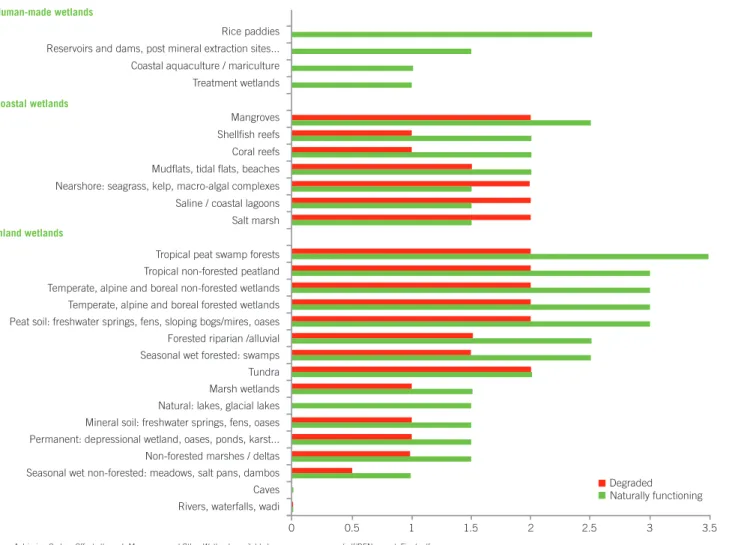
far outweigh the often short-term value of drainage and conversion for other uses. It is clear that forested wetlands are par-ticularly important stores of carbon: their destruction would release vast amounts of carbon into the atmosphere and elimi-nate the opportunity for capture of carbon (‘carbon sequestration’) for the future, thus adding to our present climate change woes. Figure 1 indicates just how much carbon storage capacity is lost when these wetland forest types (and other wetlands) are mismanaged and become degraded rather than functioning naturally. What threatens these wetlands? The need for land for urban development, conver-sion for agriculture and aquaculture, oil extraction, excessive abstraction of water upstream, and so on; in essence, many of the same threats which face other types of wetlands too.
FOrESTEd
WETlaNdS
WhaT arE WETlaNdS?
Permanent and temporary wet places such as lakes, rivers, ponds, marshes, swamps, peatlands, mangrove forests, salt pans, sandy beaches, coral reefs… and more.
WhaT’S a raMSar SITE?
All Ramsar member countries must designate at least one Wetland of International Importance – often called ‘Ramsar Sites’.
Forested wetlands are often places of natural beauty as well as providers of many other benefits to people.
r l d . W E T l a N d S . d a y
Peatlands (whether forested or not) are particularly good carbon stores and cover vast areas of the world. Globally it is esti-mated that there are 400 million hectares of peatlands which occur in 173 countries1.
Although the most extensive forested peat-lands occur in northern Europe, Russia, and Canada, significant areas of forested peatland also exist in southeast Asia, where the pressure for drainage and conversion to plantations is high. One recent estimate indicates that 13 million hectares of a total of 27 million have already been deforested in southeast Asia, mostly for oil palm and pulpwood plantations, for rice-growing, and for transmigration projects, and this has largely taken place in the last 30 years2.
The 175,000-hectare Berbak Ramsar Site is the largest peatswamp forest in Sumatra
and a leading example of its kind in the region. Important for biodiversity – with flagship species like Sumatran tiger and Malay tapir – Berbak also plays a significant role in carbon storage and regulation of water flows. Even within this protected area, fires and illegal logging have taken their toll over time, but this is coming under better control. Work is ongoing through one of our partners, Wetlands International, to achieve a sustainable balance between the activities of the people living around the site and this fragile peatland ecosystem upon which they depend.
In contrast to this threatened site, the North-Livonian Transboundary Wetland Complex in northern Europe covers a total area of 17,575 hectares with both forested and non-forested peatlands. It includes
three contiguous Ramsar Sites, two in Estonia and one in Latvia, recognized by both countries as a transboundary site so that it can be managed and protected as an ecological and hydrological entity. With very sparse human populations around the sites, the low-intensity collection of ber-ries, hunting and fishing have little impact on this wetland ecosystem. People much farther away from the site (and indeed the local people as well) benefit in that these healthy wetlands play a significant role in maintaining water quality in the area and in water storage. Another added bonus is the diversity of animal and plant species sustained by the peatlands, including some large mammals such as wolf, brown bear, and elk, and many bird species, including a number that are endangered.
Rice paddies Reservoirs and dams, post mineral extraction sites... Coastal aquaculture / mariculture Treatment wetlands
Mangroves Shellfish reefs Coral reefs Mudflats, tidal flats, beaches Nearshore: seagrass, kelp, macro-algal complexes Saline / coastal lagoons Salt marsh
Tropical peat swamp forests Tropical non-forested peatland Temperate, alpine and boreal non-forested wetlands Temperate, alpine and boreal forested wetlands Peat soil: freshwater springs, fens, sloping bogs/mires, oases Forested riparian /alluvial Seasonal wet forested: swamps Tundra Marsh wetlands Natural: lakes, glacial lakes Mineral soil: freshwater springs, fens, oases Permanent: depressional wetland, oases, ponds, karst... Non-forested marshes / deltas Seasonal wet non-forested: meadows, salt pans, dambos Caves Rivers, waterfalls, wadi
Human-made wetlands
Degraded Naturally functioning
Coastal wetlands
Inland wetlands
0 0.5 1 1.5 2 2.5 3 3.5
From Achieving Carbon Offsets through Mangroves and Other Wetlands available here: www.ramsar.org/pdf/DFN_report_Final.pdf Fig. 1 Comparative assessment of carbon storage capacity across wetland types
Forested peatlands:
W O r l d . W E T l a N d S . d a y 7
Mangroves:
Mangroves are found in 123 countries in tropical and sub-tropical regions3.
It’s estimated by some experts that the world’s area of mangrove forests has been reduced by 20% between 1980 and 20054, with aquaculture (for fish,
shrimps, crabs, etc), agriculture, and urban land uses implicated as the key culprits. The threat is felt even in many of the nearly 200 mangrove areas that have been designated as Ramsar Sites. To put these losses in perspective, it’s estimated that mangroves generate from US$ 2,000 -9,000 per hectare annually5 –
significantly more than alternative uses like aquaculture or agriculture. With climate change the likely cause, at least in part, of the increased storms striking coastlines, mangroves are now more widely recog-nized by governments as an asset to be protected, not just for their many products and the millions of livelihoods they sus-tain, but also for the coastline protection they afford us. For example, Vietnam has invested US$ 1 million in planting 12,000 hectares of mangroves – and saved annual expenditures of over US$7 million4 on
dyke maintenance to protect the coastline and secure livelihoods.
While the battle against mangrove con-version for coastal infrastructure and aquaculture continues, there is a little good news – while mangroves have been used and abused all over the tropics where they occur, the loss of mangroves has slowed significantly in the past few years, except in Asia. In addition, resto-ration efforts in recent years now cover some 400,000 hectares3 – a win for
people and wildlife.
Cameroon’s fifth Ramsar Site, Rio Del Rey, is an impressive 165,000 hectares, cover-ing half of the country’s mangrove area and contiguous with a large mangrove area just over the border in Nigeria. Rio Del Rey is not just home to a number of endemic and threatened species such as the Goliath frog, a giant indeed weighing in at 3 kilograms, the estuary has much more to offer – its role in providing a spawning ground for fishes, in protecting shorelines, in supplying fish and timber and other forest products to support the local economy, and its hydrological value in groundwater recharge and discharge, make it an ecosystem of enormous value for the whole country.
These are flooded forests that are either permanently or seasonally inundated with freshwater and they occur all over the world, from tropical to temperate to boreal regions. The Orinoco River runs for 2,600 kilometres through Brazil, Colombia and Venezuela – impressive enough in itself, but the river waters flow over the banks at certain times of the year and create one of the largest and most remarkable tracts of seasonally flooded forest in the world. This swamp forest (called várzea) sustains over 1,000 species of fish and a significant diversity of other animal and plant groups, including endangered species such as the Orinoco crocodile and Giant otter. The fertile soil makes it attractive to cattle ranchers and farmers, unfortunately, and the system endures the ever-present threats from dam and water diversion projects and siltation from deforestation and mining activities. Another typical flooded forest is the Mamirauá Reserve for Sustainable Development, a 1,124,000-hectare Ramsar Site in Brazil fed by branches of the mighty Amazon. It is well-man-aged with a particular aim: to sustain local communities and their traditional management techniques as well as the incredible diversity of species.
A contrasting example in terms of multiple human use is the Okefenokee National Wildlife Refuge, a 162,635-hectare Ramsar Site in the USA. It’s the second largest wetland complex in the USA and includes significant areas of permanently flooded cypress forests. The refuge welcomes around 400,000 visitors per year for hiking, canoeing, camping, and a variety of other sustainable activities.
The 400,000-hectare Ciénaga Grande de Santa Marta Ramsar Site in Colombia is the most important and largest mangrove area on the Caribbean coast of Colombia, vital for local fisheries and for biodiversity.
© Maria Rivera http://www.coastalwiki.org/coastalwiki Cienaga_Grande_de_Santa_Marta
Freshwater,
r
l
d
.
W
E
T
l
a
N
d
S
.
d
a
W
O
r
l
d
.
W
E
T
l
a
N
d
S
.
d
a
y
9
We have begun by looking at forested wetlands for this year’s theme, a natural focus for Ramsar. But it’s important to look at forests in a broader context as well and the following pages explain why. First, a startling fact from the United Nations Forum on Forests Secretariat: “Every day, some 350 square kilome-tres of forest cover are lost worldwide. Conversion to agricultural land, unsus-tainable harvesting of timber, unsound land management practices, and crea-tion of human settlements are the most common reasons.”
Does this really matter? If our food comes from agricultural fields and we still have some forests to supply us with timber for building and paper, and enough space for recreation, then we don’t really need vast areas of forests. Right? Well, not really...
FOrESTS -
lOOkINg aT ThE bIg pICTurE
Forests and people
We have just over 4 billion hectares of forests in our world. That’s 31% of our total land area and about 0.6 hec-tares per person6. Sounds like a lot,
but more than half of this forest area occurs in just five countries: Brazil, Canada, China, Russian Federation, and the USA. Globally the rate of loss of forests is daunting – 130,000 square kilometres of forest have been lost each year between 2000 and 20104 (that’s
Cypress swamp in North Carolina, USA.
© Jeffrey S. Pippen / www.duke.edu/~jspippen/nature.htm
dry FOrEST – WET FOrEST
Most of our forests are terrestrial but some are wetland forests as discussed above. Wet or dry, forests have an important role for people.
Many reasons, but often to produce more agricultural land to support our ever-increasing global population, to meet our ever-increasing demand for timber, and of course, in many countries, to accommo-date the ever-expanding urban areas. In addition, poor forest management affects how forests function, so we cannot just avoid deforestation – we need also to avoid forest degradation.
Why do we cut
our forests?
an area the size of Greece or twice the size of Sri Lanka each year). While this might be an improvement on the 160,000 square kilometres lost per year in the 1990s, it’s still a significant continuing loss. At the same time, large-scale tree planting efforts are helping to stem this tide. Afforestation and natural expan-sion of forests in some countries have
r l d . W E T l a N d S . d a y
Why does it matter?
Here’s what forests do for you.
Thirty percent of the world’s forests are used to produce wood and non-wood products. This includes timber for con-struction and fuelwood, but also many non-wood products like food, medicine, and clean water. Forests can provide honey
and fruits as well as many edible animals
and non-woody plants, and of course fish
and other ‘fishy’ foods in flooded forests.
Then there’s a whole range of other benefits for people. Like watershed and local flood control, protection from wind and soil erosion, air pollution filtering, avalanche protection in the mountains, storm protection in coastal areas, rec-reation opportunities. They are home
to an amazing diversity of species - close to 80% of the world’s terrestrial biodi-versity live in forest habitats. And of course forests have a vitally important role to play in mitigating and adapting
to climate change. Top of
the list of carbon stores are tropical and sub-tropical forests; next comes boreal forests and then temperate forests. Overall, they store as much as 60% of the world’s terrestrial carbon7.
Not all forests deliver all of these benefits to people – but all natural forests deliver a solid range of these benefits, which we call “ecosystem services”. So losing them by conversion to other uses (such as agri-cultural or urban land), or even degrading them by poor harvesting practices, means losing their services. By putting a dollar value on these services, Figure 2 shows some examples of just what we are forfeit-ing in three forest types when we lose or abuse the natural forest.
Currently, 12% of the world’s forests have been designated for protected status for the conservation of biological diversity. National parks, game reserves, wilderness areas and other legally established protected areas cover more than 10% of the total forest area in most countries and regions6.
It’s estimated that forests contribute to the livelihoods of 1.6 billion people.
Over 2 billion people use biomass fuels, mainly firewood, to cook and to heat their homes.
Source : Millennium Ecosystem Assesment
Wetland Canada Tropical Forest Cameroon Mangrove Thailand Tropical Forest Cambodia
6 000
5 000
4 000
3 000
2 000
1 000
0
Sustainably managed ecosystems
Converted ecosystems
Fig.2 - Net Present Value in dollars per hectare
Intact wetland Sustainable forestry Small-scale farming Intact mangroves Shrimp farming Traditional forest use Unsustainable timber harvest Intensive framing
Wetland Tropical Forest Mangrove Tropical Forest
6 000
5 000
4 000
3 000
2 000
1 000
0
Sustainably managed ecosystems
Converted ecosystems
Fig.2 - Net Present Value in dollars per hectare
Intact wetland Sustainable forestry Small-scale farming Intact mangroves Shrimp farming Traditional forest use Unsustainable timber harvest Intensive framing
W
O
r
l
d
.
W
E
T
l
a
N
d
S
.
d
a
y
11
Riverine forests have significant water protection functions.
© Tobias Salathé
¾stabilizing banks, thus minimizing erosion;
¾trapping sediment before it enters the water body;
¾reducing water velocity after storms;
¾removing harmful nutrients (e.g., fertilizers and pesticides);
¾increasing aquatic insect populations in the water bodies, resulting in higher water quality;
¾providing shade,
thus reducing water temperature;
¾providing leaf and fruit debris which enters the aquatic food chain.
SpECIal FOCuS:
rIparIaN FOrESTS
riparian forestsare found along or around rivers, streams, and lakes. They have significant water-protection functions:
Source : Millennium Ecosystem Assesment Wetland
Canada Tropical ForestCameroon MangroveThailand Tropical ForestCambodia
6 000
5 000
4 000
3 000
2 000
1 000
0
Sustainably managed ecosystems
Converted ecosystems
Fig.2 - Net Present Value in dollars per hectare
Intact wetland
Sustainable forestry
Small-scale farming
Intact mangroves
Shrimp farming
Traditional forest use
Unsustainable timber harvest Intensive
r l d . W E T l a N d S . d a y
Forests USE water and they use more of it than shorter vegetation (like grasslands) because they have a higher evapora-tion rate. But forest soils ABSORB and RETAIN water easily. This may take sur-face runoff away from the water system but forests use this water to produce many useful products as noted above. Forests also reduce soil erosion so the QUALITY of the water that is stored is better: maintaining good forest cover in forested catchments is considered the most effective mechanism for reduc-ing excessive sediment in downstream wetlands. It’s also important to note that many other land uses (such as agricul-ture, urban, and industrial development) produce pollutants which are picked up in rainwater and end up in wetlands –
and thus in our drinking water unless costly purification treatment takes place. Forests, on the other hand, even those that are heavily managed, have low inputs of pollutants.
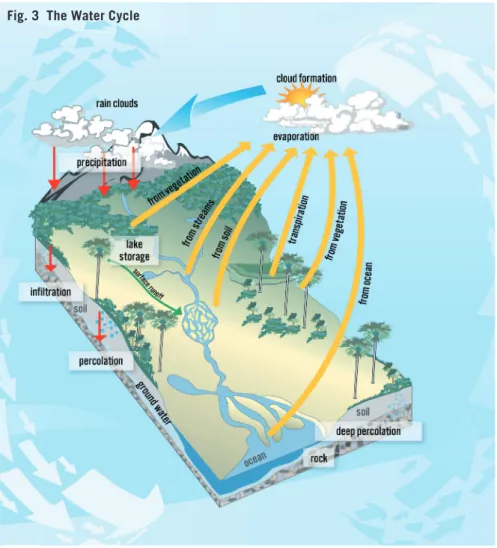
But it’s not just about improving water quality. Terrestrial forests and forested wetlands have a crucial role in the global water cycle – the cycle of freshwater that keeps our world alive (Fig. 3). Forests have a significant impact on the levels of evaporation and transpiration of water into the atmosphere, which in turn affects rainfall. What matters is not just that forests play this critical role, but that other kinds of ground cover cannot produce the same effect. Thus well-drained agricultural fields neither
absorb nor retain the same amount of water as forests, and they provide noth-ing like the same rate of evaporation and transpiration of water to the atmosphere so their contribution to the water cycle is significantly less.
In summary, in a catchment forests play a dual role both as a vital part of the water cycle AND as a strong influence on how water is routed through the catchment and stored.
These roles explain why many countries are placing a high value on protecting their forests in catchments. The classic example of this ‘value’ is New York City, which found that it could avoid spend-ing US$ 4-6 billion on water treatment plants (plus annual maintenance costs) by investing just US$ 1.0 billion in land purchase and management measures to conserve the catchment, including large forest areas9. On a smaller but no
less important scale, the city of Basel in Switzerland ‘treats’ water from the Rhine by allowing it to run into small channels through a forest where it seeps into the soil and is purified: no other water treatment is necessary for the city’s water supply. At the national level, use of untreated groundwater, mostly
Forests and water:
what we should know
FOrESTS,
WETlaNdS, WaTEr
-a pOWErFul rEl-aTIONShIp
Today the world’s leaders are focused on WATER. As global populations increase, as lifestyles become more water demanding, and as climate change impacts are increas-ingly apparent, the availability and scarcity of freshwater has become an urgent global
issue. Water supplies are dependent on healthy wetlands; healthy forests help to support and protect wetlands. The sta-tistics speak for themselves – freshwater scarcity and limited access to water already affect 1-2 billion people and the situation
can only get worse unless we manage our environment better. A recent survey of Fortune 1000 companies showed that 40% felt that the impact of water short-age would have ‘severe’ or ‘catastrophic’ impacts on their business8.
gOOd TrEES – bad TrEES
W
O
r
l
d
.
W
E
T
l
a
N
d
S
.
d
a
y
13
Forests and their management figure widely in climate change discussions. We’ve already noted the importance of forested wetlands in capturing and stor-ing carbon but on a broad forest scale it has been estimated that deforestation and forest degradation account for around 17-20% of the annual greenhouse gas emissions that are known to be fuelling climate change12,13. To put this in
perspec-tive, this is more than the emissions from the entire global transport sector12. And of
course losing or degrading forests is a dou-ble loss – since forests absorb CO2 from the atmosphere as well as storing it. At the same time forests provide great opportunities for adaptation to climate change (e.g. through reforestation of man-groves) and mitigation of climate change (e.g. through afforestation, reforestation) – all of which increase the resilience of ecosystems and people to cope with the challenges posed by climate change. coming from forested watersheds, saves
the Swiss population around US$ 64 million per year10.
So, managing our forests helps us man-age water for people, for agriculture, for industry – and for wetlands.
a CaTChMENT
Or draINagE
baSIN Or
WaTErShEd:
an area of land where water from rain and melting snow or ice drains downhill into a body of water, such as a river, lake, reservoir, estuary, sea etc. The catchment includes both the streams and rivers that convey the water as well as the land surfaces from which water drains into those channels. Thus catchments act as a funnel channeling water into a waterway.
Forests and
climate change
rEdd
– reducing Emissions from deforestation and Forest degradation in developing Countries:an initiative that recognizes the role of forests as carbon store and carbon dioxide absorber. Its aim? To link directly financial incentives with conservation, sustainable management of forests and enhancement of forest carbon stocks12.
© istockphoto
r
l
d
.
W
E
T
l
a
N
d
S
.
d
a
y
¾ Forested wetlands – and the special benefits they bring. Mangroves, peat-swamp forests, freshwater peat-swamp forests: biologically diverse, helping us manage our freshwater, and pro-viding us with many other ‘services’ across the globe including vital roles in carbon storage – our allies in the face of climate change. Despite their utility, they are often under threat from development, from drainage and conversion.
¾ The role of forests – wet or not – in our lives, and why looking after them matters. Vital to all human
lives, freshwater availability on a global scale depends on our forests. So too, to a large extent, does fresh-water quality.
¾ The role of forests in how our wet-lands function. It’s simple: the health of our wetlands, whether forested or not, is linked to the health of forests in our catchments. Losing and degrading forests means losing and degrading wetlands.
We cannot manage without forests, whether terrestrial forests or forested wetlands, given the critical roles that
they play in our lives – for water, for food, for livelihoods, for recreation... and more.
We believe World Wetlands Day 2011 brings us a great opportunity to look at our forested wetlands and the benefits we enjoy from them, and also to look at the forests in our catchments which ensure that there is enough water of good quality reaching our wetlands to keep them healthy. We hope our Ramsar countries will designate more of these vital wetland types as Ramsar Sites – a gift to Ramsar and themselves on Ramsar’s 40th birthday!
Our CONCluSION
ON WETlaNdS aNd FOrESTS?
This leaflet
has looked at:
references and other resources for those wishing to know more
1. Millenium Ecosystem assessment Wetland Synthesis. 2005. www.millenniumassessment.org/documents/document.358.aspx.pdf
2. Page, S., Hoscilo, A., Wosten, H., Jauhianen, J., Silvius, M., Rieley, J., Ritzema, H., Tansey, K., Graham, l., Vasander, H., and S. Limin (2009).
restoration Ecology of lowland Tropical peatlands in South-east asia - Current knowledge and future research directions. Ecosystems (2009) 12: 888-905. www.springerlink.com/content/63g28g6777447834/fulltext.pdf
3. World atlas of Mangroves. UNEP. 2010 www.unep.org/Documents.Multilingual/Default.asp?DocumentID=630&ArticleID=6645&l=en&t=long 4. global biodiversity Outlook 3. CBD. 2010. www.cbd.int/gbo3
5. In the Front line: shoreline protection and other ecosystem services from mangroves and coral reefs. UNEP-WCMC. 2006. www.unep-wcmc.org/resources/PDFs/In_the_front_line.pdf
6. global Forest resources assessment 2010: key Findings. FAO. http://foris.fao.org/static/data/fra2010/KeyFindings-en.pdf 7. The Natural Fix. UNEP. www.grida.no/_res/site/file/publications/natural-fix/BioseqRRA_scr.pdf
8. Water, Wetlands and Forests. a review of Ecological, Economic and policy linkages. CBD Technical Series No. 47 2009. www.cbd.int/doc/publications/cbd-ts-47-en.pdf
9. a good practice guide: drinking Water, biodiversity and development. Cbd. 2010. www.unwater.org/worldwaterday/downloads/cbd-good-practice-guide-water-en.pdf
10. Nature for Water: protecting water-related ecosystems for sustainable development. uNECE. 2005. www.unece.org/env/water/meetings/ecosystem/Brochure_final.pdf
11. Dye, P, and Jarmain, C. (2004). Water use by black wattle (Acacia mearnsii): implications for the link between removal of invading trees
and catchment streamflow response. South African Journal of Science 100: 40-44. www.dwaf.gov.za/wfw/docs/Dye&Jarmain,2004.pdf 12.Simply rEdd: CIFOr’s guide to forests, climate change and rEdd. CIFOR. 2009. www.cifor.cgiar.org/Knowledge/Publications/Detail?pid=2812 13. Forests: the green and rEdd of Climate Change. uN-dESa policy brief No. 16. 2009. www.un.org/esa/policy/policybriefs/policybrief16.pdf
additional useful resource:
W
O
r
l
d
.
W
E
T
l
a
N
d
S
.
d
a
y
15 February 2nd 1971 marks the birth of the Ramsar Convention in the city of Ramsar in Iran. February 2nd 2011 will mark our 40 years
as an intergovernmental treaty focused solely on one ecosystem – wetlands.
In 1997 the Convention launched World Wetlands Day as the annual campaign day when all those who care about wetlands can celebrate their beauty and utility.
We hope WWD2011, and indeed the whole year, will be a time for wetland supporters to focus on Ramsar and its role in saving wetlands from degradation and destruction.
Are we progressing as a Convention? Of course we are. Since 1971 the Convention has grown in every dimension.
¾ 160 Contracting Parties
¾ 1,896 Ramsar Sites covering 185 million hectares – the largest protected area network in the world
¾ 5 very active International Organization Partners – strong NGOs working for wetlands and supporting the Convention all over the world (BirdLife International, IUCN, IWMI, Wetlands International, and WWF)
¾ An increasingly effective mechanism for dealing with Ramsar Sites that are in ecological trouble for whatever reason
¾ Helpful guidance for countries at the policy level and for site managers at ground level on caring for wetlands
¾ An increasingly popular campaign day on February 2nd every year to celebrate wetlands
…and more
Where are we now?
We have…
Would you like to join those celebrating 40 years of Ramsar? Look here www.ramsar.org/40-Anniversary to download our animated 40th logo and to see what the Secretariat and some countries are planning to do.
Coming soon… our commemorative brochure to be launched on World Wetlands Day 2011 celebrating 40 years of Ramsar. This will be available in PDF and the design files will be accessible should you wish to translate it in September/October 2010.
CElEbraTINg yEarS
OF ThE raMSar CONVENTION
ON WETlaNdS
Ramsar Convention Secretariat Rue Mauverney 28 1196 Gland Switzerland Tel: +41 22 9990176 Fax: +41 22 9990169 [email protected]
United Nations Forum on Forests Secretariat DC1-1245, One UN Plaza
New York, NY 10017 USA
Tel: +1 212 963 3401 Fax: +1 917 367 3186
[email protected] : Design:
/ Print:
FORESTS
FORWATER AND
WETLANDS
FORWWAATTEERRA
W
WETLANDSS2 February
World Wetlands Day
2 de febrero
Día Mundial de los Humedales
BOSQUESPARA AGUA Y HUMEDALES 2 février
Journée mondiale des zones humides
LES FORÊTS : VITALES POUR L’EAU
ET LES ZONES HUMIDES
www.ramsar.org
CONTENTS
Forested wetlands ...5
Forests – looking at the big picture ...9
Forests, wetlands and water – a powerful relationship...12
Our conclusion on wetlands and forests ...14
Celebrating 40 years of the Ramsar Convention on Wetlands ...15
This brochure has been made possible thanks to the Danone/Evian Fund for Water
FOrESTS
FOr
WaTEr
aNdWETlaNdS
2 February WOrld WETlaNdS day
raMSar CONVENTION ON WETlaNdS
International Year
of Forests a2011
Poster Brochure
FORESTS
FORWATERAND WETLANDS
2 FebruaryWORLD WETLANDS DAY
www.ramsar.org
Sticker
CD with all the WWD materials in high resolution
Do-it-yourself facemask for children