!"#
$ %
& & #
'(#
Equality of educational opportunity employing PISA data:
Taking both achievement and access into account
ξMárcia de Carvalho*
Departamento de Estatística and Centro de Estudos sobre Desigualdade e Desenvolvimento (CEDE), Federal Fluminense (UFF), Brazil.
Luis Fernando Gamboa∗∗
Facultad de Economía, Universidad del Rosario
Fábio D. Waltenberg***
Departamento de Economia and Centro de Estudos sobre Desigualdade e Desenvolvimento (CEDE), Universidade Federal Fluminense (UFF), Brazil.
Abstract
While PISA datasets have been used for measuring inequality of educational opportunity they have important limitations: (i) samples only cover a relatively limited fraction of developing countries’ cohorts of 15-year-olds, and (ii) such fractions are not uniform across countries and waves. This casts doubts on the reliability of such measures when used for international and intertemporal comparisons: a milder calculated inequality of opportunity in a given country at a given moment might simply be the artifact of a more restricted and homogeneous sample. Previous attempts of addressing this problem have focused on explicitly reconstructing full samples. Here an alternative path is followed, relying on bidimensional indices, in which equality of opportunity in achievement is the first dimension and equality of opportunity for access to the exam is the second one. We compute the two dimensions and aggregate them using alternative techniques. Employing PISA 2006/2009 data for six Latin-American countries we observe rank reversals when comparing results based upon our indices and those based upon conventional indices of equality of opportunity for achievement. We then generalize our approach allowing for more dimensions and parameterizing the dimensions’ weights.
Resumen
La medición de la desigualdad de oportunidades con las bases de PISA implican varias limitaciones: (i) la muestra sólo representa una fracción limitada de las cohortes de jóvenes de 15 años en los países en desarrollo y (ii) estas fracciones no son uniformes entre países ni entre periodos. Lo anterior genera dudas sobe la confiabilidad de estas mediciones cuando se usan para comparaciones internacionales: mayor equidad puede ser resultado de una muestra más restringida y más homogénea. A diferencia de enfoques previos basados en reconstrucción de las muestras, el enfoque del documento consiste en proveer un índice bidimensional que incluye logro y acceso como dimensiones del índice. Se utilizan varios métodos de agregación y se observan cambios considerables en los rankings de (in) equidad de oportunidades cuando solo se observa el logro y cuando se observan ambas dimensiones en las pruebas de PISA 2006/2009. Finalmente se propone una generalización del enfoque permitiendo otras dimensiones adicionales y otros pesos utilizados en la agregación.
JEL Classification: I24, O54.
Keywords: equality of opportunity, measurement of inequality of opportunity, multidimensional measures, PISA test scores, Latin America.
ξ The authors would like to thank attendants of seminars at Universidade de São Paulo, Universidade Federal
Fluminense in Niterói, Brazil, and at the ZEW Workshop on “Equality of Opportunity in Education” in Mannheim, Germany, particularly to Erwin Ooghe and Johannes Kunz. We are very grateful to Jérémie Gignoux for having provided his Stata code used in calculating the index of equality of opportunity in achievement. Finally, we thank CNPq/UFF (“Programa de Iniciação Científica”) and the Universidad del Rosario for providing funds for research assistance.
* E-mail address: [email protected].
1. Introduction
A liberal-egalitarian theory of justice that has been widely discussed in recent years is
that of “equality of opportunity” (EOp), popularized among economists by John Roemer,
according to which while inequalities due to different circumstances are intolerable,
inequalities due to choices made by the individuals are acceptable (Roemer, 1998). Different
methodologies have been proposed attempting to translate the theory into measuring
procedures in order, for example, to determine how far apart countries or regions stand from
an ideal of equality of opportunity in terms of, say, income distribution (e.g., Checchi &
Peragine, 2010; Dunnzlauf et al. 2010). Two recent extensive surveys are available
documenting the vast literature produced along the last ten years or so (Pignataro, 2012;
Ramos & Van de Gaer, 2012).
Measuring inequality of opportunity in the educational sphere has been the focus of
recent contributions, which concentrate either on opportunity for access to a given level of
studies (e.g., Paes de Barros et al. 2009; Vega et al. 2010), or on opportunity in terms of
educational achievement (e.g., Checchi & Peragine, 2005; Ferreira & Gignoux, 2011; Gamboa &
Waltenberg, 2012). In this paper we combine both concerns.
Pupils’ educational achievement is usually measured by standardized test scores, such
as those made available by OECD’s Programme for International Student Assessment (PISA),
which are taken to be proxies for the knowledge and basic skills pupils possess in different
areas: reading, mathematics, or sciences. While PISA datasets present many well-known
virtues, they are also plagued by some important limitations, particularly in terms of coverage
rates of the population of individuals whose age is 15 (the exam’s focus). The reasons for not
evaluating individuals include: their being not enrolled in schools, their being enrolled in very
low grades, logistic difficulties in the application of the test, and school-level exclusions related
to pupils’ physical or intellectual deficiencies. While in developed countries, the coverage rate
is systematically larger than 80% – sometimes approaching 100% –, the samples cover a
relatively limited fraction of developing countries’ cohorts of 15-year-olds. Moreover such
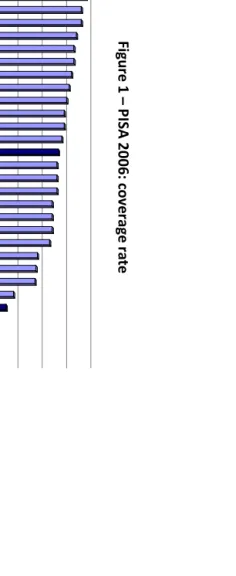
fractions are not uniform across countries and PISA waves (see Figures 1 and 2).
< Figures 1 and 2 around here >
These sample limitations cast doubts on the reliability of indices of inequality of
educational opportunities concerning developing countries, let alone international and
at a given moment) might simply be the artifact of a more restricted sample – possibly more
homogeneous – as compared to that of another country (or another moment).
Previous attempts of addressing this issue have been ingeniously performed by
Ferreira & Gignoux (2011), who have tried to explicitly reconstruct a full sample, but have
encountered two obstacles. First, the need to handle simultaneously many ancillary national
datasets, (possibly) dissimilar in many respects, contrary to PISA datasets themselves, which
are designed to be comparable across countries and years. Second, the need to adopt strong
assumptions in order to assign scores to missing pupils in the simulated distribution of scores
that they construct trying to mimic the actual distribution of scores that would have been
observed had pupils representing the whole cohort taken the exam.
Our strategy is of a very different nature. Instead of dealing with less-than-full
coverage by attempting to reconstruct a full sample, we take it for granted that it is not
possible to obtain a reliable and uncontroversial reconstructed full sample. We prefer to
explicitly acknowledge that there are two different dimensions of opportunity – access to PISA
exams and achievement conditional on access. We then introduce a bidimensional index of
equality of opportunity composed of the (conditional-on-access-) achievement dimension and
the access (-to-PISA) dimension. For the first dimension, we compute conventional inequality
of opportunity in test scores. Following Ferreira & Gignoux (2011), we propose the proportion
of the variance in test scores which is explained by variables reflecting pupils’ circumstances.1
As for the second dimension, we employ two different methods, the first of which is based on
each country’s reported PISA’s coverage rate, while the second relies on Paes de Barros et al.’s
(2009) Human Opportunity Index (HOI).
Needless to say that both dimensions are important for those worried about inequality
of opportunities. Yet it seems to us that access to a given advantage (which here means taking
part in PISA exam) is even more pressing and crucial than the relative performance obtained
by those individuals for which such advantage is accessible (which here stands for their test
scores).2 The prominence of EOp in access with respect to EOp in achievement accentuates the
importance of taking into account the former and not restricting the analysis to the latter.
Whatever the relative importance attributed to each dimension of EOp it is necessary
to aggregate the dimensions. We do so by means of two different techniques: either using a
1 Based on Item Response Theory (IRT), answers given by pupils to exam questions are transformed into test scores
and arbitrarily standardized to exhibit a given mean and a given standard deviation. As explained in detail by Ferreira & Gignoux (2011), because of this procedure, many usual inequality indices are not ordinally invariant, which led them to recommend the use of the variance to compute inequality of educational achievement, and the fraction of the variance explained by circumstances to compute inequality of opportunity in educational achievement.
2 Such “hierarchical view” we suggest here which prioritizes EOp in access with respect to EOp in achievement has
simple multiplicative specification, or turning to fuzzy sets transformations, which are routine
in multidimensional poverty analysis when it comes to aggregating variables expressed in
different metrics (Cerioli & Zani, 1990;Cheli & Lemmi, 1995;Lemmi & Betti, 2006).
In addition to overcoming the limitations of measuring EOp in education with an
exclusive focus on the achievement dimension – which per se might lead to misestimating
inequality of educational opportunity in some countries – some (though not all) of the versions
of the index we introduce also present the attractive feature of economizing on data
requirements, since they only involve PISA data complemented by descriptive information
contained in PISA technical reports.
We illustrate our approach for six Latin-American countries that took part in PISA 2006
and 2009, observing that ranking those six countries according to different versions of the
bidimensional index we introduce differs from ranking them according to a conventional index,
exclusively focused on achievement-EOp.
We skip a thorough presentation of equality of opportunity theory, as well as the main
controversies around measuring issues, since we believe that will be redundant with the
available literature, covered by two recent surveys already mentioned in this introductory
Section 1 (Pignataro, 2012; Ramos & Van de Gaer, 2012). The remaining of the paper is
organized around five further sections. Section 2 is devoted to explaining the original
motivation for this study, namely, PISA’s coverage rate problem, as well as previous attempts
of addressing it. In Section 3 we uncover our approaches to the problem, which amounts to
calculating bidimensional indices of equality of educational opportunities, taking into account
both achievement in PISA and access to PISA – each of which if taken alone would provide an
incomplete picture of the prevalent degree of inequality of educational opportunity. Section 4
contains an illustration for six Latin-American countries that took part in PISA 2006 and 2009,
comparing rankings of inequality of educational opportunity for those countries as calculated
by the indices we introduce with rankings obtained from a conventional index. We observe
rank reversals, suggesting that disregarding the access dimension has consequences. In Section
5 we undertake a generalization of our approach, allowing for more dimensions and
parameterizing the dimensions’ weights. We conclude in Section 6, pointing out possible
future research paths.
2. PISA’s coverage rate problem: paths and attempts to circumvent biases
OECD’s PISA datasets have been collected every three years, starting in 2000, allowing
over-time comparability. The fourth wave, collected in 2009, is the most recent which is
representative samples of students in dozens of countries in three different subjects –
mathematics, sciences and reading – as well as detailed information on students' background
and schools' personnel and functioning conditions. The fourth wave, for example, contains
samples of about 520 thousand students representing around 28 million pupils of more than
70 countries (OECD, 2012: 25).
Two related limitations that affect PISA samples should be mentioned. First,
individuals who are enrolled in a very low grade (“grade 6” or below3) or who are not enrolled
in schools are not assessed by PISA – they are “ineligible”. Another set of eligible pupils does
not take the exam for logistic or fortuitous reasons (e.g., pupils living in a remote region, or
pupils who were sick in the day the exam took place). Finally, local managers of PISA exams
might also exclude some pupils for physical or intellectual deficiencies (the accepted cases are
carefully detailed in PISA manuals). As a consequence of these exclusions empirical findings
based on PISA data should not be taken as valid for cohorts of 15-year-old individuals, but
rather as valid for teenagers represented by a sample of pupils who: (i) have stayed in the
educational system, (ii) have not repeated too many grades, (iii) being eligible, have actually
been evaluated.
The second limitation is a corollary of the first: the proportion of the cohort of
15-year-old individuals which has been excluded is not uniform across countries or in a given country
over time. As shown in figures 1 and 2, differences can be substantial – spatially or temporally
– casting doubts on the reliability of cross-country comparisons, as well as on over-time
evaluations.
As an example, let us reproduce here coverage rates for six Latin-American countries
recently studied (Gamboa & Waltenberg, 2012) and to which we too turn to in the illustration
provided below. In 2006, the rates are: Argentina (79%), Brazil (55%), Chile (78%), Colombia
(60%), Mexico (54%) and Uruguay (69%); in 2009, they are: Argentina (69%), Brazil (63%), Chile
(85%), Colombia (59%), Mexico (61%) and Uruguay (63%). These figures reveal that: (i) the
coverage rates are not particularly high on average, (ii) although all countries come from the
same region, cross-country dispersion is substantial, with a range of around 25 percentage
points in both years, (iii) there are important oscillations for given countries across waves
(ranging from -10 to +8 percentage points).
Disregarding coverage rates – which are incomplete and variable across countries and
over time – might lead to an imprecise estimation of the level of unfair inequalities in some
countries, particularly those with smaller coverage rates. For example, if Mexico turns out to
3 PISA’s “grade 6” corresponds with different names in different countries. PISA technical reports (e.g., OECD, 2009
show lower inequality of opportunity in achievement than Argentina in 2006, one might
wonder whether such result actually reflects larger unfair educational achievement inequality
in the latter than in the former, or whether the result is driven by a more homogeneous
sample in Mexico (the country that has the lowest coverage rate in that year) than in
Argentina (the one with the highest rate).4
It is important to emphasize that the issue of access that we raise here is not a minor
technical problem, but instead a crucial one for those worried about widening opportunities
for all. In a sense, as expressed by Paes de Barros et al. (2009) and reinforced by Peragine
(2010), lack of access to a given advantage (which here means “not being able to take part in
PISA exams”) is even more primary and serious for those concerned with equality of
opportunity than the relative performance obtained by individuals for which such advantage is
accessible (that is, their test scores). In other words, while underperforming in PISA might
signal future difficulties in an individual’s life, not even been eligible to the exam is probably
correlated with much more considerable obstacles in the future. Also, while once again both
dimensions of inequality of opportunity might pose problems for future generations, the lack
of access is arguably more pressing.
To address PISA coverage problems, we view at least three alternative paths, two of
which are mentioned in this section. The third path is the one we adopt in this study, and its
(longer) explanation is reserved to the next section.
The first path is simply to be cautious when interpreting the results of any study that
employs PISA for developing countries. This is the humblest path, but also the riskiest, since
many readers (and possibly policymakers) might basically overlook the call for caution, and
judge results by their face value. Gamboa & Waltenberg (2012) opt for what here we call “first
path”, presenting results based on PISA limited samples and emphasizing that caution is
necessary in their interpretation. 5
A second path consists of explicitly reconstructing full samples. Recently Ferreira &
Gignoux (2011) have done so for four countries: Brazil, Indonesia, Mexico, and Turkey. Due to
the absence of information in PISA samples about non-participant pupils, it is not possible to
perform a correction such as Heckman's familiar procedure. Instead, they have turned to
4 In Colombia, in turn, a considerable dropout rate has been observed during the 1990s, for multiple reasons among
which: economic recession (reducing enrollment in private schools); increase in the standards necessary to be promoted from grade to grade; negative externalities caused by the domestic conflicts. This trend was reverted during the last decade mainly as a consequence of multiple public policies designed to reduce demand barriers. The more recent situation potentially reduces the biases of estimations of equity based on PISA or national standardized tests.
5 Additionally, as a sensitivity analysis the authors report a simple simulation taking the country showing the lowest
ancillary databases (i.e. household surveys), which, however, do not contain information on
test scores. They have then imposed some assumptions in order to undertake two different
kinds of simulation. The first one consists of re-weighting test scores observations in PISA
datasets by means of information taken from the ancillary databases on the fraction of
different types of individuals in the population.6 The second one consists of imputing into the
dataset pupils who were not evaluated, ascribing to them scores equal to the lowest score
obtained by individuals very similar to them – namely, those pertaining to the same “type”,
where type is defined following Roemer (1998).
The first simulation, which relies on more conventional assumptions, provides results
almost equal to the original results, both in terms of inequality of achievement and of
opportunities. While such somewhat unexpected finding might offer relief for those employing
PISA datasets, it is not excluded that applying the procedure to other countries/years could
lead to more substantial changes. The second simulation results in more substantial
differences with respect to the naïve calculations. Having said that, the latter technique has a
drawback which is particularly important when it comes to undertaking international and
intertemporal comparisons, namely, the fact that it requires handling many different
country-specific survey datasets, and choosing similar variables in all of them, which might not always
be possible or might lead to poor definitions of types. Another disadvantage is that the
criterion employed to input pupils and their scores into the dataset is controversial – Ferreira
& Gignoux (2011) themselves acknowledge that, stating that their assumptions are
“admittedly extreme”.
Their pioneering effort deserves to be praised, and we would like to view it as
complementary to our approach, not substitute. Yet we believe sample corrections of PISA
data still present high costs (especially being data-intensive) and limited benefits (unstable
results; small impacts or results based on strong assumptions). For these reasons we tend to
favor a third path, which is described below.
3. A bidimensional approach: taking both achievement and access into account
Our strategy is of a very different nature. Instead of dealing with less-than-full
coverage by attempting to, so to speak, “reconstruct a full coverage”, we take it for granted
that it is not possible to obtain a reliable and uncontroversial reconstructed full sample. We
prefer to explicitly acknowledge that there are two different dimensions of opportunity –
access (to PISA exams) and achievement (conditional on access), to measure them separately
and to aggregate them somehow, as explained below.
1. Dimension 1: inequality of opportunity in achievement. We restrict the calculation of
inequality of opportunity in achievement to the available PISA samples, which as
stated above represent only a fraction of each country’s 15-year-olds. To do so, we
employ Ferreira & Gignoux’s (2011) regression-based index of inequality of
educational opportunity (hereafter: IOFG), which is calculated as the proportion of the
variance of test scores that is explained by a set of circumstances, with 0 ≤ IOFG ≤ 1,
thus ranging from 0 (perfect equality of opportunity) to 1 (perfect inequality of
opportunity). In our approach, again following Ferreira & Gignoux (2011), the set of
circumstances includes: mother and father education, father occupation, stock of
educational capital, city size and ownership of specific durables.7 That provides us with
a valuable, albeit limited, piece of information upon which we can judge and compare
countries’ educational systems.8
2. Dimension 2: inequality of opportunity in access. We have to take into account the
proportion of individuals which are actually represented in a given country’s PISA
sample, in order to sanction countries according to how far apart they stand from full
coverage. To do so, we propose two methods:
a) The first one consists of simply employing coverage rates available in PISA
technical reports, which range from 0 (no coverage) to 1 (full coverage), as the
second dimension of our index. Following the notation employed in a related
literature9 we denote the overall coverage rate by p, with 0 ≤p≤ 1.
b) The second one is more involved, but intuitive too. It consists of taking into
account not only the overall coverage rate for each country as in (a) above, but
also the coverage rate for different types of a given population, which might vary
across types (e.g., across types defined according to gender and ethnicity). In that
we follow Paes de Barros et al. (2009), who compute what they label a “Human
Opportunity Index” (HOI), as follows: HOI = p.(1−D), where:pis defined and bounded as above; 0 ≤ D ≤ 1 stands for a dissimilarity index, which aggregates the
7 A good property of this index is the ease with which it is calculated: it is simply the R-squared of the estimation of
scores regressed against the set of circumstances cited above. Another virtue is related to a characteristic of the R-squared: since it never goes down when new variables are added to the regression, we can interpret it in the present context as a lower bound of inequality of opportunity for achievement: if further variables reflecting circumstances could be added (but are unobservable, for example), we can be sure that the index would either remain stable or go up. For a thorough discussion, see Ferreira & Gignoux (2011).
8 It should be mentioned at this point that although we employ a regression, we are not attempting to establish
causality. The exercise undertaken is essentially a static decomposition of inequality (as expressed by the variance) into unfair inequality (the R-squared) and fair inequality (1-R²).
difference between the average coverage ratepand each type’s coverage rate
weighted by the relative frequency of each type in the population (where type is
understood according to Roemer’s (1998) meaning), and with 0 ≤ HOI ≤ 1. Such
index could be viewed as one which expresses opportunity for access, both for the
population taken together and for specific groups (types).
The main advantages of method (a) above are its simplicity, the ease with which
information can be gathered (available in PISA reports) and the fact that it does not require
further datasets, what is important for those willing to make international-intertemporal
comparisons. The main advantage of method (b), in turn, is that it is not mute with respect to
cross-types differential opportunities.10
3. Aggregating the two dimensions. The remaining step is to aggregate the two
dimensions into one single index, which we generically call the “Bidimensional Index of
Equality of educational opportunity” (or BIE). We work with two aggregation
procedures: a direct multiplicative specification, and the fuzzy sets technique. Since we
also have two procedures for calculating the access dimension, we obtain four versions
of our index (BIEV, with V = 1, …, 4). These four procedures are described below in
subsections 3.1-3.4.
3.1. BIE1: access as overall coverage rate; aggregation in a simple multiplicative form
An interesting way of dealing with both dimensions – achievement and access –, is to
weigh the inverse of IOFG by p, that is:
(
)
EOp t achievemen
FG EOp
access
IO p
BIE
− −
− ⋅
= 1
1 (3.1)
with: 0 <p≤ 1, 0 ≤ IOFG< 1, 0 < BIE1 ≤ 1.
Clearly, the index is increasing in pand decreasing in IOFG as would be desirable. More
interesting is to consider some limiting cases for its attributes. First, since IOFG ranges in the
interval [0,1), with 0 standing for perfect equality of opportunity in achievement, (1 – IOFG) will
equal 1 in the case where circumstances are unrelated to outcomes for those pupils who have
taken PISA exams. In such limiting case, BIE1 will depend solely upon the coverage rate: the
10 The use of HOI – as opposed to Yalonetsky’s (2012) recently proposed dissimilarity index – is endorsed both by
higher it is, the larger will be the opportunities offered to 15-year-olds of a given country.
Conversely, in a case of full coverage, where p= 1, the index BIE1 will depend solely upon
inequality of opportunity in achievement.BIE1 can also be expressed through a penalty, P, on
the fact that coverage is less than full: BIE1= p⋅
(
1−IOFG)
= p−p⋅IOFG = p−P.3.2. BIE2: access as overall coverage rate; aggregation through the fuzzy sets technique
A second way of dealing with the two dimensions is routine in multidimensional
poverty analysis. It consists of standardizing observations expressed in each dimension’s
metric by means of the fuzzy sets technique and then aggregating them additively (with
certain weights) to generate BIE2.
The fuzzy function of a given variable (x1) from country i will be a linear variation
between minimal and maximal values, as follows (Cerioli & Zani, 1990; Cheli & Lemmi, 1995):
= < < − − = = max , 1 max min , min max min min , 0 ) ( 1 , 1 , 1 , 1 , 1 , i i i i i x if x if x x if x
f (3.2)
This applies, for example, to the coverage rate variable, p, where the larger it is, the
better it is (i.e., the index should be increasing in p). A similar function is defined but with
inverted minimal and maximal values, for the fuzzy set of another variable (x2):
= < < − − = = min , 1 min max , min max max max , 0 ) ( 2 , 1 , 2 , 2 , 2 , i i i i i x if x if x x if x
f (3.3)
This applies, for example, to the inequality index, IOFG, where the larger it is, the worse
it is (i.e., the index should be decreasing in IOFG). The next step is weighing the two dimensions.
We postpone a discussion about weights to Section 5 and here, as a first approach, we simply
consider the simplest solution of attributing an equal weight to each dimension:
2 ) ( )
( 1 2
2 EOp t achievemen EOp access x f x f BIE − − +
With respect to BIE1, a disadvantage of BIE2 is that the calculated values will depend
upon the countries used in the sample, since minimal and maximal values in the sample
determine the function. The main advantage of the fuzzy method is that in a more general
context (i.e., a multidimensional one) it allows to transform distributions which do not fit the
range [0-1] to one that fits, a point to which we come back in Section 5.
3.3. BIE3: access as HOI; aggregation in a simple multiplicative form
A third version of the index relies on HOI – which, as argued before, can be viewed as
an “opportunity-for-access index” – to express the access dimension. The achievement
dimension remains as it was before:
(
)
EOp t achievemen FG EOp
access
IO HOI
BIE
− −
− ⋅
= 1
3 (3.5)
with: 0 < HOI ≤ 1, 0 ≤ IOFG< 1, 0 < BIE3 ≤ 1.
And sinceHOI= p.(1−D), we can rewrite (3.5) as:
(
)
EOp t achievemen
FG
EOp access
types across overall
IO D
p BIE
− −
−
− ⋅ −
= .(1 ) 1
3 (3.6)
with: 0 <p≤ 1, 0 ≤ D < 1, 0 ≤ IOFG< 1, 0 < BIE3 ≤ 1.
Now we have an index which is once again decreasing in IOFG (which captures
inequality of opportunity in achievement), increasing in p(which captures the average
access-to-PISA in a given country) but additionally it is also decreasing in D (which captures
cross-groups inequality of opportunity in access-to-PISA). A broader range of interesting cases
emerge, such as those we emphasize below:
a) If a country presents full coverage, we will havep=1 but alsoD=0 (access will be 100% for each type). Then, BIE1 will depend solely upon inequality of
opportunity in achievement. Such case is relevant for advanced countries, where
the coverage rate in PISA approaches 100%, such as Switzerland or Canada in 2006
(Figure 1). However, that is not what is observed in most countries, let alone
developing countries, but it is implicitly assumed in conventional calculations of
b) A country could have perfect equality of opportunity in achievement (IOFG = 0),
such that BIE3 would depend exclusively upon access. Such second dimension
would depend upon two subdimensions: the overall coverage rate,p, and the
cross-types dissimilarity in coverage rates, D.
c) Two countries could show similar inequality of opportunity in achievement, OFG, as
well as similar coverage rates,p, but could differ in terms of their relative
cross-types dissimilarity with respect to access. Such case might apply to pair-wise
comparisons of equality of opportunity among countries from a given region.
3.4. BIE4: access as HOI; aggregation through the fuzzy sets technique
Finally, and for the sake of completeness, we mention the version BIE4, which would
standardize HOI as in Equation (3.2), and aggregate the dimensions as in Equation (3.4). Pros
and cons are those described in Subsection 3.2.
4. An illustration of the methodology: EOp in Latin America
In this section, we provide an illustration of our approach for six Latin-American
countries that took part in PISA 2006 and 2009. We compare the rankings of inequality of
educational opportunity for those countries as calculated by two versions of the bidimensional
index introduced here (BIE1 and BIE2) 11
with the ranking obtained from a conventional index
that only takes into account inequality of opportunity for achievement. Regarding test scores,
we employ PISA’s “plausible values” for Mathematics.
We start with results using the first technique (BIE1) reported in Table 1 and Figure 3.
< Table 1 around here >
Figure 3 clearly reveals that both in 2006 and in 2009 rank reversals are observed
when switching from an index of equality of opportunity that focuses exclusively on
achievement (1 – IOFG) to a more complete index that encompasses both equality of
opportunity in achievement and in access (BIE1).
12
For example, Argentina is the most
opportunity-unequal country in 2006 in terms of achievement, but after taking into account its
relatively good coverage rate, it moves to the third position. Chile also moves up, from the
third position to the first position. Colombia and Mexico – countries that have low coverage
11 In a companion paper, we are working in calculating estimates of BIE
3 and BIE4.
12 Since samples are not very large, differences in rakings should be handled with caution: the difference between two
rates – do the opposite movement, from first and fourth to third and sixth, respectively. In
2009, Brazil and Chile, as well as Colombia and Mexico exchange positions when we switch
from the ranking based on unidimensional equality of opportunity to the one based on a
bidimensional equality of opportunity.
< Figure 3 around here >
For presentational purposes, it is useful to observe our results amidst iso-opportunity
curves (Barros et al., 2009), which have been plotted in Figure 4 exclusively for PISA 2006.
Brazil and Mexico, below the curve “BIE1=0,4” are to be contrasted to Chile, above the curve
“BIE1=0,5”. More interesting is to compare Argentina and Colombia: while the former performs
relatively well in the access-EOp dimension and does not fare very well in the
achievement-EOp dimension, the latter presents the opposite situation.
< Figure 4 around here >
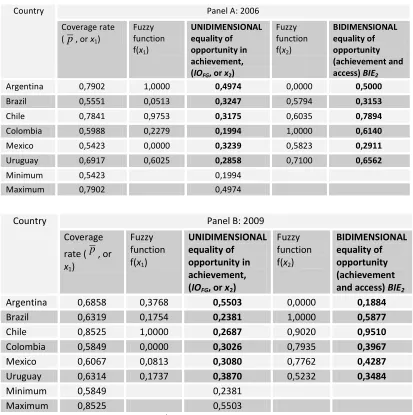
Results obtained using the second version of the index (BIE2) appear in Table 2. The
same rank reversals are observed. In fact, the correlation between calculated values for BIE2
and BIE2 is 0,97, turning the second version redundant at this point.
< Table 2 around here >
5. Generalizing the approach: Further dimensions and varying weights
It is a natural step to generalize our approach, allowing both for more dimensions and
for different weights for each dimension. The intuition is that when we use such bidimensional
indices, we are in fact:
(i) Defining social welfare functions – or, more precisely in this context: “equality of
opportunity functions” – based upon certain attributes, BIE = f (EOp in access, EOp in
achievement). However, other attributes could be incorporated. Although we
presented BIE3 as a bidimensional index in which one of the dimensions is subdivided
in two subdimensions, we were already hinting in fact on three dimensions:p, (1 – D),
and (1 - IOFG). More generally, the index could be multidimensional.
(ii) Working with implicit weights and thus ad hoc trade-offs between the two (now
5.1. A multidimensional index
Average scores might be a relevant dimension of equality of educational opportunities.
Worried about the quality of education of second-generation immigrants in OECD countries,
Kunz (2012) is particularly concerned with those living in Germany, whose average score in
reading in PISA 2009 is 474. However such indeed worrying result is in fact much better than
the average score in any Latin American country in that year, where the highest average score
is Chile’s (449). So while second-generation immigrants are in a very bad relative position in
the German context, in absolute terms the German schooling system provides more
opportunity to that worse-off group for acquiring knowledge and basic skills than
Latin-American schooling systems provide to their average pupils. That might be viewed as a
dimension of opportunity too: ceteris paribus, if country A’s average score is higher than
country B’s, country A provides more opportunities than country B.13 Those who agree with
that view could advocate four dimensions of equality of opportunity: achievement (1 – IOFG),
overall access ( p), cross-types dissimilarity with respect to access (1 – D), and a country’s average score, (s), suitably transformed to fit the (0,1] interval, for example by dividing the average score of a given country by the score of the country presenting the highest average
score. We would have the following multidimensional index:
(
)
EOp t achievemen
overall types across
FG
EOp access
types across overall
s IO D
p MIE
− − −
−
⋅ − ⋅ − ⋅
= ( ) (1 ) 1 ( )
1 (3.7)
It should be noticed that in Equation 3.7, we have included a country’s average score,
)
(s as a fourth dimension, but that term can also be interpreted as a subdimension of achievement-EOp: in fact, within the achievement-dimension, (s) is the analogue of
)
( p within the access dimension, in the sense that both indicate the overall educational opportunities available in the country. Similarly the other two terms, (1 – D) and (1 – IOFG), are
analogous since both indicate the way the available opportunities are divided across types.
In table 3, we show BIE1 multiplied by average scores, rescaled to fit the interval [0,1],
both for 2006 and 2009. Mexico and Brazil exchange positions in this new ranking as compared
to the BIE1 ranking due to Brazil’s extremely low average scores. The same happens in 2009
between Colombia and Uruguay.
13 We would like to thank Erwin Ooghe for the suggestion of including average scores as an additional dimension of
< Table 3 around here >
We would like to add two final comments here. The first is that further dimensions
could be added to MIE1. The second is that although we only presented here as an aggregation
method the simple multiplicative form, it is also possible to employ the fuzzy sets approach, a
point to which we turn at the end of Section 5.
5.2. Parameterized weights
Let us take Equation 3.7 above as a starting point. There, we had implicit exponentials
of 1 for all the four terms: that is, each attribute was equally weighted in such Cobb-Douglas
function. But we could very well imagine that different persons value differently each
dimension of equality of opportunity, so that a more appropriate way of presenting the index
would be in a general form, such as the one that follows:
(
)
χ δβ
α.(1 ) 1 .( ) )
(p D IO s
MIE = − ⋅ − FG (3.8)
where: α, β, γ and δ are (normative) weights, all of them nonnegative and possibly
normalized to sum 1.
As a first example of the relevance of explicitly parameterizing the weights, it could be
the case that for some observers average scores might have nothing to do with equality of
opportunity. Based on Equation 3.8, that would simply mean they assume δ=0.
As a second example, remember that in a previous section of this paper we have
expressed our view that while both access and achievement are important, access is more
crucial an issue. Using a simplified version of Equation 3.8 (in which β = δ = 0), the hierarchical
view advocated there could be reflected, for example in assuming α > γ. In Figure 4a, we have
plotted iso-opportunity curves with β = δ = 0 and α > γ. According to the specific parameters
chosen (α = ¾ and γ=1/4), we now observe that Uruguay and Argentina which were in different
iso-opportunity curves when we had α = γ (Figure 4a), now share the same iso-opportunity
curve, a result which is driven by the now larger weight attributed to the access dimension, in
Finally, we could also turn to fuzzy sets transformations in order to write a general
index with i-weights, which we now denote MIE’i: which has the advantage of allowing a less
ad hoc transformation of the average scores than the one commented on above.14
δ χ β α χ δ β α + + + ⋅ + ⋅ + ⋅ + ⋅ = ′ − − − − EOp t achievemen overall types across EOp access types across overall i x f x f x f x f E
MI ( 1) ( 2) ( 3) ( 4) (3.8)
This could be viewed as the most complete and general of all those discussed here.
6. Final remarks
The measurement of inequality of opportunity in the educational sphere has been the
focus of recent contributions, which concentrate either on opportunity for access to a given
level of studies, or on opportunity in terms of educational achievement. In this paper, we
combine both concerns, as a way of addressing important limitations of PISA datasets
regarding developing countries’ coverage rates, which cast doubts on the reliability of
previously calculated levels of equality of opportunity.
Instead of trying to explicitly reconstruct a full sample for each country as previously
attempted in the literature, our strategy consists of calculating a bidimensional index, in which
conventional equality of opportunity in test scores represents one dimension (the
achievement-conditional-on-participating dimension) while the second dimension reflects
PISA’s coverage rate (or the access-to-PISA dimension). The method we propose could
attenuate biases affecting inequality of educational opportunity indices that overlook coverage
rates, which stem from the fact that many young individuals abandon the educational system
in early years of their lives, either temporarily or for good – in either case, becoming ineligible
to PISA exams.
It is important to notice that, while motivated by PISA’s problem, our method’s
usefulness is not restricted to that particular test scores database; it is applicable, for example,
to national datasets presenting similar problems, and possibly to noneducational spheres.
For a number of reasons – including the message given to policymakers concerned by
equality of educational opportunity calculations – it does not seem reasonable to simply ignore
pupils not represented by PISA samples, in particular those who are out of school or who are
enrolled but attending a very low grade. These individuals face indeed even more primary
14 There is also the technical advantage of allowing extreme cases such as zero coverage rate or average scores, as
forms of inequality of opportunity, and should not be disregarded. Through the illustrative
exercise we undertake employing Latin-American countries that took part in PISA 2006 and
2009, we confirm our initial intuition that taking into consideration only inequality of
educational opportunity in terms of achievement led to biased results: ranking the six
countries according to the bidimensional index we propose differs from ranking them
according to a conventional index.
The index we propose could be extended to account for more dimensions. The cost of
adding more details would be paid in terms of reduced parsimony, since we would need to
turn to national datasets.
There are a few possibilities of extension. For example, estimating confidence intervals
for the calculated levels of equality of educational opportunity. Or testing the sensitivity of our
estimations to the set of circumstances included into the regression-based estimations of
inequality of opportunity for achievement. Including HOI in what we presented as BIE3 and BIE4
is another possible extension, on which we are working right now. Finally, it would be
interesting to decompose the contribution to (in)equality of educational opportunities (or to
References
Cecchi, D. and Peragine, V. (2010), “Inequality of Opportunity in Italy”. Journal of Economic
Inequality, 8, pp. 429-450
Cecchi, D., Peragine, V. (2005), “Regional Disparities and Inequality of Opportunity: The Case of Italy”. IZA Discussion Papers 1874, Institute for the Study of Labor (IZA)
Cerioli, A., Zani, S. (1990), “A Fuzzy Approach to the Measurement of Poverty”. In: Dagum, C., Zenga,
M. (eds), Income and Wealth Distribution, Inequality and Poverty, Studies in Contemporary Economics,
Berlim: Springer Verlag, pp. 272-284.
Cheli, B., Lemmi, A. (1995), “A Totally Fuzzy and Relative Approach to the Multidimensional Analysis
of Poverty”, Economic Notes, Monte dei Paschi di Siena, vol. 24, nº 1, pp. 115-134.
DiNardo, J., Fortin, N. and Lemieux, T. (1996), “Labor market institutions and the distribution of
wages 1973–1992: a semiparametric approach”. Econometrica 64 (5): pp. 1001–1044.
Dunnzlauf, L., Neumann, D., Niehues, J., Peichl, A. (2010), “Equality of opportunity and redistribution in Europe”. IZA Discussion Papers 5375, Institute for the Study of Labor (IZA).
Ferreira, F., Gignoux, J. (2011), “The measurement of educational inequality: Achievement and
opportunity”. Working Papers 240, ECINEQ, Society for the Study of Economic Inequality.
Gamboa, LF.; F.D. Waltenberg (2012). "Inequality of opportunity in educational achievement in Latin
America: Evidence from PISA 2006-2009". Economics of Education Review, 31(5), pp. 694-708, October
Kunz, Johannes S. (2012), "Analyzing educational attainment differences of immigrant children across countries" Mimeo, University of Zurich
Lemmi, A., Betti, G. (2006), “Fuzzy Set Approach to Multidimensional Poverty Measurement”, Economic Studies in Inequality, Social Exclusion and Well-Being, vol.3. Springer.
OECD (2009), PISA 2006 Technical Report, Paris: OECD. Retrieved from
www.oecd.org/dataoecd/0/47/42025182.pdf.
OECD (2012), PISA 2009 Technical Report, Paris: OECD Publishing
http://dx.doi.org/10.1787/9789264167872-en.
Paes de Barros R., Ferreira F., Molinas J., and Saavedra J. (2009), Measuring Inequality of
Opportunities in Latin America and the Caribbean. Washington, DC: World Bank.
Peragine, V.: Review of “Measuring inequality of opportunities in Latin America and the Caribbean”, by Paes de Barros, R., Ferreira, F., Molinas, J., Saavedra, J.:World Bank and Palgrave Macmillan, 2009, Journal of Economic Inequality (2011) 9:137–143. DOI 10.1007/s10888-010-9151-2 (2010)
Pignataro, G. (2012), “Equality of opportunity: policy and measurement paradigms”. Journal of
Economic Surveys. 26 (5), 800-834. doi: 10.1111/j.1467-6419.2011.00679.x.
Ramos, X., Van de Gaer, D. (2012), “Empirical approaches to inequality of opportunity: Principles,
measures, and evidence.” Working Papers 259, ECINEQ, Society for the Study of Economic Inequality
Roemer, J. (1998), Equality of opportunity. Cambridge, MA: Harvard University Press.
Vega, J. R. M., Paes de Barros, R.P. de, Saavedra, J., Guibale, M. (2010), Do our children have a
chance? The 2010 Human Opportunity Report for Latin América and the Caribbean. World Bank, Washington, DC, 176p
1 9 Fi g u re 1 – P IS A 2 0 0 6 : c o v e ra g e r a te
0 0,1 0,2 0,3 0,4 ,50 0,6 0,7 0,8 0,9 1
Coverage rates Switzerland Canada Belgium Norway Sweden Germany Poland United Kingdom Finland Austria France Greece Italy Japan Mean OECD Australia Korea Spain Dennmark Hungary United States New Zeaand Argentina Chile Portugal Uruguai Mean Am.Latina Colômbia Brazil México Turkey F ig u re 2 – P IS A 2 0 0 9 : c o v e ra g e r a te
0 0,1 0,2 0,3 0,4 ,50 0,6 0,7 0,8 0,9 1
[image:20.612.494.715.163.451.2] [image:20.612.153.365.164.465.2]Figure 3. Rankings: equality of opportunity in achievement (1-IO) versus equality of opportunity in
both achievement and access (BIE1)
a. 2006
b. 2009
Figure 4a. Iso-opportunity curves and EOp in Latin-American countries employing (BIE1).
5b. Iso-opportunity curves and EOp in Latin-American countries employing (MIE)
(β = δ = 0 and α > γ)
Table 1 – Unidimensional and bidimensional indices of (in)equality of educational
opportunity – 2006-2009
Country Panel A: 2006
Coverage rate in
PISA, p
Inequality of opportunity
in achievement,
IOFG
UNIDIMENSIONAL equality of opportunity in achievement,
(1-IOFG)
BIDIMENSIONAL equality of opportunity (achievement and access)
BIE1
Argentina 0,7902 0,4974 0,5026 0,3971
Brazil 0,5551 0,3247 0,6753 0,3748
Chile 0,7841 0,3175 0,6825 0,5351
Colombia 0,5988 0,1994 0,8006 0,4795
Mexico 0,5423 0,3239 0,6761 0,3667
Uruguay 0,6917 0,2858 0,7142 0,4940
Country Panel B: 2009
Coverage rate in
PISA, p
Inequality of opportunity
in achievement,
IOFG
UNIDIMENSIONAL equality of opportunity in achievement,
(1-IOFG)
BIDIMENSIONAL equality of opportunity (achievement and access)
BIE1
Argentina 0,6858 0,5503 0,4497 0,3084
Brazil 0,6319 0,2381 0,7619 0,4814
Chile 0,8525 0,2687 0,7313 0,6234
Colombia 0,5849 0,3026 0,6974 0,4080
Mexico 0,6067 0,3080 0,6920 0,4198
Uruguay 0,6314 0,3870 0,6130 0,3871
Table 2 – Bidimensional indices of inequality of educational opportunity using fuzzy sets
technique (BIE2) – 2006-2009
Country Panel A: 2006
Coverage rate
(p, or x1)
Fuzzy function
f(x1)
UNIDIMENSIONAL equality of opportunity in achievement, (IOFG, or x2)
Fuzzy function
f(x2)
BIDIMENSIONAL equality of opportunity (achievement and access) BIE2
Argentina 0,7902 1,0000 0,4974 0,0000 0,5000
Brazil 0,5551 0,0513 0,3247 0,5794 0,3153
Chile 0,7841 0,9753 0,3175 0,6035 0,7894
Colombia 0,5988 0,2279 0,1994 1,0000 0,6140
Mexico 0,5423 0,0000 0,3239 0,5823 0,2911
Uruguay 0,6917 0,6025 0,2858 0,7100 0,6562
Minimum 0,5423 0,1994
Maximum 0,7902 0,4974
Country Panel B: 2009
Coverage
rate (p, or x1)
Fuzzy function f(x1)
UNIDIMENSIONAL equality of opportunity in achievement, (IOFG, or x2)
Fuzzy function f(x2)
BIDIMENSIONAL equality of opportunity (achievement and access) BIE2
Argentina 0,6858 0,3768 0,5503 0,0000 0,1884
Brazil 0,6319 0,1754 0,2381 1,0000 0,5877
Chile 0,8525 1,0000 0,2687 0,9020 0,9510
Colombia 0,5849 0,0000 0,3026 0,7935 0,3967
Mexico 0,6067 0,0813 0,3080 0,7762 0,4287
Uruguay 0,6314 0,1737 0,3870 0,5232 0,3484
Minimum 0,5849 0,2381
Maximum 0,8525 0,5503
Table 3 – A multidimensional index: Taking average scores into account– 2006-2009
Country Panel A: 2006
Coverage rate in PISA, p
Inequality of opportunity in
achievement,
IOFG
BIDIMENSIONAL equality of opportunity
(achievement and access) BIE1
Average score
Score as a fraction of the maximum possible score
(700)
MULTIDIMENSIONAL equality of opportunity index
Argentina 0,7902 0,4974 0,3971 381 0,54 0,22
Brazil 0,5551 0,3247 0,3748 370 0,53 0,20
Chile 0,7841 0,3175 0,5351 411 0,59 0,31
Colombia 0,5988 0,1994 0,4795 370 0,53 0,25
Mexico 0,5423 0,3239 0,3667 406 0,58 0,21
Uruguay 0,6917 0,2858 0,4940 427 0,61 0,30
Country Panel B: 2009
Coverage rate in PISA, p
Inequality of opportunity in
achievement,
IOFG
BIDIMENSIONAL equality of opportunity
(achievement and access) BIE1
Average score
Score as a fraction of the maximum possible score (700)
MULTIDIMENSIONAL equality of opportunity index
Argentina 0,6858 0,5503 0,3084 388 0,55 0,17
Brazil 0,6319 0,2381 0,4814 386 0,55 0,27
Chile 0,8525 0,2687 0,6234 421 0,60 0,37
Colombia 0,5849 0,3026 0,4080 381 0,54 0,22
Mexico 0,6067 0,3080 0,4198 419 0,60 0,25
Uruguay 0,6314 0,3870 0,3871 427 0,61 0,24