Interaction between structural
capital and human capital in
Italian NPOs
Leadership, organizational culture and human
resource management
Paula Benevene
LUMSA University, Rome, Italy, and
Michela Cortini
University G. d’Annunzio, Chiete Pescara, Italy
Abstract
Purpose– This explorative research aims at examining the relationship between human capital and structural capital in Italian NPOs, focusing on senior managers.
Design/methodology/approach– Administration of a semi-structured interview to 122 senior managers of the same number of Italian NPOs. Interviews have been analyzed using different techniques: content analysis, run through the software T-Lab (analysis of word occurrence and co-word mapping, analysis of Markovian sequences), as well as discourse analysis carried out by two independent judges.
Findings– Italian NPOs’ organizational culture is action-oriented and self-referral, not knowledge-oriented. Training is not considered as a tool for strategic management of HR. Senior managers are mainly self-taught and lack adequate competence on HR management. Organizational culture does not help the development of human capital as it neither uses structured procedures to select the best candidates, nor develops a training programme based on the organizational specific needs.
Research limitations/implications– The group approached is a convenience sample, not a statistical representative sample.
Practical implications– The paper suggests that intellectual capital can be an effective tool to address Italian NPOs’ self-referential knowledge and overcome their gaps in strategic management of human resources.
Originality/value– NPOs’ senior manager training has rarely been addressed; in addition, the adopted methodology triangulates different qualitative techniques of analysis.
KeywordsHuman capital, Capital structure, Non-profit organizations, Senior management, Strategic management, Human resource management
Paper typeResearch paper
1. Knowledge and its management through intellectual capital
According to Romer (1986) knowledge-based innovation is what drives economic growth. Knowledge is the most important resource that organizations can rely on to generate innovation (Nonaka and Takeuchi, 1995). Knowledge can add value to organizations through intangible assets (such as customer relationships, goodwill, brand recognition and competences of employees), which are defined by Sveiby (1997) as knowledge structures.
The current issue and full text archive of this journal is available at
www.emeraldinsight.com/1469-1930.htm
Interaction in
Italian NPOs
123
Journal of Intellectual Capital Vol. 11 No. 2, 2010 pp. 123-139
Those intangible assets are defined as intellectual capital (IC). Edvisson and Sullivan (1996) have defined it as knowledge that can be converted into value. There are many evidences that IC has a positive impact not only on corporate value but also on its present and future performance (see, e.g. Bontiset al., 2000; Chenet al., 2005; Youndt and Snell, 2004).
There are many different ways in which the term IC has been approached and defined. Nevertheless, in spite of its multidimensional nature, the construct of IC is commonly conceptualized as divided into three components:
(1) Human capital (HC) (attitudes, skills and competences of people in the organization).
(2) Relational capital(RC) (relationships with customers or other stakeholders). (3) Structural or organizational capital (SC) (organizational culture, routines and
practices, intellectual property) (see, e.g. Bontis, 1996; Edvinsson and Malone, 1997; Marr, 2005; Rooset al., 1997; Stewart, 1997).
According to Edvinsson and Malone, (1997, pp. 145-6) “Corporate value does not arise directly from any of its Intellectual Capital factors, but only from the interaction between all of them”.
2. IC management and NPOs
Until now, researches and studies on IC have been mainly developed and used by for-profit organizations. Fewer were focused on non-profit organizations (NPOs), in spite of the fact that since the early 1990s NPOs stand out as crucial actors in politics, economics and welfare systems (Salamonet al., 2003). Kong (2007a, 2008) suggests that IC can be applied as a conceptual framework for effective strategic management of NPOs, since it does not have an economic nature and shifts strategic focus to intangible resources.
It is a matter of fact that IC has already proved to be important for the success of organizations selling services rather than concrete goods (Namasivayam and Denizci, 2006) since their products are, to a large extent, intangible in nature. Furthermore, the intangible aspects in NPOs are even more emphasized because the wellbeing of the beneficiaries of their services is more important than financial success.
3. Human capital (HC), human resources strategic management (HRSM) and training
HC is formed by aptitudes, competences, experiences and skills of internal members of the organizations (Bontis, 1999; Bontis et al., 2002). Human resources are crucial in creating HC because organizations do not create knowledge otherwise (Argyris and Scho¨n, 1978). Organizations can increase their human capital by attracting individuals with high skills from the external labor market and/or by internally developing the skills of their current members. In the latter, a big role is plaid by employees’ retention. Small organizations are more likely to make the best out of their existing resources, rather than attracting new, more skilled and superiorly paid employees. Strategic and operational choices of small organizations (such as most Italian NPOs) are quite often limited by resource constraints, but there are evidences that human capital
JIC
11,2
development facilitated by training can play a pivotal role in innovation and consolidation of small and medium size organizations (Baldwin and Johnson, 1996).
In addition, it must be noted that several studies and researches have already demonstrated that human resource management is more complex in NPOs than in public or for-profit organizations. Senior managers of NPOs must deal with and harmonize different motivations, working schedules, training systems and, approaches with the staff, volunteers, donors and other stakeholders (Abzug and Webb, 1999). Nonetheless, human resources are the most important resource in NPOs: services offered by these organizations depend mostly on human resources rather than on technical or logistical resources (Boyleet al., 2007). Strategic management of the human resources is therefore vital, because it integrates HR management into HR strategy (Kong, 2007b)
4. Relational capital (RC) and its interaction with HC and SC
RC is made of relationships with external stakeholders and NPOs are accountable for many of these: volunteers, donors, clients/people who benefit from the services; other NPOs with which they co-operate; national and local administrators (with which NPOs often co-operate), State institutions and public services (from which NPOs receive a significant amount of money to fund their activities), suppliers and the public opinion (Anheier, 2000). Not only the senior management (whom has the ultimate responsibility for the NPO’s reputation and external relationships) but also employees and volunteers play a role in constructing bridges with the external environment as well as creating a positive “brand name” for the organization’s services. Thus HC and RC interact.
RC is what enables NPOs to learn from their environment in order to better serve their targets/customers with their services, as well as to understand new requests and needs coming from the situation in which they operate. RC and SC interact through organizational culture, which defines the field of intervention of the organization, the environment in which it situates itself and the approach to the issues addressed by the organization.
5. Structural capital (SC) and organizational culture
Structural capital is the supportive infrastructure for human resources. It is made up of organizational culture, management philosophies, organizational processes, systems and informational resources.
IC management needs an organizational culture that is able to create and store knowledge. No matter how culture is defined and whichever are its contents, it inevitably affects the management of IC as well as knowledge creation, because culture is what provides the basis for the organizations’ management (Lynn, 2003). Therefore HC interacts with SC through organizational culture.
NPOs’ organizational cultures are naturally action-oriented: the reason why a NPO starts its activities is to meet the specific needs of a targeted group of people, but given their limited resources, the organizational culture of most NPOs are built almost exclusively around delivering services and not addressing strategic issues (Borzaga and Fazzi, 2000; Fazzi, 2001). This might seriously hinder the development of knowledge due to the fact that they focus on efficacy and efficiency of the services and not on knowledge. Being adaptable and responsive to the environmental inputs is not sufficient to generate knowledge (Weick, 2001). Organizations should rather be able to
Interaction in
Italian NPOs
generate knowledge through the interpretation of environment signals (Daft and Weick, 1984). According to Kong (2009), NPOs must not only learn but should also drop outdated knowledge.
6. Strategic human resource management (SHRM), IC development and management, senior management
According to some scholars (Beckeret al., 1997; Youndt and Snell, 2004; Yang and Lin, 2009) IC is a mediator between SHRM and the organization’s performance. In other words, SHRM develops human, relational and organizational capitals, which have an impact on the organization’s performance. Senior management is responsible for implementing SHRM; IC management and knowledge creation need total commitment of the senior management (Cameron, 2002).
In a strict sense, senior managers are a part of HC, but they play a vital role in creating and supporting a positive learning environment and therefore in the successful implementation of IC (Allenet al., 1999). In fact, according to Senge (1990), all organizations learn but not necessarily teachings are always for the best. Governance structure plays a significant role in learning processes leading to innovation (Konget al., 2009).
In terms of HC, senior managers are crucial in attracting, selecting and retaining the right people in the organization as well as in devising and addressing training needs to develop the participation of employees and volunteers (Hudson, 1995).
In terms of RC, senior managers are responsible for creating networks; they guarantee procedural and outcome accountability to internal and external stakeholders; they are responsible for the external image of their organization and for preserving its good reputation.
In terms of SC, managers have an impact on the organizational culture, as well as in the processes and practices that are embedded in it, as they have the power to change, promote and reaffirm them. They have the authority to connect the mission to organizational practices, which appears to be one of the most efficient tools for retaining people (Brown and Yoshika, 2003).
7. IC as a tool for addressing Italian NPOs’ challenges
A specific characteristic of the Italian scenario is the presence of many small-sized NPOs, struggling to survive because of limited resources and a reduced group of big, strong and wealthy NPOs: the average NPO has 16 employees, while 84.8 per cent of Italian NPOs have no employees at all; 54.9 per cent of Italian NPOs have a budget which does not exceed 15,000 euros per year (CNEL-ISTAT, 2008). Italian NPOs also face other challenges: there is an average turnover of 20 per cent and lacks of strategic approach to management (ORUNP, 2006). The data show how Italian NPOs operate in a very competitive and high-demanding environment. A strategic approach to knowledge creation through IC management may help them to survive and grow, attaining competitive advantage with positive outcome (Kong and Prior, 2008). Nonetheless, IC management is almost unknown among Italian NPOs: according to the literature, in Italy there have reported only been two cases of NPOs which have assessed their IC (Bronzetti and Veltri, 2007).
JIC
11,2
8. The research design
In the previous paragraphs, we explained how through SHRM, senior managers of NPOs can develop HC, RC, OC and, IC can therefore create knowledge, attaining competitive advantage for their organization. HC, OC and RC interact among themselves, mainly through organizational culture and human resources. IC can be an effective tool for NPOs and, best suits its resources and products because it addresses intangible assets, which are the most important resources for NPOs.
We hypothesize that Italian NPOs do not use IC, but they might highly benefit from using it to address their management challenges.
We hypothesize that Italian NPOs are aware of being different from for-profit and public organizations, but their organizational culture tends to be quite self-referral, mainly built around delivering services and therefore addressing day-by-day issues, not oriented at developing strategic knowledge. Their SC (through organizational culture) interacts with HC, generating lack of adequate training; inadequate criteria and procedure of selection; limited competences of senior managers on HR management.
We therefore formulated the following hypotheses:
H1. In terms of IC, Italian NPOs: are not familiar with the use of IC as a strategic tool of management
H2. In terms of SC, the organizational culture of Italian NPOs:
Almost exclusively values on-the-job training as well as direct experiences gained on the field;
Perceives training as a tool for professional updating, rather than a tool for members’ development;
Has a quite limited representation of training and its potential, though Italian NPOs are very conscious that they have different training needs in comparison to for-profit and public organizations
H3. In terms of HC, Italian NPOs:
Do not use structured or formalized procedures to select the candidates that best suit the organization;
Have limited access to training opportunities;
Senior managers have a limited competence on HR management.
8. Methodology
A semi-structured interview and an ad hoc questionnaire were individually administered by trained researchers to 122 senior managers of 122 different Italian NPOs. The observed NPOs are social cooperatives (“cooperative sociali”), which are the most entrepreneurial elements of Italian NPOs (CNEL-ISTAT, 2008). They operate either by helping the integration of disable people, immigrants, former detainees into society through work or by offering social and educational services.
The observed NPOs are mainly young: only one-third of them started their activities between 1970 and 1989. The rest of them are equally divided into those who were born between 1990 and 1999 (n¼43; 35.25 per cent) and, between year 2000 and 2009 (n¼43; 35.25 per cent). The average number of employees is 31.38; only one-fifth (n¼26; 21.31 per cent) of the interviewed NPOs have less than ten employees.
Interaction in
Italian NPOs
Participants were asked to give information about: . Their personal representation of training;
. Procedures and criteria adopted in order to recruit and select senior managers of non-profit organizations;
. How senior managers are trained in human resources management and, how they assess their training opportunities in this area;
. How senior managers of Italian non-profit organizations assess their own skills and competences in human resources management; and
. The relevance and priority assigned to human resources management by non-profit organizations.
Interviews were audio-taped and transcribed. These have been analyzed using different techniques such as content analysis, run through the T-Lab software (analysis of word occurrence and co-word mapping, analysis of Markovian sequences) and, at last, discourse analysis was carried out by two trained independent judges, who deductively built codes, systematically reassessed them during the coding process and, finally adapted them inductively.
9. Main results
9.1 Representation of training
To understand respondents’ representation of training, the interviews started with an open-ended question: “What comes to your mind if you think about training?”.
In terms of analysis, we have performed a multilevel content analysis, including analysis of word occurrence and co-word mapping, sequence analysis and concept mapping analysis, with the assistance of the T-Lab software (Lancia, 2004, 2008).
We have prepared our text for analysis through lemmatization, which gives reorganization of the T-LAB database, creating different tables to analyze data; this means creating groups and putting words that have the corresponding meaning-root into the same group, for example “training” and “to be trained” belong together. This operation, obviously, has only been performed for words (lemmas or categories) that were considered interesting for the subsequent analysis, like work/job and training.
In terms of words occurrence, the most frequently used word is “training”, with 97 occurrences.
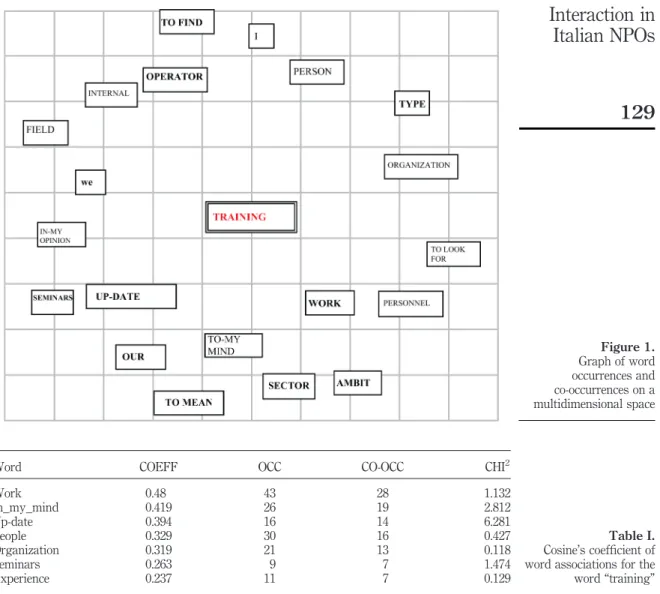
The first content analysis that was performed refers to word occurrences and co-occurrences (Figure 1 and Table I).
If we look at Figure 1, the more the words co-occur, the closer they are in the dimensional space. “Training” does not seem to be associated with anything like “strategic management”, “organizational development” or “human resource development” (which were not mentioned at all in the answers). Training appears to be considered as a useful way of up-dating professional skills, but not a tool for employees’ development.
The word “experience” does not appear in the central multidimensional scaling diagram (Figure 1), but it has a quite good index of association (Cosine’s coefficient 0.237) (Table I). Its association with “training” suggests that training is strongly associated with direct experience and less with formal or structured learning.
JIC
11,2
It is also interesting to see that other words with high association indexes are related to whom benefit from training programmes, “organization” and “people”, with, respectively, cosine coefficients of 0.319 and 0.329.
This final result may be read in the light of the fact that NPOs usually do not develop training opportunities on their own but they rather address their training needs sending their employees to informal/formal training sessions organized by other entities. Therefore both the organizations as a whole and their workers are seen as the parts who receive training benefits.
This result is strongly linked to the widespread representation of training as a transfer of knowledge and competences from an external source to both the
Figure 1.
Graph of word occurrences and co-occurrences on a multidimensional space
Word COEFF OCC CO-OCC CHI2
Work 0.48 43 28 1.132
In_my_mind 0.419 26 19 2.812
Up-date 0.394 16 14 6.281
People 0.329 30 16 0.427
Organization 0.319 21 13 0.118
Seminars 0.263 9 7 1.474
Experience 0.237 11 7 0.129
Table I.
Cosine’s coefficient of word associations for the word “training”
Interaction in
Italian NPOs
organization and the employees. In other terms, it appears to be a conceptualization of training and development of knowledge that is passively experienced by both of the recipients (organization and employees). Those reached by training do not seem to be actors, but spectators of the learning process.
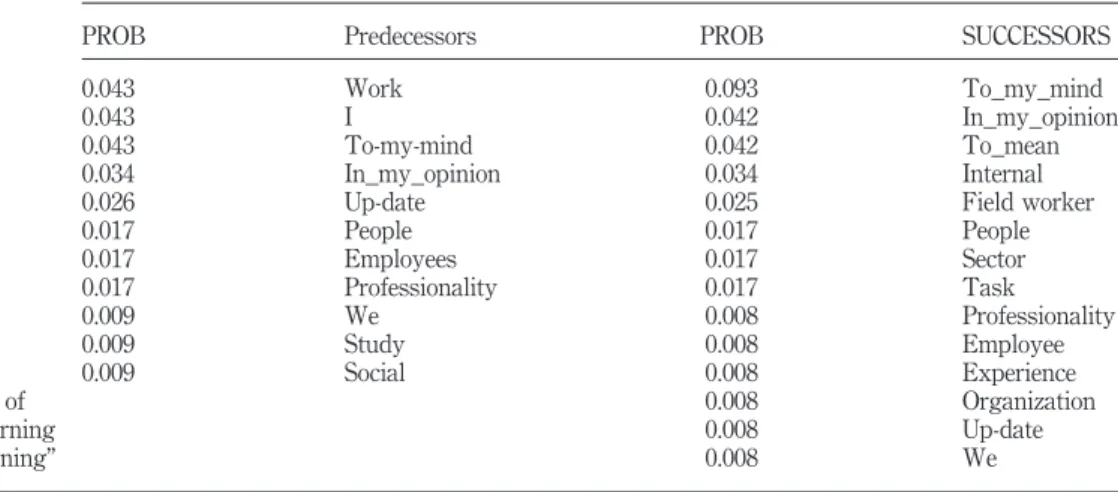
In addition, we have performed a Markovian analysis of the sequences, which are the syntagmatic relationships between the lexical units under analysis; this type of content analysis allows exploring in deeper details the lexical units’ relationship with one another. Each lexical unit has a predecessor and a successor that are respectively the lexical units that come before it and after it.
In mathematical terms, T-LAB calculates the transition probabilities (Markov chains) between the analyzed lexical units (max 1,500) starting from a matrix in which all the predecessors and all the successors of each lexical unit are recorded.
Table II shows a sorted list of predecessors (the first) and successors (the second) of the “training” lexical unit.
The list is in a descending order, according to the probability values (“PROB”). For example, in the following table, the probability that “employees” will follow “training” is equal to 0,017, that is 1.0 per cent and, the possibility that “field worker” comes before “training” is 0.25, that is 2 per cent.
Generally, the causes of the variables under analysis lie within the list of the predecessors; significantly, the most probable predecessor, in our case, is “work”. This result may suggest that in the participants’ opinion, training needs are related to the tasks and duties performed by employees, rather than a tool for organizational development.
The analysis of successors is not as clear; among the strongly associated words, there are communicative devices such as “in my mind”, “in my opinion”, “to mean”, which are ways to start a personal response to the question, thus are not meaningful for the analysis.
The rest of the lexical units, “internal”, “people” and further on in Markovian chains analysis have almost the same probability to be a successor and this stresses the idea that senior managers do not have a clear idea of the possible results of training
PROB Predecessors PROB SUCCESSORS
0.043 Work 0.093 To_my_mind
0.043 I 0.042 In_my_opinion
0.043 To-my-mind 0.042 To_mean
0.034 In_my_opinion 0.034 Internal
0.026 Up-date 0.025 Field worker
0.017 People 0.017 People
0.017 Employees 0.017 Sector
0.017 Professionality 0.017 Task
0.009 We 0.008 Professionality
0.009 Study 0.008 Employee
0.009 Social 0.008 Experience
0.008 Organization
0.008 Up-date
0.008 We
Table II.
Markovian analysis of the sequences concerning the lexical unit “training”
JIC
11,2
programmes (the consequences and results of variables under examination are found in the successors of Markovian sequences).
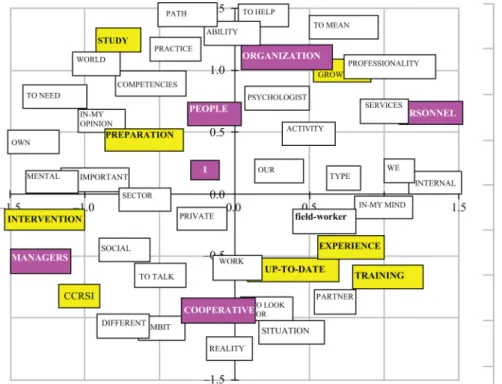
Finally, a concept mapping was run based on a co-occurrence matrix (word£word) and, on the mathematical computation of the association indexes (Cosine, in our case). It represents the outputs (Figure 2) through a graphic representation using multidimensional scaling.
This analysis was run using an occurrence-point seven times: this means that the matrix word£word is constituted only by words used at least seven times in our corpus. This choice has its rationale in terms of facilitating the interpretation of results. Results show two different categorical factors, marked in yellow and pink (Figure 2). The first one refers to the idea of training, going from “study” to “experience”, “update”, “training” etc; the second factor refers to the entities and people who benefit from training (“people”, “organization”, etc).
Concept mapping may be seen as a way to sum up and “reduce” the variability of discourse; in a way, this type of content analysis may be seen as a factor analysis performed on pure categorical data, such as words and words associations. In this case, the extraction of the factors mentioned above (for which the software can give the respective Eigen values), training types and training receivers, suggests that NPO senior managers do not have a sophisticated representation of training. On the contrary, their representation seems to be quite confused, unclear and not fully able to distinguish between professional and psychosocial training.
Figure 2.
Multidimensional scaling using a matrix word£word with seven times as cutting level of word occurrence
Interaction in
Italian NPOs
Not distinguishing between different types of training and educational needs, such as formal education, professional up-dating and field-experience seems to suggest that senior managers need to be more informed about possible training options, as well as their appropriateness for each organization, in order to address their needs effectively (Carli and Paniccia, 2004).
As far as the second factor is concerned, it is possible to interpret it in connection with the results of the index of association analysis. The relationship between the organization as a whole and its different employees emerged; when NPO managers are asked to think about psychosocial training, they cannot help referring to those who will benefit from participating in training programmes: both individual members and the NPO as a whole. At the same time, it seems as though there is no clear distinction between organizational and individual training needs and, no awareness about the relevance of shaping and scheduling training programmes.
9.2 Perceived training needs
Participants were asked whether NPOs have specific training/educational needs (“In your opinion, do non profit organizations need specific training?”). All senior managers (n¼122; 100.0 per cent) affirmed clearly that NPOs have specific training needs, different from those of for-profit and public organizations. The most recurrent reasons to explain these differences are mainly related to the NPOs’ specific approach, oriented towards people’s needs and not towards profit making (n¼58; 47.54 per cent) (“What distinguishes us is our attention to the society’s needs and weaknesses”; “Our sector is based upon people and relationships, therefore we need motivated and specialized members”; “Managing a NPO that offers social services is quite different from managing a public company, dealing for instance with road works”).
A quantitatively least significantly group of reasons deals with the need of constantly improving the offered services, through training (n¼21; 17.21 per cent)(“We need training because we improvise too often, we do our work without the proper preparation”; “When you work in the social field you cannot be untrained. Trained members’ work is 100 per cent effective; untrained members’ work is only 25 per cent effective”).
A third group of reasons deals with the need to improve human resource management (n¼12; 9.83 per cent) (“We need specific training to handle our paid staff and volunteers”; “Formal education or a degree doesn’t appropriately train a person who wants to work for a NPO”).
Money constraints (n¼76; 70.4 per cent), followed by time limitation and poor quality of training and inappropriate educational opportunities (Table III) are the most frequent obstacles to training.
n %
Money constraint 76 62.29
Time constraint 23 18.85
Poor quality of training opportunities 23 18.85 Training is not considered important 17 13.93
Note:More options could be expressed
Table III.
“What are the obstacles to obtaining more training?”
JIC
11,2
A small group of respondents (n¼11; 12.50 per cent) said that sometimes NPOs do not consider training as important as it should be (“Training is not a problem, the real problem is NPOs’ lack of interest in training”; “Training is underevaluated”).
9.3 Valuing direct experience and on-the-job training
Knowledge gained from field experiences seems to be highly valued, since seniority in the organization is considered as “very important” or “important” in almost 70 per cent of the interviewed organizations (n¼84; 60.85 per cent) (Table IV). (“Senior managers are former field-based workers, who have been given the opportunity to develop their career”; “Usually senior managers are already members of their own organization”):
Within the participants, a similar percentage (n¼82; 67.12 per cent) of current senior managers were already working in the non-profit organization before being recruited for the position. “Were the senior managers of your NPO working within the organization before being recruited for this position?”: only 18.85 per cent (n¼23) answered negatively; not respondents were 15 (12.29 per cent).
In addition, it emerged from the question “Which criteria does your NPO use for selecting its managers?”, that most recurrent criteria for selection are seniority within the organization (n¼49; 40.16 per cent) and experience gained in the same field of intervention (n¼25; 20.49 per cent). Formal and/or informal education was mentioned by only 16 respondents (13.11 per cent). Not respondents were 32 (26.22 per cent)
When participants were asked to answer the following question, “What procedures does your NPO use for selecting its managers?” they made it clear that NPOs do not use formalized or structured procedures. Most NPOs leave the president or the general secretary completely free of choosing the most suitable candidate (n¼79; 64.75 per cent). Assessment of candidates’ curriculum and/or job interviews are not widespread (respectively:n¼16; 13.11 per cent andn¼11; 9.01 per cent); only four participants (n¼4; 3.27 per cent) mentioned consulting external experts to select senior managers. A small numbers of respondents explained that senior managers are among the founders of the organization (n¼6; 4.91 per cent), therefore they have not been formally selected. Not respondents were 8 (6.55 per cent).
9.4 Competence on HR management
None of the respondents was familiar with IC (n¼122; 100.00 per cent). Being explicitly asked to evaluate NPOs’ senior managers’ competences and skills in human resource management (“How would you assess NPO’s senior managers’ competences, skills and knowledge in Human Resource management?”), about 60 per cent (n¼71; 58.19 per cent) of participants consider them as “inadequate” (“Senior managers are not
n %
Very important 54 4.26
Important 30 24.59
Fairly important 25 20.49
Of little importance 05 4.09
Not important at all 06 4.91
No answer 2 1.63
Total 122 100.00
Table IV.
When a non-profit organization recruits a manager, what importance is given to his/her previous field of experience in that same organization?
Interaction in
Italian NPOs
professionally trained on human resource management”). A minority (n¼21; 17.21 per cent) consider them as “adequate” and about one quarter (n¼30; 24.59 per cent) cannot express an opinion on this matter.
All participants answered to the question “How do senior managers of NPOs acquire their competences, skills and knowledge on Human Resources Management?” and participants were free to suggest any options. Most answered that senior managers are mainly trained on-the-job (n¼85; 69.67 per cent); having a specific degree or diploma related to their job is not frequently mentioned (n¼20; 16.39 per cent); sometimes they also attend informal courses, quite often organized by umbrella organizations (n¼16; 13.11 per cent); more often, they take advantage of participating in seminars and meetings organized by other NPOs (n¼36; 29.50 per cent), though those opportunities lack of continuity and usually are not part of a broader project. Non-respondents were 13 (10.65 per cent).
9.5 Development of senior managers’ competences, skills and knowledge
Training opportunities offered to the NPOs’ senior management are evaluated as “fully inadequate” or “partially adequate” by the majority of respondents (n¼98; 80.32 per cent). Only ten participants (n¼10; 8.19 per cent) consider them “adequate”. Not respondents were 12 (n¼12; 9.84 per cent).
In spite of this negative assessment, as well as the priority assigned to knowledge gained through previous field experiences, 70 per cent of participants (n¼79; 64.65 per cent) believe that senior managers of NPOs feel they need more training and, many of them (n¼51; 41.80 per cent) feel this very strongly (Table V).
Conclusions
In terms of structural capital, NPOs’ organizational culture definitely privileges knowledge gained from direct experience. In fact, the most recurrent criteria to select senior managers are seniority within the same organization and the experiences gained in the same field of intervention.
Organizational culture of Italian NPOs considers the training needs to be deeply different from those of for-profit and public organizations. The way organizational culture of NPOs conceptualize their different needs compared to for-profit and public organizations appears to play a key role, as it seems to underestimate the relevance of adapting practices and techniques of management that have already (successfully) been adopted by their counterparts, such as selection criteria and procedures. Nonetheless, in spite of recognising the importance of training, the representation of it is largely unclear and seems to consider it a way for updating professional skills, rather than a tool for developing human resources.
n %
Very much 51 41.80
Fairly 28 22.95
Not at all 31 14.75
No answer 12 9.83
Total 122 100.00
Table V.
“Do senior managers of NPOs feel they need more training?”
JIC
11,2
It might be interesting to further investigate into the approach adopted by NPOs towards training. From the interviews it emerges that there might be a problem with legitimating training, suggested by those who affirmed that “NPOs do not consider training important”. Further elements to be considered are the priorities embedded in the organizational culture of NPOs. Lack of time, for instance, might indicate a lower priority assigned to training on “not particularly relevant” issues that are not necessary to manage day-by-day organizational life.
Training seems to be something relegated to direct intervention, not an occasion for reflecting on action. A passive conceptualization of learning emerges, which is mainly considered a transferral of knowledge from external experts into the organization and to the employees. Organizations and employees are recipients, not actors or co-constructors of knowledge.
NPOs do not seem to be aware of the strategic role that training can play in organizational development. Snell and Dean (1992) have instead underlined the pivotal role played by training in organizations that are willing to transform their human capital from touch labour to knowledge work. The issue of training is even more strategic in Italian NPOs, as in these entities, human capital is “developed” rather than newly hired. It is rare that NPOs employ new, highly skilled employees that expect to be highly paid, as they do not have the financial possibilities to do so.
Organizational culture of Italian NPOs does not help the development of HC as it does not feel the need of structured and formalized procedures to select the best candidate to become senior manager. It does not develop training opportunities based on the organization’s specific needs and, the training opportunities offered by outsourcing are considered to be of poor quality and limited, also due to the money constraint (as suggested by the priority assigned to fund raising among the training needs).
A consequence of limited approach towards HC development is to be found in the inadequate competences of senior managers on HR. As a consequence of the priority assigned to fieldwork and, not to competences on strategic management, senior managers build their competences mainly through their direct experience. Furthermore, most of the senior management within the considered NPOs has been promoted in the same organization. For this reason, it can be assumed that senior managers have a deep knowledge of their own organization’s field of intervention and are well aware of their own organization’s values, mission and interventions. On the other hand, procedures and criteria of selection adopted by NPOs cannot guarantee that senior managers have an adequate knowledge on human resource management. In addition there is a lack of a broader training project to develop their competences and skills. In fact, senior managers feel they need more training on this aspect. Senior managers of Italian NPOs are facing not only limited financial and human resources, but also high level of turnover, which can be easily seen as a consequence of their inadequate competences on HR management.
Lack of adequate competence in HR management is a serious point of weakness: McFarlane (2008) considers managers who operate in the knowledge economy as “knowledge leaders” and strongly underlines that they must be aware of the relationship between knowledge and those who possess it, in order to be able to fully and successfully play their role. Senior management could play a role in changing the organizational culture, also by shifting it from being action-oriented to
Interaction in
Italian NPOs
knowledge-oriented. To change and restructure the organizational culture, the organization has to mobilize its intellectual capital through its managers (Schwartz and Pogge, 2000).
More in general, a further efficient and strategic approach to management of the Italian NPOs is needed because these entities are mainly small, young and struggling to survive due to the resource constraints and the incessantly competitive environment in which they operate. There is a risk for NPOs of being stuck in a vicious circle, in which money and time constraints, together with lack of proper opportunities, generates a reduced participation in training and perpetuates the difficulties in strategic management.
Senior managers of Italian NPOS are not familiar with IC, but using IC might therefore offer them a more effective approach to the organizational management, because it shifts the focus of organizational management from service delivering to knowledge creating.
By adopting the IC approach, senior managers of Italian NPOs may have a wider and more useful picture of their resources and drop part of their organizational culture that no longer suits the organization. A change in the organizational culture might lead to different approaches of training and HR development. In fact, according to the IC theory, Human Capital is part of knowledge management, while Italian NPOs appear to be assuming that Knowledge management is part of human resource management, given the relevance assigned to the field and direct experiences. This is the reason why strategic management of human resources through intellectual capital may definitely help senior managers of Italian NPOs to address self-referential knowledge and overcome gaps in management of human resources (Kong and Thompson, 2006, 2009). A limit of the present research is the lack of representative samples of NPOs; the group of NPOs that have been studied is to be considered only a convenience sample. Therefore, analysis on variables such as age (years of activities), dimension (number of members, financial resources) and, type of NPOs (voluntary organizations, co-operatives, foundations, associations, and other NPOs) have not been carried out even though they might have suggested different points of view.
This research might be further developed through the administration of a questionnaire, collecting data on larger groups and statistically significant samples of NPOs. It could also be interesting to make a cross-cultural comparison, reaching NPOs of other countries.
References
Abzug, R. and Webb, N.J. (1999), “Relationships between nonprofit and for-profit organizations: a stakeholder perspective”, Nonprofit and Voluntary Sector Quarterly, Vol. 28 No. 4, pp. 416-31.
Allen, T.D., Russell, J.E.A., Poteet, M.L. and Dobbins, G.H. (1999), “Learning and development factors related to perceptions of job content and hierarchical plateauing”, Journal of Organizational Behavior, Vol. 20 No. 7, pp. 1113-37.
Anheier, H.K. (2000), “Managing non-profit organizations: towards a new approach”, Civil Society Working Paper No. 1, available at: www.lse.ac.uk/collections/CCS/pdf/cswp1.pdf (accessed 29 September 2009).
Argyris, C. and Scho´n, D. (1978), Organizational Learning: A Theory of Action Perspective, Addison-Wesley Publishers, Reading, MA.
JIC
11,2
Baldwin, J.R. and Johnson, J. (1996), “Human capital development and innovation: the case of training in small and medium-sized firms”, Statistics Canada Working Paper No. 74, available at: http://ssrn.com/abstract¼3138 or DOI: 10.2139/ssrn.3138 (accessed 26 September 2009).
Becker, B.E., Huselid, M.A., Pinkus, P.S. and Spratt, M.F. (1997), “HR as a source of shareholder value: research and recommendations”, Human Resource Management, Vol. 36 No. 1, pp. 39-47.
Bontis, N. (1996), “There’s a price on your head: managing intellectual capital strategically”,
Business Quarterly, Vol. 69 No. 4, pp. 40-7.
Bontis, N. (1999), “Managing organisational knowledge by diagnosing intellectual capital: framing and advancing the state of the field”, International Journal of Technology Management, Vol. 18 Nos 5-8, pp. 433-62.
Bontis, N., Crossan, M.M. and Hulland, J. (2002), “Managing an organisational learning system by aligning stocks and flows”,Journal of Management Studies, Vol. 39 No. 4, pp. 437-69. Bontis, N., Keow, W.C.C. and Richardson, S. (2000), “Intellectual Capital and business performance in Malaysian Industries”, Journal of Intellectual Capital, Vol. 1 No. 1, pp. 85-100.
Borzaga, C. and Fazzi, L. (2000),Azione Volontaria e Processi di Trasformazione del Settore Nonprofit, Franco Angeli, Milano.
Boyle, F.M., Donald, M., Dean, J.H., Conrad, S. and Mutch, A.J. (2007), “Mental health promotion and non-profit health organisations”,Health and Social Care in the Community, Vol. 15 No. 6, pp. 553-60.
Bronzetti, G. and Veltri, S. (2007), “Il bilancio del capitale intellettuale nel settore non profit: il caso ANPAS Piemonte, AF analisi finanziaria”,NuovaSerie, No. 68, pp. 1-33.
Brown, A.W. and Yoshika, C.F. (2003), “Mission attachment and satisfaction as factors in employee retention”,Non Profit Management and Leadership, Vol. 14 No. 1, pp. 5-18. Cameron, P.D. (2002), “Managing knowledge assets: the cure for an ailing structure”,
CMA Management, Vol. 76 No. 3, pp. 20-3.
Carli, R. and Paniccia, R.M. (2004),L’Analisi della Domanda, Il Mulino, Bologna.
Chen, M.C., Cheng, S.J. and Hwang, Y. (2005), “An empirical investigation of the relationship between intellectual capital and firms’ market value and financial performance”,Journal of Intellectual Capital, Vol. 6 No. 2, pp. 159-76.
Consiglio Nazionale Economia Lavoro (CNEL)-Istituto Nazionale di Statistica (ISTAT) (2008),
Primo Rapporto CNEL/ISTAT sull’economia sociale. Dimensioni e caratteristiche strutturali delle istituzioni non-profit in Italia, Consiglio Nazionale Economia Lavoro, Roma. Daft, R.L. and Weick, K.L. (1984), “Toward a model of organizations as interpretation systems”,
Academy of Management Review, Vol. 9 No. 2, pp. 284-95.
Edvinsson, L. and Malone, M.S. (1997),Intellectual Capital: Realizing Your Company’s True Value by Finding its Hidden Brainpower, HarperBusiness, New York, NY.
Edvinsson, L. and Sullivan, P. (1996), “Developing a model for managing intellectual capital”,
European Management Journal, Vol. 14 No. 4, pp. 356-64.
Fazzi, L. (Ed.) (2001),Cultura Organizzativa del Nonprofit, Franco Angeli, Milano. Hudson, M. (1995),Managing without Profit, Penguin, London.
Kong, E. (2007a), “The strategic importance of intellectual capital in the non-profit sector”,
Journal of Intellectual Capital, Vol. 8 No. 4, pp. 721-31.
Interaction in
Italian NPOs
Kong, E. (2007b), “The human capital and human resource management relationships in non-profit organisations: misunderstanding and implication”, International Journal of Knowledge Management Studies, Vol. 1 Nos 3/4, pp. 471-83.
Kong, E. (2008), “The development of strategic management in the non-profit context: intellectual capital in social service non-profit organisations”,International Journal of Management Reviews, Vol. 10 No. 3, pp. 281-99.
Kong, E. (2009), “Facilitating learning through intellectual capital in social services nonprofit organization”,The International Journal of Learning, Vol. 16 No. 2, pp. 533-47.
Kong, E. and Prior, D. (2008), “An intellectual capital perspective of competitive advantage in non-profit organisations”, International Journal of Non-profit and Voluntary Sector Marketing, Vol. 13 No. 2, pp. 119-28.
Kong, E. and Thomson, S.B. (2006), “Intellectual capital and strategic human resource management in social service non-profit organisations in Australia”,The International Journal of Human Resource Development and Management, Vol. 6 Nos 2-4, pp. 213-31. Kong, E. and Thomson, S.B. (2009), “An intellectual capital perspective of human resource
strategies and practices”,Knowledge Management Research and Practice, Vol. 7 No. 4, special issue on Measuring and Managing Knowledge Assets Dynamics, pp. 356-64. Kong, E., Jenkins, S. and Ardagh, D. (2009), “A preliminary analysis of learning processes for
innovation in member-serving non-profit organisations: the role of governance structure and its elements – shared knowledge, decision making and benefit sharing”,International Journal of Learning, Vol. 16 No. 6, pp. 1-16.
Lancia, F. (2004),Strumenti per l’analisi dei testi. Introduzione all’uso di T-LAB, Franco Angeli, Milano.
Lancia, F. (2008), “Word co-occurrence and similarity in meaning. Some methodological issues”, in Salvatore, S. and Valsiner, G. (Eds), Mind as Infinite Dimensionality, Carlo Amore, Roma.
Lynn, B.E. (2003), “Culture and intellectual capital management: a key factor in successful ICM implementation”, International Journal of Technology Management, Vol. 18 Nos 5-6, pp. 590-603.
McFarlane, D.A. (2008), “Effectively managing the 21st century knowledge worker”,Journal of Knowledge Management Practice, Vol. 9 No. 1, pp. 3-7.
Marr, B. (2005), “What is intellectual capital?”, in Marr, B. (Ed.), Perspectives on Intellectual Capital: Multidisciplinary Insights into Management, Measurement and Reporting, Elsevier, Oxford and Boston, MA.
Namasivayam, K. and Denizci, B. (2006), “Human capital in service organizations: identifying value drivers”,Journal of Intellectual Capital, Vol. 7 No. 3, pp. 381-93.
Nonaka, I. and Takeuchi, H. (1995),The Knowledge-Creating Company, Oxford University Press, New York, NY.
Osservatorio Risorse Umane nel Nonprofit (ORUNP) (2006), Indagine sulle prassi gestionali e retributive, Sodalitas-HayGroup, Milano.
Romer, P. (1986), “Increasing returns and long-run growth”,Journal of Political Economy, Vol. 94 No. 5, pp. 1002-37.
Roos, J., Roos, G., Dragonetti, N.C. and Edvinsson, L. (1997),Intellectual Capital: Navigating the New Business Landscape, Macmillan Press Limited, London.
Salamon, L.M., Sokolowski, W. and List, R. (2003),Global Civil Society. An Overview, The Johns Hopkins University, Baltimore, MD.
JIC
11,2
Schwartz, R.W. and Pogge, C. (2000), “Physician leadership is essential to the survival of teaching hospitals”,The American Journal of Surgery, Vol. 179 No. 6, pp. 462-8. Senge, P.M. (1990),The Fifth Discipline: The Art and Practice of the Learning Organization,
Doubleday Currency, New York, NY.
Snell, S.A. and Dean, J.W. (1992), “Integrated manufacturing and human resource management: a human capital perspective”,Academy of Management Journal, No. 35, pp. 467-504. Stewart, T.A. (1997),Intellectual Capital: The New Wealth of Organizations, Currency Doubleday,
New York, NY.
Sveiby, K.E. (1997),The New Organisational Wealth: Managing and Measuring Knowledge-based Assets, Berret-Koehler, San Francisco, CA.
Weick, K.E. (2001),Making Sense of the Organizations, Blackwell, Malden, MA.
Yang, C. and Lin, C. (2009), “Does intellectual capital mediate the relationship between HRM and organizational performance? Perspective of a healthcare industry in Taiwan”,
The International Journal of Human Resource Management, Vol. 20 No. 9, pp. 1965-84. Youndt, M.A. and Snell, S.A. (2004), “Human resource configurations, intellectual capital, and
organizational performance”,Journal of Managerial Issues, Vol. 16 No. 3, pp. 337-60.
About the authors
Paula Benevene teaches work and organizational psychology at LUMSA University, Rome, Italy. Her main research interests are in NPOs, organizational wellbeing and economic behavior of young people.
Michela Cortini teaches “Work and organizational psychology” at the University G. d’Annunzio of Chieti Pescara (Italy). Her main research interests are in organizational communication, organizational wellbeing and qualitative methods for I/O psychology. Michela Cortini is the corresponding author and can be contacted at: [email protected]
Interaction in
Italian NPOs
139
To purchase reprints of this article please e-mail:[email protected]