México
Publicación Digital de la Facultad de Medicina Veterinaria y Zootecnia
OA
https://veterinariamexico.unam.mx/Accepted: 2019-09-11
Published: 2019-12-11
Additional information and declarations can be found on page 10
Copyright 2019 Rolando Rojo-Rubio et al.
open access
Distributed under Creative Commons CC-BY 4.0
Abstract
The ovicidal effect of hydro-alcoholic extracts from mature fruits and dried leaves of the Caesalpinia coriaria tree, against Haemonchus contortus and H. placei was evaluated by the egg hatching inhibition test (EHIT). Secondary compounds within the extracts were identified by high performance liquid chromatography. Five extract concentrations were assessed in the inhibi-tion tests (25.0, 12.5, 6.2, 3.1 and 1.5 mg/mL), using distilled water and Thiabendazole (0.5 mg/mL) as negative and positive controls, respectively. The results were analysed under a 2 × 2 × 6 completely randomized facto-rial design, and mean differences were established by the Tukey’s post hoc test. The 50% (EC50) and 90% (EC90) effective concentrations for each extract were determined using a Probit analysis. A concentration-depen-dent ovicidal effect of hydro-alcoholic extracts from both leaves and fruits was observed, reaching a 100% efficacy against both nematode species with the 25.0 mg/mL concentration (p < 0.05). The EC50 for the fruit and leaves extracts were established as 1.63 and 3.91 mg/mL, and as 3.98 and 11.68 mg/mL, against H. contortus and H. placei, respectively. The most important secondary compounds identified in extracts were free-condensed tannins, gallic acid and methyl-gallate.In conclusion,hydro-alcoholic extracts from C. coriaria mature fruits and dried leaves inhibit in vitro egg hatchingof H. contortus and H. placei.
Keywords: Haemonchus, Caesalpinia coriaria, Secondary compounds, Tannins, Gallic acid
Caesalpinia coriaria
fruits and leaves
extracts possess
in vitro
ovicidal
activity against
Haemonchus contortus
and
Haemonchus placei
Rolando Rojo-Rubio1 0000-0003-2523-9299 Manases González-Cortazar2
0000-0002-3693-1670 Agustín Olmedo-Juárez3,* 0000-0001-5499-7449 Alejandro Zamilpa2
0000-0002-2233-5958 Javier Arece-García4 0000-0001-7902-2701 Germán David Mendoza-Martínez5 0000-0002-8613-6464 Héctor Aaron Lee6
0000-0001-6146-5790 José F. Vázquez-Armijo1 0000-0003-4888-969X Pedro Mendoza-de Gives3,*
0000-0001-9595-3573
1 Centro Universitario UAEM Temascaltepec,
Universidad Autónoma del Estado de México, Temascaltepec, Estado de México, México
2 Centro de Investigación Biomédica del Sur,
Instituto Mexicano del Seguro Social, Xochitepec, Morelos, México
3 Centro Nacional de Investigación Disciplinaria
en Salud Animal e Inocuidad, Instituto Nacional de Investigaciones Forestales Agrícolas y Pecuarias, Jiutepec, Morelos, México
4 Estación Experimental de Pastos
y Forrajes Indio Hatuey, Universidad de Matanzas, Matanzas, Cuba
5 Departamento de Producción Agrícola y Animal,
Universidad Autónoma Metropolitana, Ciudad de México, México
6 Facultad de Agronomía y Veterinaria,
Universidad Autónoma de San Luis Potosí, San Luis Potosí, México
*Corresponding authors:
Email address: [email protected]
Cite this as:
Introduction
Gastrointestinal nematodes that infect ruminants cause serious health problems that substantially decrease livestock productivity worldwide.1 This condition is fur-ther complicated by resistance of parasites against existing anthelmintic drugs.2 Thus, finding alternatives for parasitic control is necessary.
The use of secondary metabolites obtained from legume trees with anthel-mintic (AH) properties has become of increasing interest in recent years,3-5
pre-senting new natural alternatives for sustainable control of parasitic infections. Reported secondary compounds with anthelmintic properties include con-densed tannins, caffeic acid, ferulic acid and flavonoids.6 Moreover, nematicidal activity of flavonoids can be enhanced by their interaction with other compounds such as tannins, which produces a synergic effect.7 Isolated compounds such as caffeoyl and coumaroyl derivatives from a hydro-alcoholic extract of legume Acacia
cochliacantha leaves, have also been shown to have a high ovicidal activity (close
to 100%) against Haemonchus contortus.8
Plants from the Caesalpiniaceae subfamiliy, including C. coriaria, have anal-gesic, antibacterial, antifungal and anti-parasitic properties.9 The objective of this work was to assess the ovicidal activity of mature fruits and leaves hydro-alcoholic extracts from C. coriaria against H. contortus and H. placei, by an egg-hatching inhibition test.
Materials and methods
Plant material
Mature fruits and leaves were collected from seven Caesalpinia coriaria trees at the site of Palmar Grande, Amatepec in the state of Mexico, Mexico (18° 35’ 6” latitude north and 100° 24’ 59” longitude west, with an altitude of 640 m above sea level). The taxonomic identification of the recovered plant material was performed by an experienced biologist, and a sample was deposited at the herbarium of the Centro de Investigación en Biodiversidad y Conservación from the Universidad Autónoma del Estado de Morelos, Mexico (Voucher code: 35273). Mature fruits and leaves were separately mixed to get a homogeneous sample from all trees, and immedi-ately placed in a portable cooler at 4 ºC, for transport to the Laboratory of Animal Nutrition of the University Center UAEM Temascaltepec. Plant material was subse-quently left to dry under the shade, until reaching a 100% of dry matter and then ground in a Wiley mill (model 4; Thomas Scientific, Swedesboro, NY, USA), to obtain 2 mm particles.
Hydroalcoholic extracts
were totally dried by lyophilization (Labconco 4.5®) and stored at −40 °C until used for bioassays and phytochemical analyses.
Condensed tannin content
Hydro-alcoholic extracts from fruits and leaves were analysed to quantify total con-tent of condensed tannins (CTC), using the butanol-HCl method.10Lysiloma
aca-pulcensis free condensed tannins (FCT) were used as internal standards.11 Free
condensed (FCT1), protein-bound (PCT) and fiber-bound (FCT2) tannins were identified following the technique reported by Porter et al.12 Purification was per-formed using a Shepadex LH-20 column, as described by Hedqvist et al.13
Identification of secondary compounds by HPLC analysis
Mature fruits and leaves hydro-alcoholic extracts were analysed using a Waters 2695 separation module HPLC system, equipped with a Waters 996 photodiode array detector and the Empower Pro software (Waters Corporation, USA). Chemical separation was achieved in a supelcosil LC-F column (4.6 mm × 250 mm i.d., 5-μm particle size) (Sigma-Aldrich, Bellefonte, USA). A 0.5% trifluoroacetic acid aqueous solution (Solvent A) and acetonitrile (Solvent B) were used as the mo-bile phase. The gradient elution was as follows: 0-1 min, 0% B; 2-3 min, 5% B; 4-20 min, 30% B; 21-23 min 50% B; 24-25 min, 80% B; 26-27 min, 100% B; 28-30 min, 0% B. The flow rate was maintained at 0.9 mL/min, and the injection volume was 10 μL. Absorbance was measured at 280 nm. Gallic acid and methyl gallate were identified by contrasting retention times and UV spectra with reference standards (Sigma-Aldrich, St Louis, Mo, USA).14
Parasite eggs
Haemonchus contortus (INIFAP strain) and H. placei (wild strain) eggs were
col-lected from feces obtained from an experimentally infected sheep (16 ± 0.2 kg BW) and calf (175 ± 0.5 kg BW), respectively. To obtain parasite eggs, feces from donor animals were washed, passed through different sieve sizes (200, 100, 72 and 32 μm) and spun with a 40% sucrose solution to separate thicker particles. The resulting material was further washed with tap water, subsequently concentrat-ed by spinning (three times at 3500 rpm for 5 min), and finally re-suspendconcentrat-ed in sterile distilled water eggs were collected and used immediately in the bioassays.15
Egg hatching inhibition test (EHIT)
per-formed using an optical microscope (Motic B3®), in ten-5 μl aliquots placed on a slide per treatment. The egg hatching inhibition percentage was calculated by the following formula: [(number of eggs)/(number of larvae + number of eggs) * 100].15,16
Statistical analysis
Data were analysed by ANOVA.17 A 2 × 2 × 6 completely randomized factorial design was used.18 Analysed factors were: 1) Two types of extract (leaves or fruits),
2) two nematode species (H. contortus and H. placei) and 3) six extract dilution (25.0, 12.5, 6.2, 3.1, 1.5, and 0.0 mg/mL). Mean differences were determined by the Tukey post hoc test (p d 0.05). Finally, the Probit analysis was used to determine effective concentrations (EC50 and EC90) for both extracts, using the SAS program.
Results and discussion
Condensed tannin and other secondary compound
content in extracts
The quantity of free, fiber-bound, protein-bound and total condensed tannins for both C. coriaria hydro-alcoholic extracts is shown in Table 1. Polyphenolic compounds in the free-condensed tannin form were the most abundant, with 217.1 g/kg found for the mature fruits extract, and 137.1 g/kg for the leaves extract, in a dry matter (DM) basis. Conversely, protein-bound tannins were present in the lowest amounts (31.7 g/kg, for the mature fruits extract, and 21.7 g/kg for the leaves extract in a DM basis).
The major compounds identified in both hydro-alcoholic extracts are shown in Figure 1. The chromatographic analysis in the leaves extract revealed the presence of gallic acid and methyl-gallate (Fig. 1 A), whilst only methyl gallate was found in the mature fruits extract (Fig. 1B). García-Hernández et al.19 have previously reported the presence of methyl gallate and gallic acid, as well as other galloyl derivatives, in a hydro-alcoholic extract from C. coriaria fruits. Likewise, Sánchez-Carranza et al.20
found phenolic compounds, including ethyl gallate, gallic acid and tannic acid, in
C. coriaria pods.
Egg hatching inhibition
Inhibition of egg hatching in both nematode species increased with greater con-centrations of hydro-alcoholic C. coriaria mature fruits or leaves extracts, reaching a 100% inhibition with the 25 mg/mL concentration (p < 0.01) (Table 2). When ana-lyzed independently of concentration or nematode spp., the hydro-alcoholic leaves extract seemed to be more efficient for inhibiting hatching of eggs than the extract from mature fruits (79 and 52% EHI respectively, p < 0.0001). In addition, EHI per-centages were higher for H. contortus than for H. placei when either type of extract was added, indicating an apparent increased susceptibility to the hydro-alcoholic extracts for the former species of nematode (76% vs. 55% respectively, p < 0.01).
Haemonchus contortus and H. placei have a high prevalence as
Table 1. Free, protein-bound, fiber-bound and total condensed tannin content (g/kg DM) in Caesalpinia coriaria hydro-alcoholic extracts obtained from mature fruits or leaves
Tannin content Mature fruit extract Leaves extract
Free 217.1 137.1
Protein-bound 31.7 21.7
Fiber-bound 71.8 41.8
Total condensed 320.6 200.6
DM: dry matter.
0.00 0.10 0.20 0.30
6.50 7.00 7.50 8.00 8.50 9.00 9.50 10.00
Gallic acid
Methyl gallate
10.50 11.00 11.50 12.00
11.
656
10.0
22
9.
76
6
8
.858
8
.948
8.62
0
7.
055
0.00 0.10 0.20
-0.10 0.40
0.30
7.00 8.00 9.00 10.00
Methyl gallate
11.00 12.00 13.00
8.
5
70
8
.686
8.8
17
8
.99
7
9
.310
9
.646
9
.956
Au
Minutes
A
Au
Minutes
B
This work shows evidence of the ovicidal effect of two C. coriaria tree extracts against both parasites. Plants belonging to Caesalpiniaceae subfamily have been shown to possess different medicinal properties. Anthelmintic effects have been particularly found in the Caesalpinia genus.23,24 These results coincide with those recorded in the present study, and could be related to the content of free con-densed tannins, which is higher than in other leguminous species from the same region, such as Lysiloma acapulcensis11 and Acacia cochliacantha.4,8
Phenols, such as tannins, may negatively impact nematode egg hatching by binding to the egg cuticle which is rich in glycoproteins, forming a tannin-protein complex that may alter embryo development and eventually the hatching pro-cess.25,26 Parasitic load in H. contortus infected hair sheep was decreased when animals were fed with leaves of the L. acapulcensis tree, with an added beneficial effect in productive performance.27 Authors found a high content of condensed tannins (116 g/kg of dry matter) in these leaves. Both C. coriaria extracts (leaves and mature fruits) used in this study had a higher content of condensed tannins than that found for L. acapulcensis.
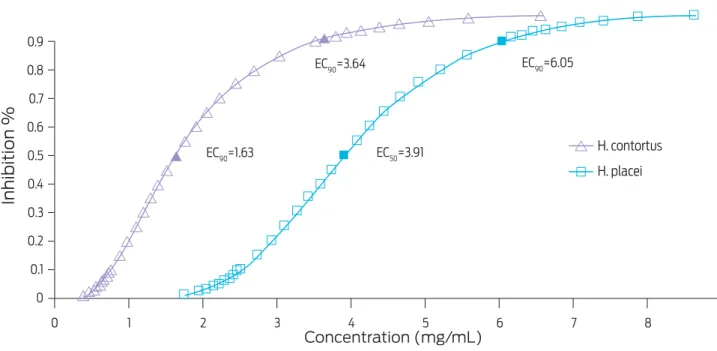
The effective concentrations EC50 and EC90 obtained with both C. coriaria
mature fruits and leaves extracts are shown in Figures 2 and 3, respectively. The EC50 and EC90 for the C. coriaria fruits extract were: 1.63 and 3.64 mg/mL respec-tively, for H. contortus eggs, and 3.91 and 6.05 mg/mL respectively, for H. placei
eggs. Effective concentrations using leave extracts were: EC50 > 3.98 and EC90 > 16.61 mg/ mL for H. contortus eggs, and EC50 > 11.68 and EC90 > 24.07 mg/mL,
for H. placei eggs (Fig. 3).
Table 2.Haemonchus contortus and H. placeiegg hatching inhibition test values after incubation with one of two Caesalpinia coriaria hydro-alcoholic extracts (from fruits or leaves) for 48 h
Treatments
Egg hatching inhibition (%)
Haemonchus contortus Haemonchus placei Mature fruits extract (mg/mL)
25.0 100a 100a
12.5 100a 100a
6.2 99.5a 92.75a
3.1 89.25a 33.75cd
1.5 58.75b 17.75e
0.0 3.25fg 2.75g
Leaves extract
25.0 95.25a 92.50a
12.5 90.00a 60.75b
6.2 60.00b 22.75de
3.1 40.75c 19.75de
1.5 27.50cde 16.25efg
0.0 3.25fg 2.75g
Thiabendazole (0.5 mg/mL) 100a 100a
P-value (Extract*Concentration*Nematode) <0.0001
SEM 0.10
0 0.1 0.2 0.3 0.4 0.5 0.6 0.7 0.8 0.9
1
0 2 3 4 5 6 7
Caesalpinia coriaria fruit extract
H. contortus
H. placei
8 9
EC90=1.63
EC90=3.64 EC90=6.05
EC50=3.91
Inhibition %
Concentration (mg/mL)
Figure 2. Effective concentrations (EC50 and EC90) required to inhibit hatching of H. contortus and H. placei eggs after a 48 h incubation with a Caesalpinia coriaria mature fruits extract, as determined by Probit analysis.
0 0.1 0.2 0.3 0.4 0.5 0.6 0.7 0.8 0.9 1
10
0 20 30 40 50
Caesalpinia coriaria leaves extract
H. contortus H. placei
60
EC90=24.07 EC90= 16.61
EC50= 11.68 EC50= 3.98
Inhibition %
Concentration (mg/mL)
A stronger ovicidal effect was observed when the fruits extract was used on both parasite species. In fact, the EC90 value for the fruits extract was fivefold than that obtained when the leaf extract was used on H. contortus eggs or fourfold on
H. placei eggs. Differences for effective concentrations found for leaves and fruits
extracts could be associated with content of phenolic compounds.7 A report of a
93% reduction in the number of Trichostrongylus eggs per gram of feces of infect-ed sheep, was recordinfect-ed when a methanolic extract from a leguminous of the same genus (Caesalpinia crista) than the plant used for this study, was administered orally (3 g/kg live weight). This same study found an EC50 of 0.134 mg/mL through the EHIT.28
Other specific compounds derived from secondary metabolism of Caesalpinia
spp. leaves, such as ellagocatechins and gallocatechins,28,29 have also been found to have nematicidal effects.29-31 Both gallic acid and methyl gallate, which were found in extracts used in the present study, are considered as the basic chemi-cal structure of hydrolysable tannins.32 The nematicidal activity of different plants has also been attributed to these two compounds.7 Indeed, a recent study by De Jesús-Martínez et al.,33 found a high ovicidal activity of a methanolic extract of C.
coriaria fruits harvested in Guerrero, Mexico, and the anthelmintic effect was
as-sociated with gallotannin content (methyl gallate). Similarly, another study showed that gallic acid and other galloyl derivatives obtained from C. coriaria fruits were associated with hatching inhibition of five gastrointestinal parasitic nematode eggs
(Haemonchus spp., Cooperia spp., Ostertagia spp., Trichostrongylus spp. and
Oe-sophagostomum spp.). However, these authors also showed that methyl gallate
had no activity against these parasites.19 Therefore, the increased efficiency in
ovi-cidal activity (against both parasites species) observed for the hydro-alcoholic ex-tract from C. coriaria leaves in the present study could be associated with its gallic acid content.
The anthelmintic activity of condensed and hydrolysable tannins has also been documented.34,35 To ascertain the anthelmintic effect of condensed tannins in particular, addition of polyethylene glycol (PEG) to the tests is imperative, since PEG has the ability to bind and inactivate tannins.36,37 Since PEG was not used in this study, the observed ovicidal effect of C. coriaria extracts cannot be directly attributed to their condensed tannin content, but it could be associated with found gallotannins.19 Hence, further in vitro studies are warranted (using PEG) to verify if condensed tannin content in extracts from C. coriaria fruits and leaves does in fact have an ovicidal activity.
Other studies ascribe nematicidal activity to free condensed tannins. For in-stance, Williams et al.6 evaluated acetone extracts of diverse tanniniferous plants
(Ribes nigrum, Tillia cordata, T. vulgaris, Salix spp. and Triflorium repens) by the
de-termination of EHT and larval development (L3) of Oesophagostomumdentatum (a pig nematode), and found a 90% inhibition of larval development at a 125-μg/mL concentration of all extracts used. The ovicidal effect of the studied extracts could also be related to the combined effect of phenols such as methyl gallate, gallic acid and flavonoids, which could interfere with the processes of embryo development of the larva within the egg. Indeed, ultrastructural damage on the cuticle of
Coo-peria spp. eggs has been observed through transmission electronic microscopy,
after being exposed to phenols (quercetin and caffeic acid) isolated from L.
inter-nal and exterinter-nal structures of infective larvae of H. contortus and Trichostrongylus
colubriformis(such as structural changes in the hypodermis, cytoplasmic vesicles
and muscular and intestinal cell degeneration), after a 3 h contact with Onobrychis
viciifolia condensed tannins.
Genetic diversity of each nematode parasite could also affect the efficiency of the ovicidal activity of fruits and leaves extracts from C. coriaria. In their adult stage, both nematode species can be distinguished by their morphological struc-tures such as the spicules and copulatory bursa in males, or the synlophe in males and females.38 A tri-layer complex cuticule has been described for H. contortus
eggs, with the external and middle layers composed of protein fibrils and chitin, respectively, as well as a semipermeable internal layer composed of lipids and glycoproteins.39 Information for H. placei egg composition is however very limited. The greater ovicidal activity found for H. contortus when compared to H. placei, independently of the type of extract used in this study could therefore be due to structural biochemical or molecular differences between these parasites. Future studies to establish and identify these factors are warranted.
Conclusions
Funding
Part of this study received financial support from the Instituto Nacional de Investiga-ciones Forestales Agrícolas y Pecuarias (INIFAP, Project SIGI 8215734475): Desar-rollo de un producto nutracéutico a partir de frutos secos de Caesalpiniacoriaria
adicionados a una dieta basal en cabritos Boer) and from the Universidad Autóno-ma del Estado de México (Project UAEMEX 4585/2018/CIP: Desarrollo de tres productos nutraceúticos elaborados a base de las leguminosas Acacia
cochliacan-tha, Caesalpinia coriaria y Acacia Farnesiana para un control de la nematodiasis
sustentable y aumento de la productividad de ovinos y caprinos, para la producción de carne inocua).
Acknowledgements
The authors wish to express their gratitude to Biologist Gabriel Flores-Franco from the Centro de Investigación en Biodiversidad y Conservación, UAEM, Morelos, Mex-ico for identifying the plant material used in this study. Also, the authors wish to thank Erik Lundell for his assistance in editing English language.
Conflicts of interest
The authors declare that they have no conflict of interest.
Author contributions
R. R.-R., M. G.-C. and A. O.-J. designed the study and wrote the manuscript; A. Z. performed the plant extraction processes and executed phytochemical identifica-tion of secondary compounds; J. A.-G., G. D. M.-M., H. A. L. and J. F. V.-A. analysed the data; P. M.-de G. designed the study and revised the manuscript.
References
1. Herrera-Manzanilla FA, Ojeda-Robertos NF, González-Garduño R, Cámara- Sarmiento R., Torres-Acosta J.F.J. Gastrointestinal nematode populations with multiple anthelmintic resistance in sheep farms from the hot humid tropics of Mexico. Vet Parasitol: Regional Studies and Reports. 2017;9: 29-33.
2. Kaplan RM, Vidyashankar AN. An inconvenient truth: global warming and anthel-mintic resistance. Vet Parasitol. 2012;186:70-8.
3. von Son de Fernex E, Alonso-Díaz MA, Mendoza de Gives P, Valles de la Mora B, Zamilpa A, González-Cortazar M. Ovicidal activity of extracts from four plant spe-cies against the cattle nematode Cooperia puncata. Vet Mex. 2016; 3(2): 1-14. 4. Olmedo-Juárez A, Rojo-Rubio R, Zamilpa A, Mendoza-de Gives P, Arece-García
J, López-Arellano ME, et al. In vitro larvicidal effect of a hydroalcoholic extract from Acacia cochliacantha leaf against ruminant parasitic nematodes. Vet Res Commun. 2017;41:227-32.
5. von Son-de Fernex E, Alonso-Díaz MA, Valles-de la Mora B, Mendoza-de Gives P, González-Cortazar M, Zamilpa A. Anthelmintic effect of 2H-chromen-2-one isolated from Gliricidia sepium against Cooperia punctata. Exp Parasitol. 2017;178:1-6.
6. Williams AR, Ropiak HM, Fryganas C, Desrues O, Mueller-Harvey I, Thamsborg SM. Assessment of the anthelmintic activity of medicinal plant extracts and pu-rified condensed tannins against free-living and parasitic stages of
7. Klongsiriwet C, Quijada J, Williams AR, Mueller-Harvey I, Williamson EM, Hoste H. Synergistic inhibition of Haemonchus contortus exsheathment by flavonoid monomers and condensed tannins. Int J Parasitol Drug. 2015;5:127-34. 8. Castillo-Mitre GF, Olmedo-Juárez A, Rojo-Rubio R, Cortazar-González M,
Mendo-za-de Gives P, Hernández-Beteta E.E, et al. Caffeoyl and coumaroyl derivatives from Acacia cochliacantha exhibit ovicidal activity against Haemonchus contor-tus. J Ethnopharmacol. 2017;204:125-31.
9. Zanin JL, de Carvalho BA, Martineli PS, dos Santos MH, Lago JH, Sartorelli P, et al. The genus Caesalpinia L. (Caesalpiniaceae): phytochemical and pharmaco-logical characteristics. Molecules. 2012;17:7887-90.
10. López J, Tejada I, Vázquez C, De Dio G, Shimada A. Condensed tannins in hu-mid tropical fodder crops and their in vitro biological activity: Part 2. J Sci Food Agric. 2004;84: 295-9.
11. Olmedo-Juárez A, Rojo-Rubio R, Arece-García J, Salem AZM, Kholif EA, Mo-rales-Almaraz E. In vitro of Pithecellobium dulce and Lysiloma acapulcensis on the exogenous development of gastrointestinal strongyles in sheep. Ital J Anim Sci. 2014;13:303-7.
12. Porter LJ, Hirstich LN, Chan BG. The conversion of procyanidins and prodelphi-nidins to cyanidin and delhpinidin. Phytochem. 1986;25:223-30.
13. Hedqvist H, Mueller-Harvey I, Reed JD, Krueger CG, Murphy M. Characterization of tannins and in vitro protein digestibility of several Lotus corniculatus varieties. Anim Feed Sci Tech. 2000;87:41-56.
14. Wagner H, Bladt S. Plant drug analysis, a thin layer chromatography, atlas. 2nd ed. Berlin, Heidelberg, New York: Springer-Verlag; 1996.
15. Coles GC, Bauer C, Borgsteede F, Geerts S, Klei TR, Taylor MA, et al. World as-sociation for advancement in veterinary parasitology (WAAVP) methods for the detection of anthelmintic resistance in nematodes of veterinary importance. Vet Parasitol. 1992;44:35-43.
16. Cortes-Morales J, Olmedo-Juárez A, Trejo-Tapia G, González-Cortazar M, Domín-guez-Mendoza BE, Mendoza de Gives P, et al. In vitro ovicidal activity of Baccharis
conferta Kunth against Haemonchus contortus. Exp Parasitol. 2019;197:20-8.
17. SAS Institute, SAS User Ůs Guide: Statistics, Ver 9.0., SAS Institute, Cary, NC USA; 2006.
18. Steel RGD, Torrie JH, Dickey DA. Principles and procedures of statistics: a bio-metrical approach. 3rd ed. New York: McGraw-Hill; 1997.
19. García-Hernández C, Rojo-Rubio R, Olmedo-Juárez A, Zamilpa A, Mendoza de Gives P, Antonio-Romo IA, et al. Galloyl derivatives from Caesalpiniacoriaria ex-hibit in vitro ovicidal activity against cattle gastrointestinal parasitic nematodes. Exp Parasitol. 2019;200:16-23. https://doi.org/10.1016/j.exppara.2019.03.012. 20. Sánchez-Carranza JN, Alvarez L, Marquina-Bahena S, Salas-Vidal E, Cuevas
V, Jiménez EW, et al. Phenolic compounds isolated from Caesalpinia cori-aria induce S and G2/M phase cell cycle arrest differentially and trigger cell death by interfering with microtubule dynamics in cancer cell lines. Molecules. 2017;22(4):666. https://doi.org/10.3390/molecules22040666.
22. Taylor MA, Coop RL, Wall RL. Veterinary parasitology. 4th ed. Ames, IA: Wi-ley-Blackwell; 2016. p. 364-8.
23. Bukke AN, Hadi FN, Produtur CS. Comparative study of in vitro antibacterial activity of leaves, bark, heart wood and seed extracts of Caesalpinia sappan L. Asian Pac J Trop Dis. 2015;5:903-7.
24. Dong R, Yuan J, Wu S, Huang J, Xu X, Wu Z, et al. Anti-inflammation furanodi-terpenoids from Caesalpinia minax Hance. Phytochemistry. 2015;117:325-31. 25. von Son-de Fernex E, Alonso-Díaz MA, Valles-de la Mora B, Capetillo LCM. In
vitro anthelmintic activity of five tropical legumes on exsheathment and
motil-ity of Haemonchus contortus infective larvae. Exp Parasitol. 2012;131:413-8. 26. Akkari H, Hajaji S, B’chir F, Rekik M, Gharbi M. Correlation of polyphenolic con-tent with radical-scavenging capacity and anthelmintic effects of Rubus ulmifoli-us (Rosaceae) against Haemonchus contortus. Vet Parasitol. 2016;221:46-53. 27. García-Hernández C, Arece-García J, Rojo-Rubio R, Mendoza-Martínez GD, Al-barrán-Portillo B, Vázquez-Armijo JF, et al. Nutraceutic effect of free condensed tannins of Lysiloma acapulcensis (Kunth) benth on parasite infection and per-formance of Pelibuey sheep. Trop Anim Health Prod. 2017;49:55-61.
28. Jabbar A, Zaman MA, Iqbal Z, Yaseen M, Shamim A. Anthelmintic activity of
Chenopodium album (L) and Caesalpinia crista (L) against trichostrongylid
nematodes of sheep. J Ethnopharmacol. 2007;114:86-91.
29. Falcão L, Araújo MEM. Tannins characterization in new and historic vegetable tanned leathers fibres by spot tests. J Cult Herit. 2011;12:149-56.
30. Brunet S, Fourquaux I, Hoste H. Ultrastructural changes in the third-stage, infec-tive larvae of ruminant nematodes treated with sainfoin (Onobrychis viciifolia) extract. Parasitol Int. 2011;60:419-24.
31. Tibe O, Sutherland IA, Lesperance L, Harding DRK. The effect of purified con-densed tannins of forage plants from Botswana on the free-living stage of gas-trointestinal nematode parasites of livestock. Vet Parasitol. 2013;197:160-7. 32. Jourdes M, Pouységu L, Deffieux D, Teissedre PL, Quideau S. Hydrolyz-able tannins: gallotannins and ellagitannins. In: Ramawat K, Mérillon JM. (Eds.). Natural Products. 2013; Springer, Berlin, Heidelberg. https://doi. org/10.1007/978-3-642-22144-6_65
33. De Jesús-Martínez X, Olmedo-Juárez A, Olivares-Pérez J, Zamilpa A, Mendoza de Gives P, López-Arellano ME, et al. In vitro anthelmintic activity of methanolic extract from Caesalpinia coriaria J. Willd fruits against Haemonchus contortus
eggs and infective larvae. BioMed Res Int. 2018;2018:7375693. https://doi. org/10.1155/2018/7375693.
34. Pérez MA, Rengifo R, Pereira C, Hernández V. Dividivi tannins: an ecological product for water-baser drilling fluids. Environ Dev Sustain. 2017;19:1815-29. https://doi.org/10.1007/s10668-016-9829-0
35. Sánchez N, Mendoza GD, Martínez JA, Hernández PA, Camacho Diaz LM, Lee-Rangel HA, et al. Effect of Caesalpinia coriaria fruits and soybean oil on finishing lamb performance and meat characteristics. BioMed Res Int. 2018;2018:9486258. https://doi.org/10.1155/2018/9486258
37. von Son-de Fernex E, Alonso-Díaz MA, Mendoza-de-Gives P, Valles-de la Mora B., González-Cortazar M, Zamilpa A, et al. E. Elucidation of Leucaena leucoceph-ala anthelmintic-like phytochemicals and the ultrastructural damage generated to eggs of Cooperia spp. Vet Parasitol. 2015;214:89-95.
38. Zarlenga DS, Hoberg EP, Tuo W. Chapter five. The identification of Haemon-chus species and diagnosis of haemonchosis. Adv Parasitol. 2016;93:145-80. https://doi.org/10.1016/bs.apar.2016.02.023
39. Mansfield LS, Gamble HR, Fetterer RH. Characterization of the eggshell of
Haemonchus contortus – I. Structural components. Comp Biochem Physiol.