PHYSICAL REVIEW B VOLUME 49, NUMBER 24 15JUNE 1994-II
Collective
electronic excitations
in
metal
coated
C6o
A. Rubio'
Department ofPhysics, University ofCalifornia at Berkeley, Berkeley, California 9/790 and Materials Sciences Division, Lawrence Berkeley Laboratory, Berkeley, California 9$7PO
J.
A. Alonso,J.
M. Lopez and M.J.
Stottt
Departamento de Fisica Teorica, Universidad de Valladolid,
E
)70-11 Valladolid, Spain (Received 16December 1993;revised manuscript received 8March 1994)A two-sheO jellium-on-jellium model has been used tostudy the collective electronic excitations ofC6p coated by an increasing number N ofNa atoms. We predict atransition from the x-electron polarization ofthe fullerene to the metallic sodium polarization as afunction ofincreasing N. For
low coverages, the Na layer produces only abroadening and fragmentation ofthe
x
plasmon ofC60. However, ifthe coverage is large enough, aNa surface plasmon appears. This occurs only after the electron density ofthe cluster clearly shows two distinct regions, the outer one having an "average" density similar tothat in pure Na metal or Na clusters. The induced density at the collective-mode frequency shows structure corresponding to two interfaces, C60-Na and Na vacuum, the Srst peak becoming less pronounced as the coverage increases due to atransfer ofoscillator strength to the metallic counterpart. The static polarizability per electron also shows this trend and tends slowlyto the Na value from below after an initial sharp rise in the region N 13—21.
I.
INTRODUCTION
The discovery
of
the C6o molecule has been fol-lowed by the synthesisof
a
solid material with face-centered-cubic structure in which the C60 units retain their identity. After doping with alkali-metal atoms in the adequate proportion, this solid shows superconduct-ing properties. More recently, C60 molecules have been condensed into finite(Cse)„clusters4
which appear to grow following an icosahedral pattern, similarto
clustersof
the inert gases. Martin and co-workers have coated the surfaceof
the(Css)„clusters
with alkali atoms (Li, Na,K)
and the mass spectra of the positively ionized coated clusters, asa
functionof
the number of coating atoms, shows interesting features not yet explained.The experimental studies
of
the electronic propertiesof
C60 in the gas phase and in the solid form have shown the presence
of
two collective excitations, associated with the collective motionof
the m and of the 0 electronsof
C60. The m resonance occurs
at
about 6 eV and the uresonance
at
about 20eV.
Theoretical calculations give results in good agreement with experiment. A great dealof
theoretical and experimental work has also been reported on the collective electronic excitationsof
alkali-metal clusters. The characteristic of these clusters isa
surface plasmonat
energies 2—3 eV, that is, 3—4 eV below the energyof
thea
plasmonof
C60. For instance, for Na clusters this plasmon occursat
2.
5eV.
One can ask what would happento
the low energy plasmon of C6p when this cluster becomes coated with increasing amountsof
Na.It
is reasonableto
expect that when C60is coated with several sodium layers, the Na cluster surface plasmon would becomea
prominent excitation but the coverageat
which this would first appear and the nature of the appearance are pointsof
interest whichremain
to
be settled. In this paper, we usea
simple model for C60 coated with Na and calculate the optical spectrum in orderto
study the evolutionof
the collective excitations as afunctionof
Na coverage.II.
CLUSTER
MODEL
The collective electronic properties
of
C60 have been studied using several models and methods.~
A com-mon characteristicof
someof
this work9 isthe mod-elingof
the positive background, consistingof
the nuclei plus core electronsof
the cluster, bya
shell of uniform charge and finite thickness. This is the so called jellium-shell model. Despite its simplicity the model gives the positionof
the m plasmon in good overall agreement with experiment and closeto
that obtained by more accurate methods in which the granularityof
the cluster is ac-counted for. 'It
is well known that the jelliumback-ground model also works well for alkali-metal clusters, or surfaces, and that the introduction
of
lattice eKects causes onlya
minor modification in the calculated optical properties.In this paper, we use
a
two-shell jellium modelto
de-scribe (CsoNaN)+ clusters. The inner jellium shell rep-resents the ionic backgroundof
the C60 cluster and the outer shell thatof
the coating metal. The densityof
the positive background is thenpg,
R
—Ag&r&R+Ag
p+(r)
=
~ p2,R+
b,
&«R+
E,
+
42
0, otherwise.
17398 A. RUBIO,
J.
A.ALONSO,J.
M. LOPEZ, AND M.J.
STOTTR=6.
64a.
u. isthe observed radius ofC6o. We are pri-marily interested in the m plasmon ofC6o because it is in the same energy range as the Na-metallic electronic lev-els. Consequently, we take each C atom in our model to contribute only one electronto
the electronic cloud. The layer thickness 2 A~ has been chosen equalto
1a.
u. This value leads toa
position of the m plasmon offree C6o in good agreement with experiment and with more accurate models. The background density pz isrelated toR
and&)
by 60=
s[(&+
6))
—
(R
—
Aq)]p).
The externallayer representing the coating atoms rests directly on the C6p shell.
Its
density p2 has been fixedto
be the knowndensity ofthe bulk Na metal (p2
—
—
0.
004e/a.
u. ) and its thickness Aq depends on the numberX
ofcoating atoms through the equationN
=
—
[(B+
Ag+ bz)
—
(R+
6))
]p2.3
With this model, the ground state electronic structure ofthe clusters [that is, the one electron energy eigenval-ues, e;,and the electron density, p(r
)],
can be calculated using the density functional theory(DFT)
in its cus-tomary Kohn-Sham version . The self-consistent effec-tive potential V,g(r
) seen by the electrons isthe sum ofthe external potential produced by the ionic background given in
Eq.
(1),
the Hartree potential of the electrons and the exchange-correlation potential. For the last piece we use the local density approximation (LDA). For small numbers ofNa atoms adsorbed on C6o the experimental mass spectra show typical small coverage eKects, but after seven atoms, the spectra show clear odd-even al-ternation similarto
that observed in the mass spectra of sodium clusters. Consequently, we expect our two-slab model for fullerenes coated by alkali atomsto
beginto
givea
realistic descriptionof
the electronic properties forN
13,
and especially for largerN
corresponding to closed shells. The experimental 6ndings forlow coverages could correlate with the special electronic properties of sodium intercalation fullerite compounds (NasCsp showsa
conventional ionic structure2).
In the present work, wewill not analyze this small coverage limit where a more sophisticated geometrical model is needed; instead we will concentrate on the optical response for large cover-ages where the two-slab model, as stated before, is more reliable.
III.
CALCULATIONOF
THE
COLLECTIVE
ELECTRONIC
RESPONSE
To calculate the collective response we have used the time-dependent
DFT.
Since exchange and correlation ef-fects are treatedat
the LDA level, the method is known astime-dependent LDA. The fundamental ingredient ofthis theory isthe dynamical susceptibilityy(r),
rq,ur),which isobtained from
a
Dyson-type integral equationHere, yo is the noninteracting susceptibility, which can be constructed from
a
numberof
ingredients arising in the ground state Kohn-Sham calculation, and the kernelK
is the functional derivative of the ground state eKec-tive potentialK(rq,
r2)=
bVs(rq)/bp(rq) T. he electrondensity induced by the applied, external, multipolar field, and the corresponding dynamical polarizability,
a((d),
are immediately obtained Rom y and the applied field. The static polarizability is given by o((u=
0).
Finally, the photoabsortion cross section cr((d) is obtained from4xu
Imn(~).
(4)where V,„&(i,ur) isthe frequency-dependent external
po-tential, and analyzing the real and imaginary parts of
Sn(r,
ur). However, an unambiguous assignment ofa
mode as collective requires
a
more detailed investigationof
the originof
the excitation such as that performed by Nuroh et gl.2~IV.
RESULTS
The electronic structure of C6o+ in the jellium-shell model is
ls(2),
1p(6),1d(10),
1f(14),
1g(18), 1h(9),
where the occupation of the electronic shells is given in parentheses. The least bound occupied shell, 1h, is only partially 61led due
to
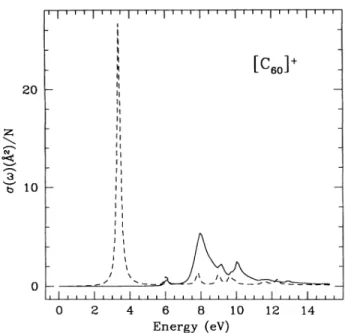
the degeneracy induced by the spherical approximation used in the calculation. The calculated photoabsortion cross section 0(~)
is given inFig.
1. It
showsa
collective resonance locatedat
8eV.These results and those reported in similar 6gures were obtained with an arti6cial broadening ofthe lines of
0.
1 eV in orderto
simulate 6nite temperature eKects on the photoabsortion cross section. The results for neutral C6o are rather similar and have been reported in Ref. 13 (in that work, however, the thicknessof
the Cso shell was slightly different, namely, 2Az—
—
0.
8a.
u.).
The in-dependent particle response, composedof
single-particle excitations, is given by the dashed curve. The collective resonance shows some fragmentation dueto
the inter-action with single-particle transitions which in our LDA approach correspondto
bound-continuum transitions be-cause the calculated ionization threshold is 7eV (peaks below this value in the dashed line are due to bound-bound transitions) .We have studied several [CsoNa)v]+ clusters with in-creasing values of
N to
investigate the modifications of the collective response and its evolution with ¹ Thespe-cific values
of
%
studied are%=13,
21,
45, 65, and93.
It
should be noted that we have performed our calcula-tions for ionized clusters so asto
correspond asc1osely as References 13and 24 can be consulted for details. In what follows, we will present results for the dipolar re-sponse of coated carbon clusters, which is readily acces-sible experimentally through optical measurements.Thephysical picture
of
a certain excitation being single pair, ora
collective surface mode, ora
strong coupling of all these excitations may bevisualized ' by consideringthe frequency-dependent induced charge density bn(r,
u)
defined as
49 COLLECTIVE ELECTRONIC EXCITATIONS IN METAL-COATED C60 17399
20—
K10—
0—
I I I I I I I II I I
I
I I I I I I I I I
I I I I
I I I I I I I I II II II II II II Ii l] II II II II II II II l I l I I I /
I I I I I I I I I I I I I I I I I I I I I I I
c„l
2 4 6 8 10 12
Energy (eV)
FIG.
1.
Calculated photoabsorption cross section per elec-tron for Csp+ (full curve). The cross section calculated from the noninteracting response is given by the dashed curve.possible with the mass spectra reported by Martin et al. These workers designed their experiments
to
reveal the relative stabilityof
ionized species. For this purpose, the photoionized clusters were heated witha
laserto
allow for atom evaporation. Since Na isa
monovalent atom, the numberof
active electrons in these clusters is60+N-1.
All the clusters studied have closed electronic shells for which the spherical approximation assumed in the re-sponse calculations is best justified. The ground state electron densitiesof
someof
the clusters are shown inFig. 2.
There isa
clear distinction betweenN=13,
21 onthe one hand, and
N=45,
65, 93on the other. The casesof
N=13,
21show electron densities that lookrathersim-ilar
to
thoseof
Csp+ or Csp (see also Ref.13).
Although the electron density is more extended in [CspNaIs]+ and [CspNa2I]+, there is still only a single decay length. Incontrast the densities for
N=45,
65, and 93 show two decay lengths. This means that the outer surfaceof
the cluster has some resemblanceto
the surfaceof
pure Na clusters and one can expect, as Ekardt has indicated in his work on metal-on-metal coated particles,to
observe new features relatedto
the Na surface and volume plas-mons. Similar behavior has also been observed in ad-sorbed alkali-metal layers on metallic surfaces.Let us now turn
to
analyzing the collective response. This is given inFig.
3for [CspNays]+. The thickness of the coating layer is3.
35a.
u. The electrons contributed by the Na layer leadto
the complete filling of the 1h shell with 22 electrons. The energy gap [highest occu-pied molecular orbital-lowest unoccupied molecular or-bital (HOMO-LUMO) gap] between this electronic shell and the lowest unoccupied shell, which isof 2s character, is small(0.
18eV).
The binding energies ofthe occupied shells are smaller with respectto
C6o+ dueto
a
more extended and shallower effective potential. The situa-tion is more complex for the unoccupied shells. We find shifts up and down in their binding energies, but all these changes are small. Consequently the single-particle tran-sitions, both bound-bound and bound-unbound occurat
lower energies, compared
to C6o+,
as can be seen froma
comparison of the noninteracting spectraof C60+
and [CspNaI s]+which are represented by dashed lines inFig.
1 and
3.
The peaks in the single particle spectra areat
the transition energies for single particle excitations and the heights are proportional
to
the oscillator strengths forthe modes. The very prominent peak in the noninter-acting cross section is dueto
1h—
1i single particle tran-sitions. In fact, this transition gives the dominant peak in the noninteracting spectra for all the cases presented here, although other transitions,e.
g., 2h—
2i, 1h—
2g, also leadto
sizeable peaks for the largerN
values shownin
Fig. 4.
The effect of the Na cladding on the fullyin-teracting photoabsortion spectrum (of [CspNaIs]+) is
a
spreading of the plasmon down
to
lower energies by more than 1eV anda
reduction in amplitude. This is mainly dueto
an increased kagmentationof
the spectrum be-cause of the interaction of the collective resonance with0.
02 a50.
01 00.
020.01
j I j I I I I j I i I j j ]+0 4 8 12 16
r
(a.
u.)I I I t I I I I:'t f r. 'I I; :I I I
ii].
]+
0 4 8 12 16 20
r (a.
u.)0.
020.
01 S 0 0 I I I I I i I I I I 4 8r (a.
u.)l 16
0.
020.
01
Q I I I I I I I I I I I I I I I I I I I0 CI
0 4 8 12 16 20
r (a.
u.)FIG.
2. Electron density and positive background density versus the distancer
to the cluster center in the two-slab jel-lium-on-jellium model ofCsp +, [CsoNagy]+, [CspNa4s]+ and [CspNsss]+. The maximum ofthe electron density (not shown in order to enhance the low density features) reachesA. RUBIO,
J.
A.ALONSO,J.
M. LOPEZ, AND M.J.
STOTT 4920 15 10 3
5 0
I
I
II
II
II
Ii
II II
I I
J
I Fthm I I
tI
2 4 6 8 10 12 14
Energy (eV)
20—
15—
10—
I3 b
0 2 4 6 8 10 12 14
Energy (eV)
particle-hole transitions (Landau damping).
The ground state electronic configuration of the [CsoNa2I]+ is
1s,
1p, 1d,1f,
1g, 2s, 2p, 1h (all shells completely filled). We notice that the 2s and 2p levels have dropped below the 1h level. The gap betweenlh
and the lowest unoccupied level (2d) isequal to0.
61 eV, much larger than the HOMO-LUMO gap in [CsoNag3]+. This appears to correlate with the fact that [CsoNa2q]+3 0
10—
0
—
IIi
II
II
II
I I I I
0 2 4 6 8 10 12 14
Energy (eV) 10
8 6 3
2
II
Ii
II
Ii II I
I
I I \
/
i
0 2 4
[CsoN
ass]'
I I I I I l I
6 8 10 12 14
Energy (eV)
FIG.
4. Calculated photoabsortion cross-section, per elec-tron, of [CppNa4p]+ and [CppNa93] (full curves). The cross section calculated from the noninteracting response is givenby the dashed curves.
FIG.
3.
Calculated photoabsorption cross section, per elec-tron, for [CppNaqp]+ and [CppNapq]+ (full curves). The cross section calculated from the noninteracting response is givenby the dashed curves. The interacting response has been
mul-tiplied by 4in ord.er to display the features of the spectrum.
is
a
magic cluster (high abundance) in the massspec-tra
of Martin et al. The modified electronic structure leadsto
new single-particle transitions andto
astrongly broadened and fragmented photoabsortion cross section(Fig. 3) with no prominent feature remaining
at
8 eV, the position of the C6O+ plasmon mode. Further-Inore, some strength beginsto
appear in the energy re-gion around 2—
4eV,typicalof
alkali-metal clusters. This indicates the beginning of the transition from the carbon vr-electron response to the Na-metallic response.A drastic change in 0'(~) is observed for [CsoNa4s]+ (see
Fig.
4).
Its
electronic configuration isls,
1p, 1d,1f,
lg,
2s, 2p, 2d, 1h,2f
Th.e 2d level has also dropped below thelb.
The electron densityof
the cluster is com-posed oftwo pieces: the innermost electrons are localized in the Csp shell; the 2s, 2p, 2d, and2f
electrons can be ascribedto
the Na layer, and the 1h electrons, which are located near the carbon-sodium interface, are shared by the C60 and Na layers. This division is illustrated in the corresponding plotof Fig.
2, where the dotted line gives the 1hcharge density and the dashed line the 2s+2p+2d +2fcharge density. The Na layer now shows its identity through the appearanceof a
strong peak in the photoabsortion spectrumat
low energy ( 3—3.
5eV).
This peak has
a
broad tail extending to higher energies, and a considerable amountof
strength is still concen-trated in the region 4—11
eV, typical of the x-carbon absorption spectrum, although the amplitude is further reduced kom the clusters with smallerN.
Finally, the largest cluster studied is [CsoNass]+; the picture is rather similar
to
that for [CsoNa4s]+. Now the electronic closed-shell configuration has as occupied levels:ls,
1p, 1d,1f,
1g, 2s, 2p, 2d,2f,
2g, 1h,3s,
3p, 2h. The peakat
the positionof
the Na surface plasmon is now well developed (seeFig. 4),
and the cluster responds much like a pure ionized Na cluster [the TDLDA sur-face plasmon ofjelliumlike ionized Na clusters occursat
3—
3.
5eV (Ref.31)].
The collective resonance hasa
broad tail and some strength is still concentrated in the region 8—10eV although the response there is much attenuated comparedto
pure C6O+.Toget more insight into the shift
of
the collective res-onance &om C60+to
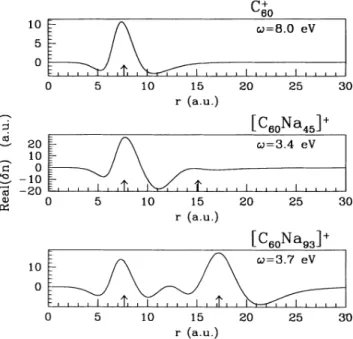
that more typical of sodium clus-ters as the coating is increased, we have plotted inFig.
COLLECTIVEELECTRONIC EXCITATIONS IN METAL-COATED C60
10:—
Csou=S.
O eV10 15
r (a.u.)
I I I I I I
20 25 30
20:—
(Q
10:—
0:
~
-10=
—20 =Q) 0 10 15
r
(a.u.)a=3.
4 eVI I I I I I
20 25 30
10 0
10 15
r (a.u.)
20
FIG.
5. Real part of the induced charge density corre-sponding to the collective mode frequency for C60+,
[CppNa4s]+ and [CppNaps]+. Vertical arrows indicate the positions of the two interfaces (carbon-sodium and sodium-vacuum).
both resonances as we have. However, the plasmons are
at
different energies and we do not detect the classical two-peak structure in our results. The contrast between our results and the classical picture is similarto
that found by Ekardt in his studyof
the optical spectrumof
coated metal clusters. The physical situation in thestatic
limit, for which we have also performedcalcula-tions, is different. In this case, the induced density lead-ing
to
the static dipole moment is located mainlyat
the sodium-vacuum interface for the coated clusters, witha
well defined structure on the sodium adsorbate.
The inverse relation between polarizability and plasma resonance frequency [u2 Ix
I/a(0)]
within classical models suggests that the static polarizability may also provide some insight into the shift in dominant collec-tive mode with Na coverage. InFig.
6the polarizability per electron is given asa
functionof
the number ofNa atoms coating the fullerene. We seea
plateau for small coverages untilN
13,
where the responseof
the coated cluster is dominated by the carbon which is much less polarizable than sodium. Then we observe an increase ofa(0),
which can be separated in two regions. BetweenN=13
andN=21
there isa
qualitative change in the po-larizability, which increases sharply. AsN
grows further the polarizability increases steadily towards the classical sodium limit, as the weight in the static response shifts from carbonto
sodium. However, convergenceto
the large-N limit is slow, which is consistent with our previous finding that the carbon-sodium interface still hasa
role in the response forN=93,
and higher cover-age is neededto
achieve Na-metal behavior. The sharp increaseof
a(0)
with respectto
the value forCsp+
af-ter
N
13
coincides with the occupationof
electronic shells with principal quantum number n=
2, which ex-tend further into the outermost regionof
the cluster than shells with n=
I
(see, for instance, the caseN=45
inFig.
2).
After this sharp rise, the evolutionof
a
is smoother and is associated with the progressive forma-tionof a
coating region witha
density similarto
that in metallic Na. However,a
large numberof
Na atoms is needed for this regionof
"almost constant" electron densityto
fully develop. We observea
different behavior &om thatof
metallic clusters where the polarizability per electron decreases (approximately asN
~~s) as the sizeof
the cluster increases. Here the opposite trend results &om the large polarizabilityof
sodium as comparedto
carbon. We have only studied Na coverages leading
to
closed electronic shells; small oscillations of the polariz-ability for coverages intermediate between those plotted in
Fig.
6 should be anticipated, but our study is enoughto
display the main trends in the optical response. The slow convergenceof
the polarizability towards the classical value is typicalof
metallic aggregates. This slow convergence (from above) has been noticed in the exper-imentsof
Knight et al. for the static polarizabilitiesof
Na andK
clusters, as well as in the experiments of Brechignac et al. on the evolutionof
the surface plas-mon resonance &oma
studyof
the photoabsorption cross section oflarge Li andK
clusters. Those experiments show that the surface plasmon has not yet convergedto
the classical value even for clusters with one thou-sand atoms. We observea
similar slow convergence on the static polarizability (from below) for hollow clusters. This behavior is consistent with the size dependence of the classical polarizabilityof
a
hollow metallic sphere.70 I I I I
)I I II)I II I)I I II[I I I IIII II[I I II(I III [IIII[IIII
60—
50—
~
R40—
C)
L]
3
30—
«5
20—
]0
ILIIIIIIIIIIIIIIIIIII]IIII[IIII]IIII IIIIII
«»
]»
II0
0
i0
2030
40 50 60 70 80 90 100Number of Na atoms
FIG.
6. Static polarizability per electron for [CppNaIv]+17402 A. RUBIO,
J.
A.ALONSO,J.
M. LOPEZ, AND M.J.
STOTT 49V.
CONCLUSIONS
The two-shell model we have used
to
study ionized Na coated fullerenes([CsoNa~j+)
predictsa
shift in response froma
~-carbon collective modeto
a
metallic-Na excita-tion as the numberof
Na coating atoms is increased. A well developed excitation in the energy region of collec-tive modes typical ofpure Na clusters only occurs after the formationof
an extended region with an electron den-sity similarto
thatof
metallic Na. However, the static polarizability ismore sensitiveto
the presence of the coat-ing and it sharply deviates from thatof
C60+ as early as forN
13.
The reliability of the method used has been con6rmed previously in studies of the m plasmonin fullerenes, and we expect the present results to con-stitute a good description
of
the response properties ofcoated fullerene clusters. Within our model similar op-tical dipolar properties are
to
be expected for Li,K,
or Rb coverings, and, in general, for those metals for which the jellium model is justified. We hope that this work stimulates experimental investigationsof
the collective electronic excitations ofthese interesting systems.ACKNOWLEDGMENTS
This work has been supported by
DGICYT
(GrantsNos.
PB89-0352
andPB92-0645).
Oneof
us (A.R.
) wassupported by
a
Fullbright-MEC grant. M.J.
S.
acknowl-edges support from MEC (Spain) during his sabbatical stay in Valladolid. We acknowledge stimulating discus-sions with ProfessorL.
C.
Balbas.Permanent address: Departamento de Fisica Teorica,
Uni-versidad de Valladolid, Spain.
tPermanent address: Physics Department, Queen's
Univer-sity, Kingston, Ontario, Canada.
H. W.Kroto,
J.
R.
Heath, S. C.O'Brien,R.
F.
Curl, and R.E.
Smalley, Nature (London)318,
162(1985).W. Kratschmer, L. D.Lamb, K.Fostiropoulos, and D.R. Huffman, Nature (London) 347, 354 (1990).
A.
F.
Hebard, M.J.
Rosseinsky,R.
C. Haddon, D. W. Murphy, S.H. Glarum,T. T.
Palstra, A. P.Ramirez, and A. R.Kortan, Nature (London)350,
600(1991).
T.
P.Martin, U.Naher, H.Schaber, and U. Zimmermann, Phys. Rev. Lett. 70,3079(1993).O. Echt, K. Sattler, and
E.
Recknagel, Phys. Rev. Lett.47, 1121
(1981).
T.
P.Martin, N. Malinowski, U. Zimmermann, U. Naher, and H.Schaber,J.
Chem. Phys.99,
4210(1993).J.
W.Keller and M. A.Coplan, Chem. Phys. Lett.193,
89 (1992).A. A.Lucas, G.Gensterblum,
J. J.
Pireaux, P.A.Thiry,R.
Caudano,
J.
P.Vigneron, Ph.Lambin, and W.Kratschmer, Phys. Rev.B
45, 13694(1992).G.
F.
Bertsch, A. Bulgac, D.Tomanek, andY.
Wang, Phys. Rev. Lett. 67,2690(1991).
G.Barton and G. Eberlin,
J.
Chem. Phys.95,
1512(1991).
'
A.Bulgac and M. Ju, Phys. Rev.B
46,4297 (1992).M.
T.
Michalewicz and M. P. Das, Solid State Commun. 84, 1121(1992).A. Rubio,
J.
A. Alonso,J.
M. Lopez, and M.J.
Stott, PhysicaB 183,
247(1993).
M.
J.
Puska andR.
M. Nieminen, Phys. Rev. A 4'F, 1181(1993).
N. Van Giai and
E.
Lipparini, Z.Phys. 27, 193(1993).
D. Ostling, P.Apell, and A. Rosen, Europhys. Lett.
21,
539
(1993).
V.Kresin, Phys. Rep. 220, 1(1992).
J.
A. Alonso and N. H. March, Electrons in MetaLs andAlloys (Academic, London, 1989).
A. Rubio, L. C. Balbas, and
J.
A. Alonso, Phys. Rev.B
45, 13 657(1992).
J.
M.Hawkins, A.Meyer,T.
A.Lewis, S.Loren, andF.
J.
Hollander, Science 252,312(1991).
W. Kohn and L.
J.
Sham, Phys Rev.140,
1133 (1965). W.Andreoni, P.Giannozzi, and M. Parrinello, Phys. Rev. Lett. 72,848 (1994).2sM.
J.
Stott andE.
Zaremba, Phys. Rev. A21,
12(1980).W.Ekardt, Phys. Rev. Lett. 52, 1925(1984)
zsW.Ekardt, Phys. Rev.
B 81,
6360(1985).A. Liebsch, Phys. Rev.
B 86,
7378 (1987).K.Nuroh, M.
J.
Stott, andE.
Zaremba, Phys. Rev. Lett. 49,862 (1982).Z. Penzar, W. Ekardt, and A. Rubio, Phys. Rev.
B
42, 5040 (1990);J.
M. Pacheco andR.
A. Broglia, Phys. Rev. Lett. 62, 1400(1989).W. Ekardt, Phys. Rev.
B
34,526 (1986). A.Liebsch, Phys. Rev. Lett. 67,2858(1991).
'
J.
M. Pacheco and W. Ekardt, Ann. Phys. (Leipzig)1,
252(1992).
This con6nement of the induced charge density at the
in-terfaces has also been reported on experiments and ran-dom phase approximation calculations for bimetallic
jel-lium Slms [see
E.
L. Yuh,E.
G. Gwinn, P.R.
Pinsukan-jana, W. L. Schaich, P.F.
Hopkins, and A. C. Gossard, Phys. Rev. Lett.71,
2126(1993)j.These authors reported that the onset of the three dimensional surface 61m plas-mon mode isvery sensitive to the surface potentials and itis mode specific.
A. A.Lushnikov, V.V.Maksimenko, and A.
J.
Simonov, inElectromagnetic Surface Modes, edited by A.D.Boardman (Wiley, New York, 1982),p.305.
A. Rubio and Ll. Serra, Z. Phys. D 26, S118 (1993),and references therein.
W.A.de Heer and W.A.Saunders, Phys. Rev.
B
31,
2539 (1985).W.Knight, K.Clemenger, W.A.de Heer, and W. A. Saun-ders, Phys. Rev.
B
31,
2539(1985).C. Brechignac, Ph. Cahuzac, N. Kebaili,
J.
Leygnier, and A. Safarti, Phys. Rev. Lett.68,
3916 (1992).The ratio between the classical polarizabilities of two spheres with equal radius R2 and dielectric constant e,one ofthem with a central hole ofradius Rq is given by Ref. —1
29, u(with hole)/a(no hole)= (1
—
q )1+
lwhere q
![FIG. 4. Calculated photoabsortion cross-section, per elec- elec-tron, of [CppNa4p]+ and [CppNa93] (full curves)](https://thumb-us.123doks.com/thumbv2/123dok_es/6063512.173585/4.918.83.429.106.438/fig-calculated-photoabsortion-cross-section-cppna-cppna-curves.webp)