BIBLIOTECAS DEL TECNOLÓGICO DE MONTERREY
PUBLICACIÓN DE TRABAJOS DE GRADO
Las Bibliotecas del Sistema Tecnológico de Monterrey son depositarias de los trabajos recepcionales y de
grado que generan sus egresados. De esta manera, con el objeto de preservarlos y salvaguardarlos como
parte del acervo bibliográfico del Tecnológico de Monterrey se ha generado una copia de las tesis en
versión electrónica del tradicional formato impreso, con base en la Ley Federal del Derecho de Autor
(LFDA).
Es importante señalar que las tesis no se divulgan ni están a disposición pública con fines de
comercialización o lucro y que su control y organización únicamente se realiza en los Campus de origen.
Cabe mencionar, que la Colección de
Documentos Tec,
donde se encuentran las tesis, tesinas y
disertaciones doctorales, únicamente pueden ser consultables en pantalla por la comunidad del
Tecnológico de Monterrey a través de Biblioteca Digital, cuyo acceso requiere cuenta y clave de acceso,
para asegurar el uso restringido de dicha comunidad.
The Importance of Interactive Activities Designed to Enhance
Oral Communication Production Skills Among Groups of More
than 25 EFL (English as a Foreign Language) Students, Both
Inside and Outside the Classroom -Edición Única
Title
The Importance of Interactive Activities Designed to
Enhance Oral Communication Production Skills Among
Groups of More than 25 EFL (English as a Foreign
Language) Students, Both Inside and Outside the
Classroom -Edición Única
Authors
Irma Graciela Martínez Cantú
Affiliation
Tecnológico de Monterrey, Universidad Virtual
Issue Date
1998-05-01
Discipline
Ciencias Sociales / Social Sciences
Item type
Tesis
Rights
Open Access
Downloaded
18-Jan-2017 17:11:26
INSTITUTO TECNOLÓGICO Y DE ESTUDIOS
SUPERIORES DE MONTERREY
UNIVERSIDAD VIRTUAL
THE IMPORTANCE OF INTERACTIVE ACT1VITIES DESIGNED TO ENHANCE ORAL COMMUNICATION PRODUCTION SKILLS
AMONG GROUPS OF MORE THAN 25 EFL (ENGLfSH AS A FOREIGN LANGUAGE) STUDENTS, BOTH INSIDE
AND OUTSIDE THE CLASSROOM
THESIS PRESENTED T O OBTAIN
A
MASTER'S DEGREE IN EDUCATION
W I T H SPECIALIZATION IN
APPLIED LINGUISTICS
AUTHOR: IRMA GRACIELA MARTÍNEZ CANTU
ADVISOR: PROFR. CAROL CARPENTER ITESM
INSTITUTO TECNOLÓGICO Y DE ESTUDIOS SUPERIORES DE MONTERREY
UNIVERSIDAD VIRTUAL
CAMPUS MONTERREY
C O N S T A N C I A D E E X A M E N Y A U T O R I Z A C I Ó N D E L A E X P E D I C I Ó N
D E G R A D O A C A D É M I C O
Los suscritos, m i e m b r o s del j u r a d o calificador del examen d e g r a d o sustentado h o y
por IRMA GRACIELA MARTÍNEZ CANTU
en opción al g r a d o a c a d é m i c o d e MAESTRA EN EDUCACIÓN CON ESPECIALIDAD EN LINGÜISTICA (INGLES)
h a c e m o s constar q u e el sustentante resultó
H a g o constar q u e el sustentante, de acuerdo con documentos contenidos en s u
expediente, h a cumplido con los requisitos de graduación, establecidos en el
R e g l a m e n t o A c a d é m i c o de los p r o g r a m a s de g r a d u a d o s de l a U n i v e r s i d a d Virtual.
Acknowlegments
This thesis would not have been possible without the help and encouragement of
several people whom I am deeply grateful to and would like to mention.
To Carol Carpenterfor all her help and guidance and whom
it has been a pleasure to work with.
To Laura Campuzano for motivating me.
To Ruth Hassell for her enthusiastic help and encouragment.
To Antonieta Arellano, Carol Carpenter, Alicia Martínez
Mary Meinke, Patty Núńez and Leonor Rosales
who made the oral evaluations possible.
To María del Roble Gauna for her valuable help.
To the ITESM for giving me this opportunity to
Dedication
To my parents, Reynaldo and Ma. Cruz for their wisdom.
To my sisters, Nellie and Alicia for their interest and support.
To Marco, Alejandro, Andrea and Carlos Reynaldo, my favorite people.
THE IMPORTANCE OF INTERACTIVE ACTIVITIES DESIGNED TO ENHANCE ORAL
COMMUNICATION PRODUCTION SKILLS AMONG GROUPS OF MORE THAN 25
EFL (ENGLISH AS A FOREIGN LANGUAGE) STUDENTS, BOTH INSIDE AND
OUTSIDE THE CLASSROOM
Author: Irma Graciela Martínez Cantu Advisor: Carol Carpenter ITESM
ABSTRACT
Nowadays, to be able to communicate in the English language has become
imperative for most professionals worldwide, especially in Mιxico, since we are
neighbors of an Englishspeaking country whích happens to be the most powerful
country in the world and whose language has become the international language of
science, technology, business and diplomacy.
The English courses that are taught at the ITESM are based on a communicative
languagelearning approach whích encompasses the four basic language skills: reading,
writing, listening comprehension and speaking. Due to the large number of students
(usually more than 25) that can be found in each classroom where English is taught, it
can be difficult for professors to ensure sufficient oral participation among all the
students.
The method applied in this study was the true experimental research method, which
requires the observation and comparison of two similar groups, one in which
supplementary oral activities were practiced and the other ΅n which they were not. The
instruments used to obtain data were a background data collection instrument,
instruments for oral evaluations, a student survey and a professor evaluation survey.
The first monthly exam scores as well as the final TOEFL evaluation scores were
compared. Also, the oral homework assignments were recorded, transcribed and
Even though the results of students' background questionnaires revealed that the
students from the control group dedicated more time to outside of classroom English
practice, and the grades of the first monthly exam were almost the same for both groups,
the final TOEFL scores revealed a significant difference which favored the experimental
group. The taperecording activities and student survey revealed that students spoke
freely during the assigned time and enjoyed doing so. Finally, the students' surveys on
course activities, as well as on their professor's performance were favorable.
The recommendations the author gives is that students should be encouraged to use
the foreign language they are studying, in this case English, in activities otherthan those
offered in their textbooks and practiced in the classroom. They should be given the
opportunity to engage in activities both inside and outside the classroom that are
enjoyable and that at the same time teach them to communicate effectivley in English.
A final suggestion is that a language lab be made available to the students so they may
record and listen to themselves, and if this is not possible, promote the use of tape
recording activities in ways that can be beneficial in improving students' oral production
LA IMPORTANCIA DE ACTIVIDADES INTERACTIVAS DISEΡADAS PARA REALZAR
LAS HABILIDADES DE PRODUCCIÓN DE COMUNICACIÓN ORAL EN GRUPOS DE
MΑS DE 25 ALUMNOS QUE ESTUDIAN INGLΙS COMO LENGUA EXTRANJERA,
TANTO DENTRO COMO FUERA DEL AULA
Autora: Irma Graciela Martínez Cantú Asesora: Carol Carpenter ITESM
RESUMEN
Hoy en día, el ser capaz de comunicarse en el idioma inglιs se ha convertido en una
necesidad imperante para la mayoría de los profesionistas en el mundo entero,
especialmente en Mιxico, ya que somos vecinos de una país de habla inglesa que a la
vez es la potencia mαs grande del mundo y cuya lengua ha llegado a ser el idioma
internacional de la ciencia, la tecnología, los negocios y la diplomacia.
Los cursos de inglιs que se imparten en el ITESM estαn basados en un enfoque de
aprendizaje comunicativo del lenguaje que cubre las cuatro habilidades bαsicas del
lenguaje que son la lectura, la escritura, la comprensiσn auditiva y el habla. Debido al
gran número (generalmente mαs de 25) de alumnos que se encuentran en los cursos
de inglιs, puede resultar difícil para los profesores asegurar una participaciσn oral
suficiente entre los alumnos.
El mιtodo utilizado en este estudio fue el experimental el cual requiere de la
observaciσn y comparaciσn entre dos grupos similares, uno en el cual las actividades
orales suplementarias fueron practicadas y el otro en el cual no lo fueron. Los
instrumentos utilizados para obtener datos fueron un instrumento para recolectar datos
de antecedentes, instrumentos para evaluaciones orales, encuestas a estudiantes e
instrumento de evaluaciσn a profesores. Los resultados del primer examen mensual,
así como los resultados del examen final de TOEFL fueron comparados. Asimismo, las
tareas orales fueron grabadas, transcritas y analizadas.
A pesar de que los resultados de los cuestionarios de antecedentes de los alumnos
inglιs fuera del aula y que los resultados del primer examen mensual fueron muy
similares, los resultados del examen final del TOEFL mostraron una diferencia
significativa a favor del grupo experimental. Las actividades grabadas y la encuesta a
los alumnos revelaron que los alumnos hablaron libremente durante el tiempo asignado
y que disfrutaron haciιndolo. Por último, las encuestas a los alumnos sobre las
actividades del curso y el desempeńo del profesor fueron favorables.
Las recomendaciones que la autora da es que los estudiantes deberαn ser alentados
a utilizar la lengua extranjera que estudian, en este caso, el inglιs, en actividades
aparte de las que son ofrecidas en sus libros de texto y de las que se practican dentro
del aula. Deberα dαrseles la oportunidad, tanto dentro y fuera del salσn, de realizar
actividades que puedan disfrutar y que al mismo tiempo les enseńen a comunicarse
efectivamente en inglιs. Una sugerencia final es la de proporcionarles un laboratorio de
idiomas para que los alumnos puedan grabar y escucharse a sí mismos, pero si esto no
fuera posible, promover el uso de actividades con grabadora de modo que pudiera serle
Index
Introduction 1
1. The Problem 2
1.1. Background of the Problem 2
1.2. Identification of Needs 3
1.3. Statement of the Problem 3
1.4. Purpose and Justification for the Study 4
1.5. Questions to be Answered 5
1.6. Scope and Delimitation 5
1.7. Limitations 6
1.8. Definition of Terms 6
2. Theoretical Framework 9
2.1. Communication 9
2.2. "Authentic Communication" 10
2.3. Early SLA Theories 11
2.3.1. Environmentalist Theories 11
2.3.2. Nativist Theories 12
2.4. Definition of Interaction 14
2.4.1. Types of Interaction 15
2.4.2. Functions of Spoken Language 16
2.4.3. Interactionist Learning Theories 17
2.4.4. Interaction in the Classroom 18
2.4.5. Interaction Outside the Classroom 20
2.5. Competence 21
2.5.1. Related Factors 21
2.6.1. Grammar-Translation 27
2.6.2. Direct Method 27
2.6.3. Audiolingual Method 28
2.6.4. Situational Language Teaching 29
2.6.5. Communicative Language Teaching 29
2.6.6. Natural Approach 31
2.7. Activities in Second Language Acquisition 31
2.7.1. Focus on Oral Communication Skills 32
2.7.2. Error Correction During Oral Production Activities 33
2.7.3. Correction Procedures 35
2.7.4. Testing Oral Production 36
3. Method 39
3.1. Research method 39
3.2. Population Sample 40
3.2.1. Instrument for Background Data Collection 40
3.2.2. Initial Overall Knowledge of the L2 40
3.3. Oral Production Activities 41
3.3.1. Oral Production Activities Practiced by Both Groups 41
3.3.2. Oral Production Activities Practiced by the Experimental Group43
3.3.2.1. Classroom Activities 44
3.3.2.1.1. Activity One 44
3.3.2.1.2. Activity Two 48
3.3.2.1.3. Activity Three 51
3.3.2.1.4. Subsequent practices 53
3.3.2.2. Oral Homework Activities 54
3.3.2.2.1. Final Oral Activity One 54
3.3.2.2.2. Final Oral Activity Two 56
3.3.4. Survey Instrument for Student Appraisal 59
3.3.5. Final TOEFL Evaluation 59
3.3.6. Student Evaluations of Professors 60
4. Findings and Resulte 63
4.1. Findings on Students' Background 63
4.2. Findings on the first monthly exam 72
4.3. Findings on Oral Homework Activities 72
4.4. Findings on Student Appraisal Survey 74
4.5. Findings on Individual Oral Presentations 84
4.6. Findings on TOEFL Evaluations 88
4.7. Findings on Professor's Evaluation by students 91
5. Conclusions and Suggestions 93
5.1. Conclusions 93
5.2. Suggestions 94
Bibliography 95
Appendices 99
Appendix A Course Program 100
Appendix B Instrument for Background Data Collection 103
Appendix C.1 First Monthly Exam 104
Appendix C.2 Resulte of the first monthly exam 108
Appendix D.1 Students' tapes transcripto (Team One) 109
Appendix D.2 Students' tapes transcripto (Team Two) 112
Appendix D.3 Students' tapes transcripto (Team Three) 115
Appendix E Students' Written Dialogues, First Draft 119
Appendix F Students' Corrected Written Dialogues 123
Appendix G.1 Evaluation Instrumente for Individual Oral Presentations
Appendix G.2 Evaluation Instruments for Individual Oral Presentations
(Guildelines for Oral Evaluation) 128
Appendix G.3 Evaluation Instruments for Individual Oral Presentations
(Evaluation Form) 129
Appendix H Survey Instrument for Student Appraisal 130
Appendix I Professor Evaluation Form 131
Appendix J Professor's Evaluation Results 134
INDEX OF FIGURES AND TABLES
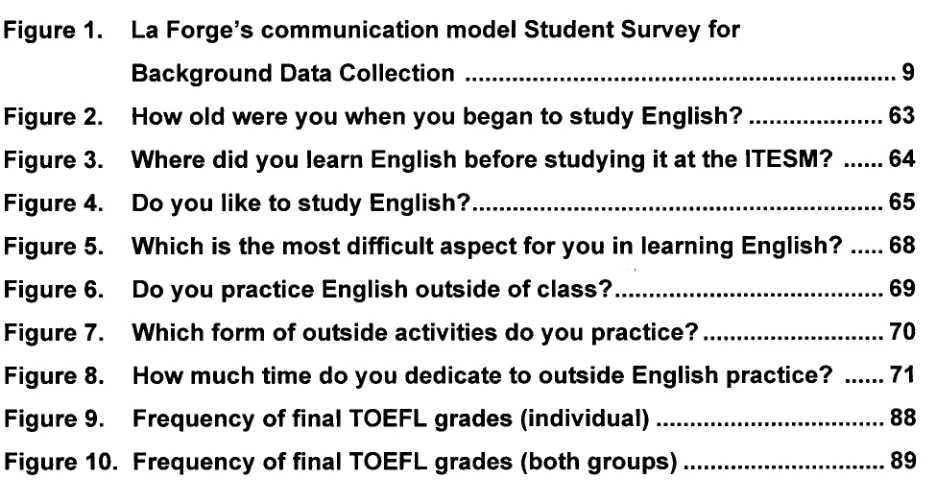
Figure 1. La Forge's communication model Student Survey for
Background Data Collection 9
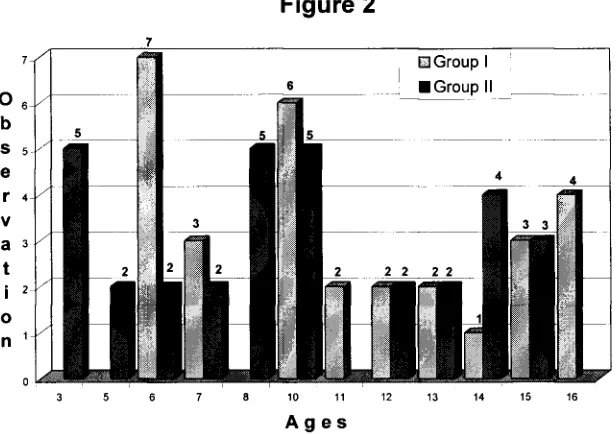
Figure 2. How oíd were you when you began to study English? 63
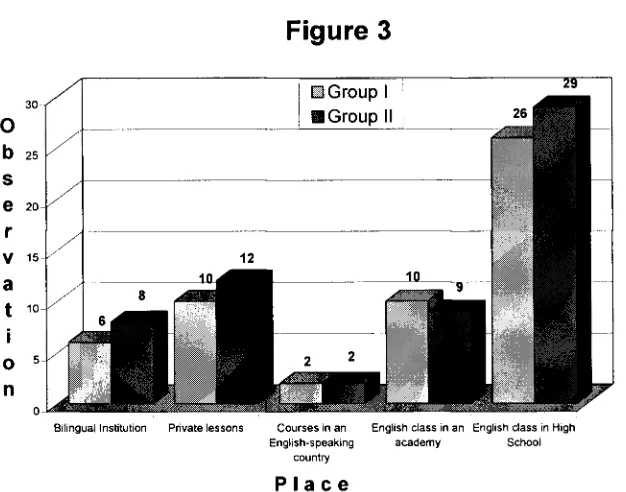
Figure 3. Where did you learn English before studying it at the ITESM? 64
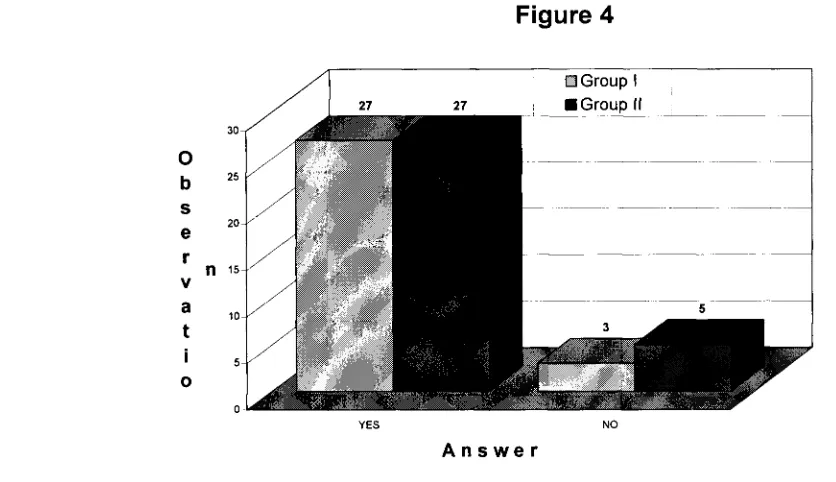
Figure 4. Do you like to study English? 65
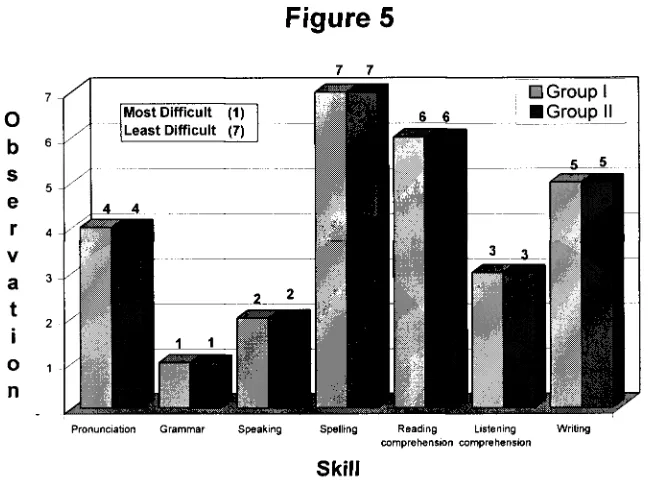
Figure 5. Which is the most difficult aspect for you in learning English? 68
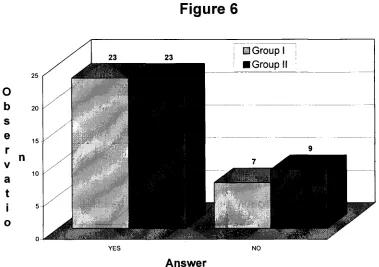
Figure 6. Do you practice English outside of class? 69
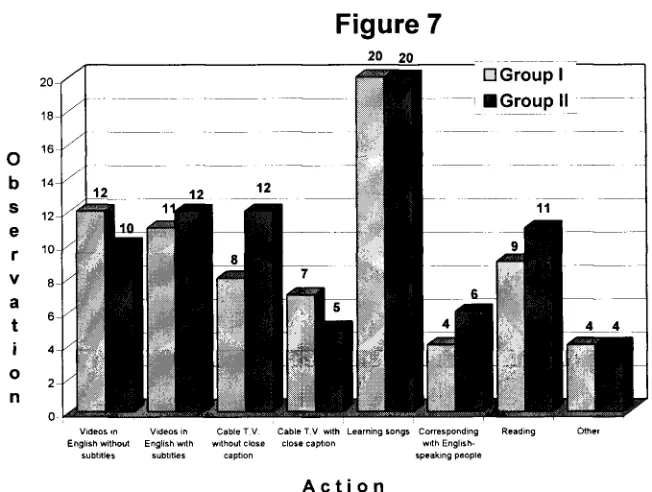
Figure 7. Which form of outside activities do you practice? 70
Figure 8. How much time do you dedícate to outside English practice? 71
Figure 9. Frequency of final TOEFL grades (individual) 88
Figure 10. Frequency of final TOEFL grades (both groups) 89
[image:16.612.113.570.402.647.2]Student Appraisal Survey
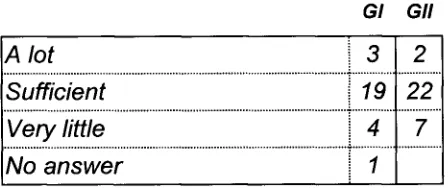
Table 1. How much oral practice do you feel you had? 78
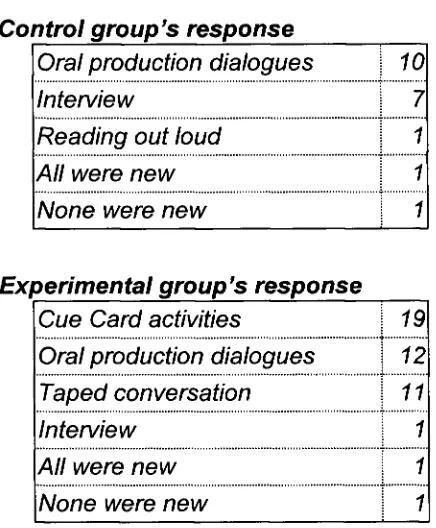
Table 2. Which oral production activities were different from others you
had practiced previously 79
Table 3. What oral production activities did you like the most? 80
Table 4. What activities would you suggest to improve oral production
skills? 81
Table 5. Results of Individual Oral Presentations Section 1 85
Table 6. Results of Individual Oral Presentations Section II 86
Table 7. Results of Individual Oral Presentations Section III 87
Table 8. Results of the TOEFL Exam 90
Introduction
One of the most important goals that a student of a second language has ΅s to
be able to speak that language as effectively as possible in order to communicate
with fellow human beings who can be spoken only to in that language. Furthermore,
the language that ΅s becoming more and more necessary to master in these times is
English due to the globalization of the world and the use of English as the
international language of science, technology, business and diplomacy.
Both students and teachers face an important challenge in the pursuit of this
goal due to the limited exposure there is when studying English in a nonEnglish
speaking country, i.e., in an environment that does not favor its constant practice. At
the ITESM, as in other teaching facilities, it is common to see groups of more than 25
students studying English as a second language, which limits student participation in
class.
The purpose of this study is to find optional ways, besides textbook and
workbook activities, of practicing English orally inside as well as outside the
classroom, and to discover if these extra activities help students improve their oral
proficiency as well as their overall knowledge of the English language.
It is also important to know how students feel when participating in activities
that are different from any that they have engaged in previously because it also
means that they will have to deal with a heavier work load. The method applied in
this study is the true experimental research method; therefore, it was necessary to
observe two groups of the same level, one in which the new activities were
undertaken, and the other in which they were not in order to establish the
comparison required by this type of research. The course level selected was the
Intermedíate Remedial IV course offered at the ITESM. The control group (Group I)
1. The Problem
The study of English as a second or foreign language has increased over the
years in all levιis of education because of the emergence of English as the
international language of science, technology, business and diplomacy. One of the
major tasks an EFL (English as a foreign language) student faces is the development
of his/her ability to interact orally with others in English while living outside of an
Englishspeaking country (in the absence of an Englishspeaking environment). This
is the reality of ITESM undergraduate students at the Monterrey Campus, whose
English classes have approximately thirty students and meet only four hours and ten
minutes a week. There are many resources that facilítate practice in skills such as
reading, listening and writing inside as well as outside the classroom. However,
when it comes to speakíng skills, the students find themselves limited because,
although they may be able to improve their pronunciation through repetition
exercises, they find it difficult to improve their communícative oral skills, due to the
lack of meaningful activities that can be introduced in the limited amount of
classroom time and practiced outside of class as well.
This chapter begins with a presentation of the background of the problem
followed by the identífication of needs, statement of the problem and purpose and
justificaron for the study. It also includes the questions to be answered, the study's
scope and delimitation as well as its limitations. Finally, definitions of línguistic terms
pertaining to the study are introduced.
1.1 Background of the Problem
Outside the normal classroom hours of English instruction at the ITESM,
students have few opportunities to practice or apply the knowledge they have
acquired in their classes. They need activities that are of interest to them and that
involve realistic situations because traditional homework assignments tend to
oral communicative skills that could reduce student frustration while students learn
the language.
To develop extracurricular activities to enhance students' oral capacity, the
author worked with students who are taking the high intermedíate Remedial IV
course in English. This course is offered by the 1995 English program in the ITESM
Humanities Department. The author selected this level because it is the last of the
remedial levιis those students who do not fulfill the requirements for a credited or
"sello" course must take. It is important for them to develop their English skills as
much as possible to be able to perform and communicate adequately at a more
advanced level.
1.2. Identification of Needs
The principal objective for learning a second language is to be able to
communicate in that language effectively, and nowadays it is of utmost importance
for ITESM students as future Mexican professionals to master the English language
due to commercial globalization and the economic growth required of our country. It
is becoming a common practice to conduct business transactions in English, not only
in Englishspeaking countries but in other countries whose official language is not
English or Spanish. Conversations or meetings in English are frequently held in most
of the leading organizations in Mιxico, especially in the highly industrialized cities,
such as Monterrey, so the need to prepare students for the spontaneous use of oral
English is imperative. Students need to engage in activities that will enhance
interaction with their teachers and peers in order to improve their oral communication
skills.
1.3. Statement of the Problem
It is clear that the lack of student exposure to the English language affects their
the students to interact in English as much as possible. However, in reality little
interaction is obtained spontaneously or voluntarily. There is not much opportunity
during the class for the students to interact due to the limited amount of classroom
time and the large number of students. When there are activities that require
interaction, the students take some time to "warm up" to start interacting and lose
valuable time to practice the skills they need to acquire or develop.
Another shortcoming is the fact that although the students involved are at the
same academic level, this does not mean that they have the same linguistic
competence. Therefore, the author gathered background information about their
previous studies of English through a questionnaire, and this information allowed her
to knowthe individual linguistic background of each student involved in the study and
also aided her in designing the activities that the students were to engage in.
1.4. Purpose and Justificaron for the Study
It is assumed that the more extracurricular exposure to the English language
the students experience, the easier it will be for them to improve their ability to
interact. Since not all the students have the same facility and/or interest in learning a
second language, it is important to find ways of motivating their interest. This will
allow them to dedícate more time to the practice of the language in order to acquire it
in a more natural and less frustrating way through activities in which they are
motivated and interested.
The main objective of this study was to find options of practicing English other
than the textbook activities and the traditional homework assignments in order to
improve the students' ability to interact orally. For this particular study it was
necessary to design activities applicable to groups of more than 25 students.
Since students are required to take oral production evaluations as part of their
production scores as well as giving them more selfconfidence when they had to
recur to the L2 in any given situation.
1.5. Questions to be Answered
The ability to interact in large groups can be difficult for students even in their
first language (L1). The task is to know what can help students overeσme the
barriere that hinder their opportunities and what possibilities to interact effectively in
a second, or foreign language (L2) with teachers and peers can professors crιate?
Can interactionaloriented activities stimulate students to particípate willingly
and with interest? Can these activities increase the frequency of oral language use
both inside and outside the classroom? Will the students be able to acquire self
confidence and improve oral evaluation scores? These questions were answered
throughout the progress of the study in results produced from analytical and survey
instruments.
1.6. Scope and Delimitation
The study was carried out during the fall semester of 1997 after the author had
designed the required activities and instruments. The subjeets involved in the study
were two Remedial IV hígh intermediatelevel groups. Group I (the control group)
consisted of 30 students and Group II (the experimental group) of 32 students. Three
activities were designed to promote oral interaction in the classroom and two for
extracurricular (homework) activities. The five activities were applied only to Group II
to establish comparisons between both groups. Surveys as to the students' personal
perceptions of their oral skills development were given to both groups at the
1.7. Limitations
The need to have increased student oral interaction in the L2, both inside and
outside the classroom, is what originated this study. The principal limitations in
achieving effective oral interactions are (a) differences in the students' linguistic
competence, (b) students' attitudes, and (c) the time allotted to reach the objective in
the course program established for the level involved in this project. Each of these is
considered below.
a) Linguistic competence. Some students have had the privilege of studying
English in an Englishspeaking country or have studied it at bilingual
institutions, and still others have facility or talent in learning languages,
placing them at an advantage over students who have not had these
opportunities or lack these talents.
b) Attitudes. The students who simply do not like the English language and
see it just as a required course may not care to cooperate.
c) Course objectives. There is an established curricular program of all English
levιis at the ITESM that must be covered, so any complementan/ material
introduced in the classroom should not interfere with the fulfillment of the
units that must be seen and the evaluations that need to be made.
1.8. Definition of Terms
The following terms are concepts that are widely used in literature of a linguistic
nature. They are included at this point in order to facilítate reading of the theoretical
framework, where these terms are initially mentioned. Brief definitions of these
concepts, some of which will be broadened in chapter 2, are given as follows.
a) CLT (Communicative Language Teaching). According to Littlewood, "One
of the most characteristic features of communicative language teaching is
that it pays systematic attention to functional as well as structural aspects of
b) Context. Ellis (1987, p. 6), states that context is " . . . the actual situation in
which a communicative event takes place."
c) Diachronic. As defined by Palmer, "Diachronic linguistics is concerned with
language through time." ( p. 12)
d) Input. Language that is addressed or directed to the learner.
e) Interaction. According to Ellis (1994, p.159), ". . . interactional acts can be
defined as utterances in context."
f) Interactional analysis. As stated by Selinger and Elana, " . . . interactional
analysis is an example of observation made with a high degree of
explicitness" (p.163).
g) Interlanguage. "Selinker (1972) characterized the learner's developing
system as "interlanguage", describing it as an intermedíate system located
somewhere between the learner's natíve language and the target language,
but governed by its unique and coherent internalízed rule system that rarely
becomes totally congruent with the system of the second language"
(Omaggio, p. 229).
h) L2. The abbreviated form which refers to the second language the student
is learning or acquiring.
i) Linguistic competence. The actual knowledge a student has of the L2.
j) Linguistic performance. The way in which the students use their knowledge
of the L2 in actual speech production and comprehension.
k) Output. Language produced by the learner.
I) Proficiency. Ellis states that "L2 proficiency refers to learner's skill in using
the L2 . . . in different tasks" (p.720).
m) SLA (Second Language Acquisition). According to Krashen, second
language acquisition is "a subconscious and intutitive process of
constructing the system of a language, not unlike the process used by a
As was mentioned above, some of these terms will be broadened in the
following chapter. The theoretical framework that pertains to this study will be
2. Theoretical Framework
The theoretical framework of this study is based on different terms, concepts
and theories related to it. The point of interest is communicative interaction, and
throughout the literature review, valuable information applicable to this topic was
found. This chapter covers the concepts of communication and interaction along with
interrelated elements. The SLA theories that are reviewed are the Environmentalist,
Nativist and Interactionalist theories. Second language teaching methods which
include the GrammarTranslation, Direct, Audiolingual, and Situational Language
Teaching, as well as the Communicative and Natural approaches are described.
Also included in the literature review are activities in second language acquisition,
error correction and testing for oral production.
2.1. Communication
This study would not be complete if the term communication were not brought
to mind. Communication can be defined as " . . . an exchange between people, of
knowledge, of information, of ideas, of opinions, of feelings" (Revel, p. 1). According
to Porter and Grant, "Communication is sharing meaning . . . . At least two people
must interact with each other for sharing to take place" (p. 32).
Communication can be manifested through different means such as speaking,
writing and even through gestures. Oral interaction, which is the object of this study,
is a form of communication that involves students in the exchange of meaningful
information.
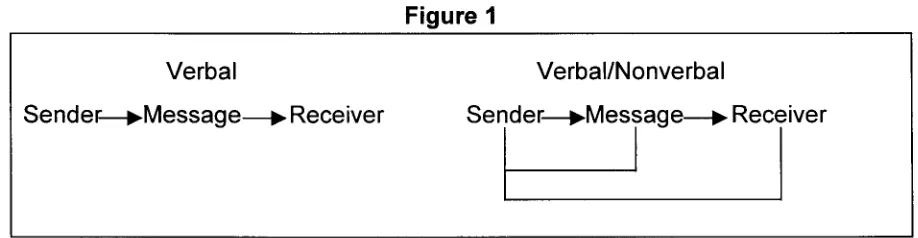
The following figure is a socialprocess model of communication designed by
[image:25.612.120.579.594.713.2]La Forge (Richards and Rodgers, p. 117).
For LaForge, communication ΅s not only the transmission of information, but a
social process. He states that " . . . Communication is an exchange which is
incomplete without a feedback reaction from the destinee of the message" (p. 116).
2.2. "Authentic Communication"
An important goal in second language acquisition is the development of oral
skills that will permit students to use the L2 in authentic oral communicative
situations. Students need to engage in activities that will prepare them for reallife
situations. According to Ellis, "Unfocused activities are designed to stimulate what is
often referred to as 'authentic communication' in the classroom. They are
characterized by the following:
1) A non linguistic outcome (e.g. drawing a picture, making a model,
solving a problem)
2) A concern for message rather than channel.
3) A gap of some kind (opiniσn, information, personal feeling) which has to
be bridged.
4) A need to negotiate meanings in order to achieve the outcome.
5) Learner control over the resources (verbal or nonverbal) that are
used.(Ellis p.189).
In contrast to the focused activities, which " . . . enable the learner to
consciously manipúlate specific linguistic items for conveying specific meanings,
when he is focused on form" (Ellis, p. 189), . . . unfocused activities allow students to
use language spontaneously. Keeping in mind the criteria Ellis has on how
"authentic communication" is produced, the activities used in this study were
2.3. Early SLA Theories
Before discussing the interactionist learning theories (see 2.4.3.) and their
pertaining factors, which are more related to this study, it is appropriate to include the
other two major and earlier SLA learning theories to review their origins. Therefore,
the environmentalist and nativist theories are explained as follows.
2.3.1. Environmentalist Theories
In oppostition to the nativist theories (see 2.3.2.), environmentalists believe that
in SLA " . . . an organism's nurture, or experience, is of more importance to
development than its nature, or innate contributions" (LarsenFreeman and Long, p.
249). These theories can best be exemplified with Skinner's 1957 behaviourst and
neobehaviourist learning theories. Underlying the principies of these theories " . . .
was the assumption that language learning, like any other kind of learning, took the
form of habit formation, a 'habit' consisting of an automatic response elicited by a
given stimulus." (Ellis, p. 299). Skinner maintained that " . . . secondlanguages
should be learned through extensive drill and practice without recourse to
rationalistic explanation" (Omaggio, p. 47). However, Chomsky, who proposed
nativist theories, seriously challenged Skinner's work, asserting that language
learning went beyond the stimulusresponse connections. Chomsky maintained that
"if language development was highly creative, then language learning theories
needed to account for the creative processing that was taking place in the human
mind" (Omaggio, p. 48).
A theorist whose work can be classified under the environmentalist field is
Schumann, who " . . . tried to explain acquisition by invoking learner external
variables, without saying anything about cognitive processing." (LarsenFreeman and
Long, p. 251). He proposed the Acculturation Model which in general terms " . . . can
be defined as the process of becoming adapted to a new culture" (Brown in Ellis, p.
Acquisition through acculturation relies heavily on exposure to the target
language through social integration. This would facilítate language learning or
acquisition if the learners were to be immersed in an Englishspeaking environment,
but would lack the cognitive development that could ensure proper forms of the
language and not just the functional aspect.
In our reality it is not so easy for students to be exposed to an authentic L2
environment, but if leaners do not have the possíbility of developing their language
skills in this manner, " . . . we must provide a classroom environment where there is
an atmosphere of trust and confidence that develops the students' own confidence
and encourages them to plunge in and make the language their own" (Barasch and
James, p. 88). This could also be encouraged outside of classroom through
activities that stimulate interaction among EFL students (see 3.3.2.2.).
2.3.2. Nativist Theories
In general terms it can be said that "nativist theories are those which purport to
explain acquisition by positing an innate biological endowment that makes learning
possible" (LarsenFreeman and Long, p. 227). Chomsky, in his theories of child
language development, claims that " . . . humans are ΅nnately (i.e. genetically)
endowed with universal languagespecific knowledge, . . . or Universal Grammar" (as
cited in LarsenFreeman and Long, p. 228). For Chomsky (1965), each individual is
bom with a language acquisition device (LAD). According to McNeill (1966), LAD
consists " . . . of four innate linguistic properties:
1) The ability to distinguish sounds from other sounds in the environment,
2) The ability to organize linguistic events into various classes which can
later be refined,
3) Knowledge that only a certain kind of linguistic system is possible and
4) The ability to engage ΅n constant evaluation of the developing linguistic
system so as to construct the simplest possible system out of the
linguistic data that are encountered" (as cited in Brown, p. 20).
Research has shown that the L2 can be learned or acquired in ways similar to
those in which children acquire the L1. According to LarsenFreeman and L o n g , " . . .
learning of patterned strings of symbols is facilitated when learners are told that
patterns exist, and are instructed to look for them, and the pattems themselves are
made salient through initial explicit presentation, followed by implicit presentation
through examples . . . " (p. 324).
An important contribution made by nativist theorists is that through the
observation of a child's systematic L1 development, it is possible to detect t h a t " . . .
the child is constantly forming hypotheses on the basis of the input received and
then testing those hypotheses in speech— (and comprehension). As the child's
language develops, those hypotheses get continually revised, reshaped, or
sometimes abandoned." (Brown p. 20). In L2 learning, students can apply learning
strategies in a way similar to the way a child does when acquiring the L1.
Another nativist theory is Krashen's Monitor Theory, in which Krashen " . . .
addresses both the process and the condition dimensions of learning" (Richards and
Rodgers, p. 18). A t t h e process level, he makes a distinction between learning, which
is the conscious process related to the formal study of language rules, and
acquisition, which is the natural assimilation of language rules through the
communicative use of language. "According to Krashen, however, learning is
available only as a 'monitor'. The monitor is the repository of conscious grammatical
knowledge about a language that is learned through formal instruction and is called
upon in the editing of utterrances produced through the acquired system" (p. 18). In
other words, learners rely on their "monitor" to produce appropriate utterances or to
As for the condition dimensiσn of learning, Krashen believes that acquisition
can take place if the appropriate conditions exist. This refers to the type of input the
learner receives. Chaudron states that "only insofar as the input is comprehensible,
at the appropriate level just ahead of the learner's stage of rules development (i+1),
will learners be able to derive support for or discomfirmation of their interlangue
rules" (p. 6).
Krashen's Input Hypothesis Theory, which derives from the Monitor Model,
visualizes several important aspects pertaining to second language acquisition. The
claims he makes are as follows:
1) Learners progress along the natural order by understanding input that
contains structures a little bit beyond their current level of competence.
2) Although comprehensible input is necessary for acquisition to take
place, it is not sufficient, as learners also need to be disposed to 'let in'
the input they comprehend.
3) Input becomes comprehensible as a result of simplification and with the
help of contextual and extralinguistic clues; finetuning . . . is not
necessary.
4) Speaking is the result of acquisition . . . learner production does not
contribute directly to acquisition (as cited in Ellis, p. 273).
Although it may seem logical that comprehensible input may aid learners in
developing their L2, . . . "relatively few studies to date have attempted to show that
comprehensible input actually leads to the acquisition of new linguistic features "
(Ellis, p. 27).
2.4. Definition of Interaction
Since the primary theme of this topic is interaction among EFL students, it is
The concepts and theories described in these sections helped the author design and
develop the necessary instruments and activities to carry out this work.
As was mentioned in 1.8.1, Ellis defines interactional acts as utterances in
context. He also states that these acts " . . . impose structure on the discourse by
insuring that one utterance leads smoothly to another, and they concern how
speakers manage the process of exchanging turns, how they open and ciσse
conversations, and how they sequence acts to ensure a coherent conversation"
(p.159).
Littlewood (as cited in Richards and Rodgers, p. 66) mentions " . . . that at least
two parties are involved in an interaction or transaction of some kind where one party
has an intention and the other party expands or reacts to the intention". The view
that Richards and Rodgers have on interaction is that "Language is a tool for the
creation and maintenance of social relations" (p.17). For Rivers, interaction is " . . .
conveying and receiving authentic messages (that is, messages that contain
information of interest to a speaker and listener in a situation of importance to both) .
.. Interaction involves not just expression of ones own ideas, but comprehension of
those of others" (p. 4).
An important goal in language teaching is to get students to interact among
themselves and with the teacher; however, this is not solely the teacher's
responsibility. Students must be aware that in order to achieve this goal, they must
commit themselves to participating in activities that will facilítate and or improve oral
communication skills.
2.4.1. Types of Interaction
There are two types of interaction, and these can be classified as interaction
between learners and interaction between learners and knowers (Richards and
communication in the L2 is carried out in the classroom or language learning
environment.
Learners normally interact between and among themselves in assigned
activities or exercises from their textbooks, but rarely spontaneously. Students can
be practicing a specific exercise to learn or internalize a certain structure and quite
suddenly recur to the L1 when dealing with something out of context such as
borrowing a pencil or an eraser.
The learnerknower interaction is between student and teacher. It is controlled
and dependent because learners cannot so easily or freely recur to their L1 when
answering or asking questions directly to the teacher, especially with those teachers
who make it a policy to avoid speaking the L1 in class.
According to Munby (1987) in Richards and Rodgers (p. 116), "These types of
interaction are said to be microcosmically equivalent to the two major classes of
human interaction interaction between equals (symmetrical and interaction between
unequals (asymmetrical)." It is important for students to view their classroom as a
scenario in which the L2, in this case English, must be used at all times, whether it is
used in structured activities or spontaneous verbal interaction among peers and or
professors.
2.4.2. Functions of Spoken Language
Language has different functions according the learner's needs, and these can
be classified as transactional and interactional functions. Porter and Grant (p. 223)
state that transactional spoken language is used primarily for the purpose of
communicating messages such as making presentations or dictating letters. On the
other hand, the interactional language is used ". . . in conversations that serve to
maintain social relations . . . " (p. 224). This function is natural and spontaneous in
nature, and according to Legutke and Thomas (p. 1 5 ) " . . . unintended or unplanned
to learner contributions of all kinds". We can see the importance Brown gives
language functions when he points out that "Mastery of vocabulary and structures
results in nothing if the learner cannot use those forms for the purpose of transmitting
and receiving thoughts, ideas, and feelings between speaker and hearer . . . " "(p.
202).
2.4.3. Interactionist Learning Theories
Since the focus of this study is on the promotion of student interaction, it is
appropriate to include the interactionalist learning theories in this section, which
pertains to interaction. According to Richards and Rodgers, interactionist theories
"focus on the patterns of moves, acts, negotiation, and interaction found in
conversational exchanges" (p. 17).
In general terms, the interactionist theory can be classified as cognitive as well
as social. With regard to its cognitive nature, Ellis (p. 243) states that "The
interactionist learning theory emphasizes the joint contributions of the linguistic
environment and the learner's mechanisms in explaining language acquisition." In
other words, the input students receive and their mental abilities work in combination
to produce interaction.
As for the social orientation, Ellis mentions that "Verbal interaction is of crucial
importance for language learning as it helps to make the 'facts' of the L2 salient to
the learner" (p. 244).
LarsenFreeman and Long regard interactionist theories as being powerful
because " . . . they invoke both innate and environmental factors to explain language
learning" (p. 266). However, these authors also state that interactionist theories differ
greatly from each other, and in reference to these differences Givon's Functional
Typological Theory and the ZISA (Zweitzprachenwerb Italienischer and Spαnischer
Arbeiter) group's multimensional model are described in order to ΅Ilústrate these
Givon, whose theory originates in work on functionaltypological syntax and
diachronic language change, " . . . claims that syntatic change is driven primarily by
psycholinguistic and pragmatic principies relating to speech perception and in face
toface interaction" (p. 267). Since interaction is one of the main points in this study,
it is interesting to know that it is considered instrumental in second language
acquisition and that syntatic changes can be caused through oral interactive
activities.
ZISA's group research was conducted in the late 1970's and involved the
acquisition of Germαn as a second language (GSL) by Spanish and Italian speakers.
The basis of this research is that . . . "learners acquire a number of grammatical
features in a clear developmental sequence . . . "(Ellis, 1994 p. 383). An example of
this is wordorder rules to which learners adhere in a developmental sequence.
The findings in this study also showed that learners display individual variation,
which is the product of sociopscyhological factors. "First, learners differ in the extent
to which they apply a particular word order to different linguistic contexts . . . Second,
learners vary in the extent to which they use restrictive simplification and elabσrate
simplification" (p. 383). In other words, restrictive simplification is the way in which
the learner simplifies the grammar to make it easier to manage; for example a
student might say, "Is hot today". or "I tired". Elabσrate simplification, which is less
common, refers to hypotheses that are formulated by the learner to achieve an
approximation of the actual rule, in which case overextensions of the rule are made
by the learner; for example, "He broked the window", "It was builted" or "Theys eat".
2.4.4. Interaction in the Classroom
EFL teachers strive to get their students to interact with them as well as with
each other. Stevik (as cited in Legutke and Thomas) points out t h a t " . . . the central
methodological challenge, for both teacher and student, consists of creating the
The communicative approach to language teaching (see 2.4.5.) has been
widely accepted and implemented by many EFL teachers; however, "despite the
widespread acceptance and endorsement in the EL classroom of these two
components of communicative language teachingsocially oriented lessons and
small group interactionfew attempts have been made to provide empirical support
for their use" (Pica and Doughty as cited in Gass and Madden, p.115).
With regard to classroom interaction, Ellis states that "This is not planned in
advance, but rather is 'coproduced' with the learners. The interaction provides
learners with opportunities to encounter input or to practice the L2. It also creates in
the learners 'a state of receptivity', defined as an active openness, a willingness to
encounter the language and the culture" (pp. 5734).
According to Lindsey, who speaks about learning in general, "Learning has
become separated from experience, structured, and prescribed ...The rigid
education structure continually blocks the pathways of spontaneous and playful
inquiry . . . " (p. 9). If the students are to interact in a more spontaneous and social
manner in their language class, it is important to motívate them to do so by
encouraging activities that are of interest to them so they have reasons to interact
and therefore develop, in a natural way, the language skills of reading and writing but
above all, listening comprehension and speaking. Lindsey also states that " . . .
learning seems to slow down after early childhoodthat is, after the learner is
removed from an interactive relationship with his or her e n v i r o n m e n t . . . " (p. 42). In
other words, student interaction creates an atmosphere that helps students develop
certain skills which makes learning easier. The challenge for the instructor at this
point is to find worthwhile activities that will motívate the EFL students in order to
enhance their capacity to interact. Activities such as games, simulations of situations
and role playing (see 2.7.1.), among others, stímulate students, and they " . . . offer
practice that takes learners' attention away from language learning and directs it
engrossed in communicating that they forget they are trying to use a new language"
(Oxford p. 77). Consequently, the students' abilities to interact will increase, and so
will their confidence in their oral communication skills.
An important aspect to consider when carrying out interactive activities is the
setting. When working in pairs, students face each other, and small circular groups
of three or four are formed when students work in teams. However, with groups of 25
students, a whole group arrangement, where students form one large circular group,
can be somewhat difficult especially when the desks cannot be moved, as is the
case of some classroom with fixed type seating.
2.4.5. Interaction Outside the Classroom
Although it may seem utopic to consider students interacting or practicing the
L2 outside of class due to the lack of an authentic target language environment, this
type of interaction would be very beneficial in their development of language
learning. An advantage that Stevens (as cited in Nunan) stresses is that tasks
outside the classroom "provide learners with opportunities for genuine interaction
which have a reallife point to them" (p. 93).
Through interaction, whether it is in or outside of the classroom, " . . . students
can use all they possess of the language all they have learned or casually
absorbed in reallife exchanges where expressing their real meaning is important
to them" (Rivers, p. 4).
Even though we are not in the midst of an Englishspeaking environment or
community, we do have technological resources that can help us crιate one through
the use of videos, tape recorders or televisiσn. Also, learners can be in contact with
native speakers, either personally (through exchange student programs) or through
electronic devices (Internet). Furthermore, activities can be assigned to students by
2.5. Competence
An important goal in any type of learning situation is competence. Human
beings engage in the learning process, in most cases, in order to master that which
they are studying. Richards and Rodgers point out that "for Chomsky, the focus of
linguistic theory was to characterize the abstract abilities speakers possess that
enable them to produce grammatically correct sentences in a language" (p.70). His
view of competence deals primarily with abstract grammatical knowledge.
Ellis refers to this term as " . . . a language user's underlying knowledge of
language, which is drawn on in actual performance" (p. 697). The term performance,
which is contrastive to competence, is also defined by Ellis who states that it is " . . .
the actual use of language in either comprehension or production" (p. 718).
However, due to prior language experience, individual differences and language
transfers, which will be described further on, not all learners have the same level of
competence in a given course, so this presents a challenge when trying to achieve
equal participation or performance from all members of a group.
It is important for students to be aware that learning is a continuous process
that does not end in the classroom; therefore, they should take responsibility for their
selflearning and development. McKeachie states, "For students who lack a sense of
efficacy, teachers must not only provide situations where success occurs but also
give students opportunities to undertake challenging tasks on their own to prove to
themselves that they can achieve "(p. 352). These tasks should be activities in
which students can express themselves freely and feel that they are using their
knowledge of the L2 in a meaningful way.
2.5.1. Related Factors
Previous knowledge of the L2, individual learner differences and language
transfer, which are factors that can affect competence and subsequently
a) Previous Knowledge of the L2. As was mentioned above, students'
previous knowledge can vary within a classroom or group of L2 learners.
Ausubel (1968, a cited in Omaggio1993) states that "for material to be
meaningful, it must be clearly related to existing knowledge that the learner
already possesses" (p.131).
At least three different types of background knowledge are activated in the
secondlanguage comprehension process. These include the knowledge of
the target language code, knowledge of the world and knowledge of the
ways the various types of discourse (conversations, speeches, broadcasts,
etc.) are organized (Omaggio, p.131).
b) Individual Learner Differences. Individual learner differences, which include
factors such as attitude, aptitude, motivation, personality, learning styles
and learning strategies can also affect student performance in the L2
(Omaggio, p. 63). In other words, students may have a certain knowledge
or competence of the L2, but when they are required to reveal it in actual
communication, these factors can affect their performance either positively
or negatively. Some authors believe that student attitudes have a direct
impact on the success of language learning whereas, others consider it to
have an indirect influence. According to B r o w n , " . . . negative attitudes can
affect success in learning a language" (p. 51). Ellis states, "Learner
attitudes have an impact on the level of L2 proficiency achieved by
individual learners and are themselves influenced by this success" (p. 198).
On the other hand, Spolsky sustains that "attitudes do not have a direct
influence on learning, but they lead to motivation that does" (p.149).
Gardner also claims that attitudes affect motivation, which in turn affects
second language acquisition (cited in LarsenFreeman and Long, p. 175).
In reference to language learning aptitude, Ellis mentions that it ΅s "the
possess" (p.36). We can easily detect aptitude differences in our students
during classroom tasks, homework assignments and tests. According to
LarsenFreeman and Long, "Regardless of the age of the learner, what is
undeniable is that individuαis learn languages at different rates" (p.167).
One of the most important factors involved or needed in L2 learning is
motivation. Brown describes motivation as being " . . . probably the most
often used catchall term for explaining the success or failure of virtually
any complex task" (p. 114). Ellis (p. 36) classifies motivation as:
a) Causative, which has an effect on learning,
b) Resultive, which is influenced by learning,
c) Intrinsic, because it derives from the personal interests and
inner needs of the learner and,
d) Extrinsic, which can derive from external sources such as
material rewards.
In today's world, there may be more extrinsic reasons for learning English as
a second language, but they should not be the only ones.
Students' personalities can also influence the degree of success they
may achieve in the L2. Two major hypotheses in L2 learning comparing
introverted and extroverted learners indícate that " . . . extroverted learners
will do better in acquiring basic interpersonal communication skills . . . and
introverted learners will do better at developing cognitive academic language
ability" (Ellis, 520). It is obvious that the talkative students are more
comfortable than the quiet or introverted ones when engaging ΅n interactive
activities, so it is important to motívate the latter by increasing their oral
participation in order to dísplay their actual knowledge of the language.
Another aspect in learner differences is learning styles (also called cognitive
styles), which " . . . refer to the characteristic ways in which individuαis
may find learning easier through audio means, another may do so through
visual ways. Another example pertaining to learning styles would be of
students who rely on instructions or exemplification compared to others who
can figure out patterns or structures on their own. However, it is still not
certain to what extent learning styles can affect second language acquisition
(LarsenFreeman and Long, p. 193).
An additional factor in learner differences is learner strategies. Ellis
defines these as " . . . the behaviors or actions that learners engage in, in
order to leam or use the L2" (p. 712). We can expand this definition with that
of Oxford's, who says t h a t " . . . learning strategies are specific actions taken
by the learner to make learning easier, faster, more enjoyable, more self
directed, more effective and more transferable to new situations" (p. 8).
According to Oxford (p.16), "Learners can handle strategies that can be
classified as:
STRATEGY EXAMPLES
Cognitive use of memory, practicing
Metacognitive arranging and planning; autoevaluation
Social interacting in the L2 with peers or native
speakers.
Once again we can see how important it is for learners to take
responsibility of their own learning through the application of strategies that
will help improve their skills in the L2. The textbook that the Remedial IV
students use during their course is the On Target 2 Intermedíate Level text
by Purpura and Pinkley. In the first unit of this book, there is a complete
lesson on learning strategies which includes questionnaires, vocabulary and
grammatical exercises based on this topic. The students therefore, have a
textbook that makes them aware of the learning strategies that can best help
exposed to this in the target language. The compementary exercises
provided in their workbooks are assigned to the studentes by their teachers
so they can obtain further practice of the learning strategies presented in
their English course.
c) Language transfer. Finally, the term "language transfer" refers to " . . . the
incorporation of features of the L1 into the knowledge systems of the L2
which the learner is trying to build" (Ellis, p. 28). This can cause disruptive or
hesitant speech when students are interacting in the L2, which would be a
negative form of language transfer; however, language transfer can be
positive when pattterns of the L1 and the L2 are similar.
The three factors explained above were apparent when students engaged in
the different activities they were assigned, inside as well as outside the classroom
(see Appendices D.1 3).
2.5.2. Communicative Competence
To expand Chomsky's definition of competence (see 2.2.), which does not
include the social and functional use of grammar, Hymes coined the term of
communicative competence. He points out "...that a normal child acquires
knowledge of sentences not only as grammatical, but also appropriate" (Spolksy, p.
52).
According to Ellis, "Communicative competence includes knowledge the
speakerhearer has of what constitutes appropriate as well as correct language
behaviour and also of what constitutes effective language behaviour in relation to
particular communicative goals" (p. 13). In other words, both linguistic as well as
behavioural knowledge are considered. Learners not only need to have knowledge
Tarone and Yule (p. 17) present Canale and Swain's (1980) key components of
communicative competence, which are grammatical competence, sociolinguistic
competence and strategic competence. These ΅nterrelated elements can be defined
as follows:
• Grammatical knowledge is what a learner knows of lexical items and of rules
of morphology, syntax, sentences, grammar, semantics and phonology.
• Sociolinguistic knowledge is the learner's knowledge of sociocultural rules of
use and rules of discourse.
• Strategic knowledge includes vebal and nonverbal communication strategies
that may be called into action to compιnsate for breakdown in
communication due to performance variables or to insufficient competence
(Canale and Swain in Spolsky, p. 53).
Therefore, we can see that language is not learned or acquired in isolation, but
evolves in a social environment which could be a classroom or any other setting
where communication in the L2 takes place. Revel states that "teachers must
demσnstrate how language items are used, and in what situations they are
appropriate" (p. 5). It is desirable for learners' communicative competence to reach
a point at which they can handle the L2 freely and spontaneously in order to
communicate effectively.
2.6. Second Language Teaching Methods
After having reviewed different theories of language acquisition, it is clear that
these theories have influenced the methods or approaches that have been
developed for the teachinglearning process of second languages, or as Brown
states it, "Teaching methods . . . may be thought of as theories in practice" (p. 11).
Methods such as the GrammarTranslation, Direct and Audiolingual Methods,
which were the most common ways of teaching foreign languages before the 1970's,
Language Teaching, Communicative, Natural and Community Language Learning
were developed later.
2.6.1. GrammarTranslation
One of the first methods that was applied to teaching modern languages in the
late nineteenth and early twentieth centuries was the grammartranslation method. It
originated from the Classical Method of teaching Latin and Greek which focused " . .
. on grammatical rules, memorization of vocabulary and various declensions and
conjugations, translations of texts, and written exercises" (Brown, p. 74). The
premise of the GrammarTranslation method was basically that it focused heavily on
teaching the L2 through the mother tongue, disregarding pronunciation. Also,
extensive grammar explanations and analysis as well as translation from the L2 to
the mother tongue were common practice. Other characteristics of this method are
that vocabulary was taught through lists of isolated words, and reading of classical
texts was seen even at early stages (Brown, p. 75).
Opposition to the GrammarTranslation Method began to develop in Europe in
the late nineteenth century with the Reform Movement, which revitalized the
discipline of linguistics and emphasized that speech and not the written word was the
primary form of language. Richards and Rodgers firmly believe t h a t " . . . though it
may be true that the GrammarTranslation Method is still widely practiced, it has no
advocates. It is a method for which there is no theory" (p.5).
2.6.2. Direct Method
The direct method, which attempted to teach language by direct demonstration,
originated at the end of the nineteenth century, and was highly popularized by
Charles Berlitz. He never referred to it as the Direct Method but made it quite
famous by referring to it as the Berlitz Method. It is believed that the true originator of
century reformers to attempt to build a methodology around child language learning"
(Richards and Rodgers, p. 9).
According to Brown, "the basic premise of the Direct Method was that . . .
second language learning should be more like first language learning: lots of active
oral interaction, spontaneous use of the language, no translation . . . and little or no
analysis of grammatical rules" (p. 57). As is well known, this method or the more
familiar Berlitz Method of language teaching has been quite successful in prívate
schools where highly motivated paying students learn the l_2 intensively in small
classes and with individual attention. However, this does not apply to public schools
or large classrooms which make this method difficult to use due to limitations such as
strong dependence on teachers' skills rather than on textbooks and failure to
consider the practical realities of the classroom (Richards and Rodgers, p. 10).
2.6.3. Audiolingual Method
The Audiolingual Method, which was first designed for militan/ personnel, " . . .
resulted from the increased attention given to foreign language teaching in the
United States toward the end of the 1950's" (Richards and Rodgers, p. 47).
"An audiolingual language teaching method is based on the assumption that
language is acquired mainly through imitation, repetition, and reinforcement"
(Fromkin and Rodman, p. 390). It stresses the mechanistic aspects of the language
in which constant drilling is required.
Since language use carne to be considered as creative and not a form of
habitual behaviour, this method became questionable and began its decline in the
late sixties. But although this method may be considered obsolete, "audiolinguism
and materials based on audiolingual principies continuι to be widely used today"