Short- and Long-term Outcomes between
Young and Older HCC Patients Exceeding
The Milan Criteria after Hepatectomy
Junyi Shen, Chuan Li, Lvnan Yan, Bo Li, Mingqing Xu, Jiayin Yang, Wentao Wang, Tianfu Wen
Department of Liver Surgery & Liver Transplantation Center, West China Hospital, Sichuan University. China.
A B S T R A C T A B S T R A C T A B S T R A C T A B S T R A C T A B S T R A C T
Aim. Aim. Aim. Aim.
Aim. The objective of this study was to evaluate short- and long-term survival after surgical treatment between young and older hepatocellular carcinoma (HCC) patients beyond the Milan criteria. Material and methods. Material and methods. Material and methods. Material and methods. Material and methods. One hundred fifty-seven HCC pa-tients (≤ 55 years old) were categorized into group A, and one hundred fifty-eight HCC patients (> 55 years old) were categorized into group B. Postoperative complications and overall survival were retrospectively analyzed. Results. Results. Results. Results. Results. Older HCC patients had a higher rate of delayed extubation after surgery and suffered more complications after surgery, especially major complications. Intra-operative blood transfusion, liver fibrosis/cirrhosis and delayed extubation were risk factors related to postIntra-operative complications. Microvascular invasion (MVI), tumor diameter, postoperative alpha-fetoprotein and the presence of satellites were independent risk factors for long-term survival. Young patients had more advanced tumors. Overall survival rates at 1, 3 and 5-years were 78.1%, 45.1% and 27.4% for young patients, respectively, and 86.5%, 57.5% and 42.4% for older patients, respectively (p = 0.007). Con-Con-Con-Con- Con-clusion.
clusion. clusion. clusion.
clusion. The category A group had poorer tumor characteristics and worse prognoses than the category B group.
Key words. Key words.Key words. Key words.
Key words. Hepatocellular carcinoma. Age. Hepatectomy. Complication. Overall survival.
January-February, Vol. 17 No. 1, 2018: 134-143
INTRODUCTION
Hepatocellular carcinoma (HCC) is the third-leading cause of death worldwide. China accounts for approxi-mately 55% of global HCC cases because of the high
prev-alence of HBV infection.1,2 Curative treatments for HCCs
primarily include liver transplantation and liver resection.
The Milan criteria, i.e., a single tumor ≤ 5 cm or three or
fewer nodules ≤ 3 cm in diameter, was first used as
stand-ard criteria for liver transplantation due to satisfactory outcomes. In China, the majority of HCC patients are di-agnosed at intermediate and advanced stages. Although the Milan criteria can be effectively and safely expanded for liver transplantations, the liver donor pool is small. Thus, most patients were alternatively treated with resections. Numerous studies have shown that HCC patients far ex-ceeding the Milan criteria could benefit from surgical
re-sections.3-5 These patients often have heavy tumor burdens
and poor liver functions. Thus, the incidences of postop-erative complications should not be overlooked. Previous studies have reported varying morbidity rates after
hepate-ctomy in HCC patients from 9% to 51%.6,7 Understanding
the incidence, severity and risk factors of complications for HCC patients exceeding the Milan criteria following resection is significant for making better decisions. Older age has been regarded as a high risk factor for surgical treatments and has been considered to be responsible for the high incidence of postoperative morbidity due to the high presence of co-morbid diseases, such as cardiovascu-lar diseases, pulmonary diseases and diabetes. However, studies have shown that the morbidity rates of elderly
pa-tients were not different from those of younger papa-tients.8
Other studies have reported lower postoperative
morbid-ity rates in elderly HCC patients.9 Postoperative
compli-cation rates between young and older HCC patients exceeding the Milan criteria remain unclear.
Additionally, the impact of age on long-term survival remains unknown. Numerous studies have reported young patients achieving similar long-term survival as those of older patients.10-12 However, Chen, et al. revealed
the survival of patients aged ≤ 40 years was better than that of patients aged > 40 years if the young HCC patients
The Official Journal of the Mexican Association of Hepatology, the Latin-American Association for Study of the Liver and
the Canadian Association for the Study of the Liver
Manuscript received: Manuscript received: Manuscript received: Manuscript received:
could survive more than 1 year.13 Other studies have
sug-gested that age was not an independent prognostic factor
when the tumor stages were the same.14 Recently, Yan, et
al. reported that HBV genotype and integration may be
dis-tinct and increase risks in young HCC patients.15
Addi-tionally, a few studies have suggested that age was a factor
for HCC mortality for those 55-years-old or more.16-18
However, prognoses have not been well-investigated for HCCs exceeding the Milan criteria between patients aged > 55 years and patients aged ≤ 55 years.
In this study, we aimed to assess the incidence, severity
and risk factors of complications between young (≤
55-years-old) and old patients (> 55-55-years-old) exceeding the Milan criteria using the Clavien-Dindo classification. We sought to analyze the risk factors associated with long-term survival between both groups.
MATERIAL AND METHODS
Patients
This study was endorsed by the Institutional Review Board of West China Hospital. Three hundred fifteen HCC patients exceeding the Milan criteria who were sub-jected to resection between December 2009 and July 2013 were included in our study. HCC was confirmed postop-eratively via histopathological diagnoses by liver patholo-gists in West China Hospital. Microvascular invasion (MVI) and satellite nodes were detected by microscopy. Liver fibroses/cirrhosis were demonstrated by pathologi-cal examination (Ishak score = 5 or 6). The following ex-clusion criteria were used:
• Child C.
• Extrahepatic spread.
• Portal vein or hepatic vein invasion. • Simultaneous malignancies.
One hundred fifty-seven HCC patients who were less than 55-years-old were categorized into group A, and 158 HCC patients who were more than 55-years-old were cat-egorized into group B.
Follow-up and definitions
The follow-up duration was calculated from the opera-tion date to either the day of death or the day of last fol-low-up. The primary endpoints for this study were postoperative complications and overall survival. The me-dian follow-up time was 32.0 mo ranging from 1 mo to 73 mo. The final follow-up evaluation was September 1, 2015. All patients were regularly followed every 3 months in the first 3 years and every 6 months in subsequent years. Liver
function tests, blood tests, AFP concentration, HBV-DNA tests, ultrasonography, computed tomography or magnetic resonance imaging and chest radiography were regularly performed for all patients. When HCC recurrence was suspected, additional imaging tests (usually magnetic reso-nance imaging or computer tomography) were performed to check for recurrence. Postoperative HCC recurrence was considered present if either a lesion was identified measuring at least 2 cm with arterial hypervascularization, which was demonstrated by at least two imaging modali-ties, or a hypervascular nodule exceeding 2 cm was dem-onstrated in a single imaging study with AFP > 400 ng/mL. If recurrence was confirmed, treatment strategies were proposed based on the multidisciplinary team consisting of surgeons, pathologists and radiologists. Infectious com-plications in our study included pneumonia and urinary tract infections or infections requiring medical interven-tion. The Clavien-Dindo classification was applied to
as-sess the severity of each complication.19 Delayed
extubation was defined as the patient not being extubated at the end of the surgical case before leaving the operating room. Postoperative ascites was defined as abdominal out-puts > 500 mL/d or ascites that required medical
treat-ment to be controlled.20 Evaluation of postoperative AFP
was conducted 12 weeks after surgery. Normalized AFP
(norm+) was described as a postoperative AFP level ≤ 20
ng/mL. Non-normalized AFP (norm-) was defined as a postoperative AFP level > 20 ng/mL. Major complications included complications graded as Clavien-Dindo stage system III-V. The cutoff value of tumor diameter in figure 1B was defined as the mean tumor size in our study.
Statistical analysis
Statistical analysis was performed using SPSS20.0 (SPSS, Chicago, IL, USA) for Windows. All continuous variables were displayed as the means ± standard
devia-tion (SD). Categorical variables were analyzed using χ2 or
Fisher’s exact test. Independent risk factors for complica-tion were identified by logistic regression. Independent risk factors for overall survival (OS) were identified by the stepwise-forward Cox regression model. Cumulative DFS and OS were calculated using the Kaplan-Meier method, and differences between the curves were tested using the log-rank test. A two-sided p-value < 0.05 was considered significant.
RESULTS
Patient clinical characteristics
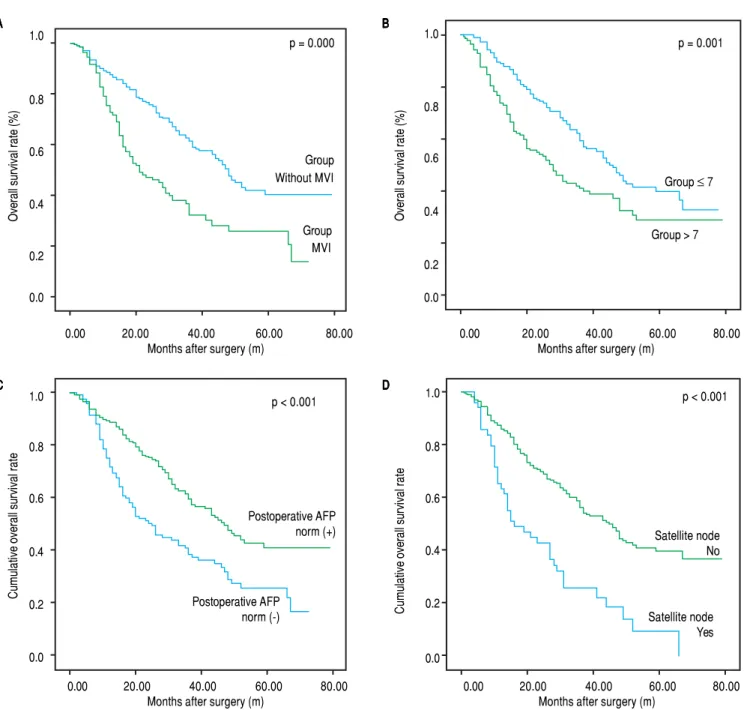
Figure 1. Figure 1. Figure 1. Figure 1.
Figure 1. The curves of OS for patients exceeding Milan criteria subdivided by MVI, tumor sizes > 7 cm, postoperative AFP and satellite node. A.A.A.A.A. The OS rates at 1, 3 and 5-years in patients with MVI were 72.7%, 32.2% and 25.7%, respectively; 40.3% patients without MVI. B.B.B.B.B. The OS rates at 1, 3 and 5-years were 89.0%, 59.4% and 40.0% in patients with tumor sizes ≤ 7 cm, respectively, and 73.9%, 41.3% and 29.1% in patients with tumor sizes >7 cm, respectively C.
C. C. C.
C. The OS rates at 1, 3 and 5-years were 88.6%, 59.3% and 40.8% in patients with AFP norm (+), respectively, and 71.8%, 38.5% and 25.5% in patients with AFP norm (-), respectively; d. The OS rates at 1, 3 and 5-years were 85.8%, 56.1% and 39.6% in patients without satellite node, respectively, and 63.3%, 25.7% and 9.2% in patients with satellite nodes, respectively.
39.6 and 65.4 years, respectively (p < 0.05). There were no significant differences in the positive HBV-DNA loads or liver functions. Group A had higher levels of blood platelet counts and albumin (p < 0.001). Group B had a lower rate of hepatitis B infection (HBV) (p = 0.001) and a higher proportion of patients with co-mor-bid diseases (p < 0.05). Rates of patients with AFP > 400
ng/mL were higher in group A than in group B (62.3% vs.
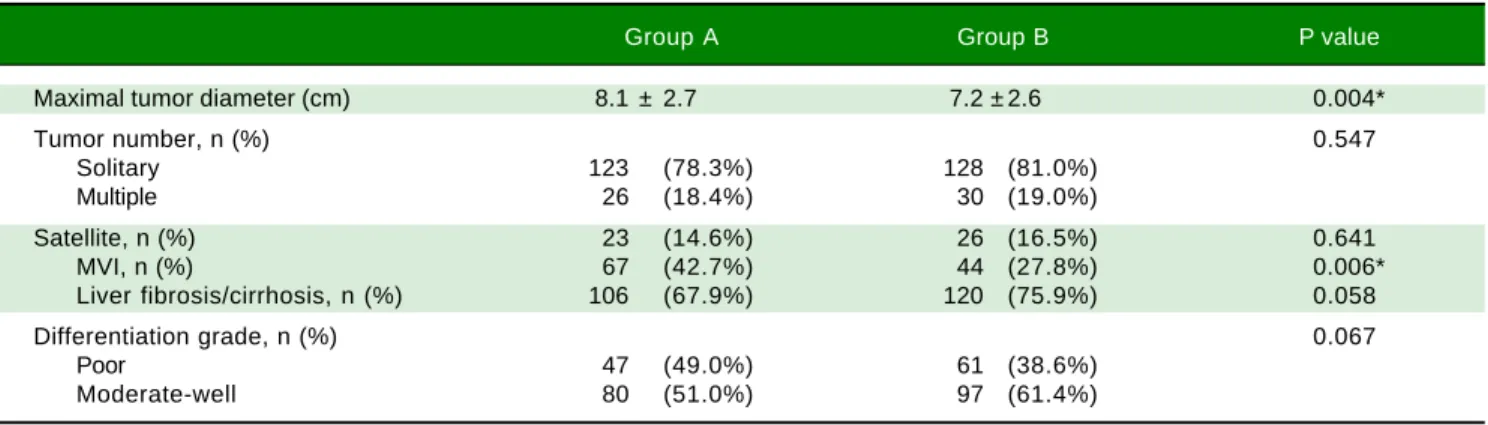
41.5%, p < 0.05). As shown in table 2, tumor differentia-tion and the presence of satellites between groups A and B were not significant. However, the size of the largest tumor was significantly larger in group A than in group B. The mean tumor diameter was 8.1 cm for group A and 7.2 cm for group B (p = 0.004). Group A had a higher
A A A A A
Without MVI
MVI p = 0.000
Overall survival rate (%)
0.00 20.00 40.00 60.00 80.00
Months after surgery (m) 1.0
0.8
0.6
0.4
0.0 0.2
Group
Group
Cumulative overall survival rate
0.00 20.00 40.00 60.00 80.00 Months after surgery (m)
1.0
0.8
0.6
0.4
0.0 0.2 C C C C C
p < 0.001
Postoperative AFP norm (-)
Postoperative AFP norm (+)
Overall survival rate (%)
0.00 20.00 40.00 60.00 80.00 Months after surgery (m)
1.0
0.8
0.6
0.4
0.0 0.2 B BB BB
p = 0.001
Group ≤ 7
Group > 7
p < 0.001
Cumulative overall survival rate
0.00 20.00 40.00 60.00 80.00 Months after surgery (m)
1.0
0.8
0.6
0.4
0.0 0.2 D DD DD
Satellite node No
presence of MVI compared with group B (42.7% vs. 27.8%, p = 0.006).
Surgery-related features and short-term results
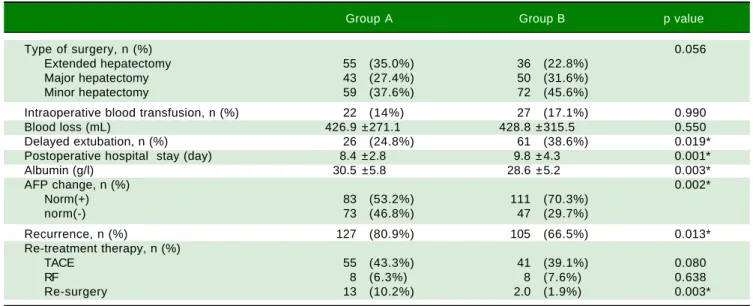
The types of surgery used in this study include minor hepatectomy (one segment), major hepatectomy (two or three segment) and extensive hepatectomy (more than three segments). A thorough intraoperative ultrasonogra-phy was performed to confirm the characteristics of each tumor. As shown in table 3, there were no significance dif-ferences in the type of surgery (p = 0.056), blood loss (p
= 0.550), and intraoperative blood transfusion (p = 0.990) between group A and group B. After operation, group B had lower albumin levels and higher rates of patients with prolonged postoperative hospital stays than group A. The rate of recurrence until the final follow-up evaluation in group A was 80.9%, which was significantly higher than that of group B (66.5%, p = 0.013). Group A had a high percentage of patients receiving re-surgery due to HCC recurrence (10.2% vs. 1.9%, p = 0.003; table 3). The rate of patients who achieved normalized AFP (norm+) after
sur-gery was higher in group B (53.2% vs. 70.3%), while the
rate of patients with non-normalized AFP (norm-) (46.8%
vs. 29.7%) after surgery was higher in group A (p = 0.002).
Table 1. Demographic data for group A and group B.
Variable Group A Group B p value
Age (y) 39.6 ± 7.4 65.4 ± 6.5 0.000*
Male, n (%) 131 (83.4%) 134 (84.8%) 0.038*
Co-morbidity, n (%) 9 (5.7%) 51 (32.2%) 0.000*
Hypertension 3 (1.9%) 35 (15.8%)
Diabetes 5 (3.1%) 21 (13.2%)
Pulmonary disease 1 (0.6%) 6 (3.7%)
Etiology, n (%) 0.001*
HBV 145 (92.4%) 121 (76%)
HCV 1.0 (0.9%) 1 (0.4%)
Without HBV or HCV 12 (7.6%) 36 (22.8%)
Positive preoperative HBV-DNA, n (%)a 69 (43.9%) 57 (36.1%) 0.234
Child-Pugh (A/B), n 125/32 127/31 0.866
TB (umol/L) 14.2 ± 6.4 14.6 ± 5.8 0.381
ALT (IU/L) 51.6 ± 41.8 45.6 ± 46.6 0.331
Albumin (g/L) 41.7 ± 5.1 40.2 ± 4.4 0.006*
Blood platelet count (109/L) 169.1 ± 75.5 136.1 ± 63.8 < 0.001*
AFP (ng/mL), n (%) 0.001*
≤ 400 60 (38.2%) 94 (59.5%)
> 400 97 (61.8%) 64 (41.5%)
* Significant difference. HBV: hepatitis B virus. HCV: hepatitis C virus. TB: total bilirubin. ALT: aminotransferase transaminase. AFP: alpha fetoprotein. Table 2. Pathological features between both groups.
Group A Group B P value
Maximal tumor diameter (cm) 8.1 ± 2.7 7.2 ± 2.6 0.004*
Tumor number, n (%) 0.547
Solitary 123 (78.3%) 128 (81.0%)
Multiple 26 (18.4%) 30 (19.0%)
Satellite, n (%) 23 (14.6%) 26 (16.5%) 0.641
MVI, n (%) 67 (42.7%) 44 (27.8%) 0.006*
Liver fibrosis/cirrhosis, n (%) 106 (67.9%) 120 (75.9%) 0.058
Differentiation grade, n (%) 0.067
Poor 47 (49.0%) 61 (38.6%)
Moderate-well 80 (51.0%) 97 (61.4%)
Postoperative complications and factors associated with complications
According to the Clavien-Dindo classification, the in-cidence of complications in the older age group B
ap-peared to be higher (42.0% vs. 53.2%, p = 0.048). Group B
had a higher proportion of major mortality (Clavien-Din-do Stage System III-V) than group A. During hospitaliza-tion, group B had 4 (2.5%) patients that required mechanical respiratory support for acute respiratory fail-ure and 9 (5.7%) patients that required punctfail-ure drainage for pleural effusion. Among them, 2 (1.3%) patients died in hospital due to Multiple Organ Dysfunction Syn-drome. There were only 4 (2.4%) patients that required puncture drainage; no deaths were reported in group A. The percentage of patients who suffered infectious com-plications after liver resection was much higher in group
B (12.3% vs. 20.9%, p = 0.04). No significant differences
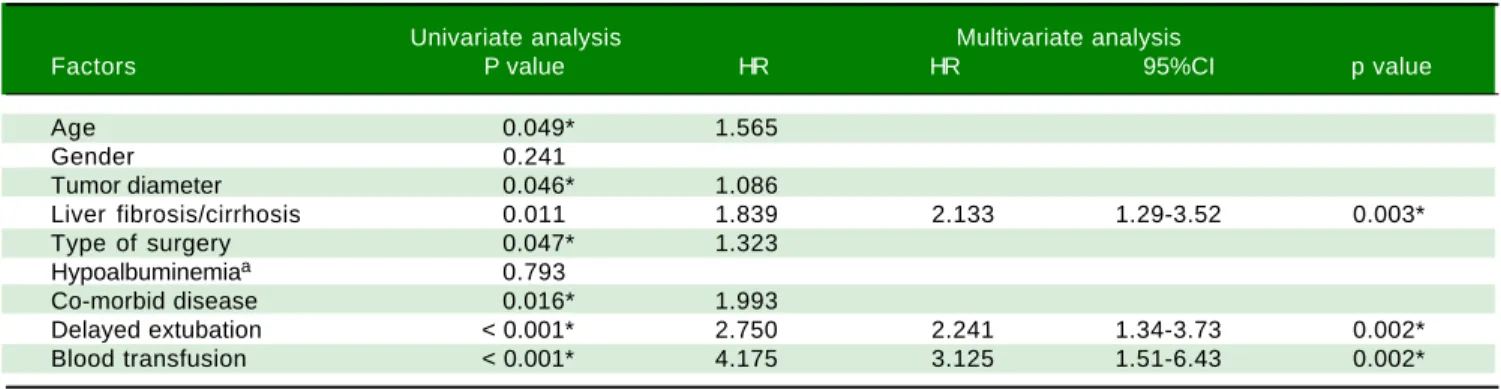
between both groups were observed regarding 30-day and 90-day postoperative mortalities. At 30 days, the mortality rate was 0.0% for group A and 1.2% for group B (p = 0.245). At 90 days, the mortality rate was 1.2% for group A and 2.5% for group B, respectively (p = 0.353) (Table 4). By univariate analyses, age, liver fibrosis/cirrhosis, tumor diameter, type of surgery, co-morbid disease, intraoperative blood transfusion and delayed extubation were significantly different between the two groups. Only intraoperative blood transfusion [hazard ratio (HR) 3.388, 95% confidence interval (CI) 1.63-7.04, p = 0.001], liver fibrosis/cirrhosis (HR 2.133 95%CI 1.29-3.52 p = 0.003) and delayed extuba-tion (HR = 2.341, 95%CI 1.39-3.92, p = 0.001) remained significant in multivariate analyses (Table 5).
Long-term survival and
risk factors between young and older HCC patients
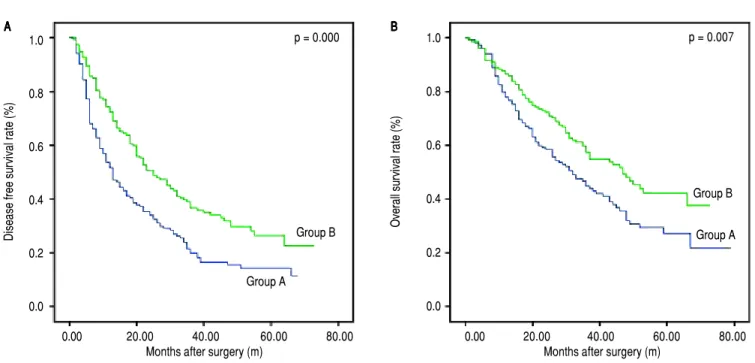
The disease-free survival rates after hepatectomy at 1, 3, and 5-years were 51.6%, 19.9%, and 14.3% in group A, re-spectively, and 72.4%, 36.7% and 26.5% in group B, respec-tively. The overall survival rates after hepatectomy at 1, 3, and 5-years were 78.1%, 45.1%, and 27.4% in group A, re-spectively, and 86.5%, 57.5% and 42.4% in group B, respec-tively. Significant differences were observed (Figures 2A and 2B) (p < 0.05). The median overall survival of group A and group B were 32.0 mo and 47.0 mo, respectively. Among the risk factors for overall survival, MVI, tumor size, postoperative AFP, tumor differentiation, presence of satellite nodules, liver fibrosis/cirrhosis and intraopera-tive blood transfusion were significant under univariate analyses (all p < 0.05). MVI (HR 1.651, 95% CI 1.20-2.26, P = 0.002), tumor size (HR 1.105, 95% CI 1.04-1.16, P = 0.000), postoperative AFP (HR 1.551, 95% CI 1.12-1.91, P = 0.009), presence of satellite (HR 2.065, 95% CI 1.3-3.1, P = 0.000) remained significant risk factors in multivari-ate analyses (Table 6). Patients with negative MVI, smultivari-atellite node postoperative AFP normalization and large tumor sizes had better long-term survival than those without. (Figures 1A-1D) Interestingly, MVI, postoperative AFP level and tumor size as risk factors were not similar be-tween both groups (Tables 2 and 3).
DISCUSSION
Surgical resection is widely utilized for HCC patients capable of liver surgery. A resection can improve survival
Table 3. Surgery-related features and follow-up data.
Group A Group B p value
Type of surgery, n (%) 0.056
Extended hepatectomy 55 (35.0%) 36 (22.8%) Major hepatectomy 43 (27.4%) 50 (31.6%) Minor hepatectomy 59 (37.6%) 72 (45.6%)
Intraoperative blood transfusion, n (%) 22 (14%) 27 (17.1%) 0.990
Blood loss (mL) 426.9 ±271.1 428.8 ± 315.5 0.550
Delayed extubation, n (%) 26 (24.8%) 61 (38.6%) 0.019* Postoperative hospital stay (day) 8.4 ±2.8 9.8 ± 4.3 0.001*
Albumin (g/l) 30.5 ±5.8 28.6 ± 5.2 0.003*
AFP change, n (%) 0.002*
Norm(+) 83 (53.2%) 111 (70.3%)
norm(-) 73 (46.8%) 47 (29.7%)
Recurrence, n (%) 127 (80.9%) 105 (66.5%) 0.013*
Re-treatment therapy, n (%)
TACE 55 (43.3%) 41 (39.1%) 0.080
RF 8 (6.3%) 8 (7.6%) 0.638
Re-surgery 13 (10.2%) 2.0 (1.9%) 0.003*
for an HCC patient regardless of tumor burden if the liver
function was permissive.5 However, postoperative
com-plications cannot be ignored especially in older patients. We defined 55-years-old as the cutoff value because many studies suggested that age was a risk factor of HCC mor-tality and that the risk score for patients older than 55 was increased.16-18 In this study, 47.6% patients suffered
post-operative complications, and 5.4% patients experienced major complications. With advances in surgical techniques and improvements in postoperative management, hepatic resection mortality could decrease to < 1-3%.21,22 Our
re-sults showed that 90-day mortality was 1.7% in HCCs ex-ceeding the Milan criteria; no significant differences were observed between young and older patients. Older pa-tients had a higher rate of developing complications, espe-cially major complications (53.3% vs. 42.0%, p < 0.05).
Transient liver failure, intra-abdominal bleeding, bile leak, sepsis and wound infection were commonly report-ed complications requiring liver resection. In this study, blood transfusion, delayed extubation and liver fibrosis/ cirrhosis were independent factors related to postopera-tive complications in the univariate and multivariate analy-ses. An association between transfusion and postoperative complications has been previously reported. The require-ment for a blood transfusion is a well-established risk fac-tor for postoperative complications in patients following
abdominal surgery.23-25 Blood transfusions suppress host
immunity via reductions in natural killer cell activity and
cytotoxic T-cell function.26 In HCC patients undergoing
hepatectomy, immunosuppressive effects may likely con-tribute to postoperative complications. Liver cirrhosis was another predictor of postoperative complications in the
Table 4. Postoperative complications classification.
Group A Group B P value
Clavien-Dindo grade, n (%) 66 (42.0%) 84 (53.2%) 0.048*
I 29 (18.5%) 28 (17.1%)
II 32 (20.3%) 42 (26.6%)
Major complicationa 0.014*
IIIa 4 (2.4 %) 9 (5.7%)
IIIb 1 (0.6%) 1 (0.6%)
IVa 0 (0%) 2 (1.3%)
IVb 0 (0%) 0 (0%)
V 0 (0%) 2 (1.3%)
Type of complication, n (%)
Infectious disease 19 (12.3%) 33 (20.9%) 0.04*
Ascites/pleural effusion 45 (22.5%) 58 (35.3%) 0.128 Mechanical ventilation support for ARF 0 (0.0%) 4 (2.5%) 0.099
Secondary surgery 1 (0.6%) 2 (1.2%) 0.809
Bile leakage 2 (1.3%) 1 (0.6%) 0.775
30-day mortality, n (%) 0 (0.0%) 2 (1.2%) 0.245
90-day mortality, n (%) 2 (1.2%) 4 (2.5%) 0.353
*Significant difference. ARF: acute respiratory failure. aMajor complication included complications graded as Clavien-Dindo stage system III-V.
Table 5. Factors associated with postoperative complications.
Univariate analysis Multivariate analysis
Factors P value HR HR 95%CI p value
Age 0.049* 1.565
Gender 0.241
Tumor diameter 0.046* 1.086
Liver fibrosis/cirrhosis 0.011 1.839 2.133 1.29-3.52 0.003* Type of surgery 0.047* 1.323
Hypoalbuminemiaa 0.793
Co-morbid disease 0.016* 1.993
Delayed extubation < 0.001* 2.750 2.241 1.34-3.73 0.002* Blood transfusion < 0.001* 4.175 3.125 1.51-6.43 0.002*
Figure 2. Figure 2. Figure 2. Figure 2.
Figure 2. The curves of DFS and OS between group A and group B. A.A.A.A.A. The DFS rates at 1, 3 and 5-years were 51.6%, 19.9% and 14.3% in group A, res-pectively, and 72.4%, 36.7% and 26.5% in group B, respectively. B.B.B.B.B. The OS rates at 1, 3 and 5-years between group A and group B were 80.0%, 45.1% and 27.4% in group A, respectively, and 87.8%, 57.5% and 42.4% in group B, respectively.
A A A A
A BBBBB
Disease free survival rate (%)
1.0
0.8
0.6
0.4
0.2
0.0
Overall survival rate (%)
0.00 20.00 40.00 60.00 80.00 Months after surgery (m)
0.00 20.00 40.00 60.00 80.00
Months after surgery (m)
p = 0.000 p = 0.007
present study. Underlying liver fibroses and cirrhosis neg-atively impacted liver regeneration and liver failure.27 This
point was proved in our study. Cirrhotic patients should avoid a major hepatectomy and preserve as much liver tis-sue as possible. Delayed extubation was also an unfavora-ble factor associated with complications, especially in older patients.28,29 Like a history of pulmonary disease, age
and co-morbidity were important factors associated with prolonged intubation times after surgery. Liver disease
was commonly attributed to altered pharmacodynamics,
leading to longer extubation times.30 Delayed extubations
may also reflect a poor liver function status. The preopera-tive albumin level was lower in older patients than young
patients, suggesting a malnutrition status.31 The decision
to delay extubation may also be an indicator of poor
pul-monary function reserve.25 These may contribute toward
prolonged intubation after surgery and correlate with de-veloping complications such as pneumonia and abdominal
1.0
0.8
0.6
0.4
0.2
0.0
Group B
Group A
Group A Group B
Table 6. Prognostic factors associated with overall survival.
Univariate analysis Multivariate analysis
Factors p value HR HR 95%CI P value
Age 0.127
Gender 0.127
Maximal tumor diameter 0.013 * 1.113 1.105 1.04-1.16 0.000*
Tumor number 0.157
Satellite nodules < 0.001* 4.935 2.156 1.49-3.11 0.000*
MVI 0.001* 2.258 1.651 1.20-2.26 0.002*
Liver fibrosis/cirrhosis 0.032* 1.275 Differentiation 0.263
Positive HBV-DNA load 0.451
AFP 0.206
Treatment after recurrence 0.161
PLT 0.223
AFP change after operation 0.001* 2.209 1.551 1.25-1.91 0.000* Type of surgery 0.465
Intraoperative blood transfusion 0.041* 1.979
Complications 0.341
ascites later in the postoperative period. Compared with factors such as age and co-morbidity, delayed extubation as a reflection of physiologic changes was a more accurate predictor for postoperative complications. In our study, older patients had a higher rate of delayed extubation. This may be correlated with a higher percentage of postopera-tive infectious complications. The length of hospital stay was considerably longer in older patients. Older patients suffered more infectious complications. Improved liver functions and preoperative respiratory exercises advanta-geously reduce postoperative complications, especially for older patients.
In agreement with previous studies, age was not
associ-ated with long-term survival in the present study.32,33
However, compared with older patients, young HCC pa-tients seem to have heavier tumor burdens as indicated by larger tumor sizes, higher rates of satellite nodes and MVIs. Elevated preoperative AFP levels in young HCC patients also suggested the tumors were highly
aggres-sive.34 The prognoses of HCC patients largely depend on
the tumor characteristics at the times the patients could
tolerate surgery.35 In our study, older patients achieved a
better 5-year survival. Tumor size, presence of satellite nodes, MVI and postoperative AFP were independent risk factors associated with long-term survival. Large tumor sizes increased the risk of metastases.36 Satellite nodes and
MVI have been identified as accepted risk factors for poor
prognoses in some solid tumors.37-39 Patients with MVI
and satellite nodes suffered more HCC recurrences. Fur-thermore, there may be intrahepatic metastases beyond the resection field, and the removal of the gross tumor alone will not be enough. HCC treatment guidelines do not fea-ture MVI and satellite nodes as factors in recommending treatment options. The need for effective adjuvant therapy and close follow-up should be taken into account in pa-tients with these risk factors. The postoperative AFP level was reportedly associated with recurrence after curative hepatectomy. A high postoperative AFP level after opera-tion may suggest potentially residual viable tumor cells. An elevated AFP is commonly related to the aggressive ability of a tumor and has been identified as an adverse
fac-tor in the prognoses of HCCs after hepatectomies.34
Young patients commonly had more advanced tumors with higher rates of MVI, larger tumor sizes and high post-operative AFP levels. Interestingly, the three risk factors strongly influenced the prognoses of these patients (Fig-ures 1A-1C, p < 0.05). Young and old patients presented different HBV subgenotype integrations. An HBV B2 inte-gration was predominantly present in young patients, con-tributing to the development of early-onset HCC. A few studies have reported worse prognoses in early-onset
HCC patients.15 Additionally, young patients had advanced
tumors at the times of diagnoses due to poor surveillance.
These factors may have ultimately contributed to poor prognoses.
CONCLUSION
In contrast with young HCC patients, older patients had a higher rate of complications, especially major com-plications. In order to decrease complications, blood transfusions should be avoided. Furthermore, improved liver functions and increased respiratory exercises should be followed, especially for older patients. Young patients seemed to suffer worse prognoses partly due to more ad-vanced tumors. Patients with risk factors, such as MVIs, satellite nodes, large tumor sizes and high postoperative AFP levels, should be closely monitored and provided ag-gressive therapies such as TACE.
ABBREVIATIONS
• AFP: alpha fetoprotein.
• CI: confidence interval.
• DFS: disease free survival.
• HBV: hepatitis B viral.
• HCC: hepatocellular carcinoma.
• HR: hazard ratio.
• MVI: microvascular invasion.
• OS: overall survival.
• RF: radiofrequency ablation.
• TACE: transcatheter arterial chemoembolization.
SUPPORT
The authors have received no financial support in the conduct of this study. The authors have no conflicts of in-terest.
REFERENCES
1. Torre LA, Bray F, Siegel RL, Ferlay J, Lortet-Tieulent J, Jemal A. Global cancer statistics, 2012. CA: A Cancer Journal for Clinicians 2015; 65: 87-108.
2. Wang FS, Fan JG, Zhang Z, Gao B, Wang HY. The global burden of liver disease: the major impact of China. Hepatolo-gy 2014; 60: 2099-108.
3. Xu X, Lu D, Ling Q, Wei X, Wu J, Zhou L, Yan S, et al. Liver transplantation for hepatocellular carcinoma beyond the Mi-lan criteria. Gut 2015.
4. Hsu CY, Liu PH, Hsia CY, Lee YH, Nagaria TS, Lee RC, Lin HC, et al. Surgical Resection is Better than Transarterial Chemoembolization for Patients with Hepatocellular Carcino-ma Beyond the Milan Criteria: A Prognostic Nomogram Study.
Ann Surg Oncol 2015.
5. Yin L, Li H, Li AJ, Lau WY, Pan ZY, Lai EC, Wu MC, et al. Par-tial hepatectomy vs. transcatheter arterial chemoemboliza-tion for resectable multiple hepatocellular carcinoma beyond Milan Criteria: a RCT. J Hepatol 2014; 61: 82-8.
Minqing X, et al. Barcelona clinic liver cancer stage B hepa-tocellular carcinoma: transarterial chemoembolization or he-patic resection? Medicine 2014; 93: e180.
7. Oishi K, Itamoto T, Kohashi T, Matsugu Y, Nakahara H, Kita-moto M. Safety of hepatectomy for elderly patients with hepatocellular carcinoma. World Journal of Gastroenterolo-gy:WJG 2014; 20: 15028-36.
8. Hirokawa F, Hayashi M, Miyamoto Y, Asakuma M, Shimizu T, Komeda K, Inoue Y, et al. Surgical outcomes and clinical characteristics of elderly patients undergoing curative hepa-tectomy for hepatocellular carcinoma. J Gastrointestinal Surg 2013; 17: 1929-37.
9. Ferrero A, Vigano L, Polastri R, Ribero D, Lo Tesoriere R, Muratore A, Capussotti L. Hepatectomy as treatment of choice for hepatocellular carcinoma in elderly cirrhotic pa-tients. World J Surg 2005; 29: 1101-5.
10. Chang PE, Ong WC, Lui HF, Tan CK. Is the prognosis of young patients with hepatocellular carcinoma poorer than the prognosis of older patients? A comparative analysis of clinical characteristics, prognostic features, and survival outcome. J Gastroenterol 2008; 43: 881-8.
11. Takeishi K, Shirabe K, Muto J, Toshima T, Taketomi A, Mae-hara Y. Clinicopathological features and outcomes of young patients with hepatocellular carcinoma after hepatectomy.
World J Surg 2011; 35: 1063-71.
12. Golfieri R, Bilbao JI, Carpanese L, Cianni R, Gasparini D, Ez-ziddin S, Paprottka PM, et al. Comparison of the survival and tolerability of radioembolization in elderly vs. younger pa-tients with unresectable hepatocellular carcinoma. J Hepatol
2013; 59: 753-61.
13. Chen CH, Chang TT, Cheng KS, Su WW, Yang SS, Lin HH, Wu SS, et al. Do young hepatocellular carcinoma patients have worse prognosis? The paradox of age as a prognostic factor in the survival of hepatocellular carcinoma patients.
Liv Int 2006; 26: 766-73.
14. Cho SJ, Yoon JH, Hwang SS, Lee HS. Do young hepatocel-lular carcinoma patients with relatively good liver function have poorer outcomes than elderly patients? J Gastroenter-ol HepatGastroenter-ol 2007; 22: 1226-31.
15. Yan H, Yang Y, Zhang L, Tang G, Wang Y, Xue G, Zhou W, et al. Characterization of the genotype and integration pat-terns of hepatitis B virus in early- and late-onset hepatocel-lular carcinoma. Hepatology 2015; 61: 1821-31.
16. Ikeda K, Arase Y, Saitoh S, Kobayashi M, Someya T, Hosaka T, Akuta N, et al. Prediction model of hepatocarcinogenesis for patients with hepatitis C virus-related cirrhosis. Valida-tion with internal and external cohorts. J Hepatol 2006; 44: 1089-97.
17. Peng SY, Chen WJ, Lai PL, Jeng YM, Sheu JC, Hsu HC. High alpha-fetoprotein level correlates with high stage, early re-currence and poor prognosis of hepatocellular carcinoma: significance of hepatitis virus infection, age, p53 and beta-catenin mutations. Int J Cancer 2004; 112: 44-50.
18. Simons JP, Ng SC, Hill JS, Shah SA, Zhou Z, Tseng JF. In-hospital mortality from liver resection for hepatocellular car-cinoma: a simple risk score. Cancer 2010; 116: 1733-8. 19. Clavien PA, Barkun J, de Oliveira ML, Vauthey JN, Dindo D,
Schulick RD, de Santibanes E, et al. The Clavien-Dindo clas-sification of surgical complications: five-year experience. Ann Surg 2009; 250: 187-96.
20. Figueras J, Llado L, Ruiz D, Ramos E, Busquets J, Rafecas A, Torras J, et al. Complete versus selective portal triad clamping for minor liver resections: a prospective rand-omized trial. Ann Surg 2005; 241: 582-90
21. Kim KS. Current status of hepatic surgery in Korea. KAMJE
2009; 15(Suppl. 6): S60-S64.
22. Fan ST, Mau Lo C, Poon RT, Yeung C, Leung Liu C, Yuen WK, Ming Lam C, et al. Continuous improvement of survival outcomes of resection of hepatocellular carcinoma: a 20-year experience. Ann Surg 2011; 253: 745-58.
23. Kooby DA, Stockman J, Ben-Porat L, Gonen M, Jarnagin WR, Dematteo RP, Tuorto S, et al. Influence of transfusions on perioperative and long-term outcome in patients following he-patic resection for colorectal metastases. Ann Surg 2003; 237: 860-9; discussion 9-70.
24. Okano K, Hirao T, Unno M, Fujii T, Yoshitomi H, Suzuki S, Satoi S, et al. Postoperative infectious complications after pancreatic resection. Brit J Surg 2015; 102: 1551-60. 25. Studer P, Räber G, Ott D, Candinas D, Schnüriger B. Risk
factors for fatal outcome in surgical patients with postopera-tive aspiration pneumonia. Int J Surg 2016; 27: 21-5. 26. Kaplan J, Sarnaik S, Gitlin J, Lusher J. Diminished
helper/sup-pressor lymphocyte ratios and natural killer activity in recipi-ents of repeated blood transfusions. Blood 1984; 64: 308-10.
27. Wong JS, Wong GL, Chan AW, Wong VW, Cheung YS, Chong CN, Wong J, et al. Liver stiffness measurement by transient elastography as a predictor on posthepatectomy outcomes. Ann Surg 2013; 257: 922-8.
28. Hayashi Y, Morisawa K, Klompas M, Jones M, Bandeshe H, Boots R, Lipman J, et al. Toward improved surveillance: the impact of ventilator-associated complications on length of stay and antibiotic use in patients in intensive care units.
CID 2013; 56: 471-7.
29. Bouadma L, Wolff M, Lucet J-C. Ventilator-associated pneumonia and its prevention. Curr Opin Infect Dis 2012; 25: 395-404.
30. Murata F, Iwade M, Hidano G, Tsunoda C, Nagata O, Ozaki M. Recovery from propofol anesthesia is delayed in hepate-ctomy patients due to altered pharmacodynamics. JSA 2006; 55: 150-7.
31. Ataseven B, du Bois A, Reinthaller A, Traut A, Heitz F, Aust S, Prader S, et al. Pre-operative serum albumin is as-sociated with post-operative complication rate and overall survival in patients with epithelial ovarian cancer under-going cytoreductive surgery. Gynecol Oncol 2015; 138: 560-5.
32. Nanashima A, Abo T, Nonaka T, Fukuoka H, Hidaka S, Take-shita H, Ichikawa T, et al. Prognosis of patients with hepa-tocellular carcinoma after hepatic resection: are elderly patients suitable for surgery? J Surg Oncol 2011; 104: 284-91.
33. Lee SH, Choi HC, Jeong SH, Lee KH, Chung JI, Park YS, Hwang JH, et al. Hepatocellular carcinoma in older adults: clinical features, treatments, and survival. J Am Geriatr Soc
2011; 59: 241-50.
34. Lu Y, Zhu M, Li W, Lin B, Dong X, Chen Y, Xie X, et al. Al-pha fetoprotein plays a critical role in promoting metastasis of hepatocellular carcinoma cells. J Cell Mol Med 2016; 20: 549-58.
35. Lencioni R, Chen XP, Dagher L, Venook AP. Treatment of in-termediate/advanced hepatocellular carcinoma in the clinic: how can outcomes be improved? Oncologist 2010; 15(Sup-pl. 4): 42-52.
36. Carr BI, Guerra V. Hepatocellular carcinoma extrahepatic metastasis in relation to tumor size and alkaline phosphatase levels. Oncology 2016; 90: 136-42.
38. Sumie S, Kuromatsu R, Okuda K, Ando E, Takata A, Fuku-shima N, Watanabe Y, et al. Microvascular invasion in pa-tients with hepatocellular carcinoma and its predictable clinicopathological factors. Ann Surg Oncol 2008; 15: 1375-82.
39. Huang J, Li BK, Chen GH, Li JQ, Zhang YQ, Li GH, Yuan YF. Long-term outcomes and prognostic factors of elderly pa-tients with hepatocellular carcinoma undergoing hepatecto-my. J Gastrointestinal Surg 2009; 13: 1627-35.
Correspondence and reprint request:
Tianfu Wen, Ph.D.
Department of Liver Surgery & Liver Transplantation Center, West China Hospital, Sichuan University, 610041, Chengdu,
Sichuan, China.