194
medigraphic.com
INVESTIGACIÓN CLÍNICAINVESTIGACIÓN CLÍNICA INVESTIGACIÓN CLÍNICA INVESTIGACIÓN CLÍNICA INVESTIGACIÓN CLÍNICA
Predictors of mortality and adverse outcome in elderly
high-risk patients undergoing percutaneous coronary
intervention
Emma Miranda Malpica,* Marco Antonio Peña Duque,* José Castellanos,* Emilio Exaire,* Oscar Arrieta,** Eduardo Salazar Dávila,* Ramón Villavicencio Fernández,* Hilda Delgadillo-Rodríguez,* Carlos J González-Quesada,* Marco A Martínez-Ríos*
* The National Institute of Cardiology, Mexico City. ** National Institute of Cancer, Mexico City.
Corresponding author: Marco Antonio Peña Duque. Department of Interventional Cardiology. Instituto Nacional de Cardiología, Juan Badiano Núm. 1, Col. Sección XVI, Delegación Tlalpan, 14080 México, D.F.
Tel.: 5573-2911 Ext. 1250
E-mail address: [email protected]
Recibido: 27 de octubre de 2006 Aceptado: 30 de abril de 2007
Resumen
PREDICTORES DE MORTALIDAD Y MAL PRONÓSTICO EN PACIENTES ANCIANOS Y DE ALTO RIESGO QUE VAN A SER
SOMETIDOS A INTERVENCIÓN CORONARIA PERCUTÁNEA
Propósito: Identificar predictores de mortalidad y de eventos cardiovasculares adversos mayo-res (ECAM) intrahospitalarios y a largo plazo (>1 año) en ancianos sometidos a intervencio-nismo coronario. Métodos: Se incluyeron 73 pacientes (≥ 80 años). Se obtuvieron retrospec-tivamente características clínicas y del interven-cionismo. Los desenlaces primarios fueron mor-talidad intrahospitalaria y a largo plazo, así como un desenlace compuesto de infarto del miocar-dio no fatal, revascularización de vaso tratado, cirugía de revascularización coronaria y muerte (ECAM). Resultados: 83% de los pacientes tu-vieron síndrome coronario agudo o Infarto agu-do del miocardio, 43% eran trivasculares, 42% presentaban insuficiencia cardíaca. La mortali-dad y ECAM intrahospitalarios fueron de 16.4% y 19%, respectivamente. Mortalidad y ECAM a largo plazo fueron de 11.3% y 16.4% respectiva-mente. Las características que se asociaron a mortalidad y ECAM intrahospitalarios fueron cla-sificación de Killip III-IV, insuficiencia cardíaca, choque cardiogénico, flujo TIMI 0-2 pre y post Summary
medigraphic.com
1. Introduction
he elderly represent the fastest growing segment of the population worldwide. The high prevalence of coronary dis-ease in this age group has resulted in an incrdis-ease of percutaneous coronary intervention (PCI) in this population.1 The best strategy of revascu-larization in this group of patients has not yet been determined. Furthermore, there is contra-dictory information about the best treatment of both acute coronary syndrome2,3 and stable an-gina;4,5 however, there is agreement that ad-vanced age is a predictor of worst outcome and increased mortality. The mechanism by which age contributes so dramatically to mortality is unknown. It has been postulated that death is precipitated in the elderly by the presence of more co-morbidities, more severe coronary dis-ease, reduced of both cardiac and physiologic reserve.6-8
Many of the randomized clinical trials evaluat-ing the effects of therapeutic interventions have excluded octogenarians, thereby providing lim-ited insights to the natural history and mortality patterns of these high-risk patients.9,10 We there-fore evaluated the outcome of patients > 80 years old who underwent PCI in our institution to iden-tify the predictors of major adverse cardiac events (MACE) and mortality.
2. Material and methods 2.1 Patients
From January 1997 to November 2004, 73 pa-tients aged > 80 years underwent PCI (100 le-sions) at our institution constituting the study population. The information was obtained ret-rospectively from patient’s files.
procedimiento, diabetes mellitus, nefropatía por contraste, presencia de bloqueo A-V o fibrila-ción auricular (FA). Los predictores de mortali-dad a largo plazo fueron insuficiencia cardíaca, diabetes mellitus, flujo TIMI 0-2 antes y después de la intervención y bloqueo A-V o FA. Conclu-siones: La identificación de estos factores de riesgo puede ayudar a predecir complicaciones en pacientes de edad avanzada.
(Arch Cardiol Mex 2007; 77: 194-199)
Key words: Percutaneous coronary intervention. Elderly. Mortality.
Palabras clave: Intervención coronaria percutánea. Mortalidad. Pacientes de edad avanzada.
and after intervention, and A-V block or AF.
Conclusion: The identification of the factors previously mentioned may help to predict com-plications in elderly patients.
2.2 Procedural characteristics
After informed consent, cardiac catheterization and PCI were performed by femoral approach, using a 6 or 7 Fr guiding catheter. Heparin (100 IU/kg) was administered intravenously at the be-ginning of the procedure and additional doses were given when necessary to maintain an acti-vated clotting time of > 300 seconds. All patients received aspirin 300 mg/day before and 100 mg daily after the procedure. In patients receiving coronary stent, clopidogrel (300 mg as a loading dose, 75 mg/day thereafter) was administered for 6 months. Glycoprotein IIb/IIIa inhibitors were administered at operators discretion.
2.3 Definition of variables
medigraphic.com
as systolic pressure < 90 mm Hg for at least 30 min, or > 90 mm Hg if treated with inotropes or intra-aortic balloon pump insertion, or pump failure as manifested by cardiac index < 2.2 liter/min per m2 and pulmonary capillary wedge pressure >18 mm Hg.12 Stroke was defined as the new onset of focal or global neurological deficit caused by ischemia or hemorrhage within or around the brain and last-ing for more than 24 hours confirmed by image. Contrast nephropathy was defined as an absolute increase of 0.5 mg in the serum creatinine level or a 25% increase over the baseline value during the 24-48 hours after the procedure. Major bleeding loss was defined as clinically significant overt signs of bleeding associated with a drop in hemoglobin of > 5 g/dL or a hematocrit drop of > 15%.11
2.3 PCI outcomes
An independent interventionalist analyzed the outcome of the PCI. Left main coronary artery disease was defined as > 50% stenosis in the left main coronary artery; a stenosis > 70% was con-sidered significant in all other coronary arteries. Follow-up was performed by clinical interview or telephone contact after discharge.
2.4 Endpoints
Primary endpoints were death and a composite endpoint including death, nonfatal myocardial infarction, target vessel revascularization or ur-gent CABG in- hospital and during long-term follow-up (1 year).
2.5 Statistical analysis
Statistical analysis was performed using the SPSS11 statistical package (SPSS, Inc., Chicago, Illinois). Continuous variables are expressed as means ± SE and discrete variables as percentages. Compari-sons of proportions were evaluated by the chi-square test and Fisher’s exact test. Cumulative survival rates were evaluated with Kaplan-Meier curves and a comparison between groups was studied using the log-rank test. Associations were considered sta-tistically significant at p < 0.05.
3. Results
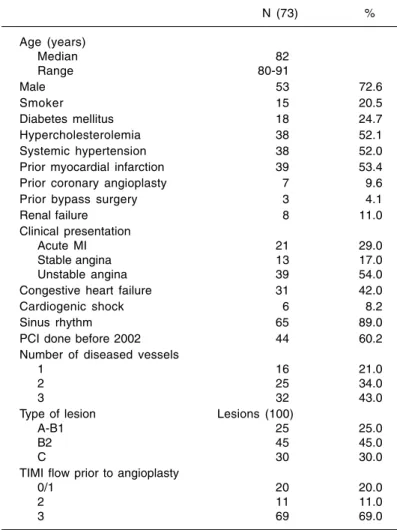
Baseline clinical and angiographic characteris-tics are described in Table I. Most of the patients underwent cardiac catheterization due to an acute coronary syndrome and had low left ven-tricular function. Most lesions were in LAD (87%) and 57% of the patients had multivessel disease. Table II shows the procedural
charac-Table I. Baseline clinical and angiographic characteristics.
N (73) %
Age (years)
Median 82
Range 80-91
Male 53 72.6
Smoker 15 20.5
Diabetes mellitus 18 24.7
Hypercholesterolemia 38 52.1
Systemic hypertension 38 52.0
Prior myocardial infarction 39 53.4
Prior coronary angioplasty 7 9.6
Prior bypass surgery 3 4.1
Renal failure 8 11.0
Clinical presentation
Acute MI 21 29.0
Stable angina 13 17.0
Unstable angina 39 54.0
Congestive heart failure 31 42.0
Cardiogenic shock 6 8.2
Sinus rhythm 65 89.0
PCI done before 2002 44 60.2
Number of diseased vessels
1 16 21.0
2 25 34.0
3 32 43.0
Type of lesion Lesions (100)
A-B1 25 25.0
B2 45 45.0
C 30 30.0
TIMI flow prior to angioplasty
0/1 20 20.0
2 11 11.0
3 69 69.0
MI: Myocardial infarction. TIMI: Thrombolysis in myocardial infarction.
Table II. Procedural characteristics.
N (100 lesions) %
PTCA only 17 17.0
Stents 83 83.0
BMS 58 70.0
DES 25 30.0
TIMI flow after PCI
0/1 10 10.0
2 6 6.6
3 83 83.0
Procedural success 90 lesions 90.0
Procedural complications
Acute closure 3 4.1
Perforation 2 2.7
Death 1 1.4
No reflow 8 11.0
Procedural failure 9 9.0
Secondary branch occlusion 3 4.0
PTCA: Primary transcutaneous coronary angioplasty. BMS: Bare metal stents. DES Drug eluting stents. PCI: Percutaneous coronary intervention.
medigraphic.com
ESTE DOCUMENTO ES ELABORADO POR MEDIGRAPHIC
teristics. The most frequent type of lesions ob-served was B2 and C (75%). Most of the lesions (83%) were stented; bare metal stents were used in 70% of the patients.
Complications during the procedure were present in 23% of the patients (Table II). In-hospital MACE was present in 19.2% and 9.6% at one year of follow-up respectively. The total mortal-ity rate was 28.8%, however 33% of these were
Table III. Clinical outcomes.
N (73 patients) %
In-hospital
MACE 14 19.2
Death 12 16.4
Post-procedural MI 1 1.3
TVR 1 1.3
At follow-up (1-5 years)
MACE 12 16.4
Death 9 11.3
TVR 3 3.9
In-stent restenosis 10 13.6
Contrast nephropathy 15 20.0
MI: Myocardial infarction. MACE: Major adverse cardiovascular events. TVR: Target vessel revascularization.
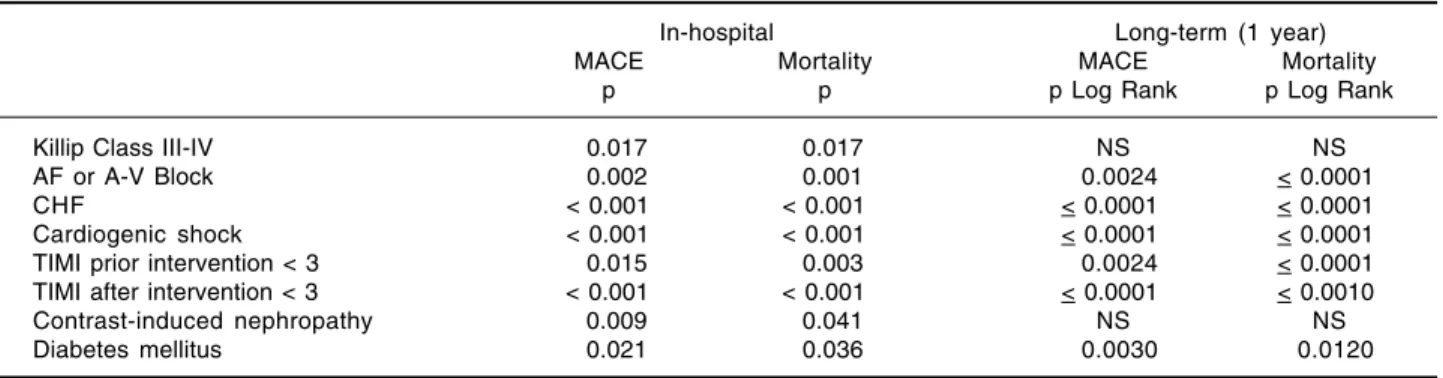
Table IV. Factors associated with in-hospital and long-term mace and mortality (univariate analysis).
In-hospital Long-term (1 year)
MACE Mortality MACE Mortality
p p p Log Rank p Log Rank
Killip Class III-IV 0.017 0.017 NS NS
AF or A-V Block 0.002 0.001 0.0024 < 0.0001
CHF < 0.001 < 0.001 < 0.0001 < 0.0001
Cardiogenic shock < 0.001 < 0.001 < 0.0001 < 0.0001
TIMI prior intervention < 3 0.015 0.003 0.0024 < 0.0001
TIMI after intervention < 3 < 0.001 < 0.001 < 0.0001 < 0.0010
Contrast-induced nephropathy 0.009 0.041 NS NS
Diabetes mellitus 0.021 0.036 0.0030 0.0120
MACE: Major adverse cardiovascular events. AF Atrial fibrillation. A-V: Auriculoventricular. CHF Congestive heart failure. PCI: Percutaneous coronary intervention. TIMI: Thrombolysis in myocardial infarction.
Table V. Stent type used associated with in-hospital and long-term MACE and mortality.
In-hospital Long-term (1 year)
MACE1 Mortality3 MACE 1 Mortality2
n % n % n % n %
BMS 7 15.9 5 11.40 15 34.1 11 25.00
DES 2 11.7 2 11.76 4 23.5 2 11.76
Only PTCA without stenting 5 50.0 5 50.00 7 70.0 7 70.00
1 p = NS, 2 p = 0.033, 3 p = 0.083.
BMS: Bare-metal stent. DES: Drug-eluting stent. PTCA: Primary transcutaneous coronary angioplasty.
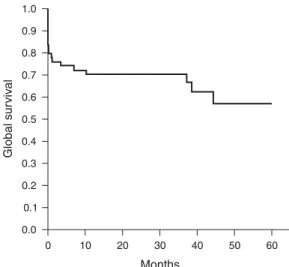
non-cardiovascular deaths, and only 5.6% were secondary to PCI complications (Table III). In-hospital mortality was 16.4% (12 patients). Four patients died during PCI (1 tamponade, 1 elec-tro-mechanic dissociation, and 2 had cardiogenic shock). At one year of follow-up there were 6 deaths (7.8%). Five-year follow-up was complet-ed in 35% of the patients; 3 deaths occurrcomplet-ed during this period of time (1-5 years), and 2 had TVR due to acute coronary syndromes). Univariate analysis is showed in Table IV. Car-diogenic shock and heart failure were strongly associated with MACE and mortality (P < 0.001) and, the presence of complete A-V Block or atri-al fibrillation (AF) was atri-also associated with both (p = 0.002 and p = 0.001, respectively). Follow-up survival time and free composite end point survival time are showed in Table IV and by Kaplan-Meier survival curves in figure 1. Among other previously known factors the presence of A-V block or AF and the presence of diabetes were significantly associated with MACE and mortality at 1-year follow-up (p < 0.05).
hos-medigraphic.com
pital and long-term MACE and mortality than patients treated with bare metal stents and drug eluting stents (Table V).
4. Discussion
This study confirms the known predictors of mortality and MACE in this population such as cardiogenic shock, heart failure, diabetes melli-tus, TIMI flow, type of lesion and, contrast neph-ropathy.13-19 Interestingly, the presence of A-V block or AF was strongly associated with MACE and mortality in this PCI cohort. This has been previously described in acute myocardial inf-arction patients undergoing thrombolysis,20-22 however, our findings support that this is a pre-dictor of adverse prognosis even after a success-ful PCI. One possible explanation is that the absence of auricular contraction due to these arrhytmias decreases the atrial contribution of the ventricular pre-load, further decreasing the ejection fraction.
The mortality rate found in the present report is high (28.8% global mortality and 19% cardiac mortality compared to 3% from previous re-ports).7 However, most of the patients included
in our series (83%) had an acute coronary syn-drome a known predictor of mortality in patients undergoing PCI independently of age,2,23 espe-cially in elderly population.3,24 Furthermore, 8.3% of the patients in this group were in car-diogenic shock, population with a mortality rate of 80% from previous reports.25 Another possi-ble explanation for the elevated mortality is that elective PCI was only performed in 17% of our population compared with 69% in other series.5,26 The presence of diabetes mellitus is associated with in-hospital and long-term mortality. These patients tend to present with several co-morbid-ities such as nephropathy; this pathology has been recently associated with a higher incidence of in-hospital mortality.19 Alternative hypothe-sis of the higher rate of mortality in diabetics would be an increase of trans-procedural com-plications such as no reflow phenomenon. This clinical relevant problem tends have a higher incidence in patients with hyperglycemia. In this small sample of patients, it is noteworthy to note we did not observe any acute, sub-acute, or late stent thrombosis despite the use of drug eluting stents in 30% of this population.
Limitations
This is a retrospective study with a limited num-ber of patients. Multivariate analysis and pro-pensity score analysis were not applied due to the limited number of events observed.
5. Conclusion
Although there has been significant improve-ment in the clinical success rate, mortality asso-ciated with PCI in octogenarians remains high. Factors associated with in-hospital and long term follow-up mortality and MACE were car-diogenic shock, heart failure, presence of A-V Block or atrial fibrillation and TIMI flow 0-2 before and after PCI. The presence of these clin-ical factors may help to identify patients at higher risk for PCI.
Fig. 1. Kaplan-Meier survival curve.
References
1. WENGER NK, O’ROURKE RA, MARCUS FI: The care of
elderly patients with cardiovascular disease. Ann Intern Med. 1988; 109(5): 425-8.
2. GRINES CL, BROWNE KF, MARCO J, ROTHBAUM D,
STONE GW, O’KEEFE J, ETAL: A comparison of im-mediate angioplasty with thrombolytic therapy for acute myocardial infarction. The Primary
Angio-plasty in Myocardial Infarction Study Group. N Engl J Med 1993; 328(10): 673-9.
3. GUAGLIUMI G, STONE GW, COX DA, STUCKEY T,
TCHENG JE, TURCO M, ETAL: Outcome in elderly
patients undergoing primary coronary intervention for acute myocardial infarction: results from the Controlled Abciximab and Device Investigation to
Global sur
viv
al
Months
1.0
0.9
0.8
0.7
0.6
0.5
0.4
0.3
0.2
0.1
0.0
10 20 30 40 50 60
medigraphic.com
Lower Late Angioplasty Complications (CADILLAC) trial. Circulation 2004; 110(12): 1598-604. 4. PFISTERER M, BUSER P, OSSWALD S, ALLEMANN U,
AMANN W, ANGEHM W, ETAL: Outcome of elderly
patients with chronic symptomatic coronary artery disease with an invasive vs optimized medical treat-ment strategy: one-year results of the randomized TIME trial. JAMA 2003; 289(9): 1117-23. 5. PETERSON ED, ALEXANDER KP, MALENKA DJ, HAN
-NAN EL, O’CONNER GT, MCCALLISTER BD: Multi-center experience in revascularization of very el-derly patients. Am Heart J 2004; 148(3): 486-92. 6. BARAKAT K, WILKINSON P, DEANER A, FLUCK D, RAN
-JADAYALAN K, TIMMIS A: How should age affect
ma-nagement of acute myocardial infarction? A prospec-tive cohort study. Lancet 1999; 353(9157): 955-9. 7. BATCHELOR WB, ANSTROM KJ, MUHLBAIER LH, GROS
-SWALD R, WEINTRAUB WS, O’NEIL WW, ETAL:
Con-temporary outcome trends in the elderly undergo-ing percutaneous coronary interventions: results in 7,472 octogenarians. J Am Coll Cardiol 2000; 36(3): 723-30.
8. GRAHAM MM, GHALI WA, FARIS PD, GALBRAITH PD, NORRIS CM, KNUDTSON ML: Survival after coronary
revascularization in the elderly. Circulation 2002; 105(20): 2378-84.
9. GURWITZ JH, COL NF, AVORN J: The exclusion of the
elderly and women from clinical trials in acute myo-cardial infarction. JAMA 1992; 268(11): 1417-22. 10. LEE PY, ALEXANDER KP, HAMMILL BG, PASQUALI
SK, PETERSON ED: Representation of elderly
per-sons and women in published randomized trials of acute coronary syndromes. JAMA 2001; 286(6): 708-13.
11. TIMI Study Group. The Thrombolysis in Myocar-dial Infarction (TIMI) trial. Phase I findings. N Engl J Med 1985; 312(14): 932-6.
12. HOCHMAN JS, SLEEPER LA, WEBB JG, SANBORN TA,
WHITE HD, TALLEY JD, ETAL: Early revasculariza-tion in acute myocardial infarcrevasculariza-tion complicated by cardiogenic shock. SHOCK Investigators. Should We Emergently Revascularize Occluded Coronaries for Cardiogenic Shock. N Engl J Med 1999; 341(9): 625-34.
13. SARNAK MJ, LEVEY AS, SCHOOLWERTH AC, CORESH
J, CULLETON B, HAMM LL, ETAL: Kidney disease as a risk factor for development of cardiovascular di-sease: a statement from the American Heart Asso-ciation Councils on Kidney in Cardiovascular Di-sease, High Blood Pressure Research, Clinical Car-diology, and Epidemiology and Prevention. Circulation 2003; 108(17): 2154-69.
14. LEVEY AS, CORESH J, BALK E, KARUSZ AT, LEVIN A, STEFFES MW, ETAL: National Kidney Foundation
practice guidelines for chronic kidney disease: eva-luation, classification, and stratification. Ann In-tern Med 2003; 139(2): 137-47.
15. MANN JF, GERSTEIN HC, POGUE J, BOSCH J, YUSUF S:
Renal insufficiency as a predictor of cardiovascu-lar outcomes and the impact of ramipril: the HOPE
randomized trial. Ann Intern Med 2001; 134(8): 629-36.
16. BEDDHU S, ALLEN-BRADY K, CHEUNG AK, HORNE
BD, BAIR T, MUHLESTEIN JB ETAL: Impact of renal
failure on the risk of myocardial infarction and death. Kidney Int 2002; 62(5): 1776-83. 17. SHLIPAK MG, FRIED LF, CRUMP C, BLEYER AJ, MA
-NOLIO TA, TRACY RP, ETAL: Cardiovascular disease
risk status in elderly persons with renal insufficien-cy. Kidney Int 2002; 62(3): 997-1004.
18. EDWARDS MS, CRAVEN TE, BURKE GL, DEAN RH,
HANSEN KJ: Renovascular disease and the risk of
adverse coronary events in the elderly: a prospecti-ve, population-based study. Arch Intern Med 2005; 165(2): 207-13.
19. ANAVEKAR NS, MCMURRAY JJ, VELAZQUEZ EJ, SO
-LOMON SD, KOBER L, ROULEAU JL, ETAL: Relation
between renal dysfunction and cardiovascular out-comes after myocardial infarction. N Engl J Med 2004; 351(13): 1285-95.
20. ABIDOV A, KALUSKI E, HOD H, LEOR J, VERED Z,
GOTTLIEB S, ETAL: Influence of conduction
distur-bances on clinical outcome in patients with acute myocardial infarction receiving thrombolysis (re-sults from the ARGAMI-2 study). Am J Cardiol 2004; 93(1): 76-80.
21. LEHTO M, SNAPINN S, DICKSTEIN K, SWEDBERG K,
NIEMINEN MS: Prognostic risk of atrial fibrillation
in acute myocardial infarction complicated by left ventricular dysfunction: the OPTIMAAL experien-ce. Eur Heart J 2005; 26(4): 350-6.
22. MEINE TJ, AL-KHATIB SM, ALEXANDER JH, GRANGER
CB, WHITE HD, KILARU R, ETAL: Incidence, predic-tors, and outcomes of high-degree atrioventricular block complicating acute myocardial infarction trea-ted with thrombolytic therapy. Am Heart J 2005; 149(4): 670-4.
23. HOLMES DR, JR., WHITE HD, PIEPER KS, ELLIS SG,
CALIFF RM, TOPOL EJ: Effect of age on outcome with primary angioplasty versus thrombolysis. J Am Coll Cardiol 1999; 33(2): 412-9.
24. DEGEARE VS, STONE GW, GRINES L, BRODIE BR, COX
DA, GARCIA E, ETAL: Angiographic and clinical cha-racteristics associated with increased in-hospital mor-tality in elderly patients with acute myocardial infarc-tion undergoing percutaneous interveninfarc-tion (a pooled analysis of the primary angioplasty in myocardial in-farction trials). Am J Cardiol 2000; 86(1): 30-4. 25. CARNENDRAN L, ABBOUD R, SLEEPER LA, GURUNA
-THAN R, WEBB JG, MENON V, ETAL: Trends in car-diogenic shock: report from the SHOCK Study. The should we emergently revascularize Occluded Co-ronaries for cardiogenic shock? Eur Heart J 2001; 22(6): 472-8.