ARTICLES
Syntactic Comprehension, Verbal Memory, and Calculation Abilities
in Spanish–English Bilinguals
SPANISH–ENGLISH BILINGUALSARDILA ET AL.Alfredo Ardila
Miami Institute of Psychology, Miami, Florida, USA
Mónica Rosselli
College of Liberal Arts, Florida Atlantic University, Davie, Florida, USA
Feggy Ostrosky-Solís
Department of Psychophysiology, National Autonomous University of Mexico, Mexico City, Mexico
José Marcos
El Colegio de México, Mexico City, Mexico Instituto Mexicano de Psiquiatria, Mexico City, Mexico
Gladys Granda and Miguel Soto
Miami Institute of Psychology, Miami, Florida, USA
This article analyzes the interfering effect of the second language (L2) on the first language (L1) in native Spanish speakers living in the United States. We examined 3 linguistic aspects: (a) syntactic comprehension, (b) verbal memory, and (c) calculation abilities. We carried out 2 different studies. In the 1st study, we studied syntactic understanding in 50 Spanish–English bilinguals. For all par-ticipants, L1 was Spanish and L2 was English, and all learned English early in life and had attended English schools. Results for the Spanish Syntactic Comprehension Test (Marcos & Ostrosky, 1995) were compared with the normative results obtained with 40 Spanish monolingual participants. We observed that the closer to the English syntax the sentences were, the easier it was for the partici-pants to understand them. Participartici-pants who had been exposed to English between the ages of 5 and 12 outperformed participants exposed to English before 5 years of age. Language preference corre-lated with syntactic comprehension. Women outperformed men. In the 2nd study, verbal memory and calculation abilities were examined in L1 and L2 in a group of 85 Spanish–English bilinguals. Parallel versions of the different tests were administered in Spanish and English. The results indi-cated some significant differences between the 2 languages in several verbal learning and calcula-tion ability subtests. Most of the verbal memory subtests were better performed in L1. Scores on tasks measuring speed and calculation accuracy were higher in the participant’s native language. Best spoken language proved to be a significant variable in some verbal memory subtests per-formed in English but not in Spanish. We analyze implications of bilingualism in neuropsychological testing. We also present some suggestions to minimize the bilingualism effect.
2000, Vol. 7, No. 1, 3–16 Lawrence Erlbaum Associates, Inc.
Key words: bilinguals, Spanish, English, verbal memory, syntactic comprehension
Bilingualism is not an unusual phenomenon. More than half of the world’s population is bilingual or multi-lingual at some level of proficiency. Bimulti-linguals and multilinguals, however, represent an extremely hetero-geneous population. They can vary along a significant number of dimensions, including (a) sociolinguistic background, (b) type of bilingualism, (c) degree of pro-ficiency, (d) age and sequence of acquisition of the lan-guages, (e) method of acquisition of the second language (L2), (f) language-specific factors, and (g) an-atomical dimensions (Dupont, Ardila, Rosselli, & Puente, 1992). Although there is extensive research on bilingualism, bilingualism in many regards remains a poorly understood phenomenon.
Spanish–English bilingualism in the United States has been the center of interest from different perspec-tives, ranging from the linguistic to the political sphere. The Hispanic population represents about 10% of the general population. When one takes into account not only the significant number of Spanish speakers but also the fact that there is one Spanish-speaking U.S. as-sociate state (Puerto Rico), the United States can be re-garded, to a certain extent, as a Latin American country. However, Spanish is not socially, academi-cally, economiacademi-cally, and politically equivalent to Eng-lish, and frequently it is maintained as a marginal language. Native Spanish speakers are usually required to speak English at work and in general everyday activ-ities. Children attend English-speaking schools. Span-ish books in the United States are very limited, and in general, cultural activities in Spanish are scarce. Some interference from English to Spanish may be conjec-tured. Furthermore, in this particular context, Span-ish–English bilingualism represents an active bilingualsm (i.e., both languages are used in everyday life), and in consequence, not only interference but also mixture can be anticipated.
Interference from the first language (L1) to L2 is a well-established observation in bilinguals (e.g., Bahrick, Hall, Goggin, & Bahrick, 1994; Dongryong, 1990; Dupont et al., 1992). Nonetheless, interference from L2 to L1 is rarely mentioned in bi-lingualism literature. It is an intuitive observation that L1 tends to deteriorate when the speaker is ex-posed to an alien linguistic environment. Everyday observation illustrates that Spanish speakers living for some time in the United States frequently present difficulties in using Spanish orthography, minor netic abnormalities may be observed in some
pho-neme productions (most frequently, /r/, /p/, /l/, and /t/), and Spanish verbal fluency decreases (Rosselli et al., 1998). Even morphological and semantic ab-normalities can be observed. This deleterious effect from L2 to L1 has been usually overlooked and evi-dently deserves much more attention. This article an-alyzes the interference from L2 to L1 in native Spanish speakers living in the United States. Three linguistic aspects are approached: (a) syntactic com-prehension, (b) verbal memory, and (c) calculation abilities. Understanding linguistic characteristics of Hispanic populations may be extremely important in psychological and neuropsychological evaluation of U.S. Spanish speakers.
Each language has its own syntactic idiosyncrasies. In contrast to English, which is a strong word-order lan-guage with relatively weak morphology, Spanish, like Italian and other Latin languages, is a weak word-order language with a rich morphological system. Spanish syntactic rules allow for various displacements of the constituents of a sentence without modifying its essen-tial meaning (Seco, 1980). For example, the sentence “John loves Mary” can be expressed in six different ways: “Juan ama a María,” “Juan a María ama,” “A
María ama Juan,” “A María Juan ama,” “Ama Juan a María,” and “Ama a María Juan.” In English (as in
many other languages), if the sentence does not have a passive form or subordinate clauses, the canonical or-der is the only one permitted.
It has been observed that, in English, Italian, and German, the subject–verb–object (S–V–O) word order is the canonical one (Bates, Friederici, & Wulfeck, 1987). However, in Japanese, the canonical order is S–O–V (Hagiwara & Caplan, 1990). In Spanish, al-though the canonical order is also S–V–O, canonicity seems to be related to the distance between the nouns (Ns) and the V (Marcos & Ostrosky, 1995). The N that appears after the V (N–V–N) is considered as the one that receives the action, thus becoming the O of the sen-tence, whereas the N that is left is given the role of agent (A). Thus, in Spanish, due to its flexibility in the position of the elements, the canonical order seems to be related to the V–O structure: The N that follows the V is the O; this is the most reliable cue to grammatical roles. Thus, once the O is identified, the N that is left is given the role of A.
grammatical knowledge of the function of the prepo-sition a (to) as a sign of the direct O. Further, the au-thors observed a tendency to interpret the nominal phrase that precedes the transitive V as the S (A) and the one that appears immediately after the V as the O. For example, in sentences such as “Un león golpeó un
tigre” (“A lion hit a tiger”), the tiger is given the role
of the O because it is placed immediately after the V, whereas the lion is assigned the role of A. However, when the syntactic ambiguity of this sentence be-comes apparent and the elements that compose it are moved (e.g., “Golpeó un león un tigre”), the role of O is usually assigned to the lion because of its position following the V. This differs from the descriptions made in other languages such as English (Bates, Friederici, Wulfeck, & Juarez, 1988; Caplan & Futter, 1986; Wulfeck, Bates, & Capasso, 1991). When the preposition is lacking or when the order does not cor-respond to canonical order in Spanish (S–V–O), other cues are observed for understanding. Among these other strategies is the use of articles to mark the A or patient. When presenting an N in a sentence preceded by the definite article el (the) or the indefinite article
un (a), different information about the N is being
pro-vided for assigning thematic roles. The different strat-egies interact very peculiarly and consistently.
Bilinguals, and particularly balanced bilinguals, are required to simultaneously rely on two different morphosyntactic systems. A certain degree of interfer-ence may be anticipated. Furthermore, it might be as-sumed that difficulties in complex syntactic comprehension should be evident in those syntactic principles separating the two languages. It can be pre-dicted that Spanish–English bilinguals may prefer the canonical order when speaking Spanish. Moreover, they may face some difficulties in understanding Span-ish noncanonical word order as a result of the EnglSpan-ish influence. We selected a bilingual Spanish–English sample and analyzed syntactic understanding in Span-ish in the first study reported in this article.
Verbal memory in bilinguals has been the focus of interest of several research studies (Peynircioglu & Durgunoglu, 1993); however, the results have been mixed. Sometimes performance in memory tasks is similar in both languages, sometimes bilinguals seem to be at a disadvantage, and sometimes bilinguals ap-pear to be at an advantage (Magiste, 1980; Ransdell & Fischer, 1987; Snodgrass, 1984). Peynircioglu and Durgunoglu suggested that, depending on the specific context of the memory task performed, bilingualism may increase or decrease performance and that a simple and unidirectional effect may not be expected.
Theoretical discussions have debated the existence of two separate storing places versus one integrated storing place in the bilingual person’s memory (Hummel, 1986; McCormack, 1976; Paradis, 1993). Differences may in-volve the encoding and retrieval systems used in tasks performed in both languages (Durgunoglu & Roediger, 1987). Because of the heterogeneity of bilingual popula-tions, results may vary between these two systems based on the bilingual sample that is selected.
Paivio and Lambert (1981) predicted and found that words coded bilingually were retained better than words coded unilingually. They suggested that the bilingual’s processing is composed of translation, which is a deeper and more intense encoding and decoding than that in-volved in encoding one language. McCormack (1976) argued that verbal memory, as other aspects of memory, may include a significantly high number of attributes, such as speaker’s voice, spatial position, and orthogra-phy. Kolers (1978, 1979) hypothesized that knowledge is organized according to the means and procedures by which it was acquired and forms part of our memory. He concluded that the organization of knowledge and mem-ory are language dependent.
Few studies have approached the question of verbal memory in Spanish–English bilinguals. Harris, Cullum, and Puente (1995) developed equivalent list-learning tests in Spanish and English and adminis-tered them to three different groups of participants: monolingual English, balanced Spanish–English bilinguals, and nonbalanced Spanish–English bilinguals. They observed that nonbalanced bilinguals assessed in English learned fewer words overall and demonstrated lower retention scores compared to monolinguals. Comparisons of groups assessed in their dominant languages (Spanish or English) revealed no significant differences on verbal memory performance. The second study presented in this article continued the analysis of verbal memory in Spanish–English bilinguals. The ability to perform calculation tasks in Spanish and English was further analyzed. It was hy-pothesized that (a) verbal memory and calculation tasks would be better performed in L1 than in L2, and (b) when similar syntactic structures between L1 and L2 were used, syntactic understanding would be higher.
Study 1
Method
years of schooling were selected. In addition to gather-ing the general demographic data, we gave each partic-ipant a special questionnaire to assess the characteris-tics of their bilingualism. For all the participants, L1 was Spanish and L2 was English, and all learned Eng-lish early in life and had attended EngEng-lish schools. Fre-quently, they mastered English better than Spanish. Twenty-eight participants had been exposed to Eng-lish before the age of 5, and 22 had been exposed be-tween ages 5 and 12. All participants were living in a bilingual community (Miami, FL) and using both lan-guages in everyday life activities. Some of the partici-pants were second-generation Latin American immi-grants born in the United States, but other participants were born abroad and had arrived in the United States before the age of 12. All the participants’ parents were native Spanish speakers born in Spanish-speaking countries, and Spanish was always the language spo-ken at home during childhood. All participants were nonpaid volunteers.
Results of the Spanish Syntactic Comprehension Test (Marcos & Ostrosky, 1995) were compared to the normative results obtained from the Spanish monolin-gual participant sample (N = 40) from Mexico City with a similar educational, age, and sex distribution. Norma-tive results of this Mexican sample have been presented elsewhere (Marcos & Ostrosky, 1995). In Miami, it is virtually impossible to find a normal Spanish monolin-gual population sample with similar education, age, and sex characteristics. All native Spanish speakers in Miami, except a few elderly people and some very re-cently arrived immigrants, are bilingual to some de-gree. This was the only reason for using the normative results obtained from Mexico City.
Instrument. The Spanish Syntactic Comprehen-sion Test developed by Marcos and Ostrosky (1995) was used. This is a normalized instrument used to assess the syntactic comprehension of Spanish. A forced election task is used in which the participant listens to 190 differ-ent reversible sdiffer-entences and is asked to select, by point-ing, one of four options presented on a plate. Each option contains a pair of animals performing a specific action, and only one option is correct. The four options corre-spond to (a) correct action and correct animal, (b) same action but performed by the wrong animal, (c) same ani-mals but performing a different action, and (d) different pair of animals and the same action. Four pairs of animals (lion–tiger, camel–horse, duck–rooster, rabbit–skunk) and five different transitive Vs (hit, kick, bite, pull, and
pick) are used based on pragmatic knowledge that both
animals are equally able to perform the action. The
posi-tion of the matching picture is randomized within sentence-distracter types. In the Spanish Syntactic Com-prehension Test, the effects of different factors are stud-ied: sentence type, presence and absence of the preposi-tion, and the use of the definite or indefinite article.
The Spanish Syntactic Comprehension Test has the following characteristics:
1. Ninety active, 65 passive, and 35 pseudocleft re-versible sentences are included, with a total of 190 sentences.
2. According to the position of the nominal phrases representing the A and the O of the transitive V, there are three different orders in the corpus for the active, six for the passive, and four for the pseudocleft sentences.
3. All the orders of constituents allowed in Spanish for each type of sentence are used, not including agrammatical sentences.
4. In half of the sentences, the first N is the A, and in the other half, the second N is the A.
5. The function of the preposition a (to) is ana-lyzed. Active sentences with and without a prep-osition are included.
6. The definite and indefinite articles are distrib-uted in the same proportion in all the sentences.
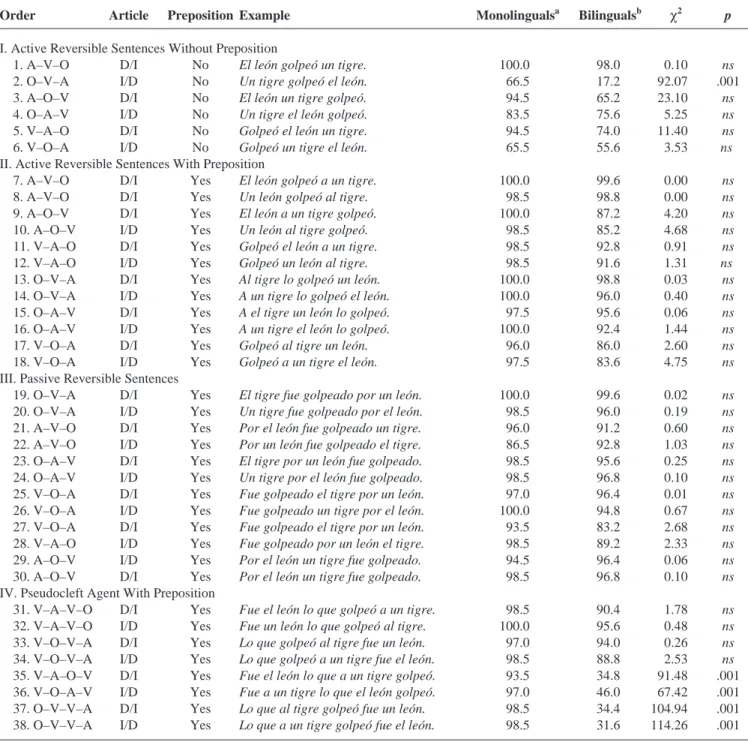
Thirty-eight different types of sentences and five ex-amples of each type of sentence are included in the test. Examples are presented in Table 1.
Results
Table 1 compares the number of correct responses between the normative sample and the Spanish–Eng-lish bilingual group. We observed that, in general, the performance on the Spanish Syntactic Comprehen-sion Test was higher in the monolingual sample than in the bilingual sample. Differences were most evi-dent in sentences with a pseudocleft A, followed by
active reversible sentences without a preposition. Differences in passive sentences were virtually non-existent. The order of difficulty in the bilingual sam-ple was passive sentences (easiest), active reversible sentences with preposition, active reversible sen-tences without preposition, and sensen-tences with a pseudocleft A (hardest).
Differences in the understanding of the following five types of sentences were statistically significant:
Table 1. General Results: Percentage of Correct Responses
Order Article Preposition Example Monolingualsa Bilingualsb χ2 p
I. Active Reversible Sentences Without Preposition
1. A–V–O D/I No El león golpeó un tigre. 100.0 98.0 0.10 ns
2. O–V–A I/D No Un tigre golpeó el león. 66.5 17.2 92.07 .001
3. A–O–V D/I No El león un tigre golpeó. 94.5 65.2 23.10 ns
4. O–A–V I/D No Un tigre el león golpeó. 83.5 75.6 5.25 ns
5. V–A–O D/I No Golpeó el león un tigre. 94.5 74.0 11.40 ns
6. V–O–A I/D No Golpeó un tigre el león. 65.5 55.6 3.53 ns
II. Active Reversible Sentences With Preposition
7. A–V–O D/I Yes El león golpeó a un tigre. 100.0 99.6 0.00 ns
8. A–V–O D/I Yes Un león golpeó al tigre. 98.5 98.8 0.00 ns
9. A–O–V D/I Yes El león a un tigre golpeó. 100.0 87.2 4.20 ns
10. A–O–V I/D Yes Un león al tigre golpeó. 98.5 85.2 4.68 ns
11. V–A–O D/I Yes Golpeó el león a un tigre. 98.5 92.8 0.91 ns
12. V–A–O I/D Yes Golpeó un león al tigre. 98.5 91.6 1.31 ns
13. O–V–A D/I Yes Al tigre lo golpeó un león. 100.0 98.8 0.03 ns
14. O–V–A I/D Yes A un tigre lo golpeó el león. 100.0 96.0 0.40 ns
15. O–A–V D/I Yes A el tigre un león lo golpeó. 97.5 95.6 0.06 ns
16. O–A–V I/D Yes A un tigre el león lo golpeó. 100.0 92.4 1.44 ns
17. V–O–A D/I Yes Golpeó al tigre un león. 96.0 86.0 2.60 ns
18. V–O–A I/D Yes Golpeó a un tigre el león. 97.5 83.6 4.75 ns
III. Passive Reversible Sentences
19. O–V–A D/I Yes El tigre fue golpeado por un león. 100.0 99.6 0.02 ns
20. O–V–A I/D Yes Un tigre fue golpeado por el león. 98.5 96.0 0.19 ns
21. A–V–O D/I Yes Por el león fue golpeado un tigre. 96.0 91.2 0.60 ns
22. A–V–O I/D Yes Por un león fue golpeado el tigre. 86.5 92.8 1.03 ns
23. O–A–V D/I Yes El tigre por un león fue golpeado. 98.5 95.6 0.25 ns
24. O–A–V I/D Yes Un tigre por el león fue golpeado. 98.5 96.8 0.10 ns
25. V–O–A D/I Yes Fue golpeado el tigre por un león. 97.0 96.4 0.01 ns
26. V–O–A I/D Yes Fue golpeado un tigre por el león. 100.0 94.8 0.67 ns
27. V–O–A D/I Yes Fue golpeado el tigre por un león. 93.5 83.2 2.68 ns
28. V–A–O I/D Yes Fue golpeado por un león el tigre. 98.5 89.2 2.33 ns
29. A–O–V I/D Yes Por el león un tigre fue golpeado. 94.5 96.4 0.06 ns
30. A–O–V D/I Yes Por el león un tigre fue golpeado. 98.5 96.8 0.10 ns
IV. Pseudocleft Agent With Preposition
31. V–A–V–O D/I Yes Fue el león lo que golpeó a un tigre. 98.5 90.4 1.78 ns
32. V–A–V–O I/D Yes Fue un león lo que golpeó al tigre. 100.0 95.6 0.48 ns
33. V–O–V–A D/I Yes Lo que golpeó al tigre fue un león. 97.0 94.0 0.26 ns
34. V–O–V–A I/D Yes Lo que golpeó a un tigre fue el león. 98.5 88.8 2.53 ns
35. V–A–O–V D/I Yes Fue el león lo que a un tigre golpeó. 93.5 34.8 91.48 .001 36. V–O–A–V I/D Yes Fue a un tigre lo que el león golpeó. 97.0 46.0 67.42 .001 37. O–V–V–A D/I Yes Lo que al tigre golpeó fue un león. 98.5 34.4 104.94 .001 38. O–V–V–A I/D Yes Lo que a un tigre golpeó fue el león. 98.5 31.6 114.26 .001
Note: All sentences mean “The lion hit the tiger.” A = agent; V = verb; O = object; D = definite; I = indefinite.
a
1. Active reversible sentences without a preposi-tion (O–V–A; e.g., “Un tigre golpeó el león” [“A tiger hit the lion”]).
2. Pseudocleft A with a preposition (V–A–pa-tient–V; e.g., “Fue el tigre lo que a un león
golpeó” [“It was the tiger that a lion hit”]).
3. Pseudocleft A with a preposition (V–pa-tient–A–V; e.g., “Fue a un tigre lo que el león
golpeó” [“It was a tiger that the lion hit”]).
4. Pseudocleft A with a preposition (pa-tient–V–V–A; e.g., “Lo que al tigre golpeó fue
un león” [“What the tiger hit was a lion”]).
5. Pseudocleft A with a preposition (pa-tient–V–V–A; e.g., “Lo que a un tigre golpeó fue
el león” [“What {to} the tiger hit was the lion”]).
Three variables were further analyzed: age when ex-posed to the L2, preferred language, and sex. Only the five sentences understood significantly differently be-tween monolinguals and bilinguals were included in this analysis. Table 2 compares the effect of age when posed to the L2. We observed that those participants ex-posed to the L2 (English) between ages 5 and 12 performed better than those individuals who were ex-posed before 5 years of age. Differences were
statisti-cally significant for all sentences with pseudocleft A and a preposition.
Table 3 compares the effect of the preferred language variable. Participants preferring Spanish outperformed those participants preferring English. In two sentences (pseudocleft A with preposition with the order V–A–O–V, and pseudocleft A with a preposition with the order O–V–V–A), the differences were statistically significant. Table 4 compares the effect of the sex variable. We noted that the number of correct responses was about twice as high in women than in men. Except for the first sentences (active reversible sentences without preposi-tion), these differences were statistically significant.
Study 2
Method
Participants. Participants were 69 middle socio-economic status Spanish–English bilinguals. They were nonpaid volunteer graduate students recruited at an ad-vanced studies institution in Miami, Florida. Their ages ranged from 18 to 49 (M = 30.28 years, SD = 7.97). There were 34 men and 35 women, of whom 27 were born in the United States and 42 were born in Latin America (Cuba =
Table 2. Age Exposed to Second Language Effect: Percentage of Correct Responses
Type of Sentence and Order Article Preposition < 5a 5–12b χ2 p
I. Active Reversible Sentences Without Preposition
2. O–V–A I/D No 11.4 24.5 0.84 ns
IV. Pseudocleft Agent With Preposition
35. V–A–O–V D/I Yes 16.4 58.2 10.51 .01
36. V–O–A–V I/D Yes 22.8 75.4 12.71 .01
37. O–V–V–A D/I Yes 12.1 61.8 19.93 .01
38. O–V–V–A I/D Yes 13.5 54.5 13.13 .01
Note: O = object; V = verb; A = agent; I = indefinite; D = definite.
a
n = 22.bn = 28.
Table 3. Preferred Language Effect: Percentage of Correct Responses
Type of Sentence and Order Article Preposition Spanisha Englishb χ2 p
I. Active Reversible Sentences Without Preposition
2. O–V–A I/D No 23.3 13.7 3.68 ns
IV. Pseudocleft Agent With Preposition
35. V–A–O–V D/I Yes 46.6 28.1 6.06 .05
36. V–O–A–V I/D Yes 55.5 40.6 3.06 ns
37. O–V–V–A D/I Yes 44.4 28.7 4.08 .05
38. O–V–V–A I/D Yes 38.8 27.5 2.71 ns
Note: O = object; V = verb; A = agent; I = indefinite; D = definite.
19; Puerto Rico = 6; Colombia = 6; Venezuela = 3; Chile = 3; Panama, Ecuador, Dominican Republic, Peru, and Ar-gentina = 1 in each country). In everyday life, they used English, Spanish, and “Spanglish” (i.e., mixture of Span-ish and EnglSpan-ish with frequent code switching, and also Spanish spoken including a significant amount of English borrowings) for communicating. All participants claimed fluency in both languages, although the ability to write and read Spanish was limited in most participants born in the United States or arriving early in life. On a self-evaluation scale ranging from 1 (virtually nothing) to 5 (excellent), they rated themselves on spoken Spanish and English at the level 3 (well) or above. All the participants had Spanish as their L1 but had used English for more than 3 years. Some participants had been exposed to both languages since birth, and both languages could be considered as their L1. Twenty-seven participants stated that they pre-ferred Spanish and spoke better Spanish than English (9 had learned English before age 12, and 18 had learned after age 12); 39 participants stated that they preferred English and spoke better English than Spanish (38 had learned English before age 12, and 1 had learned after age 12). Three pointed out that they could speak either language at the same level, and they did not have any significant differ-ence in preferdiffer-ence. These 3 participants were deleted from the sample in some analyses.
The age of acquisition of English ranged from 0 (Spanish and English were simultaneously learned) to 35 years (M = 10.5 years, SD = 8.88). As a result of liv-ing in a billiv-ingual social environment (Miami, FL), bor-rowed words from English were frequently observed when participants spoke Spanish.1
Materials and procedure. A demographic ques-tionnaire that we designed was administered to evaluate
1
Rules governing borrowing are not well defined yet. Why is a particular word (and not another) borrowed? Everyday observation makes it apparent that in the majority of cases, the borrowed word is a N, and only sporadically an adjective or V. Grammatical connectors are not borrowed. One may hypothesize that there are several simul-taneously acting principles:
Table 4. Sex Effect: Percentage of Correct Responses
Type of Sentence and Order Article Preposition Mena Womenb χ2 p
I. Active Reversible Sentences Without Preposition
2. O–V–A I/D No 12.2 20.0 1.63 ns
IV. Pseudocleft Agent With Preposition
35. V–A–O–V D/I Yes 16.6 43.7 11.75 .01
36. V–O–A–V I/D Yes 27.7 56.2 9.70 .01
37. O–V–V–A D/I Yes 20.0 42.5 8.52 .01
38. O–V–V–A I/D Yes 17.7 39.3 7.96 .01
Note: O = object; V = verb; A = agent; I = indefinite; D = definite.
a
n = 18.bn = 32.
1. In Spanish, there is not an exact word corresponding to the borrowed word (e.g., driveway).
2. The borrowed word presents some cultural salience in the new U.S. cultural context but not in the native one (e.g., suit as an ap-peal or legal demand).
3. The borrowed word has a very exact referent, or it is a sort of proper name (e.g., income tax)
4. In Spanish, there are several potentially correct words, but no one has the exact meaning (e.g., the word ratio corresponds in Span-ish to razón or relación, but for both, the meaning corresponding to
ratio is the secondary meaning, not the primary one), or there are
significant regional variations with regard to that particular word. That is, although several words exist, no one word seems to be the superordinate word (e.g., tag is placa, chapa, or tablilla; balloon is
bomba or globo; carpet corresponds in Spanish to both tapete and alfombra). In different Spanish-speaking areas, one of the two is
preferred. Some mild variations with regard to the exact meaning can exist. So, tapete may denote it is smaller, alfombra may imply it is woven, and so on. To avoid having to make a selection from sev-eral alternatives, the superordinate English word is preferred.
5. From the phonological point of view, the borrowed word is accessible with the Spanish phonology (i.e., it is quite unlikely that a word with an extremely difficult phonology for Spanish speakers, such as girl, will be borrowed).
6. When the English word is phonologically simpler than the corresponding Spanish word, the English word can be borrowed (e.g., the English word pin is a notoriously simpler word than the Spanish word alfiler).
7. Very high frequency words and, in consequence, overlearned words are not usually borrowed from the L2 (e.g., words such as
casa [house] and mano [hand] are never borrowed).
8. Use of technical words usually are also borrowed in other lan-guages, becoming international words (e.g., software).
9. When a word is frequently used in everyday life in English, there is a tendency to continue using it when speaking native Span-ish language (e.g., mailbox).
the characteristics of participants’ bilingualism. Five subtests taken from the Wechsler Memory Scale (WMS) English version (Wechsler, 1945, 1987) and its equivalent translations to the Spanish language were used to compose an instrument that could evaluate memory in both languages. In addition, the Serial Ver-bal Learning Test (SVL; Ardila, Rosselli, & Puente, 1994) was administered in both languages. The result-ing verbal memory section consisted of eight verbal memory subtests administered in the following order and language:
1. WMS Logical Memory (Spanish). 2. SVL (English).
3. Digits Forward–Backward (Spanish). 4. WMS Associate Learning (English). 5. SVL (Spanish).
6. WMS Logical Memory (English). 7. WMS Associate Learning (Spanish). 8. Digits Forward–Backward (English).
Instructions were presented in the corresponding language (Spanish or English), and participants were requested to use only Spanish or English according to the specific subtest.
To assess the participant’s calculation ability in Spanish and English, three basic arithmetical opera-tions and one numerical problem were performed aloud in both languages. This section was presented in the following order and languages:
1. Successive subtraction from 100 (to subtract 7 in a successive way from 100; Spanish).
2. One multiplication (12 × 23; Spanish). 3. One division (140÷15; Spanish).
4. Successive subtractions from 100 (to subtract 9 in a successive way from 100; English). 5. One multiplication (13 × 26; English). 6. One division (170÷13; English).
7. One numerical problem (“Si tengo 18 libros
distribuidos en dos paquetes, y en uno de los paquetes hay el doble de libros que en el otro, ¿cuántos libros hay en cada paquete?” [“If I
have 18 books distributed into two groups, and in one of the groups there are twice as many books as in the other, how many books are there in each group?”]; Spanish).
8. One numerical problem (“The sum of the ages of a father and a son is 48. If the father is triple the age of the son, how old are each one of them?”; English).
Time and errors were scored. However, errors were so low that no statistical analysis of errors was possible. Results, in consequence, refer only to time (sec).
After participants performed the calculation tasks, we assessed delayed recall with the following tests:
1. Delayed Associative Learning (Spanish). 2. Delayed Logical Memory (English). 3. Delayed SVL (Spanish).
4. Delayed Associative Learning (English). 5. Delayed Logical Memory (Spanish). 6. Delayed SVL (English).
WMS administration and scoring followed the guide-lines provided by the WMS manual (Wechsler, 1945, 1987). In the SVL Test, three different scores were used: (a) number of words recalled in the first trial, (b) number of trials required to recall the 10-word list, and (c) de-layed recall of the words. For the calculation portion, time was recorded for each subtest. Testing (including the demographic and history of bilingualism sections) lasted approximately 45 min. Performance in Spanish and English was compared using t tests. The age of ac-quisition effect and preferred language effect were ana-lyzed using 2 × 2 factorial analyses of variance.
Results
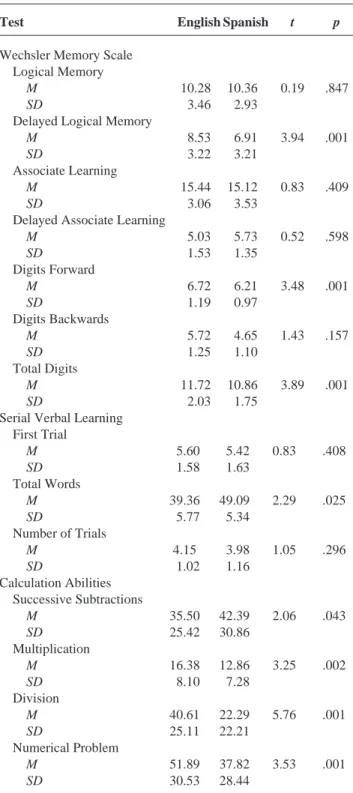
Table 5 summarizes the results on the verbal and ar-ithmetical tests used in this study. In general, perfor-mance was better in Spanish than in English. In the verbal memory subtests, out of 10 memory subtest scores, 4 (Delayed Logical Memory, Digits Forward, Total Digits, and Total Words) reached a statistical level of significance. Performance in English was better in Delayed Logical Memory and the 2 Digits scores. Performance was higher in Spanish in the Total Words of the SVL. On the calculation abilities test, per-formance was significantly faster in Spanish in 3 out of the 4 scores.
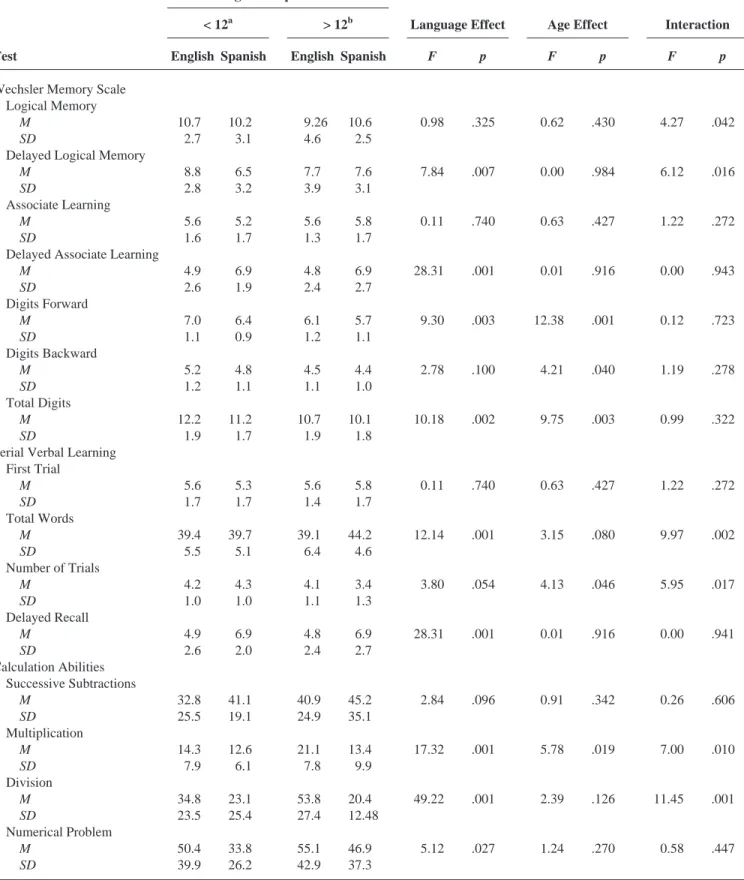
multiplication, and interaction was significant in the multiplication and division.
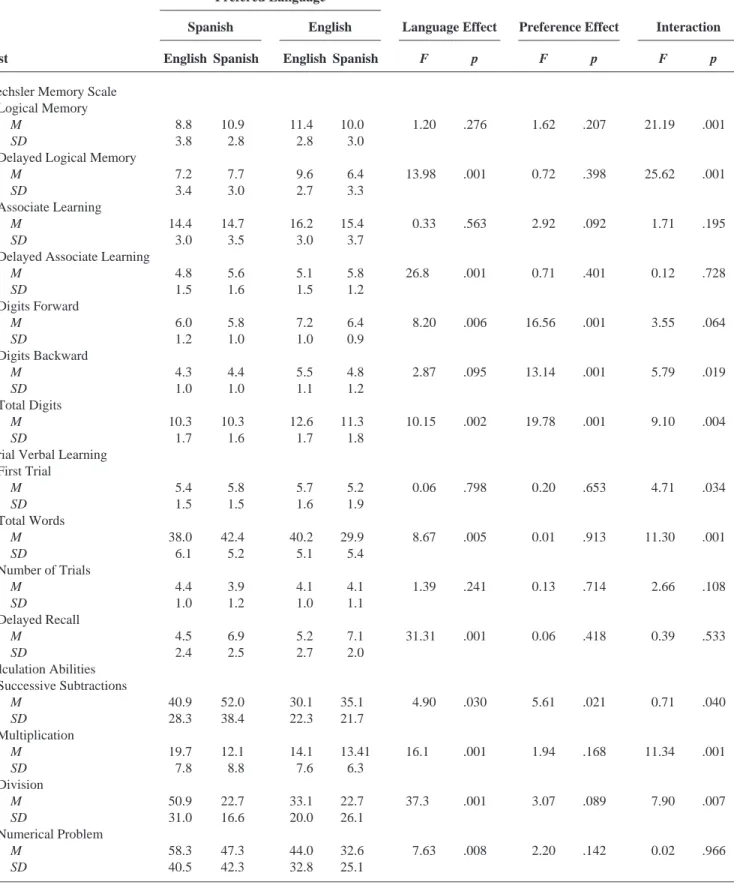
The effect of the preferred language was analyzed (Table 7). A language effect was found in 6 of the 11 verbal memory scores, whereas the preference effect was evident only in the WMS Digits (all conditions). Only four interactions were significant: Logical
Mem-ory (both conditions), Total Digits, and SVL Total Words. In the calculation abilities subtests, a language effect was observed in all scores, whereas the preferred language affected the numerical problem. Two interac-tions were significant: multiplication and division tests.
Discussion
Errors in the Spanish Syntactic Comprehension Test refer to identification of who the A is and, in conse-quence, who the patient (O) is. Four alternative re-sponses were available, but the overwhelming majority of the errors did not refer to the misinterpretation of the action or the names of the animals included in the fig-ures. Because of this, although four answers were avail-able, only two answers were likely: “The lion [tiger, camel, horse, duck, rooster, rabbit, or skunk] hits [kicks, bites, pulls, or picks] the tiger [lion, camel, horse, duck, rooster, rabbit or skunk]” or the inverse. The task for the participant was to identify the A and the O. Consequently, the chance level may be supposed to be 50%.
Passive sentences are more frequently used in Eng-lish than in Spanish, so it is not surprising that perfor-mance in understanding Spanish passive sentences was virtually perfect in our bilingual sample. However, when Spanish syntax moved apart from English syntax, difficulties emerged. Active reversible sentences with prepositions were almost normally understood. Differ-ences between monolingual and bilingual participants were slight and nonsignificant due to an appropriate un-derstanding of the use of the preposition a. The critical point is not the word order per se but understanding the markers distinguishing the A and the O. When the ac-tive sentences did not include the preposition a, how-ever, understanding difficulties became evident. In this type of sentence without a preposition, the definite arti-cle marks the A, whereas the undetermined artiarti-cle points to the patient. This is a type of strategy not ob-served in English.
Sentences with a pseudocleft A were extremely dif-ficult for bilingual participants. Significant difdif-ficulties were observed in the last four sentences. These sen-tences included a segment with an N plus a V. When, in this segment, the N was the A (Sentence 36), perfor-mance was about 50% (chance level). When the N was the O, the sentences were more frequently understood in the opposite sense, that is, as if the N were the A. This type of sentence, with a pseudocleft A, is not usually found in English.
Table 5. General Results in the Verbal Memory and Calculation Tests
Test English Spanish t p
Wechsler Memory Scale Logical Memory
M 10.28 10.36 0.19 .847
SD 3.46 2.93
Delayed Logical Memory
M 8.53 6.91 3.94 .001
SD 3.22 3.21
Associate Learning
M 15.44 15.12 0.83 .409
SD 3.06 3.53
Delayed Associate Learning
M 5.03 5.73 0.52 .598
SD 1.53 1.35
Digits Forward
M 6.72 6.21 3.48 .001
SD 1.19 0.97
Digits Backwards
M 5.72 4.65 1.43 .157
SD 1.25 1.10
Total Digits
M 11.72 10.86 3.89 .001
SD 2.03 1.75
Serial Verbal Learning First Trial
M 5.60 5.42 0.83 .408
SD 1.58 1.63
Total Words
M 39.36 49.09 2.29 .025
SD 5.77 5.34
Number of Trials
M 4.15 3.98 1.05 .296
SD 1.02 1.16
Calculation Abilities Successive Subtractions
M 35.50 42.39 2.06 .043
SD 25.42 30.86
Multiplication
M 16.38 12.86 3.25 .002
SD 8.10 7.28
Division
M 40.61 22.29 5.76 .001
SD 25.11 22.21
Numerical Problem
M 51.89 37.82 3.53 .001
SD 30.53 28.44
Table 6. Effect of the Age of Acquisition of Second Language on Verbal Memory and Calculation Tests
Age of Acquisition
< 12a > 12b Language Effect Age Effect Interaction
Test English Spanish English Spanish F p F p F p
Wechsler Memory Scale Logical Memory
M 10.7 10.2 9.26 10.6 0.98 .325 0.62 .430 4.27 .042
SD 2.7 3.1 4.6 2.5
Delayed Logical Memory
M 8.8 6.5 7.7 7.6 7.84 .007 0.00 .984 6.12 .016
SD 2.8 3.2 3.9 3.1
Associate Learning
M 5.6 5.2 5.6 5.8 0.11 .740 0.63 .427 1.22 .272
SD 1.6 1.7 1.3 1.7
Delayed Associate Learning
M 4.9 6.9 4.8 6.9 28.31 .001 0.01 .916 0.00 .943
SD 2.6 1.9 2.4 2.7
Digits Forward
M 7.0 6.4 6.1 5.7 9.30 .003 12.38 .001 0.12 .723
SD 1.1 0.9 1.2 1.1
Digits Backward
M 5.2 4.8 4.5 4.4 2.78 .100 4.21 .040 1.19 .278
SD 1.2 1.1 1.1 1.0
Total Digits
M 12.2 11.2 10.7 10.1 10.18 .002 9.75 .003 0.99 .322
SD 1.9 1.7 1.9 1.8
Serial Verbal Learning First Trial
M 5.6 5.3 5.6 5.8 0.11 .740 0.63 .427 1.22 .272
SD 1.7 1.7 1.4 1.7
Total Words
M 39.4 39.7 39.1 44.2 12.14 .001 3.15 .080 9.97 .002
SD 5.5 5.1 6.4 4.6
Number of Trials
M 4.2 4.3 4.1 3.4 3.80 .054 4.13 .046 5.95 .017
SD 1.0 1.0 1.1 1.3
Delayed Recall
M 4.9 6.9 4.8 6.9 28.31 .001 0.01 .916 0.00 .941
SD 2.6 2.0 2.4 2.7
Calculation Abilities Successive Subtractions
M 32.8 41.1 40.9 45.2 2.84 .096 0.91 .342 0.26 .606
SD 25.5 19.1 24.9 35.1
Multiplication
M 14.3 12.6 21.1 13.4 17.32 .001 5.78 .019 7.00 .010
SD 7.9 6.1 7.8 9.9
Division
M 34.8 23.1 53.8 20.4 49.22 .001 2.39 .126 11.45 .001
SD 23.5 25.4 27.4 12.48
Numerical Problem
M 50.4 33.8 55.1 46.9 5.12 .027 1.24 .270 0.58 .447
SD 39.9 26.2 42.9 37.3
Note: N = 69.
a
Table 7. Preferred Language Effect on Memory and Calculation Test Performance
Prefered Language
Spanish English Language Effect Preference Effect Interaction
Test English Spanish English Spanish F p F p F p
Wechsler Memory Scale Logical Memory
M 8.8 10.9 11.4 10.0 1.20 .276 1.62 .207 21.19 .001
SD 3.8 2.8 2.8 3.0
Delayed Logical Memory
M 7.2 7.7 9.6 6.4 13.98 .001 0.72 .398 25.62 .001
SD 3.4 3.0 2.7 3.3
Associate Learning
M 14.4 14.7 16.2 15.4 0.33 .563 2.92 .092 1.71 .195
SD 3.0 3.5 3.0 3.7
Delayed Associate Learning
M 4.8 5.6 5.1 5.8 26.8 .001 0.71 .401 0.12 .728
SD 1.5 1.6 1.5 1.2
Digits Forward
M 6.0 5.8 7.2 6.4 8.20 .006 16.56 .001 3.55 .064
SD 1.2 1.0 1.0 0.9
Digits Backward
M 4.3 4.4 5.5 4.8 2.87 .095 13.14 .001 5.79 .019
SD 1.0 1.0 1.1 1.2
Total Digits
M 10.3 10.3 12.6 11.3 10.15 .002 19.78 .001 9.10 .004
SD 1.7 1.6 1.7 1.8
Serial Verbal Learning First Trial
M 5.4 5.8 5.7 5.2 0.06 .798 0.20 .653 4.71 .034
SD 1.5 1.5 1.6 1.9
Total Words
M 38.0 42.4 40.2 29.9 8.67 .005 0.01 .913 11.30 .001
SD 6.1 5.2 5.1 5.4
Number of Trials
M 4.4 3.9 4.1 4.1 1.39 .241 0.13 .714 2.66 .108
SD 1.0 1.2 1.0 1.1
Delayed Recall
M 4.5 6.9 5.2 7.1 31.31 .001 0.06 .418 0.39 .533
SD 2.4 2.5 2.7 2.0
Calculation Abilities Successive Subtractions
M 40.9 52.0 30.1 35.1 4.90 .030 5.61 .021 0.71 .040
SD 28.3 38.4 22.3 21.7
Multiplication
M 19.7 12.1 14.1 13.41 16.1 .001 1.94 .168 11.34 .001
SD 7.8 8.8 7.6 6.3
Division
M 50.9 22.7 33.1 22.7 37.3 .001 3.07 .089 7.90 .007
SD 31.0 16.6 20.0 26.1
Numerical Problem
M 58.3 47.3 44.0 32.6 7.63 .008 2.20 .142 0.02 .966
SD 40.5 42.3 32.8 25.1
Note: N = 66.
a
In brief, the closer to English syntax the Spanish sentences were, the easier it was for participants to un-derstand them. The farther from English syntax the sen-tences were, the harder it became for the participants to interpret them correctly.
The significant effect of age exposed to the L2, pre-ferred language, and sex variables deserve some com-ment. We found a very strong effect of age exposed to the L2. Participants exposed to English between ages 5 and 12 outperformed the participants exposed to Eng-lish before the age of 5. This means that the interfering effect of English was stronger in the participants ex-posed to English before age 5. The preferred language effect is quite understandable. Participants preferring Spanish (or either) had a better syntactic understanding than those participants preferring English. Preference means that the participant feels more comfortable speaking that language. Preference, however, not only may relate to knowledge of the language but can also include affective relation with the language. Both are correlated.
The sex effect on language has been frequently re-ported (Kimura, 1992; MacCoby & Jacklin, 1974). The sex effect has been pointed out with regard to language acquisition (McGuiness, 1976; Smolak, 1986), sponta-neous language during aging (Ardila & Rosselli, 1996), verbal fluency (Kolb & Whishaw, 1996), and other ver-bal abilities. This sex effect on linguistic abilities, how-ever, remains controversial (Halpern, 1992; Hyde & Linn, 1988). Our results were not completely unex-pected: Women outperformed men. To the best of our knowledge, however, sex differences with regard to syntactic comprehension had not been mentioned in the available literature.
In our second study, several significant differences were found in verbal memory and calculation subtests performed in Spanish and English. However, it must be emphasized that our sample was quite heteroge-neous from a linguistic point of view, although spo-ken and written mastery of both languages was notoriously variable. This heterogeneity may have ob-scured the results.
Some significant differences in memory and calcu-lation abilities were nevertheless found in Span-ish–English bilinguals when tested in Spanish and English. Performance was overall better in the partici-pant’s L1 (Spanish) than in their L2 (English). Our re-sults support Harris et al.’s (1995) findings. It is important to note that our bilingual participants were proficient in both languages and over half of them re-ported a better knowledge of English than of Spanish. In fact, a significant percentage of these participants
could be considered balanced bilinguals. This similar level of proficiency as found in the majority of the par-ticipants may represent an additional factor responsible for the relatively modest differences found between both languages.
Although Spanish can be considered the L1 for this group, a significant percentage of the participants learned Spanish early in life, later attended school in English, and were currently living in a mostly Eng-lish-speaking environment. They frequently reported English to be their best spoken and preferred language. Hence, although they were native Spanish speakers, they had a better knowledge of English. Preferred spo-ken language turned out to be a more significant vari-able than age of acquisition of the L2. Preferred language was significantly associated with the school language. Preferred language, however, was not a sig-nificant variable in the calculation subtests.
Age of acquisition turned out to be a significant vari-able only with regards to the WMS Digits and SVL number of trials. These results should be interpreted as a difference in the speed with which participants learned tasks presented in their L1 or L2. Although ver-bal learning is possible using either language, the speed of learning may be faster in one language.
Overall, differences in the calculation subtests were larger than differences in verbal memory tasks. An ex-planation could be that the language used in calculation tasks is the “thinking language,” which is minimally in-fluenced by social linguistic context, and that bilinguals continue using their native language in counting and other numerical issues. Consequently, better perfor-mance in Spanish was not unexpected.
even 3 digits (551–79–75) and do not routinely prac-tice repeating 7-digit series. It is probable that, if a se-ries of 2-digit numbers (i.e., 34–87–56, etc.) were used instead of single-digit-span numbers (i.e., 5–7–3, etc.), Spanish speakers would do as well or maybe even outperform English speakers. It is noteworthy that immediate verbal memory, measured according to the number of words repeated after single presenta-tion (SVL, first trial score), was virtually identical in Spanish and English.
In the numerical section of the test, the differences between solving numerical problems in Spanish and English should be emphasized. When a numerical problem is being solved, not only is the application of an arithmetical procedure required but the correct un-derstanding of the problem conditions is also neces-sary. A numerical problem represents a reasoning task. This significant difference between both lan-guages on this task suggests a better ability for rea-soning when using a native language or L1 than when an L2 is used. It should be emphasized, however, that we were exploring the ability to reason with a particu-lar language, not reasoning per se. It is noteworthy that, in our experimental conditions, it took longer to say the Spanish problem (51 syllables) than the Eng-lish one (36 syllables).
These results have an extremely important conse-quence for the neuropsychological testing of Hispanics in the United States: Spanish–English bilinguals may be at a disadvantage when using either language. For bilingual participants, both languages were active lan-guages, and their functional language was not either Spanish or English but a mixture of both. Interference is expected to be high. To use either Spanish or English testing materials and norms can penalize U.S. Span-ish–English bilinguals. No clear solution to this diffi-culty is available.
Three procedures, however, could at least reduce the bilingualism effect in psychological and neuropsychological testing:
1. Special norms should be established for Span-ish–English bilinguals. This solution does not seem easy when the tremendous heterogeneity of U.S. bilin-gualism is taken into consideration.
2. The examiner could be a bilingual mastering a similar type of biligualism. Testing could be performed in Spanish, English, or both languages. Instructions and answers in either language or both languages could be acceptable; both English and Spanish norms could be used, with the one favoring the participant being pre-ferred. Nonetheless, the examiner should also be
trained in the scientific and clinical understanding of bilingualism.
3. The scores should be adjusted to neutralize the penalizing effect of bilingualism. The problem is that we do not know how much the test scores should be ad-justed to be fair at best. Of course, it depends on the test, the idiosyncrasies of the client’s bilingualism, and the testing situation, including the examiner’s language.
None of these three solutions alone or combined seem easy to put in action. However, when U.S. His-panic bilinguals are tested, it should be emphasized that the results do not necessarily reflect the participant’s real abilities, and his or her real performance may be higher than observed. Clearly, in any bilingual neuropsychological report, the participant’s degree of bilingualism (at least age of acquisition of the L2, schooling language, and use of both languages in ev-eryday life), language used in testing, norms used, and caution regarding the potentially penalizing effect of bilingualism should be mentioned.
It should be noted that the penalizing bilingualism effect is expected in neuropsychological testing when verbal materials are included. Bilinguals, however, are not expected to be at a disadvantage in other circum-stances, for example, when attending rehabilitation programs. In such a cases, bilingualism may even pres-ent some advantage.
References
Ardila, A., & Rosselli, M. (1996). Spontaneous language produc-tion: Age and educational effects. International Journal of
Neuroscience, 87, 71–78.
Ardila, A., Rosselli, M., & Puente, A. E. (1994). Neuropsychological
evaluation of the Spanish speaker. New York: Plenum.
Bahrick, H. P., Hall, L. K., Goggin, J. P., & Bahrick, E. (1994). Fifty years of language maintenance and language dominance in bi-lingual Hispanic immigrants. Journal of Experimental
Psy-chology: General, 123, 264–283.
Bates, E., Friederici, A., & Wulfeck, B. (1987). Comprehension in aphasia: A cross-linguistic study. Brain and Language, 32, 19–67.
Bates, E., Friederici, A., Wulfeck, B., & Juarez, L. A. (1988). On the preservation of word-order in aphasia: Cross-linguistic evi-dence. Brain and Language, 33, 232–365.
Caplan, D., & Futter, C. (1986). Assignment of thematic roles to nouns in sentence comprehension by agrammatic patients.
Brain and Language, 27, 117–134.
Dehaene, S. (1997). The number sense. New York: Oxford Univer-sity Press.
Dongryong, K. (1990). A study of linguistic interference in bilingual children—A case of students in a Korean school. Japanese
Dupont, S., Ardila, A., Rosselli, M., & Puente, A. (1992). Neuropsychological assessment in bilinguals. In A. E. Puente & R. J. McCaffrey (Eds.), Handbook of neuropsychological
as-sessment: A biopsychosocial perspective (pp. 193–210). New
York: Plenum.
Durgunoglu, A., & Roediger, H. L. (1987). Test differences in as-sessing bilingual memory. Journal of Memory & Language,
26, 377–391.
Hagiwara, H., & Caplan, D. (1990). Syntactic comprehension in Japanese aphasics: Effects of category and thematic role order.
Brain and Language, 38, 159–170.
Halpern, D. F. (1992). Sex differences in cognitive abilities (2nd ed.). Hillsdale, NJ: Lawrence Erlbaum Associates, Inc. Harris, J. G., Cullum, C. M., & Puente, A. E. (1995). Effects of
bilin-gualism in learning and memory in Hispanic adults. Journal of
the International Neuropsychological Society, 1, 10–16.
Hummel, K. (1986). Memory for bilingual prose. In J. Vaid (Ed.),
Language processing in bilinguals (pp. 47–64). Hillsdale, NJ:
Lawrence Erlbaum Associates, Inc.
Hyde, J. S., & Linn, M. C. (1988). Gender differences in verbal abili-ties: A meta-analysis. Psychological Bulletin, 106, 53–59. Kimura, D. (1992, September). Sex differences in the brain.
Scien-tific American, pp. 81–87.
Kolb, B., & Whishaw, I. Q. (1996). Fundamentals of human
neuropsychology (4th ed.). New York: Freeman.
Kolers, P. A. (1978). On the representations of experience:
Lan-guage interpretation and communication. New York: Plenum.
Kolers, P. A. (1979). Reading and knowing. Canadian Journal of
Psychology, 33, 106–117.
Lenneberg, E. H. (1967). Biological foundations of language. New York: Wiley.
MacCoby, E., & Jacklin, C. (1974). The psychology of sex
differ-ences. Stanford, CA: Stanford University Press.
Magiste, E. (1980). Memory for numbers in monolinguals and bilinguals. Acta Psychologica, 46, 63–68.
Marcos, J., & Ostrosky, F. (1995). Estrategias para la asignación de papeles temáticos en la interpretación de enunciados en español [Strategies for the assignment of thematic roles in the interpretation of Spanish statements]. In D. Pool (Ed.),
Estudios en linguistica formal (pp. 47–62). Mexico City,
Mexico: El Colegio de México.
McCormack, P. D. (1976). Language as an attribute of memory.
Ca-nadian Journal of Psychology, 30, 238–248.
McGuiness, D. (1976). Sex differences in the organization of per-ception and cognition. In B. Lloyd & J. Archer (Eds.),
Ex-ploring sex differences (pp. 123–159). New York: Academic.
Olazaran, J., Jacobs, D. M., & Stern, Y. (1996, February). Verbal and
visual span in English and Spanish speakers: Testing a linguistic hypothesis. Paper presented at the Twenty-Fourth Meeting of the
International Neuropsychological Society, Chicago.
Paivio, A., & Lambert, W. E. (1981). Dual coding and bilingual mem-ory. Journal of Verbal Learning & Verbal Behavior, 20, 532. Paradis, M. (1993). Multilingualism and aphasia. In J. C. Marshall
(Ed.), Handbook of linguistics and communication sciences (Vol. 9, pp. 278–288). New York: de Gruyter.
Peynircioglu, Z. F., & Durgunoglu, A. Y. (1993). Effects of bilin-gual context on memory performance. In J. Altarriba (Ed),
Cognition and culture: A cross-cultural approach to cognitive psychology (pp. 57–75). Amsterdam: North-Holland.
Ransdell, S. E., & Fischer, I. (1987). Memory in a monolingual mode: When are bilinguals at a disadvantage? Journal of
Mem-ory and Language, 26, 392–405.
Rosselli, M., Ardila, A., Araujo, K., Weekes, V., Volk, L., & Caracciolo, V. (1998, November). The aging of language in
Spanish–English bilinguals. Paper presented at the 18th
An-nual Conference of the National Academy of Neuropsychology, Washington, DC.
Seco, R. (1980). Manual de gramtica espaola [Handbook of Spanish grammar]. Madrid, Spain: Espasa-Calpe.
Smolak, L. (1986). Infancy. Englewood Cliffs, NJ: Prentice Hall. Snodgrass, J. G. (1984). Concepts and their surface representations.
Journal of Verbal Learning, 23, 3–22.
Wechsler, D. (1945). A standardized memory test for clinical use.
Journal of Psychology, 19, 87–95.
Wechsler, D. (1987). Wechsler Memory Scale–Revised. San Anto-nio, TX: Psychological Corporation.
Wulfeck, E., Bates, D., & Capasso, R. (1991). A cross-linguistic study of grammaticality judgements in Broca’s aphasia. Brain
and Language, 45, 448–464.