Introducing Scheme in a FP-less Environment
{ The Students' Opinions {
Authors: Kris Aerts, Karel De Vlaminck
Address:
Departement Computerwetenschappen Katholieke Universiteit Leuven
Celestijnenlaan 200A B-3001 Heverlee Belgium
Fax: ++ 32 / 16 . 32 . 79 . 97 e-mail : [email protected]
Introducing Scheme in a FP-less Environment
{The Students'Opinions {Kris Aerts, Karel De Vlaminck
Departement Computerwetenschappen Katholieke Universiteit Leuven
Celestijnenlaan 200A, B-3001 Heverlee, Belgium e-mail : [email protected]
Abstract. Since 1994 the rst programming language taught to students of the faculty of Applied
Introducing Scheme in a FP-less Environment
{The Students'Opinions {1 Overview and Scope of the Article
At the university of Leuven(Vlaanderen - Belgium), we made the move from Pascal to Scheme three years ago. We believe that Scheme oers better opportunities to express mathematically correct algorithms. The core language can also be taught very quickly and is very exible which allows us to teach dierent styles of programming and focus on software engineering concepts.
These are key issues when choosing for a specic programming language. We have also been contin-uously concerned about the quality of the course, already resulting in a number of changes, but there's a lot more to it.
People tend to (just) like what they know. Students don't know Scheme, but they do know that it isn't widely used in our country, neither in world wide industry projects, and they even tend to dislike Scheme for it. This unknown - unloved situation forces us to take care that our students are not turned away from the contents of the course, simply because of the use of Scheme. We know objectively that Scheme is a good language, but the subjective feelings of the students may dier.
If we really want functional programmingto spread widely, as is the goal of this conference, we have to address this issue, and it is vital for any teacher considering the move to Scheme or any other functional language to be aware of the students' opinions.
We have conducted two surveys on how our students feel about the course in general and Scheme specically. Some of these questions are only relevant to us, but others are important enough to be communicated on a larger scale. In this stress on the opinion of the students lies the main interest of our article. Various other papers presented the educators' view, both on their particular approach, on consequences for and errors made by the students, and on criteria for the perfect functional language 3, 4, 6, 8, 10, 12], but we believe we're the rst to actually investigate primarily the students' opinion. This is of major importance as well, because the language may be extraordinarily powerful, but if it isn't appreciated, it won't be used.
Also interesting is the fact that the course is not taught solely to computer science students. It is given in the (general) rst year ofBurgerlijk Ingenieur('civil engineering'). Only in the third year a small part (approx. 10 %) chooses for Computer Science, while others prefer mechanics, electronics, mining, architecture, :::
There are still some caveats to the article:
{ The results obviously link to the specic approach used in our teaching, which may not be your
favourite one (see also infra).
{ The results are specically valid in an environment where Scheme is (relatively) unknown. They
would probably look dierent if the survey was performed at places as MIT or Indiana.
{ It is a rather quantitative research. We have focused on questioning many students to get a
In the rest of this article we rst motivate our choice for Scheme and give an overview of the actual course. Then follows the main point of the article: the survey, of which the results are sometimes com-plemented with my personal experience of guiding last years students using Haskell 7] and Fudgets 2]. We've grouped the questions and answers in a number of categories:
{ What students think about Scheme
A controversial choice, but appreciated in the end.
{ How do students rate their implementation capabilities?
It decreases as time goes by!
{ The use of computers
We don't use computers a lot, but students denitely want more.
{ How do they like the course?
Already in real life not everyone likes computers as much as we do. The same thing applies to this computer science course, but in overall the course is at least judged relevant.
{ Preference for specialising in computer science
A dierent kind of questions relates to their interest in the computer science profession.
2 Why We Chose to Go from Pascal to Scheme
The Pascal course we taught in a previous life until 1994 was quite unsatisfactory because we were more concentrating on language syntax than on software methodologies. Moreover the structure of Pascal programs didn't fully reect the mathematically correct algorithms. We had to explain the algorithm, and then prove that the Pascal program followed this algorithm. This was double work. So we often took care that our algorithm was such that it could be directly used in Pascal.
It quickly became clear that functional languages were the way to go. Not only because we use them in our research group and other universities started using them in introductory courses, but mostly because they have little syntax and therefore allow us to quickly introduce the language and concentrate on software engineering principles the rest of the time. Another good aspect is the close relationship between algorithm, specication and implementation. This way, if the algorithm and specication are built, the implementation should not need too much eort.
Anyhow, we all ought to know whyto choose a functional language. The question iswhich one. We
opted for Scheme, mostly because it has dynamic typing. We do not need to explain all about types before we can start writing programs. For simple programs, types are not that necessary. We can quickly and intuitively start programming. We found out that even last year students, who are supposed to have at least some understanding of programming languages and types, have some diculties at rst with the strong typing practised in Haskell. So we try to prevent our students from being exposed too soon to a complete type system. Naturally, we have to admit, and the last year students agree, that strong typing oers important advantages. And as a matter of fact, one of the rst changes to the course was the addition of types (but not statically checked).
We also hoped for a positive side eect: keeping the students challenged and motivated. With Pascal we had two distinct groups: those with previous knowledge and those without. The rst group had no problems at all, which is good, but they learned very little. Members of the second group often lost their motivation as they saw how the others could solve anything in just a few seconds, whereas they had to suer hard to get something that looked like a solution. Scheme would make sure that the rst group
It would also make it easier to learn the rst group new ways of thinking. They can be quite stubborn staying with their old { bad { habits when programming in Pascal, but when using Scheme they can't use their old methods and have to resort to the general software engineering principles we're oering them.
To summarise, we preferred Scheme for the following reasons:
{ functional language
helps to construct mathematically correct program is close to specications
enables inductive programming
{ small syntax { notypes
{ also destructive updates can be modelled { Scheme puts the students at the same level { most used functional language in education { availability of programming environments
1
3 An Overview of the Course.
The course H006,Methodiek van de Informatica(Methodologies of Computer Science) is lectured through a series of approx. 25ex cathedralectures of 90 minutes for two groups of roughly 200 students. There is a small Pascal part at the end, but in this article we only describe the Scheme related contents.
The rst introductory chapter is devoted to the notion ofalgorithm, whereas in the second chapter, titledModelling of Processes, Scheme is presented (define, if, recursion, let,substitution model).
The denition of procedures is considered as the rst important way of abstraction. In the third chapter
Modelling of Information, cons and lists are introduced. We then quickly move to a rst glance at
Abstract Data Types and give the small classic examples of vector and representation of time.
Eciency is the central theme of the fourth chapter: from recursive and iterative processes to calcu-lating time eciency in terms of the O(.) notation.
A further means of generalisation and abstraction are higher order functions. We learn them how to dene genuine higher order procedures, and how to use foldr, foldl, mapandfilter. We also give
the denitions of these procedures.
There's also a part on sorting algorithms as they are ne examples of the power of a higher order language: one can simply include the sorting criterion as a parameter. Calculating their dierent time complexities is another interesting aspect.
After this side step we return to Abstract Data Types and give two more elaborate examples: alge-braic expressions and sets, implemented as both (un)sorted lists and binary trees. As an introduction to Object Oriented ADT's (implemented as procedures that receive messages), we rst discuss the problems associated with dynamic typing. A proposed solution is the use of message passing objects as inStructure and Interpretation of Computer Programs1]. This is exemplied by the redenition of algebraic expres-sions, which are implemented as functional objects: objects with a state that cannot be destructively updated.
1 For imperative programming languages even better tools may exist, but in the eld of functional programming,
survey
first second
survey introducing
Scheme Pascal
Abstract Data Types (1)efficiency higher order sorting algorithmsAbstract Data Types (2)dynamic typingfunctional objectsinteractive prog.updateable objects lists etc.
introductionprocedures, recursion
task 1 task 2
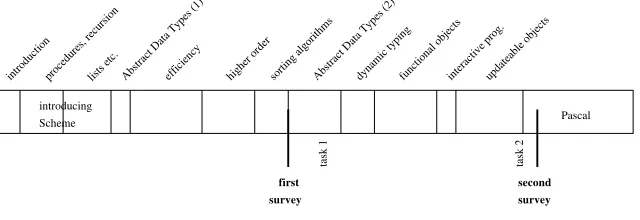
Fig.1.A rough course time scale
The use of updateable objects (andset!) is explained through the modelling of bank accounts. We
therefore need to get rid of the simple substitution model presented in the second chapter. We explain the real environmental model of Scheme and the impact ofset!on it. We stress that this set!should
only be used when dening updateable objects, and not for plain calculations.
We are not so much interested in specic algorithms. An example of backtracking (eight queens problem) was removed after the rst year, because we nd the implementationtoo technical and preferred to stress the concept of Abstract Data Types more. The solution of the towers of Hanoi is still presented, but more as an application of the chapter on interactive programming.
As for the practical side of the course, we make groups of up to 24 students and teach them a (limited) set of 12 exercise sessions of 2 hours each. Until now, we use no computer at nine of these sessions, just pencil and paper. We believe that algorithms can be better developed on paper than on computer. We want to properly teach the software engineering concepts involved in programming and are not satised when they have a program, that is, although working, hacked together. It needs to be constructed methodologically and this can be better done on paper.
On the other hand, real implementation work has to be performed in two larger projects that are to be handed in individually or in groups of up to 4 persons.
4 Our Survey
Instead of trying to prove the relevance of our approach by using our own arguments, we decided to let our audience speak, not literally, but by the use of questionnaires. This paper presents the results, mainly from the students' viewpoint and referring to their opinion, but also coupled to our own insights. This is necessary as students will mostly only notice the short term eects (especially when they have not yet been assessed), whereas we may as well be interested in the long term eects.
We have questioned the students twice, to see if there would be an evolution in their answers. The rst time was after 8 lessons, when the concept of higher order functions was explained. At that moment they had only attended the very rst exercise session and had hardly acquired any Scheme skills.
At the second time we had just started introducing Pascal. The part of Scheme that we use, was completely lectured and the students had attended ten out of twelve exercise sessions. The rst (smaller) project was nished for some time and the second task was just handed out. They were supposed to have a lot more hands on experience.
[image:6.612.140.460.13.123.2]Most of the students that follow our course have little or no previous experience with (other) pro-gramming languages. Half of them has no experience at all, while about a quarter has prescience to some larger extent. As these two groups will probably have dierent opinions, we decided not only to view the group as a whole, but also to split it according to their advance knowledge (really high or none). Another criterion was whether they liked the course a lot or not at all. It will be obvious that the group who likes the courses gave more positive answers, but it's still worth looking at.
5 What Students Think about Scheme
5.1 Our Questions
{
In the rst questionnaire:To me, the choice of Scheme is1 = awfully bad, 9 = amazingly great
I consider the use of brackets in Scheme as1 = perfect, 9 = terrible
{
In the second questionnaire:In Scheme one can do a lot more than I thought at rst( 1 = agree, 6 = not agree)
We have seen lots of programming styles (stepwise renement, Abstract Data Types, Object Orientation (message passing style)). I think this can be done very nicely in Scheme(1 = agree, 6= not agree)
The item that strikes the students most in our course is the programming language. We should point out that Scheme is completely unknown to our students. Until now, even most graduated students do not know of this language. So when students asked colleagues who study computer science about Scheme, they got the answer 'Never heard about it'. Some even started thinking that Scheme was something invented by us (which, ofcourse, it is not!). The most frequent complaint is that it's useless to teach a language they won't be using later on.
But as those who complain loudly may not be representative, we had to ask the entire group. The most striking elements in Scheme is the parenthesis, much to the annoyance of many students. So we expected rather negative answers on both questions, but were convinced that the third question would yield better results. The last question in this category is the most thrilling. We hoped the response would be positive, but had received no indications in whatever direction.
5.2 Some Criticism
entire group
6 5 18
9 30
13 13
5 1 0
10 20 30
1 2 3 4 5 6 7 8 9
average = 4.74
% of 213 responses
high advance knowledge
15
6 27
4 19
10 12 8
0 0
10 20 30
1 2 3 4 5 6 7 8 9
average = 4.19
% of 52 responses
[image:7.612.148.451.546.661.2]Despite the distinct number of complaints, the answer to whether they liked our preference for Scheme as an implementation language (Fig. 2), was not that negative. The slightly negative trend was mostly pushed by those with major knowledge of other languages. It is a fact that, if used to an imperative language, one has to make a notable mental switch to be able to program correctly in Scheme. One could argue that their opinion counts double as they are the only ones that know of other possible choices, but we rather believe it's due to prejudice. We have a hard time convincing these people to use Scheme properly. In the beginning, lots of them misusedefineto write Scheme programs in a Pascal like way.
And if they do not know how to program in Scheme, how can they judge it properly?
no advance knowledge
1 11
9 10 17 18
12 7
15
0 5 10 15 20
1 2 3 4 5 6 7 8 9
average = 5.59
% of 105 responses
high advance knowledge
6 6 10 8 8 2
14 8
39
0 10 20 30 40
1 2 3 4 5 6 7 8 9
average = 6.41
% of 51 responses
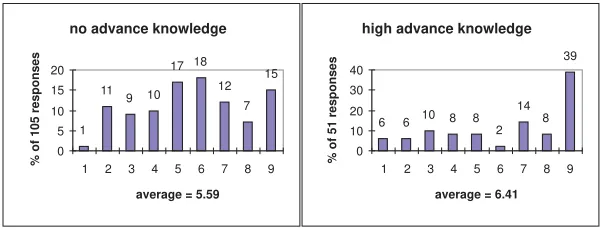
Fig.3. I consider the use of brackets in Scheme as1= perfect,9= terrible
Further exploring their opinion on aspects of Scheme, we especially notice that the use of parentheses is something students don't seem to like and/or understand (Fig. 3). Those without advance knowledge are best o. They are open to its use as a function evaluator, while those with advance knowledge (probably better called prejudice) do not see the light: they clearly dislike them. This is certainly a pity, because we considered it an advantage that everything in Scheme is a S-expression. This makes the language very orthogonal, but students do not seem to get this. They just see a lot of brackets that have to be placed somewhere. Lots of them open a bracket just when they feelappropriate, and wait with
closing until the very end of the denition. This is clearly very error prone. In a negative mood, we could be tempted to state that we switched from the problems in Pascal with the semicolon, to the parentheses in Scheme. It is denitely true that some students loose the overview, purely due to the brackets.
This may seem like a trivial observation, but if this would be the main reason why students dislike Scheme, we have to take care. The source of their frustration is most likely the fact that parentheses mostly do not have a semantics as strict as in Scheme. The number of parentheses has a big inuence on the meaning of the program. Another problem is that brackets are sometimes used as a means to group entities (as in thelet), but also then, students must be aware that the grouping can just be done in one
single way.
Another related problem is the use of lists. The fact that a cons can also create a pair, but that
some pairs are lists, while others are not, turns out to be very confusing. A good solution might be to avoid the confusion by restricting the use ofcons. We could redeneconssuch that it can only be used
to construct lists. It is quite feasible to do this such that conssignals an error whenever the second
[image:8.612.147.449.195.310.2]5.3 Some Good Points
In our second questionnaire, we included the question
'In Scheme one can do a lot more than I
thought at rst
(1 =agree, 6 =not agree)'(Fig. 4). And this question is answered quite positively(a score of 2.95). Those who have advance knowledge and didn't like Scheme at rst, agree even more. But the most convinced group is those who like Scheme. They already liked Scheme, but their faith still seems to be growing.
the entire group
18
25 26
15
8 9
0 10 20 30
1 2 3 4 5 6
average = 2.95
% of 244 responses
high advance knowledge
24 33
17 9
4 13
0 10 20 30 40
1 2 3 4 5 6
average = 2.76
% of 46 responses
Fig.4.In Scheme one can do a lot more than I thought at rst(1=agree,6=notagree)
The question '
We have seen lots of programming styles (stepwise re nement, Abstract
Data Types, Object Orientation (message passing style)). I think this can be done very
nicely in Scheme
(1 =agree,6= notagree)', scores a 2.80, with identical scores if one knew nothingor a lot of other programming languages. Even those who dislike the course score 3.38, but here the histogram is more evenly spread. On the other hand, those who like it, score an incredible 1.92.
5.4 Discussion of the Results
Although the students are resistant at the beginning, the positive reactions in the second questionnaire indicate that they nally seem to agree that Scheme oers certain advantages. We believe this to be true for all functional languages.
Haskell may even do better, because it needs no or little brackets and has features such as pattern matching that enhance readability. Its list manipulation is far better and the confusion between pairs and lists is removed.
Another aspect is that programs in Scheme still really look like programs: a bit obfuscated by the use of brackets, and the control structures such as if, cond, :::that need to be written explicitly.
Haskell (just as other modern functional languages) comes closer to programs looking like specications. Because our strong interest in specications, this is good. It stresses that we are not interested that much in programming in itself, but more in well thought out development.
[image:9.612.147.450.166.284.2]6 How do students rate their implementation capabilities?
Questions relating to this were asked on both occasions. Although the curves didn't reveal a lot, we noticed that there was a negative trend. On overall they thought they were worse implementors on the second occasion. This really surprised us a lot, as one would expect this to ameliorate.
After some consideration, we came up with two hypotheses:
{
either the complexity of our algorithms grew faster than the students could cope with,{
or they overestimated their capabilities at the rst occasion.The last one may be the most likely. At the time of the rst survey they had rarely implemented something useful. The programs they had seen, were fully explained in the course. Due to Scheme's expressive nature, the programs can be easily understood and seem to be very easy. It is most probable that students could not fully appreciate the diculties involved in programming. They justthoughtthey
would be able to implement, but programming in Scheme turned out to be more dicult than it seemed. When we asked them during the exercise sessions why they couldn't implement a certain exercise, students mostly mentionedIdon'tknowhow tostartwith it. This was conrmed by the empty sheet of
paper they were still facing. Thisnot beingable tostart is more explicit when programming in Scheme
than in Pascal. There, students can easily write down a frame of program heading, variable declarations etc. without actually having done any thinking on the solution. Such abusydoingnothingphase doesn't
exist in Scheme and students face in a more violent way the fact that they actually can't solve the problem. They rst have to completely understand the problem and develop a solution for it before they can write any Scheme code. And if they can't nd an algorithm, they can't write the program.
As a matter of fact, we have calculated the individual correlations between the questions \
If I
understandthe algorithm,I can implementit.
" and \If I understandthe problem completely,
I can develop the algorithm and the program.
". They are really signicant: a whopping high of 0:82 for the group who likes the course, but also 0:77 for those without advance knowledge and 0:68 forthe entire group. This indicates that the two problems are very strongly related.
Indeed, if we take a look at the group with prior knowledge of programming, this correlation drops to 0:40. But then we noticed that this is the group who disliked Scheme the most. Their problem may be
dual. Firstly, they're probably not used to the functional way of thinking and develop their algorithms in a dierent way. Secondly, it is even likely that they generally don't think about the algorithm, but just start programming, which is a failure proof method in Scheme. Scheme doesn't seem to pose extra diculties for the non experienced users, but it does so for the experienced group and that may be why their correlation drops.
Another but related view on this problem can be seen when students thinkthey have an algorithm
for the solution. When we notice that they cannot write the Scheme program, we ask them to explain what they're trying to program. It turns out that they are unable to formalise their algorithm enough to be able to write it down as a computer program. Computers need very concise programs, and they have problems getting to this level of conciseness. They would suer from the same pain in any programming language, either Scheme or Pascal.
7 The Use of Computers
7.1 The Questions
These questions vary largely in scope, but all relate to moments in which students can/should encounter computers.
{
Our use of computersI want more/less demonstrations of working Scheme programs on computer during the lectures. 3 out of 12 exercise sessions are in the computer lab. This is1 = simply not enough 9 = way too much.
{
The programming tasksI've used a Scheme interpreter at home(before the rst task was handed out). How do you feel about the programming tasks?
Would you still perform the task if you weren't obliged to? How much did you learn from the rst project?
7.2 Our Use of Computers
Due to circumstances, we haven't given any computer demonstrations during the lectures this year. But even in normal situations, the amount of demos remains pretty limited. We believe that it is not that interesting to see a Scheme program run: one learns little about the way Scheme works by just looking at a running computer. It's even pretty boring e.g. to see several lists being sorted.
It surprised us that the students don't agree. They clearly want to have demonstrations and the need even grows in time: the rst enquiry gave 2.26 (recalculated gure), the second time 2.13(1 = a must, 6 = don't want demos). So we asked a few students what they considered an interesting demo. They don't want a plain run, but would like to see how the dierent procedures are used during evaluation. So they'd rather have a program with breakpoints, and not just a trace, because that scrolls way too fast and doesn't show code being executed, just entry and exit points.
As already mentioned earlier on, we prefer not to program computers extensively. It is not a course on programming, but on methodology. Practical issues are also involved. During the exercise sessions, we usually rehearse the theoretical concepts to be used. We experienced that it is dicult to get the students' attention during the computer sessions. That is why we are reluctant to schedule more of them. Another problem is that we want them to implementseveralprograms. When implementing on PC, they rather make sure that theirrstprogram actually runs, before continuing with the rest. Having a program run is important, but because of our limited amount of exercise sessions, we do not necessarily want all the gory details. Instead of having them struggling with syntax details (mostly bracket related), we want the overall structure.
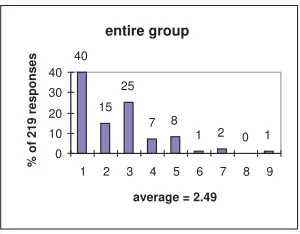
Despite the fact that we get to do more exercises during the paper sessions, the students denitely want more computer sessions. 81 % want it real hard (Fig. 5). They nd that computer sessions are more ecient. Perhaps they can only nish one or two exercises, but then they really do understand them. And there's also the important psychological bonus of\Hey, look what I can do!", which is lost on paper.
7.3 The Programming Tasks
entire group
40
15 25
7 8
1 2 0 1 0
10 20 30 40
1 2 3 4 5 6 7 8 9
average = 2.49
% of 219 responses
Fig.5.3 out of 12 exercise sessions are in the computer lab. This is1 = simply not enough 9 = way too much.
On the other hand, we agree that being able to really implement something working is an important issue, but we prefer to let them experiment on their own. It is a well known fact that programming can only be learned by extensive experimenting.
For this purpose, we include two mandatory projects to be made on computer. The results don't count for the examination, but it gives them the opportunity to learn to develop bigger applications. Not all students take care of this as seriously as they should, but those who do, generally get higher grades. It's not important that they score well in the project, just that they actually make the eort, and not simply copy the result from a colleague.
To help them nish the project, we give them the opportunity to have a Scheme interpreter at home. Before the task is handed out, some of them already use it voluntarily. If1 = neverand9 = all the time, about one third answers from 6 to 9. The amount of advance knowledge doesn't inuence this, and even in the group of people who love the course, a rather large number seldom experiments at home.
On the matter of projects: they really feel comfortable about them (Fig. 6). And an average score of 6.59 on another question indicates that they would still participate in the projects, even if they were no longer mandatory. This further stresses their interest in real programming.
entire group
0 2 1 5 8 7
20 21 35
0 10 20 30 40
1 2 3 4 5 6 7 8 9
average = 7.32
% of 215 responses
I don’t like the course
0 3 0 3 3 6
38
25 22
0 10 20 30 40
1 2 3 4 5 6 7 8 9
average = 7.31
% of 32 responses
[image:12.612.223.373.45.162.2] [image:12.612.145.449.465.581.2]Although educators do not agree on whether it is better to do exercises on paper or using a computer 5], the students themselves clearly rebuked our approach to sparsely use computers.
And perhaps this is good. We may rightfully concentrate on the software engineering principles, but as it is the students' rst computer science course, they should get some real hands-on experience. They can only understand and appreciate what is involved in (good) software development if they went through the (painful) process of programming a computer. This necessarily includes paying full attention to the details and precisely expressing the algorithm in the programming language. As long as we take care that they don't get overwhelmed by the details, they will certainly learn that the software engineering principles help in controlling the complexity of software development.
But please take note that students are very critical when it comes to programming environments. In the rst year we used SCM 9] for DOS, which is just a recompilation of the Unix version and therefore has a very basic command line and needs a separate editor. The students were far from enthusiastic, but as we moved to EdScheme for Windows 11] (a very user friendly tool, that helps in parentheses matching, indentation, key words colouring,:::) their appreciation for Scheme more than doubled and
they became a lot more eager to actually experiment.
This may sound like a very trivial fact, but it is important to stress that students tend to confuse between the language and the tool. If the tool is bad, they think the language is bad. This is conrmed by the fact that many questions and/or complaints about Scheme are actually about (the use of) EdScheme. We agree with their concern for a good programming environment. It may have nothing to do with the language itself, but it is an important aspect that cannot be underestimated. After all, if the students can write their programs quickly and nicely, but only feed it to the computer through major eorts, what's the point?
So the morale of this section is that anyone considering to start teaching a functional language has to take care that it is complimented with a suitable programming environment, and that, especially in an introductory course, a substantial part of the exercises is scheduled on computers.
8 How Do Students Like the Course? 8.1 Questionsand Answers
Whereas we looked into their love for Scheme earlier on, we also asked whether or not they like the course (Fig. 7). During the rst survey only few people disliked the course, and a fair number liked it a lot, but the overall curve was Gaussian (again) with a slight advantage for the positive side. The second survey revealed that a number of people with a neutral opinion moved to the negative side. We see no clear reason for that. It may be inuenced by the dierent lectors: as the normal lector was ill during the rst nine weeks of the semester, another person replaced him. The students viewed his lessons as more interesting (4.04 instead of 4.85 (1 = swift, 6 = boring)). Especially those with advance knowledge preferred the part with the rst lector.
The other question of the second survey that ts in this section is more specialised towards the contents of the course: 'The software engineeringconceptsin this courseare fascinating(1= agree,6=disagree)'. It gave no really dierent result. The average (3.50) is now exactly in the middle.
first survey 3 3 10 18 22 15 16 8 5 0 5 10 15 20 25
1 2 3 4 5 6 7 8 9
average = 5.30 (3.71 on 6)
% of 220 responses
second survey 14 20 24 21 16 5 0 5 10 15 20 25
1 2 3 4 5 6
average = 3.21
% of 247 responses
Fig.7.I(1=hate,9= love)this course
Up to the crucial question:
'Do you think the contents (as far as known) makes sense?
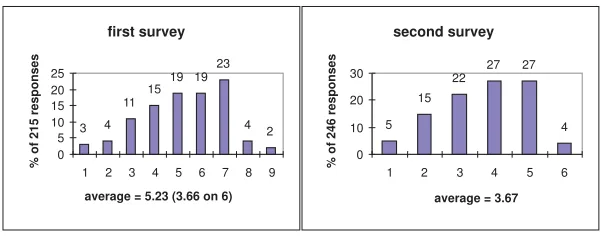
(1 = not at all, 6 = 100%)' (Fig. 8).The results were identical on both occasions, but clearly point in the good direction. There's no Gauss curve here, but a steady ascend with a peak just below the top score. The average is clearly positive: 5.23 (max. 9) or 3.67 (max. 6).
first survey 3 4 11 15 19 19 23 4 2 0 5 10 15 20 25
1 2 3 4 5 6 7 8 9
average = 5.23 (3.66 on 6)
% of 215 responses
second survey 5 15 22 27 27 4 0 10 20 30
1 2 3 4 5 6
average = 3.67
% of 246 responses
Fig.8.Do you think the contents (as far as known) makes sense?(1=notatall,6or9=100%)
8.2 Discussion
The observation that students prefer some lecturers over others may not be surprising, but is important. Teachers still in doubt about moving to Scheme or another language, should keep in mind that simply the decision of moving from one language to another will not substantially inuence the fascination for the course. Other eorts have to be made.
For example, when we used Scheme for the rst time, we introduced lists very late (after higher order functions). At that time, we had lots of complaints of the kind 'In Scheme one can only work with numbers. Nothing interesting can be solved.' As a result we now introduce lists a lot earlier, immediately after recursion. Since then we no longer heard such complaints, but we decided to explicitly ask the question during our rst survey. The answers were evenly spread. A conclusion cannot be safely drawn, but at least the initial { wrong { impression is gone.
[image:14.612.148.449.46.162.2] [image:14.612.147.448.315.434.2]the course, would like some. As we should try to convince them too (otherwise, convincing the convinced is not hard), it may be appropriate to include some more graphics, for example through the use of the turtle graphics included in EdScheme.
If the direct question to the relevance of the contents is answered positively, there's another indication to prove this. We also asked how much they would remember after 1 and 5 years. There was no immediate interesting answer to this, but it struck us that those with advance knowledge think they will remembera lotmore. We interpret this positively because we believe that they can see the dierence between specic
techniques and general principles. If there's anything to be remembered, it's the principles. So if they think there's a lot to be remembered, there must have been many principles learnt and this is what we wanted.
9 Preference for Specialising in Computer Science
A matter not really related to simply teaching a course, but still very relevant, is the following. Our students are very heterogeneous: they still have to choose an option: they can go into mining, electronics, computer science, :::
Some may already know what to choose and others may only be sure not to choose CS. Anyhow, for most of the students this course meant the rst contact with real computer science, not just programming, playing games, word processing and web browsing.
Perhaps it learned them that computer science is more than just bit manipulations and indeed a very interesting art. Or perhaps to the contrary, only now they see that programming computers is a hard working profession and realise that it's not as fun as blasting enemies in the games gallery.
It may be vital for our department at the university, but more importantly for our economy, to raise the amount of students choosing for CS, because in Belgium we are facing a huge shortage of computer science graduates (at the moment approx. 7000), and I'm sure this equally applies to various other countries.
Our rst questionnaire included two questions about the inuence of this course on their preference for computer science.
{ Did your interest in the option computer science (1 = grow, 9 = shrink) ?
One third had no opinion, but for the rest we have a bit more interest losers than interest winners.
{ 'If this course gives a correct taste of the computer science option, I will choose 1 =
computer science, 9 = no computers.'
10 Conclusion
As long as Scheme is not widely used in Belgium, both in educational and commercial projects, our use of Scheme as the rst programming language will be controversial. Not because we allegedly don't do valuable things with it, but simply because the language won't be used later on. The students who are actually exposed to this strange thingie called Scheme, appreciate it in the end. We think that it is a powerful language in which a lot of software engineering concepts can be modelled and most of the students nally agree.
Despite the fact that a lot of students will continue to be confused by the brackets of Scheme and the problems related with dynamic typing, we will continue to use Scheme the following years, mostly because dynamic updating of objects is possible and the absence of types partly liberating. The presence of a user friendly environment is another important advantage.
The students who had advance knowledge of other computer languages resisted the most in the beginning, but even this group can be persuaded of the assets of our approach. The group of nal year students who use Haskell is the most convinced of the power of functional programming, but then, they really got to taste it to its full extent. The problem with a rst year course may be that it is just a rst course: the examples and tasks are not big enough to fully appreciate the power of well thought out development.
Although not everyone is fully satised about the course and the language, we have certainly been able to convince most of our students. We therefore believe our approach and our preference for a functional language to be quite successful.
Acknowledgements
1. H. Abelson, G.J. Sussman:Structure and Interpretation of Computer ProgramsMIT Press, (1985).
2. M. Carlsson, Th. Hallgren, Th.:Fudgets - A Graphical User Interface in a Lazy Functional Language. Pro-ceedings of FPCA, (1993) 321{330.
3. C. Clack, C. Myers:The Dys-functional Student, Proceedings of FPLE '95, Lecture Notes in Computer Science
1022(1995).
4. A. Davidson: Teaching C after Miranda, Proceedings of FPLE '95, Lecture Notes in Computer Science 1022
(1995).
5. S. Fincher (co-ordinator), S. Thompson, P. Molyneux: Teaching Functional Programming: Opportuni-ties and DiculOpportuni-ties, CSDN one-day workshop, Kingston University (10th September 1996), report at
http://snipe.ukc.ac.uk/CSDN/conference/96/Report.html
6. P. H. Hartel, B. van Es, D. TrompBasic Proof Skills of Computer Science StudentsProceedings of FPLE '95, Lecture Notes in Computer Science 1022(1995).
7. P. Hudak, S. Peyton Jones, P. Wadler (editors):Report on the Programming Language Haskell (version 1.3), Technical Report Yale University/Glasgow University (1995)
8. J.-P. Jacquot, J. Guyard:Requirements for an Ideal First Language, Proceedings of FPLE '95, Lecture Notes in Computer Science1022(1995).
9. A. Jaer: SCM 4e.1, Implementation of Scheme that conforms to R4RS and is available for many platforms. 10. E. T. Keravnou: Introducing Computer Science Undergraduates to Principles of Programming through a
Functional Language, Proceedings of FPLE '95, Lecture Notes in Computer Science1022(1995).
11. E. Martin (editor):The WinScheme editor, the manual for EdschemeSchemers Inc. (1994)