UNIVERSIDAD DE CANTABRIA
FACULTAD DE CIENCIAS ECONÓMICAS Y EMPRESARIALES
DEPARTAMENTO DE ADMINISTRACIÓN DE EMPRESAS
TESIS DOCTORAL INTERNACIONAL
EL AFECTO, LAS DECISIONES FINANCIERAS Y
LOS MERCADOS FINANCIEROS
Robert P. Merrin
Dirigida por:
Profesor Dr. Francisco Javier Martínez García
Profesor Dr. Lázaro Rodríguez Ariza
Profesor Dr. Guillermo Maraver Tarifa
UNIVERSIDAD DE CANTABRIA
FACULTAD DE CIENCIAS ECONÓMICAS Y EMPRESARIALES
DEPARTAMENTO DE ADMINISTRACIÓN DE EMPRESAS
TESIS DOCTORAL INTERNACIONAL
EL AFECTO, LAS DECISIONES FINANCIERAS Y LOS
MERCADOS FINANCIEROS
ROBERT P. MERRIN
Directores:
Dr. Francisco Javier Martínez García
Dr. Lázaro Rodríguez Ariza
Dr. Guillermo Maraver Tarifa
TESIS DOCTORAL INTERNACIONAL
EL AFECTO, LAS DECISION FINANCIERAS,
Y MERCADOS FINANCIEROS
PRESENTADA POR EL DOCTORANDO
Robert P. Merrin
DIRIGIDA POR LOS DOCTORES
D. Francisco Javier Martínez García
D. Lázaro Rodríguez Ariza
D. Guillermo Maraver Tarifa
It shall have taken a long time to bring this dissertation project to a close, and without a doubt there are many people without which it surely would not have arrived at a satisfactory conclusion.
Most importantly, I would like to thank the “triumvirate of triumph,” Dr. Guillermo Maraver Tarifa, Dr. Lázaro Rodríguez Ariza, and Dr. Franciso Javier Martínez García. If it were not for their hands-on approach, their stalwart courage, their open-mindedness, their sincere kindness, and their honest support for this dissertation, it may well have gotten lost in the jungle of traps and snares brought about by following a path untrodden. When I undertook this doctoral project, I was willing to take risks (despite my father’s warnings) that were sure to make it a distinct and unique experience. Were it not for Guillermo, Lázaro, and Javier the adventure might well have been the casualty of a “because its never been done before.” Often times in life, there are formative experiences that one cannot forget, and that set the stage for what is to come; my experience with them is one of those. And for that, I am deeply and eternally grateful.
I would like to also thank the institutions that admitted me and allowed me to undergo my European academic journey: the University of Cantabria and Maastricht University. When I left the United States in 2007, it was to come and discover what institutions of higher education were like on the other side of the pond, and I am very grateful that they were so incredibly welcoming and supportive. They offered me great opportunities for personal growth and professional development, and I am thankful to them for it.
I am also grateful for non-academic support from a fine group of highly appreciated professionals. I greatly benefitted in many and various respects from the time, talent, and attention of: Dr. Pilar Núñez Delgado, Dr. José Rienda Polo, Hugo Alfredo Vázquez López, Seila González Contreras, Celia de Sebastián Contreras, Francien Masthoff, Els van Aernsbergen, Carina van der Velde, Cecile van Luijten, and Antoine Guillaud’s wonderful team at International Management Solutions. Also, I would like to extend special thanks to Cala for her much-appreciated legwork up and down the coastal hills of Santander.
I was likewise privileged to meet some great people during my doctoral studies and I am grateful for their friendships: Paulo, Ines, Chico, Nick, Rika, Yoshi, Ayumi, Claudio, Anette, Alex, Nikos, Simone, Ricardo, Kevin – and of course, the boys in red, ons MVV’ke.
Table of Contents
LIST OF TABLES ... XV
LIST OF FIGURES ... XVII
SHORT NOTICE CONCERNING AFFECTIVE TERMINOLOGY ... XIX
BREVE NOTA RELATIVA A LA TERMINOLOGÍA SENTIMENTAL ... XXI
ABSTRACT ... XXIII
RESUMEN ... XXV
INTRODUCTION CHAPTER ... 1
1. Introduction to Affect, Financial Decision Making, and Financial Markets ... 1
2. The Road to Behavioral Finance: Historical Background of Affect and the Social Sciences ... 6
3. Problem, Motivation, Research Questions, and Contribution to Behavioral Finance . 14 3.1. Chapter 1 ... 16
3.2. Chapter 2 ... 18
3.3. Chapter 3 ... 19
3.4. Concluding chapter ... 21
CHAPTER 1: INVESTOR SENTIMENT AND THE CROSS-SECTION OF STOCK RETURNS: AFFECT AND THE BOTTOM-UP APPROACH ... 23
Abstract ... 23
1. Investor sentiment: a short introduction ... 24
1.1. Approaches to the study of investor sentiment ... 24
1.2. Limitations of the bottom-up approach and the synchronization problem ... 25
1.3. Addressing the synchronization problem: the Affect Hypothesis ... 26
1.4. Testing the Affect Hypothesis ... 27
AFFECT, FINANCIAL DECISION MAKING, AND FINANCIAL MARKETS
2. Placing the study: context and background ... 30
2.1. The “Top-to-Bottom” conceptual model of investor sentiment ... 31
2.1.1. The top-down approach ... 31
2.1.2. The bottom-up approach ... 35
a. Investor Decisions ... 37
b. Cognitive Biases ... 37
c. Affect ... 38
d. Physiology ... 38
e. The Environment ... 39
2.2. Affect: empirical, theoretical, and practical considerations ... 39
2.2.1.Definition of affect ... 39
2.2.2.Theory ... 40
2.2.3.Empirics ... 41
2.2.4.Practical Considerations ... 41
3. Research design ... 43
3.1. Data collection and descriptive statistics ... 43
3.1.1. Investor Affect ... 43
3.1.2. Stock market outcomes and their historical circumstance ... 51
3.2. Methodology ... 59
3.2.1. The conditional characteristics model ... 59
3.2.2. The sentiment seesaw ... 62
4. Results ... 65
4.1. Parametric results: the conditional characteristics model ... 65
4.1.1.Levels and subsequent corrections ... 65
4.1.2.Changes and contemporary overreactions ... 67
4.2. Non-parametric results: cross-sectional graphs conditional on affect ... 70
5. Conclusion and Discussion ... 78
CHAPTER 2: OF TRIGGERS AND TARGETS: RISK-BASED AFFECT IN A DOUBLE-HURDLE MODEL OF RETAIL COMMON STOCK TRADING DECISIONS ... 81
1. Introduction ... 82
2. Literature review ... 84
3. Data collection and descriptive statistics ... 87
3.1. Affective risk behavior ... 87
3.2. Risk exposure ... 94
3.3. Trading decisions ... 95
4. Methodology ... 97
4.1. The Double-Hurdle model ... 98
5. Results ... 101
5.1. Purchase decisions ... 101
5.1.1. Hurdle 1: Participation decisions ... 101
5.1.2. Hurdle 2: Degree of riskiness ... 105
5.2. Sale decisions ... 107
5.2.1. Hurdle 1: Participation decisions ... 107
5.2.2. Hurdle 2: Degree of riskiness ... 109
6. Discussion and Conclusion ... 110
CHAPTER 3: MANAGING MARKET-BASED ASSETS: CUSTOMER SATISFACTION AS A BUFFER AGAINST SENTIMENTAL STOCK PRICE MOVEMENTS ... 113
Abstract ... 113
1. Introduction ... 114
2. Literature Review ... 115
2.1. The benefits of managing market-based assets ... 115
2.2. Managing firm exposure to investor sentiment ... 116
2.3. Customer satisfaction and the stock market: a review ... 118
3. Descriptive Statistics ... 121
3.1. Customer Satisfaction ... 123
3.2. Investor Sentiment ... 124
3.3. Monthly Stock Returns ... 124
4. Methodology and Results ... 125
AFFECT, FINANCIAL DECISION MAKING, AND FINANCIAL MARKETS
4.2. Parametric approach ... 128
5. Robustness Check: Repeating the Analysis with Corporate Social Responsibility .. 130
5.1. Introduction to CSR: a Determinant of Customer Satisfaction ... 130
5.2. Data and descriptive statistics of the Robustness Check ... 132
5.2.1. CSR Scores ... 133
5.2.2. Investor Sentiment ... 133
5.2.3. Stock Returns ... 133
5.3. Methodology and results of the Robustness Check ... 133
5.3.1. Non-Parametric Approach ... 134
5.3.2. Parametric Approach ... 135
6. Discussion and conclusion ... 137
CONCLUSION CHAPTER ... 140
1. Summary and Concluding Remarks ... 140
2. Limitations of this Research ... 145
3. Considerations for Future Research ... 148
BIBLIOGRAPHY ... 153
APPENDICES ... 175
Appendix A. Spanish translation of Introduction Chapter to opt for the International Doctorate ... 179
List of Tables
Table 1.1: Top-down measures of investor sentiment ... 33
Table 1.2: Bottom-up measures of investor sentiment ... 36
Table 1.3: Scales of SMA, RP, and RA, their survey items and factor analysis ... 45
Table 1.4: Summary statistics of the monthly survey responses for SMA, RA, and RP ... 48
Table 1.5: Summary statistics and correlation of monthly of SMA, RA, and RP ... 50
Table 1.6: Common stock characteristics: measurement and relation to riskiness ... 54
Table 1.7: Summary statistics of returns and characteristics data ... 57
Table 1.8: The conditional characteristics model: lagged monthly levels of SMA, RA, RP, and aggregate affect on long-short portfolios of the ASX, April 2008-April 2009 ... 66
Table 1.9: The conditional characteristics model: monthly levels of SMA, RA, RP, and aggregate affect on long-short portfolios of the ASX, April 2008-April 2009 ... 69
Table 2.1: Yearly summary statistics of Dutch retail investors responding to the surveys, and their trades, April 2008 to April 2009 ... 88
Table 2.2: Definition and interpretation of risk behavior factors, adapted from Pennings and Wansink (2004) ... 89
Table 2.3: Factor survey items, their scales, and the results of the factor analysis ... 91
Table 2.4: Summary statistics of the monthly survey results, April 2008-April 2009 ... 92
Table 2.5: Common stock characteristics: measurement and relation to riskiness ... 93
Table 2.6: Average monthly stock deciles traded, purchased, and sold by the sample of Dutch Retail Investors, April 2008-2009 ... 96
Table 2.7: Double-hurdle model of factors influencing the common stock purchase decisions of individual investors ... 103
Table 2.8: Double-hurdle model of factors influencing the common stock sale decisions of individual investors ... 108
Table 3.1: Descriptive statistics: returns, ACSI, and investor sentiment, January 1994 to December 2010 ... 122
Table 3.2: Portfolio returns for ACSI-sorted portfolios in periods of high and low investor sentiment ... 128
Table 3.3: Summary Statistics for the Corporate Social Responsibility Data ... 134
List of Figures
The focus of this thesis is what can collectively be called “affect” as it applies to various financial topics. However, the scientific study of affect spans many disciplines and has been performed in many languages – especially because it exhibits a long and storied history. For this reason, it is easy to confuse terms that refer to passions, attitudes, feeling states, moods, the process that is responsible for emotions, the results of emotions, and the way that each of these is referred to in various languages, various disciplines, and even time periods (what once was called passion came to be understood as emotion, and is now called affect).
Given that this thesis is interdisciplinary and tries to bring the affective terminology from various fields together, it has been a challenge to reconcile the various terms from each discipline: finance, marketing, accounting, management, psychology, and neuroscience. Each discipline has become comfortable using its own specific terminology, but this has not brought any order to the overall nomenclature. Instead of lexicographical harmonization in the domain of affect (i.e. using the same words to refer to the same things), we are currently experiencing an explosion in affective neologisms including terms such as: “fast and slow thinking,” “hot and cold cognition”, and “emotional intelligence.” The growing diversity in affective wording is encouraging because it attests to the vast interest in affect, but it can make it quite challenging to ensure that words being used are specific enough to refer to that which is meant.
The challenge is great when reaching across disciplines, but also when reaching across cultures. This thesis was written in an international context where readers with native proficiencies in Greek, Spanish, French, Dutch, German, and English have made valid points concerning the specificity and appropriateness of each individual term in the affective lexicon used in this dissertation: it turns out that from a cultural standpoint, the affective lexicon exhibits strong implicit definitions that are specific to different regions (and this despite their often common Greek and Latin etymology).
Hence, here are some definitions to help curb any misunderstandings that may arise from the chosen wording:
• Affect: (from marketing, psychology, and neuroscience) the physiological processes
AFFECT, FINANCIAL DECISION MAKING, AND FINANCIAL MARKETS
• Investor Sentiment (or “Market Sentiment”, or simply “Sentiment”): (from
Finance) the difference between the theoretical ideal price and the actual market price.
• Attitude: (from psychology and marketing) an expression of favor or disfavor toward
a person, place, thing, or event (the attitude object).
• Emotion: (from psychology) a subjective, conscious experience characterized
primarily by psychophysiological expressions, biological reactions, and mental states. Emotion is often associated and considered reciprocally influential with mood, temperament, personality, disposition, and motivation.
• Mood: (from psychology) differs from emotions in that they are less specific, less
intense, and less likely to be triggered by a particular stimulus or event. Moods generally have either a positive or negative valence.
Esta tesis se centra en lo que en conjunto se puede denominar “afecto” ya que atañe a varios temas financieros. Sin embargo, el estudio científico del afecto es multidisciplinar y se ha realizado en muchos idiomas ya que presenta una larga y variada historia. Por este motivo, es fácil confundir no solo los términos con los que nos referimos a las pasiones, actitudes, sentimientos, estados de ánimos, los procesos responsables de las emociones y los resultados de esas emociones sino también a la manera de referirnos a cada uno de estos términos en varios idiomas, disciplinas e incluso períodos temporales (así, por ejemplo, lo que una vez se llamó pasión fue entendido más tarde como emoción y ahora es llamado afecto).
Dado que esta tesis es interdisciplinar e intenta aunar la terminología de varios campos, ha sido todo un desafío armonizar los diferentes términos de cada disciplina: economía, marketing, contabilidad, administración y dirección de empresas y neurociencia. Cada una de las disciplinas anteriores usa su propia terminología específica, lo que ha fomentado que no exista una nomenclatura común e unitaria. En lugar de una armonización lexicográfica con respecto al dominio del afecto, es decir, que se usen los mismos vocablos para referirse a las mismas entidades, estamos experimentando ahora mismo una explosión de neologismos afectivos que incluyen términos como por ejemplo: “pensar rápido y despacio”, “pensar en caliente y en frío” e “inteligencia emocional”. La creciente diversidad de la nomenclatura afectiva es motivadora ya que pone de manifiesto el vasto interés que existe por el afecto pero, a su vez, puede llegar a resultar desafiante cuando intentamos asegurarnos de que los vocablos que usamos sean lo suficientemente específicos parar hacer referencia a lo que queremos decir.
AFFECT, FINANCIAL DECISION MAKING, AND FINANCIAL MARKETS
Por esto, más abajo se muestran algunas definiciones con el objetivo de no dar pie a ningún malentendido que pueda ocasionar la nomenclatura elegida:
• Afecto: (en marketing, psicología y neurociencia) diferentes procesos fisiológicos del
sistema nervioso responsables de las emociones y los sentimientos.
• Sentimiento inversor (o “sentimiento de mercado” o sencillamente
“sentimiento”): (en economía) la diferencia entre el precio teórico ideal y el precio
de mercado real.
• Actitud: (en psicología y marketing) expresión a favor o en contra de una persona,
lugar, objeto o situación (el objeto actitudinal).
• Emoción: (en psicología) experiencia subjetiva, consciente caracterizada
principalmente por expresiones psicofisiológicas, reacciones biológicas y estados mentales. Las emociones con frecuencia se asocian y se considera que tienen una influencia recíproca con los estados de ánimo, el temperamento, la personalidad, la disposición y la motivación.
• Estado de ánimo: (en psicología) difiere de las emociones en que es menos
específico, menos intenso y tiene menos probabilidades de ser desencadenado por un estímulo o situación particular. Los estados de ánimo tienen normalmente una valencia positiva o negativa.
Introduction Chapter
1. Introduction to Affect, Financial Decision Making, and Financial Markets
As science gains a better understanding of how the brain works and how decisions are made, it provides fresh wherewithal to improve the existing financial model. Many interesting breakthroughs have come to show that affect drives behavior more than previously thought and should hold a central role when studying humans, their organizations, and their societies. Due to the complex, heterogeneous, and latent nature of affect, social science researchers have tended to leave affect out of their analyses. They have instead favored the use of so-called “rational” models of behavior that rely on simplified rules and describe automatons rather than actual decision behavior.
Thanks to the maturation of neuroscience, rational models have become controversial: we now know that the very part left out of rational models – affect – is fundamental to the functioning of the brain. Affect has thus come to hold a unique position in social sciences in general, and in finance in particular: it is the most neglected and yet the most important piece to the puzzle of behavior. This state of affairs represents a great opportunity for researchers: a large gap exists between current models of decision-making and the models of behavior that would incorporate affect.
AFFECT, FINANCIAL DECISION MAKING, AND FINANCIAL MARKETS
enough to have rooted the development of the modern financial system, which has become an important set of institutions for any developed economy.
Comparing finance and marketing provides an interesting example in terms of showing how a discipline that incorporates affect uses it to provide effective affect-based solutions to its practitioners, whereas the other struggles with problems that are widely recognized to be caused by affect. Research in marketing has theoretically and empirically embraced affective processes; the drivers of affect are commonly studied and their consequences for behavior and marketing practice are widely documented and used in industry. Despite vast progress in behavioral finance, finance theory still considers behavior to be secondary to “rationality” and has resisted incorporating affect, especially as a primary driver of decision behavior. Instead, standard finance theory considers behavior to be a source of error rather than an objective piece of the financial puzzle. It is hardly surprising then, that stock bubbles remain one of financial economics’ main unresolved questions; it is broadly acknowledged that popping stock bubbles result from affectively rooted manias and panics. It results that the standard analytical methods rule out affect as a fundamental part of the mechanics of a price bubble, and that the intuitive cause of stock bubbles goes unexamined.
in research, and are mainly used practitioners. The few cases of research using these methods have earned recognition as plinths for future behavioral finance research, but where the measures are borrowed from practitioners there is an unfortunate lack scientific rigor, despite their interesting findings.
AFFECT, FINANCIAL DECISION MAKING, AND FINANCIAL MARKETS
[image:30.595.67.521.129.556.2]
From: Georgios Paltoglou, Michael Thelwall, "Seeing Stars of Valence and Arousal in Blog Posts," IEEE Transactions on Affective Computing, vol. 4, no. 1, pp. 116-123, Jan.-March 2013, doi:10.1109/T-AFFC.2012.36
Figure A.1: The Heterogeneity of Emotions
As an example, instead of considering fear and greed to be opposite points on the same scale with opposite effects on the stock market, a more accurate and descriptive way of conceptualizing greed and fear is to consider that fear is one affective factor and that greed is another. They would thus each be measured on a scale, and may both have positive and negative valences or be neutral. Greed and fear may thus effectively influence different trading decisions in different ways and at the same time. By conceptualizing each affective factor as its own driver of behavior, researchers will be thus able to examine a more accurate and nuanced set of relationships between affective processes and financial markets.
Finance is only just beginning to take heed of the ongoing affective revolution in the social sciences, and the perspectives are broad and exciting. Access to the technologies necessary to study affective topics (such as big data, social media, and medical imagery) is becoming widespread. For the first time, reliable, longitudinal, and direct measurements of affect are possible and accessible. This means that researchers who are interested in studying how affect is responsible for price bubbles can now open that black box. We now have the ability to paint a detailed picture of the latent mechanics of a price bubble. This set of circumstances is exciting because our financial system will benefit greatly from the better information we will have, that will make markets more efficient, and allow for better regulation, monitoring, and investor performance. The situation is also a little off-putting because affective information is of a personal nature and a disconcertingly good predictor of behavior. The changes to the financial system will be inevitable because the typical measures of utility and wealth will be complemented (perhaps even replaced) by distinct affective factors, which can be specifically related to physical processes in the brain. Indeed, the purpose of the financial system is to ensure that resources and capital are efficiently distributed and used; the success of this process is measured today by economic growth or returns. One may imagine a not so distant (and somewhat Orwellian) future where the success of capital distribution may also be directly measured by subjective states of wellbeing.
AFFECT, FINANCIAL DECISION MAKING, AND FINANCIAL MARKETS
of which the economic system consists. It follows that determining what affect is, how to measure it, and how variation in affective factors is related to financial decisions are the next logical steps to improve our understanding of the financial system, its latent mechanics, and its participants. This research is effectively using finance as a testing ground for a new, modern, and innovative set of tools to eventually help tackle tough economic problems that continue to confound researchers and policy-makers: price bubbles, excessive wealth-distribution inequality, and economic growth. It is too early to see where this research will lead us, but the prospects are exciting and full of promise.
Well before research of affect in finance matures to the point of being able to address the larger macroeconomic problems, it is important to determining what affect is and to grasp the depth and scale of the revolution caused by neuroscientific advances at the microeconomic level. As a result, this dissertation focuses on defining and measuring affect, and testing its influence on the financial system in terms of price formation, trading decisions, and corporate financial policy. The rest of this introductory chapter consists of a summary of the history of affect from its earliest conceptualizations until the development of the social sciences, and ultimately the role it has played in framing behavioral finance. This provides broader context for the research performed in in this dissertation in terms of understanding why we think the way we do about emotions. Subsequently, we specify the motivation and research questions of each study.
2. The Road to Behavioral Finance: Historical Background of Affect and the Social
Sciences
resistance in the academic financial community to incorporate affect into a standard financial model. This is especially surprising when public discourse so obviously refers to affect in financial markets be it by regulators (e.g. Greenspan’s famous reference to “irrational exuberance”), or by practitioners on any financial news network.
There is a historical reason for why, at least among Western thinkers, there is resistance to the idea that emotions drive behavior, and a propensity to believe that emotions are implicitly responsible for “bad” behavior. At first, emotions were objectively considered to be part of the process that resulted in behavior. Plato and Aristotle (IIIrd B.C.) provided a surprisingly accurate picture of emotions by portraying them as part of an interactive relationship with the process responsible for conscious, analytical thought. Some of their disagreements would be the subject of debate for over 2000 years, and would represent significant hurdles to the incorporation of emotions into any consensus among thinkers concerned with behavior and society. On one hand, Plato posited that this interaction was brought about by a mind that pre-existed the body; Aristotle, on the other, felt the whole mechanism is derived from physical processes.
AFFECT, FINANCIAL DECISION MAKING, AND FINANCIAL MARKETS
Descartes’ influence on science and philosophy is still felt today: some of his contributions include the Cartesian graphing system, analytical geometry, infinitesimal calculus, and his philosophical writings represent one of the foundations for Western philosophical thought. His revolutionary piece, the Passions of the Soul (1649), would set the stage for examination and analysis of emotions and behavior for at least the next 400 years. In his philosophy, he posited that the world consisted of both tangible and intangible matter, and that the human body was made from the former, and the soul (i.e. interpretable here as the “mind”), an inherently rational device, consisted of the latter. Despite how outlandish his model might sound by today’s standards, it is effectively the first ever dual-process model; a successful class of models of behavior built on cognition and affect that are still used to this day.
Descartes even targeted, albeit incorrectly, the place in the brain (i.e. the pineal gland), where interactions between the soul and animal spirits would occur – putting, in very avant-garde fashion, the brain in the center of his explanation of behavior. The sensations that arose from these interactions are what Descartes would call passions, and would eventually come to be called emotions. Descartes’ discussion of passions would be the basis for the understanding of emotions until modern neuroscience’s growing interest in emotions would take the helm in the end of the twentieth century. While other influential thinkers would immediately build upon Descartes’ analysis of emotions, the recurring assumption has since been that emotions hampers “rationality” and the ability to make successful decisions. The part of the philosophy that was so hard to uproot from conventional scientific thought about behavior, was that human behavior was primarily driven by the rational part, but was intermittently subject to the emotional part. The reality however, is that affect is the primary driver of behavior, and that reasoning only occurs intermittently, due to its high cost in terms of physiological resources.
phenomena in favor of ones that were supported by rational behavior. However, in addition to being inaccurate, modeling humans as strictly rational agents can have negative consequences when moving from social science theory to organizational practice – precisely because affective effects are ignored. Affective effects condemn rational theories’ usefulness and can cause extensive monetary and social costs as a result: first, by putting the “rational” idea into practice, only to subsequently discover that it does not work, and then by having to undo what had been put in place. It results that social science models must include affect if they are to be used to create and administer social organizations and institutions.
This dissertation argues that including the theoretical and empirical study of affect in finance will improve financial institutions, decisions, and policy. In order to convey why this topic is important and how it fits cutting-edge scientific trends, it is helpful in the context of this section to offer a historic example of how a rational theory put into practice would backfire for the lack of incorporating the study of affect. Here, the analogy with finance concerns another social science discipline in its own right: geography. Geography realized the importance of affect after the rise and fall of the rational urban planning movement (1890-1960). Just like rational finance (1900-1980), the rational urban planning movement formed as a result of the generalization of quantitative techniques (in terms of measurement and predictive modeling, for example) that were brought about by the industrial revolution.
In the case of urban planning these techniques used important spatial characteristics such as exposure to direct sunlight, movement of vehicular traffic, standardized housing units, and proximity to green-space. The list brings to mind the common variables used in rational financial research: returns, volatility, size, liquidity, volume, book-to-market ratio... Neither discipline’s measurements concern subjective preferences of the people involved – the potential residents in the case of urban planning or the market participants in the case of finance – both fields effectively ignored affect.
AFFECT, FINANCIAL DECISION MAKING, AND FINANCIAL MARKETS
private developers. This would subject rational planning to the eventual critique of being elitist and socially insensitive; its limits would become clear when, sometimes just after being built, many housing projects around the world would fail and be dismantled at great cost. Rational finance is also an inherently top-down discipline, studying aggregate market characteristics and drawing conclusions about what is in effect a diverse and heterogeneous set of market participants. Finance has also been criticized of being elitist, and although markets have not been dismantled, the financial crises subsequent fallout are very costly, and were blamed on the financial community.
The rational urban planning movement ended because it had lost touch with the public it was building the housing projects for. The rational model of behavior they were based on assumed that exposure to direct sunlight, movement of vehicular traffic, standardized housing units, and proximity to green-space were characteristics that would make residents happy, but something important had been left out. From the subsequent bottom-up urban planning movements, we now know that residents feel very strongly about many intangible characteristics that were ignored in rational planning such as social cohesion, the preservation of local culture, and sustainability. These characteristics satisfy affective needs of residents, and were a necessary condition in order to improve on rational planning: the majority of subsequent urban planning movements favored bottom-up planning. This approach meant measuring the agents first, and would focus on public participation, communication, and consensus to establish preferences and what important affective characteristics needed to be addressed.
subsequently crashes causing damage to the financial system and economic growth. Studies have provided many rational causes for stock market bubbles, such as excessive credit or loose monetary policy, and while these causes are a part of the bubble problem, they do not preclude the role of affective events like manias and panics. Indeed, many researchers have tended to study affect-related processes to explain financial crises rather than affect itself.
“Animal spirits” has become a popular term for the collective effects of many non-rational decision behaviors that have emerged from psychology since the 1970s, and explain economic phenomena that do not conform to rational models of the economy. Psychologists have provided a long list of cognitive biases, named for their divergence from rational behavior, which can be integrated into rational models of the economy with relative ease. In terms of model parsimony however, each non-rational adjustment to an economic model makes the model increasingly complex. Often, economic models can only account for two or three cognitive biases at a time, but nonetheless are generally accompanied by improved model performance over the original rational model. The most famous case is the replacement of Von Neumann and Morgenstern’s rational expected utility model with use of Kahneman and Tversky’s prospect theory – it is possible to swap the first for the second in any expected utility model to make it a behavioral model that relies on empirically determined decision routines rather than rationally theorized ones. The success of prospect theory’s adaptation by economists ended up being a seminal event in economics that would spawn many models based on cognitive biases, and generalize the acceptance of behavioral approaches to economic problems.
AFFECT, FINANCIAL DECISION MAKING, AND FINANCIAL MARKETS
who are supposed to correct unsustainable prices do not act to do so (sometimes even exacerbating the problem). Many behavioral explanations for the extra volatility in price behavior would thus be documented: herding, overtrading, overconfidence, positive feedback trading, the disposition effect (i.e. holding losing stocks too long, and winners not long enough), and the expression of preferences. Even though it is implicit that emotions play a role in the manifestation of such behavioral explanations of price behavior, the role of affect is not explicitly examined: the study of investor sentiment has yet to focus on the study of actual sentiments.
Investor sentiment is a term that behavioral economists have borrowed from finance practitioners that originally referred to the feelings of the market participants that practitioners would speak with. As such, the original use of the term explicitly referred to their instinctive understanding of market participants’ affect, but since the development of behavioral finance, it refers instead to the collection of documented psychological effects on prices. One reason for the shift in semantics comes from the fact that when behavioral finance came into existence in 1980, an important debate in psychology about affect remained unresolved. The aftermath of that discussion would prove to be an important turning point in the way that psychology would influence other social sciences, and would foreshadow the empirical results of future neuroscientific studies. The debate concerned which of the three categories of the mind: cognitive (e.g. reflection and analysis), affective (e.g. feeling states), and conative (e.g. impulse behavior), was the first system in the brain to respond to stimuli. The original view, inherited from Descartes, assumed that cognitive mechanisms reacted first and that affect would interrupt. Throughout the 1970s, researchers influenced by Pavlov and Skinner would instead argue that affect was the primary stimulus-response mechanism.
natural experiment arising in cases of patients who after brain injuries underwent a personality changes. The particular parts of the brain that were damaged were related to emotional processes. As Damásio explains, the changes in personality were due to the fact that even though emotional parts of the brain were damaged, the patients could not perform what would normally be considered rational tasks. He concludes based on observing the brain that cognition and affect are inherently linked at a neurological level, and that neither one can function without the presence of the other. As far as the structure of the brain is concerned, the separation of emotion and reason is an illusion of consciousness.
In the late 2000s, once the discovery that activation of cognitive function in the brain happens in concert with affective activation achieved broader acceptance of neuroscientific findings across the social sciences, economic disciplines began studying financial topics related to affect. This dissertation concerns the discipline of finance proper, but in terms of incorporating affect it was a relatively late adopter. Marketing scholars had been keeping up to date concerning research about affect, they did not wait for the breakthrough discovery to incorporate affective research. Behavioral finance is now benefitting from the research performed by marketing researchers, their results, and their methodologies. Finance scholars are finding that the approach to questions of consumer behavior, which relies on extensive affect-related research, is easily translatable to issues of value-creation, trading behavior, and preferences in finance. Other disciplines fueling the affective revolution in finance include psychology and neuroscience, which are motivating the trend for financial research in the 2010s. Financial research on affective topics during this period also reflects a reaction to the subprime crisis, which involved manias, panics, and the management of specific affective sensations in the public (e.g. trust, confidence, and optimism), by central banks for example, despite having no established measurements or policy towards affective effects.
AFFECT, FINANCIAL DECISION MAKING, AND FINANCIAL MARKETS
about price bubbles, their effects, how they arise, and how to manage them. Below we lay out the motivation and research questions for this research.
3. Problem, Motivation, Research Questions, and Contribution to Behavioral Finance
The present collection of studies approaches the problem of price bubbles from three directions: the relationship between affect and prices, the relationship between affect and the trading decisions, as well as how this knowledge can inform corporate financial policy. By examining these three points of view with regard to affect’s relationship to financial markets we are able to contribute evidence to the literature on how to conceptualize, measure, and address the incidence of bubbles. The overarching motivation of this dissertation, however, is essentially about measurement: testing a new measurement methodology with the purpose of creating an affect-based measurement framework that can provide relevant informational content about stock bubbles. For the purposes of this study “relevant” means that a relationship exists between affect and price behavior, between affect and trading decisions, and between affect and organizational decision making. Measurements that satisfy these conditions represent the first step in constructing a measurement framework that is useful for all market participants – traders, arbitrageurs, regulators, and researchers - to understand, identify, analyze, and prepare for price bubbles.
Given the recent turbulence of financial markets, being more specific about the mechanics and drivers of bubbles is necessary, despite its thorniness. Although many causes for investor sentiment have been recognized and can be measured, identifying and correcting price bubbles remains ineffective – they have occurred almost continuously around the world since the 1970s. One reason bubbles are so persistent may be the fact that investor sentiment is poorly measured. The fact that supports this claim is that investor sentiment is also vaguely defined as a result of so many competing explanations. In the case of the stock market, explanations of stock price bubbles are not taken into account. Even if financial data reflects the advent of a bubble, it still does not say anything about the related, latent, non-financial equity valuation process that is occurring amongst investors. As the underlying cause for bubbles, that latent non-financial process requires its own measurement approach. The current picture drawn by traditional accounting- and economics-based measurement and reporting practices does treat the latent valuation of investors, and thus does not make the onset of a price bubble obvious enough for practitioners and policy makers to take pre-emptive action. It is possible to affirm this because the bubbles keep occurring, which is a strong signal that existing measurement and reporting practices, with regard to bubbles at least, require improvement.
By seeking to understand affect and its relation to financial decisions and financial markets, this research poses the question of how to improve current financial measurement and reporting practices such that proactive procedures can be taken with respect to price bubbles. The existing system, based on accounting, obliges public corporations to be transparent in public financial reports and standardizes financial measurements so that corporations can be compared to each other and themselves through time. This helps determine which firms are risky and allows investors to separate them from the safe firms. The shortcoming of such a system is that determining the riskiness of an asset also depends on the relative judgments of other market participants. This is in effect Keynes’ famous “beauty contest,” and ultimately the point of measuring investor sentiment - to quantify what the rest of the market thinks.
AFFECT, FINANCIAL DECISION MAKING, AND FINANCIAL MARKETS
multitude of behavioral factors, but that it is measured on a single “catch all” dimension. It is typically considered to be positive, neutral, or negative, and denotes the average level of excitation of the market. It assumes that excited markets are risk seeking and subject to price bubbles, whereas passive markets are risk averse and underperform their potential. In reality, there is no perfect price indicator, and it is likely that investor judgment and decision making is too complex to be summarized by one direct measurement or proxy. The research performed in this dissertation is novel in its approach in the sense that it argues that rather than one measure, a multidimensional framework for measuring investor sentiment must be developed. Such a framework will complement standard financial reporting measures and provide context for them. This dissertation thus investigates what the best way is to develop such a framework with discussions of theory and empirical evidence.
3.1. Chapter 1
The first step to establishing the relevance of affect for investor sentiment is addressed in Chapter 1. It is a study of the relationship between affect and the cross section of stocks returns: do different affective factors measured using the same methodology exhibit different relationships to the cross-section of stock returns? This research question is fundamental to establish the measurability and relevance of affect in price behavior for two reasons. First, it allows for the comparison between results derived from the affective measurements and those derived from existing investor sentiment measures. Second, by comparing investor sentiment measures with affective measures, it is also possible to determine if using multiple dimensions of affect provide additional information about the market. By proving that it is possible to use affective measures to reproduce the relationships we already know investor sentiment exhibits in the cross section of stock returns, and then by proving that using different dimensions of affect to portray differing relationships, Chapter 1 effectively shows that there is great potential for a measurement framework based on affect.
concerns the primacy of affect, which is the recognition that affect is the first process to respond to stimuli. These are important arguments because they allow the study to support the view that affect-based measurements can explain all other valid approaches to explaining and measuring investor sentiment. As such, the chapter aims to assert that affect-based measurements exhibit a high “return on investment” in the sense that they are relatively cheap methodologies to put in place given the wealth of relevant information that they are able to collect. Indeed, they are the most relevant measures in terms of explaining pricing with behavior because they explain all other behavioral explanations for pricing.
Chapter 1 explicitly addresses the theoretical discussion that offers the basis for stating that affect drives other drivers of investor sentiment. It provides a unique and parsimonious theoretical model of the chain of events from the informational stimulus up through the order in which behavioral patterns occur when a trading decision is being made. This is important because currently many measures of investor sentiment compete, yet are fundamentally different in terms of the different parts of the decision making chain of events they target. For example, sunny weather, positive emotional states, the use of heuristics, high levels of testosterone, and changing skin conductance are all competing measures of investor sentiment. However, when the sun is out, people tend to be happier, meaning they use more heuristics, experience higher levels of testosterone, and exhibit changes in skin conductance: each documented cause for investor sentiment is in effect a link in the same chain from stimulus to decision that results in the sentimental market outcome. The important question therefore concerns choosing a universally acceptable way to measure the entire process that causes sentimental market outcomes, so that everyone agrees on what a bubble is, and how to deal with it.
AFFECT, FINANCIAL DECISION MAKING, AND FINANCIAL MARKETS
measurement of investor sentiment will help synchronize arbitrageurs, which can in turn decrease the intensity and incidence of price bubbles. Because different affective factors exhibit different relationships to the stock market, are measured with the same methodology, and can be structured into a specific framework it suggests that it would offer arbitrageurs a more flexible, more specific, and easily communicable set of tools to better undertake the endeavor of correcting large bubbles.
3.2. Chapter 2
Chapter 2 picks up where Chapter 1 leaves off. From Chapter 1 we know that affect is measurable, is multidimensional, and exhibits statistically and economically significant relationships to the cross-section of stock returns. The next step in terms of providing evidence that affect serves as a better option to measure investor sentiment than existing alternatives is to show that in addition to relationships with price behavior, affect also exhibits a relationship to the very decisions that drive prices: trading decisions. The theory provided by the primacy of affect suggests that affective measures drive decisions and the purpose of Chapter 2 is to provide the empirical evidence. To show that measures of affect also drive trading decisions provides an opportunity to corroborate the findings in Chapter 1, but also to strengthen the argument that affect is a better measure of investor sentiment. Indeed, if measures of affect can explain prices, but can also explain the decisions that drive the prices, then the argument in favor of affect becomes even more tenable. This is especially the case if it is shown that different affective factors are relevant for different trading decisions – such evidence effectively shows that affective-based measures of investor sentiment are capable of doing what other measures of investor sentiment cannot: address issues of latent heterogeneity in behavior.
traced to risk behaviors, to the use of cognitive biases and heuristics, to physiological changes such as skin conductance and hormones, and thus provide a far more detailed picture of how investment decisions are being made. Chapter 2 turns out to find that one set of affective factors influences retail investors’ purchases of common shares, and that a different set influences their sales.
The implications of findings in Chapter 2 are far reaching. Research from the affective sciences has documented that affect is malleable; this means that an individual’s particular levels of affect can be influenced by third parties. Chapter 2 identifies specific affective factors that are involved in the purchase and sale decisions of retail investors. This suggests that by influencing the affective factors specifically responsible for purchase or sale decisions, it is possible to increase and decrease purchases and sales. Central banks and corporations make use of this finding in their daily operations. Central banks typical use monetary policy to influence markets, cooling them down if they are too hot – or stimulating growth if they feel it is warranted. Another tool they use is their communication with the public – central bank announcements are dissected and heeded by their audiences: this research suggests that the discourse, depending if they wish to encourage buying or selling, should be oriented towards influencing certain affective factors. In the same vein, corporations’ investor relations departments can construct a reliable communication policy based on the malleability of the right affective factors.
3.3. Chapter 3
AFFECT, FINANCIAL DECISION MAKING, AND FINANCIAL MARKETS
A corporation faced with a stock price bubble, may see its stock prices fall for no other reason than because all other stock prices are falling in a market panic. In such a case, firms will want to protect themselves against such an event - which is ultimately an event that is out of their control. To measure affect, this study collects the customer satisfaction levels of publically traded firms, and analyzes the cross-section of stock returns, conditional on high or low levels of investor sentiment. As such, the study shows how the affect of market participants towards the market can be tempered by the affect of market participants towards individual firms. The study finds that firms with happy customers exhibit smaller corrections than firms with unhappy customers when stock markets are in a relative panic.
Thus this dissertation makes contributions on both theoretical and empirical levels. From a theoretical perspective, it provides the most comprehensive discussion of affective theory in finance, offering the groundwork for a comprehensive model of behavioral finance. Empirically, this dissertation shows that affect is related to price formation, to trading decisions, and to corporate financial policy. In addition, the studies show that different affective factors have different effects on prices and trading decisions. The perspectives for future research are thus quite ample. In particular, building a taxonomy of the various affective factors and their effects on the various parts of the financial system would represent a large step forward in the study of affect and finance. From a practical perspective, this dissertation recasts the importance of measuring affect, not only because it is a fundamental process for behavior, but also because it is more practical to quantify than other drivers of sentiment - providing the most informational content with the least effort, and enough flexibility to capture many complexities of decision behavior that existing measures of investor sentiment simply cannot. The evidence in this dissertation shows that affect-based measurement is capable of being structured into a consistent, comparable, reliable, and valid framework that is at least informative about price behavior, investor decisions, and corporate financial policy.
of the agents they are meant to serve, can help identify and pre-empt financial crises and thus ensure long-term growth, efficient distribution of capital, and a more stable, sustainable society.
3.4. Concluding chapter
The concluding chapter provides a summary and a holistic discussion about the results of this dissertation for researchers, practitioners, and regulators. It begins by reminding us that investor sentiment is a convoluted term, the theory behind the concept is vague, and that the measurement is, as a result, also convoluted – investor sentiment means many things to many different people. The three studies approach the problem methodically first by defining the term, then by looking for adequate measurements, and then by testing the measurements in various contexts. This approach has identified how the recasting of investor sentiment into a structured theory with specific measurements and definitions can help arbitrageurs, investors, and corporations. Taken together, the studies suggest that markets may work better if such techniques could be refined and applied by various market participants. Nonetheless, the chapter also discusses that despite the exciting results presented here, much work remains to be done, and these studies only scratch the surface of what is truly an immense topic. In any case, the application of affect to finance, and to business economics in general (at least beyond disciplines like marketing) should be transformative and much work remains to be done in the future.
AFFECT, FINANCIAL DECISION MAKING, AND FINANCIAL MARKETS
and that the latent heterogeneity of market participants can be examined, allowing for improved profiling techniques. Such techniques would help specify the best practices for investor relations officers, help identify the profiles that relate to performance, and allow researchers to test these profiles over time, to determine if they are dynamic or conditional on the environment.
Chapter 1
Investor Sentiment and the
Cross-Section of Stock Returns:
Affect and the Bottom-Up Approach
Abstract: The Affect Hypothesis (Statman, Fisher, and Anginer 2008) states affect is related
AFFECT, FINANCIAL DECISION MAKING, AND FINANCIAL MARKETS
concerning its nature or required measurement framework. We conclude that this state of affairs is a cause for the synchronization problem (Abreu and Brunnermeier 2003), where arbitrageurs are unable to synchronize their arbitrage efforts to effectively correct stock price bubbles. This occurs because they cannot agree about the causes and effects of investor sentiment. We discuss why affect will be at the center of future research in this direction.
1. Investor sentiment: a short introduction
Behavioral finance relies on two fundamental assumptions (Baker and Wurgler 2006, 2007). The first, called investor sentiment, states that stock price behavior reflects a variety of psychological, physiological, and evolutionary factors inherent to the natural behavior of market participants (Arthur 1999, Shiller 2003, Lo 2004). Investor sentiment implies that stock prices are susceptible to investor overreaction (De Bondt and Thaler 1985), which may lead to stock price bubbles, and the problematic aftermath of stock market crashes. The natural market mechanism that corrects stock price bubbles relies on arbitrageurs, the traders who can theoretically identify stock price bubbles due to their specific knowledge, and trade against them in order to profit from the subsequent price corrections. The second assumption, limited arbitrage, states that such traders may exhibit reasons to not take action (e.g. limited wealth, see Shleifer and Vishny 1997) thus allowing stock price bubbles to grow unsustainably and become hazardous to the financial system. Identifying stock price bubbles is thus important for two reasons: it creates profit opportunities for traders and it serves as a signal for an impending threat to the financial system.
1.1. Approaches to the study investor sentiment
are more likely to be overreacting, and shows that these effects can be measured with stock market variables such as price volatility, trading volume, and implied option volatility (Whaley 2000, Bandopadhyaya and Jones 2008). Baker and Wurgler (2006) maximize the informational content and minimize the error of this measurement approach by using the principal component of several exchange-level variables to estimate levels of investor sentiment. Relying on the assumption that stock-market variables reflect investor overreaction, they show that the cross-section of stock returns exhibits a systematic relationship to levels of investor sentiment. Measures of investor sentiment thus provide investors with specific knowledge that helps identify and correct sentimental price inefficiencies.
The second category of analysis, called the bottom-up approach, relies on a variety of measures drawn from behavioral explanations of investor overreaction, such as heuristics or physiology. While the top-down approach is meant to test for the existence of investor sentiment and measure its effects, it is not designed to make statements on the processes that drive investor overreaction. Bottom-up analysis includes a wealth of theory and empirical measurements that explain how and why investors overreact, as well as consequences for stock price behavior. The multiplicity of studied behavioral explanations for investor overreaction has yet to crystallize into a comprehensive theory of investor sentiment; consequently, no consensus has arisen concerning the nature of investor sentiment aside from the fact that investor sentiment exists and that it has many behavioral drivers. The lack of consensus surrounding the behavioral drivers of investor overreaction is observable from the fact that no uncontroversial measure of investor sentiment currently exists (Baker and Wurgler 2006, 2007).
1.2. Limitations of the bottom-up approach and the synchronization problem
AFFECT, FINANCIAL DECISION MAKING, AND FINANCIAL MARKETS
stock price bubbles relies on arbitrageurs’ ability to identify and correct sentimental mispricing patterns. Unless arbitrageurs are able to agree what processes cause sentimental patterns, they will be unable to work in unison to correct stock price rallies unjustified by existing information. Without a clear signal for traders that stock prices are overvalued, there is no reason any individual arbitrageur will bear the risk of short-selling overvalued stocks that may continue to increase in value, and thus result in large losses. This explanation for limited arbitrage has been identified in the literature and is called the Synchronization
Problem (Abreu and Brunnermeier 2003). It occurs because arbitrageurs do not make their
bearish trades at the same time, and since small groups of arbitrageurs cannot single-handedly correct a price bubble, no particular arbitrageur has the incentive to take action.
1.3. Addressing the synchronization problem: the Affect Hypothesis
1.4. Testing the Affect Hypothesis
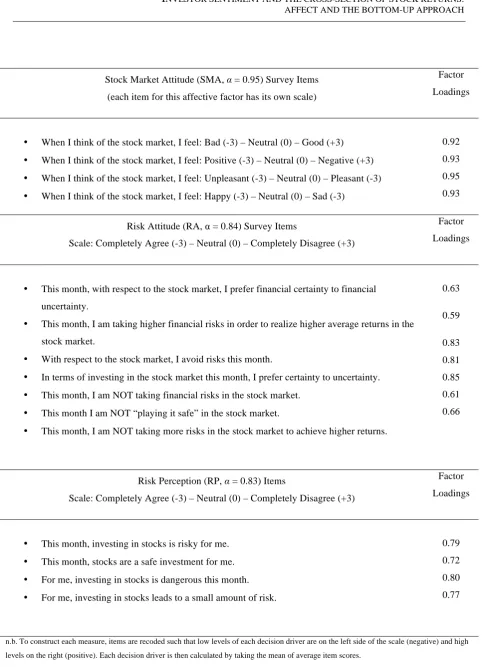
The Affect Hypothesis relies on research in psychology and neuroscience that demonstrates the fundamental function affect performs in the decision-making mechanisms of investors. The affective sciences provide a robust framework for the direct measurement of many affective factors, but in the interest of conservatism, we focus on three that reflect investor affect toward the stock market and stock market risk. First, Stock Market Attitude (SMA) reflects whether investors like or dislike how the stock market makes them feel. Second, Risk Attitude (RA) reflects investor predisposition to stock market risk (e.g. risk preference). Third, Risk Perception (RP) reflects investors’ subjective interpretation of the probability to be exposed to stock market risk (the level of risk to which they feel exposed). A good measure of investor sentiment will serve as a leading indicator of price behavior for investors, but will also exhibit contemporary relationships to price bubbles. In order to validate each affective factor as a driver of stock price bubbles, we analyze their relationships to both concurrent stock market overreactions and subsequent stock market corrections.
Our analysis consists of adapting two top-down methodologies: the conditional characteristics model and the sentiment seesaw (Baker and Wurgler 2006, 2007). The former is a regression model that tests the relationship between a sentiment indicator and the difference between the returns of safe, easy-to-arbitrage stocks and risky, hard-to-arbitrage stocks. Examining the difference between safe and risky returns allows us to determine if variation in the sentiment indicator is related to stock market corrections (when the difference between the returns of risky and safe firms shrinks), or stock market overreactions (when this difference grows). The second method, the sentiment seesaw, is a cross-sectional graph of stock market returns conditional on sentiment. It shows how stocks sorted by characteristic-based measures of riskiness are more or less sensitive to sentimental price effects. Adapting top-down analyses for a bottom-up study of investor sentiment provides the benefit of guiding our expectations concerning the relationship between affect and the cross-section of stock returns.
AFFECT, FINANCIAL DECISION MAKING, AND FINANCIAL MARKETS
of safe, easy-to-arbitrage stocks than on risky, hard-to-arbitrage stocks. Second, high levels of TDS are shown to precede periods of lower than average returns for safe stocks, and higher than average returns for risky stocks. The opposite relationship exists for low levels of TDS, which are found to precede periods of relatively low returns for risky shares, and relatively high returns for safe shares. As a result, if TDS increases, risky shares overreact and subsequently correct more than safe shares. This results in an increase and subsequent decrease in the difference between the returns of safe and risky shares. Baker and Stein (2004) have shown that top-down and bottom-up measures of sentiment are highly correlated, even though they do not stem from a similar measurement frameworks. Hence, using a single affect-based measurement framework, we expect levels of SMA, RA, and RP to exhibit the same cross-sectional patterns as TDS with respect to overreactions and subsequent corrections in stock returns. This is equivalent to breaking down the aggregate measure of sentiment that is TDS into specific affective factors and determining which ones exert the greatest influence.
1.5. Takeaways: the contribution of this study
different bottom-up measures of investor sentiment, may not be measuring the same process, which on a large scale leads to the synchronization problem.
The research provides three takeaways: the first is that directly measured affective factors, namely SMA, RA, and RP, contain relevant information about equity prices beyond what is contained in TDS. Second, SMA, RA, and RP contain relevant information about the behavior of market participants, providing a measurable and specifically defined explanation for why they are overreacting, in addition to a reason why TDS exists in the first place. Current official reporting systems either do not consider sentimental information relevant (traditional financial reporting) or do not adhere to a behaviorally-based theoretical framework when measuring sentimental information (see e.g. the European Commission’s European Sentiment Index). The conclusion of this study is that it would be beneficial to the financial system if affect were reliably measured and publically reported; the information provided by specific affect-based measures of investor sentiment would help market participants identify arbitrage opportunities and prevent stock price bubbles. In terms of the
Synchronization Problem, arbitrageurs tend to synchronize when there is an unmistakable
signal of a market correction – generally observed by a market-wide panic (extremely negative affect) – yet determining such a signal before the market panic itself is no easy task, especially without a common framework. Observed levels of affect during periods of panic can identify thresholds at which investor overreaction is problematic. These may serve as a public warning that investors are taking too many risks, that stock markets are highly overvalued, and that current pricing levels are likely unsustainable. This would encourage arbitrageurs to correct the bubble instead of riding it, thus preventing investor mania, subsequent investor panic, and would avoid significant stress to the financial system.
The following section and lays out the 5-level “top-to-bottom” conceptual model of investor sentiment, reviews the top-down and bottom-up literature, and places the current study. Section 3 discusses the research design of the study, including the data collection procedure, the descriptive statistics, and the methodology used to test the affect hypothesis: the conditional characteristics model and the sentiment seesaw. Section 4 presents the results of the analysis and Section 5 concludes, discusses the implications of this research for the
Synchronization Problem, and considerations for future research that will help develop an