HLA Class II-DRB1 Alleles with
Hepatitis C Virus Infection Outcome in Egypt:
A Multicentre Family-based Study
Mahmoud El-Bendary,* Mustafa Neamatallah,† Hatem Elalfy,* Tarek Besheer,* Emily Kamel,‡ Hend Mousa,§ Abdel-Hamid Eladl,|| Maged El-Setouhy,¶ Abdel-Hady El-Gilany,‡ Ahmed El-Waseef,§ Gamal Esmat*** Tropical Medicine & Hepatology, Mansoura Faculty Of Medicine, Mansoura University, Mansoura,Dakahlyia, Egypt.
† Medical Biochemistry, Mansoura Faculty of Medicine, Mansoura University, Mansoura, Dakahlyia, Egypt. ‡ Public Health & Preventive Medicine, Mansoura Faculty of Medicine, Mansoura University, Mansoura, Dakahlyia, Egypt. § Biochemistry, Mansoura Faculty of Science, Mansoura University, Mansoura, Dakahlyia, Egypt. || Internal Medicine Department, Alazhar Faculty of Medicine- Assiut University, Assiut, Egypt. ¶ Department of Community and Occupational Medicine, Ain Shams Faculty of Medicine. Ain Shams University, Cairo, Egypt.
** Tropical Medicine & Hepatology, Cairo Faculty of Medicine. January-February, Vol. 18 No. 1, 2019: 68-77
The Official Journal of the Mexican Association of Hepatology, the Latin-American Association for Study of the Liver and
the Canadian Association for the Study of the Liver
Manuscript received: Manuscript received: Manuscript received: Manuscript received:
Manuscript received: June 06, 2017. Manuscript accepted:Manuscript accepted:Manuscript accepted: December 11, 2017.Manuscript accepted:Manuscript accepted: DOI:10.5604/01.3001.0012.7864
A B S T R A C T A B S T R A C T A B S T R A C T A B S T R A C T A B S T R A C T
Introduction and aim. Introduction and aim.Introduction and aim. Introduction and aim.
Introduction and aim. Hepatitis C virus (HCV) infection is a global medical problem. HLA –DRB1 alleles have an important role in immune response against HCV. The aim of this study is to clarify the contribution of HLA –DRB1 alleles in HCV susceptibility in a multicentre family-based study. Material and methods.Material and methods.Material and methods.Material and methods. A total of 162 Egyptian families were recruited in this study with a totalMaterial and methods. of 951 individuals (255 with chronic hepatitis C (CHC), 588 persons in the control group(-ve household contact to HCV) and 108 per-sons who spontaneously cleared the virus (SVC). All subjects were genotyped for HLA -DRB1 alleles by SSP-PCR and sequence based typing (SBT) methods. Results.Results.Results.Results.Results. The carriage of alleles 3:01:01 and 13:01:01 were highly significant in CHC when compared to that of control and SVC groups [OR of 3 family = 5.1289, PC (Bonferroni correction ) = 0.0002 and 5.9847, PC = 0.0001 and OR of 13 family = 4.6860, PC = 0.0002 and OR = 6.5987, PC = 0.0001 respectively]. While DRB1*040501, DRB1*040101, DRB1*7:01:01 and DRB1*110101 alleles were more frequent in SVC group than CHC patients (OR = 0.4052, PC = 0.03, OR: OR = 0.0916, PC = 0.0006, OR = 0.1833, PC = 0.0006 and OR = 0.4061, PC = 0.0001 respectively). Conclusions.Conclusions.Conclusions.Conclusions.Conclusions. It was concluded that among the Egyptian families, HLA- DRB1*030101, and DRB1*130101 alleles associated with the risk of progression to CHC infection, while DRB1*040101, DRB1*040501, DRB1*7:01:01and DRB1*110101 act as protective alleles against HCV infection.
Key words. Key words.Key words. Key words.
Key words. HCV susceptibility. HLA-DRB1 polymorphism. virus clearance, intrafamilial.
INTRODUCTION
Hepatitis C virus (HCV) is a global health problem.1
In 2013 HCV was infecting approximately 2%-3% of the world’s population, with additional 3-4 millions are in-fected annually.2 Although acute hepatitis C is
asympto-matic, HCV persists in about 70%-85% of cases.3 The
role of nonsexual HCV interfamilial transmission is controversial. The prevalence of anti-HCV antibodies among household contacts of infected patient was found to be 13.7% in Egypt4 HCV is slowly progressive
dis-ease, as cirrhosis will develop in about 20%-30% of patients within 20 years and 1%-4% of them are at high
risk of hepatocellular carcinoma (HCC).5 The natural
history of HCV infection is determined by a complex interaction between host genetic, immunological and viral factors.6
Although HCV elicits innate immune responses early after infection the virus can overcome the immunity and persist. Viral clearance occurs only in the presence of anti-viral CD4+ and CD8 + T cell responses.7
The class I and class II human leukocyte antigens (HLA) are ideal candidate genes to study associations be-tween HCV infection and outcomes.8 Specific HLA
Class II is composed of three major genes DR, DQ, and DP. HLA-DR is composed of multiple genes and DRB1 is the most polymorphic and important one which gives variation in immune response.8 A recent study from
Egypt reported that the clearance of HCV was associated with DQB1*03:01:01:01 allele while the chronicity of HCV infection was associated with the risk allele: DQB1*02:01:01.9 Several studies reported that
HLA-DRB1 alleles may play a critical role in the susceptibility to or clearance from HCV infection and also may deter-mine the response to antiviral drugs.8,10,11
The responsibility of the HLA-DRB1 alleles for the susceptibility to HCV infection is highly variable from one population to another.11
We aimed in this study to investigate the role of HLA-DRB1in HCV infection in large family based study com-munity to avoid any concomitant population stratification or type I error.
MATERIAL AND METHODS
Subjects
This multicenter study was carried out in the Molecu-lar Genetic Unit in Endemic Hepatogastroenterology and Infectious Diseases (MGUHID), Faculty of Medicine, Mansoura University. We investigated Egyptian HCV pa-tients and their families or close household contacts from different Egyptian population representing [Upper Egypt and lower Egypt (including East and West Delta)] Mainly from Dakahlia, Cairo & Assuit governorates between 2011 and 2015. We selected the families on the bases of includ-ing at least one positive HCV member (index), one posi-tive for HCV markers and one family member negaposi-tive for HCV infection or liver complications and disorders. Ac-cording to these criteria 162 Egyptian families were re-cruited in this study with a total of 951 individuals (255 infected participants with chronic hepatitis C (CHC), 588 controls (a household contact negative to HCV) and108participants who spontaneously cleared the virus (SVC): i.e with positive Anti-HCV but negative PCR HCV RNA in 2 successive samples at least 6 months apart with no prior history of antiviral therapy. The index cases in the family were selected with inclusion criteria of 1-HCV positive by PCR RNA > 6 months, 2-Adults (above 18 years) of both sexes 3-Any stage of HCV related liver diseases, while exclusion criteria of the index cases were:
• Patients co-infected with HIV or HBV (HBV core an-tibodies).
• Patient with anti-HCV antibodies positive and no detect-able PCR-HCV in the serum, also autoimmune hepatitis, HCC and metabolic liver diseases were excluded.
Healthy control household contacts were included in this study with inclusion criteria of 1-Age > 18 years of both sex, 2-first and second degree consanguinity to the index case living and sharing usual life activity with index case and having at least 15 years of exposure to the index case. 3- serological evidence of HCV, HBV, HCC, and history of liver diseases were excluded. Each partici-pant was subjected to routine clinical and laboratory inves-tigations by one staff clinician in addition to molecular diagnosis and PCR HCV to confirm HCV infection. All the studied cases were subjected to clinical examinations and routine laboratory investigations (com-plete blood picture, liver function tests).
This study was carried out in accordance with the most recent declaration of Helsinki, and each participant signed a written informed consent before participating in the study. The study was reviewed and approved by the Re-search Ethics Committee (REC) of the Faculty of Medi-cine, Mansoura University, Egypt.
Methods
• HCV-PCR. Viral RNA was extracted from serum us-ing Qiagen RNA extraction kit (QIA amp® DNA Blood kit (QIAGEN GmbH; Hilden’s, Germany) ac-cording to manufacturer instructions. Extracted HCV RNA samples were quantitatively by real time PCR (Applied Biosystem, Foster City, CA, USA, 7,500 real time PCR system) that determine the viral load of the samples. Sero-negative HCV-Ab were pooled and cen-trifuged at 15,000 rpm for 60 min. Supernatant was dis-carded and the pellet was resuspended in 150 μL of supernatant and extracted for viral RNA.
• DNA extraction. Genomic DNA was extracted from peripheral blood cells using a DNA extraction kit (QIAmp DNA Mini kit; Qiagen, Hilden’s, Germany)according to manufacturer instructions. Ex-tracted DNA were assessed by using NanoDropTM (NanoDrop™2000/2000c spectrophotometer, Thermo Scientific, USA)
• HLA-DRB1 typing. Low and high resolution typing combine in this complete, two-step system for HLA-DRB1 typing research. The 9 ready-reaction PCR mix-es provide high specificity amplification using allele group-specific primers for exon 2 of HLA-DRB1. The PCR products are subsequently sequenced to generate high-resolution allele assignments.
purified PCR product in the forward direction by the forward primer using Big Dye TM terminator Cycle sequencing kits (versions 3.0) according to manufac-turer’s protocol. Sequenced products were then sepa-rated by capillary electrophoresis using an Applied Biosystems 310 Genetic Analyzer. Sequences were an-alyzed with dedicated software.
• HLA genotyping analysis. This consensus sequences were compared against the appropriate library of HLA alleles (www.ebi.ac.uk/ipd/imgt/hla/blast.html) and (http://blast.ncbi.nlm.nih.gov)) to obtain the results of specific allele sequence.
Statistical analysis.
Data were computed and statistically analyzed using SPSS software program. (IBM Corp. Released 2012. IBM SPSS Statistics for Windows, Version 21.0. Armonk, NY: IBM Corp). For comparison of qualitative variables (pre-sented as frequencies and percentages) χ2 of Fisher Exact
test were used. Hardy Weinberg equilibrium (HWE) was assessed in each group separately using χ2 tests. The allele
carriage is defined as the number of individuals carrying at least one copy of a specific allele. Allelic frequencies are defined as the number of occurrences of the test allele di-vided by the total number of alleles in the group. Odds ra-tio at 95% confidence interval (CI) of specific allele carriage was calculated compared with the non-carriage of target allele using Med Calc software(Med Calc statistical
software version 16.4.3. Med Calc (software bvba, Ostend,Belgium; https://www.medcalc.org; 2016). The difference was considered significant if P ≤ 0.05. OR and confidence interval was calculated using two by two con-tingency table by comparing the allele carriage of at least one copy of this allele in different groups. If OR and 95 %CI is greater than 1. It mean this allele is a risk one. The allele is considered as protective allele if OR and 95% CI is less than one. The p value statistic of OR was adjusted using Bonferroni formula (PC corrected) The Bonferroni corrected-p value is an adjustment made to P values when several dependent or independent statistical tests are being performed simultaneously on a single data set.12
RESULTS
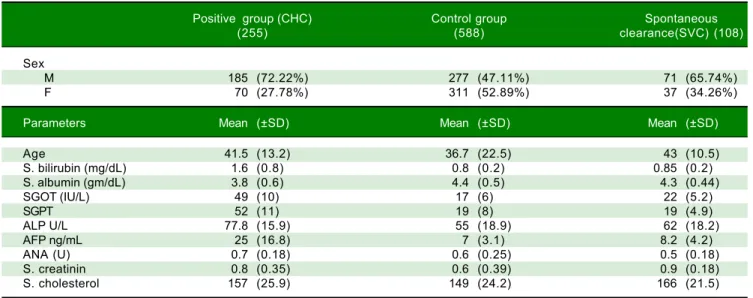
The laboratory charateristics of the studied groups are shown in table 1.
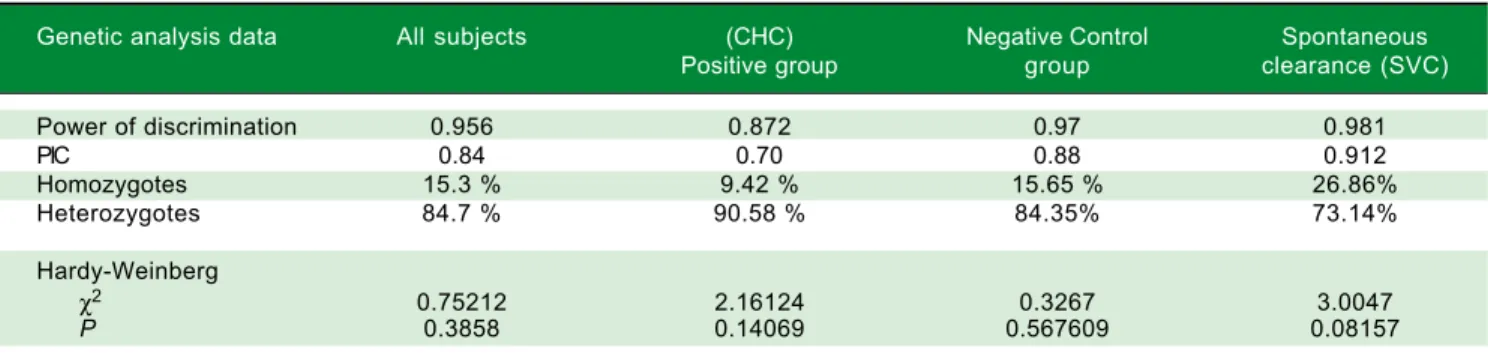
Descriptive genetic analysis data for HLA-DRB1 alleles
Genetic analysis data for HLA-DQB1 alleles in table 2 showed that the Matching Probability, Power of Discrim-ination, PIC (polymorphic information content), Ho-mozygotes, Heterozygotes rates showed no significant differences between, chronic HCV(CHC), control and SVC groups. The analysis showed that the PIC for CHC, control subjects and SVC group ranged from (0.70 to 0.91)
Table 1. Clinical & laboratory characteristics of studied groups.
Positive group (CHC) Control group Spontaneous
(255) (588) clearance(SVC) (108)
Sex
M 185 (72.22%) 277 (47.11%) 71 (65.74%)
F 70 (27.78%) 311 (52.89%) 37 (34.26%)
Parameters Mean (±SD) Mean (±SD) Mean (±SD)
Age 41.5 (13.2) 36.7 (22.5) 43 (10.5)
S. bilirubin (mg/dL) 1.6 (0.8) 0.8 (0.2) 0.85 (0.2)
S. albumin (gm/dL) 3.8 (0.6) 4.4 (0.5) 4.3 (0.44)
SGOT (IU/L) 49 (10) 17 (6) 22 (5.2)
SGPT 52 (11) 19 (8) 19 (4.9)
ALP U/L 77.8 (15.9) 55 (18.9) 62 (18.2)
AFP ng/mL 25 (16.8) 7 (3.1) 8.2 (4.2)
ANA (U) 0.7 (0.18) 0.6 (0.25) 0.5 (0.18)
S. creatinin 0.8 (0.35) 0.6 (0.39) 0.9 (0.18)
S. cholesterol 157 (25.9) 149 (24.2) 166 (21.5)
and heterozygosity ranged from (73.14 to 90.58) which in-dicates that this locus is highly polymorphic enough to do statistical analysis in Egyptians.
Allele frequency and allele
carriage of HLA-DRB1 alleles in different groups
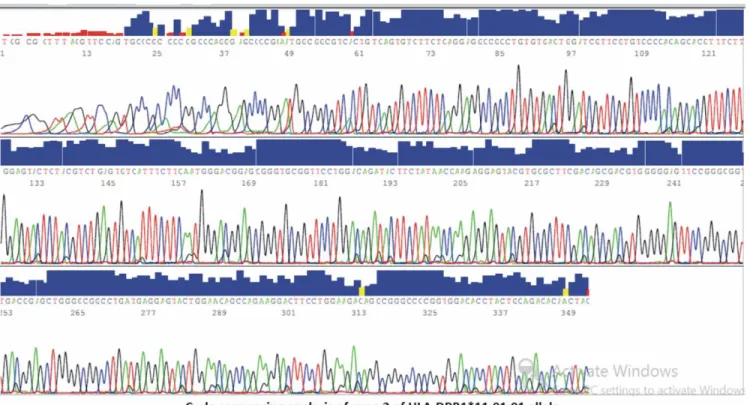
Analysis of the frequency of HLA-DRB1 alleles in CHC, control, and SVC groups revealed that DRB1*13:01:01 (26.07%) (Figure 1) is the most frequent allele in positive cases, followed by DRB1*13:02:01 and DRB1*03:01:01 (25.29%) (Figure 1). In control,
DRB1*11:01:01 is the most frequent allele (14.88%) fol-lowed by DRB1*3:01:01 (13.1%) and DRB1*07:01:01 (10.88%). In SVC group, DRB1*11:01:01 (20.37%) is the most frequent allele (Figure 2), followed by DRB1*1:01:01 (13.89%) and DRB1*03:01:01 (12.04%) while other alleles showed less equal frequencies (Table 3).
Table 4, comparing the distribution of HLA-DRB1 alleles between CHC, control and SVC groups revealed that: The carriage of allele 3:01:01 was significant in CHC group when compared to that of control and SVC groups (OR = 5.1289, 95% CI: 3.8570 to 6.8225,
Figure 1. Figure 1. Figure 1.
Figure 1. Figure 1. Cycle sequencing analysis of exon 2 of HLA-DRB1*:03:01:01 & HLA-DRB1*:13:01:01alleles.
T a b l e 2. Descriptive genetic analysis data of HLA-DRB1 alleles in different groups
Genetic analysis data All subjects (CHC) Negative Control Spontaneous
Positive group group clearance (SVC)
Power of discrimination 0.956 0.872 0.97 0.981 8
8 . 0 0
7 . 0 4
8 . 0 C
I
P 0.912
Homozygotes 15.3 % 9.42 % 15.65 % 26.86%
Heterozygotes 84.7 % 90.58 % 84.35% 73.14%
Hardy-Weinberg
χ2 0.75212 2.16124 0.3267 3.0047
P 0.3858 0.14069 0.567609 0.08157
Figure 2. Figure 2. Figure 2. Figure 2.
Figure 2. Cycle sequencing analysis of exon 2 of HLA-DRB1*:11:01:01 allele.
p = 0.001; and OR = 5.9847, 95% CI: 3.6217 to 9.8896, P < 0.000, 1 PC = 0.0006) respectively. The carriage of allele 13:01:01 was significantly higher in CHC group when compared to control and SVC groups. After Bonferroni correction the result remain significant (OR = 4.6860, CI: 3.3702 to 6.5156, P < 0.0001 PC = 0.0006 and OR = 6.5987, CI: 3.5159 to 12.3846, P = 0.0001, PC = 0.0006) respective-ly. On the other hand, DRB1*040501 and DRB1*110101 alleles were more frequent in both control and SVC groups more than in CHC patients (for DRB1*04051 OR = 0.4052 CI: 0.2543 to 0.6456, P = 0.0001, PC = 0.0006 and OR = 0.4061, CI: 0.2165 to 0.7620 P = 0.005, PC = 0.03 respectively. For DRB1*110101 OR = 0.2169, CI: 0.1345 to 0.3498, p = 0.0001, PC = 0.0006 and OR = 0.1739, CI: 0.0965 to 0.3135, P < 0.0001 PC = 0.0001 respectively). While DRB1*040101 was statistically significant in SVC group when compared to both CHC & control groups (OR = 0.0916, CI: 0.0299 to 0.2812, P = 0.0001, PC = 0.0006 and OR = 0.2130, CI: 0.1072 to 0.4232, P = 0.0001, PC = 0.0006). The carriage of alleles 7 family (7:01:01) was found to be significantly higher in both con-trol and SVC groups when both were compared to CHC group even after Bonferroni correction the results remain significant (OR = 0.1833, CI: 0.0970 to 0.3464 P < 0.0001, PC = 0.0006 and OR = 0.2592 , CI: 0.1160 to 0.5794,
P = 0.001, PC = 0.006 respectively). Also no significant association was found when a comparison was made between control and SVC group (OR = 1.4744, CI: 0.8359 to 2.6006, P = 0.1883).
DISCUSSION
HCV is a major health problem in Egypt affecting more than 10% of the population.2 Interplay between
host and environmental factors are major determinants of HCV infection outcome.13 A number of baseline factors
were reported as independent predictors for HCV infec-tion14,15 including, low viral load, HCV genotype,
absence of co infection as well as the host immunogenetic factors including human leukocyte antigen (HLA-DRB1) alleles.7,16
Polymorphism in the peptide binding regions of HLA-DR molecules determines antigenic specificities and strength of immune response to a given pathogen. It is well known that HLA-DRB1 alleles are crucial factors regulating cellular and humoral immune response through producing HLA-DR molecules participating in presenta-tion of viral antigens on the surface of antigen presenting cells to CD4 + T cells.17,18 Genes of DR may determine
Table 3. Allele carriages and allele frequencies of DRB1 Loci in different study groups.
Alleles Total Index Relative Total Negative Spontaneous
(951) (162) positive positive(CHC) control clearance(SVC)
(93) (255) (588) (108)
1:01:01 16/77 0/13 0/2 0/15 12/40 4/22
5.73% 4.01% 1.07% 2.941% 5.44% 13.89%
3:01:01 14/281 3/77 2/42 5/119 7/140 2/22
16.25% 25.62% 24.73% 25.29% 13.1% 12.04%
4:01:01 3/38 0/4 0/0 0/4 2/19 1/15
2.31% 1.23% 0 0.78% 1.96% 7.87%
4:05:01 8/158 0/16 0/8 0/24 5/115 3/19
9.15% 4.94% 4.3% 4.71% 10.63% 11.57%
7:01:01 12/135 0/5 0/6 0/11 8/112 4/12
8.36% 1.54% 3.22% 2.15% 10.88% 9.25%
7:03:01 3/38/ 0/1 0/0 0/1 0/33 3/4
2.31% 0.31% 0 0.19% 2.81% 4.63%
7:05:01 0/11 0/0 0/0 0/0 0/9 0/2
0.58% 0 0 0 0.76% 0.92%
7:07:01 1/29 0/1 0/2 0/3 1/24 0/2
0.63% 0.31% 1.07% 0.58% 2.21% 0.92%
8:02:01 0/76 0/2 0/6 0/8 0/64 0/4
3.99% 0.62% 3.22% 15.69% 5.44% 1.85%
9:01:01 3/81 0/9 0/1 0/10 3/70 0/1
4.57% 2.78% 0.538% 1.96% 6.46% 0.463%
10:01:01 0/13 0/1 0/8 0/9 0/2 0/2
0.684% 0.31% 4.30% 1.76% 0.17% 0.926%
11:01:01 25/193 1/11 1/9 2/20 17/141 6/32
12.77% 4% 5.91% 4.7% 14.88% 20.37%
12:01:01 0/9 0/2 0/1 0/3 0/6 0/0
0.47% 0.62% 0.53% 0.58% 0.51% 0
13:01:01 31/198 5/74 3/39 8/113 21/74 2/11
13.66% 25.93% 24.19% 25.29% 9.86% 6.94%
13:02:01 29/182 6/74 3/41 9/115 16/57 4/10
12.61% 26.54% 25.26% 26.07% 7.56% 8.33%
14:01:01 0/15 0/3 0/1 0/4 0/11 0/0
0.78% 0.93% 0.53% 0.78% 0.93% 0
15:02:01 0/66 0/1 0/1 0/2 0/64 0/0
3.47% 0.31% 0.53% 0.39% 5.44% 0
16:01:01 0/12 0/0 0/1 0/1 0/11 0/0
0.64% 0 0.53% 0.19% 0.93% 0
The presence of specific HLA-DRB1 alleles may affect the HCV infection but associations vary among popula-tions and results are controversial.3,20
To the best of our knowledge, this study is the first multicentre one to test the association between HLA-DRB1 alleles and HCV infection outcome among the Egyptian families.
Studies of the relations between human leukocyte anti-gens and HCV infection showed inconsistent results. This inconstancy may be due to improper diagnosis and classi-fication of the disease, population straticlassi-fication, ethnic variation, or inadequate sample sizes.11 Another cause may
be due to comparing the studied groups either (persist-ence of infection group or virus clearance group) with healthy control only.21 The problem of using healthy
con-trol subject is that about 80% of these subjects when ex-posed for the first time to HCV will develop chronicity while the rest showed spontaneous viral clearance (SVC).To overcome this inconstancy, subjects with Spon-taneous viral clearance (SVC) should be compared to sub-jects with persistence of infection (CHC).3
Comparing the distribution of HLA-DRB1 alleles be-tween CHC and other 2 groups revealed that the carriage of alleles 3:01:01 and 13:01:01 were significantly higher in
CHC compared to control and SVC groups (i.e. These al-leles associated with persistence of HCV infection).
On the other hand, DRB1*04:01:01, DRB1*04:05:01, DRB1*7:01:01 and DRB1*11:01:01 alleles were more fre-quent in SVC group when compared to CHC patients (i.e. These alleles associated with protection against HCV in-fection).
These results are consistent with previous results from different ethnic groups. In Caucasian American and in large multiracial cohort of U.S. women viral persistence was associated with DRB1*0301.11,22
Several studies conducted in Italian neonates, Spanish Irish , Northern European Caucasoid (NEC), France, Thailand and Indian populations showed that DRB1*03 was associated with persistence of HCV infection.8,19,23-27
On the other hand HLA-DRB1*11 seems to be protective against the development of severe forms of HCV infection in Spanish, Italian neonates, France and UK.19,28-30
Where-as in Japanese DRB1*1101 was more frequently found in carriers with persistently normal ALT values than in pa-tients with CLD.31
A German study of North Europeans found that DRB1*13 was associated with susceptibility to HCV infection.32 However another study revealed that
Table 4. Odds ratio of common allele of DRB1 Locus in different study groups.
Allele Positive(CHC)vs. Positive(CHC)vs. Spontaneous
negative control spontaneous (SVC) clearance(SVC) vs. negative control
OR P OR P OR P
(95% CI) (Pc) (95 % CI) (Pc) (95 % CI) (Pc)
03:01:01 5.1298 0.0001 5.9847 0.0001 1.1667 0.5380
(3.8570 to (0.0006) (3.6217 to (0.0006) (0.7143 to NA
6.8225) 9.8896) 1.9054)
04:01:01 0.4303 0.1257 NA 0.0916 0.0001 0.2130 0.0001
(0.1462 to (0.0299 to (0.0006) (0.1072 to (0.0006)
1.2665) 0.2812) 0.4232)
04:05:01 0.4052 < 0.0001 0.4061 0.0050 1.0023 0.9929
(0.2543 to 0.0006 (0.2165 to 0.0300 (0.6022 to NA
0.6456) 0.7620) 1.6682)
07:01:01 0.1833 0.0001 0.2592 0.0010 1.4744 0.1883
(0.0970 to (0.0006) (0.1160 to (0.0060) (0.8359 to NA
0.3464) 0.5794) 2.6006)
11:01:01 0.2169 0.0001 0.1739 < 0.0001 0.8019 0.3248
(0.1345 to 0.0006 (0.0965 to (0.0006) (0.5166 to NA
0.3498) 0.3135) 1.2445)
13:01:01 4.6860 0.0001 6.5987 < 0.0001 1.4082 0.2791
(3.3702 to (0.0006) (3.5159 to (0.0006) (0.7577 to NA
6.5156) 12.3846) 2.6172)
HLA-DRB1*11 allele was associated with a reduced risk for the development of HCV induced end stage liver dis-ease.33
A meta-analysis carried on by Yee, et al. 2004 involving Caucasian population only from the period of 1997-2002 concluded that DRB1*11 was associated with protection against HCV infection.13,26,27,34-37 But these studies are
gen-erally smaller in size, less conclusive and performed with low resolution techniques.
In China it was found that DRB1*1101 was a protective allele and subjects with this allele are at a lower risk of de-veloping chronic HCV.38
In Brazilian population it was confirmed that there were higher frequencies of HLA-DRB1*13 in patients compared with controls while DRB1*11was associated with protection from chronic HCV infection.39,40 Also in
Pakistan and Iran DRB1*11 was associated with viral clear-ance.41,42 While in Iraq, it was found that the presence of
DRB1*11 was significantly associated with increased risk for HCV infection.43
Reports from Egypt addressed that HLA-DRB1*03 in-dividually or in combination with HLA-DRB1*04 act as a protective alleles against HCV infection.44 While In
Egyptian HCV infected children it was reported that the most frequent alleles demonstrated among patients were DRB1 *03, DRB1 *04 and DRB1 *13 while DRB1*15 was significantly reduced among patients when com-pared with the control group.45 Shaker, et al. 2013 found
that DRB1*04 and DRB1*11 were significantly more frequent in non responders than in responders. In con-trast, DRB1*13 and DRB1*15 alleles were significantly more frequent in responders than in non responders. However this study compared the patients with the healthy control group not to the SVC group making these results inconsistent.10
There are other studies found that other HLA-DRB1 alleles were associated with the susceptibility to HCV in-fection. The frequency of DRB1*0405 was higher in HCV-infected patients than in uninfected subjects in Ja-pan,31 whereas DRB1*1302 was more frequently found in
carriers with persistently normal ALT values than in pa-tients with CLD.3
Different studies carried on populations with different ethnic origin showed that the virus clearance was associat-ed with the DRB1*1 and DRB1*13 in Caucasians (Euro-pean and Americans) and with DRB1*12 in Non-Caucasian Americans.46 While the susceptibility to
infection was connected to DRB1*3 and DRB1*7 in Cau-casians (European and Americans) and to DRB1*12 in Caucasians Americans only. In a Midwestern American cohort reported the associations of DRB1*12 with HCV infection.21 Furthermore in Taiwan population it was
sug-gested that DRB1*12 was significantly associated with the
risk of HCC.47 In contradiction to these results, it was
found that interaction between the KIR receptor gene 2DL3 with HLA-DRB1*1201 was associated with SVC.48
Several reports from different ethnic origin in the world reported that DRB1*07 allele was linked to viral persist-ence of HCV infection. (in British, Polish,Italian, Brazilian, Mid western Americans and Pakistanian popula-tions.19,21,27,39,41,49 On the other hand in Iranian and Thailand
HCV infected patient DRB1*0701 allele was found to be significantly presented in patients with HCV clearance.24,42
DRB1*01 is associated with viral clearance in a large multiracial cohort of U.S. women with a high prevalence of HCV and HIV.22 Same results were reported in white
subjects and in Swiss Cohor, but another investigators re-ported that DRB1*1001 was associated with disease.27
Conflicting reports as regard DRB1*08 were recorded, whereas DRB1*0803 in Korean patients was associated with chronic HCV carriers,50 in Tunisian patients it was
associated with clearance of circulating HCV.51
The frequency of DRB1*15 was associated with SVC but in Tunisian patients it appears to predispose to pro-gression of liver disease.51
In conclusion, the present study suggested that certain HLA-DRB1 alleles namely DRB1*03:01:01 and DRB1*13:01:01 may act as a risk alleles for HCV persistence while DRB1*04:01:01, DRB1*04:05:01, DRB1*7:01:01 and DRB1*11:01:01 alleles were associat-ed with HCV clearance in the Egyptian families. This is important for disease management and deciding which person would most likely susceptible to HCV infection and which would not. It is strongly recommended that further investigations are needed to study more associa-tions of these factors which may affect HCV susceptibility in the Egyptian population which may help towards eradi-cation of HCV.
ACKNOWLEDGEMENT
We would like to thank Medical Biochemistry depart-ment &Medical Expreidepart-mental Research Centre (MERC)-Mansoura Faculty of Medicine, (MERC)-Mansoura University for their kind help & support to complete routine laboratory work.
ABBREVIATIONS
• Ab: antibody.
• AFP. alpha feto protein. • CHC: chronic hepatitis C. • CI: confidence interval. • CV: chronic viraemia.
• HCC: hepatocellular carcinoma. • HCV: hepatitis C virus.
• HIV: human immundefeciency virus. • HLA: human leukocyte antigen. • HWE: hardy weinberg equilibrium. • LC: liver cirrhosis.
• MHC: major histocompatibility complex. • OR: odd ratio.
• PC: bonferroni correction. • SBT: sequence-based typing.
• SCV: spontaneously cleared the virus.
• SSP-PCR: sequence specific primer-polymerase chain reaction.
• UV: ultra violet. • VC: viral clearance.
CONFLICT OF INTEREST
The authors declares that there is no conflict of interest regarding the publication of this article.
FINANCIAL SUPPORT
This research was funded by Science & Technology Development Foundation (STDF), Project NO.1784 (TC/2/Health/2009/hep-1.3).
REFERENCES
1. Messina JP, Humphreys I, Flaxman A, Brown A, Cooke GS, Pybus OG, Barnes, E. Global Distribution and Prevalence of Hepatitis C Virus Genotypes. Hepatology (Baltimore, Md)
2015; 61: 77-87.
2. El-Shabrawi MH, Kamal NM. Burden of pediatric hepatitis C.
World J Gastroenterol 2013; 19: 7880-8.
3. Yee LJ. Host genetic determinants in hepatitis C virus infec-tion.Genes Immun 2004; 5: 237-45.
4. El-Bendary M, Esmat G, Neamatallah M, Kamel E, Besheer T, Elalfy H, El-Setouhy M, et al. Epidemiological Aspects of In-trafamilial Spread of HCV Infection in Egyptian Population: A Pilot Study. Open J Gastroenterol 2014; 4: 228-36.
5. Urabe Y, Ochi H, Kato N, Kumar V, Takahashi A, Muroyama R, Hosono N, et al. A genome-wide association study of HCV-induced liver cirrhosis in the Japanese population iden-tifies novel susceptibility loci at the MHC region. J Hepatol
2013; 58: 875-82.
6. Kamal SM, Kassim SK, Ahmed AI, Mahmoud S, Bahnasy KA, Hafez TA, Aziz IA, et al. Host and Viral Determinants of the Outcome of Exposure to HCV Infection Genotype 4: A Large Longitudinal Study. Am J Gastroenterol 2014; 109: 199-211. 7. Bruno R, Sacchi P, Maiocchi L, Zocchetti C, Filice G. Host factors affecting the outcome of treatment of hepatitis C.
Rev Gastroenterol Disord 2004; 4(Suppl. 1): S3-7.
8. Tripathy AS, Shankarkumar U, Chadha MS, Ghosh K, Arankalle VA. Association of HLA alleles with hepatitis C in-fection in Maharashtra, western India. Indian J Med Res
2009; 130: 550-5.
9. El-Bendary M, Neamatallah M, Esmat G, Kamel E, Elalfy H, Besheer T, Eldeib D, et al. Associations of human leucocyte
antigen class II-DQB1 alleles with hepatitis C virus infection in Egyptian population: a multicentre family-based study.
Journal of Viral Hepatitis 2016; 23: 961-70.
10. Shaker O, Bassiony H, El Raziky M, Kamary S, Esmat G, El-Ghor AM, Mohamed M. Human Leukocyte Antigen Class II Alle-les (DQB1 and DRB1) as Predictors for Response to Interferon Therapy in HCV Genotype 4. Mediat Inflamm 2013: 1-10. 11. Thio CL, Thomas DL, Goedert JJ, Vlahov D, Nelson KE,
Hilgartner MW, O’Brien SJ, et al. Racial differences in HLA class II associations with hepatitis C virus outcomes. J In-fect Dis 2001; 184: 16-21.
12. Perneger TV. What’s wrong with Bonferroni adjustments.
BMJ 1998; 316: 1236-8.
13. Alric L, Fort M, Izopet J, Vinel JP, Charlet JP, Selves J, Puel J, et al. Genes of the major histocompatibility complex class II influence the outcome of hepatitis C virus infection. Gastro-enterology 1997; 113: 1675-81.
14. Roulot D, Bourcier V, Grando V, Deny P, Baazia Y, Fontaine H, Bailly F, et al. Epidemiological characteristics and re-sponse to peginterferon plus ribavirin treatment of hepatitis C virus genotype 4 infection. J Viral Hepat 2007; 14: 460-7. 15. Gad RR, Males S, El Makhzangy H, Shouman S, Hasan A,
Attala M, El Hoseiny M, et al. Predictors of a sustained viro-logical response in patients with genotype 4 chronic hepati-tis C. Liver Int 2008; 28: 1112-9.
16. Mahapatra C, Tripathy AS. Antigen Specific Cellular Re-sponse in Patients with Hepatitis C Virus Infection and its Association with HLA Alleles. IJCRIMPH 3.3 (2011): 273-273.
17. Lombard Z, Brune AE, Hoal EG, Babb C, Van Helden PD, Ep-plen JT, Bornman L. HLA class II disease associations in southern Africa. Tissue Antigens 2006; 67: 97-110. 18. De Re V, Caggiari L, Monti G, Libra M, Spina M, Dolcetti R, De
Zorzi M, et al. HLA DR-DQ combination associated with the increased risk of developing human HCV positive non-Hodg-kin’s lymphoma is related to the type II mixed cryoglobuline-mia.Tissue Antigens 2010; 75: 127-35.
19. Singh R, Kaul R, Kaul A, Khan K. A comparative review of HLA associations with hepatitis B and C viral infections across global populations. World J Gastroenterol 2007; 13: 1770-87.
20. Sim H, Wojcik J, Margulies M, Wade JA, Heathcote J. Re-sponse to interferon therapy: influence of human leucocyte antigen alleles in patients with chronic hepatitis C. J Viral Hepat 1998; 5: 249-53.
21. Wang JH, Zheng X, Ke X, Dorak MT, Shen J, Boodram B, O’Gorman M, et al. Ethnic and geographical differences in HLA associations with the outcome of hepatitis C virus in-fection.Virol J 2009; 6: 46.
22. Kuniholm MH, Kovacs A, Gao XJ, Xue XN, Marti D, Thio CL, Peters MG, et al. Specific Human Leukocyte Antigen Class I and II Alleles Associated with Hepatitis C Virus Viremia.
Hepatology (Baltimore, Md) 2010; 51: 1514-22.
23. McKiernan SM, Hagan R, Curry M, McDonald GS, Nolan N, Crowley J, Hegarty J, et al. The MHC is a major determinant of viral status, but not fibrotic stage, in individuals infected with hepatitis C. Gastroenterology 2000; 118: 1124-30. 24. Vejbaesya S, Songsivilai S, Tanwandee T, Rachaibun S,
Chantangpol R, Dharakul T. HLA association with hepatitis C virus infection. Hum Immunol 2000; 61: 348-53.
25. Hue S, Cacoub P, Renou C, Halfon P, Thibault V, Charlotte F, Picon M, et al. Human leukocyte antigen class II alleles may contribute to the severity of hepatitis C virus-related liver disease.J Infect Dis 2002; 186: 106-9.
as-sociated with hepatitis C viral clearance, originating from a single source. Hepatology (Baltimore, Md) 2004; 40: 108-14. 27. Romero-Gomez M, Gonzalez-Escribano MF, Torres B,
Bar-roso N, Montes-Cano MA, Sanchez-Munoz D, Nunez-Roldan A, et al. HLA class I B44 is associated with sustained re-sponse to interferon + ribavirin therapy in patients with chronic hepatitis C. Am J Gastroenterol 2003; 98: 1621-6. 28. Minton EJ, Smillie D, Neal KR, Irving WL, Underwood JCE,
James V, Trent Hepatitis C Virus Study Grp. Association be-tween MHC class II alleles and clearance of circulating hep-atitis C virus. J Infect Dis 1998; 178: 39-44.
29. Thursz M, Yallop R, Goldin R, Trepo C, Thomas HC, Grp H. Influence of MHC class II genotype on outcome of infection with hepatitis C virus. Lancet 1999; 354: 2119-24.
30. Lopez-Vazquez A, Rodrigo L, Mina-Blanco A, Martinez-Bor-ra J, Fuentes D, Rodriguez M, Perez R, et al. Extended hu-man leukocyte antigen haplotype EH18.1 influences progression to hepatocellular carcinoma in patients with hepatitis C virus infection. J Infect Dis 2004; 189: 957-63. 31. Kuzushita N, Hayashi N, Moribe T, Katayama K, Kanto T,
Na-katani S, Kaneshige T, et al. Influence of HLA haplotypes on the clinical courses of individuals infected with hepatitis C virus.Hepatology (Baltimore, Md) 1998; 27: 240-4.
32. Kallinowski B, Scherer S, Mehrabi A, Theilmann L, Stremmel W. Clinical impact of HLA DR B1 genotypes in chronic hepati-tis C virus infection. Transplantation proceedings 1999; 31: 3346-49.
33. Tillmann HL, Chen DF, Trautwein C, Kliem V, Grundey A, Berning-Haag A, Boker K, et al. Low frequency of HLA-DRB1*11 in hepatitis C virus induced end stage liver dis-ease.Gut 2001; 48: 714-8.
34. Yenigun A, Durupinar B. Decreased frequency of the HLA-DRB1*11 allele in patients with chronic hepatitis C virus in-fection.J Virol 2002; 76: 1787-9.
35. Fanning LJ, Levis J, Kenny-Walsh E, Wynne F, Whelton M, Shanahan F. Viral clearance in hepatitis C (1b) infection: re-lationship with human leukocyte antigen class II in a homoge-neous population. Hepatology (Baltimore, Md) 2000; 31: 1334-7.
36. Alric L, Izopet J, Fort M, Vinel J-P, Fontenelle P, Orfila C, Pay-en J-L, et al. Study of the association betwePay-en major histo-compatibility complex class II genes and the response to interferon alpha in patients with chronic hepatitis C infection.
Hum Immunol 1999; 60: 516-23.
37. Asti M, Martinetti M, Zavaglia C, Cuccia MC, Gusberti L, Tinelli C, Cividini A, et al. Human leukocyte antigen class II and III al-leles and severity of hepatitis C virus-related chronic liver disease.Hepatology (Baltimore, Md) 1999; 29: 1272-9. 38. Hong X, Yu R-B, Sun N-X, Wang B, Xu Y-C, Wu G-L. Human
leukocyte antigen class II DQB1* 0301, DRB1* 1101 alleles and spontaneous clearance of hepatitis C virus infection: a meta-analysis.World J Gastroenterol 2005; 11: 7302-7. 39. Corghi DB, Goncales NS, Marques SB, Goncales Jr FL.
Dis-tribution of the human leukocyte antigen class II alleles in Brazilian patients with chronic hepatitis C virus infection.
Braz J Med Biol Res 2008; 41: 884-9.
40. Cangussu LOF, Teixeira R, Campos EF, Rampim GF, Mingoti SA, Martins OA, Gerbase-DeLima M. HLA Class II Alleles and Chronic Hepatitis C Virus Infection. Scand J Immunol 2011; 74: 282-7.
41. Ali L, Mansoor A, Ahmad N, Siddiqi S, Mazhar K, Muazzam AG, Qamar R, et al. Patient HLA-DRB1* and -DQB1* allele and haplotype association with hepatitis C virus persistence and clearance. J Gen Virol 2010; 91: 1931-8.
42. Samimi-Rad K, Sadeghi F, Amirzargar A, Eshraghian MR, Alavian SM, Rahimnia R. Association of HLA class II alleles with hepatitis C virus clearance and persistence in tha-lassemia patients from Iran. J Med Virol 2015; 87: 1565-72. 43. Hasan A-RS, Al-Ajeeli KSA. Association of Hepatitis C Virus
(HCV) Infection and Human Leukocyte Antigens (HLA). Diy-ala Journal of Medicine 2: 53-9.
44. Shaala A, Harfoush R, ElKhouly E, Ahmed M, Morsi M. Could Human Leukocyte Antigens (HLA) be Predictive Factors to Interferon Response among Chronic Hepatitis C Virus Hepa-titis?J Med Microbiol Diagnos 2012; S1: 003. DOI:10.4172/ 2161-0703.S1-003
45. Yosry A, Fouad R, Mahmoud S, El-Raziky MS, El-Hennawy A, Ghoneim MA. The association of HLA class II DR B1 alle-les with HCV infection in Egyptian children. Arab J Gatroen-terol 2011; 12: 25-8.
46. Shankarkumar A, Shankarkumar U. HCV infection and its as-sociation with HLA alleles. International Journal of Life Sci-ences Biotechnology and Pharma Research 2012; 1: 10-9. 47. Lin ZH, Xin YN, Dong QJ, Wang Q, Jiang XJ, Zhan SH, Sun,
Y, et al. Association between HLA-DRB1 alleles polymor-phism and hepatocellular carcinoma: a meta-analysis. Bmc Gastroenterol 2010; 10: 145-55.
48. Romero V, Azocar J, Zúñiga J, Clavijo OP, Terreros D, Gu X, Husain Z, et al. Interaction of NK inhibitory receptor genes with HLA-C and MHC class II alleles in Hepatitis C virus in-fection outcome. Molecular Immunology 2008; 45: 2429-36. 49. Wawrzynowicz-Syczewska M, Underhill JA, Clare MA,
Bo-ron-Kaczmarska A, McFarlane IG, Donaldson PT. HLA class II genotypes associated with chronic hepatitis C virus infec-tion and response to alpha-interferon treatment in Poland.
Liver 2000; 20: 234-9.
50. Yoon SK, Han JY, Pyo CW, Yang JM, Jang JW, Kim CW, Im Chang U, et al. Association between human leukocytes anti-gen alleles and chronic hepatitis C virus infection in the Ko-rean population. Liver International 2005; 25: 1122-7. 51. Ksiaa L, Ayed-Jendoubi S, Sfar I, Gorgi Y, Najjar HA,
Abdal-lah TB, Ayed, K. Clearance and persistence of hepatitis C vi-rus in a Tunisian population: association with HLA class I and class II. Viral Immunol 2007; 20: 312-9.
Correspondence and reprint request:
Mahmoud El-Bendary, M.D.
Professor of Tropical Medicine & Hepatology Department, Mansoura Faculty of Medicine, Mansoura University. Mansoura,
Egypt. Mansoura City, El-Gomhoria street, P.C. 35111. Tel.: 00201002592205, Fax: 0020502267016