Instituto Tecnológico y de Estudios Superiores de Monterrey
Campus Monterrey
Monterrey, Nuevo León a
Lic. Arturo Azuara Flores:
Director de Asesoría Legal del Sistema
", en los sucesivo LA OBRA, en virtud de lo cual autorizo a el Instituto Tecnológico y de Estudios Superiores de Monterrey (EL INSTITUTO) para que efectúe la divulgación, publicación, comunicación pública, distribución y reproducción, así como la digitalización de la misma, con fines académicos o propios al objeto de EL INSTITUTO.
El Instituto se compromete a respetar en todo momento mi autoría y a otorgarme el crédito correspondiente en todas las actividades mencionadas anteriormente de la obra.
De la misma manera, desligo de toda responsabilidad a EL INSTITUTO por cualquier violación a los derechos de autor y propiedad intelectual que cometa el suscrito frente a terceros.
Nombre y Firma AUTOR (A)
de 200
Copyright
by
A Field Study on Social Loafing: Implications of Expectations
on Co-Workers, Task Meaningfulness, Relationship
Meaningfulness and Indivual s Orientation-Edición Única
Title A Field Study on Social Loafing: Implications of
Expectations on Co-Workers, Task Meaningfulness, Relationship Meaningfulness and Indivual s Orientation-Edición Única
Authors del Roble Hernández Pozas, Olivia
Issue Date 2006-06-01
Abstract This study examines the potential moderating effect of
Task meaningfulness (TM) and Relationship meaningfulness (RM), of team members, on the relationship between Expectations on co-workers
competence and reliability (ECW) and Social loafing (SL). In addition, a direct effect of an individuals Orientation (i.e. Allocentric or idiocentric) (O) on Relationship
Item type Tesis
???pdf.cover.sheet .thesis.degree.nam e???
Doctoral Program in Management
???pdf.cover.sheet .dc.contributor.adv isor???
Ricardo Flores Zambada
???pdf.cover.sheet .thesis.degree.disci pline???
EGADE Business School
???pdf.cover.sheet .thesis.degree.prog ram???
Campus Monterrey
Rights Open Access
Downloaded 18-Jan-2017 06:43:27
A FIELD STUDY ON SOCIAL LOAFING: IMPLICATIONS OF EXPECTATIONS ON CO-WORKERS, TASK MEANINGFULNESS,
RELATIONSHIP MEANINGFULNESS AND INDIVIDUAL’S ORIENTATION
by
Olivia del Roble Hernández Pozas
Dissertation
Presented to the Faculty of the Graduate School of Business Administration and
Leadership (EGADE) of
the Instituto Tecnológico y de Estudios Superiores de Monterrey
in Partial Fulfillment of the Requirements for the Degree of
Doctor of Philosophy in
Management
Instituto Tecnológico y de Estudios Superiores de Monterrey
A FIELD STUDY ON SOCIAL LOAFING: IMPLICATIONS OF EXPECTATIONS ON CO-WORKERS, TASK MEANINGFULNESS,
RELATIONSHIP MEANINGFULNESS AND INDIVIDUAL’S ORIENTATION
Approved by Dissertation Committee:
_________________________________ Ricardo Flores Zambada, Ph. D. Professor of Organizational Behavior
EGADE
ITESM, Campus Monterrey, México
_________________________________ _________________________________ Héctor René Díaz Sáenz, Ph. D. Joel Mendoza Gómez, Ph. D.
Associate Global MBA Director Professor of Organizational Behavior EGADE FACPyA
ITESM, Campus Monterrey Universidad Autónoma de Nuevo León Monterrey, México Monterrey, México
_________________________________ Alejandro Ibarra Yúnez, Ph. D. Director of the Doctoral Program
EGADE
DEDICATION
This thesis is dedicated to my two lovely and smart daughters, Ariana and Vanessa, who are my daily inspiration, who always motivate me to be a better person and drive me to persist through even the most difficult of circumstances. Also, to my
husband, Jaime, who cheered me up and supported me since the very beginning of this project and who always encourages me, with great faith in my abilities, to pursue
ACKNOWLEDGMENTS
First, I would like to thank God for giving me this opportunity and for enlightening the path throughout my doctoral studies in such a wonderful way.
Additionally, I would like to thank my main advisor, Dr. Ricardo Flores, who has been, not just a mentor, but also a friend. His guidance, enthusiasm and dedication allowed me to accomplish my goals.
I am also grateful to my other committee members, Dr. Héctor René Díaz and Dr. Joel Mendoza, I appreciate their encouragement, cooperation, suggestions and
understanding.
I also thank the director of the doctoral program, Dr. Alejandro Ibarra, and all the faculty members, for their continual assistance, intellectual support and for providing
an atmosphere conductive to learning.
My gratitude to the academic and practice experts, who collaborated with the
reverse-translation, as well as, with face and content validity processes of this study. Also, to coordinators of this research in each participating company, their
interest, trust, and recommendations made this project feasible.
Special thanks go out to many friends and many family members for helping me to save time when I needed it the most, sometimes running my errands or helping me
ABSTRACT OF DISSERTATION
GRADUATE SCHOOL OF BUSINESS AND LEADERSHIP, INSTITUTO TECNOLOGICO Y DE ESTUDIOS SUPERIORES DE
MONTERREY, CAMPUS MONTERREY
Degree: Doctor of Philosophy. Program: Doctoral Program in Management. Name of the Candidate: Olivia del Roble Hernández Pozas.
Main Advisor: Dr. Ricardo Flores Zambada.
Title: A FIELD STUDY ON SOCIAL LOAFING: IMPLICATIONS OF EXPECTATIONS ON CO-WORKERS, TASK MEANINGFULNESS,
RELATIONSHIP MEANINGFULNESS AND INDIVIDUAL’S ORIENTATION
Abstract
This study examines the potential moderating effect of Task meaningfulness (TM) and Relationship meaningfulness (RM), of team members, on the relationship
between Expectations on co-workers’ competence and reliability (ECW) and Social loafing (SL). In addition, a direct effect of an individual’s Orientation (i.e. Allocentric or idiocentric) (O) on Relationship meaningfulness (RM ) is tested too.
In a field-based study, 697 production team members, as well as, their direct supervisors & co-workers responded to questionnaires. Results of descriptive
between the proposed SL model variables. As expected, the direct effect of O on RM was found as significant. On the contrary, the moderating effects of TM and RM on
the relationship between ECW and SL were not significant. As a result, the study of a potential direct, antecedent, or mediating effect of these two variables on SL is
recommended for future research. Theoretical and practical implications of these findings are discussed.
ABSTRACT OF DISSERTATION
GRADUATE SCHOOL OF BUSINESS AND LEADERSHIP, INSTITUTO TECNOLOGICO Y DE ESTUDIOS SUPERIORES DE
MONTERREY, CAMPUS MONTERREY
Degree: Doctor of Philosophy. Program: Doctoral Program in Management.
Name of the Candidate: Olivia del Roble Hernández Pozas. Main Advisor: Dr. Ricardo Flores Zambada.
Title: UN ESTUDIO DE CAMPO ACERCA DE LA PEREZA SOCIAL:
IMPLICACIONES DE LAS EXPECTATIVAS EN LOS COMPAÑEROS DE EQUIPO, LA SIGNIFICACIÓN DE LA TAREA, LA SIGNIFICACIÓN DE LA RELACIÓN Y
LA ORIENTACIÓN INDIVIDUAL
Resumen
Este estudio examina el efecto moderador potencial de la Significación (i.e. relevancia) de la tarea (TM) y la Significación de la relación (RM), de los miembros
de equipos de trabajo, en la relación entre las Expectativas de competencias y de confiabilidad que se tienen respecto a los compañeros de equipo (ECW), y la Pereza social (SL). Además, un efecto directo de la Orientación del individuo (i.e.
Alocéntrica o idiocéntrica) (O) en la Significación de la relación (RM) es probado también.
estadística descriptiva, las correlaciones, el análisis de varianzas y el análisis de las regresiones moderadoras son exhibidos. Estos resultados indican que existen
relaciones significativas diversas entre las variables del modelo de Pereza social que fue propuesto. Según se esperaba, el efecto directo entre la Orientación individual (O)
y la Significación de la relación (RM) fue encontrado como significativo. Por el contrario, los efectos moderadores de la Significación de la tarea (TM) y la Significación de la relación (RM) en la relación entre las Expectativas en los
compañeros y la Pereza social no fueron significativos. Como resultado, el estudio de un efecto potencial directo, antecedente o mediador de estas dos variables sobre la
Pereza social es recomendado para una investigación a futuro. Las implicaciones teóricas y prácticas de estos hallazgos son discutidas.
Table of Contents
Chapter 1. Introduction. 14
Chapter 2. Research problem statement. 16
2.1 Research questions 21
2.2 Research objectives 22
2.3 Potential Research contributions. 22
Chapter 3. Literature review. 24
3.1 Early studies. 25
3.2 Determinants of Social loafing. 27
3.2.1 Size. 28
3.2.2 Identifiability (accountability). 28
3.2.3 Task related variables: Difficulty, uniqueness, attractiveness, meaningfulness and visibility.
29
3.2.4 Evaluation potential: Experimenter, co-actor (s), participants. 29
3.2.5 Dispensability of effort. 29
3.2.6 Self-reference variables: Self-efficacy, collective efficacy. 30
3.2.7 Incentives. 30
3.2.8 Culture (collectivism-individualism). 30
3.2.9 Expectations on co-workers. 31
3.2.10 Orientation: Allocentric or idiocentric. 32
3.2.11 Perceived Social loafing. 32
3.2.12 Cohesiveness. 33
3.2.13 Exchange relationships: Leader (LMX), team-member (TMX). 33 3.2.14 Justice: Distributive, procedural and interactional. 33 3.3 Theoretical frameworks in Social loafing literature. 35 3.3.1 Social impact theory (Latané et al., 1979; Latané, 1981). 35 3.3.2 Arousal reduction theory (Jackson & Williams, 1985). 36 3.3.3 Social identity theory (Abrams & Hogg, 1990; Tajfel, 1970;
Tajfel & Turner, 1986).
37
3.3.4 Free-rider theory (Olson, 1965). 37
3.3.5 Knoke´s synthesized motivation model (Knoke, 1990). 38
3.3.6 Expectancy theory (Vroom, 1964). 38
3.3.7 The collective effort model (CEM; Karau & Williams, 1993). 39 3.3.8 Self-efficacy theory (Bandura, 1997). 40 3.3.9 Justice and Equity theory (Greenberg, 1990; Bies & Moag, 1986;
Adams, 1965).
40
3.3.10 Social exchange theory (Blau, 1964). 41 Chapter 4. Proposed model of Social Loafing. 42
4.1 Variables. 43
4.1.1 Expectations on co-workers (ECW). 43
4.1.2 Task meaningfulness (TM). 44
4.1.4 Orientation (i.e. allocentric – idiocentric) (O). 45
4.1.5 Social loafing (SL). 46
4.2 Hypotheses of the study. 48
Chapter 5. Research methodology. 52
5.1 Research type. 52
5.2 Population. 53
5.3 Sample. 53
5.4 Operationalization of variables. 56
5.4.1 Reverse translation. 61
5.4.2 Measurement validity. 62
5.4.2.1 Face validity. 62
5.4.2.2 Content validity. 69
5.4.2.3 Pilot test. 80
5.4.2.4 Construct validity. 81
5.4.2.5 Reliability. 89
5.4.3 Final instruments. 90
5.4.3.1 Expectations on co-workers (ECW). 90 5.4.3.2 Task meaningfulness (TM). 91 5.4.3.3 Relationship meaningfulness (RM). 92 5.4.3.4 Orientation (allocentrism-idiocentrism) (O). 93
5.4.3.5 Social loafing (SL). 97
5.5 Data collection. 99
5.6 Data codification and capture. 101
5.7 Data analysis. 102
5.7.1 Analysis of missing data & outliers. 102 5.7.2 Subject’s total score for each variable. 106 5.7.3 Placement of individuals in groups for comparison purposes. 106
5.7.4 Descriptive statistics. 107
5.7.5 Correlations. 107
5.7.6 Differences between groups: Analysis of variance. 107 5.7.7 Moderated regression analysis (MRA). 108
5.8 Hypotheses testing. 111
Chapter 6. Results and Discussion. 114
6.1 Descriptive statistics. 114
6.2 Correlations. 120
6.3 Differences between groups: Analysis of variance. 124
6.4 Moderator regression analysis (MRA). 132
6.5 Hypotheses testing. 137
6.5.1 Testing hypothesis 1. 138 6.5.2 Testing hypothesis 2. 139 6.5.3 Testing hypothesis 3. 141
Chapter 7. Conclusions. 143
7.2 Proposed model. 145
7.3 Contributions. 153
7.3.1 To current theory. 153
7.3.2 To practice. 156
7.4 Implications. 159
7.5 Limitations of the study. 161
7.6 Future research. 163
References. 165
Appendix A. Steps on the reverse translation process of instruments. 177 Appendix B. Face validity: Comments and suggestions. 213 Appendix C. Content validity: Comments and suggestions. 233
Appendix D. Questionnaire. 255
Vita. 263
List of Tables
Table 1. Summary of determinants of social loafing. 34
Table 2. Variable definitions. 47
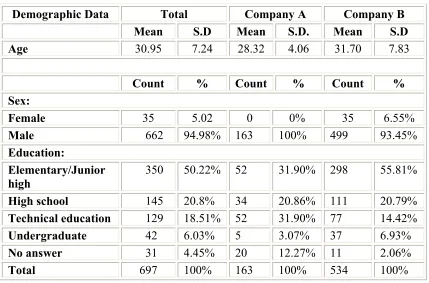
Table 3. Characteristics of the sample: Subjects. 55
Table 4. Characteristics of the sample: Demographic data. 56
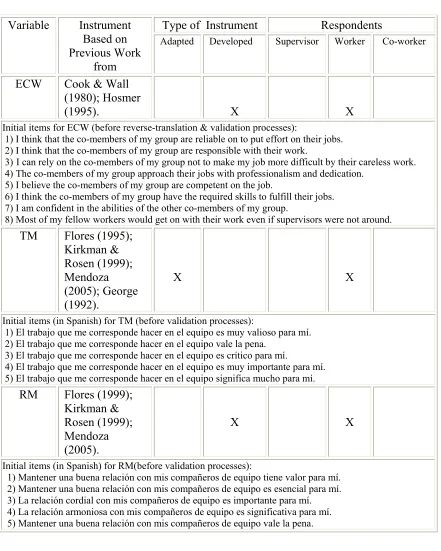
Table 5. Measurement instruments. 58
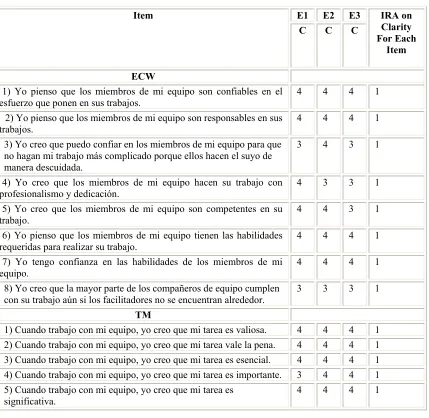
Table 6. Results for face validity: Clarity. 64
Table 7. Results for content validity: Representativeness & clarity. 70 Table 8. Results for IRA on Clarity, panel of experts 1 and 2 together. 75 Table 9. Factor analysis loadings for TM, RM, ECW. 82 Table 10. Resulting factors & items after factor analysis for TM, RM, ECW. 83
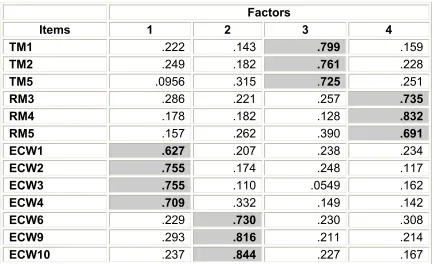
Table 11. Factor analysis loadings for O. 84
Table 12. Resulting factors & items after factor analysis for O. 86
Table 13. Factor analysis loadings for SL. 88
Table 14. Resulting factors & items after factor analysis for SL. 89
Table 15. Variables reliabilities. 90
Table 16. Operationalization of ECW: Seven final items. 91 Table 17. Operationalization of TM: Three final items. 92 Table 18. Operationalization of RM: Three final items. 93 Table 19. Operationalization of O: 24 final items. 95 Table 20. Operationalization of SL: Seven final items. 98
Table 21. Missing data. 103
Table 22. Results of the descriptive statistics: Variable descriptors. 115 Table 23. Results of the Spearman correlations: The five variables of the SL
Model.
120 Table 24. Results of the analysis of variance: Effect ECW-factor on SL
(sup).
Table 25. Results of the analysis of variance: Effect ECW-factor on SL (cws).
125 Table 26. Results of the analysis of variance: Effect of TM on SL (sup). 127 Table 27. Results of the analysis of variance: Effect of TM on SL (cws). 128 Table 28. Results of the analysis of variance: Effect of RM on SL (sup). 129 Table 29. Results of the analysis of variance: Effect of RM on SL (cws). 130 Table 30. Results of the analysis of variance: Effect O on RM. 131 Table 31. Results of MRA: TM as moderator of ECW & SL (sup). 133 Table 32. Results of MRA: TM as moderator of ECW & SL (cws). 133 Table 33. Results of MRA: RM as moderator of ECW & SL (sup). 135 Table 34. Results of MRA: RM as moderator of ECW & SL (cws). 135
List of Figures
Figure 1. Potential moderating effect of Task meaningfulness. 17 Figure 2. Potential moderating effect of Relationship meaningfulness. 18 Figure 3. Potential direct effect of Orientation on Relationship
meaningfulness.
21
Figure 4. Proposed model of Social loafing. 42
Figure 5. Sharma’s et al., (1981) framework for identifying moderator variables.
112
Figure 6. Results on hypotheses testing of the proposed model of Social loafing.
142
Chapter 1
Introduction
The fact that individuals are always experiencing membership in groups (Johnson & Johnson, 2000) has opened a wide range of unexplored possibilities for researchers.
Specially, since in the last decades, many companies have experienced the appearance of groups such as project teams1, focus groups, autonomous work groups, quality
circles and multifunction work teams among others, which support their relevance in organizations (Guzzo & Shea, 1992). Moreover, several organizations have relied on groups in an attempt to improve performance indicators, such as productivity or
quality (Guzzo, 1995). These organizations are now designed around groups where collaboration among workers is formally evaluated (Moreland, Argote & Krishnan,
1998).
In spite of the potential convenience of organizing work in groups, individuals working in groups do not always function efficiently (Johnson & Johnson, 2000;
Harkins, Latané & Williams, 1980; Olson, 1965). One of the possible explanations for inefficient group work has been identified by Latané, Williams & Harkins (1979)
as Social loafing. Social loafing is a decline in motivation, it is a reduction of individual effort when working with others on an additive group task (Latané,
1
Williams, & Harkins, 1979). Lack of effectiveness, wasted resources, production
delays and reduction of motivation and effort of the other members of the group are just some of the negative consequences of social loafing on individuals, groups, organizations and societies.
The good news is that Social loafing is not inevitable (Heller, 1997). Literature on Social loafing has found that it is under certain conditions that group members can
demonstrate levels of effort far beyond what would be necessary for group goal achievement. Therefore, appropriate care of these conditions can help to minimize or avoid its negative consequences. Furthermore, since designing effective work groups
is a major focus of management theory and practice (Hackman, 1992) and individual effort, provided by group members, is a major factor that may enhance or impede the
effective design and management of work groups (Katzenback & Smith, 1994), it is crucial for management researchers to investigate potential determinants of Social loafing behavior. Thus, this thesis elaborates on the results of a field-based
investigation dealing with several determinants of the Social loafing phenomenon.
Chapter 2
Research Problem Statement
One of the potential determinants of Social loafing (SL) – Expectations on
co-workers (ECW)- has been previously investigated by Kerr (1983) and by Jackson & Harkins (1985). However, these two studies are in disagreement. While Kerr (1983)
suggested that loafing would occur with a co-worker who is expected to perform well (i.e. a positive relationship between Expectations on co-workers and Social loafing); Jackson & Harkins (1985) reported the opposite. Jackson & Harkins found that
participants matched the level of output that they expected from co-workers. In other words, the more they expected from co-workers, the more effort they put on their own duty (this means less Social loafing) and vice versa (i.e. a negative relationship
between Expectations on co-worker and Social loafing).
Kerr (1983) explained his findings rationalizing that individuals loafed, when
they had a good expectation, because they view this situation as an opportunity to free ride. On the other hand, Jackson & Harkins (1985) suggested that people behaved in the opposite way because they wanted to maintain equity in effort when working
together. Although, in 1991, Williams & Karau offered an additional explanation, which may conciliate both positions, this is the only intent to explain the
disagreement. In their study, Williams & Karau (1991) found a moderating effect of Task meaningfulness (TM), highlighting in this way, the necessity that the
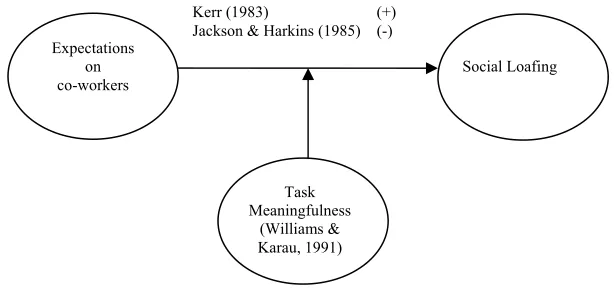
Figure 1. Potential moderating effect of Task meaningfulness.
Looking at Figure 1 and paying attention to this found moderating effect, by Williams and Karau, in 1991, one might think that their reasoning makes sense, but at the same time, one may ask if Task meaningfulness is the only moderator of the
relationship between Expectations on co-workers and Social loafing. Would it be possible that individuals, working in a group, choose their level of effort depending
on other factors? For example, on how meaningful is the relationship with other group members? Is there any evidence of a direct, mediating or moderating effect of the variable - Relationship meaningfulness (RM) with other members of the group –
on the Social loafing phenomenon? Particularly, is there any evidence that Relationship meaningfulness has a moderating effect on the relationship between
Expectations on co-workers
Social Loafing
Task Meaningfulness
Expectations on co-workers and Social loafing, just like has been found in the case of
[image:21.612.180.486.287.448.2]Task meaningfulness?
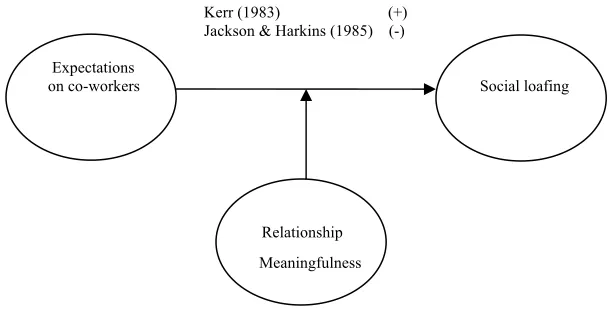
Figure 2. Potential moderating effect of Relationship meaningfulness.
Kerr (1983) (+) Jackson & Harkins (1985) (-) Expectations
on co-workers Social loafing
Relationship
Meaningfulness
Searching for answers to the previous questions in current literature, it seems that
studies examining the role of interpersonal relationships on social loafing are rare (Murphy et al., 2003). Nevertheless, the few existing studies emphasize the influence
found a negative relationship between leader member exchange relationships (LMX)
and Social loafing. However, in this last study, contrary to theory and expectations of Murphy et al., (2003), a significant relationship between Team member exchange relationships (TMX) and Social loafing was not found. Murphy et al. (2003)
explained that unmeasured moderating variables or their only reliance on supervisor ratings may had been partially responsible for the lack of significant relationship
between TMX and Social loafing.
In summary, although there are few studies relating interpersonal relationships with Social loafing in the field, no study was found in the current literature that could
solve the specific enigma of what is the impact of Relationship meaningfulness with other members of the group on Social loafing. Neither was found any study that could
explain if there is or is not a moderating effect of Relationship meaningfulness on the relationship between Expectations on co-workers and Social loafing. Moreover, Relationship meaningfulness, as a variable, was not found in current field studies on
Social loafing. Other studies regarding similar constructs are, either at the group level, (e.g. Cohesiveness: Karau & Williams, 1997 and Karau & Hart, 1998) or are
not fully conclusive because co-worker’s ratings were not included (e.g. TMX: Murphy et al., 2003). Therefore, there is an opportunity to respond to some of these questions conducting a new field-based study.
loafing, it would be useful to start examining potential determinants of Relationship
meaningfulness too. An interesting alternative, to start with, could be individual’s Orientation (i.e. Allocentric or idiocentric).
In 1997, an effect of individual’s Orientation (O) on Social loafing was found by
La Greca. This study provided strong support for existing differences in an individual’s willingness to engage in group endeavors, within a single societal
culture. In La Greca’s (1997) study, allocentric individuals outperformed idiocentric ones when working in pseudo-groups. Her study was conducted using an experimental design with undergraduate students from local universities. La Greca
explained that, in her study, individuals worked independently, although they believed their work would later be combined with the work of others in the group.
She indicated that her scenario did not provide opportunities for the development of relationships within the group. Therefore, there is another opportunity, in field-based studies of Social loafing, to investigate interactions among the significance of
relationships with other members of the group, for example, the suggested RM variable, and the individual’s Orientation (see Figure 3). Moreover, La Greca
recommended to direct future research toward examining factors like these, in collectivistic societies, to see if individuals exhibit similar performance patterns than in her study. Thus, based on previous literature, there is another opportunity to
investigate, in a collectivistic society, interactions among Relationship meaningfulness, Orientation and Social loafing in order to review if current findings
Figure 3. Potential direct effect of Orientation on Relationship meaningfulness.
2.1
Research questions.
This thesis approaches the research topic guided by the following main questions:
Does the moderated effect of TM on the relationship between ECW and SL, found by Williams & Karau (1991), prevail when the relationship is tested outside the
laboratory and in a collectivistic country such as México?
Is the relevance of the Task the only factor that can change the relationship
between Expectations on co-workers and Social loafing, or is it possible that a social cause, such as the relationship with co-members of the group, has the same ability to do so?
Orientation (Allocentric,
idiocentric) (O) Relationship Meaningfulness
Is it possible that individuals see the importance of the relationship with other
members of the group differently depending on a personality trait, such as allocentrism-idiocentrism? If so, how different is it?
2.2
Research objectives.
The objectives of the present investigation are the following: To examine, outside
the laboratory - in the field with natural groups - the potential moderating effect of Task meaningfulness on the relationship between Expectations on co-workers and Social loafing. Additionally, to test by the first time, a possible moderating effect of
Relationship meaningfulness on the relationship between Expectations on co-workers and Social loafing. Finally, to examine the effect of Orientation (i.e. allocentric or
idiocentric) on Relationship meaningfulness.
2.3
Potential Research contributions.
Given that there are only few studies examining social loafing in actual work groups (Murphy, Wayne, Liden, Berrin, 2003), this research attempts to benefit current literature by exploring social loafing in real-world settings revising the impact
of Task meaningfulness on the relationship between Expectations of co-workers and Social loafing. Additionally, this thesis intends to expand theory by introducing the
and by complementing the proposed Social Loafing model with individual’s
Orientation.
This research attempts to contribute to practice assisting organizations and managers in the control for conditions that can cause social loafing and helping to
devise interventions that can reduce or overcome this behavior.
In this chapter, the research problem statement and various potential research opportunities have been identified, according to the current state of the literature on Social loafing. Additionally, the research questions, objectives and potential
Chapter 3
Literature Review
The study of group behavior goes back to the late 1800’s, however it was not
until the early 1940’s that it gained prominence. During the period of 1940 to 1950 there was a gradual growth of research in the area. This research yielded valuable
findings. Then, in the 1960’s and 1970’s statistical and methodological difficulties made social researchers to start changing the focus of their research attention (Johnson & Johnson, 2000). However, during the last two decades, the analysis of
group behavior and particularly, the analysis of the determinants of performance in groups have strongly emerged again. McGrath and Argote (1999) believe that the increasing use of groups as the basic building blocks of organizations, during the
1980’s, is the main reason for the resurgence of interest in research on groups. Hence, in recent years, new blocks at long standing issues in group performance such as,
cohesiveness, group composition, heterogeneity, familiarity, leadership and motivation among many others have appeared (Guzzo and Dickson, 1996).
During these last decades, not just social psychologists, but also, organizational
psychologists have showed interest in the study of group behavior. Nowadays, the study of group behavior is very popular and crucial for individuals and organizations.
Management and Economics are included among the main disciplines where research
on Social loafing has been conducted. Although theoretical and practical questions are similar among disciplines, variations among research approaches and among terms have occurred. For example, while Social Psychologists usually name the
phenomenon as “Social loafing”, Economists prefer to use the term “Free riding”2. Other terms such as “Shirking”, “Job neglect” and “Sucker effect” sometimes are also
used interchangeably in the literature to the same or similar phenomena. This paper focuses mainly on a social psychological approach. Hence the term “Social loafing” will be used throughout the thesis. Next, a review on particular Social loafing studies
is presented.
3.1 Early studies.
Social loafing research began early in the 20th century when Max Ringelmann,
conducted the first study to suggest a possible decrement in individual motivation as a result of working in groups. The results of his study showed that as a group size
increased, the overall performance of the group was increasingly lower than would be expected from the simple addition of individual performances. This effect is now well known as the Ringelmann effect.
2
Many years after Ringelmann’s discovery, in 1972, Steiner conducted an
experiment to test if in addition to coordination loss, as a determinant for performance decrement, reduced individual motivation could be a cause too. Steiner favored coordination loss as a most parsimonious explanation since he observed that
individuals may fail to synchronize their efforts in an efficient way when working in groups.
Later, in 1974, Ingham, Levinger, Graves & Peckham conducted another experiment, now controlling for coordination losses. Ingham et al., (1974) attempted to differentiate coordination loss and effort reduction. As a result, they found that
reduced performance was caused by effort reduction rather than solely inefficient coordination. Until that moment, this effect of effort reduction had been tested using
experiments with only physical tasks, for example rope pulling. Then, Petty, Harkins, Williams & Latané (1977) reported that the effect was not confined only to tasks requiring physical effort but also it extended to cognitive tasks.
It was in 1979, when Latané, Williams & Harkins coined the term Social loafing for the demotivating effects of working in groups. Specifically, they defined Social
loafing as a reduction of individual effort when working with others on an additive group task. Latané et al., (1979) conceptually replicated Ingham et al., (1974) findings, but this time, holding audience size constant and using and experiment with
possible output from being unidentifiable to experimenters when their efforts were
pooled with those of group members.
In the next sub-section, a brief description of the previously studied determinants of Social loafing is presented as an important part of this literature review. Specifying
which variables have an effect on Social loafing is critical to understanding motivation and performance of individuals and groups (Karau & Williams, 1993). As
it is explained next, these variables can either increase or decrease individual’s motivation to put effort on a collective task, consequently affecting individual’s performance, when working in groups.
3.2 Determinants of Social loafing.
Since the decade of 1970’s many studies on Social loafing have been conducted. As a result, the effects of this phenomenon have been generalized to a wide variety of
tasks. For example, shouting and clapping (Latané et al., 1979); pumping air (Kerr & Bruun, 1981); brainstorming (Harkins & Petty, 1982; Harkins & Jackson, 1985) and
evaluating job descriptions (Weldon & Gargano, 1985) among many others.
Most of the studies, during the decades of 1970’s and 1980’s were designed as experiments using pseudo-groups. Typical experimental designs compared subjects
loafing using or suggesting the use of questionnaires on individuals of natural groups
started to be published. Nevertheless, this type of studies on Social loafing still remains to be a few, for example, George (1992); Comer (1995); Murphy, Liden, Erdogan (2003) and Liden, Wayne, Jaworski & Bennett (2004).
Studies of determinants of Social loafing include variables such as group size, identifiability (accountability), task related variables, evaluation potential,
dispensability of effort, self-reference variables, incentives, culture, expectations on co-workers, orientation, perceived social loafing, cohesiveness, exchange
relationships and justice (see Table 1 for a summary of determinants of Social
loafing). Next, the findings of the studies on each previously mentioned determinant on Social loafing are briefly elaborated.
3.2.1 Size.
It is clear that size may affect performance. However, the nature of the
relationship between size and performance seems to vary depending on other
conditions such as characteristics of the task and processes operating within the group
(Littlepage, 1991).
3.2.2 Identifiability (accountability).
Performance identifiability has been shown to influence Social loafing. When individuals believe that their effort is not distinguishable from that of others, their
Harkins & Williams, 1980; Williams, Harkins & Latané, 1981; Weldon & Gargano,
1985; Weldon & Mustari, 1988).
3.2.3 Task related variables: Difficulty, uniqueness, attractiveness, meaningfulness
and visibility.
Researchers have found that individuals are motivated to perform on unique,
difficult and challenging tasks (Harkins & Petty, 1982; Jackson & Williams, 1985), as well as, on attractive (Zaccaro, 1984) and meaningful (Williams & Karau, 1991; George, 1992) ones. Another important characteristic of task is its visibility. When
task visibility is high, individuals believe their effort is been monitored and thus, they are less likely to engage in Social loafing (George, 1992).
3.2.4 Evaluation potential: Experimenter, co-actor (s), participants.
Researchers concur to explain that Social loafing happens when participants’
outputs cannot be evaluated by either the experimenter, the co-actor (s) or by the participants themselves (Szymanski & Harkins, 1987; Harkins & Szymanski, 1988,
1989; and Stevenson, 1989).
3.2.5 Dispensability of effort.
3.2.6 Self-reference variables: Self-efficacy, collective efficacy.
Sanna (1992) provides a thorough analysis of self-efficacy before the emergence of the collective efficacy variable. According to Sanna (1992), efficacy expectancy and outcome expectancy jointly affect performance. Collective efficacy centers on the
appraisal of others’ personal efficacies as a predictor of performance (Bandura, 1982, 1986, 1997), and status may need further consideration in empirically based studies
on Social loafing (Miller, 2001).
3.2.7 Incentives.
Albanese and Van Fleet (1985) explained that special incentives have to be used in order to encourage interest in the public good. Others such as, Shepperd & Wright
(1989), Zaccaro (1984) and Erez & Somech (1996) also found mitigation on the effect of Social loafing because of incentives.
3.2.8 Culture (Collectivism-individualism).
Gabrenya, Wang & Latané (1985) set out to determine whether Social loafing
was a transcultural phenomenon. Their results indicated the occurrence of Social loafing by American subjects, but not by Chinese subjects, suggesting that Social loafing may not be a transcultural phenomenon. In another study, this time with
Japanese students, Matsui, Kakuyana & Onglatco (1987) argued that collectivistic tendencies of Japanese students were responsible for the superior performance of
1989, Earley examined the effect of collectivism and individualism on Social loafing
in an organizational setting. Results indicated a three-way interaction; highly individualistic people performed poorest under conditions of high shared
responsibility and low accountability, whereas, highly collectivistic people did not
show this tendency and actually performed better under conditions of high shared responsibility, regardless of accountability. Following the same line of thought, Viega
(1991) revealed that highly collectivistic people performed better under conditions of high shared responsibility, regardless of accountability.
Among the studies of Social loafing with individuals in the same country (i.e.
The United States) working in groups, Cox, Label & McLeod (1991) found that ethnically diverse groups with collectivistic backgrounds acted more cooperatively
than Anglo groups with individualistic backgrounds, and those behavioral differences tended to increase when the situational cues favored cooperation. Later, the study of Wagner (1995) provided support that variations in collectivism-individualism within
a single societal culture can have effects on group cooperation and that these effects can extend and modify the influence of factors often analyzed in research on Social
loafing.
3.2.9 Expectations on co-workers.
Kerr (1983) found that social loafing occurred when individuals had an expectation of high performance from co-workers, supporting in this way a
individuals tended to match the effort of their co-workers. Seeking to create order in
these contradictory findings, Williams & Karau (1991), found support for the social-compensation hypothesis and for the Social-loafing hypothesis suggesting the presence of Task meaningfulness as a moderating variable.
3.2.10 Orientation: Allocentric or idiocentric3.
According to La Greca (1997) even within a single societal culture (collectivistic or individualistic) differences in an individual’s willingness to engage in group endeavors exist. Thus, La Greca (1997) examined if tendencies towards allocentrism
or idiocentrism can serve as successful predictors of an individual’s willingness to engage in group endeavors. In her study, La Greca (1997) found that allocentrics
outperformed idiocentrics when working in pseudo-groups, and this difference was most apparent under conditions of large group sizes as compared to small group sizes.
3.2.11 Perceived Social loafing.
Mulvey & Klein (1998) reported that recognized perceive loafing, as compared to
unrealized loafing, has the effect of lowering expectations for group success and hence, reduces performance.
3
collectivism-3.2.12 Cohesiveness.
Group cohesiveness – the degree to which members are attracted to one another and desire to stick together (Mudrack, 1989) has been recognized in several studies as a salient variable with respect to Social loafing (Liden, et al., 2004). For example, in
the experiments of Karau & Williams (1997) and Karau & Hart (1998), Social loafing was found to occur in groups that were not cohesive or mildly cohesive. Then, in
Liden et al., (2004) cohesiveness was also negatively correlated with Social loafing.
3.2.13 Exchange relationships: Leader (LMX), team-member (TMX).
Murphy et al. (2003) tested the relationship between the Leader-member exchange relationship (LMX) and the Team-member exchange relationship (TMX)
with Social loafing. They found that LMX was negatively related to Social loafing, and contrary to their expectations, they did not find a relationship between TMX and Social loafing. Researchers believed that maybe unmeasured moderating variables
such as the normative environment in the work group, collective self-efficacy,
perceived peer motivation, reliance on supervisor ratings and a more important role of
LMX could help to explain the lack of significance between TMX and Social loafing.
3.2.14 Justice: Distributive, procedural & interactional.
In 2004, Liden et al. reported that distributive justice negatively correlated with Social loafing. However, in their study, procedural justice was found to be unrelated
(i.e. interactional and distributive justice) were related to Social loafing but through
[image:37.612.100.534.215.672.2]Leader-member exchange relationships.
Table 1. Summary of determinants of Social loafing.
Variables Relationship With Social Loafing.
Size. Relationship seems to vary depending on
other conditions such as characteristics of the task and processes (Littlepage, 1991)
Identifiability, accountability. (-) (Latané, Williams & Harkins, 1979; Petty, Harkins & Williams, 1980; Williams, Harkins & Latané, 1981; Weldon & Gargano, 1985; Weldon & Mustari, 1988).
Task related variables: Difficulty, uniqueness, attractiveness,
meaningfulness and visibility.
(-) (Harkins & Petty, 1982: Jackson & Williams, 1985; Zaccaro, 1984; Williams & Karau, 1991; George, 1992).
Evaluation potential. (-) ( Szymanski & Harkins, 1987; Harkins & Szymanski, 1988, 1989; Stevenson, 1989). Dispensability of effort. (+) (Kerr, 1983; Kerr & Brunn, 1983). Self reference variables: Self
attention, self efficacy and collective efficacy.
Status may need further consideration in empirically based studies (Miller, 2001). A (-) relationship is believed.
Incentives. (-) (Albanese and Van Fleet, 1985; Shepperd & Wright, 1989; Zaccaro, 1984; Erez & Somech, 1996).
Culture:
Collectivism-individualism.
(+) (Gabrenya, Wang & Latané, 1985; Matsui, Kakuyana & Onglatco, 1987; Earley, 1989; Cox, Lobel & McLeod, 1991; Wagner, 1995).
Expectations on co-workers. (+) (Kerr, 1983). (-) (Jackson & Harkins, 1985).
Orientation
(Allocentric or idiocentric).
(+) (La Greca, 1997).
Continuation of Table 1. Summary of determinants of Social loafing.
Variables Relationship With Social Loafing. Cohesiveness. (-) (Karau & Williams, 1997; Karau & Hart,
1998; Liden et al., 2004). Exchange relationships: Leader
and team member.
Leader-member (LMX): (-) (Murphy, Wagne, Liden, Erdogan, 2003).
Team-member (TMX): No relationship was found (Murphy et al., 2003).
Justice Distributive: (-) (Liden et al., 2004) & interactional: Through LMX, (-) (Murphy et al., 2003).
Procedural: No relationship was found (Liden et al., 2004)
(-) Inverse relationship. (+) Positive relationship.
3.3
Theoretical frameworks in social loafing literature.
Given the evidence that Social loafing occurs under certain conditions,
researchers have decided to explain the phenomenon using existing theories and even
suggesting new ones. Next, the main theoretical frameworks in Social loafing literature are introduced. Those marked with an asterisk: Social identity theory,
expectancy theory, the collective effort model and social exchange theory are the ones used to support hypotheses in this research.
3.3.1 Social impact theory (Latané et al., 1979; Latané, 1981).
Social impact theory (Latané et al., 1979) states that people can be viewed as
source’s influence) of social impact. According to Latané (1981) the total impact of a
source on a target, in a given situation, depended on three factors: The number of sources, the strength of the source (s), and the immediacy of the source (s) to the targets. This theory explains why the presence of others sometimes leads to social
facilitation and, other times, it causes social loafing. When a facilitator asks a group to complete a task, the facilitator is the only source of social impact, whereas the
group serves as multiple targets. Then, impact is diffused among members of the group, therefore the result is a reduction of effort as group size increases. On the contrary, in coactive conditions, all the facilitator influence is concentrated on the
individual, making the individual to work hard.
3.3.2 Arousal reduction theory (Jackson & Williams, 1985).
The arousal reduction theory was suggested by Jackson & Williams (1985) to accompany social impact theory. Arousal reduction theory states that the presence of
others is not necessarily drive inducing. Instead, the presence of others should be drive reducing when those others serve as sources of impact, but should be drive
reducing when others serve as co-targets of an outside source of social impact. They found that, when working collectively, it is more difficult to evaluate individual inputs. According to this theory, Social loafing occurs when working collectively on a
well-learned task. This is because individual group members do not experience an increase in arousal due to evaluation concerns and, therefore, do not work hard on the
evaluated, therefore increasing arousal. This arousal leads to a greater individual
effort.
3.3.3 Social identity theory (Abrams & Hogg, 1990; Tajfel, 1970; Tajfel & Turner,
1986)*.
Social identity theory argues that an individual’s social identity is determined by
the groups to which he or she belongs (Abrams & Hogg, 1990; Tajfel, 1970; Tajfel & Turner, 1986). In an effort to enhance one’s identity, individuals are motivated to join the most attractive groups and / or give an advantage to the groups to which one
belongs (in-groups). Social identity theory suggests that the in-group is incorporated into the individual’s identity, and efforts expended for the group service the self
(Worchel, Rothgerber, Day, Hart & Butemeyer, 1998).
3.3.4 Free-rider theory (Olson, 1965)*.
Free-rider theory (Olson, 1965) explains how the individual tendency to try to minimize costs relative to the benefits operates to affect group formation and
individual productivity in groups. Free-rider theory contains four major propositions: (1) The group formation proposition, (2) the suboptimal proposition, (3) the group size proposition and (4) the counter-forces proposition.
The group formation proposition asserts that the opportunity to receive an equal share in the public good that might be provided by a potential group is not in itself
The suboptimal proposition asserts that once a group, large or small, is formed to
provide a public good, a suboptimal amount of the public good is provided because of free-riding.
The group size proposition asserts that beyond the level of very small groups,
unless coercion, special incentives, or both are used, increases in group size lead to increases in free-riding.
Finally, the counter-forces proposition asserts that coercion and / or special incentives can be used as counter-forces to the free-riding effects of rational behavior on group formation and on the provision of public goods by groups.
3.3.5 Knoke´s synthesized motivation model (Knoke, 1990).
Knoke (1990) constructed a model that addresses how individuals are motivated to join and contribute to collective action. Knoke integrated three theoretical
perspectives: (1) rational choice (i.e. individuals are motivated to collective action
when benefits are greater than costs), (2) normative conformity (i.e. individuals are motivated to collective action in order to adhere to social values), and (3) affective
bonding (i.e. individuals are motivated to collective action based on emotional attachments).
3.3.6 Expectancy theory (Vroom, 1964). *
Vroom’s expectancy theory (1964) asserts that individual’s motivational force
are expected to lead to high levels of performance); (2) instrumentality (i.e. the
degree to which high-quality performance is perceived as instrumental in obtaining an outcome) and (3) valence (i.e. the degree to which the outcome is viewed as
desirable).
3.3.7 The collective effort model (CEM; Karau & Williams, 1993). *
The collective effort model (CEM; Karau & Williams, 1993) expands the basic knowledge of expectancy-value models of work motivation to collective tasks and uses elements of social identity and self-evaluation theories to identify outcomes that
individuals are likely to value in a collective setting. The CEM suggests that
individuals are willing only to work hard on a collective task to the degree that they
expect their individual efforts to be useful in obtaining outcomes that they will personally value.
CEM, like expectancy theory (Vroom, 1964), is based on the idea that three
factors influence an individual’s decision to work hard on a task: Expectancy, instrumentality and valence. However, it accounts for these conditions by specifying
three additional factors associated with instrumentality: (1) the individual’s perception of the relationship between individual and group performance; (2) the individual’s perception of the relationship between the performance and outcome of
collectively, because the relationship between individual effort and obtaining valued
outcomes is weaker collectively than when working individually on a task.
3.3.8 Self-efficacy theory (Bandura, 1997).
Bandura (1997) emphasized the importance of self-referent thought in the overall dynamic of human capability because it frequently leads to behavioral changes.
Self-efficacy – “ The belief in one’s capabilities to organize and execute the courses of action required to produce given attainments” (Bandura, 1977, p.3)- is one aspect of self-reference thought that influences the courses of action individuals choose to
pursue (Zimmerman, 1985). The role self-efficacy beliefs have in establishing effort is in the interaction between efficacy expectancies (i.e. believe that one is capable of
performing the required task) and outcome expectancies (i.e. the belief that a specific set of behaviors will lead to a desired or valued outcome) (Miller, 2001).
3.3.9 Justice and Equity theory (Greenberg, 1990; Bies & Moag, 1986; Adams, 1965).
Three types of justice perceptions are prevalent in the justice literature.
Distributive justice refers to the extent to which individuals perceive the distribution of outcomes in the organization as fair (Greenberg, 1990). Interactional justice (Bies
& Moag, 1986) is defined as the extent to which individuals perceive that they are being treated with respect and dignity. Finally, procedural justice refers to the
are working in groups they often strive to deliver a performance that represent a fair
contribution in relation to the total group performance. Thus, group members may or may not loaf because they desire to maintain equity (see Adams, 1965 for an
explanation of equity theory).
3.3.10 Social exchange theory (Blau, 1964). *
Social exchange theory suggests that individuals develop a desire to reciprocate, leading to the creation of mutual obligation in the relationship (Blau, 1964).
In this chapter, a brief history of the development of theory in the field has been elaborated, as well as, a synthesis of determinants and theories of Social loafing. As
the reader can notice, many have been the theories and the determinants that can explain the phenomenon, while the predominant design for studies has been the experimental one, using pseudo-groups. Based on these findings, it seems that in the
current stage of SL theory development, there is an opportunity to contribute to the Social loafing field, going out to organizational settings and testing the phenomenon
in the field, with real groups.
In the next chapter, an explanation of the proposed model of Social loafing is presented, including the definitions of variables, the hypotheses and the rationales
Chapter 4
Proposed Model of Social Loafing
The proposed model of Social loafing includes relationships among five
variables: Expectations on co-workers (ECW), Task meaningfulness (TM),
Relationship meaningfulness (RM), Orientation (O) and Social loafing (SL). Social
loafing is the main dependent variable of the proposed model as a whole. The model includes three hypotheses. The first (H1) and second (H2) hypothesize moderating relationships, while the third one (H3) hypothesizes a direct relationship (see Figure
[image:45.612.117.529.404.686.2]4).
Figure 4. Proposed model of social loafing.
Expectations on co-workers
( ECW )
Social loafing ( SL )
Task meaningfulness
( TM )
Relationship meaningfulness
( RM )
Orientation (Allocentric, idiocentric) (O) H3 H1 H2
O is negatively related to RM
RM moderates the relationship between ECW and SL such that the relationship is stronger when RM is low than when RM is high. TM moderates the
4.1 Variables.
Next, the specific definition along with, a brief explanation of each of the five variables of the proposed model are presented. (See Table 2 as a reference of variable
definitions).
4.1.1 Expectations on co-workers (ECW).
The variable named as Expectations on co-workers is the extent to which an individual, when working in a group, perceives the co-members of his/her group as
reliable and competent.
In this research, ECW has been based on the dimensions of competence and reliability of the construct of interpersonal-trust (Cook & Wall, 1980; Hoy &
Tschannen-Moran, 1999), this time contextualized to a work environment organized by groups. Thus, an individual would perceive the co-members of his/her group as
reliable when the individual feels confident that he/she can count on the other members of the group to put appropriate effort on their jobs, to be responsible, to approach their jobs with professionalism and to be careful. In addition, an individual
would perceive the co-members of his/her group as competent when he / she believes co-members of his / her group, have the required skills, and when the individual
4.1.2 Task meaningfulness (TM).
The variable named as Task meaningfulness is the extent to which an individual, when working in a group, experience his/her task as important, valuable and
worthwhile (Kirkman & Rosen, 1999 quoted by Mendoza, 2005).
The previous definition of the construct of Task meaningfulness is similar to the
one of the motivational process construct of meaningfulness, first suggested by Hackman & Oldham (1980), then by Kirkman & Rosen (1997; 1999), and recently by Mendoza (2005). The difference is that this time, since the unit of analysis of this
research is the individual, the belief is not collective but individual. This
characteristic allows individuals, even within the same group, to have different levels
of Task meaningfulness depending on their own personal valuation of their task in the group. As a result, the Social loafing test, proposed by this research at the individual level, can be executed.
4.1.3 Relationship meaningfulness (RM).
The variable named as Relationship meaningfulness is the extent to which an individual, when working in a group, experiences his/her relationship with the other members of his/her group as important, valuable and worthwhile.
harmonic or good relationship with other members of the group, instead of, to the
task.
Justification for the study of the impact of relationships within a group on the reduction of individual’s effort is given by the “Need to belong” theory of Baumeister
and Leary (1995) and by the socio-technical approach. Baumeister and Leary (1995) stated that the need for interpersonal relationships and ties to groups is one of the
most fundamental motives of the human social condition. This theory is supported by the finding that most people feel anxious when they face exclusion from their social groups. Additional supporting evidence is given by the socio-technical approach
(Trist, 1981). This approach has focused more on work group interactions than individual performance, emphasizing that both the social and technical systems must
be jointly considered and optimized.
4.1.4 Orientation (i.e. allocentric – idiocentric) (O).
The variable named as Orientation is the extent to which an individual has allocentric or idiocentric preferences and values. Allocentric preferences and values
include subordination of personal to in-group goals, in-group as extension of self and in-group as source of identity. On the contrary, idiocentric preferences and values include more concern for one’s own goals than the in-group’s goals, self reliance and
competition, detachment from in-groups, deciding on one’s own rather than asking the views of others, and less general concern for the in-group (Triandis et al., 1985;
The construct of Orientation (allocentrism-idiocentrism) corresponds at the
individual level to collectivism-individualism at the societal level4. By separating the cultural from the individual, it is possible to determine if idiocentric individuals working in a society of a collectivistic culture relate to other members of the group
differently than do allocentric individuals in the same situation.
4.1.5 Social loafing (SL).
The variable named as Social loafing is a decline in motivation. It is a reduction of individual effort when working with others on an additive group task (Latané,
Williams, & Harkins, 1979).
SL is like hiding in the crowd (Johnson & Johnson, 2000). When SL has been
previously studied in the control environment of a laboratory, it has frequently shown the actual reduction of effort. On the other hand, when it has been studied using questionnaires, in the field, through the evaluation made by supervisors (see George,
1992) or co-workers, like in this research’s case, it has referred to a supervisor’s or co-worker’s perception on the SL of other workers, with whom they interact. In other
words, it is the extent to which an individual, working in a work group, perceives that a co-member, in the group, tends to put forth low effort on the job, when other
members in the group are present to do the work.
4
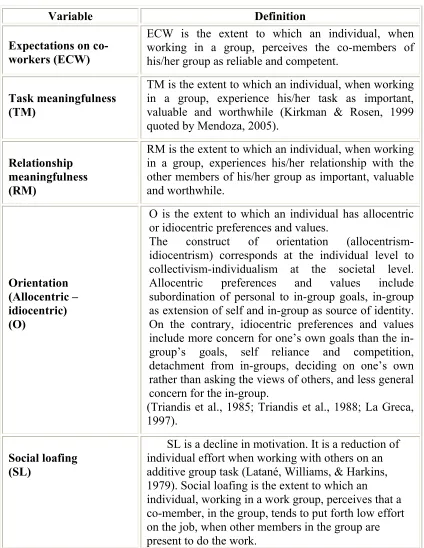
Table 2. Variable definitions.
Variable Definition Expectations on
co-workers (ECW)
ECW is the extent to which an individual, when working in a group, perceives the co-members of his/her group as reliable and competent.
Task meaningfulness (TM)
TM is the extent to which an individual, when working in a group, experience his/her task as important, valuable and worthwhile (Kirkman & Rosen, 1999 quoted by Mendoza, 2005).
Relationship meaningfulness (RM)
RM is the extent to which an individual, when working in a group, experiences his/her relationship with the other members of his/her group as important, valuable and worthwhile.
Orientation (Allocentric – idiocentric) (O)
O is the extent to which an individual has allocentric or idiocentric preferences and values.
The construct of orientation (allocentrism-idiocentrism) corresponds at the individual level to collectivism-individualism at the societal level. Allocentric preferences and values include subordination of personal to in-group goals, in-group as extension of self and in-group as source of identity. On the contrary, idiocentric preferences and values include more concern for one’s own goals than the in-group’s goals, self reliance and competition, detachment from in-groups, deciding on one’s own rather than asking the views of others, and less general concern for the in-group.
(Triandis et al., 1985; Triandis et al., 1988; La Greca, 1997).
Social loafing (SL)
SL is a decline in motivation. It is a reduction of individual effort when working with others on an additive group task (Latané, Williams, & Harkins, 1979). Social loafing is the extent to which an
4.2 Hypotheses of the study.
When organizations form groups of people to work in a particular group task,
they rarely (or never) expect the entire group’s performance to be determined by the contributions of just one or few group members (Comer, 1995). On the contrary, it is
common to find that organizations expect all individuals in the group to perform well their assigned tasks. However, according to Salancik & Pfeffer (1978) what subjects perceive about their co-workers will either enhance or impair their performance. Yet,
according to Goethals & Darley (1987), individuals working in groups compare their effort and abilities with those of their group members.
If an individual perceives that others in the group are very competent and perform sufficiently, this individual might sense that it is not necessary for him/her to do the job or might even think there is an opportunity to free-ride. However, if either
the task or the relationship with co-workers is important, the individual will feel compelled to make an effort. This can happen because he/she cares about the
evaluation of the group product or because he/she is motivated to preserve a good relationship or exchange with co-workers. However, when the individual expects others to do the job well, and there is a low level of Task meaningfulness or a low
as Social loafing. In such cases, performing their tasks within the group, for their own
sake is not likely; therefore, performance should be more contingent upon perception on expectations on co-workers than when Task meaningfulness or Relationship meaningfulness are high. Therefore, it is expected that
According to Triandis et al., (1988), while allocentrics subordinate personal to
in-group goals and consider the in-group as extension of self and as a source of identity, idiocentrics have more concern for their own goals. In addition, Triandis et
al., (1988) argued that idiocentrics are more detached from in-groups and have a less general concern for the in-group. Following the same line of thought, La Greca (1997) explained that allocentric individuals, working in groups, give a priority to the
well being of the group. Therefore, based on previous knowledge about the H1: Task meaningfulness moderates the relationship between Expectations on
co-workers and Social loafing such that the relationship is stronger when Task meaningfulness is low than when Task meaningfulness is high.
H2: Relationship meaningfulness moderates the relationship between Expectations on co-workers and Social loafing such that the relationship is
characteristics of each type of group of individuals (i.e. allocentrics and idiocentrics) ,
if a low value of Orientation means that the individual is allocentric and a high value of Orientation means that the individual is idiocentric, one might expect that
Previous hypotheses are consistent with theoretical frameworks such as the Expectancy theory (Vroom, 1964) and the Collective effort model (CEM; Karau & Williams, 1993). Expectancy theory and the Collective effort model (Expectancy
theory in a collectivistic setting) state that individuals will be willing to exert effort on a collective task, if they believe their effort will result in performance that is
instrumental in obtaining valued outcomes. If the individual believes performance on a task and a good relationship with co-members depends on his or her individual effort and sees this task and / or the relationship as an instrument in obtaining an
ultimate valued outcome (e.g. better pay, job satisfaction, recognition, acceptance from co-workers or a sense of belonging in the group) it would be expected that this
individual be motivated to work harder. As a result, Social loafing will be less contingent on expectations on co-workers and the relationship between ECW and SL will be weaker with high Task and Relationship meaningfulness and stronger with
low Task and Relationship meaningfulness.
H3: Orientation (i.e. allocentric - idiocentric) is negatively related to
Also, proposed hypotheses are consistent with Social exchange theory (Blau,
1964) which states that individuals who pay attention to good relationships with their partners, based on a desire to reciprocate, behave in ways that can benefit the
exchange party, for example, exerting extra effort.
This chapter provided a review of the proposed model, starting with definitions &
Chapter 5
Research Methodology
The objective of this chapter is to provide a review of each component of the
research procedure and methodology of this study. Included in this section are discussions about the type of research, the population and the sample in which this
research has been focused, and the ways its variables have been operationalized. Thus, an explanation of the methodology that has been used to translate existing instruments, as well as, descriptions of all the taken precautions to validate
measurement instruments are presented. Finally, the data collection, the data codification & capture, the data analysis and the hypotheses testing procedures are elaborated.
5.1. Research type.
The present research is a cross-sectional and correlation study. A cross-sectional study collects and studies data, of a population’s subset, at a single point in time. A
correlation study investigates the relationships among variables or constructs participating in the proposed model. Neither of these types of research can
(Murphy et al., 2003) that allow establishing the permanence of these relationships.
However, this type of research allows a partial explanation of the discovered causality relationships (Mendoza, 2005).
5.2 Population.
This research focuses on a population of adult individuals, working in groups. Since, in this study, the terms group and team are not distinct, this research focuses on, the type of teams that Cohen & Bailey (1997) identified as, work teams. Work
teams are “continuing work units responsible for producing goods or providing services” (Cohen & Bailey, 1997, p. 242). According to Cohen (1991), they are
well-defined and membership is typically stable. Individuals’ permanence in this type of groups is usually full-time, although it can varies in occasions. This study focuses on a population of work teams, found in manufacturing settings. They are directed by
supervisors, other times called facilitators depending on their roles and decision making processes.