FACULTAD de FILOSOFÍA Y LETRAS
DEPARTAMENTO de FILOLOGÍA INGLESA
Grado en Estudios Ingleses
TRABAJO DE FIN DE GRADO
Lexico-grammatical aspects of the translation of a
medical research paper about hepatitis
Mª de la Concepción Sáez-Royuela Pacheco
Tutor: Beatriz Méndez Cendón
ABSTRACT
The aim of the present undergraduate dissertation is to provide a translation for the
medical research paper “Chronic Hepatitis C Virus Infection in the United States,
National Health and Nutrition Examination Survey 2003 to 2010” published in the
journal Annals of Internal Medicine and, additionally to analyze the most recurring translation procedures. In order to reach this, an analysis of the main features of
Languages for Specialized Purposes is conducted. The query of several parallel texts in
Spanish as well as the creation of a specialized purpose corpus is essential for the text
translation. An analysis of the most recurrent methods of medical translation is provided
so as to conclude that nominal groups, passives and transpositions are the most
recurrent translation techniques when dealing with the translation of a medical research
paper.
Keywords: languages for specialized purposes, medical translation, hepatitis C,
translation procedures, medical language, parallel texts.
RESUMEN
El objetivo de este proyecto es proporcionar la traducción del artículo original “Chronic
Hepatitis C Virus Infection in the United States, National Health and Nutrition
Examination Survey 2003 to 2010” publicado en la revista Annals of Internal Medicine,
así como analizar los principales métodos de traducción utilizados para la misma. Para
lograrlo ha sido necesario el estudio de las características más importantes del lenguaje
especializado, además de la consulta de textos paralelos en español y la elaboración de
un corpus especializado. Finalmente, se proporcionará un análisis de los métodos de
traducción más importantes para mostrar la importancia que tienen los grupos
nominales, la pasiva y las transposiciones en la traducción médica de un trabajo de
investigación clínico.
Keywords: lenguaje especializado, traducción médica, hepatitis C, métodos de
TABLE OF CONTENTS
1. INTRODUCTION………..7
2. THEORETICAL FRAMEWORK………..9
2.1 The process of translating ………9
2.2 Distinctive features between English and Spanish……….11
2.2.1 Syntactic structures ………..11
2.2.1.1 Extension and linking of sentences……….11
2.2.1.2 Linking within clauses………11
2.2.1.3 Word order.……….12
2.2.2 Morphological elements.………..13
2.2.2.1 Adjectives……….…13
2.2.2.2 Verbs.………15
2.3 Languages for specific purposes……….19
2.3.1 Concept of Specialized Languages………..…19
2.3.2 Features of Specialized Languages………..19
2.3.3 Ways to identify a specialized language………..20
2.3.4Variations in LSP……….21
2.3.5The role of terminology in LSP ………..22
2.3.6 Specialized terms………..22
3. METHODOLOGY………..23
3.1 Corpus creation ………23
4. RESULTS: TRANSLATION COMMENTS………..25
4.1 Source text: background ………..25
4.2 Transposition………..………..27
4.3 Latin and Greek prefixes and suffixes………..31
4.4 The use of acronyms ………32
4.5 Borrowings ………..33
4.6 The passive voice……….34
LIST OF TABLES
Table 1. Composition of the corpus for the translation..………24
Table 2. Transposition of present participles..………28
Table 3. Transposition of adverbs..……….29
Table 4. Transposition of gerunds.……….……….……29
Table 5. Translation and meaning of Latin of Greek prefixes and suffixe…………31
Table 6. Translation of acronym……….………32
Table 7. Borrowings……….……….………..33
Table 8. Translation of passives to pasiva refleja……….…………..36
Table 9. Translation of passives to passive with the verb ser……….36
Table 10. Translation of passives to active voice………37
Table 11. Translation of nominal groups……….………38
Table 12. Number of appearance of each structure……….42
Table 13. Times that the structure was used to translate passive voice…..…………43
Table 14. Times that the structure was translated by using transposition…..………44
LIST OF GRAPHICS Graphic 1. Percentage of each of appearance of each structure………..42
Graphic 2. Percentage of each of the structures used to translate passive voice……….43
Graphic 3. Percentage of each structure translated by using transposition……….44
LIST OF ABBREVIATIONS Abbreviation Term
GL General language
TL Target language
ST Source Text
TT Target Text
LSP Language for Specific Purposes
LGP Language for General Purposes
1. INTRODUCTION
The 88% of scientific and technical texts are originally written in English. That is
why the translation from English to another languages is essential to receive scientific
knowledge. It is also necessary to highlight that when a scientific medical article is
published, it must be translated as soon as posible, because medicine is a science that is
constantly changing. So that, if texts are not immediately translated after being
published, the information that the reader of the translation receives may be obsoleted.
The importance of the translation is obvious. Nowadays, 50% of scientists can not read
a half of the total publications because they are not fluent in the original language in
which these texts are written.
It is not easy to determine if translators are the most suitable people to translate a
scientific article or if doctors should be the ones who do this job. I would like to point
out that the person who wants to do a correct translation should have a perfect
knowledge and dominance not only of the ST, but also of the TT. Besides, the translator
should have knowledge of the field in which he/she is working and should also
dominate the terminology. Regarding the specific case of medicine, the translator of a
research paper should try to achieve a standardization of the translation using a
normalized terminology. In the medical field we can find two types of terms: terms
coming from general language (GL), such as tonsillitis, and terms coming from the specialized domain of medicine, such as amigdalitis. The terms coming from GL, that is ‘subtechnical terms’, are the ones that are more problematic when finding equivalents in
the target language (TL). We will be explaining medical terminology in the theoretical
background of this undergraduate dissertation.
This undergraduate dissertation consists of 5 sections: an introduction, a theoretical
background, the methodology, the translation comments and the conclusion. In the
theoretical background what translation is will be explained, as well as the different
stages of the process of specialized translation. After that, we will be dealing with the
the differences between these two languages will help us to do an accurate translation.
The last part of the theoretical framework is focused on the concept of ‘language for
specific purposes’ (LSP), its features and how terminology is used in LSP. This is an
important topic because this undergraduate dissertation is based on a specialized text (a
scientific-medical text). In the methodology it is explained how the corpus has been
created and the parallel texts used for this compilation, as well as their structure,
features and impact factor. Then the results and translation comments section will be
explained. First, I will deal with the theme and genre of the translated article as well
different classifications of the text according to several authors. After that the methods
used for the translation are explained. Every relevant term, as well as its equivalent in
Spanish are classified in tables according either to the method that has been used for its
translation, or to the type of term that we are dealing with. Finally, we can find the
conclusion and the bibliography used to write this dissertation. In the annexes, the
2. THEORETICAL FRAMEWORK
2.1 THE PROCESS OF TRANSLATING
As we are dealing with translation, it is necessary to know what it is. Foster (1958)
asserted that “translation is an act through which the content of a text is transferred from
the source language in to the target language.” Another accurate definition is the one
given by Ghazala (1995) when he said that “translation is generally used to refer to all
the process and methods used to convey the meaning of the source language in to the
target language.”
According to García Yebra, (n.d.) there are two translation stages. The first one
consists of the understanding of the original text and the second stage is the
reproduction of the assimilated information into the TL. The translator’s aim is to
reproduce the message of the ST in a coherent way, being loyal to the meaning and
resulting spontaneous and natural at the time of being read or heard in the TT. The
Italian author Adamo (2002), points out that to reach a great translation, the translator
should analyze the sociological, linguistic and cultural features surrounding the ST and
the TT. The translator should also have a good knowledge of the specialized
terminology.
Teresa Cabré (2004) divides the process of translation in four different stages:
-
During the first level the translator focus on terminology. This stage comprises thesearching of databases, encyclopedias or specialized dictionaries. Sometimes the
translator is not able to find the term and in this case the best option is to do a literal
translation or to explain what the term means.
-
In the next stage the translator uses his linguistic competence and creates neologismswhen they are needed.
-
The third step is the center of the terminological process. It deals with the creation ofa database where all the terms are compiled. This allows the translator to analyze the
terms easily as well as to solve the translation problems that appeared during levels
-
During the last level the translator creates a specialized glossary that can be useful2.2 DISTINCTIVE FEATURES BETWEEN ENGLISH AND SPANISH
2.2.1 Syntactic structures
In the following pages, the distinctive features between English and Spanish
regarding to syntax will be explained, as well as the most common ways of translating
these structures from the TT in English into the ST in Spanish.
2.2.1.1 Extension and linking of sentences
According to Lopez Guix and Wilkinson (2001) “one of the biggest syntactic
differences between English and Spanish is the extension of phrases and sentences”.
English tends to use simple structures separated with punctuation marks elements; on
the other hand, Spanish uses the subordinated structures. While in Spanish the excessive
use of dots between sentences can provoke a feeling of monotony and a weak domain of
linguistics, in English this is a symbol of expositive clearness. So that, at the time of
translating, the translator into Spanish must extend the clause using coordination and
subordination. English language uses repetition and anaphoric references to maintain
discursive cohesion. This cohesion is searched by the use of participles, gerunds and
deictics (demonstratives, adverbs of place and time, personal pronouns and articles).
Due to all the mentioned features we can conclude that English tends to use simple
sentences and anaphora to reach the discursive cohesion. However, Spanish prefers
complex clauses because repetition is seen as a depletion of linguistic resources.
2.2.1.2 Linking within clauses
English language shows preference for juxtaposition and coordination compared
with the number of times that subordination appears in written texts. So that, at the time
of translating these structures into Spanish, the translator should connect these clauses
adding linking words and conjunctions. Lopez Guix and Wilkinson (2001) show this
technique using the following example:
Linked with Guatemala in colonial days, Chiapas became a Mexican State in
1824; its boundaries were fixed in 1882.
“Unida a Guatemala en la época colonial, la región de Chiapas se convirtió en un
As we can see in the previous example, English applies juxtaposition using a
semicolon to link two sentences. However, this is translated to the TL by using
coordination.
It is necessary to mention the way of translating relative pronouns into Spanish.
These terms are commonly omitted or dispensable in English but not in Spanish. The
following examples show how to make an accurate translation of these structures:
We thought it must have been an accident.
“Pensamos que debía de haber sido un accidente”.
Eventually came the day we visited the United States.
“Al fin llegó el día que visitamos Estados Unidos”.
Both examples require the item “que”. In the first example “que” acts as a
conjunction introducing a subordinate clause and in the second it is a relative pronoun
introducing a subordinate adjective clause.
2.2.1.3 Word order
Every language has a specific word order. Spanish language enables more variations
than English regarding to word order, one of the causes for this is that the Spanish verb
inflection is really rich. Besides, Spanish is a [+ null subject language], this means that
subject omission is perfect acceptable, while in English it is not in most of the cases.
Therefore, a translator should avoid calques of pronominal subjects in the translation
from English into Spanish.
Other English syntactic feature that we should mention is the English tendency to
place verbs at the end of the sentence. Lopez Guix and Wilkinson mention that there are
When a wave passes, it distorts space so that the lengths of the tubes vary.
“Cuando pasa una onda, distorsiona el espacio, con lo cual varían las longitudes
de los tubos”.
These artificial languages have not made much progress, though an international society of Esperanto speakers does exist.
“Estas lenguas artificiales no han realizado grandes progresos en su difusión, a
pesar de la existencia de una sociedad internacional de esperantistas”.
In the first example the placement of the verb varies from final position in English,
to second position within the sentence in Spanish. The second example shows a
transposition where the English verb is translated into a noun. So this means that, the
translation into Spanish must not place a verb in final position.
2.2.2 Morphological elements.
2.2.2.1 Adjectives
English adjectives have two main features: they do not have gender or number
inflections (so they are not variable) and they are placed before the noun in most cases.
However, in Spanish some adjectives are not variable and a great amount of them have
gender inflection and almost all have number inflection. Besides the expressive value of
Spanish adjectives changes depending on their position with respect to the noun. Lopez
Guix and Wilkinson (2001) explain that a translator should think before applying
syntactic calque at the time of translating English premodifier adjectives into Spanish.
They encourage the translator to analyze the meaning of the adjective and decide
whether to translate it as a premodifier or a postmodifier. It has to be taken into account
that in Spanish a premodifier adjective has an ornamental use to make reference to an
implicit feature of the noun (See example 1). Premodifier adjectives can also have a
figurative use in the cases in which the adjective is commonly placed after the noun in
Spanish (see example 2); meanwhile, a postmodifier adjective has an explicative or
Example 1: “la blanca nieve”.
Example 2: “la hermosa mujer”.
Example 3: “el niño rubio”.
Other English feature that we should bear in mind is the use of one adjective to
qualify several nouns. The authors warned us that, in the translated version, the
adjective should refer to all the nouns and not only to the first one, as it is shown in the
following example:
Spanish biblical translator, humanist, and Catholic martyr.
“Traductor bíblico, humanista, y mártir católico español.”
However, English adjectives do not always qualify the following noun. So, again,
the understanding of syntactic structures is really important for the translator:
The body cavities were filled with powder of myrrh and other aromatic resins and
perfumes.
“Las cavidades corporales se rellenaban con polvo de mirra y otras resinas
aromáticas, así como con perfumes”.
The previous example is a sequence, so its elements must be classified and the
relation between those elements must also be analyzed in order to assign location to
each of them in the TL.
Apart from what is mentioned above, we should also highlight the common use of
noun adjectivization in English. This rarely happens in Spanish, so translators must use
transposition or modulations to translate them. Lopez Guix and Wilkinson show us a
clear example of this construction and a possible translation:
“En principio, un análisis translatorio del texto de la LO basado en su
comprensión constituye la primera frase de la traducción y el fundamento de la
útil disciplina de la acrílica de traducciones”.
As we have seen, the placement of adjectives within a sentence must be interpreted
using linguistic sensibility as well as lexical, morphological, and syntactic resources of
the TL.
2.2.2.2 Verbs.
English verbs are extremely simple in terms of morphology, while Spanish verbs
have a rich morphology. The main differences between English and Spanish verbs will
be explained in the following lines:
-
The main difference deals with agreement: Spanish is wider than English. Secondand first person of verbs, do not indicate number or gender, so the translator must
interpret who the author of the action is and relate this verb with the suitable subject.
-
Progressive tenses are used in English to make reference to past, present and future,while in Spanish the progressive aspect is not so common. So that we should not
translate these structures using the calque as a translating technique because the
result will be too many progressive structures, which means a way of linguistic
interference from English to Spanish.
-
English does not have a past tense similar to the Spanish pretérito imperfecto. Pastsimple is used for spontaneous actions and for usual ones, while in Spanish the
pretérito perfecto simple and the pretérito imperfecto are used respectively for these cases. Therefore, the translator must analyze the context in order to determine which
Spanish past tense should choose for the translation.
-
English past simple has two functions: to talk about finished actions and about pastand usual actions. However this tense can be translated into Spanish by using the
recently; and the pretérito imperfecto for usual actions and states that are not temporary limited.
-
Future tenses are expressed in English by using “will/shall” + infinitive; “be goingto” + infinitive; present of the verb “to be” + gerund; present tense; “will/shall” +
“be” + “-ing”; “be to” + infinitive, and by using “be about to” + infinitive. These
forms are translating into Spanish by using presente simple, futuro or perífrasis verbal de infinitivo.
• When we are dealing with offerings, “shall” and “will” must be translated into
Spanish by using presente simple.
• Other two English forms that must be translated into Spanish by using the
presente simple are predictions and insistences, as it is shown in the following
examples shown by López Guix and Wilkinson (2001):
On average, French men will report having 13 sexual partners in their lifetime, while women will report between 2 and 5.
“Por término medio, los franceses declaran tener relaciones sexuales con 13
personas distintas a lo largo de su vida, mientras que las francesas entre 2 y 5
parejas”.
She will keep interrupting me.
“No para de interrumpirme”.
“Se empeña en interrumpirme”.
-
Regarding the past participle, its use is the same for English and Spanish. It is used toform the perfect tenses and the passive voice. However, English has a higher rate of
use of participle, so in some situations the translator into Spanish should avoid the use
of participles and substitute them by nouns or verbs, as it is shown in the following
examples:
Their mission accomplished, they began the long journey home.
The contract signed, I was now committed to working for the company for the next three years.
“Tras firmar el contrato, me veía obligado a trabajar para la compañía durante los
siguientes tres años”.
-
Passive voice is more frequent in English than in Spanish. Authors such as Cuervo(1955) criticize some author’s tendency for overusing the passive voice in Spanish.
This structure tends to be avoided by translators, who substitute it by using impersonal
forms, active voice orthe pasiva refleja.
English passive voice has a great amount of specific features explained by López
Guix and Wilkinson (2001):
• In English, the subject of the passive sentence can be either the direct object or
the indirect object of the active sentence:
1. They sent him a reminder.
2. A reminder was sent to him.
3. He was sent a reminder.
Examples 1 and 2 are grammatically correct in Spanish (“Le enviaron un
aviso” and “Le fue enviado un aviso”), although the structure of example 2 is not common. However, example 3 is ungrammatical in Spanish so it should be
translated using an impersonal active sentence: “Se le envió un aviso”.
• English passive can be used with intransitive verbs, while in Spanish this is not
possible, that is why we should use other resources at the time of translating them:
The policeman was laughed at.
“El policía fue objeto de burla”.
The bed hadn´t been slept in.
• Progressive forms are also used with English passives, but this is not a possibility of Spanish, where these structures are translated by using pasiva refleja, presente simple, pretérito imperfecto, perfecto simple or voz activa
impersonal:
Research is being carried out on the mainstreaming of deaf children in the ordinary classroom.
“Se llevan a cabo investigaciones en relación con la integración de niños
sordos en clases de niños sin problemas auditivos”.
Passengers were being warned of delays due to security checks
“Se avisaba a los pasajeros de que había retrasos provocados por los controles
de seguridad”.
• In some cases, English passive of infinitive or gerund is translated by using Spanish subjunctive case:
She wishes to be informed immediately of his arrival.
2.3 LANGUAGES FOR SPECIFIC PURPOSES
As we are going to deal with a specialized text (a scientific-medical text) it is
essential to know what Languages for Specific Purposes (LSP) are, as well as their
features and how terminology is used in them. This will be explained in the following
pages.
2.3.1 Concept of Specialized Languages
There are several definitions for LSP (Language for Specific Purposes). I would like
to highlight the one provided by Varantola:
“Special languages are semi-autonomous, complex semiotics
systems based on and derived from general language; their
use presupposes special education and is restricted to
communication among specialists in the same or closely
related fields”. (Varantola, 1986: 23)
From this definition we can observe that the author considers specialized languages
as subcodes, mostly pragmatic subcodes, of the global language. However, other
authors support the complete independence of specialized languages against the global
language. They consider LSP as independent codes, with specific units and rules.
Hoffman (1984) is one of these authors since he claims that LSP are “a complete set of
linguistic phenomena occurring within a definite sphere of communication and limited
by specific subjects, intentions and conditions”. By using this definition Hoffman makes
clear that extralinguistic and communicative elements must be considered at the time of
determining the specificity of specialized languages. However, it must be considered
that specialized languages have common features.
2.3.2 Features of Specialized Languages
Cabré (2004) highlights that LSP are not the same as artificial languages or invented
languages. It is important to mention the main features that a code must have to be
-
They can not be considered invented languages because they are strongly influencedby the GL.
-
Specialized languages have not been built having the language as a referent, but theyare part of the language.
-
These languages may admit new terms and structures, so their development iscontinuous. However, these terminological additions should be revised by experts.
-
They usually provide one term for each concept.-
Every syntactic possibility that can be applied to GL can be also applied to LSP.-
They do not have a limited set of signs.2.3.3 Ways to identify a specialized language
Cabré uses the term specialized language referring to a subcode pragmatically
characterized by the topic, the users of the language and the communicative situations.
For defining an LSP we have to consider the following asserts:
-
A specialized topic does not belong to the general knowledge that the speakers of alanguage have.
-
This specialized knowledge is usually known by professionals.-
Communicative situations also influence the degree of speciality of a subcode since aspecialized language should appear in a formal context.
-
A special language is defined by certain linguistic features (terms and rules) and bytextual features such as the type of texts or documents.
-
Special languages are not monolithic subcodes, but they have varieties depending onthe use and on the communicative situations. These varieties can appear as a result of
historical, geographical and social dialects or due to the personal linguistic style of
the person using the language.
2.3.4 Variations in LSP
“On the continuum formed by different SL´s, we would
discern the prototype areas of various fields such as
science, technology, law, religion, etc,. and also
determine interface areas where the different fields
fuse”.
(Varantola, 1986: 26)
With this assertion the author explains that from a thematic point of view,
specialized languages can be divided into different thematic areas, each of them, by
itself, constitutes a determined specialized language and all of them together form a
general specialized language. Therefore, LSPs permit several variations. For instance,
two scientific texts dealing with the same topic but written in two distant dates, can be
really different not only regarding to the terminology, but also to their expressive
aspects. Besides, the geographical origin of the authors of specialized texts can also
have a great influence in the way in which these documents are written. To solve the
difficulties that these variations can cause, it is necessary to highlight that the main
objective of LSP is to offer and exchange of information that must be accurate and free
of ambiguities. Experts do not give any importance to these dialectal variations and
linguistic peculiarities and they focus on a great communication.
Due to the aspects mentioned before, we can consider that LSPs have many
resources in common with LGP (language for general purposes), but LSPs are more
international and universal than LGP. However, it is really difficult to establish a clear
boundary between LSPs and common language, as well as to establish a border between
different LSPs.
2.3.5 The role of terminology in LSPs
Terminology has an essential role within the process of translation, specially if we
are dealing with a specialized text. According to Adamo (2002), the main objective of
specialized field, so that, their translation would be accurate. In most cases these terms
are simple or complex linguistic units that constitute the center of the sentence in a
specified context.
Specific terminology is the element that easily allows us to distinguish not only
LSPs from LGP, but also different LSPs to each other. So that terminology has an
essential role to define and classify different types of LSPs.
Rondeau (1983) assets that LSPs are mainly characterized by their lexicon and by
the semantic features of the texts where they are used. There are 3 aspects that help to
create a concise aspect appearance of the specialized text and the international
communication. Those aspects are:
-
A concise terminology (especially when it is not an adaptation of a foreign language).-
A formal terminology.-
The international nature of the terms.2.3.6 Specialized terms
According to Cabré (2004) specialized terms have a referential and informative
function. They do not deal with a general topic, but with a specialized one. We can just
consider that a word is a term if it is within the boundaries of a specialized field, this
means that they do not make reference to general lexicon or to activities that can result
familiar for every speaker. Terms and terminology are usually used by professionals
specialized on a certain area. Specialized terms are common in certain situations. They
3. METHODOLOGY
3.1 CORPUS CREATION
Translating a text successfully implies many steps and one of the most important
ones is to find some parallel texts that will guide the translation. That is why I have
created a corpus consisting of 7 samples that constitute a total of 20,843 words. I
consider this number of words enough to create a good corpus where I can analyze the
terminology and grammatical features of research papers related to hepatitis. All the
files containing the texts are collected in a corpus under the heading: Corpus Hepatitis-Research Paper.
Talking about the subject field, as I have previously mentioned, I have chosen medical
articles related to the subfield of ‘hepatitis’. The genre of all the texts belonging to the
corpus is ‘medical research papers’. The original language of all these articles is
Spanish and none of them is a translation from English or other languages.
Due to the fact that all the texts are research papers the format or structure of all of
them is the same that I mentioned previously: Abstract, Introduction, Methods, Results
and Discussion. Although in some cases the name of these sections differs from one text
to another, their content is closely related. The articles that constitute this corpus are
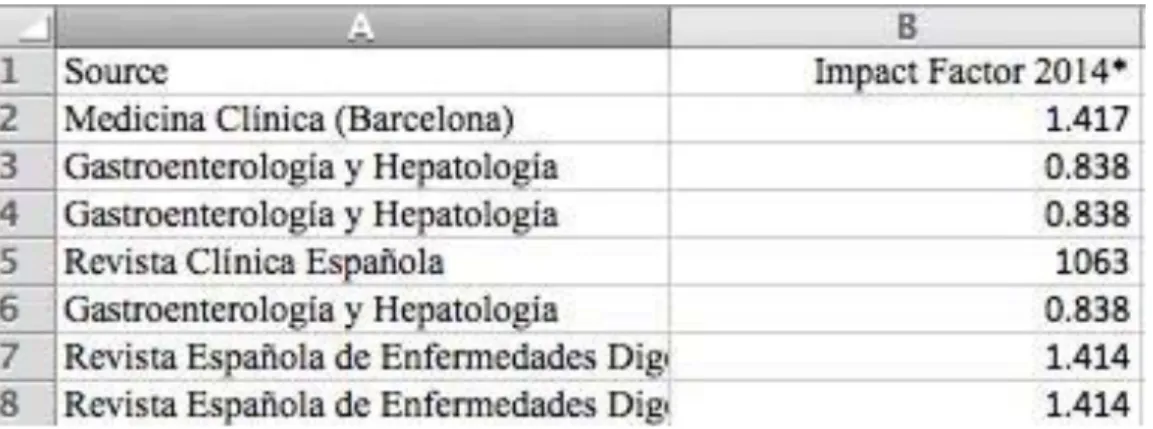
published in the following four Spanish medical journals: Medicina Clínica (Barcelona), Gastroenterología y Hepatología, Revista Clínica Española y Revista Española de Enfermedades Digestivas. (See table 1)
After having explained how the corpus has been created, I would like to determine
the target group the corpus is aimed at. It is addressed to every knowledgeable
professional within the framework of medical translation and specially in the field of
‘hepatitis’. However, this corpus may also be interesting for doctors and for every
professional whose job is related to medicine. The main use of the database and corpus
is to serve as a terminological source and as a medium to find information about the
It is necessary for the users to have some skills before using the corpus. It would be
advisable to have a high level of Spanish. As it has been mentioned before, the corpus is
constituted by articles in Spanish, since they are going to be used as parallel texts to
translate a research paper from English to Spanish.
The image below shows the impact factor of the chosen texts compiled in the
corpus. The impact factors shown in the image are not high if we compare them to the
ones from the English medical journals. Spanish journals do not usually have high
impact factors in the field of medicine, mainly due to the use of Spanish vs English.
However, the texts chosen as parallel texts have high impact factors in terms of Spanish
publications and are mostly read by Spanish doctors, according to experts in the
gastroenterology field.
4. RESULTS :TRANSLATION COMMENTS .
In this section the methods used to translate the terminology and the most
problematic grammatical structures will be explained.
4.1 SOURCE TEXT: BACKGROUND
The translated text is “Chronic Hepatitis C Virus Infection in the United States,
National Health and Nutrition Examination Survey 2003 to 2010”, a research paper
(original research) published in the journal Annals of Internal Medicine, comprised in volume 160. It deals with the study of chronic hepatitis C virus infection in the United
States in order to find the best possible medicine to help diagnose this disease. This
paper has conventions about the layout (superstructure), form and style that are usually
standardized and it has the IMRAD superstructure of research papers. As it is explained
by Méndez Cendón (2014-2015), than means, it includes an Abstract, an Introduction, a
Materials and Methods section, a Results section and a Discussion. I have chosen this
text due to the fact that ‘hepatitis C’ is a condition that interests me a lot. Besides, as it
is shown in its webpage, Annals of Internal Medicine is ranked 5th among 154 general medicine journals. It is one of the most highly cited and influential journals in the
world. It is also asserted in this previous source that “the most recent (2016) Impact
Factor for Annals of Internal Medicine is 17.202—the highest of any specialty journal
in the Clarivate Analytics’ General and Internal Medicine category.”
It should be noted that according to Hatim and Mason's classification of text types
(2014), the predominant function in this text is expository. Its purpose is to inform the
reader about accurate information through a reliable source. In addition, this research
paper has a referential function because it is used to represent phenomena of the world;
in this case, it describes the chronic hepatitis C virus. Then, it would have an
informative sub-function since its purpose is to communicate the facts of this virus.
This scientific writing is characterized for having a high level of formality and
objectivity; non-personal use of language; low use of first and second personal
According to Pearson´s classification of communicative contexts (1998), this text is
an expert-to-expert text. Experts do not explain any terminology in this type of texts.
The author, as well as the reader, share a common language and knowledge, so they are
assumed to have similar level of expertise. In addition, both of them understand the
terms and structures used and there are not definitions of complex terminology.
According to Göpferich's classification (1995), the source text is a progress-
oriented actualizing text, that means that it conveys information intended to advance
science and technology. Due to the fact that it is a research paper, it would be a text with
4.2 TRANSPOSITION
Transpositions are commonly used at the time of translating a scientific text. García
(1993: 139) defined transposition as “A shift in the grammatical structure without
modifying the meaning and basic vocabulary when translating from one language into
another”. The author explains that by using transposition we obtain natural structures
that are usually produced in the TT, instead of forced sentences that try to be similar to
the ones in the ST. Transpositions are also used in cases in which the grammatical
structure of the ST does not exist in the TT. I have translated different grammatical
categories by using transposition:
-
Past participles are some of the structures translated by using a transposition (Seetable 2). A relative clause is sometimes needed for translation of a past participle
(See examples 1-3 in table 2). I have applied this type of transposition several
times along my translation.
-
It is also necessary to bear in mind the transpositions used to translate adverbs. Byusing transposition on table 3, the elements have the same meaning in both
languages, follow the grammatical rules and sound natural at the time of reading
them.
-
Transposition is also used as a translation resource at the time of translatinggerunds. Examples of English gerunds translated into Spanish using transposition
are shown in table 4. I have translated examples 1 and 2 by using a relative clause.
A conditional sentence in Spanish is the result of using a transposition to translate
example 3. Besides, we can observe a gerund transposed into a preposition in
example 4.
ENGLISH SPANISH
persons ever infected personas que nunca han estado infectadas
residents in the population sampled by NHANES
to determine risk factors and exposures
associated with chronic infection.
para determinar los factores de riesgo y
las exposiciones que se asocian a la
infección crónica.
persons aged 16 years or older personas de 16 años o más
(…) no more than one half of persons with chronic HCV infection have been
tested for anti-HCV;
(…) no más de la mitad de personas con infección crónica del VHC han sido sujetas a un análisis de anti-VHC; of the 43 898 persons aged 6 years or
older sampled in NHANES
de las 43 898 personas de 6 o más años
de edad de la muestra de NHANES
However, many persons infected with HCV remain untested and unaware of their infection (…)
Sin embargo, muchas personas infectadas por el VHC permanecen sin ser sujetas a examen e inconscientes de la infección (…)
(…) no more than one half of persons with chronic HCV infection have been
tested for anti-HCV;
(…) no más de la mitad de personas con infección crónica del VHC han sido sujetas a un análisis de anti-VHC; Risk factors are essentially unchanged
from previous periods and were reported by only about one half of infected persons.
Los factores de riesgo no han variado con respecto a periodos anteriores y se han descrito solo en alrededor de la mitad de las personas infectadas
Although increased successful treatment of HCV infection might also cause a decrease in prevalence estimates since the last survey,
Aunque el incremento del tratamiento exitoso de la infección por el VHC pueda causar también una disminución de la prevalencia estimada desde el último estudio
Table 2. Transposition of past participles
ENGLISH SPANISH
ENGLISH SPANISH
cronically de manera crónica
untested sin ser sujetas a examen.
nationally a nivel nacional
significantly de forma significativa
accordingly en consecuencia
approximately aproximadamente
annually anualmente
Table 3. Transposition of adverbs
ENGLISH SPANISH
ENGLISH SPANISH
The prevalence of HCV infection was
1.0% (95%CI, 0.8% to 1.2%),
corresponding to 2.7 million chronically infected persons.
La prevalencia de la infección por el
VHC es de 1.0% (95%IC: 0,8 a 1,2), que se corresponde con los 2,7 millones de personas infectadas
The estimated prevalence of anti-HCV
among persons aged 6 years or older was
1.3% (95% CI, 1.2% to 1.5%),
corresponding to approximately 3.6 million persons (CI, 3.0 to 4.2 million
persons) with past or current HCV
infection in the general U.S. population.
La prevalencia estimada de anti-VHC en
personas de 6 o más años era del 1,3%
(95% IC; 1,2% a 1,5%), lo que corresponde aproximadamente a 3,6 millones de personas (IC, 3,0 a 4,2
millones de personas) con infección
pasada o actual por el VHC en la
población general de Estados Unidos.
Using NHANES data from 2003 to 2010, we estimated that 1.3% of persons in the
general U.S. population,(…), had
anti-HCV…
Si utilizamos los datos de NHANES desde 2003 hasta 2010, estimamos que el
1,3% de la personas de la población
general de Estados Unidos, (…) tenían
Serum samples that were confirmed
positive or indeterminate for anti-HCV
were further tested for HCV RNA using
an in vitro nucleic acid amplification test
for the quantitation of HCV RNA in
human serum or plasma.
Las muestras de suero que se evaluó
como positivas o indeterminadas para el
anti-VHC fueron posteriormente
sometidas a una prueba para el ARN
VHC medianteuna prueba de
amplificación de los ácidos nucleicos in
vitro para la determinación cuantitativa
del ARN VHC en el suero humano o plasma humanos.
Table 4. Transposition of gerunds
4.3 LATIN AND GREEK PREFIXES AND SUFFIXES
Latin and Greek prefixes and suffixes are used in medical academic and
professional registers. They have their own meaning and terms formed with these
affixes are called international terms since they stay the same in all languages. The ones
that appear in the translated text are shown in the following table as well as their
equivalents into Spanish and meanings. (See table 5)
ENGLISH SPANISH MEANING
cirrhosis cirrosis -osis: Combining form meaning
a process, condition, or state, usually abnormal or diseased; production of an abnormal substance, increase of a normal s u b s t a n c e , o r p a r a s i t i c infestation (Farlex Partner Medical Dictionary, 2012).
epidemic epidemia epi-: Prefix denoting upon, over
(American Heritage Dictionary, 2011).
-demic: relating to people or a d i s t r i c t ( M o s b y ' s M e d i c a l Dictionary, 2009).
hepatocelular hepatocelular hepato-: liver (Mosby’s Medical Dictionary, 2009).
carcinoma carcinoma c a r c i n - : c a n c e r ( M o s b y ’s Medical Dictionary, 2009).
-oma: tumor; neoplasm. (Miller-K e a n e E n c y c l o p e d i a a n d Dictionary of Medicine, 2003).
4.4 THE USE OF ACRONYMS
Acronyms have a high rate of occurrence in medical texts and they are used to give
brevity to long complex noun groups that need to be constantly repeated. According to
Ordóñez (1992), if it is possible, acronyms should be translated into Spanish (see
examples 1-5 in Table 6). Besides, Newmark (1988) asserts that if we are dealing with
the translation of institutions or terms whose meaning can be unknown for the reader,
the main point is not to translate the acronym, but to highlight the function of the
institution or the meaning of the term (see example 6 on Table 6).
ENGLISH SPANISH
1. HIV VIH
2. anti-HCV anti- VHC
3. RNA ARN
4. CI IC
5. HCV chronic hepatitis C virus VHC infección crónica por el virus de la hepatitis C
6. NHANES (National Health and Nutrition Examination Survey)
NHANES (Encuesta Nacional de Examen de Salud y Nutrición)
7. RIBA (confirmatory recombinant immunoblot assay)
Ensayo confirmatorio
immunoblot recombinante (RIBA)
4.5 BORROWINGS
About the borrowings it is important to talk about a term that occurs constantly in
the text: screening. As some other words ending with the “-ing particle”, sometimes
they are not translated, as a sign of modernity and globalization (Gutierrez Rodilla,
1996). As it has been previously mentioned, this text is an expert-to-expert text, so both,
the author and the reader have a similar level of expertise. According to this, screening
should not be translated into Spanish. However, I have translated this word as “cribado”
(see table 7 above) because this is the word that Spanish doctors use most of the time
while they are working according to experts.
ENGLISH SPANISH
Qualitative determination of anti-HCV in blood serum or plasmawas measured using direct solid-phase enzyme immunoassay with an anti-HCV
screening chemi-luminescence immunoassay
Se evaluó la determinación cualitativa del anti- VHC en el suero sanguíneo o
plasma utilizando un inmunoensayo enzimático en fase sólida directa mediante un inmunoanálisis
quimioluminiscente para cribado de anti-VHC (sistema de inmunodiagnóstico VITROS,
Screening reactive specimens were then tested using a confirmatory recombinant immunoblot assay
Las muestras reactivas al cribado fueron entonces examinadas utilizando el ensayo confirmatorio immunoblot recombinante
National data on prevalence are useful for the design of programs for HCV
screening, linkage to care, and treatment.
Los datos nacionales de prevalencia son de ayuda para el diseño de programas de
cribado del VHC asociados a la atención y el tratamiento.
4.6 THE PASSIVE VOICE
The passive voice constantly appears in medical texts. In fact, according to Marsh
(1996) passive structures are quite more common in English medical texts than in
medical Spanish ones. These structures are usually translated into Spanish using a
pasiva refleja (see Table 8), which is a type of passive voice that can be used with transitive verbs and that does not show who the performer of the action is. English
passive voice can be also translated using the passive voice with the verb “ser (to be)”t.
Sometimes we decided to use also a passive in Spanish since we checked the corpus and
found that, this use is predominant in the texts extracted from Spanish medical journals
(see table 9).
Another type of passive in English is the “passive infinitive”. There is not an
equivalent passive voice in Spanish so I have translated it using active voice acting as a
relative clause (see table 10, example 1). There is a case (see table 10 example 2) in
which I have translated a passive sentence in English by using the active voice in
Spanish, to make the sentence sound more natural in the TT.
ENGLISH SPANISH
serum samplesfrom participants aged 6
years or older were tested for antibody to HCV.
seanalizó los anticuerpos del VHC en muestras de suero de los participantes de
al menos 6 años.
qualitative determination of anti-HCV in
blood serum or plasma was measured
se evaluó la determinación cualitativa del antiVHC en el suero sanguíneo o plasma
49% of persons with HCV infection did not report either risk factor
en el 49% de las personas infectadas por
el VHC no se encontró ninguno de los factores de riesgo.
however, many persons infected with
HCV remain untested and unaware of
their infection (…) are not captured in case-based surveillance
hin embargo, muchas personas infectadas
por el VHC permanecen sin ser sujetas a
examen e inconscientes de la infección
participants were interviewed in their homes
se entrevistó a los participantes en sus respectivos domicilios
persons aged 16 years or older and
emancipated minors were interviewed
directly
se entrevistó directamente a las personas de 16 años o más y a menores de edad
emancipados
qualitative determination of anti-HCV in
blood serum or plasma was measured
using direct solid-phase enzyme
immunoassay
se evaluó la determinación cualitativa del anti- VHC en el suero sanguíneo o
plasma utilizando un inmunoensayo
enzimático en fase sólida directa
mediante un inmunoanálisis
quimioluminiscente para cribado de
anti-VHC
these participants were considered to be never infected with HCV.
a estos participantes se les consideró como personas nunca infectadas por el VHC.
those who tested positive for anti-HCV
but negative for HCV RNA (resolved
infections; n = 90) and those who had no
serum available for RNA testing (n = 51)
were not included in our analyses
en los análisis no se incluyó a aquellos que tuvieron el anti-VHC positivo pero el
ARN VHC negativo (infecciones
resueltas; n=90) y a aquellos que no
tenían el suero disponible para la prueba de ARN (n=51)
serum samples that were confirmed
positive or indeterminate for anti-HCV
were further tested for HCV RNA
las muestras de suero que se evaluó
como positivas o indeterminadas para el
anti-VHC fueron posteriormente
sometidas a una prueba para el ARN
VHC
of the 43 898 persons aged 6 years or
older sampled in NHANES between
2003 and 2010, a total of 34 039 (77.5%)
were interviewed and 32 791 (96.3% of those interviewed) were examined.
de las 43 898 personas de 6 o más años
de edad de la muestra de NHANES entre
2003 y 2010, se entrevistó a un total de 34 039 (77,5%) y se examinó a 32.791 (el 96,3% de aquellos entrevistados).
serum samples were available for anti-HCV testing for 30 074 persons (91.7%
of those examined)
Se disponía de muestras de suero para la prueba de anti-VHC para 30.074
personas (91,7% de las personas
examinadas).
among the 30 114 persons aged 20 years
or older sampled in NHANES between
2003 and 2010, a total of 22 173 (73.6%)
were interviewed and 21 281 (96.0% of those interviewed) were examined.
entre las 30 114 personas de 20 o más
años de edad registradas en NHANES
entre 2003 y 2010, se entrevistó a un total de 22 173 (73,6%) y se examinó a 21 281 (el 96,0% de aquellos
entrevistados)
serum samples were available for anti-HCV testing for 20042 persons (94.2% of
those examined)
se disponía de muestras de suero para la prueba de anti-VHC para 20042 personas
(94,2% de las examinadas)
Table 8. Translation of passives to pasiva refleja
ENGLISH SPANISH
ENGLISH SPANISH
those with indeterminate results were reported as indeterminate
aquellas con resultados imprecisos
fueron descritas como indeterminadas.
screening reactive specimens were then tested using a confirmatory recombinant immunoblot assay (RIBA) (RIBA HCV
3.0 Strip Immunobot Assay, Chiron,
Emeryville, California)
las muestras reactivas al cribado fueron entonces examinadas utilizando el ensayo confirmatorio immunoblot
recombinante (RIBA) (técnica de
immunoblotting en tira 3.0o RIBA-VHC,
samples with positive results on RIBA
testing were reported as confirmed positive for anti-HCV, those with results
that were negative were reported as negative for anti-HCV, and those with
indeterminate results were reported as indeterminate.
las muestras con resultados positivos en
las pruebas RIBA fueron descritas como positivos confirmados para anti-VHC,
aquellas con resultados negativos fueron descritas como negativas para anti-VHC, y aquellas con resultados imprecisos
fueron descritas como indeterminadas.
these estimates do not include cases of chronic HCV not captured by NHANES
estas estimaciones no incluyen los casos de infección crónica por VHC que no fueron recopilados por NHANES serum samples that were confirmed
positive or indeterminate for anti-HCV
were further tested for HCV RNA
las muestras de suero que seevaluó como
positivas o indeterminadas para el
anti-VHC fueron posteriormente sometidas
a una prueba para el ARN VHC
we considered persons to have chronic
HCV infection if results of their test for
anti-HCV were confirmed positive or indeterminate and results of their test for
HCV RNA were positive.
consideramos que las personas tenían la
infección crónica por VHC si los
resultados de las pruebas para el
anti-VHC eran confirmados como positivos o indeterminados y los resultados de las
pruebas para el ARN VHC fueron positivos.
homeless and incarcerated persons were not
surveyed.
los indigentes y los reclusos no han sido evaluados.
no more than one half of persons with chronic HCV infection have been tested for anti-HCV
(…) no más de la mitad de personas con
infección crónica del VHC han sido sujetas a un análisis de anti-VHC;
Table 9. Translation of passives to passive with the verb “ser”
ENGLISH SPANISH
we considered persons to have chronic HCV infection if results of their test for
anti-HCV were confirmed positive or
indeterminate and results of their test for
HCV RNA were positive.
consideramos que las personas tenían la infección crónica por VHC si los
resultados de las pruebas para el
anti-VHC eran confirmados como positivos o
indeterminados y los resultados de las
pruebas para el ARN VHC fueron
positivos.
incarcerated and homeless persons were not surveyed
personas reclusas o sin techo no participaron en el sondeo
4.7 NOMINAL GROUPS
According to Gillett (2009), nominal groups or noun-based sentences, as well as
nouns, are more common in formal written English than in other structures, such as
verbs. Every nominal group in English is formed by a head and elements that modify
this head (premodifiers). We can deal with pre-modification, where the head of the
nominal group is at the end of it, or postmodification, when the head is the first word of
the nominal group and the modifiers are placed after it, such is the case of Spanish. By
analyzing my translation (see Table 11) we can notice that Spanish is a left-headed
language, due to almost always the modifiers are placed after the head of the nominal
group. However, we can also realize that English is a right-headed language because the
head of the nominal group is premodified.
ENGLISH SPANISH
additional serum available for HCV RNA
testing
suero adicional para la prueba de ARN
VHC
all-cause mortality mortalidad por cualquier causa
anti-HCV screening chemi-luminescence
immunoassay
inmunoanálisis quimioluminiscente para
cribado de anti-VHC
antiviral therapy terapia antiviral
at-risk populations poblaciones de mayor riesgo
blood transfusion transfusion de sangre
case-based surveillance vigilancia en el cribado
Centers for Disease Control and
Prevention’s National Center for Health
Statistics
Centros para el Control y la Prevención
de Enfermedades del Centro Nacional de
Estadísticas de la Salud
chronic hepatitis C virus (HCV) infection infección crónica por el virus de la
hepatitis C (VHC)
chronic infection infección crónica
clinical practice práctica clínica
Computer-Assited Personal Interviewing
system
sistema de Entrevista Personal
confirmatory test prueba de confirmación
confirmatory recombinant immunoblot
assay
ensayo confirmatorio immunoblot
recombinante
decompensated cirrhosis cirrosis descompensada
direct solid-phase enzyme immunoassay
with an anti-HCV screening
chemi-luminescence immunoassay
inmunoensayo enzimático en fase sólida
directa mediante un inmunoanálisis
quimioluminiscente para cribado de
anti-VHC
estimated prevalence of chronic HCV
infection
prevalencia estimada de la infección
crónica por el VHC
estimation of overall anti-HCV
prevalence
estimación de la prevalencia global del
anti-VHC
false-positive results resultados falsos positivos
health burden carga sanitaria
health care system sistema de atención sanitaria
hepatocellular carcinoma carcinoma hepatocelular
in case-based surveillance vigilancia en el cribado de casos
infected persons personas infectadas
in vitro qualitative immunoassay inmunoensayo cualitativo in vitro
in vitro nucleic acid amplification test prueba de amplificación de los ácidos
nucleicos in vitro
laboratory testing análisis de laboratorio
liver cancer cáncer de hígado
lower family income renta familiar baja
medical care atención médica
Mobile Examination Center Centro Móvil de Asistencia Sanitaria
National Center for Health Statistics Institutional Review Board
Consejo de Revisión Institucional del Centro Nacional de Estadísticas de la
Salud
National Health and Nutrition
Examination Survey
Encuesta Nacional de Examen de Salud y
Nutrición
physical examinations exploraciones físicas
policy planning planificación de políticas
positive results on RIBA testing resultados positivos en las pruebas RIBA
possible risks posibles riesgos
primary Funding Source principal fuente de financiación
programs for HCV screening, linkage to
care, and treatment
programas de cribado del VHC asociados
a la atención y el tratamiento
quantitation of HCV RNA determinación cuantitativa del ARN
VHC
resolved infections infecciones resueltas
risk factors factores de riesgo
sampling design muestreo
serum specimens muestras de suero
serum samples muestras de suero
standardized interviews entrevistas estandarizadas
successful treatment tratamiento exitoso
surveillance purposes fines de vigilancia
survey estimates of persons estimaciones de las encuestas de las
personas
survey design for NHANES diseño de encuestas para NHANES
sustained virologic response indicative of cure
una respuesta viral sostenida indicativa de la curación
tests of biological samples pruebas de muestras biológicas
the estimated prevalence of anti-HCV la prevalencia estimada de anti-VHC
typically asymptomatic generalmente asintomáticas
VITROS Anti-HCV Immunodiagnostic
System
Sistema de inmunodiagnóstico VITROS
written informed consent consentimiento informado por escrito
Table 11. Translation of nominal groups
5. CONCLUSIONS
After having analyzed all the results we finally know what the most and less
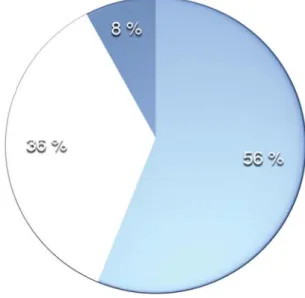
common structures are in medical research papers. The following graphics show a
classification of the total amount of structures translated.
As it is shown in the table above, there is a clear predominance of nominal groups,
followed by the passive voice and transpositions. Acronyms and Latin and Greek
prefixes and suffixes have a high rate of use but they are not so common as the
structures mentioned before. We can also observe that borrowings are the less-used
structure. All of this is clearly shown by the percentages in the graphic below:
Translate d
structures
Nominal groups
Passive voice
Transpositio ns
Acronyms Latin and Greek prefixes and suffixes:
Borrowings
Quantity 56 25 22 7 6 1
Table 12. Number
of
appearance of each structure
Nominal groups Passive voice Transposition
Latin and Greek prefixes and suffixes Acronyms
Regarding the passive voice, we can observe that the pasiva refleja is the structure mostly used when translating a passive structure in a research paper. Passive voice using
the verb “ser” is also frequent and the less-used option is the transition from passive to
active voice. The number of times that each resource has being used in my translation is
shown in the table below and the percentages can be seen in graphic 2.
As far as transpositions are concerned, it has been observed that the structures that
have been most frequently used as transpositions are past participles. It is quite common
to use transpositions in order to translate adverbs. Transpositions are also useful to
translate gerunds but their rate of use is less than past participles or adverbs. The times
Type of passive
Pasiva refleja Passive
with ser Active voice
Quantity 56 25 22
Table 13. Times that the structure was used to translate passive voice
that each of these three previous forms have been used as transpositions is shown in
table number 14 and the percentages can be seen in the graphic below:
In conclusion, we can determine that nominal groups, passives and transpositions
are the most recurrent translation techniques when dealing with the translation of a
medical research paper.
Further research can be conducted for example on the use of these previous three
translation techniques in other registers of the medical language, such as the didactic
and the popularized ones so as to check their frequency of occurrence when translating
texts belonging to these two communicative contexts. These techniques could also be
collected in a translation manual that might help medical translators, doctors and other
experts.
Type of structure
Past participles Adverbs Gerunds
Quantity 10 8 4
Table 14. Times that the structure was translated by using transposition.
References
Annals of Internal Medicine. Retrieved from http://annals.org/aim/pages/about-us
Adamo, G. (2002). La terminología en la teoría y la práctica de la traducción.
Hieronymus complutensis, (9), 85-92.
Cabré, M.T. (2004). La terminología en la traducción especializada. GONZALO GARCíA, Consuelo; GARCíA YEBRA, Valentín. Manual de documentación y
terminología para la traducción especializada. Madrid: Arco Libros, 89-125.
Foster, M. (1958) Translation from/in Farsi and English. Retrieved April, 2007, from
http://www.parasa.ts.com/index.htm.
Garcia, M. D, González, M. T, & Catrain, M. (1993). Transposición y
modulación en la traducción técnica. III Encuentros Complutenses en Torno a la Traducción, 2-6 de abril de 1990, 137.
García Yedra, V. (n.d.). Centro Virtual Cervantes. Retrieved from
https://cvc.cervantes.es/lengua/aeter/conferencias/garcia.htm
Ghazala, Hasan, (1995) Translation as problems and solutions (4th ed.) Syria: Dar
Elkalem ElArabi.
Gillett, A. (2009). Using English for academic purposes. A Guide for Students in Higher Education, School of Combined Studies, Univ. of Hertfordshire.
Göpferich, S. (1995). A pragmatic classification of LSP texts in science and technology.
Gutiérrez Rodilla, B. (1996). El lenguaje médico, un enfermo no imaginario. El Médico,
15, 54-60.
Hatim, B., & Mason, I. (2014). Discourse and the Translator. Routledge.
Hoffman, L. (1979) “Towards a theory of LSP. Elements of a methodology of LSP analysis”. Fachsprache, 12-17.
López Guix, J. G., & Wilkinson, J. M. (2001). Manual de traducción: inglés-castellano: teoría y práctica. Barcelona, Spain.
Marsh, M. (1996). Algunas consideraciones sobre la traducción médica. A. Gil de Carrasco y L. Hickey (comp.), Aproximaciones a la traducción. Centro Virtual
Cervantes.[consulta en línea: http://goo. gl/dWXMBV, 23(05), 2014.
Méndez Cendón, Beatriz. "Traducción de Lenguajes Especializados II (Inglés/Español): Ciencia y Técnica." Class Notes. Valladolid: Universidad de Valladolid, 2014- 2015.
Newmark, P. (1998). More paragraphs on translation. Multilingual matters.
Ordóñez Gallego, A. (1992). Lenguaje médico 1992. Medicina clínica, 99(20), 781-783.
Pearson, Jennifer (1998), Terms in Context, Amsterdam: John Benjamins Publising Company.
Varantola, K. (1986). Special language and general language: Linguistic and didactic aspects. Unesco Alsed-LSP Newsletter (1977-2000), 9(2).
Online Medical Dictionaries
Farlex Partner Medical Dictionary. (2012). Retrieved April 11 2018 from
https://medical-dictionary.thefreedictionary.com/-osis
American Heritage® Dictionary of the English Language, Fifth Edition. (2011).
Retrieved April 11 2018 from https://www.thefreedictionary.com/epi-
Mosby's Medical Dictionary, 8th edition. (2009). Retrieved April 11 2018 from
https://medical-dictionary.thefreedictionary.com/-demic
Miller-Keane Encyclopedia and Dictionary of Medicine, Nursing, and Allied Health,
Seventh Edition. (2003). Retrieved April 11 2018 from
https://medical-dictionary.thefreedictionary.com/-oma
Medical research paper
Denniston, M. M., Jiles, R. B., Drobeniuc, J., Klevens, R. M., Ward, J. W., McQuillan, G. M., & Holmberg, S. D. (2014). Chronic hepatitis C virus infection in the United States, national health and nutrition examination survey 2003 to 2010.