UNIVERSIDAD TÉCNICA PARTICULAR DE LOJA
La Universidad Católica de Loja
ÁREA SOCIO HUMANÍSTICA
TÍTULO DE LICENCIADO EN CIENCIAS DE LA EDUCACIÓN
MENCIÓN INGLÉS
The influence of large classes in the English language teaching-learning
process in Ecuadorian high schools
TRABAJO DE TITULACIÓN.
Autor: Guamantica Aguilar, Juan Francisco
Directora: Arias Córdova, María Olivia, Dra.
CENTRO UNIVERSITARIO MACHALA
ii
APROBACIÓN DEL DIRECTOR DEL TRABAJO DE TITULACIÓN
Doctora.
María Olivia Arias Córdova. DOCENTE DE LA TITULACIÓN
De mi consideración:
El presente trabajo de titulación: “The influence of large classes in the English language teaching-learning process in Ecuadorian high schools” realizado por Guamantica Aguilar Juan Francisco, ha sido orientado y revisado durante su ejecución, por cuanto se aprueba la presentación del mismo.
Loja, February 15, 2016
iii
DECLARACIÓN DE AUTORÍA Y CESIÓN DE DERECHOS
“Yo, Juan Francisco Guamantica Aguilar declaro ser autor (a) del presente trabajo de titulación: The influence of large classes in the English language teaching-learning process in Ecuadorian high schools, de la Titulación de Ciencias de la Educación mención Inglés, siendo María Olivia Arias Córdova director (a) del presente trabajo; y eximo expresamente a la Universidad Técnica Particular de Loja y a sus representantes legales de posibles reclamos o acciones legales. Además certifico que las ideas, conceptos, procedimiento y resultados vertidos en el presente trabajo investigativo, son de mi exclusiva responsabilidad.
Adicionalmente, declaro conocer y aceptar la disposición del Art. 88 del Estatuto Orgánico de la Universidad Técnica Particular de Loja que en su parte pertinente textualmente dice: “Forman parte del patrimonio de la Universidad la propiedad intelectual de investigaciones, trabajos científicos o técnicos y tesis de grado que se realicen a través, o con el apoyo financiero, académico o institucional (operativo) de la Universidad”.
f. ...
iv
DECICATION
There is a small group of important people to me whom I am greatly indebted.
To Jesus Christ, who died for my sins, and thanks to him my life changed positively. A very, very special thanks for being with me all the time and helping me to take the best decisions in my life.
To my father, Francisco Guamantica Paucar, who supported me in my studies from the beginning to the end of this career.
To my mother, Esther Judith Roque Aguilar, who always advised and support me during my studies.
To my sister, Johanna, who was also part of this support.
To my wife, Yuliana, who gave me a reason to keep going on this.
To my sons, Angel and Joel, who also changed my life positively and pushed me to finish all this work.
v
ACKNOWLEDGE
With this work, I want to thank all my teachers from Universidad Técnica Particular de Loja (UTPL), especially Arias Córdova María Olivia, who helped in this graduation and research process.
vi
CONTENTS
Cover ………. i
Aprobación del director del trabajo de fin de titulación ………...……… ii
Declaración de autoría y cesión de derechos………..…... iii
Dedication………..…...v
Acknowledgment……….………..…. vi
Contents ………..vii
ABSTRACT………. 1
INTRODUCTION……… 3
DISCUSSION……….……….. 7
LITERATURE REVIEW ……….………..…. 7
Teaching approaches and methods …...……… 8
Class size ……….…. 10
Managing learning ……….……... 11
Managing large classes……….……. 12
Activities for working with large classes……….…….. 14
Seating arrangement and classroom space ….………..…….. 15
Different levels of proficiency…….……..…..………..…………. 16
Previous studies………...……….. 18
METHOD ………...………. 24
DESCRIPTION, ANALYSIS, AND INTERPRETATION OF RESULTS…………. 26
4.1.1 Quantitative Analysis ……….. 28
4.1.2 Instructional Implications...………. 29
4.1.3 Social Implications………..……….... 39
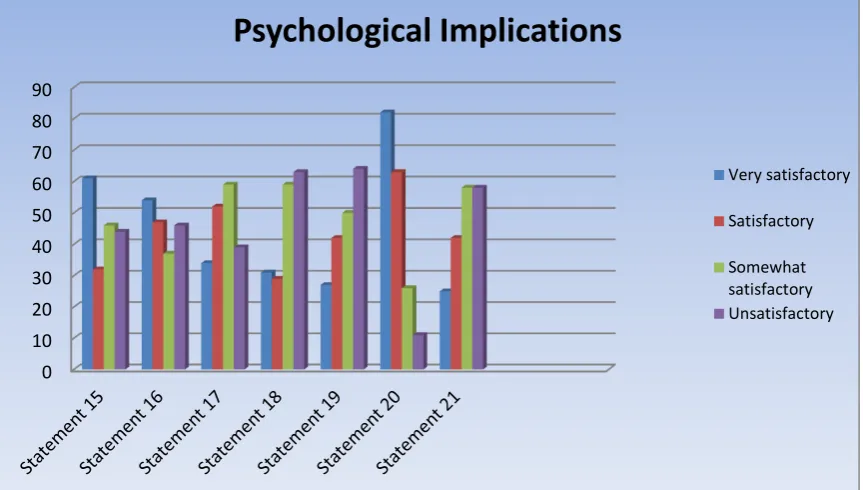
4.1.4 Psychological Implications ……..………..… 45
Conclusions……….………. 53
Recommendations……….……… 54
1
Abstract
This research is about the influence of large classes in the English language teaching-learning process in Ecuadorian high schools. The purpose of this study is to determine what instructional, social, and psychological implications large classes have on the teaching-learning process.
This research took place in two high schools in the City of Machala. It is focused on students from secondary schools of 8th, 9th, and 10th grades, and 1rst and 2nd“bachillerato”.
The methods applied to carry out this research were qualitative and quantitative. The qualitative analysis describes the teaching approaches and methods used in large classes, and other aspects such as class size, managing learning, managing large classes, activities for working with large classes, classroom space and seating arrangement, and different levels of proficiency. The quantitative analysis describes results of questionnaires taken to students based on academic, social and psychological aspects.
This research demonstrates that teaching English to a large number of students has limitations, and in order to face them, teachers must be trained in methods and techniques that can help to succeed in the English language-learning process.
2
Resumen
Esta investigación es sobre la influencia de clases numerosas en el proceso de enseñanza-aprendizaje de idiomas Inglés en las escuelas secundarias del Ecuador. El propósito de este estudio es determinar qué implicaciones de instrucciones, sociales, y psicológicas tienen las clases numerosas en el proceso de enseñanza-aprendizaje.
Esta investigación se llevó a cabo en dos escuelas secundarias en la ciudad de Machala. La investigación se centra en jóvenes estudiantes de octavo, noveno y décimo grado, y primero y segundo año de bachillerato.
Los métodos aplicados para llevar a cabo esta investigación fueron cualitativos y cuantitativos. El análisis cualitativo describe los métodos de enseñanza y los métodos utilizados en las clases numerosas, y otros aspectos como el tamaño de la clase, el manejo del aprendizaje, el manejo de las clases numerosas, actividades para trabajar con clases numerosas y ubicación de los asientos, y los diferentes niveles de competencia. El análisis cuantitativo describe los resultados de los cuestionarios adoptados para los estudiantes basados en aspectos académicos, sociales y psicológicos.
Esta investigación demuestra que la enseñanza de inglés a un gran número de estudiantes tiene muchas limitaciones, y con el fin de hacer frente a estas, los maestros deben ser entrenados en los métodos y técnicas que puedan ayudar a tener éxito en el proceso de aprendizaje de idiomas inglés.
3
Introduction
Teaching English has always been a tool aimed at preparing high school students to understand people and cultures beyond linguistic and geographic limits. Although these students have been studying this language since the primary school, they do not achieve the basic language communicative competence.
In recent years, after an intensive evaluation to English teachers and students, which confirmed the lack of language communicative competence, by the Ecuador government, important decisions have been taken in order to improve the education on this field. In order to give a solution to this issue, different policies and strategies have been implemented such teachers’ training, not only in teaching methods but also in their English language proficiency,
improvement of the curriculum based on international standards, and adding technology to classes so that English language teaching can be improved on its process and quality.
Nevertheless, not all aspects mentioned above may be the only ones that influence the teaching learning process of English language in Ecuadorian high schools. There are other aspects that do not allow students and teachers to accomplish their learning and teaching goals in class, as well. One of those aspects is teaching large classes. Woodward (2001) states that “these problems include noise, too many people and fixed objects in a restricted space, not
enough material for everyone, not being able to respond to different needs, and thedifficulty of organizing anything more than lockstep teaching ” (p. 218). Large classes have been a problem for teachers in Ecuadorian high schools, especially in Public schools, where classes with over 35 students can easily be noticed; thus, they are claimed to be researched due to the fact that teaching English in this kind of classes have, in some cases, advantages and disadvantages in others, as stated by Harmer (1998) “despite of big classes, there are things
4
Therefore, the present research titled “The influence of large classes in the English language teaching-learning process in Ecuadorian high schools” is aimed at determining whether or not large classes affect the English language teaching-learning process. Through this research, the reader will learn what instructional, social, and psychological implications large classes have on the teaching-learning process. And so that those implications can be found, topics related to this research were investigated such as teaching approaches and methods, class size (number of students), managing learning (instructions, feedback, discipline, and timing), managing large classes, activities for working with large classes, seating arrangement and classroom space (physical space- big/small rooms), and different levels of proficiency.
Previous studies have researched on the influence of large classes in the English language teaching-learning process. For instance an study carried out by Thaher (2005) aimed at determining the instructional, psychological and social effect that large classes have
through the analysis and research of students’ aptitude in EFL. To achieve this study, a
questionnaire was distributed among students that were studying English language as a requirement to apply for a university. The results showed that instructional effects have the highest mean over the social and psychological one. It seems that despite the negative aspects of learning English in large classes, there might be some positive aspects that teachers can use. Some recommendations are resolved in this study in order to face the problem of teaching English in large classes.
5
focused on 6 different areas: classroom management, establishing collaboration, range of tasks, giving feedback, classroom English and home assignment.
The results of the study above indicated that classroom management plays an important role in a large class. Fifty percent of students have top expectations of fixed class rules. Another discussion found in this study was enhancing collaboration, which does not happen with all students. Some students were found more frank and sociable than others who like group work and are good at speaking. Around fifty-five percent of students replied that they have enjoyed the group and pair work very much. Range of tasks was also another discussion topic in this study, which confirms that more than twenty-five percent of students expected different activities in a period. Using an appropriate level of English in classroom is very important, too. In this study, only twenty percent of students admitted that their English teacher should speak in English only. And, last discussion was feedback, which is one of the great challenges of teaching in a large class. Ninety-five percent of students reported they like to be informed about their progress.
6
All the results obtained of this research will benefit any education institution, teachers, and students who are involved in this English language teaching-learning process.
7
Discussion Literature Review
Although it seems that in Ecuador teaching English is an easy task for anyone who can speak English fluently, but in reality, it is not. There are several aspects to be considered before deciding to teach English as a career. It requires, an intensive professional training, teaching experience and practice. In addition, this profession implies a high level knowledge of a variety of methods and strategies that must be used according to students’ needs and the learning atmosphere they are immersed in.
From time to time language learning occurs almost instantaneously, and other times it is acquired only through long, arduous study and diligent practice, that is why teaching English should be based on vocation and love for it. Therefore, teachers have a great challenge to improve teaching at any educational institution.
In order to face such challenge, the Ecuadorian Ministry of Education (MinEduc) acknowledges the need to align the English curriculum to standards like the Common European Framework of Reference: Learning, teaching, assessment (CEFR)—which is internationally recognized and provides a common basis for the elaboration of language curriculum guidelines and syllabi, and the Communicative Approach which is currently the most recognized, accepted method in the field of language teaching and learning worldwide because it comprises a theoretically well-informed set of principles about the nature of language and of language learning and teaching (Ecuadorian Ministry of Education, 2011)
8
Teaching approaches and methods, managing learning, lesson design, class size (number of students), classroom space (physical space- big/small rooms), seating arrangement, classroom and/or teaching resources, classroom observation (institution observation/monitoring), learning styles, and language aptitude.
The English language teaching-learning process is something that has worried societies since many years ago; for this reason, several teaching methods have been used through the years. Five of these methods and approaches have been selected for this research.
Teaching Approaches and Methods
As stated above, there are some approaches and methods in language teaching. They refer to general principles and theories, concerning how languages are learned, how language knowledge is represented and organized in memory, and how language itself is structured. The approaches and methods have to be appropriated to the English language teaching-learning process.
According to The Ecuadorian Ministry of Education (2011), today’s most popular approach is the communicative approach. It is the best-known current approach to language teaching. It is characterized by two main features: The first feature is to focus on real-world contexts, because students will ultimately have to use the language productively (through speaking and writing) and receptively (through listening and reading) outside the classroom; classroom tasks/activities must equip students with the necessary skills for communication in everyday contexts. The second one is the relationship of language forms (grammar, vocabulary, and pronunciation) and function (use).
9
encourage students to learn more effectively by working in groups and thinking in term of positive interdependence. In CLL, students are grouped and mixed so that they ask each other to contribute with learning and share responsibility. Teachers guide students with this learning process and are in charge of having students feel responsible for participating and learning. Similarly, Richards and Rodgers (2001) state that “Cooperative Learning is an approach to teaching that makes maximum use of cooperative activities involving pairs and small groups
of learners in the classroom” (p.62).
Alternatively, to learn a second language, Content-Based Learning (TBL) uses tasks as the center of planning and instruction. Richards and Rodgers (2001) argue that there must be 4 conditions for language learning. They are exposed to a rich but comprehensive input of real spoken and written language in use, to use of the language to do things, to motivate to listen and read the language, to speak and write, and instruction in language.
Equally important is the Content-Based Instruction approach which is designed to provide second-language learners instruction in content and language. The same above authors state that teaching is organized around the information that learners will acquire. Content used with a variety of different meanings refers to the subject matter that students communicate through language. Likewise, Larsen-Freeman (2000) states that this approach has been applied for years, which includes content relevant to a particular profession or academic discipline that motivate students to learn a second language.
10
For beginners, lessons require the teacher’s voice, actions, and gestures which are sufficient
basis for classroom activities. Then, the teacher uses classroom objects such as pens, books, furniture and so on. Similarly, Larsen-Freeman (2000) states that “Emphasis is placed on student’s developing basic communication skills and vocabulary through their receiving
meaningful exposure to the target language” (p. 107).
Class size
The number of students in a class plays an important role in the teaching-learning process. There are some advantages and disadvantages of having large and small classes. Harmer (1998) states that working with large classes is difficult for not only teachers, but also students. In case of teachers, they cannot make contact with students, and in case of students, they cannot ask for and receive individual attention. This author also states that having a large class can be impossible to perform dynamic and creative lessons, but there are some options that can be considered in order to manage this size such as the use of worksheets, pair and group work, chorus reactions, and group leaders. On the other hand, Woodward (2001) suggests that having a big number of students can make teachers have the change to work in pairs if there are about 15 students or in groups of 10 if there are more than 30 students, so it can facilitate the language-learning process
11
On the contrary, Woodwards (2010) also suggests that switching to very small group such as one-to-one class, things are totally different, directions such as “all of you”, “everyone”, “get into pair” disappear. In this kind of classes to have to adjust to student pace
and interests and have authentic conversations in your planning. There are many useful books on teaching one-to-one. The authors claims that classes are more flexible with small group, teachers can apply some principles for teaching such as planning plenty of time at the first meeting for getting to know each other, making the encounters as equal as possible by doing the work you ask the students to do yourself, making the occasions you meet a real exchange of information by exchanging things such as poems, books, CDs or cassettes with students, use the students as a resource, bringing other people in, using the local environment, and making plans, recaps and summaries even more clearly and jointly than usual.
Manage Learning
Regarding managing learning, very important aspects have been considered so that students can succeed in the learning process. First of all, the instructions that teacher give in class are essential. According to Davis and Pearse (2000), teachers should use simple and clear instructions so that students are able to understand. Teachers need to have students pay attention and train them in all the principal instruction needed to perform any activity. If the instruction is understood, the activity will go well.
12
technique, students must be able to correct it himself or herself, either with teacher or students’ help. The students must know something is not accurate, where the error is, and
what kind of error it is. According to the authors above, these are the three stages to consider making sure students learn successfully.
Besides, Gower, Phillips, and Walters also state that timing for every activity has to be set. The proper timing of your lessons is an area that ESL teachers need to be aware of.
The thing is that if you come into your lesson with too much or too little planned, you are going to have a hard time. Proper management of your in-lesson time is essential to maintaining a good class. Harmer (1998, p. 124) argues:
Some activities which sound very imaginative end up lasting for only a very short time. Others demand setting-up time, discussion time, student-planning etc. One of the things that undermine the students’ confidence in the teacher is if they never finish what they set out to do. One of the things that irritate them most is when teachers run on after the bell has gone because they have to finish an activity. Thinking about how long an activity will take is a vital part of planning. Most teachers indicate the intended Timing of an activity in their plan.
Managing large classes
13
order, cooperation, and respect in the classroom, it depends on the way you teach and way you are related to the learners.
However, that does not mean that teachers will not be able to manage learning. Saraswathi (2004) states that because of the large size of the class, teachers have to shout in order to be heard, and most of time teachers cannot make sure if all the students, especially those in the back, and listen to the instructions. In addition, individual attention is impossible in large classes. Saraswathi (2004, p. 154) states:
A teacher cannot even get to know the names of all her learners in a large class. A personalized approach, very vital to the process of learning, becomes impossible in a large class. If, however, individual attention is viewed as a means of involving learners, it could be achieved in a large class. When learners do tasks on their own, they learn much better than while passively listening to the teacher. While learners are engaged in group activities,the teacher can learn more from group to group and get to know them intimately.
Davis and Pearse (2000) also state that “it is obviously much more difficult to achieve good results in very large groups. Some of the main problems are: Communication, numbers, and co-operation” (p. 129).
14
With respect to cooperation, the Davis and Pearse (2000) argue that “large groups are most common in captive learner situations—schools and universities where the students are obliged to attend the English courses. This means teachers are always likely to have a fair number of people who simply do not want to be there or to co-operate with teachers and the
other more motivated learners” (p. 129).
What should teachers do regarding large classes? Davis and Pearse (2000, p. 130) state:
There are no magic, guaranteed solutions. The best starting point is probably obtaining the learners' co-operation. If the learners are adolescents or adults, you can discuss the challenges and options they face in their L1. The basic options are everybody co-operating and achieving some worthwhile objectives, or everybody wasting their time. If a majority chooses the first option, which they probably will if you present it attractively, there is pressure on the minority at least not to disrupt the lessons.
If the author mentioned above suggest that, teachers should focus on cooperative learning, which according to Larsen-Freeman (2000), Cooperative learning involves earning from each other in groups. Thus, teachers teach students collaborative or social skills so that they work more effectively.
Activities for working with large classes
15
According to Harmer (1998), there are some things that teacher can do in order to face large classes, so teaching-learning process succeed. Hanging out worksheets with different tasks can be great for having students practice their English language knowledge. After having done these exercises, the teacher can go through the worksheet with the whole group, and all the students will get the benefit. A group exercise can be conducted as an in-class exercise or out-of-class assignment, and it is a very good way to manage the active learning of students in a large class. Before working in groups, it is very important to give clear instructions, so the learning process can flow without misunderstanding about what it has to be done. In group activities, students work together to discuss or solve problems, a process that is also called collaborative learning or cooperative learning. In a large class, students working in pairs or larger groups can help and learn from each other.
Another activity is through chorus reaction. Due to the fact that it is difficult to give individual attention, dividing the class in pairs or groups can be great for practicing dialogues, ask and answer questions, repeat sentences, or a song in chorus.
Another great activity is when doing the workbook (exercises), the teacher can make groups and give each group different section of the workbook. When they finish, they can go with the next one, in this way all the group are working in different exercises. No matter how big the class is, teachers must use the size of the group to their advantages.
Seating Arrangement and classroom space
16
different meaning in a multicultural class. This can cause unease or even offence to other students.
Seating arrangement always affects the learning atmosphere to perform different activities. Gower, Phillips, and Walters (1983) note that with moveable desks, tables or seminar chairs of probably no more than sixteen students, a horseshoe arrangement will allow easy, face-to-face contact between the student and between teachers and students. These authors state that if the class has more than 16 students, teachers may be able to make a double horseshoe, group the students around tables, orderly rows, and circle.
Harmer (1998) also notes that teachers must consider the time for moving furniture, and return the classroom to the original arrangement because this can cause nonconformance for the next teacher that will be in charge of the class. And whatever the seating arrangement is, teachers can have students work as a whole class, in groups, in pairs or individually.
Different levels of proficiency
When teaching a class with students all at different levels, many teachers do not know what to do or where to start. Harmer (1998) states that “as with many other classroom subjects, teachers face this problem every day unless the most rigorous selection has taken place” (p. 10). The mentioned author states that there are possible ways of dealing with this
situation. One way is by making groups and using different materials with different topics according to their levels, or using the different task with the same material. This solution may be frustrated if teachers do not know their students’ level and do not have enough classroom space to work in groups.
17
independent learners, develop strong relationships with their peers, and becoming partners in learning. According to Rogers (2007), four ways to group your students can be applied in this kind of classes. The first is pair work, that is, two students working together. The second one is group work, that is, three to ten students working together. The third one is teamwork, that is, teams of students working together in a competition with other teams. The fourth one is whole-class work, that is, the entire class participating in an activity. All of this means that the role of the teacher is not only to give instructions, but also to make the pairing, grouping and teaming-up of the students.
On the other hand, Woodward (2001) states that working with different levels of proficiency have some inconvenient. It is difficult to meet all the expectations held by each student and difficult to make sure that everyone learns. It also takes too much time for teachers to plan a class for each level of proficiency, and planning for this kind of classes can need more time that not all teachers have. In additions to this, Hess (2001) points out that there are different opinions about what a large class is. This author states that a 20-student class is considered large in different places, while a one-hundred class even with more students is also considered large in different countries. Therefore, the concept of a large class is not exact since attitude toward language, language proficiency, language aptitude and styles are different from one person to another. Other aspects need to be considered such as gender, maturity, occupations, ethnicities, cultural background as well as personalities. In other words, a large multilevel class is not an issue of a class size but perception.
18
among others. However, in order to understand more about the implications that large classes have on the teaching-learning process, an analysis and comparison among five studies were necessary. These studies will help to see what is going on other high schools and have a better understanding of different point of view about this issue. The selected studies deal with the researched topic such as The effects of large class on EFL Students at An-Najah National University, Exploring common expectations from students in large multilevel secondary level English classes, Promoting oral interaction in large groups through task-based learning, How class size reduction mediates secondary students’ learning: hearing the pupil voice, and Class size and language learning in Hong Kong: the students’ perspective.
These studies mentioned above will allow incorporating subjects such as instructional, psychological and social effect of large classes in EFL, common expectations of students inside large classrooms, the lack of oral interaction and the huge amount of students per class, formulating the problem of large EFL classes and choosing a solution for it, differences between teaching and learning in a large class and in a reduced-size class, and to examine whether, and how class size reduction might help to alleviate language learning anxiety. As we can see, previous studies will really enrich this research proposal.
19
some positive aspects that teachers could make use of. The paper concludes with a number of recommendations to cope with the problems of large classes for future application in teaching EFL students.
The second study was carried out by Khati (2010), who explored common expectations from students in large multilevel secondary level English classes. The purpose of this study is to find out the very common expectations of students inside the classroom where students are learning English at a variety of different pace and the classroom is large in size. This study is mainly focused on six different areas: classroom management, establishing collaboration, range of tasks, giving feedback, classroom English and home assignment.
The population was sampled using purposive non-random sampling procedure. To collect primary data, one structured questionnaire was developed containing nineteen closed ended questions. Students were asked to tick the both nominal and ordinal alternatives.
This study reveals many findings at a time regarding the expectations of students in large multilevel classes. Many teachers do not seem to make trouble to learn names of the students but in this study, more than ninety percent students reported that they like to be called by their first names.
20
Sharing experiences like this activity is highly preferred by the considerable (40%) number of students. It shows that sharing experiences of teachers and students has strong motivational drive on the part of students. In the process of data collection, for example, they seemed to be interested in the passage (appendix 1) of 10th grade English (CDC, 2010 p. 104) in which the narrator is telling his story when he got the first pair of trousers. In the data, more than ninety percent students reported that they expect additional activities more than of textbook.
It is clearly revealed that students might have felt boring with the limited and repetitive exercises, materials and techniques used in the prescribed textbook. This study also supports that limited use of mother tongue in English classroom is bearable and accepted. However, while using English, the teacher should introduce some new words every day in simpler and shorter expression. In case of feedback, feedback at personal level inside classroom is more preferable. But William and Burden (1997) recommends for feedback that is informational.
This study also reveals that most of the students like challenging activities, neither too easy, nor too difficult. It is commonly believed that excessive ‘check’ work cannot be
21
On the third study, Forero (2005) promoted oral interaction in large groups through task-based learning. The purpose of this study was to analyze the state of the art to identify possible weaknesses found in the state of the art stage and some data collected in the different classes, to become aware of the lack of oral interaction and the huge amount of students per class, to formulate the problem, to choose the best method as a solution, to make a plan and to consider the methods to get data, and to analyzing and reflecting on data collection in order to get the findings.
The use of task-based learning in large groups helped students to improve oral interaction, but it was a gradual process. It required providing opportunities to practice the language, providing different visual aids and working with topics related to students’ needs
and interests. In addition, to teach English in large groups, it was necessary to use different strategies to maintain motivation such as changing the activities very often, using creative and colorful flashcards and guides, and making a dynamic plan outline.
The control of students’ discipline was very difficult but necessary. Some of the
strategies used were to have different classroom settings (rows, groups, pairs), to promote competition among students (games), and to stimulate.
On the fourth study, Harfitt (2012) analyzed how class size reduction mediates secondary students’ learning. This paper discusses the question of why and how class size can make a difference to teaching and learning from the students’ perspective. Secondary school
contexts and, in particular, the students’ own voice on the issue of class size represent an
22
This paper positions the case studies within a broader context that focuses on class size and the processes that appear to be mediated by class size reduction.
It also draws on interview data and findings from classroom observations. Notably, these data all suggest that students perceive smaller classes as being able to foster a greater sense of belonging and cohesion in their classroom, closer relations with teachers and enhanced participation levels in classroom activities. Crucially, findings also suggest that smaller classes can help to overcome some key cultural obstacles to learning such as language learning anxiety and the issue of ‘face’. Some implications for teachers, trainers and researchers are also presented.
On the fifth study, Harfit (2012) analyzed the students’ perspective of class size and language learning in Hong Kong. The purpose of this study is to examine whether, and how, class size reduction might help to alleviate language learning anxiety, which has long been seen as an obstacle to second language acquisition.
23
The research findings indicate that students reflect on their experiences of studying in reduced-size classes in a mature and confident way. Students reported that smaller classes promoted a strong sense of security within their classroom community and seemed to weaken students’ fears of negative evaluation from their peers and teachers. Students also reported
that they felt more confident about participating in English lessons and these perspectives were supported by evidence from classroom observations.
This small-scale exploratory research study suggests that the student voice can provide insights into language learning classrooms. Data from the case studies reveal that students’
24
Method
Setting and participants
This research took place in the City of Machala in Ecuador, in the south of the city, in two different private and public schools. The participants invited to this research were
students of 8th, 9th, 10th grades of Basic General Education, and 1rst and 2nd grades of Senior General Education . These students receive two hours of English classes daily. Each
classroom has from 35 to 45 students. There is one teacher for each classroom.
Procedure
As soon as the topic of this research was known, several libraries were visited to get information about the content outlines for the literature review and this information was filled out in the corresponding chart. There were 7 topics to be searched on different books, and 5 previous studies in the Internet.
The general approaches applied on this research are Qualitative and Quantitative.. The qualitative method was used for the description of the gathered information.
The purpose of this method is not only to study individuals and events in their natural setting but also to present a natural and holistic picture of the phenomena being studied. The quantitative research was used for the numerical data concerning to teachers and students’ perceptions about teaching English in large classes.
25
formal request was handed in, too, obtaining a positive result. Three grades were surveyed in the second school. Every class was observed before students answered the questionnaire. The questionnaire consisted of 9 questions related to academic issues, 5 questions dealing with social issues, and 7 questions based on psychological issues.
Once the 5 courses were surveyed, the information was tabulated in the corresponding tables in each question. These 3 questions refer to what instructional, social, and
psychological implications large classes have on the teaching-learning process. They were organized by criteria, number of students, and percentages. This information was also used to insert Microsoft Excel graphs which represents the information filled in the table.
The description, analysis and interpretation of results were done by taking into account the quantitative and qualitative tabulation. On this part, the obtained results were taken as references; with this, the researcher shared his criteria through the respective description, analysis and interpretation, based on solid and scientific information, as providing comments and coherent arguments about the researched topic, without losing sight of the goals outlined in this research.
In order to make the qualitative analysis, the information gathered in the literature review was used to check if methods and approaches, and teaching techniques have been used. Additionally, the comparative analysis (quantitative) was made statement by statement which were in the questionnaire focusing on percentages and frequencies of the different criteria. Finally in this section, the researcher introduces his point of view of possible causes for the results obtained.
26
Description, Analysis, and Interpretation of Results
One of the biggest problems often found in teaching English as a foreign language is the large number of students. English teachers prefer not to work with large classes because of the many teaching difficulties they have to face. The purpose of this study is to analyze the influence of large classes in the English language teaching-learning process in Ecuadorian high schools as reflected by their responses to the questionnaire in order to determine what effects (instructional , psychological or social) large classes have on students’ learning.
In this section the results of the survey, which is the main part of this research, will be described, analyzed, and interpreted. To accomplish this purpose, statistical graphs will show the percentages obtained. This survey was held in 2 private and public schools in the City of Machala.
The process of collecting information was complete by following the necessary steps to do so. First, a previous selection of schools was made within the City of Machala. Second, the corresponding formal request was delivered to school selected, which was a private school. Third, the answer to the request was obtained, which was positive. However, 5 grades could not be surveyed in this school due to the fact that there were only 2 grades with 35 students, which is the minimum numbers needed for this research. Thus, a Public school was selected, and the formal request was delivered to it, obtaining a positive answer. 3 large-class courses were surveyed in this last school.
27
Consequently, the results of an investigation process providing specific evidence about the reality of the English language teaching-learning process in Ecuadorian high schools is shown.
The summaries of the results obtained from the statistical analysis are introduced and the main results of the three study questions are highlighted. To analyze the findings, the researcher used the following criteria for analysis:
28
Quantitative Analysis
What instructional implications do large classes have on the teaching-learning process?
To answer this question, the researcher used the total and percentage of students in each criterion, and total of surveyed students. Table (1) and graph (1) shows the results of the first question.
Table (1)
N°
In classes with a large number of students:
T ot ally Ag re e Ag re e P art ia lly Ag re e Dis ag re e T O T A L
STATEMENT f % f % f % f % F %
1. The activities done in class help to apply what students learn in class.
98 53.3 65 35.3 21 11.4 0 0 184 100
2. The activities done allow to practice listening, speaking, reading and writing skills.
95 51.6 57 30.9 31 16.7 1 0.5 184 100
3. The students are attentive and participate in class activities, including those sitting at the back of the classroom.
22 11.9 51 27.7 82 44.6 29 15.8 184 100
4. Varied class activities are used such as group, individual, pair-work activities, etc.
118 64.1 49 26.6 15 8.2 2 1.1 184 100
5. Activities such as plays, competitions, debates, games, etc. are used in class.
43 23.4 40 21.7 66 35.9 35 19.0 184 100
6. Students can cheat during
the test. 13 7.1 15 8.2 37 20.1 119 64.7 184 100 7. Students get distracted by
doing assignments from other subjects.
13 7.1 23 12.5 41 22.3 107 58.2 184 100
8. The seating arrangement facilitates the tasks that are carried out in class.
88 47.8 67 36.4 17 9.2 12 6.5 184 100
9. Students cannot receive regular feedback from the teacher due to the large number of students.
29 Graph 1
Author: Francisco Guamantica
Source: Student’s questionnaire
In statement 1, it is observed that fifty-three point three percent of the surveyed students “totally agree” that the activities done in class help to apply what they learn in class; 35.3% of them “agree”; 11.4% “partially agree”, and 0% “disagree” with it.
There is a clear indication that half of the surveyed students accept that the activities that are being done in class help to apply what they learn in class. Hence, it can be said that teachers are using the appropriate activities from the material studied to succeed in their teaching. Another group of students (35.3%) support this statement, by answering that they agree with it. To this group, these activities are less frequent as the first ones. However, a third group of students (11.4%) state that they “partially agree” with activities done in class; this can reflect that teachers are working on these activities, but not as usual as it has to be. On the other hand, none of this group of student states that these activities are not being done.
0 10 20 30 40 50 60 70
Instructional Implications
Totally Agree
Agree
Parcially Agree
30
Regarding this implication, Richards and Rodgers (2001) suggest that instructional materials play an important role in the language learning. That is, task is essential in planning and instruction due to that fact that activities are involved in real communication; they promote learning and provide both the input and output processing necessary for language acquisition. All of this implies that different roles must be followed in the learning process, especially with large-size class, that is, group participation, monitoring, selection and sequencing of task, preparation of learners for task, and consciousness-raising.
Another important point to be considered is that in order to succeed in teaching English to large-size classes, Cooperative Language Learning (CLL) must be taken into account. Larsen-Freeman (2000) states that CLL is an approach that uses the cooperative activities that make students often stay together and in this way, they learn from practice and how to get along with people, different from themselves; thus, language acquisition is facilitated by students interacting in the target language.
The result above, in the statement 1, gives evidence that a big amount of students 53.3% “totally agree”; 35.3% “agree” accept that activities that help to apply what they learn are being done, but just a few say they are not as frequent as they have to be. Regarding this last group, it seems that teachers have to apply activities more frequently on them, because instructional material play an important role in language learning, and increase the frequently to apply this kind of activities. This, together with an excellent selection and organization in making small and big group, by students interacting in the target language, can improve the language learning process in schools with large classes.
31
Regarding language skills, Harmer (1998) states that students need to be exposed to language in order to learn it, by the teacher using it for them to listen to/see, by listening to tapes, by reading texts, by speaking in role plays, and by writing letters. And there many reasons why getting students to read, write, speak and listen to English. In the first place, students want to be able to read texts in English either for their careers, for study purpose or simple for future. In the second place, the reasons to teach writing include reinforcement, language development, learning style and, most importantly, being able to write in one’s own style. In the third place, the reasons to teach speaking are rehearsal, to get students to have a free discussion. Through feedback teachers can see how well their classes are being done, what language problems and engagement they are having; and when good speaking activities can and should be highly motivating. In the fourth place, one of the main reasons for getting students to listen to spoken English is to let them hear different varieties and accents, rather than just voice of their teacher.
Teachers should find a method that allows them to use activities of different types in large classes. According to Richards and Rodgers (2001), the Communicative Language Teaching (CLT) is an approach with unlimited types of exercises such as accuracy and fluency activities, mechanical, meaningful, communicative practice activities, information-gap activities, jigsaw activities, task-completion activities, information-gathering activities, opinion-sharing activities, information-transfer activities, reasoning-gap activities, role plays. All these activities are designed to be carried out in pairs or small groups. Thus, this approach can help students do activities that best facilitate learning to practice listening, speaking, reading and writing skills, especially in large classes
32
four skills mentioned above. Regarding the other group of students 16.7% “partially agree”, classes need to be focused on all the skills and not just on some as it is probably happening. On the other hand, just 0.5% of students “disagree” with this statement that might mean that it has more acceptance positively for the English language learning process.
As statement 3 shows, only eleven point nine percent of the surveyed students “totally agree” that the students are attentive and participate in class activities, including those sitting at the back of the classroom; 27% of them “agree”; 44.6 “partially agree”; and 15.8 “disagree” with this statement.
With respect to this academic aspect, Harmer (1998) it is difficult for the teacher to make contact with the students at the back and it is difficult for the students to ask for and receive individual attention. This means that it is impossible to prepare dynamic lesson plans because the large-size class makes students unable to walk around, teachers to have contact with all of them. This can be very challenging for inexperienced teachers. It is vitally important to make sure that they remain in contact with the students and that they keep everyone involved. So, if they are asking questions to the class, they must remember to ask students at the back.
33
contact with them most of the time and are not using the correct technique to avoid inattention from students.
In statement 4, it is seen that sixty-four point one percent of surveyed students “totally agree” that varied class activities are used such as group, individual, and pair-work activities;
26.6% of them “agree”; 8.2% “partially agree”; and 1.1% “disagree” with this statement.
Regarding this academic aspect, Harmer (1998) reports that there are some activities and teaching techniques that can be done in large classes. Working with worksheets is one solution for teachers; thus, when feedback stage is reached, teachers can work on the worksheets, so all students will get benefit. Pair and group work are also essential because they make all students participate, even when there is no enough space in the classroom. Another activity, according to this author, might be by using chorus reaction; teachers can divide the class in two groups, left and right, and ask them to repeat loudly a dialogue, and they can practice pronunciation, fluency, and intonation; also playing which group best work. Also, another activity might be by using group leaders; this can help teachers to have the control of the whole class, especially those ones that very big in size, also giving feedback to leaders only, and they can return to the group the share with members. These are just a few activities; others can come up with according to the teaching experience.
34
It is obvious that big groups have disadvantages, but this does not have to be an excuse so that teachers cannot perform well in classes. There are many advantages and activities working with big group as are mentioned above. In most of the classes surveyed in this research a big group of students accept this (64.1%), that is, the activities mentioned are being done in some degree that together with the 26.6% of students who “agree” with it, makes the statement stronger in a good way. On the other hand, just 1.1% of students do not accept it, which is a really small amount.
Statement 5 reveals that twenty-three point four percent “totally agree” that activities such as plays, competitions, debates, and games are used in class; 21.7% of them “agree”, 35.9 “partially agree” and 19% “disagree” with this statement.
Concerning the type of activities mentioned above, it seems that teachers should change their methods in dealing with large-size classes and they should adapt new and different types of activities to their lesson plans. Richards and Rodgers (2001) state that there are unlimited exercise types and activities compatible that can be applied in class with the Communicative Language Teaching Approach, whose activities were mentioned before (see statement 3). Teachers play important roles in this approach. Teachers have to organize the classroom appropriate for communication and communicative activities to facilitate the communication process between all participants in the classroom. During this process the teacher monitors, encourages, and support students in any misunderstanding related to the grammar. Material has the maim role of promoting communicative language use. There are numerous textbooks designed to direct and support this approach and where teachers can find different games, role plays, simulations, and activities that teacher can use in lesson plans.
35
success, thus, it would result in anxiety, discomfort and boredom. The negative findings affect students’ learning and achievement.
Davis and Pearse (2000) indicate that there must be an organization regarding topics and activities of students’ interest. For example: teaching Past Simple to young learners must
be practice in the context of Disneyland rather than that of banks, hotels, and restaurants in a city. Another example might be in the context talking about life of favorite actors/actresses to teach teenagers. Varied activities, interactions and topics joined in chain drills, ‘find -someone-who’ can surveys, team games and competitions such as noughts-and-crosses all help to make a lesson more enjoyable, even for large classes.
As we can see, activities such as plays, competitions, debates, and games are supported by the CLT approach; teachers just need to use them appropriately in large classes. 35.9% of students are somewhat satisfactory, which means that somewhat teachers are working with these kinds of activities, but not as it has to be. This kind of school surveyed request students to buy textbooks which always come with this kind of activities. But if they do not, teachers should find the way to get them, especially nowadays when internet is accessible for most teachers.
The results shown in statement 6 indicated that 7.1% “totally agree” that students can cheat during the test; 8.2% “agree”, 20.1 “partially agree and 64.7% “disagree” with this statement.
Managing large classes on students’ examination can be very frustrated for teachers,
36
does not when it is small, and cheating during the test is indiscipline that can be seen in both cases. Additionally, the author states that individual attention is impossible in large classes.
It is seems that the results in statement 6 show positive feedback for students, but that is not totally true. Teachers know that students always try to cheat on exams, no matter the class is big or small. Teacher must be award and prevent it by using techniques such as preparing different exams, organize rows, changing students’ common seats, etc. By applying
these techniques, cheating on exams will be difficult for students.
Statement 7 shows that 7.1% “totally agree” that students get distracted by doing assignments from other subjects; 12.5% “agree”; 22.3% “partially agree” and 58.2 % disagree” with this statement.
It is not rare to see students doing assignments from other subjects during English classes. This issue happens even in the best ones. By taking into consideration that teaching English to large-size class is much more difficult to get good results, Harmer (1998) notes that “it is difficult to make contact with the students at the back and it is difficult for students to
ask for and receive individual attention” (p. 128), and most of student that are sit at the back are found doing assignments from other subject. In fact, the back is their favorite place.
37
that way, this kind of students we will always have to do something related to the English subject.
The results above shows almost 50% of students who “disagree” with this statement, which might indicate that another 50%, get distracted by doing other subject assignments. This might indicate that these students need to be more motivated in class activities so they have no change to do something else that it is not part of the learning process. Keeping them busy must be teachers’ goal.
Statement 8 shows that 47.8% “totally agree” that the seating arrangement facilitates the tasks that are carried out in class; 36.4% “agree”; 9.2% “partially agree” and 6.5 % “disagree” with this statement.
Harmer (1998) states that there are some advantages when students sit in rows. This is very easy for teachers to see all students, and students can see the teacher. Besides, the teacher can monitor students by walking around in the space these orderly rows allow. When students work with groups, it allows the teacher to focus on groups and not on each student, for example, if there is a group of five working on a task, teachers will check answers on 1 task only, and the leader of the group can share the results.
Additionally, Gower, Phillips, and Walters (1983) state that classroom furniture arrangement always affects the learning atmosphere. Moving furniture to different styles such separate tables, circle, solo work, horseshoe an orderly can help teachers to work better with students, but teachers need to take into account that it takes time to do so, especially after finishing because they have to move the furniture back.
38
front of such classrooms, on an un-raised platform, the teachers stand. In contrast, there was only one classroom with double chairs. More than 70% answered positively on this statement, which tells teachers that seating arrangement is very useful to get good results in the English language learning process.
Statement 9 allows seeing that 31.5% “totally agree” that students cannot receive regular feedback from the teacher due to the large number of students; 17.9% “agree”; 21.7% partially “agree” and 28.8 % “disagree” with this statement. Gower, Phillips, and Walters (1983, p.163) state:
Giving feedback is one of the most important responsibilities of a teacher. By providing ongoing feedback you can help your students evaluate their success and progress. Feedback can take a number of forms: giving praise and
encouragement; correcting; setting regular tests; having discussions about how the group as a whole is doing; giving individual tutorials; etc.
On the other hand, Davis and Pearse (2000) state that teachers should not correct students continually due to the fact that learners will be passive if they do so. Thus, learners must eventually correct themselves. This author suggests that teachers get learners used to self-correcting and give them help when necessary.
39
What social implications do large classes have on the teaching-learning process?
N° In classes with a large number of students: Ve ry satisfac tor y S at isfac tor y S ome what satisfac tor y Unsa tisfac tor y T OT AL
f % f % f % f % f %
10 There is a proper balance of student-student and teacher-student interaction.
99 53.8 57 30.9 23 12.5 5 2.7 184 100
11 Students have the opportunity to build relationships with their classmates.
97 52.7 55 29.9 25 13.6 7 3.8 184 100
12 The teacher has problems
remembering all the students’ names.
32 17.4 44 2.4 69 3.7 39 21.2 184 100
13 The atmosphere is less stressful since the teacher does not ask several questions to the same student.
44 23.9 75 40.8 47 25.5 18 9.8 184 100
14 It is easier for students to use their cellphone or any other mobile device without being seen by the teacher.
40 Author: Francisco Guamantica
Source: Student’s questionnaire
As statement 10 presents, fifty-eight point three percent of the surveyed students
“totally agree” that there is a proper balance of student-student and teacher-student
interaction; 30.9% “agree”; 12.5% partially “agree” and 2.7 % “disagree” with it.
Thaher (2005) states that “it is obvious that the social interaction between the students and their teacher is very important in learning a foreign language” (p. 29). Teachers should be able to build up a collaborative and lively learning atmosphere, thus they can evaluate the quality of their class, and notice how far the students cooperate with each other.
In fact, Larsen-Freeman (2000) states that the Total Physical Response method plays an important role in the interaction with the whole group of students and with individuals by using pictures and occasional words in the student’s native language and by being as
expressive as possible so that students can understand most of the time and have no excuse to
41
misunderstand something in class. The teacher helps students through 3 phases by modeling, and demonstrating understanding by them.
On the other hand, Harmer (1998) claims that in large classes there are some difficulties not only to make contact with the students, but also to organize dynamic and creative teaching and learning sections. This issue may intimidate inexperienced teachers.
As we can see in the results above, only 2.7% percent of students state that student-student and teacher-student-student interaction is not being done properly. Thus, it can be confirmed that most of teachers have teaching experience in this technique and know how to deal with interaction in large classes.
As it is shown in statement 11, 52.7% of the surveyed students “totally agree” that students have the opportunity to build relationships with their classmates; 29.9% “agree”; 13.6% “partially agree” and 3.8 % “disagree” with it.
These results have no much difference from the statement 10, which is focused on social interaction, which, according to Thaher (2005), plays an important role in learning a new language. Therefore, EFL students should interact with each other to benefit mutual learning while building relationships among them.
Regarding students’ relationships in classrooms, Thaher (2005) states that “it appears from the students’ responses that learning in a large class helps them to make more friends and exchange their own English knowledge.” In fact, teachers can benefit from working with large classes, it demands a variety of interactive activities and students can be changed to work with different classmate in most activities, so this can help to increase the relationship between them.
42
are free to talk each other while the teachers are teaching in front of the class, and students are making friends just because they have nothing else to do in class.
As statement 12 presents, seventy point four percent of the surveyed students “totally
agree” that the teacher has problems remembering all the students’ names; 2.4% “agree”;
3.7% “partially agree” and 21.2 % “disagree” with it.
Regarding problems with teaching large classes, Harmer (1998) states that working with large classes is difficult, especially with the students at the back. For inexperienced teachers, this can be frustrated because they may not be able to organize dynamic and interactive activities that permit students and teachers to have more face to face contact and use their names regularly.
On the other hand, Saraswathi (2004) argues that even when teacher cannot get the students’ name easily in large classes, group activities can be prepared meanwhile they focus on groups and not on individuals, so it will be easier to remember student’s name.
In any case, in the results on statement 12, students’ response express that almost 50% of the class agree on that. That is, students express that teacher cannot remember their names and this can cause a disconformity. This issue can brings problems when teachers want to get individual progress report, and in teachers’ meeting at the end of each cycle when teachers talk about each student. But even so, there is a 50 percent of students feeling that teachers can remember their names. This means that some teachers are experienced and know what activities they must use to avoid this problem.
As statement 13 presents, twenty-three point nine percent of the surveyed students
“totally agree” that the atmosphere is less stressful since the teacher does not ask several
43
In regard to the atmosphere in the classroom, Harfitt (2012) mentions in his study that students found it difficult to answer teacher’s questions due to the fact that students look
down on them. Moreover, others found it better to work in small classes than large ones for the simple reason that they can support each other. As a matter of fact, some students get nervous speaking in class, they do not like presentations. Davis and Pearse (2000) state that it is very difficult to get good results teaching to large classes. Student may not be able to see
and hear teacher’s instructions. This can be the reason to have students bored during class and
start doing something else or just talking with their classmate, and create a stressful atmosphere in class.
In contrast, Thaher (2005) mentioned on his study that some students feel an atmosphere of competition because they can share answer and prove their English knowledge. According to these students, they can compete in English activities and this creates a positive learning atmosphere.
The author above also states that the EFL teacher should build up a collaborative and lively learning atmosphere. Teachers are able to judge the quality of their class by noticing students’ cooperation, and find the cause that makes the atmosphere stressful and fix it.
The students’ responses on statement 13 were high. These responses are positive since students show that teachers are creating a positive learning atmosphere, letting all students participate and interact in class. However, there are other responses (9.8%) which might indicate that teachers are not finding the way so that all students can answer their questions, and speak English during class.
As statements 14 presents, seven point six percent of the surveyed students “totally
44
According to the results, a big number of students state they do not use the cellphone during the class. This might indicate that student feel it is not allowed to use or bring cellphones in class.
Using technology has been a boom in students nowadays. Students are involved in this technology revolution and cannot wait to use it. The truth is that most of the students bring the mobile devices to class and use them when they feel the necessity. The use of this devices become easy when teachers face large classes due to the fact that it is easy for students to hide them and use them whenever they want if the teacher is not looking at them.
Most of the surveyed students disagree with the idea of using the cellphone maybe because they know they are not allowed to do so. In Ecuador, authorities and teachers still think that mobile devices are a distraction in the learning process. However, other countries are already using them to be part of the learning process.