Combination of Standard and Complementary
Models for Audio-Visual Speech Recognition
Gonzalo D. Sad, Lucas D. Terissi, and Juan C. G´omez
Lab. for System Dynamics and Signal Processing, Universidad Nacional de Rosario CIFASIS-CONICET, Rosario, Argentina
E-mail: {sad, terissi, gomez}@cifasis-conicet.gov.ar
Abstract. In this work, new multi-classifier schemes for isolated word speech recognition based on the combination of standard Hidden Markov Models (HMMs) and Complementary Gaussian Mixture Models (CG-MMs) are proposed. Typically, in speech recognition systems, each word or phoneme in the vocabulary is represented by a model trained with samples of each particular class. The recognition is then performed by computing which model best represents the input word/phoneme to be classified. In this paper, a novel classification strategy based on comple-mentary class models is presented. A complecomple-mentary model to a particu-lar classjrefers to a model that is trained with instances of all the consid-ered classes, excepting the ones associated to that classj. The classifica-tion schemes proposed in this paper are evaluated over two audio-visual speech databases, considering acoustic noisy conditions. Experimental results show that improvements in the recognition rates through a wide range of signal to noise ratios (SNRs) are achieved with the proposed classification methodologies.
Keywords: Speech Recognition, Audio-Visual Information Fusion, Decision
Le-vel Fusion, Complementary Models.
1
Introduction
Communication among humans is inherently a multimodal process, in the sense that to transmit an idea not only is important the acoustic speech signal but also the visual information during speech, such as mouth movements, facial and body gestures, etc. [4]. This fact has made Audio-Visual Speech Recognition (AVSR) systems a fundamental component in Human Computer Interfaces (HCIs). AVSR systems make use of both acoustic and visual information during speech to per-form the recognition task. Several techniques have been proposed in the literature to combine (or fuse) the audio and the visual information [7]. According to the way the information is combined, the techniques can be classified in: those based on Feature Level Fusion [2][6], those based on Classifier Level Fusion [5], and those based on Decision Level Fusion [3][6].
and Complementary Gaussian Mixture Models (CGMMs). In contrast to the case of standard HMMs, where each class is represented with a model trained with instances of the corresponding class, CGMMs are trained with samples of all the remaining classes. For instance, let consider a vocabulary composed by four classes,a,b,candd, the complementary model to classais trained with samples of classes b, c and d. In particular, two classification schemes are proposed in this paper to handle data represented by single and multiple feature vectors, re-spectively. For the case of single feature vectors, a cascade classification scheme using HMMs and CGMMs is proposed. On the other hand, for the case when data is represented by multiple feature vectors, a decision level fusion strategy is proposed. Two audio-visual databases are employed to test the proposed recogni-tion schemes. To evaluate the robustness of the proposed methods, experiments under noisy acoustic channel are performed. The experimental results show that significant improvements in the recognition task are achieved by the proposed classification methods.
The rest of the paper is organized as follows. The proposed classification schemes are described in sections 2, 3 and 4. The description of the audio-visual databases is presented in section 5. In section 6, the experimental results of the proposed systems are shown. Finally, some concluding remarks and perspectives for future work are included in section 7.
2
Complementary models
Typically, the classifiers used in an AVSR systems are implemented using HMMs. In the training stage, an HMM is trained for each particular word in the vocab-ulary, using several instances of the word to be represented. Then in the recog-nition stage, given an observation sequence associated with the input word to be recognized, the probability of each HMM is computed and the recognized word corresponds to the HMM who gives the maximum probability. This decision rule is expressed in equation (1), whereiis the recognized class,λj is thej-th model
andO is the observation sequence.
i=argmax
j
P(O|λj), (1)
(a) (b)
Class 1 Class 2 Class 3 Class 1 Class 2 Class 3
HMM HMM
HMM GMM GMM GMM
Training Training
Training Training Training Training
[image:3.595.173.448.112.227.2]λ1 λ2 λ3 λIN−{1} λIN−{2} λIN−{3}
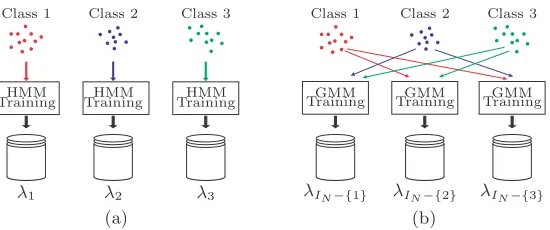
Fig. 1.Training procedure (N = 3). (a) Standard models. (b) Complementary models.
This decision rule can be expressed as follows
i=argmin
j
P O|λIN−{j}
; IN ={1,2,3, . . . , N}, (2)
where iis the recognized class, N is the vocabulary size, λIN−{j} is the model
which has been trained with all the classes in IN except the j class, which
will hereafter be referred to as complementary model. Figure 1 schematically depicts the training procedure for the classifiers based on standard models and complementary models, for the case of a vocabulary with N = 3.
3
Cascade classifiers combination
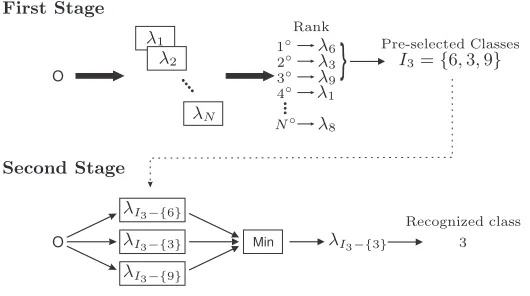
A combination of traditional and complementary models, using a cascade config-uration, is proposed to improve recognition rates. To this end, the recognition is carried out in two stages. First, theM most likely classes are pre-selected using the likelihood scores provided by theλmodels. At this point, the possible solu-tions are reduced to theseM classes. Then, theλIM−{j}complementary models of theseM selected classes are formed. These models will hereafter be referred to asM-class complementary models. Finally, the recognized word corresponds to theλIM−{j} which gives the minimum probability.
Figure 2 schematically depicts the classifier combination strategy proposed in this paper for the case ofM = 3. Given an observation sequence, associated with the word to be recognized, the λ models are ranked according to their corresponding output probabilities. The M = 3 highest ranked models define the classes to be used to form theλI3−{j} complementary models, in this case:
O Min
O
First Stage
Second Stage
1◦
2◦
3◦
4◦
N◦ λ1
λ2
λN
λ6 λ3 λ9 λ1
λ8
Rank
Pre-selected Classes
I3={6,3,9}
λI3−{6}
λI3−{3}
λI3−{3}
λI3−{9}
[image:4.595.178.443.116.264.2]Recognized class 3
Fig. 2.Example of the proposed classifier combination strategy withM = 3.
4
Multimodal fusion strategy
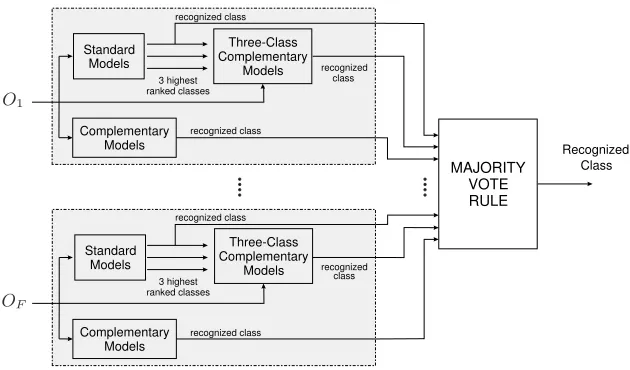
In some cases, the data is represented by multiple features/modalities, each one with its corresponding feature vector. In order to handle this particular situ-ation, a fusion strategy based on a voting scheme is proposed. In Fig. 3, the proposed classification method is schematically depicted for the case of consid-ering data represented by F modalities. It must be noted that now the input of the recognition system are multiple synchronized observation sequences, each one related to each particular modality. For each modality, three decision (class recognitions) are made using classifier based on standard models, complemen-tary models and M-class complementary models, respectively. In particular, in this paper the M-class complementary models are composed considering M = 3. Finally, the individual decisions associated to each particular modalities are combined in a majority vote rule to take the final decision.
5
Audio-visual Databases
The performance of the proposed classification schemes is evaluated over two isolated word audio-visual databases, namely, Carnegie Mellon University (AV-CMU) database (now at Cornell University) [1], and a database compiled by the authors, hereafter referred to as AV-UNR database.
I) AV-UNRdatabase:The AV-UNR database consists of videos of 16
speak-ers, pronouncing a set of ten words (up,down,right,left,forward,back,stop,save,
open andclose) 20 times. The audio features are represented by the first eleven non-DC Mel-Cepstral coefficients, and its associated first and second derivative coefficients. Visual features are represented by three parameters, viz., mouth height, mouth width and area between lips.
II) AV-CMU database: The AV-CMU database [1] consists of ten speakers,
Standard Models
Three-Class Complementary
Models
Complementary Models
3 highest ranked classes
recognized class recognized class
recognized class
Recognized
MAJORITY VOTE RULE
Class
Standard Models
Complementary Models
3 highest ranked classes
Three-Class Complementary
Models recognized class
recognized class
recognized class O1
[image:5.595.149.464.113.298.2]OF
Fig. 3.Fusion strategy for the case of data represented by multiple features/modalities.
the visual information, the weighted least-squares parabolic fitting method pro-posed in [2] is employed in this paper. Visual features are represented by five parameters,viz, the focal parameters of the upper and lower parabolas, mouth’s width and height, and the main angle of the bounding rectangle of the mouth.
6
Experimental Results
The proposed classification schemes presented in sections 3 and 4 are tested separately on the databases described in section 5. Experiments with additive Babble noise, added intentionally to the databases, were performed. To obtain statistically significant results, a 5-fold cross-validation is performed over the whole data in each of the databases, to compute the recognition rates. The clas-sifiers based on standard models are implemented using left-to-right HMMs with continuous observations. For the classifiers based on complementary models and three-class complementary models, Gaussian Mixture Models with continuous observations were used. It is important to note that these models were trained using clean data, and the additive noise was injected to the testing sets.
6.1 Audio only data
−10 0 10 20 30 40 clean 0 20 40 60 80 100 ∫∫ SNR [dB] R e c o g n it io n ra te [% ] Standard models Proposed method (a)
−10 0 10 20 30 40 clean 0 20 40 60 80 100 ∫∫ SNR [dB] R e c o g n it io n ra te [% ] Standard models Proposed method (b)
−10 0 10 20 30 40 clean 20 40 60 80 100 ∫∫ SNR [dB] R e c o g n it io n ra te [% ] Standard models Proposed method (c)
[image:6.595.150.464.109.397.2]−10 0 10 20 30 40 clean 20 40 60 80 100 ∫∫ SNR [dB] R e c o g n it io n ra te [% ] Standard models Proposed method (d)
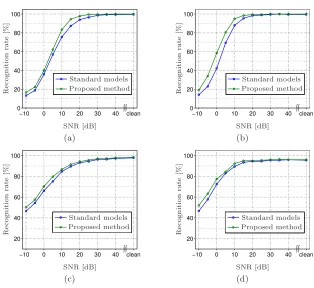
Fig. 4. Recognition rates for the audio ((a) and (b)) and the audio-visual ((c) and (d)) data, using the proposed classifiers. (a) and (c) AV-UNR database. (b) and (d) AV-CMU database.
the AV-CMU database (Fig. 4(b)), the higher accuracy was obtained for HMMs with 3 states and 1 Gaussian mixtures (standard model) and GMMs with 12 Gaussian mixtures (proposed method). As it can be observed, the use of the complementary models improves the recognition over the full range of SNRs.
6.2 Audio-visual data
be observed that the recognition over the full range of SNRs is improved using the complementary models strategy.
6.3 Multi-feature data
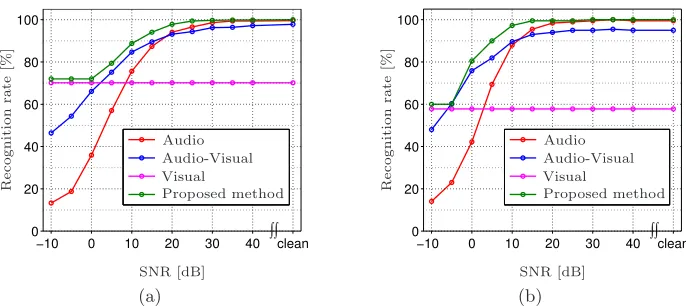
When the acoustic channel is corrupted by noise, which is the usual situation in most applications, an improvement can be achieved by fusing audio and visual features. The efficiency of a classifier based on audio-only information deteri-orates as the SNR decreases, while the efficiency of a visual-only information classifier remains constant, since it does not depend on the SNR in the acoustic channel. However, the use of only visual information is usually not enough to obtain relatively good recognition rates. It has been shown in several works in the literature [4][7], that the use of audio-visual feature vectors (early integra-tion) improves the recognition rate in the presence of noise in comparison to the audio-only case. Different performances can be achieved depending on the amount of information used for each modality. If the recognition rates of these three classifiers (audio, visual, and audio-visual classifiers) are compared, in most cases occurs that each one performs better than the others in different regions of SNR. Usually, visual classifiers achieve better recognition rates at low SNR, audio classifiers at high SNR, and audio-visual classifiers at middle SNR.
Taking into account the previous analysis, the classification strategies de-scribed in 3 and 4 will be used here in combination, aiming at maximizing the efficiency of the recognition system over the different SNRs. The full range of SNRs is split in three regions: from -10dB to -5dB, from 0dB to 15dB and from 20dB to clean. In the lowest region, the visual modality with the classifiers com-bination technique in section 3 is used. In the middle region, the audio, visual, and audio-visual data are used with the proposed fusion strategy in section 4. In the highest region, the audio modality with the classifiers combination technique in section 3 is used.
The results of these experiments over the two databases, are depicted in Figs. 5(a) (AV-UNR database) and 5(b) (AV-CMU database). In these figures, the recognition rates corresponding to the audio, visual and audio-visual classifiers based on standard models (λ) are also depicted. It is clear that the proposed objective of improving the recognition rates over the full range of SNRs has been accomplished for both databases. In addition, the performance of the proposed system is comparable to that of other methods presented in the literature [7].
7
Conclusions
−10 0 10 20 30 40 clean 0
20 40 60 80 100
∫∫
SNR [dB]
R
e
c
o
g
n
it
io
n
ra
te
[%
]
Audio Audio-Visual Visual
Proposed method
(a)
−10 0 10 20 30 40 clean 0
20 40 60 80 100
∫∫
SNR [dB]
R
e
c
o
g
n
it
io
n
ra
te
[%
]
Audio Audio-Visual Visual
Proposed method
[image:8.595.136.479.114.267.2](b)
Fig. 5. Recognition rates for the proposed combined strategy. The recognition rates corresponding to the audio, visual and audio-visual classifiers based on standard models (λ) are also depicted. (a) AV-UNR database. (b) AV-CMU database.
by multiple feature vectors, a classification scheme based on a voting strat-egy which combines scores from individual HMMs and CGMMs was also pro-posed. These classification schemes were evaluated over two audio-visual speech databases, considering acoustic noisy conditions. Experimental results show that in both cases, the proposed methods lead to improvements in the recognition rates through a wide range of signal-to-noise ratios. Absolute recognition rates could be further improved by including noisy features in the training stage.
References
1. AMP Lab.: Advanced Multimedia Processing Laboratory. Cornell University, Ithaca, NY, http://chenlab.ece.cornell.edu/projects/ AudioVisualSpeechProcessing, Last visited: April 2015.
2. Borgstr¨om, B., Alwan, A.: A low-complexity parabolic lip contour model with speaker normalization for high-level feature extraction in noise-robust audiovisual speech recognition. IEEE Transactions on Systems, Man and Cybernetics, Part A: Systems and Humans 38(6), 1273–1280 (2008)
3. Estellers, V., Gurban, M., Thiran, J.: On dynamic stream weighting for audio-visual speech recognition. IEEE Trans. Audio, Speech, Language Process. 20(4), 1145–1157 (2012)
4. Jaimes, A., Sebe, N.: Multimodal human-computer interaction: A survey. Com-puter Vision and Image Understanding 108(1-2), 116–134 (2007)
5. Papandreou, G., Katsamanis, A., Pitsikalis, V., Maragos, P.: Adaptive multimodal fusion by uncertainty compensation with application to audiovisual speech recog-nition. IEEE Trans. Audio, Speech, Language Process. 17(3), 423–435 (2009) 6. Sad, G., Terissi, L., G´omez, J.: Isolated word speech recognition improvements
based on the fusion of audio, video and audio-video classifiers. In: Proceedings of the XV RPIC. pp. 391–396 (Sept 2013)