Constructing social interaction by enhancing the communicative competence through authentic tasks at IED La Belleza-Los Libertadores
Yised Núñez Franco
Universidad Distrital Francisco José de Caldas School of Science and Education
Constructing social interaction by enhancing the communicative competence through authentic tasks at IED La Belleza-Los Libertadores
Yised Núñez Franco
Thesis Director: Eliana Garzón Duarte, M.A.
“a thesis submitted as a requirement to obtain the degree of M.A. in Applied Linguistics to the Teaching of English”
Universidad Distrital Francisco José de Caldas School of Science and Education
Note of acceptance
Thesis Director _____________________________________
Jury: _____________________________________
Acuerdo 19 de 1988 del Consejo Superior Universitario
iii
iv
Libertadores. Ninth graders have been told that by means of learning English they will have a better future. However, the economic situations that students have, take out validity to that argument, and make students understand that English is not really necessary for their conditions of life. Additionally, students` reluctance to participate and the lack of
opportunities to practice the language make even more difficult the learning process in the students. That is why, the main purpose of the research was to identify and describe the social interaction that students constructed when working on authentic tasks whose focus was to put in practice the English language.
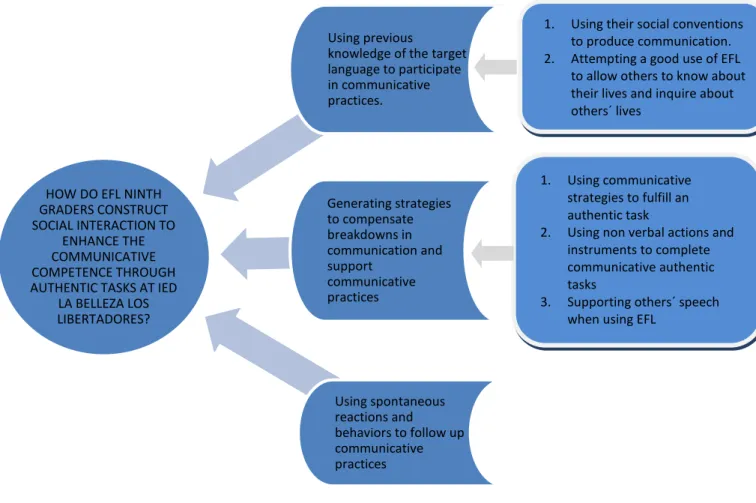
Data were collected from the artifacts produced by the students, the analysis of field notes, and qualitative interviews. And, during 28 lessons students were constructing social interaction by using previous knowledge of the target language, generating strategies to compensate breakdowns in communication and support communicative practices, and by using spontaneous reactions and behaviors to follow up interaction processes.
v
Introduction ... 1
Statement of the Problem ... 2
Research Question ... 6
Research Objective ... 6
Specific objectives ... 6
Rationale ... 7
Chapter II ... 9
Literature Review ... 9
Background to the Study ... 10
Theoretical Framework ... 15
Socio cultural theory. ... 15
The zone of proximal development (ZPD). ... 16
Interaction hypothesis. ... 17
Investment. ... 21
Communicative Competence. ... 23
Chapter III ... 27
Research Design ... 27
Research Paradigm ... 27
Research Approach ... 28
Research Type ... 29
Settings ... 31
Participants ... 31
Sampling Method ... 33
Researcher´s Role ... 34
Data Collection Instruments ... 35
Qualitative interview. ... 35
Field notes. ... 36
Artifacts. ... 38
vi
Curricular Platform ... 40
Visions of curriculum. ... 40
Visions of language. ... 42
Language as doing things: The functional perspective. ... 42
Language as self – expression. ... 43
Visions of learning. ... 44
Experiential Learning. ... 44
Visions of Classroom. ... 45
Emergent socialization. ... 45
Methodology. ... 45
Chapter V ... 52
Data Analysis ... 52
Data Analysis Procedures ... 53
Naming. ... 54
Grouping. ... 55
Finding relationships in the data. ... 56
Displaying. ... 56
Categories. ... 56
Using previous knowledge of the target language to participate in communicative practices. ... 58
Using their social conventions to produce communication. ... 59
Attempting a “good” use of EFL to allow others to know about their lives and inquire about others´ lives. ... 60
Generating strategies to compensate breakdowns in communication and support communicative practices. ... 71
Using communicative strategies to fulfill an authentic task ... 72
Using nonverbal actions and instruments to complete communicative authentic tasks. ... 80
vii
Chapter VI ... 92
Conclusions and Pedagogical Implications ... 92
References... 98
Appendices ... 108
Appendix 1: Students` Questionnaire Chart ... 108
Appendix 2: Students` Questionnaire Analysis ... 109
Appendix 3: Parents’ Survey ... 110
Appendix 4: Parents´ Survey Analysis ... 112
Appendix 5: Teachers’ Interviews Transcriptions ... 116
Appendix 6: Class observation (Notetaking/Notemaking) ... 121
Appendix 7: Questions used in the qualitative interview ... 128
Appendix 8: Parent´s Consent Form ... 129
viii
Figure 2: Field notes chart ... 38
Figure 3: Written Artifacts ... 38
Figure 4: Curricular platform 2014 ... 51
Figure 5. Categories and subcategories ... 57
Figure 6. Formal Language in oral productions ... 60
Figure 7. Formal Language in written productions ... 60
Figure 8. Interactions in class when starting the pedagogical intervention ... 61
Figure 9. Written texts about self-biographies ... 64
Figure 10. Excerpts taken from videos about the family ... 66
Figure 11 Students´ oral presentation related to family issues ... 68
Figure 12. Excerpts taken from field notes when making oral presentations about the family. ... 69
Figure 13. Excerpts taken from interviews done to students and foreigners ... 70
Figure 14 Strategies used in TC oral presentation ... 75
Figure 15 Excerpts taken from a native interview to evidence communicative strategies... 77
Figure 16. Excerpts taken from interaction within the classroom that reflect communicative strategies ... 79
Figure 17 Excerpts taken from oral presentation to evidence the use of visual aids ... 81
Figure 18 Excerpts taken from social interactional practices to support the use of body language ... 83
Figure 19 Excerpts taken from interviews done to students to illustrate strategies used by students. ... 85
Figure 20Excerpts taken from social interactional practices to evidence supporting others´ speech ... 87
Chapter I Introduction
In order to identify the difficulties ninth graders at IED La Belleza – Los Libertadores had, which impeded the use of EFL inside or outside the classroom and as a consequence affected EFL learning process; interviews, questionnaires and surveys were applied to teachers, students´ parents and students, as well as class observation. From these instruments it was identified that students had been told that by learning English, they would have better life conditions in a future, an assumption questioned by Shohamy (2003) who considers that English has been imposed as a symbol of success within the world of international labor and as a symbol of educational status in many parts of the world. However, despite of those discourses, students do not see themselves studying at a university or using EFL in their daily lives due to the socioeconomic situations they have to face. Additionally, data demonstrated that they do not invest time learning or practicing EFL inside or outside the classroom, and they have low self-confidence, as English learners.
through which a child or other novice acquires the knowledge, orientations, and practices that enable him or her to participate effectively and appropriately in the social life of a particular community.
From this perspective, chapter one presents the statement of the problem, the research objectives, and the research question. Chapter two depicts the theoretical framework. For that purpose, the chapter is divided into three main components, a description of the background of the study where there is a description of previous research in order to support the concepts used in the second stage which is the theoretical framework, and finally the conclusions taken out from this theoretical framework. Chapter three explains the research approach, the research type, the research paradigm, the setting, the participants, the researcher´s role and the data collected instruments used for the purpose of this research. Chapter four describes the instructional design used during 28 sessions worked with ninth graders; on it is explained in depth the way as the sessions were done. Chapter five depicts the data analysis gotten from the instruments explained on Chapter three and after implementing the instructional design. Finally, Chapter six portrays the conclusions gotten from this research project, as well as, a reflection on the limitations of this research.
Statement of the Problem
opportunities with foreign countries. This situation has caused that education focuses on the learning of a foreign language with the main purpose of establishing business relationships and being part of globalization process.
From this perspective, the government published in 2006 the Estándares básicos de competencias en lenguas extranjeras: Inglés (Basic competence standards in foreign languages: English) and in 2013 the Law 1651/13, better known as “Ley de Bilingüismo”. By means of them, the Colombian Government highlights the importance of learning a second language in order to allow citizens being more competitive against the international trading and help Colombian people get better life conditions, and if people use it they can access to the wonders of the modern world (Guerrero, 2010). As a consequence of this discourse, English was
established in the Article 8th of the Law 1651/13, as the principal language to teach in public
schools: “El gobierno reglamentará la presente ley…dando prelación al fomento de la lengua inglesa en los establecimientos educativos oficiales…” (p.2) Giving a kind of empowerment to this language.
Bearing this situation in mind, teachers, parents and students at IED La Belleza – Los Libertadores, a school located at Localidad Cuarta de San Cristóbal, were asked about their opinion in relation to the importance, relevance, and use of the English language (See appendices 2, 4 and 5). The main objective of these instruments was to know if they agreed with the
aforementioned discourse. To collect the information, surveys, interviews and questionnaires were applied (See appendices 2, 4 and 5).
with learners in order to motivate them to learn this foreign language (See appendices 4 and 5). As a result, students deem English as a language which can help them to get into a University or have a good job in their future, which will give them social recognition or economic advantages (See appendix 2), as it was found by Dabbagh & Khajehpour (2011). However, some students at IED La Belleza – Los Libertadores mentioned that they do not have expectations to go to the university because of the socioeconomic situations they have to face (living just with one of their parents, grandparents, or other relatives; having unemployed parents or parents that work in informal jobs; living in rented houses; spending their time with teenagers who are part of gangs; and needing money to contribute to pay the bills): “No teacher, cuando yo salga del Colegio, no, yo no puedo estudiar, yo tengo que trabajar porque hay que llevar plata para la casita, de pronto ahorro plata y luego si” (Informal talk with a ninth grader, November, 2013).
Additionally, despite the fact that students consider English useful for their socioeconomic purposes as mentioned before, during a class observation, where a
consider they do not have the capability to do it because they think they do not know English due to the fact that they do not have enough vocabulary.
On the other hand, from the students’ survey (See appendix 3) it was identified that students lack of opportunities to practice the foreign language outside the classroom, they have not had contact with English speakers outside the classroom not even contact with authentic materials or what is more, they do not interact among them by means of the foreign language, situations that affect even more their learning process, as it is limited to the English classroom. These similar situations were depicted by Lee (2007). She has pointed out that the limited time students spend in the English classroom; the lack of opportunities to socialize outside the classroom with people who speak English and the lack of investment of time to practice the language among them are the most important restrictions that students have to face to acquire the language.
Research Question
According to this problematic situation, the following research question leads this study: How do EFL ninth graders construct social interaction to enhance the communicative
competence through authentic tasks at IED La Belleza – Los Libertadores?
Research Objective
To identify and describe the form as EFL ninth graders construct social interaction to enhance their communicative competence while implementing authentic tasks.
Specific objectives
To recognize the social interactions constructed by EFL ninth graders when working on authentic tasks.
Rationale
EFL learning process implies developing receptive or passive skills (listening and reading) and productive or active skills (speaking and writing) (Nunan, 2004; Golkova &
Hubackova, 2014). Considering that receptive or passive skills are concerned in making students to gain knowledge in a passive form without forcing pupils to reproduce it while the active ones push students to produce knowledge it can be concluded that both forms of skills are
co-dependent and necessary in the learning process (Golkova & Hubackova, 2014). From this perspective, literacy considered not just as the merely process of learning how to read and how to write (Hudelson, 1994; Mc Donald 2014) but as the construction of meaning (Hudelson, 1994) and as a social practice that is produced in social settings (Barton & Hamilton, 2000) contributes in the EFL learning process when individuals can learn about the world and share their
understandings with others (Hudelson, 1994).
communities where they live their mastery of advanced English will be affected (Hansen, 1989 as cited by Helman, 2009). Hence, from the sociolinguistic perspective, the communicative competence plays an important role in the literacy development because it involves functions, forms, conventions, and cultural systems (Street, 1993 & Rassool, 1999)
Consequently, this research study informs the academic community about the social interaction practices constructed by EFL ninth graders and the effects produced in the
enhancement of the students´ communicative competence and their literacy development when the pedagogical intervention takes place. Additionally, it contributes to EFL research in the field of sociolinguistic studies where knowing about teaching strategies that cooperate in the
enhancement of students´ EFL communicative competence is required.
From this perspective, this research took into account theoretical perspectives such as: the Sociocultural Theory (Vygotsky, 1978), Interaction Hypothesis (Long, 1996), Investment
Chapter II Literature Review
Teaching a foreign language can be a difficult task when facing problems such as students´ reluctance produced by lack of confidence, fear of making mistakes, cultural factors and teacher effect (Savaşçı, 2014, Choudhury, 2005); the use of teacher centered discourses which give rare opportunities for negotiation of meaning (Antón, 1999); and the lack of
opportunities that students have to use the target language outside the classroom (Lee, 2007). As a response to these problems, research and theories about foreign language learning have been developed.
This chapter encloses the theoretical constructs and literature related to the main topics of this research which contribute to identify and describe the form as EFL ninth graders construct social interaction when learning a foreign language and how they enhance the communicative competences. The main theoretical constructs described in this research are Vygotsky` social development theory, Long´s interaction hypothesis, Norton´s theory of investment and Bachman and Palmer´s communicative language ability theory.
Background to the Study
In learning a language, socialization plays an important role. According to Chaudhari (2013) socialization is the process by which children and adults learn from others and we are constantly learning during our entire lives. In this respect, Garret & Baquedano (2002) affirm that socialization is the process through which a child or other novice acquires the knowledge, orientations and practices that enable him or her to participate effectively and appropriately in the social life of a particular community. And finally, Ochs (2000) defines socialization as a collaborative enterprise where language socialization researchers are in “the business of articulating the architecture of that collaboration” (p.230). She concludes that socialization is a “two way street” where neophytes and more experienced members learn from each other. Taking into account the previous views, socialization is understood in this research project as a
collaborative process by which students construct meaning and knowledge by interacting with their classmates, teacher, and native speakers without leaving behind students’ cultural
background.
In this sense, the background of the study is classified in four main concepts obtained from the findings of previous research: sociocultural theory, interaction, motivation, and communicative competence.
opportunities of learning. In this same perspective, Dass & Ferguson (2012) establish that by using the Zone of Proximal Development (ZPD) learners are challenged to undertake tasks that are difficult for their level and thus teacher´s guidance and assistance are necessary in order to make students internalize the skills required to perform their tasks independently. Finally, Lee (2007) considers that ZPD can benefit others to achieve goals and help them to become
autonomous learners. She also asserts that by means of interaction with native speakers, learners are exposed to functional language within social and cultural contexts, making more realistic the learning process. In this context, when students are exposed to authentic interaction with natives, they reflect on the linguistic and sociopragmatic features to convey messages; they increase their language awareness; and create confidence in the production of their oral skills and consequently increase their academic activities (Polyakov, 2014) important features that are considered in this study when the analysis of constructing social interaction is done.
In this same line, interaction is seen as the heart of communication due to the fact that students use all what they know in real life exchanges. Choudhury (2005) affirms that the best way to learn to interact is by interaction and he also deems that for the creation of an
interactional environment it is necessary to allow students to talk freely without correcting their mistakes. Wang & Castro (2010) consider that interaction focuses on the “negotiation for meaning” (p.181). They state that by interaction, learners can have a better comprehension and acquisition of the target language. Besides, Ho (2011) argues that by interaction, learners not only develop voice identity; and agency in their field, but also, they enhance skills as speaking and writing. Alfaro & Rex (2008) claim that social communication is necessary for the
interactive communicative processes. Antón (1999) asserts that when learners are engaged in negotiation, the functions of scaffolding are achieved by communicative moves such as assisting questions, repetition and nonverbal devices (gestures and pauses). Finally, Olson (1988) asserts that children learn a second language best by interacting with at least two native speakers.
Therefore, for the purpose of this research project, the role of the teacher as a guide in regards to linguistic features; and the role of their classmates and native speakers when interacting by means of EFL as cooperators in the enrichment of the sociopragmatic
characteristics, are of paramount importance because they contribute in analyzing the form as EFL ninth graders construct social interaction when they are participating of authentic tasks. Harris & Marx (2009) define authentic tasks as actions that are situated in meaningful contexts where the learner can perform everyday situations generating motivation. Consequently, by means of people who know more about the language students can learn about others’ cultures, improve the language learning, and consequently their literacy development.
have a great role because learners like cultural based activities such as singing, dancing, role playing, discussing, and doing research on countries and peoples. Thus, for the purpose of this research project, social interaction among native speakers and EFL ninth graders generate expectations on the students that contribute to the enhancement of the communicative competence, as well as, in more time investment in order to fulfill their authentic tasks.
In addition to, Vallejo & Martínez (2011) affirm that by means of communicative tasks students are able to reach the competence. They clarify that communicative tasks involve aspects such as: comprehension, production, and interaction in linguistic, sociolinguistic, and pragmatic aspects. Additionally, these researchers assert that previous knowledge, experience, contexts, sociocultural conditions, and skills should be present in each one of the mentioned aspects. Lasala (2013) affirms that when developing a communicative approach in the learning of a language the study of grammatical competence is as important as the study of sociolinguistic competence. She also considers that communicative and sociolinguistic competence improves when authentic language and real-world tasks are introduced in the classroom instead of using artificial material. Bearing in mind these perspectives, this research project considers that although the focus of EFL learning should be on meaning rather than form, it is undeniable that grammar plays an important role when students need information in relation to the form to convey their ideas even more when they are concerned on doing it “appropriately” specially in their written activities where language does not happen spontaneously.
skills permit students to participate in tasks. This researcher states that in order to facilitate the development of communicative competence teachers should use tasks where the learner focuses on linking ideas and “stop dwelling on isolated words” which do not cooperate in the
comprehension of texts. Additionally, he considers that before using tasks, teachers can discuss about the title, theme and cultural background. Sergeeva (2014) affirms that intercultural interaction with foreign people is enhanced when knowledge of the language and vocabulary is applied. She considers that foreign language communicative competence is not only formed and developed, but it is also lost if the learner is excluded of practical activities. Finally, Poolsawad, Kanjanawasee & Wudthayagorn (2014) consider that teachers must give feedback about
strengths and weaknesses to their students as a way to help students to develop and improve their communicative competence. In this respect, the communicative competence in this research project is strengthened when students experience authentic tasks where they have to use EFL to convey their messages.
Theoretical Framework
Socio cultural theory. Bearing in mind the main concerns of this study which are to identify and analyze the way EFL students construct social interaction when they are using a foreign language, the research project is rooted in Lev Vygotsky`s Socio Cultural Theory (1978).
The term Socio Cultural Theory (henceforth SCT) was used by Wertsch (1985) as a way to grasp the concept that human mental functioning results from the interaction in, and
appropriation of, the forms of cultural intervention incorporated into social activities. But what does exactly SCT mean? SCT was born in contrast to Piaget´s stages of cognitive development. Piaget considers that children act on the environment to learn, whereas Vygotsky (1978) states that learning is a social process where social interaction plays an important role in the
development of cognition. He also deems that everything is learnt by means of interaction with others.
To conclude, for the purposes of this research project SCT is considered as the form as EFL ninth graders socialize with others, where the learner can use their previous concepts in order to construct new meaning and new knowledge. One construct worked on Vygotsky´s SCT is the ZPD, which is discussed in the next section.
The zone of proximal development (ZPD). A factor that Vygotsky considers important in the learning process is the ZPD. Vygotsky (1978) defines the ZPD as “the distance between the actual developmental level as determined by independent problem solving and the level of potential development as determined through problem solving under adult guidance or in collaboration with more capable peers” (p. 33). For Briner (1999) as mentioned by Berns and Erickson (2001) this "zone" is an exploration area where the learner is cognitively prepared, but requires help and social interaction to fulfill his or her goals. In other words, the ZPD is
considered as the interaction between a more competent person and a less competent person on a task, where the less competent person becomes independently proficient by means of an initial jointly- task (Chaiklin, 2003).
Vygotsky (1978) states that, in ZPD, what a child can do with other´s help might be more effective in his or her mental development than what he can do alone. In addition, Lantolf & Thorne (2007) assert that another attribute of ZPD is the notion of assisted performance. Due to the aforementioned characteristics, they affirm that educators and psychologists are captivated by Vygotsky´s research.
which children grow into the intellectual life of those around them” (Vygotsky, 1978:34). Therefore, the ZPD must be understood not only as a model of the developmental process, but also as a tool which can be used by teachers in order to understand learners’ capacities, and as a diagnostic instrument which can help educators to create conditions for learning (Lantolf & Thorne, 2007).
To sum up, ZPD can facilitate the foreign language learning process if it is taken into account that learners need other´s guidance and collaboration in order to have a fully social and cognitive development. In connection with these theories, SCT, in this research project, is understood as the process by which the construction of meaning and new knowledge or modification of previous knowledge takes place through collaboration and interaction. As a consequence, the language learner is considered as a novice who needs of others (Teacher, classmates, and native speakers) who will guide him and help him to develop tasks, knowledge, and understand the world (ZPD). As likely, outcomes by means of social interaction, learners establish social relationships which allow them to learn new knowledge as well as enhance their communicative competence.
Interaction hypothesis. For the main purpose of this research project which consists in identifying and analyzing the form as EFL learners construct social interaction when interrelate among them, the Interaction Hypothesis plays an important role. Concepts such as
The interaction hypothesis is credited to Michael Long. Long (1983) uses Krashen`s insights about the role of comprehensible input in the acquisition of a second language. This applied linguist considers that access of comprehensible input leads to a successful first and second acquisition. Additionally, he states that big amounts of comprehensible input result in faster acquisition. Lastly, Long (1983) thinks that limited access to comprehensible input results in little or no acquisition.
In accordance to Krashen (1982), comprehensible Input makes reference to understanding language that has not been acquired yet. In other words, it is the capability to understand a
message without knowing every single word. Krashen (1982) asserts that the main characteristic of comprehensible input is that the listener is focused on meaning and not in form. Therefore, Long (1983) thinks that comprehensible input is necessary for acquisition and important for interaction. However, Long (1989) admits that comprehensible input may not be sufficient contrasting what he had affirmed in Long (1981), where he considered that in second language acquisition, participation in conversations with native speakers, which allowed the modification of interaction, was the necessary and sufficient condition.
Regarding to interaction, Pica (1987) asserts that social relationships play an important role in interactional modifications. She states that interaction is a social relationship where the participants are aware of their unequal linguistic proficiencies in the second language.
According to Mackey (1999) negotiation is a type of interaction where a nonnative speaker (NNS) can identify an interlocutor’s signal that they do not understand, having as a result an opportunity to modify and use the language that was incomprehensible. For this purpose, Long & Crookes (1987) suggest that teacher should avoid display questions because these inhibit the restructuring of interaction. Besides, Pica (1994) affirms that it is necessary to create classroom conditions in which the negotiation of meaning can work.
As an additional phase, Swain (1995) argues that another element that affects interaction is the comprehensible output. She considers comprehensible output important because learners are “pushed” to convey messages in order to process language more deeply. She considers that when a learner is forced to produce language they are also thinking in syntax. She also considers that an additional benefit is that learners try out new forms of modify others in order to make themselves understandable by the listener. In accordance to Swain (1995), “Output may
stimulate learners to move from the semantic, open-ended, nondeterministic, strategic processing prevalent in comprehension to the complete grammatical processing needed for accurate
production. Output, thus, would seem to have a potentially significant role in the development of syntax and morphology.” (p.128)
To sum up, owing to those conceptions of interaction, Long (1996) concludes that comprehensible input, interaction, and comprehensible output are part of the learning of the second language process. In relation to the former, he affirms that although it is not enough, it is necessary for acquisition. Concerning the second concept, he states that interaction promotes second language acquisition not only by means of comprehensible input, but also by giving opportunities of production. On the latter concept, he recognizes that by means of pushing
learners to produce output, the interlanguage development takes place.
In this context, interaction hypothesis is considered of paramount importance when EFL learners are immersed in authentic tasks where they act as speakers, listeners, writers and readers who need of “the other” in order to get a response or feedback with the purpose of reshaping his or her knowledge and enhance their communicative competence. Consequently, during the interaction process, language learners are pushed to convey messages (Comprehensible output), understand language that they have not acquired (Comprehensible input), and reshape their messages (Negotiation of meaning) practices that will be more evident when pupils interact among them, with the teacher, and native speakers. By giving students the chance to produce language with native speakers, they will require to use strategies in order to convey or
understand messages even more than the used inside the classroom. Besides, they will have the opportunity to evaluate their EFL learning process because of the amount of language they can produce and understand. As a matter of fact, being immersed in authentic practices generate expectative in the students that lead them to invest more time and in motivation.
opportunity to practice the target language inside and/or outside the classroom for the social interaction process.
Investment. Motivation has been always one of the teachers and researchers’ concerns because it is considered that it might influence in the success of learning a foreign/second
language (Dörney, 2009). Gardner & Lambert (1972) set up two kinds of motivation: integrative motivation and instrumental motivation. Integrative motivation refers to the desire of learning a language to integrate with the target community, whereas the instrumental motivation makes reference to the utilitarian purposes the language will have in his/her future such as getting a job or having a career. From this perspective, the learner is seemed as an ahistorical language learner whose desires are to access to the “material resources that are privilege of target language
speakers” (Garzón, 2010).
(2011) consider that when learners invest in a language they expect to receive something that can help them to have access to hitherto unattainable resources.
From this perspective, Norton (1995) and Norton and Toohey (2011) clarify that the concept of investment must not be misunderstood with instrumental motivation proposed by Lambert and Gardner (1972). For Norton (1995) Norton and Toohey (2011), and Norton and McKinney (2011) instrumental motivation conceives the language learner as unitary, fixed, and ahistorical person who wants to have access to the material resources that are the privilege of second language speakers, while investment considers “the language learner as having a complex identity and multiple desires” (p.17).
encourage students in using EFL in a more authentic form and exchanging real information what will result on investing in their learning process.
Communicative Competence. In order to define the communicative competence it should be clarified the concept of competence done by linguists that have influenced in the second language learning. In accordance with Chomsky (1965) “Linguistic theory concerns primarily with an ideal speaker listener, in a completely homogeneous speech-community, who knows its language perfectly” (p.7). Additionally, Chomsky (1965) makes a distinction between competence, understood as the knowledge of grammar; and performance, as the use of language in real situations. On the other hand, Hymes (1972) considered the communicative competence as the ability to use the grammatical competence in communicative situations, bringing the sociolinguistic perspective into Chomsky´s theory.
Later, Canale and Swain (1980) and Canale (1983) consider communicative competence as “underlying systems of knowledge and skill required for communication” (p.5). Canale (1983) emphasizes that communicative competence refers to knowledge, and skill in using the
language code (verbal or non-verbal), “Knowledge of vocabulary, word formation, sentence formation, pronunciation, spelling, and linguistic semantics” (p.7). The sociolinguistic
competence is related to the knowledge and appropriate understanding of rules and conventions that are part of sociolinguistic contexts. The discourse competence makes reference to the mastery to combine grammar and meaning to produce oral and written texts in different genres. In doing so, it is necessary to take into account cohesion and coherence. The strategic
competence deals with verbal or non-verbal strategies the language user masters in order to compensate the breakdowns in communication produced for insufficient competence in one or more components of the communicative competence, or to improve the effectiveness of communication.
On the other hand, Bachman and Palmer (1996) introduce the concept of communicative language ability which involves two components: language competence (language knowledge) and strategic competence (metacognitive strategies). Bachman and Palmer (1996) consider that by means of language competence and strategic competence, language users have the ability or capacity to create, interpret discourses, and answer tasks. According to Bachman and Palmer (1996) characteristics of the language user such as their personal traits, the topical knowledge, affective schemata, and language ability influence in the communicative language ability, however they consider that the language ability is the most crucial one. For these authors language ability has two components: language knowledge and strategic knowledge.
Language knowledge is defined as the mastery of information that a language user has in his memory that can use by means of the metacognitive strategies to create and interpret
pragmatic knowledge. They affirm that organizational knowledge deals with the formal structure of language to produce or understand acceptable sentences, or organized written or oral texts, and is composed by grammatical knowledge (vocabulary, syntax, phonology and graphology) and textual knowledge (comprehension, production, cohesion, and rhetorical or conversational organization). In regards to pragmatic knowledge they state that it is related to abilities that the language user applies to create and interpret discourse by establishing a relation among the sentences and texts with their meanings. Pragmatic knowledge includes functional knowledge which allows us to understand and interpret the relationship among sentences and texts and the intention of the language user, and sociolinguistic knowledge which takes into account the capacity the language user have to create or interpret appropriate language according to the language context, it includes knowing dialects and language varieties, registers, natural or idiomatic expressions, cultural references and figures of speech.
Now, in terms of the strategic competence Bachman and Palmer (1996) define it “a set of metacognitive components or strategies” that are mastered to use language. It integrates the language knowledge components and the characteristics of the language user (personal features, the topical knowledge, affective schemata).
Keeping in mind the theory, the communicative competence in this study is situated in producing the linguistic knowledge that language learners have in their memories and using communicative strategies in order to make themselves comprehensible when conveying messages and interacting with their classmates, teacher, and native speakers. In doing so,
connection, grammar is explained when students require this information with the purpose of writing or speaking “good” because they are concerned on form in order to convey their
messages. In connection with this, the strategic competence is understood as mastering verbal or non-verbal metacognitive strategies in order to follow up communication and overcome
breakdowns in the communicative process when students are producing oral tasks where communication is spontaneous.
Chapter III Research Design
This chapter presents the research methodology that supports this study. It includes the research paradigm, the research approach and the research type. It also describes the setting, the participants, and the researcher´s role. Last, it describes the data collection instruments that were used during the pedagogical intervention.
Research Paradigm
Taking into account the main research objective of this investigation which is to identify and describe the form as EFL ninth graders build social interaction when enhancing the
As a possible result, students may construct knowledge and implement strategies when participating of authentic tasks such as conveying and comprehending a message and comparing their realities with the lived by others, where they are able to enhance the communicative
competence in real contexts. Connecting with this, the lesson plans are designed in order to encourage students to construct and co-construct knowledge when interaction takes place.
Additionally, Creswell (2003) considers that by means of using open – ended questions, the participants can express their ideas and opinions about what they are asked for in order to construct knowledge. In this respect, the students that participate of this research project were asked about the form as they conceived the language before starting the research, their feelings about their participation in authentic tasks, and the strategies implemented to convey messages with the aim to identify and analyze the form as they construct social interaction. Finally, Creswell (2003) states that the researcher is always observing and listening carefully to what participants do or say in their real contexts. As a consequence, the researcher must visit the community and gather information about the context in order to understand the participants’ culture and social features. Because of this; I decided to observe participants’ behaviors and forms to communicate in their natural context with the purpose of identifying and analyzing how they build social interaction by means of EFL.
Research Approach
result, the researcher has the chance to observe and talk directly with the participants (Creswell, 2003) and participants’ voices are heard (Hatch, 200). That is why; this research project took place in situ with students of ninth grade at IED La Belleza – Los Libertadores. And from this perspective, my role is as a teacher-researcher, and as a consequence, I had the opportunity to build rapport, interact, and observe the participants social interactions with the aim of getting useful information used to solve the answer of this research question, which focus is on knowing the way EFL ninth graders construct as social interaction to enhance the communicative
competence through authentic tasks at IED La Belleza – Los Libertadores.
Creswell (2003) considers that qualitative researchers collect data by means of examining documents, observing behavior, or interviewing participants. Reason because, this research project used instruments such as students’ artifacts, field notes based on video recorded classes, and interviews done to the participants of this research. The purpose of using those instruments was to triangulate information and describe the social interaction processes that are distinctive in the participants when participating of authentic tasks.
Research Type
Bearing in mind the main objective of this research that was to identify and analyze the way as EFL ninth graders construct social interaction to enhance the communicative competence through authentic tasks at IED La Belleza – Los Libertadores, the research type implemented was case study. Yin (2003) states that a case study is an empirical inquiry that looks into a contemporary phenomenon embedded in its real – life context, using multiple sources of
individual representative of a group or in a phenomenon. In this sense, the particular
phenomenon under study was the social interaction processes that students built when using EFL in order to identify, analyze and describe those processes.
Yin (2003) affirms that a case study can be classified as explanatory, exploratory and descriptive. According to Yin (2003) an explanatory case study is used to answer a question that tries to explain the presumed casual links in real – life interventions that are difficult to identify by means of surveys or experimental strategies. An exploratory case study explores those situations in which the intervention being evaluated has no clear, single set of outcomes, and a descriptive case study is used to describe an intervention or phenomenon and the real – life context in which it occurred. Schutt (2012) deems that exploratory case study looks into find out the way as people who participate of the research “get along in the setting under question” (p.13), the meanings participants give to their actions, and the issues that concern them.
Settings
The research was carried out at IED La Belleza – Los Libertadores, a public school located in the south - west of Bogotá, in Localidad Cuarta (San Cristóbal). It has two branches, one where the students of primary school take classes (Sede B) located in Los Libertadores neighborhood, and the other one for the students of secondary (Sede A) located in La Belleza neighborhood. The afternoon shift, in sede A, has an average of 450 students. The neighborhood belongs to the UPZ (Unidad de Planeamiento Zonal) No. 5, Los Libertadores from Localidad San Cristóbal. The neighborhood`s socioeconomic strata is 1 and 2.
In the secondary branch (Sede A) the classrooms were organized by areas of study, which means that every teacher had its own classroom and students were the ones who changed of classroom to receive their classes. Additionally, the English classroom had a TV and a tape recorder what made easier the access to listening activities.
Participants
grade and they had big communicative competence differences. Students who belonged to 801 in 2013 were more participative and competitive among them what permitted them to have better academic processes and more knowledge of the language. While students who belonged to 802 in 2013 were passive, lazy and had a low level of compromise what restricted their process and did not permit to advance in the knowledge of EFL. These situations affected the learning process because of their language differences and because they did not feel comfortable when participating in the English class.
Figure 1: Ninth graders who participated in the research process.
understood the teacher`s indications because they acted up what the teacher asked for. Normally, grammar, vocabulary, expressions were the main topics explained
During the research process, the variation was to include authentic tasks in order to ease the production of oral and written texts, students were immersed in activities where they had to use more English and where they had to write and talk about them, a factor that also cooperated in the improvement of self-esteem and self-confidence.
Sampling Method
The sampling used to this research was a purposive sampling. Ritchie, Lewis & Elam (2003) considered that a purposive sampling takes into account particularities or characteristics of a population and has a purpose for the investigator. Dawson (2002) states that purposive sampling´ goal is making descriptions instead of generalizations. From this perspective, this group was selected in first instance because of the particular interest of the researcher due to the fact that I had been teaching them since they were in sixth grade, and consequently, I knew the academic processes they had. Secondly, because after telling them the intention to make a research project with them, students manifested their interest to participate. Finally, I chose the group because of the common characteristics they had such as: the socioeconomic strata, the age, and their interest about the L2. In this sense, the research used a homogenous sampling. Ritchie et al (2003) stated that homogenous sampling takes into consideration the same particularities of a group under research.
Researcher´s Role
In this study I was a participant observant. According to Guest, Namey and Mitchell (2013), participant observation allows the researcher to connect with the context by means of immersion in order to know how and why some people behave in a determined way in specific communities. Thus, considering that the main research objective of this study is to analyze and describe the social interaction processes that students build when they enhance their
communicative skills through the use of authentic task, I was concerned about understanding and describing the specific behaviors that could benefit the enhancement of the communicative competence in the students of ninth grade, such as an active participation, commitment with their process, investment, self-confidence, and language skills development.
During the research process, I was embedded in the specific context from where I wanted to obtain reliable information, the ninth grade at IED La Belleza – Los Libertadores. I had the opportunity to share more time with them in spaces beyond the English classroom, such as museums, coffee shops, and tourist places at downtown of Bogotá city. Those kinds of activities allowed me to spend more time with my students in order to observe their social and learning behaviors and building rapport closer. In accordance to Guest et al. (2013), conducting the observation in situ, inspiring trust and acceptance, and spending time to build rapport and observing or participating for a long period to have a sufficient range of experiences, are the three key elements of a participant observation study.
interact among them or with foreigners, which, according to Guest et al. (2013), it is an inherently paradigm in participant observation.
Data Collection Instruments
The instruments used for the research process were qualitative interviews, field notes, and artifacts. In order to identify the effectiveness and the viability of the instruments, a piloting process was done. In this sense, each instrument was pre-tested with some of the students who were participants of the research process. In accordance to Teijlingen & Hundley (2001), pre-testing the instruments, the process, or the methods might help the researcher to identify their appropriateness or feasibility when using them in the research process. Additionally, Teijlingen & Hundley (2001) consider that by means of piloting the researcher can implement a research protocol and assess it.
Qualitative interview. Qualitative interview is based on conversation. Its main aim is to obtain qualitative descriptions of the life world of the subject with respect to interpretations of their meaning (Kvale, 1996). Bearing in mind the aforesaid, this research used a qualitative interview. The main purpose was to identify the strategies used by students when they were participating of communicative practices, as well as to know their points of view in relation to the
implementation of authentic tasks.
According to Yin (2010), when doing qualitative interviews the dialogue is not scripted which means that the researcher and the participant are not forced to follow the order of
only 10 questions were asked in order to allow freely talk, as it can be evidenced in appendix No.7. Additionally, Yin (2010) states that in qualitative interviewing; the researcher does not adopt any uniform behaviors because the main idea is to have a conversation with the participant. From this perspective, for applying the qualitative interview, the rapport built between the
researcher and the participants was taken into account and a conversational interview was done. Finally, Yin (2010) affirms that one of the most important characteristics of qualitative interviewing is the use of open-ended questions. By means of them participants use their own words to give their opinions related to how they felt when developing authentic tasks, and their feelings when communicating with others. In this sense, this research interview was using open-ended questions in order to allow participants talk freely avoiding manipulating the answers to benefit the research outcomes. The qualitative interview was done after implementing the instructional design in order to observe and identify the way students communicate their ideas.
Field notes. According to Koshy (2005) field notes are used for having evidence of something that happens in order to support the research process. Additionally, Wolfinger (2002) states that field notes are important in qualitative research because they reconstruct events. From this perspective, field notes were of vital importance for this research which main focus was to analyze and describe the socialization processes students have when using EFL in authentic tasks. By means of field notes, I explored students` social behaviors when they were interacting among them or with foreigners in EFL in order to categorize students´ social interaction
Bernard (2006) proposes the use of small notes, which should be written on a computer, and then, should be coded. Additionally, he states that there are four types of field notes: jottings, diaries which can be done by the researcher or students, logs, and field notes produced by the observation of a context. From this angle, students´ voices were taken into consideration by means of video recorded classes, students´ journals, researcher´s journals, and photos taken from authentic tasks done by my students.
Finally, Chiseri-Strater & Sunstein (1997) affirm that aspects such as date, time, place of observation, details of what happens at the site, sensory impressions (sights, sounds, textures, smells, taste), specific words, phrases, summaries of conversations, questions about people or behaviors at the site for future investigation are clue for doing field notes. In addition, Bernard (2006) considers that coding field notes help the researcher to describe and reflect of what is being observed.
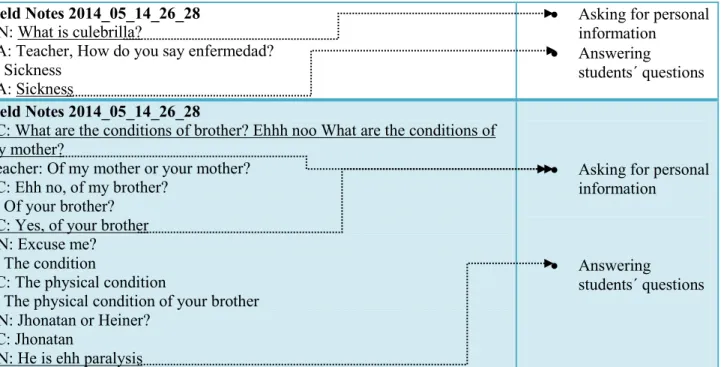
That is why, as it is seen in Figure 2, the field notes chart registered such aspects in order to answer the question proposed in this research which was concerned on the way as EFL ninth graders at IED La Belleza – Los Libertadores construct social interaction while enhancing the communicative competence through authentic tasks
FIELD NOTES CHART Code:
Date: Time: Place:
Taken from: Video Recording Direct observation
Reflexion (Questions, Ideas, Insights)
Figure 2: Field notes chart
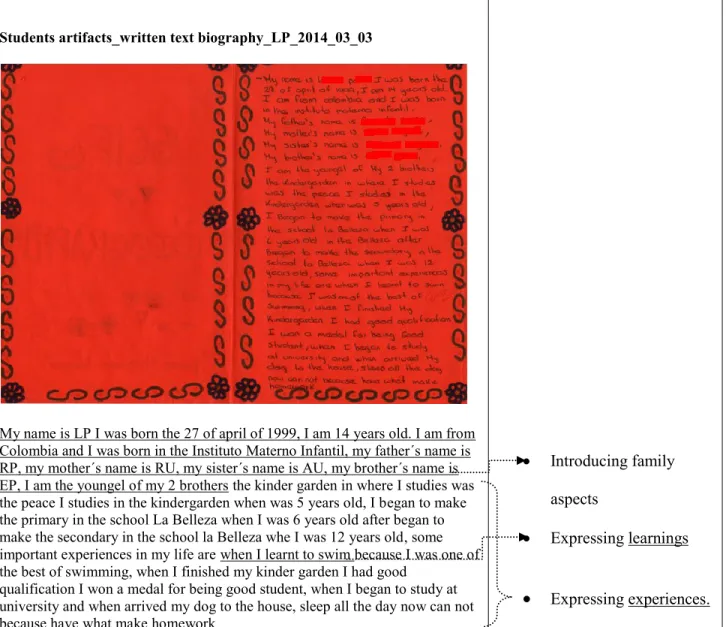
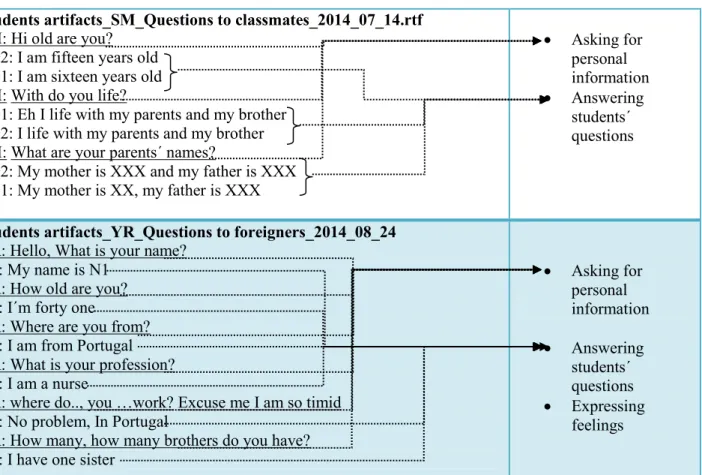
Artifacts. In relation to artifacts, Merriam (2009) points out that they are objects that represent some kind of information of a specific environment. Additionally, Divita (2011) states that an artifact is a concrete thing that helps in the construction of social meanings such as personal and historical meanings which can be narrated. In this sense, the artifacts worked in the research looked into identifying and describing how the social interaction is constructed when enhancing the communicative competence through authentic tasks such as writing about their experiences, feelings, and learnings they had had (Figure 3); speaking about family members´ routines, habits, customs and values taught to them; and listening classmates and foreigners when asking them about their routines, habits, customs and values, as explained in chapter IV.
Ethical Issues
Creswell (2003) affirms that researchers must respect the participants and the places where the research takes place. Additionally, he considers that an “informed consent form” should be signed before the research takes place as a form to protect the participants’ rights. From this perspective, two consent forms were signed. One was signed by students´ parents (Appendix 8), and another one signed by the principal of the Institution (Appendix 9). Some elements suggested by Sarantakos (2005) were taken into account such as: the identification of the researcher, the identification of the sponsoring institution, the identification of the level and type of participant involvement, the identification of the purpose of the research, and the
Chapter IV Instructional Design
This chapter depicts the pedagogical intervention that was used in order to identify and describe the way as students built social interaction by means of practicing and improving the communicative competence in EFL through authentic tasks. In this section the vision of curriculum, vision of language and vision of learning is described as well as the methodology that were used in the research.
Curricular Platform
Visions of curriculum.
According to Richards (2013), curriculum is “the plan of a course where the content is transformed to a blueprint for teaching and learning” (p. 6). Curriculum takes into account three concepts: The input (content of a course), the process (how teaching is carried out), and the output (learning outcomes). Richards (2013) affirms that there are three design processes: The forward design (Goes from input to output), the central design (Starts with process, continues with input and finishes in output) the backward design (Consists of with output, process and input)
with after a methodology has been chosen or developed or during the process of teaching itself” (p.13).
Consequently, after identifying the needs that ninth graders had when analyzing the instruments employed in the needs analysis (see appendixes 2, 4, and 6) six lesson plans were designed and worked during 8 months. The lesson plans took into consideration the authentic tasks to develop with the students, which were oriented on family aspects; and the methods, and techniques, which were focused on Task Based Language Teaching (TBLT). Additionally, during the implementation of the pedagogical intervention, as explained later, it was noticed that students needed input related to grammar issues such as the use of simple past, simple present, present perfect, and the form to do questions. Finally, students were “pushed” to produce output in relation to family aspects where they wrote their biographies, spoke about the values their families had taught them, did presentations about their experiences of life, interviewed classmates and native speakers, and compared their lives with the others´ lives.
convey meaning. However, he clarifies that meaning and form are interrelated, and that the aim of grammar must be allowing the language user to convey different meanings.
Now, in terms of authentic tasks Harris and Marx (2009) state that they are performed in meaningful environments and consider the form as they are found and approached in real life. They also consider that an important feature of authentic tasks is that they have “value and meaning beyond the classroom” (p.80). Additionally, the purpose of authentic tasks is allowing students to experience knowledge in a real life setting in order to provide meaning and
motivation for learning. Besides, authentic tasks permit the participant to relate to real world situations with the purpose of making connections to their own interests and engage with the subject matter. Consequently, students create artifacts that demonstrate the knowledge acquired and the skills developed.
In this sense, for the purpose of this research project, authentic tasks take into consideration meaningful topics, real contexts, and real interactions with the main purpose of enhancing students’ communicative competence. Furthermore, giving students opportunities to interact among them and with native speakers allow them to establish differences not just in the cultures but also in the language.
Visions of language.
seen as a social action that must focus on making language learners use the language in social contexts. In other words, the main idea is to allow students learn a language to do something in or with the language. Tudor considers that students must be involved in communicatively oriented activities where they have to use the language and make it alive in the classroom in order to engage the students in their learning process. Tudor (2001) also deems that the functional perspective needs to consider the varieties of language which means that although pronunciation and correctness are necessary, it is important to understand that students have particularities in their learning process.
Bearing in mind the previous insights, this research considers the concept of “doing things” as tasks such as writing self- biographies, making videos about their families, doing interviews to their classmates and native speakers, and doing oral presentations where students had the opportunity to express their ideas, opinions and feelings about the importance of their families’ teachings in the construction of their lives and compare their lives with the others´ lives by means of EFL. By using these tasks, students were enhancing their communicative
competence, because they had to move from theory to practice.
Visions of learning.
Experiential Learning. Tudor (2001) states that a language can be learned taking into account two factors, the exposure to the TL and the use of the language for communicative purposes. Experiential Learning is seen from two different perspectives: Learning by doing and Experience in Context. Tudor affirms that learning by doing refers to the praxis of the language in which there are five principles. These principles are message focus, holistic practice, the use of authentic materials, the use of communication strategies, and the use of collaborative modes of learning. Message focus refers to convey information by means of learning activities such as role plays, opinion activities, etc. Holistic practice deems that the main point of learning is the ideas or the task that will be performed. The use of authentic materials is the principle which considers the use of real and contextualized materials to be used in a class. The use of
communication strategies refers to the strategies used by students to negotiate meaning. Finally, the use of collaborative modes of learning refers to activities where collaboration among learners exists.
Tudor (2001) affirms that experience in context refers to prepare students to use and understand real language through meaningful experiences. It takes into account the real context of the students, their study habits and their attitudes to the TL.
For the purposes of this study, experiential learning is considered as a form to help students to convey their ideas, feelings and opinions about their families. In this sense, students wrote and spoke about their lives´ experiences, the customs, values, and traditions their families had taught them, and they inquired about others´ experiences in order to compare them.
among them and with native speakers. This means that they had the opportunity to allow their classmates to know about them and understand and learn about others.
Visions of Classroom.
Emergent socialization. In concordance with Tudor (2001), learning a language has its own purposes for the learner. It could be because the pupil has expectations about the language or because it is part of the curriculum. Tudor (2001) classifies the vision of the classroom, in the socialization aspect, in two constructs: the imposed socialization and the emergent socialization. In regards to this research project, the emergent socialization was analyzed. It means that by means of negotiation, students and learners create their own rules and their own forms of socialization where understanding the background of the student plays an important role. In this respect, emergent socialization was evident when students participate in the development of their authentic tasks, by means of social interaction about topics related to their families, habits, and customs, as they established their own rules of social interaction and look for strategies to negotiate meaning.
Methodology.
self-biographies where students had to make a short description of how their families were formed, when and where they were born, and aspects that they wanted to share with their
classmates. In doing so, it was necessary to explain grammar issues (simple past, simple present, can, could, etc.) in order to help students who were concerned on writing in a “good” form. From this perspective, when students were doing things they needed a previous input in relation to the form in order to make EFL alive. After, students were told to check and edit their classmates’ texts. And finally, they read the final paper.
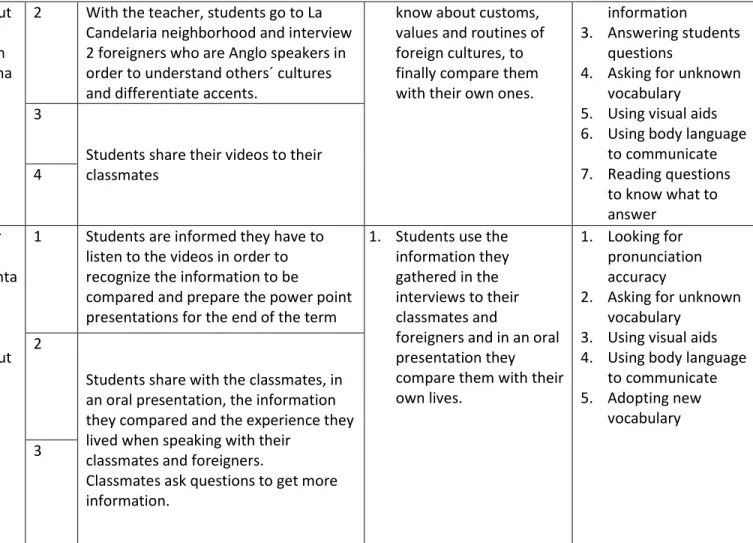
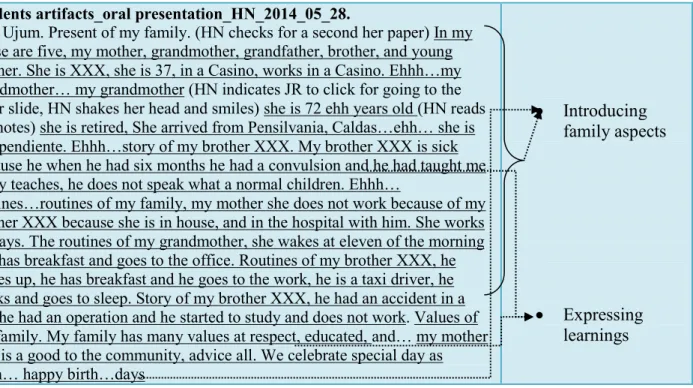
The second authentic task was labeled “My family chronicle”. On it, students made a video about their family members’ routines, habits, customs, and teachings. In order to perform the video, students wrote in the classroom the text to be used in the recording moment. After doing the video, students watched them. The third authentic task was about their feelings about their families. In this connection, students made an oral presentation about their families to allow them know more about them, and they were asking questions to their classmates in order to know more about others´ families.
CURRICULAR PLATFORM – 2014
Area: Humanities Subject: English Cycle: 4th Grade: Ninth Teacher: Yised Núñez Franco Afternoon Shift ESTANDARES CURRICULARES
General Curricular Standards:
Leo y comprendo textos narrativos y descriptivos o narraciones y descripciones de diferentes fuentes sobre temas que me son familiares, y comprendo textos argumentativos cortos y sencillos.
Cuando me hablan sobre lo que hago en la escuela o en mi tiempo libre, comprendo las ideas generales si el lenguaje es claro.
Hago presentaciones breves para describir, narrar, justificar y explicar brevemente hechos y procesos, también mis sueños, esperanzas y ambiciones.
Mi pronunciación es clara pero aún cometo errores y tengo acento extranjero.
En mis redacciones uso el vocabulario y la gramática que conozco con cierta precisión, pero cuando trato temas que no conozco o expreso ideas complejas, cometo errores.
Specific Curricular Standards: Listening:
Entiendo lo que me dicen el profesor y mis compañeros en interacciones cotidianas dentro del aula, sin necesidad de repetición.
Reading:
Identifico relaciones de significado expresadas en textos sobre temas que me son familiares.
Writing:
Escribo narraciones sobre experiencias personales y hechos a mi alrededor. Edito mis escritos en clase, teniendo en cuenta reglas de ortografía, adecuación del vocabulario y estructuras gramaticales.
Monologues:
Hago presentaciones cortas y ensayadas sobre temas cotidianos y personales. Expreso mi opinión sobre asuntos de interés general para mí y mis
compañeros. Conversation:
Participo en una conversación cuando mi interlocutor me da el tiempo para pensar mis respuestas.
Me arriesgo a participar en una conversación con mis compañeros y mi profesor.
Demuestro que reconozco elementos de la cultura extranjera y los relaciono con mi cultura.
Research Objectives:
To analyze and describe how EFL ninth graders at IED La Belleza – Los Libertadores, enhance their communicative skills when using socialization processes in authentic tasks.
General Pedagogical Objectives:
GENERAL TOPIC: TALKING ABOUT THE FAMILY
Time Lesson
Plan Contents/ Vocabulary Resourc es Sessi on No.
Mini task Pedagogical Outcomes/
Final Authentic Tasks
Research Outcomes
February 17th to March 5th 2014 (Six sessions) My Biograph y
Can - Could Simple Past Simple Present Adverbs or frequency Irregular and Regular Verbs Adjectives Family members English Dictiona ry Colored sheet of Paper
1 Students write about family aspects such as how it is compounded, names and age. Additionally, they write about when and where they were born.
1. A written text where students narrate aspects of their lives
2. Reading others
biographies, in order to know about others´ lives.
1. Introducing family aspects.
2. Expressing their experiences
3. Comparing lives
4. Asking for clarification
5. Asking for unknown vocabulary
6. Using instruments to get vocabulary 2 Students write about school moments
lived. Students are explained about grammar aspects related to simple past as a tool to facilitate their writing process.
3 Students write about past important events.
4 Students write about activities they could do when they were child. Finally, by pairs, students read the draft of their classmates and make corrections (Peer editing)
5 Students write their fairy tales in a colored sheet of paper.
6 Students read what others wrote about their families and ask questions. March
26th to April 23rd 2014 (Five sessions) My family Chronicl e Present Perfect Simple Irregular and Regular Verbs Video camera CD Video Beam Comput
1 Students write about the routines, habits and customs their relatives have.
1. A video recorded chronic which reflect their relatives` routines, customs, as well as values, and norms their family have taught
1. Introducing family aspects.
2. Expressing their feelings,
experiences, and learnings