
Executive functions in universal design for learning: moving towards inclusive education
11
0
0
Texto completo
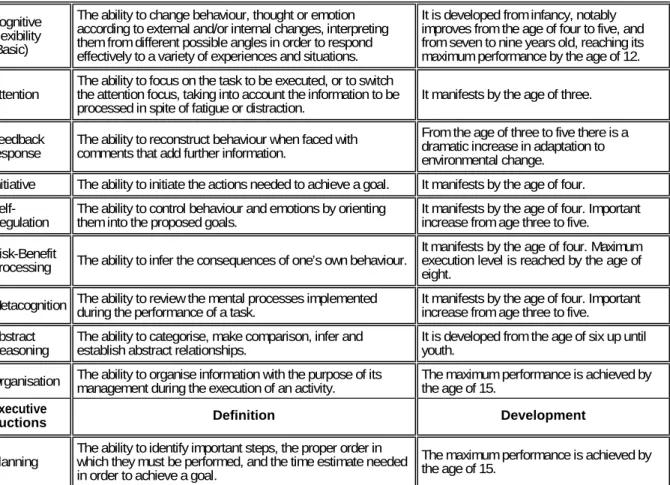
(2) INTERNATIONAL JOURNAL OF INCLUSIVE EDUCATION Copyright Line: © 2018 Informa UK Limited, trading as Taylor & Francis Group ISSN: 1360-3116 (Print) 1464-5173 (Online) Journal homepage: http://www.tandfonline.com/loi/tied20. Executive functions in universal design for learning: moving towards inclusive education María-Dolores García-Camposa,. Cristina Canabala and. Carmen Alba-Pastorb. aDepartment of Education Sciences, University of Alcalá, Alcalá de Henares, Spain bDepartment of Didactics and School Management, Complutense University of Madrid, Madrid, Spain History: received: 2018-02-28 accepted: 2018-05-07 To cite this article: María-Dolores García-Campos, Cristina Canabal & Carmen Alba-Pastor (2018): Executive functions in universal design for learning: moving towards inclusive education, International Journal of Inclusive Education, DOI: 10.1080/13603116.2018.1474955 To link to this article: https://doi.org/10.1080/13603116.2018.1474955. ABSTRACT The aim of this study is to understand the way in which executive functions are promoted in students by analyzing the Universal Design for Learning (UDL) principles, guidelines and checkpoints. After having performed a content analysis of such material, the results show that a little over half of the 31 checkpoints address the 12 executive functions being considered, the most prominent being: feedback response, planning, metacognition and organisation. Among the three brain networks represented in UDL, in particular, cognitive control has a more relevant presence in the strategic and affective networks, which indicates the importance given to teachers promoting that students learn how to anticipate, structure and decide their learning actions, and how students can rebuild their experience and learning, through reflection, revision and improvement processes. It is concluded that UDL not only constitutes a framework that enhances improvement towards barrier elimination to students’ learning and participation, but it also provides guidance for classroom practices that can improve the executive ability of students as long as there is encouragement to develop the affective dimension and its internal management within the learning context.. KEYWORDS: Executive functions; cognitive control; universal design for learning; inclusive education. Introduction The mental processes that intervene during the execution of complex cognitive tasks are known as Executive Functions (EFs), which are ‘a collection of top-down control processes used when going on automatic or relying on instinct or intuition would be illadvised, insufficient, or impossible’ (Diamond 2013, 136). Children manifest their executive control as much in the accomplishment of basic academic skills (such as writing, reading or mathematics), as in the performance of activities in their daily and extracurricular environments. Examples of the latter would be the child’s choice of the best colour to use when painting a certain element; the anticipation of which objects would be needed before playing a game; or the activation of simultaneous mental processes when using a tablet. Promoting EFs (see Table 1 ) in schools as a support system for complex cognitive control is not a novel idea (Diamond and Ling 2016). However, succeeding in promoting them for all students by taking into account their diversity is one of the challenges of inclusive education. Following this idea, the Universal Design for Learning (UDL) approach highlights the need to maximise learning opportunities for all students (Rose and Meyer 2002), promoting attractive and flexible teaching environments that proactively start at the acknowledgement of student diversity (Meyer, Rose, and Gordon 2014). All of that implies being backed by inclusive education that allows for a timeframe that accommodates human differences, inclusive of all students and succeeding in overcoming the existing exclusion in our classrooms (Florian and Black-Hawkins 2011).. Table 1. Executive functions. Executive Fuctions. Definition. Development. Inhibitory Control (Basic). The ability to control behaviour, avoiding impulsivity, automatic response, stimuli interference or irrelevant information during the performance of a complex task.. It manifests by the age of three. It notably improves from age three to six. It again manifests a remarkable development between the age of eight and 14.. Working Memory (Basic). The ability to retain and manage the information needed for the performance of a task.. It manifests by the age of three..
(3) Cognitive Flexibility (Basic). The ability to change behaviour, thought or emotion according to external and/or internal changes, interpreting them from different possible angles in order to respond effectively to a variety of experiences and situations.. It is developed from infancy, notably improves from the age of four to five, and from seven to nine years old, reaching its maximum performance by the age of 12.. Attention. The ability to focus on the task to be executed, or to switch the attention focus, taking into account the information to be processed in spite of fatigue or distraction.. It manifests by the age of three.. Feedback response. The ability to reconstruct behaviour when faced with comments that add further information.. From the age of three to five there is a dramatic increase in adaptation to environmental change.. Initiative. The ability to initiate the actions needed to achieve a goal.. It manifests by the age of four.. SelfRegulation. The ability to control behaviour and emotions by orienting them into the proposed goals.. It manifests by the age of four. Important increase from age three to five.. Risk-Benefit Processing. The ability to infer the consequences of one’s own behaviour.. It manifests by the age of four. Maximum execution level is reached by the age of eight.. Metacognition. The ability to review the mental processes implemented during the performance of a task.. It manifests by the age of four. Important increase from age three to five.. Abstract Reasoning. The ability to categorise, make comparison, infer and establish abstract relationships.. It is developed from the age of six up until youth.. Organisation. The ability to organise information with the purpose of its management during the execution of an activity.. The maximum performance is achieved by the age of 15.. Executive Fuctions Planning. Definition The ability to identify important steps, the proper order in which they must be performed, and the time estimate needed in order to achieve a goal.. Development The maximum performance is achieved by the age of 15.. Note: Adapted from Cartwright (2012); Diamond (2013); Flores, Castillo, and Jiménez(2014); Montgomeryand Koeltzow (2010); Kochanska and Aksan (2006).. UDL proposes a curriculum design based on three basic principles: (1) representation, (2) action and expression, and (3) engagement. Each of them is subdivided into three guidelines (adding up to a total of nine), that are then split into 31 checkpoints that offer specific guidance for teachers (see Tables 2 –4). This enables a broader access to school for all students, therefore encouraging students’ participation, addressing all possible educational needs (Hall, Meyer, and Rose 2012). These checkpoints permit the identification of the needs of every student in the group-classroom based upon a flexible teaching plan. This means that checkpoints must be part of curricular design in the context of what Rose, Gravel, and Gordon (2014, 477) define as ‘accessible pedagogy’, instead of thinking at first only in the majority of the students, develop the instructional practice, finding out that it is not appropriate for some, and then having to perform adaptations only for those special students (Simón et al. 2016, 11).. Table 2. Guidelines and checkpoints for Principle I of UDL (Recognition Network) that promote EFs. PRINCIPLE I. Provide Multiple Means of Representation. EF. Guideline 1. Provide options for perception 1.1 Offer ways of customising the display of information 1.2 Offer alternatives for auditory information 1.3 Offer alternatives for visual information Guideline 2. Provide options for language, mathematical expressions, and symbols 2.1 Clarify vocabulary and symbols 2.2 Clarify syntax and structure. Abstract Reasoning. 2.3 Support decoding of text, mathematical notation, and symbols 2.4 Promote understanding across language 2.5 Illustrate through multiple media Guideline 3. Provide options for comprehension 3.1 Activate or supply background knowledge 3.2 Highlight patterns, critical features, big ideas, and relationships. Abstract Reasoning. 3.3 Guide information processing, visualisation, and manipulation. Working Memory. 3.4 Maximise transfer and generalisation Note: Adapted from CAST (2011a)..
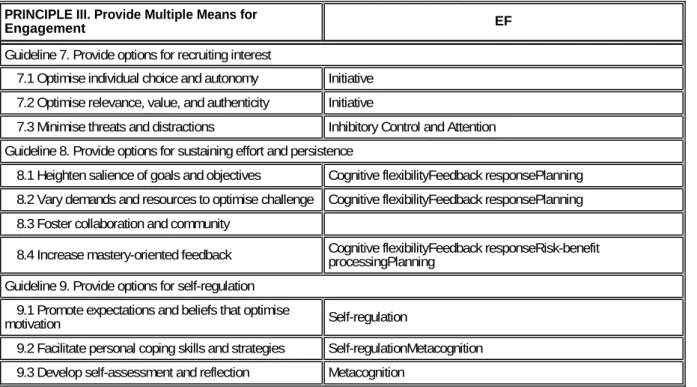
(4) Table 3. Guidelines and checkpoints for Principle II of UDL (action and expression network) that promote EF. PRINCIPLE II. Provide Multiple Means for Action and Expression. EF. Guideline 4. Provide options for physical action 4.1 Vary the methods for response and navigation 4.2 Optimise access to tools and assistive technologies Guideline 5. Provide options for expression and communication 5.1 Use multiple media for communication 5.2 Use multiple tools for construction and composition 5.3 Build fluencies with graduated levels of support for practice and performance. Organisation and Planning. Guideline 6. Provide options for executive functions 6.1 Guide appropriate goal setting. Organisation and Planning. 6.2 Support planning and strategy development. Organisation and Planning. 6.3 Facilitate managing information and resources. Organisation and Planning. 6.4 Enhance capacity for monitoring progress. Feedback response.Metacognition. Note: Adapted from CAST (2011a).. Table 4. Guidelines and checkpoints for Principle III of UDL (Affective Network) that promote EF. PRINCIPLE III. Provide Multiple Means for Engagement. EF. Guideline 7. Provide options for recruiting interest 7.1 Optimise individual choice and autonomy. Initiative. 7.2 Optimise relevance, value, and authenticity. Initiative. 7.3 Minimise threats and distractions. Inhibitory Control and Attention. Guideline 8. Provide options for sustaining effort and persistence 8.1 Heighten salience of goals and objectives. Cognitive flexibilityFeedback responsePlanning. 8.2 Vary demands and resources to optimise challenge. Cognitive flexibilityFeedback responsePlanning. 8.3 Foster collaboration and community 8.4 Increase mastery-oriented feedback. Cognitive flexibilityFeedback responseRisk-benefit processingPlanning. Guideline 9. Provide options for self-regulation 9.1 Promote expectations and beliefs that optimise motivation. Self-regulation. 9.2 Facilitate personal coping skills and strategies. Self-regulationMetacognition. 9.3 Develop self-assessment and reflection. Metacognition. Note: Adapted from CAST (2011a).. One of the main aims of the research project in which this study is framed was to generate knowledge regarding the use of concepts linked to UDL in teaching contexts intended to overcome barriers to students’ learning and participation (Booth and Ainscow 2000). While conducting research, it became clear how transversal the 12 selected EFs analyzed were beyond those which where explicitly stated in the principle two (action and expression), guideline six. Thereforein the present article we introduce an analysis of the UDL checkpoints (CAST 2011a) in order to determine which of them are related to cognitive control (Diamond 2013). That will allow for a better management of teaching practices related to EFs, since they are ‘skills essential for mental and physical health; success in school and in life; and cognitive, social and psychological development’ (Diamond 2013, 136). The tool subject of analysis is the observation record in which the UDL three principles, nine guidelines and 31 checkpoints, Version 2.0 (CAST 2011a) are presented..
(5) Universal design for learning UDL provides a framework for teaching aimed at eliminating any type of barriers to students’ learning and participation (Booth and Ainscow 2000; Booth, Ainscow, and Kingston 2006; Martín and Mauri 2011) that promotes inclusive education (CAST 2011b). It was originally developed to assist those learners most vulnerable to classroom segregation due to inadequately designed curriculum (National Center on Universal Design for Learning 2011), becoming what Pérez (2012) defines as ‘the overwhelmed school’. Currently, multiple studies support that implementing UDL improves the learning process for all students (Capp 2017). UDL is based on the individuals’ brain networks that are simultaneously activated when facing a learning task: the recognition network, the strategic network, and the affective network. The recognition network allows one to identify and make sense of the information received, relating it to previously established knowledge. The strategic network is activated when the EFs that foster planning, execution and supervision of the learning processes start working. Simultaneously, the affective network allows an assessment of patterns and assigns them emotional significance. These three brain networks involved at the beginning of learning a new task might help to explain why each person has a unique way of learning, just as they have a unique DNA or set of fingerprints (Rose and Meyer 2002). The three main principles of UDL are both defined by and linked to the described networks, which requires providing students multiple means of representation (recognition network), multiple means of action and expression (strategic network), and multiple means of engagement (affective network) within the teaching-learning processes.. EF in principle I of UDL: recognition network As not all students use the same channels to learn or possess the same previous knowledge, they do not interpret or understand information in the same manner. It is essential to provide a diversity of options for learning, understood as the reconstruction of knowledge and experience (Pérez 1992). This entails using different channels to support the student’ strengths used to learn and thus implement teaching strategies so students can find out not only their visual, auditory or kinesthetic preferences for learning (O’Brien 1989) but also the right strategies to thoroughly understand their interests, motivations and abilities so that they can benefit from them in the learning processes in which they are involved. They can then achieve the promotion of metacognition (García-Campos, Canabal, Gavaldón, and López-Escribano 2015), with the joint engagement of students and teachers (Manen 1998).. EF in principle II of UDL: strategic network Taking into account that a learning process implies both managing a wide range of varied information and activating different cognitive processes with differing tiers of competence, it is essential to diversify proposals for interaction in the classroom capable of generating meaningful, contextualised and relevant.. EF in principle III of UDL: affective network Taking into account both that engagement is a fundamental requirement for the development of relevant learning, and that the degree of engagement varies depending on different personal and contextual circumstances, processes that engage the emotional aspect should be promoted in the classroom (Manen 1998). From these three principles, arise nine guidelines that encompass 31 checkpoints that act as teaching signposts. Throughout this article we will analyse these checkpoints according to their relation with the 12 selected EFs.. Executive functions EFs comprise the set of mental processes that intervene during the execution of complex cognitive tasks such as abstract reasoning, problem solving or planning (Diamond 2013). Executive control is paramount for the development of basic skills in both academic and non-academic environments. Amongst the scientific community a consensus exists on that EFs are sequentially developed from childhood into adulthood. The EFs reach their maximum performance during adolescence (Anderson 1998; Cartwright 2012). During that developmental process there are periods of accelerated development, such as the age between two and five, or adolescence (Zelazo and Müller 2002; Dawson and Guarre 2010), which coexist with other slower paced periods. Initially, basic EFs such as inhibitory control, working memory, and cognitive flexibility, are developed as building blocks to support other more complex EFs (Diamond 2013). All of the above explains why at the beginning of human development, responses are characterised by impulsivity and a lack of emotional control. Progressively, during adolescence these relations are reorganised, as different EFs become integrated with each other, generating new development pathways, that have their own attributes and characteristics (Flores, Castillo, and Jiménez 2014) allowing to gradually achieve a greater control over information processing, as well as more selective information management and preservation, in spite of the increasing complexity of the data. Meanwhile, increasingly better alternatives are being generated in response to new situations, accompanied by the mastery of more effective memory strategies and more complex psycholinguistic and abstraction levels, which promote the development of new and consolidated learning. The integration achieved among different EFs throughout the development process is understood to be the functional or executive performance of the individual, considered as one of the competences paramount to learning. Cognitive control is neither a unitary nor a linear process. Rather, it is made up of several components, many of them similar but differentiated, that are interwoven, and that develop at different times. In this article, we have focused on the analysis of the 12 EFs collected in Table 1 (Kochanska and Aksan 2006; Montgomery and Koeltzow 2010; Cartwright 2012; Diamond 2013; Flores, Castillo, and Jiménez 2014). Combined with this apparent differentiation, EFs entail a series of subprocesses that, while interacting, lead to individual performances to be even more diverse. Classrooms receive an influx of great diversity regarding students’ performance ability, where high levels of executive control coexist with a variety of execution difficulties. Because of that, we believe that understanding the relationship between UDL’s approach and EFs would be of great help to its implementation in classrooms, not only with the purpose of eliminating barriers to learning and participation, as the curriculum itself recommends, but also with the intention of proposing working guidelines in the classroom when confronting executive control difficulties. The opposite of doing that, as González (2013, 23) points out, summarising Rose and Meyer’s (2002) approach, would mean that we are keeping barriers that magnify students’ executive difficulties in the classroom just as the lack of access ramps magnifies the disability of wheelchair users. There is, however, a common core to EFs, the control ability that they perform either on their own or interlinked, whether it is self-directed or not, in an individual’s cognitive, behavioural and affective realm (Zelazo 2004; Dawson and Guarre 2010), within the context of wide or multi-tasking performances (Bombín et al. 2014). Therefore, metacognition plays a fundamental role in.
(6) those processes that in turn, shall be accompanied by motivation (Moraine 2014). As longitudinal studies show, EFs contribute to academic achievement and vice versa, not only during compulsory schooling (Bull, Espy, and Wiebe 2008; Best, Miller, and Naglieri 2011) but also from an early age (Nayfeld, Fuccillo, and Greenfield 2013; Fitzpatrick et al. 2014). Those regulatory processes are malleable and plastic during formative experiences (Hsu, Novick, and Jaeggi 2014). The study of functional connectivity, which seems to prevail through those processes, is shedding light regarding the functioning of this process network, intrinsic to neuropsychology and educational neuroscience analysis, given that EFs constitute the main connecting link between cognition and emotion (González 2013, 31). The UDL, as CAST (2011b) proposes, supported on the three brain networks, fosters learning through the creation of an accessible curriculum and the provision of specific educational intervention strategies to work on EFs. The aim of the present work is to understand how executive control is being promoted by the principles, guidelines and checkpoints of UDL.. Methodology UDL principles, Version 2.0 (CAST 2011a) adapted to Spanish (EDUCADUA 2011), where subject of a content analysis. Such analysis was supported by a qualitative data analysis software (MaxQDA 12).. Data analysis The coding criteria were established after consulting with an expert on UDL and a content analysis was performed by the tree authors of the article. Then, the tree principles were coded, with their corresponding guidelines and checkpoints, delving into each and every one of them in order to identify which EFs they promoted. Finally, the data were triangulated. The principles, guidelines and checkpoints were coded individually by the two researcher and were later compared to check consistency. The detailed analysis of each of the three brain networks (recognition, strategic and affective) related to the three principles (representation, action and expression and engagement), together with their nine guidelines and 31 checkpoints regarding the presence of the 12 EFs selected (inhibitory control, working memory, cognitive flexibility, attention, feedback response, initiative, self-regulation, riskbenefit processing, metacognition, abstract reasoning, organisation and planning) allowed us to understand how present EFs are within that framework and what this entails for the teaching-learning process. All nine guidelines were analysed in spite of the factthat EFs in UDL are explicitly collected under guideline six, in the strategic network, considering that the remaining eight guidelines may be collected however implicitly.. Results After the content analysis was performed, two EFs were identified in the recognition network in three checkpoints belonging to two of the guidelines aimed at promoting the recognition network: working memory and abstract reasoning (see Table 2 ), EFs were identified in the following checkpoints: clarifying syntax and structure (2.2); highlighting patterns, critical features, big ideas and relationships (3.2) as well as guiding information processing, visualisation and manipulation (3.3). These are all actions that within a network improve working memory and abstract reasoning, contributing to the diversification of learning opportunities that favour students’ representation processes. At the same time, in the strategic network, five checkpoints and two guidelines have been identified (see Table 3), among them some in which EFs are explicitly formulated: build fluencies with graduated levels of support for practice and performance (5.3), guide appropriate goal setting (6.1), support planning and strategy development (6.2), facilitate managing information and resources (6.3), and enhance capacity for monitoring progress (6.4). Finally, in the affective network (see Table 4) EFs seem to be collected implicitly. Specifically, eight of the nine checkpoints of the three guidelines of this network foster nine of the 12 selected EFs (except for working memory, abstract reasoning and organisation). Therefore, when intending to reinforce the emotional component of learning through UDL guidelines, at the same time, executive control is being fostered since it is present in the following guidelines: optimising individual choice and autonomy (7.1), optimising relevance, value and authenticity (7.2), minimising threats and distractions (7.3), heightening salience of goals and objectives (8.1), varying demands and resources to optimise challenge (8.2), increasing mastery- oriented feedback (8.4), promoting expectations and beliefs that optimise motivations (9.1), facilitating strategies and personal coping skills for facing daily life problems (9.2), and developing self-assessment and reflection. After performing the analysis, we can say that EFs appear in a little over half of the proposals stated by UDL, specifically in 17 of the 31 checkpoints, thus the implementation of those processes in the classrooms, supporting the control capacity in performance, can mean an enhancing element and a complementary resource towards the elimination of barriers to learning and participation. While in the recognition and strategic networks they appear less frequently, in the affective network there is an emphasis in the promotion of EFs, specifically as a tool to capture interest, sustain effort and develop the ability for learning self management. Therefore, three of the twelve checkpoints in the recognition network pose strategies that imply activating cognitive control; in the strategic network, there are five out of nine checkpoints; and in the affective network, nine out of ten. Lastly, at the quantitative level, as shown in Table 5, each and every one of the 12 EFs analysed in the 17 UDL checkpoints are collected. To summarise, of the total EFs present in seven out of the nine UDL Guidelines, three are linked to the affective network, two belong to the strategic network, and the remaining two to the recognition network.. Table 5. EF frequency in the UDL principles. Executive Functions. Frequency. Feedback Response. 6. Planning. 6. Metacognition. 4. Organisation. 4. Cognitive Flexibility. 3. Self-regulation. 3.
(7) Initiative. 2. Abstract Reasoning. 2. Inhibitory Control. 1. Working Memory. 1. Attention. 1. Risk-benefit Processing. 1. Note: Compiled bythe authors.. These results show the teaching opportunity that entails using UDL in the classroom for the development of EFs, promoting the students’ ability to learn, anticipate, structure and make decisions about their learning actions (planning and organisation) and, in an implicit manner, to rebuild it (feedback response); reflect over and improve the resources set into action simultaneously (metacognition); redirect their thoughts, emotions and actions while interpreting them from every possible angle cognitive flexibility); steer their behaviours and emotions towards the expected goals (self-regulation), and at particular times, develop inhibitory control, working memory, attention and risk-benefit processing.. Discussion and conclusions In this article we highlight, agreeing with Meltzer (2010), the need to work on the EFs specifically in the classroom, given that students’ academic success depends on their skills to organise the available material and information, planning, prioritising time, discerning big ideas from secondary ones, changing course flexibly, etcetera. UDL, understood as a framework oriented at eliminating barriers to students’ learning and participation, proposes a large number of action proposals, both explicitly and implicitly, that teachers can use to promote EFs in the classroom. These teaching strategies allow for flexibility in the teaching-learning processes in a way in which they can be adapted to the diverse styles and preferences of the students (CAST 2011b), backed both by Gardner’s theory of multiple intelligences and Vygotsky’s zone of proximal development, as Rose and Meyer (2002) state. The content analysis of the UDL principles, guidelines and checkpoints was performed, enabled us to identify that working memory and abstract reasoning are emphasised in the recognition network. In the strategic network not all EFs are represented, as might have been expected, in guideline six, there is, however, a focus on executive processes relating to planning, organisation, metacognition and feedback response, specifically those regarding: the identification of relevant learning goals by the students; planning and development of strategies cohesive with the established goals; organisation of the resources needed to develop actions and adapting to changing environments; and the consideration of the information and guidance generated during the process, with the aim to reflect on their learning with the intention of improvement. In this particular network, again, the organisation and the planning function appear linked to strategic ability, in this case amounting to the need to progressively provide support during the learning process. Finally, in the affective network there is an indirect reinforcement of executive control, specifically in the following three areas. Increasing the interest in learning, teaching the student how to manage curiosity (attention), how to avoid impulsive behaviour that may lead to error (inhibitory control), and guiding them to infer the consequences of their own acts (riskbenefit processing). In this way, confidence is reinforced and it is more likely that students show the determination to learn (initiative) that may allow them to explore the possibilities of individual choice and autonomy, learning to find authenticity, together with the relevance and the individual and social value of what has been learned. Sustaining effort and perseverance during the learning process, suporting by formative assessment, in such a way that the student may develop the ability to respond to comments that provide new information about learning processes (flexibility and feedback response) guiding them to interpret information from different perspectives (cognitive flexibility) and promoting and open-minded attitude to change (planning). From that open-minded and critical attitude, the relevance of the goals and the suitability of the resources can be questioned and reevaluated, as well as the traits considered desirable during learning. Promoting knowledge regarding learning processes (metacognition), including redirection (self-regulation) of their own behaviour and feelings in order to reach learning goals owing to self-assessment and reflection. It is important to note that since it is in the affective network where more practical guidelines oriented to executive control have been identified, there is the risk of instrumentalising the affective component for the sake of success in the cognitive function, sidelining the achievement of holistic emotional development by the students. In the same line of thought, we consider that, through UDL, the internal management of the affective dimension can be promoted if it does not remain an external choice that exclusively involves a systemic implementation of fragmented strategies and directives. It shall entail, however, involve the creation by the teacher of spaces for reflection that promote students’ autonomy and personal growth within the learning environment. We conclude that applying UDL principles, guidelines and checkpoints would help the students build a deep knowledge regarding their way of learning allowing them to adapt and improve processes, addressing the joint work of both teachers and students, and the formative assessment to be developed. In this way, by promoting the EFs identified in the recognition, strategic, and mainly in the affective network, a teacher who implements UDL will create opportunities for the whole class, since students learn better when they are involved in their own learning. Currently, those holding political responsibility, as well as teaching speak of inclusion and defend the importance of social capital at the same time as segregation is being reestablished through policies and practical developments in our schools (Slee 2012). Using UDL as a framework makes it possible to identify the diversity present in the classroom and address it through the design and development of more comprehensive and inclusive learning contexts, backed by collaborative effort and reflection on the praxis (Cochran-Smith 2003, 2005; McLaughlin and Talbert 2006; Postholm 2008; Margalef and Pareja 2013). It is necessary to keep moving forward in the development of reflection processes both among teaching practitioners and those in training formulated in a context of production and application (Berstein 1989), that shall include as much teaching practice as the creation of meaning and conceptualisation from that teaching practice so that educators can act in order to improve students’ learning. In that way it would be possible to overcome both the implicit ideology of ‘Separate but Equal’ (Lalvani and Broderick 2015) that underlies deficit ideologies, and the concept of ‘special’ in education, focusing on the active role that the school has in its.
(8) production and perpetuation (Rutherford 2016). It is necessary to include those purposes in the curriculum from the early school years until higher education. Addressing the proposals generated by UDL in the design and development of the curriculum would contribute to identify, within the school, any kind of imbalance in cognitive performance, as it is the case of students with learning difficulties (Attentiondeficit/hyperactivity disorder -ADHD, Nonverbal learning disorder -NVLD, Dyslexia, etcetera) at the same time as EFs would be promoted broadly in all students. Therefore, we consider that using proposals such as UDL’s that are focused on emphasising that the issue is not the child’s but the school’s, we will be able to cater to students’ diversity knowing and adjusting teaching proposals to diverse paces and styles regarding student’s cognitive control. In that manner, the focus will no longer be on sustained complaints, regarding the lack of attention by the students, among others, but rather into steering efforts into a more proactive direction, focused on the creation of learning spaces that shall promote specific EFs and, in the case of attention, the promotion of its varied processes: sustained, selective, alternating, divided, etcetera. Regrettably, there still exists teaching practices in which the only resource being used is the textbook. Others in which there is a convergence of rejection and low expectations towards certain groups of the student body (McGuire and Scott 2006). There even exist those where the use of assessment strategies focused on memory-based teaching are used as a means to prepare for standardised testing, thus conditioning the daily development of the classroom (Stobart 2010; Slee 2012). These bad practices, among many others that could be described, do not facilitate the meaningful and relevant learning that promotes feedback as the main focus of formative evaluation or learning (Canabal y Margalef. 2017). We believe that studies such the present one that highlight the relevance of EFs in UDL, could promote the creation of alternatives for inclusive education. This was to be expected since EFs are a cohesive resource within the goals of this teaching framework, and at the same time constitute a goal for learning in themselves. We consider desirable to continue in this line of work that would allow us to look into the possibilities for the assessment of teaching and learning processes based on UDL. Among the limitations and future lines of research, the relevance of discussing these results with teachers practitioners, in order to examine the development of teaching proposals that would promote EFs in the classroom. It would be useful to understand both the conditions needs to promote EFs through the implementation of UDL as much as its uses at different levels and educational contexts. In a different research project we are analyzing the functioning of UDL guidelines in several primary school classrooms, which will allow us to have another perspective which we will then use to triangulate the results of the present work. Due to all of the above and extrapolating what McGuire, Scott, and Shaw (2006) state regarding Universal Design for Instruction (UDI) in the specific context of university, UDL’s implementation allows for the development of a more accessible curriculum with room for different ways of organising, designing, developing and following up the teaching-learning processes; offering students greater flexibility, making their involvement possible and succeeding when confronting the educational challenge of adapting to the biggest range of variability present in the classroom. These issues make it even more essential to promote training processes that result in the development of the ability to collaborate, offering criticism and reflection on the practice both for working teachers and those still in training, as well as helping to develop competencies in order to move forward into a truly inclusive school.. Funding This article partially introduces and analyses the results of a project funded by the Spanish Ministry of Science and Innovations regarding the ‘Application of Universal Design for Learning by means of the use of digitally accessible materials: implications for literacy in Primary Education and teacher education-DUALECTIC’(Ref. EDU2011-24926), within the National R+D+I Plan 2008– 2011. Sub-programme of Fundamental Research Projects 2011-2014.. Acknowledgements This article partially introduces and analyses the results of a project funded by the Spanish Ministry of Science and Innovation regarding the ‘Application of Universal Design for Learning by means of the use of digitally accessible materials: implications for literacy in Primary Education and teacher education-DUALECTIC’ (Ref. EDU2011-24926), within the National R+D+I Plan 2008– 2011. Sub-programme of Fundamental Research Projects 2011–2014.. Disclosure Statement No potential conflict of interest was reported by the authors.. Notes on contributors María Dolores García-Campos. PhD in Education Sciences, Complutense University of Madrid. Lecturer, Faculty of Education, Department of Education Sciences, Area of Didactics and School Management, University of Alcalá (UAH), Spain. [email protected] She has been a member of the Programme for Teacher Training at UAH for almost a decade. Her current teaching practice both at the undergraduate and master’s levels is focused on the scope of innovation and educational research. She is the Coordinator at the Project for Teaching Innovation Generating Spaces for Dialogic Reflection in the Training of Teachers at UAH. She is a member of the research team ‘FIT:Formar, Indagar, Transformar [Train, Search, Transform]’ where she has developed studies related to competence assessment in higher education, educational attention to university students with functional diversity and the development of Universal Design for Learning in schools. Other research interests are university teaching and gerontologic education, topics on which she has been the supervisor of several doctoral thesis. Current line of research: teacher training for inclusion and innovation through dialogic reflection. Cristina Canabal. Ph.D. in Psychopedagogy, Complutense University of Madrid. Lecturer, Faculty of Education, Department of Education Sciences, Area of Didactics and School Management, University of Alcalá (UAH), Spain. She is a member of the research team «FIT:Formar, Indagar, Transformar [Train, Search, Transform]» and the innovation team ‘Innovación curricular y aprendizaje crítico [Curriculum innovation and critical learning]’. She has been involved in the development of research projects related to the inclusion of deaf students in pre-school education, university accessibility for people with disabilities, the application of Universal Design for Learning and competence assessment in higher education, among others. Her research interest focus on educational innovation and the professional development of teachers. For 12 years she has collaborated with the Programme for Teacher Training as well as in the Ph.D. programme for Planning and Educational Innovation at UAH. She is currently teaching several courses in the Degree for Pre-School Teaching and the Master’s for Teaching Hispanic Language and Culture for primary and secondary education teachers and is currently developing a project.
(9) for teaching innovation entitled ‘Generating spaces for dialogic reflection in teacher training’. Carmen Alba-Pastor . Ph.D. in Education. Full Professor, Faculty of Education, Department of Didactics and School Management, Complutense University of Madrid (UCM), Spain. [email protected] Her educational background combines training in new technologies applied to education and attention to diversity. She has been the director at the Complutense Observatory of Accessibility to Higher Education and the Microsoft-Complutense Chair of Accessibility to Education. She has been a Visiting Professor at the Graduate School of Education at Harvard University and at the College of Education at Loyola Marymount University in Los Angeles. Her line of research focuses on the accessibility of education for all students from the perspective of diversity, through curriculum and technological resources. From her stay at Wakefield's Center for Applied Special Technologies (CAST), Massachusetts (USA) she develops her work on Universal Design for Learning in collaboration with this centre, a field of research that is recently gaining ground and which has carried out projects, publications, and training of researchers and teachers. She is a member of the University Network of Research and Educational Innovation (REUNI+D). She is currently directing EducaDUA, a space dedicated to research, training and dissemination of Universal Design for Learning in Spanish.. ORCID María-Dolores García Campos https://orcid.org/0000-0002-2223-4575 Cristina Canabal http://orcid.org/0000-0003-1081-6778 Carmen Alba-Pastor http://orcid.org/0000-0002-2569-143X. References Anderson , V. 1998. “Assessing Executive Functions in Children: Biological, Psychological and Developmental Considerations.” Neuropsychological Rehabilitation 8: 319–349. doi:10.1080/713755568. Berstein , B. 1989. Clases, códigos y control I. Estudios teóricos para una sociología del lenguaje [Class, Codes and Control. Applied Studies towards a Sociology of Language]. Madrid: Akal. Best , J. R., P. H. Miller , and J. A. Naglieri . 2011. “Relations Between Executive Function and Academic Achievement From Ages 5 to 17 in a Large, Representative National Sample.” Learning and Individual Differences 21: 327–336. doi:10.1016/j.lindif.2011.01.007. Bombín , I., A. Cifuentes , G. Climent , P. Luna , J. Cardas , J. Tirapu , and U. Díaz . 2014. “Validez ecológica y entornos multitarea en la evaluación de las funciones ejecutivas [Ecological validation and multitasking environments in executive functions assessment].” Revista de Neurología 59 (2): 77–87. Booth , T., and M. Ainscow . 2000. Index for Inclusion. Guía para la evaluación y mejora de la educación inclusiva [Handbook for the assessment and improvement of inclusive education]. Madrid: Consorcio Universitario para la Educación Inclusiva. Booth , T., M. Ainscow , and D. Kingston . 2006. Index para la inclusión. Desarrollo del juego, el aprendizaje y la participación en Educación Infantil [Index for inclusion. Game development, learning and participation in Pre-school Education]. Bristol: CSIE. Bull , R., K. A. Espy , and S. A. Wiebe . 2008. “Short-term Memory, Working Memory and Executive Functioning in Preschoolers: Longitudinal Predictors of Mathematical Achievement at age 7 Years.” Developmental Neuropsychology 33: 205–228. doi:10.1080/87565640801982312. Canabal , C., and L. Margalef . 2017. "La retroalimentación: la clave para una evaluación orientada al aprendizaje [The Feedback: a key to learning-oriented assessment]" Profesorado, Revista de Currículum y Formación del Profesorado 21 (2): 149-170. https://recyt.fecyt.es/index.php/profesorado/article/view/59454 Capp , M. J. 2017. “The Effectiveness of Universal Design for Learning: a Meta-Analysis of Literature Between 2013 and 2016.” International Journal of Inclusive Education 21 (8): 791–807. doi:10.1080/13603116.2017.1325074. Cartwright , K. B. 2012. “Insights From Cognitive Neuroscience: The Importance of Executive Function for Early Reading Development and Education.” Early Education and Development 23 (1): 24–36. doi:10.1080/10409289.2011.615025. http://www.tandfonline.com/doi/pdf/10.1080/10409289.2011.615025. CAST. 2011a. “UDL Guidelines - Version 2.0.” Web del CAST. http://www.udlcenter.org/sites/udlcenter.org/files/updateguidelines2_0.pdf. CAST. 2011b. Universal Design for Learning Guidelines Version 2.0. Wakefield, MA: Author. http://www.udlresource.com/uploads/1/2/1/2/12126894/udl_guidelines_version_2.0_final_3.pdf. Cochran-Smith , M. 2003. “Learning and Unlearning: The Education of Teacher Educators.” Teaching and Teacher Education 19: 5–28. doi:10.1016/S0742-051X(02)00091-4. Cochran-Smith , M. 2005. “Teacher Education and the Outcomes Trap.” Journal of Teacher Education 56 (5): 411–417. doi:10.1177/0022487105282112..
(10) Dawson , P., and R. Guarre . 2010. Executive Skills in Children and Adolescents: A Practical Guide to Assessment and Intervention. New York: Guilford Press. Diamond , A. 2013. “Executive Functions.” Annual Review of Psychology 64: 135–168. doi:10.1146/annurev-psych-113011143750. https://www.ncbi.nlm.nih.gov/pmc/articles/PMC4084861/. Diamond , A., and D. S. Ling . 2016. “Conclusions About Interventions, Programs, and Approaches for Improving Executive Functions That Appear Justified and those that, Despite Much Hype, do not.” Developmental Cognitive Neuroscience 18: 34– 48. doi:10.1016/j.dcn.2015.11.005. EDUCADUA. 2011. “Pautas del Diseño Universal para el aprendizaje versión 2.1.” [Guidelines in Universal Design for Learning 2.1 version] Web from Proyecto DUALETIC. http://www.educadua.es/doc/dua/dua_pautas_esquema_resumen.pdf. Fitzpatrick , C., R. D. Mckinnon , C. B. Blair , and M. T. Willoughby . 2014. “Do Preschool Executive Function Skills Explain the School Readiness gap Between Advantage and Disadvantaged Children?” Learning and Instruction 30: 25–31. Flores , J. C., R. E. Castillo , and N. A. Jiménez . 2014. “Desarrollo de funciones ejecutivas, de la niñez a la juventud [The Development of Executive Functions, From Childhood to Youth].” Anales de Psicología 30 (2): 463–472. doi:10.6018/analesps.30.2.155471. http://www.redalyc.org/articulo.oa?id=16731188009. Florian , L., and K. Black-Hawkins . 2011. “Exploring Inclusive Pedagogy.” British Educational Research Journal 37: 813– 828. doi:10.1080/01411926.2010.501096. García-Campos , M. D., C. Canabal , G. Gavaldón , and C. López-Escribano . 2015. , May. "Universal Design for Learning: The Possibilities to Address Diversity Attending the Different Ways of Learning." Paper presented at 17th Annual International Conference on Education, Athens (Greece). http://www.atiner.gr/abstracts/2015ABST-EDU.pdf González , D. 2013. “Funciones ejecutivas y educación [Executive functions and education].” Revista Argentina de Neuropsicología 23: 11–34. http://www.revneuropsi.com.ar/images/stories/pdf/gonzalezmunozranps23.pdf Hall , T., A. Meyer , and D. Rose . 2012. Universal Design for Learning in the Classroom: Practical Applications. New York: Guilford Press. Hsu , N. S., J. M. Novick , and S. M. Jaeggi . 2014. “The Development and Malleability of Executive Control Abilities.” Frontiers in Behavioral Neuroscience 8: 1–15. doi:10.3389/fnbeh.2014.00221. https://pdfs.semanticscholar.org/57a0/213df9dd8b10f2dcd644905de23efead02e0.pdf? _ga=2.32333180.311809163.1513688870-1842459298.1513688870. Kochanska , G., and N. Aksan . 2006. “Children’s Conscience and Self-Regulation.” Journal of Personality 74 (6): 1587– 1617. Lalvani , P., and A. A. Broderick . 2015. “Teacher Education, Exclusion, and the Implicit Ideology of Separate but Equal: An Invitation to a Dialogue.” Education, Citizenship and Social Justice 10 (2): 168–183. doi:10.1177/ 1746197915583935. Manen , v. M. 1998. El tacto en la enseñanza [Tact in teaching]. Barcelona: Paidós. Margalef , L., and N. N. Pareja . 2013. “Learning From Dilemmas: Teacher Professional Development Through Collaborative Action and Reflection.” Teachers and Teaching: Theory and Practice 19 (1): 18–32. Martín , E., and T. C. Mauri . 2011. Orientación educativa. Atención a la diversidad. [Educational guidance. Attention to diversity] Barcelona: Graó-MEC. McGuire , J. M., and S. S. Scott . 2006. “An Approach for Inclusive College Teaching: Universal Design for Instruction.” Learning Disabilities-Multidisciplinary Journal 14 (1): 21–31. https://ldaamerica.org/. McGuire , J., S. Scott , and S. Shaw . 2006. “Universal Design and its Applications in Educational Environments.” Remedial and Special Education 27 (3): 166–175. doi:10.1177/07419325060270030501. McLaughlin , M., and J. Talbert . 2006. Building School-Based Teacher Learning Communities. Professional Strategies to Improve Student Achievement. New York: Teachers College Press. Meltzer , L. 2010. Promoting Executive Function in the Classroom. New York: The Guilford Press. Meyer , A., D. H. Rose , and D. Gordon . 2014. Universal Design for Learning: Theory and Practice. Wakefield, MA: CAST Professional Publishing. Montgomery , D. E., and T. E. Koeltzow . 2010. “A Review of the day-Night Task: The Stroop Paradigm and Interference Control in Young Children.” Developmental Review 30: 308–330. doi:10.1016/j.dr.2010.07.001. Moraine , P. 2014. Las funciones ejecutivas del estudiante. Mejorar la atención, la memoria, la organización y otras funciones para facilitar el aprendizaje. Madrid: Narcea. Student’s executive functions. Improving attention, memory,.
(11) organisation and other functions to improve learning. National Center on Universal Design for Learning. 2011. UDL Guidelines - Version 2.0. http://www.udlcenter.org/aboutudl/udlguidelines. Nayfeld , I., J. Fuccillo , and D. B. Greenfield . 2013. “Executive Functions in Early Leaning: Extending the Relationship Between Executive Functions and School Readiness to Science.” Learning and Individual Differences 26: 81–88. O’Brien , L. 1989. “Learning Styles: Make the Student Aware.” NASSP Bulletin 73 (519): 85–89. doi:10.1177/019263658907351913. Pérez , A. I. 1992. “Las funciones sociales de la escuela: de la reproducción a la reconstrucción crítica del conocimiento y la experiencia [School’s Social Function: From Reproduction to the Critical Reconstruction of Knowledge and Experience].” In Comprender y transformar la enseñanza, edited by J. Gimeno y A. I. Pérez , 17–33. Madrid: Morata. Pérez , A. I. 2012. Educarse en la era Digital [Education in the Digital Era]. Madrid: Morata. Postholm , M. 2008. “Teachers Developing Practice. Reflection as Key Activity.” Teaching and Teacher Education 24: 1717– 1728. doi:10.1016/j.tate.2008.02.024. Rose , D. H., J. W. Gravel , and D. T. Gordon . 2014. “Universal Design for Learning.” In The SAGE Handbook of Special Education, edited by L. Florian , Vol. 2, 475–490. London: SAGE. Rose , D., and A. Meyer . 2002. Teaching Every Student in the Digital age: Universal Design for Learning. Cambridge: Harvard Education Press. Rutherford , G. 2016. “Questioning Special Needs-ism: Supporting Student Teachers in Troubling and Transforming Understandings of Human Worth.” Teaching and Teacher Education 56: 127–137. doi:10.1016/j.tate.2016.02.009. Simón , C., G. Echeita , M. Sandoval , and E. Pérez . 2016, May. “De las adaptaciones curriculares al diseño universal para el aprendizaje y la instrucción: un cambio de perspectiva. [From curriculum adaptation to universal design for learning and instruction: a change in perspective].” Paper presented at Accesibilidad, ajustes y apoyos. Universidad Carlos III, Proyecto ‘Madrid sin barreras: discapacidad e inclusión social’. Madrid (Spain). http://www.madridsinbarreras.org/wpcontent/uploads/2016/06/De-las-adaptaciones-curriculares.pdf. Slee , R. 2012. La escuela extraordinaria. Exclusión, escolarización y educación inclusiva [The extraordinary school. Exclusion, escolarization and inclusive education]. Madrid: Morata. Stobart , G. 2010. Tiempos de pruebas. Los usos y abusos de la evaluación [Time for testing. Use and abuse of assessment]. Madrid: Morata. Zelazo , P. D. 2004. “The Development of Conscious Control in Childhood.” Trends in Cognitive Sciences 8: 12–17. doi:10.1016/j.tics.2003.11.001. Zelazo , P. D., and U. Müller . 2002. “Executive Function in Typical and Atypical Development.” In Blackwell Handbook of Childhood Cognitive Development, edited by U. Goswami , 445–469. Malden, MA: Blackwell..
(12)
Figure
Documento similar