
Facilitation of Quercus ilex in Mediterranean shrubland is explained by both direct and indirect interactions mediated by herbs
34
0
0
Texto completo
(2) 23. Summary. 24. 1. Competitive and facilitative interactions shape plant communities. Whereas a number of. 25. studies have addressed competition and direct facilitation among plants in dry ecosystems,. 26. indirect facilitation has received little attention.. 27. 2. We investigated the relative importance of direct and indirect facilitation by the nurse plant. 28. Retama sphaerocarpa on late-successional Quercus ilex seedlings mediated by herb. 29. suppression in a Mediterranean shrubland in 2006 and 2007. We also studied whether. 30. facilitation outcome depended on the size of the facilitated seedlings.. 31. 3. A field experiment was carried out to test the effect of (1) position of Q. ilex seedling with. 32. respect to shrub canopy (under shrubs or in gaps), (2) herb competition (presence or. 33. absence), and (3) seedling size. 2006 was an average rainfall year while 2007 had a much. 34. more humid spring and a dryer summer than 2006.. 35. 4. In both years, nurse shrubs reduced seedling mortality whereas herbs increased it. In the. 36. average rainfall year, seedling mortality under shrubs was unaffected by herbs whereas in. 37. gaps it was significantly higher in presence of herbs. This showed that the nurse shrub. 38. indirectly facilitated the seedlings by reducing the competitive capacity of herbs.. 39. Conversely, facilitation was predominately direct during the humid spring and dry summer. 40. year since herbs hindered seedling survival similarly under the nurse shrub and in gaps.. 41. The nurse shrub directly facilitated the seedlings by reducing seedling photoinhibition and. 42. water stress.. 43. 5. Improvement of environmental conditions by Retama benefited smaller seedlings but not. 44. larger seedlings since the nurse shrub reduced mortality of smaller seedlings relative to. 45. that in gaps, but this effect was not observed for larger seedlings. This indicates that. 46. individuals within a seedling population may not have the same response to facilitation.. 47 48. 6. Synthesis. Both indirect and direct facilitation are important mechanisms for Q. ilex regeneration in Retama shrubland and their importance seems to vary with climatic 2.
(3) 49. conditions. Indirect facilitation by release of herb competition under nurse shrubs is. 50. important in years of dry springs when competition between nurse shrubs and herbs is. 51. high, whereas direct facilitation mediated by microclimate amelioration increases with. 52. summer aridity.. 53 54. Key-words: Chlorophyll fluorescence, herb competition, Quercus ilex, Retama sphaerocarpa,. 55. seedling size, water potential. 56 57. Introduction. 58. Biotic interactions are major drivers of the structure and dynamics of plant communities. 59. (Lortie et al. 2004). Competition has traditionally been considered as the major interaction that. 60. structures plant communities (Grime 1974). However, in the last decade, an increasing number. 61. of studies have also emphasized the importance of facilitative or positive interactions (Bertness. 62. & Callaway 1994; Callaway 1995; Brooker et al. 2008). Positive and negative interactions. 63. among organisms act simultaneously, and the net balance of these interactions determines the. 64. community organization and composition (Callaway & Walker 1997; Holmgren, Scheeffer &. 65. Huston 1997; Brooker et al. 2008). The balance of plant–plant interactions is context-. 66. dependent, varying in response to abiotic stress, disturbance, life cycle stage, species identity. 67. and interactions with other neighbours (Callaway 2007).. 68. Facilitation can be direct, i.e. one species increases the performance of a second species. 69. by ameliorating the abiotic environment (Callaway 1995; Pugnaire, Haase & Puigdefábregas. 70. 1996a; Pugnaire, Armas & Valladares 2004). Facilitation may also be indirect, i.e. a third. 71. species mediates interactions between the nurse species and the target species. Thus, some. 72. plants protect other plants from herbivores, attract pollinators, concentrate propagules of other. 73. species, or enhance mycorrhizae and soil microbial activity (Callaway 1995, 2007). The. 74. occurrence of a third plant species may also convert the competition between two species into 3.
(4) 75. indirect facilitation via suppression of a shared competitor (Miller 1994; Levine 1999;. 76. Callaway & Pennings 2000). Levine (1999) predicted that indirect facilitation mediated by a. 77. third competitor would mainly occur in a system in which the three species compete for. 78. different resources or use different mechanisms to acquire them. This argument is supported by. 79. previous studies (Siemann & Rogers 2003; Kunstler et al. 2006).. 80. In contrast to direct facilitation and competition, indirect facilitation has received less. 81. attention. Most studies assessing indirect facilitation have focused on interactions between. 82. different trophic levels, such as those analysing defence against herbivory (Boulant et al. 2008;. 83. Gómez-Aparicio et al. 2008; Anthelme & Michalet 2009) or concentration of progagules of. 84. other species (Verdú & García-Fayos 2003; Aerts et al. 2006). Experimental field studies. 85. investigating indirect facilitation within the same trophic level are much less frequent (Brooker. 86. et al. 2008). Most studies of indirect facilitation among plants have been performed in. 87. productive or moderately productive environments; whereas some of them documented. 88. indirect facilitation (Levine 1999; Callaway & Pennings 2000; Siemann & Rogers 2003;. 89. Kunstler et al. 2006), others failed to detect this process (Pagès & Michalet 2003; Pagès et al.. 90. 2003). To our knowledge, no experimental field study to date has explored the importance of. 91. indirect facilitation in semi-arid or arid systems.. 92. Direct facilitation is a recognized recruitment mechanism for plants in Mediterranean. 93. environments (Verdú & García-Fayos 2003; Gómez-Aparicio, Gómez & Zamora 2005a), but. 94. the importance of indirect facilitation remains to be assessed in this system. Retama. 95. sphaerocarpa (Retama henceforth) is one of the most-studied Mediterranean nurse species. It. 96. promotes the development of a diverse herbaceous community due to changes in microclimate. 97. and soil fertility under its canopy (Pugnaire et al. 1996b; Pugnaire et al. 2004). Although herbs. 98. compete with the seedlings of woody species and impair woodland regeneration (Nambiar &. 99. Zed 1980; Rey Benayas et al. 2005), mid- and late-succession woody species such as Quercus. 100. ilex develop under Retama canopy (Tovar 2009). Several studies have demonstrated the direct 4.
(5) 101. facilitative effect of Retama on the plant community developed under its canopy, but no study. 102. has assessed its potential indirect facilitative effect (Pugnaire et al. 1996a; Pugnaire et al.. 103. 1996b; Rodríguez-Echeverría & Pérez-Fernández 2003; Pugnaire et al. 2004).. 104. There is an increasing body of evidence that the response to facilitation and that the. 105. facilitating ability of nurse species are species-specific (Gómez-Aparicio et al. 2004;. 106. Liancourt, Callaway & Michalet 2005; Padilla & Pugnaire 2009). However, to our knowledge,. 107. no study has tested whether the response to facilitation varies among individuals of the same. 108. species. Individuals of the same species may have distinct functional traits that may determine. 109. their performance. For example, Q. ilex seedlings produced by different mother trees exhibit. 110. significant size differences that influence their performance (Leiva & Fernández-Alés 1998).. 111. Seedling size can affect survival, with large seedlings having a greater chance of survival under. 112. stressful conditions than small seedlings (Cook 1980; Leishman & Westoby 1994)... 113. In the present study, we addressed the following questions: 1) In addition to direct. 114. facilitation, is indirect facilitation mediated by herbs an important mechanism for Q. ilex. 115. regeneration in Retama shrubland? 2) Does the response of Q. ilex seedlings to facilitation. 116. depend on seedling size? To answer these questions, we conducted a factorial field experiment. 117. in two consecutive years. We measured the performance of Q. ilex seedlings of contrasting size. 118. planted under Retama canopy and in gaps, as well as in the presence and absence of herbs.. 119 120. Materials and methods. 121. STUDY SITE AND SPECIES STUDIED. 122. The study site is located in La Mancha, central Spain (38º38´ N, 3º28´ W), at an altitude. 123. of 714 m a.s.l. The climate is continental Mediterranean, with a mean annual precipitation of. 124. 370 mm and a mean annual temperature of 15.2 ºC. Summers are very hot and dry and last for. 125. three to five months, while winters are cold with frequent frosts. The soil is a poorly developed. 5.
(6) 126. inceptisol with relatively high clay and quartzite content. The experiment was performed on an. 127. abandoned flat wheat cropland that was planted with R. sphaerocarpa, Pinus pinea and Q. ilex. 128. in 2000. Each of these three species had the same density, and individuals were planted in rows. 129. separated 4m and within each row the distance between plants was 3m. Species were randomly. 130. distributed within each row. At the start of the experiment, P. pinea and Q. ilex trees were. 131. more than 2 m and 1m high, respectively, while Retama shrubs were c. 2 m high. The. 132. understorey vegetation was composed of an herbaceous community, which emerges in the. 133. autumn, flowers in spring and senesces during early summer. Annuals such as Avena barbata,. 134. Bromus spp., Hordeum murinum, Lolium rigidum, Taeniatherum caput-medusae, Rapistrum. 135. rugosum as well as several Trifolium species dominated this community.. 136. The nurse species R. sphaerocarpa is a leguminous, broom-like deep-rooted shrub that is. 137. native to the Iberian Peninsula and north-west Africa, where it forms shrublands that have. 138. traditionally been managed for sheep grazing and hunting. In the last decades, this shrub has. 139. colonized large areas of abandoned cropland, and it has been used for subsidized plantation. 140. programs. The target benefactor species was Q. ilex, an evergreen late-successional oak tree. 141. native to the western Mediterranean Basin. It constitutes most of the community biomass in. 142. areas where it thrives. However, Q. ilex seedlings display low survival rates in forest. 143. plantations compared with other Mediterranean forest species (Baeza et al., 1991).. 144 145. EXPERIMENTAL DESIGN. 146. A factorial field experiment was performed with three factors: (1) position with respect. 147. to the Retama canopy (under or outside), (2) herb abundance (presence or absence) and (3) Q.. 148. ilex seedling size. The experiment was conducted in 2006 and 2007. In 2006, the rainfall and. 149. mean temperature during the experimental period (February-September) were 255 mm and. 150. 19.2 ºC, respectively, while in 2007 they were 352 mm and 17.7 ºC, respectively. The mean. 151. historical rainfall (over a 70-year period) and temperature (over a 55-year period) during the 6.
(7) 152. same period were 256 mm and 17.5 ºC, respectively. Thus, 2006 can be considered as an. 153. average rainfall year and 2007 as a humid year. Differences between years mainly occurred in. 154. spring (February to May), which was much more humid in 2007 than in 2006 (150 and 267. 155. mm in 2006 and 2007, respectively). However, summer (June to September) was more humid. 156. in 2006 than in 2007 (105 and 85 mm in 2006 and 2007, respectively).. 157. We randomly selected 30 Retama shrubs with an average canopy height and diameter of. 158. 2 and 2.3 m, respectively, and 30 gaps located 1.5-2 m outside of the shrub canopies, where the. 159. ground was not shaded during most of the day. Each Retama shrub was separated from its. 160. neighbour by at least 3-4 m. The distribution of the experimental Retama shrubs and gaps was. 161. not paired, i.e. a particular Retama shrub was not associated with a particular gap in the field.. 162. In each position (under shrub and gap), we distinguished two herb abundance levels (presence. 163. or absence). In the microsites with absence of herbs, herbaceous vegetation was removed with. 164. herbicide in an area of 0.55-0.6 m2 (Oxyfluorfen 24%, Inteike, TradeCorp, Madrid, Spain) at. 165. the beginning of the experiment in both years. Finally, in each of these four microsites, Q. ilex. 166. seedlings were planted in 30 cm-deep holes made with a mechanical auger, minimizing the. 167. disturbance of the herbaceous community at the microsites with herb presence. Planting was. 168. performed in February in both years. The experimental plot was fenced to exclude medium and. 169. large herbivores.. 170. We planted seedlings that largely varied in size in both years. In 2006, to promote. 171. seedling size differences, we varied (1) the seeding date in the nursery, which affected. 172. emergence time and, therefore, the length of the growing period (14 months vs. 11 months),. 173. and (2) we used different nitrogen fertilization rates. In 2007, we did not apply any cultivation. 174. treatment and randomly selected the plants from a standard nursery crop that had a high. 175. variation in seedling size. In 2006, the 10th and 90th percentiles of plant height were 9 and 22. 176. cm, respectively, while in 2007 they were 12 and 28 cm, respectively. The seedlings were. 7.
(8) 177. cultivated following standard nursery cultivation methods (Villar-Salvador et al. 2004). The. 178. acorns used to grow seedlings from were of the same provenance in both years.. 179 180 181. MICROCLIMATE, SOIL AND HERB COMMUNITY CHARACTERISTICS To analyse the effect of the nurse shrub on the environmental conditions under its. 182. canopy and on the characteristics of the herb community, we measured several abiotic and. 183. biotic variables under the Retama canopy and in the gaps. Incident photosynthetic photon flux. 184. density at seedlings’ mid-height was measured using a quantum photo/radiometer (HD 9021,. 185. Delta OHM, Casselle Di Selvazzano, Italy) for all of the planted seedlings. Measurements were. 186. carried out in May of both years on clear days between 12:00 and 14:00 h solar time. Seedling. 187. leaf temperature and the relative humidity and the temperature in the air were measured in. 188. spring of 2006 under the canopy of nine shrubs and in nine gaps. The latter were measured in. 189. both presence and absence of herbs with a thermo-hygrometer (HI 9065, HANNA Instruments,. 190. Eibar, Spain). The seedling leaf temperature was only measured in the microsites with herbs. 191. using a thermocouple inserted under a dry average-sized oak leaf, which was held horizontally. 192. during the measurements.. 193. Soil samples excluding litter and stones were collected 5-10 cm deep under the canopy. 194. of nine shrubs and in nine gaps for nutrient analyses. After air-drying, the samples were sieved. 195. through a 2-mm sieve and finely ground. The organic matter was analysed using the method. 196. proposed by Walkley & Black (1934). Total N concentration was determined by Kjeldahl. 197. analysis with SeSO4-K2SO4 as the catalyst, while the K concentration was measured with an. 198. Optic PLASMA ICP (Perkin-Elmer, model 4300 DV, Waltham, Massachusetts, USA),. 199. according to MAPA (1986). Soil pH was determined for a 1:2.5 mass-to-volume soil and water. 200. suspension. Soil temperature at a 5 cm depth was recorded with a digital thermometer in May. 201. 2006 in both presence and absence of herbs under nine Retama shrubs and in nine gaps.. 202. Finally, soil water content in a 0-30 cm soil profile was measured in all planted seedlings in 8.
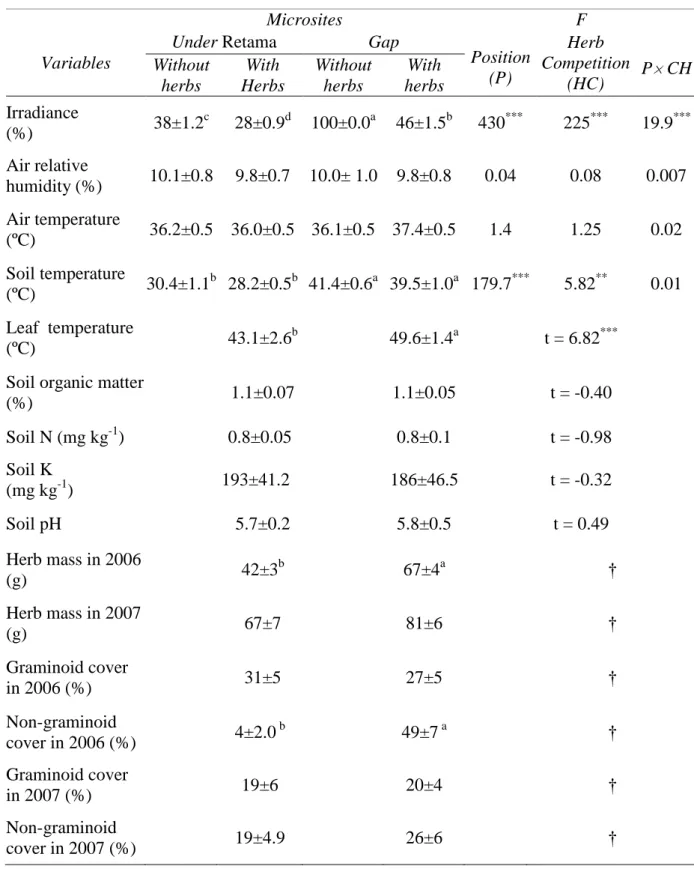
(9) 203. late spring (25 May 2006 and 30 May 2007) and in mid-summer (18 July 2006 and 15 July. 204. 2007) using Time Domain Reflectometry (TDR, Tektronix, Beauverton, CO, USA) according. 205. to Cassel et al. (1994). Two 35 cm long stainless-steel rods were inserted one month after. 206. planting at a 5-10 cm distance from plants.. 207. In late May of both years, when flowering of the herbaceous community was ending, we. 208. visually recorded the percentage of herb cover around each Q. ilex seedling, as well as the. 209. specific composition and abundance of herbs under nine nurse shrubs and in nine gaps using a. 210. 50. 211. June, when the herbaceous community started to wither, the above-ground herb biomass. 212. contained in a 50. 213. after drying at 50 ºC for two days. The Retama shrubs and gaps used to measure the relative air. 214. humidity and the air, leaf and soil temperature were randomly selected among all shrubs under. 215. which Q. ilex seedlings were planted, whereas the Retama shrubs and gaps used to determine. 216. the soil nutrient concentration and herb mass were randomly selected among shrubs and gaps. 217. where no seedlings were planted.. 50 cm quadrat. Herb species were classified as graminoids and non-graminoids. In early. 50 cm quadrat was measured under nine Retama shrubs and in nine gaps. 218 219. QUERCUS ILEX SEEDLING PERFORMANCE. 220. The mortality of Q. ilex seedlings was recorded at the end of spring (last week of May). 221. and at the end of the summer (last week of September) in both years. We measured the spring. 222. (February to June), summer (June to September) and all first growing season (February to. 223. September) seedling mortality. Seedling growth was measured as the stem volume increase and. 224. calculated as the difference between the seedling stem volume at the end of the summer and at. 225. the planting date. Stem volume was calculated from the height and diameter of the stem,. 226. assuming a cone-shaped stem. The diameter was measured immediately above the cotyledon. 227. insertion points. We measured the maximum photochemical efficiency of photosystem II. 9.
(10) 228. (Fv/Fm) and the leaf water potential (ψ) in mid summer of both years (7 July 2006 and 2 July. 229. 2007) in 3-8 seedlings per treatment to assess the physiological performance of oak seedlings.. 230. The Fv/Fm ratio is a good indicator of plant photoinhibition caused by stress factors such as. 231. drought, high radiation and frost (Maxwell & Johnson 2000), whereas ψ is a measure of the. 232. water status of plants (Flexas et al. 2004). Fv/Fm was measured with a portable fluorometer. 233. (Hansatech Instruments, Norfolk, England) at predawn and midday (between 12:00 and 14:00. 234. h solar time) after 30 minutes of dark adaptation. Leaf water potential was determined at. 235. midday using a pressure chamber; it was measured at midday because the value then usually. 236. reflects the maximum water stress experienced by the plant within a day. We only measured ψ. 237. once a day to prevent distorting the water and carbon economy of seedlings.. 238 239. DATA ANALYSIS. 240. Differences among microsites in 2006 with regard to air relative humidity and leaf. 241. temperature were analysed with two-way ANOVA, where the main factors were position. 242. (under Retama canopy vs. gaps) and herb abundance (absence vs. presence of herbs). The. 243. differences between the nurse shrub locations and the gaps, both in presence of herbs, in soil. 244. nutrient concentration, soil pH and leaf temperature in 2006 were analysed with Student’s t-. 245. test. Differences in irradiance among treatments were analysed with ANOVA where the main. 246. factors were year (2006 vs. 2007), position and herb abundance. Soil water content was. 247. analysed with repeated-measures ANOVA where between-effects were year and position and. 248. the within-effect was season (spring vs. summer). Total herbaceous mass was analysed with. 249. ANOVA, where the main factors were year and position. Differences in the floristic. 250. composition of the herbaceous community were analysed with semi-parametric MANOVA,. 251. where dependent variables were the cover of every herb species. Graminoid and non-graminoid. 10.
(11) 252. covers were analysed with ANOVA in which the main factors were year, position and herb. 253. guild (graminoid vs. non-graminoid).. 254. Seedling mortality was analysed using a generalized linear model with a binomial. 255. distribution and a logit link function that included a herb competition surrogate (see below) and. 256. seedling stem volume at the planting date as co-variables. Seedling stem volume was highly. 257. correlated with total plant mass (r=0.92, P<0.001), which was determined in 30 plants. 258. randomly harvested from the same lot of plants used for the field experiment in 2006 after. 259. removing the growing media and oven drying for 48h. Growth and Fv/Fm in both years were. 260. analysed using ANCOVA. The factors in these analyses were year and position; as in the. 261. previous analysis, the surrogate of herb competition and seedling stem volume at the planting. 262. date were co-variables. We used a herb competition co-variable instead of a qualitative factor. 263. (absence vs. presence of herbs) in these analyses because the herb community under Retama. 264. canopies and in gaps had a different floristic composition and above-ground biomass (Table 1),. 265. which can lead to a distinct competition capacity of herbs at each position. The herb. 266. competition co-variable values were calculated for each planted seedling in the spring (late. 267. May) and summer (mid July) using the first factor scores obtained from a Principal Component. 268. Analysis on herb cover, soil volumetric water content and photon flux density around the. 269. seedlings. The values of soil water content and irradiance were relative values from field. 270. measurements taken under each Retama canopy and in each gap; they were calculated as the. 271. relative reduction in soil humidity and irradiance in the microsite with herbs with respect to the. 272. adjacent microsite without herbs. This removes the effect of the nurse shrub. As the ψ of many. 273. of the plants exceeded the measurement limit of the pressure chamber (6.8 MPa) in both years,. 274. data were grouped into ψ classes, and the effect of year, position, herb competition and initial. 275. seedling volume was analysed by an ordinal multinomial lineal model with a generalized logit. 276. link.. 11.
(12) 277. Data were checked for normality and homogeneity of variance, and were transformed,. 278. when necessary, to correct deviations from these assumptions. All statistical analyses were. 279. performed with the Statistica 6.0. Package (StatSoft, Inc., Tulsa, OK, USA), except the semi-. 280. parametric MANOVA, which was performed with R.2.8 (R Development Core Team 2008).. 281 282. Results. 283. MICROCLIMATE, SOIL AND HERB COMMUNITY CHARACTERISTICS. 284. Herbs and the Retama canopy reduced irradiance similarly in both years (statistical. 285. results not shown). The Retama canopy reduced irradiance by 33%. The reduction of irradiance. 286. by herbs was greater in gaps than under the Retama canopy (Position × Herb competition. 287. interaction, Table 1). The Retama canopy with herbs was the microsite with the lowest. 288. irradiance. Leaf and soil temperature were significantly lower under the Retama canopy than in. 289. gaps. Neither soil chemical properties nor relative humidity or temperature of the air. 290. significantly differed among the four microsites (Table 1).. 291. Soil water content in spring was 14% higher in 2007 than in 2006, while in summer it. 292. was 16% lower in 2007 than in 2006 (Year × Season interaction; F1,302 = 45.63, P < 0.001). 293. (Fig. 1). Soil water content was lower under the Retama canopy than in gaps, but this. 294. difference was only observed in spring and not in summer (Position × Season interaction; F1,302. 295. = 5.87, P=0.016). Herbs reduced soil water content both under the Retama canopy and in gaps,. 296. although this reduction was statistically significant in spring but not in summer (Herb. 297. competition × Season interaction; F1,302 = 8.61, P = 0.004). Soil water content under the. 298. Retama canopy with herbs in spring was 20 % lower in 2006 than in 2007.. 299. Herb mass was lower in 2006 than in 2007 (F1,57 = 12.22, P = 0.01) and under Retama. 300. canopy than in gaps ( F1,57 = 11.78, P = 0.02) (Table 1). However, the relative reduction of. 301. herb mass under Retama compared to gaps was higher in 2006 than in 2007 (38% vs. 18%,. 12.
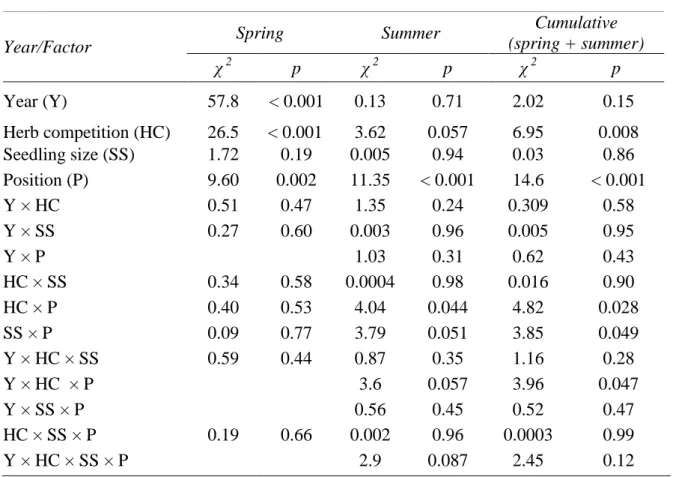
(13) 302. respectively). The composition of the herbaceous community under the Retama canopy. 303. differed from the composition detected in gaps in 2006 but not in 2007 (Year × Position. 304. interaction; F1, 35 = 4.54, P < 0.001). In 2006, the non-graminoid cover was significantly lower. 305. under the Retama canopy than in gaps, whereas the graminoid cover did not differ significantly. 306. between positions. By contrast, the cover of both groups of herbs were similar under the. 307. Retama canopy and in gaps in 2007 (year × position × herb guild interaction; F1, 64 = 9.02, P =. 308. 0.004).. 309 310 311. QUERCUS ILEX SEEDLING PERFORMANCE Seedling mortality of the introduced plants at the end of the experiment was 83.3% in. 312. 2006 and 76.9% in 2007, but these differences were not statistically significant (Table 2).. 313. Significant mortality occurred in the spring of 2006, but not in the spring of 2007 (Fig. 2).. 314. Seedling mortality was lower under the Retama canopy than in the gaps and in the absence of. 315. herbs than in their presence in both years (Table 2 and Fig. 2). However, the negative effect of. 316. the herbaceous community differed between years. Herbs increased seedling mortality in gaps. 317. but not under Retama canopy in 2006, and this effect was already apparent in spring. In. 318. contrast, herbs similarly increased seedling mortality at both positions in 2007, and it occurred. 319. later, in summer (Year × Herb competition × Position interaction, Table 2). Plant size. 320. negatively affected Q. ilex seedling mortality (Fig. 3); however, this effect was only observed. 321. in gaps but not under the Retama canopy (Position × Seedling size interaction in Table 2). No. 322. factor influenced seedling growth (data not shown).. 323. Fv/Fm was higher under the Retama canopy than in gaps in both years (F1,76 = 5.03, P =. 324. 0.027; Fig. 4) and higher in 2006 than in 2007 (F1,76 = 5.28, P = 0.024). Fv/Fm tended to be. 325. higher at midday than at predawn, although this was only observed in 2007 but not in 2006. 326. (Measurement time × Year interaction, F1,76=3.79 P=0.052). Neither herb competition (F1,76 =. 327. 0.02, P = 0.89) nor seedling size affected Fv/Fm (F1,76 = 0.10, P = 0.75). 13.
(14) 328. Leaf water potential was higher in 2006 than in 2007 (χ2= 28.6, P < 0.001). The. 329. frequency of Q. ilex seedlings with higher (less negative). was greater under the Retama. 330. canopy than in gaps. This difference was more apparent in 2006 than in 2007 (Year × Position. 331. interaction, χ2= 6.20, P = 0.045; Fig. 5). Neither herb competition (χ2= 0.13, P = 0.94) nor. 332. plant size (χ2= 5.00, P = 0.08) had any effect on .. 333 334 335. Discussion Retama sphaerocapa facilitated Q. ilex seedlings, which is consistent with greater. 336. recruitment of Q. ilex under Retama canopy than in the gaps observed in other Retama. 337. shrublands (Tovar 2009). This study provides further evidence for the role of facilitation in the. 338. secondary succession of Mediterranean ecosystems (Maestre et al. 2001; Gómez-Aparicio et. 339. al. 2004). However, the mechanism underlying facilitation in this system is complex since it. 340. differed between years and depended on seedling size.. 341 342. TEMPORAL VARIATION IN THE RELATIVE IMPORTANCE OF DIRECT AND. 343. INDIRECT FACILITATION. 344. In both years, Retama facilitated Q. ilex seedling survival, whereas herbs reduced it,. 345. demonstrating that herbs competed with oak seedlings. However, the effects of Retama and. 346. herbaceous vegetation on seedling survival differed between years. Herb competition started. 347. earlier in the growing season in the average rainfall year than in the humid year as indicated by. 348. early higher spring mortality that occurred in the former relative to the latter year. This can be. 349. explained by the dryer spring of the average rainfall year in comparison to the humid year. Our. 350. results suggest that there is a link between the prevailing facilitation mechanism and climate. 351. conditions. Facilitation was predominantly indirect in the average rainfall year, when spring. 352. was drier than in the humid year. By contrast, facilitation was direct in the humid year, when. 14.
(15) 353. summer was drier than in the average rainfall year. This assertion is supported by the following. 354. results. First, herbs increased Q. ilex mortality in gaps but not under the Retama canopy in the. 355. average rainfall year (Fig. 2). The lower herb mass found under Retama canopy as compared to. 356. the gaps, specially in the average rainfall year, suggests that the nurse shrub reduced the. 357. competitive capacity of the herbs, and hence indirectly improved seedling survival, as. 358. previously reported in other studies (Li & Wilson 1998; Siemann & Rogers 2003; Kunstler et. 359. al. 2006). Additionally, species composition of the herbaceous community differed between. 360. years. In the average rainfall year, graminoids predominated over non-graminoids under the. 361. nurse shrub, whereas both herb guilds had similar abundance in gaps. By contrast, in the humid. 362. year, graminoid and non-graminoid cover were similar both under the Retama canopy and in. 363. the gaps. Differences in species composition may affect the competitive capacity of the. 364. community (Gordon et al. 1989), and graminoids tend to prevail under drought conditions. 365. (Goldberg et al. 2001). Secondly, seedling mortality in the absence of herbs did not differ. 366. between gaps and under the nurse shrub in the average rainfall year, but it did during the humid. 367. year. This demonstrates lack of direct facilitation in the former case, but the existence of direct. 368. facilitation in the latter case. In the average rainfall year, resource competition between the. 369. nurse shrub and Q. ilex seedlings may have overwhelmed the direct positive effects of Retama. 370. canopy on Q. ilex seedlings (Ludwig et al. 2004; Maestre & Cortina 2004). Third, the. 371. reduction in oak seedling survival caused by herbs was similar under the shrub and in the gaps. 372. in the humid year, suggesting a lack of indirect facilitation. Consistently, relative differences in. 373. herb mass or in the composition of the herbaceous community were smaller or non-existent. 374. between positions in the humid year respective to the average rainfall year.. 375. Thus, in response to our first question, indirect facilitation may also be an important. 376. mechanism for Q. ilex regeneration in Mediterranean shrublands that are mostly known for. 377. direct facilitation (Pugnaire et al. 1996b; Gómez-Aparicio et al. 2004; Pugnaire et al. 2004). In. 378. addition, the mechanism underlying facilitation may vary with climatic conditions. Indirect 15.
(16) 379. facilitation can be important in years of dry springs where competition for water between nurse. 380. shrubs and herbs is high, resulting in benefits for Q. ilex seedling establishment, whereas direct. 381. facilitation mediated by microclimate amelioration seems to increase with summer aridity.. 382. Therefore, not only summer drought but also spring climatic conditions may determine. 383. facilitation interactions. This hypothesis should be experimentally tested in the future.. 384 385. UNDERLYING MECHANISMS OF DIRECT AND INDIRECT FACILITATION. 386. Variations in soil nutrient and water content do not explain the direct facilitation observed in. 387. our system. Soil fertility did not differ between positions, probably because our nurse shrubs. 388. were too young to have induced changes in soil properties (Pugnaire et al. 1996b). Soil water. 389. content was lower or similar under the Retama canopy in comparison with the gaps, as. 390. documented in other dry environments (Tielbörger & Kadmon 2000; Valladares & Pearcy. 391. 2002). Irradiance reduction seemed to be the main driving force for direct facilitation of Q. ilex. 392. seedlings. The lower irradiation measured under the shrub canopy explains the lower leaf. 393. temperature found in this microsite, which probably reduced Q. ilex transpiration under. 394. Retama (Smith & Geller 1980). Consequently, Q. ilex seedlings were less water-stressed and. 395. photoinhibited under the nurse shrub than in the gaps, which could explain their higher survival. 396. rate under the shrubs (Hikosaka, Kato & Hirose 2004; Baquedano & Castillo 2006). The higher. 397. and Fv/Fm values found under Retama relative to gaps support this argument. Therefore, the. 398. physiological results of this study provide a mechanistic explanation for the role that moderate. 399. shade plays in direct facilitation in dry environments such as Mediterranean ecosystems. 400. (Maestre et al. 2001; Gómez-Aparicio et al. 2005b). Seedlings were less water stressed and. 401. photoinhibited (Fig. 4 and Fig. 5) in the average rainfall year than in the humid year. The. 402. higher summer rainfall and soil water content in the former year can explain this difference.. 403. Levine (1999) predicted that indirect facilitation is more likely when different pairs of. 404. competitors compete for different resources or have different mechanisms to acquire them. The 16.
(17) 405. three competitors of our particular system are likely to compete for the same resource, i.e. soil. 406. water. We suggest that nurse shrubs and herbs competed mainly for soil water because the soil. 407. water content under Retama shrubs in spring was lower than in gaps in both years. However,. 408. Retama only suppressed herb competitive capacity in the average rainfall year, probably. 409. because soil water content under the Retama canopy with herbs in spring was 20% lower than. 410. the soil water content in the spring of the humid year. The reduction in soil water content. 411. imposed by Retama under its canopy did not hinder Q. ilex performance probably because it is. 412. more drought-tolerant than herbs (Levitt 1980; Larcher 1995).. 413. Many studies have shown that shading by adults is the main factor responsible for. 414. reducing the competition of herbs with tree seedlings (Li & Wilson 1998; Pagès et al. 2003;. 415. Siemann & Rogers 2003; Kunstler et al. 2006). In our study, shade per se was unlikely to be a. 416. major mechanism of herb suppression because shrub shade was similar in both years, but shade. 417. could have exacerbated the water stress caused by low soil water content in the spring of the. 418. average rainfall year (Valladares & Pearcy 2002). In contrast to our results, some previous. 419. studies have found greater herb biomass under Retama shrubs than in gaps (Pugnaire et al.. 420. 1996b; Rodríguez-Echeverría & Pérez-Fernández 2003). This can be attributed to the. 421. extremely dry climate of some regions, where facilitative interactions can overcome the. 422. competitive interactions, and to the fact that these studies were performed on grazed. 423. woodlands, where herbivores may reduce herb biomass to a greater extent in open spaces than. 424. under shrubs (Osem, Perevolotsky & Kigel 2007).. 425. Herbs and Q. ilex seedlings also competed for water because herbs reduced water. 426. availability for the seedlings in spring (Fig. 1) as observed in previous studies (Rey Benayas et. 427. al. 2005; van der Waal et al. 2009). This can be due to herb canopy interception of rainfall or. 428. to direct exploitation by roots. Competition for water has been shown to be a major interaction. 429. between herb species and tree seedlings in water-stressed systems (Knoop & Walker 1985;. 430. Ludwig et al. 2004; van der Waal et al. 2009), while competition for nutrients is more 17.
(18) 431. commonly involved in mesic systems (Pagès & Michalet 2003). Nevertheless, herbs and Q.. 432. ilex seedlings might also compete for soil nutrients, and diminution of herb competition by. 433. nurse shrub might have increased nutrient availability to the Q. ilex seedlings (Pagès et al.. 434. 2003).. 435 436 437. RESPONSE TO FACILITATION DEPENDED ON Q. ILEX SEEDLING SIZE The response to facilitation has been demonstrated to vary among species (Gómez-. 438. Aparicio et al. 2004; Liancourt et al. 2005; Padilla & Pugnaire 2009). Our study goes a step. 439. further and indicates that not all individuals within a species have the same response to. 440. facilitation. Thus, amelioration of abiotic and biotic conditions by Retama benefited smaller. 441. seedlings but not larger seedlings since Retama reduced mortality of smaller seedlings relative. 442. to gaps but not of larger seedlings. Large seedlings frequently have lower mortality than small. 443. seedlings under higher stressful conditions (Cook 1980; Leishman & Westoby 1994; Villar-. 444. Salvador et al. 2008), such as those found in gaps. This can be explained on the basis that large. 445. seedlings probably contain more nutrient and storage compounds (Cook 1980; Leishman &. 446. Westoby 1994; Villar-Salvador et al. 2008) and have higher rates of photosynthesis (Cuesta. 447. unpublished data) than smaller seedlings. Differences in seedling size within a population can. 448. be attributed to genetic differences among individuals as demonstrated for Q. ilex (Leiva &. 449. Fernández-Alés 1998), but also to emergence time or seed size (Jurado & Westoby 1992;. 450. Green & Juniper 2004; De Luis, Verdú & Raventón 2008). We suggest that if Q. ilex seedling. 451. size has a genetic basis and determines mortality probability, nurse shrubs may contribute to. 452. maintain genetic diversity of Q. ilex populations.. 453 454 455 456. CONCLUSIONS In conclusion, both indirect and direct facilitation are important processes of oak regeneration in Retama shrublands. The pioneer shrub R. sphaerocapa facilitated Q. ilex 18.
(19) 457. seedlings both by suppressing herb competition (indirect facilitation) and/or by ameliorating. 458. microclimatic conditions under its canopy (direct facilitation). Prevalence of indirect and direct. 459. facilitation differed between years of distinct climatic conditions. Indirect facilitation seems to. 460. be important in years of dry springs, whereas direct facilitation may increase with summer. 461. aridity. Since large areas of the Iberian Peninsula have been planted with or colonized by. 462. pioneer shrubs, and seedling stage is the most critical phase in Mediterranean woodland. 463. regeneration, nurse shrubs could enhance shrubland conversion into forests and play an. 464. important role in both passive (i.e. secondary succession) and active restoration of. 465. Mediterranean woodlands (Padilla & Pugnaire 2006; Rey Benayas, Bullock & Newton 2008).. 466. Furthermore, future studies should assess the incidence of indirect interactions among plants in. 467. other Mediterranean shrublands, in which direct positive interactions are known to drive. 468. community structure.. 469 470. Acknowledgements. 471. We are grateful to J.L. Peñuelas for permitting this study to be carried out on his property and. 472. for his assistance with the experimental field treatments. We thank F. Bustos, J. Cuadrado, L.. 473. Muñoz, J. Oliet, A. Rovere, J. Sánchez, L. Tovar and P. Villar-Hernández for technical support. 474. with field experiments and J. Rejos for helping with the taxonomic determinations. We thank. 475. M. Verdú for valuable comments on an earlier version of this manuscript. This study was. 476. supported by a FPI-MEC grant to B.C., and by projects CGL2007-60533/BOS, AGL2006-. 477. 12609-C02-01/FOR (Spanish Ministry of Science and Education), and S-0505/AMB/0355-. 478. REMEDINAL (Madrid Government).. 479 480. References. 19.
(20) 481. Aerts, R., Maes, W., November, E., Negussie, A., Hermy, M., & Muys, B. (2006) Restoring. 482. dry Afromontane forest using bird and nurse plant effects: Direct sowing of Olea. 483. europaea ssp cuspidata seeds. Forest Ecology and Management, 230, 23-31.. 484. Anthelme, F. & Michalet, R. (2009) Grass-to-tree facilitation in an arid grazed environment. 485 486. (Aïr mountains, Sahara) Basic and Applied Ecology, 10, 437-446. Baquedano, F.J. & Castillo, F.J. (2006) Comparative ecophysiological effects of drought on. 487. seedlings of the Mediterranean water-saver Pinus halepensis and water-spenders. 488. Quercus coccifera and Quercus ilex Trees-Structure and Function, 20, 689-700.. 489 490 491. Bertness, M.D. & Callaway, R.M. (1994) Positive interactions in communities. Trends in Ecology and Evolution, 9, 191-193. Boulant, N., Navas, M.L., Corcket, E., & Lepart, J. (2008) Habitat amelioration and. 492. associational defence as main facilitative mechanisms in Mediterranean grasslands. 493. grazed by domestic livestock. Ecoscience, 15, 407-415.. 494. Brooker, R.W., Maestre, F.T., Callaway, R.M., Lortie, C.J., Cavieres, L.A., Kunstler, G.,. 495. Liancourt, P., Tielbörger, K., Travis, J.M.J., Anthelme, F., Armas, C., Coll, L., Corcket,. 496. E., Delzon, S., Forey, E., Kikvidze, Z., Olofsson, J., Pugnaire, F.I., Quiroz, C.L.,. 497. Saccone, P., Schiffers, K., Seifan, M., Touzard, B., & Michalet, R. (2008) Facilitation. 498. in plant communities: the past, the present and the future. Journal of Ecology, 96, 18-. 499. 34.. 500. Callaway, R.M. (1995) Positive Interactions among Plants. The Botanical Review, 61, 306-349.. 501. Callaway, R.M. (2007) Positive interactions and interference in plant communities Spinger,. 502. Dordrecht, The Netherlands.. 503. Callaway, R.M. & Pennings, S.C. (2000) Facilitation may buffer competitive effects: indirect. 504. and diffuse interactions among salt marsh plants. American Naturalist, 156, 416-424.. 505. Callaway, R.M. & Walker, L.R. (1997) Competition and facilitation: a synthetic approach to. 506. interactions in plant communities. Ecology, 78, 1958-1965. 20.
(21) 507 508 509 510 511 512 513. Cassel, D.K., Kachanoski, R.G., & Topp, G.C. (1994) Practical considerations for using a TDR cable tester. Soil Technology, 7, 113-126. Cook, R.E. (1980) Germination and size-dependent mortality in Viola blanda. Oecologia, 47, 115-117. De Luis, M., Verdú, M., & Raventón, J. (2008) Early to rise makes a plant healthy, wealthy, and wise. Ecology, 89, 3061-3071. Flexas, J., Bota, J., Cifre, J., Escalona, J.M., Galmes, J., Gulias, J., Lefi, E.K., Martinez-. 514. Canellas, S.F., Moreno, M.T., Ribas-Carbo, M., Riera, D., Sampol, B., & Medrano, H.. 515. (2004) Understanding down-regulation of photosynthesis under water stress: future. 516. prospects and searching for physiological tools for irrigation management. Annals of. 517. Applied Biology, 144, 273-283.. 518. Goldberg, D.E., Turkington, R., Olsvig-Whittaker, L., & Dyer, A.R. (2001) Density. 519. dependence in an annual plant community: variation among life history stages.. 520. Ecological Monographs, 71, 423-446.. 521. Gómez-Aparicio, L., Gómez, J.M., & Zamora, R. (2005a) Microhabitats shift rank in. 522. suitability for seedling establishment depending on habitat type and climate. Journal of. 523. Ecology, 93, 1194-1202.. 524. Gómez-Aparicio, L., Gómez, J.M., Zamora, R., & Boettinger, J.L. (2005b) Canopy vs. soil. 525. effects of shrubs facilitating tree seedlings in Mediterranean montane ecosystems.. 526. Journal of Vegetation Science, 16, 191-198.. 527. Gómez-Aparicio, L., Zamora, R., Castro, J., & Hódar, J.A. (2008) Facilitation of tree. 528. samplings by nurse plants: Microhabitat amelioration or protection against herbivores?. 529. Journal of Vegetation Science, 19, 161-172.. 530. Gómez-Aparicio, L., Zamora, R., Gómez, J.M., Hódar, J.A., Castro, J., & Baraza, E. (2004). 531. Applying plant facilitation to forest restoration: a meta-analysis of the use of shrubs as. 532. nurse plants. Ecological Applications, 14, 1128-138. 21.
(22) 533. Gordon, D.R., Welker, J.M., Menke, J.W., & Rice, K.J. (1989) Competition for soil water. 534. between annual plants and blue oak ( Quercus douglasii) seedlings. Oecologia, 79, 533-. 535. 541.. 536. Green, P.T. & Juniper, P.A. (2004) Seed–seedling allometry in tropical rain forest trees: seed. 537. mass-related patterns of resource allocation and the ‘reserve effect’. Journal of. 538. Ecology, 92, 397-408.. 539. Grime, J.P. (1974) Vegetation classification by reference to strategies. Nature, 250, 26-31.. 540. Hikosaka, K., Kato, M.C., & Hirose, T. (2004) Photosynthetic rates and partitioning of. 541 542 543 544 545 546 547 548. absorbed light energy in photoinhibited leaves. Physiologia Plantarum, 121, 699–708. Holmgren, M., Scheeffer, M., & Huston, M.A. (1997) The interplay of facilitation and competition in plant communities. Ecology, 78, 1966-1975. Jurado, E. & Westoby, M. (1992) Seedling growth in relation to seed size among species of arid Australia. Journal of Ecology, 80, 407-416. Knoop, W.T. & Walker, B.H. (1985) Interactions of woody and herbaceous vegetation in a southern African savanna. Journal of Ecology, 73, 235-253. Kunstler, G., Curt, T., Bouchaud, M., & Lepart, J. (2006) Indirect facilitation and competition. 549. in tree species colonization of sub-Mediterranean grasslands. Journal of Vegetation. 550. Science, 17, 379-388.. 551. Larcher, W. (1995) Physiological Plant Ecology Springer, Berlin.. 552. Leishman, M. & Westoby, M. (1994) The role of seed size in seedling establishments in dry. 553. soil conditions: experimental evidence from semi-arid species. Journal of Ecology, 82,. 554. 249-258.. 555. Leiva, M.J. & Fernández-Alés, R. (1998) Variability in seedling water status during drougth. 556. within a Quercus ilex subsp. ballota population, and its relation to seedlings. 557. morphology. Forest Ecology and Management, 111, 147-156.. 22.
(23) 558 559 560. Levine, J.M. (1999) Indirect facilitation: evidence and predictions from a riparian community. Ecology, 80, 1762-1769. Levitt, J. (1980). Responses of plants to environmental stresses. Volume II. Water, radiation,. 561. salt, and other stresses. Physiological Ecology (ed T.T. Kozlowski), pp. 607. Academic. 562. Press, New York.. 563 564 565. Li, X. & Wilson, S.D. (1998) Facilitation among woody plants establishing in an old field. Ecology, 79, 2694-2705. Liancourt, P., Callaway, R.M., & Michalet, R. (2005) Stress tolerance and competitive-. 566. response ability determine the outcome of biotic interactions. Ecology, 86, 1611-1618.. 567. Lortie, C.J., Brooker, R.W., Choler, P., Kikvidze, Z., Michalet, R., Pugnaire, F.I., & Callaway,. 568 569. R.M. (2004) Rethinking plant community theory. Oikos, 197, 433-438. Ludwig, F., Dawson, T.E., Prins, H.H.T., Berendse, F., & Kroon, H. (2004) Below-ground. 570. competition between trees and grasses may overwhelm the facilitative effects of. 571. hydraulic lift. Ecology letters, 7, 623-631.. 572. Maestre, F.T., Bautista, S., Cortina, J., & Bellot, J. (2001) Potential for using facilitation by. 573. grasses to establish shrubs on a semiarid degraded steppe. Ecological Applications, 11,. 574. 1641-1655.. 575. Maestre, F.T. & Cortina, J. (2004) Do positive interactions increase with abiotic stress? A test. 576. from a semi-arid steppe. Proceedings of the Royal Society of London. Series B. 577. (Supplement), 271, S331-S333.. 578 579 580 581 582 583. Maxwell, K. & Johnson, G.N. (2000) Chlorophyll fluorescence-A practical guide. Journal of Experimental Botany, 51, 659-668. Miller, T.E. (1994) Direct and indirect species interactions in an early old-field plant community. American Naturalist, 143, 1007-1025. Nambiar, E.K.S. & Zed, P.G. (1980) Influence of weeds on the water potential, nutrient content and growth of young radiata pine. Australian Forest Restoration, 10, 279-288. 23.
(24) 584. Osem, Y., Perevolotsky, A., & Kigel, J. (2007) Interactive effects of grazing and shrubs on the. 585. annual plant community in semi-arid Mediterranean shrublands. Journal of Vegetation. 586. Science, 18, 869-878.. 587. Padilla, F.M. & Pugnaire, F.I. (2006) The role of nurse plants in the restoration of degraded. 588. environments. Frontiers in Ecology and the Environment, 4, 196-2002.. 589. Padilla, F.M. & Pugnaire, F.I. (2009) Species identity and water availability determine. 590. establishment success under the canopy of Retama sphaerocarpa shrubs in a dry. 591. environment. Restoration Ecology, 17, 900-907.. 592. Pagès, J.-P. & Michalet, R. (2003) A test of the indirect facilitation model in a temperate. 593. hardwood forest of the northern French Alps. Journal of Ecology, 91, 932-940.. 594. Pagès, J.-P., Pache, G., Joud, D., Magnan, N., & Michalet, R. (2003) Direct and indirect effects. 595 596 597 598 599. of shade on four forest tree seedlings in the French Alps. Ecology, 84, 2741-2750. Pugnaire, F.I., Armas, C., & Valladares, F. (2004) Soil as mediator in plant-plant interactions in a semi-arid community. Journal of Vegetation Science, 15, 85-92. Pugnaire, F.I., Haase, P., & Puigdefábregas, J. (1996a) Facilitation between higher plant species in a semiarid environment. Ecology, 77, 1420-1426.. 600. Pugnaire, F.I., Haase, P., Puigdefábregas, J., Cueto, M., Clark, S.C., & Incoll, L.D. (1996b). 601. Facilitation and succession under the canopy of a leguminous shrub, Retama. 602. sphaerocarpa, in a semi-arid environment in south-east Spain. Oikos, 76, 455-464.. 603 604 605. R Development Core Team (2008) R: A language and environment for statistical computing. R Foundation for Statistical Computing, Vienna, Austria. Rey Benayas, J.M., Bullock, J.M., & Newton, A.C. (2008) Creating woodland islets to. 606. reconcile ecological restoration, conservation, and agricultural land use. Frontiers in. 607. Ecology and the Environment, 6, 329-336. 608. Rey Benayas, J.M., Navarro, J., Espigares, T., Nicolau, J.M., & Zavala, M.A. (2005) Effects of. 609. artificial shading and weed mowing in reforestation of Mediterranean abandoned 24.
(25) 610. cropland with contrasting Quercus species. Forest Ecology and Management, 212, 302-. 611. 314.. 612 613 614. Rodríguez-Echeverría, S. & Pérez-Fernández, M.A. (2003) Soil fertility and herb facilitation mediated by Retama sphaerocarpa. Journal of Vegetation Science, 14, 807-814. Siemann, E. & Rogers, W.E. (2003) Changes in light and nitrogen availability under pioneer. 615. trees may indirectly facilitate tree invasions of grasslands. Journal of Ecology, 91, 923-. 616. 931.. 617 618 619 620 621. Smith, W.K. & Geller, G.N. (1980) Leaf and environmental parameters influencing transpiration: Theory and measurements. Oecologia, 46, 308-313. Tielbörger, K. & Kadmon, R. (2000) Temporal environmental variation tips the balance between facilitation and interference in desert plants. Ecology, 81, 1544-1553. Tovar, L. (2009) Reclutamiento de plantas leñosas en retamares. Una aproximación. 622. multiescala. Senior Sciences Thesis, University of Alcalá, Alcalá de Henares, Madrid,. 623. Spain.. 624. Valladares, F. & Pearcy, R.W. (2002) Drought can be more critical in the shade than in the. 625. sun: a field study of carbon gain and photo-inhibition in a Californian shrub during a. 626. dry El Niño year. Plant, Cell, and Environment, 25, 749-759.. 627. van der Waal, C., de Kroon, H., de Boer, W.F., Heitkonig, I.M.A., Skidmore, A.K., de Knegt,. 628. H.J., van Langevelde, F., van Wieren, S.E., Grant, R.C., Page, B.R., Slotow, R., Kohi,. 629. E.M., Mwakiwa, E., & Prins, H.H.T. (2009) Water and nutrients alter herbaceous. 630. competitive effects on tree seedlings in a semi-arid savanna. Journal of Ecology, 97,. 631. 430-439.. 632 633. Verdú, M. & García-Fayos, P. (2003) Frugivorous birds mediate sex-biased facilitation in a dioecious nurse plant. Journal of Vegetation Science, 14, 35-42.. 25.
(26) 634. Villar-Salvador, P., Planelles, R., Enríquez, E., & Peñuelas Rubira, J.L. (2004) Nursery. 635. cultivation regimes, plant functional attributes, and field performance relationship in. 636. the Mediterranean oak Quercus ilex L. Forest Ecology and Management, 196, 257-266.. 637. Villar-Salvador, P., Valladares, F., Domínguez-Lerena, S., Ruiz-Díez, B., Fernández-Pascual,. 638. M., Delgado, A., & Peñuelas Rubira, J.L. (2008) Functional traits related to seedling. 639. transplanting performance in the Mediterranean leguminous shrub Retama. 640. sphaerocarpa: insights from a provenance, fertilization and rhizobial inoculation study.. 641. Environmental and Experimenal Botany, 64, 145-154.. 642 643. 26.
(27) 644. Table 1. Microclimate features, soil properties, herb biomass and the cover of graminoid and. 645. non-graminoid herbs in the four studied microsites. Microclimatic and soil variables were. 646. measured in 2006. Values are mean ± SE. Means with different superscript letters are. 647. significantly different at P < 0.05 after a Tukey post hoc test. *P < 0.05,. 648. 0.001. † Statistical data are reported in the text.. **. P < 0.01,. ***. P<. 649. Variables. Microsites Under Retama Gap Without With Without With herbs Herbs herbs herbs. F Herb Position Competition P CH (P) (HC). Irradiance (%). 38±1.2c. 28±0.9d. 100±0.0a. 46±1.5b. 430***. 225***. 19.9***. Air relative humidity (%). 10.1±0.8. 9.8±0.7. 10.0± 1.0. 9.8±0.8. 0.04. 0.08. 0.007. Air temperature (ºC). 36.2±0.5 36.0±0.5 36.1±0.5 37.4±0.5. 1.4. 1.25. 0.02. Soil temperature (ºC). 30.4±1.1b 28.2±0.5b 41.4±0.6a 39.5±1.0a 179.7***. 5.82**. 0.01. Leaf temperature (ºC). 43.1±2.6b. 49.6±1.4a. t = 6.82***. Soil organic matter (%). 1.1±0.07. 1.1±0.05. t = -0.40. Soil N (mg kg-1). 0.8±0.05. 0.8±0.1. t = -0.98. 193±41.2. 186±46.5. t = -0.32. 5.7±0.2. 5.8±0.5. t = 0.49. Herb mass in 2006 (g). 42±3b. 67±4a. †. Herb mass in 2007 (g). 67±7. 81±6. †. Graminoid cover in 2006 (%). 31±5. 27±5. †. Non-graminoid cover in 2006 (%). 4±2.0 b. 49±7 a. †. Graminoid cover in 2007 (%). 19±6. 20±4. †. Non-graminoid cover in 2007 (%). 19±4.9. 26±6. †. Soil K (mg kg-1) Soil pH. 27.
(28) 650. Table 2. Results of the ANCOVA models used to test the effects of year, position, herb. 651. competition and seedling size on Q. ilex seedling mortality. The Year × Position, Year × Herb. 652. competition × Position, and Year × Position × Herb competition × Seedling size interactions. 653. were not analysed in spring because there was no mortality under Retama canopy in May. 654. 2007.. 655 Spring. Year/Factor. Summer. Cumulative (spring + summer) χ2 p. χ2. p. χ2. p. Year (Y). 57.8. < 0.001. 0.13. 0.71. 2.02. 0.15. Herb competition (HC) Seedling size (SS) Position (P) Y × HC Y × SS Y×P HC × SS HC × P SS × P Y × HC × SS Y × HC × P Y × SS × P HC × SS × P Y × HC × SS × P. 26.5 1.72 9.60 0.51 0.27. < 0.001 00001 0.19 0.002 0.47 0.60. 0.34 0.40 0.09 0.59. 0.58 0.53 0.77 0.44. 0.19. 0.66. 3.62 0.005 11.35 1.35 0.003 1.03 0.0004 4.04 3.79 0.87 3.6 0.56 0.002 2.9. 0.057 0.94 < 0.001 0.24 0.96 0.31 0.98 0.044 0.051 0.35 0.057 0.45 0.96 0.087. 6.95 0.03 14.6 0.309 0.005 0.62 0.016 4.82 3.85 1.16 3.96 0.52 0.0003 2.45. 0.008 0.86 < 0.001 0.58 0.95 0.43 0.90 0.028 0.049 0.28 0.047 0.47 0.99 0.12. 656. 28.
(29) 657. Fig. 1. Soil water content at the four microsites in 2006 (above) and 2007 (below). Data. 658. represent mean values ± SE.. 659 660. Fig. 2. Mortality rate of Quercus ilex seedlings at the four microsites during spring, summer. 661. and the whole first growing season in 2006 (above) and 2007 (below). Data represent means ±. 662. SE.. 663 664. Fig. 3. Mortality probability of Quercus ilex seedling as a function of seedling size under the. 665. Retama canopy and in gaps across the two years. Lines are the fitted logistic regressions. The. 666. and. 667. and 1.0087 and 0.01018, respectively, under Retama.. parameters of the logistic regression were 2.2773 and –0.227, respectively, for the gap. 668 669. Fig. 4. Photochemical efficiency (Fv/Fm) of photo-system II of Quercus ilex seedlings planted. 670. at the four microsites in 2006 and 2007. Data represent the average between morning and. 671. midday data. Values are means ± SE.. 672 673. Fig. 5. Frequency of Quercus ilex seedlings according to midday leaf water potential classes. 674. under the Retama canopy and in gaps in 2006 (top) and in 2007 (below). The number of. 675. sampled plants under the Retama canopy and in gaps in 2006 was 12 and 10, respectively,. 676. whereas 24 plants per position were sampled in 2007.. 29.
(30) Soil water content (%). 9. 7 6 5 4 3 0 9. Soil water content (%). 2006. 8. Under Retama without herbs Under Retama with herbs Gap without herbs Gap with herbs. 2007. 8 7 6 5 4 3 0. Spring. 677 678. Summer. Fig. 1.. 30.
(31) 2006. 1.0. Mortality rate. 0.8 0.6 0.4 0.2 0.0 1.0. Under Retama without herbs Under Retama with herbs Gap without herbs Gap with herbs. 2007. Mortality rate. 0.8 0.6 0.4 0.2 0.0. Spring. 679 680. Summer Cumulative (spring +summer). Fig. 2.. 681. 31.
(32) Mortality rate. 1.0. Under Retama Gap. 0.9 0.8 0.7 0.6 0.0 0. 682 683. 1. 2. 3. 4. 5. 6. 7. Seedling stem volume (mL). Fig. 3.. 32.
(33) Under Retama without herbs Under Retama with herbs Gap without hebs Gap with hebs. 0.9. Fv/Fm. 0.8 0.7 0.6 0.5 0.0. 2006. 684 685. 2007. Fig. 4.. 686. 33.
(34) Frequency of plants. 0.8 0.6. Under Retama Gap. 0.4 0.2 0.0. >-4.5. .-4.6 to -6.8. < -6.9. Mid-day water potential (MPa) classes. 687 688. Fig. 5. 689 690. 34.
(35)
Figure
Documento similar
Growth regulation of human colon cancer cells by epidermal growth factor and 1,25-dihydroxyvitamin D 3 is mediated by mutual modulation of receptor expression. The down-regulation
It is distinguished two ways of efficiency measurement: in the direct method, the input and output power are measured directly, as the expression (2); and the indirect
In particular, usage has a direct positive effect on loyalty and when linked to a variable cost, it can have an indirect negative effect, mediated through costs..
Accordingly, the increase in government spending (that in this case is equivalent to an increase of the budget deficit) will induce a direct (through its purchases) and
The purpose of this research is to analyze the features of English as a Lingua Franca (ELF) interactions in travel blogs and explore some strategies used by participants in blog
All observations of SSOs published in the Gaia DR2, both for astrometry and photometry, are based on measurements obtained by single CCDs.. The TDI rate is an instrumental constant,
rated by the greater abundance of saline soils in arid environments and by that of other leached ones in Mediterranean environments (Luvisols and Planosols). 6b) that
La información de esta revisión bibliográfica sugiere que el uso de técnicas habitualmente empleadas en agricultura ecológica es eficiente y potencialmente recomendable para paliar
