STALlion: A Simple Typed Assembly Language for Static
Analysis
∗
Mart´ın Nordio,
1, Francisco Bavera
1Ricardo Medel,
1,3, †Jorge Aguirre
1, Gabriel Baum
1,2(1)
Universidad Nacional de R´ıo Cuarto, Departamento de Computaci´
on
R´ıo Cuarto, Argentina
{
nordio,pancho,jaguirre
}
@dc.exa.unrc.edu.ar
(2)
Universidad Nacional de La Plata, LIFIA
La Plata, Argentina
[email protected]
(3)
Stevens Institute of Technology,
New Jersey, EE.UU.,
[email protected]
2004
Abstract
Typed assembly languages have the goal of providing security guarantees, for example, for the limited use of resources in a host machine or the detection of autoupdate code. This work presents a simple typed assembly language which allows us to perform various kinds of static analysis tasks with the purpose of detecting flaws in the code security. The security policy we use guarantees type and memory safety. Moreover, wa can ensure that non-initialized variables are not read, and that there is no out-of-bound array accesses. The language we present, called STALlion, was designed in order to interpret a particular kind of imperative programs, more specificallyabstract syntax tree.
Keywords:Mobile Code, Proof-Carrying Code, Security Properties, Programming Lan-guages.
∗This work was supported through grants from the SECyT-UNRC, the Agencia C´ordoba Ciencia, and the NSF. †This author’s work was supported by the NSF projectCAREER: A Formally Verified Environment for the
1
Introduction
Typed assembly languages are assembly languages that preserve the types of the registers. They have the goal of providing security guarantees, for example, for the limited use of resources in a host machine or the detection of autoupdate code. This kind of assemblies have received increasing attention since the invention ofProof-Carrying Code(PCC).PCC is a technique developed by Necula and Lee [9] whose aim is guaranteeing the safety of untrusted mobile code. Since its conception in 1998, this technique generated several active lines of research [1, 2, 3, 6, 8, 9, 11, 12, 15, 17], but there are still some open problems.
With the goal of resolving some open problems of PCC, we developed the framework Proof-Carrying Code based on Static Analysis(PCC-SA) [13], that guarantees the safe execution of mobile code based onPCCand static analysis techniques. This framework uses a high-level intermediate language in order to verify the code security. Moreover, we implemented a prototype to study the applicability of our approach in practice. This framework uses anabstract syntax tree (AST) with type annotations. These intermediate representations enable us to use static analysis techniques in order to generate and verify this type information and also to apply several code optimization techniques. The AST is then used by the code consumer, both to prove that the code complies with the security properties, and to generate object code.
AST resulted to be a suitable vehicle for performing some analysis on the code, since it allows for linear-time evaluation (as opposed to the typical exponential-time complexity of standardPCC
techniques). This is achieved at the expense of overloading the code consumer with the job of generating the object code before executing it. One way to solve this problem is by means of the use of a typed assembly language, as well as the AST. The AST represents only the proof that the code verifies the consumer’s security policies and does not contain the executable code. In this way, the code consumer only verifies that theASTsatisfy the security policy and it “matches” the assembly.
Another important feature of a typed assembly is that it can be used to make security checkers. If we combine the assembly language with the ASTwe can obtain a hybrid system where certain proofs are made on the AST and other proofs can be made by a type checker on the assembly. Some proofs are made on the AST because either they cannot be made on the assembly or they are more efficient on theAST.
With the aim of implementing the above described idea, we designed a typed assembly language namedSTALlion. In contrast with other proposed assembly languages,STALlioninterpretsASTs, and allows for various static analysis tasks. Furthermore, we can obtain an abstract syntax tree
from a program written in the STALliontyped assembly language efficiently. Due to the relation between both, the algorithm which verifies that a program written inSTALlionmatches anAST is simple and efficient.
This paper is structured as follows: in section 2 we present theSTALlionassembly language. We describe theabstract syntax treein section 3. The compilation function from theASTto aSTALlion
program is presented in section 4. The related work are analysed in section 5. The last section is devoted to the conclusions of our work and some proposals of future work.
2
The
STALlion
Typed Assembly Language
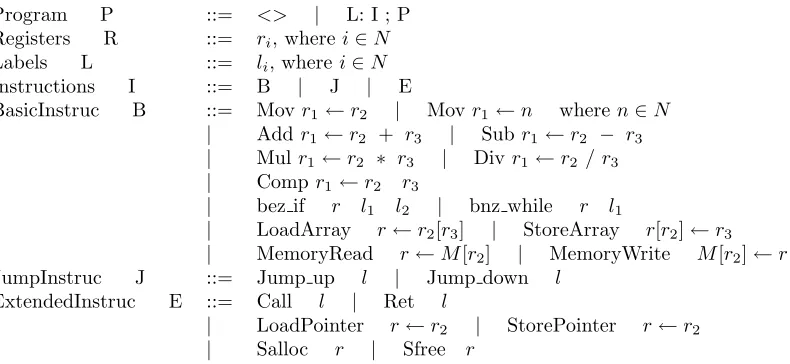
A programP consists of a sequence l:Iof labels and instructions. Each register of the language has a certain type. The types of registers are int, arrayint and [int]. The int type represents integer type, thearrayintrepresents integer array type and [int] pointer to an integer. Arrays are formed by an integer which it represents bound array and the corresponding set of integers. For example, if we have an array of five elements, this is formed by the constant 5 (which it cannot be updated by the programmer) and five elements ofinttype (figure 2). The integer pointers are composed of the memory address which contains the value and the account of registers (of type integer pointer) that points to this memory address. This last information is used to make different kinds of alias analysis.
Types T ::= intw | array intw | [int]w
w ::= + | −
Figure 1: Types of STALlion
[image:3.612.99.494.371.553.2]The types are tagged with an initialization flag, z which can be either + or − indicating an initialized or an unitialized value, respectively. We say that the array int type is initialized (array int+) if all its constituent elements are initialized, otherwise it is unitialized (array int−).
Figure 2: Example of a lenght-five array structure.
Program P ::= <> | L: I ; P Registers R ::= ri, wherei∈N
Labels L ::= li, where i∈N
Instructions I ::= B | J | E
BasicInstruc B ::= Movr1←r2 | Movr1←n wheren∈N
| Addr1←r2 + r3 | Subr1←r2 − r3
| Mulr1←r2 ∗ r3 | Divr1←r2/ r3
| Compr1←r2 r3
| bez if r l1 l2 | bnz while r l1
| LoadArray r←r2[r3] | StoreArray r[r2]←r3
| MemoryRead r←M[r2] | MemoryWrite M[r2]←r
JumpInstruc J ::= Jump up l | Jump down l
ExtendedInstruc E ::= Call l | Ret l
| LoadPointer r←r2 | StorePointer r←r2
| Salloc r | Sfree r
Figure 3: TheSTALlionTyped Assembly Language
The language has a set of basic instructions, two unconditional jump instructions and a set of extended instructions. The basic instructions areMov, Add, Sub, Score, Times, bez if, bez while, LoadArray, StroreArray, MemoryRead, MemoryWrite y StackPointer.
The Mov instruction moves the contents of a r2 register to r1 register. Given two registers r2 and r3, the Add, Sub, Div, Mul instructions add, subtract, multiply and divide the values
stored in r2 and r3 respectively and store the result in the r1 register. Given a register r, the
bez if instruction jumps to either the labell1, ifris equal to 0, or, labell2, otherwise. TheComp
instruction compares the r2 and r3 registers and if r2 is smaller than r3 store the zero constant
in r1, otherwise, store the constan 1. Given a registerr, the bez while instruction jumps to the
labell1, ifr is equal to 0. Although thebez if instruction can be replace by the use of bnz while
of a conditional sentence. TheLoadArray, StroreArrayinstructions allow us to load the contents of a position of an array to a register and to store the contents of a register to an array, respectively. Furthermore,MemoryRead allows us to read from a memory position and to store its value to an
rregister andMemoryWrite allows us to store the contents of ar register in a memory position. Finally, the extended instructions allow us both to use pointers and to invoke functions.
2.1
Typing Rules
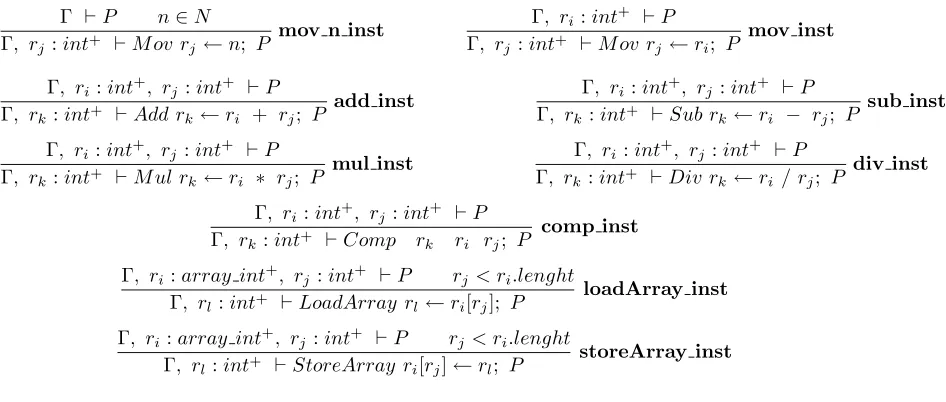
Own typing rules define a judgement Γ⊢P meaning thatP is a well-typed assembly program in context Γ. TheSTALliontyping rules are defined as follows:.
Γ ⊢P n∈N
Γ, rj :int+ ⊢M ov rj←n; P
mov n inst Γ, ri:int
+ ⊢P
Γ, rj:int+ ⊢M ov rj ←ri; P
mov inst
Γ, ri:int+, rj :int+ ⊢P
Γ, rk :int+ ⊢Add rk ←ri + rj; P
add inst Γ, ri:int
+, r
j :int+ ⊢P
Γ, rk :int+ ⊢Sub rk ←ri − rj; P
sub inst
Γ, ri:int+, rj :int+ ⊢P
Γ, rk :int+ ⊢M ul rk ←ri ∗ rj; P
mul inst Γ, ri:int
+, r
j :int+ ⊢P
Γ, rk :int+ ⊢Div rk ←ri / rj; P
div inst
Γ, ri :int+, rj:int+ ⊢P
Γ, rk:int+ ⊢Comp rk ri rj; P
comp inst
Γ, ri:array int+, rj :int+ ⊢P rj < ri.lenght
Γ, rl:int+ ⊢LoadArray rl←ri[rj]; P
loadArray inst
Γ, ri:array int+, rj :int+ ⊢P rj < ri.lenght
Γ, rl:int+ ⊢StoreArray ri[rj]←rl; P
[image:4.612.82.555.213.414.2]storeArray inst
Figure 4: Basic Rules of The Type System.
TheLoadArray, StoreArrayrules impose the property of constraint that non-existent array positions are not read and not written, respectivelly. We want to remind that thearray inttype is made up by two fields: its lenght andr′
iselements. Ifriis ofarray inttype, thenri.lenghtcontains
its lenght. Therefore, LoadArray rl ←ri[rj] instruction is safe ifrj is smaller that the lenght of
the array.
Γ ⊢P;l1:I1 Γ⊢l2:I2 l1, l2∈Σ(Labels) f labels(l1) =f labels(l2) + 1
Γ⊢P;l1:I1;l2;I2
r labels
Γ ⊢P l1, l2∈Σ(Labels) f labels(l1)> f labels(l2)
Γ⊢l1:Jump up l2; P
jump up inst
Γ ⊢P l1, l2∈Σ(Labels) f labels(l2)> f labels(l1)
Γ⊢l1:Jump down l2; P
jump down inst
Γ ⊢P l1, l2, l3∈Σ(Labels) f labels(l1)< f labels(l2)< f labels(l3)
Γ⊢l1:bez if r l1 l2; P
bez if inst
Γ ⊢P l1, l2∈Σ(Labels) f labels(l1)< f labels(l2)
Γ⊢l1:bnz while r l1; P
bnz while inst
Figure 5: Labels Rules of the Type System.
[image:4.612.84.479.518.673.2]determines that a program is well-typed, which among other things, ensures that label numbers are increasingly ordened.
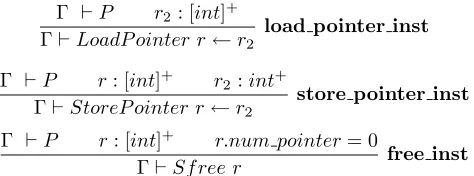
Γ ⊢P r2: [int]+
Γ⊢LoadP ointer r←r2
load pointer inst
Γ ⊢P r: [int]+ r 2:int+
Γ⊢StoreP ointer r←r2
store pointer inst
Γ ⊢P r: [int]+ r.num pointer= 0
[image:5.612.177.414.121.209.2]Γ⊢Sf ree r free inst
Figure 6: Pointer Rules of the Type System.
The load pointer inst rule determines when is safe to load a pointer r2 in the r register.
The associated semantics of load pointer instis: r2.nun pointers= r2.num pointers+ 1 and r.nun pointers=r.num pointers−1. In words,r2.num pointerscontains the information of how
pointers are pointed to this memory address. Then , in order to perform theLoadP ointeroperation, the account of pointers pointing to the address held inr2is increased by 1, and its account pointed
byr2 is decreased by 1, since r2 has changed its contained value. The free instrule determines
that is safe to free a memory address if there is no pointer pointing to it (r.num pointer=0).
3
The Abstract Syntax Tree
The abstract syntax tree (AST) is an abstract representation of a subset of C called Mini. This representation enables us to apply several static analysis, such as control flow and data flow analysis. Also, it can be used to apply code optimizations.
The prototype’s abstract syntax trees are similar to a traditionalAST, but the former include code annotations. These annotations show the status of the program objects, and they contain information about variable initializations, loop invariants, and variable ranges.
Each sentence of a program is represented by an AST. The nodes in an AST contain a label, information or references to the sub-sentences that compose the sentence, and a reference to the next sentence.
Each expression is represented by a graph. Two different labels are used when an array is accessed:unsafeandsafe. These labels mean that it is not safe to access to such element of that array and that it is safe to access, respectively. By modifying the node label we avoid the necessity of include run-time checks.
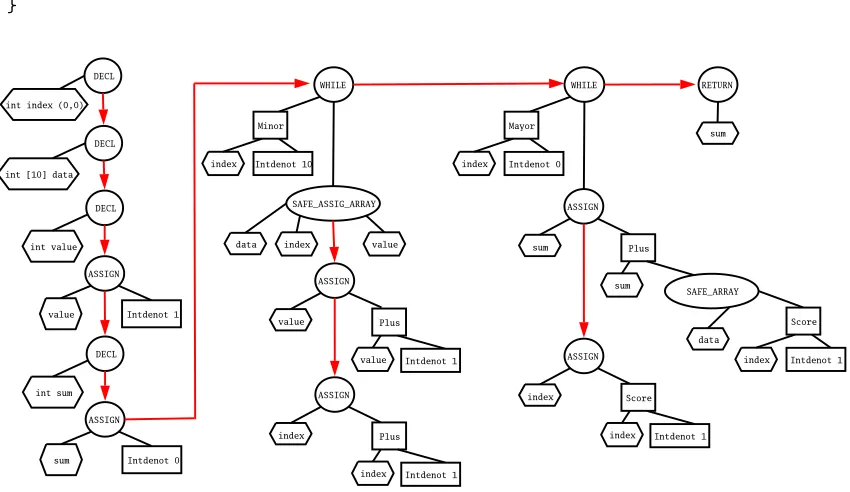
The figure 7 presents theAST of the following example writted onMini:
int ArraySum ( int index(0,0) ) {
int [10] data; /* Define an array */
int value=1; /* Define an initialization variable */
int sum=0; /* Define the summatory variable */
while (index<10) { /* Initialize the array */ data[index]=value;
value=value+1; index=index+1; }
while (index>0) { /* Calculate the summatory */ sum=sum+data[index-1];
return sum; }
Figure 7:ASTof the program example.
The circles in Figure 7 represent sentences, while the hexagons represent variables and the rectangles represent expressions. Arrows show the control flow, and straight lines join sentences with their attributes. The labelDECL is used for declarations, ASSIGNfor assign sentences, UN-SAFE ASSIG ARRAY for array assign sentences, WHILE for loops, and RETURNfor function re-turn sentences. For example, note that the AST of the first loop includes the logic condition (index < 10) and the body of the loop. The AST of the body includes three assign sentences, the first of them assigns the valuevalueto the element indexof the array data. So, it is labeled
UNSAFE ASSIG ARRAY.
4
Compilation Function
In the following table, we present the compilation function. In the first column, we present the example written in Mini [5], in the second, the corresponding AST and finally we present the
MiniProgram AST STALlionProgram
variable=5 l1: Movrvar ←5
variable=expresion l1: Movrvar←rexpr
a array[expresion]=value l1: StoreArray
rarr[rexpr]←rval
a array[expresion]=value
l1: MemoryRead ri ←M[rarr]
l2: Comp r←ri rind
l3: bez if r l4 l6 l4: StoreArray
rarr[rind]←rval
l5: jump down l6 l6: ARRAY ERROR l7: ...
var x=a array[expresion]
l1: LoadArray ra ←rarr[rexpr]
l2: Movrx ra
if (var x>var y) { Body Then }
else
Body Else Sentences
l1: Compr rx ry
MiniProgram AST STALlionProgram
while (var x>var y) { Body W
}
Sentences
l1: Comp r rx ry
l2bez while r l5 l3: Basic Body While l4: jump upl1 l5: Instructions
The expresions are compiled by the following way:
MiniExpresions AST STALlionProgram
var x+ Expresion l1: Addraux←ry + rexpr
var x−Expresion l1: Subraux←ry − rexpr
var x∗Expresion l1: Mul raux←ry ∗ rexpr
var x/Expresion l1: Divraux←rx / rexpr
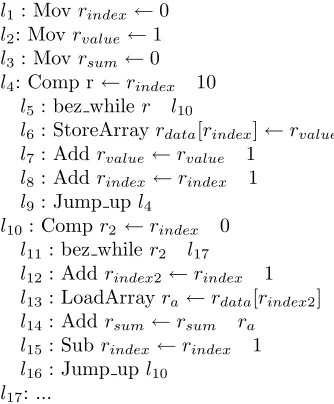
The figure 8 shows the generatedSTALlioncode for the example of the figure 7.
5
Related Work
l1: Movrindex←0
l2: Movrvalue ←1
l3: Movrsum←0
l4: Comp r←rindex 10
l5: bez whiler l10
l6: StoreArrayrdata[rindex]←rvalue
l7: Addrvalue←rvalue 1
l8: Addrindex←rindex 1
l9: Jump upl4
l10: Compr2 ←rindex 0
l11: bez whiler2 l17 l12: Addrindex2←rindex 1
l13: LoadArrayra ←rdata[rindex2] l14: Addrsum←rsum ra
l15: Subrindex←rindex 1
[image:9.612.209.376.76.278.2]l16: Jump upl10 l17: ...
Figure 8:STALlioncode for theASTof the figure 7
more suitable thanJava bytecodesto support a great variety of source languages and an important number of optimizations. At the moment,TALis implemented in theIntel IA32architecture (32-bit 80x86 flat model), and is calledTALx86.
A TAL program contains assembly code together with type annotations and TAL pseudo-intructions, which are used to check the assembly language program with the type checker.
The typed rules guarantee memory security, control flow security and type security of theTAL
programs. TAL is an ideal platform for compilers pointed by types that want to produce safe code for the use of mobile code applications or extending operative systems kernels. The compiler developers can use theTALprogram security to “purify” tranformations of sophisticated program. Types help us to check the soundness of the transformations and optimizations that are very difficult to make without types. TheTALapplets, similar to java applets, can be downloaded from non-trusted servers from internet, to verify and then execute without damaging of the host security.
DTAL is a dependently typed assembly language [18]. Its type system supports the use of dependent types, obtaining some advantages of dependent type assembly level. DTAL is better thanTAL, allowing for important optimizations in the compilers, such as array bound checking.
DTALaddresses formally the problem of sum type representation in an assembly level, doing this handling not only data types inMLbut also dependent data types in dependent ML (DML).
HBAL is a typed assembly language oriented to ensure that each program of a valid type is executed in a heap bounded memory [4, 7] . If the type of a program HBAL is verifiable, it is executed in a safe form in any memory that satifies the initiated type conditions. In order to guarantee the safe execution, a program P must:
1. check the type of P once,
2. before each execution, check that the memory satisfies the type assumption of initial context
HBAL distinguishes explicitly between addresses devoted to store code and devoted to store datas by means of an appropriate discipline of types. It can also eliminate the possibility of re-writing addresses where the code is stored. By adding to this the restriction of control flow by typing the label, is eliminated the danger of execution of hidden instructions on the addresses where dates are stored. As for the verification of non-interference property, it enforces that in the execution of a program, the public information does not depend confidencial information.
6
Conclusions and Future Work
We developed a typed assembly language that allows us to make various kinds of static analysis for the purpose of ckecking security properties. This is a preliminary approach to a mixed check system of security policies, which allows us to verify security properties based on flow analysis and data analysis over a formal type system. The security verifications made onSTALlionare pointer alias analysis, array bound checking, initialized values and label checking.
An interesting future work is to define an isomorphism betweenMini,ASTandSTALlion. Fur-thermore, it could be interesting to continue researching in the typed assembly language area. This should allow us to extend STALlion incorporating new instructions but also defining a memory space that only contains data and another space that only contains instructions. In this way, we should prevent many security violations, for example, the violations done by buffer overflow. We plan to define a classification of which security properties can be done efficiently overSTALlionand which over theAST.
Another future work is the incorporation of STALlion to the implemented prototype of safe mobile code environment [13].
References
[1] A. Appel, A. Felty, “A Semantic Model of Types and Machine Instructions for Proof-Carrying Code”, inProceedings of the 27thACM SIGPLAN-SIGACT Symposium on Principles of
Pro-gramming Languages (POPL’00), pp. 243–253, ACM Press, Boston, Massachusetts (USA), January 2000.
[2] A. Appel, “Foundational Proof-Carrying Code”, inProceedings of the 16th Annual
Sympo-sium on Logic in Computer Science, pp. 247–256, IEEE Computer Society Press, 2001. [3] A. Appel, E. Felten, “Models for Security Policies in Proof-Carrying Code”. Princeton
Uni-versity Computer Science Technical Report TR-636-01, March 2001.
[4] D. Aspinall, A. Compagnoni, “Heap Bounded Assembly Language”, March 2001, Journal of Automated Reasoning, 2003, vol. 31, iss. 3-4, pp. 261-302(42). Kluwer Academic Publishers. Special issue on Proof-Carrying Code. 2004.
[5] F. Bavera, M. Nordio, J. Aguirre, M. Arroyo, G. Baum, R. Medel, “CCMini: A prototypy of Certifying Compiler”. Submitted for publication. 2004.
[6] A. Bernard, P. Lee, “Temporal Logic for Proof-Carrying Code”, inProceedings of Automated Deduction(CADE-18), Lectures Notes in Computer Science 2392, pp. 31–46, Springer-Verlag, 2002.
[7] A. Compagnoni, M. Lucotte, R. Medel, “Implementing a Typed Assembly Language and its Machine Model”, in Proceedings of the CACIC’02 (Argentinean Conference of Computer Science), Buenos Aires (Argentina), October 2002.
[9] G. Necula “Compiling with Proofs” Ph.D. Thesis School of Computer Science, Carnegie Mellon University CMU-CS-98-154. 1998.
[10] G. Necula, P. Lee, “The Design and Implementation of a Certifying Compiler”, inProceedings of the 1988 ACM SIGPLAN Conference on Programming Language Design and Implemen-tation(PLDI’98), pp. 333–344, ACM Press, Montreal (Canada), June 1998.
[11] G. Necula, R. Schneck, “Proof-Carrying Code with Unstrusted Proof Rules”, inProceedings of the 2nd International Software Security Symposium, November 2002.
[12] G. Necula, R. Schneck, “A Sound Framework for Untrusted Verification-Condition Gener-ators”, in Proceedings of IEEE Symposium on Logic in Computer Science (LICS’03), July 2003.
[13] M. Nordio, F. Bavera, R. Medel, J. Aguirre, G. Baum, “ A Framework for Execution of Secure Mobile Code based on Static Analysis”. To be published at XXIV International Conference of the Chilean Computer Science Society. IEEE-CS PRESS. 2004.
[14] G. Morrisett, K. Crary, N. Glew and D. Walker, “Stack-Based Typed Assembly Language”. In Second International Workshop on Types in Compilation. Kyoto, pp. 95-117. Published in Xavier Leroy and Atsushi Ohori, editors, Lecture notes in Computer Science, volume 1473, pages 28-52. Springer-Verlag, 1998.
[15] M. Plesko, F. Pfenning, “A Formalization of the Proof-Carrying Code Architecture in a Linear Logical Framework”, inProceedings of the FLoC Workshop on Run-Time Result Ver-ification, Trento (Italy), 1999.
[16] Fred B. Scheneider, “Enforceable security policies”. Computer Science Technical Report TR98-1644, Cornell University, Computer Science Department, September 1998.
[17] R. Schneck, G. Necula, “A Gradual Aproach to a More Trustworthy, yet Scalable, Proof-Carrying Code”, in Proceedings of International Conference on Automated Deduction
(CADE’02), pp. 47–62, Copenhagen, July 2002.