FLOOR IMPACT SOUND INSULATION PERFORMANCE AND IT’S
REGULATION OF MULTI-FAMILY DWELLINGS IN JAPAN
SS-RBA-04-01 SOUND INSULATION OF MULTI-FAMILY DWELLINGS
Author: Katsuo Inoue
Institution: Dept. of Architecture, College of Science & Technology, Nihon Univ.
Complete Address: 1-8-14 Kanda Surugadai Chiyoda-ku, Tokyo 101-8308, JAPAN, +81-3-3259-0418, +81-3-3259-0418, [email protected]
Author: Masahito Yasuoka
Institution: Science Univ. of Tokyo, Faculty of Engineering, Dept. of Complete Address: 1-3 Kagurazaka Shinjuku, Tokyo 162-8601, JAPAN Author: Kei Ando
Institution: Kajima Technical Research Institute
Complete Address: 2-19-1 Tobitakyu Choufu-shi, Tokyo 182-0036, JAPAN
ABSTRACT
In Japan, there are many constructed high multi-family buildings in the city. As regards inside noise in these buildings, there are many problems for floor impact sound from up-stairs. For solutions to these problems in Japan, a great deal of research has gone into the improvement of floor impact sound insulation performance. And it is an important part of the new architectural law.
In this paper, we will introduce the present condition of floor impact sound insulation performance for multi-family dwellings, and it’s standard and recommendations, in Japan.
1. INTRODUCTION
Multifamily housing such as this in which other households reside in the spaces above and below and to the left and right gives rise to problems of sound insulation between dwelling units, among which, floor impact sound from the units above and below is the problem that is pointed out most frequently by residents. The problem of floor impact sound in Japan frequently originates in so-called “heavy floor impact sound,” i.e., people walking or stepping around, due to the characteristic lifestyle of barefoot ambulation. Major countermeasures adopted heretofore have been centered on increasing the mass of the floor structure and increasing flexural rigidity. Therefore, unique standards and criteria have been produced for measurement and evaluation methods.
Though there were previously no laws and regulations governing floor impact sound, the Law Concerning the Promotion of Residence Quality was enacted in April 2000 and this appears in the law as the labeling item “housing performance labeling system.” Application of the housing performance labeling system is voluntary and is left to the discretion of residential sales companies; however, there are hopes that it will become widely used due to the strong demands of the consumers (residents) for labeling.
Meanwhile, research into floor impact sound is being pursued vigorously in Japan centered in methods for predicting and improving performance. Research and development is bound to gain further in importance, especially in relation to the housing performance labeling system.
In this paper, we introduce regulations and standards as well as research and development activities relating to the floor impact sound problem in Japan.
2. STANDARDS AND CRITERIA RELATING TO FLOOR IMPACT SOUND INSULATION PERFORMANCE
The following standards and criteria are currently in place for floor impact sound measurement, evaluation, standards, design methods and so forth.
(1) Architectural Institute of Japan recommended standards (2) Japan Industrial Standards (JIS)
1) JIS A 1418/1: Measurement of floor impact sound insulation of buildings ; Part 1: Method using standard light impact source.
2) JIS A 1418/2: Measurement of floor impact sound insulation of buildings ; Part 2: Method using standard heavy impact sources.
3) JIS A 1419/2:Rating of sound insulation in buildings and of building elements ; Part 2: Floor impact sound insulation.
4) JIS A 1440: Laboratory measurement of the reduction of transmitted tapping machine impact sound by floor coverings on a solid standard floor
(3) Law Concerning the Promotion of Residence Quality: Housing performance labeling system
Corporation standards, etc.
The Architectural Institute of Japan recommended standards indicated in item (1) above were first proposed in 1954 and were subsequently revised, the most recent version appearing in 1997. These standards serve as the basis for the initial proposals in Japan for methods for measuring floor impact sound as well as assessment criteria and methods and they are cited in many other standards. The introduction of the L-curve in the assessment of floor impact sound and the introduction of heavy impact sources as standard impact sources, in particular, can be given as characteristics. They are still in wide use as judgment criteria for assessing floor impact sound insulation performance and determining design target values. The assessment curve is indicated in Fig. 1 and application grades are shown in Table 1. A reverse A-weighting correction curve is used as the assessment curve and an ISO standard tapping machine and standard heavy impact source (peak impact force: 3900N, 1500N, impact duration: 20ms) are stipulated as the standard impact sources.
The JIS standards of item (2) basically conform to the relevant ISO standards. JIS A 1418/1, JIS A 1419/2 and JIS A 1440 conform, respectively, to ISO 140-7 (1998), ISO 717-2 (1996) and ISO/DIS 140-8 (1995). However, since the measurement method using a standard heavy impact source (JIS A 1418/2) and the assessment method for heavy floor impact sound (JIS A 1419/2) are standards unique to Japan, they are stipulated as additional. Incidentally, in the method for measuring heavy floor impact sound, average octave band F-peak values are stipulated for the measurement volume and a method using the L-curve is indicated for assessments.
2).
The Government Housing Loan Corporation and Urban Development Corporation indicated in item (4) are a public financing organization and a public multifamily dwelling supply organization for housing construction and purchasing, each of which has set up its own standards for floor impact sound insulation performance. The setting of the values is decided while referring to (1) the Architectural Institute of Japan recommended standards and (3) the grades of the housing performance labeling system.
3. CONDITIONS OF RESEARCH AND DEVELOPMENT RELATING TO FLOOR IMPACT SOUND
Research and development relating to floor impact sound is being undertaken enthusiastically as the result of the demands of residents for improvements in floor impact sound insulation performance and the implementation of the housing performance labeling system. Since the improvement of heavy floor impact sound is especially considered to be of high priority in Japan, there are numerous examples of research and development relating to floor frame structure. As the major content of this research, much of it is being conducted in the areas of (1) numerical and other prediction calculation methods using calculation methods, FEM, etc., based on the impedance method as advocated by the authors, (2) floor impact sound generating system and remedies and (3) the development of various flooring materials that have a high level of floor impact sound insulation performance using tapping machine. Thus, there are many studies among research and development relevant to heavy floor impact sound relating to the improvement of the floor frame structure and also many in the area of floor impact sound using tapping machine relating to flooring materials.
In research and development relating to methods for improving heavy floor impact sound insulation performance, since the important points are strongly dependent on the vibration performance of the floor frame structure, studies are being conducted focusing on methods for increasing driving point impedance of the floor structure cross-section, methods for improving restriction in the vicinity of the slab and the reduction of slab area, that is, reduction of the acoustic radiation area. The use of void slabs, a hollow-core slab structure, can be cited as a specific development for the purpose of suppressing increased flexural rigidity of the floor slab cross-section as well as increased mass. For example, it is possible to achieve L-50 or higher performance using a floor slab with a total thickness in the range of 250-300mm. An example of a floor slab cross-section for use as a heavy floor impact sound countermeasure is shown in Fig. 2.
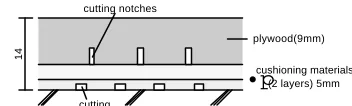
achieve a performance in the range of L-40 – L-50 (performance when applied on ordinary concrete: thickness 15cm) by cutting notches in the wooden panels and then spreading cushioning material as indicated in Fig. 3.
Meanwhile, in the housing performance labeling system, “general floor cross-sectional specifications” for which performance is verified in the law are indicated for each grade and, as long as floors are constructed in accordance with the designated specifications, it is possible to label the corresponding grade and it is a mechanism that easily enables the achievement of performance. Table 6 shows examples of the specification stipulations for heavy floor impact sound.
As indicated above, floor impact sound is an extremely serious problem in Japan at present and there are many examples of relevant research and development. In addition, remedies for heavy floor impact sound caused by people walking or children stepping are deemed to be important.
4. FUTURE TRENDS
Floor impact sound is ranked as a major factor that determines performance in the sound environment in multifamily dwelling. The results of questionnaire surveys of multifamily dwelling residents conducted by the authors pointed to floor impact sound as the leading source of “irritating noises” and there is considered to be a need for further active research and development seeking improvements in performance.
The housing performance labeling system is currently being implemented, which enables residents to be aware of the floor impact sound insulation performance when they purchase a residence. The introduction rate of this system is still low but there are hopes for its further dissemination in the future.
In addition, it is also necessary to clearly define the correspondence between the floor impact sound insulation performance (L-value) and the sensations felt by residents in their everyday lives. Indicating this correspondence quantitatively is extremely difficult and has thus far been passed by without thorough examination. It is especially necessary to move ahead promptly with efforts to specify the performance that would naturally be expected of housing suppliers, that is, that we must be able to secure in society.
Bibliographical references:
1) K.Inoue,S.Kimura, ” Research and Development of Floor Impact Sound Insulation of Multi-Family Dwellings in Japan ”, INTER-NOISE2000, pp749-754
Table 1Application grades for floor impact sound (AIJ)
It is applied to wooden frame structure, light weight steel frame structure.
Table 2 Grades for heavy floor impact sound Table 3 Grades according to equivalent slab insulation performance (labeling system) thickness (labeling system)
h=h110( L/40)100(cm) h1=(2 m (EI) 10-13)1/4
L reduction of heavy floor impact sound level by floor coverings
EIflexural rigidity per unit width of floor
unit area density (kg/m2)
Table 4 Grades for floor impact sound using tapping (labeling system)
Table 5Grades according to the reduction of Floor impact sound (tapping machine)
Fig1 Evaluation curves of floor impact sound (AIJ,JIS)
Table 6 Example of the specification stipulation for heavy
Fig2 Example of floor slab cross-section for heavy floor floor impact sound insulation performance Impact sound countermeasure
Fig3 Example of soundproof type directly-applied wooden flooring 81 82 85 91 108 98 L-85 76 77 80 86 93 103 L-80 71 72 75 81 88 98 L-75 66 67 70 76 83 93 L-70 61 62 65 71 78 88 L-65 56 57 60 66 73 83 L-60 51 52 55 61 68 78 L-55 46 47 50 56 63 73 L-50 41 42 45 51 58 68 L-45 36 37 40 46 53 63 L-40 31 32 35 41 48 58 L-35 26 27 30 36 43 53 L-30 20 30 40 50 60 70 80 90 100 110
63 125 250 500 1000 2000 4000 Octave Band Center Frequency(Hz)
Floor Impact Sound Level(dB)
6 7 8 9 10 11 12 13 14 15 16 17 18 150 160 170 180 190 200 210 220 230 240 250
Room areas(m2
)
Equivalent thickness(mm)
Rank3
Rank5 R ank4
125 250 500 1k 2k
5 •… 58dB •… 51dB •… 45dB •… 42dB •… 41dB 4 •… 63dB •… 56dB •… 50dB •… 47dB •… 46dB 3 •… 68dB •… 61dB •… 55dB •… 52dB •… 51dB
2 •… 73dB •… 66dB •… 60dB •… 57dB •… 56dB
1 •| •| •| •| •|
Impact sound level (tapping machine) Octave-band center frequency(Hz) Rank
Equivalent slab Thickness(h) a •† 27cm
b •† 20cm
c •† 15cm d •† 11cm e the others
Reduction of impact sound level (tapping machine) <octave band 500Hz>
‡
@ •† 30dB
‡
A •† 25dB
‡
B •† 20dB
‡
C •† 15dB
‡
D The others
250 • ` 300mm hollow-core concrete 14 cutting notches plywood(9mm)
•p
cushioning materials(2 layers) 5mm cuttingspecial grade grade 1 grade 2 grade 3
Heavy impact source L-45 L-50 L-55 L-60,L-65*
Tapping machine L-40 L-45 L-55 L-60
Heavy impact source L-45 L-50 L-55 L-60
Tapping machine L-40 L-45 L-50 L-55
Heavy impact source Tapping machine
Application grades
Building Room use Impact source
L-50 L-55 L-60 L-65
School Classroom
Sitting room
Hotel Guest room
Multi-family dwellings
63 125 250 500
5 •… 73dB •… 63dB •… 56dB •… 50dB 4 •… 78dB •… 68dB •… 61dB •… 55dB 3 •… 83dB •… 73dB •… 66dB •… 60dB 2 •… 88dB •… 78dB •… 71dB •… 65dB
1 •| • | •| •|