This is the accepted version of the manuscript:
Temprano, V., A.I. Rodríguez-Escudero y J. Rodríguez-Pinto (2018). “Brand deletion: How the decision-making approach affects deletion success”. BRQ Business Research Quarterly, vol. 21 (2), pp. 69-83, https://doi.org/10.1016/j.brq.2018.03.003
BRAND DELETION: HOW THE DECISION-MAKING APPROACH
AFFECTS DELETION SUCCESS
VÍCTOR TEMPRANO-GARCÍA
ANA ISABEL RODRÍGUEZ-ESCUDERO
JAVIER RODRÍGUEZ-PINTO
Department of Business and Marketing
University of Valladolid
Avda. Valle Esgueva, 6.
47011 Valladolid (Spain)
Corresponding author: VÍCTOR TEMPRANO-GARCÍA. Email: [email protected]
Financing: European Social Fund (ESF) and Junta de Castilla y León (Spain), ORDEN EDU/828/2014, and European Regional Development Fund (ERDF) and Junta de Castilla y León (Spain), project reference VA112P17.
The authors declare no conflict of interest in this article.
Acknowledgements:
1
BRAND DELETION: HOW THE DECISION-MAKING APPROACH
AFFECTS DELETION SUCCESS
1. Introduction
After decades in which building a diversified portfolio of brands coupled with deep product lines was a customary practice in many firms (Keller et al., 2011; Morgan and Rego, 2009; Rosenbaum-Elliott et al., 2015), with the turnaround of the century we have witnessed a reversal in this trend. Thus, brand deletion (hereinafter BD), i.e., discontinuing a brand from a firm’s brand portfolio (Shah, 2013), in their different types, emerges as a strategic decision in the realm of brand portfolio management. Brands can be deleted through a brand name change. Examples of this move are the migration by Unilever from Starlux to Knorr, or the rebranding by the Santander banking group from Abbey in the UK or Banesto in Spain to the global brand Santander. In other instances, the deletion occurs through a total brand killing, so the company retires from the market both the brand and the product lines commercialized under that brand, as did General Motors (GM) when eliminating some emblematic brands, such as Hummer, Pontiac or Saturn. In the cases of Saab, Opel or Vauxhall, the deletion was made through brand disposals, as these brands were sold by GM and the new owners assumed their commercial use. Disposal was also used by the Danone Corporation to delete brands such as San Miguel, in the beer market (Barrett, 2000), or Lu and Príncipe, in the biscuits market (Jones, 2007).
2
companies, and efficiency became a priority (Hooley and Saunders, 1993), which forced many diversified corporations to get rid of businesses that were unrelated to their own core competences (Varadarajan et al., 2006). Secondly, market globalization facilitated significant cost reductions derived from outsourcing and relocating operations in emerging countries, but it also triggered substantially increased market competition. The reaction of many corporations has been to focus their efforts on fewer but stronger brands with a global presence, divesting from local or regional brands (Depecik et al., 2014; Özsomer et al., 2012). Thirdly, the rising market share of private label brands has further prompted manufacturers to compete with a smaller set of strong brands rather than with a larger set of weak ones, thus deleting underperforming and secondary national brands (Sloot and Verhoef, 2008).
However, despite the strategic nature of the BD decision and the fact that many companies are suffering the environmental circumstances mentioned above, managers are not knowledgeable about how they should tackle the challenge to delete a brand, and scholarly research on BD is so scarce and fragmented that it is hard to talk of a cohesive body of knowledge on the subject.
3
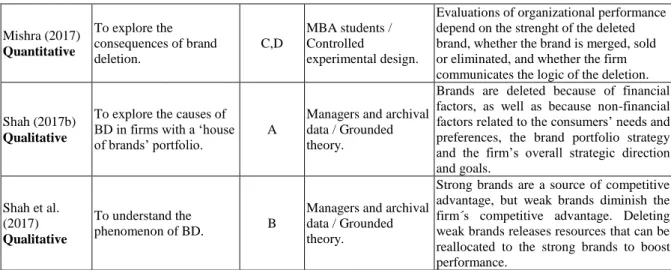
tend to focus on the outcomes of BD, either considering consumer evaluations as a performance measure (Mao et al., 2009; Mishra, 2017) or analyzing the impact on the firm’s value by looking at stock market reactions after the announcement of a brand disposal (Depecik et al., 2014; Wiles et al., 2012). These studies reveal factors which affect customer and investors reactions to a BD (e.g., type of BD, brand weakness, scope, relatedness to other brands in the portfolio), yet treat BD as an exogenous event. In other words, these studies do not explicitly consider the BD decision maker’s point of view and fail to examine why or how a BD decision was taken and how it was implemented. One notable exception is the qualitative research by Shah (2017b) and Shah et al. (2017) in which, based on grounded theory, a causal model of the BD strategy is proposed and several questions are explored such as the context, reasons and fit of this strategy, the types of BD, as well as its implementation and consequences. Even if we look at a related field of study, namely research into brand delistings –i.e., the retailer’s decision to remove an entire brand from its assortment, leading to the unavailability of the deleted brand within the retailer’s stores–, we see how this has been neglected in the literature, with empirical research having opted to focus on customer reaction to the delisting (Sloot and Verhoef, 2008; Wiebach and Hildebrandt, 2012).
(Insert Table 1 here)
4
5
firm’s brand portfolio, but which has thus far received little scholarly attention. We expand on the scant empirical research conducted to date into the results of BD and contribute to a better understanding of which factors under managerial control may render a BD more successful. More specifically, we delve more deeply into the BD decision-making process and analyze main and interactive effects of rational, intuitive and political approaches, which, alone or in combination, affect BD success. Furthermore, unlike prior quantitative research, which gathers experimental data from consumers concerning their reactions to fictitious BDs (Mao et al., 2009; Sloot and Verhoef, 2008; Wiebach and Hildebrandt, 2012) or which relies on secondary data and press reports (Depecik et al., 2014; Wiles et al., 2012), we have gathered information from managers about 155 real cases of recent BDs by companies in a range of different industries. Albeit in retrospect, this method did enable us to ascertain managers’ perceptions about the particular internal and external circumstances of each case of BD in our sample when the decision was made and implemented together with their evaluation of how appropriate each decision proved to be.
2. Theoretical framework
The BD decision can be considered as a critical strategic choice because, in addition to being infrequent, non-routine and complex, it involves an important relocation of a firm’s resources, alters its brand architecture, seriously affects diverse stakeholders, and can have a major impact on long-term market and financial performance (Shah, 2015). In any case, this kind of decision must not be conceived as a stand-alone one-shot decision problem with a single optimal solution, but as a strategic decision-making process which different firms may approach in different ways.
6
perspective and logical incrementalism. Synoptic formalism emphasizes deliberate, effortful and analytical procedures such as formal planning activities, generating alternatives and evaluating quantitative data as well as all relevant information as a basis for decision-making in order to reach an optimal decision (Atuahene-Gima and Li, 2004; Wiltbank et al., 2006). Rationality is the representative trait of the synoptic model (Elbanna and Child, 2007a). On the other hand, the incremental perspective advocates strategic decision-making based on adaptation through a gradual and complex process of learning, which is intuitive in nature (Atuahene-Gima and Li, 2004; Fredrickson, 1984; Rajagopalan and Spreitzer, 1997). Finally, Quinn (1980) proposes the logical incrementalism as an approach that combines elements of rational planning and intuitive behavior, and incorporates a third component: political maneuvering based on power and social interactions. As a group, people may differ in preferences and interests regarding the decisions to be taken within the company (Quinn, 1980). In this common scenario, politics may have a major influence on the strategic planning process and its outcomes (Eisenhardt and Zbaracki, 1992). In sum, logical incrementalism states that decisions are undertaken based on rationality, intuition and politics. Thus, following the literature (e.g., Elbanna and Child, 2007b; Kester et al., 2011) three approaches may be at work in the strategic decision-making process: rational, intuitive and political (see Table 2).
7
underlying the decisions taken when following this approach (Khatri and Ng, 2000). Therefore, although it is sometimes contaminated with presumptions and naïve preferences, intuition does represent a complex psychological phenomenon which helps in problem-solving by drawing from the store of knowledge in our subconscious and is rooted in past experience. In a political approach, the key assumption is that organizations are coalitions of people with competing interests. People with conflicting preferences may employ political tactics so as to shape decisions in line with their preferences. Consequently, we define political behavior as intentional attempts to enhance or protect the self-interest of individuals or groups (Hickson et al., 1986).
(Insert Table 2 here)
The literature has acknowledged that just one approach may not be sufficient to describe the complexity of the strategic decision-making process (Brews and Hunt, 1999; Eisenhardt and Zbaracki, 1992). As Hart and Banbury (1994) argue, strategic decision-making requires integrating both formal planning and incremental adjustments. Nutt (2002) contends that strategic decisions are made through the combined use of rational processes, judgment (intuition) and bargaining (politics). Our proposal is that rational, intuitive and political approaches to decision-making can coexist in a decision process, thus making it relevant to examine the specific impact each approach has on BD success, and even the interactive effects between them. Hence, as a first objective, hypotheses H1 to H4 of our research elaborate on how the different approaches to BD decision-making influence BD success (see Figure 1).
8
sold to another company that assumes its ownership and commercial use), and brand name change (i.e. the brand is eliminated in order to sell the same –or very similar– products or services under another brand name or trademark of the same or from a different company). Both total killing and disposal entail determining an irreversible strategic decision since it usually involves the company getting out of the market and closing or at least downsizing one or more of its business units. Alternatively, when the BD is undertaken through a brand name change, the company reduces the number of brands in its portfolio currently used for commercial purposes, although it retains ownership of the deleted brand name and remains in the market. This form of BD is also strategic since it alters the company’s brand architecture and its branding strategy, but compared to total killings or disposals, brand name changes are less risky as they can be reversed or implemented gradually. Given the unequal consequences and risk of the different BD types, we argue that this variable conditions how rational, intuitive and political approaches to the decision might impact on the success of the deletion. Therefore, a second objective in our study is to explore the moderating effect of the type of BD on the relationship between the different approaches to BD decision-making and
BD success. This objective is specified in H5 to H7 (see Figure 1). 3. Hypotheses development
3.1. The decision-making process and BD success
9
Cardinal (1994) and Schwenk and Shrader (1993) observe a positive relationship between planning and superior performance. When managers make the BD decision as a result of careful thought based on a comprehensive assessment of the economic, financial and market situation of the deleted brand, and after having exhaustively generated and evaluated numerous potential courses of action, the decision taken is most likely the best alternative. Moreover, during the rational and well-thought out decision-making process, potential problems and risks associated to the decision may be anticipated, thereby helping managers to have a clearer view of what solutions there are and, thus, proactively act upon them. Therefore, we hypothesize that,
10
reinforce the credibility of their opinions, helping them to gain respect and also to deal with the stress and difficulties surrounding this decision. Therefore, following strategic decision-making literature, intuition-based decision-making is expected to prove natural and faster, and this approach leads to a more efficient management of BD. Accordingly, we propose that:
H2. The greater the intuition in BD decision-making, the greater the BD success. Political behaviors are characterized as those observable actions by which people use their power to influence a decision (Eisenhardt and Zbaracki, 1992). To date, researchers have acknowledged that political behavior is an undeniable part of how organizations operate, and how strategic decisions are made (Child and Tsai, 2005). Subsequently, several studies have explored the effects of political behavior on the outcomes of the strategic decision-making process. Based on such studies (Dean and Sharfman, 1996; Elbanna and Child, 2007b), we identify three causes for a negative relationship between political behavior and BD success. First, managers under this approach may tend to put their self-interest above the company’s interest when deleting a brand. Consequently, this decision-making approach may prevent a full understanding of any environmental constraints since the decision is directed towards the interest of particular groups rather than what is desirable or feasible for the firm given the contextual limitations. Second, private interests may lead to distorted information being conveyed about the brand, thus resulting in decisions based on inadequate or incomplete information. Third, political processes may prove time-consuming which can lead to inefficiencies, delays in decision-making (Nutt, 2002) and lost opportunities (Pfeffer, 1992). Thus, we suggest that:
11
When adopting political criteria, strategic decisions are made in the interest of one or several groups within the company. Political behavior is generally considered detrimental to organizational performance, and this negative effect is likely to be exacerbated when the company has exhaustive information and when multiple alternatives have been analyzed. In this case, there is a growing awareness of the deviations from an optimal decision when the politics and self-interest of a dominant group shapes the decision. Use of incomplete or biased information, obstacles to information-searching, or biased disclosure of information, so typical of political behavior, may be hidden within the company when there is no evidence to support the decision or when it does not have access to valid information sources. But implementing a decision for which sufficient information was available and then became blurred by political maneuvering can compromise the quality of the decision and reduce cohesion and commitment. Consequently, we consider there is an interaction effect between rationality and politics in such a way that the negative impact of political behavior on BD success is more evident when the firm has made a comprehensive assessment of the situation based on objective information. In this sense, (Dean and Sharfman, 1993) found that a high level of rationality and a low level of politics are optimal for making a successful strategic decision. Therefore, we propose that:
H4. There is a negative interaction between rational and political approaches to BD decision-making, such that the greater the rationality, the greater the negative effect of political decision-making on BD success.
3.2. Moderating effect of the type of BD
12
appropriateness of the decision made, in this case deleting a brand in the firm’s portfolio (Atuahene-Gima and Li, 2004). Papadakis et al. (1998) state that decision-makers act more rationally when decisions imply important consequences.
Totally killing a brand or selling it to another company are examples of irreversible strategic moves which entail a go/no-go decision and require a strong determination before the decision is executed. Both types of BD may cause a major impact and will probably face the rejection by important stakeholders, such as the affected customers and channel partners, employees, managers or investors. Furthermore, a brand disposal means losing ownership of an asset which in the past may have yielded significant profits and prestige to the firm. In these instances, exhaustive data gathering and analysis should help ensure the BD strategy is right, otherwise the firm will likely perceive safer to retain the brand in its portfolio and discard the deletion. In other instances of BD, the value of having greater number of evidences may not compensate for the drawbacks of a delay in making and implementing the decision. This seems to be the case when a brand is deleted by changing its name, since the firm retains legal ownership of the brand and BD decision may be more easily reversed if expected results are not achieved. Accordingly, we suggest:
H5. The positive effect of rational decision-making in BD success will be less positive when the firm is changing the brand name than when the firm is totally killing the brand or selling it to another company.
13
Brand managers who are considering killing or disposing of a brand are less likely to have confronted such a critical decision and have a know-how that facilitates a rapid but precise assessment of the situation, the most viable strategic alternatives and the expected outcomes. In this case, flawed and unsound beliefs are likely to emerge if managers attempt to replace evidence with intuition, which may drive the BD to a failure. In contrast, brand name change is a quite common strategy (Pauwels-Delassus and Mogos-Descotes, 2012), and thus firms can rely on judgments based on their own experience or on the success or failure of other companies that made previous similar decisions. Furthermore, a natural and agile decision based on intuitions derived from managers’ domain of expertise may bring the conviction and determination required to make the BD successful. Therefore, we propose:
H6. The positive effect of intuitive decision-making in BD success will be more positive when the firm is changing the brand name than when the firm is killing or selling the brand.
14
consider the decision to be undeniably good for the company, conflicts of interest will inevitably emerge and those stakeholders who feel the decision does not benefit them will likely fight it back. Compromising and trying to convince those groups most noticeably affected and “damaged” by the deletion will probably prove a waste of time. We thus hypothesize that:
H7. The negative effect of political decision-making on BD success will be less negative when the firm is changing the brand name than when the firm is totally killing the brand or selling it to another company.
4. Methodology
4.1. Sample and data collection
15
they did not wish to disclose any information concerning this type of decision or because the managers were too busy to comply with our request.
As a means of exploring the manager’s point of view regarding the relevance of the variables identified in our literature review on BD decision-making, we conducted eight in-depth interviews with executives, five of whom worked in firms operating in service industries, and the other three in the manufacturing industry. As regards size, three of the interviewees were top managers in medium-sized companies and five in large companies. These interviews also served to refine and pre-test the questionnaire designed to gather data for the empirical analysis.
The final version of the questionnaire, in which the unit of analysis is a case of BD recently carried out by the respondent firm, was sent to the 232 companies that agreed to participate, along with two letters of support by Interbrand and the Leading Brands of Spain Forum and a letter thanking them for participating in our research, and explaining the benefits of joining our research in terms of full access to the research findings. After a follow-up by telephone and personal visits to their offices, we obtained 155 complete questionnaires, provided by 111 respondent firms, yielding an effective response rate of 48%. Table 3 shows the sample characteristics. Respondents were asked about their direct participation in the BD decision and implementation as well as their knowledge of the reasons and facts surrounding the deletion. Mean scores for these questions were, respectively, 5.75 and 6.38 out of 7, indicating that the key informants in our sample are a valid source of information.
(Insert Table 3 here)
16
significantly underrepresented in the sample, while the information and communication sector is significantly overrepresented. The reason might be the inclusion of a large number of wholesalers in the “Wholesale and retail trade” group (NACE code 45, 46 and 47). For these companies, the strategy of using the brand as an asset on which to base the value proposition is of little importance when compared to other industries. It is uncommon for wholesalers to own several brands (they sometimes own only one) and, when they do own them, they are used primarily for identification purposes rather than for differentiation. The decision to eliminate a brand rarely occurs, hence the low representation of this industry in the sample. In contrast, in the information and communication sector, knowing that Atresmedia, one of the leading private media groups in Spain, was taking part in our research had a snowball effect, encouraging other companies within this sector to also participate.
(Insert Table 4 here)
To assess the quality of the gathered data, we compared the correlation between the data on sales and employees extracted from the Amadeus database, and the data on sales and employees reported by respondents. The correlation for sales is .89, and the correlation for employees is .88, providing an indication of the reliability of the answers given by informants. In addition, following the recommendation of Armstrong and Overton (1977), we examined the potential influence of non-response bias by comparing early (33%) and late respondents (33%) via a t-test. No significant differences at p<.05 were found between the two groups regarding the constructs examined in this study.
17
anonymity and, as indicated above, ensured respondents were executives in a position to provide accurate information and opinions. In addition, item wording was carefully revised to prevent biased connotations, the dependent and independent variables were in separate parts of the questionnaire, and different scale formats were used (see Table 5). As post-hoc analysis, we used Harman’s one-factor test and results indicate that little common method variance (CMV) is observed in our data. According to Fuller et al. (2016), it is very unlikely that such a small CMV could substantially bias the estimated relationships. The observation of positive and negative construct intercorrelations (see Table 6) further supports the conclusion that the possible impact of CMB is minimal. 4.2. Construct measurement
Measurement instruments are presented in Table 5. As stated before, the literature on BD is extremely scarce. Therefore, scales previously used in strategic decision-making literature were adapted to operationalize the three constructs measuring the firm’s approach to BD decision-making. In particular, we adapted the scales used in the research by Papadakis et al. (1998), Khatri and Ng (2000) and Dean and Sharfman (1996), which have also been used by Kester (2011) in the context of research into NPD portfolio decisions. We elaborated a new scale to measure BD success, which reflects the level of satisfaction of the company with the outcomes of this decision. The choice of BD success as the dependent variable provides for a close link between the strategic decision-making process and its outcomes as well as it avoids the causal ambiguity associated with more general indicators of organizational performance (Dean and Sharfman, 1996; Elbanna and Child, 2007a; Shepherd and Rudd, 2012). Please, note that a perceptual construct of BD success is used1.
1
18
We incorporated the firm´s prior economic situation as a control variable since this can affect the greater or less urgency to accomplish the BD as well as the reactions and perceptions concerning its impact on company performance. We operationalized this control variable with a three-item scale adapted from Moorman and Rust (1999) and Verhoef and Leeflang (2009). Considering Varadarajan et al.’s (2006) proposition, we also controlled for the effects of the firm having previous experience in similar strategies, as it could be expected that the accumulation of relevant knowledge will positively influence performance (Finkelstein and Hambrick, 1996; Golden and Zajac, 2001). A single-item scale, adapted from Dayan and Elbanna (2011), was used to operationalize the firm’s experience in BDs. Finally, we controlled for the effects of formalizing the execution of the BD. Establishing standardized rules, protocols, deadlines and control mechanisms during the deletion process should help to ensure it is undertaken in an effective and timely manner (Argouslidis, 2008; Argouslidis and Baltas, 2007; Avlonitis and Argouslidis, 2012; Gounaris et al., 2006). Formalization was measured with five items adapted from the works by Argouslidis (2008), Argouslidis and Baltas (2007).
(Insert Table 5 here) 5. Analysis and results
The validity of the measurement instruments was assessed using the Partial Least Squares technique with the SmartPLS 3 software (Ringle et al., 2015). Reliability was examined by verifying that Cronbach’s α and composite reliability (CR) values were all above .70 and that average variance extracted (AVE) exceeded the recommended minimum of .50 (Bagozzi et al., 1991). As reported in Table 6, discriminant validity
19
was assessed by applying the well-known Fornell and Larcker (1981)’s criterion, which provided satisfactory results, as well as the criterion recently proposed by Henseler et al. (2015). According to this new criterion, based on the HTMT (heterotrait-monotrait) ratio of correlations, discriminant validity is established when the HTMT ratios do not exceed the .85 recommended threshold and their 90% bootstrapped confidence intervals do not include the value 1, conditions that are clearly met in our survey.
(Insert Table 6 here)
Moderated hierarchical regression analysis with the SPSS software (v.23) was used to test the hypotheses depicted in Figure 1. As the nature of the main effects differs for models with and without interactions and may involve false and misleading conclusions (Henseler and Fassott, 2010), we sequentially introduced different blocks of variables to check their respective explanatory power. Firstly, in Model 1 we estimated the main effects of the focal and the control variables in our model. Secondly, in Model 2 we added the interaction effect between rational and political decision-making approaches (Model 2). Finally, in Model 3 we incorporated as predictors of BD success the two-way interactions between the three different approaches to BD decision-making and the type of BD (measured with a dummy variable in which a zero was assigned to BDs undertaken through total killing or disposal, and one was assigned to the cases of BDs through a brand name change). All model variables were mean-centered to avoid difficulties concerning interpretation of coefficients resulting from simultaneously including linear and interaction terms of the same variables in the same model (Echambadi and Hess, 2007). The standardized parameter estimates of the hypothesized and control relationships are presented in Table 7.
(Insert Table 7 here)
20
H1 is confirmed since said effect is positive and significant (β=.19, p<.05). H2, which postulates that the relation between intuitive decision-making and BD success is also positive, is likewise supported (β=.20, p<.01). The relationship between political decision-making and BD success is negative and significant (β=-.20, p<.01), as hypothesized in H3.
The results in Table 7 also show a negative and significant interaction effect between rational and political decision-making on BD success (β=-.13, p<.05) thus providing support for H4. The nature of this interaction has been examined using Aiken et al. (1991) procedure, which tests for the significance of regression coefficient estimates for the independent variables at one standard deviation below and above the mean of the moderating variable. At a low level of rational decision-making, the relationship between political decision-making and BD success is non-significant (β=-.09, n.s.), whereas at a high level of rational decision-making, a large and highly significant negative effect of political decision-making is found (β=-.32, p<.00).
21
significant difference across groups (p<.05) in the effect of political decision-making on BD success. In particular, results show that the negative effect of political decision-making on BD success is stronger (β=-.39 p<.01) when the brand was killed or sold to another company2 than when the brand was deleted through a name change, where the impact becomes insignificant (β=-.05, n.s.).
(Insert Table 8 here) 6. Discussion
Rational, intuitive and political approaches, all of which potentially present in BD decision-making, are not equally recommendable because, whereas both rationality and intuition exert a positive effect on BD success, politics provokes a negative impact. There is no controversy in the literature surrounding the result of the positive impact of rationality in success. What is more noticeable, however, is the positive effect of the intuitive approach on BD success. Our findings are in line with the literature highlighting the benefits of intuition in the cases of strategic (or non-routine) decisions characterized by incomplete knowledge. For example, intuition can be brought in after rational processes have done the groundwork and can provide data and analyses concerning the BD as the basis for intuitive processes (Sauter, 1999). Intuition could be a form of intelligence which decision-makers can use when they cannot access rational processes or can be used simultaneously (Fredrickson, 1985; Parikh et al., 1994). In addition, when compared to rationality, intuition has the advantage of requiring less resources and being fast, whereas rationality struggles to deal with discrepant
2
22
information since this proves troublesome when determining the weight of such information (Bingham and Eisenhardt, 2011).
In line with previous research, we find support for a negative relationship between political behavior and the outcomes of BD (e.g., Dean and Sharfman, 1996; Gandz and Murray, 1980). Nevertheless, the strength of the negative relationship between political decision-making and BD success is contingent on two variables. First, it depends on the level of rationality. When a firm relies on a rational decision-making approach and bases the BD decision on objective and comprehensive information, having to negotiate and make concessions to particular groups might be perceived as a deviation from an optimal choice and may cause a feeling of frustration among those having access to the data that proves the BD is necessary and urgent. However, when the BD decision is adopted without robust evidence of the convenience of this initiative, political behavior is easier to justify as a result of the lack of objective information.
23
7. Conclusion, managerial implications, limitations and future research
24
by the different organizational stakeholders and facilitating its implementation as well as adaptation to the new situation.
From a managerial point of view, the most important implication of our research is that managers have the power to influence the success of the BD. In this vein, we recommend that firms establish information systems which help decision-makers facing a BD decision to access the relevant data in order to decide accordingly and to provide evidence of the appropriateness of the strategy to be implemented. It is also necessary to make sure that management team members have the relevant expertise to rapidly and accurately assess the available evidence and to facilitate effective intuition, thus avoiding naïve intuition based on biased assumptions. As Khatri and Ng (2000) indicate, intuition can be developed through repeated exposure to the complexity of real problems, such intuition proving advantageous in the context of challenging and complex decisions such as a BD. In general, the political approach to BD decision-making should be minimized, particularly when managers have suitable information to base their decision on rational evidence. One exception to this general recommendation of minimizing political behavior is the situation in which the use of political tactics helps to overcome certain stakeholders’ initial rejection of the BD. This may be the case of BDs which simply involve a brand name change and where the business continues to operate in the market. In these instances, a political approach might not automatically lead to poorer performance. However, politics could jeopardize the success of the BD in cases involving total brand killing or disposal.
25
findings must be interpreted with due caution. Second, a more precise understanding of the causal relationships between decision-making approaches and BD success requires the use of a longitudinal research methodology combining qualitative and quantitative methods. A longitudinal design would help to more rigorously test our hypotheses by preventing respondent managers from giving their answers as a post hoc justification aimed at demonstrating the undeniable logic of their decisions, and would also enable cases to be investigated in which the decision-making process ended in the brand not being eliminated.
26
raises the issue of the multidimensional nature of political behavior. Finally, future research must consider the impact of BD implementation on BD performance so as to complete the model of strategic decision-making and success. As Nutt (1999) suggests, the key reasons for failure occur predominantly during decision implementation rather than during making. Thus, beyond the satisfaction generated by the decision-making approach, much more academic work is required to better understand how the implementation determines the success of BDs.
References
Aiken, L. S., West, S. G., and Reno, R. R. 1991. "Multiple regression: Testing and interpreting interactions" Sage Publications. Los Angeles.
Akinci, C., and Sadler-Smith, E. 2012. "Intuition in management research: A historical review". International Journal of Management Reviews, 14 (1), 104-122.
Argouslidis, P. C. 2008. "Determinants of the speed of elimination decision making in financial services". Journal of Services Marketing, 22 (3), 237-254.
Argouslidis, P. C., and Baltas, G. 2007. "Structure in product line management: The role of formalization in service elimination decisions". Journal of the Academy of Marketing Science, 35 (4), 475-491.
Armstrong, J. S., and Overton, T. S. 1977. "Estimating nonresponse bias in mail surveys". Journal of Marketing Research, 14, 396-402.
Atuahene-Gima, K., and Li, H. 2004. "Strategic decision comprehensiveness and new product development outcomes in new technology ventures". Academy of Management Journal, 47 (4), 583-597.
Avlonitis, G. J., and Argouslidis, P. C. 2012. "Tracking the evolution of theory on product elimination: Past, present, and future". The Marketing Review, 12 (4), 345-379.
Bagozzi, R. P., Yi, Y., and Phillips, L. W. 1991. "Assessing construct validity in organizational research". Administrative science quarterly, 36, 421-458.
Barrett, A. (2000). Danone Narrows Its Focus With Sale of Beer Assets, The Wall Street
Journal. Dow Jones & Company, New York. Retrieved from
https://www.wsj.com/articles/SB953545178838800207
Bingham, C. B., and Eisenhardt, K. M. 2011. "Rational heuristics: the ‘simple rules’ that strategists learn from process experience". Strategic Management Journal, 32 (13), 1437-1464.
Brews, P. J., and Hunt, M. R. 1999. "Learning to plan and planning to learn: Resolving the planning school/learning school debate". Strategic Management Journal, 20 (10), 889-913.
Child, J., Elbanna, S., and Rodrigues, S. 2010. "The political aspects of strategic decision making". The handbook of decision making (pp. 105-137) Wiley.
Child, J., and Tsai, T. 2005. "The dynamic between firms’ environmental strategies and institutional constraints in emerging economies: Evidence from China and Taiwan". Journal of Management Studies, 42 (1), 95-125.
Dane, E., and Pratt, M. G. 2007. "Exploring intuition and its role in managerial decision making". Academy of management review, 32 (1), 33-54.
27
Dean, J. W., and Sharfman, M. P. 1993. "Procedural rationality in the strategic decision-making process". Journal of Management Studies, 30 (4), 587-610.
Dean, J. W., and Sharfman, M. P. 1996. "Does decision process matter? A study of strategic decision-making effectiveness". Academy of Management Journal, 39 (2), 368-392. Depecik, B., van Everdingen, Y. M., and van Bruggen, G. H. 2014. "Firm Value Effects of
Global, Regional, and Local Brand Divestments in Core and Non-Core Businesses". Global Strategy Journal, 4 (2), 143-160.
Echambadi, R., and Hess, J. D. 2007. "Mean-centering does not alleviate collinearity problems in moderated multiple regression models". Marketing Science, 26 (3), 438-445.
Eisenhardt, K. M., and Zbaracki, M. J. 1992. "Strategic decision making". Strategic Management Journal, 13 (2), 17-37.
Elbanna, S. 2006. "Strategic decision-making: Process perspectives". International Journal of Management Reviews, 8 (1), 1-20.
Elbanna, S., and Child, J. 2007a. "The influence of decision, environmental and firm characteristics on the rationality of strategic decision-making". Journal of Management Studies, 44 (4), 561-591.
Elbanna, S., and Child, J. 2007b. "Influences on strategic decision effectiveness: Development and test of an integrative model". Strategic Management Journal, 28 (4), 431-453. Fedor, D., Maslyn, J., Farmer, S., and Bettenhausen, K. 2008. "The contribution of positive
politics to the prediction of employee reactions". Journal of Applied Social Psychology, 38 (1), 76-96.
Finkelstein, S., and Hambrick, D. C. 1996. "Strategic leadership: Top executives and their effects on organizations" West Publishing Company.
Fornell, C., and Larcker, D. F. 1981. "Evaluating structural equation models with unobservable variables and measurement error". Journal of Marketing Research, 39-50.
Fredrickson, J. W. 1983. "Strategic process research: questions and recommendations". Academy of management review, 8 (4), 565-575.
Fredrickson, J. W. 1984. "The comprehensiveness of strategic decision processes: Extension, observations, future directions". Academy of Management Journal, 27 (3), 445-466. Fredrickson, J. W. 1985. "Effects of decision motive and organizational performance level on
strategic decision processes". Academy of Management Journal, 28 (4), 821-843. Fuller, C. M., Simmering, M. J., Atinc, G., Atinc, Y., and Babin, B. J. 2016. "Common methods
variance detection in business research". Journal of Business Research, 69 (8), 3192-3198.
Gandz, J., and Murray, V. V. 1980. "The experience of workplace politics". Academy of Management Journal, 23 (2), 237-251.
Golden, B. R., and Zajac, E. J. 2001. "When will boards influence strategy? Inclination × power = strategic change". Strategic Management Journal, 22 (12), 1087-1111.
Gounaris, S. P., Avlonitis, G. J., and Papastathopoulou, P. G. 2006. "Uncovering the keys to successful service elimination:“Project ServDrop”". Journal of Services Marketing, 20 (1), 24-36.
Hart, S., and Banbury, C. 1994. "How strategy-making processes can make a difference". Strategic Management Journal, 15 (4), 251-269.
Henseler, J. 2012. "PLS-MGA: A non-parametric approach to partial least squares-based multi-group analysis" Challenges at the interface of data analysis, computer science, and optimization (pp. 495-501). Springer.
Henseler, J., and Fassott, G. 2010. "Testing moderating effects in PLS path models: An illustration of available procedures" Handbook of partial least squares. (pp. 713-735). Springer.
Henseler, J., Ringle, C. M., and Sarstedt, M. 2015. "A new criterion for assessing discriminant validity in variance-based structural equation modeling". Journal of the Academy of Marketing Science, 43 (1), 115-135.
28
Hooley, G. J., and Saunders, J. A. 1993. "Competitive positioning: The key to market success"
Prentice Hall, London.
Jones, A. (2007). Kraft buys Danone biscuits business, Financial Times. The Financial Times Ltd, London. Retrieved from https://www.ft.com/content/fc754432-293d-11dc-a530-000b5df10621
Keller, K. L., Parameswaran, M., and Jacob, I. 2011. "Strategic brand management: Building, measuring, and managing brand equity" Pearson Education India.
Kester, L. 2011. "New Product Development Portfolios: Identifying the antecedents and consequences of decision-making processes" TU Delft, Delft University of Technology, Delft.
Ketkar, S., and Podoshen, J. (2015). New Thoughts on Brand Disposal Strategies of Multinational Firms. Paper presented at the Proceedings of the 2009 Academy of Marketing Science (AMS) Annual Conference, Baltimore. (pp. 40). Springer International Publishing.
Khatri, N., and Ng, H. A. 2000. "The role of intuition in strategic decision making". Human relations, 53 (1), 57-86.
Kumar, N. 2003. "Kill a brand, keep a customer". Harvard Business Review, 81 (12), 86-95. Mao, H., Luo, X., and Jain, S. P. 2009. "Consumer responses to brand elimination: An
attributional perspective". Journal of Consumer Psychology, 19 (3), 280-289.
Miller, C., and Cardinal, L. B. 1994. "Strategic planning and firm performance: A synthesis of more than two decades of research". Academy of Management Journal, 37 (6), 1649-1665.
Miller, D., and Friesen, P. H. 1983. "Strategy-making and environment: the third link". Strategic Management Journal, 4 (3), 221-235.
Mintzberg, H. 1998. "Covert leadership: Notes on managing professionals" Harvard Business Review. Vol. 76, pp. 140-148.
Mishra, A. A. 2017. "Consumer responses to brand deletion". Journal of Brand Management, 1-11.
Moorman, C., and Rust, R. T. 1999. "The role of marketing". The Journal of Marketing, 63, 180-197.
Morgan, N. A., and Rego, L. L. 2009. "Brand portfolio strategy and firm performance". Journal of Marketing, 73 (1), 59-74.
Nutt, P. 2002. "Why decisions fail: Avoiding the blunders and traps that lead to debacles"
Berrett-Koehler Publishers.
Nutt, P. C. 1998. "Evaluating alternatives to make strategic choices". Omega, 26 (3), 333-354. Nutt, P. C. 1999. "Surprising but true: Half the decisions in organizations fail". The Academy of
Management Executive, 13 (4), 75-90.
Özsomer, A., Batra, R., Chattopadhyay, A., and ter Hofstede, F. 2012. "A global brand management roadmap". International Journal of Research in Marketing, 29 (1), 1-4. Papadakis, V. M., Lioukas, S., and Chambers, D. 1998. "Strategic decision-making processes:
the role of management and context". Strategic Management Journal, 19 (2), 115-147. Parikh, J., Lank, A. G., and Neubauer, F. F. 1994. "Intuition: The new frontier of management"
Oxford : Blackwell Business.
Pauwels-Delassus, V., and Mogos-Descotes, R. 2012. "Brand name substitution and brand equity transfer". Journal of Product & Brand Management, 21 (2), 117-125.
Pfeffer, J. 1992. "Managing with power: Politics and influence in organizations" Harvard Business Press.
Podsakoff, P. M., MacKenzie, S. B., Lee, J.-Y., and Podsakoff, N. P. 2003. "Common method biases in behavioral research: a critical review of the literature and recommended remedies". Journal of applied psychology, 88 (5), 879.
Quinn, J. B. 1980. "Strategies for change: Logical incrementalism" Irwin Professional Publishing.
29
Rindfleisch, A., Malter, A. J., Ganesan, S., and Moorman, C. 2008. "Cross-sectional versus longitudinal survey research: Concepts, findings, and guidelines". Journal of Marketing Research, 45 (3), 261-279.
Ringle, C. M., Wende, S., and Becker, J.-M. 2015. "SmartPLS 3. Bönningstedt: SmartPLS". Retrieved from: http://www.smartpls.com.
Rosenbaum-Elliott, R., Percy, L., and Pervan, S. 2015. "Strategic brand management" Oxford University Press, USA.
Sadler-Smith, E., and Shefy, E. 2004. "The intuitive executive: Understanding and applying ‘gut feel’in decision-making". The Academy of Management Executive, 18 (4), 76-91. Sauter, V. L. (1999). Intuitive decision-making. Paper presented at the Communications of the
ACM. Vol. 42, pp. 109-115.
Schwenk, C. R., and Shrader, C. B. 1993. "Effects of formal strategic planning on financial performance in small firms: A meta-analysis". Entrepreneurship: Theory and Practice, 17 (3), 53-65.
Shah, P. (2013). The brand deletion strategy in brand portfolio management. Texas Tech University, Texas.
Shah, P. 2015. "Kill it or keep it: The weak brand retain-or-discard decision in brand portfolio management". Journal of Brand Management, 22 (2), 154-172.
Shah, P. 2017a. "Culling the Brand Portfolio: Brand Deletion Outcomes and Success Factors". Management Research Review, 40 (4).
Shah, P. 2017b. "Why do firms delete brands? Insights from a qualitative study". Journal of Marketing Management, 33 (5-6), 446-463.
Shah, P., Laverie, D. A., and Davis, D. F. 2017. "Research paper Brand deletion". Journal of Brand Strategy, 5 (4), 434-452.
Shepherd, N., and Rudd, J. (2012). An examination of intuition in strategic decision-making: the role of context. Paper presented at the SMS 32nd annual international conference. Sloot, L. M., and Verhoef, P. C. 2008. "The impact of brand delisting on store switching and
brand switching intentions". Journal of Retailing, 84 (3), 281-296.
Taggart, W., and Valenzi, E. 1990. "Assessing rational and intuitive styles: A human information processing metaphor". Journal of Management Studies, 27 (2), 149-172. Varadarajan, R., DeFanti, M. P., and Busch, P. S. 2006. "Brand portfolio, corporate image, and
reputation: managing brand deletions". Journal of the Academy of Marketing Science, 34 (2), 195-205.
Verhoef, P. C., and Leeflang, P. S. 2009. "Understanding the marketing department's influence within the firm". Journal of Marketing, 73 (2), 14-37.
Wiebach, N., and Hildebrandt, L. 2012. "Explaining customers' switching patterns to brand delisting". Journal of Retailing and Consumer Services, 19 (1), 1-10.
Wiles, M. A., Morgan, N. A., and Rego, L. L. 2012. "The effect of brand acquisition and disposal on stock returns". Journal of Marketing, 76 (1), 38-58.
30
TABLE 1
Summary of BD research
Conceptual studies
Objective Variables
set* Main conclusions
Kumar (2003)
To guide managers when facing the decision on BD.
B
This author recommends how to put into practice a brand portfolio rationalization program in order to release and reallocate resources in stronger brands.
Varadarajan et al. (2006)
To develop a conceptual model delineating the drivers of BD propensity.
A
These authors discuss how BD enables a firm to free up resources which may be redeployed to enhance the competitive standing and financial performance of other brands in its portfolio. They propose a theoretical model of the organizational and environmental drivers of BD propensity and suggest several moderating factors.
Shah (2015)
To theoretically explain the factors influencing a firm’s decision to retain or discard a brand.
A,B,C
She outlines a theoretical model in which new relationships among established constructs in the strategic decision-making and brand management literature are proposed. Specifically, it explains how internal, external and top management factors influence the decision to retain or discard a weak brand.
Ketkar and Podoshen (2015)
To propose a theoretical framework of the brand disposal and brand exit strategies among multinational firms.
A
A new theoretical framework is introduced to explain BD and brand exit strategies among multinational firms. Their research categorizes BD strategies according to the relatedness of underlying brand capabilities and the entry mode of the brand.
Shah (2017a)
To present a list of success factors and outcomes of BD.
B,C,D
The success of a BD depends on factors related to the brand, to the deletion process, and to the stakeholders influenced by or influencing the decision. As BD outcomes, she considers the impact on customer relationships, as well as on the firm’s competitive position and financial performance.
Empirical studies
Objective Variables
set Sample/Methodology Main findings
Sloot and Verhoef (2008)
Quantitative
To examine customer responses to a brand delisting by a retailer.
D
Beer buyers and supermarket consumers / Controlled
experimental design.
Consumer choices are affected by brand delistings, and the switching patterns provoked by this strategy tend to cause bigger losses for manufacturers than for retailers.
Mao et al. (2009)
Quantitative
To examine how brand elimination might influence consumer evaluations of the firm.
D
University students / Structural Equation Modeling (SEM).
Explanations provided by the firm and loyal customers on weak brands eliminated are more likely to be associated with eliminate-to-improve attributions.
Wiebach and Hildebrandt (2012)
Quantitative
To examine consumers’ reactions in terms of store and brand switching when a retailer delists a brand.
D University students / Real live experiment.
The retailers’ strategy of brand delisting as a means to enhance their negotiation power and to reduce their dependence on national brands may be harmful as many consumers tend to stay brand loyal.
Wiles et al. (2012)
Quantitative
To examine stock market reactions to brand acquisition and disposal announcements.
B
Secondary data of firms in USA (1994-2008) /
Event study analysis.
Returns of brand acquisitions and disposals depend on the firm’s marketing capabilities, channel relationships and brand portfolio. Greater returns arise when the seller has inferior channel
relationships, competes with multiple brands, and for the disposal of non-related brands or low price/quality brands.
Depecik et al. (2014)
Quantitative
To examine the effect of brand divestments on firm value.
A
Brand portfolio rationalization announcements / Event study analysis.
31 Mishra (2017)
Quantitative
To explore the consequences of brand deletion.
C,D
MBA students / Controlled
experimental design.
Evaluations of organizational performance depend on the strenght of the deleted brand, whether the brand is merged, sold or eliminated, and whether the firm communicates the logic of the deletion.
Shah (2017b)
Qualitative
To explore the causes of BD in firms with a ‘house of brands’ portfolio.
A
Managers and archival data / Grounded theory.
Brands are deleted because of financial factors, as well as because non-financial factors related to the consumers’ needs and preferences, the brand portfolio strategy and the firm’s overall strategic direction and goals.
Shah et al. (2017)
Qualitative
To understand the
phenomenon of BD. B
Managers and archival data / Grounded theory.
Strong brands are a source of competitive advantage, but weak brands diminish the firm´s competitive advantage. Deleting weak brands releases resources that can be reallocated to the strong brands to boost performance.
* NOTE: Variables set: A–Causes of BD; B–BD decision-making; C–BD implementation; D–BD outcomes.
TABLE 2
Approaches to the strategic decision-making process
Construct Definition
Rational The extent to which the decision process involves collecting information relevant to the
decision and the reliance upon analysis of this information when making the choice.
Intuitive Mental process based on a “gut feeling” and personal experiences to build a subjective
decision-making rationale.
Political Decision-making results when an unequal distribution of power allows more powerful
groups or individuals to make decisions that reflect their personal interests. Source: Based on Dean and Sharfman (1993), Khatri and Ng (2000), Hickson et al. (1986) and Kester (2011).
FIGURE 1 Research model Rational decision-making BD success Intuitive decision-making Political decision-making
Type of BD
Total brand killing or disposal vs. brand name change
H1: + H2: + H3: – H5:-H6:+ H7:+ H4: + BD DECISION-MAKING APPROACH
32
TABLE 3
Sample characteristics
Brand characteristics
Deleted brand N % Type of BD N %
Created 108 69.70% Total brand killing or disposal 71 45.80%
Acquired 47 30.30% Brand name change 84 54.20%
TOTAL 155 100.00% TOTAL 155 100.00%
Geographical scope N %
Local/regional 23 14.80%
National 95 61.30%
International 37 23.90%
TOTAL 155 100%
Firm characteristics
Industry N % Family business N %
Manufacturing 39 35.10% Yes 75 67.60%
Service 72 64.90% No 36 32.40%
TOTAL 111 100.00% TOTAL 111 100.00%
Number of employees (2014) N % Turnover (2014) N %
<50 5 3.60% <= 10 6 2.70%
<250 32 28.83% <= 50 26 23.42%
>251 71 63.96% >50 67 60.36%
N.A. 3 2.70% N.A. 12 10.81%
TOTAL 111 100.00% TOTAL 111 100.00%
Market targeted %
Consumer 55.70%
Industrial 44.30%
33
TABLE 4
Population and sample distribution by industry: Proportion test
Population Sample
NACE Code N % of total N % of total
10,11,12,13,14,15. Manufacture of food, tobacco and wearing apparel. 82 14.39% 19 17.12% 20,21,22,23,24,25. Manufacture of chemical, pharmaceutical, plastic
and metal products. 68 11.93% 12 10.81%
26,27,28,29,30,31,32,33. Manufacture of electronic and optical
products and machinery and furniture. 23 4.04% 5 4.50%
35,36,38,41 Electricity supply, water collection and waste
management. 6 1.05% 2 1.80%
45,46,47. Wholesale and retail trade 190 33.33%* 24 21.62%*
49,52,53,55,56. Transportation, storage and housing services. 18 3.16% 3 2.70% 58,59,60,61,62,63. Information and communication. 19 3.33%* 12 10.81%* 64,65,66,69,70. Financial, insurance and professional activities. 129 22.63% 24 21.62% 71,73,74,77,79,81,82,85,86. Scientific, technical support education and
health activities. 35 6.14% 10 9.01%
TOTAL 570 100% 111 100%
* Significant differences: p <.05.
TABLE 5
Construct measurement
Construct
(Scale adapted of …) Items
Mean (S.D.)
Rational decision-making*
(Papadakis et al., 1998; Kester, 2011)
The management team made a comprehensive assessment of the economic, financial and market situation of the deleted brand.
The decision was made in a systematic way (sequential, organized, logic and analytical).
The decision was based on evidence and objective information. Multiple information sources were incorporated.
5.16 (1.80)
5.42 (1.65)
5.60 (1.41) 5.01 (1.69) Intuitive decision-making*
(Khatri and Ng, 2000; Kester, 2011)
We based our decision on what we felt to be right.
We made the decision based on our own experience rather than on evidence. When making the decision, we took into account firm member experience.
4.15 (1.93) 3.63 (1.87) 4.68 (1.84)
Political decision-making*
(Dean and Sharfman, 1996; Kester, 2011)
We had to negotiate and make concessions to get the decision approved. Our decision was conditioned by the stance of certain groups or individuals. We had to accept the position of particular groups or individuals to gain approval for the deletion.
3.26 (1.78) 3.19 (1.91) 2.91 (1.81)
BD success**
Deletion of this brand has been good for the future of the company. The company achieved the goals for which the decision was made. The deletion decision is considered a complete success.
8.31 (1.87) 8.42 (1.67) 8.18 (1.96) Firm´s prior economic
situation*
(Moorman and Rust (1999); Verhoef and Leeflang (2009)
Our market performance was satisfactory. The company was performing well financially. The company was experiencing substantial growth.
4.97 (1.60) 4.98 (1.65) 4.58 (1.84)
Experience in BDs***
(Dayan and Elbanna, 2011) Degree of experience in BD decisions. 5.70 (2.55)
Formalization*
(Argouslidis, 2008; Argouslidis and Baltas, 2007).
A standardized or normalized procedure was used to execute the BD. An action plan was elaborated to guide the deletion process. Milestones or deadlines that had to be met were set up.
The responsibilities of the members involved in the BD were pinned down. The evolution of the deletion process was regularly monitored.
5.00 (1.81) 5.40 (1.78) 5.40 (1.70) 5.34 (1.79) 5.36 (1.72)
34
TABLE 6
Correlation matrix and discriminant validity
Cronbach-α CR AVE 1 2 3 4 5 6 7
1. Rational decision-making .88 .92 .74 .86 .40 .13 .26 .08 .05 .54 2. Intuitive decision-making .81 .88 .72 -.33 .85 .11 .10 .27 .13 .36 3. Political decision-making .90 .94 .83 -.07 -.01 .91 .21 .10 .22 .08
4. BD success .92 .95 .86 .24 .08 -.20 .93 .08 .06 .25
5. Firm´s prior economic situation .94 .95 .87 -.02 .25 -.09 .09 .93 .04 .13
6. Experience in BDs - - - .03 -.13 .21 .02 -.04 - .20
7. Formalization .94 .96 .81 .50 -.31 .07 .24 -.14 .20 .90
Note: The diagonal elements (in bold) are the values of the square root of AVE. The values below the diagonal are the zero-order correlation coefficients. The elements above the diagonal (in grey) are the values of Henseler et al.’s (2015) HTMT ratio of correlations.
TABLE 7
Standardized parameter estimates
Model 1 Model 2 Model 3
Hypothesized relationships
Rational decision-making → BD success Intuitive decision-making → BD success Political decision-making → BD success
Rational decision-making* Political decision-making→ BD success
Type of BD→ BD success
Rational decision-making *Type of BD→ BD success Intuitive decision-making *Type of BD → BD success Political decision-making *Type of BD → BD success
.19* (H1) .20** (H2)
-.20** (H3)
.21* .22** -.20**
-.13* (H4)
.22** .25** -.20* *
-.14*
.08
.00 (H5) -.02 (H6) .13* (H7)
Control relationships
Firm’s prior economic situation → BD success Experience in BDs → BD success
Formalization → BD success
.04 .05 .20* .04 .05 .19* 03 .06 .18*
R2 of BD success .15 .17 .19
35
FIGURE 2
Interaction effect between rational and political BD decision-making
TABLE 8
Standardized parameter estimates of multigroup analysis for total brand killing or disposal vs. brand name change
Group 1
Total brand killing or disposal (71 cases)
Group 2 Brand name change
(84 cases)
Political decision-making → BD success -.39** -.05
** = p<.01, * = p<.05 (one-tailed test). Significance levels based on bias-corrected bootstrap confidence intervals.