Second foreign language learning strategies and their variations
across language proficiency levels among Iranian EFL learners
(Estrategias de aprendizaje del segundo idioma y su variación a
través de niveles de competencia en los alumnos Iraníes de EFL)
Pazhakh, A. Dezful Azad University, Iran
Key Words: EFL, proficiency, second foreign language
Abstract. The present study has attempted to determine weather there is any relationship between language learning strategies employed by language learners, and if so what relationship exists between them. Furthermore, it has tried to investigate what effective and useful strategies the learners employ while learning English as a foreign language correspondent with their proficiency levels. A simulated TOEFL (REA, 1993) test was initially administered to classify the learners into three classes of proficiency levels. Oxford‟s Strategy Inventory, SILL, (Oxford, 1990) was used to determine the frequency of the language learning strategies applied by learners. The results of this study provide confirmation of previous research findings concerning the direct relationship between language learning strategies and language proficiency level, and represent the types of the strategies adopted by advanced, intermediate and elementary language learners. The implications of this study are to suggest both the metacognitive compensatory strategies, the most frequent strategies employed by advanced learners be instructed to the language learners in order to upgrade their proficiency level.
Palabras claves: Competencia, EFL, segundo idioma extranjera
Introduction
Language learning strategies have been the subject of a number of researches in language learning. It has been of importance for a number of methodologists to find out what set of strategies English language learners (ELLs) apply to promote their language potential and enhance the capability of their linguistic competence. The recognition of what strategies work for the language learners enables them to eliminate the problems they encounter in the course of foreign or second language learning. This study focuses on three areas. Initially, it focuses on language learning strategies employed by language learners. Then it discusses language proficiency as a catch-all term describing the language ability of language learners. Finally, the third part maps language proficiency and language learning strategies, and reflects on the relationship between the two areas.
Objectives of the study. The present study aims to tease out the different kinds of strategies employed by BA and MA English majour students at Dezful Islamic Azad University and Ahvaz sciences and research center, respectively. A further purpose of this research is to find whether there is any direct relationship between the learning strategies they adopt and their proficiency levels. Moreover, it is going to investigate what fruitful strategies these learners apply correspondent to their proficiency levels. Having studied all about the learning strategies and proficiency use, the researcher has posed the following questions for the present research.
1. Is there any relationship between the strategy use and the proficiency level of the language learners?
2. What relationship is there between language proficiency use and the language learning strategies?
3. What helpful strategies do the language learners select correspondent to the level of their proficiency?
or understand language (Richards, Platt & Platt, 1992, P.204). 4. Affective strategy: helps learners gain better control over their emotions, attitudes, and motivations linked to language learning (Oxford, 1990).
5. Cognitive strategy: search for patterns, remembering mentally and practicing second language patterns (they make learners able to separate and organize the second language information) (Oxford, 1990). 6. Compensatory strategy: behaviors applied to compensate for missing knowledge, e.g. guessing while listening or reading, or using synonyms or circumlocution while speaking or writing (Oxford, 1990). 7. Memory strategy: techniques that help learner store new information and retrieve it later (Oxford, 1990). 8. Meta-conitive strategy: helps check performance based on that of L1 speakers (they help the learner monitor his or her progress) (Oxford, 1990). 9. Social strategy: actions involving other people in the language learning process, e.g. questioning, cooperating with peers, and developing empathy (Oxford, 1990).
Delimitation. The present study has tried to focus on the strategies adopted by Iranian EFL/ESL learners in terms of their proficiency level. It has tried to investigate the various strategies adopted by the language learners, and it has also evaluated the proficiency level of the learners via a vocabulary, reading and structure TOFL test, while the listening and speaking tests were omitted from the test due to the physical constraints. It has, however, disregarded some factors such as: the age, gender, the geographical location of the learners‟, and their motivation and attitudes towards language learning.
Review of literature. As far as proficiency is concerned, Hughes (1996) referred to it as having sufficient ability in the language for a particular purpose. Language proficiency is defined as an individual‟s skill in language use for a specific purpose, and it can be evaluated through the application of a proficiency test (Richards, Platt & Platt, 1992). Some findings mentioned by Green and Oxford might indicate a link between strategy use and language proficiency. Although a plethora of researches in this field exists, no one has yet proven what useful strategies Iranian EFL learners would adopt correspondent with their proficiency level. Therefore, this study has embarked upon making this relationship crystal clear, i.e. to find out whether there is any relationship between them and if so what kind.
for exploiting available information to improve competence in second language” (p. 71).
Likewise, Clause, Casper and Tarone (1983) defined them as attempts made to develop linguistic and sociolinguistic competence in the target language. Chamot (1987) stated that language learning strategies are techniques, approaches, or attentive actions that pupils adopt to facilitate the learning and recall of both linguistic and contextual information.
While Weinstein and Mayer (1986) earlier defined learning strategies broadly as “behaviors and thoughts that a learner engages in during learning which are intended to influence the learners encoding process (p. 315), later on they defined them specifically as “behaviors of a learner that are intended to influence how the learner processes information” (1988, p. 1). O‟Malley and Chamot (1990), Oxford (1990, p. 209) and Wenden and Rubin (1987) defined language learning strategies as the particular thoughts or behaviors and tasks that learners apply to assist them to comprehend, learn, and retain new data.
While to Rubin (1987) and Cook (1991) strategies are a choice selected by the learner, to Ellis (1987) and Cohen (1990) they are the means whereby the learner processes the second language input to develop linguistic competence.
According to Stern (1992, p. 261) language learning strategies imply conscious involvement of language learners in tasks to achieve specific targets and they are considered as “broadly conceived intentional directions and learning techniques”.
Richards, Platt and Platt (1992) stated that learning strategies are means by which learner attempt to solve their problems of meanings and uses of words, grammatical rules, and other aspects of a language, for example by the use of generalization and inference. Strategies are „battle plans‟ contextualized which might alter from moment to moment, day to day, or year to year (Brown, 2000, p. 113). Brown (2000) stated that learning strategies are “the moment by moment techniques that we employ to solve problems raised in second language input and output (p. 122).
Whatever the definition is, literature shows that a simple classification of proficiency has been offered (Stern, 1997) as the „four skills‟, i.e. listening, speaking, reading and writing, specially for curriculum design and testing since the sixties. Yet, today several classes of proficiency levels have been presented by various researchers (Vossoughi & Javaherian, 2000; Brown, 2001) other than specified on the four skills. Stern offers five language proficiency levels: (1) elementary proficiency; (2) limited working proficiency (3); minimum professional proficiency; (4) full professional proficiency: and (5) native or bilingual proficiency. He also stated that language proficiency of different groups of second language learners ranges from zero to native-like proficiency. The initial stage is not usually zero since the second language learners speak one language at least, i.e., their mother tongue. On the opposite, total competence is rarely achieved by second language learners, and it is assumed among theorists and teachers wasteful to try to reach such a level.
Vossoughi and Javaherian (2000) presented the guidelines established by ACTFL (American Council on Teaching Foreign Language) about the levels of proficiency. The proficiency guidelines have described four proficiency levels of language learners as: novice, intermediate, advanced, and superior. These guidelines are applied to investigate the degree of general proficiency set up for communication tasks to rate the proficiency level of language learners‟.
Brown (2001) stated that nowadays nobody defines learners‟ proficiency levels with the terms, beginning, intermediate, or advanced. The definition of these terms differs among language teachers. Brown argues that at the American Language Institute of San Francisco University, beginning means levels at which learners already know just a small number of English words, approximately 200, and can use a few common survival phrases. Yet, in other institutes they are labeled as „false beginners‟ on the opposite of „true beginners‟. On the other hand, „advanced level‟ is not like the ESL writing courses presented for credit in the same English departments of university. In brief, what is beginning for some may not be the same for others?
Supplying a workable interpretation about proficiency. Thomas (1992) argued that the goal of proficiency for nonnative speakers is equal to a native speaker in a moving target.
Relationship between learning strategies and proficiency. Having experimentally worked on the learning strategies and language proficiency, researchers have explored a tangible relationship between them (Cook, 1991; Ellis, 1994; Rubin, 1975; Cummins and Swain, 1986; Chastain, 1988). Naiman, Frohlich and Todesco (1975) claimed successful second language learners think in the L2 language and point out the affective language learning strategies. In line with this, Rubin (1975) offered the following strategies of proficient L2 learners: (a) they are willing to make accurate guesses; (b) they would like to communicate; (c) they are ready to make wild guesses (d) they focus on both structure and meaning; (e) they benefit from all practice opportunities; and (f) they monitor their own speech and the speech of others.
Methodology
Participants. The participants of the study were 90 university students both males and females majoring in TEFL and literature at Islamic Azad University of Dezful. They were selected based on a simulated proficiency test and randomly assigned to three groups.
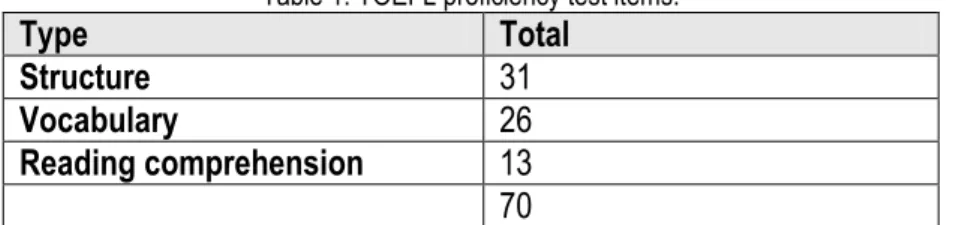
Instruments. The first instrument applied in this study was a simulated proficiency test extracted from a sample TOEFL (test of English as a foreign language) test (1993, pp. 547-563).This proficiency test consisted of 70 multiple choice items including vocabulary, structure and reading comprehension. The test included 31 structural items, 26 vocabulary items and three short reading comprehension texts including 13 reading comprehension questions. Table 1 presents a summary of the components of the proficiency test.
Table 1. TOEFL proficiency test items.
Type Total
Structure 31
Vocabulary 26
Reading comprehension 13
70
a 50-item version for learners of English as a second or foreign language. The SILL asks students to report, on a five-point scale, the frequency of the use of six different categories in terms of how often they use certain strategies. The SILL is in the form of statements. The participants graded their answers on the scale from one to five points where:
1 means never true of me. 2 means rarely true of me. 3 means sometimes true of me. 4 means usually true of me. 5 means always true of me.
The SILL contains six parts. Each part is related to one category of strategies: statements one through nine refer to memory strategies, statements ten through twenty three refer to cognitive strategies, statements twenty four through twenty nine refer to compensation strategies, statements thirty through thirty eight refer to meta-cognitive strategies, statements thirty nine through forty four refer to affective strategies, and statements forty five to fifty refer to social strategies. Table 2 summarizes the number of items related to each strategy type.
Table 2. Strategy grouping according to the six strategy types.
Strategy Types Items Total
Memory 1-9 9
Cognitive 10-23 14
Compensation 24-29 6
Metacognitive 30-38 9
Affective 39-44 6
Social 45-50 6
Sum toal 50
Participants were advised to leave no statement unscored since they were not penalized for wrong answer.
First of all, the proficiency test was rated and the testees who had scored above 64% were classified as the advanced group, those who scored between 33% and 64% correctly were grouped as intermediate learners, and those who answered below 33% of the questions correctly were classified as elementary learners. The results of the proficiency test helped form three groups representing different proficiency levels: advanced learners 11, intermediate learners 42 and elementary learners 37.
The SILL was rated via the numbers assigned to the frequency of each preference, that is never was 1, rarely 2, sometimes 3, usually 4 and finally 5 for always was determined. Then the boundary of each strategy was determined and the frequency of all the strategies rated by the learners was calculated.
Results
The descriptive statistics related to the participant‟s proficiency test of TOEFL of LLSs, measured via a discrete-point test is summarized in Table 3.
Table 3. Descriptive statistics related to the TOEFL test.
Mean SD V
28.288 11.288 126.97
As Table 3 shows, the testees were initially rated; then their scores were ranked. Finally, the mean (28.288), standard deviation (11.268) and variance (126.97) of the scores were calculated. Table 4 presents the groups performance on proficiency test.
Table 4. Descriptive statistics of the three groups of proficiency test.
Group Number Percentage
Advanced 11 12.2%
Intermediate 42 46.6%
Elementary 37 41%
Total 90 100%
descriptive statistics related to the participant‟s reported preferences of language learning strategies (LLSs), measured through the strategy questionnaire (SILL) is represented in Table 5.
Table 5. Descriptive statistics related to the SILL.
Mean SD V
163.66 39.02477 1540.0449
As Table 5 shows, the mean (163.66) was obtained to find the variance (1540.0449) through which the SD=(39.02477) of the SILL questionnaires was determined via running a statistical ANOVA.
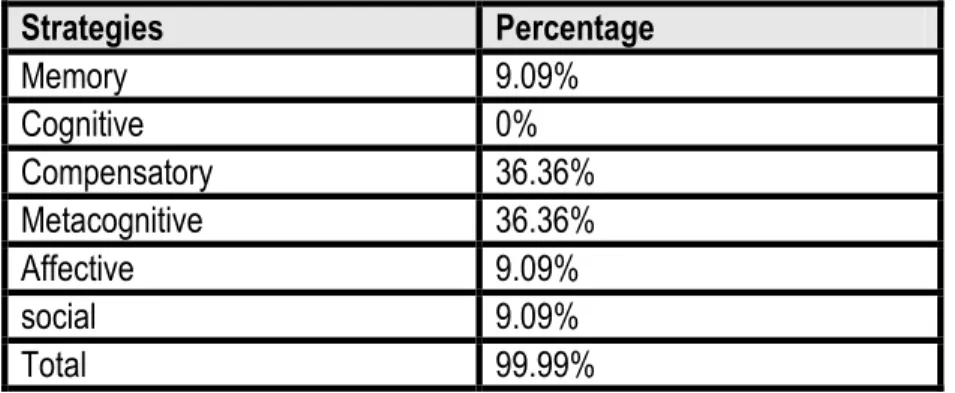
Table 6. Descriptive statistics of the strategies used by the advanced group of LLSs.
Strategies Percentage
Memory 9.09%
Cognitive 0%
Compensatory 36.36%
Metacognitive 36.36%
Affective 9.09%
social 9.09%
Total 99.99%
Table 7. Descriptive statistics of the strategies used by the intermediate group of LLSs.
Strategies Percentage
Memory 7.14%
Cognitive 9.52%
Compensatory 4.76%
Metacognitive 50%
Affective 9.52%
social 19.04%
Total 99.98%
Diagram 1 represents the co-efficiency correlation between the SILL and proficiency test. Table 6 represents the percentage of the different strategies used by the advanced group of the language learners.
As the Table 6 shows, while about 36.36% use compensatory and meta-cognitive strategies at a high level, no learners in the advanced group made use of cognitive strategies. The other strategies were equally employed by the learners in this group. Table 7 represents the percentage of the different strategies used by the intermediate group of the language learners.
As is shown in the Table 6, while about 50% used meta-cognitive as the highest strategy, 19.04% employed social strategy and cognitive and affective strategies were equally applied by the intermediate students and the lowest strategy adopted by this group was memory strategy. Table 8 represents the percentage of the different strategies used by the beginner group of the language learners.
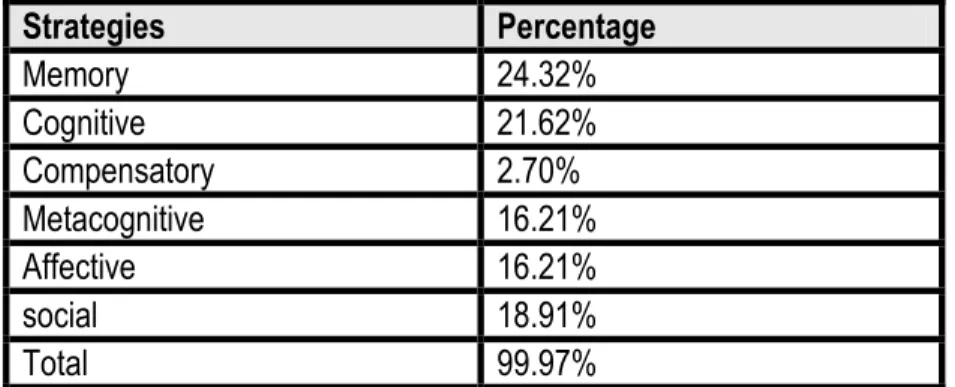
Table 8. Descriptive statistics of the strategies used by the elementary group of LLSs.
Strategies Percentage
Memory 24.32%
Cognitive 21.62%
Compensatory 2.70%
Metacognitive 16.21%
Affective 16.21%
social 18.91%
Total 99.97%
As the table above presents, in this group memory strategy was the most frequent strategy by 24% of the learners, and cognitive strategy was the second frequent strategy use by this group. The third useful strategy to this group was social strategy, and finally, meta-cognitive and affective strategies were equally important strategy to them. While, the least strategy applied was compensatory strategy.
To summarize, the results of the analysis also indicated that advanced learners opt for compensatory and meta-cognitive strategies. While compensatory strategies were almost ignored in intermediate and elementary groups, meta-cognitive strategy use increased rapidly, and then there was a slight downfall. As the learners‟ proficiency increases, the frequency of the use of the cognitive strategies decreases.
In this part the results reported above will be discussed and clarified with regard to the research questions:1. Is there any relationship between the strategy use and the proficiency level of the language learners‟? According to tables 4.1 and 4.3 in the previous section and by comparing the variances of the obtained scores of the TOFL and the scores of the SILL, the correlation coefficient of them was 0.91 which shows there is a relationship between the learner‟s proficiency level and the adoption of the strategies by them. The findings of this study show that they are opposite the findings of Politzer and McGroarty (1985) as they looked at the relationship between a range of good learning activities and the learner‟s proficiency level via using a questionnaire and gaining scores on an intensive course. They reported mixed results. They reported that when the obtained scores were not related to their categories of strategy use as a whole- classroom activity, individual study activities, and social interaction behaviors outside the classroom- there existed some special items which showed salient relationship with their proficiency level. They stated that the relationship between language learning strategies and proficiency level is observed not as a one-way direction leading from cause to effect, but rather as an ascending spiral in which active applied strategies assist students obtain higher proficiency. Also the findings of this study of divergent from Green and Oxford‟s (1995) as they indicated that there is a relationship between the strategy use and proficiency, but the exact nature of this association, which is a casual relationship, is a subject of debate. However, the findings of this study show that the relationship between the strategy use and proficiency level is not a casual association, and it presented that there is a real relationship between the strategy use and the proficiency level of the students. Therefore, it can be concluded that there exists a certain link between the strategies employed by the language learners and their proficiency levels.
level. Moreover, the findings are the same as Bremner‟s (1999) who reported that there is a significant and positive variation in proficiency and the strategy use. Hence, it is concluded that the relationship between the strategy use and proficiency level of the students is a direct relationship, that is, the more proficient the students are, the greater the number of strategies they use. Regarding the third question, “what helpful strategies do the language learners select correspondent to the level of their proficiency?”, this study delineated that the advanced group employed compensatory and meta-cognitive strategies most, and they equally applied memory, meta-cognitive and affective strategies after compensatory and meta-cognitive strategies, but language strategies were not used at all, i.e. the percentage of the learners who used cognitive strategy was zero. The findings of the study correspond to Oxford‟s (1990) who argues that compensatory strategy is the most frequent strategy adopted by the advanced learners, and meta-cognitive strategy as the second highest in rank. Bermner (1999) also argues that Hong Kong students use compensation strategies more than any other strategies.
Conclusion
The following is a summary of conclusions relying on the analysis of the data collected in the study:
1. The data demonstrated that there was a relationship between the strategy use by the learners and the level of their proficiency.
2. The relationship between the strategy use by the language learners and their proficiency level was positive, i.e. there was a direct association between them. The more proficient the learners were, the greater the number of strategies they apply.
3. The data showed that a great number of the advanced group of learners employed the compensatory and meta-cognitive strategies, and memory,
affective, and social strategies followed them. The least used strategy by a minority of the learners of this group was cognitive.
Implications
As it was mentioned previously, language learning strategies have been discussed in versatile studies during the last decades. It has been proved that they have a significant share in acquiring or learning a foreign or second language. Therefore, teacher should be trained to instruct the strategies to their language learners. In Iran, language learning strategies have not been encompassed in the school syllabi. Each learner has his/her own way of learning regardless of any useful strategies, so their learning may not improve aptly. In this regard, one implication is that language instructors and syllabus designers should be advised to inform language learners about language learning strategies. Also, by taking a careful look at the strategies used by the advanced group of learners of this study it is understood that this group who are more successful in learning language use the most strategies and high percentage of compensatory and meta-cognitive strategies. Therefore, all of these fruitful strategies should be introduced to the language learners by the teachers in order to apply them in their learning process to promote their language potential appropriately.
Learning about and using any strategy, efficient are by-product of practicing inside or outside the classroom. The implication of this assertion is that learning about the strategies should not be understood only in terms of direct strategy, yet they should constantly be practiced and applied by the learners consciously or subconsciously, actively or passively in the naturalistic setting. How and how much individual learners approach language learning strategies in the classroom should be investigated by language teachers and outside the classroom by themselves through self assessment. Developing an awareness concerning one‟s own language learning strategy use demands providing opportunities for learners to set goals, self-assess, plan courses of action to fulfill these goals, and identify the most fruitful strategies in their own process of learning. Moreover, they should provide circumstances under which learners practice those useful strategies and evaluate their benefit from their learning strategies.
Suggestions for further research
1. The current research has just concentrated on the proficiency level of the learners. Continued studies can regard factors such as, gender, age, attitude and motivation in relation to strategy use.
2. The research was administered through the six major strategies relying on Oxford‟s strategy inventory. The subcategories can be further investigated. 3. The present study was carried out at the university level. Replicated studies are recommended using junior and senior high school students and language institute learners. Findings of this study will not only clarify focused in this research, it will also add to the inclusiveness of learning strategy research.
4. The participants who took part in the study did not have sufficient familiarity with language learning strategies (LLSs). Teaching LLSs would entail for an eye-catching investment of time for practice and discussion activities. Similar studies could be conducted to involve regular classroom teachers over a semester or year in the teaching of learning strategies to obtain better and clearer consequences.
5. In this study factors such as learning strategies and the proficiency level of the learners was considered. Further studies might be carried out to determine other factors such as language teaching methods, language learning goals, testing methods, and new computer-assisted language learning technologies.
References
Bowen, D. J., H. Madsen. & A. Hilfery. 1985. TESOL techniques and procedures. Massachusetts, Newbury House Publication, INC.
Brown, D. H. 2000. Principles of language learning and teaching. (4th ed.). White Plains, New York,
Longman.
Brown, H. D. 20001. Teaching by principles: an interactive approach to language pedagogy. (2nd
ed.). London. Longman.
Bialystok, E. 1978. A theoretical model of second language learning. Language learning, 28: 69-83.
Chamot, A. 1987. The learning strategies of ESL students. New York, Prentice Hall.
Chastain, K. 1988. Developing second-language learning skills: theory and practice. (3rd ed.).
Chicago: Harcourt Brace Javanovich Publishers.
Cohen, D. A. 1990. Language learning: insights for learners, teachers and researchers. New York, Newbury House & Harper Collins.
Cohen, D. A. 1998. Strategies in learning and using a second language. TESL- EJ. 3(4): 1-5. Cook, V. 1991. Second language learning and language teaching. New York, Edward Arnold. Cummins, J. 1979. Putting language proficiency in its place: Responding to critiques of the
conversational/academic language distinction. TESOL Quarterly, 12: 17- 21.
Cummins, J., & M. Swain. 1983. Analysis by rhetoric: Reading the text or the readers‟ own projections? a reply to Edelsky et al. Applied Linguistics, 4 (1): 23-41.
Ellis, R. 1987. Second language acquisition in context. New York, Prentice Hall. Ellis, R. 1994. The study of second language acquisition. Oxford, Oxford University Press. Green, J. M., & R. L. Oxford. 1995. A closer look at learning strategies, L2. proficiency, and
gender, TESOL Quarterly, 29: 261-297.
Hughes, A. 1996. Testing for language teachers. (8th printing). Cambridge, Cambridge University
Press.
Naiman, H., A. Frohlich and J. Todesco. 1975. The good second language learner. In: J. C. Richards & W. A. Renandya. 2002. Methodology in language teaching: an anthology of current practice. New York, Cambridge University Press.
Nation-Thomas, W. P. 1992. An analysis of the research methodology of the Ramirez study. Bilingual Research Journal, 16 (1-2): 213-25.
Nunan, D. 1999. Second language teaching and learning. Boston. Massachusetts. Heinle & Heinle.
O‟Malley, J. M., & A. Chamot. 1990. Learning strategies in second language acquisition. Cambridge, Cambridge University Press.
Oxford, R. L. 1990. Language learning strategies: A synthesis of studies with implications for strategy training. System, 17: 235-247.
Oxford, R. L. 1990. Language learning strategies: What every teacher should know. New York, Heinle & Heinle.
Richards, J. C., J. Platt & H. Platt. 1992. Dictionary of language teaching and applied linguistics. (2nd Ed.). London, Longman.
Rubin, J. 1975. What the “good language learner” can teach us. TESOL Quarterly, 9 (11): 41-90. Rubin, J. 1987. Learning strategies: Theoretical assumptions, research history and typology.
Englewood Cliffs, New Jersy, Prentice Hall.
Stern, H. H. 1997. Fundamental concepts of language teaching. (7th impression). London, Oxford
University Press.
Su, M., M. 2005. A study of EFL technological and vocational college students‟ language learning and their self-perceived English proficiency. Electronic Journal of Foreign Language Teaching. (On-line), 2 (1). Available at: http://e-flt.nus.edu.sg/.
Vossoughi, H. & J. Javaherian. 2000. An encyclopedic dictionary of teaching English as a foreign language. Tehran, Rahnama Publication.
Weistein, C. & R. Mayer. 1986. The teaching of learning strategies. (3rd Ed.). New York, Macmillan.