Journal Name
RSCPublishing
ARTICLE
Cite this: DOI: 10.1039/x0xx00000x
Received 00th January 2012, Accepted 00th January 2012
DOI: 10.1039/x0xx00000x
www.rsc.org/
Asymmetric Organocatalysts Supported on Vinyl
Addition Polynorbornenes for Work in Aqueous
Media
Irina K. Sagamanova,
aSonia Sayalero,
aSheila Martínez-Arranz,
bAna C.
Albéniz,
*bMiquel A. Pericàs
*a, cIn an effort to identify novel polymer architectures suitable for the covalent supporting of catalysts, L–proline derivatives have been immobilized onto rationally designed vinyladdition polynorbornene (VA-PNB) resins through copper-catalyzed azide-alkyne cycloaddition (CuAAC) reactions. The fully saturated VA-PNB resins have been found to be optimal catalyst supports, the resulting proline-functionalized resins behaving as very active, easily recoverable and highly reusable organocatalysts for the asymmetric direct aldol reaction of benzaldehydes with ketones in aqueous media. The obtained results show that the combination of modular, VA-PNB resins with proline derivatives through triazole linkers represent a promising strategy for the immobilization of organocatalytic species.
Introduction
As a result of increasing concerns on sustainable characteristics of chemical processes, the use of polymer-supported catalysts in synthetic chemistry has increased considerably in recent years.1 The covalent immobilization of catalytic species, offer
important advantages.2 The catalytic activity of
polymer-supported species is importantly determined by the accessibility of the catalytic sites to the reactants, and is modulated by mass transfer limitations In this respect, different features of polymeric supports, such as solubility/swellability profile, degree of functionalization and the possible involvement of the polymer backbone in the catalytic reaction need all to be considered.3 The choice of polymeric support is therefore an
essential issue, since its structure and properties can importantly influence the course of chemical reactions mediated by catalysts immobilized on it. As a matter of fact, no
single polymer structure would be optimal for every conceivable synthetic application.4 In spite of that, a vast
majority of the applications reported so far rely on the use of polystyrenes as supports.1 Recently, we have developed a
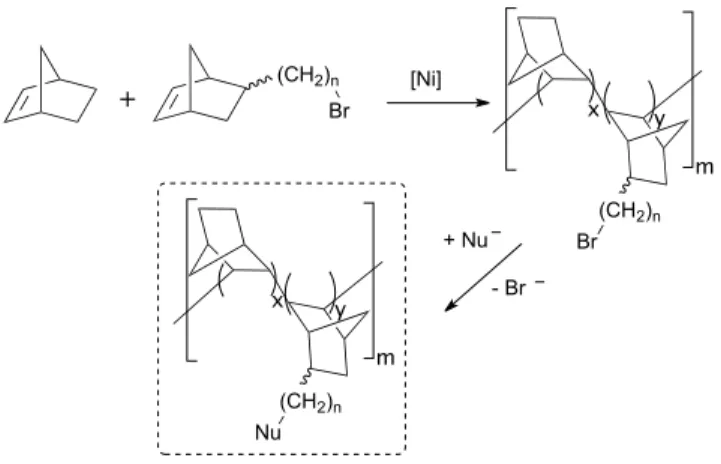
straightforward route to functionalized, vinyl addition (VA) polynorbornenes (PNB’s).5 In this approach, haloalkyl
substituted norbornenes, prepared by Diels-Alder reactions of cyclopentadiene and terminal 1-haloalkenes, are co-polymerized with norbornene in the presence of [Ni(C6F5)2(SbPh3)2], and the intermediate ω-bromoalkyl
(CH2)n
x
m y
Br
+ (CH2)Brn [Ni]
(CH2)n
x
m y
Nu
+ Nu - Br
Scheme 1. Synthesis of functionalized VA-PNBpolymers
In sharp contrast with polynorbornenes prepared by ring-opening metathesis polymerization (ROMP), VA-PNB’s do not contain in their skeletons carbon-carbon double bonds. For this reason, the possibility of uncontrolled side reactions triggered by these skeletal functional groups that could occur on ROMP-PNB’s is completely avoided in VA-ROMP-PNB’s (Figure 1).
m m
ROMP-PNB VA-PNB
Figure 1. General structures of ROMP-PNB and VA-PNB
polymers.
In spite of this potential limitation, ROMP-PNB’s have been used as supports for the immobilization of reagents and catalysts.4 By the contrary, the chemically inert, fully saturated
VA-PNB resins have not been evaluated so far for these applications.6 Our previous experience in the development of
polymer-supported, easily recyclable organocatalysts for chemical processes with improved sustainability characteristics7 led to the idea of anchoring suitably
functionalized proline derivatives onto VA-PNB’s with the double goal of assessing the suitability of these versatile polymers as inert supports for catalyst immobilization and of developing new robust, efficient and recyclable organocatalysts for asymmetric transformations. Herein we report the successful achievement of these goals through the application of the novel functional polymers 1-2 (Figure 2) as reusable catalysts for the highly stereoselective direct asymmetric aldol reaction in water.8 The reported strategy opens up new avenues
for supporting multiple-function catalytic systems onto fully saturated VA-PNB supports.
support
linker
catalytic site (CH2)n
x
m y
N N N
O
NH CO2H
1
linker N
N N
HN
CO2H 2
O
spacer O support
H2C x
m y
catalytic site
Figure 2. Schematic design of the polynorbornene-supported prolines developed in this work.
Results and Discussion
Synthesis and characterization of the polynorbornene-supported catalysts
Previous studies on the covalent immobilization of proline derivatives onto polystyrene (PS) resins through 1,2,3-triazole linkers have shown that the triazole units appear to play an active, synergistic role in catalytic processes mediated by these species in aqueous solvents.8c
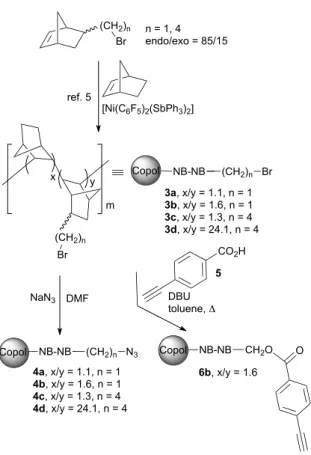
For similar immobilization approaches to be used in the present instance, either alkyne- or azide-functionalized VA-PNB's should be first prepared. This has been done as illustrated in Scheme 2.
First, ω-bromoalkyl functionalized VA-PNBs (3a-d) were prepared by Ni–catayzed copolymerization of norbornene and
ω-bromoalkylnorbornenes according to our previously reported procedure.5 Two different lengths of the bromoalkyl chain (n =
Journal Name ARTICLE
y
m x
(CH2)n Br
NaN3 DMF
NB-NB (CH2)n Br Copol
3a, x/y = 1.1, n = 1 3b, x/y = 1.6, n = 1 3c, x/y = 1.3, n = 4 3d, x/y = 24.1, n = 4
NB-NB (CH2)n N3 Copol
DBU toluene, Δ
CO2H
5
NB-NB CH2O
Copol O
6b, x/y = 1.6 4a, x/y = 1.1, n = 1
4b, x/y = 1.6, n = 1 4c, x/y = 1.3, n = 4 4d, x/y = 24.1, n = 4
(CH2)n Br
n = 1, 4 endo/exo = 85/15
[Ni(C6F5)2(SbPh3)2] ref. 5
Scheme 2. Ready-to-click functional polymers employed in this study.
The azido function was introduced on these copolymers by nucleophilic substitution, by treatment with sodium azide in DMF.5 In this manner, ω-azidoalkyl VA-PNB's 4a-d were
readily prepared. On the other hand, the intermediate bromoalkyl VA-PNB's 3b (x/y = 1.6; n = 1) was treated with p -ethynylbenzoic acid (5) and DBU in toluene under reflux to afford the alkynyl-functionalized resin 6b. While the substitution of bromide by azide was essentially complete in the preparation of 4a-d, the corresponding substitution by p -ethynylbenzoate leading to 6b left unreacted some 31% of the bromomethyl groups present in 3b. In any case, this was not problematic for the catalytic use of resins arising from 6b, since these residual CH2Br groups turned out to be completely
unreactive. The incorporation of the functional unit in polymer
6b was monitored spectroscopically. Thus, characteristic IR absorption bands for the ester and 4-ethynylphenyl groups gained intensity as the reaction proceeded, while the C-Br absorption at 638 cm-1 was almost absent at the end of the
process. Raman experiments also confirmed the presence of the alkyne (2109 cm-1) and remaining Br (638 cm-1) in the polymer.
In addition, the 13C NMR spectrum of the polymer confirmed
the presence of 4- ethynylphenyl group.
For the preparation of the catalytic resins 1a-d, diastereo- and enantiomerically pure (2S,4R)-N-Boc-4-propargyloxyproline
77bwas used as the partner of resins 4a-d in copper-catalyzed
alkyne-azide cycloaddition (CuAAC) reactions (Scheme 3, left).9 After deprotection with trifluoroacetic acid in
dichloromethane, the target prolines immobilized onto VA-PNB supports 1a-d were obtained.
Catalyst 2, was readily prepared from copolymer 6b (Scheme 3, right). First, the alkynyl functionalized polymer was transformed into a fully protected form of the organocatalyst by a CuAAC reaction with the diastereo- and enantiomerically pure azido derivative 8.8c Then, deprotection with trifluroacetic
acid (TFA) in dichloromethane of N-Boc and t-butyl ester groups led to the ready-to-act catalytic resin 2.
It is interesting to note that whereas VA-PNB 6b is a white solid, soluble in common aprotic solvents of medium polarity, copolymer 2 generated in the click reaction is completely insoluble in the above mentioned media. This change of properties is of particular interest in connection with the recovery and reuse of the immobilized catalyst 2. A similar behavior has already been noted in the preparation of ω -azidoalkyl VA-PNB's from the corresponding ω-bromoalkyl precursors.5 Besides the structural changes introduced by the
new substituent, a modification of the conformational behavior of the rigid bicyclic units in the polymer backbone during the cycloaddition plus deprotection process could also contribute to this change in the solubility behavior.10
The incorporation of the functional proline derivatives onto the copolymers via formation of a 1,2,3-triazole linker could be easily followed by IR spectroscopy. For catalysts 1a-d, characteristic IR absorption bands for the N-Boc and t-butyl ester groups (ca. 1737, 1699; ca. 1392, 1365 cm-1) were present
after the click reaction, whereas the stretching band of the azido group (ca. 2091 cm-1) had completely disappeared. The
presence of the free amino acid after the deprotection step was also confirmed spectroscopically (1615-1631 cm-1). In the case
of catalyst 2, characteristic IR absorption bands for the t-butyl groups (ca. 1392, 1365 cm-1) and the ester group in the
p-ethynylbenzoate fragment (C=O, 1709 cm-1) were present after
the click reaction.
Table 1 summarizes the preparation of the copolymer-supported organocatalysts 1a-d and 2: composition, functionalization (f).11,12a yield12b and equilibrium swelling ratio
(SR).13 As a general trend, the overall yield for the click and
deprotection steps in the preparation of 1a-d was found to be in the 83-95% range. Somewhat surprisingly, the more intensely functionalized copolymers (1a and 1c) lead to the highest incorporation of catalytic unit (Yield column). On the other hand, the modification of the length in alkyl spacer connecting the polymer backbone with the functional units (n= 1 or 4) had little effect on the final functionalization yields (compare entries 1-2 and 3-4). In any case, and as we will see later, 1b
presented optimal characteristics in catalysis.
incorporation of the catalytic units also suffers from somewhat low efficiency, and the functionalization of the final resin indicates overall yields of 49% (from 3b) or 75% (from 6b). The occurrence of some solvolytic ester cleavage during the final deprotection step could explain the decreased yield from
6b. Solvent uptake data using different solvents (water, dimethyl sulfoxide and dichloromethane) indicate the swelling
ability of the copolymers. The equilibrium swelling ratio (SR) measured for each solvent shows that copolymers 1 and 2
swelled better in dichloromethane than in water, while dimethyl sulfoxide afforded an intermediate result. These data correlate well with the experimental results in catalysis described in the following section.
Copol
2.5 mol% CuI, DIPEA THF:DMF 1:1, 40 ºC 1)
2) 2:1 TFA:CH2Cl2
3) 2:98 Et3N:THF
NBoc O
CO2tBu
7
N
N N
O
NH CO2H
NB-NB (CH2)n
2.5 mol% CuI, DIPEA THF, 80 oC, MW
NBoc N3
CO2tBu
8 1)
2) 1:1 TFA:CH2Cl2
3) 2:98 Et3N:THF
NB-NB CH2O
Copol
O
N N N
NH CO2H
NB-NB (CH2)n N3
Copol
4a, x/y = 1.1, n = 1 4b, x/y = 1.6, n = 1 4c, x/y = 1.3, n = 4 4d, x/y = 24.1, n = 4
1a, x/y = 1.1, n = 1 1b, x/y = 1.6, n = 1 1c, x/y = 1.3, n = 4 1d, x/y = 24.1, n = 4
NB-NB CH2O
Copol
O
6b, x/y = 1.6
2, x/y = 1.6
Scheme 3. Preparation of the VA-PNB immobilized catalysts 1a-d and 2.
Table 1. Characterization of polynorbornene-supported organocatalysts 1-2. Entry Cat. x/ya nb f
0 (mmol g-1)c,d fmax (mmol g-1)e f (mmol g-1)d Yield
(%)e H
2O
SR (%)f
DMSO CH2Cl2
1 1a 1.1 1 3.08 2.02 1.80 90 270 370 490
2 1b 1.6 1 2.37 1.69 1.47 87 290 430 600
3 1c 1.3 4 2.96 1.97 1.88 95 360 440 590
4 1d 24.1 4 0.48 0.44 0.37 83 170 280 370
5 2 1.6 1 2.98g 1.79 0.87 49 210 410 590
a x/y = NB/NB(CH
2)nX ratio in the starting copolymer. b Chain length of the alkyl spacer in the functional norbornene monomer (NB(CH2)nX). c
Functionalization of the starting copolymer (4a-d for 1a-d, and 3b for 2). d Calculated from the results of elemental analysis. See Ref. 11 e Calculated with the
formula given in Ref. 12. f Determined gravimetrically. See Ref. 13 and Supporting Information. g Determined by quantitative analysis of bromine in 3b. See
Ref. 11.
Journal Name ARTICLE
200 µm 100 µm
600 µm 10 µm
200 µm 200 µm
500 µm
90 µm
1a 1b
1d 1c
Figure 3. SEM images of VA-PNB supported organocatalysts
1a-d.
600 µm
90 µm
2
Figure 4. SEM images of VA-PNB supportedorganocatalyst 2.
Asymmetric aldol reaction mediated by catalysts 1a-d.
For the optimization of reaction conditions, we centered our attention on the use of benign reaction media (DMSO, water, and their binary mixtures) and on work under neat conditions with catalysts 1a and 1b. The reactions were performed at room temperature with a 10 mol% catalyst loading. The results of this study are summarized in Table 2. A complete account of the performed solvent optimization studies can be found in the Supporting Information.
With both catalysts, optimal performance regarding yield (97-99%) and stereoselectivity (89:11 to 91:9 anti:synratio, 90-91% ee) was achieved in DMSO/water 83:17 mixtures (entries 4 and 9). Reactions in pure DMSO (entries 1 and 6) or in pure water (entries 2 and 7) led to decreased conversions and enantioselectivities, as the use of higher amounts of water also did (entries 3 and 8). This behavior parallels that of organocatalytic aldol reactions mediated by PS-proline immobilized through triazole linkers.8b Also in
that case, the use binary mixtures of polar aprotic solvents
and water had positive effects,14 importantly increasing both
reaction rate and enantioselectivity.7c,8
Likewise, the optimal solvent composition (DMSO/water 83:17) represents an optimal balance between ability for the establishing of a hydrogen bond network and VA-PNB swelling.8c The combination of 1b and this solvent mixture
(entry 9) exhibited a slightly better profile and, for this reason, its use in combination with acidic additives (entries 10 and 11) was also studied. The best result (96:4 anti:syn
ratio, 96% ee, entry 11) was achieved with trifluoroacetic acid (10 mol%), and attempts to further accelerate the reaction at higher temperatures (see Supporting Information) did not lead to any practical improvement.
When the reaction was performed under solvent free conditions very low conversion and moderate stereoselectivity were observed (entries 5 and 12). However, performing the reaction in a ball-mill,15 with the use of p
-nitrobenzaldehyde and cyclohexanone in essentially stoichiometric amounts, resulted in significantly better conversión after a notably short reaction time, although the recorded stereoselectivity continued to be only moderate (entry13).
Table 2. Solvent effect on the aldol reaction of cyclohexanone with p-nitrobenzaldehyde catalyzed by polymers 1a-b.a
O2N
CHO O
O2N
O OH
+ 1a or 1b (10 mol%)
solvent, r.t.
9a 10a 11a
Entry Cat. Solvent Time (h)
Conv.b,c anti:
synb
ee
antid
(%)
1 1a DMSO 21 61 74:26 91
2 1a H2O 21 74 71:29 73
3 1a DMSO/
H2O
(50/50)
21 94 81:19 85
4 1a DMSO/
H2O
(83/17)
16 100 (97) 89:11 90
5 1a neat 21 10 77:23 76
6 1b DMSO 21 82 76:24 92
7 1b H2O 21 81 79:21 78
8 1b DMSO/
H2O
(50/50)
21 96 86:14 93
9 1b DMSO/
H2O
(83/17)
10 1b DMSO/ H2O
(83/17)e
21 100 (97) 92:8 93
11 1b DMSO/
H2O
(83/17)f
21 99 (90) 96:4 96
12 1b neat 21 17 77:23 75
13 1b neatg 6.5 94 78:22 76
a Reactions were performed with 1a or 1b (0.015 mmol), p
-nitrobenzaldehyde (9a, 0.15 mmol) and cyclohexanone (10a, 0.75 mmol) in the indicated solvents (54 µL).b By 1H NMR on the reaction crude. c
The combined yield of isolated diastereomers is given in parentheses. d
By chiral HPLC. e p-Nitrobenzoic acid (0.022 mmol) was used as an
additive. f Trifluoroacetic acid (0.015 mmol) g Reaction performed in a
ball-mill: 9a (89 mg, 0.59 mmol), 10a (67 µL, 0.65 mmol), 1b (40 mg, 0.059 mmol) and 60 zirconium oxide balls, rotation speed of 250-400 rpm..
It became apparent from these optimization studies that the best reaction conditions consisted in using 10 mol% of catalyst in combination of 10 mol% of TFA as an additive, a mixture DMSO:H2O (87:13) as solvent and performing the
reactions at room temperature. The transferability of these conditions was next checked by performing the reaction of
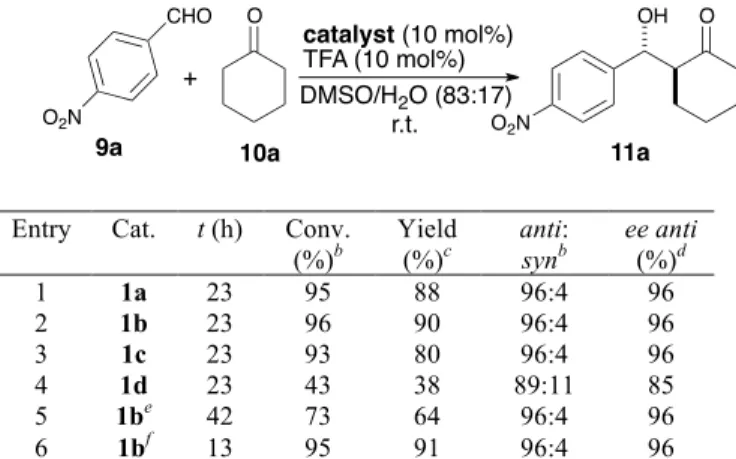
9a with 10a under catalysis by 1a-d (Table 3). Catalysts 1a,
1b and 1c showed similar behavior in terms of conversion, diastereo- and enantioselectivity (entries 1-3). Copolymer
1d, in turn, led to much lower conversion and decreased stereoselectivity (entry 4). This provides clear indication that the functionalization level of the catalytic polymers (1d is much less functionalized than 1a-c) has a significant influence on their performance. An examination of the effect of the amount of catalyst 1b (entries 5-6) showed that catalyst loading could be reduced to 5 mol%, but at the expense of increased reaction times. Thus, after 42 h conversion was only 73%, while diastereoselectivity and enantioselectivity kept at the same level (entry 5). Conversely, when 20 mol% of catalyst was used (entry 6), a noticeable increase in reaction rate was observed, the process being essentially complete in only 13 h.
Table 3. Benchmarking of VA-PNB supported catalysts 1a-d in the aldol reaction of cyclohexanone with p nitrobenzaldehyde.a
O2N
CHO O
O2N
O OH
+
catalyst (10 mol%) TFA (10 mol%) DMSO/H2O (83:17)
r.t.
9a 10a 11a
Entry Cat. t (h) Conv. (%)b
Yield (%)c
anti:
synb
ee anti
(%)d
1 1a 23 95 88 96:4 96
2 1b 23 96 90 96:4 96
3 1c 23 93 80 96:4 96
4 1d 23 43 38 89:11 85
5 1be 42 73 64 96:4 96
6 1bf 13 95 91 96:4 96
a Reactions were performed with resin 1 (0.015 mmol), 9a (0.15 mmol), 10a (0.75 mmol) in DMSO/water (83:17, 54 µL). bBy 1H NMR on the
reaction crude. c Combined yield of isolated anti:syn diastereomers. d By
chiral HPLC. e 5 mol% catalyst used. f 20 mol% catalyst used.
We then set out to explore the applicability of 1b with respect to the aldehyde reaction partners. As it can be seen in Scheme 4, a wide range of aromatic aldehydes can effectively participate in this reaction affording the anti aldol products in very high yields and with both, high diastereo- and enantioselectivity. As a general trend, reactions performed in the absence of TFA additive required slightly longer reaction times. Although higher yields were normally achieved in the absence of TFA, stereoselectivity slightly eroded in these experiments (11a,f-g,i-j), so that the convenience or not of using this additive has to be evaluated in each particular case.
These results show that VA-PNB supported proline 1b
works in close parallelism to other amphiphilic polymeric proline derivatives that have proven to be efficient catalysts for the asymmetric aldol reactions of ketones and benzaldehydes in aqueous reaction conditions,7c,8b-c,17 and
Journal Name
RSCPublishing
ARTICLE
CHO O OH O
anti R R
1b (10 mol%)
DMSO:H2O (87:13), r.t.
TFA (10 mol%)
9a-j
11a-j
OH O
O2N
OH O
NC
11a, 23 h, 90% yieldb
96:4 anti:sync, 96% eed
OH O
OH O
O2N NO2
11c, 47 h, 93% yieldb
95:5 anti:sync, 97% eed 11b, 47 h, 94% yieldb
96:4 anti:sync, 96% eed
11d, 43 h, 88% yieldb
97:3 anti:sync, 96% eed
OH O
F3C
OH O
MeO2C
11e, 93 h, 87% yieldb
96:4 anti:sync, 97% eed
OH O OH O
11f, 110 h, 65% yieldb
98:2 anti:sync, 96% eed
11g, 93 h, 74% yieldb
95:5 anti:sync, 95% eed
11h, 46 h, 81% yieldb 97:3 anti:sync, 96% eed CF3
OH O
Br
OH O
11i, 88 h, 63% yielde
96:4 anti:sync, 91% eed
11j, 47 h, 79% yieldb
96:4 anti:sync, 96% eed
11j, 65 hf, 98% yieldb
93:7 anti:sync, 93% eed 11i, 96 hf, 75% yieldb
90:10 anti:sync, 90% eed
11f, 110 hf, 98% yieldb
97:3 anti:sync, 91% eed
11g, 96 hf, 95% yieldb
90:10 anti:sync, 91% eed 11a, 21 hf, 98% yieldb
91:1 anti:sync, 91% eed
10a
a Reaction conditions: aldehyde (0.15 mmol), 10a (0.75 mmol), 1b (10.2 mg, 0.015 mmol), TFA (0.015 mmol) in DMSO:H2O (83:17, 54 µL) at room
temperature. b Combined yield of the isolated diastereomers. c By 1H NMR on the reaction crude. d By chiral HPLC of 11. e Isolated yield of anti isomer. f
Without TFA additive.
Scheme 4. Substrate scope of the aldol reaction catalyzed by 1b.a
Asymmetric aldol reaction mediated by catalyst 2.
Catalyst 2 was designed with the goal of increasing the catalytic activity and stereoselectivity depicted by 1a-c. We anticipated that the structural changes introduced in 2 would modify the hydrophobic/hydrophilic balance in the amphiphilic catalyst, leading to higher catalytic activity in water and to higher levels of stereocontrol in this reaction media.8,17
As a common characteristic, proline and pyrrolidine derivatives able to catalyze aldol reactions in aqueous media display well differentiated molecular regions with
hydrophobic and hydrophilic characters, as it is known for type-I aldolases. In polymer-supported prolines, the extended polymer backbone efficiently mimics the hydrophobic pocket of the natural enzymes, while the functional units need to provide the hydrophilic environment where the reaction takes place. The same behavior could be expected in case of copolymer 2 where, according to precedents,8c the triazole unit could play the double role of
improve the catalyst activity and stereoselectivity because of the increased separation between the hydrophilic, catalytically active moiety and the hydrophobic polymer backbone, as previously noted with polystyrene-supported prolines.7c The study on the catalytic behavior of 2 in water
was initiated by using p-nitrobenzaldehyde (9a) and cyclohexanone (10a) as model substrates in the aldol addition (see Supporting Information fordetails). Pleasingly, the reaction proceeded nicely in water, affording aldol 11a
in 22 h with excellent yield (90%) and stereoselectivity (95:5 anti:synratio, 96% ee). Identical stereoselectivity was recorded when the reaction was conducted in DMSO:H2O
(50:50) or DMF:H2O (50:50) mixtures. In these solvent
mixtures, a slightly improved yield (95%) was also recorded. In practice, a (50:50) mixture of DMF and water was the solvent of choice for these reactions. In this media, the
reactions catalyzed by 2 provided the aldol adducts 11a-l
with excellent yield and stereoselectivity, in shorter reaction times than with catalyst 1b and without the need of added acid (Scheme 5). It thus appears that the combination of the polynorbornene skeleton, the p-phenylenecarboxylate spacer and the triazole linker leads to a significant improvement of the catalytic activity of the proline unit in aqueous media. Reactions involving cyclopentanone (10b) and 4-pyranone (10c) as pronucleophiles were remarkably fast, providing the corresponding anti-aldol products 11k-l in very high yield and good stereoselectivity.15b,17d,20 In general, products 11
were obtained in high purity after a simple filtration (to recover 2), extraction with dichloromethane and evaporation, no further purification being required.
CHO OH
anti R
R
2 (10 mol%)
DMF:H2O (50:50), r.t.
OH O
O2N
OH O
NC 11a, 22 h, 97% yieldb
96:4 anti:sync, 97% eed
OH O OH O
O2N NO2
11c, 26 h, 86% yieldb
97:3 anti:sync, 97% eed
11b, 35 h, 69% yieldb
97:3 anti:sync, >99% eed
11d, 23 h, 97% yieldb
96:4 anti:sync, 97% eed
OH O
F3C
OH O
MeOOC 11e, 26 h, 93% yieldb
95:5 anti:sync, 96% eed
OH O OH O
11f, 110 h, 55% yieldb
98:2 anti:sync, 94% eed
11g, 82 h, 80% yieldb
93:7 anti:sync, 95% eed
11h, 46 h, 95% yieldb
96:4 anti:sync, 96% eed
CF3
OH O
Br OH O
11i, 82 h, 76% yielde
95:5 anti:sync, 95% eed
11j, 44 h, 99% yieldb
95:5 anti:sync, 97% eed
9a-j
11a-l X
O
X O
X= -CH2CH2-, -CH2-, -OCH2
-OH
O2N
11k, 4 h, 93% yieldb
76:24 anti:sync, 90% eed
O
O OH O
O2N
11l, 16 h, 92% yieldb
88:12 anti:sync, 69% eed
10a-c
a Reaction conditions: 9a-j (0.15 mmol), 10a-c (0.75 mmol), and 2 (17 mg, 0.015 mmol) in DMF:H
2O (50:50, 54 µL) at room temperature. b Combined yield
of the isolated diastereomers after flash chromatography. c By 1H NMR on the reaction crude. d By chiral HPLC of 11. e Isolated yield of anti isomer.
Scheme 5. Substrate scope of the aldol reaction catalyzed by 2.a
Catalysts recycling and reuse.
To show the recyclability of polymers 1b and 2, two series of experiments were planned where single samples of these catalytic copolymers were repeatedly used at constant reaction time to mediate the aldol addition of 10a to 9a. The results of these studies have been summarized in Figure 5. The insoluble nature of the polymer allows for catalyst recovery by performing a simple filtration. Thus, after each
run, the catalyst was readily recovered from the reaction mixture, washed and reused in the next reaction cycle (see Supporting Information).
Journal Name ARTICLE
activity, SEM studies were performed to monitor the change of the catalyst surface morphology. Compared with fresh catalyst 1b, a very similar surface morphology was observed after the seventh run. This observation indicates that 1b does not experience structural collapse with repeated use. On the other hand, it was found that the %N determined by elemental analysis decreased after recycling, which was indicative that leaching of catalytic proline units from the copolymer backbone takes place to some extent. Catalyst 2, on the contrary, could be recycled and reused for at least seven runs without any appreciable loss in yield or in stereoselectivity. The polymer presented similar IR spectra and the same surface morphology before and after recycling. Furthermore, it was found that the %N determined by elemental analysis remained unchanged after recycling (see Supporting Information). It is thus clear that the presence of the p-phenylenecarboxylate spacer has a notable and very positive effect on the chemical stability of the polynorbornene-supported organocatalyst.
Figure 5. Recycling experiments of the test reaction under optimized conditions with catalysts 1b and 2. Black bars: yield (%); pale gray bars: dr; gray bars: ee (%).
Conclusions
In summary, we have successfully developed a family of modified prolines anchored onto VA-PNB's through two complementary alkyne-azide click reactions. The versatility of these species as organocatalysts has been also illustrated by their application in asymmetric aldol additions of ketone pronucleophiles to aromatic aldehydes in a variety of reaction conditions. Polynorbornene-supported proline has shown excellent performance in this particular aldol transformation in an aqueous environment, and the robustness of the new polymeric catalysts has been demonstrated by the possibility of extending its use for up to seven cycles in the aldol reaction of cyclohexanone and p -nitrobenzaldehyde. These results show that VA-PNB's can be considered as viable alternatives to well-established polystyrene resins as supports for the immobilization of catalysts. In addition, the absence of unsaturations in the polymer backbone of VA-PNB's should make these polymers transparent to UV light and therefore, could greatly facilitate the use of catalysts supported on these resins in photocatalytic processes. Further applications of VA-PNB's as catalysts supports, dictated by the structural characteristics of these copolymers, are now in progress in our laboratories.
Experimental Section
Synthesis of catalysts 1a-d.
1a: t-Butyl (2S,4R)-N-Boc-4-propargyloxyprolinate 7 (600 mg, 1.84 mmol), N,N-diisopropylethylamine (2.5 mL, 14.20 mmol) and copper(I) iodide (6.7 mg, 0.035 mmol) were added to a suspension of copolymer 4a (Copol-NB-NBCH2N3 x/y = 1.1:1, n = 1; 460 mg, f = 3.084 mmol g-1) in
a DMF:THF 1:1 mixture (9 mL) placed in a flask under N2.
The reaction mixture was shaken at 40 ºC for 24 h, the reaction progress being monitored by FTIR. When the IR band of the azido group had completely disappeared, the polymer was collected by filtration, sequentially washed with H2O (40 mL), THF (40 mL), THF-MeOH (40 mL),
MeOH (40 mL), THF (40 mL) and CH2Cl2 (50 mL) and
dried under reduced pressure at 40 ºC for 24 h. The intermediate polynorbornene-supported t-butyl prolinate, which was obtained as a white solid (892 mg, 97% yield) [FTIR (ATR, neat): ν 2941, 2868, 1738 (C=O), 1699 (C=O), 1476, 1453, 1393 (t-butyl), 1393 (t-butyl), 1254, 1366 cm-1.
Elemental Analysis(%): Calcd.: N, 8.63. Found: N, 8.51; f = 1.52 mmol g-1], was directly submitted to the deprotection
process. To this end, the prolinate (870 mg) was swollen in CH2Cl2 (10 mL), after 10 min TFA was added (20 mL) and
the mixture was shaken at room temperature. When the IR bands of the t-butyl and carbonyl moieties in the protecting groups had completely disappeared, the reaction mixture was filtered off and the polymer was washed sequentially with THF (with 2% of Et3N, 50 mL), H2O (50 mL), THF (50
reduced pressure at 40 ºC for 24 h (648 mg, 98% yield). FTIR (ATR, neat): ν 3409 (COOH), 2942, 2866, 1622 (C=O), 1450, 1371, 1317, 1219, 1154 cm-1. Elemental
Analysis(%): Calcd.: N, 11.37; Found: N, 10.06; f = 1.80 mmol g-1. Catalysts 1b, 1c and 1d were synthesized in the
same way, starting from the corresponding azido-copolymer.
1b: The intermediate polynorbornene-supported t-butyl prolinate (a white solid) was obtained from 7 (1.0 g, 3.08 mmol), N,N-diisopropylethylamine (4.2 mL, 23.70 mmol), copper(I) iodide (10 mg, 0.059 mmol) and copolymer 4b
(Copol-NB-NBCH2N3 x/y = 1.6:1, n = 1; 1.0 g, f = 2.37
mmol g-1) in DMF:THF 1:1 (12 mL) after 22 h reaction in
95% yield (1.69 g). [FTIR(ATR, neat): ν 2943, 2867, 1737 (C=O), 1699 (C=O), 1476, 1453, 1392 (t-butyl), 1365 (
t-butyl), 1255, 1217 cm-1. Elemental Analysis (%): Calcd.: N,
7.50. Found: N, 7.67; f = 1.37 mmol g-1]. Then final catalytic
polymer 1b (1.18 g, 99% yield) was obtained by shaking the intermediate prolinate (1.50 g) in CH2Cl2 (15 mL) with TFA
(30 mL). FTIR(ATR, neat): ν 3430 (COOH), 2942, 2867, 1631 (C=O) cm-1. Elemental Analysis(%): Calcd.: N, 9.47.
Found: N, 8.26; f = 1.47 mmol g-1.
1c: The polynorbornene-supported t-butyl prolinate (a white solid) was obtained from 7 (292 mg, 0.89 mmol), N,
N-diisopropylethylamine (1.2 mL, 6.90 mmol), copper(I) iodide (3.3 mg, 0.017 mmol) and copolymer 4c (Copol-NB-NBCH2N3 x/y = 1.3:1, n = 1; 233 mg, f = 2.96 mmol g-1) in
DMF:THF 1:1 (6 mL) after 23 h reaction in 98% yield (464 mg). [FTIR (ATR, neat): ν 2934, 2865, 1738 (C=O), 1698 (C=O), 1476, 1454, 1393 (t-butyl), 1365 (t-butyl), 1255, 1218 cm-1. Elemental Analysis(%): Calcd.: N, 8.46. Found:
N, 8.75; f = 1.56 mmol g-1]. Then final catalytic polymer 1c
(365 mg, 98% yield) was obtained by shaking the intermediate prolinate (440 mg) in CH2Cl2 (4 mL) with TFA
(8 mL). FTIR (ATR, neat): ν 3416 (COOH), 2933, 2863, 1625 (C=O) cm-1. Elemental Analysis(%): Calcd.: N, 11.04.
Found: N, 10.56; f = 1.88 mmol g-1.
1d. The polynorbornene-supported t-butyl prolinate (a white solid) was obtained from 7 (61 mg, 0.19 mmol), N,
N-diisopropylethylamine (250 mL, 1.43 mmol), copper(I) iodide (1 mg, 5.74 mmol) and copolymer 4d (Copol-NB-NB(CH2)4N3 x/y = 24.1:1, n = 4; 300 mg, f = 0.478 mmol g -1) in DMF:THF 1:1 (2 mL) after 24 h reaction in 92% yield
(320 mg). [FTIR(ATR, neat): ν 2940, 2865, 1743 (C=O), 1707 (C=O), 1451,1392 (t-butyl), 1366 (t-butyl), 1255, 1218 cm-1. Elemental Analysis (%): Calcd.: N, 2.31. Found: N,
1.91; f = 0.34 mmol g-1]. Then final catalytic polymer 1d
(280 mg, 98% yield) was obtained by shaking the intermediate prolinate (300 mg) in CH2Cl2 (4 mL) with TFA
(8 mL). FTIR(ATR, neat): ν 2940, 2864, 1620 (C=O) cm-1.
Elemental Analysis(%): Calcd.: N, 2.48. Found: N, 2.09; f = 0.37 mmol g-1.
Synthesis of polymer 6b.
Bromoalkyl polynorbornene 3b (Copol-NB-NBCH2Br, x/y
= 1.6:1, 330 mg, f = 2.98 mmol g-1), toluene (21 mL),
p-ethynylbenzoic acid (5, 393 mg, 2.69 mmol) and DBU (0.41
mL, 2.69 mmol) were mixed in a flask under N2, and the
mixture was heated under reflux for 22 h. The solvent was evaporated and MeOH was added (30 mL). A solid appeared, which was stirred for 30 min, filtered, washed with MeOH (2 x 30 mL) and dried under reduced pressure at 40 ºC for 24 h. Compound 6b was obtained as a white solid
(375 mg) soluble in dichloromethane or THF, which contained 73.3 mg of Br/g of copolymer, indicating that substitution has proceeded to a 69% degree. 13C NMR
(gel-phase, 126 MHz, CDCl3): δ 166.3 (C=O), 132.2, 130.6,
129.6, 126.9, 83.0 (C=C), 80.2 (C=C), 56-52.8 (br), 52.2-50.2 (br), 47.9-45.9 (br), 43.7-41.6 (br), 40.2-38.6 (br), 36.8- 34.4 (br), 32.2-31.0, 30.6-29.0 (br), 28.7-28.3 (br) ppm. Raman: ν 2100 (C=C), 1720, 1600, 638 (C-Br) cm-1. FTIR
(ATR, neat): ν 3301 (=CH), 2942, 2866, 1719 (C=O), 1607, 1266 (C-O), 1173, 1094, 857, 768 cm-1.
Synthesis of catalyst 2.
(2S,4R)-N-Boc-4-azido-L-proline tert-butyl ester 8 (151 mg, 0.48 mmol), N,N-diisopropylethylamine (650 mL, 3.72 mmol) and copper(I) iodide (2 mg, 9.3 mmol) were added to a solution of 4-ethynylphenyl-polynorbornene copolymer 6b
(220 mg) in THF (1.5 mL) placed in a flask under N2. The
reaction mixture was shaken at 40 ºC for 24 h, the reaction progress being monitored by FTIR. When the IR band of the alkynyl group had completely disappeared, the polymer was collected by filtration, sequentially washed with H2O (20
mL), THF (20 mL), THF-MeOH (20 mL), MeOH (20 mL), THF (20 mL) and CH2Cl2 (20 mL) and dried under reduced
pressure at 40 ºC for 24 h. The polynorbornene-supported prolinate was obtained as an insoluble white solid (320 mg). [FTIR (ATR, neat): ν 2942, 2867, 1709 (C=O), 1614 (C=O), 1392 (t-butyl), 1367 (t-butyl), 1266 (C-O) cm-1. Elemental
Analysis (%): Found: N, 5.05; f = 0.90 mmol g-1]. Then
polymer 2 (250 mg) was obtained by shaken the prolinate (200 mg) in CH2Cl2 (1.5 mL) with TFA (1.5 mL). When the
IR bands of the t-butyl and carbonyl moieties in the protecting groups had completely disappeared, the reaction mixture was filtered off and the polymer was washed sequentially with THF (with 2% of Et3N, 20 mL), H2O (20
mL), THF (20 mL), THF-MeOH 1:1 (20 mL), MeOH (20 mL), THF (20 mL) and CH2Cl2 (20 mL). The solid was
dried under reduced pressure at 40 ºC for 24 h. FTIR (ATR, neat): ν 3431 (COOH), 2943, 2865, 1717 (C=O), 1615 (C=O), 1449, 1267 (C-O), 1177, 1100, 771 cm-1. Elemental
Analysis(%): Found.: N, 4.89; f = 0.87 mmol g-1.
General procedure for the asymmetric aldol reaction catalyzed by polymers 1a-d.
Polynorbornene-supported proline 1 (0.015 mmol) was swollen in 54 mL of a DMSO/H2O (87:13) mixture
containing TFA (0.015 mmol). The corresponding aldehyde
9a-j (0.15 mmol) and cyclohexanone (0.75 mmol) were
Journal Name ARTICLE
polymer was filtered off, washed with water (2 mL) and dichloromethane (2 mL) and air-dried. The aqueous filtrate was separated by decantation and extracted with dichloromethane (3 x 10 mL). The combined organic phases were washed with brine, dried (MgSO4) and concentrated
under reduced pressure.
Purification by flash column chromatography (ethyl acetate/hexanes, 9:1 to 4:1) gave the aldol products 11aj as mixtures of anti and syn diastereomers. Conversion and diastereomeric ratio were determined by 1H NMR
spectroscopy on the crude samples after polymer removal. The enantiomeric excess was determined by HPLC on a chiral stationary phase after purification by flash column chromatography on silicagel.
General procedure for the asymmetric aldol reaction catalyzed by polymer 2.
Polynorbornene-supported proline 2 (0.015 mmol) was swollen in a mixture of DMF/H2O (50:50, 54 µL). The
corresponding aldehyde 9a-j (0.15 mmol) and ketone 10a-c
(0.75 mmol) were added and the reaction mixture was stirred at room temperature (see Scheme 5). After the indicated time, dichloromethane (1 mL) was added and the polymer was filtered off, washed with water (2 mL) and dichloromethane (2 mL) and air-dried. The aqueous filtrate was separated by decantation and extracted with dichloromethane (3 x 10 mL). The combined organic phases were washed with brine, dried (MgSO4) and concentrated
under reduced pressure. When required, purification by flash column chromatography (ethyl acetate/hexanes, 9:1 to 4:1) was performed to give the aldol products 11a-l as mixtures of anti and syn diastereomers. Conversion and diastereomeric ratio were determined by 1H NMR
spectroscopy on the crude samples after polymer removal. The enantiomeric excess was determined by HPLC on a chiral stationary phase after purification by flash column chromatography on silicagel.
Acknowledgements
Financial support from Institute of Chemical Research of Catalonia (ICIQ) Foundation, the Spanish MINECO (DGI, grants CTQ2013-48406-P and CTQ2012-38594-C02-01), DEC-Generalitat de Catalunya (Grant 2014SGR827) and the Junta de Castilla y León (grant VA373A11-2) is gratefully acknowledged. We also thank MINECO for support through Severo Ochoa Excellence Accreditation 2014-2018 (SEV-2013-0319). The authors thank Dr. Carles Lizandara for valuable support in the characterization of polymers.
Notes and references
a Institute of Chemical Research of Catalonia (ICIQ), Av. Països
Catalans 16, 43007 Tarragona, Spain. Fax: (+34)977920244; E-mail: [email protected]
b IU CINQUIMA/Química Inorgánica, Universidad de Valladolid,
47071 Valladolid, Spain. E-mail: [email protected]
c Departament de Química Orgànica, Universitat de Barcelona, 08028
Barcelona, Spain.
† Electronic Supplementary Information (ESI) available: Preparation of compound 5, screening of additives and solvent and temperature effects on the aldol reaction between 9a and 10a, recycling experiments, spectroscopic and chromatographic data of the aldol products, and characterization of the polymers are provided. See DOI: 10.1039/b000000x/
1 For reviews about polymer-supported catalysts, see: (a)
Handbook of Green Chemistry & Technology, eds. J. Clark and D. Mcquarrie, Blackwell Publ., London, 2002; (b) N. E. Leadbeater and M. Marco, Chem. Rev. 2002, 102, 3217; (c) C. A. McNamara, M. J. Dixon and M. Bradley, Chem. Rev. 2002, 102, 3275; (d) Polymeric materials in organic synthesis and catalysis, ed. M. R. Buchmeiser, Wiley-VCH, Weinheim, 2003; (e) M. Benaglia, A. Puglisi and F. Cozzi, Chem. Rev. 2003, 103, 3401; (f) R. Haag and S. Roller, Immobilized Catalysts in: Topics in Current Chemistry, ed. A. Kirsching, Springer, Heidelberg, 2004; (g) Polymer-Supported Reagents and Catalysts: Increasingly Important Tools for Organic Synthesis, eds. P. H. Toy and M. Shi, Tetrahedron 2005, 61, 12013; (h) B. M. L. Dioos, I. F. J. Vankelecom and P. A. Jacobs, Adv. Synth. Catal. 2006, 348, 1413; (i) S. Itsuno and N. Haraguchi, Heterogeneous Enantioselective Catalysis Using Organic Polymeric Supports in Handbook of Asymmetric Heterogeneous Catalysis, eds. K. Ding and Y. Uozumi, Wiley-VCH, Weinheim, 2008; (j) Recoverable and Recyclable Catalysts, ed.M. Benaglia, John Wiley & Sons, Chichester, 2009; (k) K. E. Kristensen and T. Hansen, Eur. J. Org. Chem. 2010, 3179.
2 C. Jimeno, S. Sayalero and M. A. Pericàs, Covalent Heterogenization of Asymmetric Catalysts on Polymers and Nanoparticles in Heterogenized Homogeneous Catalysts for Fine Chemicals Production. Catalysis by Metal Complexes, eds. P. Barbaro and F. Liguari, Springer, Heidelberg, 2010, Vol. 33, chapter 4, pp. 123-170. 3 F. Cozzi, Adv. Synth. Catal. 2006, 348, 1367. 4 J. Lu and P. H. Toy, Chem. Rev. 2009, 109, 815.
5 (a) S. Martínez-Arranz, A. C. Albéniz and P. Espinet,
Macromolecules 2010, 43, 7482; (b) A. C. Albéniz, S. Martínez-Arranz and P. Espinet, ES2364781A1.
6 For examples of the use of tin reagents supported on vinyl addition polynorbornes in the Stille reaction see: (a) S. Martínez-Arranz, N. Carrera, A. C. Albéniz, P. Espinet and A. Vidal-Moya, Adv. Synth. Catal. 2012, 354, 3551; (b) I. Meana, A. C. Albéniz and P. Espinet, Adv. Synth. Catal.
2010, 352, 2887; (c) N. Carrera, E. Gutierrez, R. Benavente, M. M. Villavieja, A. C. Albéniz and P. Espinet,
Chem. Eur. J. 2008, 14, 10141.
Ayats, A. H. Henseler and M. A. Pericàs, ChemSusChem
2012, 5, 320; (d) X. Fan, S. Sayalero and M. A. Pericàs,
Adv. Synth. Catal. 2012, 354, 2971; (e) P. Kasaplar, C. Rodríguez-Escrich and M. A. Pericàs, Org. Lett. 2013, 15, 3498; (f) R. Martín-Rapún, S. Sayalero and M. A. Pericàs,
Green Chem. 2013, 15, 3295; (g) X. Fan, C. Rodríguez-Escrich, S. Sayalero and M. A Pericàs, Chem. Eur. J. 2013,
19, 10814; (h) L. Osorio-Planes, C. Rodríguez-Escrich and M. A. Pericàs, Chem. Eur. J. 2014, 20, 2397.
8 (a) Modern Aldol Reactions, ed. R. Mahrwald, Wiley-VCH, Weinheim, 2004. For selected examples see: (b) D. Font, C. Jimeno and M. A. Pericàs, Org. Lett. 2006, 8, 4653; (c) D. Font, S. Sayalero, C. Jimeno and M. A. Pericàs, Org. Lett. 2008, 10, 337.
9 (a) Centenary Lecture - 1,3-Dipolar Cycloadditions, R. Huisgen, Proc. Chem. Soc. London 1961, 357; (b) R. Huisgen, 1,3-Dipolar Cycloaddition Chemistry, ed. A. Padwa, Wiley, New York, 1984; (c) M. Meldal and C. W. Tornøe, Chem. Rev. 2008, 108, 2952.
10 P. P. Chu, W.-J. Huang, F.-C. Chang and S. Y. Fan,
Polymer 2000, 41, 401.
11 The functionalization of a given resin can be calculated from the results of elemental analysis with the formulae: For nitrogen containing functional resins: f (mmol g-1) =
0.714(%N)/nN, (%N) representing the weight percentage of
nitrogen determined by elemental analysis and nN
representing the number of nitrogen atoms in the functional unit; For bromine containing functional resins: f (mmol g-1)
= 0.125(%Br)/nBr, (%Br) representing the weight
percentage of bromine determined by elemental analysis and nBr representing the number of bromine atoms in the
functional unit.
12 (a) The maximal functionalization (fmax) of a given resin
can be calculated from the functionalization of a precursor resin (f0) by means of the following formula: fmax (mmol g -1) = f
0/(1 + f0(ΔMW/1000), where ΔMW represents the
variation in molecular mass of the functional unit along the considered transformation(s); (b) Yield in reactions involving functional resins is not related to mass recovery, which is generally complete, but rather to the ratio between actual functionalization (f) and maximal functionalization (fmax) for the resin undergoing the considered process: yield
(%) = 100(f/fmax).
13 The equilibrium swelling ratio (SR) in each solvent was determined gravimetrically with the formula: Swelling Ratio (SR, %) = 100(Ws-Wdry)/Wdry,where Ws is the weight
of swollen samples after thecertain time and Wdry is the
weight of dried samples.
14 P. M. Pinko, K. M. Laurikainen, A. Usano, A. I. Nyberg and J. A. Kaavi, Tetrahedron 2006, 62, 317.
15 For the role of concentration effect in solvent-free aldol reactions, see: (a) B. Rodríguez, T. Rantanen and C. Bolm,
Angew. Chem. Int. Ed. 2006, 45, 6924; (b) B. Rodríguez, A. Bruckmann and C. Bolm, Chem.Eur. J. 2007,13, 4710. 16 J. Rudolph, N. Hermanns and C. Bolm, J. Org. Chem.
2004, 69, 3997.
17 For linear supports, see: (a) Y.-X. Liu, Y.-N. Sun, H.-H. Tan, W. Liu and J.-C. Tao, Tetrahedron: Asymmetry 2007,
18, 2649. (b) Y.-X. Liu, Y.-N. Sun, H.-H. Tan and J.-C. Tao, Catal. Lett. 2008, 120, 281. For cross-linked supports, see: (c) F. Giacalone, M. Gruttadauria, A. M. Marculescu and R. Noto, Tetrahedron Lett. 2007, 48, 255; (d) M. Gruttadauria, F. Giacalone, A. M. Marculescu, P. Lo Meo, S. Riela and R. Noto, Eur. J. Org. Chem. 2007, 4688. For acrylic polymers, see: (e) T. E. Kristensen, K. Vestli, K. A. Fredriksen, F. K. Hansen and T. Hansen, Org. Lett. 2009,
11, 2968; (f) T. E. Kristensen, K. Vestli, M. G. Jakobsen, F. K. Hansen and T. Hansen, J. Org. Chem. 2010, 75, 1620. 18 Y. Hayashi, T. Sumiya, J. Takahashi, H. Gotoh, T.
Urushima and M. Shoji, Angew. Chem. Int. Ed. 2006, 45, 958.
19 (a)M. Gruttadauria, F. Giacalone and R. Noto, Adv. Synth. Catal. 2009, 351, 33; (b) J. Paradowska, M. Stodulski and J. Mlynarski, Angew. Chem. Int. Ed. 2009, 48, 4288; (c) M. Raj and V. K. Singh, Chem. Commun. 2009, 44, 6687. 20 K. Sakthivel, W. Notz, T. Bui and C. F. Barbas, III, J. Am.