Chapter 6
Cultural landscapes and planning in Spain
Maríadel carMen cañizares ruiz University of Castilla-La ManchaUMMARy:
S I. THE RELEVANCE OF CULTURAL LANDSCAPES. 1. Cultural landscapes in the context of UNESCO. 2. The scarce attention paid to Cultural Landscapes in Spain. II. THE NATIONAL PLAN FOR CULTURAL LANDSCAPES. 1. Objectives, Categories and Methodological Aspects. 2. Implementation and most relevant Interventions. III. CONCLUSIONS. IV. BIBLIOGRAPHy. Web resources.
I. THE RELEVANCE OF CULTURAL LANDSCAPES
All landscapes are, by definition, cultural as they are «accumulators of heritage that fixes the process that forms them: they are both products and examples of their history» (Martínez de Pisón, 2007: 330). As territorial heritage, they are the result of the appropriation of space by the society that has modelled them and with which they are identified (Fernández & Silva, 2015: 256). From this heritage conception of the landscape, they all include a set of inherited resources that are the reflection of the values, beliefs and traditions in continuous evolution, together with aspects of the environment that appear through the interaction over time between the people and the space (CE, 2009).
that «contains ecological, cultural and heritage values that cannot be reduced to the value of the land» (AA.VV., 2006). The interest lies in the material reality of its organisation and geographical structures, but also in the interpretation that the culture makes of this medium, that is, of the landscape (Cruz & Español, 2009: 40). If the territory is broken down into landscapes, it is easy to understand their cultural nature, since they are «the mark or sign that imprints character on each territory» (Mata, 2008: 158). The second concept, heritage, is the indispensible reference in the concept of heritage or legacy for future generations. It has undergone a paradigmatic metamorphosis centred on the displacement of attention concerning heritage from the object (or heritage asset) to the subject (or agent of heritage status) (Silva & Fernández, 2017: 131), stressing the value attributed by the population (identity) and the institutions. Today, heritage is object, action, product and process, including not only the assets received as legacies, but also the processes that allow us to understand them, place them in their context, perceive them, manage them, and even modify or destroy them (Fairclough, 2009: p31 & ff.; Mata, 2016: 547).
Over the last few years, the landscape has drawn closer to the heritage paradigm (Fernández & Silva, 2015) and it is clear that today «it is an element of identity and thus of heritage scope», a mirror of any society in which their achievements and aspirations are reflected, but also their defeats and paradoxes (Hernández, 2009; Fernández & Silva, 2016: 179). As social constructions, landscapes can thus «be interpreted as a social product, as the result of the collective transformation of nature and as the cultural projection of a society in a particular space» (Nogué, 2007b: 11-12). In this way, the heritage status of a landscape is the logical consequence of the discovery of its value by the population that inhabits and lives within it in varying ways; even, on occasion, for all humanity (Sanz, 2012: 700).
quality of the processes of which it is made up, or in other words, its evolution, in which some processes have been dominant; and finally, the dimension derived from the «perception», related to the experience and understanding that the individual has of the landscape through emotions, knowledge, identity, etc. (Cruz, 2015b: 13-16).
1. CULTURAL LANDSCAPES IN THE CONTEXT OF UNESCO One of the institutions that have paid most attention to cultural landscapes, though sometimes under debatable criteria, is UNESCO (The United Nations Educational, Scientific and Cultural Organization). Initially, the Recommendation Concerning the Safeguarding of the Beauty
and Character of Landscapes and Sites (1962) dealt with the preservation
and, whenever possible, the restoration of the aspect of natural, rural and urban landscapes and sites. Later, the Convention Concerning the
Protection of the World Cultural and Natural Heritage (1972) distinguished
between assets linked to the natural heritage (natural monuments, geological and physiographic formations that make up threatened habitats, as well as natural sites or areas with strict boundaries) and those linked to the cultural heritage (monuments, ensembles and sites), which would be included as such in the World Heritage List. A new category, that of cultural landscape, was institutionalised in 1992 through the updating of the Practical Guidelines for the implementation of the Convention, in which Cultural Landscapes were defined as the «joint work of man and nature», places that combine the work of nature and that of man, and which are illustrative of the evolution of human society and the use of space over time. This all happens under the influence of physical limitations and/or opportunities presented by the natural environment and the successive social, economic and cultural forces (Fernández & Silva, 2015: 262). Thus began the international legal protection of cultural landscapes, cataloguing as such those that possessed «an exceptional universal value» and those that complied with one or more of the criteria established by UNESCO and submitted to periodic review (Cañizares, 2014: 154 & ff.). This gave them the «highest heritage recognition» (Fernández & Silva, 2015: 253), incorporating the territorial variable as a further element to be protected (Calderón & García, 2016: 77). Later, the Operational Guidelines for the
Implementation of the Convention would classify cultural landscapes
in the past, and living if it still maintains an active social role); and 3: An associative cultural landscape.
Today, after some years, the deficiencies in conceptualisation are appearing, as well as some other problems concerning the typologies and a classification that has become obsolete; added to which we have the need to incorporate such elements as heritage perception, vectors and matrices (Fernández & Silva, 2016: 182 and following). Nevertheless, it is still a reference of undoubted importance, as it provides a «brand» image which is especially profitable in territorial marketing. In Spain, 45 assets are included in the World Heritage List, but only 3 are catalogued as cultural landscapes: the Pyrenees
Cross-Border Mountain Landscape of Monte Perdido (Lost Mountain – Spain/
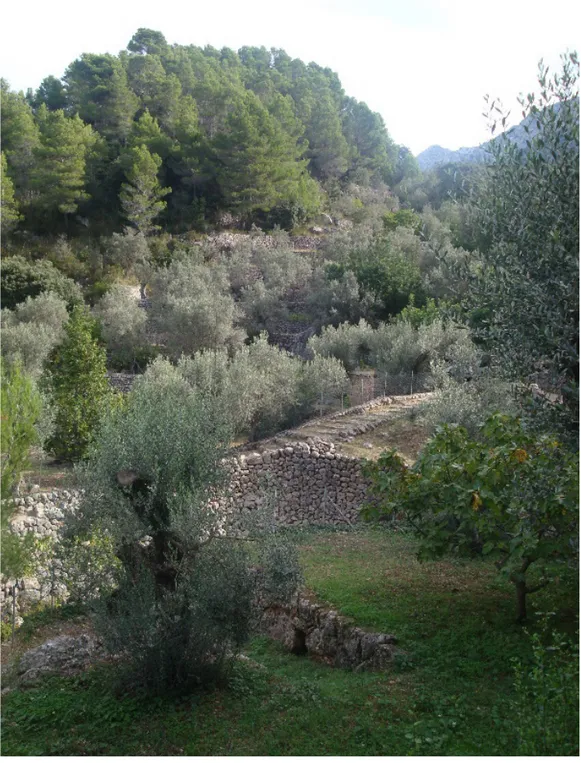
Figure 1. Cultural Landscape of the Sierra de la Tramontana (Mallorca, Spain)
2. THE SCARCE ATTENTION PAID TO CULTURAL LANDSCAPES IN SPAIN
Through the end of the last and the beginnings of this century in the scientific-academic sphere the landscape has become an element of special interest, encouraged by institutional contributions of an international and European nature. As part of a multidisciplinary vision benefitting from the protagonism of the territory, «Geography is recuperating the landscape, which had been studied as the physical manifestation of the actions of humanity on the natural medium, that is, as territorial heritage, in the sense of a spatial legacy received from our ancestors» (Molinero, 2016: 19). In this context, in order to consolidate a theoretical and methodological corpus around the landscape, the contributions of such Spanish geographers as E. Martínez de Pisón (2007, 2012), F. Zoido (2012), R. Mata (2003, 2008, 2015, 2016), C. Sanz (2003, 2012), J. Nogué (2007a, 2007b, 2011), V. Fernández Salinas (2005, 2015, 2016), R. Silva (2015, 2016, 2017), etc., have been fundamental. Also of great importance were the contributions of authors from other disciplines, such as J. Maderuelo (2005) and F. Sabaté (2015), together with the work of some research centres, such as the Observatori del Paisatge (Landscape Observatory) in Catalonia and the Centro de Estudios Territorio y Paisaje (Landscape & Territory Study Centre) in Andalusia.
This contrasts with the scarce institutional preoccupation there has been in Spain about the conservation of the landscape and its enhancement. The Ministry of Education, Culture & Sport only began to pay attention to this question following the European Convention on
Landscape (Florence, 2000) and its official definition as «any part of the
territory as perceived by the population, whose character is the result of the action of and interaction between natural and/or human factors». It was only then that state planning included some of them as cultural landscapes or as heritage elements. At the same time, the Atlas of the
Landscapes of Spain (Mata & Sanz, 2003) was created and the progressive
These were, then, the first steps towards the knowledge, valuation and integration of development strategies, even though it was some time after other European countries. This delay can be explained by the lack of territorial culture, understood as «the individual and collective capacity to appreciate the peculiarities of each place and landscape, to establish similarities and differences between the various spaces, to contribute to the preservation of their qualities and to use them rationally; and also, where appropriate, to improve their potential so as to be able to transmit them to future generations» (Caravaca & Fernández, 2005: 5). In order to advance towards a consideration of the value of the landscape as heritage, it is essential to conserve and protect them, but also to manage them correctly in their condition as cultural and economic resources. It is a legacy in which human actions have a place if done «carefully and intelligently, so as not to deteriorate it and to shape it to the needs and aspirations of society today» (Sanz, 2012: 699). In this context, the geographer’s work is particularly valid when «certain landscapes are subjected to very intense, brusque and fast transformations, which leads to an evident degradation and trivialisation, particularly in terms of a loss of symbolic, traditional and heritage values» (Nogué, 2007a: 373; Cañizares, 2016: 150). yet it is also a question of the analysis of the landscape as a living element in continuous transformation. Heritage landscapes which, «due to their identity, exceptionality and/or representativity, require safeguarding and tutelage by the administration», that is, any landscape that can be protected for its natural and/or cultural values, following V. Fernández Salinas & R. Silva (2015: 274), who opt for this concept for general use, leaving cultural landscapes for those catalogued by UNESCO.
II. THE NATIONAL PLAN FOR CULTURAL LANDSCAPES
diffusion1. All of these offer «an integrated view of heritage» with a spatial character, while also showing the relationships between the economic, social and political variables and the ethnographic, cultural and environmental characteristics of each space over time, through a holistic vision (Calderón & García, 2016: 84).
As with the others, this National Plan for Cultural Landscapes is a multidisciplinary instrument for integral management that foments knowledge and programmes interventions to protect the cultural assets and allow access to them, so that the people can enjoy them, through the following objectives: Active protection of cultural assets; Promoting knowledge through research; Preventive conservation; Programming of interventions; Coordination of the interventions; Encouraging citizen access; and Information and diffusion. A commission made up of technicians from the General Administration of the State, the Autonomous Regions and independent experts has been given the task of drafting it and it will then be approved by the Historic Heritage Council.
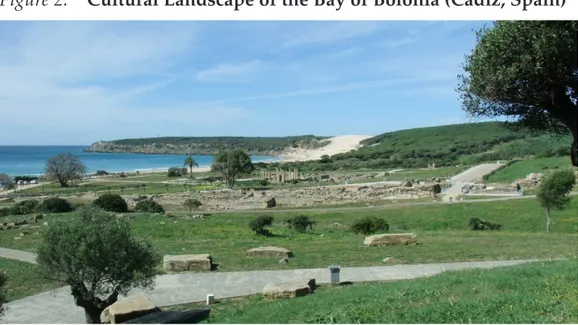
Faced with the complexity that cultural landscape entails, this Plan aims to work as a referee in the appropriate mechanisms of identification, protection and management on a national scale. The initial project is from 2002 (Base Document), together with the Cultural Landscapes Programme which, in 2004, started up several interventions2 (Figure 2). It was finally approved by the Historic Heritage Council on October 4th 2012, mainly on the basis of the Spanish Constitution of 1978 (articles 46 and 149.2) and the Law 16/1985, of June 25th, on Spain’s Historic Heritage. This law states that «the Administration of the State will adopt the necessary measures to facilitate collaboration with and between other public powers, as well as to gather and provide the necessary information». In addition, the
1. National Plans: 1. Cathedrals; 2. Abbeys, monasteries and convents; 3. Defensive Architecture; 4. Industrial Heritage; 5. Conservation of the Cultural Heritage of the 20th century; 6. Traditional Architecture; 7. Safeguarding the Immaterial Cultural Heritage; 8. Research into the Conservation of the Cultural Heritage; 9. Preventive Conservation; 10. Conservation of the Photographic Heritage; 11. Education and Heritage; 12. Emergencies and Risk Management in Cultural Heritage; y 13. Protection of the Archaeological Submarine Heritage (http://www.
mecd.gob.es/planes-nacionales/planes-nacionales.html).
Historic Heritage Council of Spain will facilitate «communication and the exchange of intervention programmes and information concerning Spain’s Historic Heritage» (article 2). The said plans are specified as National Information Plans on Spain’s Historic Heritage (article 35). Later, the Royal Decree 565/1985 of April 24th, which establishes the organic structure of the Ministry of Culture and its organisms, includes the figure of Conservation and Restoration Plans under the Institute of Conservation and Restoration of Cultural Assets (today the Institute of the Cultural Heritage of Spain). The current National Plans were born from these two figures: the Information Plans and the Conservation and Restoration Plans (SGT, 2015: 21).
Figure 2. Cultural Landscape of the Bay of Bolonia (Cadiz, Spain)
Source: M. Carmen Cañizares (2014).
In addition, it responds to the European Territorial Strategy (1999) in its interest in the «creative management of cultural landscapes» as one of the tenets of land management and, in particular, to the European
Convention on Landscape (2000) in its demand for a commitment from
activity sectors and social groups in the valuation, maintenance and improvement of the cultural landscapes on various different levels. 3. The introduction of cultural landscapes into the education and formation of experts and technicians. 4. Raising awareness among the population and public participation in collective territorial values, the cultural landscape and social and economic consensus. 5. Administrative consensus. 6. The incorporation and treatment of cultural landscapes in sectorial policies. 7. European and international cooperation on matters involving the landscape (SGT, 2015: 20).
Following R. Mata (2016: 546), it falls within the framework of «the semantic and political extension of the notion of heritage, of the “new heritage” that is mostly advocated in the Framework Agreement on the value of cultural heritage for society», signed in Faro in 2005, and in which heritage is democratised through public participation. This is based on several factors, such as the diversity of the many cultural values accommodated within Spain’s landscapes, the rising social demand for landscapes of quality, and the growing incorporation of landscape heritage in the touristic and territorial development strategies; all of this together with the very complex nature of landscape management itself and the vulnerability and threats to which some landscapes are subject (SGT, 2015: 7). It is a context in which there is an ever growing process of commercialisation of the common good (Calderón & García, 2016: 81) that is not always free from criticism.
values of a regional, national or international scope» (Silva & Fernández, 2017: 137). However, this sometimes comes up against the possibilities of assuming some proposals for the use and management of vulnerable landscapes and the scarcity of any specific legislation on landscape in Spain, especially of a regional nature (Calderón & García, 2016: 83).
1. OBJECTIVES, CATEGORIES AND METHODOLOGICAL ASPECTS
Following the update document of the Plan (SGT, 2015: 23 & ff.), the main aim is the «safeguarding of landscapes of cultural interest», that is, the creation of measures to guarantee the viability of cultural landscapes, including such actions as identification and characterisation, documentation, investigation, protection, improvement, or revitalisation. To these, the necessary aspects of definition, delimitation, component analysis and management, were all added from a sustainable development perspective. Furthermore, this tool should contribute to achieving, among others, the following specific goals:
– The identification, characterisation and safeguarding of landscapes of particular cultural interest based on agreed guidelines. To elaborate a proposal for landscapes of particular cultural interest that also includes their valuation. To establish objectives, directives and specific lines of action to safeguard these landscapes, measures that will boost their character and values, but which are compatible with their evolution and development, as well as favouring their interpretation and the enjoyment of the public.
– Social awareness and political recognition through the impulse of social recognition and the awareness of public administrations and citizens concerning the dimensions and cultural values of the landscape. This should contribute to the incorporation of criteria for safeguarding these values in the form of policies, plans and sectorial interventions with an impact on the territory.
also generate documentary knowledge and valuation databases for the inclusion of Cultural Landscapes in the UNESCO World Heritage List.
Cultural Landscape is defined as «the result of the interaction over time between people and the natural environment, whose expression is a territory perceived and valued for its cultural qualities, the product of a process and the basis of the community’s identity» (SGT, 2015: 25). Thus, a new focus is adopted, in that it is not restricted to landscapes of exceptional value, following the European Landscape Convention (Mata, 2016: 553). It faces a «dynamic and complex» reality, which is «difficult to manage» and which must also contemplate its holistic nature, the multidisciplinary character, the many scales of landscape as a territorial fact, the agents involved, the vulnerability of the character of the landscape, the conflicts of ownership and use, the scarce development in specific landscape legislation and the mainly private ownership of the land. It also establishes the following landscape
categories (Table 1) derived from the activities that a greater shaping
power has had, depending on the historic perspective.
Table 1. Landscape Categories included in the National Plan for Cultural Landscapes
Categories
Agricultural, farming and forestry, either independently or associated
(histo-rical agricultural-silvo-pastoral systems), marine, fluvial and hunting
activi-ties. Artisan activities connected with the above Industrial activities: mining, large industry, energy, etc.
Exchange and commercial activities, associated especially with the coastal and/or fluvial environments
Activities related with social events of a leisure, symbolic, religious or artistic nature… Offensive-defensive activities, such as defensive installations, battlefields… Urban systems or historic settlements with protagonism in the construction of certain landscapes over time (*)
Large communication, transport and hydraulic infrastructures, as the main agents of images of the historical construction of the landscape
Scenarios associated with historical events
Itineraries and routes that generate cultural landscapes
(*) Considered in a specific way, when they have a major role in the model and historical image of certain landscapes.
From the methodological point of view, the progressive complexity and dispersion in the territory of all the entities that are currently considered to be cultural assets, whether material or immaterial, as well as their spatial, functional and historical connections, must all be taken into account in identifying and selecting landscapes. For this reason, the procedure used starts with the analysis of the cultural values of the landscape as a whole, not only of those considered to be singular or of cultural interest, as well as of their contextualisation within the framework of complex territorial heritage systems which provide the necessary heritage coherence. The three main aspects are identification, selection and classification; yet the fact that it is necessary «to attend in most cases to dominances or processes that predominate in the historical construction, in the functioning and in the image and perception of a particular landscape» (SGT, 2015: 30) must also be taken into account. The valuation criteria are of three types:
Intrinsic values: typological representativity, exemplarity, territorial
significance, authenticity, integrity and singularity; Heritage values: the historical, social, environmental and procedural significance (productive activities, rituals, popular manifestations, etc.); and
Potential values and viability: the legal situation that allows their
safeguarding and management, fragility and vulnerability, and their viability and social profitability. On the other hand, the instruments
of the plan are set out in the Inventory or Registry, which allows
landscapes of cultural interest to be identified prior to any selection procedure; Studies (integral and specific) which provide the necessary knowledge about a particular landscape, as well as a diagnosis of its values, problems and dynamics, on the basis of which it is possible to establish the criteria for safeguarding and viability; and Resources, such as toponymy, cartography, old and current aerial photography, historic photography of the land, documentary, bibliographic and oral sources, remote-sensing and georeferencing.
Three specific types of document are also considered within the Plan: 1. the Master Plans to know a landscape in depth; 2. The specific
Concrete intervention projects to evaluate the objectives of landscape
2. IMPLEMENTATION AND MOST RELEVANT INTERVENTIONS
For implementation, preventive conservation is considered to be relevant, as it includes the characterisation of a concrete territorial environment, the identification of the values that define its character and the desire of society to integrate them into their daily life and to perpetuate them for future generations. It also includes the participation of people alongside rights and responsibilities towards the landscape and access to it. For some years now, the Plan has been carrying out several interventions aimed at enhancing some of the most relevant cultural landscapes in Spain (Table 2).
Table 2. Interventions carried out within the framework of the National Plan on Cultural Landscapes
Intervention Location
Methodological bases of the Atlas of Vine
Cultiva-tion (2008) Various regions
Thematic Comparative Study: The Landscapes of
the Olive in Spain (2012) Various regions 100 Cultural Landscapes of Spain (2015) Various regions The Landscape of the High Lozoya Valley or the
Valley of El Paular. Allotments and Gardens of the
Monastery of Santa María of El Paular (2002-2014) Rascafría (Madrid) Restoration of the Moorish cemetery around the
Tower of Hercules (2005-2007) La Coruña (Galicia) Study of the cultural landscape of the district of La
Vera (2006) Caceres (Extremadura)
Study of the cultural landscape of the valley of
Ri-cote (2007) Ricote (Murcia)
Study of the historic garden of Abadía (2007) Abadía (Extremadura) Restoration of the Muslim cemetery and the
gar-den wall n.º 1 of the Generalife (2008 & 2012-2013) Granada (Andalusia) Ethnographic Documentation of the Wine
Growing Area (2009-2010) Madrid
Ethnographic Documentation of the Wine
Intervention Location
Study of the Ethnographic Documentation of the
Wine Growing Area (2009-2010) Cangas de Narcea (Asturias) Study of the Ethnographic Documentation of the
Wine Growing Areas (2009-2010 & 2010-2011) Toro & Valdevimbre-Los Oteros (Castile & León) Study of the Ethnographic Documentation of the
Wine Growing Areas (2010-2011) Mondéjar & Méntrida (Castile La Mancha) Landscape intervention in the Bay of Bolonia
(2010-2013) Cadiz (Andalucía)
Methodology for registering Landscapes of
Cultu-ral Interest in Andalusia (2013-2014) Almeria, Cadiz, Cordoba, Huelva, Jaen & Malaga
Quality Plan of the Urban Landscape of Lorca
(2015) Lorca (Murcia)
Source: National Plan on Cultural Landscape (http://www.mecd.gob.es/planes-nacionales/ actuaciones/paisaje-cultural.html).
Interventions, studies, inventories and other results of the developed activity are included3, either for the Spanish regions as a whole, indicated in the first place, or for concrete spaces, on occasion not without a certain amount of opportunism. There is a certain protagonism of interventions in particular landscapes with agricultural activities, for instance, those connected with vineyards and their designations of origin, essential for creating the Atlas of the
traditional cultivation of the vine and its singular landscapes published
in 2016. For its importance, we should mention the representative Catalogue of the 100 Cultural Landscapes of Spain (Cruz, 2015a), as a first approximation to the documental registry of landscapes of cultural interest, selected by each Autonomous Region. Elaborated on the basis of a previously established methodology, it allows a first identification and documentation of landscapes of cultural interest in the form of an indicative list of those that are part of the National Plan on Cultural Landscape. It includes landscapes chosen for their representativeness,
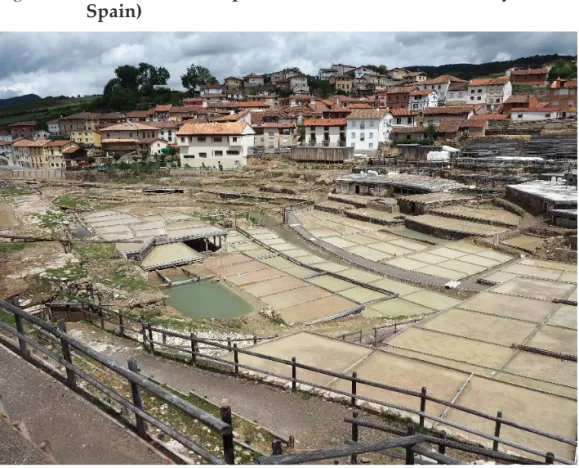
typology and geographical diversity based on a classification in four large thematic landscape groups: Agricultural, farming and forestry; Industrial, infrastructure and commercial activity; Urban, historic and defensive; and finally symbolic. The following image (Figure 3) shows one of them, the old salt mines of the Valley of Añana in Álava, which has recently presented its candidature for inclusion in the UNESCO World Heritage List as a cultural landscape.
Figure 3. Cultural Landscape of the Salado de Añana Valley (Álava, Spain)
Source: M. Carmen Cañizares (2016)
also been stressed (Mata, 2016: 558). They are landscapes which have mostly been turned into heritage, as has happened in other cases, once they have been perceived, lived, characterised and transformed by their populations (Gómez, 2013: 16) and which now have their value recognised through planning.
Finally, it should be pointed out that there is also an important quantity of graphic documentation collected in the Media Library, associated with each National Plan, with mainly complementary information from documentaries by Spain’s public television. In this case in particular, there are videos with the conclusions of the Seminars celebrated on Cultural Landscapes and World Heritage, as well as several other documentaries («Spain at ground level», etc.).
III. CONCLUSIONS
It has been said that it provides «a formidable vision of contemporary Spain, in favour of the integration of the landscape dimension in Spanish policies» (Déjeant-Pons, 2016: 11), and this should be understood in relation to the changes that have happened around the concepts of territory and heritage, and even landscape, within the framework of the institutional processes leading to heritage status that assign them alternative values to those the population that uses them may give them. To quote Rafael Mata, geographer and member of the Commission for Monitoring the Plan: «there is still much to be done, but it seems to us that the path ahead is clear» (Mata, 2016: 560).
To conclude, it should be pointed out that, from the perspective offered by Spanish Geography, «the landscape is in fashion» and academic reflection has contributed to the heritage status of certain landscapes (Silva, 2016: 56 & 60). It is a driven interest, because these landscapes allow us to discover different material (buildings, etc.) and immaterial (culture, traditions, etc.) elements that make up identities which are enormously valuable for geographers to be able to understand how a territory and its population has evolved, unravelling the relations between man and nature (Cañizares, 2016: 437). In other words, how man has adapted to the environment and been able to survive in it. Furthermore, it is often an interest related with territorial development strategies, which are vital for some territories in times of crisis, and which are generally related with tourism.
IV. BIBLIOGRAPHY
alonso, P.: «La transición al post-productivismo: parques
patrimoniales, parques culturales y ordenación territorial», EURE vol. 40, n. 119, 2014, pp. 217-238.
calderón, B. and garcía cuesta, J.l.: «Patrimonio y Territorio en España: fundamentos y estrategias para la gestión de la cultura territorial», In Manero, F. and garcía cuesta, J.l. (Coords.):
Patrimonio Cultural y Desarrollo Territorial. Pamplona, Thomson
Reuters Aranzadi, 2016, pp. 51-105.
cañizares, M.c.: «Cultura y patrimonio en clave territorial: las
aportaciones del geógrafo», In Feria, J.M.; garcía, a. and oJeda,
J.F. (Coords.): Territorios, sociedades y políticas. Sevilla, Universidad
Pablo de Olavide y AGE, 2009, pp. 93-105.
– «Paisajes culturales, ordenación del territorio y reflexiones desde la
– «Paisajes culturales e iniciativas de recuperación del patrimonio
industrial minero en España», In sÁnchez, F.J. (Coord.): Nuevas
estrategias en la gestión del patrimonio industrial. I Congreso Internacional de Patrimonio Industrial y de la Obra Pública. Sevilla, Fundación del
Patrimonio Industrial de Andalucía, 2016, pp. 435-452.
caravaca, i. y FernÁndez salinas, v. (Coords.): Jornadas de Patrimonio
y Territorio. Sevilla, Junta de Andalucía, 2005.
counciloF euroPe (ce) (ed): Heritage and Beyond. Strasbourg, 2009.
cruz, l.: «Plan Nacional de Paisaje Cultural», In aguiló, M. (Ed.):
Jornadas sobre Paisajes Culturales. Madrid, Cyan, Proyectos y
Producciones Editoriales, 2005, pp. 223-231.
– (Coord.): 100 Paisajes Culturales en España. Madrid, Ministerio de
Educación, Cultura y Deporte, Secretaría General Técnica, 2015 (a).
– «El Paisaje Cultural», In cruz, l. (Coord.): 100 Paisajes Culturales
en España. Madrid, Ministerio de Educación, Cultura y Deporte,
Secretaría General Técnica, 2015 (b), pp. 13-16.
cruz, l. and esPañol, i.: El paisaje: de la percepción a la gestión. Madrid,
Liteam, 2009.
deJeant-Pons, M.: «El Plan Nacional de Paisaje Cultural y el Convenio Europeo del Paisaje», In cruz, l. (Coord.): 100 Paisajes Culturales
en España. Madrid, Ministerio de Educación, Cultura y Deporte,
Secretaría General Técnica, 2015, pp. 11-12.
Fairclough, g.: «New heritage frontiers», In counciloF euroPe:
Heritage and Beyond. Strasbourg, 2009, pp. 29-41.
FernÁndez salinas, v.: «Patrimonio o Desarrollo ¿realidad o deseo?», In caravaca, i. and FernÁndez salinas, v. (Coords.): Jornadas de
Patrimonio y Territorio. Sevilla, Junta de Andalucía, 2005, pp. 29-61.
FernÁndez salinas, v. and silva, r.: «Criterios para la identificación y selección de paisajes españoles susceptibles de ser incluidos en la Lista del Patrimonio Mundial de Unesco», Boletín de la Asociación de
Geógrafos Españoles, n. 68, 2015, pp. 253-278.
– «Deconstruyendo los paisajes culturales de la Lista del Patrimonio
Mundial de la Unesco», Cuadernos Geográficos, n. 55(1), 2016, pp. 176-197.
góMez Mendoza, J.: «Del patrimonio paisaje a los paisajes patrimonio»,
Documents d’Anàlisi Geogràfica, vol. 59/1, 2013, pp. 2-20.
hernÁndez, M.: «El paisaje como seña de identidad territorial», Boletín
de la Asociación de Geógrafos Españoles, n. 49, 2009, pp. 169-183.
Martínez de Pisón, e.: «Paisaje, cultura y territorio», In nogué, J. (Ed): La construcción social del paisaje. Madrid, Biblioteca Nueva, 2007, pp. 325-337.
– «Sobre la idea y enseñanza del paisaje», Nimbus n. 29-30, 2012, pp.
373-380.
Mata, r.: «El paisaje, patrimonio y recurso para el desarrollo territorial
sostenible. Conocimiento y acción pública», Arbor, vol. CLXXXIV, n.º 729 (enero-febrero), 2008, pp. 155-172.
– «Paisajes culturales de las actividades agrícolas, ganaderas y
forestales», In cruz, l. (Coord.): 100 Paisajes Culturales en España. Madrid, Ministerio de Educación, Cultura y Deporte, Secretaría General Técnica, 2015, pp. 26-39.
– «El Plan Nacional de Paisaje Cultural. Una iniciativa para el
conocimiento, la cooperación y la salvaguarda de paisajes de alto interés cultural», In Fundicot (Ed.): Nuevos tiempos, nuevos objetivos. Fuerteventura, Gobierno de Canarias y Otros, 2016, pp. 545-560.
Mata, r. and sanz, c: Atlas de los Paisajes de España. Madrid, Ministerio
de Medio Ambiente, 2003.
Molinero, F.: «Los paisajes patrimoniales en el desarrollo rural», In
leco, F. (Ed.): Territorio y Desarrollo Rural: aportaciones desde el ámbito
investigador. Cáceres, Junta de Extremadura y Otros, 2016, pp. 15-38.
nogué, J.: «Territorios sin discurso, paisajes sin imaginario. Retos y
dilemas», Ería. Revista de Geografía, n. 73-74, 2007 (a), pp. 373-382.
– «El paisaje como construcción social», In nogué, J. (ed): La
construcción social del paisaje. Madrid, Biblioteca Nueva, 2007 (b), pp.
11-24.
– «Paisaje, Identidad y globalización», Fabrikart, n. 7, 2011, pp. 136-145. saBaté, J.: «De la preservación del patrimonio a la ordenación del
paisaje», Urbano, vol. 7, n. 10, 2015, pp. 42-49.
sanz, c.: “Paisaje y Patrimonio Natural y Cultural: historia y retos
actuales”, Nimbus, n. 29-30, 2012, pp. 687-700.
sgt (secretaría general técnica) (ed.): Plan Nacional de Paisaje
Cultural. Madrid, Ministerio de Educación, Cultura y Deporte,
2015 (Edición Actualizada). On line
http://www.mecd.gob.es/planes- nacionales/dms/microsites/cultura/patrimonio/planes-nacionales/textos-planes-nacionales/05-maquetado-paisaje-cultural.pdf.
silva, r.: “Paisaje, patrimonio y territorio. Algunos apuntes desde la
Crisis, globalización y deseqillibrios sociales y territoriales en España.
Madrid, AGE y Otros, 2016, pp. 56-64.
silva, r. and FernÁndez salinas, v.: “El nuevo paradigma del
patrimonio y su consideración con los paisajes: conceptos, métodos y perspectivas”, Documents d’Anàlisi Geogràfica, vol. 63/1, 2017, pp. 129-151.
UNESCO: Operational Guidelines on Implementation of the World Heritage
List. WHC. 08/01, January 2008. On line http://whc.unesco.org/archive/ opguide08-en.pdf#annex3.
VV.AA.: Manifiesto por una Nueva Cultura del Territorio. 2006. On line http://
www.geografos.org/images/stories/interes/nuevacultura/manifiesto-por-una-nueva-cultura-del-territorio-d5.pdf.
zoido, F. “El Paisaje, un concepto útil para relacionar ética, estética y
política”, Scripta Nova vol. xvi, n. 407, 10 de julio de 2012. On line
http://www.ub.edu/geocrit/sn/sn-407.htm
WEB RESOURCES
http://www.mecd.gob.es/planes-nacionales/planes-nacionales.html Planes
Nacionales. Instituto del Patrimonio Cultural Español.
http://ipce.mcu.es/pdfs/convencion-florencia.pdf Convenio Europeo del
Paisaje.
http://portal.unesco.org/es/ev.php-URL_ID=45692&URL_DO=DO_ TOPIC&URL_SECTION=201.html Lista del Patrimonio Mundial.
UNESCO.