ESCUELA DE INGENIERÍAS INDUSTRIALES
DEPARTAMENTO DE INGENIERÍA QUÍMICA Y TECNOLOGÍA DEL MEDIO
AMBIENTE
TESIS DOCTORAL:
Comparative evaluation of conventional and innovative
biotechnologies for odour abatement in wastewater
treatment plants
Presentada por la Ingeniera Química Raquel Lebrero Fernández
para optar al grado de
Doctora por la Universidad de Valladolid
UNIVERSIDAD DE VALLADOLID
ESCUELA DE INGENIERÍAS INDUSTRIALES
Secretaría
La presente tesis doctoral queda registrada en el folio número _______ del
correspondiente libro de registro número _____________________
Valladolid, a ______ de_______________ de 2011
Raúl Muñoz Torre
Investigador Ramón y Cajal
Departamento de Ingeniería Química y Tecnología del Medio Ambiente
Universidad de Valladolid
Certifica que:
La ingeniera RAQUEL LEBRERO FERNÁNDEZ ha realizado bajo su
dirección el trabajo “Comparative evaluation of conventional and innovative
biotechnologies for odour abatement in wastewater treatment plants”, en el
Departamento de Ingeniería Química y Tecnología del Medio Ambiente de la
Escuela de Ingenierías Industriales de la Universidad de Valladolid.
Considerando que dicho trabajo reúne los requisitos para ser presentado como
Tesis Doctoral expresan su conformidad con dicha presentación.
Valladolid, a ______ de_______________ de 2012
Reunido el tribunal que ha juzgado la Tesis Doctoral titulada “Comparative
evaluation of conventional and innovative biotechnologies for odour abatement
in wastewater treatment plants” presentada por la ingeniera Raquel Lebrero
Fernández y en cumplimiento con lo establecido por el Real Decreto 778/1998
del 1 de Mayo de 1998 acuerda conceder por_______________ la calificación
de ________________________.
Valladolid, a ______ de_______________ de 2012
PRESIDENTE SECRETARIO
Agradecimientos ... I Resumen ... III Resumen (inglés) ... VII Relación de artículos pertenecientes a la tesis ... XI Contribución personal a cada artículo de la tesis ... XII
1. Introducción ... 1
1.1. La problemática de los olores ... 3
1.1.1. Caracterización de un olor ... 3
1.1.2. Legislación de emisiones odoríferas ... 6
1.2. Emisión de olores en plantas de tratamiento de aguas residuales ... 9
1.2.1. Formación y composición ... 9
1.2.2. Principales fuentes de olores ... 10
1.3. Control de olores ... 11
1.3.1. Técnicas de prevención y minimización del impacto ... 12
1.3.2. Tecnologías de tratamiento de olores ... 13
1.3.2.1. Métodos físico-químicos ... 13
1.3.2.2. Tratamientos biológicos ... 17
1.3.2.2.1. Biotecnologías convencionales ... 20
1.3.2.2.2. Biotecnologías emergentes ... 27
1.3.3. Modelado y diseño de biotecnologías para el control de olores ... 30
1.3.4. Análisis comparativo de tecnologías de eliminación de olores ... 31
1.4. Referencias ... 34
2. Alcance de la tesis ... 41
3. A comparative assessment of biofiltration and activated sludge diffusion for odour abatement ... 47
4. H2S and VOCs abatement robustness in biofilters and air diffusion bioreactors: A comparative study ... 59
5. Characterization and biofiltration of a real odorous emission from wastewater treatment plant sludge ... 71
6. Odor abatement in biotrickling filters: Effect of the EBRT on methyl mercaptan and hydrophobic VOCs removal ... 83
Acknowledgements ... I Resumen ... III Abstract ... VII List of publications ... XI Personal contribution to the articles ... XII
1. Introduction ... 1
1.1. The problematic of odours ... 3
1.1.1. Odour characterization ... 3
1.1.2. Odour legislation ... 6
1.2. Odorous emissions from wastewater treatment plants ... 9
1.2.1. Odour formation and composition ... 9
1.2.2. Main odour sources ... 10
1.3. Odour control ... 11
1.3.1. Odour prevention and impact minimization ... 12
1.3.2. Odour treatment technologies ... 13
1.3.2.1. Physical-chemical methods ... 13
1.3.2.2. Biological treatment ... 17
1.3.2.2.1. Conventional biotechnologies ... 20
1.3.2.2.2. Emerging biotechnologies ... 27
1.3.3. Modeling and design of odour control biotechniques ... 30
1.3.4. Comparative analysis of odour abatement technologies ... 31
1.4. References ... 34
2. Scope and extent of the thesis ... 41
3. A comparative assessment of biofiltration and activated sludge diffusion for odour abatement ... 47
4. H2S and VOCs abatement robustness in biofilters and air diffusion bioreactors: A comparative study ... 59
5. Characterization and biofiltration of a real odorous emission from wastewater treatment plant sludge ... 71
6. Odor abatement in biotrickling filters: Effect of the EBRT on methyl mercaptan and hydrophobic VOCs removal ... 83
I
En primer lugar, quiero agradecer a Raúl todo lo que me ha enseñado durante estos años, su apoyo y paciencia, su dedicación y disponibilidad las 24 horas del día, los 7 días de la semana.
A los profesores del departamento, con cuyo apoyo he tenido la suerte de contar durante los cuatro años de doctorado.
A todos los chicos/as Pana: al grupo VOC & Odour Treatment: Guillermo, Jose y Juan Carlos, y a las chicas de algas: Esther kinki, Cynthia, Marta y Melanie. Y como no a Mary, por escucharme y ayudarme siempre.
Por supuesto a todos mis compañeros, con los que he pasado horas interminables en el laboratorio, en el cuarto, en la sala del café, en barbacoas, casas rurales, fiestas… A los que ya acabaron: Sali, Teresa, Eva, Andreita, Alex, Jose, Facundo… a Elisa, porque parte de esta tesis es suya! Gracias por todo lo que me has enseñado de microbiología. Y a los que aún estáis dando guerra: a las chicas Kati, Rayito, Sarita, Rebeca, Cati, Cris, Flor, Iris, Ana, Camila, Lara, Silvia, Begoña… y a la FAF (Danilo, Oscar Don Perfecto, Joao, Theo, Pablo, Mou,…) y a todos los que formamos parte de esta enorme familia. Gracias por compartir los buenos momentos y estar ahí en los más difíciles.
A los técnicos del laboratorio, y en especial a Araceli por todos los análisis, por su ayuda y disponibilidad en todo momento, y por cuidar de todos.
To all the members of the Water Research Center, and especially to Richard Stuetz, for their support during my research stay in Sydney. To Gio, thanks for your friendship, and all the good friends from everywhere who made my stay unforgivable.
Also to the members of the EnVOC Group in Gent, for their help with lab and no-lab tasks during my research stay in Belgium. To Diëgo, for your help and happiness when working, and to Herman van Langenhove, for giving me the opportunity to develop there part of my thesis.
A María G. Lira Rangel y a Ana Celina Gondim Santos, las mejores koalas, gracias por vuestra ayuda y los buenos ratos del laboratorio. Ha sido un placer trabajar con vosotras!
A todos mis amigos/as, en especial a Mariate por las largas conversaciones, los paseos y los momentos de diversión.
Y por supuesto a mi familia, a mis padres y mis hermanas Cris y Patri, gracias por vuestro apoyo, sin vosotros esto no habría sido posible.
III
Como resultado de una legislación ambiental cada vez más estricta, del acercamiento de las zonas residenciales a las Estaciones Depuradoras de Aguas Residuales (EDARs) y del aumento de las expectativas ciudadanas con respecto a los estándares de calidad ambiental exigidos a las compañías que explotan estas EDARS, el número de quejas por contaminación odorífera ha crecido de manera substancial en los últimos años. A pesar de no ser una causa directa de enfermedad, la exposición prolongada a emisiones odoríferas afecta negativamente a la salud humana, además de ser perjudiciales para el medio ambiente. Por lo tanto, la minimización y el tratamiento de dichas emisiones se han convertido en uno de los principales retos de las EDARs. Son muchas las tecnologías que han sido implementadas para el control de las emisiones odoríferas, tanto físico-químicas como biológicas. No obstante, estas últimas son cada vez más empleadas por ser más respetuosas con el medio ambiente y presentar menores costes de operación y elevadas eficacias de eliminación.
Sin embargo, a pesar de las ventajas arriba mencionadas, las eliminaciones de compuestos odoríferos hidrofóbicos en las tecnologías biológicas suelen verse reducidas debido a limitaciones de transferencia desde la fase gaseosa a la biopelícula donde tiene lugar la degradación. Por otro lado, la mayor parte de los estudios existentes emplean compuestos modelo (H2S, NH3), o bien corrientes sintéticas con un
único compuesto orgánico volátil (COV) a alta concentración, mientras que las emisiones odoríferas son mezclas complejas de numerosos compuestos a concentraciones traza (mg m-3).
En la presente tesis se realiza una comparación sistemática de la eficacia de diferentes sistemas biológicos (tanto convencionales como innovadores) en el tratamiento de emisiones odoríferas, centrándose en la fracción más hidrofóbica de estas emisiones. Además, se evalúa la influencia de parámetros clave en el rendimiento de desodorización del proceso, la estabilidad y las dinámicas microbianas.
En el primer estudio comparativo se operaron un biofiltro (BF) y un sistema de difusión en lodos activos (ASD) para tratar una corriente de H2S (24-43 mg m-3),
butanona (4-6 mg m-3) y tolueno (0.4-0.6 mg m-3) a tiempos de residencia entre 94 y 32 s. Las eficacias de eliminación (RE) fueron similares para ambos biorreactores, con concentraciones de H2S a la salida inferiores a 1.4 mg m-3 y eliminaciones de
IV
proceso. El reducido espectro de fuentes de carbono alimentado al sistema no afectó a la diversidad bacteriana, que se mantuvo elevada durante todo el periodo experimental. Adicionalmente al estudio del rendimiento de ambos procesos en condiciones estacionarias, se evaluó la robustez frente a fluctuaciones de temperatura (8-30 ºC), incrementos de 3 y 6 veces en la carga nominal de contaminantes, paradas en la alimentación de 5 días y fallos en el sistema de riego del BF y en el de control del pH del ASD. El análisis cuantitativo de robustez demostró la fiabilidad de ambas tecnologías en el tratamiento de emisiones odoríferas procedentes de plantas depuradoras (H2S, butanona, tolueno y alfa-pineno fueron empleados como
compuestos modelo a un tiempo de residencia del gas de 50 s), no obstante el ASD presentó una mayor robustez frente a los fallos comunes de operación.
Aunque los BFs se han empleado durante décadas para el tratamiento de corrientes odoríferas, son escasos los estudios orientados a evaluar las eficacias de tratamiento individuales para cada compuesto en corrientes reales. Por otro lado, la información relativa a las dinámicas de formación y emisión de los contaminantes odoríferos también es limitada pero resulta necesaria para un correcto diseño y operación del biorreactor. Por ello, se realizó un estudio con el objetivo de analizar el comportamiento de un BF de compost durante el tratamiento de una corriente odorífera “real” procedente de un lodo de depuradora, representativa de las emisiones en las etapas de espesamiento, centrifugado y transporte de fangos. Se seleccionaron 8 compuestos de diferente naturaleza (cetonas, terpenos, hidrocarburos, derivados sulfurados y ácidos volátiles). Las RE del limoneno, acetona, butanona y benceno fueron superiores al 99% incluso a tiempos de residencia de 40 s, mientras que el tolueno y el trisulfuro de dimetilo mostraron eliminaciones por encima del 80% a un tiempo de residencia de 60 s. Estos valores de RE se mantuvieron estables a pesar de las fluctuaciones en las concentraciones de entrada observadas. Por otro lado, las reducidas eliminaciones de sulfuro de dimetilo y ácido acético en el biofiltro se atribuyeron a la formación de estos compuestos en zonas anaerobias del material de empaque.
V
sistemas de aireación por difusión. Una alternativa potencial a estos procesos biológicos la constituyen los biofiltros percoladores (BTF), que presentan bajos costes de operación y menores necesidades de espacio debido a sus bajos tiempos de retención. En este contexto, el efecto del tiempo de residencia en el tratamiento de una corriente odorífera de metil mercaptano, tolueno, alfa-pineno y hexano (concentraciones de entrada de 22, 0.22, 0.23 y 0.28 mg m-3 respectivamente) se estudió en un BTF empacado con espuma de poliuretano a tiempos de residencia de 50, 30, 11 y 7 s. Los resultados confirmaron los altos rendimientos de estos sistemas a bajos tiempos de residencia, con RE> 95% para metil mercaptano, tolueno y alfa-pineno, y RE >70% para el hexano. Sin embargo, a 7 s de tiempo de residencia se observó un deterioro de la actividad microbiológica, y por lo tanto del rendimiento del BTF. La adición de aceite de silicona permitió estabilizar el proceso, y tras la re-inoculación del BTF únicamente se detectó hexano en la corriente de salida, con eliminaciones estables del ~ 80%.
Las limitaciones en el transporte de los compuestos odoríferos hidrofóbicos dan lugar a menores eficacias de desodorización en sistemas biológicos de tratamiento, por lo que su diseño y escalado debe estar basado en datos de transferencia de materia. El modelo desarrollado en la presente tesis permitió caracterizar el potencial de transferencia de un BTF basándose en coeficientes globales de transporte (KLa).
Los altos valores de KLa observados en el sistema (35-113 h-1) corroboran los
elevados rendimientos de eliminación descritos con anterioridad. Por otro lado, la estimación de los coeficientes individuales situó en la fase líquida la principal resistencia al transporte.
VI
estable, con una mayor resistencia ante fluctuaciones en las concentraciones de entrada y periodos de inanición. Por otro lado, los fallos en el sistema de recirculación de líquido provocaron un importante deterioro del rendimiento del sistema bifásico, posiblemente debido a disminución en la capacidad de transferencia del sistema.
Los biorreactores de membrana (MBR) aplicados al tratamiento de corrientes gaseosas han emergido recientemente como una alternativa compacta y capaz de superar las limitaciones de transferencia gracias a la elevada permeabilidad y afinidad de algunas membranas por los compuestos más hidrofóbicos. Sin embargo, no existen estudios orientados al tratamiento de corrientes odoríferas en estos MBR. Para ello, se estudió el comportamiento de un MBR de membrana plana para el tratamiento de una mezcla de COVs (acetona, tolueno, limoneno y hexano) a concentraciones comprendidas entre 1.3 y 3.2 mg m-3 y tiempos de residencia entre 60 y 7 s. Mientras que la acetona y el tolueno presentaron RE > 93%, las REs de hexano y limoneno fueron muy inferiores. Para aumentar el transporte y degradación de hexano, se inoculó la membrana con un consorcio hidrofóbico embebido en aceite de silicona y adaptado a la degradación de hexano. Sorprendentemente, la re-inoculación del sistema dio lugar a un incremento en la RE del limoneno, alcanzando valores superiores al 90% a tiempos de residencia de 7 s, mientras que las REs de hexano no se vieron afectadas. Un análisis abiótico posterior del MBR reveló limitaciones en el transporte del limoneno y el hexano, por lo que la selección adecuada de un material afín a los COVs más hidrofóbicos se identificó como un elemento clave en el rendimiento de los MBR.
VII
During the last decades, the number of public complaints related to malodorous emissions has increased noticeably due to the enforcement of the environmental regulations, the encroachment of residential areas on wastewater treatment plants (WWTPs), and the increasing public expectations on privatized water companies. Despite not being a direct cause of disease, the prolonged exposition to odorous emissions negatively affect human health, besides being harmful for the environment. Thus, minimization and abatement of odours has become one of the main challenges for WWTPs utilities worldwide. Several technologies have been implemented for odour control, both physical-chemical and biological techniques. Nevertheless, biological treatment has overcome physical-chemical technologies due to their environmentally friendly profile, their lower operating cost and the higher removal efficiencies (RE).
In spite of the above mentioned advantages, biological techniques usually present low REs for the hydrophobic fraction of the odorous emission, due to mass transfer limitations from the gas phase to the biofilm where the odorants are biodegraded. In addition, most of the studies are focused on the removal of a model odorant (H2S, NH3), or they mimic odorous emissions by means of a synthetic stream
with single or few volatile organic compounds (VOCs) at high concentrations. These conditions are not representative of WWTPs odorous emissions, which are complex mixtures of several compounds at trace level concentrations (mg m-3).
In the present thesis, a systematic comparison of the removal performance of some biological systems for odour abatement was performed, particularly focused on the most hydrophobic fraction of these emissions. The influence of the key operating parameters on the removal performance, the process stability and the microbial dynamics were also evaluated.
In the first comparative study, a biofilter (BF) and an activated sludge diffusion system (ASD) where operated to treat a H2S (24-43 mg m-3), butanone (4-6 mg m-3)
and toluene (0.4-0.6 mg m-3) polluted stream at empty bed residence times (EBRTs) ranging from 94 to 32 s. Similar REs were observed in both bioreactors, with H2S outlet
VIII
3 and 6 times the nominal load of pollutants, starvation periods of 5 days, and failures in the irrigation system of the BF and in the pH control system of the ASD was also evaluaed. The quantitative analysis of the robustness showed the reliability of both technologies for odorous emissions treatment (H2S, butanone, toluene and
alpha-pinene were employed as model odorants at gas residence times of 50 s), although the ASD showed a higher robustness towards common operational failures.
Biofilters have been employed for decades for odorous emission treatment, but there is still a limited number of studies focused on the evaluation of the individual odorant REs. Moreover, there is a lack of information on the odorant formation and emission dynamics, in spite of being necessary for a proper bioreactor design and operation. For this reason, the performance of a compost-based BF was assessed for the treatment of a “real” odorous emission from WWTP sludge, representative of the emissions from sludge thickening, centrifuge and transport activities. Eight compounds of different nature were selected (ketones, terpenes, hydrocarbons, sulfur derived compounds and volatile fatty acids). Limonene, acetone, butanone and benzene REs always exceeded 99% even at EBRTs of 40 s, whereas REs > 80% were recorded for toluene and dimethyl trisulfide at an EBRT of 60 s. A stable operation was observed in spite of the fluctuations in the inlet odorant concentration. On the other hand, the low REs recorded for dimethyl sulfide and acetic acid were attributed to their formation in anaerobic zones of the packing material.
IX
of the process, and after the BTF re-inoculation only hexane was detected in the outlet stream, achieving stable REs of ~ 80%.
The mass transport limitations of hydrophobic odorants result in lower deodorization efficiencies in biological systems, therefore their design and scale-up should be based on mass transfer data. The model herein developed allowed for an accurate characterization of the mass transfer potential in BTFs based on global mass transport coefficients (KLa). The high KLa values observed in the system (35-113 h-1)
corroborated the high removal performances previously described. On the other hand, the estimation of the individual coefficients revealed that the main resistance for VOC transfer was in the liquid film regardless of the EBRT.
The biodegradation of highly hydrophobic VOCs is still the main restriction of biological technologies such as BTFs. In this context, the addition of an organic, non-aqueous phase to conventional BTFs (biphasic reactors) has resulted in an increased mass transfer of hydrophobic VOCs from the gas phase to the microbial community, although their application to odour abatement has not been evaluated yet. In order to assess the influence of an organic phase, two BTFs were operated in parallel, one of them containing 30% v/v of silicone oil in the recycling solution. The biodegradation efficiency of a mixture of butanone, toluene, alpha-pinene and hexane was recorded at EBRTs ranging from 47 to 6 s. Both bioreactors achieved butanone, toluene and alpha-pinene REs > 96%, regardless of the EBRT, while the biphasic system showed in general higher REs for hexane than the conventional BTF. Besides, the addition of silicone oil resulted in a more stable operation, with a higher robustness towards fluctuations in VOC inlet concentration and starvation periods. Conversely, a failure in the liquid recycling system lead to a significant deterioration of the two-phase BTF performance, likely due to a reduction in the mass transfer potential of the system.
X
hexane biodegradation. Surprisingly, the re-inoculation of the system resulted in higher limonene REs, reaching values >90% at an EBRT of 7 s, while no improvement in hexane RE was recorded. A subsequent abiotic analysis of the MBR revealed limonene and hexane mass transport limitations, thus the selection of a membrane material with high affinity for the target hydrophobic odorants is of key importance for a proper MBR performance.
XI
The following publications are presented as part of this thesis. Five of them are published in international journals indexed in ISI Web of Knowledge (articles I to V), and two of them (articles VI and VIII) have been sent for publication.
Article I. Lebrero R., Rodriguez E., García-Encina P.A., Muñoz R. (2011). A
comparative assessment of biofiltration and activated sludge diffusion for odour
abatement. Journal of Hazardous Materials, 190: 622-630
Article II. Lebrero R., Rodriguez E., Martín M., García-Encina P.A., Muñoz R. (2010). H2S and VOCs Abatement Robustness in Biofilters and Air Diffusion Bioreactors: A
Comparative Study. Water Research, 44: 3905-3914.
Article III. Lebrero R., Rangel M.G.L., Muñoz R. (2012). Characterization and
biofiltration of a real odorous emission from wastewater treatment plant sludge.
Environmental Management, sent for publication.
Article IV. Lebrero R., Rodriguez E., Estrada J.M., García-Encina P.A., Muñoz R. (2012). Odor abatement in biotrickling filters: effect of the EBRT on methyl mercaptan
and hydrophobic VOC removal. Bioresource Technology, 109: 38-45.
Article V. Lebrero R., Estrada J.M., Muñoz R., Quijano G. (2012). Toluene mass
transfer characterization in a biotrickling filter. Biochemical Engineering Journal, 60: 44-49.
Article VI. Lebrero R., Rodriguez E., Perez R., Garcia-Encina P.A., Muñoz R. (2012). Abatement of odorant compounds in one a two-phase biotrickling filters under steady
and transient conditions. Applied Microbiology and Biotechnology, available On-line.
Article VII. Lebrero R., Volckaert D., Perez R., Muñoz R., Van Langenhove H. (2012). A membrane bioreactor for the simultaneous treatment of acetone, toluene, limonene
and hexane at trace level concentrations. Water Research, sent for publication.
Article VIII. Lebrero R., Gondim A.C., Perez R., Muñoz R. (2012). Comparative
assessment of a biofilter, a biotrickling filter and a hollow fiber membrane bioreactor for
XII
Article I. During the execution of this work I was responsible of the start-up and operation of the experimental set-up, results evaluation and article writing under the supervision of Dr. Raúl Muñoz. Dr. Elisa Rodríguez was responsible of the microbiological analysis together with Dr. Pedro Garcia-Encina. I collaborated in sample preparation and results discussion.
Article II. In this work I was in charge of the start-up and operation of the experimental set-up, results evaluation and article writing under the supervision of Dr. Raúl Muñoz. Dr. Elisa Rodríguez was responsible of the microbiological analysis together with Dr. Pedro Garcia-Encina, and I helped with the analytical part and results discussion.
Article III. During this research study I co-supervised Maria G. Lira Rangel in the start-up and operation of the experimental set-start-up and I performed part of the experimentation, the results evaluation and I wrote the article under the supervision of Dr. Raúl Muñoz
Article IV. During the execution of this work I was responsible of the start-up and operation of the experimental set-up with the assistance of Jose M. Estrada, results evaluation, and article writing under the supervision of Dr. Raúl Muñoz. Dr. Elisa Rodríguez was responsible of the microbiological analysis together with Dr. Pedro Garcia-Encina. I helped with the analytical part and results discussion.
Article V. The experimental data was obtained in collaboration with Jose M. Estrada, the model was developed by Dr. Guillermo Quijano and both of us wrote the article under the supervision of Dr. Raúl Muñoz.
Article VI. In this work I carried out the start-up and operation of the experimental set-up, results evaluation, and article writing under the supervision of Dr. Raúl Muñoz. Dr. Elisa Rodríguez was responsible of the microbiological analysis together with Dr. Pedro Garcia-Encina. I collaborated in the analytical procedures and results discussion.
Article VII. In this work I performed the experimental part with the assistance of Diëgo Volckaert and I wrote the article under the supervision of Dr. Herman Van Langenhove and Dr. Raúl Muñoz. Dr. Rebeca Pérez was responsible of the microbiological analysis. This work was developed in the EnVOC Research group, in the Faculty of Bioscience Engineering, Gent University (Belgium).
1
Chapter 1
3
1.1 The problematic of odours
The term “odour” refers to the physiological stimulus of the olfactory cells in the presence of specific molecules (known as odorants) that varies between individuals and with environmental conditions such as temperature, pressure and humidity [1].
Odorous emissions have traditionally occupied a secondary role in environmental concern since they represent a lower risk for human health and natural ecosystems when compared to solid and liquid emissions. However, despite not being a direct cause of disease, long-term exposure to such odorants can have a negative effect on human well-being, causing nausea, headaches, insomnia, loss of appetite, respiratory problems, irrational behavior, weakness, etc. When detected in residential areas, they lead to a negative perception of the quality of life, and they can even create a significant economic cost for housing surrounding odour sources. In addition, they can pose a severe occupational risk within confined spaces in wastewater treatment plants (WWTPs), such as sludge handling and pumping facilities, reaching lethal concentrations [2-4].
As a result of the encroachment of residential areas on WWTPs, the general higher environmental standards and the increasing public expectations on private water companies’ duties, the number of public odour complaints has substantially increased during the last decades. This increase in public complaints has in turn lead to the enforcement of stricter environmental regulations [3]. Therefore, the minimization and abatement of unpleasant malodorous emissions has become one of the main challenges for WWTPs worldwide, increasingly concerned about their public image.
1.1.1 Odour characterization
Odorous emissions from WWTPs are complex mixtures of compounds including H2S and highly malodorous sulfur derived compounds such as mercaptans or organic
sulfides, NH3 and nitrogen-containing compounds (amines, indole, skatole), and a wide
4
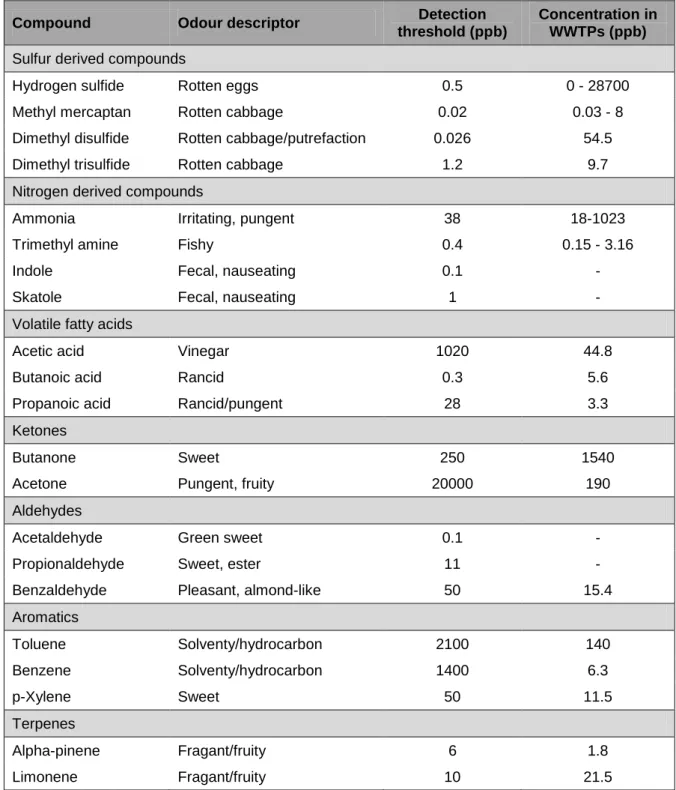
concentrations (within the range of µg L-1 - mg L-1) and their high emitted flow rates (between one and five thousands higher than wastewater flow rates) [5-7]. Nevertheless, trace level concentrations of certain odorants can induce a significant nuisance due to their low detection threshold (minimum concentration of an odorant that is perceivable by human sense of smell). In general, sulfur derived compounds present the lowest detection thresholds, in the order of ppb (Table 1.1).
Table 1.1 Odour descriptor, detection threshold and typical concentration of selected odorants emitted from WWTPs [8-10]
Compound Odour descriptor Detection
threshold (ppb)
Concentration in WWTPs (ppb)
Sulfur derived compounds
Hydrogen sulfide Rotten eggs 0.5 0 - 28700
Methyl mercaptan Rotten cabbage 0.02 0.03 - 8
Dimethyl disulfide Rotten cabbage/putrefaction 0.026 54.5
Dimethyl trisulfide Rotten cabbage 1.2 9.7
Nitrogen derived compounds
Ammonia Irritating, pungent 38 18-1023
Trimethyl amine Fishy 0.4 0.15 - 3.16
Indole Fecal, nauseating 0.1 -
Skatole Fecal, nauseating 1 -
Volatile fatty acids
Acetic acid Vinegar 1020 44.8
Butanoic acid Rancid 0.3 5.6
Propanoic acid Rancid/pungent 28 3.3
Ketones
Butanone Sweet 250 1540
Acetone Pungent, fruity 20000 190
Aldehydes
Acetaldehyde Green sweet 0.1 -
Propionaldehyde Sweet, ester 11 -
Benzaldehyde Pleasant, almond-like 50 15.4
Aromatics
Toluene Solventy/hydrocarbon 2100 140
Benzene Solventy/hydrocarbon 1400 6.3
p-Xylene Sweet 50 11.5
Terpenes
Alpha-pinene Fragant/fruity 6 1.8
5
Figure 1.1 Odorant concentrations emitted from a WWTP [9]
The subjective nature of human odour perception and the chemical complexity of odorous emissions from WWTPs make odour characterization a rather difficult task, which has resulted in odour measurement being the cornerstone of odour management [11-12]. Sensorial odour perception constitutes, together with analytical measurements, the most common approach for odour characterization.
Sensory measurements characterize odours in terms of their perceived effects employing the human nose as odour detector, and therefore provide an estimation of the total effect of the sample in the perception of the affected population. Sensorial measurements are highly costly, time consuming, very sensitive to the receptor characteristics and less precise and repeatable than analytical measurements, but they accurately describe the odour effect on receptors. The odour concentration is commonly determined by dynamic olfactometry and is expressed in terms of “odour units” (OU), which, according to the European Standard EN-13725 is a unit volume of air (usually 1 m3) containing a compound at its odour identification threshold.
On the other hand, analytical measurements characterize odours in terms of their chemical composition. Traditionally, single odorants such as hydrogen sulfide or ammonia were commonly used for online monitoring as surrogate markers, and a broad variety of specific, high sensitivity and selectivity gas sensors have been developed for these surrogates (chemical, electrochemical, catalytic or optical detectors). However, these specific sensors only provide a partial characterization of the odorous emissions since the surrogate marker is not always responsible for the entire odour nuisance. Besides, the low concentration of the chemical compounds
0 1 2 3 4 5 6
C
on
c
e
nt
ra
ti
on
(
m
g
m
6
present in the odorous emission (ppb and ppt concentrations) often challenges the sensitivity and separation capacity of gas chromatography, very often below the detection limits of most common GC detectors (mass spectrometry and flame ionization).This enforces the pre-concentration of the odorants either by cryogenic trapping or via adsorption into porous polymers or carbon-based adsorbents [5] (Chapter 5). Analytical techniques are more objective, repeatable and accurate than sensorial odour measurements, although they provide little information about the real odorant impact on human receptors (Table 1.2).
Table 1.2. Advantages and limitations of analytical and sensorial odour monitoring techniques ([5, 13-14]).
Analytical techniques Sensorial techniques
Identification and quantification of the chemical compounds
Quantitative and qualitative characterization of the sensorial component of the odour
Objectivity
Repeatability
Reproducibility
Accuracy
Useful for
identification of odour sources
No indication of the
actual odour nuisance
Detectability limit of
some compounds
Impossible to
determine the odorous potential
Determination of
odour
concentration
(OU m-3)
Description of
the odour effect on receptors
Highly costly
Time consuming
Subjective
Sensitive to
receptor characteristics
Due to their dual sensorial and chemical nature, the characterization of odorous emissions from WWTPs does not necessarily involve a unique or universal technique. The last decade has brought about a paramount development both in sensorial and chemical measurement, which will certainly contribute to improve both the design and monitoring of odour abatement units and the assessment of odour impact [5].
1.1.2 Odour legislation
7
limits for those toxic pollutants present in the malodorous emissions, based on health and safety issues. Former standards such as minimum distance and maximum emission regulations do not meet the current requirements for population protection since they do not take nuisance level into consideration. Therefore, more sophisticated standards based on maximum impact and maximum tolerable annoyance have been introduced [11, 15].
Nowadays, different approaches to the legislation of environmental odours can be found: a qualitative approach, where odour is regarded and assessed as a nuisance; a quantitative approach if odour standards are provided to assess odour data obtained from ambient air measurements, and/or prediction and operational requirements, which include setback distances, specific operating procedures and odour control equipment [16].
In most European countries, Canada or Australia, odour regulations are evolving to take directly into account not the emission but the actual impact in the environment, and are based on the maximum impact odour concentration associated with a limit time during which a higher impact concentration is not tolerable. The concentration limit usually depends on the land use and/or the industrial activity sector. Some regulations take into account the nuisance indirectly, for example several regulations in France set limits in terms of odour flow depending on the height or diffuse odour concentration and on the distance to the closest house. In other European countries such as Switzerland, odour regulation policies do not set emission or impact limits and are based on local population questioning and complaints. Likewise, in the United States, ambient air quality is controlled via H2S concentration
standards or dilution to threshold (D/T) limits, which is a measure of the number of dilutions needed until the odorous emission is not detectable [15-17] (Table 1.3).
8
Table 1.3. Current odour regulation and policies
Limits Receptor Observations
AUSTRALIA
New South Wales
2/7 OU m-3
<0.5% hour year-1 Urban/rural areas Odour regulation policies are responsibility of each state. Very
individual approaches Queensland 0.5/2.5 OU m-3 Short/tall stacks based on
modeling South
Australia 2/10 OU m -3
Urban/rural based on modeling ASIA
Japan Odour standards for 22 odorants
South Korea
1000/500 OU 20 OU 10 OU
Stack concentration in industrial/other areas
Industrial areas Other areas-facility boundary EUROPE
Austria
1 OU at 8% detection / 3 OU at
3% detection Any
Minimum distances Farm animals Belgium <12% of mildly annoyed population Denmark 17 OU m
-3 1 OU m-3
Sensitive receptor, pig farm Urban area Germany 1 OU m
-3 <15% time <10% Industrial areas Residential areas Netherlands
<12% of mildly annoyed population Eliminate severe odour nuisance (8-10 OU) by 2010
Minimum distance setbacks in farm animals Switzerland No emission/impact limits, based on public complaints
United
Kingdom No general valid odour emission standards CANADA
Ontario 1 OU m-3, average 10 min Any No federal legislation: responsibility relies
on individual provinces/territories Manitoba 2 OU m
-3 7 OU m-3
Residential Industrial UNITED STATES
California Complaints of >10 persons in a period of < 90 days
Individual states generally have a responsibility for odour emission Colorado 8 D/T
16 D/T
Residential/commercial Other areas
Connecticut 8 D/T Any
Illinois 9 D/T 25 D/T 17 D/T Residential/recreational Industrial Others Vermont No odour detectable Any Wisconsin Odour complaints by 66% of persons
9
Similarly, the Municipal Bylaw of the Council of San Vicente de Raspeig (Alicante) for odour control is based on perception indices.
The increasing public concern, together with the coming technological breakthroughs in odour measurement and best available technologies will certainly result in more stringent limits in the near future. The combination of annoyance surveys within malodours-affected population and the development of robust instrumentation for continuous odour monitoring will lay the basis for the establishment of accurate concentration-nuisance relationships. The development of these combined odour concentration-odour nuisance maps will certainly allow the introduction of objectivity into the assessment of odour impact and the establishment of reasonable odour limits in environmental odour legislation [17-18].
1.2 Odorous emissions from WWTPs
1.2.1 Odour formation and composition
Odour emissions from WWTPs are composed of stripped components present in receiving wastewaters, volatile by-products generated in the complex biochemical reactions occurring within the different treatment steps and chemical reagents used during the treatment process. The complete depletion of O2 and nitrate, together with
the presence of a well developed fermentative and sulfate oxidizing microbial community, result in an intense formation of volatile fatty acids, aldehydes, amines, H2S and sulfur derived compounds. This occurs both in transport and treatment
10
1.2.2 Main odour sources
Odour impact only occurs when the odorants are transferred from the liquid to the gaseous phase. This mass transfer, usually referred to as odour emission rate (OER), is determined by the Henry’s law constant and concentration of the odorants, the temperature, the pH and the volumetric mass transfer coefficient. These OERs can be either calculated from direct flow rate and concentration measurements or estimated from empirical equations based on wastewater odour emission potentials. Direct OER measurements are highly dependent on the type of odour source being evaluated, which can be classified as active or passive depending on the presence or absence of an external airflow, respectively. While in active sources such as biofilters or aeration tanks, odorants are transported by the active airflow emitted, in passive sources odorants diffuse from the wastewater and are swept by the natural movement of ambient air (wind) [2, 21]. Depending on their extension and geometry, odour sources can also be classified as punctual (locally restricted emissions such as biofilters), linear (elongated sources such as receiving wastewater channels), superficial (extensive emission areas such as primary settlers) and mobile (changing position) sources [22].
The knowledge of the main odour sources and their contribution to the overall problem is crucial for the development of an odour abatement strategy. In general, odorous emissions are more significant in areas with a high turbulence or a high wastewater-air interfacial area such as weirs, inlet works, sedimentation tanks, etc., where a high mass transfer value governs gas-liquid mass transport. The primary sedimentation tank is usually pointed out as the major odour source in WWTPs, with their high odour emission factors also associated with the first stages of the wastewater treatment process: raw wastewater and wastewater pre-treatments (grit chambers, screenings). Hence, the odour potential tends to decrease along the depuration process (Figure 1.2) [7, 23-24].
On the other hand, anaerobic conditions are inherent to sludge handling processes such as sludge thickening, centrifugation or anaerobic digestion. Due to the high organic matter concentrations (in the range of 5-20% w/w) and the absence of O2
or NO3-, these units also exhibit high odorant and odour concentrations (especially
11
Figure 1.2. (a) Percentage of the potential odour impact at a small WWTP [9] and (b) Average (left axis) and maximum (right axis) area-related odour emission rates in the different units of
WWTPs ([23] .
1.3 Odour Control
Odour control in WWTPs involves both prevention of odorant formation and emission, impact minimization and “end of the pipe” odour-abatement technologies. Any assessment of odour control techniques must consider odour prevention before impact minimization or treatment, since it often constitutes a more simple and economical alternative than odour containment and treatment.
Wastewater treatment Sludge treatment
Raw wastewater influent 0% 10% 20% 30% 40% 50% 60% 5% 1% 2% 11% 20% 9% 52% P o te n ti a l o d o u r im p a c t (% ) Wastewater treatment Sludge treatment
Raw wastewater influent
12
1.3.1 Odour Prevention and Impact Minimization
Odour prevention involves a combination of both efficient design and operation practices and odour containment via installation of process covers. In this context, prevention of odour formation in sewers is crucial since a large number of odours that are emitted from WWTPs are associated to the formation of septic wastewaters in sewer networks. Although physical modifications in the network to reduce malodorous emissions would require a significant capital investment, the proper design of gravity sewers is among the most common approaches to minimize odour formation in receiving wastewaters. Moreover, in-situ control technologies can be applied to minimize the formation of malodours by preventing the production of sulfides (through addition of NO3-, O2, ozone to the wastewater) or their stripping from the wastewater by
precipitation with ferric salts [25-27].
In WWTPs, prevention of odour formation mainly involves good operation practices such as the frequent cleaning of grit chambers or screening units, minimization of sludge retention time in thickeners or dewatering units, operation under adequate aeration and mixing rates, etc. Reductions in odour emissions can also be achieved by a correct plant design, minimizing heights in weirs and by process covering. Process covering not only allows for prevention in odour emissions but also facilitates their subsequent treatment, which is particularly relevant in passive sources such as primary settlers or sludge thickeners. However, and despite the broad range of measures available for odour emission minimization, a complete reduction of odorant formation and release is not always possible.
13
of action of the available commercial products. As a matter of fact, recent studies have shown that most of them do not possess the claimed odour neutralizing potential or even increase the odour concentration in the emission when applied [28-30].
1.3.2 Odour Treatment Technologies
When prevention of odorant emissions or impact minimization is not sufficient to mitigate odour nuisance, odour abatement technologies must be applied. The selection of the most cost-effective end-of-the-pipe treatment technology for each specific odour contamination case is determined by the nature and concentration of the odorants, the level of efficiency required, the type of odour sources (active or passive), the air flow rates to be treated, etc. Based on the mechanisms underlying odour removal, two major treatment methods, physical-chemical and biological, are distinguished.
1.3.2.1 Physical-Chemical Methods
Chemical Scrubbers
Chemical scrubbers are among the most commonly employed abatement techniques in WWTPs mainly due to the extensive experience in their design and operation, their short gas retention time (as low as 1-2.5 s), low pressure drops and high robustness when properly operated [30-31]. Odorants are transferred from the malodorous air into an aqueous solution (often sulfuric acid or sodium hydroxide depending on the target odorants) where they are destroyed by chemical oxidation. Chemical scrubbers are implemented in packed towers (either in counter current or cross flow configurations) or atomized mist absorbers, using sodium hydroxide, potassium permanganate or hydrogen peroxide as the oxidant (Figure 1.3). The bed height ranges between 1 and 1.5 m, with pressure losses from 100 to 400 Pa m-3bed
14
Figure 1.3. Physical-chemical technologies for odour abatement: chemical scrubber
Removal efficiencies of up to 98% for H2S and 90% for mercaptans are
commonly achieved under good operation practices, although more specific data on the abatement of other odorants are needed. Moreover, chemical scrubbing is only cost-effective for the treatment of low odorant and VOC concentrations since high odour concentrations result in excessive chemical requirements (Table 1.4) [30, 32-33].
Table 1.4 Oxidants commonly used in chemical scrubbers [30]
Oxidant Reaction mg L
-1
oxidant/ mg L-1 H2S
NaOCl H2S + 4NaOCl + NaOH → Na2SO4 + 2H2O + 4NaCl H2S + NaOCl → So + NaCl + H2O
8-10
KMnO4
3H2S + 2KMnO4 → 3S + 2KOH + 2MnO2 + 2H2O (acid pH)
3H2S + 8KMnO4 → 3K2SO4 + 2KOH + 8MnO2 + 2H2O (basic pH)
6-7
H2O2 H2S + H2O2 → Sº↓ + 2H2O (pH<8.5) 1-4
Adsorption
The efficiency and experience acquired in the off-gas treatment of industrial effluents has also contributed to the wide implementation of activated carbon, silica gel or zeolite-based odour adsorption systems in WWTPs. In this process, odorants are adsorbed onto a fixed bed of adsorbent by intermolecular forces [30, 34] (Figure 1.4). This process is especially convenient for the mitigation of odour impact when hydrocarbons, mercaptans or other oxygenated organic compounds rather than H2S
are the main odorants in WWTP emissions. Adsorption systems are operated at empty bed residence times (EBRTs) ranging from 2 to 3 s, with common pressure drops of 1400-1750 Pa. Carbon lifespan varies widely depending on the adsorbent and the characteristics of the emission, but usually ranges between 3 and 9 months [35].
Water
Waste liquid Polluted air
Liquid recycling
15
Among the above mentioned adsorbents, activated carbon obtained by carbonization followed by activation at high temperature of organic precursors (anthracite, coal, wood, etc.) is the most widely used option [36]. Recent advances in the field of catalysis have also resulted in the development of a new generation of high-performance sludge-based activated carbons capable of adsorbing up to 10 times more H2S and NH3 than commercially available activated carbons [37].
Adsorption-based systems provide an excellent performance for the treatment of highly hydrophobic odorants, with typical odour and VOCs removals from 90 to 99%.
Polluted air
Treated air
Steam (carbon regeneration)
Adsorber 1 Adsorber 2
Figure 1.4. Physical-chemical technologies for odour abatement: activated carbon adsorption
Incineration
Incineration consist of the complete oxidation of the odorous compounds at high temperatures using an additional source of heat (natural gas or oil are commonly used as fuels) since the combustion process cannot be self-maintained by the low odorant concentrations present in the emissions from WWTPs. The air emission must be heated at temperatures up to 800ºC for 3 to 4 s. Typical pressure drops vary from 1000 to 1200 Pa. The high cost and availability of energy, coupled with the low odorant concentrations typical in odorous emissions from WWTP, make thermal incineration an inappropriate technique for odour treatment from an economic and environmental viewpoint. However, it is still employed in landfill or industrial applications due to the high odorant removal efficiencies (99.9%) [35].
16
the quantity of fuel needed (and therefore the environmental impact) and the costs of the construction materials. However, due to the complexity of odorous emissions, a complete oxidation usually involves an excess of oxygen and a combination of several catalysts to achieve acceptable odour removal efficiencies. On the other hand, some odorous compounds such as sulfur derivates can poison the catalyst, thus reducing its lifetime [38].
Photolysis
Photolysis is based on the transfer of electromagnetic energy (UV radiation) from a source of radicals to the odorous compounds being oxidized. During photolysis, the odorant is disintegrated by UV light releasing radicals (e.g. the breakdown of the S-H bound in sulfur compounds), which then react with oxygen or other oxidants (O3,
H2O2, OH, O-) [34].
H S CH hv SH CH
H HS hv S H
3 3
2
This method can be employed directly to the air emission without any preliminary transfer of the odorant to a secondary phase since radiation is able to deeply penetrate the gas stream. In the particular case of photocatalysis, the UV light is combined with a semiconductor and a photo-catalyst (TiO2, CdS), which allows the
oxidation of both organic and inorganic compounds. The mechanism is based on the excitation of the electrons of the semi-conductor material, inducing areas with both an excess (reducing area) and a deficit of electrons (oxidizing area) [38].
Ozonization
Ozone is commonly used as an oxidant in the aqueous phase due to its low oxidation kinetics in the gas phase (which requires its combination with UV radiation). Hence, malodorous compounds (H2S or COVs) must be firstly transferred to the liquid
phase in a scrubber column and subsequently oxidized either by ozone molecules or by ozone radicals:
H 2 4O SO
4O HS
O OH S O HS
2 4 3
-2 o
-17
Radical concentration depends on the pH, the presence of neutralizers such as CO32- and the concentration of the odorous compound in the aqueous phase. Amines,
phenols and alkenes exhibit the higher oxidation rates. However, ozonization requires the in situ production of ozone due to its high instability, turning it into a highly energetic and inefficient process. Although odour concentration is significantly reduced at very short residence times (few seconds), many authors support that oxidation is not complete and an odour masking effect is produced instead. Besides, the high costs and the difficult control of ozone in-situ generation reduce the applicability of ozonization [30, 38].
1.3.2.2 Biological Treatment
Since the late 1970s, the extensive research carried out in the microbiology of VOC biodegradation has demonstrated that most odorant are biodegradable to some extent by bacteria, fungi, yeasts and even microalgae, and therefore subjected to removal in bioreactors. Physical-chemical treatment systems are been gradually replaced by biological-based odour technologies such as biofilters, biotrickling filters and bioscrubbers due to their higher cost-effectiveness and environmental friendliness. This is derived from the reduced energetic and/or chemical requirements and the absence of expensive adsorbent materials. Biotechnologies also have a more environmentally friendly profile since pollutants are finally converted into innocuous compounds such as CO2, H2O, and biomass at ambient pressure and temperature
[39-40].
Microbiological fundamentals of biological oxidation
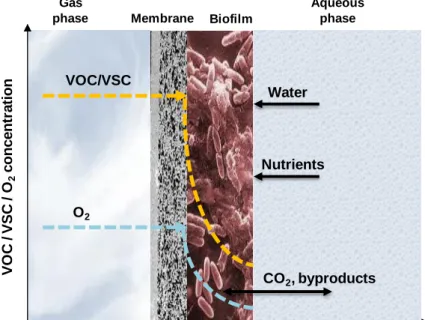
The biodegradation of odorants is based on their use as carbon and/or energy source by the microorganisms present in the bioreactor. On one side, VOCs such as terpenes, aldehydes or hydrocarbons are used as a carbon source to produce new biomass (maintenance and cellular reproduction) and as a energy source to support microbial metabolism (by oxidation to H2O and CO2 using as electron acceptor the
oxygen from the odorous emission). On the other side, odorants such as H2S or NH3
18
odorants as raw material for their growth and maintenance makes possible their biological removal from wastewater and composting plants’ emissions. The presence of an aqueous media to sustain all the metabolic reactions, together with the availability of dissolved macronutrients (nitrogen, phosphorous, sulfur, potassium, etc.) and micronutrients (usually heavy metals for enzyme synthesis) is mandatory in biodegradation processes.
Bacteria and fungi are the main groups of microorganisms responsible for odorant biodegradation in most biological techniques (Figure 1.5). Bacteria present high growth and biodegradation rates, a high resistance to toxicity and are able to degrade a wide spectrum of gaseous pollutants. However, their optimum pH is near neutrality and they require high water activity. Fungi, on the other side, possess a narrower spectrum of biodegradable odorants (likely due to the fact that they have been less studied), but tolerate a low pH (2-5), low humidity and nutrients limitation, conditions typically found in biological systems (biofilters and biotrickling filters). Besides, fungi are able to synthesize proteins (namely hydrophobins) that facilitate the direct transport of hydrophobic odorants from the gas phase to the fungi hyphae.
Figure 1.5. Bacteria and fungi growth in bioreactors
19
Figure 1.6. Odorant biodegradation mechanisms in bioreactors
An odorant can be biodegraded through mineralization, partial oxidation or co-metabolic degradation. Thus, while odorant mineralization is the optimum scenario (transformation of C into CO2 and biomass, N into NO3-, H into H2O, S into SO4-2 and
chloride to HCl), a partial oxidation entails the generation of a by-product waste stream to be treated (formation of acetone from isopropanol, catechol from benzene, etc). However, partial oxidation is more common under high pollutant concentrations, situation hardly found in odour treatment. Co-metabolic pollutant degradation is typical in the biodegradation of very recalcitrant compounds (usually branched compounds or very stable ring structures), unable to induce the synthesis of the enzymes needed for their destruction. The degradation of such compounds occurs by enzymes generated to degrade a secondary carbon source present in the media (monooxygenases and dioxygenases). As a rule of thumb, the biodegradability of a compound is related with its structure: lineal, short chain compounds such as alcohols, aldehydes, ketones, esters, organic acids or amines are considered easily biodegradable, while hydrocarbons and phenolic compounds support lower biodegradation rates due to their higher stability. Finally, halogenated compounds and polycyclic hydrocarbons are considered extremely recalcitrant due to their high resistance to microbial degradation.
The distribution of carbon fluxes during odorant biodegradation is determined by the thermodynamics of the biodegradation process, which is related with the pollutant structure (bonds stability). In the case of pollutants moderately stable such as toluene, approximately 50-60% of the carbon is converted into CO2, 30-40% into biomass and
5-10% into extracellular metabolites. The biomass yield increases with the biodegradability of the compound. In the particular case of H2S degrading bacteria, the
biomass
Pollutants
Oxygen New
biomass
Nutrients
CO2
Biomass phase
Polluted air Aqueous
20
inorganic carbon needs are determined by the overall cellular yields (0.15-0.2 g biomass (g H2S oxidized)-1 [41].
Physical fundamentals of biological odorant oxidation
The transport of odorants from the air emission to the aqueous phase constitutes the first step in any biological odour abatement process. In general, the volumetric odorant flowrate N l m-3 h- from the gas to the aqueous phase is described according to the equation:
N l K la KC
l Cl
Where K l (h-1), Cg (g m-3), Cl (g m-3) and Kg/l (dimensionless) are the
volumetric mass transport coefficient gas/water, the odorant concentration in the gas phase, the odorant concentration in the aqueous phase and the odorant partition coefficient between the gas and the aqueous phase, respectively.
The volumetric transport coefficient is a function of the diffusivity of the odorant in water, the gas turbulence within the bioreactor, the type and size of the packing material in the particular case of packed towers or the bubble size in aerated sludge diffusion systems. For instance, K l values of 700 h-1 and 500-1400 h-1 are typical in activated sludge diffusion systems at an EBRT of 30 s and in biotrickling filters at 5-10 s of EBRT, respectively [42] (Chapters 4 and 6). On the other hand, the partition coefficient gas-water can be estimated based on the Henry´s constant and the equation of state of ideal gas. It is also worth noting that hydrophobic odorant transport, and therefore their biodegradation, is limited by the low concentration gradients available for mass transfer from the gas phase as a consequence of their high partition coefficients (alkenes, terpenes or sulphur-derived compounds) [43].
1.3.2.2.1 Conventional biotechnologies
Biofiltration
21
environmental legislations became increasingly stringent worldwide in the 1970s, and residential and urban areas started to encroach on odour sources, the application of biofilters for odour mitigation expanded significantly [44-45]. From the 1980s, the application of biofiltration extended to the removal of volatile organic and inorganic compounds (VOCs and VICs, respectively) from industrial waste gases [44, 46]. A 3rd generation of enclosed biofilters capable of providing a more controlled environment in terms of moisture content, pH, T and metabolite accumulation was developed in the late 1990s [34]. Today, based on the extensive experience acquired in full scale facilities and the sustained research effort carried out over the last two decades, biofiltration has become a cost-effective and environmentally friendly alternative to other physical-chemical methods such as incineration, adsorption or absorption (Figure 1.7).
Figure 1.7. Biological treatment technologies for odour abatement: biofilter
In biofilters, the malodorous-laden air is forced through a fixed bed hosting the microbial community responsible for odorant mineralization. Odorants must first diffuse from the gas phase into the biofilm before being biodegraded. Several factors such as the gas-biofilm contact time (characterised as EBRT), the filtration packing media, moisture content and temperature must be considered when designing biofilters (Table 1.5). The optimization of these parameters provides both the optimum scenario for an efficient mass transfer and a suitable environment to sustain the activity of the microorganisms responsible for odorant mineralization.
Organic media column
Waste solution Intermitent irrigation Treated air
Polluted air
22
Table 1.5 Typical parameters for biofilter design and operation [30, 47].
Parameter Typical range
Empty bed residence time (EBRT) 15-60 s
Height 0.9-1.5 m
Volumetric gas flow rates <200000 m3 h-1
Superficial gas velocity 35-400 m3 m-2h-1
Inlet gas humidity 90%-100% RH
Water content 40%-70% RH
Temperature 15-40ºC
Inlet gas concentration 0-1000 ppmv
Biofilter media is very often pointed out as the key design parameter in biofilters, determining the removal efficiencies, the pressure drop (and therefore the operating costs) and biofilter lifespan [48-49]. In this context, the maximum economically-tolerable pressure drop across a biofilter bed (due to compaction and thus increased energy requirements) ranges between 600 and 825 Pa mbed-1 (6-8.4 cm
H2O mbed-1) [49]. Indeed, packing media replacement represents 47% of the total
operation costs, while the energy consumption accounts for 18% [35]. Adequate packing materials must exhibit a high porosity (0.4-0.9) to reduce the pressure drop across the bed, a high specific surface area (300-1000 m2 m-3)for biomass attachment and odorant adsorption, an elevated structural strength and a low bulk density, a good moisture retention and pH buffering capacities for acidic end-products, low cost and local availability, and the ability to retain microorganisms and to provide them with a suitable growth environment. Organic media (compost, soil, peat, wood chips, bark, sludge, etc.) provide an extra C and nutrients source necessary to maintain microbial activity, likely challenged by the low C concentrations present at the biofilm-water/air interface as a result of the extremely low odorant concentrations. On the other hand, inorganic materials such as ceramic, plastics, lava rock, activated carbon, etc. provide an extra structural stability, which increases the biofilter lifespan (typically ranging from, 1 to 2 years) [50-51].
23
accumulation of toxic metabolites in the filter media are also crucial issues to ensure a reliable and efficient operation.
Biofiltration is best suited for the treatment of moderate to high polluted airflow rates at low concentrations, although high VOC concentrations (up to 1000 ppmv) and
flow rates up to 170 000 m3/h have been successfully treated [56]. Most of the laboratory scale studies reported in literature focused on the abatement of a single pollutant or simple mixtures of few selected compounds from a synthetic stream at high concentrations (in the range of g m-3), conditions rarely found in real malodour air emissions. Under these “ideal” conditions, biofilters have shown hi h removal efficiencies for odorous sulfur compounds, amino-acids, oxygenated aliphatics, aromatics and chlorinated compounds [40, 57-60]. However, the performance of full-scale biofilters is significantly affected by the varying environmental conditions (temperature, humidity, etc.) and discontinuous pollutant supply (system maintenance or breakdowns), and the elimination of hydrophobic VOCs might be also limited by the low concentration gradients available for mass transfer. In Chapters 1 and 2, the abatement performance of a mixture of H2S, butanone, toluene and alpha-pinene at
trace level concentrations (mg m-3) in a compost-based biofilter was evaluated under steady and transient operating conditions.
Field biofiltration studies always report high H2S removal efficiencies,
(90%-100%) and odour abatements over 80% [61-62]. However, the VOC removal performance in pilot and full scale plants varies widely from 20% to 95%, being usually lower than 90% even for easily biodegradable VOCs [49, 53, 63-64]. Moreover, the odour abatement efficiency of biofilters has been rarely assessed on an individual odorant elimination basis [65], which together with the lack of information on the dynamics of odorant formation, have hindered the proper design of biofilters. In Chapter 5, the dynamics of the chemical composition of the odorous emissions
produced during sludge handling and the VOC abatement performance of a compost-based biofilter treating this emission under different EBRTs was evaluated.
Biotrickling filtration
![Figure 1.1 Odorant concentrations emitted from a WWTP [9]](https://thumb-us.123doks.com/thumbv2/123dok_es/6067269.173988/29.892.236.666.108.447/figure-odorant-concentrations-emitted-wwtp.webp)

![Figure 1.2. (a) Percentage of the potential odour impact at a small WWTP [9] and (b) Average](https://thumb-us.123doks.com/thumbv2/123dok_es/6067269.173988/35.892.149.744.112.835/figure-percentage-potential-odour-impact-small-wwtp-average.webp)
![Table 1.4 Oxidants commonly used in chemical scrubbers [30]](https://thumb-us.123doks.com/thumbv2/123dok_es/6067269.173988/38.892.166.735.588.792/table-oxidants-commonly-used-chemical-scrubbers.webp)


![Table 1.5 Typical parameters for biofilter design and operation [30, 47].](https://thumb-us.123doks.com/thumbv2/123dok_es/6067269.173988/46.892.184.707.129.374/table-typical-parameters-biofilter-design-operation.webp)