http://tde.sagepub.com/content/36/2/268
The online version of this article can be found at: DOI: 10.1177/0145721710361783
2010 36: 268 originally published online 23 February 2010 The Diabetes Educator
Bertha C. Salazar
Lidia G. Compeán-Ortiz, Esther C. Gallegos, José G. Gonzalez-Gonzalez, Marco V. Gomez-Meza, Barbara Therrien and
Cognitive Performance Associated With Self-care Activities in Mexican Adults With Type 2 Diabetes
Published by:
http://www.sagepublications.com
On behalf of:
American Association of Diabetes Educators
can be found at: The Diabetes Educator
Additional services and information for
http://tde.sagepub.com/cgi/alerts Email Alerts:
http://tde.sagepub.com/subscriptions Subscriptions:
http://www.sagepub.com/journalsReprints.nav Reprints:
http://www.sagepub.com/journalsPermissions.nav Permissions:
What is This?
- Feb 23, 2010
OnlineFirst Version of Record
- Apr 21, 2010
Version of Record
Cognitive Performance
Associated With Self-care
Activities in Mexican Adults
With Type 2 Diabetes
Purpose
The purpose of this study was to determine the effect of memory-learning on self-care activities in adults with type 2 diabetes moderated by previous education/ understanding in diabetes and to explore the explicative capacity of age, gender, schooling, diabetes duration, and glycemic control in memory-learning.
Methods
A descriptive correlational study was conducted in a ran-domized sample of 105 Mexican adult patients with type 2 diabetes at a community-based outpatient clinic. Evaluation measures included the Wechsler Memory Scale for memory-learning; 2 questionnaires for self-care activities and previous education/understanding in diabe-tes, respectively; and glycosylated hemoglobin for glyce-mic control. Multiple linear regression analysis was used to examine the effect of memory-learning on self-care activities and the moderator capacity of previous educa-tion/understanding on diabetes. Multivariate analysis was used to identify the capacity of age, schooling, dia-betes duration, and glycemic control in memory-learning types.
Results
A significant positive effect of memory-learning on self-care activities was found. Education/understanding in diabetes moderated the relationship between immediate and delayed memory-learning and self-care in glucose
Lidia G. Compeán-Ortiz, PhD Esther C. Gallegos, PhD José G. Gonzalez-Gonzalez, PhD Marco V. Gomez-Meza, PhD Barbara Therrien, PhD Bertha C. Salazar, PhD
From the Universidad Autonoma de Tamaulipas School of Nursing, Tampico, Tamulipas, Mexico (Dr Compeán-Ortiz); Universidad Autonoma de Nuevo Leon (UANL) School of Nursing, Doctoral Program Department, Monterrey, Nuevo Leon, Mexico (Dr Gallegos); UANL School of Medicine, “Dr. José Eleuterio Gonzalez” University Hospital, Monterrey, Nuevo Leon, Mexico (Dr Gonzalez-Gonzalez); UANL School of Economics, Statistics Center, Monterrey, Nuevo Leon, Mexico (Dr Gomez-Meza); University of Michigan School of Nursing, Center for Enhancement and Restoration of Cognitive Function, Ann Arbor, Michigan (Dr Therrien); and UANL School of Nursing, Associate Dean of Research, Monterrey, Nuevo Leon, Mexico (Dr Salazar).
Correspondence to Lidia Compeán-Ortiz, PhD, Facultad de Enfermería Tampico, Av Universidad, Boulevard López Mateos S/N, Tampico, Tamaulipas, 89140, México ([email protected]).
Acknowledgments: We thank the Universidad Autonoma de Tamaulipas (UAT) and the School of Nursing Tampico for their support. The authors are grateful for the facilities provided by the Family Medicine Unit 32 (UMF-32) of the Mexican Institute of Social Security (IMSS) in the state of Nuevo Leon through the Teaching and Research Coordination, and for the support of personnel at the Universidad Autonoma de Nuevo Leon (UANL) School of Nursing Laboratory. We thank Dr. Sergio Lozano-Rodriguez for his help in translating and reviewing the manuscript. Partial results of this study were presented at the 39th Biennial Nursing Convention of Sigma Theta Tau International in Baltimore, Maryland, in November 2007.
DOI: 10.1177/0145721710361783
performance.
Conclusions
Immediate and delayed verbal and visual memory-learning were important for the patient to carry out self-care activities, and this relationship can be moderated by pre-vious education/understanding in diabetes. These find-ings suggest potential benefits in emphasizing cognitive strategies to promote relearning of self-care behaviors in persons who live with diabetes.
T
he prevalence of type 2 diabetes (T2DM) has increased importantly, becoming a pub-lic health problem for several countries.1 InMexico, diabetes is the first cause of general mortality and the second and sixth causes of loss of healthy life-years in women and men, respec-tively. Diabetes is also the disease that consumes the largest percentage of public expenses assigned to the health sector. At present, more than 5 million adults older than 20 years suffer from this syndrome.2
Early onset of T2DM exposes patients to long periods of hyperglycemia and to a greater risk of chronic compli-cations. T2DM is linked to altered insulin regulation and glucose metabolism. The chronic nature of fluctuations in glucose and glucose metabolism tends to adversely affect brain structures. The most vulnerable areas are the hippocampus and the frontal lobes. These specific brain areas are associated with varied cognitive functions, among which learning and memory are of particular importance in self-care.3,4
Learning and memory refer to the information acquired and the ability to conserve it. Short-term memory indicates temporary storage, and long-term memory permanent storage; delayed memory is classified as declarative when the information is accessible to conscious remembering and as procedural when the information is contained in the learned abilities that are generally executed automatically. Verbal and visual learning memory refers to content obtained through language and vision, respectively.5
Self-care in T2DM consists of maintaining balanced food consumption, considering the amount of calories required individually, performing sufficient physical
monitoring the disease’s effect and treatment. To carry out self-care activities, the person requires knowledge acquisition and the development of specialized habits, processes in which the cognitive functions of learning and memory play a fundamental role. The literature reports that patients who practice self-care in diabetes have a greater probability of maintaining good glycemic control than those who do not. Self-care also helps to delay the appearance of complications,6 thus improving
quality of life.
The harmful effect of diabetes on cognitive perfor-mance has been known since 1922, with the studies of Miles and Root.7 Some investigations in older adults
report an association between T2DM and verbal memory deterioration.8-10 Studies performed with young adults
are scarce and have not found a correlation between dia-betes and cognitive deterioration.11,12 On the other hand,
although certain authors have found some association between memory and self-care, there has been no clear explanation to date of the manner in which cognitive functions affect self-care practices in young adults with T2DM.13-15
As a chronic disease, T2DM forces those who suffer the illness to be responsible for their own treatment and for monitoring disease progression throughout their life-times. Health professionals have the role of facilitating the carrying out of self-care by patients; thus, it is neces-sary to know the effect of cognitive performance on daily health care actions. This study had a double purpose: (1) to determine the memory-learning effect on self-care activities and the moderator capacity of education/under-standing between these 2 variables and (2) to explore the explicative capacity of age, gender, schooling, diabetes duration, and glycemic control on the cognitive perfor-mance of memory-learning.
Methods
Subjects and Design
criteria were used: (1) age between 30 and 55 years, (2) 3 or more years since being diagnosed with diabetes, and (3) without cognitive deterioration, as indicated by a Mini-Mental State Examination score of 23.16 Exclusion
criteria included patients (1) with a history of a cerebro-vascular event, epilepsy, Parkinson disease, or another neurological disorder; (2) using anticonvulsant drugs or sedatives; (3) with uncontrolled high blood pressure (>160/100 mm Hg); (4) undergoing chemotherapy; (5) with severe depression; or (6) with any sensorial problem that could affect performance on the cognitive tests.
Procedure and Measurements
Participants were selected from a list prepared on Excel software from 58 medical consult registries. Each subject was assigned a progressive number, randomly identifying potential study participants. During a first interview, the preselected patients were evaluated accord-ing to eligibility criteria. Those who met these criteria were invited to participate in the study. The Health Institution’s Ethics Committees approved the study, and all participants provided informed consent.
Measurements were carried out at the clinic in a space designated for this purpose. At the first appointment, the researchers applied pencil-and-paper instruments. For measuring self-care, they used the Diabetes Self-Care Activities Questionnaire,17 an instrument with 12 items
that explores activities associated with diet, exercise, monitoring, and medication adherence over the previous 7 days. Raw scores were transformed to a scale of 0 to 100, with the highest scores reflecting best self-care.
Previous diabetes education was evaluated with the education/understanding dimensions of the Diabetes Care Profile,18 which is made up of 16 items that measure
education received on diabetes and the understanding of specific care for the disease. Questionnaire scores were transformed to a 0 to 100 scale, with the highest values reflecting best education/understanding. Age, schooling, disease duration, and weight and height figures were registered in a specifically designed data cell. At a sec-ond session, 8 cognitive tests were applied strictly fol-lowing the protocol of the Spanish-version Wechsler Memory Scale.5 Prior to the application of the scale, blood
glucose level was measured to identify hypoglycemia that could affect participants’ cognitive performance, also verifying whether they were oriented in person, place, and time. No patient had hypoglycemia. Participants who
felt drowsy or were not feeling well regardless of blood glucose level were given a new appointment. This was done because the researchers wished patients to be fully alert during cognitive testing. The cognitive tests were applied individually by a trained professional with a duration of approximately 60 minutes.
Immediate verbal memory-learning was evaluated with Texts I and Word Pairs I, and immediate visual memory-learning was measured with Faces I and Drawings I. Between 25 and 30 minutes after the first part, delayed verbal memory-learning, delayed verbal recognition, and delayed visual memory-learning were evaluated with Text II, Word Pairs II (freely and by rec-ognition), and Faces II and Drawings II, respectively.
Following the instrument manual’s instructions, immediate verbal and visual memory-learning scores were grouped to make up immediate general learning; similarly, delayed verbal and visual memory-learning and delayed verbal recognition integrated delayed general memory-learning. In each dimension, raw scores were transformed to a 50- to 150-point scale as proposed by Wechsler,5 with the highest scores
reflect-ing the best memory-learnreflect-ing level.
At a third session, a blood sample was drawn from each participant to determine glycosylated hemoglobin (A1C) levels. Cutoff points were established according to American Diabetes Association (ADA) criteria19
(accept-able <7.0%). The test procedure was conducted by ion-exchange chromatography with spectrophotometry.
Statistical Analysis
Analyses were carried out with the SPSS version 15. Memory-learning and self-care variables were represented with central tendency and variability measurements. Differences by gender were determined by the Mann-Whitney U test. The effect of memory-learning on self-care activities and the moderator capacity of education/ understanding on diabetes were verified by a multiple linear regression model according to Baron and Kenny.20
Demographic and Clinical
One hundred five patients (34 men and 71 women) participated in the study. The average age was 47.93 ±
5.49 years, average length of schooling was 7.9 ± 3.30 years, and average diabetes disease duration was 8.26 ±
4.89 years. The average diabetes education score was 85.48 ± 7.50; for the understanding subscale, the average was 61.26 ± 18.64. The average percentage for glycosyl-ated hemoglobin was 7.54 ± 1.03. Most of the group was aged between 46 and 55 years (median= 49 years), had low schooling (median= 8 years), had a diabetes disease duration less than 5 years (median= 7 years), and had poor glycemic control (median= 7.6). See Table 1.
Cognitive Performance and Self-care
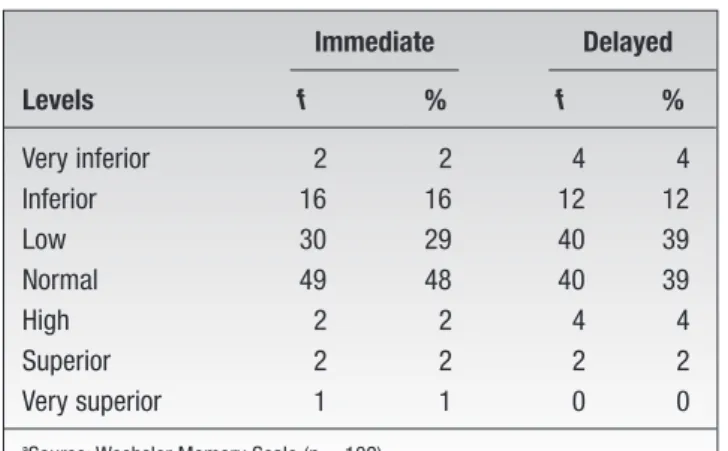
The average score obtained in immediate general memory-learning was 89.83 ± 12.03 and for delayed general memory-learning 89.72 ± 14.26 (both on a scale of 50 to 150). Participants were classified according to performance level in these cognitive variables, finding 47% and 55% of participants between low and very low categories in immediate and delayed general memory-learning, respectively (see Table 2). The younger participants (age range, 35-45 years) exhibited better immediate (U = 771.00,
P = .02) and delayed general memory-learning (U =
697.50, P = .005) in comparison with older study par-ticipants (age range, 46-55 years). No differences were found in gender, diabetes duration, or glycemic control (P > .05).
Self-care activities showed a low average in general (mean = 37.7 ± 15.7); men obtained higher averages than women (median= 43.74 for men, 33.69 for women;
P = .024). Self-care actions that were developed with greater frequency comprised medication consumption (mean = 73.69 ± 30.88), in which 29% consumed oral hypoglycemics most of the time and always. Second place was observation of diet (mean = 49.38 ± 16.96), with 30% of participants following it always or gener-ally, while third place was doing exercise (mean = 22.87
± 25.80). Glucose monitoring was the activity in which the study participants engaged in least frequently (mean = 10.39 ± 21.85).
Effect of Cognitive
Performance on Self-care Moderated by Education/ Understanding of Diabetes
Regression models that verified the effect of cognitive performance on self-care showed significance for 3 of the 4 diabetes care components (P < .05). Glycemic monitor-ing was predicted between 9% and 14% by immediate and delayed verbal and visual-type memory-learning. With regard to taking medications, prediction was between 7% and 16% by immediate and delayed visual memory-learning. Likewise, consumption of the prescribed diet was predicted by means of immediate and delayed visual memory-learning in 7% and 8%, respectively.
When the education/understanding variable was intro-duced as a moderator in regression models, a significant effect (P < .05) was observed between memory-learning and 2 self-care dimensions: diet and glucose monitoring (see Table 3).
Variable f %
Age, y
35-45 32 30.5 46-55 73 69.5 Schooling
Primary or less 51 48.6 Secondary 30 28.6 Preparatory 15 14.3 Professional 9 8.6 Diabetes duration, y
5 or less 43 41.0 6-10 33 31.4 11-15 19 18.1 16 or more 10 9.5 Glycemic controla
Good control 30 28.8 Poor control 74 71.2
Predictor Variables of Cognitive Performance
The predictive capacity of age, gender, schooling, diabetes duration, and glycemic control in the 5 types of memory-learning was adjusted to test a multivariate analysis. Through a backward method, the researchers
identified that memory-learning was best predicted by schooling, F(5, 93) = 9.09, P < .001; gender, F(5, 93) = 2.96, P = .016; and glycemic control, F(5, 93) = 0.185,
P = .967; plus the interaction between the latter 2 variables,
F(5, 93)= 2.59, P = .031.
Analysis between subjects was carried out by setting schooling at 7.89 years. Schooling was significant in dicting the 5 memory-learning types; gender solely pre-dicted immediate and delayed visual memory. The interaction of glycemic control by gender demonstrated predictive capacity for delayed visual memory-learning; women with good glycemic control had better cognitive performance than men with good glycemic control. Nevertheless, when there was poor glycemic control, the average cognitive performance decreased significantly in women (mean = 99.6 vs 89.2) and in contradictory fashion improved in men (mean = 82.7 vs 89.10). See Figure 1.
All independent variables predicted immediate verbal memory in 5.7%, immediate visual memory in 23.7%, delayed verbal recognition in 7.1%, delayed verbal memory in 14.1%, and delayed visual memory in 29.7%.
Discussion
The score achieved in cognitive memory-learning per-formance in this study was low, which can be one of the factors that explain the poor average obtained in self-care activities. Immediate memory-learning, in which nearly
Immediate Delayed
Levels f % f %
Very inferior 2 2 4 4 Inferior 16 16 12 12 Low 30 29 40 39 Normal 49 48 40 39 High 2 2 4 4 Superior 2 2 2 2 Very superior 1 1 0 0
aSource: Wechsler Memory Scale (n = 102).
Table 2
General Memory-Learning Levelsa
F gl P R2
Diet
Immediate visual memory-learning
2.55 5, 93 .024 0.085 Delayed visual
memory-learning
2.38 5, 93 .035 0.076 Monitoring
Delayed verbal recognition 2.74 5, 93 .017 0.094 Immediate visual
memory-learning
3.78 5, 93 .002 0.142 Delayed visual
memory-learning
3.09 5, 93 .008 0.111
Table 3
Multiple Linear Regression Model in Which Diabetes Education/Understanding Contributed Significantly as a Moderator
Figure 1. Averages of delayed visual memory-learning and glycemic
delayed memory-learning—with similar results in this study—facilitates application of the contents acquired. Therefore, these memory types play a fundamental role in the practice of self-care behaviors in diabetes about which persons receive information at health institutions concerning the manner in which to carry out treatment later at their homes when they apply this information. The deficient scores obtained in self-care activities, which consisted of adherence to medical treatment, are reflected in the high proportion of participants with A1C levels falling within the range of poor glycemic control.
Some authors have reported better self-care activities in women than in men21; in this study, men obtained
higher scores in this variable. One possible explanation is that men will manifest having carried out an action, although the action was in reality performed by their wives or mothers, who, culturally speaking, play the role of family caretakers.
To avoid confusion due to the effect of aging on memory-learning cognitive functions, the participants included in this study were young adults. Nevertheless, the authors observed a difference within the age range, because younger participants (35-45 years of age) exhib-ited better cognitive performance than older study par-ticipants (aged 46-55 years). This situation is congruent with the work of Ostrosky-Solís et al,22 who, using the
same tests, found a decline from one decade to another in apparently healthy persons of both genders.
Among the subjects, an analysis of memory types and their influence on self-care components or dimensions demonstrated that the care implicated in taking medication and observance of the prescribed diet fundamentally required immediate and delayed visual memory-learning. This finding suggests that the procedure followed by health services to inform patients about taking medica-tions and adhering to the prescribed diet should take into consideration the utilization of teaching strategies that facilitate the development of this type of memory-learn-ing; the content or knowledge acquired is recovered by procedural or implicit memory and explicit or declarative memory, thus empowering individuals to act in complex situations, such as the environments in which they nor-mally make their living. Some authors, such as Sinclair et al,13 have reported better cognitive performance associated
with better medication-associated actions. In this sample, a minimum percentage of participants took their oral
recognizing that many diverse, not previously contem-plated factors can be the cause of this situation.
Glycemic monitoring was shown to be complex for the memory types implicated in its execution. In addition to visual memory, patients required verbal memory, espe-cially delayed verbal recognition, to carry out monitor-ing. This latter memory type is achieved by furnishing keys to facilitate remembering and, consequently, act-ing.23 Monitoring is the most complex act and that which
is most dependent on declarative or explicit memory; because of this, the patient should make conscious use of the information. These results suggest that orientation or education strategies should include verbal combined with visual information and, above all, that several stages of educative contact must be considered for relearning the self-care dimensions involved in diabetes throughout the lifetime of the individual.
This result confirms the importance of education in diabetes as fundamental in self-care. The ADA24 and
other authors25,26 maintain that ongoing education in
patients with diabetes is essential for the success of treat-ment. In this sample, the percentage of participants who carried out glycemic monitoring was very low, suggest-ing a substantial failure in self-care because the data gathered from this monitoring form the basis for balanc-ing diet, exercise, and medications, with the latter bebalanc-ing the most practiced action, which coincides with other authors’ findings.27-29
Existing health services policies in Mexico contem-plate the delivery of health education to patients diag-nosed with diabetes.30 Practically every patient affiliated
with a health unit has received orientation on how to carry out his or her treatment; however, the information received has not always been understood by the person in a way for him or her to be able to make use of it in his or her daily life. The participants of this study obtained a higher average in knowledge of diabetes than in the understanding dimension of this knowledge. This sug-gests that there is a memorized datum but that there is no understanding of the latter, thus limiting its application in decision making regarding self-care activities.
Memory learning in the adult with diabetes was influ-enced by the participants’ years of schooling, confirming the results reported by some authors.31 Similarly, it was
in memory-learning, a finding that is in agreement with Dey and collaborators.12 What did affect the delayed
visual memory-learning level in women was glycemic control, expressed in A1C figures: women with good con-trol achieved higher performance means, while those with poor control possessed the lowest means. Nonetheless, this was not so in men, in whom good glycemic control demonstrated low performance levels, while men with poor control increased their performance levels. This finding is unexpected and requires further research.
The finding of A1C as a predictive variable of delayed visual memory in women suggests that constant hyper-glycemia can affect brain function adversely and in turn cognitive performance. One possible explanatory mecha-nism is the altered long-term duration potentiation in the hippocampus leading to suppressed synaptic plasticity, which is essential for the neural modification needed for new learning and the conversion of learning into estab-lished memory.3
Implications
One limitation of this study was not having a com-parison group for verifying differences in a healthy popu-lation versus a popupopu-lation with the disease. Therefore, one immediate implication comprises replicating the study including at least one comparison group. Notwithstanding this, the findings of this study in terms of verbal and visual memory-learning types associated with self-care dimensions and moderated by education/ understanding of diabetes can be considered for improv-ing the practice of health professionals
These findings lead us to review the strategies applied in education programs on diabetes that are offered by health services. One possibility would be to carry out a simple assessment of cognitive performance in adults with diabetes before they enter an educational program. This assessment would identify different groups of per-sons who require different educational strategies. It would also be important to consider other variables, such as educational level and gender, when designing educa-tional strategies.
References
1. Wild S, Roglic G, Green A, et al. Global prevalence of diabetes. Diabetes Care. 2004;27:1047-1053.
2. Secretaría de Salud. Programa Nacional de Salud 2007-2012. México: Secretaría de Salud; 2007.
3. Trudeau F, Gagnon S, Massicotte G. Hippocampal plasticity and glutamate receptor regulation: influences of diabetes mellitus. Eur J Pharmacol. 2004;490:177-186.
4. Biessels GJ, Heide LP, Kamal A, et al. Ageing and diabetes: implications for brain function. Eur J Pharmacol. 2002;441:1-14. 5. Wechsler D. Escala de memoria de Wechsler. Madrid, Spain:
TEA Ediciones; 2004. Originally published 1997.
6. United Kingdom Prospective Diabetes Study Group. Intensive blood glucose control with sulphonylureas or insulin compared with conventional treatment and risk of complications in patients with type 2 diabetes (UKPDS 33). Lancet. 1998;352:837-853. 7. Miles WR, Root HF. Psychologic tests applied to diabetic
patients. Arch Intern Med. 1922;30:767-777.
8. Strachan MWJ, Deary IJ, Ewing FME, et al. Is type two (non insulin dependent) diabetes mellitus associated with an increased risk of cognitive dysfunction? Diabetes Care. 1997;20:438-445. 9. Grodstein F, Chen J, Wilson RS, et al. Type 2 diabetes and
cogni-tive function in community-dwelling elderly women. Diabetes Care. 2001;24:1060-1065.
10. Gregg EW, Yaffe K, Cauley JA, et al. Is diabetes associated with cognitive impairment and cognitive decline among older women? Arch Intern Med. 2000;160:174-180.
11. Ryan CM, Geckle MO. Circumscribed cognitive dysfunction in middle-age adults with type 2 diabetes. Diabetes Care. 2000;23:1486-1493.
12. Dey J, Misra A, Desai N, et al. Cognitive function in younger type II diabetes. Diabetes Care. 1997;20:32-35.
13. Sinclair AJ, Girling AJ, Bayer AJ. Cognitive dysfunction in older subjects with diabetes mellitus: impact on diabetes self-manage-ment and use of care services. Diabetes Res Clin Pract. 2000;50:203-212.
14. Coker L, Shumaker S. Type 2 diabetes mellitus and cognition: an understudied issue in women’s health. J Psychosom Res. 2003;54:129-139.
15. Asimakopoulou KG, Hampson S. Cognitive functioning and self-management in older people with diabetes. Diabetes Spectrum. 2002;15:116-121.
16. Ostrosky-Solís F, López-Arango FG, Ardila A. Influencias de la edad y de la escolaridad en el examen breve del estado mental (Mini-Mental State Examination) en una población hispano-hablante. Rev Salud Mental. 1999;22:20-25.
17. Tootbert D, Glasgow R. Assessing diabetes self-management: the summary of diabetes self-care activities questionnaire. In: Bradley C, ed. Handbook of Psychology and Diabetes: A Guide to Psychological Measurement in Diabetes Research and Practice. New York, NY: Hardwood Academic; 1994:354-393.
18. Michigan Diabetes Research and Training Center. Diabetes Care Profile. Ann Arbor: University of Michigan; 1998.
19. American Diabetes Association. Diagnosis and classification of diabetes mellitus. Diabetes Care. 2005;28:S37-S42.
20. Baron RM, Kenny DA. The moderator-mediator variable distinction in social psychological research: conceptual, strategic, and statistical considerations. J Pers Soc Psychol. 1986;51: 1173-1182.
21. Sousa VD, Zauszniewsk JA, Musil CM, et al. Relationships among self-care agency, self-care, and glycemic control. Res Theory Nurs Pract. 2005;19:217-230.
24. American Diabetes Association. National standards for diabetes self-management education. Diabetes Care. 2005;28:S72-S79. 25. Loveman E, Cave C, Green C, et al. The clinical and
cost-effective-ness of patient education models for diabetes: a systematic review and economic evaluation. Health Technol Assess. 2003;7:1-46. 26. Ovalle JF. La educación, piedra angular en el tratamiento de la
diabetes. In: Lerman I, ed. Atención Integral del paciente diabé-tico. México, DF: McGraw Hill-Interamericana; 2003:55-62. 27. Durán-Varela BR, Rivera-Chavira B, Franco-Gallegos E. Apego al
tratamiento farmacológico en pacientes con diagnóstico de diabe-tes mellitus tipo 2. Salud Pública de México. 2001;43:233-236.
diabetes patients. Salud Pública de México. 2003;45:191-197. 29. Toljamo M, Hentinen M. Adherence to self-care and glycemic
control among people with insulin-dependent diabetes mellitus. J Adv Nurs. 2001;34:780-786.
30. Secretaría de Salud. Modificación a la Norma Oficial Mexicana NOM-015 SSA2-1994 para la prevención, tratamiento y control de la diabetes mellitus en la atención primaria. México, DF: Secretaría de Salud; 2000.
31. Ardila A, Ostrosky-Solís F, Rosselli M, et al. Age-related cogni-tive decline during normal aging: the complex effect of education. Arch Clin Neuropsychol. 2000;15:495-513.