A Fog Computing and Cloudlet Based Augmented Reality System for the
Industry 4.0 Shipyard
Article in Sensors · June 2018 DOI: 10.3390/s18061798
CITATIONS
3
READS
245
4 authors, including:
Some of the authors of this publication are also working on these related projects:
Shipyard 4.0View project Tiago M. Fernández-Caramés University of A Coruña 68 PUBLICATIONS 492 CITATIONS
SEE PROFILE
Paula Fraga-Lamas University of A Coruña 49 PUBLICATIONS 343 CITATIONS
SEE PROFILE
All content following this page was uploaded by Tiago M. Fernández-Caramés on 02 June 2018.
Article
A Fog Computing and Cloudlet Based Augmented
Reality System for the Industry 4.0 Shipyard
Tiago M. Fernández-Caramés1, Paula Fraga-Lamas1,*, Manuel Suárez-Albela1
and Miguel Vilar-Montesinos2
1 Unidade Mixta de Investigación Navantia-UDC, Universidade da Coruña, Edificio Talleres Tecnológicos,
Mendizábal s/n, Ferrol 15403, Spain; [email protected] (T.M.F.-C.); [email protected] (M.S.-A.)
2 Navantia S. A., Astillero Ría de Ferrol, Taxonera, s/n, Ferrol 15403, Spain; [email protected]
* Correspondence: [email protected]; Tel.: +34-981-167000 (ext. 6051)
Received: 1 May 2018; Accepted: 31 May 2018; Published: 2 June 2018
Abstract: Augmented Reality (AR) is one of the key technologies pointed out by Industry 4.0 as a
tool for enhancing the next generation of automated and computerized factories. AR can also help shipbuilding operators, since they usually need to interact with information (e.g., product datasheets, instructions, maintenance procedures, quality control forms) that could be handled easily and more efficiently through AR devices. This is the reason why Navantia, one of the 10 largest shipbuilders in the world, is studying the application of AR (among other technologies) in different shipyard environments in a project called “Shipyard 4.0”. This article presents Navantia’s industrial AR (IAR) architecture, which is based on cloudlets and on the fog computing paradigm. Both technologies are ideal for supporting physically-distributed, low-latency and QoS-aware applications that decrease the network traffic and the computational load of traditional cloud computing systems. The proposed IAR communications architecture is evaluated in real-world scenarios with payload sizes according to demanding Microsoft HoloLens applications and when using a cloud, a cloudlet and a fog computing system. The results show that, in terms of response delay, the fog computing system is the fastest when transferring small payloads (less than 128 KB), while for larger file sizes, the cloudlet solution is faster than the others. Moreover, under high loads (with many concurrent IAR clients), the cloudlet in some cases is more than four times faster than the fog computing system in terms of response delay.
Keywords: augmented reality; Industry 4.0; shipyard; industrial augmented reality; Microsoft
HoloLens; industrial operator support; fog computing; cloudlet; IIoT
1. Introduction
Industry 4.0 is aimed at changing the way modern factories operate thanks to the application of
some of the latest technologies associated with the Industrial Internet of Things (IIoT) [1], Big Data [2]
or robotics [3]. Some Industry 4.0 technologies are already mature, but others are still being studied
by manufacturers and academia for their application in industrial environments [4–9]. One of
such technologies is Augmented Reality (AR), which, although it is based on different pioneering
works performed in the 1960s [10,11], it was not until the late 1990s that it was actually pushed
by academia [12] and by the industry (in this latter case, thanks to the support of the German
government [13,14]). Since the 1990s, AR has been proposed to be used at different manufacturing
stages [15], in assembly processes [16] or in nano-manufacturing [17]. The automotive industry
has been the most active in the development of AR applications, creating solutions for the design
phases [18,19] or for car assembly [20].
It is important to note that AR hardware and software have to include certain characteristics (e.g., ruggedness, battery life, robustness) to be used in industrial environments, which led to the
concept of Industrial Augmented Reality (IAR). IAR devices usually have to receive data wirelessly and in real or quasi-real time in order to provide an attractive user experience. However, factories and other industrial environments are often a tough place for electro-magnetic wireless communications because of the presence of numerous and large metal objects that create reflections and even block
signal propagation [21,22]. In addition, in an Industry 4.0 factory, IAR solutions are expected to
provide dynamic on-demand information, which requires fast responses from remote data servers. Furthermore, such information may vary in payload size, because IAR devices can request from just a few kilobytes of text content to several megabytes of video. Therefore, IAR systems not only need to provide AR functionality, but also have to be able to exchange and manage content as fast as possible. In the past, researchers have addressed the high-detail 3D content transfer speed limitations mainly by
trying to simplify or decimate such content [23–25], but although this can be useful in some cases, the
loss of certain details in industrial designs may derive into problems (e.g., when using a simplified 3D design as a reference during manufacturing or in quality checks).
To tackle the previous issues, this article proposes the use of an IAR architecture based on the fog
computing paradigm [26], which allows for supporting physically-distributed, low-latency and Quality
of Service (QoS) aware applications that decrease the network traffic and the computational load of traditional cloud computing systems. In addition, note that fog gateways are usually constrained in
terms of computing power [27], so, if an IAR system demands real-time rendering or compute-intensive
services, other approaches, like cloudlets, are a better fit [28]. Therefore, the proposed architecture
also includes a local cloudlet for performing the most demanding tasks. Thus, this paper presents the design, implementation and practical evaluation of such an IAR architecture. The following are the main contributions of the article, which, as of writing, have not been found together in the literature:
• It presents a novel architecture that merges cloudlets and fog computing devices to provide fast
IAR device communications.
• It evaluates cloud, fog and cloudlet systems in real IAR scenarios when transferring payloads of
different sizes.
• It also shows a performance evaluation in a scenario when up to 240 virtual IAR clients are
transmitting payloads with a size according to demanding Microsoft HoloLens [29] applications.
The rest of this paper is structured as follows. Section2describes briefly the latest commercial
and academic IAR systems, enumerates promising IAR applications for a shipyard and analyzes
the most relevant IAR architectures. Section3presents the design and implementation of the IAR
system proposed, while Section4studies the performance of the system in terms of latency response
in different practical scenarios. Finally, Section5is devoted to conclusions.
2. State of the Art: AR in the Shipyard
2.1. Commercial and Academic Systems
There are not many well-documented AR and IAR solutions devised explicitly for shipbuilding environments. Regarding commercial systems, it is worth mentioning the work carried out by companies like BAE Systems, IndexAR or Newport News Shipbuilding. BAE Systems is currently
developing IAR solutions [30,31] and has already tested virtual reality solutions at certain construction
stages of the offshore patrol vessels and Type 26 frigates [32]. IndexAR [33] has developed diverse IAR
applications for shipbuilding, mainly for easing construction, operation and maintenance processes.
Similarly, Newport News Shipbuilding [34] developed an IAR system for enhancing safety, training,
operation and maintenance processes performed in ships and shipyards.
In the academic field, although the first documented industrial developments date back to the
early 1990s [35], just a few researchers have focused their work on developing novel AR and IAR
solutions for shipbuilding. For instance, in [36] an augmented reality helmet is presented for welding
are also proposed in [37,38]. In [37] an IAR interface is described to control a welding robot in a ship
under construction. In contrast, in [38] a training system is presented that makes use of a pair of smart
glasses and a torch to simulate welding processes.
The use of IAR in design processes is popular in different industries, but there are not many
examples for shipbuilding. An example is the work presented in [39], which describes an IAR solution
for detecting differences between a design model and the real construction. In the case of finding a discrepancy, operators can notify it and then modify the CAD model or some elements of the construction to make them match.
Finally, it is important to note the possibilities that IAR can bring to maintenance tasks, which, traditionally, have been performed by using manuals that require previous instruction. Thus, systems
like the one created by Havard et al. [40] allow for replacing traditional paper and electronic
maintenance documents with a tablet that shows step-by-step instructions on the maintenance procedure.
2.2. Potential IAR Applications in a Shipyard
IAR can help shipbuilding processes in many scenarios. The most relevant are the following:
• Providing plant information. In the case of Navantia’s shipyards, most information about products
and procedures is stored digitally, but operators still rely on paper documents.
• Performing quality controls. At the manufacturing stage most processes require a supervisor
to perform a quality control where it is necessary to compare the design model with the actual product, which involves consulting datasheets and determining if the product requirements are fulfilled [41].
• Assisting operators during assembly and manufacturing processes. The manufacturing process
of the products created in a shipyard (e.g., pipes, metal sheets) requires sequential steps that must be followed in a specific order. IAR can help operators by providing them with step-by-step instructions through intuitive interfaces, which have proved to reduce significantly the number of
human errors [42].
• Locating items. Shipyard workshops are usually quite large, what makes it difficult to locate
certain items. An IAR system can help operators by pointing at the specific location of the item or at the area where it is placed. In certain cases, this functionality may be implemented into the IAR software, but, in large spaces, it is more common to make use of sensors or third-party location systems. For example, in Navantia’s pipe workshop a pipe location system is deployed
based on active Radio Frequency IDentification (RFID) tags [43–45] that can exchange data with
IAR applications.
• Guiding and navigating environments. Shipyards are often quite large. In the case of Navantia’s
shipyard in Ferrol (Galicia, Spain), it occupies 1,000,000 square meters. Therefore, it would be
useful to guide operators through the optimal route when they go from one place to another [46].
Moreover, a guiding system may help indoors, in the workshops and warehouses, when looking for specific items or areas.
• Visualizing hidden areas. In many shipyard installations and inside a ship, part of the piping and
wiring is installed behind walls or bulkheads, which makes it difficult to carry out maintenance procedures and to detect the origin of certain faults. An IAR display can superimpose digital 3D
models with reality and then ease the location of the underlying infrastructure [47].
• System monitoring. IAR can work together with IIoT to show the information collected from
sensors scattered throughout the shipyard [48]. Moreover, an IAR interface enables user-friendly
and real-time interactions with certain objects and machines that behave as actuators [49].
• Performing predictive maintenance. The use of IIoT, Big Data techniques and IAR devices can help
• Augmented collaboration. In Navantia’s shipyards, like in other shipbuilding companies, communication systems usually only involve voice communications (e.g., walkie-talkies, mobile phones). IAR systems are able to provide first-person video and audio content to remote collaborators, which enriches the communication and eases remote guidance on the resolution
of incidents [51]. In addition, IAR devices usually allow for creating enriched notes, enhancing
dramatically traditional text-based reports [52].
2.3. IAR Architectures
IAR is a technology that projects digital information on displays, so it demands low-latency responses in order to create an attractive user experience. For this reason, the digital content is usually stored locally, first in permanent memory and then in RAM, which guarantees low data access times. Although such an approximation is fine for static content, an Industry 4.0 environment is characterized by being dynamic, especially when information collected from IIoT and third-party networks has to be displayed.
One strategy to load information dynamically is caching: when the IAR solution predicts that there is a high likelihood that certain information will be required, an IAR device can download through a background process such content. However, note that when using local caching, algorithms become more complex, since the prediction algorithm has to be effective and it has to be checked periodically if the memory contains the latest version of the data. Moreover, cache synchronization becomes expensive in terms of energy cost in the case of exchanging large files that may end up not being used.
Because of the previously mentioned limitations, researchers have modified traditional AR architectures. The most common variation consists in adding local PCs to the network in order to
increase computational capabilities. For instance, an interesting work is described in [53], where it
is studied how to deploy AR systems in vehicles. Although the researchers state that it is easy to create centralized in-vehicle AR systems when relying on traditional Engine Control Units (ECUs), such an approach derives into an increasing response latency due to the multiple tasks to be carried out (e.g., image acquisition and display, protocol conversions, sensor value collection and processing). Moreover, the researchers indicate that the latest trends in car manufacturing regarding vehicle architecture design prefer to go for architectures divided into domains (for instance, there might be a domain for the powertrain, one for the transmission and another one for chassis control), among which an automotive AR system would distribute its functionality.
The use of remote processing servers has also been proposed, which led to central server-based
and cloud computing-based architectures. An example of such a kind of architecture is detailed in [54].
In such a paper, an AR solution is presented based on a five-layer architecture that focuses most of the processing in a central server, which exchanges data through HTTP while relying on web services.
The latest trend in processing for AR solutions consists in the use of edge computing. Note that such a paradigm is really close to fog computing and, in fact, some authors consider fog computing as one of the possible implementations of edge computing, together with cloudlets and mobile edge
computing [28]. An example of an AR application that uses edge computing is presented in [55].
3. System Design and Implementation
3.1. Communications Architecture
After analyzing the state of the art and the requirements of potential shipbuilding IAR applications,
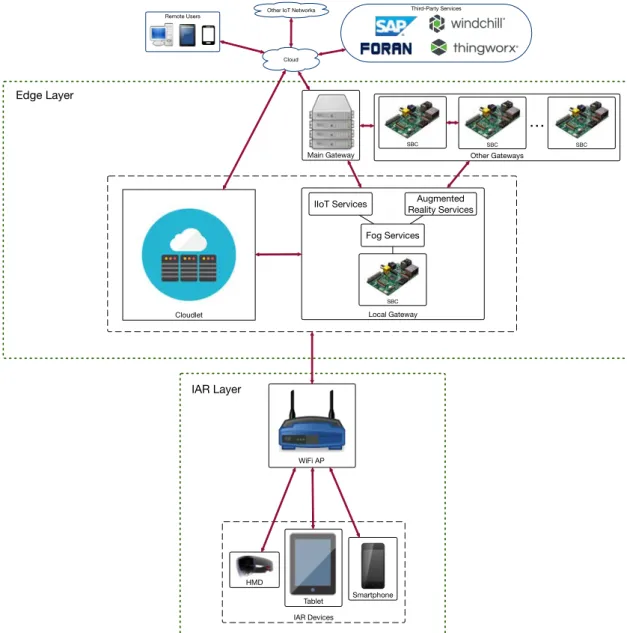
the communications architecture was proposed, as shown in Figure1, which is a three-layer edge
computing architecture. The layer at the bottom includes the IAR devices, which make use of WiFi connectivity since Navantia’s shipyard in Ferrol has already deployed IEEE 802.11 b/g/n/ac infrastructure and because it is the most popular medium-range wireless standard used by tablets,
smartphones and smart glasses [56]. Nonetheless, the architecture can make use of other wireless
technologies.
Cloud Remote Users Other IoT Networks
Edge Layer
IAR Layer
IAR Devices WiFi AP
Other Gateways
SBC SBC
…
SBC
Main Gateway
Third-Party Services
Tablet Smartphone HMD
Local Gateway
SBC Fog Services
IIoT Services Reality ServicesAugmented
Cloudlet
Figure 1.Proposed IAR communications architecture.
services, to distribute compute-intensive tasks and to ease the collaboration between remote IAR
devices. In Figure1every local gateway is represented by a Single-Board Computer (SBC), which is
a reduced-size low-cost computer that can be installed easily in any shipyard workshop. Thus, the architecture assumes that SBCs that act as gateways are scattered throughout the shipyard.
In addition, the Edge Layer contains cloudlets, which are able to carry out compute-intensive tasks like rendering or image processing. Since a cloudlet is really close to the IAR devices that request its services, their response latency is lower than the one offered by traditional cloud computing systems.
Finally, at the top of Figure1is Navantia’s cloud, where the services that require more processing
power are executed. The cloud also connects with third-party systems that are part of Navantia’s
IT core. Specifically, software from SAP [57] is used as Enterprise Resource Planning (ERP) and
Manufacturing Execution System (MES), PTC’s Windchill [58] is the Product Life-cycle Management
(PLM) software, shipbuilding models are created with FORAN [59], and ThingWorx [60] is being
tested as an IIoT platform.
3.2. IAR Software and Hardware
Both software and hardware are key in IAR applications [48]. Regarding the hardware, it is
possible to use regular smartphones and tablets, although, for industrial environments, they should be protected against dirt, dents and drops. The evolution of the technology in the last years has led
the manufacturers to develop solutions embedded into smart glasses [61–63], helmets [29,64] or HMD
devices [65], which are really promising, but that are still expensive (between US $500 and $5,000) and
can be considered experimental in terms of features for industrial environments. Such ideal features include: being as light as possible, the battery should last through the whole working day, the field of view should be as wide as possible, and devices should embed voice-recognition features to enable hands-free operation.
With respect to the software, there are many AR Software Development Kits (SDKs) that can be
used for developing IAR implementations, like ARToolkit [66], Mixare [67], Vuforia [68] or Wikitude [69].
An SDK should include the following features to be able to create successful IAR applications [15]:
• It should be as accurate as possible, reliable and provide fall-back alternatives.
• An IAR application should be user-friendly, making as easy as possible its setup and the
learning period.
• The application should be scalable, since factories involve many users interacting concurrently.
The advantages and disadvantages of cloud and fog computing architectures have to be weighted in order to determine which fits better depending on the user requirements.
For the tests performed in this article, among the different hardware devices available, Microsoft HoloLens smartglasses were selected. Although they are not cheap (around US $3000 as of writing), they are one the most promising AR headsets on the market thanks to its power (it contains a custom Holographic Processing Unit (HPU), 2 GB of RAM and 64 GB of on-board storage), embedded sensors, display (it includes see-through holographic lenses, automatic pupillary distance calibration, 2.3 million light points of holographic resolution) and potential interfaces (voice commands, gaze tracking and gesture recognition). In addition, the smartglasses can be connected to other devices through WiFi (IEEE 802.11 ac) or Bluetooth 4.1, and its battery lasts approximately 2 to 3 h with intensive use (two weeks in stand-by).
Furthermore, It should be mentioned that the HoloLens tracking system operates in a different
way with respect to traditional marker-based AR systems [56], since the smartglasses make use of two
4. Experiments
4.1. Experimental Setup
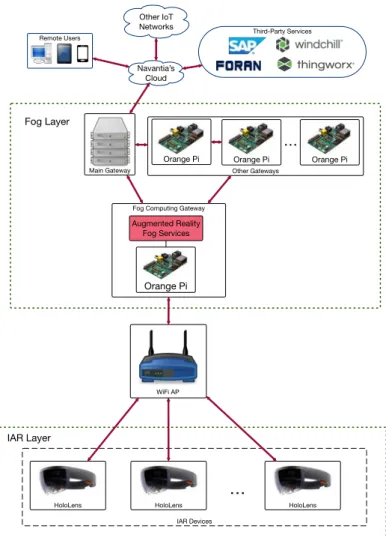
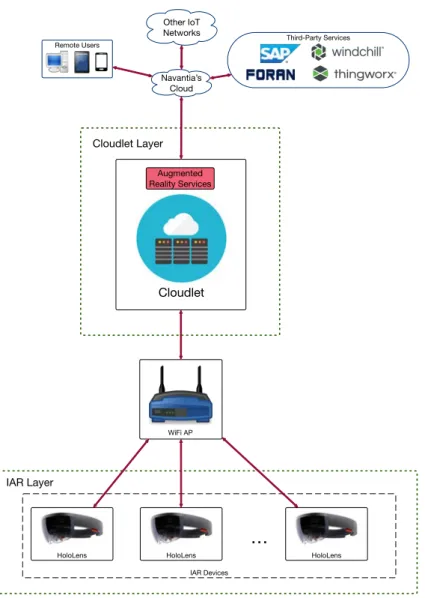
In order to determine the performance of the proposed architecture in terms of response delay, three scenarios were evaluated depending on where the augmented reality services were
provided. This resulted in the three architectures depicted in Figures2–4(for cloud, fog computing
and cloudlet-based architectures). Each architecture contains a subset of the components of the
edge-computing architecture previously illustrated in Figure1. In the case of Figure2, the different
IAR devices are connected through WiFi access points to Navantia’s cloud, which runs the augmented
reality services. In contrast, in Figure3, such services are provided by the different SBCs of the fog
layer. In Figure4, a cloudlet is the device responsible for executing the mentioned services.
Before carrying out the experiments, the transfer speed requirements of the system when running wirelessly were determined, at a medium distance (roughly three meters from the IAR server); there are two representative IAR applications on the Microsoft HoloLens smartglasses:
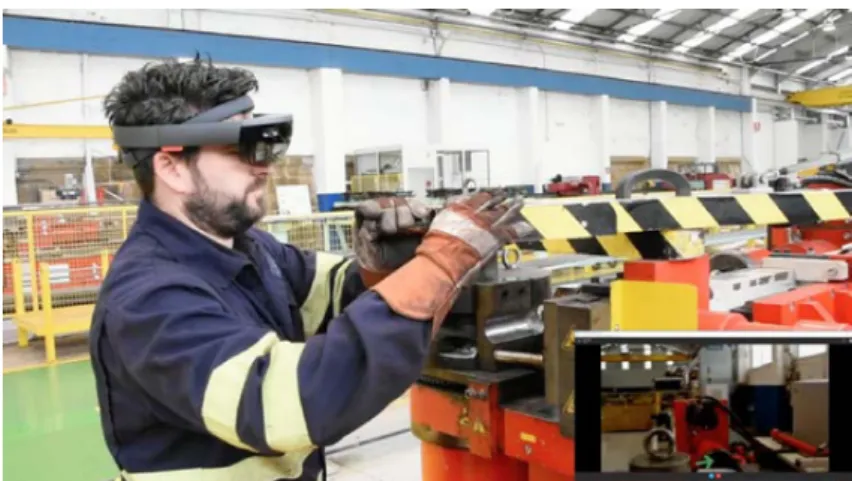
• A Holo app (an application for HoloLens) that embedded Skype for remote augmented
collaboration in the shipyard’s pipe workshop. Figure5shows a screenshot of the application.
In the Figure, one of the moments when a remote worker (who is using Skype) guides the operator wearing the Microsoft HoloLens through the steps for performing a specific maintenance
procedure on a bending machine is shown. Figure6shows the mentioned operator following
the remote instructions. The data exchanged by the HoloLens with the upper layers of the architecture were basically Skype frames, which make use of a closed-source protocol that is able to stream audio (voice-over-IP from the HoloLens towards the remote collaborator and from such a collaborator towards the operator with the HoloLens) and video (it was only streamed video from the HoloLens front-facing camera to the remote collaborator).
• The second Holo app was a streaming application that projected highly polygonal models.
Such models were extracted from FORAN in JT and OBJ formats. Since the total file size of the raw 3D models was actually large (1.5 GB), before including them in the Holo app, they were
polished with Blender [70] to reduce the number of required triangles (the raw 3D models were
made of 630,477 triangles). The final models only use 65 MB of disk and 28,726 triangles. Figure7
shows a screenshot of the app when projecting a ship block during a design meeting. The models were first downloaded into the HoloLens and then they were projected in a specific place (selected by the user) of the meeting room. The mixed reality 720p video captured by the HoloLens was then sent via WiFi through a streaming service to a remote computer that was connected to an HDMI projector.
For both tested applications, the exchanged data were sniffed using WireShark and the average data transfer speeds were determined. In the case of the Skype-embedded Holo app it was 8780 KB/s,
while the video streaming app averaged 369 KB/s. It is also interesting to identify the type and
IAR Layer
IAR Devices WiFi AP
HoloLens HoloLens HoloLens
…
Remote UsersOther IoT
Networks Third-Party Services
Navantia’s Cloud
Augmented Reality Services
Figure 2.Implemented cloud-based architecture.
Fog Layer
IAR Layer
IAR Devices WiFi AP
Other Gateways Orange Pi Orange Pi
… Orange Pi Main Gateway
HoloLens
Fog Computing Gateway
Orange Pi
Augmented Reality Fog Services
HoloLens HoloLens
…
Navantia’s Cloud Remote Users
Other IoT Networks
Third-Party Services
Navantia’s Cloud Remote Users
Other IoT Networks
Cloudlet Layer
IAR Layer
IAR Devices WiFi AP
Third-Party Services
HoloLens
Cloudlet
HoloLens HoloLens
…
Augmented Reality Services
Figure 4.Implemented cloudlet-based architecture.
Figure 6.One of the tests in the pipe workshop with the HoloLens augmented collaboration application.
Figure 7.Ship block projected during a meeting.
Then, in order to automate the tests and to be able to increase the number of concurrent IAR devices, a laptop (Intel [email protected] GHz processor, 250 GB SSD, 8 GB of RAM and a Gigabit Ethernet connection) with a virtual machine (64-bit Debian 9) was used to carry out IAR file exchanges. To limit the performance of the laptop when simulating the use of a true IAR device, the virtual machine was configured to use only two cores and 2 GB of RAM. Note that a laptop was selected due to practical reasons and because what was measured was the latency response, but the measurement methodology and conclusions would be identical when performed through the actual smartglasses. However, it is worth mentioning that all the communications performed by the Holo apps are exclusively wireless, while the laptop allows for using an Ethernet connection, thus avoiding the impact on the latency response of the wireless scenario (e.g., distance to access points, obstacles, presence of metal) and therefore providing a fairer evaluation of the different architectures.
made use of the same server as the cloudlet, but it was deployed in a remote Internet location with minimum/average/maximum round-trip times of 47.25/49.3/62.87 ms.
The software for the experiments was configured exactly in the same way for all the tests. In the server-side, four concurrent processes waited for requests. At the client-side 20 concurrent clients were simulated. The clients asked for files (i.e., plain data or multimedia objects) that were required by the local IAR software. Such a number of clients was selected for the sake of fairness when comparing the different architectures, due to the hardware constraints of the fog gateways. Therefore, it was assumed that, in a real deployment, in the physical area covered by a fog gateway in a shipyard, there would be up to 20 workers using IAR devices simultaneously. In such scenarios, every exchanged file, whose size varied from 32 B to 8 MB, was downloaded 1000 times.
4.2. Response Latency Comparison
One of the main challenges of IAR deployments is that IAR devices should be able to obtain and display the required information fast enough to be presented seamlessly to the user. This speed limitation is determined by different factors (e.g., involved hardware, communication technology, evaluated scenario), but, during the experiments, most of them were fixed, thus reducing their impact on the obtained absolute results. The only exception was the network traffic, since the experiments were carried out on local and Internet-connected networks shared with other users (their influence can be decreased by averaging many tests). Therefore, in this subsection, the performance of the proposed fog, cloud and cloudlet-based architectures was evaluated in order to determine which should be used when exchanging IAR payloads of different sizes.
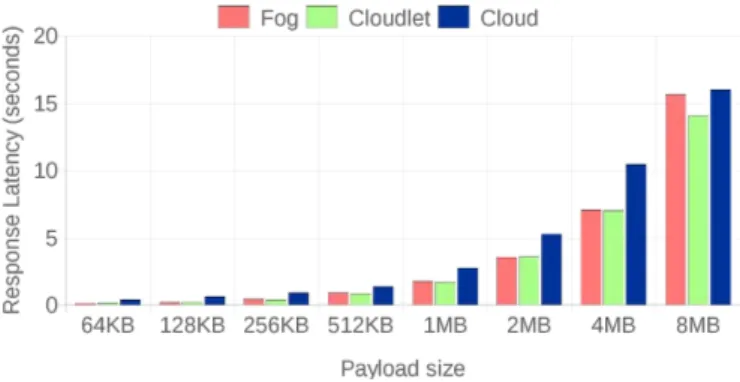
Figures8and9compare the response latencies for the three scenarios. For the sake of clarity, the
results were split into two different figures, distinguishing between small file sizes (Figure8) and large
file sizes (Figure9). Small files are mainly related to certain contextual data (for instance, characteristics
of the pipes obtained from SAP), while large files would be associated with video streaming of design models from FORAN.
Figure 8.Response latencies for 32 B to 32 KB file sizes.
Before drawing conclusions from the Figures, it is important to note that, for the largest files
(4 and 8 MB), Table1must be taken into account. Such a table shows the percentage of 4 and 8 MB
files that were transmitted successfully. While for other file sizes there was a 100% success rate, for the largest sizes, the rate dropped remarkably in fog and cloud computing scenarios due to the joint effect of file size, the internal processing lag (in the case of the fog gateways) and communication delays
(that mainly affect the cloud). Therefore, as a result, Figures8and9show the average results for the
Figure 9.Response latencies for 64 KB to 8 MB file sizes.
In addition, note that slight fluctuations can be observed in the Figures due to the network load, but they do not alter the conclusions.
Table 1.Successful transmissions of 4 and 8 MB files.
Approach/File Size 4 MB 8 MB
Cloudlet 100% 100%
Fog 100% 47.8%
Cloud 96.5% 32.1%
For small file sizes (up to 128 KB), fog gateways respond faster, despite their hardware constraints, thanks to their low communication latency. Moreover, it can be observed that cloud-based communications are clearly slower. However, in the case of large files (more than 128 KB), the cloudlet architecture is the one that obtains the smallest latencies, both thanks to its proximity to the IAR devices and to its computing power, which is superior to the one of a fog SBC. Nonetheless, the latency differences between the fog computing and the cloudlet-based systems may not seem as large as expected when taking into account their difference in power and cost. In spite of the lack of such differences, what makes the cloudlet system a clear winner for large file exchanges is that, as it can be
observed in Table1, it is the only system capable of providing a 100% transmission success rate.
4.3. Sample Processing Rates under High Loads
The previous tests allowed for establishing a performance baseline for fog and cloudlet scenarios and for discarding a cloud deployment, since it presents excessive response latency. To compare in a fair IAR scenario the performance of the proposed fog and cloudlet architectures, a new set of tests was carried out by taking into account the actual Microsoft HoloLens data transfer speeds for the two
Holo apps previously described in Section4.1. The methodology used for obtaining such transfer
speeds was also applied to the scenarios evaluated in the previous section and it was concluded that the closest values to the HoloLens data transfer rates (8780 B/s for the Skype-embedded Holo app and 369 KB /s for video streaming) were achieved when downloading the 64 KB and the 32 B files, which obtained practical data transfer rates of 392.45 KB/s and 13.15 KB/s, respectively. With these two file sizes, a total of 50,000 file transfers were performed for different concurrency levels: from 30 to 240 simultaneous clients. To cope with such a large number of concurrent connections, a virtual machine that had four cores and 8 GB of RAM that was hosted on a server with an Intel Core i7-4790 @ 3.6 GHz, 32 GB of RAM and a 500 GB SSD was used.
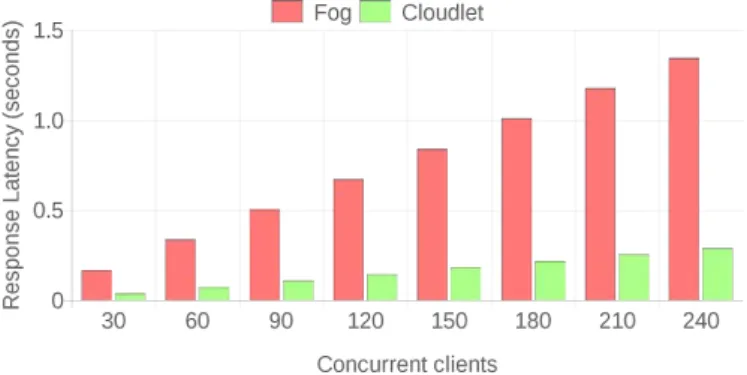
The obtained results are presented in Figures10and11. As it can be observed, when a large
the cloudlet for both 32 B and 64 KB file sizes. Regarding successful transaction rates, both the cloudlet and the fog deployments reach 100% for all the tests, but, at the view of the response latencies, it is clear that, in high-load scenarios, the cloudlet outperforms the fog computing system.
Figure 10.Latencies for 32 B and 30 to 240 concurrent clients.
Figure 11.Latencies for 64 KB and 30 to 240 concurrent clients.
4.4. Key Findings
After analyzing the results of the tests described in the previous subsections, the following conclusions can be drawn:
• When a single IAR device operates in a specific shipyard area, for files of up to 128 KB, fog
gateways respond faster despite being less powerful, cheaper and less energy demanding than a cloud or than the typical high-end PC used by a cloudlet.
• In the case of exchanging large files, the cloudlet-based solution is the fastest of the three
tested architectures. However, in some scenarios it might be less expensive to make use of fog computing and SBCs, which are slightly slower, but cheaper in terms of acquisition cost and energy consumption.
• When a relevant number of IAR devices transmit concurrently, a cloudlet responds faster than a
remote cloud or a fog gateway.
In addition, it must be emphasized that, despite the previously mentioned results, in a real environment, several types of IAR data and applications are involved, so the ideal architecture would consist in the combination of the three alternatives that conform to the proposed edge computing architecture. In this way, an IAR device would have to choose in real time the data source that would optimize the user experience. In addition, for every specific scenario it should be considered whether the content can be previously simplified in terms of detail in order to decrease the amount of data transferred to the operator’s IAR device.
Furthermore, at the view of the obtained results, it can be concluded that the proposed
adding infrastructure to every area where IAR devices need to be used. Working areas differ in size depending on the workshop and on the tasks to be performed, but for the currently planned needs of the evaluated shipyard (in terms of potential IAR devices that are planned to operate concurrently), a cloudlet would be enough for every workshop and a fog computing gateway would be required for covering a working area of 1000 square meters. However, note that the scale of the infrastructure is highly dependent on the number of potential IAR devices operating in the workshop (in the case of cloudlets) or in a specific area (when determining the number of fog computing gateways).
Finally, it is worth indicating the advantages and disadvantages collected from the operators after testing the Holo apps. First, it must be pointed out that all workers were really impressed by the augmented reality experience provided by HoloLens. In fact, the feeling of having an immersive experience was unanimous. Under a regular use, no relevant lag was experienced, except for certain moments when the WiFi connection was dropped or when large image files were transferred to the operator that wore the HoloLens.
After all the practical tests, the plant operators found the remote collaboration application useful. However, while the Holo app that projects ship 3D models made a great impression on Navantia’s designers, plant operators consider that such an app would not be used frequently in their everyday tasks.
In addition, it has to be mentioned that, after carrying out experiments with both applications at different workshops of the shipyard, even with the presence of operators performing welding tasks or using other machinery and tools, reliability issues (e.g., object tracking problems) were not observed. This can be mainly attributed to the feature extraction algorithm based on two black and white cameras and to the use of IMU data to estimate pose continuously. Note that, in contrast, other traditional AR systems based on markers are heavily influenced by lighting and by the characteristics of the camera,
so their performance falls dramatically under low light conditions or when there is a high contrast [56].
Despite all the benefits of the proposed system, several issues arose:
• Although, in general, the smartglasses were easy to adjust to the worker head, in some specific
cases it took time to find the right position to align the operator’s sight with the display.
• In certain areas of the shipyard where helmets were required, it was difficult for the operator to
wear both the HoloLens and the safety helmet at the same time. Therefore, future IAR devices should take safety procedures into account.
• Since virtual and real objects live together under the operators point of view, it is possible that
certain virtual objects may hide relevant events of the real world. Although operators can move most virtual objects around the working environment, occlusions have to be prevented as much as possible in order to avoid possible accidents.
• Although the operators did not complain about the comfort of the smartglasses, after using them
for a certain time (around an hour), the users had use marks on their noses due to pressure. There were no complaints about headaches, nausea or loss of visual acuity.
• The system was not tested during a whole working shift (around eight hours), but at certain
production stages for less than two hours in total, since that is how long the batteries lasted. Therefore, future IAR devices would have to extend battery life, while preserving a light weight.
• Despite HoloLens’ excellent performance for tracking objects, note that their memory is limited,
techniques to load content dynamically from the fog computing or cloud system depending on the detected area.
5. Conclusions
IAR can be a really useful technology for the Industry 4.0 shipyard, but current architectures still have to be optimized and analyzed to adapt to the fast responses required by certain dynamic IAR applications. In this article Navantia’s IAR architecture has been described, which makes use of cloudlets and fog computing to reduce latency response and offload traditional cloud-based systems. After detailing the proposed architecture, it was evaluated in different real scenarios and for diverse payload sizes, concluding that, in terms of response delay, fog gateways are the fastest when transferring small payloads, but a cloudlet is faster for medium and large IAR payloads. In addition, when many IAR clients access concurrently the IAR service, the cloudlet is also remarkably faster than the fog computing system (in some cases more than four times faster). In any case, the proposed architecture is able to provide low-latency responses by mixing elements of both computing paradigms that may enable the development of future real-time IAR applications for the Industry 4.0 shipyard.
Author Contributions: T.M.F.-C. and P.F.-L. conceived and designed the experiments; T.M.F.-C. and M.S.-A.
performed the experiments; P.F.-L. and T.M.F.-C. analyzed the data; T.M.F.-C., P.F.-L., M.S.-A. and M.V.-M. wrote the paper.
Acknowledgments: This work was supported by the Plant Information and Augmented Reality research line of
the Navantia-UDC Joint Research Unit.
Conflicts of Interest:The authors declare no conflict of interest. The founding sponsors had no role in the design
of the study; in the collection, analyses, or interpretation of data; in the writing of the manuscript, and in the decision to publish the results.
Abbreviations
The following abbreviations are used in this manuscript:
AR Augmented Reality
ERP Enterprise Resource Planning HMD Head-Mounted Display IAR Industrial Augmented Reality IIoT Industrial Internet of Things IMU Inertial Measurement Unit MES Manufacturing Execution System PLM Product Life-cycle Management RFID Radio Frequency IDentification SBC Single Board Computer SoC System-on-Chip
References
1. Fraga-Lamas, P.; Fernández-Caramés, T.M.; Castedo, L. Towards the Internet of Smart Trains: A Review on Industrial IoT-Connected Railways. Sensors2017,17, 1457.
2. Qi, Q.; Tao, F. Digital Twin and Big Data Towards Smart Manufacturing and Industry 4.0: 360 Degree Comparison. IEEE Access2018,6, 3585–3593.
3. Robla-Gómez, S.; Becerra, V.M.; Llata, J.R.; González-Sarabia, E.; Torre-Ferrero, C.; Pérez-Oria, J. Working Together: A Review on Safe Human-Robot Collaboration in Industrial Environments. IEEE Access2017, 5, 26754–26773.
4. Fernández-Caramés, T.M.; Fraga-Lamas, P. A Review on Human-Centered IoT-Connected Smart Labels for the Industry 4.0. IEEE Access2018, accepted.
6. Fraga-Lamas, P. Enabling Technologies and Cyber-Physical Systems for Mission-Critical Scenarios. May 2017. Available online: http://hdl.handle.net/2183/19143(accessed on 1 May 2018).
7. Blanco-Novoa, O.; Fernández-Caramés, T.M.; Fraga-Lamas, P.; Castedo, L. An Electricity-Price Aware Open-Source Smart Socket for the Internet of Energy. Sensors2017,17, 643.
8. Fraga-Lamas, P.; Fernández-Caramés, T.M.; Suárez-Albela, M.; Castedo, L.; González-López, M. A Review on Internet of Things for Defense and Public Safety.Sensors2016,16, 1644.
9. Fernández-Caramés, T.M.; Fraga-Lamas, P.; Suárez-Albela, M.; Castedo, L. A Methodology for Evaluating Security in Commercial RFID Systems, Radio Frequency Identification. InRadio Frequency Identification, 1st ed.; Crepaldi, P.C., Pimenta, T.C., Eds.; INTECH: Rijeka, Croatia, 2016.
10. Sutherland, I.E. The Ultimate Display. In Proceedings of IFIP 65, New York, NY, USA, 24–29 May 1965; pp. 506–508.
11. Sutherland, I.E. A head-mounted three dimensional display. In Proceedings of AFIPS 68, San Francisco, CA, USA, 9–11 December 1968; pp. 757–764.
12. Azuma, R.T. A survey of augmented reality.Presence Teleoperators Virtual Environ.19976, 355–385.
13. Wohlgemuth, W.; Triebfürst, G. ARVIKA: Augmented Reality for development, production and service. In Proceedings of DARE 2000, Elsinore, Denmark, 12–14 April 2000; pp. 151–152.
14. Friedrich, W. ARVIKA-Augmented Reality for Development, Production and Service. In Proceedings of International Symposium on Mixed and Augmented Reality, Darmstadt, Germany, 1 October 2002; pp. 3–4. 15. Navab, N. Developing Killer Apps for Industrial Augmented Reality. IEEE Comput. Graph. Appl.2004,
24, 16–20.
16. Novak-Marcincin, J.; Barna, J.; Janak, M.; Novakova-Marcincinova, L.; Torok, J. Visualization of intelligent assembling process by augmented reality tools application. In Proceedings of the 14th IEEE International Symposium on Logistics and Industrial Informatics, Smolenice, Slovakia, 5–7 September 2012; pp. 33–36. 17. Li, G.; Xi, N.; Chen, H.; Saeed, A. Augmented reality enhanced “top-down” nano-manufacturing.
In Proceedings of the 4th IEEE Conference on Nanotechnology, Munich, Germany, 16–19 August 2004; pp. 352–354.
18. Fruend, J.; Grafe, M.; Matysczok, C.; Vienenkoetter, A. AR-based product design in automobile industry. In Proceedings of the First IEEE International Workshop Augmented Reality Toolkit, Darmstadt, Germany, 29 September 2002.
19. Gausenmeier, J.; Matysczok, C.; Radkowski, R. AR-based modular construction system for automobile advance development. In Proceedings of the IEEE International Augmented Reality Toolkit Workshop, Tokyo, Japan, 7 October 2003.
20. Park, H. S.; Choi, H. W.; Park, J. W. Augmented Reality based Cockpit Module Assembly System. In Proceedings of the International Conference on Smart Manufacturing Application, Gyeonggi-do, South Korea, 9–11 April 2008; pp. 130–135.
21. Arumugam, D.D.; Engels, D.W. Characterization of RF Propagation in Helical and Toroidal Metal Pipes for Passive RFID Systems. In Proceedings of the IEEE International Conference on RFID, Las Vegas, NV, USA, 16–17 April 2008; pp. 269–276.
22. Wong, S.F.; Zheng, Y. The effect of metal noise factor to RFID location system. In Proceedings of the IEEE International Conference on Industrial Engineering and Engineering Management, Bangkok, Thailand, 10–13 December 2013; pp. 310–314.
23. Mocanu, B.; Tapu, R.; Petrescu, T.; Tapu, E. A experimental evaluation of 3D mesh decimation techniques. In Proceedings of the International Symposium on Signals, Circuits and Systems, Lasi, Romania, 30 June–1 July 2011; pp. 1–4.
24. Ma, T.; Gong, G.; Yan, J. A 3D model simplification algorithm based on edge-collapse. In Proceedings of the IEEE 10th International Conference on Industrial Informatics, Beijing, China, 13 September 2012; pp. 776–779.
25. Ng, K.W.; Low, Z.W. Simplification of 3D Triangular Mesh for Level of Detail Computation. In Proceedings of the 11th International Conference on Computer Graphics, Imaging and Visualization, Singapore, 23 October 2014; pp. 11–16.
27. Suárez-Albela, M.; Fernández-Caramés, T.M.; Fraga-Lamas, P.; Castedo, L. A Practical Evaluation of a High-Security Energy-Efficient Gateway for IoT Fog Computing Applications. Sensors2017,17, 1978. 28. Dolui, K.; Datta, S.K. Comparison of edge computing implementations: Fog computing, cloudlet and mobile
edge computing. In Proceedings of the Global Internet of Things Summit (GIoTS), Geneva, Switzerland, 6–9 June 2017; pp. 1–6.
29. Microsoft HoloLens Official Web Page. Available online: https://www.microsoft.com/en-us/hololens (accessed on 1 May 2018)
30. Augmented Reality Systems Set to Revolutionise Battlefield Operations. Available online: https://www.baes ystems.com/en/article/augmented-reality-systems-set-to-revolutionise-battlefield-operations(accessed on 1 May 2018).
31. BAE Systems Unveils Latest Wearable Display Technology at DSEI. Available online: https://www.baes ystems.com/en-uk/article/bae-systems-unveils-latest-wearable-display-technology-at-dsei(accessed on 1 May 2018).
32. Virtual Reality Technology Transforms Design of UK Warships. Available online: http://www.baesystems .com/en/article/virtual-reality-technology-transforms-design-of-uk-warships(accessed on 1 May 2018). 33. Index AR Solutions Official Web Page. Available online: https://www.indexarsolutions.com/about-us
(accessed on 1 May 2018).
34. Newport News Shipbuilding Official Web Page. Available online: http://nns.huntingtoningalls.com/ar (accessed on 1 May 2018 ).
35. Mizell, D. W. Virtual Reality and Augmented Reality in Aircraft Design and Manufacturing. In Proceedings of WESCON/94, Anaheim, CA, USA, 27–29 September 1994.
36. Aiteanu, D.; Hillers, B.; Graser, A. A step forward in manual welding: demonstration of augmented reality helmet. In Proceedings of the Second IEEE and ACM International Symposium on Mixed and Augmented Reality, Tokyo, Japan, 10 October 2003; pp. 309–310.
37. Andersen, R.S.; Bøgh, S.; Moeslund, T.B.; Madsen, O. Task space HRI for cooperative mobile robots in fit-out operations inside ship superstructures. In Proceedings of the 25th IEEE International Symposium on Robot and Human Interactive Communication (RO-MAN), New York, NY, USA, 26–31 August 2016; pp. 880–887. 38. Fast, K.; Gifford, T.; Yancey, R. Virtual training for welding. In Proceedings of the third IEEE and ACM International Symposium on Mixed and Augmented Reality, Arlington, VA, USA, 5 November 2005; pp. 298–299.
39. Olbrich, M.; Wuest, H.; Riess, P.; Bockholt, U. Augmented reality pipe layout planning in the shipbuilding industry. In Proceedings of the 10th IEEE International Symposium on Mixed and Augmented Reality, Basel, Switzerland, 26–29 October 2011; pp. 269–270.
40. Havard, V.; Baudry, D.; Louis, A.; Mazari, B. Augmented reality maintenance demonstrator and associated modelling. In Proceedings of IEEE Virtual Reality (VR), Arles, France, 23–27 March 2015; pp. 329–330. 41. Goode, O.R.; Dallinger, J.F. Quality control in shipbuilding.Naval Eng. J.1964,76, 397–407.
42. Loch, F.; Quint, F.; Brishtel, I. Comparing Video and Augmented Reality Assistance in Manual Assembly. In Proceedings of the 12th International Conference on Intelligent Environments (IE), London, UK, 14–16 September 2016; pp. 147–150.
43. Fraga-Lamas, P.; Noceda-Davila, D.; Fernández-Caramés, T.M.; Díaz-Bouza, M.A.; Vilar-Montesinos, M. Smart Pipe System for a Shipyard 4.0. Sensors2016,16, 2186.
44. Fraga-Lamas, P., Fernández-Caramés, T. M., Noceda-Davila, D., Vilar-Montesinos, M. RSS Stabilization Techniques for a real-time passive UHF RFID Pipe Monitoring System for Smart Shipyards. In Proceedings of the IEEE International Conference on RFID, Phoenix, AZ, USA, 9–11 May 2017; pp. 161–166.
45. Fraga-Lamas, P.; Fernández-Caramés, T.M.; Noceda-Davila, D.; Díaz-Bouza, M.; Vilar-Montesinos, M.; Pena-Agras J. D.; Castedo, L. Enabling automatic event detection for the pipe workshop of the shipyard 4.0 In Proceedings of the 2017 56th FITCE Congress, Madrid, Spain, 14–15 September 2017; pp. 20–27.
46. Narzt, W.; Pomberger, G.; Ferscha, A.; Kolb, D.; Müller, R.; Wieghardt, J.; Hörtner, H.; Lindinger, C. Augmented reality navigation systems.Univers. Access Inf. Soc.2005,4, 177–187.
48. Fraga-Lamas, P.; Fernández-Caramés, T.M.; Blanco-Novoa, Ó.; Vilar-Montesinos, M.A. A Review on Industrial Augmented Reality Systems for the Industry 4.0 Shipyard. IEEE Access2018,6, 13358–13375 49. Berning, M.; Riedel, T.; Karl, D.; Schandinat, F.; Beigl, M.; Fantana, N. Augmented service in the factory of
the future. In Proceedings of the International Conference on Networked Sensing (INSS), Antwerp, Belgium, 11–14 June 2012; pp. 1–2.
50. Cordonnier, M.; Martino, S.; Boisseau, C.; Paslier, S.; Recapet, J.-P.; Blanc, F.; Augustin, B. Contribution of augmented reality to the maintenance of network equipment.Open Access Proc. J.2017,2017, 87–90. 51. Smparounis, K.; Mavrikios, D.; Pappas, M.; Xanthakis, V.; Viganó, G. P.; Pentenrieder, K. A virtual and
augmented reality approach to collaborative product design and demonstration. In Proceedings of the IEEE International Technology Management Conference (ICE), Lisbon, Portugal, 23–28 June 2008; pp. 1–8. 52. Flatt, H.; Koch, N.; Röcker, C.; Günter, A.; Jasperneite, J. A context-aware assistance system for maintenance
applications in smart factories based on augmented reality and indoor localization. In Proceedings of the IEEE 20th Conference on Emerging Technologies Factory Automation (ETFA), Luxembourg, 8–11 September 2015; pp. 1–4.
53. Rao, Q.; Grünler, C.; Hammori, M.; Chakrabort, S. Design methods for augmented reality in-vehicle infotainment systems. In Proceedings of the 51st ACM/EDAC/IEEE Design Automation Conference (DAC), San Francisco, CA, USA, 1–5 June 2014; pp. 1–6.
54. Schroeder, G.; Steinmetz, C.; Pereira, C.E. Visualising the digital twin using web services and augmented reality. In Proceedings of the 14th IEEE International Conference on Industrial Informatics (INDIN), Poitiers, France, 19–21 July 2016; pp. 522–527.
55. Schneider, M., Rambach, J., Stricker, D. Augmented reality based on edge computing using the example of remote live support. In Proceedings of the IEEE International Conference on Industrial Technology (ICIT), Toronto, ON, Canada, 22–25 March 2017; pp. 1277-1282.
56. Blanco-Novoa, Ó.; Fernández-Caramés, T.M.; Fraga-Lamas, P. and Vilar-Montesinos, M.A. A Practical Evaluation of Commercial Industrial Augmented Reality Systems in an Industry 4.0 Shipyard. IEEE Access
2018,6, 8201–8218.
57. SAP Official Web Page. Available online: https://www.sap.com(accessed on 1 May 2018)
58. Windchill Official Web Page. Available online: https://www.ptc.com/en/products/plm/plm-products/wi ndchill(accessed on 1 May 2018)
59. FORAN Official Web Page. Available online: http://www.marine.sener/foran(accessed on 1 May 2018) 60. ThingWorx Official Web Page. Available online: https://www.ptc.com/en/products/iot(accessed on
1 May 2018)
61. Epson Moverio Glasses Official Web Page. Available online: https://epson.com/moverio-augmented-reali ty(accessed on 1 May 2018)
62. ODG R-7 glasses official web page. Available online: https://www.osterhoutgroup.com/r-7-glasses-syste m.html(accessed on 1 May 2018)
63. Vuzix Glasses Official Web Page. Available online: https://www.vuzix.com/Business-and-Enterprise-Sol utions(accessed on 1 May 2018)
64. Daqri Smarthelmet Glasses Official Web Page. Available online: https://daqri.com/products/smart-helmet (accessed on 1 May 2018)
65. Fujitsu Ubiquitousware HMD Official Web Page. Available online: http://www.fujitsu.com/fts/products /computing/peripheral/wearables/hmd-iot001/(accessed on 1 May 2018)
66. ARToolKit Official Web Page. Available online: https://artoolkit.org(accessed on 1 May 2018) 67. Mixare Official Web Page. Available online: http://www.mixare.org(accessed on 1 May 2018) 68. Vuforia Official Web Page. Available online: https://www.vuforia.com(accessed on 1 May 2018) 69. Wikitude Official Web Page. Available online: https://www.wikitude.com(accessed on 1 May 2018) 70. Blender Official Website. Available online: https://www.blender.org(accessed on 1 May 2018)
c
2018 by the authors. Licensee MDPI, Basel, Switzerland. This article is an open access article distributed under the terms and conditions of the Creative Commons Attribution (CC BY) license (http://creativecommons.org/licenses/by/4.0/).